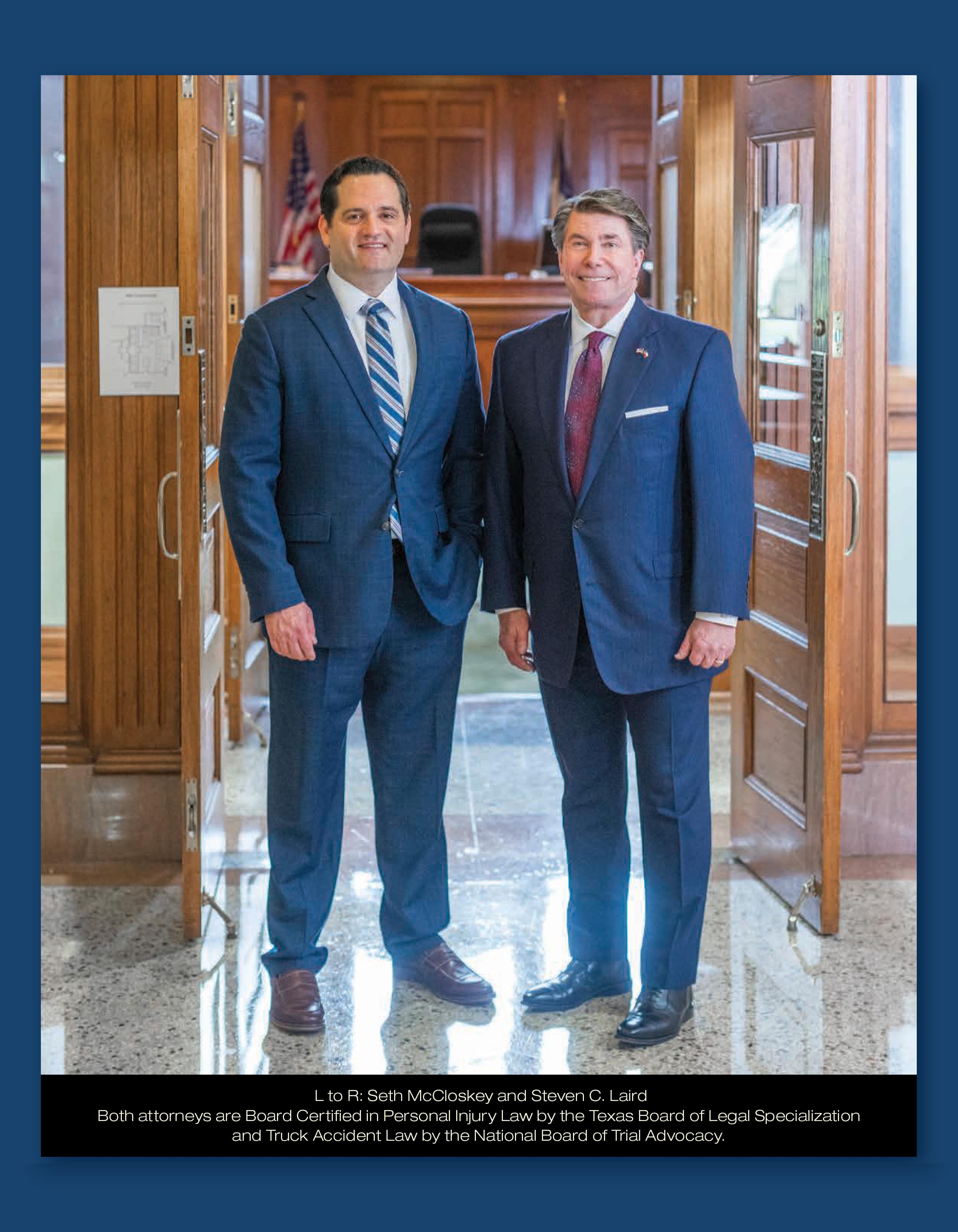
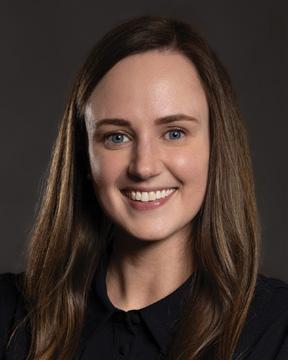
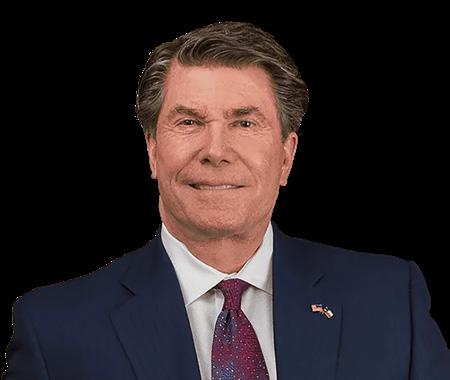
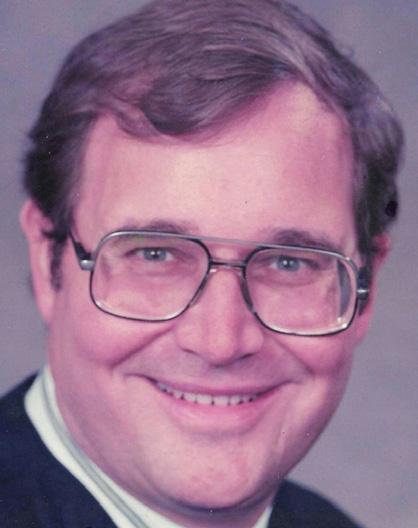
Appointed Director.......................Seth McCloskey
Tarrant
PRESIDENT'S PAGE
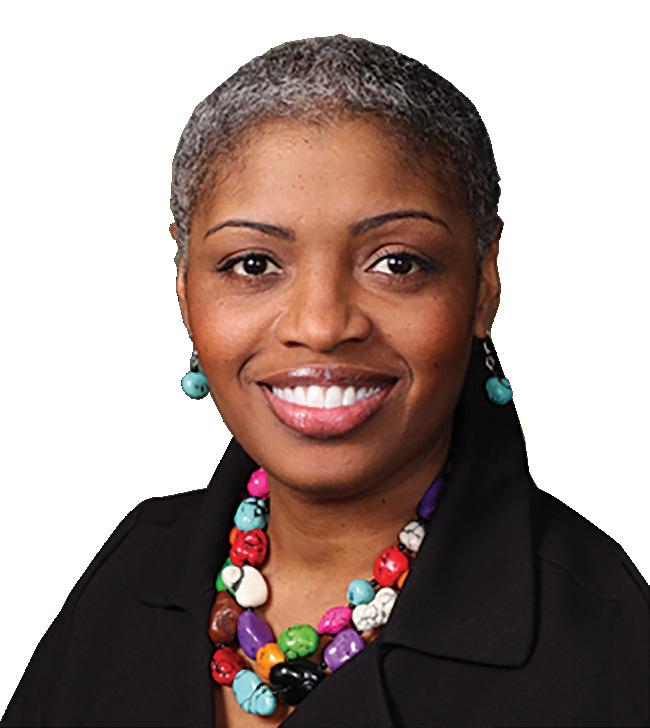
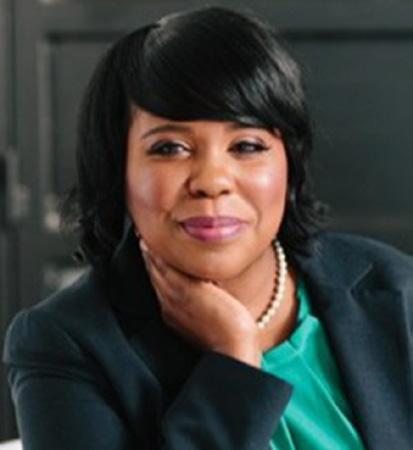
MARVINA ROBINSON 2025–2026 TCBA President
Why The Bulletin Became The Verdict
Change is not made lightly at the Tarrant County Bar Association, especially when it involves a publication that has served our members so well for so many years. As the TCBA continues to grow and evolve, the Board took time to consider whether the name The Bulletin still reflected the energy, purpose, and sense of connection within our legal community today. I sat down with TCBA Board member Nikki Chriesman-Green, who served on the Bulletin NameChange Subcommittee, to talk about the thoughtful process behind the decision and to introduce our newly renamed publication, The Verdict
Marvina: Nikki, let’s start at the beginning. Why did the Board decide it was time to revisit the name of our publication?
Nikki: The Bulletin has been a trusted source of information for TCBA members for a long time, and we were very mindful of that legacy. But as the TCBA has grown and evolved, we wanted to pause and ask whether the name still reflected the energy, engagement, and sense of community that exists today. This wasn’t about change for the sake of change—it was about alignment.
Marvina: How did the Board approach something like this, knowing how familiar the publication is to members?
Nikki: Very deliberately—like lawyers would. The Board formed a subcommittee, and we spent time reviewing other local and national bar publications, discussing branding, and weighing what felt authentic to TCBA. Every option was discussed thoroughly, and the guiding question was always whether the name felt meaningful, memorable, and rooted in the profession.
Marvina: So how did you land on The Verdict?
Nikki: The word “verdict” really resonated because it captures the essence of what lawyers do every day. A verdict is the result of careful consideration, analysis, and judgment—and that process isn’t limited to a courtroom. Whether you’re a litigator, in-house counsel, government attorney, or transactional lawyer, you reach verdicts in different forms all the time.
Marvina: Some people might hear “verdict” and think it sounds very trial focused. How did the committee think about that?
Nikki: That came up in our discussions, and it’s actually one
of the reasons we liked the name so much. A verdict isn’t just something a jury delivers—it’s a conclusion reached after weighing facts, law, and competing considerations. That process is universal across practice areas, and it’s something every TCBA member understands.
Marvina: What does the new name say about the publication itself?
Nikki: The Verdict reflects our goal of being clear, thoughtful, and relevant. It’s a place where information turns into insight —where members can read about what’s happening in our legal community, learn about opportunities to engage, and see themselves reflected in the work of the TCBA. It feels professional, but also approachable.
Marvina: What can readers expect to stay the same?
Nikki: All the essentials. Members will still find TCBA news, upcoming events, CLE opportunities, section updates, and spotlights on our community. The mission of keeping members informed and connected hasn’t changed at all.
Marvina: Any final thoughts you’d like to share with members as we officially welcome The Verdict?
Nikki: Just that this publication belongs to the members. A verdict is reached when people show up and participate, and the same is true here. The Verdict is shaped by the voices, achievements, and involvement of TCBA members—and we’re excited to see how it continues to grow with the community. g
Nikki ChriesmanGreen TCBA Board Member
YLA SNAPSHOT
JOHN EASTER
OLA CAMPBELL
A Look Back at 2025: A Year of Connection & Community
As we kick off 2026, the Tarrant County Young Lawyers Association (“TCYLA”) is taking a moment to look back on a busy and rewarding 2025. Over the past year, TCYLA focused on what it does best: bringing young lawyers together and creating programming that supports both professional growth and personal well-being.
The year got off to a fun start in January 2025 with Chili Wars at Fort Brewery. Six teams brought their best recipes— and competitive spirit—for a friendly cook-off that combined good food and good company.
In March 2025, TCYLA shifted gears with service-focused programming by fielding a TCYLA Team for the Victory Over Violence 5K Run/Walk. Participating together allowed young lawyers to support an important cause while connecting outside the usual professional setting and reinforcing TCYLA’s commitment to giving back.
Spring brought one of TCYLA’s signature membership events. In April 2025, the Spring Fiesta at Joe T. Garcia’s welcomed new and familiar faces of the Tarrant County legal community for conversation, networking, and margaritas.
http://www.tcyla.org/
We're Social | Follow Us
Tarrant County Young Lawyers Association @TarrantYoungLawyers
The Tarrant County Young Lawyers Association is an organization for attorneys 35 years of age or younger or attorneys who have practiced law for less than 10 years. Learn more: www.tarrantbar.org/TCYLA.
In September 2025, TCYLA hosted its Fall Fête at the Flying Saucer, another annual event that has become a staple of TCYLA programming. After a busy summer, the Fall Fête offered the perfect opportunity to reconnect, welcome new members, and build relationships.
October brought one of the most exciting events of the year: the Order on the Court Pickleball Tournament. Whether participants came to compete, cheer, or partake in the costume contest, the tournament delivered a fun way to bring lawyers together and proved once again that professional connections don’t always have to happen in a conference room.
Professional connections don’t always have to happen in a conference room.
Alongside these events, TCYLA continued its Mental Health Initiative, a series of wellness-focused CLEs tailored to the unique challenges facing young lawyers. Covering topics such as stress, burnout, and sustainability in practice, the initiative reflects TCYLA’s belief that supporting young lawyers means addressing the realities of the profession, not just the practice of law.
None of this would be possible without the continued support of TCBA members, sponsors, and mentors who invest in TCYLA and the next generation of lawyers. That partnership remains critical to TCYLA’s success and to the strength of the Tarrant County legal community as a whole.
As we move into 2026, TCYLA is excited to build on the momentum from 2025 and continue offering programming that is welcoming, meaningful, and fun. We look forward to another year of connection, service, and collaboration—and hope to see many familiar and new faces at TCYLA events in the months ahead. g
Members of the 2025-2026 100 Club
*List Reflected Below is as of January 12, 2026
Adams, Lynch & Loftin, P.C
Albert, Neely & Kuhlmann, LLP
Anderson & Cummings, LLP
Anderson & Riddle, LLP
Baker Monroe, PLLC
Barlow Garsek & Simon, LLP
Blaies & Hightower, L.L.P.
Bonds Ellis Eppich Schafer Jones, LLP
Bourland, Wall & Wenzel, P.C.
Brackett & Ellis, P.C.
Brown, Proctor, Peck & Piwetz, LLP
Bruner & Bruner, PC
City Attorney’s Office – City of Fort Worth
Cook Children’s Health Care System
– Legal Department
Curnutt & Hafer, LLP
Decker Jones, P.C.
Dismuke & Waters, P.C.
Factor, Campbell & Baker
Freeman Mills PC
Friedman, Suder & Cooke, P.C.
Gardner Smith & Vaughan, PLLC
Griffith, Jay, & Michel, LLP
Harris, Finley & Bogle, P.C.
Harrison Steck, P.C.
Haynes and Boone, LLP
Holland Johns & Penny LLP
Jackson Walker LLP
Kelly Hart & Hallman LLP
KoonsFuller, P.C.
Killen & Dennis, PC
Law Offices of Paup, Shutt & Associates, P.C.
Linebarger Goggan Blair & Sampson, LLP
Lively & Associates, PLLC
McDonald Sanders, P.C.
Naman, Howell, Smith & Lee, PLLC
Nelson Bumgardner Conroy PC
Noteboom – The Law Firm
Padfield & Stout, LLP
Patterson Law Group
Pham Harrison, LLP
Phelps Dunbar LLP
Pope, Hardwicke, Christie, Schell, Kelly & Taplett, L.L.P.
To be eligible for the 100 Club, any law firm, government agency, law school, or corporate legal department with four or more members must attain 100% TCBA membership compliance for the 2025–2026 bar year. This qualifies them for the “100 Club.” The firms/ organizations listed above have already paid their membership dues and qualify for 100 Club membership
for the new bar year. Any firm/organization that qualifies in the future will have its name published in every issue of the Bar Bulletin for this bar year. TCBA takes pride in the participation of these law firms and other groups. The new bar year began on July 1. If you have not paid your renewal invoice, please contact Tiffany Myles at tiffany@tarrantbar.org. g
TEXAS LAWYERS FOR TEXAS VETERANS
TARRANT COUNTY CHAPTER
By Sarah Hall Hoffman, Pro Bono Programs Director
John J. Corbin, Chair
Alexis Allen
Brittany Allen-Brantley
Robert Blankenship
Scott Conyers
John Corbin
Byrolyn Daniels
Alexandra Esparza
Wendy Hart
John Johnson
Samantha Kehl
Deborah Krane
William Larimer
Angelia Megahan
George Muckleroy
Alessandra Papa
Brenda Pfieff
David Pritchard
Joe Robles
Karon Rowden
Aaron Sigal
Brian Singleterry
Emily Teel
Amber Tilly
Dwight Tom
Rheana Whelchel
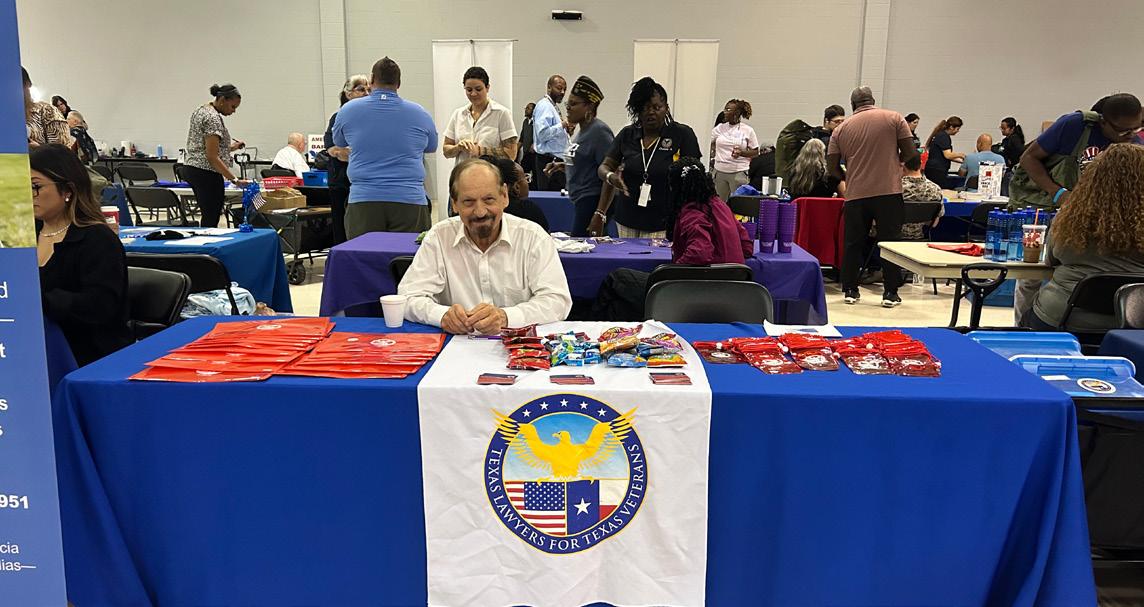
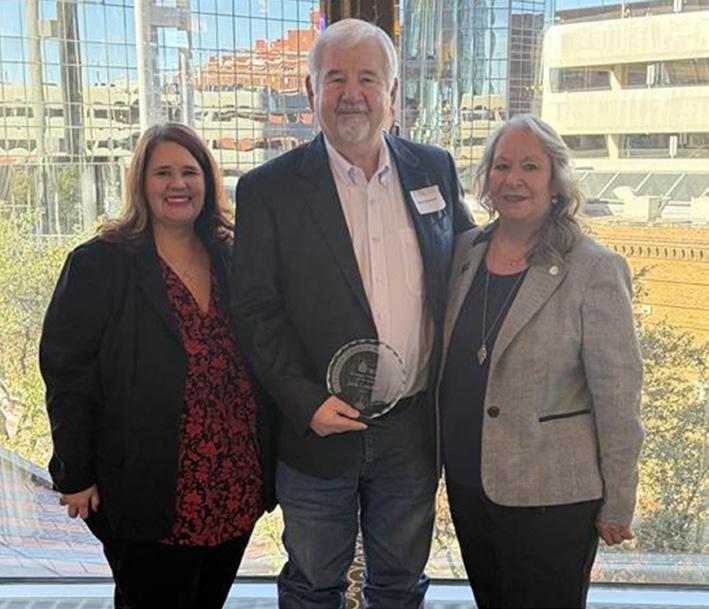
John Corbin, Chair of Texas Lawyers for Texas Veterans, represented TLTV at the Tarrant County Homeless Veterans Stand Down, an annual event offering vital housing, healthcare, employment, and legal resources to homeless and at-risk veterans.
If you are passionate about providing legal assistance to veterans in need and have creative solutions and ideas to share, consider joining the TLTV committee. Contact sarah@tarrantbar.org for more details. g
Dora Zamora February 20, 2026 March 20, 2026
A Call to Action: Ensuring Safety for Attorneys, Courts, and Clients
By Professor Karon L. Rowden Texas A&M School of Law – Family & Veterans Advocacy Clinic
Ensuring the physical safety of legal professionals—and the integrity of our courts—is no longer a speculative concern. Attorneys, judges, and court staff across Texas and throughout the nation increasingly face threats, harassment, and acts of violence related to their work. As officers of the court, we have a professional duty to acknowledge this trend and take intentional steps to protect ourselves, our families, our employees, and our clients.
At the National Council on Family & Juvenile Court Judges conference this summer, Judge Cyndi Wheless of Collin County described sustained threats against herself, her court staff, and her family after false social-media accusations. Protestors appeared outside of her courthouse, making threats and then armed protestors showed up at her home, carrying long guns, underscoring the dangerous intersection of misinformation, online radicalization, and targeted harassment of judicial officers.
Recently, in Tarrant County, an organized group filed bar and judiciary complaints, sovereign citizen type “criminal complaints” in civil courts, published inflammatory socialmedia posts, and made threats against multiple attorneys, court staff and judges in Tarrant County. At least one Tarrant County Judge and the District Clerk have been subject to online threats, demonstrating the very real danger posed by their coordinated harassment campaigns.
Over the course of my practice, I have received threats from opposing parties and their families, including threats to kill me, strangle me, hurt me and most recently someone came to my house and etched their name into the side of my house. Like many practitioners, I advised clients on safety planning without prioritizing my own protection – until the recent threats and stalking that put my family at risk. The realization that we, as attorneys, do not take our safety seriously, prompted me to conduct a statewide survey to assess the scope of the problem in the Texas legal community.
A survey distributed to Texas legal-community groups received 71 responses, revealing:
• 72% of responding attorneys reported receiving threats;
• Over half described threats involving serious physical harm or death;
• 60% received multiple threats, and 18% reported more than ten;
• 48% knew other attorneys who experienced threats or violence;
• 23% reported property damage related to their practice.
Disturbingly, several respondents also reported concerning conduct by opposing counsel, including physical intimidation, hostile verbal confrontations, and inappropriate physical contact.
These findings align with national data. A 2018 study on violence against attorneys documented numerous shootings, stabbings, assaults, vandalism, death threats, stalking, and attempts to hire individuals to harm attorneys and judges.1
Immigration practitioners have also faced escalating hostility following political rhetoric suggesting prosecution for zealous representation of asylum seekers. Even when unfounded, such statements embolden public harassment and threats.
Although attorneys are skilled at helping clients assess risk and plan for safety, many do not apply this discipline to their own circumstances. Failure to plan can have severe—and potentially fatal—consequences.
Every attorney should conduct a personal and office security assessment, including identifying high-risk cases or individuals, reviewing digital footprint exposure, establishing safety protocols for meetings and courthouse appearances, and engaging in security training and emergency planning.
Digital security is particularly important. Attorneys should remove geolocation data from photos, delay posting travel updates, and avoid sharing real-time locations. Regular public posts from the same location can create patterns that may be exploited.
Boundaries with clients also matter. Constant availability erodes professional boundaries and increases risk. Setting structured communication expectations supports client wellbeing while protecting attorney safety and mental health.
Best practices for improving safety include securing entry points and cameras, educating staff and family members about emergency protocols, practicing situational awareness and de-escalation, removing geotags, using strong privacy settings, locking office doors, visitor escort procedures, installation of panic buttons, surveillance systems, and staff emergency training.2 g
Professor Rowden will present at the March Brown Bag Seminar Series: Hot Topics.
1 Violence in the Legal Profession: A Study of Our Colleagues Nationwide, Stephen D. Kelson https://paralegals.utahbar.org/uploads/9/1/9/4/91940160/violence_in_the_legal_profession_-_stephen_kelson.pdf, Utah Bar, 2018.
2 For a detailed example, see “Personal Security Guide, Office of Court Administration|Court Security Division”, https://stage.txcourts.gov/media/1460484/personal-security-guide.pdf 10 www.tarrantbar.org ▪ JANUARY/FEBRUARY 2026
Purpose-built for your path forward
Designed specifically for legal, accounting, and client-focused professionals
Optimized for clarity and control
Smarter workflows that drive efficiency and deliver the insights you need to succeed
Supported by experts you can trust From onboarding to live support, our team is here to help you—every step of the way
One platform, many possibilities
Powerful solutions built to support every part of your business and simplify your day
Kill All the Lawyers […except for mine]
By Steven C. Laird
Law Offices of Laird & McCloskey | laird@texlawyers.com
Why is it that the legal profession is one that people either love or love to hate? Few groups or professions have such a tumultuous relationship with the public as do lawyers. For centuries, attorneys have evoked ire, and not just in everyday life. Even Shakespeare entered into the clash with Dick the Butcher’s famous quote from Henry VI: “The first thing we do, let’s kill all the lawyers.”
Ironically, both Shakespeare and Dick the Butcher were paying the highest of compliments to the legal profession.
Dick the Butcher was a follower of a rabble-rouser name Jack Cade, who was trying to incite a riot to overthrow the King of England. After giving a rousing speech to his group of troublemakers, the mob recognized that the defenders of freedom and guardians of civil liberties (lawyers!) had to be taken out of the mix immediately if any such effort to overthrow the government was ever going to succeed.
Although many people regard lawyers as a necessary evil, the reality is that they are simply “necessary.” That was the implicit but fervent message from Shakespeare. Every day lawyers are involved in every conceivable situation where a person, a company or even the government needs a representative and an advocate. No one would fathom entering the legal arena without an attorney when accused of a criminal or civil wrongdoing. Nor would anyone consider going into a significant civil lawsuit, including a divorce, unless an able advocate was on their side.
No other profession has confrontation as part of its intended and inherent responsibility. Disdain or animosity towards opposing counsel is intrinsic to a dispute, especially if the other side is performing well. But the contempt and suspicions don’t stop there-they extend to the opposing client’s family and friends. Thus mistrust is bred based on an attorney simply representing his client well.
Most lawyers handle thousands of cases throughout their career, with each one carrying more than just a possibility that thoughts of scorn, or perhaps even hatred, will be generated by the simple act of the lawyer doing a good job. And the only person who is likely to have any measure of respect for the lawyer is his or her own client, regardless of how many others have been offended or alienated.
Our legal system is not only the cornerstone, but is truly the foundation for the very fabric of our nation. The most important document that we have as a nation is a “legal” document, the United States Constitution. The freedoms outlined within that document are protected vigilantly by lawyers and the justice system. The right to a jury trial, for example, depends upon the legal profession.
Attorneys help with everything from adopting a child to preparing the paperwork for the purchase of your first home. Lawyers are even instrumental in presidential elections. All of us remember the hotly contested election of November 2000, and each side was well represented by their legal advocates.
The support and services of attorneys can actually help ease the pressures of difficult situations, as evidenced by services performed following the Sept. 11 tragedies. Tarrant County lawyers banded together to provide legal services for military families who were being called upon to respond to fight terrorism. These services ranged from preparing wills to closing real estate transactions.
It is lawyers who also help to make our everyday living safer. The next time you drive to the grocery store keep these thoughts in mind-you’re driving in a dependable car, on tested tires and on secure roads in large part due to what lawyers have accomplished. Many of the foods you select at the grocery store will have safe ingredients, be properly labeled and will not be subject to monopolistic pricing, all thanks to lawyers.
So maybe Dick the Butcher really grasped the concept when he inadvertently acknowledged that lawyers are the ones who protect the freedoms and civil liberties that we enjoy and take for granted on a daily basis. There will always be people like Dick the Butcher who attempt to reduce individual liberties and rights. As long as lawyers do their jobs, our society can rest assured that we will continue to enjoy the greatest system of justice known to the world.
Published in Fort Worth, Texas: The City’s Magazine, December 2002.
This article is reprinted with permission from the author. Although written years ago, its insights continue to resonate and hold renewed significance today. g
Meet the New TCBA Office Manager : Leslie Silvey
Q: Where are you from?
I was born and raised in Fort Worth, only leaving to move to College Station, TX for college.
Q: Can you tell us a little about your family?
My husband and I have been married for almost two decades and are raising two strong, independent young ladies and a very spoiled dog. I am now in what we lovingly call the “sandwich generation,” also caring for aging parents and in-laws. I have a large extended family (think more than 20 first cousins), and many of them live within a 10-mile radius of my home.
Q: What do you like to do in your spare time?
I spend most of my free time watching my children compete in sports and the performing arts. I am involved with my church, as well as the PTSO and PTA, dance, volleyball, and theater booster clubs. I also enjoy crafting, reading, game nights, and date nights with my foodie husband.
Q: What made you want to join the TCBA team?
I was looking for an opportunity that would allow me to feel productive and engaged again. I wanted a role that offered the flexibility I need as a parent, while also giving me a sense of purpose outside the home. Joining the TCBA team allows me to use my strengths in a meaningful way and contribute to a nonprofit I respect.
Q: What has been your favorite part of the job so far?
I’ve really enjoyed developing new systems that strengthen our office workflow and being part of the team that helps host events both in the office and throughout Fort Worth. I value the many opportunities to serve not only our TCBA members, but also the broader Tarrant County community. Contributing to efforts that enhance the lives of others through TCBA’s altruistic work has been especially meaningful to me.
Q: What’s one interesting or unexpected fact about you?
I have a rare liver disorder called Erythropoietic Protoporphyria (EPP), which causes extreme photosensitivity, especially to sunlight. I’m passionate about educating others because the condition is often difficult to diagnose, and many people don’t even know it exists. I’ve even visited the FDA to share what life is like living in the shadows, as well as the impact EPP has on both patients and their loved ones. My advocacy helped fast-track approval for the only treatment currently available in the U.S.
Unfortunately, the treatment is still not cost-effective for many patients, and advocates like myself continue pushing for broader access and additional approved therapies. I’ve been on this treatment for almost three years now, and it has made life in the Texas sun not only manageable—but SO MUCH FUN! g
Welcome
New Members of the TCBA:
ATTORNEYS
Sarah Anderson
Claire Andrews
Bruce Anton
Mitchell Barry
Jon Bursey
Robert Carsey
Edward Castillo
Kaitlen Cerney
Mark Clasby
Beverlei Colston
Dvorah Cristol
Kaitlyn Darr
Rees Dunn
Andrew Eberlein
Nathalia Feitosa Guedes
Carter Ferguson
Travis Fortune
Nildsen Gaeta
Jordan Gaines
Eddie Gaytan
Alyson Halpern
James Hinton
Lisa House
Hattie Jefferies
Mamie Johnson
Sarah Keathley
Bhavya Krishnan
Edward Lasater
Jeremiah Loar
Kevin Lockhart
Desireé Malone
Christy Mazurek
Matthew McGowan
Brenna Miller
James Murphy
Jennifer Murphy
Spencer Muskopf
Annalisa Netherton
James Osteen
Alyssa Padilla
Kicking Off 2026: TCBA Committee Updates & Highlights MEMBERSHIP REPORT
Hello TCBA Members! Thank you for your continued support of our bar association. TCBA continues to grow and thrive, and we are excited to welcome 53 new members since our last publication. This growth is a testament to the strength of our legal community and the value of staying connected through TCBA.
We are committed to offering meaningful opportunities to connect, learn, and serve.
If you are looking for a way to become more involved with TCBA, I encourage you to consider joining one of our committees. There are many ways to contribute, and we would love to help you find the best fit. Please feel free to email me at tiffany@tarrantbar.org to start the conversation.
Program Highlights Membership Committee
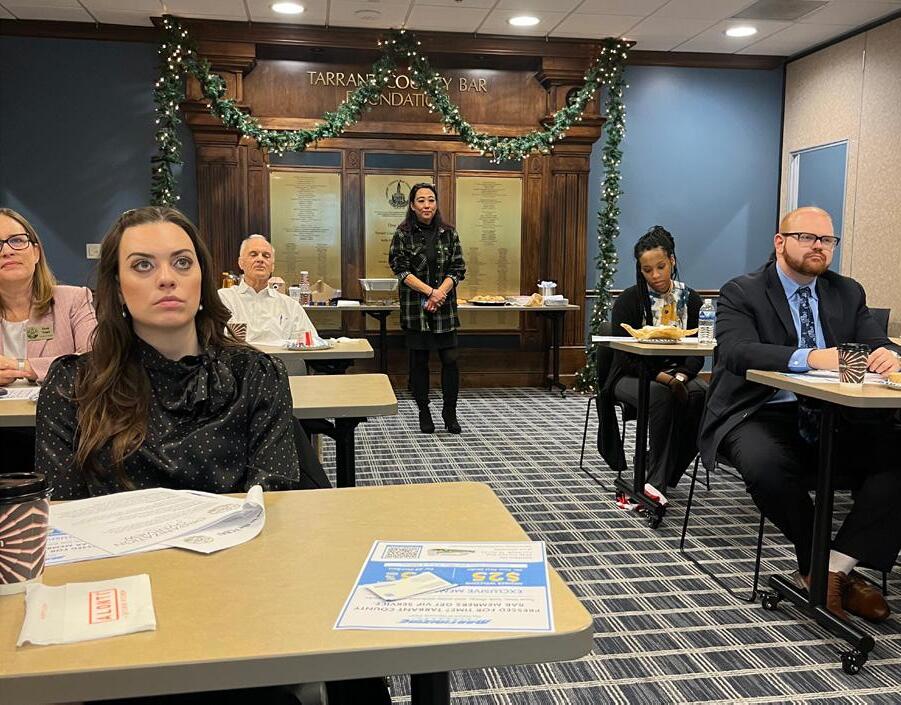
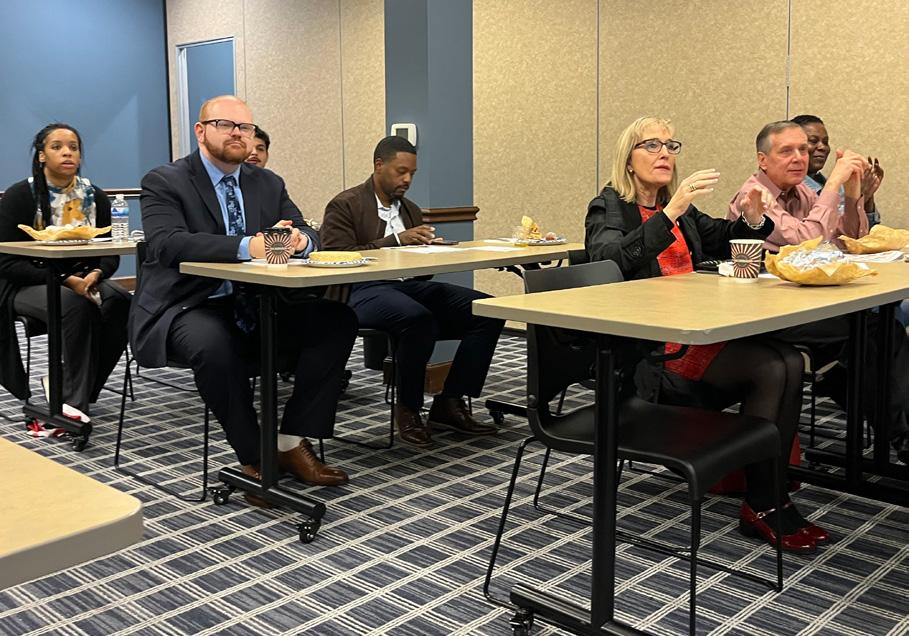
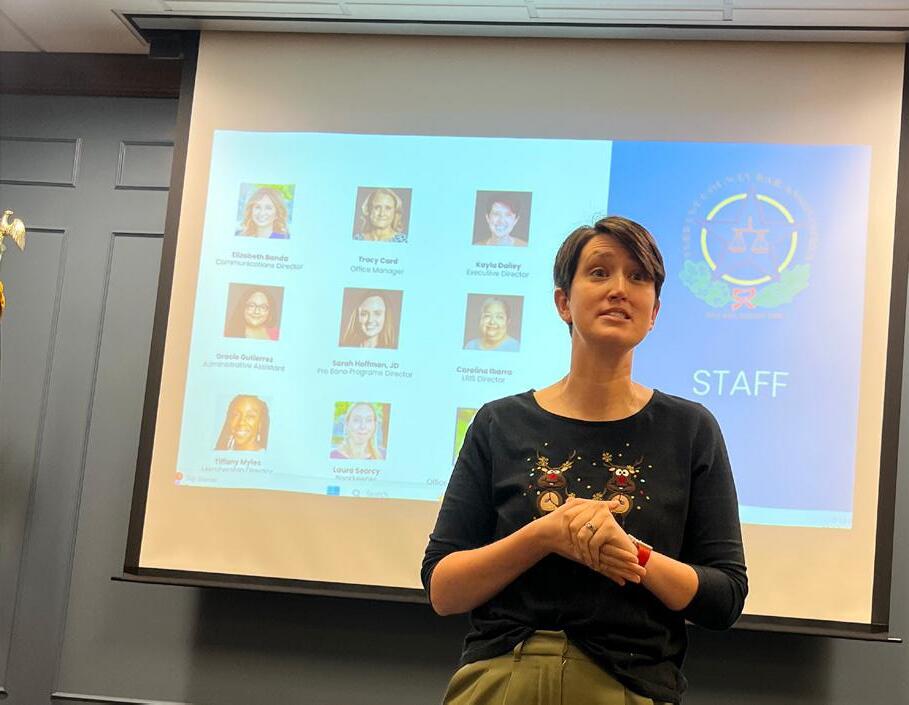
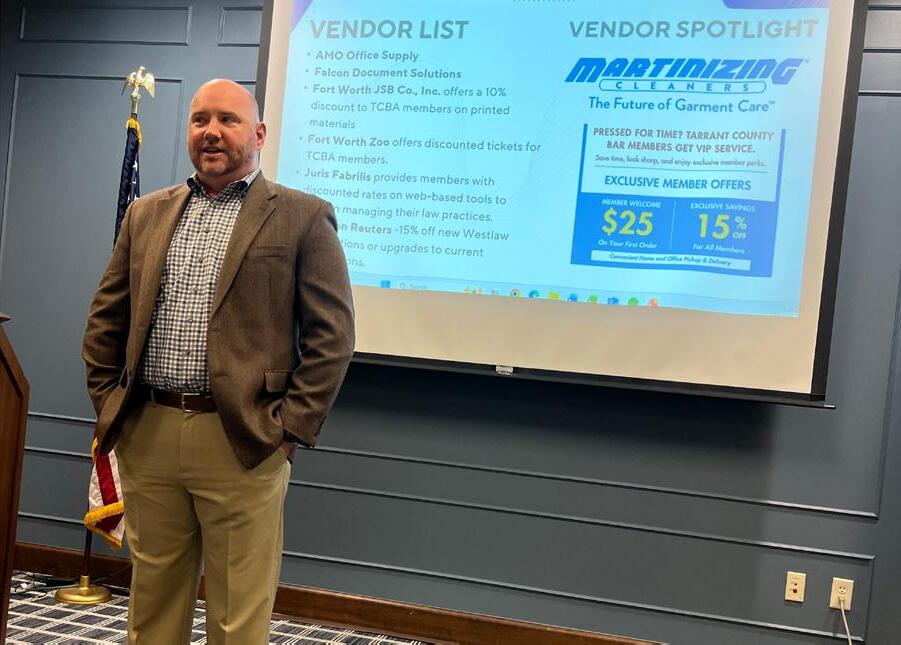
In December, we hosted our quarterly New Member Breakfast and welcomed over 15 new members, as well as our newest member benefit, Martinizing Cleaners. Board members John Brookman, Caroline Harrison, and Heidi Angel spoke about their experiences with TCBA and encouraged involvement. The event generated great enthusiasm among attendees to connect and engage with the TCBA community.
Community Service Committee
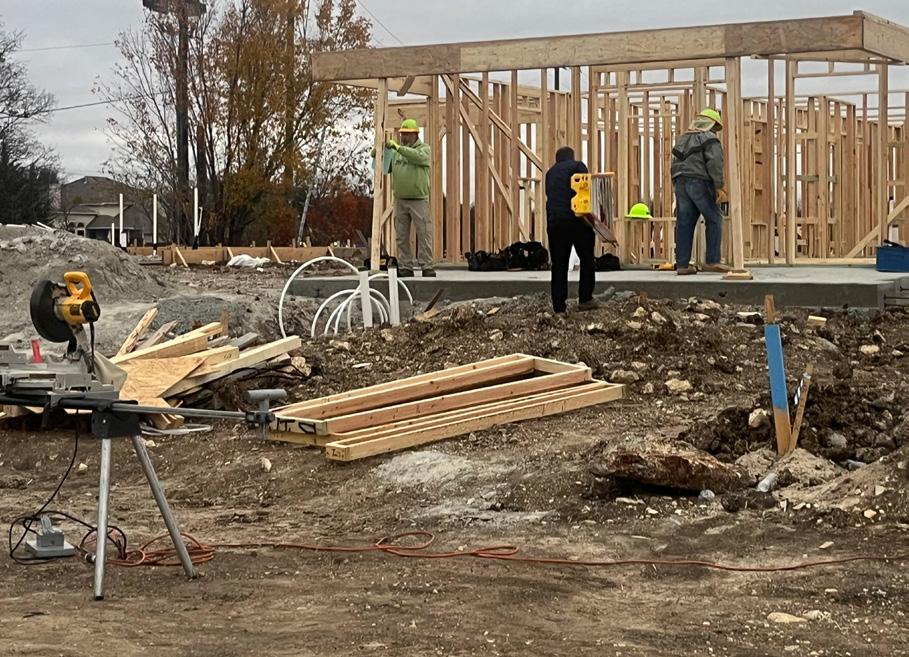
The Community Service Committee successfully concluded its Angel Tree program in partnership with the Center for Transforming Lives, providing gifts for 30 children. The committee also partnered with Habitat for Humanity for a group build day, working alongside community members and the future homeowner.
Looking ahead, the Community Service Committee, in partnership with TAMU and TCFLBA, will host a blood drive on January 21 at the TCBA office. Please visit the events calendar to register and consider donating blood.
Wellness Committee
The Wellness Committee wrapped up the year with our second Tails on Trails walk at Clearfork.
By Tiffany Myles, Membership Director
Participation continues to grow, and we look forward to welcoming even more members on our next walk on March 7.
The Committee is also seeking speakers for The Balanced Bar, a mental wellness CLE series. If you know someone with a background in nutrition, psychology, counseling, psychiatry, or another mental health field who can share practical, evidence based strategies for the legal profession, please email me.
Women in the Law Committee
The Women in the Law Committee has been actively meeting and planning our Women in the Law Luncheon, which will take place on March 5 at Palmwood in Frost Tower. More details regarding the program and registration will be shared soon. Thank you for your continued engagement and support of the Tarrant County Bar Association. We look forward to seeing you at upcoming events and encourage you to stay involved as we continue to strengthen and grow our legal community together. g
TCBA Angel Tree Tails on Trails
Jennifer Panicker
Abbey Payne
Danielle Reagan
Hailey Schmitt
Joseph Schuelke
Fabiola Segovia
Carlos Sierra
Catherine Simpson
Jacob Smith
Christopher Stenholm
Victoria Strickland
Caroline Sullivan
Brett Taylor
Peter Thomson
Tiffany Wen
Joel Whitney
Jared Wood
JUDICIARY
Hon. Brian Bolton
Hon. David Cook
Hon. Lori DeAngelis
Griffith
Hon. Trent Loftin
Hon. Thomas Lowe
Hon. Beth Poulos
Hon. Alan Wayland
Hon. Chris Wolfe
LEGAL STAFF
Shanna Ellis
Samuel Prince
ASSOCIATES
Marco Britton
Cassie Lively
Devin Morgan
Ryan Perucci
John Sands
LAW STUDENTS
Robert Canady
Rosendo Fregoso
Macias
Alexander Henderson
Sibeles Torres
Khalil Tucker
SAVE 10% by bundling and planning ahead!
TIER 1
$9,225 Valued at $10,250
• Women in the Law Luncheon
EVENT SPONSOR
• Bench Bar Conference XXXI
GUARDIANS SPONSOR
• Law Day Awards Luncheon
GOLD SPONSOR
Women in the Law Luncheon
TIER 2
$6,075 Valued at $6,750
• Women in the Law Luncheon
TABLE SPONSOR
• Bench Bar Conference
XXXI
CAPTAIN SPONSOR
• Law Day Awards Luncheon
SILVER SPONSOR
TIER 3
$2,250 Valued at $2,500
• Women in the Law Luncheon RESERVED TABLE
• Bench Bar Conference XXXI
IRON SPONSOR
• Law Day Awards Luncheon
BRONZE SPONSOR
Tarrant County Bar Association’s Women in the Law Luncheon is an annual event intended to honor and celebrate the accomplishments and leadership of women attorneys in Tarrant County.
Now in its 31st year, the Tarrant County Bar Association’s Bench Bar Conference is an annual event bringing
Tarrant County Bar Association’s Law Day Awards Luncheon is an annual event celebrating the rule of law and honoring outstanding members of the legal community for their service and contributions. JANUARY/FEBRUARY 2026 ▪ THE VERDICT 17
• A half-page color ad in the Bar Bulletin.
• Recognition at the luncheon and on TCBA’s website, in the Bar Bulletin, and on TCBA’s social media.
TIER 2
Women in the Law Luncheon — Table Sponsor
Includes:
• One reserved, branded table (seats 3 for the roundtable and 8 for the luncheon).
• Prominent event branding on emails, flyers, and the program prior to the event.
• Recognition at the event and on TCBA’s website, in the Bar Bulletin , and on TCBA’s social media.
Bench Bar Conference — Captain Sponsor
Includes:
• Exclusive sponsorship of one special event with custom signage (see attached table for options).
• Prominent placement on t-shirts, signage, and all pre-event marketing materials.
• One complimentary golfer registration for the event.
• May distribute one branded promotional/swag item during your sponsored activity.
• Special recognition at the event, including a representative or committee member publicly thanking your firm and addressing attendees prior to the special event.
Law Day Awards Luncheon — Silver Sponsor
Includes:
• One reserved table (8 seats) for the luncheon.
• Recognition at the luncheon and on TCBA’s website, in the Bar Bulletin, and on TCBA’s social media.
TIER 3
Women in the Law Luncheon — Reserved Table
Includes:
• One reserved table (8 seats) for the luncheon.
Bench Bar Conference — Iron Sponsor
Includes:
• Exclusive sponsorship of one special event with custom signage (see attached table for options).
• Placement on general marketing materials at the event.
Law Day Awards Luncheon — Bronze Sponsor
Includes:
• 2 seats for the luncheon.
• Recognition at the luncheon and on TCBA’s website, in the Bar Bulletin, and on TCBA’s social media.
The Intersection of Texas Probate and Personal Injury Law: Understanding Authority, Standing, and Capacity
By Kaitlin R. Goddard, JD
The Blum Firm, P.C. | kgoddard@theblumfirm.com
When a personal injury or medical malpractice matter involves a client who is incapacitated or has passed away, the legal landscape becomes significantly more complicated. Determining who may file suit, who may continue the litigation, and who ultimately receives the proceeds requires a nuanced understanding of both Texas probate law and the rules governing survival and wrongful death claims. These intersecting bodies of law often work together, and misunderstandings can result not only in procedural missteps but also in lost claims, dismissed cases, or improper distribution of settlement proceeds.
This article aims to provide an explanation of how probate administration intertwines with personal injury litigation in Texas, with a particular focus on standing, capacity, and the proper parties in both survival and wrongful death actions.
Standing and Capacity: Differentiating the Concepts
Personal injury litigation involving deceased or incapacitated individuals requires a clear understanding of standing and capacity, which are distinct but equally essential.
Standing concerns whether an actual injury exists, whether that injury was caused by the defendant, and whether courts can redress it. Texas courts require an injury in fact, causation, and redressability. Standing addresses whether a valid claim exists.
Capacity concerns who may bring that claim. In the context of deceased individuals, only the personal representative has the authority to pursue survival claims. Courts treat capacity as a procedural matter, but one that must be established at the outset. A potential client may have a meritorious claim yet lack capacity to bring it; for example, a grandchild may contact an attorney for an injury their grandparent suffered, but if the grandchild’s parent is still living, the grandchild has no authority to bring or benefit from the case. Similarly, if a sibling of an injured party contacts an attorney for a wrongful death claim, the sibling has no capacity under Texas Law to file such a claim.
Understanding the interplay between standing and capacity is critical because both must exist at filing to avoid dismissal.
Why Probate Matters in Personal Injury Cases
The most fundamental rule in this area is simple but often misunderstood: a deceased person cannot bring a lawsuit, and neither can an “Estate” standing alone. Only the courtappointed personal representative, either an executor or administrator, has capacity to bring a survival action.
Because of this, probate is not a mere administrative
formality for personal injury attorneys as it determines the following:
• Who has authority to file suit (capacity)
• Who may sign settlement agreements on behalf of the Estate
• Whether recovery is subject to creditor claims
• Which family members must be included in litigation or settlement
Properly identifying the correct plaintiff is essential to a successful claim. Filing suit under the wrong party’s name can lead to dismissal, and if limitations have run in the interim, the claim may be completely lost.
To ensure proper authority, attorneys should always request a death certificate and any available estate planning documents at the intake phase when the injured party is deceased. The informant named on the death certificate often provides insight into the family relationships, while a will—if one exists—may identify the intended executor and the decedent’s family structure The intake phase of a personal injury suit for a deceased injured party is incredibly important and ensures that you engage the proper client with authority to file suit. Remember, until the probate court makes an appointment of an Executor or Administrator, however, the client lacks the authority to formally pursue the litigation.
Understanding the Foundation: Texas Probate Administration
Texas estate administration serves as the formal legal process by which the property of a deceased person is managed and distributed. Whether an individual dies testate, with a valid will, or intestate, without one, has profound implications on who may ultimately serve as the estate representative and therefore who has the authority to bring claims on behalf of a deceased individual.
When a valid will exists, the probate process is generally smoother, but numerous pitfalls can complicate even the most straightforward estate. Poorly drafted wills can omit residuary clauses, fail to name an executor, fail to provide for an independent administration, or inadequately identify family members. In some cases, the original Will cannot be located and must be admitted as a copy which may require additional service and evidentiary proof. Others involve interested subscribing witnesses or ineffective execution as a whole which can cause the Will to fail entirely. Even a will
Continued on page 22
Continued from page 21
that appears valid on its face has no legal effect until it is admitted to probate, meaning that the named executor has no authority to act—including filing litigation—until a court validates the document.
In intestate estates, the first critical step is determining the legal heirs. Texas Estates Code § 202.004 identifies who may initiate an heirship proceeding, and this often becomes the gateway for identifying the appropriate estate representative to bring your claim. Family circumstances can complicate matters significantly: adoption by estoppel, common law marriages, presumptions of paternity under Family Code § 160.204, and the presence of full- or half-blood siblings all affect the final determination of heirs. Community property rules also become especially important when the decedent leaves children from outside the marriage, and lineage issues may extend even further when heirs have themselves pre-deceased the decedent, creating multiple layers of probate considerations.
Once the heirs are known, the question becomes who may serve as the personal representative. Texas Estates Code § 304.001 provides an order of priority. Executors named in a will receive the highest preference (if there is a Will), followed by a surviving spouse, principal devisees, other devisees, and next of kin. In the absence of agreement, intestate estates can become challenging because independent administration requires unanimous written consent from all heirs. Even one resistant heir may force the estate into dependent administration, significantly raising costs and procedural burdens.
These probate determinations are the gateway to determining who has the legal capacity to bring a survival claim on behalf of a deceased personal injury victim so that the claim does not fail and also determine the proper statutory wrongful death beneficiaries.
Survival Actions and Wrongful Death Actions: Separate Claims with Distinct Purposes
Texas recognizes two separate causes of action when injuries result in death: survival claims and wrongful death claims. Though frequently plead together, they serve different purposes, involve different authorized plaintiffs, and compensate different harms.
Survival Actions
Under Texas Civil Practice & Remedies Code § 71.021, a decedent’s personal injury claim survives their death and may be brought by the estate representative. These claims encompass pain and suffering prior to death, medical expenses, lost wages, and other damages the decedent could have recovered had they lived.
Because the claim “belongs” to the decedent, any recovery becomes an estate asset. As a result, creditors may pursue these funds, and agencies such as the Medicaid Estate Recovery Program (MERP) may impose reimbursement claims. This makes the financial feasibility of survival claims an important consideration, especially when the estate is burdened by significant debt.
Survival claims always require some form of probate proceeding. Even when a will exists, it has no operative effect until admitted to probate; when no will exists, deter-mining the heirs and appointing an administrator becomes unavoidable as the Court appointed Representative is the only person with legal capacity to file suit and sign a settlement agreement.
Wrongful Death Actions
Wrongful death claims, governed by Texas Civil Practice & Remedies Code §§ 71.002 and 71.004, compensate statutory beneficiaries—being exclusively the surviving spouse, children, and parents—for their emotional and financial losses resulting from a loved one’s death. These claims may be brought by any one beneficiary on behalf of all. If no such action is filed within three months of death, the personal representative may file the claim but it is important to note that even when the Estate representative files the claim, the claim is still for the exclusive benefit of the surviving spouse, children and parents and not the Estate beneficiaries or heirs as a whole.
Crucially, wrongful death proceeds do not pass through the estate and are not subject to estate creditors. They belong directly to the statutory beneficiaries.
The separation between these two actions means that the same lawsuit may involve both types of claims and that the individuals entitled to recovery under each may differ. A grandchild, for example, may be an heir for purposes of a survival action but is not a statutory beneficiary for wrongful death purposes.
Because these distinctions can lead to confusion—and even improper payments—many attorneys explicitly allocate settlement proceeds between survival and wrongful death claims within the settlement agreement to remove ambiguity.
When the Injured Party Is Alive: Authority Through Powers of Attorney and Guardianship
If the injured party is still living at the time of intake, the question becomes one of continuing authority rather than probate. Two types of powers of attorney are typically necessary for personal injury investigation and litigation: a Medical Power of Attorney, which allows the firm or designated agent to obtain necessary medical records, and a Durable Power of Attorney, which should include explicit authority to pursue litigation. Attorneys must review these documents carefully. Not all Powers of Attorney authorize litigation powers.
Time is often critical. Victims of personal injury claims or medical malpractice may decline rapidly. If the injured person still has capacity, helping them execute these documents promptly is essential. If capacity is already lost, the firm will need to pursue a guardianship—an intensive judicial process—to establish the needed authority to file suit and appoint an individual to accept and manage funds from any settlement or verdict.
Importantly, powers of attorney terminate automatically upon the principal’s death. If the client dies mid-litigation, the attorney must file a suggestion of death and initiate the
probate process to appoint a personal representative who can continue the case.
Practical Considerations for Attorneys Handling
Deceased or Incapacitated Clients
Navigating cases involving deceased individuals requires both legal precision and practical foresight. Establishing a clear understanding of the decedent’s family structure is essential, particularly when dealing with common law marriages, adopted children, deceased children leaving issue, or situations where a child has been adopted by others. Texas permits an adopted child to inherit from both biological and adoptive parents, yet biological parents who relinquished rights cannot inherit from the child—an important distinction when evaluating potential beneficiaries. This is just one example of the intricacies of probate law that can change the landscape of a personal injury claim involving a deceased injured party.
Attorneys should also assess the decedent’s debts early, as large liabilities may diminish or negate the value of pursuing a survival claim. In wrongful death cases, even though probate is not required to bring the action, many practitioners still request a determination of heirship coupled with an order of no administration to provide a judicial confirmation of the family structure. This prevents the late discovery of previously unknown beneficiaries and ensures all proper parties are before the Court and included in any settlement agreement. When no probate proceeding exists, a family settlement agreement signed by all statutory beneficiaries serves as a valuable risk-management tool. It clarifies the individuals entitled to wrongful death proceeds and can help prevent disputes following distribution.
Conclusion
Cases involving deceased or incapacitated personal injury victims require attorneys to understand both the procedural mechanics of probate and the statutory distinctions defining survival and wrongful death actions. The “bookends” of such litigation—determining who may file suit and who may receive the recovery—are governed not only by tort law but by Texas probate law as well. Mastery of these principles ensures that claims are filed correctly, settlements are distributed lawfully, and the rights of both the injured and their families are fully protected. g
Watch the recorded session and earn 3 hours of CLE at Kaitlan presented at November’s Brown Bag Seminar Series: Wills & Estate. www.tarrantbar.org/ bb-wills-estate-2025.
Snippets
ASK JUDGE BOB
Judge Carey Walker, County Criminal Court No. 2
Civil and Criminal
by Judge Bob McCoy g County Criminal Court No. 3
2. Confrontation Clause
Judge Bob, what is the “nonentrenchment doctrine”?
The nonentrenchment doctrine is “[O]ne Legislature cannot bind the hands of a subsequent Legislature by the enactment of laws which may not be altered or repealed by a subsequent Legislature.”
Dallas v Employees’ Ret. Fund of Dallas, 687 S.W.3d 55 (Tex. 2024).
THE PACK’S MONTHLY
PARAPROSDAKIAN (a figure of speech in which the latter part of a sentence or phrase is surprising or unexpected; frequently humorous)
When tempted to fight fire with fire, remember that the fire department usually uses water.
Abigail, Mary, and Martha Elijah
THE PACK’S QUOTE OF THE MONTH
I think dogs are the most amazing creatures. For me they are the role model for being alive.
Gilda Radner
—
THE Editor's NOTES FROM THE FARM
An army of sheep led by a lion can defeat an army of lions led by a sheep.
CRIMINAL ITEMS OF INTEREST
1. Miranda Warnings
The Miranda right to counsel, with all of its prophylactic protections, becomes ripe for invocation only after (1) Miranda warnings have been given while the suspect is in custody or (2) if custodial Miranda warnings have not been given, when custodial interrogation begins.
State v. Johnson, 707 S.W.3d 256 (Tex.Crim.App. 2024).
If the Confrontation Clause is implicated, there must be individualized findings by the trial court regarding the witness in question as to why the special procedure was necessary. “The requisite finding of necessity must of course be a case-specific one: The trial court must hear evidence and determine whether use of the special procedure is necessary for the particular witness who seeks to testify.” The finding cannot be generalized towards a specific group of individuals, but rather why the individual witness’s testimony will further an important public policy.
Finley v. State, 707 S.W.3d 320 (Tex.Crim.App. 2024).
3. Confessions
A confession is involuntary for due process purposes when: “(1) police engaged in activity that was objectively coercive, (2) the statement is casually related to the coercive government misconduct, and (3) the coercion overbore the defendant’s will.” When a defendant challenges his confession as involuntary, due process requires that the state prove by preponderance of the evidence that the confession was voluntary.
Ochoa v. State, 707 S.W.3d 344 (Tex.Crim.App. 2024).
4. Punishment Election
A criminal defendant has no constitutional right to have a jury determine punishment. But a defendant does have a statutory right to elect to have the jury assess punishment in the event of a guilty verdict. “The default under this provision is judgeassessed punishment, but a defendant may obtain jury punishment, at his option, where he so elects in writing before the commencement of the voir dire examination of the jury panel.
Tanner v. State, 707 S.W.3d 371 (Tex.Crim.App. 2024).
5. Statement Against Interest
In determining whether a possible statement against interest is sufficiently corroborated under Rule of Evidence 803(24), the “trial court should consider a number of factors”: (1) whether guilt of declarant is inconsistent with guilt of the defendant, (2) whether declarant was so situated that he might have committed the crime, (3) the timing of the declaration, (4) the spontaneity of the declaration, (5) the relationship between the declarant and the party to whom the statement is made, and (6) the existence of independent corroborative facts.
Irsan v. State, 708 S.W.3d 584 (Tex.Crim.App. 2025).
6. Rule of Optional Completeness
Hearsay is an out-of-court statement offered to prove the truth of the matter asserted in the statement and is generally not admissible unless the statement falls within a recognized exception to the hearsay rule. One such exception – Texas Rule of Evidence 107 – known as the rule of optional completeness, provides: If a party introduces part of an act, declaration, conversation, writing, or recorded statement, an adverse party may inquire into any other part on the same subject. An adverse party may also introduce any other act, declaration, conversation, writing, or recorded statement that is necessary to explain or allow the trier of fact to fully understand the part offered by the opponent.
Schoen v. State, 708 S.W.3d 632 (Tex.App.—San Antonio 2023).
7. Deadly Weapon
It is well-established, however, that a deadly weapon need not “possess any particular trait or characteristic other than its capacity to cause death or serious bodily injury.” “The gist of the offense of assault with a deadly weapon is found in the character of the weapon and manner of its use.”
Rivera v. State , 708 S.W.3d 732 (Tex.App.—San Antonio 2024).
CIVIL ITEMS OF INTEREST
1. Gag Order
A judicial order that forbids certain communications before they occur, also known as a gag order, constitutes a prior restraint on speech. The Texas Supreme Court recognized the Texas Constitution provides greater protection of speech than the United States Constitution and held that prior restraints on speech in a civil case are presumptively unconstitutional under Article I, Section 8 of the Texas Constitution. In Re: Lee, 687 S.W.3d 69 (Tex.App.—Dallas 2024).
2. Arbitration Provision in a Will
The fundamental question addressed in this appeal is whether an arbitration provision in a will can be enforced to require disputes to be submitted to binding arbitration. Applying the same analysis that the Supreme Court of Texas has applied in other situations, we hold there is no reason an arbitration provision in a will should not be enforceable. Hollingsworth v Swales , 717 S.W.3d 655 (Tex.App.—Waco 2025).
3. Trespass To Try Title
The unique rules that govern trespass-to-try-title actions do not prohibit a trial court from ruling on some aspects of a trespass-to-try-title claim through a partial summary judgment. The rules of civil procedure and the provisions of the Property Code governing trespass-to-try-title actions simply do not
preclude the trial court from granting partial summary judgments or making other interlocutory rulings.
Devon Energy Prod. V McClure Oil Co., 717 S.W.3d 681 (Tex. App.—Eastland 2025).
4. Justiciability
Justiciability is a formal word for a fundamental concept: The line separating lawsuits that courts may adjudicate from those they may not. A case may be justiciable yet not fall within a particular court’s subject-matter jurisdiction, but courts never have subject-matter jurisdiction over cases that are nonjusticiable.
Tex. Dep’t of Family & Protective Servs. v. Grassroots Leadership, Inc., 717 S.W.3d 854 (Tex. 2025).
5. Release by Petition
Release by petition allows the owner of even a single parcel of land to unilaterally and automatically secure the property’s release from a city’s ETJ. Once the city secretary has verified the property owner’s signature on an otherwise valid petition, the city is required to “immediately release the area from [its ETJ].”
Elliott v City of College Station, 717 S.W.3d 888 (Tex. 2025).
6. Absolute Judicial Immunity
When judges delegate their authority or appoint others to perform services for the court, the absolute judicial immunity barring civil liability that attaches to the judge may follow the delegation or appointment. Those clothed with authority to perform judicially appointed or delegated duties, including court-appointed receivers, are entitled to derived judicial immunity if they actually function as an arm of the court.
Met Water Vista Ridge v Blue Water, 717 S.W.3d 918 (Tex. App—Houston [14th Dist.] 2025).
LAWYER’S QUOTE OF THE MONTH
Unlimited power is apt to corrupt the minds of those who possess it; and this I know, my Lords, that where law ends, tyranny begins.
—William Pitt, Earl of Chatham
QUOTE OF THE MONTH
There are two ways to get enough. One is to accumulate more and more. The other is to desire less.
—G. K. Chesterton g
LegalLine
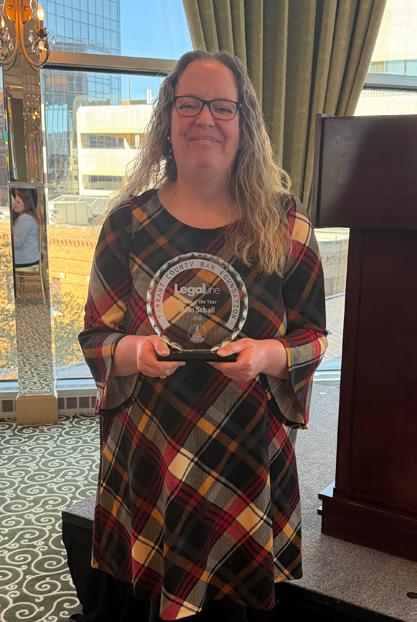
Alexis Allen
Amy Allen
Brittany Allen-Brantley
John Barnes
John Corbin
Sara Correa
John Cummings
Patrick Curran
Upcoming Volunteer Dates
Nick Bettinger
Robert Blankenship
By Sarah Hall Hoffman, Pro Bono Programs Director
Anne Underwood THANK YOU TO ALL OF OUR 2025 LEGALLINE VOLUNTEERS
Blake Bobo
Julie Camacho
MarQuetta Clayton
DMadeline D’Alise
Steve Gaylord
Ndidi Gbulie
Dustin G. Hoffman
Merrit Klapperich
o you have two hours to spare on a Thursday evening to assist those seeking legal advice?
LegalLine is looking for attorneys from all areas of law to contribute their expertise and support the community. If you’re interested in learning more, please contact me at sarah@tarrantbar.org. g
Deborah Krane
Cynthia Maragoudakis
Reba Martin
Patrick McCarthy
Angelia Megahan
Ricardo Ochoa
Hannah Orand
C.D. Peebles
Kate Pratt
David Pritchard
Lisa Ramirez
Karon Rowden
Arin Schall
Timothy Stafford
Sara Thornton
Upcoming Volunteer Dates
February 12
February 26 March 12 March 26
Spotlighting members practicing law beyond Fort Worth
GRAPEVINE, TEXAS
A Q&A with TCBA Member
Stephanie Cantu
Q: Where do you live and practice in Tarrant County, and what do you love most about your community there?
I live and have my office in Grapevine, and I practice in Tarrant and Dallas. What I love most about Grapevine is that it’s a great community. It feels like a small town but has all the amenities of a larger city. It’s a great town for families!
Q: What area of law are you practicing?
I practice family law and immigration law. You know these areas of laws are always changing, and they intersect a lot. I enjoy finding a pathway for each individual that makes the most sense for them. I’ve always enjoyed puzzles so I feel like those two areas of laws can really kind of exercise that part of your brain.
Q: What inspired you to become a lawyer, and what keeps you motivated in your work today?
I have always enjoyed being around people and interacting with people from all different backgrounds. I think the law puts you in a place where you help people navigate through very difficult times in their lives and that has always been very rewarding to me. I’ve met great people and have learned a lot about the world doing this work.
Q: What is a fun or surprising fact that people probably don’t know about you?
I worked at a bakery in high school, and I am trained to decorate cakes.
Q: Who has been a mentor or a major influence in your legal career?
My first job was at Legal Aid in Weatherford as a staff attorney, and my managing attorney was a man named Gary Orren. He really taught me how to be empathetic and how to meet your client where they are. He’s probably been one of the biggest influences in my career thus far.
Q: If you weren’t a lawyer, what do you think you’d be doing instead?
I would love to be a chef and work in the kitchen, but chef's hours are terrible. But I love cooking, so I think that would be really fun in theory (but probably not practical). g
Guardianship in Texas: Legal, Ethical, and Practical Considerations
By Hon. Patricia Burns Probate Court No. 1 | pmburns@tarrantcountytx.gov
Guardianship remains one of the most profound interventions a court can impose, representing a judicial mechanism that fundamentally alters an individual’s legal status by transferring decision-making authority from the individual to the court or an appointed guardian. Because of its significant consequences, probate courts, in accordance with Texas law, consistently emphasize that guardianship must constitute both the last resort and the most appropriate means of protecting an individual who is incapable of adequately safeguarding their personal or financial interests. This dual imperative underscores the delicate balance between protection and autonomy, which lies at the heart of guardianship law and practice.
The primary justification for guardianship is protection: individuals who lack the capacity to make informed decisions may face substantial risks, including financial exploitation, medical neglect, or diminished quality of life. A guardianship provides structured oversight, court supervision, and legally enforceable safeguards designed to mitigate these risks while ensuring the individual’s needs are met. Courts, through their legally required ongoing supervisory authority, must monitor the guardian’s actions, requiring accountability and periodic reporting to prevent abuse or mismanagement. In this sense, guardianship serves as both a protective and regulatory tool within the legal system.
However, the benefits of guardianship are counterbalanced by substantial drawbacks. The imposition of a guardianship results in the diminution of fundamental rights, including the capacity to make personal, financial, and medical decisions. This loss of autonomy can have profound psychological and social consequences for the ward. Additionally, guardianship introduces significant government oversight into personal and family matters, and in some cases this structure can result in a failure to fully honor the ward’s preferences. The administrative and financial burdens associated with maintaining a guardianship are also significant, including court fees, bond requirements, and professional oversight costs. Moreover, guardianships can exacerbate family conflict, particularly in situations where competing interests or historical tensions exist. Consequently, the decision to pursue guardianship must be approached with caution, care, and thorough legal scrutiny.
For attorneys, the guardianship process requires a rigorous, fact-driven assessment of the proposed ward’s capacity, the existence of less restrictive alternatives, and the adequacy of existing support systems before a petition is filed. Ethical, legal, and professional obligations dictate that less restrictive
options must be fully explored, attempted, and demonstrated to be insufficient before seeking the removal of an individual’s legal rights. Attorneys must carefully consider questions such as:
Is a less restrictive alternative available that preserves the individual’s autonomy while meeting their needs?
• Have previous interventions failed, and if so, could those approaches succeed with additional support or modifications?
• What community or familial resources exist to support decision-making without resorting to guardianship?
• Is the individual demonstrably unable to make or communicate responsible decisions?
• Is the person incapable of effective communication with caregivers?
• Does a valid surrogate decision-maker exist, such as an agent under a durable power of attorney or a healthcare directive?
These inquiries reflect not only a legal obligation but also an ethical commitment to the principle of the least restrictive alternative, a standard consistently emphasized in probate practice.
Texas law offers a variety of mechanisms designed to achieve protection without removing legal rights. Less restrictive alternatives to guardianship include Medical or Durable Financial Powers of Attorney, Declarations for Mental Health Treatment, Supportive Decision-Making Agreements, and the appointment of Representative Payees to manage public benefits. Financial oversight may also be achieved through joint bank accounts, management trusts, and special needs trusts. Furthermore, individuals may proactively designate a guardian prior to incapacity, thereby preserving their autonomy while ensuring their preferences are honored. Additional supports, including person-centered planning and decisionmaking frameworks under Texas Health and Safety Code Chapter 313, offer flexible, individualized solutions tailored to the specific needs of the individual. Collectively, these tools illustrate the legal system’s commitment to balancing protection with the preservation of autonomy.
When guardianship is ultimately deemed necessary, attorneys must present evidence that satisfies both statutory requirements and evidentiary standards. Exhibits must be relevant, material, and properly authenticated. In Statutory Probate Court proceedings, the Court Visitor’s Report— which documents the proposed ward’s circumstances—can be admitted as part of the court record. A written statement
from a licensed Texas physician is mandatory, attesting to the individual’s incapacity. Lay witnesses must provide testimony grounded in personal knowledge and observation; conclusory statements devoid of factual support are insufficient. Texas law requires the proposed ward to be present at the hearing unless excused in accordance with Texas Estates Code Section 1101.051(b). The evidence presented must collectively meet the “clear and convincing” standard of proof, a high threshold reflective of the serious consequences of guardianship.
The law further imposes rigorous standards for the selection of guardians. Texas Estates Code Sections 1104.0351 through 1104.0359 enumerate disqualifications that safeguard the ward by ensuring that only competent and trustworthy individuals may serve. Disqualifying factors include a lack of requisite experience or capacity, a history of behavior indicating unsuitability, conflicts of interest that may compromise the ward’s welfare, or preexisting disqualifications specified in the ward’s advance directives. Potential guardians may also be found unsuitable due to family conflicts. Guardians must also meet procedural requirements, such as appropriate residency and certification, thereby maintaining the integrity and accountability of the guardianship system.
Standing requirements also play a critical role in protecting wards. Texas Estates Code Section 1055.001(b) prohibits individuals with interests adverse to the proposed ward from initiating or contesting guardianship proceedings. Courts are required, pursuant to Section 1055.001(c), to evaluate potential adverse interests, often through a motion in limine, to prevent parties with conflicting motives from influencing the process. This safeguard ensures that the guardianship system functions in the ward’s best interest, free from manipulation by parties with self-serving agendas.
Attorneys themselves may encounter situations in which their clients exhibit diminished capacity issues. Texas Disciplinary Rules of Professional Conduct Rule 1.17 provides that, when the lawyer reasonably believes that the client has diminished capacity, is at risk of substantial physical, financial, or other harm unless action is taken, and cannot adequately
Starting the Year Strong
The start of a new year brings something powerful, a fresh start. It is a time when many of us pause, reflect, and consider what we want the next twelve months to look like: growth, change, community, new skills.
Whatever your goals may be, this is the perfect moment to take a step forward and become more active within your sections. Whether that means speaking to the group, helping organize a luncheon or social, or attend-
act in the client’s own interest, the lawyer may take reasonably necessary protective action. Such action may include, but is not limited to, consulting with individuals or entities that have the ability to take action to protect the client and, in appropriate cases, seeking the appointment of a guardian ad litem, attorney ad litem, amicus attorney, or conservator, or submitting an information letter to a court with jurisdiction to initiate guardianship proceedings for the client. When taking any protective action, the attorney may disclose confidential information to the extent the lawyer reasonably believes is necessary to protect the client’s interests.
In sum, guardianship represents a profound and complex legal intervention, designed to provide protection to those who are unable to safeguard themselves, while simultaneously posing significant ethical, practical, and legal challenges. Effective practice requires a careful evaluation of alternatives, adherence to statutory and evidentiary requirements, and a commitment to preserving autonomy whenever possible. Texas law provides an extensive array of mechanisms for achieving this balance, but the successful application of these tools depends on the attorney’s rigorous assessment, ethical judgment, and meticulous attention to procedural and substantive requirements. By approaching guardianship with deliberation, respect for the individual, and fidelity to professional standards, attorneys can ensure that this powerful legal tool is employed judiciously, ethically, and effectively, reflecting the dual goals of protection and autonomy that lie at the heart of guardianship jurisprudence. g Watch the recorded session and earn 3 hours of CLE at Judge Burns presented at November’s Brown Bag Seminar Series: Wills & Estate.
www.tarrantbar.org/ bb-wills-estate-2025.
By Tracy Card TCBA Sections & CLE Director
ing your first section event, we welcome your ideas and participation.
There is always something exciting happening. Sometimes all it takes is a small leap to get involved. If you are unsure where to start or how to help, feel free to reach out to me. You can also find the full calendar of events on our website. We look forward to seeing you at an upcoming event! g
Civil District Court Jury Trial Verdicts November 2025 LOCAL JURY TRIAL VERDICTS
11/1/2025–11/31/2025 sorted by judgment date.*
*Does not include cases designated as “on appeal” with the Clerk’s Office as of 12/15/2025.
SHAHIN EISAWI v. LOUIS BOSTON SPIVA
017-349311-24
Hon. Melody Wilkinson (17th District Court)
Trial: October 28–30, 2025
Judgment: November 3, 2025
Attorney – Plaintiff: Sarnie Randle
Attorneys – Defendant: T. Chair Garrett and Jon Strain
Summary: This breach-of-contract case arose from unpaid home repairs following storm damage. The jury initially found in favor of Plaintiff but also found Plaintiff filed a fraudulent lien. The Court granted Defendants’ JNOV, vacated Plaintiff’s award, and entered judgment awarding damages and attorneys’ fees to Defendants. Plaintiff took nothing.
NATHAN MCFARLAND v. BENITO SANCHEZ, et al.
067-349168-24
Hon. Don Cosby (67th District Court)
Trial: November 18–19, 2025
Judgment: November 6, 2025
Attorney – Plaintiff: Michael James II
Attorney – Defendant: Michael Miller
Summary:
Plaintiff was t-boned when Defendant ran a red light while acting in the course and scope of employment. The jury found in favor of Plaintiff and awarded $1,642,592 for past and future physical pain and suffering, mental anguish, physical impairment, plus prejudgment interest and court costs.
STANLEY WRIGHT, RECEIVER, AND DONALD YOUNG v. JEFFREY KYLE BABINA AND CPR STAFFING OF TEXAS, INC.
048-370995-25
Hon. Chris Taylor (48th District Court)
Trial: July 14–15, 2025
Judgment: November 14, 2025
Attorneys – Plaintiff: Bob Haslam and Victor McCall
Attorney – Defendant: Jason Ankele
Summary: Plaintiffs previously recovered a judgment in this cause in 2016 that remained uncollected. After two days of trial, the case was severed and a settlement was reached with one defendant.
The jury unanimously found Plaintiffs recover $500,000 from Defendant Babina (after subtracting a $150,000 settlement credit) for fraudulent transfers made by CPR Staffing with intent to hinder, delay, or defraud a creditor.
MICHAEL C. HARR, et al. v. NANCY K. VANDERGRIFF, et al.
153-340599-23
Hon. Susan McCoy (153rd District Court)
Trial: July 7–15, 2025
Judgment: November 20, 2025
Attorney – Plaintiff: Scott Garelick
Attorney – Defendant: Clint Corrie
Summary:
Plaintiff and Defendants entered into a contract for the sale of a business, including multiple deliverables. The jury found Defendant breached the contract and awarded Plaintiffs $89,300 plus attorneys’ fees.
TIKICHA ENGLISH v. AMERICAN AIRLINES, INC., et al.
153-305752-19
Hon. Susan McCoy (153rd District Court)
Trial: November 17–19, 2025
Judgment: November 21, 2025
Attorney – Plaintiff: Justin Moore
Attorneys – Defendant: Marc Michael Rose and Brenton Allison
Summary:
Plaintiff alleged injury while boarding a flight. The jury returned a verdict in favor of Defendant, and Plaintiff took nothing.
PAULA C. MENTZER v. STATE FARM MUTUAL AUTOMOBILE INSURANCE COMPANY
153-306745-19
Hon. Susan McCoy (153rd District Court)
Trial: August 4–7, 2025
Judgment: November 24, 2025
Attorneys – Plaintiff: Tammy Holt and Seth McCloskey
Attorney – Defendant: Armando De Diego
Summary:
Plaintiff was injured in a car accident, and her insurer refused to pay the full amount submitted under underinsured motorist benefits. The jury found State Farm knowingly engaged in unfair or deceptive acts and awarded Plaintiff $944,000 in noneconomic damages.
EXTERIORS, INC. v. RAFAEL PALMEIRO, et al.
017-348898-23
Hon. Melody Wilkinson (17th District Court)
Trial: October 21–24, 2025
Judgment: November 25, 2025
Attorney – Plaintiff: Melanie Kemp Okon
Attorneys – Defendant: T. Chair Garrett and Jon Strain
Summary:
This breach-of-contract case arose from unpaid home repairs following storm damage. The jury initially found in favor of Plaintiff but also found Plaintiff filed a fraudulent lien. The Court granted Defendants’ JNOV, vacated Plaintiff’s award, and
entered judgment awarding damages and attorneys’ fees to Defendants. Plaintiff took nothing.
J.M. AND L.M. v. WEN ROLDAN LLC d/b/a ANGEL FOOT SPA AND SHUGUANG LI
352-353716-24
Hon. Josh Burgess (352nd District Court)
Trial: November 10–11, 2025
Judgment: November 25, 2025
Attorney – Plaintiff: Robert L. Chaiken
Attorney – Defendant:
Jack Downing Summary:
Plaintiff was sexually assaulted during a massage by an unlicensed massage therapist at an unlicensed business. The jury found each Defendant 50%
responsible. Plaintiff previously received $135,000 in settlement funds, and the jury awarded an additional $12,046.95 in non-economic damages.
LUIS AVITIA VELEZ v. JOSHUA JAHMAR BATES
096-343902-23
Hon. Pat Gallagher (96th District Court)
Trial: August 18–19, 2025
Order: November 26, 2025
Attorney – Plaintiff: Freddie Gabriel
Attorney – Defendant:
Jennifer McNabb-Fjerestad Summary:
Defendant rear-ended Plaintiff on the highway. The jury unanimously found Defendant was not negligent, and Plaintiff took nothing. g
If you are a TCBA member and would like to place a free announcement in the The Verdict, we would like to hear from you. Please submit information by email to Elizabeth Banda, Communications Director, at elizabeth@tarrantbar.org.
On-Demand CLE Credits Available Anytime
General CLEs
Annual Joint Meeting of Metroplex Inns - Hosted by Eldon B. Mahon Inn of Court CLE
Topic: Stevenson v. Johnson: The Disputed Election of 1948 and the Fort Worth Federal Case that Changed American History
CLE: 1 hour ($20 for TCBA Members)
Foster Youth Grant Project - What It Can Do for Your Client
Speaker: Samuel Sanchez, Texas A&M University School of Law
CLE: 1 hour (FREE for TCBA Members)
Section CLEs
Appellate Law Section
Topic: How Lawyers Can Uphold the Constitution & Rule of Law
Speaker: Dr. Bill Chriss, Chair of the Appellate Section of the State Bar of Texas
CLE: 1 hour ($40 for TCBA Members)
Business Litigation Section
Topic: Charting New Territory: Texas Business Courts’ First Year
Speakers: Judge Jerry Bullard, Eighth Business Court Division
Judge Brian Stagner, Eighth Business Court Division
Moderator: Judge Chris Taylor, 48th District Court
CLE: 1 hour ($20 for TCBA Members, $10 for Law Students)
Construction Law Section
Topic: Truth or Tech – Navigating AI Generated Evidence in the Courtroom
Speaker: Beth Silverman, ArcherHall
CLE: 1 hour ($20 for TCBA Members, $10 for Law Students)
Topic: Design Professional Contract Negotiations
Speaker: James Pruden, Freese and Nichols, Inc.
CLE: 1 hour ($20 for TCBA Members, $10 for Law Students)
Topic: Change Order Reviews: Validity & Reasonableness
Speaker: Akshaya Iyer, Peritia Partners
CLE: 1 hour ($20 for TCBA Members, $10 for Law Students)
Topic: Private Equity in the Real Estate Development and Construction Industries
Speaker: Benton Wheatley, Duane Morris LLP
CLE: 1 hour ($20 for TCBA Members, $10 for Law Students)
Topic: Preventing Design Professional Malpractice
Speaker: James Pruden, Waddell Serafino Geary Rechner Jenevin, PC
CLE: 1 hour ($20 for TCBA Members, $10 for Law Students)
Energy Law Section
Topic: From Pipelines to Powerlines – Opportunities and Obstacles for Energy in the Rapid Growth of Data Centers
Speaker: Mark Doré, The Doré Law Firm, LLC
CLE: 1 hour ($30 for TCBA Members)
Topic: Navigating Safe Harbor: The Texas Division Order Statute
Speaker: Megan Knell, Steptoe & Johnson, PLLC
CLE: 1 hour ($40 for TCBA Members)
Topic: Produced Water in Texas: A Fluid Frontier
Speaker: Kyle Weldon, James D. Bradbury, PLLC
CLE: 1 hour ($40 for TCBA Members)
Topic: Getting Paid in the Oilpatch: Oil & Gas Mineral Liens & Chapter 67 Production Proceeds Letters
Speaker: Brent R. Doré, Doré Rothberg Law, P.C.
CLE: 1 hour ($40 for TCBA Members)
Fort Worth Business & Estate Section
Topic: Creative Income Tax Strategies
Speaker: Marvin E. Blum, Founder and Managing Partner, The Blum Firm. P.C.
CLE: 1 hour (FREE for Section Members)
Topic: Planning Update for 2025
Speaker: Alan L. Stroud, Senior Vice President / Wealth
Strategies Advisor, Bank of America Private Bank
CLE: 1 hour (FREE for Section Members)
Topic: 2025 Hot Topics in Estate Planning Seminar
Speakers: Mike Bourland, Bourland Wall & Wenzel, P.C.
John Porter, Baker Botts LLP
Lee Schwemer, Current Lecturer - UTA
Steve Akers, Bessemer Trust, Dallas
CLE: 1 hour (FREE for Section Members)
Topic: The Biggest Retirement Expense Your Clients Don’t Expect
Guest Speaker: Federal Magistrate Judge Hal R. Ray, Jr., United States District Court for the Northern District of Texas
1 hour Ethics (FREE for TCBA Members)
Guest Speaker: Judge Pat Gallagher, 96th District Court
1 hour Ethics (FREE for TCBA Members)
Guest Speaker: Lu Pham, Pham Harrison, LLP
1 hour Ethics (FREE for TCBA Members)
Guest Speaker: Major Brandon Reese, United States Marine Corps
1 hour Ethics (FREE for TCBA Members)
Brown Bag Seminar Series
Topic: Federal Litigation
CLE: 3.25 hours
($65 for TCBA Members, $25 for Paralegal/Staff)
Topic: Hot Topics
CLE: 3.25 hours
($65 for TCBA Members, $25 for Paralegal/Staff)
Topic: Legislative Update & Trial Practice
CLE: 3.25 hours
($65 for TCBA Members, $25 for Paralegal/Staff)
Topic: Ethics
CLE: 2.25 hours
($65 for TCBA Members, $25 for Paralegal/Staff)
Topic: Employment Law
CLE: 3 hours
($65 for TCBA Members, $25 for Paralegal/Staff)
Topic: Wills & Estate
CLE: 3 hours
($65 for TCBA Members, $25 for Paralegal/Staff)
Child Welfare 2025 Seminar
CLE: 3 hours
($65 for TCBA Members, $25 for Paralegal/Staff)
ADR Seminar
CLE: 3.5 hours, .5 hour Ethics
($20 for TCBA Members, $15 for Paralegal/Staff)
Bench Bar 2025 Conference
Civil Law Track
CLE: 3 hours
• What I Wish You Knew About Immigration
• Recent Supreme Court Cases for PI Attorneys
• Assault and Defense: Expert Witnesses Under Robinson and its Progeny
Criminal Law Track
CLE: 3 hours
• Disappearing Acts: Exploring the World of Expunctions & Nondisclosures
• Evolving Discovery Landscape in Criminal Cases
• Trying FV Cases When They Overlap with a Family Law Case
Family Law Track
CLE: 3 hours
• Takes a Village- Strengthening Your Client and Their Story
• Divorcing a Pro Se
• Enforcement Actions in Family Law Cases
General Session
CLE: 3 hours, 2 hours Ethics
• Borderline – True Crime Podcast
• Non-Economic Damages in the Wake of Gregory v. Chohan
• Weaponizing Race to Attack Tribal Sovereignty, Tribal Citizenship & Democracy in America
• Life in the Law and the Balance Between Them [Ethics]
The Balanced Bar - A Mental Wellness CLE
Series
Topic: Session 1 – Law & Loss: Navigating Grief While Practicing
Speaker: Kate Casey, LPC, JD, Autumn Ridge Counseling and Wellness
CLE: 1 hour Ethics (FREE for TCBA Members)
Insurance Concepts for Corporate Counsel
By Andrea M. Palmer, JD Vice President & Corporate Counsel, TTI, Inc., a Berkshire Hathaway Company
TCBA Corporate Counsel Section Secretary
For the corporate lawyer, understanding insurance is a vital skill. Internal corporate attorneys may manage their company’s insurance program and claims, and external corporate attorneys may be asked to advise on coverage or claims. This article briefly addresses a few key concepts for the corporate lawyer.
Types of Coverages
Every corporate lawyer should be familiar with the terms of key business and commercial insurance coverages. Note that many times, these coverages may be bundled in a “package” commercial policy.
• Commercial General Liability
Coverage for general claims a business may face, including bodily injury or death, damage to property, and personal and advertising injury.1
• Commercial Auto
Coverage for autos used for business.2 Key components include first-party loss of the auto and third-party loss caused by use of the auto.
• Worker’s Compensation
Coverage for bodily injury or death arising from jobrelated risk, as proscribed under applicable law.3 Special coverages exist in Texas for non-subscribers.
Coverage for liability an employer has other than under workers compensation law; such as harassment, wrongful termination, misclassification of employees, or nonworkers-compensation injuries.4
• Pollution & Environmental Impairment Liability
Coverage for contamination by “pollutants”. Note that “pollutants” are typically excluded on other policy forms.5 The definitions are very broad, so many businesses that do not appear to deal with “pollutants” may require this coverage for common raw materials (e.g., sand, silt, salt, etc.).
• [Real] Property Coverage
Coverage for real property and improvements, rather than liability arising out of the property.6 Terrorism, war, flood, and windstorm are usually excluded, and must be purchased separately, or as part of a commercial package.
• Business & Personal Property Coverage
Coverage for tangible items (“personal property”7) used for business, such as computers, desks, coffee machines, etc. It may also cover lost income.8
• Inland Marine
Inland marine covers business goods while “in transit over land”, as well as certain stationary goods and equipment.9 Similar coverages are available for cargo, shipping, and equipment. The paradoxical name comes from its origins as simply “marine”, covering goods transported by ship.
• Professional Liability; Errors & Omissions
Coverage for professional occupations (e.g., architects, attorneys, doctors, etc.). Distinct from general liability, it provides coverage for losses and defense arising out of the provision of professional services.10 Most professional liability policies are claims-made, meaning timing of the claim is key.11
1 See definition provided by IRMI, https://www.irmi.com/term/insurance-definitions/commercial-general-liability-policy (accessed Dec. 29, 2025).
2 See definition provided by IRMI, https://www.irmi.com/term/insurance-definitions/business-auto-policy (accessed Dec. 29, 2025).
3 See definition provided by IRMI, https://www.irmi.com/term/insurance-definitions/workers-compensation (accessed Dec. 29, 2025).
4 See definition provided by IRMI, https://www.irmi.com/term/insurance-definitions/employers-liability-coverage (accessed Dec. 29, 2025).
5 See definition provided by IRMI, https://www.irmi.com/term/insurance-definitions/pollution (accessed Dec. 29, 2025).
6 See definition provided by IRMI, https://www.irmi.com/term/insurance-definitions/real-property (accessed Dec. 29, 2025).
7 See definition provided by IRMI, https://www.irmi.com/term/insurance-definitions/personal-property (accessed Dec. 29, 2025).
8 See definition provided by the Texas Department of Insurance, https://www.tdi.texas.gov/pubs/consumer/cb021.html (accessed Dec. 29, 2025).
9 See definition provided by IRMI, https://www.irmi.com/term/insurance-definitions/inland-marine-coverage (accessed Dec. 29, 2025).
10 See definition provided by IRMI, https://www.irmi.com/term/insurance-definitions/errors-and-omissions-insurance (accessed Dec. 29, 2025).
11 See definition provided by IRMI, https://www.irmi.com/term/insurance-definitions/errors-and-omissions-insurance (accessed Dec. 29, 2025).
• Directors & Officers Liability
Covers losses sustained by a business or its shareholders arising from the actions or advice of its directors and officers (not from an external professional). This coverage is generally claims-made.12
• Crime
Coverage for losses arising out of crimes committed against the business, whether by employees or external bad actors (e.g., employee dishonesty, funds transfer fraud, embezzlement, forgery, etc.).13
• Cyber & Privacy; Social Engineering
Coverage includes compromise of a computer or network, ransom demands, and data breaches. 14 A new development is exclusions regarding war or insurrection. Businesses that process payments (e.g. title companies, law firms, banks, etc.)15 may require additional coverage for social engineering, where a bad actor inserts themselves into communication, providing new bank account details to steal funds.
• Umbrella & Excess
These coverages are technically distinct but functionally similar, providing coverage when the primary or underlying policies do not. An umbrella policy provides additional coverage where the primary insurance may not, including for different types of losses. An excess policy provides additional limits when the underlying insurance has been exhausted, typically with “followform” coverage that matches the underlying form, and provides additional limits.16
Insurance Placement
Placing or renewing insurance coverage involves filling out applications, providing documentation, and answering underwriter questions. Applications must be filled out comprehensively and accurately. The individual filling out the applications must make a reasonable internal inquiry to ensure answers are correct and complete. Everyone interviewed must understand the importance of disclosing potential claims at renewal, since they may be denied if reported later.
A common issue arises when the individual handling the application or renewal is in finance, HR, or office management, who may not be aware of negative information to
disclose. For example, one law firm had a malpractice claim denied, because the office manager completing the renewal application was not aware a client had sent an email, alleging a partner had committed malpractice.
Timing of Notice in the Claims Process
Internal corporate lawyers must be aware of importance of when a claim is reported to the insurance carrier. Further, insurance coverage is state-specific, and different rules apply in different states.
If an insured is aware of a potential claim, and does not report it during the application or renewal process, most policies will deny coverage later, since underwriting is based on information known by the carrier at the time. If the insured is only aware of the potential of a claim, the claim may be reported as record- or notice-only. If (or when) the claim later occurs, the report will relate back to the initial notice, avoiding denials based on notice.
For occurrence-based coverage in Texas (typically genera l liability, [real] property, auto), a claim may be late reported as long as the carrier is not prejudiced.17 Note that this rule is different in other states. Common prejudices to the carrier are allowing a default judgment, or making voluntary payments or settlements without the carrier’s input.
For claims-made and claims-made-and-reported coverage (typically professional liability, or errors and omissions), late reporting is typically defacto prejudice18, and the carrier may deny claims late reported, or reported after the current policy year. Note that this rule is different in other states.
With this knowledge, corporate counsel should take certain steps: a) regularly (and particularly at application or renewal) inquire internally about potential claims that are not yet ripe; b) consider reporting potential claims as record- or noticeonly; c) monitor lawsuits against the company; and d) not allow good-will or settlement payments without carrier approval.
Conclusion
Every corporate lawyer may benefit from general knowledge of insurance coverages, placement, and claims. This article has provided a very high-level review. For more nuanced information, consult the insured’s broker, or insurance counsel. g
12 See definition provided by IRMI, https://www.irmi.com/term/insurance-definitions/directors-and-officers-liability-insurance (accessed Dec. 29, 2025).
13 See definition provided by IRMI, https://www.irmi.com/term/insurance-definitions/commercial-crime-policy (accessed Dec. 29, 2025).
14 See definition provided by IRMI, https://www.irmi.com/term/insurance-definitions/cyber-and-privacy-insurance (accessed Dec. 29, 2025).
15 See definition provided by the IRMI, https://www.irmi.com/term/insurance-definitions/social-engineering (accessed Dec. 29, 2025).
16 See definition provided by the IRMI, https://www.irmi.com/term/insurance-definitions/umbrella-liability-policy (accessed Dec. 29, 2025).
17 Farmers Texas County Mutual Ins. Co. v. Wilkinson, 601 S.W.2d 520 (Tex. Civ. App.—Austin 1980, writ ref’d n.r.e.).
18 Ulico Casualty Co. v. Allied Pilots Association, 262 S.W.3d 773 (Tex. 2008).
Tarrant County Bar Association
LAWYER REFERRAL & INFORMATION SERVICE
The Lawyer Referral & Information Service (LRIS) is a service of the Tarrant County Bar Association that benefits both TCBA member attorneys and the public.
Approved by the American Bar Association, LRIS allows member attorneys to receive client referrals and build their business, while helping callers quickly find an attorney in the area of law they need.
The program is intended to help individuals who are able to pay normal attorney fees but have difficulty finding legal representation due to lack of experience with the legal system, lack of information about needed services, or fear of costs.
TCBA’s Lawyer Referral & Information Service is in need of attorneys specializing in the following areas of practice:
• Identity Theft
• Collection Against Debtors
• Criminal Appeals
• Auto Repair Dispute
• Dealership
• Medical Malpractice
• Tenant Rights
Questions about how to help? Please contact lris@tarrantbar.org.
LRIS is pleased to announce that Jonathan Wharton has earned the title of Top Referral Attorney for TCBA’s Lawyer Referral & Information Service for the period from July 1, 2025, to present. Through his dedicated participation in the program, Wharton earned $51,731.37!
Why Join LRIS?
• Maximize Your Earnings: Like Jonathan, you can earn substantial rewards by offering quality referrals.
• Grow Your Practice: Connect with clients in need of your expertise and grow your client base.
• Build Your Reputation: Build valuable relationships and be recognized for your exceptional service.
For more details about joining LRIS, please visit www.tarrantbar.org/JoinLRIS or reach out to us at lris@tarrantbar.org.
Tarrant County Bar Foundation 2026 Pro Bono Awards Luncheon & Annual Meeting 2026
Tarrant County Volunteer Attorney Services
By Sarah Hall Hoffman, Pro Bono Programs Director
Susan Davis, Co-Chair
Joshua Ross, Co-Chair
Sarah Anderson
Chad Arnette
Joseph Austin
John Barnes
Josue Barron
Whitney Beckworth
Bryan Berens
Robert Blankenship
Teddy Boschini
Tiereney Bowman
Brian Brisco
Emily Campbell
Summer Chappell
Kelly Cobb
John Corbin
Jack Cutshall
Byrolyn Daniels
Devon Davis
Susan Davis
Brent Doré
Samantha Elliot
Alexandra Esparza
Brighton Forst
Austin Franklin
Stephanie Garner
Mike Gilmore
Doris Jackson
Monica James
Shelby Jean
Hunter Jones
Deborah Krane
Paul Lancaster
Ethan Lennon
Amy Lorenz
Stephanie Lugo
Jeremy Markham
Phil McCrury
Kirsten McIntyre
Kathryn Moore
Vanessa Murra-Kapon
Ryan Nordhaus
Harrison Pavlasek
Kenesha Phillips
Chris Ponder
Sam Pymphrey
Michele Rayburn
Lanie Read
Nancy Ribaudo
Chad Robbins
Joshua Ross
Karon Rowden
Maddie Royal
Julie Sherman
Julie Sladek
Mason Smith
Gabi Snow
Taylor Terry
Jeffrey Tillman
Carol Traylor
Sara Vargas
Philip Vickers
Jacob Wall
Rheana Whelchel
Kenya White
Jeff Whitfield
Taylor Winn
Dora Zamora
IN MEMORIAM
Mark David Beatty 1956 – 2025
AFort Worth native, Mark graduated from Arlington Heights High School in 1974, received his BA in 1978, and his JD in 1981 both from the University of Texas at Austin.Professionally, he was a partner at the esteemed Fort Worth law firm Cantey Hanger LLP. Mark later served as corporate counsel at Tenet Healthcare, which caused a temporary relocation to Laguna Beach, California. He enjoyed living on the beach and driving along the Pacific Coast Highway. Mark concluded his career serving as Guardian ad Litem attorney to numerous minors in Tarrant County.
In his high school years, he enjoyed participating as a cheerleader, in Young Life and Campaigners, on the golf team, and in Spirit of the Hill, and he served as Senior Class Vice President. On Saturday mornings in the Beatty household, Mark refined his expansive dance moves while watching Soul Train. He also thoroughly enjoyed embarrassing his siblings across the ping-pong table. During the summers, he worked at Shady Oaks Country Club as a caddy to none other than the legendary Ben Hogan.
Mark treasured the University of Texas Longhorns, the St. Louis Cardinals, and the theatre, especially musicals. Over the last six years Mark enjoyed numerous extended trips to Western Europe where he traveled extensively. While traveling in Austria, he enjoyed touring the location of the filming of one of his favorite musicals, The Sound of Music. He ignored all complaints of singing “Do-Re-Mi” repeatedly while on the tour bus. An avid golfer, it brought Mark great joy to have played St. Andrews Golf Course in Scotland. While in London, he had the honor of meeting, Lord Andrew Lloyd Webber after the performance of The Phantom of the Opera.
Among his many accomplishments, he completed the White Rock Marathon and was greeted with open arms by his father at the finish line.
Mark claimed his heavenly reward on New Year’s Eve. Fireworks celebrated his entry into heaven.
A devout Christian and member of Arlington Heights United Methodist Church, Mark was predeceased by his father, John Paul Beatty; his mother, Dorothy Lou Johnson Beatty; his sister, Susan Catherine Beatty; and his beloved Labrador, Midnight. He is survived by his brother, John Carl Beatty and sister, Michelle Ann Beatty of Fort Worth, TX. He is also survived by nephew, Matthew Chase Beatty and wife, Kayla; great-niece, Navy Mae; and great-nephew, Kolson Briggs of Vilonia, Arkansas. Published by Greenwood Funeral Homes and Cremation Services. g
The Honorable James Richard Ames II 1946 – 2025
The Honorable James Richard Ames II, known to most as Jim Ames and lovingly called Dee by his family, passed away on December 31, 2025, in Fort Worth, Texas, just minutes before the New Year. He was 79 years old and died from complications following a stroke. Jim was born on November 11, 1946, in Weslaco, Texas, to James Richard Ames I and Marion Ames, both of whom preceded him in death.
Due to his father’s career in the United States Air Force, Jim lived in multiple states while growing up and even spent his high school years in Izmir, Turkey. As an adult, however, he found his true home in Tarrant County, where he lived as a proud Texan until his passing. Jim dedicated his life to service—first to his country, then to his profession, and always to his family and community.
Jim served honorably in the United States Air Force, attaining the rank of sergeant before being honorably discharged. He attended Baylor University for his undergraduate studies and went on to Baylor Law School, where he earned his law degree. He was licensed to practice law in Texas in 1977.
Jim practiced law in Tarrant County for more than 30 years, focusing primarily on family law. True to his nature as the middle child between two sisters, Jim became a highly respected mediator, regularly volunteering his services and earning numerous awards for his mediation skills. His calm demeanor, positive nature, and ability to bring people together defined his professional legacy.
One of Jim’s proudest accomplishments was his long service as a municipal judge in several cities throughout the Dallas–Fort Worth area, including Bedford, Haltom City, Lake Worth, and Colleyville. In Colleyville, he served as municipal judge for over thirty years, leaving a lasting impact on the community and earning widespread respect simply as “Judge Ames.”
Jim’s commitment to service extended far beyond the courtroom. He gave generously of his time through organizations such as the Rotary Club of HEB, Colleyville Lions Club, Metro Teen Court, and Meals on Wheels, work he truly enjoyed. He also served Fellowship Church faithfully for many years as an usher. After retiring from the practice of law, Jim continued to serve—this time ushering for the Texas Rangers, a role he cherished as a chance to watch baseball for free and enjoy interacting with fans. His tenure with the Rangers coincided with the team’s multiple American League West titles, which surely were no coincidence.
Jim lived an active life, with a particular passion for golf, while also enjoying racquetball, softball, and pickleball over the years. He was competitive in the best sense of the word—whether on the golf course or in the courtroom—but always good-natured and kind.
More than anything, Jim was devoted to his family and close friends. He was always willing to lend a helping hand, always ready with a joke, and always met life with a positive outlook. His kindness was genuine, his friendliness infectious, and his humor legendary. He was smart and capable, yet never felt the need to show it off. He never had a mean word to say about anyone—unless, of course, he was joking.
Those who knew him remember Jim as a man who loved people, loved serving others, and loved making others laugh. His positive impact on the Tarrant County community was vast, touching countless lives over the years.
Jim is survived by his sisters, Cassie Ames and Elisa Marchand; his son, James Richard Ames III; his daughter-in-law, Rachel Ann Ames; and his beloved grandson, Aiden Ames. Published by Lucas Funeral Homes and Cremation Services. g
The Honorable James R. Wilson 1955 – 2026
Judge James R. Wilson, a respected member of the Fort Worth community (Tarrant, Parker, and surrounding counties), went to be with the Lord on January 3, 2026, at the age of 70. Born on December 8, 1955, in Fort Worth, Texas, Judge Wilson dedicated his life to service, law, and family, and he will be deeply missed by all who knew him.
A man of many talents, Judge Wilson’s career spanned several fields. He began his journey as a limo driver and furniture refinisher before pursuing a legal career that saw him excel as an attorney and ultimately a State District Court Judge. In his later years, he proudly retired as a Senior District Court Judge. This remarkable professional trajectory was underpinned by his education at Lamar High School, UT Arlington, and California Western School of Law, where he laid the groundwork for his future success.
Beyond his professional accomplishments, Judge Wilson was a beloved member of St. Andrews of Fort Worth. He cherished his family and was particularly proud of spending time, as a Pappy of six and a Great Pappy of five, with his grandchildren, Andrew Reisinger, Tyler Reisinger, Alyssa, Frankie III, Caiden, and Maddi Reisinger. His passions extended into cooking, hunting, vegetable gardening, and following college football, being an avid TCU fan, which he enjoyed alongside his many friends.
Judge Wilson’s dedication to his community and academic excellence was recognized when he received the UT Arlington Distinguished Alumni Award in 2002, a testament to his lifelong commitment to his alma mater and his professional endeavors. He was a member of the State Bar of Texas, the Tarrant County Bar Association, the College of the State Bar, and the Board of Criminal Judges. Judge Wilson spent many years on the board of directors for the Texas Girls Choir.
James Wilson leaves behind a legacy of kindness, resilience, wisdom, laughter, and unconditional love, and cherished memories that will live on forever in the hearts of those who knew him.
He leaves behind his loving wife, Amy Wilson; daughter, Lisa Reisinger (lumii); sons, Ricky Reisinger, Frankie Reisinger, and Scott and wife Kristie Reisinger; sister-in-law, Sooie Wilson; brother, Ric and wife Frankie Wilson; great-grandchildren, Laikyn, Kylee, Luke, and Amy Reisinger, and Xavier Sauceda; as well as nieces, Christie Daniel, Carolyne Canady, and Becky Walter; and nephews, Scott Wilson, Eric Wilson, Greg Walter, Russell, and Logan Johnson.
Judge Wilson was preceded by his parents, Marvin and Betty Wilson; his brother, Tuck Wilson; and his nieces, Katie Wilson and Stacey Robertson. His legacy will undoubtedly live on in the hearts of his family and friends who admired his wisdom, warmth, and integrity. He is remembered as a dedicated public servant, a loving family man, and a friend to all who had the privilege of knowing him. Published by Skyvue Funeral Home and Memorial Gardens. g
www.tarrantbar.org ▪ JANUARY/FEBRUARY 2026
The Verdict ▪ January/February 2026
Tarrant County Bar Association 1315 Calhoun Street
Fort Worth, TX 76102-6504
If any of your contact information is incorrect, please submit the corrected information to the TCBA office at 817.338.4092, or email admin@tarrantbar.org
Member Benefits Vendor List
TCBA members may take advantage of discounts provided by the following vendors:
AMO Office Supply guarantees the lowest prices on office supplies for TCBA members, with next-day delivery and free shipping. Call 800.420.6421.
For the last 17 years EVERNET Consulting has been established in the legal industry, growing nationwide to support law firms across the country. Our wide range of services include email, network, and computer support, as well as practice management solutions. Our expertise also extends to website development, marketing, social media management, online reviews, and new client outreach. Contact us today and receive a discount on our services: https://evernetco.com/lp/tarrant-county-form/.
Falcon Document Solutions delivers fast, reliable process service, scanning, printing, copying, e-discovery, litigation displays, and trial boards. Available 24/7 at 817.870.0330 or falcondocs.com. TCBA members receive discounted rates.
Fort Worth JSB Co., Inc. offers a 10% TCBA member discount on business cards, letterhead, envelopes, brochures, flyers, and more. Call 817.577.0572 for a quote.
Fort Worth Zoo offers discounted tickets for TCBA members—$20 adult, $16 child/senior. Contact Tracy Card at tracy@tarrantbar.org or 817.338.4092.
Martinizing Cleaners offers TCBA members VIP service and exclusive savings: $25 off your first order and 15% off all services, plus convenient home and office pickup and delivery. Visit 5950 Cityview Blvd., Fort Worth, go to www.martinizing.com/Fort-Worth-Cityview or call 817.292.0605.
Thomson Reuters offers TCBA members 15% off new Westlaw subscriptions or upgrades, including Westlaw Edge. Contact Ben Galloway at Ben.Galloway@TR.com.
For IT Help:
Juris Fabrilis provides members with discounted rates on web-based tools to assist in managing their law practices. For more information, call 817.481.1573 ext. 101.
For Shredding and Document Disposal:
Magic Shred is a secure shredding business that offers TCBA members a 10% discount to TCBA members. They provide on-site document shredding services. TCBA also organizes 4 free shredding events per year exclusively for its members. Members can bring up to five boxes for shredding free of charge. Call 940.783.6580 for details. g