CHRISTOPHER BUTLER PUSH
Push by Christopher Butler © 2026 Tapspace Publications, LLC (ASCAP). All rights reserved.
tapspace.com
Notice of Liability: Any duplication, adaptation, or arrangement of this composition requires the written consent of the copyright owner. No part of this composition may be photocopied or reproduced in any way without permission. Unauthorized uses are an infringement of the U.S. Copyright Act and are punishable by law.
TSPCE26-008
PROGRAM NOTES
Originally written for BlueSHIFT Percussion in 2019, Push is a high-energy work for mallet quartet featuring a vibrant bass marimba groove and evolving rhythmic and harmonic patterns in all other voices. In many ways, this piece is inspired by live-looping—the process of a single player recording and playing back short musical loops in real time.
While I’ve provided a basic roadmap of dynamics, phrasing, and articulations, the performers should feel free to take ownership of this piece by experimenting with phrasing, dynamics, and more. Please feel free to adapt this to your ensemble and performance situation!
I am deeply grateful to Dr. Brian West and the Texas Christian University percussion program for their generous and continued advocacy of this work. Without their support, this piece may never have found its way to publication.
—Christopher Butler
PERFORMANCE NOTES
Vibraphone pedaling is left to the discretion of the players with the goals of groove and clarity while observing note lengths.
Marimba 1 may be played on a low A marimba by taking a few measures up an octave (as notated in the score and part). Play as written if on a 5-octave marimba.
Marimba 2 must groove at all times! Think of yourself more as a drumset player than a marimba player. You are responsible for creating the feel and excitement in this work.
Top to H: All players should match phrasing and expression of unison rhythms. Try to always be aware of ensemble dynamics and blend. New musical material should always come to the forefront.
H: Experiment with different types of dead strokes on the vibraphones. For example, try muting the bar with your left hand similar to Balinese gamelan.
K: Vibraphones 1 and 2 are welcome to improvise freely under the changing harmonic patterns of the marimbas. You are welcome to mimic their rhythmic patterns, outline harmonic movement, et cetera.
L to end: Vibraphone 1 and Marimba 2 play melodic sequences that continue to add notes and grow longer. I would recommend memorizing these sections and always leading to the accent.
PLAYERS AND INSTRUMENTATION
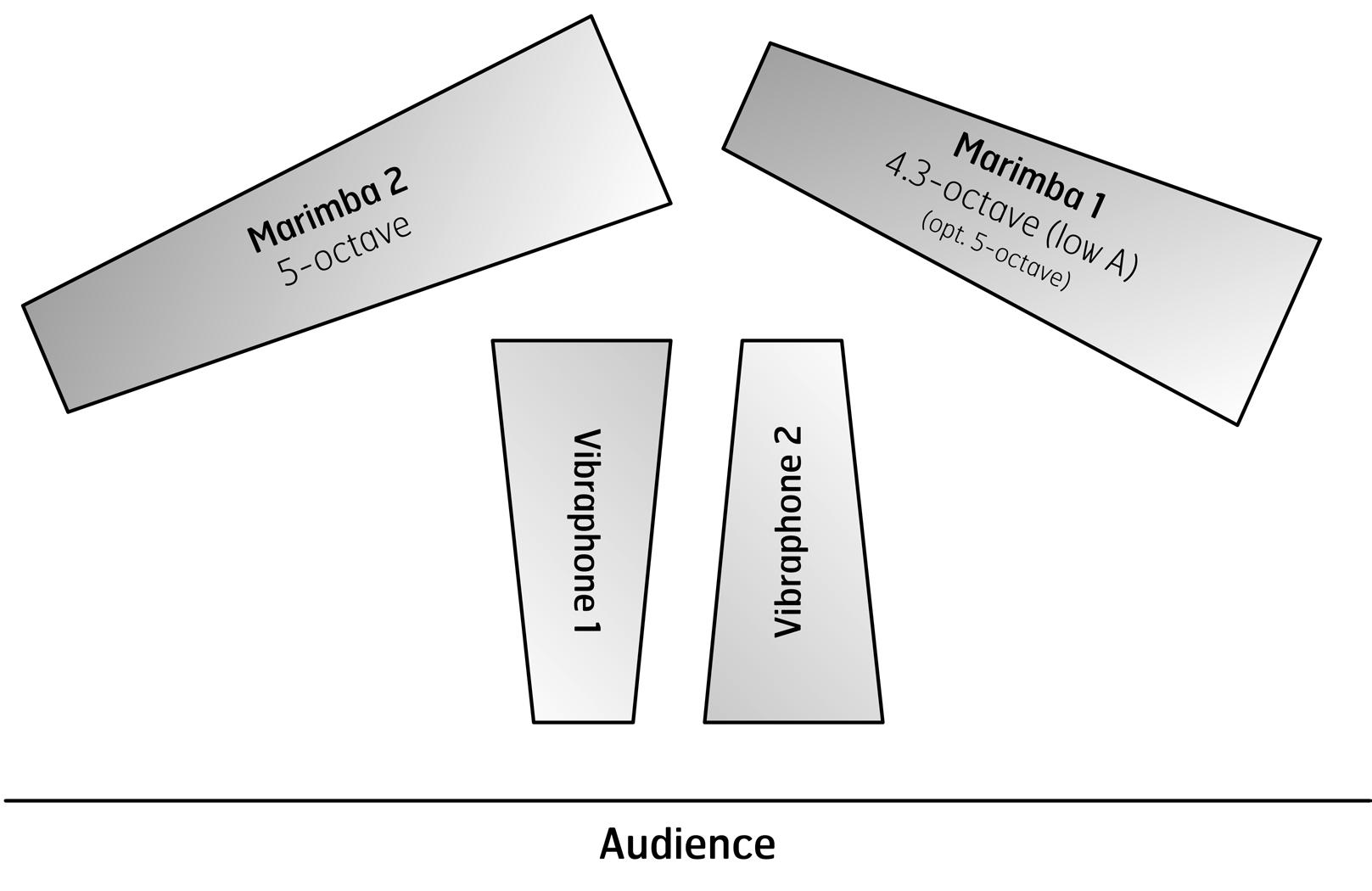
Push requires 4 players with the following instrumentation:
1. Vibraphone 1
2. Vibraphone 2
3. Marimba 1 (low A, optional 5-octave)
4. Marimba 2 (5-octave)
SUGGESTED SETUP