PROGRAM & PERFORMANCE NOTES
About the piece: For a Christmas gift (right before the COVID-19 shut down), my wife surprised me with a brand-new instrument, a handpan. While comparable to its older percussion relative, the steel drum, there are many unique characteristics that put the handpan into its own category, including its convex shape, diatonic tuning, and use of the hands instead of mallets. Over the next year and a half, my time at home with this beautiful and intriguing instrument yielded a new piece, with an appropriate title.
Listening: With any new instrument, listening and inspiration are vital parts of the learning process. During my exploration of the handpan, I discovered a musician named Sam Maher. I find Sam’s artistry breathtaking. His technique is inspiring and his compositions are true works of beauty. It was by transcribing his piece “New York” that I gained perspective on many of the concepts below.
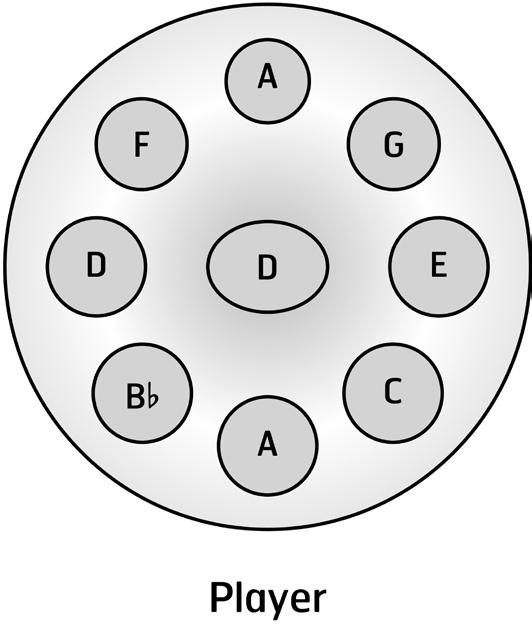
Handpan type: At Home was composed on a 9-note D Kurd handpan. This is a natural minor scale (Aeolian mode).
Note collection (lowest to highest): D (low/center)/-A-Bb-C-D-E-F-G-A (Sounding pitch is one octave lower than written in the score.)
Handpans are diatonic, which means they can only play in one key (two if you count relative major/minor). Many different styles of handpans exist, in different keys, with different names associated with each unique mode (scale). It is possible for At Home to be played on a different type or handpan in a different key, as long as the pan is rooted in the Aeolian mode and has the proper scale degrees (1/-5-b6-b7-1-2-b3-4-5).
For example:
Handpan type: C Aeolian 13
Note collection: C/-F-G-Ab-Bb-C-D-Eb-F-G-Ab-C-D
On that drum, only the bold notes would be used in At Home. Keep in mind that different note orientations might necessitate different “stickings.”
Drum orientation (low A closest to you):
Basic tone: Producing a fundamental tone is done by gently striking and releasing the “tone field,” which is the outermost circle around the indent, or “dimple.” This can be done by any finger or thumb (at times similar to a light bongo technique). The center tone, also called the “ding,” is struck directly on top.
Which hand or finger do I use? Once the note layout is learned, using the right vs. left hand is quite intuitive. Choosing which digit to use is largely based on personal preference and comfortability, but there are times when choosing a specific finger or thumb can really help. For example, using the thumb on the lower notes closest to you (Bb, A, C) can help the wrist to remain physically comfortable. Another common technique is alternating between the thumb and index in the same hand, creating fluidity over arpeggios. Phrases where I’ve used this technique are indicated throughout.
1 = thumb (RH); 2 = index (RH); L = your choice of LH finger
Note: Using this pattern on Bb arpeggios (indicated in measure 3) requires reaching across the drum, which is fun to play and fun to watch, especially at letter J.
Percussive sounds: The handpan can achieve a wide array of sounds in different areas of the drum, from slaps to knocks, providing an added layer of texture, rhythm, and even harmonics. While At Home doesn’t prioritize any particular non-melodic sound, by allowing my hands to relax and stay close to the drum, I noticed some subtle sounds naturally occurring on their own. Subtle finger taps (comparable to ghost notes) started to fill in spaces. I even noticed the occasional brush-like sweeping sound.
Places where ghost notes are more integral to the music are indicated with x notation. Allow the finger to fall very lightly so that these notes become a rhythmic texture rather than a solid melodic pitch. You can also strike closer to (or on) the “interstitial” (the space between the notes). If it proves difficult to achieve a tone-free strike, you can delete the note altogether to preserve the melody.
Acoustic and collaborative considerations: At Home is written for solo handpan but may be performed with accompanying rhythm section or other collaborative instruments. If you choose to collaborate with a rhythm section, I would suggest amplifying the handpan to avoid having to play too hard to compete for volume. The handpan is often played as a solo instrument (or with other handpans) and is acoustically quieter than any other percussion instrument struck with a stick or mallet, or any amplified instrument. Like steel pan, it can go out of tune with heavy-handedness over time. The rhythm section’s playing should reflect this sonic awareness as well. Strongly consider the use of brushes (or softer stick implement) by the drummer from start to finish. If available, an unmic’d, acoustic upright bass would also be an appropriate choice. If a mallet instrument is to be incorporated, I would suggest a vibraphone for its sustaining capabilities. (Piano could also work.) Use the instrument sparsely, playing occasional chords (lead sheet included) or partial melodic embellishments, always leaving space for the handpan to be the focus.
[A version of At Home for marimba and vibraphone duet (with optional drumset and bass) is also available from Tapspace.]
Form: On the first time through the piece, do not play the repeats at letter F. At the end of page 4, take the D.S. back to letter A as instructed. However, after taking the D.S., you will only play the sections at letter A, E, F (with repeats this time), and G, ending where it says Fine
Demo video: For added convenience, At Home comes with a supplemental demonstration video by the composer that demonstrates various sections of the solo slowly and from an overhead point of view.
m i st e r i o so , e spr e ssi v o