RYAN LOUD
At Home by Ryan Loud © 2026 Tapspace Publications, LLC (ASCAP). All rights reserved. tapspace.com
Notice of Liability: Any duplication, adaptation, or arrangement of this composition requires the written consent of the copyright owner. No part of this composition may be photocopied or reproduced in any way without permission. Unauthorized uses are an infringement of the U.S. Copyright Act and are punishable by law.
TSPCE26-012
PROGRAM NOTES
For a Christmas gift (right before the COVID-19 shut down), my wife surprised me with a brand-new instrument, a handpan. While comparable to its older percussion relative, the steel drum, there are many unique characteristics that put the handpan into its own category, including its convex shape, diatonic tuning, and use of the hands instead of mallets. Over the next year and a half, my time at home with this beautiful and intriguing instrument yielded a new piece, with an appropriate title.
At Home started as a solo (also available from Tapspace) for a D natural minor handpan. While standing strongly on its own as a solo, the groove and chordal nature of the piece inspired a unique collaboration, leading to a recording featuring North Indian tabla and sparse colorations from drumset, bass, and vibes. Though composed on handpan, At Home also translates well to keyboard percussion. In an effort to make the music accessible to a broader percussion audience, I have taken the liberty of arranging it as a duet for marimba and vibraphone, with optional parts for drumset and bass. —Ryan Loud
PERFORMANCE NOTES
Vibraphone (2 mallets): Touch dampenings and specific pedalings are indicated throughout. If no specific direction is given, pedal to achieve note length and full tone. Dotted 16th rhythms presented at C and D (if easier to conceptualize) can be thought of as similar to 8th note triplets with a more laid-back interpretation.
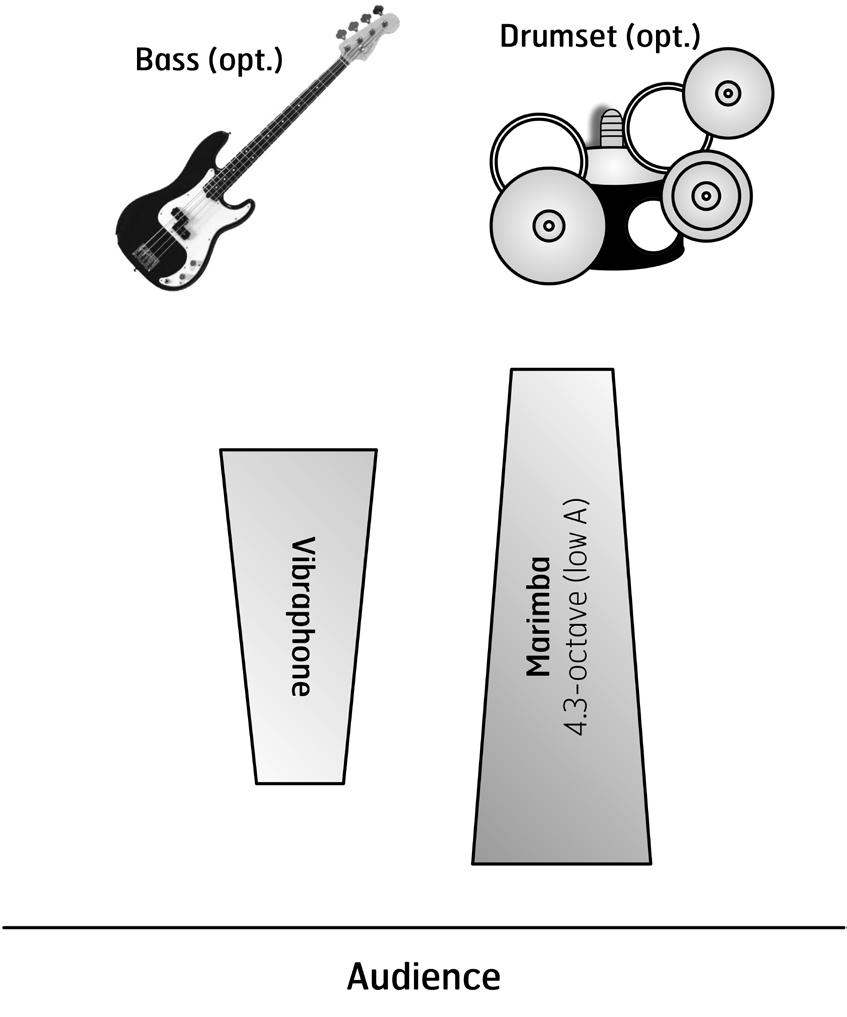
Marimba (4 mallets): Play one octave lower than written throughout (to facilitate ease of reading). Stickings should be fairly intuitive with some room for personal preference. Suggested stickings are given throughout the piece.
A medium mallet would be appropriate for both vibes and marimba. Mallet choice should accommodate articulation, while still being able to convey warmth and sensitivity.
Drumset: Play supportively and with a light touch. Snare accents don’t have to be loud. Cymbal crashes can often be approached on top of the cymbal as opposed to through. Fills should be simple, complementing the music. Dynamics are provided to give deference to the general emotional shape of the piece, but (especially when using sticks) play a notch under the mallet players’ volume so that you can clearly hear the nuance. Drumset is an instrument steeped in language and expression, so a good drum chart should always leave room for the player to express — acting more like a guide for groove feel, kicks, overall texture, and build. While preserving a supportive relationship to the other instruments, feel free to expand or simplify based on your own ability level.
Bass (electric or upright): A basic chord lead sheet is provided above the written part for players who prefer that reading method or wish to explore their own creativity within the harmonic structure. Octave directions are given throughout the piece. The register of the bass part adds to the overall composition, deepening as the piece progresses.