On View
Museum Galleries | Santa Fe M Visit gokm.org 'r m're in 'rmati'n ,
Michael Namingha Disaster #8 il#+c*een 'n can.a+ × in e'*gia Keeffe Pelvis Series, Red with Yellow , 1945. "$ '& &. + , × 4 "&. /, & ' & , *". , '$$ ,"'& . Gift of the Georgia O ’Keeffe Foundation © Georgia O’Keeffe useu% . [L.1997.3.4] Jason Garcia. TEWA TALES OF SUSPENSE ! #134 Fogeri 1977 ‘Welcome to Tewa Country ’, 2025. Hand-processed clay , %ineral pig%ents , traditional outdoor firing using ue lo pottery techni)ues . .5 × 13 in. | Georgia O’Keeffe. Pedernal, 1941. Oil on can.as , 19 × 30 1/4 in. Georgia O’Keeffe useu% . Gift of the Georgia O ’Keeffe Foundation . © Georgia O’Keeffe useu% . [2006.5.172] .
,
.
.
. |
’
.
|
Bernadette Pino
Traditional Santera
Rick Romancito
“Our Vast and Open Heart” 32” x 48” Acrylic on Canvas
Wilder Nightingale Fine Art 119 Kit Carson Road, Taos, NM • 575-758-3255 • wnightingale.com
EL ESPÍRITU DEL NORTE
N O RT H E R N R Í O G R A N D E NAT I O NA L H E R I TA G E A R E A
E
n El Norte conocemos tales guías fuertes, y sabios, que enseñan y ayudan y bendicen a los ciudadanos de las plazas y los pueblos. Y también sabemos de algunos centros del poder espiritual en El Norte, como El Santuario del Cristo de Esquipulas, en Chimayó. El Santuario de Chimayó verdaderamente muestra que es un sitio de “Santuario espiritual” para todos, no importa de dónde vengan. Casi todos en El Norte conocen bien el Santuario como un centro poderoso y milagroso, en donde los que sufren enfermedades del cuerpo, de la mente, del corazón o del espíritu pueden recibir profundo consuelo y curación por una combinación de su fe y por la tierra bendita que hay allí. El sitio del Santuario es muy antiguo. Durante miles de años la gente indígena, y luego los españoles, han ido allí para ganar
las bendiciones y las curaciones milagrosas de las aguas en un tiempo y ahora de la tierra bendita del Santuario. El Santuario de Chimayó es famoso y conocido por todo el mundo. Allí puede uno ser sanado y purificado no solamente de las aflicciones físicas, sino también de enfermedades de la mente y los sentidos, del corazón y hasta de la mera alma. El Santuario es un refugio espiritual para todos, en el medio de las tempestades del mundo. Damos gracias a los guías y los sabios del Norte y en el mundo. Damos gracias por los sitios sagrados como El Santuario. Se reza y se espera siempre por la Paz, y que se abran los corazones de la humanidad. Y, en fin y sencillamente, damos gracias por el acompañamiento del Espíritu del Norte en esta región de Río Grande de Arriba y por donde quiera en el mundo.
EL SANTUARIO DE CHIMAYÓ PHOTOS BY ELIJAH RAEL 12
L AND WAT E R P EOP LE TI ME
taosnews.com/landwaterpeopletime
14
L AND WAT E R P EOP LE TI ME
taosnews.com/landwaterpeopletime
taosnews.com/landwaterpeopletime
L A N D WATER P EO P L E TI M E
15
S
ome stories belong in the places that inspired them. At Los Luceros Historic Site, a partnership between the Santa Fe Film Institute and the Northern Rio Grande National Heritage Area is helping filmmakers tell those stories where Northern New Mexico’s history, culture and landscape meet. Makaio Frazier became the first recipient of the joint grant, using Los Luceros as the setting for his short film, “The Way We Carry Water.” After filing the initial application, which included proof of his eligible residency within the heritage area, Frazier, “submitted the first paperwork and then I had to put together a proposal for their board to review. “I spent about a week just writing out a treatment and I pitched the concept. Went above and beyond, I think it was like a 10- to 12-page document outlining what I wanted to do, who I wanted to bring in, how I wanted to make it happen. A month or two later I was shortlisted, which allowed me to go to Los Luceros Historic Site in Alcalde, and do a tour of the grounds, to meet with the folks, and they really liked what I had to offer. So just about a week later I got the call that I was the grant recipient.” Although the first movie Frazier worked on (as a set dresser in the art department), “Frybread Face and Me” (directed by Billy Luther, known for “Dark Winds”), Frazier had also worked on “Oppenheimer.” He was expanding his storytelling horizons, so here he shares how the requirements of this grant money actively shaped the narrative for “The Way We Carry Water,” a story about a young man struggling to preserve his family’s acequia after the death of his grandfather, and how Frazier navigated his own surging creative current: “For me, I had always wanted to make something in the bosque because of its natural beauty, and I’d never really seen it as a character on screen before. There’s a lot of Westerns shot here. There’s ‘Breaking Bad,’ which is Albuquerque, but Northern New Mexico,
FROM LEFT TO RIGHT : Lane Luper, Brett Becker, the man sitting is Alex Torres, then Makaio Frazier, Dylan Summer, Niccolo Snyder, Estevan Vigil, Alano Gonzales behind Estevan. / PHOTO BY KUBA KASKIEWICZ
taosnews.com/landwaterpeopletime
L A N D WATER P EO P L E TI M E
17
F I L M / S T O R I E S W O R T H S AV I N G
N O RT H E R N R Í O G R A N D E NAT I O NA L H E R I TA G E A R E A
PHOTO COURTESY CHILE LINE MEDIA
Makaio Frazier. / PHOTO BY JANNIS SCHELENZ
specifically, is this really unique place, especially the bosque. I mean water is so valuable. That’s our oasis in the desert as I like to say, so I wanted to capture that. So, when Los Luceros Historic Site was the location that we had to use for the film, I asked myself, ‘What kind of personal story do I have?’ And it was the relationship I had with water and my grandfather. So, it’s just really fortunate. That was also the cool thing about the grant, was that not only did you get the financial resources, but then you also got to have access to the location, you know?” Marcos Martinez, left, and Aaryan Attreya, right. / PHOTO BY JANNIS SCHELENZ
18
L AND WAT E R P EOP LE TI ME
taosnews.com/landwaterpeopletime
After sharing his epiphany moment on the set of “Frybread Face and Me” in the midst of cleaning rat [scat] out of a decrepit mobile home, declaring, “This is awesome!” I asked why he thinks filmmaking is an important job to have. “Film has this really wonderful ability, like, you know when you’re writing a book, it’s literature, right? When you’re making music, it’s auditory. When you’re painting, it’s visual. But film is a blend of all of those things. The filmmaker’s job is to capture and act as a mirror for our shared histories, perspectives, legacies. And that’s why the power of filmmaking is something that I hope we value as a society because I feel like it’s one of the most complex art forms there is because it takes all of those mediums and puts them into one.” Frazier’s view is shared by the team at 7K Studios, where I had witnessed his fresh face on a distinguished panel, discussing making films in Northern New Mexico during the inaugural Taos Film Festival in April. 7K co-founder Sayer Danforth had this to add: “I feel like film’s a well-respected art form, where it’s like, ‘Well, I can tell you that story. I can write you that story, or I can show you the story and I can put an emotion into you using music and sound and somebody’s tone of their voice and all this stuff’ — so film just accesses all points of our senses. That, yeah, that bring it... it’s visceral.” Film may be culture’s most complete preservation technique (thus far) precisely for the onetwo punch that all art strives to achieve: to be felt and considered. “That’s why I love filmmaking. I want people to feel something,” Frazier says. “That’s my… hunger and passion for it. My whole goal is to make you think about what-
CSHS_LWPT-July 2026_final
E. Martin Hennings, Drying Chiles, late 1920s
Experience the authentic story of Taos On view through October 17, 2026. imagemakersforamerica.org
The 2+ acre campus of Couse-Sharp Historic Site in the heart of Taos features the former homes, studios, and gardens of E. I. Couse and J. H. Sharp, two founders of the Taos Society of Artists. The complex of 19th and early 20th century buildings with original furnishings, ephemera, and art collections entices visitors into the confluence of creativity Taos represents. We offer exhibition hours, in-depth docent-led site tours by appointment, a unique research center for the study of early Taos art and its cultural context, and special events.
Learn more about our national treasure and menu of activities by requesting a free printed brochure and a link to the electronic version. Use the QR code or email us
couse-sharp.org thecousesharphistoricsite cousesharp Couse Sharp
TAOS, NEW MEXICO
575 .751. 0369 info@couse-sharp.org
taosnews.com/landwaterpeopletime
L A N D WATER P EO P L E TI M E
19
F I L M / S T O R I E S W O R T H S AV I N G
N O RT H E R N R Í O G R A N D E NAT I O NA L H E R I TA G E A R E A
Drew Lopez / PHOTO BY JANNIS SCHELENZ
ever it is that I’ve made and take your own personal sense from it, or your own, you know, emotion and create your own perspectives and your own ideas around it. And just get you to think about what it is that the story is translating to you. Not just an emotional reaction, but a cognitive one as well. “Yes, it’s got to blend. It’s got to do both things.” Frazier continues to pursue projects that blend those two goals on screen. IMAGE COURTESY CHILE LINE MEDIA
LEFT TO RIGHT: Eric Mendonca, Cassandra Olivas, Drew Lopez (visible, centered), Jasmine Olivas, Gene Ortega, Daniel Romero, and Andy Chavez. / PHOTO BY LANE LUPER
20
L AND WAT E R P EOP LE TI ME
taosnews.com/landwaterpeopletime
Alameda Waterlily Ponds 24x40 o/c
Silvery Nocturne 8x8 o/c
Morning Sky 8x8 o/c
See my Paintings at Wilder Nightingale Fine Arts (Taos), Legacy (Santa Fe) and Manitou Galleries (Santa Fe)
MINING
N O RT H E R N R Í O G R A N D E NAT I O NA L H E R I TA G E A R E A
RED RIVER, at the time called River City,
TOP: The Victoria was one of Red River’s first hotels. It only operated in the early mining era and is no longer in existence. BOTTOM: Mining allowed businesses like the Jayhawk Store to flourish, grow and provide jobs that allowed the community to survive. The store was one of Red River’s first and most successful general stores. RIGHT: Early Taos skiers on the mountain in 1932.
32
L AND WAT E R P EOP LE TI ME
was laid out in 1894 amid hundreds, likely thousands, of mines, according to Archeologist Michael Burney, who spent seven years studying the impacts of mining in Red River. By 1905, Burney notes, Red River had 3,000 residents, 15 saloons, four hotels, two newspapers, a hospital and a sawmill. Mining began to wane in the early 1900s, and Red River briefly became a ghost town. “It wasn’t until about 1930, Red River was promoted as a ‘mountain playground’ to tourists desperate to escape the Dust Bowl,” Burney explains. “The trend continues today.” Little Red Schoolhouse Museum Director Mary Miller credits that transition to the mountain pass, now called the Old Red River Pass, constructed in 1917 which made the area accessible to tourists looking for hunting, fishing and mountain recreation. Former publisher of the now-defunct weekly newspaper the Red River Miner, Fritz Davis tells an oral history of a journalist boosting the draw with a story about the mountain town’s incredible trout fishing. “The fact that the mining played out so quickly, the town should have died, like Elizabethtown eventually did,” Davis says. “It’s the same kind of people today who were here in the early days. People who want to be in the mountains are drawn here for some reason.” Tourism first brought visitors to Red River in the 1930s, but skiing helped secure the town’s future. Locals built an early rope tow that operated for one day Dec. 7, 1941, but everything changed when Red River Ski Area opened in 1959, giving the community a new economic foundation that complemented its growing reputation for fishing and mountain recreation.
FROM SO-SO MINING TO WORLD-CLASS SKIING Over the mountains in Twining, with similar quality ore, mining proved just as difficult. Rick Richards wrote in his book “Ski Pioneers” that the mines in the Twining area only yielded around $100,000 of
taosnews.com/landwaterpeopletime
gold, but it was mostly copper. Instead, another resource proved far more valuable: snow. “A community of more than 350 residents sprang up with the opening of the mine, but faded away with the failure of the mill,” notes Mickey Blake, the eldest son of Taos Ski Valley founders Ernie and Rhoda Blake. On both sides of the mountain, ore contained relatively little gold, making hard-rock mining expensive. Without a nearby smelter to separate the gold from the rock, costs added up to haul ore over the rugged mountain passes. Unlike Red River, Twining remained isolated after mining declined. It wasn’t until after World War II that Orville E. Pattison purchased the abandoned mining claims, eventually clearing the title and paving the way for Ernie Blake’s vision of what became Taos Ski Valley. As Pattison’s grandson Roger recalled, reaching the property was an adventure in itself. “I think the first trip my grandfather made up that canyon involved 13 stream crossings,” he says. Roger Pattison recalls his uncle, also named Roger, was fascinated by the area’s mining potential, earning a geology degree and spending decades searching for mineral deposits. “You can pick up a spoonful of dirt nearly anywhere up in that whole valley and see gold,” Pattison recalls. “There’s plenty of evidence that there should be gold and silver up there. But nobody has ever found the big vein.”
unearthing futures
desenterrando futuros 6.27.2026—2.28.2027
taosnews.com/landwaterpeopletime
L A N D WATER P EO P L E TI M E
33
Caja N O RT H E R N R Í O G R A N D E NAT I O NA L H E R I TA G E A R E A
ONE OF NORTHERN
del Rio PROTECTI NG T HE
b y G a r re tt Ve n e k l a s e n
N E W M E X I C O ' S M O ST S I G N I F I CA N T C U LT U R A L L A N D S CA P E S
I
f I were asked to pick only one iconic landscape in New Mexico that personified our state’s remarkable and rich tradition of Indigenous and Hispano history, it would be the Caja del Rio Plateau. Just southwest of Santa Fe, the roughly 107,000-acre volcanic plateau rises between the Rio Grande and Santa Fe River. Its basalt escarpments, canyons and open grasslands hold thousands of petroglyphs, archaeological sites, sacred places and historic travel routes. Beneath the volcanic rock and ash, ancient lake bed sediments preserve fossilized trackways left by prehistoric camel ancestors that once roamed North America, offering a glimpse into a landscape millions of years older than its human history.
Wilderness advocate, author and conservation photographer Jim O’Donnell atop Tetilla Peak looking west toward Cochiti Lake. Tetilla Peak is considered sacred to the Native people of the Caja.
34
L AND WAT E R P EOP LE TI ME
taosnews.com/landwaterpeopletime
The Caja is also a vital wildlife corridor connecting the Jemez, Sangre de Cristo, Sandia and Manzano mountain ranges. This is a living cultural landscape, where sovereign Pueblo Nations have utilized this singular place since time immemorial. Tesuque, Cochiti, San Ildefonso, Kewa, Jemez and other Pueblo communities maintain deep cultural and spiritual ties to the plateau. Their ancestors built villages and irrigation structures and left petroglyphs in the basalt canyon walls. Pueblo people continue to use the Caja for ceremony, pilgrimage, hunting, gathering and other traditional practices. One of the plateau's best-known cultural resources is the La Cieneguilla Petroglyph Site along the Santa Fe River, where hundreds of petroglyphs created between the 13th and 17th centuries are carved into basalt cliffs. Spanish colonists came north in 1598 along El Camino Real de Tierra Adentro,
following routes long used by Indigenous peoples for trade and travel. The residents of traditional Hispano communities including La Bajada, La Cienega, La Cieneguilla and Agua Fría are descendants of generations who have relied on the landscape for grazing, farming, firewood, hunting, foraging and spiritual sustenance. La Bajada itself became one of the most formidable passages along El Camino Real, dividing the Rio Arriba and Rio Abajo regions. In the early 1900s, New Mexico's first state highway, Highway 1, followed the Camino Real across the Caja, including the steep climb over La Bajada Mesa. Completed in 1909, its dramatic switchbacks were considered one of the nation's most ambitious road-building projects. Early automobiles, including Model T Fords with gravity-fed fuel systems, often had to climb the grade in reverse to keep gasoline flowing to the engine, while travelers frequently hired local drivers from the Village of La Bajada to navigate the dangerous route.
COURTESY
Residents also sold water to motorists whose overheated vehicles stopped at pullouts along the ascent. Route 66 later followed the same corridor across the Caja until 1937, when the highway was rerouted to a gentler alignment. Today, remnants of the historic road and its switchbacks still wind across the mesa, linking the region's transportation history to much older trails. The old road, its switchbacks and the traces of earlier routes are reminders that the Caja has long been a crossroads between Central and North America — a place of migration, commerce and cultural exchange long before there were borders between Mexico and the United States or a state called New Mexico. ALL PHOTOS BY GARRETT VENEKLASEN EXCEPT WHERE NOTED
taosnews.com/landwaterpeopletime
L A N D WATER P EO P L E TI M E
35
A
THE CAJA DEL RIO
N O RT H E R N R Í O G R A N D E NAT I O NA L H E R I TA G E A R E A
separate highway bypass across the plateau has also been discussed over the years as a way to serve commuters traveling to Los Alamos. Although that proposal remains conceptual, it illustrates why advocates believe piecemeal decisions could gradually erode the Caja’s cultural and ecological integrity. Efforts to secure permanent protection began more than 15 years ago, when the Coalition for La Bajada Mesa sought a national monument designation. The campaign later broadened into the Caja del Rio Coalition, bringing Pueblo Nations, Hispano communities, grazing permittees, hunters, anglers, recreation groups, watershed organizations and conservation advocates into a long process of outreach and consensus building. For years, advocates considered several paths, including a national monument, a national conservation area and a special management area. The process was slow because the Caja’s complexity demanded that Pueblo and Hispano communities help shape any proposal rather than simply react to one. By the end of the Biden administration, the All Pueblo Council of Governors and Santa Fe County had adopted resolutions supporting permanent protection, but a monument designation was not completed before President Joe Biden left office. → 42
38
L AND WAT E R P EOP LE TI ME
taosnews.com/landwaterpeopletime
T
THE CAJA DEL RIO
N O RT H E R N R Í O G R A N D E NAT I O NA L H E R I TA G E A R E A
he effort has now shifted to Congress. In spring 2026, U.S. Sen. Martin Heinrich introduced the Caja del Rio Protection Act with support from New Mexico’s congressional delegation. The legislation would establish protected areas managed by the Bureau of Land Management and U.S. Forest Service, prohibit new mining and most new roads and utility corridors, protect sensitive cultural information and preserve grazing, hunting, gathering and other traditional uses. It would also require federal land managers to consult with nearby Pueblo and traditional Hispano communities. The legislation does not stop the already approved transmission line, and passage in the current Congress is far from certain. Still, the bill represents something that once seemed elusive: broad agreement among communities whose relationships with the Caja are distinct but deeply rooted. The Caja del Rio is more than a scenic plateau or a battleground over public policy. It is a living cultural landscape where Indigenous traditions, Hispano communities, wildlife and centuries of history continue to intersect. However Congress ultimately acts, the debate reflects a larger question: how Northern New Mexico chooses to protect the places that define its identity. CAJADELRIO.ORG Garrett VeneKlasen is the Northern Conservation Director at New Mexico Wild. Caja cattle permittee Julian Gonzales sits overlooking the Rio Grande White Rock Canyon on the west side of the Caja del Rio Plateau. In addition to protecting the Caja's ecological treasures, current legislation aims to preserve traditional Indigenous and Hispano cultural land use. 42
L AND WAT E R P EOP LE TI ME
taosnews.com/landwaterpeopletime
This 20 mile section of White Rock Canyon on the western side of the Caja del Rio Plateau along the Rio Grande is magical, wild and untamed country.
taosnews.com/landwaterpeopletime
L A N D WATER P EO P L E TI M E
43
N O RT H E R N R Í O G R A N D E NAT I O NA L H E R I TA G E A R E A
THE RETURN OF BLUE LAKE
President Theodore Roosevelt at his desk 1906 / COURTESY LIBRARY OF CONGRESS
THE CRISIS BEGAN IN 1903,
48
L AND WAT E R P EOP LE TI ME
ROBERT L. KNUDSEN/COURTESY NATIONAL ARCHIVES
at a time when the nearby town of Taos was undergoing a discovery of its own by artists and writers who flocked to this quaint village seemingly frozen in time and surrounded by a breathtaking landscape. In the meantime, “the West was still slowly being parceled, packaged, and settled,” according to an article in the National Archives titled “Righting a Wrong: The Return of Blue Lake to Taos Pueblo.” That November, the Secretary of Agriculture requested that the Secretary of Interior “temporarily withdraw a swath of forest in the Territory of New Mexico for a forest reserve — much to the dismay of the Taos Pueblo, who had lived in the area for thousands of years and made treks into that very forest for religious ceremonies. Within a month, the Secretary of Interior complied,” the article continued. “‘Constant dread.’ That’s how Vernon Bailey of the Bureau of Biological Survey reported the Taos Pueblo felt about the land grab shortly thereafter. But in 1906, President Theodore Roosevelt made the withdrawal permanent; the land, and thus Blue Lake, were now a national forest.” It is noted that the Office of Indian Affairs pushed back, with both the Commissioner of Indian Affairs as well as the
local superintendent, who petitioned for the land to be returned in 1912 and 1918, only to be rebuffed on both occasions. “The Pueblo Lands Board, which was established in the 1920s to address lands taken from all of the various Pueblos, failed to rectify the situation, as the board
could only reimburse the value of taken lands, not actually return them,” the National Archives article continued. “A compromise, the first of many, was reached in 1927 — a cooperative agreement between the Taos Pueblo and the Secretary of Agriculture covering the disputed section of the Carson National Forest. The agreement allowed lumbering and forage within the area for natives, required tribal approval for camping and issuance of access permits, and ensured privacy for the tribe’s religious ceremonies.” That’s right. In order for the Taos Pueblo people to continue using Blue Lake and its surrounding lands for Native religious ceremonies that had been practiced for time immemorial, they would have to obtain a special use permit from the Carson National Forest Office. This included the ancient practice of taking game and other foods to feed Pueblo families under pain of punishment for breaking the law. Renowned local author Frank Waters fictionalized an incident based on reality in his seminal 1942 novel, “The Man Who Killed the Deer.” In this way, he helped readers understand the depth of offense the stolen land was having on the Taos people. Over time, many other non-Natives joined the cause, including local arts and culture maven Mabel Dodge Luhan.
Taos Pueblo interpreter Paul Bernal and Cacique Juan de Jesus Romero look on as U.S. President Richard M. Nixon signs the Blue Lake bill, HR 471, deeding lands to the Taos and Pueblo American Indian tribes on Dec. 15, 1970.
taosnews.com/landwaterpeopletime
A
lthough the government attempted to placate the Taos people by flat-out purchasing the land, the tribe would have none of it. It was the land, first and foremost, that they needed to maintain their spiritual health. Finally, on Dec. 15, 1970, U.S. President Richard M. Nixon signed HR 471, which became Public Law 91-550, which returned ownership of Blue Lake to Taos Pueblo after it was effectively stolen in 1906. Nixon’s support also involved the creation of a new American Indian pol-
icy of self-determination. Little known is the fact that Nixon’s motive for his support went back to his days in school when he was greatly inspired by a Native American coach, something that stayed with him for many years. Upon the signing of legislation, Nixon said, “This is a bill that represents justice, because in 1906 an injustice was done in which land involved in this bill, 48,000 acres, was taken from the Indians involved, the Taos Pueblo Indians … I can’t think of anything more appropriate or any action that could make me
more proud as President of the United States.” Speaking in Tiwa, Taos Pueblo Cacique Juan de Jesus Romero (through interpreter Paul Bernal), told those attending the bill signing, “In telling you the truth I go to Blue Lake with my little package of worship, with the thing that I have to give and offer to the spiritual way, to give thanksgiving of every day of my life for what we have in this country … A new day begins, not only for the American Indian, but for all the Americans in this country.”
Taos Pueblo tribal elder and Blue Lake-struggle veteran Gilbert Suazo, left holding drum, takes part in a procession starting off the Return of Blue Lake ceremonies Saturday, Sept. 18, 2010. / PHOTO BY RICK ROMANCITO
taosnews.com/landwaterpeopletime
L A N D WATER P EO P L E TI M E
49
N O RT H E R N R Í O G R A N D E NAT I O NA L H E R I TA G E A R E A
w d e b r a Behind b
THE LITTLE-KNOWN STORY OF THE SANTA FE JAPANESE INTERNMENT CAMP
O
ne picture is worth a thousand words, and Dorothea Lange said it all through the lens of her camera — including the devastation of captivity in a U.S.-imposed Japanese Internment Camp. On Dec. 7, 1941, the Japanese bombed the naval base at Pearl Harbor in Hawaii. The attack drew the previously neutral
50
L AND WAT E R P EOP LE TI ME
United States into World War II. Weeks later, President Franklin Roosevelt issued Executive Order 9066 authorizing the forced relocation of Japanese Americans. Most of the incarcerated individuals were American citizens forced to sell their homes, businesses and belongings quickly, often accepting offers far below their true value. Family members were sometimes sent to different camps, causing family separations. Some Japanese men
taosnews.com/landwaterpeopletime
received the distinction of “troublemaker” or “dangerous,” with false or no charges to collaborate the titles. Such association occurred because of the subjects’ previous leadership role or respect in their communities. For over a decade, Taos High School students learned about the internment camps by studying "Farewell to Manzanar," a memoir by Jeanne Wakatsuki Houston and James D. Houston. Jeanne’s
A
mong the artists helping shape that future is Chimayó weaver Emily Trujillo, who teaches through EVFAC and represents the kind of bridge between tradition and innovation the center hopes to foster. The eighth-generation weaver grew up surrounded by looms at Centinela Traditional Arts, the gallery operated by her parents, nationally recognized weavers Irvin and Lisa Trujillo. Today, she sees preserving the tradition as one of her life’s missions. “I feel very honored, not burdened, but it matters a lot to me,” Trujillo says. “I feel like I have this connection to my ancestors that other people don’t get to have, so it’s also sort of lucky. And I absolutely feel the weight of that responsibility all the time.” Studying ethnology at the University of New Mexico convinced Trujillo that preserving her own culture mattered. Rather than pursue careers in neuroradiology or mental health, she chose weaving because she wanted to remain in Northern New Mexico with her family and help carry the tradition forward. “I only came back to weave because I felt responsible for carrying it on,” she says. “Every day with fewer and fewer people weaving and with the industry dying, I feel more and more weight all the time.” Instead of leaving New Mexico, Trujillo devoted herself to weaving, teaching and helping introduce the tradition to new audiences. “The more exposure we get, and the more people get interested, I think the better chance we have of helping it survive,” she says. “I’m going to try and save it.” Today, Trujillo represents both continuity and change. While honoring the Rio Grande and Chimayó traditions passed down through eight generations, Trujillo isn’t
afraid to let the modern world into her work. Contemporary music, including K-pop, has inspired some of her boldest designs and even helped push her beyond her comfort zone as an artist. Rather than seeing those influences as separate from tradition, she views them as part of her own story. “I know about the tradition. I understand the tradition,” Trujillo says. “I take little bits of my tradition, and then I put it into my art.” A goal of someday seeing a K-pop artist wear one of her designs became the motivation that pushed her outside her comfort zone and encouraged her to think about how traditional weaving could speak to a new generation. “I really love the process,” Trujillo says. “I love the history behind it. I love the fact that it’s a part of my family, and it just makes me feel connected to other people and my ancestors and just my culture.” Zitzow sees Trujillo’s work as evidence that tradition survives by growing rather than standing still. She points to Trujillo’s collaboration with a designer in Japan and her ability to blend contemporary interests with centuries-old weaving practices as examples of cultural exchange rather than cultural loss. Those kinds of connections, Zitzow says, help younger generations recognize that traditional arts remain relevant in today’s world. The future of Northern New Mexico’s fiber arts depends upon that balance. Trujillo says about 300 weavers once worked professionally in Chimayó. Today, barely more than two dozen remain as many younger residents pursue careers elsewhere. Apprenticeship programs, including efforts supported through EVFAC and its partners, are helping train a new generation while creating pathways into the craft and broader markets.
PHOTO BY LISA TRUJILLO
→ 66
taosnews.com/landwaterpeopletime
L A N D WATER P EO P L E TI M E
63
N O RT H E R N R Í O G R A N D E NAT I O NA L H E R I TA G E A R E A
WOVEN THROUGH TIME
Tiny experimental weaving by Emily Trujillo.
COURTESY ESPAÑOLA VALLEY FIBER ARTS CENTER
Emily Trujillo sewing. / PHOTO BY KEIA ROACH
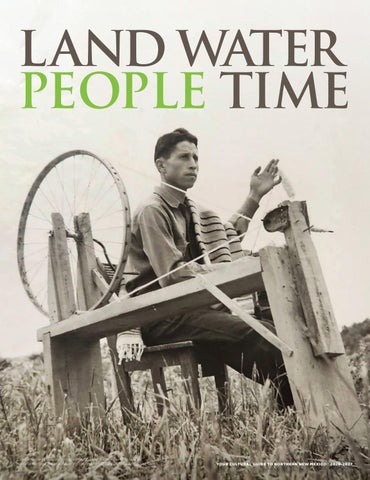
Grandpa Jake (Jocobo) Trujillo spinning c. 1928, El Rito, NM / PHOTOS COURTESY EMILY TRUJILLO EXCEPT WHERE NOTED 66
L AND WAT E R P EOP LE TI ME
taosnews.com/landwaterpeopletime
FROM SHEEP TO SHAWL Emily Trujillo's Rio Grande/Chimayó weaving class at Española Valley Fiber Arts Center . / PHOTO BY DEBBIE HARRIS
W
hat gives Zitzow hope is not simply preserving old techniques but preserving the relationships behind
them. Every handwoven textile, she says, is built “weft line by weft line.” That slow rhythm teaches patience in a fast-moving world and reminds people that making something beautiful still requires time.
“Every culture has had a textile tradition,” Zitzow says. “It’s this thing that connects us through time, like our humanity. I think that’s a really important thread to maintain.” In Northern New Mexico, that thread stretches from pasture to loom, from grandparents to grandchildren, and from centuries-old traditions into the hands of the next generation.
Los Luceros Historic Site in Alcalde preserves a living flock of endangered Navajo-Churro sheep, helping visitors understand where Northern New Mexico’s textile traditions begin. During its annual Sheep Shearing Day, visitors can watch traditional shearing, learn how fleece is cleaned and prepared for spinning, and explore the role Navajo-Churro sheep have played in the region’s agricultural, cultural and weaving history. The site treats the sheep as part of its living collection, reinforcing the idea that every woven textile begins with healthy land, water, animals and skilled hands.
taosnews.com/landwaterpeopletime
L A N D WATER P EO P L E TI M E
67
N O RT H E R N R Í O G R A N D E NAT I O NA L H E R I TA G E A R E A
Renewing the heart of Taos BY DAVÍD FERNÁNDEZ DE TAOS
A
t the center of Taos County Plaza, the Old Taos County Courthouse is preparing to open its doors again after years of planning, fundraising and construction. The work is restoring more than an aging public building. It is preserving a place where the long, complicated and still-unfolding story of Taos has repeatedly come into view. Almost any attempt to write even a relatively small part of the ongoing Taos story becomes charged by the historical and cultural forces that have shaped Taos and Northern New Mexico. They are dramatic, traumatic and, at times, nearly thaumaturgic. A straightforward account of a courthouse renovation soon becomes a meditation on how daily community life, repeated across generations, becomes history, legacy and heritage.
Above: A photo of the 1975 plaza renovation / TAOS NEWS FILE PHOTO
LEFT: One of several county courthouse murals commissioned by depression-era New Deal agency the Works Progress Administration. ABOVE: County courthouse WPA works in progress.
68
L AND WAT E R P EOP LE TI ME
taosnews.com/landwaterpeopletime
N O RT H E R N R Í O G R A N D E NAT I O NA L H E R I TA G E A R E A
TA O S C O U N T Y C O U RT H O U S E
RESTORING A LANDMARK FOR THE NEXT GENERATION
E
ach July, the Fiestas de Taos de Santiago y Santa Ana bring families and generations together on Taos County Plaza. Faith, music, song, dance and parades fill the space. Languages and traditions echo across time and circumstance, not as museum pieces but as parts of a living community. The Old Taos County Courthouse is one of the clearest expressions of that landscape. Its courtroom murals belong to a particular chapter of New Deal-era art and public works, but the building’s meaning extends beyond architecture and art history. It has been a place of law, government, memory and community identity. The current restoration aims to preserve that history while returning the building to active public use. Taos County Construction Administrator Richard Sanchez has said the renovated courthouse is expected to accommodate exhibits, meetings, cultural programming and other community functions. Officials were considering a grand reopening in September or October 2026, though the date remains subject to completion of the work. When the courthouse reopens,
visitors will again be able to experience the courtroom and its murals within the building for which they were created. Residents will regain a civic gathering place on the plaza. The courthouse will resume its place not simply as a surviving structure, but as a working part of the community around it. That distinction matters in Taos. Preservation here is not only the act of holding something still. It is the work of carrying a place forward without severing it from the people, stories and traditions that gave it meaning. The courthouse, the plaza and the buildings around them are historic structures, but they are also part of Taos’ living story. Day by day and year by year, they continue gathering new memories alongside the old. In that sense, Taos County Plaza resembles a Tío Vivo, the old Taos carousel whose figures circle through a shared space again and again. The riders change. The music rises and fades. Generations step on and off. But the turning continues, carrying the community past familiar landmarks while always returning it to the heart of Taos.
The Old Taos County Courthouse restoration is doing more than repairing an aging adobe building. The project is preserving one of Taos County Plaza’s defining public spaces while making it safer, more useful and accessible to everyone. Improvements include an ADA-compliant elevator and accessible restrooms, upgraded life-safety systems and restoration of original architectural features. The project also includes conservation of the Works Progress Administration-era murals in the historic courtroom, where paintings by Emil Bisttram, Victor Higgins, Ward Lockwood and Bert Geer Phillips remain among the building’s most significant cultural treasures. The work is intended to improve the visitor experience without erasing the character of the courthouse. When the building reopens, visitors are expected to be able to explore the historic courtroom, view the murals in their original setting and encounter interpretive features connected with the courthouse and former jail. The restored building is also expected to provide flexible space for public meetings, exhibits, cultural programs and other community activities. That future use is central to the project: The goal is not merely to preserve the courthouse as an artifact, but to return it to public life. Taos County Construction Administrator Richard Sanchez said officials are considering a September or October 2026 reopening, depending on completion of the remaining work. Once reopened, the courthouse will again connect the architectural and artistic history of Taos County Plaza with the people who use the plaza today. Its restoration will allow a landmark shaped by earlier generations to serve the next one.
An event takes place outside the old Taos County Courthouse in Taos Plaza in this historical photo.
70
L AND WAT E R P EOP LE TI ME
taosnews.com/landwaterpeopletime
THE ART OF K AT I E B R I G G S
“ TURNING ROBE”10X8 GRAPHITE
T H E R A N C H AT TA O S G A L L E R Y 117B KIT CARSON ROAD TAOS THERANCHAT TAOS.COM . 325 647 5736 NEXT TO KIT CARSON HOME AND MUSEUM
taosnews.com/landwaterpeopletime
L A N D WATER P EO P L E TI M E
73
Protecting New Mexico’s waters since 1988.
Amigos Bravos protects and restores New Mexico’s waters, partnering with communities to ensure clean, healthy rivers sustain ecosystems, cultures, and future generations through restoring watershed health, holding polluters accountable, and building a waters movement. Projects Include: River Otter Reintroduction Native Species Protection Beaver Restoration Water Policy Advocacy Mining Reform Water Quality Monitoring Youth Leadership Watershed Restoration Wetland Jewels Technical Assistance
Learn more about our efforts and upcoming events:
@amigosbravos | amigosbravos.org taosnews.com/landwaterpeopletime
L A N D WATER P EO P L E TI M E
75