![]()


by Cindy Brown

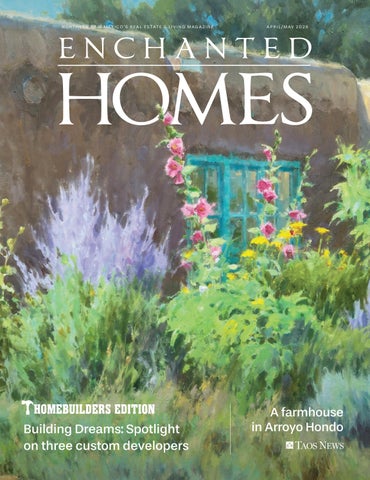
Arriving at this historic farmhouse in Arroyo Hondo feels like coming home. The expertly renovated house was built in Territorial style in the early 1900s. Tucked into the valley on two acres, the property previously grew alfalfa and has a thriving apple orchard.
The house has welcoming porches on the front and side that overlook the expansive yard which is irrigated by an acequia called the Plaza Ditch. As spring begins, vibrant flowers bloom next to the porches. Flagstone connects the house to the outdoors and forms bridges that cross the acequia.
The property has artifacts from the past, including the old well house now made into a birdhouse. The towering cottonwoods provide shade and create quiet sheltered spots for relaxing and watching the sunset. Views of Taos mountain are visible through the trees.


When they rst saw the house, Trakimas and Chase were immediately drawn to it. “ e walls spoke to us,” Trakimas said, “ e home had thick double walls and a certain gravitas to it.”
e home had been abandoned for about 25 years when they found it, and had no plumbing or electricity.
“Anyone else would have likely torn it down,” Trakimas observed. “We sat with it for a while before beginning work to renovate it. Although we had remodeled kitchens and bathrooms, this house turned into the biggest restoration project we ever did.”
e house was built as a classic, L-shaped, two-story farmhouse. Trakimas and Chase added an addition downstairs with a new kitchen, pantry and mudroom. ey opened up the existing downstairs to create a bigger entry and relocated the staircase.
Upstairs, they added the large primary bathroom and a second bath along with a laundry. All of the plumbing was installed in the new section to avoid disturbing the integrity of the original walls. During the extensive remodling process they extended electricity to the existing part of the home.
e result of their work is a home that seamlessly combines the old and new, retaining the historic charm while providing a comfortable and elegant contemporary feeling.
In the original part of the home, there are sitting and dining rooms, as well as a bedroom and half bath.
e dining area ows into the expansive and bright kitchen addition with the pantry and mudroom near the back entry. ere is a Dutch door leading outside — one of the many handcra ed doors in the home.

Upstairs the primary suite has a sitting area, cedar lined closet and views through the south facing windows. Its bathroom has travertine tile and a soaking tub under a window that can be opened to catch spring breezes.
ere is a large open space that is currently a media room but could be an o ce or artist studio due to its north facing skylights, Chase pointed out. e whole upstairs has the feel of a cozy attic and makes artful use of the roof pitch to create comfortable spaces.

e owners credit Steven Ninneman, founder of Taos Red Cabinet and Construction, with the custom woodworking like the staircase railing. e general contractor was Cadillac Builders, and Lafe Harrower was brought in to do the majority of the renovation work.


remembers what the first contractor he worked for in Taos repeatedly told him: “Whatever you do, don’t become a contractor.” Orner was young then — 20 and adventurous, a transplant from Montana, where he took woodworking in high school and was already making furniture.
That was 45 years ago and he's been building in Taos with his company, Up Front Construction, ever since. The business' name conveys Orner's goal of constant transparency.
He’s built hundreds of homes through the years, both contemporary and more traditional, Southwestern style. Still, his favorites are the adobes because of their curved details, weathered vigas, the way the material holds up over time, and how the walls hold the cool and quiet.
“It’s creating a new home in an old-world style that looks like it’s been there for 200 years,” says Orner, who prizes getting his clients the best deals and keeping the budget as low as possible. He knows that good communication and giving contractors plenty of lead time — to find lighting fixtures or plumbing features, for instance — keeps the process less stressful.
In all these years, Orner has seen an uptick in clients who want home offices, since more people are able to work remotely. A lot lean toward frame builds, because they’re cheaper, especially with material prices as high as they are right now.
“We can build a frame and it’s hard to tell it’s not adobe,” says Orner, who believes in affordable housing for all, and who’s looking into building more and more houses with smaller floor plans — 800 or 900 square feet — to keep costs down.

BY

AARON MAGEE was destined to build. His father, Vishu, is a renowned home designer, and, under his lead, Aaron worked on his first full house at age 15. Upon graduation from Taos High School, he began work in a cabinet shop before signing on to become an expert finish carpenter and job site foreman for one of Taos’ finest builders. He started his own construction company in his hometown of Taos in 2004. He’s done small remodels and million-dollar, detail-intensive homes.

“Growing up here has allowed me to build lifelong relationships with the building community and the community at large,” says Magee, who maintains a deep understanding of the land and resource pool here in Taos, including craftsmen, subcontractors, realtors, etc.
He’s also well versed in the local natural materials—wood, stone, adobe—which he loves working with for their timeless feel. When building trends change year to year and decade to decade, the Pueblo style stays consistent, even as more clean lines and modern twists like smart-home technology are implemented into the design. Think country contemporary. Magee also focuses in green building systems.
In this post-COVID world, Magee has seen the largest price increases of his career, coupled with a large demand and a labor shortage, which jacks prices even more. He tries his best to maximize his client's budgets by adding higher-end finishes in the main spaces and doing value engineering in the less-used areas of the home.
“For a lot of people building a home is the largest investment they’ll ever make and with that comes a lot of excitement and stress and emotion. My goal is to make the building experience as enjoyable as living in the new home,” says Magee, noting the grand orchestration of it all, and how there’s no better feeling than everything falling exactly into place.


As the Taos Valley Acequia Association’s website says, the annual cleaning of the acequias — our local irrigation systems — is considered a right-of-passage ceremony. It’s an honor to nish a big day’s worth of work clearing debris from the waterways our farmers and land stewards rely upon. It’s a community e ort that’s taken place every spring for four centuries.
Whether a generations-deep parciante (water rights holder), a newcomer
with ditch usage, a simple volunteer, giving to the land like this deepens one's sense of place and knowledge of these traditional systems. It’s fun, too — walking up an o shoot of the acequia madre (main waterway) with your neighbors and a shovel, tossing dirt buildup and fallen limbs out of the way.
“Cleanings used to be in April and May, but now everyone is planning early early March,” says the TVAA’s executive director, Judy Torres, about
the decreased snowfall we’ve been seeing over the years. e TVAA is in charge of 55 ditches from Arroyo Hondo to Llano Quemado. “It’s been a real challenge on us catching the peak run-o from the mountain. It’s all up to Mother Nature,” Torres says.
Torres encourages new homeowners to study the TVAA’s brochure on property acequia easements and the responsibility of water rights.
“We share in drought and we share in plenty,” she says.


TheRedArrowEmporiumwishestothankTaosfor 23 great yearsinbusiness.We love youTaos!
We are New Mexico’s favorite luxury and ne furniture store. We feature the best in American-made ne furniture, lighting, accessories, and art. The most original designs and stocked inventoryare ready to take home today. We are located just two miles North of the Taos Plaza, in the Overland Sheepskin Ranch. We are locally owned and family-operated. We feature Old Hickory Furniture, GreenGables, Classic Leather, Omnia, Marsh eld, andSimmons Beautyrest. Live with piecesyou love. You’ve been to the rest now come to the Best. See us on Facebook and Instagram.
Located at 1405 Paseo delPueblo Norte, El Prado. (575)758-0540