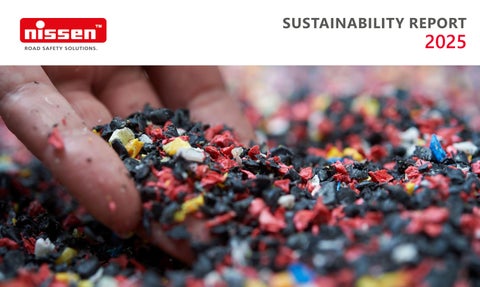
SUSTAINABILITY REPORT
2025
About Nissen
Materiality
Environment
Social
Governance
Index
Imprint
About Nissen ADOLF NISSEN ELEKTROBAU GMBH + CO. KG & NISSEN PLAST GMBH Nissen is a global technology leader, manufacturer, and supplier of products developed and produced to improve road safety. The products are designed to protect all road users and must therefore meet the highest standards of quality and functionality. The product range extends from safety lamps, safety beacons, and safety barriers to LED variable message signs and software for mobile telematics. At its headquarters in Tönning, northern Germany, Nissen operates three plants where nearly all products are manufactured using in-house production expertise and distributed internationally through its own sales network. The Nissen Group is represented externally by Adolf Nissen Elektrobau GmbH + Co. KG. The Nissen Group also includes the subsidiary Nissen Plast GmbH as well as the sales subsidiaries Nissen Switzerland, Nissen Polska, Nissen Iberica, Nissen UK, and Neuhauser in Austria. The sustainability report consolidates only the companies Nissen Elektrobau and Nissen Plast (hereinafter collectively referred to as “Nissen”) and thus differs from the scope of financial consolidation. The sales subsidiaries were excluded from the sustainability report because they are not considered material to the achievement of the goals or the calculation of CO2 emissions. Nissen Elektrobau is responsible for the production and development of electronic components, the fabrication of steel products, the distribution of the entire product portfolio, and the administration of both companies. Nissen Plast, meanwhile, specializes in the production of plastic products. Nissen employs a total of 254 people: 187 at Nissen Elektrobau and 67 at Nissen Plast. For competitive reasons, we do not disclose our sales revenue.
2
Sustainability Report 2025
About Nissen
Materiality
Environment
Social
Governance
Index
Imprint
About Nissen BUSINESS MODEL AND STRATEGY Our business model is based on the high-quality development and production of mobile traffic safety solutions. We place particular emphasis on the quality of the raw materials and components we use, especially plastics and metals. We source approximately 90% of these resources from national and European suppliers to ensure short transport routes, high quality standards, and compliance with European labor conditions. We only turn to non-European suppliers in exceptional cases, when certain components are unavailable within the EU or are not economically viable. We develop and design all our products in-house and manufacture them largely on our own with a workforce of about 250 employees. We source electronic components from selected suppliers and process them further in-house. We outsource parts of the preliminary and main production to companies within our group as well as to regional partners, including workshops for people with disabilities, in order to fulfill our social responsibility and keep transportation distances short. In the logistics sector, we primarily work with regional and national freight forwarders who deliver our products directly to customers or consolidation centers. Our rural location in North Frisia presents infrastructure challenges, such as higher transportation costs and greater difficulty in recruiting skilled workers, which we address through targeted investments and close regional partnerships. We serve national and international markets. Our key customer groups include road and highway authorities, municipalities, and public institutions, as well as
3
specialized traffic safety companies. In addition, we supply warning devices for organizations such as the police and fire departments. To ensure customer satisfaction, we offer supplementary services and product training. Our products are designed for a long service life, so repairs generally take priority over disposal. Due to legal requirements and complex product structures, recycling is currently only possible to a limited extent. Likewise, a comprehensive takeback system for customers is still under development. Nevertheless, we are continuously working to increase the proportion of recycled materials and further improve reusability. Our operational waste is disposed of in a professional and environmentally responsible manner. A central component of our business strategy is responsible and sustainable business practices. This is supported by our certified environmental, energy, and quality management systems in accordance with ISO 14001, ISO 50001, and ISO 9001, which we use to systematically manage and continuously improve our environmental and quality standards. CORPORATE STRATEGY Sustainable business practices have been an integral part of our corporate strategy for many years. With the motto “GEMEINSAM STARK. FÜR MEHR SICHERHEIT!”, we place a special focus on teamwork, high-quality products based on years of expertise and the courage to innovate, as well as on sustainable and future-oriented corporate development.
Sustainability Report 2025
About Nissen
Materiality
Environment
Social
Governance
Index
Imprint
About Nissen We communicate these values not only internally to our employees, but also externally to potential applicants—including through a VIDEO published in December on our newly launched careers website that highlights our goals and the sense of unity within the company. We pursue our corporate strategy steadily and consistently. However, should sustainability or other business risks emerge that require adjustments, we will make them within an appropriate framework.
We were able to achieve our first goal as early as 2024 with the publication of our first sustainability report for the 2023 fiscal year. In addition, since 2025, we have integrated our sustainability communications through a dedicated section on our website and a stronger presence on social media. A detailed examination of our other goals is provided in the following report.
SUSTAINABILITY STRATEGY In December 2023, we established our sustainability strategy for the period from 2024 to 2030. Based on the principle of double materiality, we developed a comprehensive strategy that covers all material issues in the areas of Environment, Social, and Governance. The goals were defined during an internal, cross-departmental workshop and were subsequently finalized by the Sustainability Task Force.
CENTRAL RESPONSIBILITY Nissen is represented by two managing directors and two authorized signatories. The top management team also includes the heads of sales, operations, and development.
Our sustainability strategy brings together existing goals from our certified environmental, energy, and quality management systems and aims, among other things, to continuously improve energy efficiency. Based on targeted consumption measurements, we identify appropriate measures and continuously refine our products to use and reuse resources efficiently. Another focus is on the safety, satisfaction, and professional development of our employees through appropriate working conditions and targeted training programs.
Gender Ratio in Management and Supervisory Bodies
Responsibility for sustainability reporting and the sustainability strategy lies with the management board.
Category
Total
Female
Male
Executive Management
4
1
3
Senior Management Level
3
1
2
Supervisory Board
3
0
3
4
“SUSTAINABILITY” TASK FORCE To provide operational support, the Sustainability Task Force consists of six members from various areas of the company, including the commercial managing director, the heads of the Human Resources and Legal departments, the sales and operations managers, the quality and environmental management teams, and the sustainability manager. This composition ensures that the Task Force has the necessary technical expertise for all areas of sustainability reporting. Monitoring the achievement of goals and preparing the report are primarily the responsibility of the Sustainability Manager, while the Executive Board and the Task Force are kept informed of current progress through regular meetings.
Sustainability Report 2025
About Nissen
Materiality
Environment
Social
Governance
Index
Imprint
About this report We have prepared this sustainability report for the first time on an individual basis in accordance with the European reporting standard “Voluntary Sustainability Reporting Standard for Small and Medium-sized Enterprises” (VSME). It is based on the draft from December 2024. We report on both the basic module and the supplementary module, supplementing them with additional content that we believe is essential for a comprehensive understanding of our sustainability performance. We publish the information required by the VSME using the reporting platform of the German Sustainability Code (DNK). For the sake of readability, we have often used the generic masculine form. This expressly includes all genders. CONTACT PERSON Hannah Leuchtmann HR & Legal Specialist, Sustainability Manager +49 (0) 4861-612-211 hleuchtmann@nissen-germany.com
5
Sustainability Report 2025
About Nissen
Materiality
Environment
Social
Governance
Index
Imprint
Materiality In 2023, we conducted a materiality analysis. This was based on a comprehensive environmental analysis consisting of an SDG impact analysis, a stakeholder survey, a benchmark against competitors, and the preparation of our first carbon footprint assessment. As part of the materiality analysis, we considered both internal company processes and upstream and downstream activities along the value chain. The SDG impact analysis identified Nissen’s relevant sustainability impacts, while the stakeholder analysis mapped out both the importance of individual sustainability issues from the stakeholders’ perspective and their expectations regarding future developments. The benchmarking study provided insights into the sustainability performance of comparable companies in the traffic safety industry, while the carbon footprint analysis identified key emission sources and potential opportunities for reduction. The results of these analyses were incorporated into the assessment of Nissen’s particularly positive and negative impacts across the various sustainability issues and ultimately led to a comprehensive evaluation of the impacts, opportunities, and risks within the framework of impact materiality and financial materiality, in accordance with ESRS. IMPACTS As part of our materiality analysis, we have identified a wide range of material impacts throughout our entire value chain.
Our business model has direct and indirect environmental impacts throughout the entire value chain. The provision and use of our products generate transportation volumes and additional private mobility, which has a negative impact on upstream, internal, and downstream areas. Although our business model is generally not energy-intensive, significant energy and resource consumption occurs in our own production processes as well as during product use. Land use is comparatively low but may increase as the company continues to grow. Additional environmental impacts result from the use of materials and non-renewable raw materials, as well as from production-related emissions, waste, and the management of durable products at the end of their life cycle. In the social sphere, our business activities have predominantly positive effects. Fair working conditions, opportunities for employee participation, equal opportunity, and an open work culture have a positive impact on our employees. In addition, training programs, transparent communication, and the active involvement of employees foster motivation and skill development. Potentially negative impacts arise where work processes pose health risks, such as through sedentary work, workplace accidents, or noise exposure. Upstream, social risks can arise from supplier selection and international value creation, particularly where labor law standards differ.
6
Sustainability Report 2025
About Nissen
Materiality
Environment
Social
Governance
Index
Imprint
Materiality From an economic perspective, our business model generates both positive and potentially negative effects. Significant societal value is created through the downstream impact of our products on road safety. Our focus on highquality solutions and long-term customer relationships also has a positive effect. At the same time, regulatory requirements and fluctuating material prices lead to increased costs and potential risks to efficiency and flexibility. Opportunities arise in particular from innovative product developments and increasing digitalization, which strengthen competitiveness and unlock efficiency potential along the entire value chain. RISKS Through our materiality analysis, we have also identified material risks that could affect our economic stability and future business development. These include, in particular, external factors such as climate-related product adaptation requirements, CO2 pricing, rising energy prices, volatile raw material markets, and the limited availability of finite raw materials. Legal requirements regarding compensation systems and general inflation also pose economic challenges. In addition, there are internal corporate risks, such as absences due to illness, employee turnover, or employee dissatisfaction. Rising expectations from stakeholders and
regulators regarding transparent and detailed sustainability information also lead to increased efforts in data collection and communication. Another significant risk stems from the growing and, in some cases, divergent regulatory requirements, which necessitate a continuously adapted compliance management system. Overall, the materiality analysis makes it clear that regulatory, environmental, and social factors require a proactive refinement of our corporate strategy. OPPORTUNITIES We have also identified material opportunities that will have a positive impact on our corporate development. Low employee turnover, driven by good working conditions and a stable work environment, strengthens employee retention and ensures the preservation of internal expertise as well as consistently high service and product quality. Regular training and targeted development initiatives further enhance employee competence, boost innovation, and strengthen our competitiveness. Another opportunity arises from the ongoing maintenance and modernization of transportation infrastructure, which generates stable demand for traffic safety and traffic management products and has a positive impact on our financial position.
7
Since the business model and the basis for assessing impacts, risks, and opportunities have not changed significantly recently, a reassessment was not conducted. A revision of the materiality analysis is planned for 2026.
Sustainability Report 2025
Environment
8
Sustainability Report 2025
About Nissen
Materiality
Environment
Social
Governance
Index
Imprint
Climate Change CLIMATE-RELATED RISKS Due to our location in northern Germany, we are currently only affected to a limited extent by extreme weather events. Accordingly, climate-related extreme weather does not currently pose a significant risk to us. We have also not identified any other climate-related risks for the year 2025, as no separate climate risk analysis has been conducted to date. Internally, the focus this year has initially been on other areas, and we have not yet received any specific inquiries from external stakeholders in this regard.
9
Sustainability Report 2025
About Nissen
Materiality
Environment
Social
Governance
Index
Imprint
Climate Change ENERGY Type of Energy
Goal: Achieve 100% renewable energy in production by 2030 A substantial share of our rooftop areas is equipped with photovoltaic (PV) systems. At the Nissen Elektrobau sites, the rooftop installations are currently leased to third parties, meaning that the electricity generated cannot yet be used for our own operations. At Nissen Plast, however, all electricity generated by the PV system is available for internal consumption and currently accounts for 11% of the site's electricity demand. Over the long term, we intend to further expand the installation of PV systems across our available rooftop areas. In addition, in December 2024 we transitioned our electricity procurement from a conventional electricity mix to certified renewable electricity, further increasing the share of renewable energy used in our operations.
10
Consumption in MWh
693.62 4,500
Fuel consumption (in l)
4,000
945.96
3,500
Heating energy consumption (natural gas)
3,000
505.14
2,500
Power consumption from selfgenerated electricity
2,000
4,233.83
1,500
Power consumption (renewable energies)
1,000
17.51
0
Power consumption (mix)
500
@Samanta: Hier kommt die Grafik rein, die im alten bericht auf Seite 10 zu sehen ist, nur ohne Kühlenergie und Dampf. Die Daten findest du in dem Word auf Seite 9 in der Tabelle. Der gelb markierte Inhalt ist lediglich eine Berechnungshilfe und kommt nicht mit in den Bericht. Achte darauf, dass wir die Einheit von kWh in M
Goal: Reduce per capita energy consumption by 20% by 2026 Based on total energy consumption, per capita energy consumption amounted to 22.45 MWh during the reporting period. Performance is assessed against the 2024 baseline of 21.08 MWh per employee. The current value is therefore slightly above the baseline, primarily reflecting increased natural gas consumption during the reporting period.
Sustainability Report 2025
About Nissen
Materiality
Environment
Social
Governance
Index
Imprint
Climate Change EMISSIONS Our main sources of emissions include the following areas:
Data is collected by the accounting department, the human resources department, and the purchasing department, among others. Data that cannot be obtained directly from documents or in digital form is determined either through surveys or calculations. We no longer need to rely on estimates in our carbon footprint assessment. Compared to the previous year, Nissen was able to reduce its emissions by a good 7%.
Fleet
Heat
Electricity
Waste
Goal: Reduce mobility-related emissions by 25% by 2030 (base year 2024) One of our largest emission factors in the carbon footprint is mobility-related emissions. To reduce these in the future, we purchased three e-bikes for plant transportation in Tönning in 2024. A total of 609 km were traveled on these bikes in 2025. We were also able to more than double the number of train-km traveled. Additionally, we were able to reduce the fuel consumption of our company vehicles.
Transportation
Raw materials
Employee commuting
Indirect emissions (Scope 1+2)
Overall, we were able to reduce mobility-related emissions by 13% compared to the previous year’s figure of 898.69 metric tons of CO₂e.
THG-BRUTTOEMISSIONS Our carbon footprint is calculated annually in accordance with the GHG Protocol. For the year 2025, the emissions for Scope 1, 2 (market-related), and 3 are as follows: Scope 1: 692,249 tons/CO₂
Scope 2: 7,892 tons/CO₂
Total greenhouse gas emissions: 84,919.605 tons/CO₂
Goal: Reduce energy-related emissions by 25% by 2026 and by 50% by 2030 (base year 2024) By switching to green electricity, we were able to reduce our energy-related emissions by approximately 80% in 2025. Energy-related emissions in 2025 totaled 376.63 tons of CO₂e, which is significantly below our baseline of 1,861.97 tons of CO₂e from 2024. With this substantial reduction, we have already achieved our 2030 climate goal. To reduce energy-related emissions not only within our company but also beyond, we plan to conduct surveys in the future with both new and existing suppliers regarding their energy usage. Here, too, our goal is to increase the share of renewable energy in the upstream supply chain.
Scope 3: 84,219.465 tons/CO₂
In this way, we are helping to achieve these SDGs: 11
Sustainability Report 2025
About Nissen
Materiality
Environment
Social
Governance
Index
Imprint
Water and pollution As part of the dual materiality analysis, no material impacts, risks, or opportunities related to water were identified. Our production processes are designed to be extremely water-efficient and require virtually no water. Whenever water is needed in production, we strive to create closed-loop water systems to minimize fresh water consumption. We do not have specific targets related to water. For our base plate production, we use cooling tanks with a water circulation system to keep water consumption as low as possible. In total, we consumed 2,118 m³ of groundwater (freshwater) in 2025. The data was recorded in the water bill from the municipal utility company. We did not withdraw any water from areas affected by waterrelated risks. For these reasons, we have not developed any strategies related to water and marine resources and do not plan to do so in the future.
No microplastics are intentionally added to our products. To manufacture our base plates, we use recycled plastic granules, which are delivered in the form of fine granules (less than 6 mm). This material is completely melted down and then further processed. Theoretically, individual particles could escape before processing. However, our existing technical and organizational measures prevent this to the greatest extent possible. After processing and in the final product, there is no further risk of microplastic release. Furthermore, Nissen Plast’s base plate production has been classified as non-harmful to the environment by the State Office for Agriculture, Environment, and Rural Areas (LLUR). During use, the environmental impact of our products is very low. Our electrically powered products are powered exclusively by batteries, rechargeable batteries, and solar energy and therefore do not require an external power source.
In this way, we are helping to achieve these SDGs: 12
Sustainability Report 2025
About Nissen
Materiality
Environment
Social
Governance
Index
Imprint
Circularity RESOURCE INPUTS Our most important material resources include steel, plastic, and various electronic components. We prefer to use steel for the construction of warning trailer attachments and various warning systems due to its strength and durability. Plastic plays a crucial role in the manufacture of safety barriers and lights, as it is versatile and, thanks to modern processing techniques, is available in numerous shapes and with a wide range of properties. Electronic components form the technological foundation for the functionality and innovation of our products. We also use various chemical substances in our products, including adhesives and soldering agents, cleaners, paints, and lubricating oils and greases. We source our materials from reliable suppliers who meet the highest quality standards to ensure the performance and durability of our products.
All production steps are documented in work instructions, which ensures consistently high product quality as well as the efficient and needs-based use of resources. Our employees are encouraged to use resources responsibly in order to avoid waste. This is supported by notices posted on bulletin boards as well as regular communication from department heads, who continuously provide information on the sustainable use of resources. In 2025, material consumption was approximately 2% below the previous year’s figure, representing a slight reduction. This trend is primarily attributable to the difficult market conditions that have prevailed in the meantime.
Our goal is to reduce our material consumption. As a manufacturing company, we have long placed a high priority on the responsible use of resources so that we can ensure the lowest possible consumption of finite raw materials and, by developing a suitable circular economy system, reduce our dependence on the raw materials market.
13
Sustainability Report 2025
About Nissen
Materiality
Environment
Social
Governance
Index
Imprint
Circularity Total weight of resources and products used in 2025 Chapter according to customs tariff numbers Chemical industry products
19.14
Plastics
6,136.22
Wood
78.92
Paper
40.21
Textilies
59.22
Base metals
436.89
Maschines Means of transport
357.16
Other
6,500
6,000
5,500
5,000
4,500
4,000
3,500
3,000
2,500
2,000
1,500
1,000
500
0
0.65
Weight in tons
3,249.57
The values shown in the chart are measured and evaluated annually.
14
Sustainability Report 2025
About Nissen
Materiality
Environment
Social
Governance
Index
Imprint
Circularity RESOURCE OUTFLOWS Our products are internally grouped into four main product categories: 1. Large Equipment: LED advance warning signs, mobile barrier signs, variable message signs, roof-mounted units, TMA 2. White Goods: Beacons, safety barriers, traffic cones 3. Black Goods: Base plates 4. Yellow goods: Warning lamps, flashing lamps While recycled materials can hardly be used in large equipment due to its design and safety-related requirements, we already use over 70% recycled material in our white goods. In addition, we return approximately 98% of manufacturing-related scrap to the production cycle. Our base plates are made entirely from recycled materials. Currently, no reliable quantitative data on the proportion of recycled components is available. The available figures are therefore based on well-founded estimates of our material consumption. Due to the specific requirements of our products, the use of renewable materials is possible only in exceptional cases, such as with wood or paper. In all other cases, non-renewable materials are used. The actual service life of our products depends largely on proper use and the specific operating conditions. In product development, we place great emphasis on robust and durable designs. To further extend their service life, our products are always repairable. Individual components can be replaced, or more extensive maintenance can be performed. In addition, we offer regular maintenance services. These services are provided by our service team, which operates throughout Germany.
Goal: Increasing the proportion of materials returned to production at Nissen Further developing the recyclability of our products is a key focus of our sustainability efforts. Legal requirements—such as those regarding product labeling or the use of special films—currently make economic recycling more difficult. Furthermore, the use of recycled materials must not result in any loss of quality. At the same time, the increased use of recycled materials offers significant opportunities, such as lower material costs and reduced consumption of finite resources. We would like to make greater use of this potential in the future and are therefore driving forward the development of a holistic circular economy concept. There is currently no take-back system in place at the end of the product life cycle. However, since a take-back system offers potential for the reuse of individual components, we are currently exploring possible concepts for such a system. Our products are currently recycled through external recycling facilities. According to internal estimates, the proportion of recyclable components is approximately 75% for large appliances, around 80% for white goods, 100% for brown goods, and about 80% for yellow goods (excluding batteries).
15
Sustainability Report 2025
About Nissen
Materiality
Environment
Social
Governance
Index
Imprint
Circularity WASTE In 2025, we will have a total waste volume of 616,69 tons. The specific composition is as follows.
Amount in tons
Compared to the previous year, 2024, our waste volume has increased slightly. However, this change falls within the range of normal fluctuations.
6.18 Electronis wasre
Type of waste
5.53 Hazardous waste
Batteries
6.17 Metals
85.71 Municipal waste
32.17
16.2 Paper
Plastics
16.9 Wood
500 450 400 350 300 250 200 150 100 50 0
447.83
Waste volumes 2025 in tons:
Goal: Reduce waste generation by 25% by 2026 We work with regional service providers for waste disposal, who ensure that waste is disposed of properly. The data on waste volumes comes from the waste volume reports provided by the waste management companies and the reported used batteries.
In this way, we are helping to achieve these SDGs: 16
Sustainability Report 2025
About Nissen
Materiality
Environment
Social
Governance
Index
Imprint
Biodiversity and ecosystems LAND USE We do not operate a land-intensive business. In total, we have approximately 16,600 m² of building space and approximately 50,850 m² of land in Tönning. Furthermore, our plants are not located in any endangered or particularly sensitive habitats. The vast majority of our land is used to house our facilities, as well as for storage and parking areas. We strive to ensure that our facilities blend harmoniously into the Tönning neighborhood through the aesthetically pleasing design of our buildings and green spaces. We design the green spaces at our sites to be spacious, environmentally friendly, and animal-friendly. Around the parking lots, we have created numerous flower beds and green areas that provide important habitats for insects and other small animals. In addition, we lease out a portion of the unpaved areas. A flock of sheep grazes almost year-round on the green spaces adjacent to Plant I.
In this way, we are helping to achieve these SDGs: 17
Sustainability Report 2025
Social
18
Sustainability Report 2025
About Nissen
Materiality
Environment
Social
Governance
Index
Imprint
Own workforce EMPLOYEE STATISTICS At Nissen, we employ a total of 254 people. The vast majority of our workforce resides in Germany, and we also have one employee working for us in Austria. All employees are subject to the applicable country-specific legal requirements as well as our internal guidelines. Number of employees by gender
The turnover rate (including retirements) was 11.35% at Nissen Elektrobau and 17.14% at Nissen Plast.
Total number of employees: 254 employees
Male: 191 employees (75,2 %)
Employee figures are reported as headcounts. As of the reporting date of December 31, 2025, 12 employees were employed under fixed-term contracts. The remaining employees have permanent contracts. We do not enter into collective bargaining agreements. All employees are hired on the basis of individual employment contracts.
WORKING HOURS AND VACATION We place great importance on fair and family-friendly working conditions. Our standard weekly work schedule for full-time positions is 39 hours, and we also offer 10 additional vacation days per year. We actively support flexible work arrangements, particularly those designed to improve work-life balance. Part-time arrangements or temporary adjustments to working hours are also possible at any time and contribute significantly to the satisfaction, well-being, and long-term retention of our employees.
Female: 63 employees (24,8 %)
Goal: Making Work Schedules More Flexible by 2026 In April, we extended the pilot phase for introducing summer work hours and flex time to further improve work-life balance. In addition, for the first time, we allowed employees to convert their vacation pay and Christmas bonus into ten additional vacation days each, to provide more time for family and friends. Twenty-four employees took advantage of this offer.
Number of employees by age group Age groups
28
74
Female
92
Number of employees
Over 50 Years
117
120
92
90
25
60
Between 30 and 50 years
In the future, we plan to develop concepts for remote work among white-collar employees as well as more flexible work models for blue-collar employees.
45
30
10 35
0
Under 30 years
Male
19
Sustainability Report 2025
About Nissen
Materiality
Environment
Social
Governance
Index
Imprint
Own workforce COMPENSATION For us, it goes without saying that we comply with applicable law and pay above the German minimum wage. Our internal wage and salary structure outlines fixed categories that are transparent to all employees. Compensation is based on local market rates. Thanks to these fixed wage and salary categories, compensation is no longer dependent on individual negotiating skills and, at the same time, ensures equal pay regardless of gender. Our gender pay gap is 12% at Nissen Elektrobau and 26% at Nissen Plast. This is primarily due to the fact that more men hold leadership positions at our companies and a higher proportion of women work part-time. When filling leadership positions, we consider men and women equally. Since fewer women work in industrial sectors, we primarily fill these positions with male executives. The ratio of the total annual compensation of the highest-paid individual in our organization to the median compensation for all employees is 3.5 at Nissen Elektrobau and 1.7 at Nissen Plast. TRAINING AND CONTINUING EDUCATION Supporting training and continuing education is a central component of our human resources strategy. Due to regular changes in the law, we are constantly refining our products, which is why the ongoing professional development of our employees is of great importance. In addition, we conduct regular training sessions for fire safety and first aid personnel. Responsibility for general training lies primarily with the Human Resources department, while department-specific training needs are determined by the respective department heads. Overall, our professional development initiatives are tailored to current needs and the individual requirements of our employees.
20
Training hours 2025: Male: 868
Total number of training hours: 1.128 Female: 260
Training hours for 2025 were recorded based on the available invoices for training sessions that were conducted. If the invoices did not include specific time details, these were supplemented—to the extent possible—through our own research. In cases where even this did not yield reliable information, we relied on realistic estimates. Participation in free webinars and internal training sessions conducted by employees for other employees is not included in the list. In addition, one employee is currently undergoing continuing education to become an office administrator, two employees have begun continuing education to become project management specialists, and another employee successfully passed the exam to become an industrial business administrator.
Sustainability Report 2025
About Nissen
Materiality
Environment
Social
Governance
Index
Imprint
Own workforce As a company committed to training, we are also dedicated to supporting the next generation. Since 2025, we have been providing training in five vocational fields and hire the majority of our trainees upon completion of their training. Our trainees receive hands-on guidance from experienced professionals, are integrated into work processes early on, and are specifically prepared for their professional futures. Our goal is to retain young talent for the long term and actively involve them in the further development of our company. Goal: Comprehensive continuing education opportunities for employees and skills development in the area of sustainability All of our employees participate in performance and career development reviews once a year. This serves as the foundation for individual skills development. To support our employees in their communication, we have been providing access to the Babbel learning platform since 2024. Since then, employees have spent over 28,602 minutes learning on the platform. This program is aimed at both employees with international contacts and those
with an immigrant background, helping them improve their German language skills and everyday communication. In addition, we offer in-person English classes twice a month. Sustainable development should not only take place at the management level in our company but should be embedded throughout the entire organization. That is why we invited our employees to an informational event in March. During the event, we provided an overview of the materiality analysis, our sustainability strategy, and the next steps we plan to take. Goal: 100% of affected employees participate in at least one IT security awareness training session each year We also want to actively support our employees in addressing the challenges of digitalization. In January, we held an event for our employees on the secure use of artificial intelligence. In addition, we established a corresponding company policy that governs the responsible use of artificial intelligence within the company.
21
Sustainability Report 2025
About Nissen
Materiality
Environment
Social
Governance
Index
Imprint
Own workforce CORPORATE CULTURE We actively promote employee participation and involvement through our works councils, an employee suggestion program, and open corporate communication. Our employees can contact their department heads or senior management at any time. We greatly appreciate it when our employees go above and beyond their job responsibilities to help improve our company, and we reward this commitment with an individual bonus. At least twice a year, management briefs all employees on current developments within the company during a face-to-face presentation. In addition, weekly meetings are held with all department heads, followed by internal departmental meetings. At Nissen, communication on an equal footing is a central component of our daily interactions and shapes collaboration across all hierarchical levels. This approach is reflected, among other things, in our committed “you” culture, which since August has not only become the norm in our daily interactions but is also consistently applied in written internal communications. In addition, we place great importance on a strong sense of community and teamwork, even outside of our daily work routine. For many years, our employees have participated in group sports activities such as the “Run Between the Seas” or the company soccer tournament in Tönning. Joint events like the annual Christmas party or the summer festival also provide opportunities for interaction, strengthen team spirit, and allow employees to get to know new colleagues.
We also promote internal communication through our quarterly company magazine, “Nissen Inside,” in which employees share insights into their daily work and personal topics. In addition, we are continuing to expand our presence on social media to provide authentic insights into our company and strengthen dialogue with employees, customers, and interested parties. Goal: Create opportunities to strengthen the sense of “we” across departments To strengthen the sense of “we” at work, we introduced in-house internships this year. These internships are designed to enable colleagues to better understand other departments, grasp interconnected workflows, and, ideally, optimize them. CHALLENGES IN 2025 Our order book is heavily dependent on the federal budget. Since the federal budget for 2025 was not approved until late in the year, the awarding of federal contracts—as well as subsequent contracts from the states—remained subdued for an extended period. This also affected our customers in the traffic safety sector, resulting in few new orders in this segment as well. As a result, we were forced to implement short-time work for certain production departments from mid-June through the end of September. Management had delayed this step for as long as possible, but the economic conditions ultimately made it necessary. To mitigate the financial
22
impact on employees, the short-time work allowance was voluntarily increased to up to 92% of net pay. HEALTH AND SAFETY An important component of our corporate culture is our workplace health management program (BGM). We take a holistic approach that combines preventive, behavioral, and environmental measures, including ergonomic workplace design, health programs, stress prevention, and psychosocial counseling. The goal is to promote the well-being of our employees, reduce absenteeism, and ensure their long-term ability to work. We place a special focus on providing safe and ergonomic workstations—both in production and in the office—for example, through height-adjustable work surfaces, appropriate lighting, and personalized assistive devices. To further develop our safety standards, an occupational safety committee meets quarterly, supported by the occupational safety specialist. This is supplemented by regular safety briefings, specific training courses (e.g., first aid and fire safety), and a reporting system for near-misses and hazards. The works council represents the interests of our employees in this regard.
Sustainability Report 2025
About Nissen
Materiality
Environment
Social
Governance
Index
Imprint
Own workforce Goal: 80% of employees take advantage of company health promotion programs each year In September, we once again partnered with the Barmer health insurance provider to host a Health Day covering various health topics. In addition, our employees had the opportunity in November to voluntarily receive flu and COVID-19 vaccinations. Since 2024, we have also provided all employees with access to OpenUp. OpenUp is a digital platform for promoting mental health that offers quick and easy access to professional counseling sessions, preventive measures, and extensive resources for managing stress and mental strain. To assess the effectiveness of our workplace health management program, we also conducted an employee survey in September regarding the existing health services. The results provide us with an overview of the awareness and usage rates of these services and, at the same time, offered valuable insights into employee preferences and areas for improvement as we continue to develop our workplace health management program. WORK-RELATED ACCIDENTS At Nissen, we generally distinguish between office and production workplaces. Office employees are primarily exposed to health risks associated with sedentary work, while those in production face an increased risk of injury from workplace accidents. In 2025, we recorded six reportable workplace accidents. This corresponds to an accident rate of 2.43 and resulted in a total of 42 days lost to injury.
23
Sustainability Report 2025
About Nissen
Materiality
Environment
Social
Governance
Index
Imprint
Own workforce HUMAN RIGHTS AND INCLUSION When developing and implementing our policies regarding our employees, we focus on practical, company-specific solutions that are tailored to actual needs. Our priorities include fair working conditions, occupational health and safety, equal opportunity, and work-life balance. At the same time, we are expressly committed to respecting internationally recognized human rights. We summarize regulations regarding working hours, breaks, and vacation entitlements in a company agreement, which is communicated via internal notices, our document management system, and department heads. As early as the hiring process, we ensure that human trafficking, forced labor, and child labor are ruled out and consistently prevented. We view our active promotion of an open corporate culture and equal opportunity as having a positive impact on our employees. At our company, all employees have equal opportunities, regardless of gender, age, background, or other factors. We welcome and promote women in leadership positions. We are not aware of any cases of discrimination within the company or in the value chain for the year 2025.
For us, inclusion and equal opportunity are indispensable components of corporate governance. As a company, we are firmly committed to diversity, equal treatment, and mutual respect. A visible sign of our commitment is Nissen Plast, a recognized inclusive workplace that offers 20 inclusive jobs. There, people with and without disabilities work together on an equal footing—in an environment that specifically focuses on individual strengths and breaks down barriers. In total, Nissen employs 21 male and 8 female employees with disabilities. This represents approximately 11% of the total workforce. Goal: Ensuring planning certainty for workshops through 2030 In addition, we have maintained close cooperation with workshops for people with disabilities for many years. These partnerships include both orders carried out directly at the workshops and employment at off-site workstations within our company. Having already extended our cooperation agreements with the Husum workshops through 2024, we began renting a shared warehouse in Husum this year. The shared storage facility is intended to make workflows more efficient and facilitate collaboration.
WHISTLEBLOWER SYSTEM Our employees can report concerns or complaints regarding issues such as working conditions, equal treatment, and other work-related rights through various channels—to department heads, the Human Resources department, the works council, or anonymously via our whistleblower system on our website. To introduce the whistleblower system, all employees were informed via bulletin board notices; existing communication channels are also regularly communicated. We take reports seriously and investigate them to identify and minimize potential risks at an early stage. These reports are typically handled by the Human Resources and Legal departments, and each case is treated individually. Of course, all our employees are free to use external complaint mechanisms. However, we prefer that concerns be brought to our attention internally first.
In this way, we are helping to achieve these SDGs: 24
Sustainability Report 2025
About Nissen
Materiality
Environment
Social
Governance
Index
Imprint
Responsibility along the supply chain SUPPLY CHAIN MANAGEMENT In our day-to-day business operations, we work with over 5,000 suppliers and place great importance on ensuring that they share our values, particularly with regard to human rights and compliance with the law. To minimize potential risks, we rely primarily on European sourcing; approximately 90% of our purchases are made within Europe. This promotes short transport routes and compliance with European labor standards. We source products from non-European countries only in exceptional cases. We have the greatest influence along the value chain on our partners, particularly workshops for people with disabilities. Through stable order placement, we support employment and participation in working life at these facilities and contribute to safe and appropriate working conditions, supported by regular communication with local managers. Furthermore, our direct influence on working conditions further down the value chain is limited and is primarily exercised through the careful selection of our suppliers. Going forward, we plan to further optimize our selection processes and incorporate additional sustainability criteria into the selection and evaluation of suppliers in order to identify and minimize potential risks at an early stage. Specific criteria regarding working conditions are to be integrated into supplier surveys and audits by 2026. Through the location of our upstream processes, we can have a decisive influence on occupational safety and the labor rights of employees in those regions.
Goal: 80% of particularly relevant suppliers will comply with our Code of Conduct by 2030 We are not directly subject to laws regarding due diligence obligations in the supply chain. Nevertheless, we want to understand our supply chains in order to improve them—both in our own interest and to be able to provide informed responses to inquiries from our customers. In 2025, we were unable to move forward with our Code of Conduct and the planned supplier survey as originally intended. This was due to preparations for the ERP system migration, which required our full attention. We intend to actively resume work on these topics in 2026. CUSTOMERS Our customers are a central component of our company’s success, which is why we consistently focus on long-term partnerships and stable customer bases. As an internationally active B2B company, we serve both privatesector customers and government agencies, whose requirements vary depending on the application area and region. To meet these diverse requirements, we have a broadly based sales team as well as several subsidiaries within the Nissen Group that enable customer-specific support on-site. A key component of our customer retention strategy is our participation in national and international trade shows, as well as, increasingly, our own customer events. These provide us with the
25
opportunity to engage directly with existing and potential customers, better understand their needs, and showcase our products in a practical setting. In addition, we place great emphasis on ongoing dialogue and high availability to ensure a reliable partnership based on mutual trust. Our employees maintain close communication with our customers and provide comprehensive support in all matters related to consulting, quote and contract processing, and product handover. We place special emphasis on training for products that require explanation. Our goal is to raise our customers’ awareness of the safe use of our products. Through targeted product training—both onsite and at our facility—we promote safe and proper use, prevent misuse, and support responsible handling throughout the entire product lifecycle. Goal: To ensure consistently high product quality and, consequently, product safety To ensure the quality and safety of our products, our sales, development, and operations management teams work closely together. This includes measures such as systematic quality inspections, feedback processes with customers, and continuous product development. As a matter of principle, we assume that our measures will not have a negative impact on our customers.
Sustainability Report 2025
About Nissen
Materiality
Environment
Social
Governance
Index
Imprint
Responsibility along the supply chain SOCIAL COMMITMENT As part of our commitment to social responsibility, we are particularly dedicated to promoting education and career guidance for young people. We provide high school and college students with practical insights into the working world and support them in their personal and professional development. Our key initiatives include regularly offering internships, supervising thesis projects, and actively collaborating with schools and universities—for example, through lectures, plant tours, and participation in career fairs. In addition, we support schools, universities, and various organizations through monetary and inkind donations. As a premium partner of the volunteer fire department in Tönning, it goes without saying that we grant our employees time off for emergency calls.
Goal: Long-Term Noise Reduction During production and as a result of our plant traffic, isolated noise emissions occur, though overall levels remain low. Since two of our three plants are located in residential areas, we relocate noisier work to the production halls and reduce traffic to the absolute minimum necessary. The use of our products may also result in brief, minor noise, such as from legally required audible signals. Overall, we take care to keep noise pollution in the surrounding area as low as possible.
In this way, we are helping to achieve these SDGs: 26
Sustainability Report 2025
Governance
27
Sustainability Report 2025
About Nissen
Materiality
Environment
Social
Governance
Index
Imprint
Governance REGULATION AND MEMBERSHIPS We operate in an industry characterized by constant regulatory changes. Therefore, we see it as our responsibility not only to respond to regulatory developments but also to anticipate them proactively. Regulatory compliance and market orientation are firmly anchored in our corporate strategy. As a manufacturer and supplier of products for road traffic, we actively contribute to improving traffic safety and infrastructure. In doing so, we do not limit ourselves to merely complying with existing requirements, but are also committed to the further development and standardization of safety standards. This commitment is particularly evident in our participation in associations and organizations that share our goals and to which we contribute our expertise. Our company motto, “WE POINT THE WAY,” reflects both our impact on road traffic and our upstream activities. Nissen Elektrobau has been a member of several transportation and infrastructure associations for many years, including ProMobilität – Initiative für Infrastruktur e.V., the Industrieverband Straßenausstattung e.V. (IVSt) in its Traffic Safety Division, the European Union Roads Federation (ERF), and the Forschungsgesellschaft für Straßen- und Verkehrswesen (FGSV). In addition, we are a premium partner of the “Schleswig-Holstein – the Real North” initiative. Nissen Plast is a member of the Vinylplus plastics network. Our Commercial Managing Director, Jan Vogt, is
a member of the General Assembly of the Flensburg Chamber of Commerce and Industry (IHK). Furthermore, Anna Frerichs, as an authorized signatory, serves on a volunteer basis as a member of the board of the Unterelbe-Westküste Business Association (UVUW). We do not make any financial or material contributions to politicians or politically relevant parties. However, we support schools, universities, and various organizations through monetary and inkind donations. ANTI-CORRUPTION We do not tolerate attempts at corruption or bribery under any circumstances. Our goal is to win over our customers through the quality and value of our products—not through gifts, collusion, or other unfair means. This principle is firmly anchored in our business philosophy and is also publicly communicated in our COMPLIANCE STATEMENT. We expect both our employees and our business partners to act in compliance with the law. Since customer contact takes place primarily through our employees, each and every individual bears responsibility for adhering to the guidelines. This approach is firmly embedded in the company and is particularly well-established in customer-facing areas such as sales.
Goal: Strengthening existing compliance regulations Thanks to this clear set of values, no attempts at corruption or bribery, nor any other legal violations, were detected in 2025. To ensure this in the long term, we are continuously expanding our compliance structures. This includes, in particular, targeted training and awareness-raising measures for our employees, as well as the further development of our regulations and processes to ensure we act in compliance with the rules even in the face of dynamic and internationally varying requirements. Responsibility for compliance lies with the Legal Department, Quality Management, and Executive Management, with a clear division of tasks based on subject area. Since a large portion of our clients are in the public sector, acting in compliance with the law is of particular importance to us, including with regard to participating in competitive bidding processes. Ensuring compliance is a central component of our quality and development processes, as violations pose both legal and reputational risks. Through effective quality management and regular audits, we ensure compliance with all relevant requirements. Reports of potential violations can be submitted at any time—including anonymously—through our whistleblower system. Should violations nevertheless occur, our goal is to investigate them promptly and impose appropriate sanctions.
In this way, we are helping to achieve these SDGs: 28
Sustainability Report 2025
About Nissen
Index DNK
Materiality
Environment
Specification
Social
Description
1
B1.1 - VSME Abs. 24
Key company and reporting metrics
1
B1.2 - VSME Abs. 25
Sustainability certifications
6
C1.1 - VSME Abs. 47
Strategy: business model and sustainability
C8.2 - VSME Abs. 64
Exclusion from EU benchmarks
3 6
6
6
6
C9.1 - VSME Abs. 65
C8.1 - VSME Abs. 63 B2.1 - VSME Abs. 26
C2 - VSME Abs. 48 bis 49
B3.3 - VSME Abs. 31
Greenhouse gas intensity
11
C4 - VSME Abs. 57 bis 58
Climate-related risks
14 15
16 16
B4 - VSME Abs. 32
B6 - VSME Abs. 35 bis 36
B5 - VSME Abs. 33 bis 34 B7 - VSME Abs. 37 bis 38
B8 - VSME Abs. 39 bis 40
C5 - VSME Abs. 59 bis 60
17
The company's revenue is not disclosed
12
Circular economy, resource use, and waste
13 - 16
Workforce – general characteristics
19 - 20 22 - 23 There were no fatalities resulting from work-related injuries during the reporting year
Workforce – general characteristics (additional information)
Adverse human rights incidents
B11 - VSME Abs. 43
a. through d.: No revenue was generated in these sectors
9
Areas with vulnerable biodiversity
C7 - VSME Abs. 62
20
10 - 11 12
16
B10 - VSME Abs. 42
-
Water withdrawal
Occupational health and safety
16
11
Air, water, and soil pollution
B9 - VSME Abs. 41
C6 - VSME Abs. 61
NACE-Code: Nissen Elektrobau 27.90; Nissen Plast 22.21, GPS-locations: Werk I: 54° 19′ 11″ N, 8° 56′ 57″ E; Werk II: 54° 19′ 07″ N, 8° 56′ 12″ E; Plast: 54° 19′ 39″ N, 8° 57′ 10″ E
11
GHG reduction targets and transition plan
16 16
Notes
3-4
Greenhouse gas emissions
11
13
-
10
Information on scope 3 disclosures
12
3-4 -
Description of policies, etc., and accountability
C1 - VSME Abs. 50
Imprint
4
3-4
11
C3 - VSME Abs. 54 bis 56
3
Policies, guidelines, and future initiatives Energy consumption
11
2-3
Revenue from specific sectors
B3.1 - VSME Abs. 29
B3.2 - VSME Abs. 30
Index
Page
Gender diversity on the management and/or supervisory board
11 11
Governance
20
Human rights policies
24, 28 24
Compensation and training
20 - 21
Corruption and bribery
28
29
Sustainability Report 2025
About Nissen
Materiality
Environment
Social
Governance
Index
Imprint
Imprint Publisher: Adolf Nissen Elektrobau GmbH + Co. KG and Nissen Plast GmbH Responsible:
Jan-Christian Vogt, Kai Freund
Consulting & Design:
Sustaineration GmbH, Husum
Pictures: Adolf Nissen Elektrobau GmbH + Co. KG Contact: Adolf Nissen Elektrobau GmbH + Co. KG Friedrichstädter Chaussee 4 25832 Tönning Phone: +49 (0)4861- 612-0 Email: vertrieb@nissen-germany.com Website: https://nissen-germany.com/ © Juli 2026 Adolf Nissen Elektrobau GmbH + Co. KG Reproduction and other distribution, even in part, is only permitted with the written consent of Adolf Nissen Elektrobau GmbH + Co. KG.
30
Sustainability Report 2025