Senior Vice President for Institutional Advancement
ASSOCIATE EDITORS
Elvia Aguilar ’17
Executive Director of Alumni Engagement
Luisa Buttler ’05
Director of Communications
Ashley Larrabee ’06
Executive Director of Marketing
WRITERS
Carlos Adamez ’04
Greg Chandler ’27
Len Hayward
DESIGN
Holly Brooks ’28
Katelynn Phelan ’24
Richard Solis ’26
PHOTOGRAPHY
Cole Bailey
Juan Canchola ’12
Edgar De La Garza
Jaden Diaz
Morgen Dozier ’28
Kira Elizondo ’27
Ariella Kamanzi Imbabazi ’27
Jaiden Miller ’28
Jason Page
Terence Russell ’26
Benjamin Zaragosa
Me dia representatives may use part or all of any article within this publication. Please provide appropriate credit and tearsheet. For more information, contact the editors.
Check out the Islander magazine online at theislander.tamucc.edu to share your story ideas.
The Isla nder is published biannually by the Texas A&M-Corpus Christi Division of Institutional Advancement.
DEAR ISLANDERS,
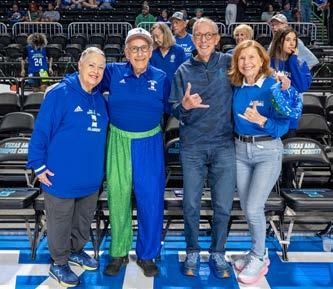
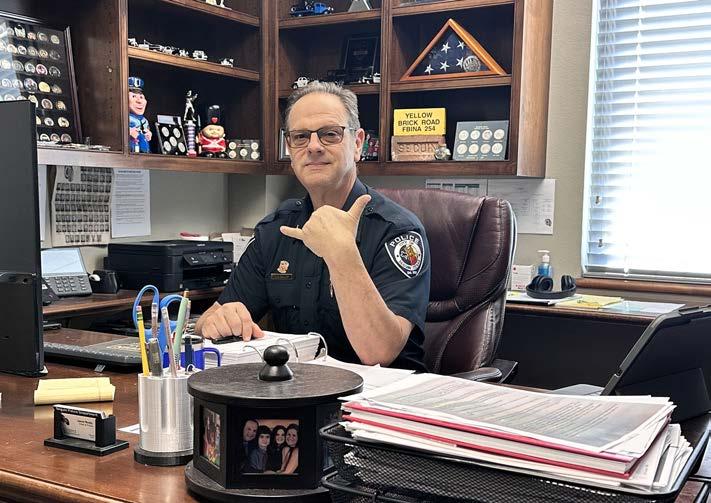
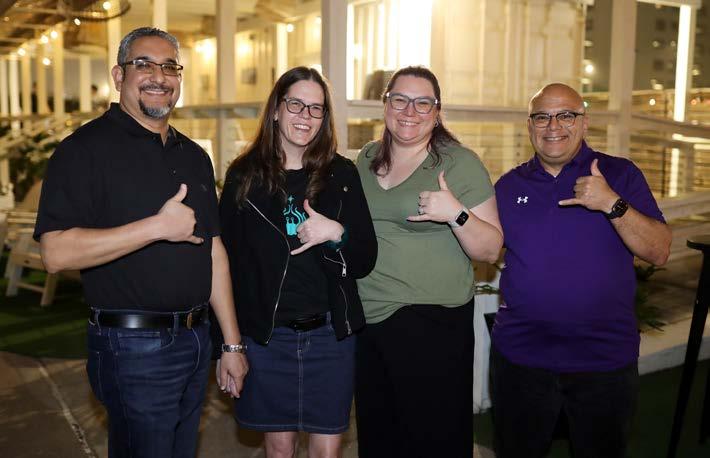
At Texas A&M University-Corpus Christi, “Shakas Up” is more than a gesture — it is a symbol of who we are. It reflects the pride we share, the community we build, the traditions that unite us, and the support we extend to one another as Islanders. It is a reminder that when we come together, there is no limit to what we can accomplish.
In this issue of the Islander Magazine, you’ll discover stories that embody that spirit. Across campus and beyond, Islanders are making a difference through service, innovation, and leadership. Through the Student Volunteer Connection, students are strengthening communities while developing the skills and experiences that will shape their futures. That same spirit of service and leadership is evident in the ONE DAY Campaign, where Islanders are creating positive change through projects that support local nonprofit organizations. Meanwhile, Islander alumni like Andrew Foster ’14 and Matt Worthington ’21 are using entrepreneurial vision to create lasting change and sisters Kaselyn Counterman ’25 and Jalen Counterman ’26
remind us how education, opportunity, and support can transform lives and strengthen families.
Equally inspiring, our faculty researchers are tackling some of the most pressing challenges facing our region and world — from advancing sustainable water solutions and AI-powered infrastructure monitoring to restoring the ecological health of Baffin Bay and protecting our coastal resources.
Together, these stories reflect a university committed to creating a brighter future for our communities, our state, and our world.
As you explore these pages, I hope you’ll be inspired by the achievements, service, and Islander spirit that represent the very best of our university community.
Sincerely,
Kelly M. Miller, Ph.D. President and CEO Texas A&M University-Corpus
Christi
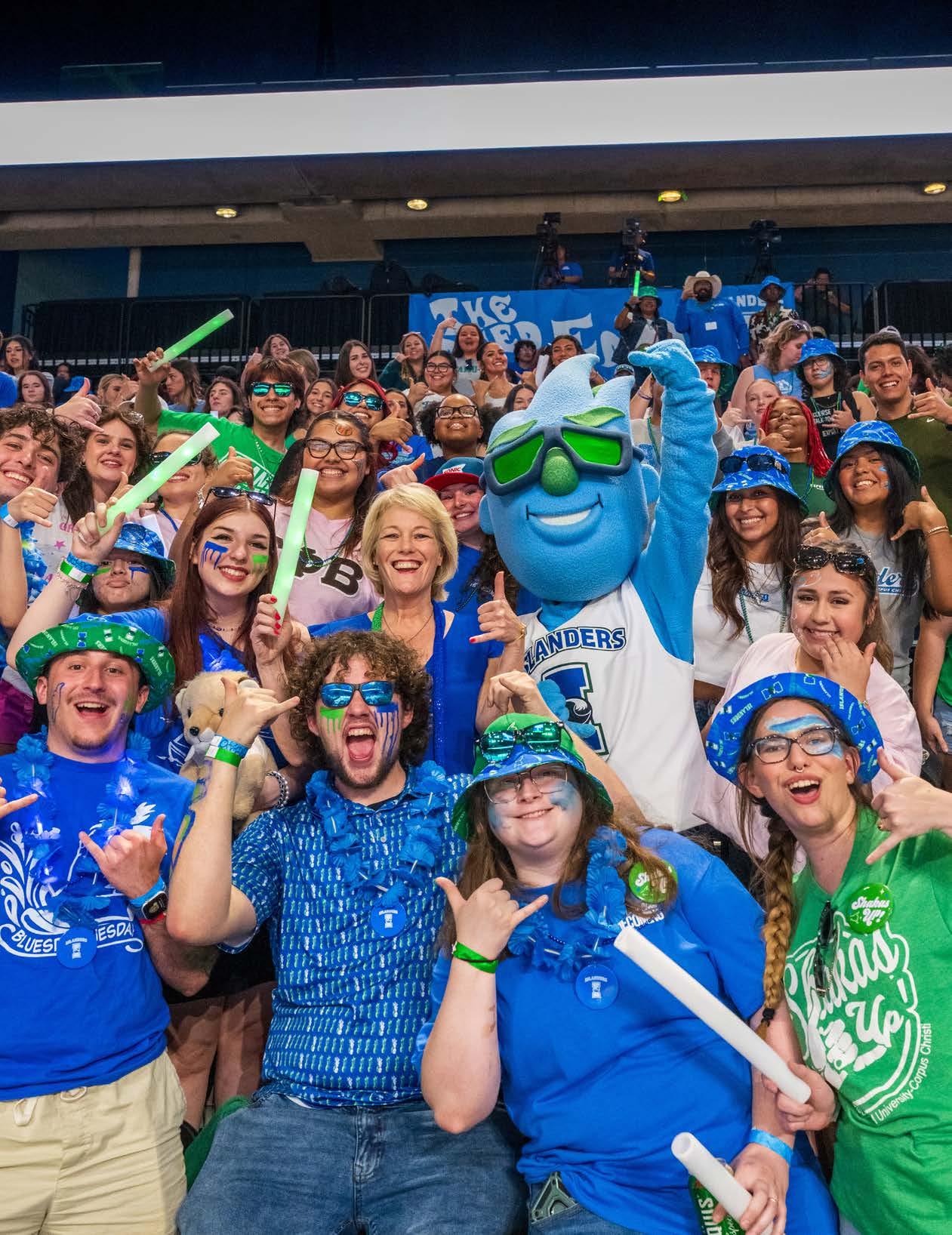
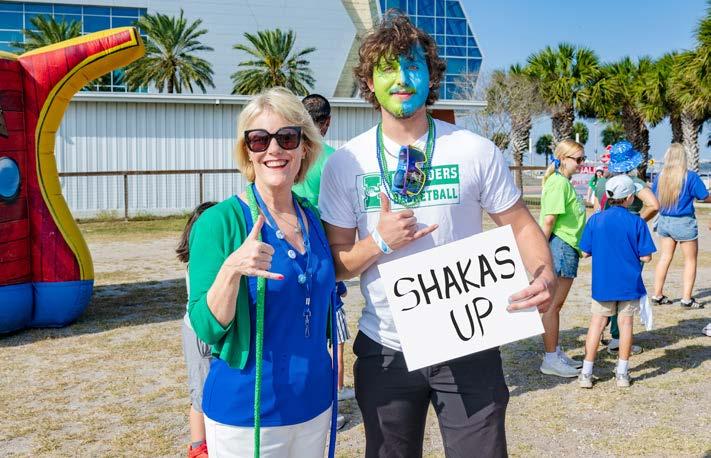
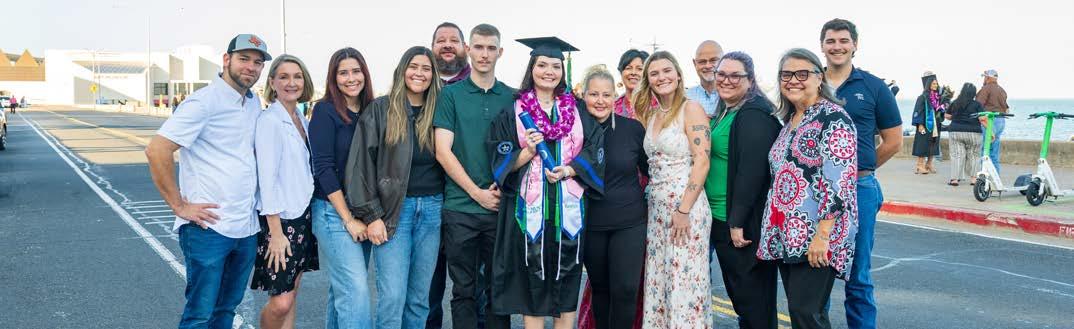
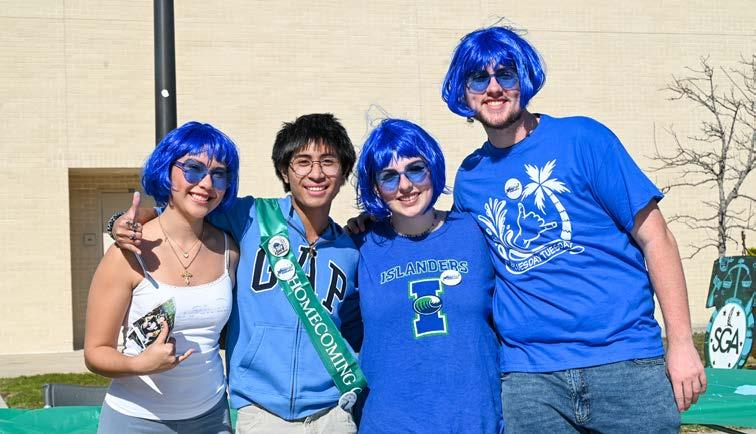
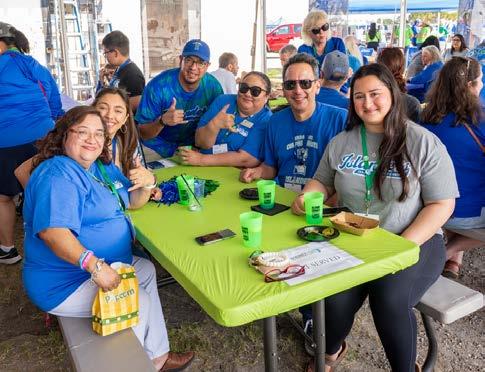
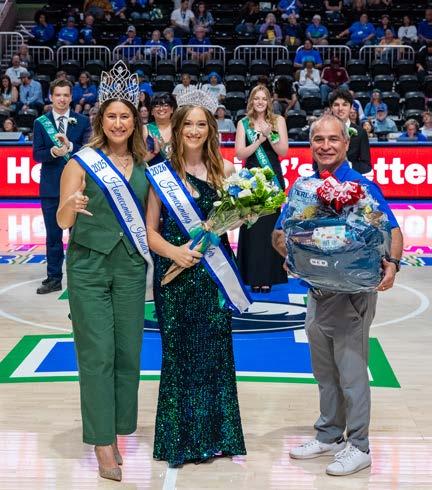
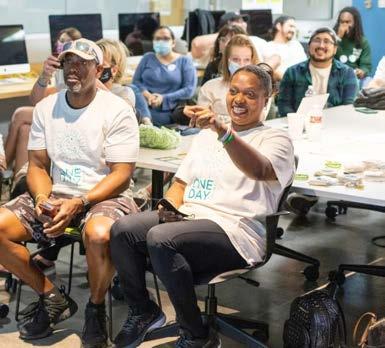
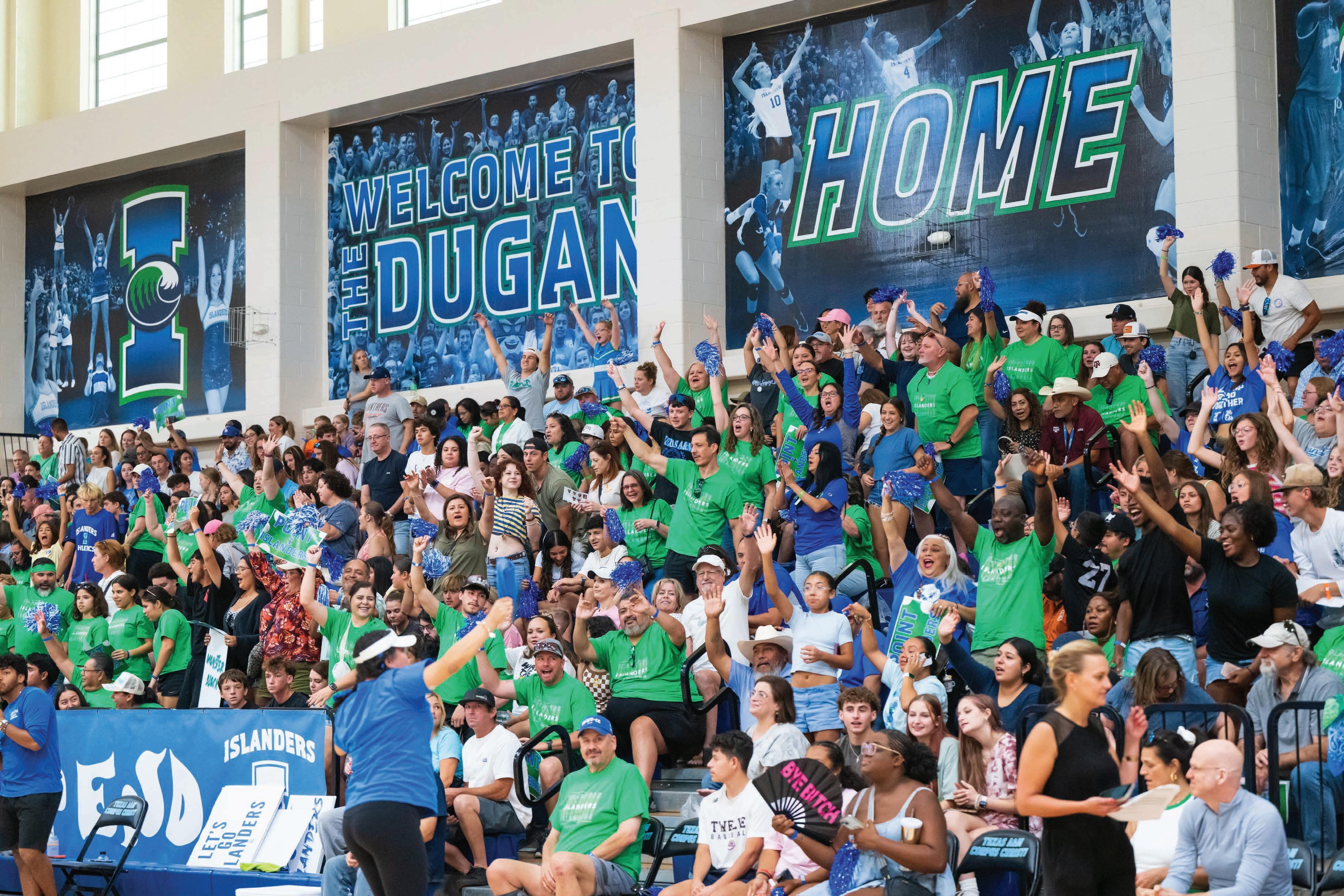
President and CEO Kelly M. Miller, Ph.D. celebrates Islander Homecoming 2026.
TABLE OF CONTENTS
MAKING A REAL CONNECTION
Islanders give back through Student Volunteer Connection program
TURNING THE TIDE
TAMU-CC researchers dive deep into water quality and sustainable solutions
06 04 18 30 33 15 24 38 FEATURES
FINDING A HOME AT TAMU-CC
Sisters find support and success at Island University after foster care
BEST DAYS, ISLANDER ROOTS
A promise formed in family hardship becomes a way to make an Islander Impact
BRINGING BAFFIN BACK
The magic of Baffin Bay and the mission to protect it
WHERE LEADERSHIP MEETS LOCAL IMPACT
Master of Public Administration program celebrates its 35th anniversary
A PLACE AT THE TABLE
Islander Teaching Kitchens turn cooking into connection, confidence, and creativity
MOMENTUM IN MOTION
Track and Field team makes their mark, sets records
CLASS NOTES
Catch up on the accomplishments, milestones, and adventures of our Islander alumni 46
BAFFIN BAY
MAKING CONNECTION
a real
ISLANDERS GIVE BACK THROUGH STUDENT VOLUNTEER CONNECTION PROGRAM
Growing a successful garden takes hard work, dedication, and patience — the same qualities it takes to earn a college degree.
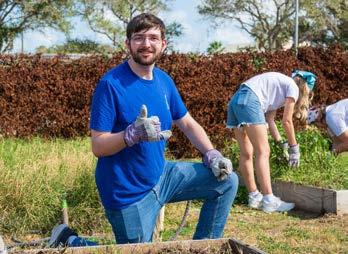
On a beautiful spring afternoon in Corpus Christi, Grace Williams ’27 is learning that lesson firsthand. The mechanical engineering major is one of a dozen students volunteering at a community garden run by the nonprofit Grow Local South Texas. As she pulls away dead vines tangled around the garden’s fence, she sees the parallels between tending a garden and tending her future.
“Volunteering has taught me a lot about having initiative, leadership, and teamwork,” Williams said. “I really love giving back, and I am so happy I found SVC.”
Student Volunteer Connection (SVC) organizes volunteer and community
service opportunities for students across campus. Open to anyone willing to roll up their sleeves, the student organization gives Islanders opportunities to make a meaningful impact while building friendships and skills that extend beyond the classroom.
For more than 20 years, SVC has helped shape civic-minded leaders one service project at a time.
“Our mission is to help students create their Islander Impact,” said Benjamin Oliveira ’22, Student Activities Coordinator for Service and SVC adviser. “It’s about helping our Islander students connect to service and understand that being an Islander means giving back.”
That commitment to service stretches far beyond the Coastal Bend. Each semester, selected students participate in an Alternative Break — traveling
during winter or spring break to serve communities in need rather than heading off on vacation.
Last year, a group traveled to North Carolina to assist communities recovering from Hurricane Helene, which caused widespread damage after making landfall in September 2024.
“That was the largest group of students we’ve ever taken on an Alternative Break,” Oliveira said. “We had three vehicles full of students. It was the furthest and longest trip we’ve ever done. They worked incredibly hard, but they also got to see the real impact of what they were doing.”
Among them was Isabela Garcia ’27, an elementary education major. The experience was so meaningful that she now serves as SVC’s Alternative Break Coordinator, helping plan future trips.
“We met people whose homes we were
“I’ve fallen in love with volunteering. I don’t think I’ll ever stop.”
ISABELA GARCIA ’27
working on — people who had been directly affected by the floods,” Garcia said. “To see the emotion and gratitude on their faces was life changing. I’ve fallen in love with volunteering. I don’t think I’ll ever stop.”
While the gratitude of those they serve keeps students coming back, their reasons for joining SVC vary. Some are looking to
build their resumes. Others are looking to build their community.
“I joined SVC my freshman year because I was searching for friendships,” said Jacob Schirmer ’26, a graphic design major. “It has been fun meeting people, going to events, and volunteering. It is a very social organization, and it has really helped me with my communication skills.”
Isabella Bingham ’26, an environmental science major, credits SVC with strengthening her confidence and leadership since she joined in 2023.
“I want to work in a national or state park in environmental education,” Bingham said. “Those jobs involve public outreach and connecting people with the outdoors. This program has really helped me become more confident talking to different kinds of people and doing outreach.”
Each semester, hundreds of students participate in SVC, balancing volunteer opportunities — typically held on Fridays and Saturdays — with busy class schedules.
“SVC helps students connect with classmates they might not otherwise
meet,” Oliveira said. “We have nursing students, fine arts students, engineering students — a little bit of everyone from across campus. It’s great to see them working together.”
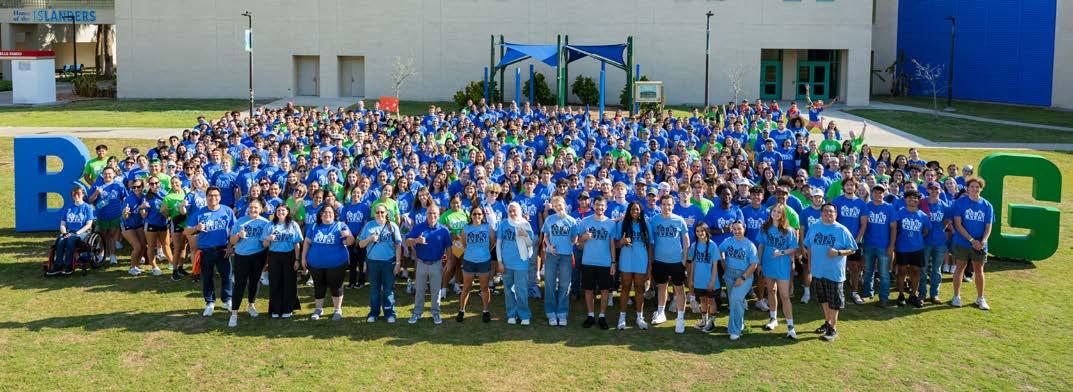
One of the organization’s signature traditions is The BIG Event, launched in 2008 and now the university’s largest student-led day of service. Its success inspired a fall counterpart, The Little Event, doubling the opportunities for Islanders to serve.
From the Gulf Coast Humane Society and the Salvation Army to the Coastal Bend Food Bank and the USS Lexington, local nonprofits have felt the impact of SVC’s dedication.
“What makes SVC special is that the benefit truly goes both ways,” Oliveira said. “Nonprofits receive much-needed help, and our students gain leadership skills, connections, and confidence. Most importantly, they discover a passion for service.”
Like a well-tended garden, that passion grows — season after season — shaping not only stronger communities, but stronger students as well. •
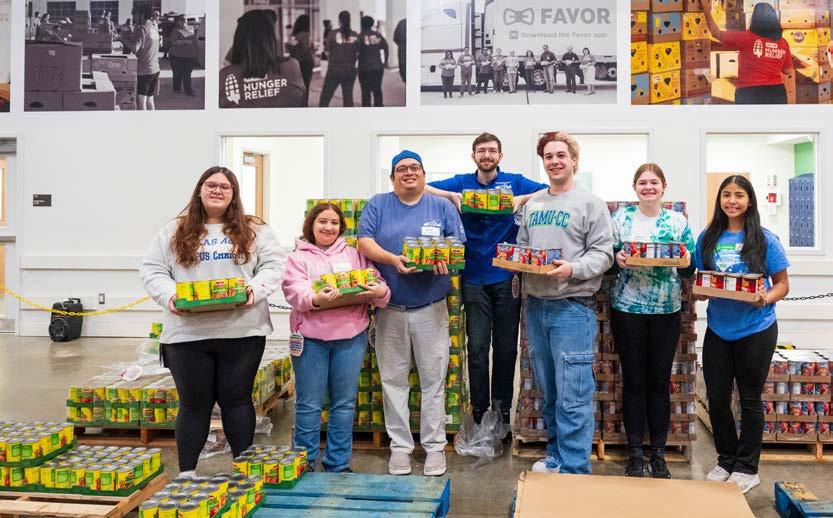
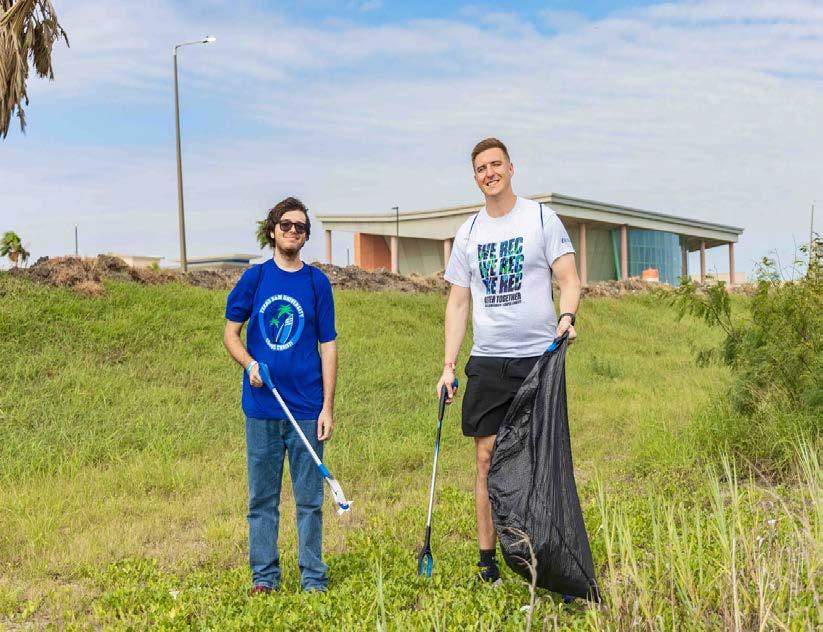
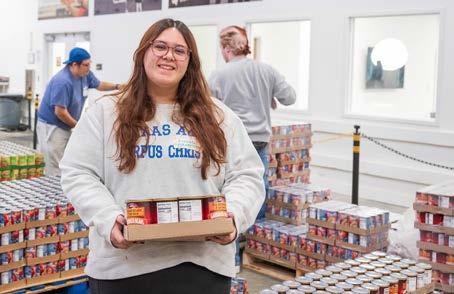
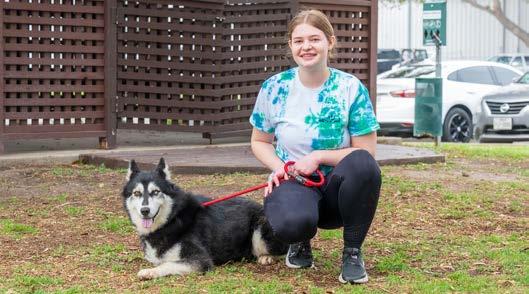
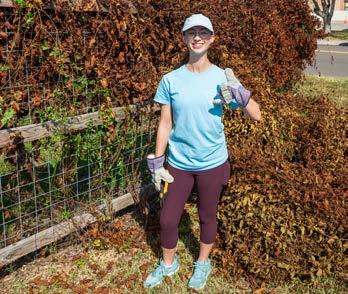
From left: Isabela Garcia ’ 27 sorts cans at the Coastal Bend Food Bank. Isabella Bingham ’ 26 lends a helping hand to a four-legged friend at the Gulf Coast Humane Society. With clippers in hand, Grace Williams ’ 27 helps tame the Garden of Grace community garden.
Jacob Schirmer ’ 26
The BIG Event 2025
TURNING
TIDE
THE
TAMU-CC RESEARCHERS DIVE DEEP INTO WATER QUALITY AND SUSTAINABLE SOLUTIONS
At the Island University, water isn’t just scenery — it’s identity. At Texas A&M University-Corpus Christi, the Gulf shimmers just steps from campus, shaping not only the landscape but the work happening within it.
From safeguarding water quality to advancing conservation and harnessing technology for smarter management, researchers are tackling water challenges from multiple angles — stretching from the oilfields of West Texas to underserved communities along the Coastal Bend and even beneath city streets.
A NEW HOPE FOR CLEAN WATER
For more than a century, the MidlandOdessa area of Texas, located in the heart of the Permian Basin, has been defined by oil. Its legacy lives on at the Permian Basin Petroleum Museum and across a landscape dotted with pump jacks.
In the small town of Imperial, on land once occupied by a drilling rig, a different resource has bubbled to the surface. Groundwater — enough to form a small lake. Now, that lake has become the proving ground for a breakthrough in water reuse.
TAMU-CC researchers are partnering with industry leaders to test a system designed to clean heavily contaminated water and make it reusable. The technology, known as the Harmonic Frequency Cascade, was developed by Mark Law, founder of Coactus LLC.
“In this case, the system can collect brine — a highly concentrated saltwater solution — and make that water functional again,” said Dr. Richard Coffin, Professor of Physical and Environmental Sciences. “Our initial plan is to process 1,000 gallons per minute and we have the capability to expand this volume.”
The patented process uses high heat to break down complex organic compounds. As contaminants separate and solidify, they are removed, leaving cleaner water behind. Since 2018, Coffin — working in a lab led by Chemistry Professor Dr. Hussain Abdulla — has tested the system on everything from oilfield-produced water to hydraulic fracturing wastewater, diesel, crude oil, used cooking oil, and even untreated sewage.
“The university’s testing has been essential in validating the technology,” Law said. “We’ve moved from a proofof-concept unit to building multiple commercial devices.”
With support from the U.S. Department of Energy, discussions about expanding the technology’s use across Texas are underway. And as drought tightens its grip statewide, the stakes continue to rise.
“The university’s testing has been essential in validating the technology. We’ve moved from a proofof-concept unit to building multiple commercial devices.”
MARK LAW
Founder of Coactus LLC
“I used to think the biggest thing that would impact the general public would be oil limitations,” Coffin said. “But now, it’s water. Recovering water to support data centers, along with industrial, municipal, and agricultural applications is critical. And we’re going to be able to do that. This technology is amazing — and it’s the future.”
BREAKING GROUND IN GROUNDWATER RESEARCH
Closer to home, in rural Nueces and Aransas counties, another water story is unfolding in communities known as colonias — neighborhoods that often lack reliable access to drinking water infrastructure, drainage systems, and sewer service.
For many residents, groundwater is the only source of drinking water.
Graduate students from TAMU-CC are working alongside Dr. Dorina Murgulet, Professor of Hydrogeology and Director
of the university’s Center for Water Supply Studies, on projects funded by the U.S. Environmental Protection Agency and the National Science Foundation. The goal is to understand how flooding affects groundwater quality and identify solutions that work with nature rather than against it. As part of that approach — because soils, geology, and groundwater flow vary from place to place — the team evaluates site-specific pathways and risks rather than assuming a single outcome across all communities.
“Because of poor drainage, among other factors, in these low-lying areas, downpours can cause flooding,” Murgulet explained. “Our hypothesis is that floodwaters can carry contaminants from faulty septic systems, agricultural areas, or dump sites — and that contamination can seep into the groundwater that residents may depend on, from which, in some settings, it may also be transported to nearby surface water.”
By collecting soil and water samples before and after major rain events, the team tracks how contaminants move across the landscape and into aquifers.
The research doesn’t stop at data collection. Students also share results with residents, helping them better understand water quality and the importance of maintaining septic systems.
The team is exploring nature-based solutions — restoring native vegetation, improving soil infiltration, and installing green infrastructure that slows and filters runoff, potentially reducing contaminant loading before water reaches nearby waterways or drinking-water wells.
For students, the experience is transformative.
“I’ve been able to work with equipment I’d never used before,” said doctoral student Ifeanyi Emmanuel Anyanwu ’27. “Working with people from different backgrounds has also been a privilege.” Continued on next page.
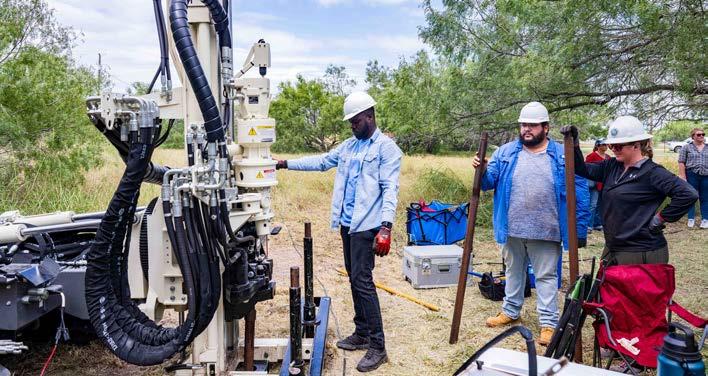
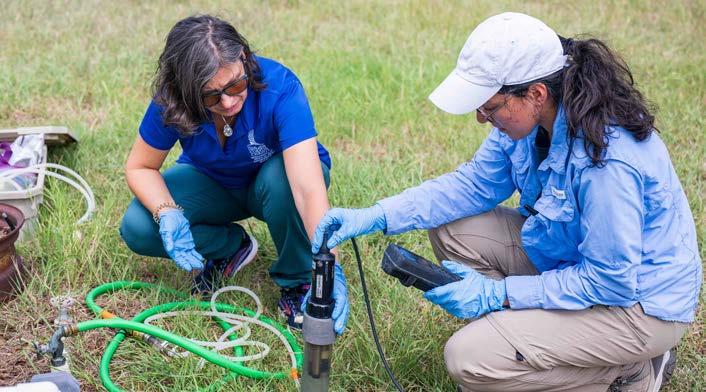
Clockwise from left: The Harmonic Frequency Cascade, a project involving Dr. Richard Coffin, transforms contaminated water into a reusable resource. Dr. Dorina Murgulet’s research team performs groundwater quality testing in local colonias. Murgulet mentors a student conducting groundwater research.
USING AI TO FIX AN OLD PROBLEM
Not all water challenges are visible. Some run beneath city streets.
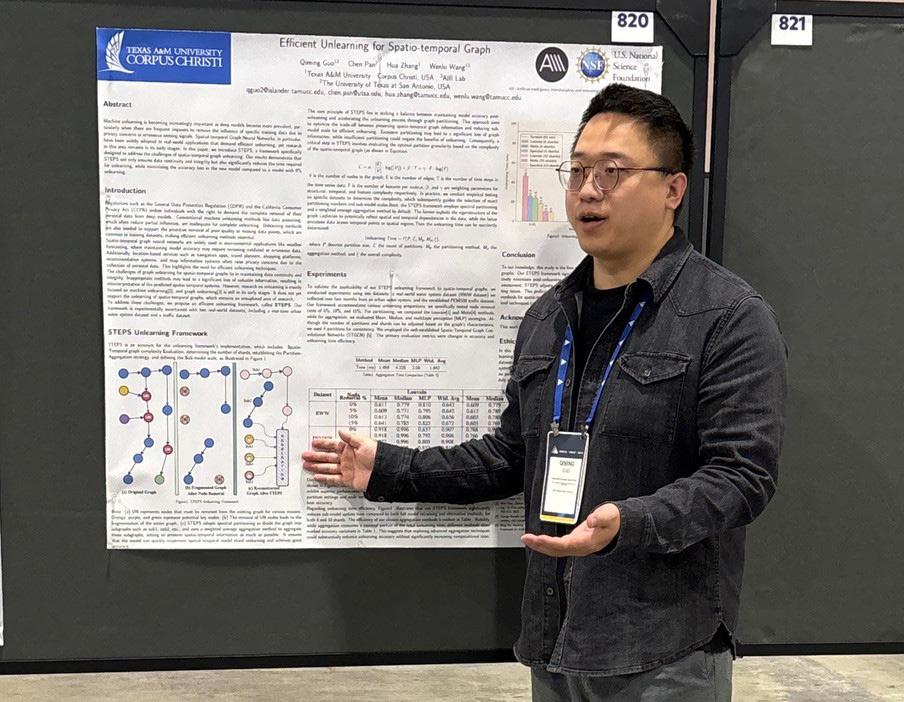
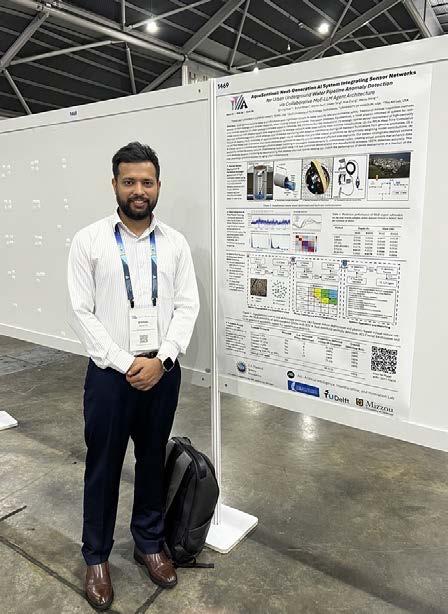
In partnership with the City of Corpus Christi, TAMU-CC researchers are working to modernize how municipalities monitor aging sewer systems. The project, supported by the National Science Foundation, is led by Dr. Wenlu Wang, Assistant Professor of Computer Science, and Dr. Hua Zhang, Professor of Civil Engineering.
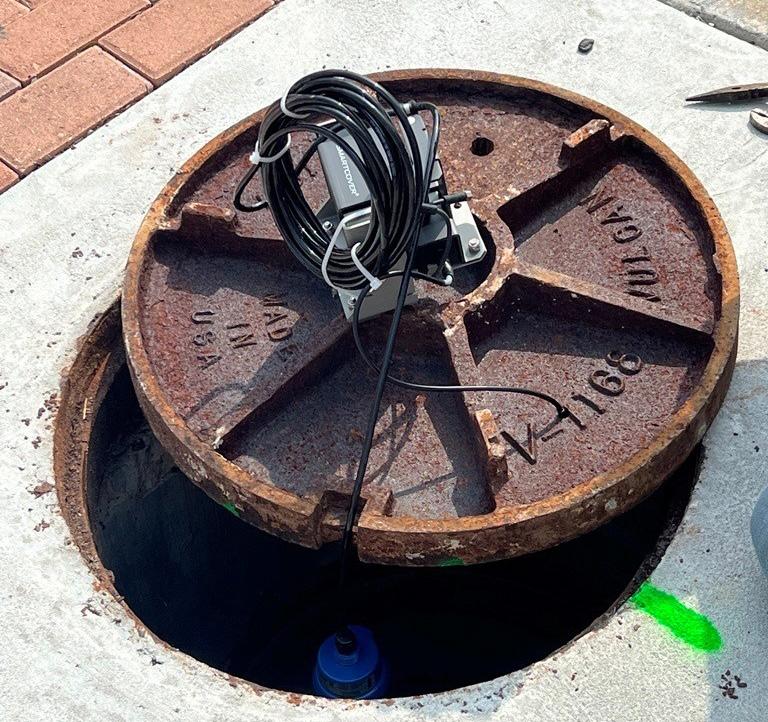
Instead of relying solely on manual inspections and resident complaints, the team has installed sensors inside manholes to collect data such as water depth and inflow rates. That information feeds into a customized graph neural network — an artificial intelligence model designed to reflect the city’s unique wastewater layout that can monitor conditions and predict issues before they happen.
“The current wastewater system relies on extensive manual inspections that are time-consuming, labor-intensive, and costly,” Wang said. “This is a much more efficient system that helps workers be much more proactive, than reactive.”
The system, currently being tested around TAMU-CC property, acts as a digital twin of the sewer network, analyzing patterns in real time and
forecasting potential problems before they become emergencies.
Doctoral students Qiming Guo ’27 and Bishal Khatri ’28 play a central role in the project — from data collection and modeling to presenting findings through international conferences and journals.
“The students are spearheading the core components of the work,” Zhang said.
“And this technology is so new, we are learning alongside them.”
For the research team, the impact extends beyond city limits. By developing a production-ready prototype, they hope Corpus Christi can serve as a model for other communities facing similar infrastructure challenges. •
An AI-powered monitoring device, installed on a sewer line on the TAMU-CC campus, collects data that could lead to smarter, more efficient infrastructure maintenance.
Qiming Guo ’ 27
Bishal Khatri ’ 28
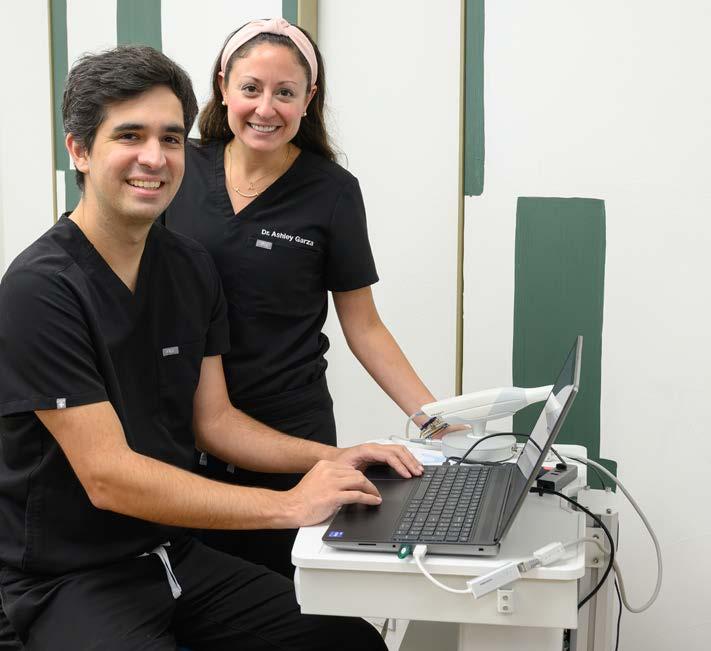
MEET ISLANDER ALUMNI WHO TURNED DENTISTRY INTO A FAMILY BUSINESS
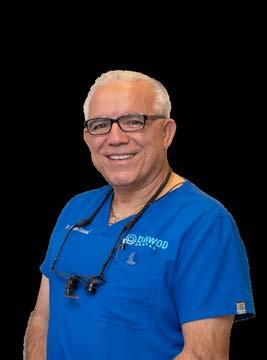
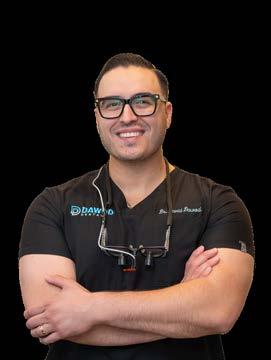
Dr. Haysam Dawod ’ 85
Bachelor of Science in Biology
Owner of Dawod Dental Center since 1991
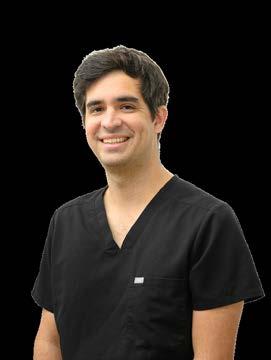
Dr. David Dawod ’ 14
Bachelor of Science in Biomedical Sciences
Dentist at Dawod Dental Center
Dr. Marcos E. Garcia ’ 14
Bachelor of Science in Biomedical Sciences
Periodontist at South Texas
Periodontics & Implants
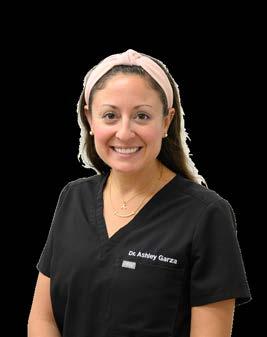
Dr. Ashley V. Garza ’ 14
Bachelor of Science in
Biomedical Sciences
Dentist at Garza & Associates
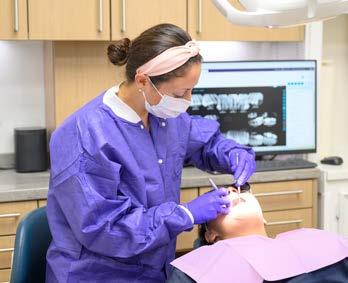
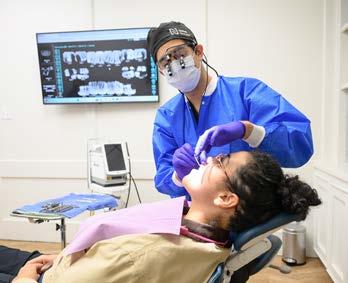
“Ask an Islander” is a regular feature that spotlights university alumni from diverse careers, sharing their journeys and inspirations. In this edition, meet two sets of Islander alumni — a father and son, and a husband and wife — who have sunk their teeth into the family business of dentistry.
Continued on next page.
WHY DENTISTRY
Dr. Haysam Dawod (HD): Dentistry is the perfect intersection of my strengths and passions — working with my hands, connecting with people, and improving lives. Every day, I have the opportunity to relieve pain and restore smiles, which goes far beyond aesthetics. When patients regain their confidence and self-esteem, you see the true impact of what we do.
Dr. David Dawod (DD): Growing up with a father in dentistry gave me early exposure, but my decision came from a deeper place. I was drawn to how dentistry blends science, medicine, and artistry while remaining centered on helping people. It challenges you both intellectually and creatively. Now, having the opportunity to work alongside my dad adds another layer of meaning to my career. It’s rewarding not just professionally, but personally as well.
THE ISLAND UNIVERSITY EXPERIENCE
HD: My time at Corpus Christi State University, now TAMU-CC, prepared me exceptionally well for the demands of dental school. It was also a pivotal time in my personal life — I met my college sweetheart and wife of 38 years, Sandy Dawod, who completed her nursing degree in 1986 from what would later become TAMU-CC.
DD: What stood out most to me was the supportive and close-knit environment. Smaller class sizes allowed for meaningful interaction with professors, which helped me build strong academic and professional relationships. Those connections made a real difference in preparing me for dental school. The campus culture was welcoming and collaborative, which encouraged growth and confidence.
ON PERSEVERING
HD: I use humor to help deal with stress both for myself and my patients. I also find giving back to be healing. I am very active in the community, and I serve on several boards, as well as volunteer with several organizations.
DD: Staying physically active, whether being in the weightroom or going on walks, not only helps physically but also
Dr. David Dawod ’ 14 and
Dr. Haysam Dawod ’ 85
mentally when dealing with stress. I have also found that building relationships with colleagues is so important, especially for young dentists.
FROM ONE ISLANDER TO ANOTHER
HD: Take ownership of your journey and stay intentional about your goals. The Island University provides an excellent foundation, but success ultimately depends on your effort and mindset. Understand the requirements of your chosen field, stay disciplined in your studies, and remain involved in activities that help you grow. Most importantly, believe in your ability
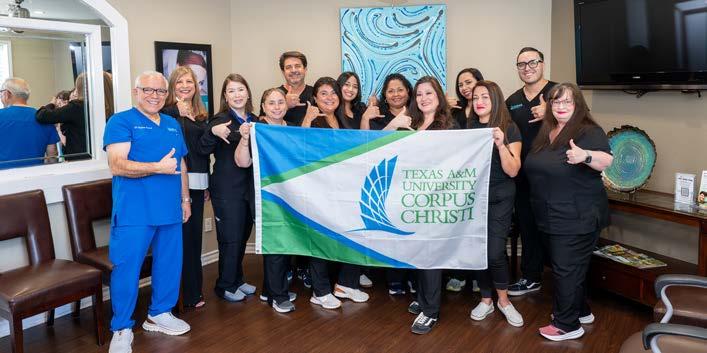
Dental Center staff
to succeed. Challenges are part of the process, but persistence and confidence will carry you forward.
DD: One of the most valuable things you can do is spend time shadowing in clinics or offices. It gives you real insight into what the profession is like beyond textbooks and lectures. Along with that, focus on building a strong academic foundation and developing meaningful relationships with mentors. Those connections can provide guidance and open doors. Staying curious, proactive, and willing to learn from realworld experiences will set you apart as you pursue a career in healthcare.
Dawod
WHY DENTISTRY
Dr. Marcos Garcia (MG): My path into dentistry was shaped by my fatherin-law’s influence. Spending time in his practice while Ashley and I were dating allowed me to see the profession up close. What stood out wasn’t just the clinical work, but the trust and relationships he built with patients over time. It showed me that dentistry is about more than procedures — it’s about helping people feel comfortable and confident.
Dr. Ashley Garza (AG): My father is a dentist, and growing up, my dream was to follow him into that profession. I saw firsthand the kind of impact he had on people. It wasn’t just about fixing teeth, it was about relieving pain, restoring confidence, and building long-term relationships with patients. I am grateful to be able to practice alongside him and share the passion of dentistry with him.
THE ISLAND UNIVERSITY EXPERIENCE
MG: Attending our hometown university allowed us to stay connected with family while pursuing our education, which was very meaningful. At the same time, the school provided valuable opportunities that expanded
our perspectives. We participated in trips to visit dental schools across Texas and were accepted into summer enrichment programs that gave us early exposure to dental education.
AG: The pre-dental program at TAMU-CC provided a strong academic foundation that prepared us for the challenges of dental school. The coursework pushed us to develop discipline, critical thinking, and effective study habits. Beyond academics, my experience as a Division I student-athlete with Islanders Tennis taught me how to manage time and balance multiple responsibilities — skills that proved essential later. The professors were incredibly supportive and always willing to help, which made a significant difference.
ON PERSEVERING
MG: Spending time with our children is the best way for me to reset. No matter how challenging the day has been, being greeted by their excitement instantly puts things into perspective. Those moments with family provide both motivation and balance, helping me stay grounded while continuing to grow professionally and personally.
AG: Coming home to our four children
is the most rewarding part of my day. After the demands of practicing dentistry, those simple moments — helping with homework, sharing meals, and hearing about their day — help me decompress and recharge. They also serve as a constant reminder of why I work so hard.
FROM ONE ISLANDER TO ANOTHER
MG: Success in dentistry requires hard work, persistence, and a willingness to seek guidance. Building relationships with professors and mentors is especially important, as they can provide valuable advice and support throughout your journey. Don’t hesitate to ask questions or take advantage of opportunities to learn outside the classroom. Those connections often play a key role in opening doors. The path may be demanding, but the rewards of the profession make it all worthwhile.
AG: Building a strong academic foundation is essential, but so is developing discipline and effective time management. Balancing coursework, extracurricular activities, and shadowing can be challenging, but those experiences are important for growth. Stay organized, remain consistent, and don’t lose sight of your long-term goals. •
Dr. Marcos E. Garcia ’ 14 and Dr. Ashley V. Garza ’ 14
HUSBAND AND WIFE DUO
ISLANDER ALUMNUS BUILDS A COASTAL BRAND
Andrew Foster ’14 didn’t arrive at Texas A&M-Corpus Christi with a business plan; he arrived chasing something less defined: the water, the openness, the sense that something different might be waiting on the coast.
That instinct stayed. What changed was everything else.
As a San Antonio native, Foster spent weekends at SeaWorld, drawn to life on and near the water. When he enrolled at TAMU-CC in 2006, he initially imagined a future in marine biology. That plan shifted to business as he found his way to marketing, a field which matched his curiosity and range of interests.
He left campus for a time, working in the music industry and touring with a band before returning to finish his degree.
“Those experiences gave me perspective and clarity, and when I came back to school, I was older and more mature,” Foster said. “The classes made more sense because I could actually apply what I was learning.”
Foster completed his Bachelor of Business Administration in Marketing in 2014. He credits marketing professor Dr. Kent Byus with shaping how he approaches problems.
“He didn’t want textbook answers,” Foster said. “He wanted you to think
deeper. That stuck with me.”
In 2013, during what was supposed to be a final, carefree summer before moving on to other plans, Foster found himself hooked on an idea.
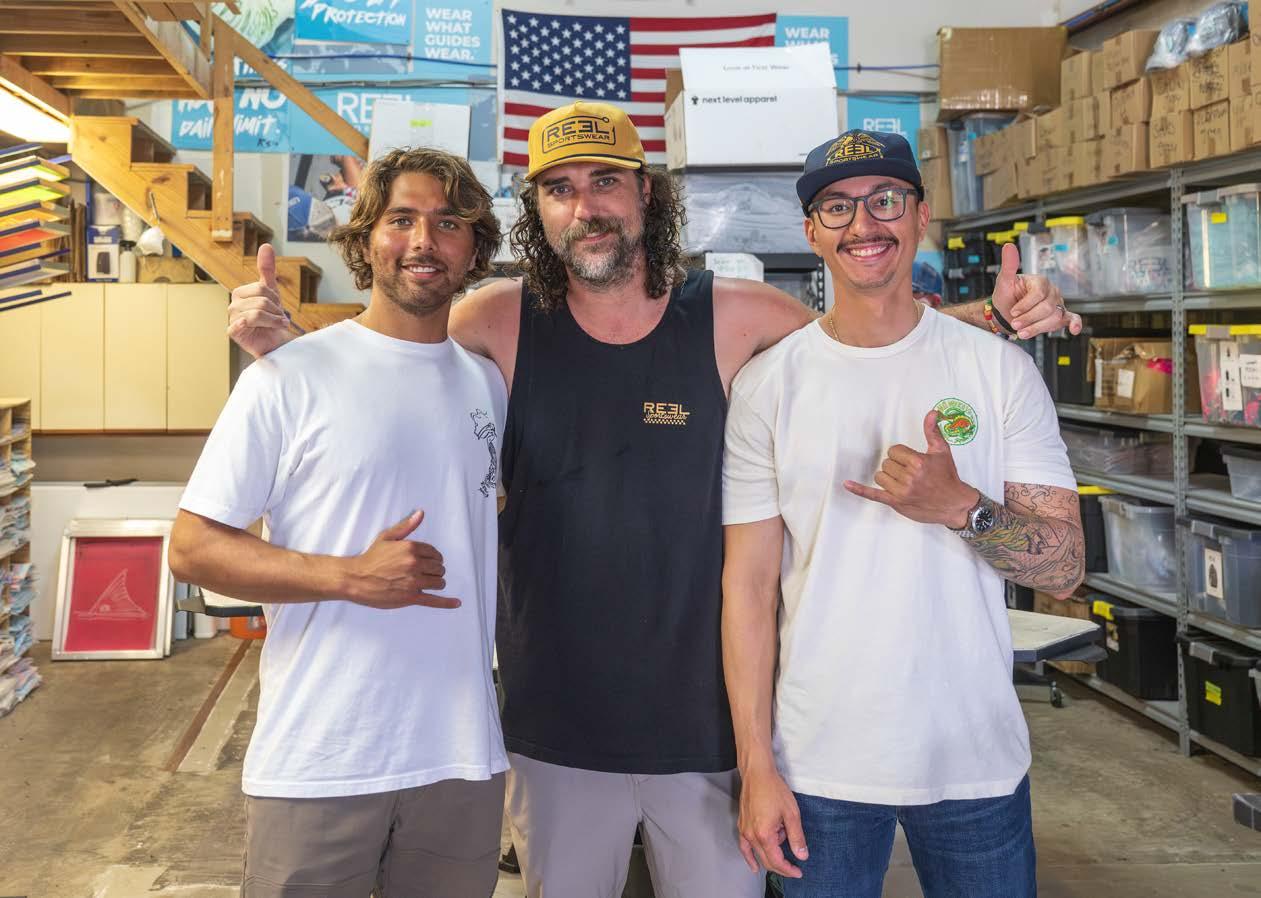
With minimal research, no roadmap, and about $1,000, Foster launched Reel Sportswear, a fishing-inspired apparel brand. He printed T-shirts, sold them, reinvested the proceeds, and repeated the process. Foster describes the decision as brash and uninformed.
“I had no idea how crowded the space was,” Foster said. “I just thought if we made something cool, people would buy it.”
Early lessons came quickly. Trade shows
and local fishing tournaments became classrooms. Foster set up tents, talked to customers, and learned by doing. Growth was slow and often uncertain.
For Foster, the turning point came in 2017, when he took a step back and reassessed the direction of the company. What followed was a shift in focus from rapid growth to building something more sustainable.
Results weren’t immediate. For years, Reel Sportswear remained a demanding pursuit without financial return. Foster supported himself through freelance web design and development, teaching himself the skills he needed to stay afloat while continuing to invest in the brand.
“I didn’t make any money off of the business personally back then,” Foster said. “It was essentially a really expensive hobby.”
Reel Sportswear did not feel sustainable until after the COVID-19 pandemic. While the period posed challenges for many businesses, the outdoor industry proved resilient. A major account in 2021 created steady demand, which shifted the equation. By 2023, Foster was finally paying himself.
“I still don’t feel like we’ve made it,” Foster said. “But now I can see that this can really be something.”
Reel Sportswear has grown from T-shirts for local anglers into a coastal apparel
company producing fishing shirts, hats, and everyday wear designed for time on or off the water. Its aesthetic leans minimalist, with a focus on utility and durability.
Foster’s Islander ties now extend into his own team. He hired fellow alumni Zachary Hernandez ’24 and Jaden Diaz ’26, creating a space where emerging creatives can gain hands-on experience and mentorship.
“We want to be something this community is proud of,” Foster said. “Not because we’re from here, but because we’re actually that good.”
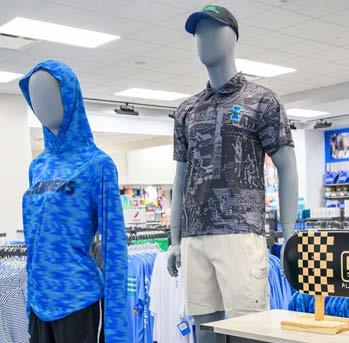
Seeing alignment between his brand, coastal conservation, and the university that helped shape him, Foster reached out to the Harte Research Institute at Texas A&M-Corpus Christi in hopes of securing a partnership. That relationship has led to a wider licensing agreement with the university, with Reel products now available through the Campus Store.
“At first, it felt like just another business deal,” Foster said. “Now it feels like a real accomplishment — a full-circle moment.”
Reel has also worked with the Islander Anglers, a student organization, offering mentorship and helping members navigate the industry.
“There’s no manual for this,” Foster said. “You learn everything the hard way. If I can pass along some of that hard-earned
“We want to be something this community is proud of. Not because we’re from here, but because we’re actually that good.”
ANDREW FOSTER ’ 14
knowledge, that matters to me.”
Foster has lived in Corpus Christi for nearly two decades and while he did not grow up on the coast, it’s now his home.
“This community supported us,” Foster said. “Up and down the Texas coast, people believed in what we were doing. The university connection reinforces that we’re rooted here, that we care about this place and want to see it thrive.”
The brand’s identity lies within the same values it started with — family, friends, and community. Foster credits those relationships, along with steady support from anglers along the Texas coast, for sustaining the company through its early uncertainty and into its second decade.
“It’s a strange thing to build a clothing brand,” Foster said. “Not many people do it, and it’s hard. But I’m grateful we’re still here, still learning, and still moving forward.” •
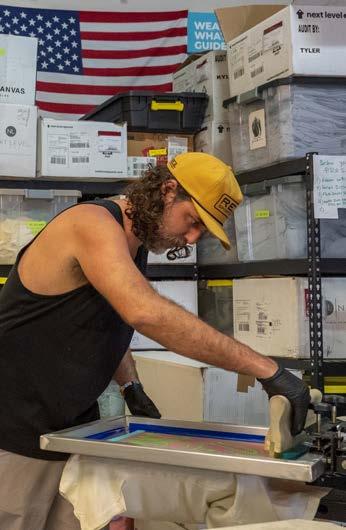
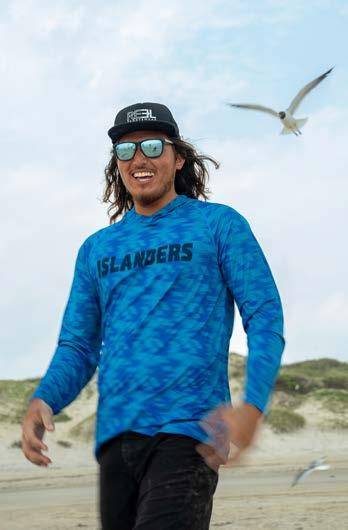
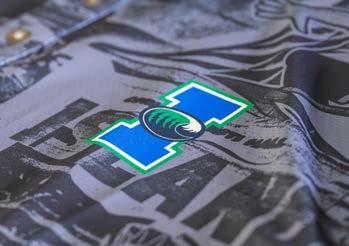
From left: Andrew Foster '14 carefully screen prints a design to a T-shirt inside Reel Sportswear's Corpus Christi workspace. Dylan Nakasaki models a Reel Sportswear hooded performance shirt. Reel Sportswear has entered into a licensing agreement with TAMU-CC, allowing Islander branded apparel to be sold in the Campus Store.
FROM THE ISLAND
Get your passport today!
Passport Services offers passport applications, renewals, and photos to the public and the campus community. They are located in the SandDollar$ Services o ce on the first floor of the University Center.
Click here or visit tamucc.edu/passport to book your appointment and come prepared with the required documents.
PRINT WITH US!
BUSINESS CARDS • CUSTOM PROJECTS
University Printing Services is here to bring your ideas to life! Perfect for students, alumni, local businesses, and anyone with a project to print. Submit your order today!
Finding a Home at
TAMU-CC
SISTERS FIND SUPPORT AND SUCCESS AT ISLAND UNIVERSITY AFTER FOSTER CARE
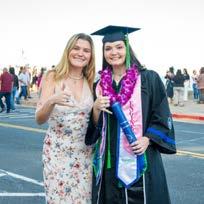
On a pleasant December afternoon, the sun shined brightly outside the Hilliard Center while friends and family smiled, hugged, and even shed a few tears as they greeted graduates from Texas A&M-Corpus Christi’s fall 2025 graduating class. Among those not only soaking in the sun, but the adulation of her friends and family, was Kaselyn Counterman ’25. At one point in her life, this moment felt impossibly far away.
Continued on next page.
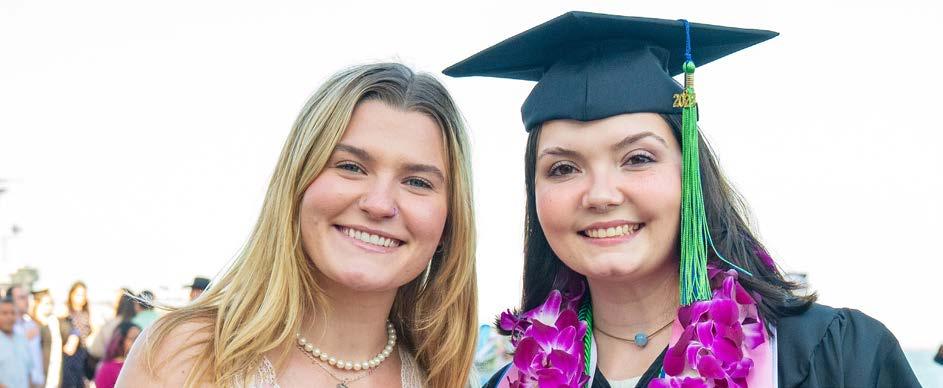
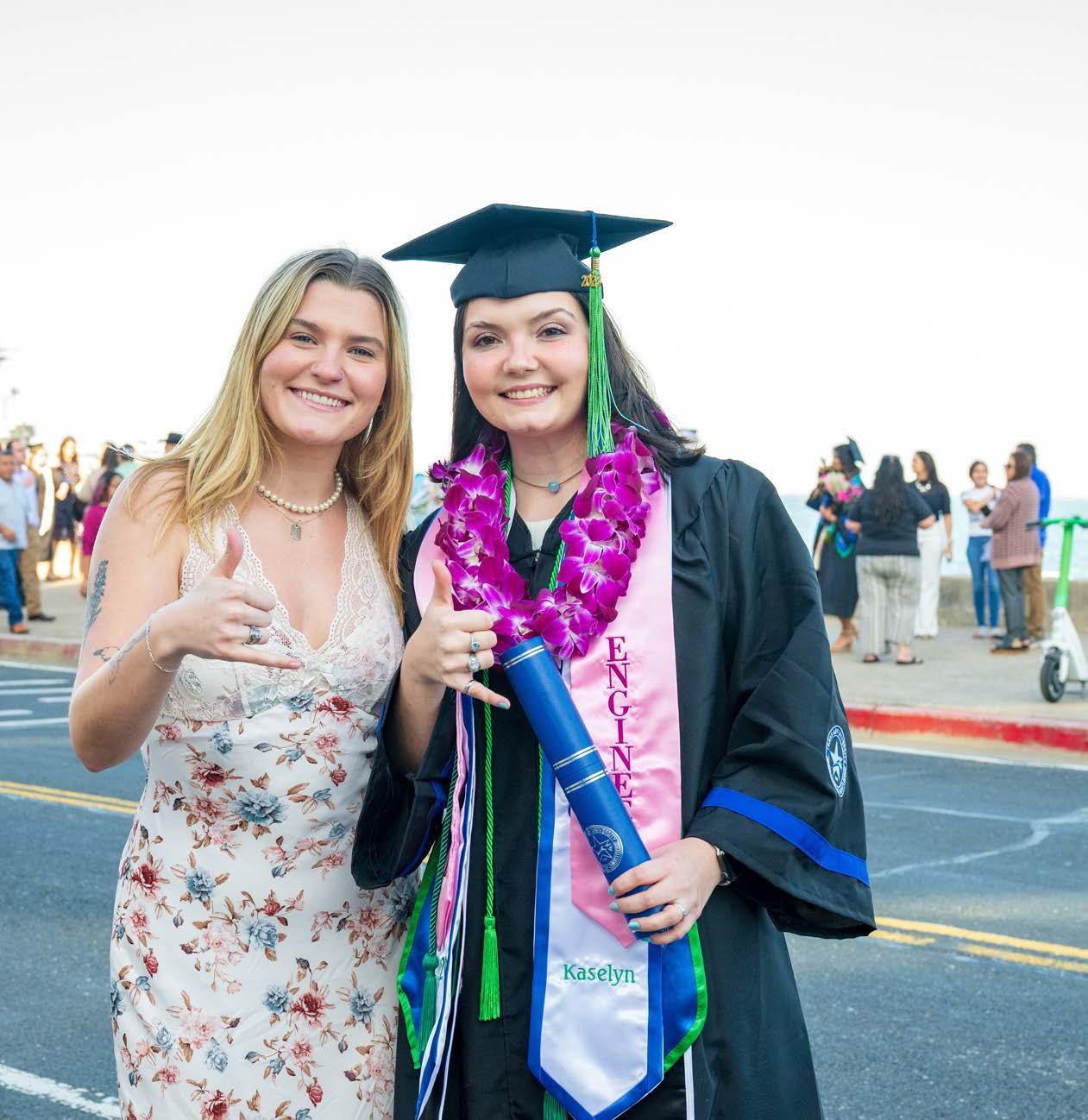
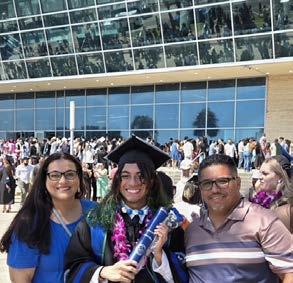
Jalen Counterman ’ 26 and her sister Kaselyn Counterman ’ 25 at Kaselyn's fall 2025 graduation.
“This has been the biggest accomplishment of my life so far,” Counterman said. “I am so proud of myself for creating this path to a better future for myself.”
That path was anything but easy. Counterman and her sister, Jalen Counterman ’26, faced more obstacles than most on their road to academic success. At times, they stumbled. But they always got back up.
“We grew up mostly in foster care in and around Central Texas,” Kaselyn said. “Our father was in prison, and our mother has multiple personality disorder, bipolar disorder, and depression.”
Born less than a year apart, the Counterman sisters entered foster care before their first birthdays. Their childhood became a cycle of foster families, brief reunions with their parents, and eventually time with their grandparents — who at that point were taking care of a total of six grandchildren.
As teenagers, instability followed them. Substance use became a part of their environment, and during their later high school years, they found themselves living in an emergency placement shelter for teenage girls.
“We both started behaving poorly because we didn’t have anybody looking out for us,” Kaselyn said. “When we ended up at that shelter in Waco, it was there that I decided I needed to turn my life around. I wanted a better life than I grew up in.”
The sisters would eventually graduate from high school. From there, Kaselyn decided to enroll at TAMU-CC because it was far away from the places and problems that had surrounded her youth. Jalen took time off to work and regroup
before following her sister to the Island University.
“It was a pretty easy choice,” Jalen said. “It was by the beach, and Kaselyn was here. She’s my best friend. We’ve had a lot of inconsistencies in our lives, but we are each other’s one constant.”
With the help of nonprofit organizations like Foster Angels of South Texas, the sisters learned about educational benefits available to former foster children, including free tuition and student housing. In the state of Texas, students who enroll in extended foster care are entitled to a free tuition waiver.
Once on campus, they connected with Island Harbor, a university program designed to help foster youth transition into college life.
“A lot of times in foster care, decisions are made for these students, and they
come out not used to being on their own,” said Martha Valladolid, Island Harbor Program Specialist. “They’re writing their story now — I just help guide them. I show them what’s available, give advice, and help where I can. I’m kind of a jackof-all-trades.”
Island Harbor also offers a Supervised Independent Living Program in partnership with the Department of Family and Protective Services. The program gives former foster care students access to fully furnished campus living, a meal plan, and a monthly stipend to put toward a cell phone bill and incidentals.
“The free housing was critical for me,” Kaselyn said. “My time at TAMU-CC was the most stabilizing time in my life. Knowing I had a roof over my head was such a relief. It helped me mature and helped me become comfortable with being
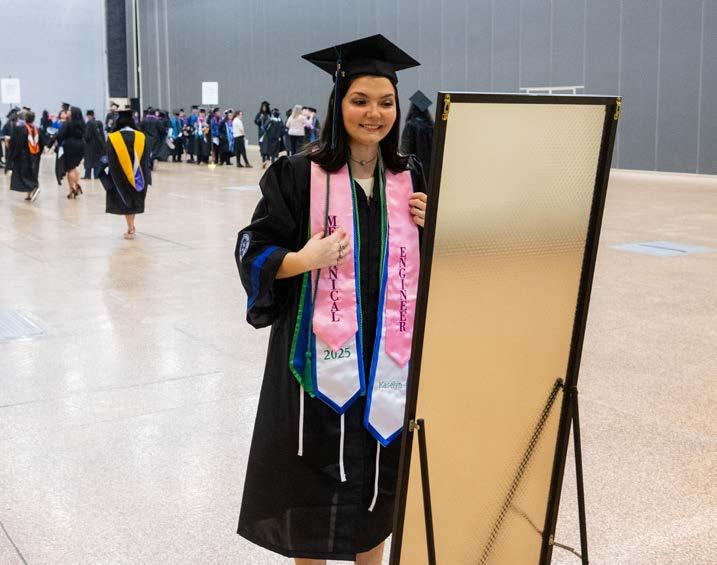
Kaselyn Counterman ’ 25 prepares to cross the graduation stage — a defining milestone that reflects her determination, resilience, and spirit, made possible with the support of the Island Harbor program.
Surrounded by family and friends, Kaselyn Counterman ’ 25 celebrates her graduation outside the Hilliard Center.
alone. I don’t always need the loud noises I grew up with.”
Island Harbor, which has received generous grant support from the Coastal Bend Community Foundation over the last three years totaling $40,500, also offers workshops and social events to teach life skills while cultivating a sense of belonging. The program also connects students with community partners who provide resources — everything from school supplies funded by Foster Angels to groceries provided by Catholic Charities, to career-building opportunities through local organizations like the Rotary Club.
“Island Harbor and TAMU-CC have done so much for us,” Jalen said. “We’ve
made friends, our professors have been amazing, and we’ve built our own little support system that will always be with us.”
Jalen, a computer science major, hopes to one day launch her own cybersecurity business, while Kaselyn dreams of creating the next great car in the automotive industry.
“The journey is really just beginning, and it’s exciting,” Kaselyn said. “Someone once told me setbacks are not failures — they are setups for success.”
As the final notes of “Pomp and Circumstance” echoed through the Hilliard Center, and Kaselyn embraced Jalen for the first time as a college
graduate, they both couldn’t help but reflect on just how far they’ve come.
“I have never been prouder in my life than seeing Kaselyn walk the stage after all her hard work and dedication,” Jalen said. “When I first got to TAMU-CC, I remember thinking to myself ‘I’ll try this out for a semester and see how it goes.’”
Today, Kaselyn is a manufacturing engineer for a company in Wisconsin. And while the Counterman sisters are now living apart, somehow, they have never been closer.
“We don’t have to be in the same place to be sisters,” Kaselyn said. “We’re always on the phone, and we’ll always be there for each other — no matter where we are.” •
“My time at TAMU-CC was the most stabilizing time in my life. Knowing I had a roof over my head was such a relief.”
Kaselyn Counterman ’ 25 and Jalen Counterman ’ 26
BEST DAYS,
Matt Worthington ’21 didn’t set out to build a nonprofit. He started with a promise.
Years earlier, as his father Jeff’s health declined, Worthington watched neighbors, friends, and community carry his family through their struggles. They dropped off meals, offered rides, sent flowers, and showed up in ways both quiet and unforgettable. Their kindness stayed with him.
“I saw the power of people and the power of community from an early age,” Worthington said. “I always promised
myself, when I got a little bit older and had a little bit more time and resources, I was going to figure out a way to give back.”
That promise became the Best Day Ever Foundation, a nonprofit which creates tailored experiences for people and families walking through difficult circumstances. Sometimes that means a simple gathering with loved ones. Sometimes it means an unforgettable adventure. Every time, it means meeting people where they are and reminding them that joy still exists.
ISLANDER R TS
The flexibility of the Island university’s online MBA proved essential. A PROMISE FORMED IN FAMILY HARDSHIP BECOMES A WAY TO MAKE AN ISLANDER IMPACT
Worthington completed his
undergraduate degree at Texas State University before looking for a graduate program which would let him stay close to home. Texas A&M-Corpus Christi stood out. A friend had spoken highly of their Islander experience, and Worthington already felt a connection to the Coastal Bend through game fishing experiences in Corpus Christi as a child.
“Texas is home,” Worthington said. “I love the state, and I love being by the ocean.”
Barret Storm and Matt Worthington ’ 21 reunite at the Best Day Ever Foundation Gala.
At the time, his father was terminally ill, and the program allowed Worthington to stay at home in Austin during one of the most important periods of his life.
“We spent a lot of those days together in between classes and homework,” Worthington said. “It was just me and my dad.”
Conversations during this period became sacred. They also shaped the life Worthington wanted to build after his father’s death.
“When he passed, I felt lost,” Worthington said. “I asked myself what I wanted my life to look like. And if I could paint a dream day, what would that dream day be? And it was this.”
Before the foundation officially launched, Worthington spent a year doing one kind thing every week and sharing the acts online. This included cleaning his roommate’s room, mowing a neighbor’s yard, anything to make people’s days lighter. Some videos spread on social media, confirming what he had begun to suspect.
“Kindness cuts through the noise,” Worthington said.
The foundation received its 501(c) (3) status in January 2025. Since then, it has granted more than 200 “Best Days,” mostly in Texas, while expanding to other
states as submissions continue to pour in. No two experiences look alike. The team usually focuses on people facing timesensitive hardships — serious or terminal illnesses, traumatic accidents, lost homes, or life-altering setbacks. They listen first, then build a day around what matters most.
One recent Best Day began with a nomination from Jennifer Storm ’00, CEO of the Buda Economic Development Corporation and a fellow TAMU-CC alumna. At the time, neither she nor Worthington knew they shared a school connection.
Storm submitted the nomination after her son Barret suffered an accident in summer 2025 which left him without sight in one eye. Emergency treatment and follow-up surgery could not restore his vision. As Barret prepared to start junior high wearing an eye patch, Storm searched for something which might lift his spirits.
“You’re trying to figure out how to help your child through something like that,” Storm said. “He needed something positive.”
Worthington asked what Barret loved. The answers were delightfully specific — fast cars, barbecue, and Johnny Cash.
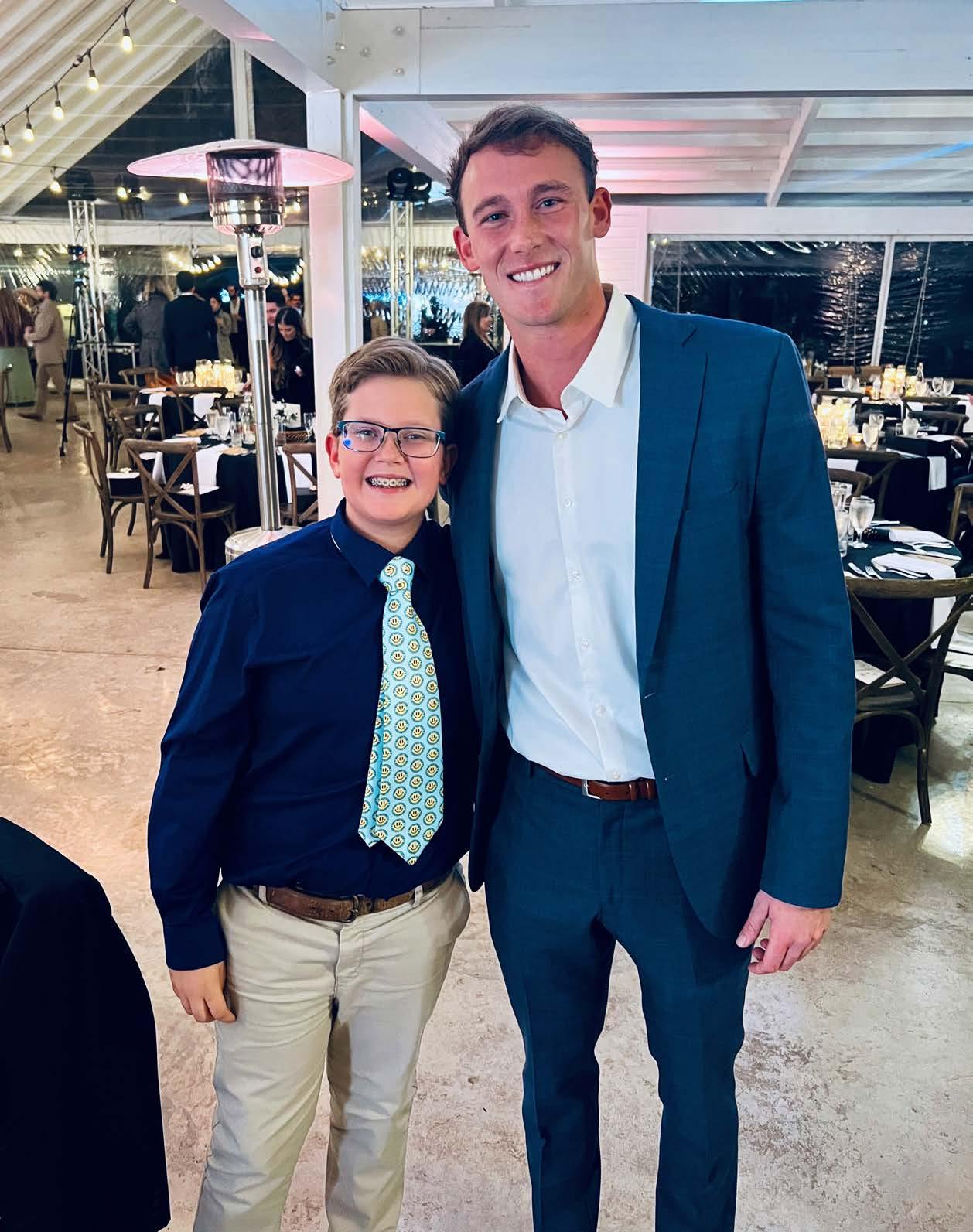
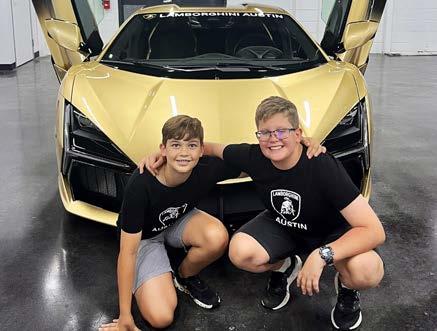
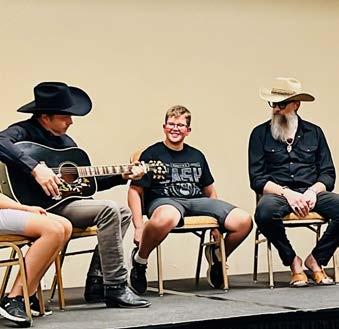
What followed felt almost too perfectly stitched together to be planned. Barret and two friends climbed into a Tesla Cybertruck. A Johnny Cash tribute band happened to be in Austin, so the foundation arranged a private performance where Barret sang with the musicians. Then came Lamborghinis and barbecue to finish the day.
Storm said the experience changed more than Barret’s mood — it changed the story he was telling himself.
“Just be kind. We need more kindness.”
MATT WORTHINGTON ’ 21
“It made him believe that good things could happen to him again,” Storm said.
Later, the two discovered their shared Islander connection, making an already meaningful story feel even more personal.
“I was so impressed with what he is doing for the world,” Storm said. “People need to know what Matt’s doing, because it’s so simple, but it can actually change the world if people just say yes.”
Many Best Days come together because businesses, performers, and volunteers donate time, access, or experiences. For Worthington, the generosity mirrors the support his own family once received. For the foreseeable future, he has pledged not to take a salary from individual donations, instead supporting himself through his full-time sales job and partnerships tied to content and storytelling. It’s not the easiest path, but one he considers essential.
“A promise is a promise,” Worthington said.
For now, he balances foundation work with his day job, pushing toward a future where Best Day Ever can grow even further. The stories keep coming. The need keeps growing. So does the evidence that kindness, when organized with care and conviction, can travel farther than people expect.
For Worthington, the mission remains straightforward.
“Just be kind,” Worthington said. “We need more kindness.” •
From left: Matt Worthington ’ 21 spreads the message of Best Day Ever with local Austin media. Barret Storm (right) and a friend pose in front of a Lamborghini during his Best Day Ever outing. Storm sings with members of Church of Cash, a Johnny Cash tribute act.
Barret Storm, Matt Worthington ’ 21, and friends ride in a Tesla Cybertruck as part of Storm's Best Day experience.
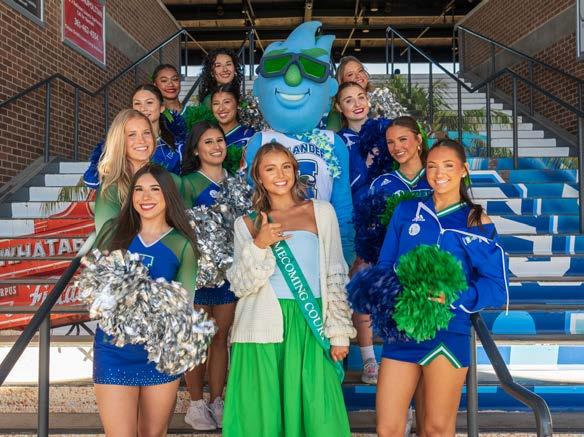
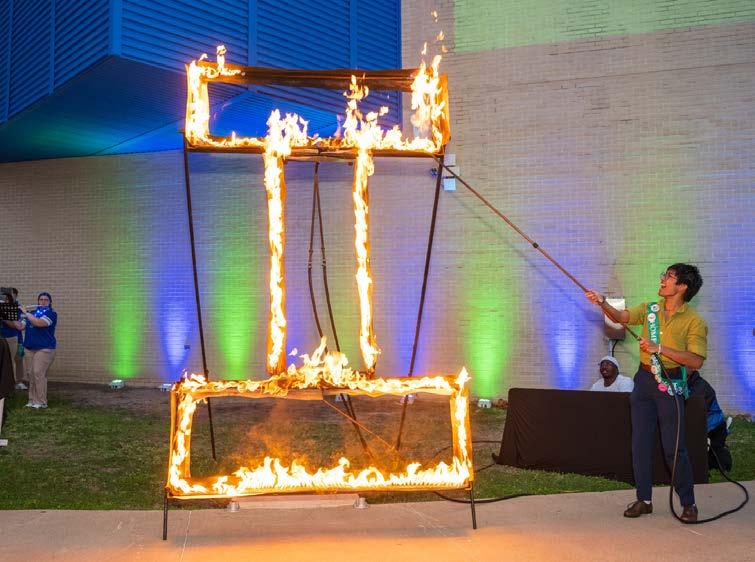
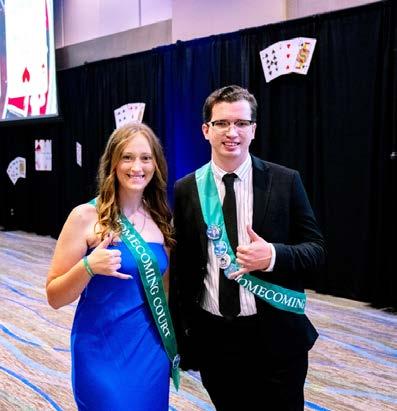
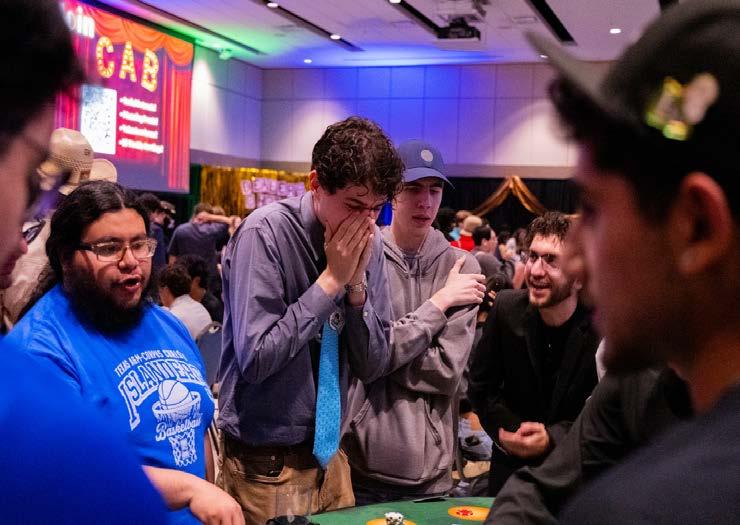
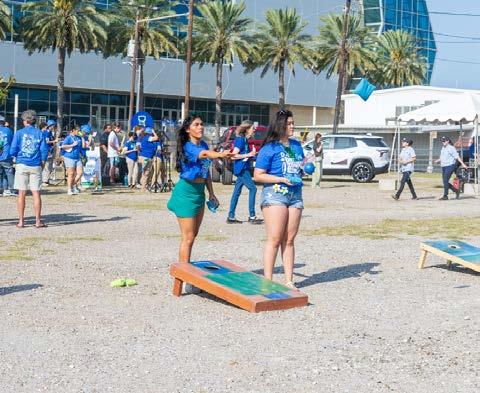
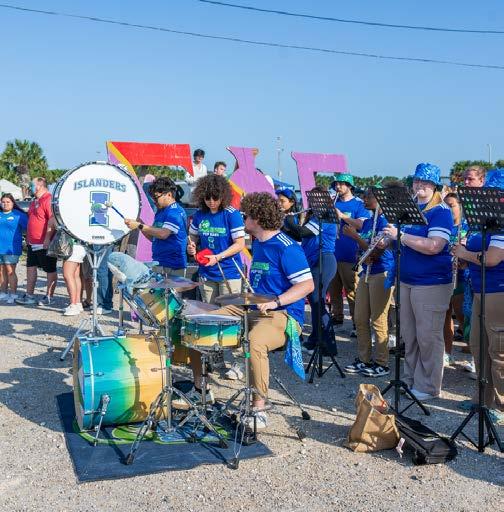
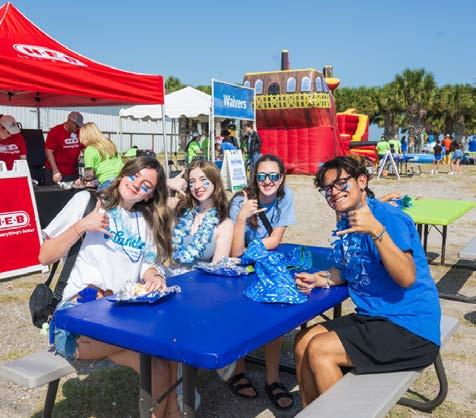
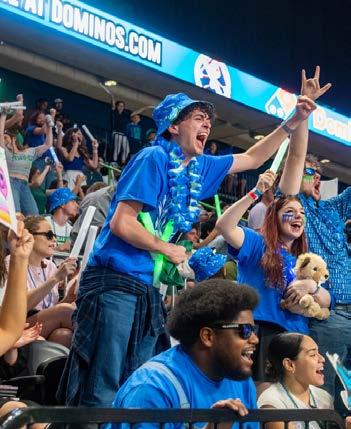
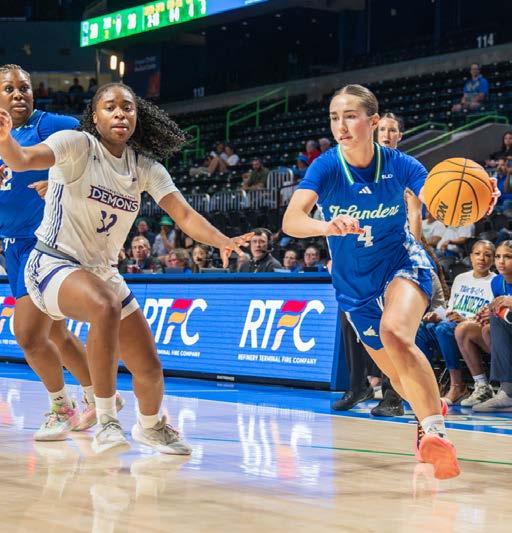
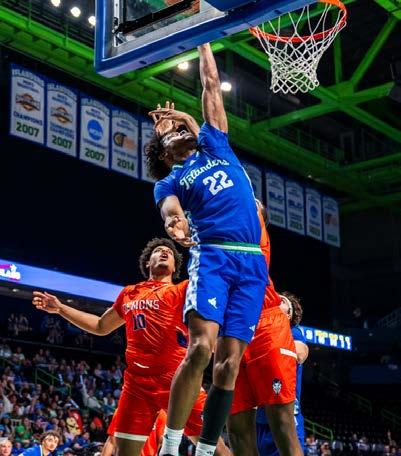
Islanders near and far made their way back to TAMU-CC for Islander Homecoming 2026, a weekend filled with tradition, pride, and celebration. From reunions to festivities, the Islander community came together to honor the past, celebrate the present, and look ahead to the future.
Alumni, students, faculty, and friends made this year’s Islander Homecoming a memorable return for all who call themselves Islanders.
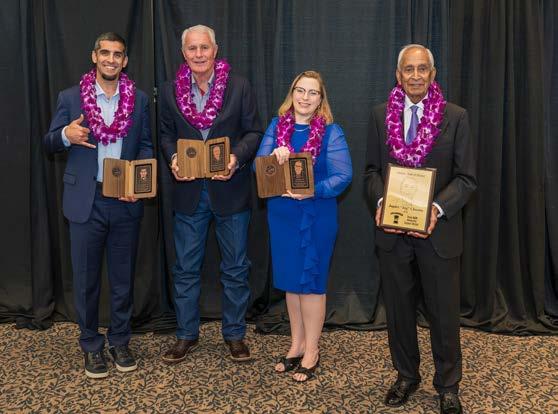
The Homecoming Honors Banquet celebrated the accomplishments of outstanding Islanders who have made a lasting impact.
This year’s honorees included Outstanding Alumnus Moses Mostaghasi ’06, Distinguished Alumnus John Baker ’64, Young Alumnus Callie Walker ’19, and Athletic Hall of Honor inductee Jag Cheema ’67. Each honoree exemplifies the spirit and excellence that define the Islander legacy.
Homecoming Saturday brought the Islander community together for a day of excitement and school spirit. Fans cheered on the Islanders with pride and passion throughout
Whether at the tailgate party, on the court, or in the crowd, everyone enjoyed the celebration of what it means to be an Islander, together.
WHERE LEADERSHIP MEETS LOCAL Impact
MASTER OF PUBLIC ADMINISTRATION CELEBRATES ITS 35TH ANNIVERSARY
In a region where public decisions shape everything from stormwater fees to hurricane readiness, Texas A&M-Corpus Christi’s Master of Public Administration program has spent the last 35 years training the people who make government work.
Launched in 1991, the MPA program has grown with the Island University itself, evolving with the needs of working professionals who serve the Coastal Bend and beyond.
Now celebrating its 35th anniversary, the program reflects three and a half decades of preparing public servants to lead with clarity and purpose. Many students arrive midcareer, already managing teams, budgets, and community expectations. They come looking for a stronger toolkit and leave with skills and applied experience they can take straight back to the office.
“Most of our students are full-time professionals,” said Dr. Isla Schuchs Carr, Chair of the Department of Social Sciences and former coordinator for the MPA program and its graduate certificates. “That reality shapes how the program operates and why it has stayed flexible. The program offers a hybrid structure, with courses in both face-to-face and online formats to meet the demands of public sector schedules.”
The MPA is a traditional 36-hour graduate program. There are also two 15-hour graduate certificates designed for professionals who want focused training without committing to a master’s degree. One is a Homeland Security Graduate Certificate, which can stand alone or pair with the MPA. The other, a newer Public Management Graduate Certificate, gives students in other disciplines a way to formalize public sector expertise they may already be building through elective coursework.
“It is an option that can serve students headed for agency work, utilities,
healthcare administration roles, and other public-facing careers,” Schuchs Carr said. That broader reach matches what alumni say drew them in.
Sylvia Carrillo-Trevino ’02, ’04, City Manager for Bastrop, located east of Austin, did not start out planning to earn an MPA. For her, an elective course shifted her direction and introduced her to city management as a career path. After an internship in the Corpus Christi City Manager’s Office, everything clicked and Carrillo-Trevino found her calling.
“I absolutely love working in city government,” Carrillo-Trevino said. “This is what I want to do.”
She credits the program with sharpening both her technical and peoplecentered skills — from interpreting data to navigating collaboration across departments. She also pointed to the network built in the classroom, a cohort of professionals who became practical sounding boards later in her career.
“That network that I was able to create became a resource when I needed perspective from peers working in other areas of government,” Carrillo-Trevino said.
Jason Brady ’16, Chief of Police for the Seguin Police Department, entered the program while serving as a captain with the Corpus Christi Police Department. He enrolled looking for leadership training which went beyond the core work of law enforcement.
“In law enforcement, you could be the best cop,” Brady said, “but if you do not understand how to write policy and you do not understand how to budget properly, then you will be less effective in a police management role.”
For Brady, the program taught him to look at public safety from inside the ecosystem of city government — where finance, facilities, parks, fire, and police all operate as one team with shared constraints and shared goals.
That applied, cross-sector lens sits at the center of the MPA experience. Faculty emphasize decision-making grounded in evidence, budgeting which reflects realworld tradeoffs, and management theories which explain why a strategy works in one setting and fails in another.
According to Schuchs Carr, graduates most often return to talk about the program’s budgeting course, because it teaches students to evaluate financial information and make defensible decisions.
“I am not teaching them to be financial analysts,” Schuchs Carr said. “I am teaching them to understand the report when the financial analyst brings it to you.” Continued on next page.
Sylvia Carrillo-Trevino ’ 02, ’ 04
Jason Brady ’ 16
The same practical emphasis shows up in the program’s capstone work. Recently, students have partnered with local entities to create projects that tackle applied questions. Schuchs Carr described a project with the City of Corpus Christi’s facilities management team which compared policies and practices for building upkeep in places with similar environmental challenges, including heat, humidity, and salinity. Other projects have included needs assessments and program evaluations connected to public agencies, sometimes designed in earlier coursework and developed into capstone-level work.
These collaborations matter because they give students the kind of experiences they can point to in an interview and provide value to community partners at the same time.
As the program marks its 35th anniversary, it also stands on the edge of another milestone: pursuing program
“We had students commuting from places like Laredo and Victoria because there were so few other options available.”
DR. PHILIP RHOADES
Professor of Criminal Justice
accreditation through the Network of Schools of Public Policy, Affairs, and Administration (NASPAA), the primary accrediting body for public service education programs. Schuchs Carr said the program received eligibility approval and plans to submit its self-study this August. If successful, the program expects an accreditation decision in 2027.
The effort reflects both ambition and continuity, documenting what the program has built and where it plans to go. The anniversary also opens a window into the program’s early foundation, including the faculty who helped shape it when the university and region looked different.
In 1991, graduate options in the social sciences at the university were limited. The new MPA degree filled a clear gap for working professionals across the region.
“The MPA was needed for employees who wanted to advance in government and nonprofit sectors,” said Dr. Philip Rhoades, Professor of Criminal Justice and a Texas A&M University System Regents Professor who retired in 2022. “No other degree was available in the region, and online degrees did not exist.”
Early cohorts reflected South Texas’ public service workforce. Students included police officers, federal agents, probation and parole officers, victim services professionals, and employees in state and federal corrections systems. Some held supervisory roles, while others saw the degree as a stepping-stone toward promotion.
“The focus was on a degree that would
support the advancement of careers,” Rhoades said.
The Coastal Bend’s needs helped shape the program from the start. Local and regional agencies needed trained supervisors and administrators but often struggled to recruit from outside the area. The program offered a way to grow that leadership locally.
“We saw some governments, especially the City of Corpus Christi, encourage and help fund employees to enter the degree program,” Rhoades said. “We had students commuting from places like Laredo and Victoria because there were so few other options available.”
Over time, informal relationships between faculty and local agencies evolved into stronger partnerships, including advisory support from practitioners in the field. Those connections helped ensure the curriculum remained grounded in the realities of public service work.
Looking back after more than three decades, Rhoades hopes the program’s legacy is measured by the influence of its graduates.
“It is nice when people recognize the impact our graduates have had in improving management and administrative practices in the region over the years,” Rhoades said.
That impact can be seen across the region in graduates who have moved into leadership roles in city government and public service. Carrillo-Trevino and Brady are just two examples. Others have taken on key roles closer to home, including Arlene Medrano ’15, Executive Director of the Corpus Christi Downtown Management District, and Amanda Torres ’10,’16, who leads building and development services for the city of Rockport. Together, they reflect the program’s reach across South Texas and beyond, where alumni apply what they learned to the day-to-day work of governing communities.
After 35 years, the Island University’s MPA program still attracts students who want careers defined less by spotlight and more by responsibility. Some serve in city halls. Others lead public safety agencies. Others build careers in nonprofits, utilities, higher education, and public-facing organizations where governance and community trust matter.
•
From left: Javier Zambrano ’ 05, Mary Mahan (MPA ’ 23), Jessica Aleman (MPA ’ 23), and Juan Aleman ’ 24 at an MPA reunion mixer during Islander Homecoming 2026.
Lasting Impact
TAMU-CC DESIGN STUDENTS CREATE BRIGHTER FUTURES FOR LOCAL NONPROFITS
On most Saturdays, the campus of Texas A&M-Corpus Christi settles into a slower, more relaxed pace. But one Saturday each fall, the second floor of Bay Hall hums with energy as some of the Coastal Bend’s most creative minds come together with a shared purpose — helping nonprofits amplify their message, extend their reach, and create lasting change.
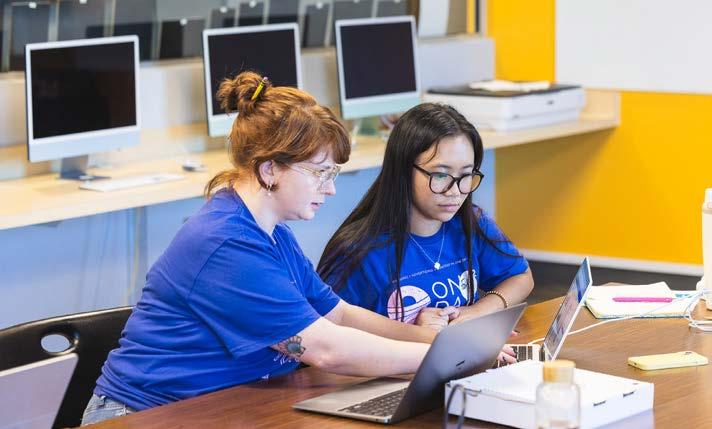
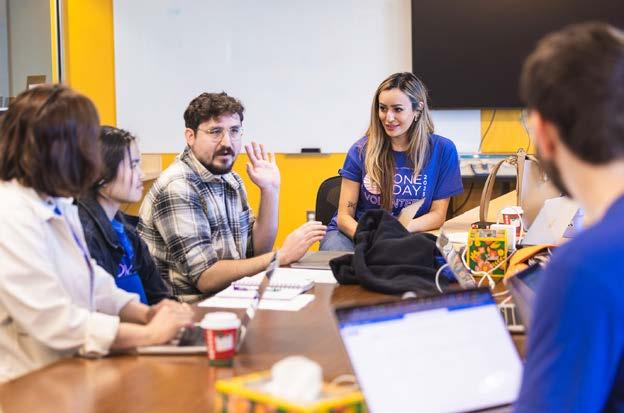
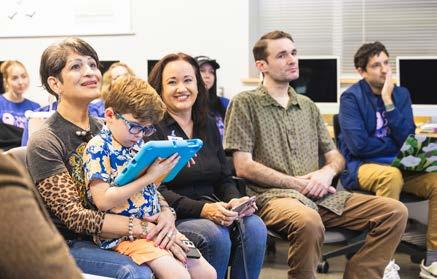
It’s all part of the work being done by the ONE DAY Campaign, a project which started over a decade ago and still drives meaningful change today. Continued on next page.
“It was a little chaotic at the beginning, but we have a system in place now and it’s much more organized,” said Nancy Miller, TAMU-CC Associate Professor of Communication Design and ONE DAY Campaign Coordinator.
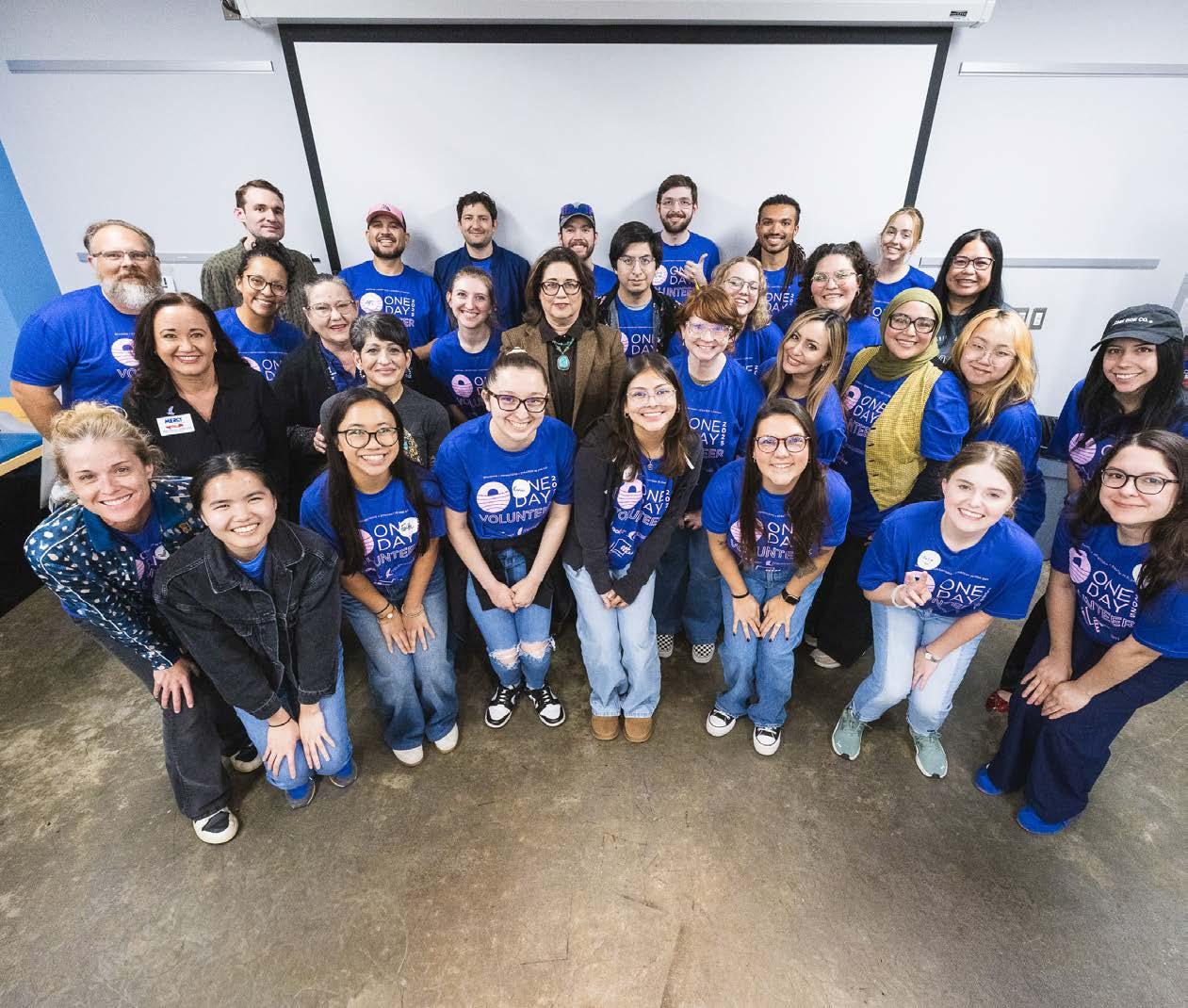
Miller, who also serves as the university’s Communication Design (formerly Graphic Design) Program Coordinator, has been a part of the campaign since nearly the beginning. The concept is a simple one: In one day, Islander communication design students work alongside industry professionals to create full-scale marketing campaigns for local nonprofits at no cost. Those campaigns often include logos, marketing collateral, slogans, social media content, and television advertisements.
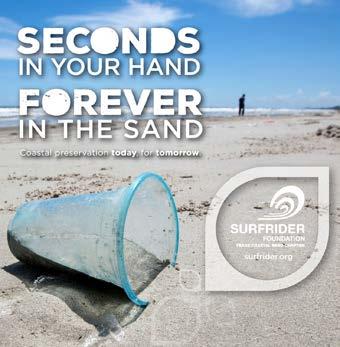
The American Advertising FederationCoastal Bend (AAF-CB) and university first partnered on the project in 2014. One of the earliest organizations to benefit from the partnership was the Coastal Bend Chapter of the Surfrider Foundation, which educates the public about the dangers that plastic pollution poses to local beaches.
“While Surfrider is a national organization, the chapters are volunteerrun and must rely on locally raised funds,” said Neil McQueen, Co-Chair of the local Surfrider Foundation. “Without ONE DAY, there’s no way we could have afforded a professional-quality ad campaign that reached so many people with the ‘Skip the Plastic’ message.”
The campaign slogan created during ONE DAY — “Seconds in your hand, forever in the sand” — resonated far beyond the Coastal Bend. Surfrider chapters nationwide adopted it, and the
campaign went on to win national awards.
“It was rewarding to see that small campaign grow and have real impact,” Miller said. “That was proof that this concept, this ONE DAY project, could really work.”
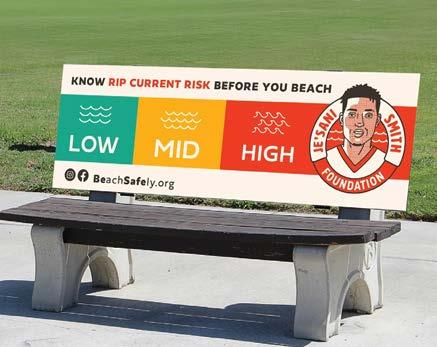
Another powerful example came through the Je’Sani Smith Foundation, a nonprofit founded after 18-year-old Je’Sani Smith, a local high school student just two months shy of graduation, drowned in a rip current in April 2019. His mother established the foundation in 2020 to educate the public about rip current dangers and promote beach safety. In 2021, the foundation was awarded a ONE DAY marketing package worth more than $65,000 to help rebrand and amplify the mission of the foundation. The brand identity created during ONE DAY has since appeared on
“It was rewarding to see that small campaign grow and have real impact.”
NANCY MILLER
Communication Design Program Coordinator and Associate Professor
brochures, billboards, bus benches, and the foundation’s website.
“For families like ours, who have lost a child to open water drowning and are striving to reach as many people as possible to prevent similar tragedies, ONE DAY offers a powerful opportunity,” said Kiwana Denson, Je’Sani’s mother and president
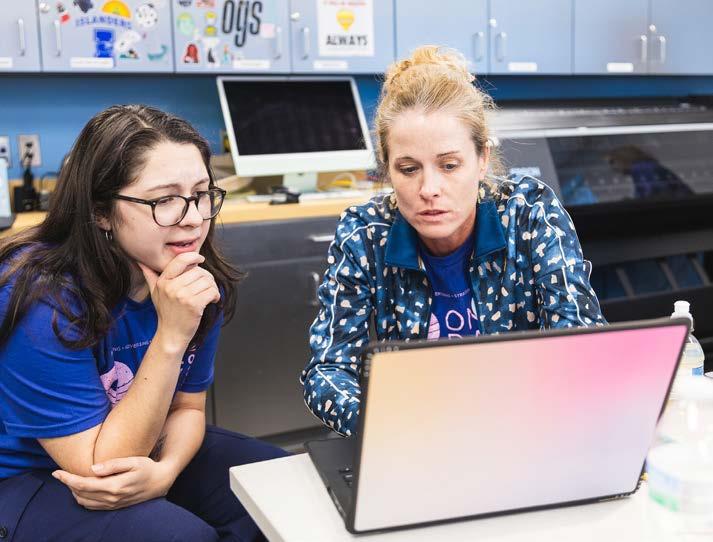
Alex Garcia ’ 27, communication design major, collaborates with Nancy Miller, Associate Professor of Communication Design and ONE DAY Campaign Coordinator.
From left: Campaigns for the Surfrider Foundation and the Je’Sani Smith Foundation showcase the meaningful impact of ONE DAY, while Kiwana Denson, Je’Sani’ s mother, cheers on the work honoring her son’s legacy.
and founder of the foundation. “It allows organizations to build a brand that can truly make a difference and help save lives.”
The impact of the work is what has continued to bring Artemio (Art) Lopez ’20 back to the ONE DAY project. Lopez first participated as a TAMU-CC student in 2017 and later graduated with a bachelor’s degree in graphic design. He now owns his own design company and returns each year to Bay Hall, lending a hand not only to the nonprofits but also to the young creatives gaining real-world experience through the campaign.
“Last year was fun because I was put in charge of a group of students,” Lopez said. “I got to experience what art directors do by guiding younger designers through their tasks. ONE DAY has helped me grow as a person, business owner, and mentor.”
Each year, about 30 nonprofits apply to receive services from ONE DAY, and the AAF-CB Board of Directors chooses one to benefit from the program. Students
“It was an amazing opportunity to design alongside other creatives and see firsthand how design can make a strong impact...”
FAITH DO ’ 26
make up the majority of the creative volunteers, with more than two dozen participating during the event.
Faith Do ’26 took part in her first ONE DAY in 2025. It is an experience she wishes she had taken advantage of sooner.
“It’s a long day, but it goes by quickly,” Do said. “It was an amazing opportunity to design alongside other creatives and see firsthand how design can make a strong impact to not only on us as designers, but also our client.”
Do worked on the campaign for Mission of Mercy, an organization that provides free medical care to underserved populations.
“We simply do not have any allocated budget or revenue dedicated to advertising or media,” said Sherry Bowers ’03, Executive Director at Mission of Mercy.
“During the presentation, several of my staff members were in tears because we all
recognized that this is a true game changer for our organization.”
While the impact of ONE DAY extends far beyond numbers, Miller estimates the annual current value of the work at more than $35,000 in professional creative services and $75,000 in donated media placements coordinated by professional volunteers from AAF-CB.
In one focused day, students discover that their work can serve a greater good — and that the skills they sharpen in service not only make a difference now, but also help shape and enrich their future careers.
“It’s so valuable for the students to work alongside other professionals,” Miller said. “Not only do they get to experience what a work environment could be like, they also make important connections with the professionals that can often lead to internships and full-time employment.” •
Clockwise from top: Faith Do ’ 26 collaborates on social media posts and design templates for ONE DAY. Industry professionals listen as students pitch their ideas.
Sherry Bowers ’ 03, Executive Director of Mission of Mercy, smiles as she hears the presentation focused on her organization.
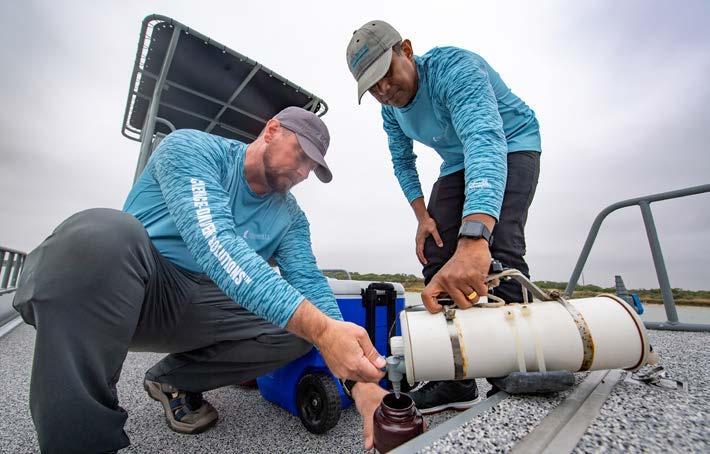
Coastal Water Health Lab researchers conduct monthly water quality monitoring of
THE MAGIC OF BAFFIN BAY AND THE MISSION TO PROTECT IT
Baffin Bay is one of those places along the Texas Gulf Coast that many people consider their personal “fishing hole.”
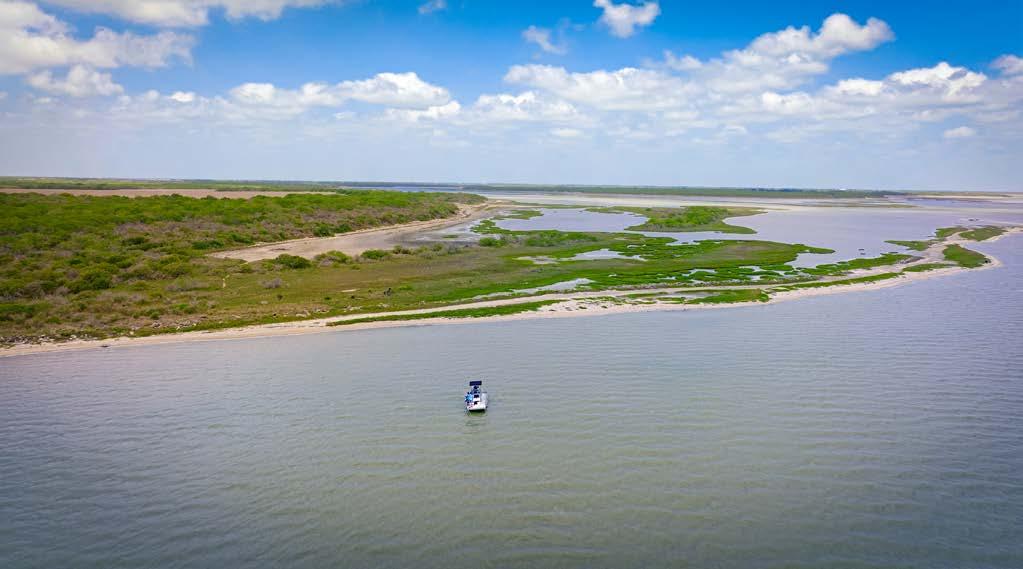
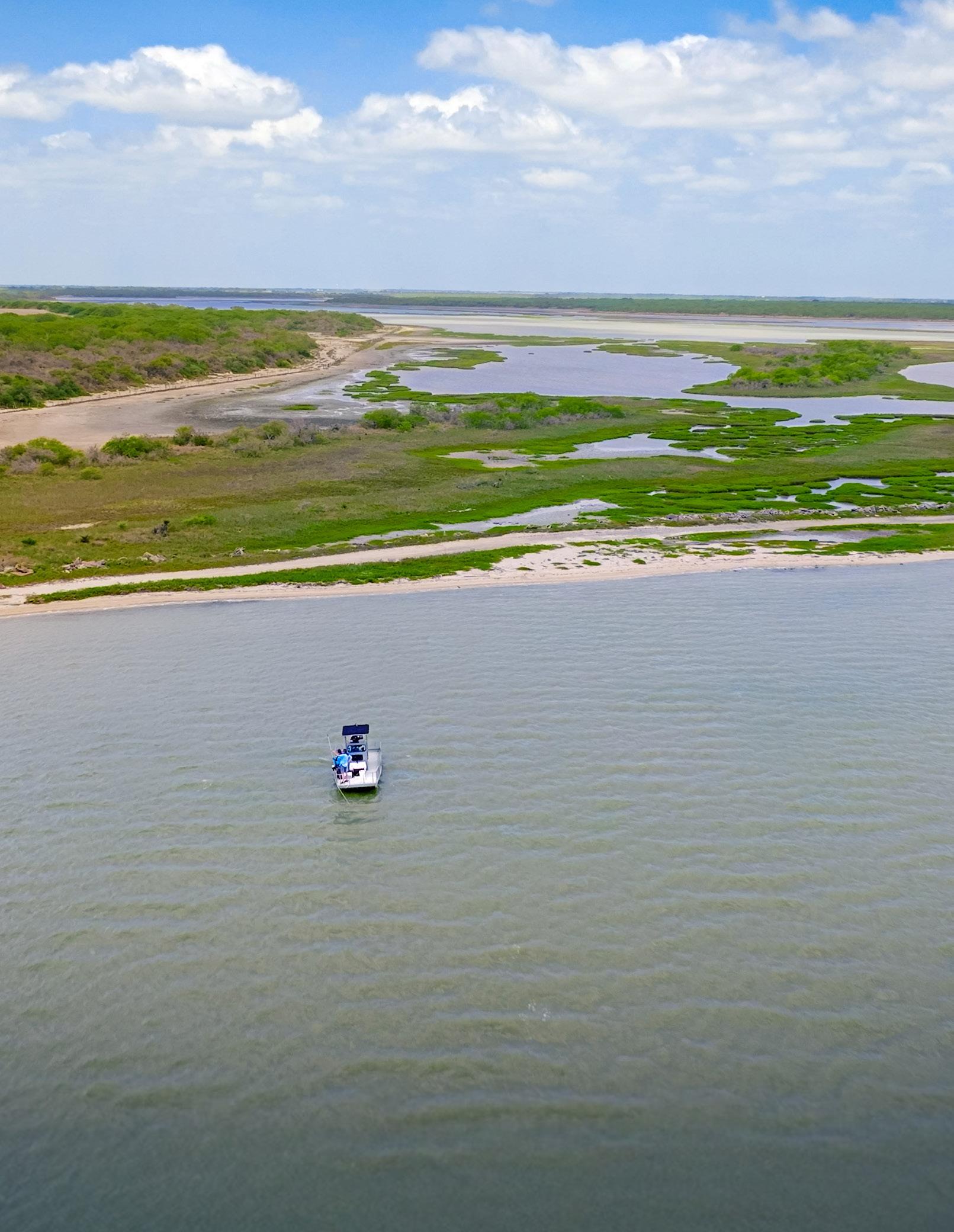
Covering roughly 100 square miles along the Laguna Madre south of Corpus Christi, Baffin Bay and its surrounding 1.5-million-acre watershed are among the most remote areas of the Texas coast and support one of the state’s most robust recreational fisheries. There is a devotion to Baffin Bay not seen anywhere else on the Gulf Coast. Its salty waters support a rich diversity of species, including the prized spotted seatrout and black drum, and generations of anglers have taken up rod and reel to try their hands at landing a fish.
“From the time you leave Marker 37 in Corpus Christi heading south you have the National Seashore on one side and the King Ranch on the other — it’s just very isolated down there,” said Dr. David McKee ’80, a former marine biology professor at Texas A&M-Corpus Christi and long-time Baffin Bay angler and cabin owner. “It’s just a magical place.”
Baffin Bay.
CONNECTION AND DEVOTION
“It’s remote, ecologically unique, and boasts a productive fishery,” noted Athena Frasca, Program Coordinator for Bringing Baffin Back™. “For many people, it’s also where they learned to fish with a grandparent or caught a personal best. Those kinds of connections to a place inspire lifelong stewardship.”
More than 15 years ago, long-time anglers, landowners, and others who live and work on the bay began noticing troubling changes, including recurring brown tide algal blooms, cloudy water, and loss of seagrass habitat. These weren’t just concerns for a favorite fishing spot but warning signs about the health of an entire ecosystem.
Those concerns were brought to researchers at the Harte Research Institute at Texas A&M-Corpus Christi, who launched a collaboration that combines stakeholders’ lived experiences on the water with rigorous research and data collection in the form of the Baffin Bay Volunteer Water Quality Monitoring Program.
Researchers identified excess nutrient pollution, including nitrogen and phosphorus, from upstream sources as a primary contributor to declining water quality and stressed habitats. These pollutants disrupt ecological balance and put long-term strain on the bay’s ecosystem and fisheries.
INVOLVING THE MASSES
The Baffin Bay volunteers were also instrumental in shaping Bringing Baffin Back, formally established in 2022, and
led by HRI’s Coastal Water Health Lab in collaboration with the Coastal Bend Bays & Estuaries Program (CBBEP).
The goal of Bringing Baffin Back is to find solutions to the water quality issues affecting the health of the bay. Today, HRI researchers and TAMU-CC students continue to engage with volunteers on water quality monitoring and data analysis.
“These experiences directly shaped my career goals and prepared me for continued work in environmental research,” stated Lucero Barraza ’24, a research scientist who works in the Coastal Water Health Lab at HRI.
Bringing Baffin Back uses data collected through the program to address watershed sources of pollution and advance collaborative restoration strategies designed to create measurable, long-term
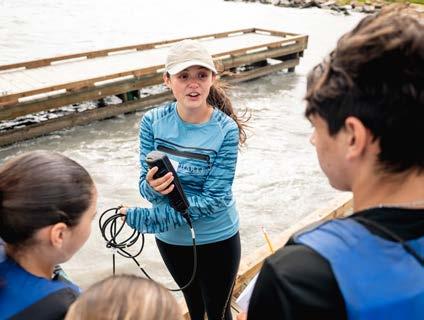
Post-Doctoral Researcher, collect water from Baffin Bay using a Van Dorn sampler. Above: Kalie Tovar ’ 24, HRI Graduate Research Assistant, guides Texas Brigades Experience attendees through water sample collection.
water quality improvements.
To facilitate community buy-in, HRI and its partners at CBBEP convene stakeholder working groups — including landowners, conservationists, and business owners — to identify and implement conservation strategies for Baffin Bay. This structure not only strengthens scientific understanding but also creates hands-on training opportunities for the next generation of coastal scientists.
Dr. Michael Wetz, HRI Chair for Coastal Water Health, sees student participation as an important component in expanding the ability to study the bay. Students work in the field and in the lab, gaining experience in water quality monitoring and stakeholder management, while also learning how stakeholder collaboration can strengthen conservation outcomes.
Continued on next page.
Left: Dominic Burch ’ 10, HRI Research Specialist, and Sankar Manalilkada Sasidharan, former HRI
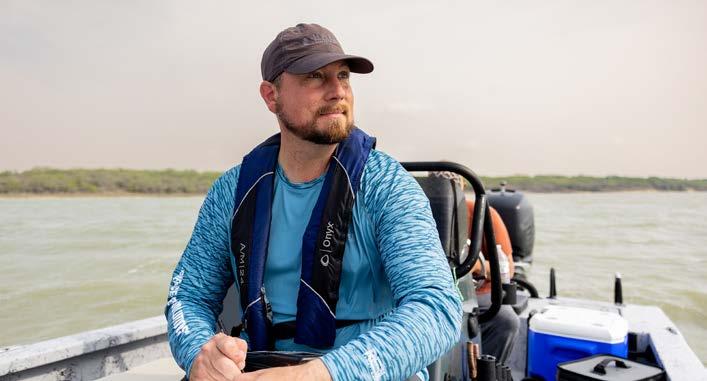
Dominic Burch ’ 10, HRI Research Specialist, collects water quality data during a monthly monitoring trip on Baffin Bay.
“Baffin Bay is an iconic and unique ecosystem, and yet for so many years, it was understudied, which is part of the reason why the water quality degradation and habitat loss went mostly unnoticed,” Wetz explained. “Now, it has turned into a living laboratory for students and Bringing Baffin Back gives them an opportunity to mesh their research with stakeholder engagement, which is a unique experience.”
THE FUTURE
Bringing Baffin Back is beginning to produce measurable results, as the collaboration between citizen scientists, researchers, and stakeholders is providing a model for other conservation efforts along the Gulf and beyond.
“The Bringing Baffin Back initiative actively seeks community input on solutions, ensuring that restoration efforts reflect local priorities and have support,” said CBBEP Executive Director Kiersten Stanzel. “Combining science with community engagement ensures that restoration is both technically sound and socially supported, which is essential for the long-term recovery and protection of Baffin Bay.”
Hundreds of tons of waste have been removed from creeks and drainage areas that feed Baffin Bay, and conservation best-management practices are now in place on more than 2,000 acres of agricultural land in the watershed, reducing runoff before it reaches the water.
“I think they are doing a bang-up good job on it,” McKee said.
Wetland restoration and rain garden projects are also being implemented across the Baffin Bay watershed. These naturebased solutions are designed to filter pollutants, increase infiltration, and slow the flow of nutrients into the bay.
And McKee added the fishing has been “as good as it’s ever been.”
“In five to10 years, success will look like scaling these efforts to get more projects on the ground, sustained coordination
between partners and stakeholders, and documented improvements in water quality over time,” said Frasca. “I value being part of an effort that is so collaborative, is built on long-term partnerships, and operates at an ecosystem scale.”
Baffin Bay’s future is being shaped by a unique, coordinated effort to protect the entire ecosystem and ensure the bay, and the people who love it, continue to thrive. •
“Combining science with community engagement ensures that restoration is both technically sound and socially supported...”
KIERSTEN STANZEL
CBBEP Executive Director
lab.
Dr. Michael Wetz, HRI Chair for Coastal Water Health, and Athena Frasca, Watershed Restoration Coordinator, visit with volunteers at the 2025 “ Exploring Baffin Bay” Texas Brigades Experience.
Lucero Barraza ’ 24, MS HRI Research Assistant, and Dr. Laura Beecraft, Assistant Research Scientist, process water quality samples in the Coastal Water Health
TABLE at the TABLE A PLACE A PLACE
ISLANDER TEACHING KITCHENS TURN COOKING INTO CONNECTION, CONFIDENCE, AND CREATIVITY
Food has always been part of campus life. At Texas A&M-Corpus Christi, however, it’s becoming something more — a pathway to connection, confidence, and creativity.
At Islander Dining Teaching Kitchens, students aren’t just grabbing a meal between classes, they’re rolling sushi, stuffing salmon, and getting hands-on lessons in how to build a plate that works for their lives.
Islander Dining Teaching Kitchens are regular cooking classes run by Chartwells, operators of Islander Dining. The classes take place in the Islander Dining Hall and allow students to get hands-on experience making their own fresh, healthy food.
For Alyssa Olea ’28, a first-generation student from Houston studying nursing, the Tteaching Kitchens have become part of her routine. What started as curiosity turned into something more consistent.
“I’ve been cooking a lot more in my dorm,” Olea said. “I use some of the recipes quite often. It just makes it fun to cook.”
That shift from obligation to enjoyment is the driving purpose behind these monthly events.
“Teaching Kitchens turn nutrition education into an interactive, empowering experience,” said Carly Richter, Regional Nutritionist for Chartwells. “Instead of simply being told what to eat, students
learn how to prepare balanced meals themselves.”
Students learn by doing — how to build a meal with protein, fiber, and fresh ingredients; how to handle a knife properly; how to prepare something simple that doesn’t come ready-to-eat out of a package. Just as important, they learn eating well doesn’t have to be restrictive.
Richter said many students arrive on campus with the misconception that nutritious food is bland, or that eating well means following rigid rules. The Teaching Kitchens challenge that thinking.
Continued on next page.
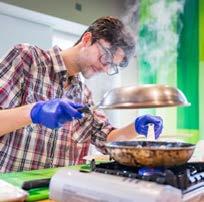
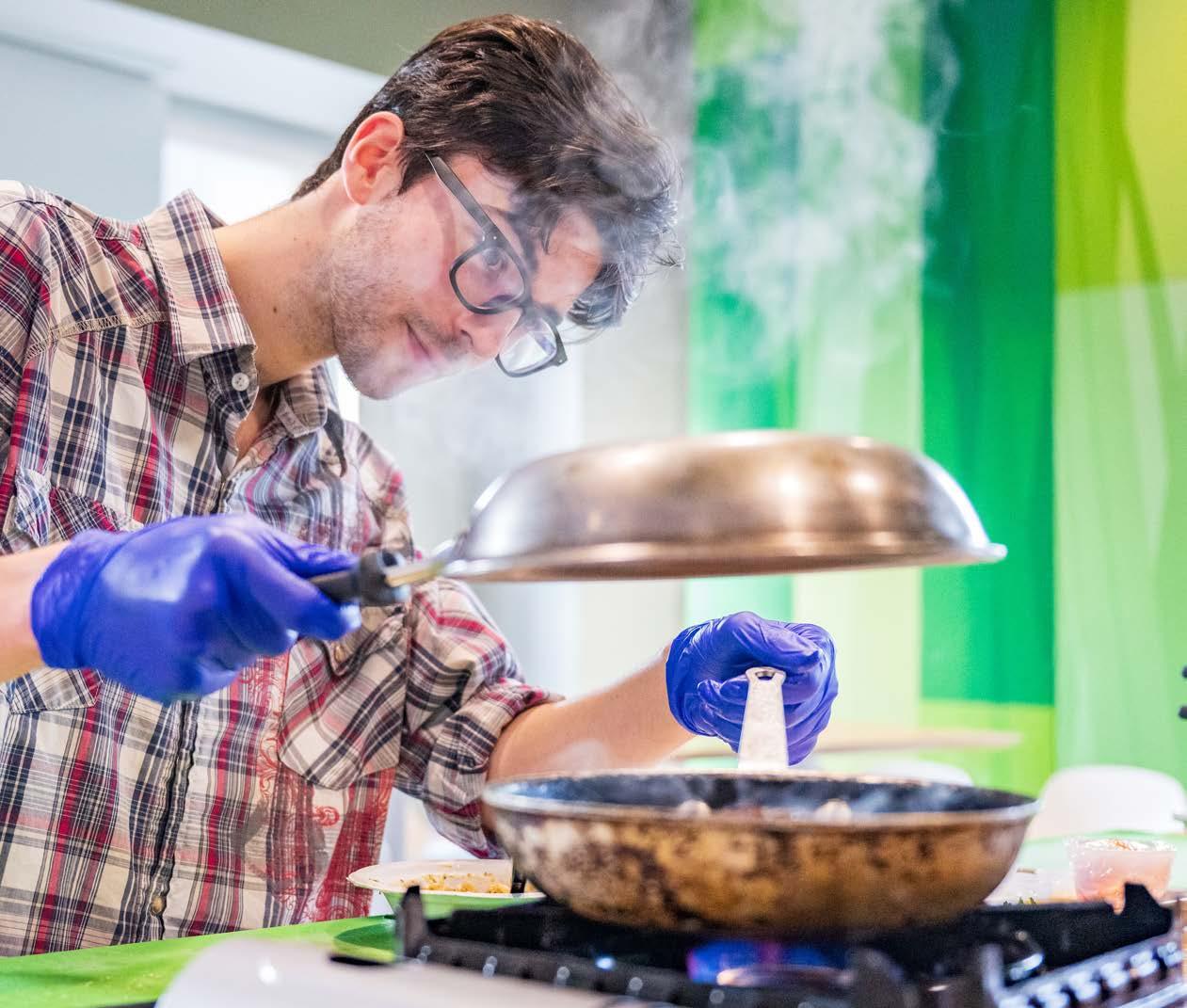
Logan Dixon ’ 27 carefully checks on his stuffed salmon during a recent Islander Dining Teaching Kitchen.
“We follow an ‘all foods fit’ approach,” Richter said. “It’s about what students can add to make meals more balanced, rather than what they should take away.”
That approach lands differently when it’s experienced, not explained.
At a recent session, students gathered around prep stations, working through the careful process of rolling sushi. Some struggled at first — too much rice, not enough pressure — but the room stayed light. Mistakes were part of it.
For Steven Wright, Resident Dining Chef, that’s where the learning happens.
“When students step into a Teaching Kitchen, they aren’t just watching a demonstration,” Wright said. “They’re actively cooking, asking questions, and building confidence.”
The teaching kitchens, presented by the university’s health promotions plan Thrive 365, are designed to meet students where they are, whether they’re novices or have been cooking for years. Lessons start with fundamentals before opening the door to experimentation.
“There isn’t just one right way to cook,” Wright said. “You can explore.”
That sense of exploration is what drew
“Food has the power of connection. It brings people together.”
CARLY RICHTER Regional Nutritionist, Chartwells
Logan Dixon ’27 to his first Teaching Kitchen, where students were taught how to make stuffed salmon. A junior geospatial science major originally from Tennessee, Dixon came across the event while scrolling through the campus calendar. He was curious — and hungry.
“I didn’t want to cook a bunch of white rice tonight,” Dixon said with a laugh.
Dixon already had some experience in the kitchen, having worked as a deli cook and experimented with recipes on his own. But the Teaching Kitchen offered a chance to expand his range in a more hands-on, guided environment.
“I like fish,” Dixon said, “and I’ve never made stuffed salmon.”
For Dixon, the value isn’t just in learning a new recipe. It’s in being introduced to new ingredients and new ways of thinking about food.
“Some people grow up cooking a certain way,” Dixon said. “If I’m only making Cajun food, then I don’t know how to make anything else.”
For Olea, who has attended nearly every session since arriving on campus, the draw is as much about the atmosphere as the instruction.
“It’s more enjoyable because I get to come with my friends,” she said. “It’s a fun way to de-stress.”
In a college environment often defined by deadlines and demands, that kind of space matters. Food becomes less about convenience and more about care, something students can return to when they need a reset.
And while the lessons start in the kitchen, they don’t stay there.
Basic skills, from prepping vegetables to building a simple meal, translate into everyday life, whether in a residence hall or an off-campus apartment. Over time, those small shifts build something larger: independence.
“By cooking simple, nutritious meals, students gain skills that promote confidence and healthy living long after they leave campus,” Wright said.
The impact is communal. Cooking side by side, students meet others they might not have otherwise — different majors,
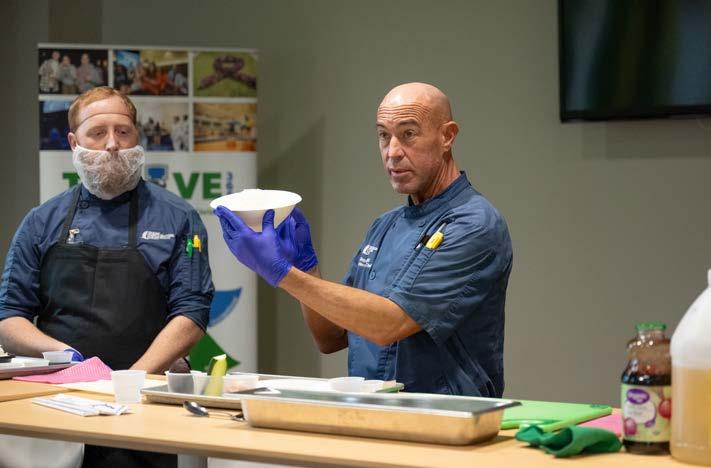
Resident Dining Chef Steven Wright leads students through the proper techniques for sushi making.
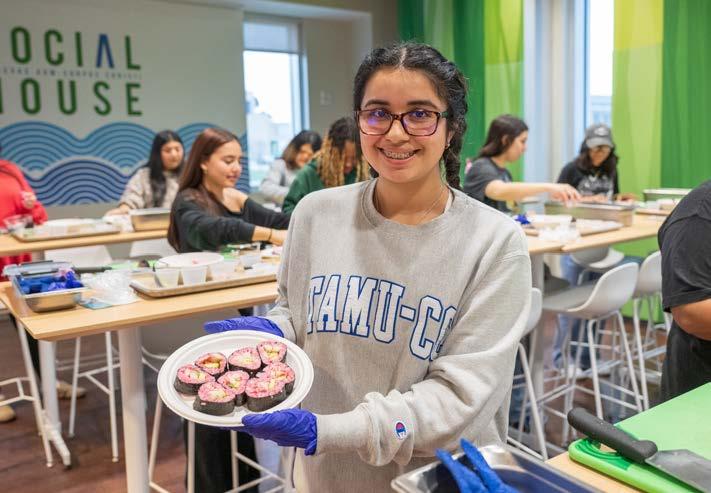
Alyssa Olea ’ 28 shows off the “ Sweetheart Sushi” she made during a Teaching Kitchen, with a Valentine’ s Day theme.
backgrounds, and experience levels. Conversations happen naturally, over cutting boards and shared ingredients.
“I’ve made closer friends,” Olea said. “Friends invite their friends, and you just build a bigger circle.”
It’s a simple idea, but one that resonates: learning something new, together.
That sense of belonging, built around a shared table, is what Islander Dining is working toward — not just feeding students, but equipping them.
For Richter, the connection is clear. Food touches more than physical health; it shapes emotional and social well-being, too.
“Food has the power of connection,” Richter said. “It brings people together.”
And in the Teaching Kitchens, that connection is something students can see, taste, and carry with them long after the last dish is washed. •
EMP OW E R STUDENT S ENRICH YOUR LEGACY
Leaving a legacy at Texas A&M University–Corpus Christi means investing in the bright futures of students and the continued growth of our Islander community.
By including TAMU-CC in your will, retirement account, or life insurance policy, you create lasting opportunities that empower scholarship recipients, fuel innovative research, and strengthen programs for years to come — all while benefiting from potential tax advantages.
Planned giving is a meaningful way to make an enduring impact, ensuring that your values and commitment continue to inspire long after today.
To learn how your thoughtful gift can build a stronger future, please contact the 361.825.2372 or click here. We’re here to help you
Logan Dixon ’ 27 samples his stuffed salmon creation.
BUILT IN 48 HOURS, BOUND FOR THE W RLD
ISLANDERS PLACE SIXTH WORLDWIDE IN ‘ INVENT FOR THE PLANET, ’ ADVANCE TO GLOBAL FINALS IN IRELAND
The clock started at 48 hours, with no roadmap or pre-assigned teams. A roomful of Islanders from vastly different disciplines were introduced to a global challenge they had never seen before, and given the freedom to build something that matters.
That is the premise of Invent for the Planet (IFTP), an international innovation competition organized by Texas A&M University and hosted simultaneously at universities across the globe each spring. Teams have 48 hours to identify a problem worth solving and develop a viable, marketable solution from scratch. This year’s competition featured 32 universities in 17 countries trying to solve the 2026 IFTP theme — Reimagining Food Systems for a Resilient Planet.
Dr. José Baca, Associate Professor of Engineering, has watched that weekend unfold from the inside nearly every year since TAMU-CC joined the competition in 2019. He has seen teams soar and stall and find their footing at midnight. He knows what the good ones look like.
“You get to see them from the very
beginning,” Baca said. “You see how the idea starts, how they develop solutions, and how they overcome the challenges.”
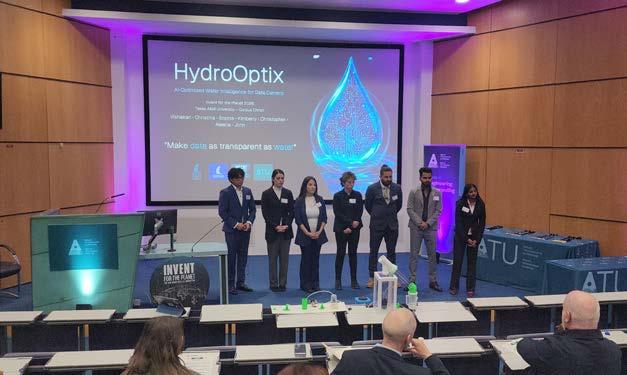
This year’s winning team, HydroOptix, emerged from the Island University’s competition with not only a first-place finish on campus, but also a sixth-place ranking among participating universities worldwide which earned them a trip to the global finals in Ireland.
HydroOptix featured a trio of students: Kimberly Lopez ’22, ’26; Aleena Roy ’26; and Christopher Salazar ’24, ’26. All who knew each other from their work in a university lab.
For Salazar, a first-generation electrical engineering graduate student from Corpus Christi, having at least two team members he was already familiar with made the IFTP process seem a little less intimidating.
“I have trust in them,” Salazar said. “Everything we do together, we get good results.”
The rest of the seven-person team — Christina Gonzalez ’26, Sophia Hernandez ’28, John Lava ’28, and
Vishakan Umapathy ’26 — filtered in from medical laboratory science, marine biology, engineering, and computer science, respectively. Lopez, a firstgeneration student from the Rio Grande Valley pursuing a Master of Science in Electrical Engineering, said the blend of academic backgrounds drove their success.
“Everybody was different and we all came together,” Lopez said. “Everybody picked their topic and went off on it. Normally one person does all the work, but this time, everybody was a team leader.”
The first 24 hours were far from glamorous. Competing ideas pulled the group in different directions.
Salazar wanted to lean into greenhouse agriculture, a topic he knew well from his thesis research.
“We don’t have a lot of time — 48 hours,” he said. “I thought, this will be how we can sound the most professional, because I can take the lead on this and we’ll have a big leg up.”
But Lopez and Roy worked through the night chasing a different thread entirely,
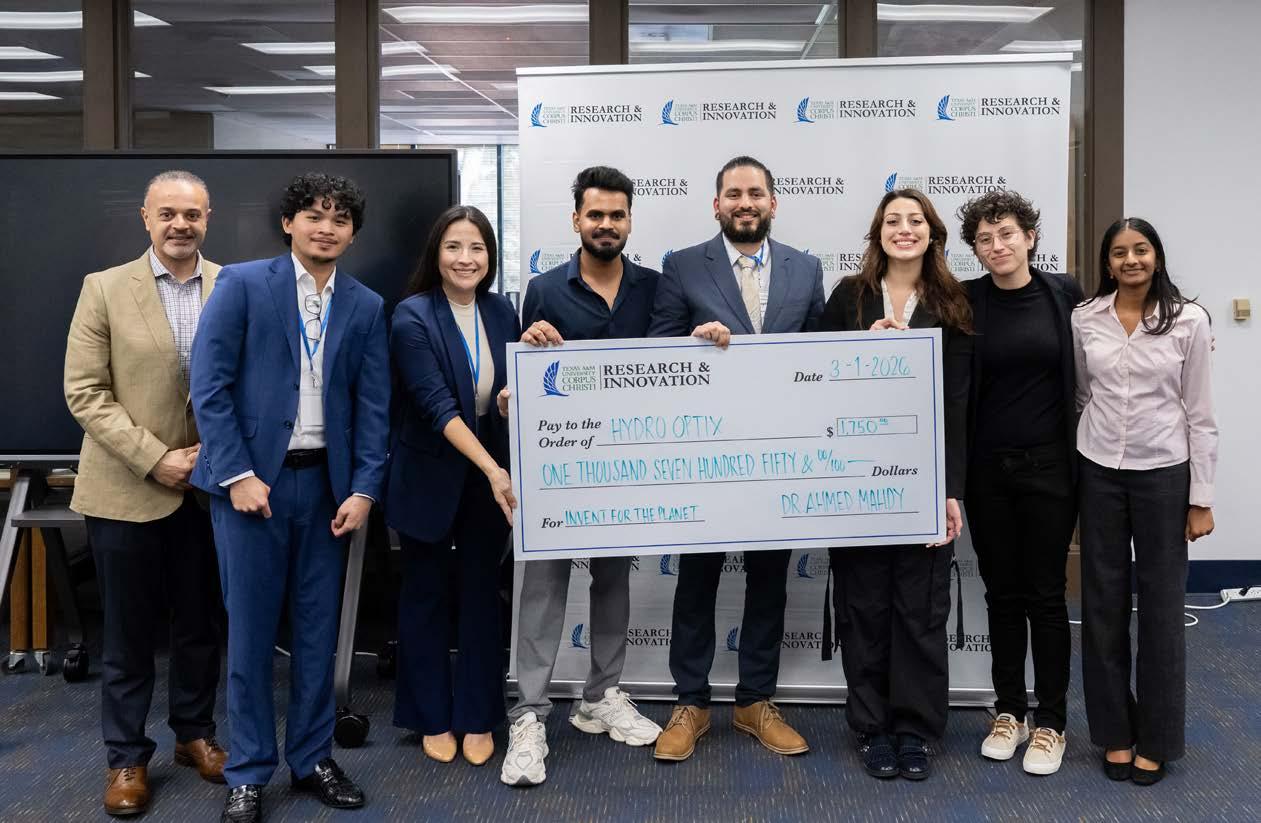
From left: Executive Vice President of Research and Innovation
Dr. Ahmed Mahdy, John Lava ’ 28, Christina Gonzalez ’ 26, Vishakan Umapathy ’ 26, Christopher Salazar ’ 24, ’ 26, Sophia Hernandez ’ 28, Kimberly Lopez ’ 22, ’ 26, and Aleena Roy ’ 26.
one that felt more urgent. By morning, they were ready to make their case. The challenge they landed on — the water demands of artificial intelligence data centers.
Every time a user interacts with a large AI model, data centers consume water to cool their systems. That water circulates through cooling towers, gradually accumulating contaminants until it triggers a “blow-down event,” a full system flush which can consume millions of gallons in a single cycle. Meanwhile, much of the steam produced in the cooling process simply escapes into the atmosphere, unrecovered.
“The team looked at how we can
“They performed well and put forth an impressive effort that made us all very proud.”
DR. JOS É BACA
Associate Professor of Engineering
maximize use, so you don’t need to use so much new water,” Baca said.
The solution they came up with was a sensor-based system, integrated directly into existing data center pipelines, which monitors water quality in real time. The system would end blow-down events as soon as water is ready for reuse rather than running a fixed, potentially wasteful cycle. Separately, the system would also capture condensation, already distilled and contaminant-free, and return it to circulation before it escapes into the air.
Lopez made the conceptual leap from her lab work.
“I thought of a laboratory distiller,” Lopez said. “It’s a glass ball with a tube, and you boil the water so that it condensates and collects.”
Salazar framed the idea in plain numbers. If a blow-down event consumes one million gallons and the system cuts that in half, that’s 500,000 gallons recovered per event, per facility. Multiply that across a global industry building data centers at an accelerating pace, and the potential compounds fast.
“If it’s cheap and it can integrate directly into what they already have, then it’s a nobrainer,” Salazar said. “You’re saving water, your energy bill is lower, and your pumps last longer.”
The team estimates a realistic reduction in water consumption of 5-20%.
Weeks later, in a lab meeting, Lopez’s phone lit up with a text message saying they had been selected for the global finals in Ireland. She slid the phone silently to Baca, then to Roy, and finally Salazar. They were stunned.
“Hopefully we’re doing some good for the world,” Lopez said.
The group was TAMU-CC’s second team to advance to the global competition. While HydroOptix did not finish in the top three at the finals in Ireland in May, the team made a lasting impression.
“The event was a fantastic experience, and I was so proud to be there listening to their final presentation,” Baca said. “They performed well and put forth an impressive effort that made us all very proud. Students from around the world learned about the things we are doing at the Island University.” •
Clockwise from left: In May, TAMU-CC’s Team HydroOptix joined student innovators from around the world in Galway, Ireland, as part of the global Invent for the Planet finals. HydroOptix presents at the global finals in Ireland. The team takes in the sights in Ireland.
Momentum MoTION
Momentum MoTION
TRACK AND FIELD TEAM MAKES THEIR MARK, SETS RECORDS
Striving for greatness often begins with a single step. For many athletes on the Islanders Track and Field team, it also begins long before sunrise. Behind every personal best, conference title, and school record is a commitment to discipline, consistency, and a relentless pursuit of improvement. That mindset has become the foundation of the program under head coach Bryan Jackson.
Now in his third season leading the Islanders, Jackson has steadily elevated the program. The 2025 season alone saw 40 athletes crack the program’s all-time top 10 list, while 20 school records fell between indoor and outdoor competition. Most recently, at the 2026 Southland Conference Indoor Championships, both the men’s and women’s teams finished fifth, combining for six gold medals. For Jackson, success starts with something simple.
Elizabeth Khatevi ’ 28
Cyan Green ’ 26, ’ 28
Samson Black ’ 29
“Attitude really is key,” he said. “Their determination, their willingness to work, their willingness to be pushed — it all matters. I can’t coach the talent they have. That’s something they’re born with. But I can enhance it.
I can help them maximize it, if they’re willing to work for it.”
Few embody that mindset more than Cyan Green ’26, ’28. Green completed her bachelor’s degree in university studies and is working toward a second undergraduate degree in electrical engineering while remaining a dominant force in weightthrowing events, balancing an ambitious academic path with elite athletic performance.
“I’ve always been strong and lifted weights,” Green said. “So, the sport came naturally to me. It was easy to grasp. It was easy to excel in.”
And excel she has. Since transferring from Stephen F. Austin State University, Green has become one of the program’s most decorated athletes. She recently defended her title at the Southland
“This university has given them the opportunity to earn an education while chasing their athletic dreams — and they’re making the most of it.”
BRYAN JACKSON Islanders Track and Field Head Coach
Conference Indoor Championships, earning back-to-back gold medals in the women’s weight throw. With that victory, she became the first female Islanders student-athlete to repeat as an indoor conference champion in any event. Add in a bronze medal in the hammer throw during the 2025 outdoor season, and Green has now reached the podium three times in her Islanders career.
“She’s incredibly hard-working and has great leadership skills,” Jackson said. “She leads by example in the classroom, in the community, and in competition. You can’t ask for a better athlete to coach.”
Another name etched into the Islander record books is Elizabeth Khatevi ’28, already one of the most accomplished athletes in program history.
Following a perfect season that included titles at both the Southland Conference Championship and the 2025 NCAA South Central Regional in the 6K, Khatevi advanced to the NCAA National Championships. There, she finished 46th out of 262 runners, the highest finish ever by an Islander woman at the national meet.
“It was fun, but not easy,” Khatevi said. “The good thing is that I learned how to compete at that level, especially against national champions.”
Her list of accolades continues to grow. Khatevi was named Southland Conference Women’s Outdoor Most Valuable Performer and Freshman of the Year. One
of her most memorable moments came at the 2026 Southland Conference Indoor Championships.
As the anchor of the women’s distance medley relay, Khatevi received the baton with her team in last place with 2,000 meters remaining. What followed was nothing short of remarkable.
She surged past the field, took the lead with two laps to go and never looked back.
“It was unbelievable,” Jackson said. “It was the most incredible relay leg I’ve ever seen.”
While her athletic achievements are impressive, the impact the Kenyan native is having off the track is just as important — especially when it comes to her family.
“Competing and studying at Texas A&M-Corpus Christi has opened doors for me to support my family, and that is one of the most meaningful parts of my journey here,” Khatevi said.
For freshman thrower Samson Black ’29, success has come through trusting the process.
The Sabine, Texas, native first picked up a discus in middle school, where his size and natural ability immediately caught the attention of his coaches. Years later, that potential has translated into conference success. At the 2026 Southland Conference Outdoor Championships, Black earned silver in the discus, bronze in the hammer throw, and was named the Southland Conference Men’s CoFreshman of the Year.
Continued on next page.
Elizabeth Khatevi ’ 28 and coach Bryan Jackson
Cyan Green ’ 26, ’ 28
“It was really just about trusting all the work I put into the season,” Black said. “All the conditioning, the squats — I just trusted the process.”
Black has applied that same discipline in the classroom. A finance major with a perfect 4.0 GPA, he was recognized as one of the Southland Conference’s Outdoor Student-Athletes of the Year.
“I have such a great support system,” Black said. “The coaches have been super flexible with my studies, and I’ve worked really hard on my time management.”
Each athlete has different goals beyond graduation.
Khatevi, a sports psychology major, hopes to combine her passion for athletics with a career in coaching and education.
“My ultimate goal is to be a track and field coach,” she said. “And maybe one day, I’d like to run for my home country.”
Green, meanwhile, is focused on a future in automotive engineering, a path she said has been strengthened by the support she’s found on campus, including through a student organization affiliated with the Institute of Electrical and Electronics Engineers.
“I have so much support,” Green said. “From my professors, my coaches, and my peers. The connections and opportunities have been amazing.”
For Jackson, the true measure of success goes far beyond medals and records.
“They’re just hard-working studentathletes who want to improve every day,” Jackson said. “They love what they do, and they love where they do it. This university has given them the opportunity to earn an education while chasing their athletic dreams, and they’re making the most of it.” •
ELIZABETH KHATEVI’S DOMINANT OUTDOOR RECORD
Elizabeth Khatevi ’28 wasted little time making her mark on the Islanders Track & Field program.
Across the 2025 and 2026 outdoor seasons, she delivered a series of dominant performances that shattered records, captured titles, and cemented her place among the most accomplished athletes in program history.
2025 Southland Conference Honors
• Women’s Outdoor Most Valuable Performer
• Women’s Outdoor Freshman of the Year
• 800m Champion
• 1,500m Champion
• 5,000m Champion
2026 Southland Conference Honors
• Women’s Outdoor Track & Field Athlete of the Year
• Women’s Outdoor Most Valuable Performer
• All-American Honorable Mention
• 5,000m Champion
Islander All-Time Top 10 Performances
• 1st – Outdoor 800m (2:03.42)
• 1st – Outdoor 1,500m (4:09.80)
• 1st – Outdoor 4x800m Relay (8:51.05)
Samson Black ’ 29 throws shot put at the 2026 SLC Outdoor Track and Field Championships in Nacadoches, Texas.
GRANT WRITING COURSE DELIVERS LOCAL IMPACT
The graduate grant writing course is turning classroom learning into meaningful community impact, helping secure critical funding for the Coastal Bend Food Bank.
Led by Dr. Charles Etheridge, Professor of English, the course partners students with local nonprofits to research, develop, and write grant proposals addressing real community needs. Every spring, Etheridge’s students collaborate directly with the food bank to identify priorities, from equipment and infrastructure to expanding food distribution and disaster preparedness, and produce fully developed grant applications ready for submission.
Since the mid-2000s, faculty and students have contributed to more than $1 million in awarded grants benefiting local organizations, with the majority tied to ongoing work with the food bank.
The course is offered through a collaboration between graduate English and Master of Public Administration programs. Students gain hands-on experience in professional grant writing while making a tangible difference, demonstrating how academic programs at the Island University continue to serve and strengthen the Coastal Bend community.
KHOJA WELCOMED AS COLLEGE OF BUSINESS DEAN
Dr. Faiza Khoja was named Dean of the College of Business this spring.
Khoja brings more than two decades of higher education leadership experience to the Island University, most recently serving as dean of the College of Business at Central Washington University. Her background includes expertise in strategic management, industry partnerships, experiential learning, and advancing student success initiatives.
She previously held leadership roles at Texas A&M University-Central Texas and University of Houston-Downtown, where she focused on strengthening academic programs and expanding community engagement. Beyond academia, Khoja founded a nonprofit school serving neurodivergent individuals and remains active on several community boards.
Khoja’s appointment reflects the university’s continued commitment to innovation, workforce development, and regional impact. In her new role, she leads efforts to enhance academic excellence, expand research and professional development opportunities, and deepen partnerships with industry to prepare students for success in a rapidly evolving global economy.
College can be a heavy lift for any freshman, but for first-year mechanical engineering student Ian Webb ’29, that idea carries literal weight.
Webb balances a demanding academic schedule while setting personal records and claiming top finishes at powerlifting competitions across the state. What makes his achievements even more remarkable is that he is doing it all while facing a significant health challenge. Born with spina bifida, a condition in which the spinal cord develops outside the spinal column, Webb has undergone multiple surgeries throughout his life and uses a wheelchair to get around.
None of that has kept him from the weight room.
“When I’m lifting, I’m not disabled,” Webb said. “I’m not in a wheelchair at that point. I’m not handicapped. I’m just me, and I’m strong.”
The Pearland, Texas, native recently claimed first place in the bench press at the Texas State Championship, the Aggie Showdown, and the USA Powerlifting Summer Power Fest in Houston, where he set a personal record with a 336-pound bench press.
For Webb, every competition is another opportunity to demonstrate that strength is measured by far more than the weight on the bar.
ISLANDER FRESHMAN SHOWS TRUE STRENGTH
FOREVER
ISLANDER CRICKET CLUB MAKING ITS MARK IN SOUTH TEXAS
Cricket may not be the first sport associated with South Texas, but in Corpus Christi, one team is quickly changing that narrative. The Islander Cricket Club, composed largely of TAMU-CC students and alumni, is making waves both on and off the pitch under the guidance of Dr. Vishnu Reddy, a President’s Circle member and dedicated university supporter.
In just over a year, this independent club has built an impressive reputation across the state, highlighted by its recent Cricket of San Antonio League Championship victory. Their rapid rise speaks to both talent and determination, as the team continues to compete at a high level.
Off the field, the players are just as driven. Eleven members are current TAMU-CC students, each maintaining a GPA above 3.4 — an achievement that reflects the club’s commitment to academic excellence as much as athletic success.
For Reddy, the team is about more than competition. He and his wife, who even designs the team’s uniforms, have fostered a close-knit, family-like culture rooted in discipline, support, and camaraderie.
“We’ve become very close and take care of each other,” Reddy said. “It’s truly a family.”
SPRING 2026
A RECORD-SETTING YEAR FOR IZZY'S MIRACLE MARATHON
Izzy’s Miracle Marathon reached new heights in 2025, drawing a record-setting wave of Islanders committed to pushing further for Miracle Kids. The studentled dance party fundraiser brought in $17,633 — a 67% increase over 2024 — through the efforts of 19 teams and 233 participants. Since launching in 2018, the event has now raised $64,500 in support of Driscoll Children’s Hospital.
For the first time in campus history, four Islanders joined the Dance Marathon Comma Club by raising more than $1,000 each: Lauren Breckenridge ’23, ’26, Araceli Longoria ’28, Aidan Martinez ’29, and Christina Semonis ’25. Martinez led all participants with $1,358, making him the highest fundraiser in TAMU-CC Dance Marathon history — an achievement made even more notable as a first-time participant. The Kappa Sigma fraternity had another strong showing, earning top team honors for the second consecutive year with $3,172 raised, more than double its total from 2024. Funds raised through Izzy’s Miracle Marathon directly benefit critical pediatric treatments, therapy programs, medical equipment, research, and other support services for families in crisis.
NURSING PROGRAMS RECEIVE NATIONAL ACCOLADES
The online Master’s in Nursing programs are celebrating a milestone years in the making.
In the newly released 2026 rankings by U.S. News & World Report, the programs climbed to No. 22 in the nation, earning a spot among the top online nursing programs in the country and ranking No. 2 in Texas. The recognition places the university among just three institutions statewide to make the list.
The achievement didn’t happen overnight. Just a few years ago, the program was unranked. Then it appeared at No. 52, rose to No. 49, and now stands firmly in the top 25. The steady ascent reflects a focused commitment on strengthening curriculum, expanding student support, and refining the online learning experience.
The momentum continues beyond a single ranking. For 2026, The Princeton Review also recognized the university’s online nursing programs among the best in the nation — further cementing their growing reputation for excellence.
Sparkle, shine, or keep it sleek and form-fitting — showing your Islander pride has never been more stylish. With new licensing collaborations from makers big and small, TAMU-CC gear offers more ways than ever to rep the Island University. Get your
Screenprinted Islanders Tote
QUEEN OF SPARKLES COLLAB
BELLA
CAMPUS STORE
LET'S
GET CRAFTY!
Want to become a licensed TAMU-CC
Turn your creativity into something officially Islander. With the Texas A&M-Corpus Christi Crafter’s License Program, you’ll gain access to approved logos and artwork to design, submit, and sell your own standout pieces. From application to approval, every step ensures your creations are polished, on-brand, and Islander pride.
Contact licensing@tamucc.edu to get started.
CLASS NOTES
1980 s
Dr. Brian Lenhart ’86 received his Doctor of Education degree in December 2025 from East Texas A&M University.
1990 s
Rick Barrera ’97, owner of Shaolin West SA in San Antonio, was recently promoted to sixth-degree black belt and received the title of Master. This highlights 25 years of training and 17 years of teaching Kung Fu and Tai Chi.
Sylvia Leal ’98 recently celebrated her eldest son, Jason, graduating from Texas A&M-Corpus Christi. He now joins her as an Islander alum! She and her family are so proud of his accomplishments and look forward to seeing what his next chapter holds.
2000 s
Miguel Escobar ’01 was named President of the Texas Society of Professional Surveyors for the 2025-2026 term.
Christina Castle ’02 and Jennifer Kapanka ’08 are making waves with their podcast, Two Crime Newsies. The podcast debuted just over a year ago and ranks in the top 2.5% globally, reaching listeners in more than 20 countries.
Virginia Garcia ’02, ’08 recently visited Rome after helping friends move to Albania.
Jesse Buttler ’03, ’09 and Luisa (Martucci) Buttler ’05 welcomed their fourth child, Ruth Florence Buttler, on Feb. 22, 2026. She joins Benjamin, 13, and 5-year-old twins Henry and Josephine.
Leslie Davis ’03 is in her 22nd year in education as a school counselor. Her daughter is in her first year as an Islander.
Dr. Richard Smith ’03, ’06, Executive Director of the Conrad Blucher Institute at TAMU-CC, was elected to the Texas Society of Professional Surveyors Board of Directors, where he will serve a three-year term advancing the surveying profession.
2010 s Desiree Hurst ’10 received the Vern Wayne Hanan Memorial Community Action Award from the Texas Society of Professional Surveyors, recognizing outstanding civic and educational contributions to the profession.
Elvia Rodriguez ’11 started a new position at Sam Houston State University as a Graduate Retention Associate in the College of Education.
Sean Koch ’13 was named Managing Partner of Jones & Koch Law Firm in Corpus Christi.
Vanessa Armentrout ’14 met the love of her life and married her sweetheart in October 2025.
Janelle Madewell ’15, an Army Surgical Nurse Officer, was promoted to the rank of major and has medically retired from service. While her time in uniform has come to a close, her commitment to helping others remains as strong as ever. She is now preparing for her next chapter, pursuing a career as a nurse practitioner so she can continue making a difference in the lives of others.
Marina Marroquin ’16 completed 3,000 clinical hours and passed her exam to become a licensed clinical social worker in San Antonio.
Dominic Castillo ’17 joined Amazon Web Services as Associate Corporate Counsel in Seattle, Washington.
Alissa Ramirez ’17 accepted a new role as Director of New Student Recruitment at TAMU-CC.
Dominique Chavez ’19 has danced for the NBA’s Oklahoma City Thunder for five seasons, including the last two as team captain.
Alexie Galeas ’19 was awarded the Rising Star Award for Corsicana ISD.
2020 s Garreth Bell ’20 was featured in a segment on the Jennifer Hudson show alongside his father. The two shared the story of how his father’s paralysis inspired him to get his Doctor of Physical Therapy from the University of Miami and help individuals with similar injuries process the life change and begin their recovery. Through the Adaptive Beach program run by the Sabrina Cohen Foundation in Miami, Florida, he was able to take his father into the ocean for the first time in 30 years since his injury.
Deputy Chief Doug Matthijetz ’21 was appointed as Fire Chief for the Copperas Cove Fire Department.
Gabriela Bidwell Morin ’21, ’23 married Michael Morin ’23, in September 2025, on top of a mountain in Durango, Colorado.
Alyssa Hinojosa ’22 has been named the Reimbursement Coordinator for Driscoll Children’s Hospital in Corpus Christi.
Jaime Ramirez ’22 welcomed his firstborn son, Jaime Ramirez III, on July 14, 2025 at 3:13 a.m. weighing 5 pounds and 8 ounces.
Maria Rodriguez ’22 celebrated her marriage to Matthew Volpe on March 14, 2026. Her bridesmaids were Sofia Rodriguez ’ 19, Bella Lin ’ 21, and Jennifer Rodriguez ’ 22.
Dominique Barrientez ’24 currently works in Orlando, Florida, as a cast member at Disney World in Park Arrival Merchandise.
Joseph Anderson ’25 served as a teacher and football coach at Haas Middle School, starting with his clinical teaching to full-time employee. He has been recognized for having a powerful and lasting impact through his leadership, commitment, and support of students, on and off the field.