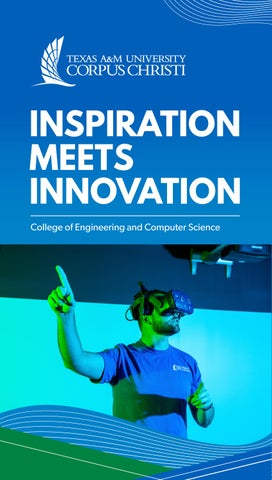
INSPIRATION MEETS INNOVATION College of Engineering and Computer Science
Inspiration meets innovation in the College of Engineering and Computer Science at Texas A&M University-Corpus Christi. Our dynamic undergraduate engineering and computer-focused programs are led by engaged and supportive faculty who are invested in your success. Our programs encourage students to participate in research activities at the undergraduate level, providing them with practical, real-world research experience in their chosen field.
tamucc.edu/engineering
DEPARTMENT OF ENGINEERING Our engineering programs are designed to allow students to take their degree to the next level by specializing in one or more aspects of engineering or engineering technology through technical electives. Civil Engineering The civil engineering program will teach you to apply scientific principles to the design, construction, and implementation of civil infrastructure systems, build cities that are resilient to natural disasters, and protect the natural environment from stresses imposed by humans. The bachelor's degree program in Civil Engineering is accredited by the Engineering Accreditation Commission of ABET (www.abet.org), under the commission's General Criteria and Program Criteria for Civil and Similarly Named Engineering Programs.
Electrical Engineering The electrical engineering program emphasizes service, systems-based knowledge, and sustainability with an eye toward interfacing traditional electrical engineering with new and emerging fields, in particular unmanned aircraft systems, maritime sciences and marine biology that directly impact the Gulf Coast. The bachelor's degree program in Electrical Engineering is accredited by the Engineering Accreditation Commission of ABET (www.abet.org), under the commission's General Criteria and Program Criteria for Electrical, Computer, Communications, Telecommunication(s), and Similarly Named Engineering Programs.
Industrial Engineering Industrial engineers apply science, math, and engineering to system integrations and operations to find ways to eliminate wastefulness in production processes. Our program will teach you to design, develop, implement, and improve integrated systems in several industries. Because the systems you’ll learn about and work with are large and complex, you will develop a knowledge base in a number of disciplines, the ability to work well with teams, and a broad systems perspective. The bachelor's degree program in Industrial Engineering is accredited by the Engineering Accreditation Commission of ABET (www.abet.org), under the commission's General Criteria and Program Criteria for Industrial and Similarly Named Engineering Programs.
Mechanical Engineering The mechanical engineering curriculum prepares students to work in mechanical or fluid/thermal systems areas such as mechanical systems design, thermal management, and flow of industrial processes, and energy harvest from renewable resources. The bachelor's degree program in Mechanical Engineering is accredited by the Engineering Accreditation Commission of ABET (www.abet.org), under the commission's General Criteria and Program Criteria for Mechanical and Similarly Named Engineering Programs.
Mechanical Engineering Technology Mechanical engineering technologists implement and extend existing technology. Our curriculum will provide you with industry knowledge, problem solving ability, and hands on skills for practice in product improvement, manufacturing, and engineering operational functions. With a degree in mechanical engineering technology, you will be able to pursue careers in industries that deal with aspects of mechanical systems such as installation, manufacturing, testing, technical sales, and maintenance. The bachelor's degree program in Mechanical Engineering Technology is accredited by the Engineering Technology Accreditation Commission of ABET (www.abet.org), under the commission's General Criteria and Program Criteria for Mechanical Engineering Technology and Similarly Named Programs.
DEPARTMENT OF COMPUTER SCIENCE Computer Science This program blends classroom academics with hands-on experience to prepare you to begin or advance a computing career in business, industry, government, or education, or to pursue further study in computer science. The curriculum emphasizes the development, evaluation, and integration of software systems. Program lab spaces utilize a wide range of software, hardware, operating systems, and several servers keep and give you access to the most up-to-date resources for computer programming with several experiential opportunities to learn and excel in their chosen field. You can specialize in: • Artificial Intelligence • Cyber Security and Infrastructure • Game Programming
• Information Systems • Systems Programming1
1
The bachelor's degree program in Computer Science - Systems Programming is accredited by the Computing Accreditation Commission of ABET (www.abet.org), under the commission's General Criteria and Program Criteria for Accrediting Computing Programs.
Geospatial Science The geospatial science program, offered fully online and in person, prepares students for professional careers in land surveying and geospatial fields. Students gain a strong foundation in boundary law, measurement science, and survey practice, along with advanced skills in data acquisition, management, and analysis. Our curriculum blends core surveying principles with emerging technologies such as drone operations, remote sensing, photogrammetry, GIS, 3D laser scanning, and AI. Graduates are well-positioned for high-demand careers as licensed land surveyors, GIS analysts, and geospatial professionals, or for advanced study in geomatics and geospatial science. The bachelor's degree program in Geospatial Science is accredited by the Applied and Natural Science Accreditation Commission of ABET (www.abet.org), under the commission's General Criteria and Program Criteria for Accrediting Applied and Natural Science Programs.
UNDERGRADUATE RESEARCH OPPORTUNITIES Hands-on learning is important at TAMU-CC, and that’s why we encourage our students to take part in research opportunities at the undergraduate level. You’ll collaborate with faculty and staff on cutting-edge research while building your résumé.
ACADEMIC ADVISING FOR STUDENTS Success at Texas A&M University-Corpus Christi starts by reaching out for assistance when you need it. Our advisors and faculty mentors help you reach your educational goals by providing you crucial tools, resources, and guidance.
GO FURTHER Continue your education with TAMU-CC in one of our top-rated graduate programs: • Engineering, MS ƒ Specialties: civil, electrical, industrial, or mechanical engineering • Computer Science, MS • Geospatial Systems Engineering, MS • Computer Science, Ph.D.
STUDENT ORGANIZATIONS Student organizations are a great way to make new friends and build your networking skills. You can get involved in our various students groups: • American Society of Civil Engineers • American Society of Mechanical Engineers • Geographic Information Science Student Organization • Institute of Electrical and Electronics Engineers • Islander Cyber Society and many more!
ABOUT TAMU-CC Take the next step! Apply Now | applytexas.org Take a Tour | tour.tamucc.edu Over $140 million in aid awarded annually. Visit osfa.tamucc.edu to learn more.