RWFM-PU-432 September 2025
Wildlife Monitoring and Management for New World Screwworm Marcus E. Blum1, James C. Cathey2, Roel R. Lopez3, Parr Rosson4, Sarah Fuller5, Hunter Reed6, and Kory Gann7
Introduction The New World screwworm (NWS), Cochliomyia hominivorax, was eradicated from the U.S. in 1966 and has been limited to isolated outbreaks, including in 1976 in Texas and 2016 in Florida. Due to its recent northward movement through Central America and Mexico, it is once again an emerging threat to Texas.
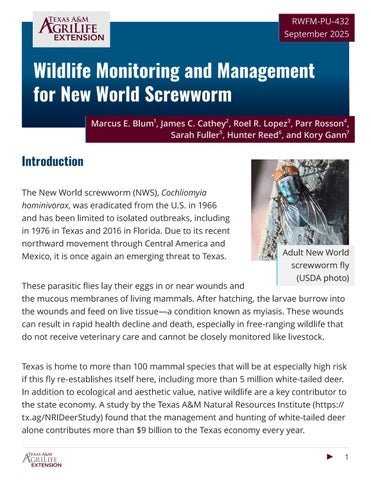
Adult New World screwworm fly (USDA photo)
These parasitic flies lay their eggs in or near wounds and the mucous membranes of living mammals. After hatching, the larvae burrow into the wounds and feed on live tissue—a condition known as myiasis. These wounds can result in rapid health decline and death, especially in free-ranging wildlife that do not receive veterinary care and cannot be closely monitored like livestock.
Texas is home to more than 100 mammal species that will be at especially high risk if this fly re-establishes itself here, including more than 5 million white-tailed deer. In addition to ecological and aesthetic value, native wildlife are a key contributor to the state economy. A study by the Texas A&M Natural Resources Institute (https:// tx.ag/NRIDeerStudy) found that the management and hunting of white-tailed deer alone contributes more than $9 billion to the Texas economy every year. ►
1
The following information provides both urban and rural Texans with the knowledge needed to monitor, detect, and report signs of NWS infestations to help protect wildlife ranging from squirrels and coyotes to white-tailed deer, mule deer, and black bear.
What to look for • Open sores and tissue damage found on living, warm-blooded wildlife. º Wounds as small as a tick bite can become infested. º Maggots may be visible in wounds.
• Areas commonly infested include the head and neck, as well as the umbilical region for newborns. Mucous membranes with wounds, including genitalia, eyes, nose, mouth, and ears, are also highly susceptible if wounds are present on these tissues. The fresh wound where antlers shed from the skull and antlers damaged while in velvet are also susceptible to infestation.
• Foul odor like rotting flesh. • Strange behavior in wildlife, such as: º Head shaking. º Discomfort and
irritated behavior. º Lethargy and isolation
from other animals.
• Do NOT attempt to approach live wildlife closer than a reasonable viewing distance—no closer than 25 yards.
Commonly infested areas on wildlife include the head and neck, but any region of the body experiencing a wound is vulnerable. Pictured is a Key deer experiencing an infestation during the 2016 NWS outbreak in Florida. (Valerie Preziosi)
►
2
What to do if you suspect New World screwworm in wildlife IMMEDIATELY REPORT ANY SIGHTING OF LIVE ANIMALS WITH MAGGOTS to your local Texas Parks and Wildlife Department biologist (https://tx.ag/ TPWDWildlifeBiologist) or the Texas Animal Health Commission (https://tx.ag/ TAHCGuidance). Texas A&M AgriLife Extension Service county agents (https:// tx.ag/AgriLifeCountyDirectory) and AgriLife Extension specialists (https://tx.ag/ ExtensionSpecialists) can serve as key contacts to help connect you with proper resources and official reporting agencies.
• REPORTING IS CRITICAL to implement management actions to curtail the spread of NWS. Texans are advised to report any suspected sightings of infested animals.
• Comply with any movement and treatment requirements that may be implemented for animals by state and federal agencies.
Texas Parks and Wildlife Department (TPWD) for wildlife biologist assistance: 512-389-4505 https://tx.ag/TPWDWildlifeBiologist Texas Animal Health Commission (TAHC) for livestock and pets: 800-550-8242
• If housing captive wildlife, contact local TPWD biologists. • For suspected infestations in exotic hoofstock, contact the TAHC or your local veterinarian for treatment options.
Wildlife monitoring considerations • Monitoring wild, free-ranging animal populations is considerably more difficult than monitoring domestic or confined animals.
• If possible, monitor animals every few days for signs of NWS. º This may be more feasible for wildlife held at rehabilitation and zoo facilities.
►
3
º Monitoring free-ranging wildlife will pose challenges; however, increased
monitoring will assist state and federal agencies in responding to new outbreaks. º Monitor current movement patterns and behavior pre-outbreak so
abnormalities in behavior, movement, and location will be more apparent should infestations of NWS occur. It is suggested that daily observation records be kept to better track animal inspections
• Susceptibility to New World screwworm infestation varies by sex and season because of behavioral changes that increase the likelihood of injury in animals. Seasonal management practices among confined wildlife, such as ear tagging, de-antlering, and capture can also increase the potential risk for infestation.
Activity of the New World screwworm based on average monthly temperature and its correlation with seasonal deer physiology, including antler development, fawning, and rut. ►
4
Infestation potential varies based on seasonal behavioral changes
FEMALE WILDLIFE AND YOUNG BIRTHING SEASON Birthing season places females and their young at risk for infection. New World screwworm can lay eggs on mucous membranes, such as the genitalia, experiencing a wound. The umbilical region of newborn animals is also highly susceptible to infestation. High mortality of females and offspring have the potential to severely reduce populations of large mammals such as white-tailed deer, mule deer, bighorn sheep, pronghorn, black bears, exotic wildlife, and other mammal species.
MALE WILDLIFE BREEDING SEASON Breeding seasons see male wildlife competing for mating dominance. Fighting styles vary among species, so rates of wounds may differ. Deer species may be more prone to open wounds from fights than species like bighorn sheep. Mature males had the highest mortality rates in Key deer during the 2016 New World screwworm epidemic that occurred during rut. ANTLER GROWTH Male deer species will have higher rates of infection during velvet shedding, antler shedding, and antler growth.
►
5
Wildlife monitoring techniques • Trail cameras º Trail cameras can be useful tools
in identifying wildlife displaying clinical signs consistent with NWS infection. º Place trail cameras at locations
where wildlife frequent, such as water and food sources, along trails, and at crossings. º When placing a trail camera, attach it to a sturdy tree or post overlooking
an area potentially frequented by wildlife. Place the camera roughly 2 to 3 feet high—roughly knee high—off the ground and approximately 15 feet from the target area where you think the animals will frequent. Finally, consider the orientation of the camera in relation to sunrise and sunset. It is recommended to orient the camera to face north to minimize false triggers and low-quality photos caused by shadows and sun rays.
• Hunting stands, blinds, and wildlife viewing areas º These areas provide
opportunities to survey animals via optics such as binoculars or scopes. º High-quality optics will increase
your ability to identify potentially infected animals quickly and with a higher degree of accuracy. º Taking notes from your
hunting stand (https://tx.ag/ HerdComposition) can assist you in tracking your wildlife populations over time. Keep track of the number of bucks, does, fawns, and unidentified ►
6
individuals you see at each stand. Note the dates and times you make these observations. Using this data, TPWD wildlife biologists can calculate herd composition.
• Backyard and urban wildlife watching º Many wildlife species are drawn
to residential areas and the resources they offer, such as food, cover, shelter, and water. Monitoring wildlife that may frequent residential areas, such as deer, squirrels, raccoons, and coyotes, is a meaningful step to aid in early detection in urban and suburban areas. Use tools such as binoculars and security recording systems to ensure you maintain a safe distance from the animals.
• Pay attention to signs of scavengers, such as vultures and coyotes. º If you see vultures circling on your property, investigate what is
attracting them.
• Certified wildlife rehabilitators º Animals that have been identified
as in need of rehabilitation should be thoroughly inspected for signs of NWS. º Citizens should not move or
surrender animals to wildlife rehabilitators that exhibit any signs of infestation. Immediately contact your local TPWD wildlife biologist if those signs are present. º If a wildlife rehabilitator receives an animal exhibiting signs of NWS
infestation, they should immediately contact their local TPWD wildlife biologist. ►
7
º In most cases, wildlife biologists advise people not to interfere with or
remove wildlife they believe may be orphaned.
Wildlife management • TPWD is the state agency responsible for managing the natural and cultural resources of Texas, including wildlife. Consult your local TPWD wildlife biologist for management recommendations specific to your property. º Your local TPWD wildlife biologist
can assist you with methods for monitoring wildlife populations and, if warranted, harvest recommendations on your property through their Technical Guidance and Managed Lands Deer programs (https://tx.ag/TPWDGuidanceProgram).
• Population monitoring and recordkeeping are critical for adaptive management strategies if NWS impacts wildlife populations on your property. Keep detailed records so you can measure changes in populations. If changes are noticed, contact TPWD for assistance.
• Key demographic information to monitor includes abundance, fawn-to-doe ratios, and buck-to-doe ratios. º Record observations of bucks, does, fawns, and unidentified (e.g., could not
determine sex or age class) deer to develop abundance and various ratios. º If possible, also collect age class data (https://tx.ag/TPWDDeerGuide) to help
determine which age classes are being impacted by NWS.
►
8
1
Assistant Professor and Extension Wildlife Specialist, Department of Rangeland, Wildlife and Fisheries Management, Texas A&M College of Agriculture and Life Sciences, Texas A&M AgriLife
2
Professor and Associate Director, Texas A&M Natural Resources Institute, Texas A&M University, Texas A&M AgriLife
3
Department Head and Director, Department of Rangeland, Wildlife and Fisheries Management, Texas A&M Natural Resources Institute, Texas A&M College of Agriculture and Life Sciences, Texas A&M AgriLife
4
Professor and Associate Department Head for Extension, Department of Rangeland, Wildlife and Fisheries Management, Texas A&M College of Agriculture and Life Sciences, Texas A&M AgriLife
5
Natural Resources Communications Coordinator, Department of Rangeland, Wildlife and Fisheries Management, Texas A&M College of Agriculture and Life Sciences, Texas A&M AgriLife
6
Wildlife Veterinarian, Texas Parks and Wildlife Department
7
Big Game Program Director, Texas Parks and Wildlife Department
Texas A&M AgriLife Extension is an equal opportunity employer and program provider. AGR IL IF EE X T ENSION .TA MU. EDU