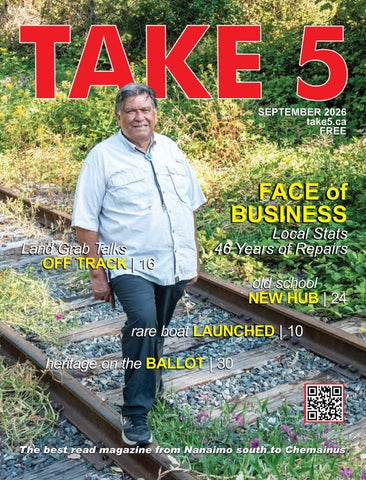
TAKE 5
take5.ca
3
TAKE 5
take5.ca
Letters Dragon Boat Racing I am a member of the Sync or Swim Dragon Boat Racing Team in Ladysmith. We have had an incredibly successful racing season this year resulting in several medals won at various festival here on the Island and also on the Lower Mainland. We have been competing against not only Island teams but Provincial and international teams and wanted to bring to the attention of your readers that Ladysmith is well and truly on the map regarding Dragon Boating. The team was formed by Lesley Lambert and myself, Janine Smith, in 2022 as a dedicated racing team. We are part of the Ladysmith Dragon Boat Society, which has about 95 members and two dragon boats and paddles out of Oyster Bay Marina in Ladysmith. - Janine Smith Above: Dragon boaters. Photo Dan Collett
Letters to the editor are always welcome. This is an open forum for readers and do not necessarily represent the opinion of TAKE 5 or its affiliates. Letters are subject to editing for space and legality. Email us at editor@take5.ca
5
6
take5.ca
SEPT 2026
Municipal Election All Candidates Meet & Greet With the October 17 Municipal Election on the horizon, the Ladysmith Residents’ Association is bringing candidates and community members together for an evening of conversation, connection and civic engagement. Following the Ladysmith Chamber of Commerce Municipal Candidate Forum on September 29, the LRA is hosting a Town of Ladysmith Municipal Election Meet & Greet on Tuesday, October 6 at 6:30 p.m. at the Eagles Hall. This event provides residents with an opportunity to meet the individuals who have put their names forward to serve as mayor and councillors, hear about their priorities, ask questions and have meaningful conversations about the future of Ladysmith. The evening, which is intended to compliment the Chamber’s event, is open to all Town of Ladysmith municipal election candidates and is designed to be an informal and welcoming opportunity to get to know the candidates and learn more about the people who could be making important decisions on behalf of the community. When considering who to support on council, attending a candidate event is a valuable way to become an informed voter. Municipal elections have a direct impact on the community we call home. Decisions made locally can influence everything from neighbourhoods and development, infrastructure and transportation, to community services, recreation, local businesses and the overall direction of Ladysmith. Taking the time to meet the candidates and understand their perspectives is an important part of participating in the democratic process. The Ladysmith Residents’ Association encourages all local electors to come out, ask questions, listen to the candidates and be part of the conversation. It is also an opportunity to connect with neighbours and demonstrate the importance of an
TAKE 5
take5.ca
7
8
take5.ca
SEPT 2026
TAKE 5
take5.ca
9
Rainbow Makes a Splash BY FRANCESCA PACCHIANO The Rainbow’s skiff-gig has returned to the water after decades of intricate and painstaking restoration by the Ladysmith Maritime Society volunteers and support from the Maritime Museum of BC. The gig was launched at the Ladysmith Marina on August 27th, during a celebratory “soft launch.” This is an important moment in the skiff-gig’s legacy as a living display. Robert Lawson, LMS member, historian and previous owner of the gig, spoke about its role as a historic artifact: “Rainbow’s gig is a boat that has been brought back to life, and in such a way as [to] give people a sense of what [it was] like … we try to create the feeling that the boat would have had when it was new.” While the Rainbow’s future will primarily be on display at the
Maritime Museum of BC, the gig will be brought out into the water for special occasions and demonstrations. The restorations, conducted by LMS volunteers, used modern tools, glues, and paints to return the vessel to as close to its original state as possible. “It will not look in any way significantly different than it would have looked one hundred years ago, or one hundred and thirty years ago,” Robert said. The gig is now seaworthy, but restorations will continue in the fall to build a canopy that matches a 1900 photograph of the vessel. The vessel was thought for years to be a Royal Navy skiff-dinghy, but Robert recently discovered it is a much rarer officer’s skiff-gig. The ornate rowboat ferried officers from their Navy ships to shore during the 1800s. The gig is particularly important because it’s one of the last completely hand-crafted, lapstrake boats, and “it’s probably the only skiff-gig still in existence on the planet.” Robert first saw the boat fifty-four years ago. He owned it from 1998–2009 and has continued to work on it with LMS since then. “It’s wonderful that the original excitement and vision I had so long ago … has finally come to fruition,” he said, and went on to express
Ladysmith Maritime Society’s Robert Lawson puting finishing touches on the Rainbow skiff-gig. Photo: Jeff Reichert
gratitude to the LMS volunteers, the Maritime Museum of BC for supporting the restoration and the Town of Ladysmith for the use of the Car Shop. Jackie Elliott, LMS president, also extended her congratulations to the team, saying, “We’re delighted that our awardwinning volunteers have yet again completed another amazing restoration project.” The Rainbow’s skiff-gig will be on display at the Classic Boat Show in Victoria from September 4–6.
New Executive Director for Chemainus Chamber BY EVAN SHUMKA The Chemainus & District Chamber of Commerce welcomed its new executive director, Dory Haney, on March 17th of this year. She was thrust into the busy summer season, overseeing the Wednesday Market and the annual Giant Street Market, which was more giant than it’s ever been, at 157 vendors. Prior to taking on this role, Dory was already helping small businesses with her company, WestCoast Thrive. “Now I get to help a whole community of businesses,” she says. She’s worked for a variety of industries in logistics, sales, purchasing—all kinds of stuff. “I’m a bit of a Swiss army knife,” she says. But rather than cutting down the competition, Dory’s all about collaboration. “We’ve been reaching out to different chambers who are doing things right,” she says. Her counterparts have been great at sharing information and offering guidance as she’s learned her new
TAKE 5
take5.ca
role. She’s also grateful for her “right hand,” Eilish Murphy, the Chemainus Visitor Centre coordinator, who came on at the same time. Dory’s from the Yukon originally, but lived in Ladysmith for 10 years. “Up until just recently when I moved to Nanaimo because of love.” Dory and her partner of three years, Doug, are both outdoor enthusiasts. She says it’s cool to meet in your 40s, because it’s when you really know Dory Haney, Executive who you are. After trying to make Director Chemainus a go with her business in Nanaimo, Chamber of Commerce. she felt ready for a change. “It’s Photo submitted. tougher to reach out to people when you’re in a city,” she says. “It’s a very different business model there. You’re contending with much more promotion online as opposed to…word of mouth.” She’s looking forward to moving to Chemainus in the fall. For years, she’s felt that Chemainus was her community. “Ladysmith was nice, but that’s where I went to sleep,” she says. “This is where I came to play.”
Gardening Speaker Series BY GAIL WISEMAN As we witness the rapid worldwide decline in Earth’s biodiversity and all the news seems bleak, we can also find light if we look. Scientists, naturalists, conservation organizations,
11
12
and gardeners everywhere have come together to show how important our gardens can be in reversing this decline. Some keystone native plants in pots on a balcony, in a raised bed for school children, or in a backyard or public garden can host pollinators and other beneficials. The butterflies we love, their caterpillars (also needed to feed baby birds), are all interconnected. Adding water sources and other bits of habitat can bring dragonflies, tiny tree frogs, salamanders and snakes, which keep our gardens in balance – and the doing
take5.ca
restores our own wonder and hope. Ladysmith and Saltair Garden Club invite you to explore these concepts in their 2026/27 speaker series. The series opens Sept 17, with TAKE 5’s own Pamela Walker. Pamela will illustrate the planning and conservation work done at the Walkers’ beautiful seaside setting. This includes integrating native trees and plants, a newly restored native meadow, and traditional and sustainable practices like edible and ornamental gardening and permaculture. The series continues on the third
SEPT 2026
Thursday of each month at the Ladysmith Eagles Hall. In October, Linda Brooymans of NALT will speak on nurturing and sheltering biodiversity, and in November, Jay Rastogi, formerly of Wildwood, will speak on planting native hedgerows. In January 2027 Kurtis Howes will show how to create rich, water-retentive soils, as in nature. Details at ladysmithsaltairgc.com
Unveiling Japanese Canadian Art Project An art installation project, tied to the None Came Back exhibit, will be opening on September 19th. The outdoor venue is surrounded by a peaceful garden, giving space to remember and honour the Japanese Canadians who once called Chemainus home. Three hundred Japanese Canadians were deported from the village in 1942, leaving everything behind. The art installation is funded by the Japanese Canadian Legacies Society and managed by the Chemainus Festival of Murals Society. The official unveiling on the 19th starts at 1pm and will include remarks from dignitaries and guest speakers.
TAKE 5
take5.ca
13
Island Crime Podcast: “The Dead File” BY FRANCESCA PACCHIANO Nearly 70 years ago, Curly and Lizzy Kostyniuk were brutally murdered in their South Wellington home. Their case quickly went cold and, for decades, has remained in RCMP storage, labelled as a “Dead File.” Laura Palmer, host of the Island Crime podcast and former CBC producer, reinvestigated the case in her latest true crime series. “It’s the kind of podcast that tells one case per season. … I dig deeply into each case over a number of episodes.” This storytelling approach allows Laura to speak with the family, police and other experts involved in the case over several months. It gives a comprehensive
and compassionate view of the victims and their story. The community of South Wellington is a sleepy one. Surrounded by forests and farmland, it seems almost unbelievable that a double homicide was committed there. While it’s not well known, the case hasn’t been forgotten. The Kostyniuks’ great-great-granddaughter, Shauna, is a passionate advocate for this case and brought it to Laura’s attention. This is the oldest cold case that Laura has investigated and while the immediate family and close friends of the Kostyniuks are now all deceased, she uses the statements given and local news coverage to paint a vivid picture of be-
fore and after the murders. “The local reporting at the time was incredible.” The hardest part has been the police. Shauna and Laura requested to see the original police files and received a heavily redacted version, which was frustrating. “We are still pushing for more information to be released by the RCMP,” Laura said. Unfortunately, it could take up to 20 additional years before police release the full files, due to concerns that the perpetrator may still be alive. A trigger warning is needed for several episodes in “The Dead Files,” which discuss a pedophile within the Kostyniuk family. The abuser was a compelling suspect for the murders, and it was
TAKE 5
take5.ca
unavoidable to discuss the case without also discussing the abuse. One of the victims, a granddaughter now in her eighties, shared her story in her own words. “My initial thought was that I should protect her,” said Laura. “I offered her anonymity.” But the process of sharing her story was an empowering one. “As a survivor of child sexual abuse, she felt it was important to have her voice heard.” Laura added, “If I can push the investigation forward, clearly that’s what Elizabeth (Lizzy) Kostyniuk and her I’m trying to do. And also husband’s murder are featured on trying to tell a human sto- crime podcast.Photo submitted. ry with as much dignity and empathy as I can.” Laura has received criticism from more action-seeking fans, but to them, her response is simple: “If it’s not your cup of tea, that’s fine. The victims and their families are something that are always going to be at the forefront.” The full season of “The Dead File” is out now on Spotify, Apple Podcasts or directly from the Island Crime website.
15
Treaty Maker Negotiating in Good Faith BY FRANCESCA PACCHIANO AND EVAN SHUMKA Over 140 years ago, the provincial government looked at a map of Vancouver Island and carved out a slice encompassing a fifth of the land to dish out to coal baron Robert Dunsmuir to build the E&N Railway. This land – the E&N grant – remains privately held today and is at the heart of treaty negotiations between the Hul’qumi’num Treaty Group (HTG) and the Crown. But after almost 30 years, the Crown refuses to put it on the table. This raises a larger question: What does it really mean for Canada and BC to negotiate in good faith? Tl’ul’thut, also known as Robert Morales, is HTG’s chief negotiator and legal counsel. We met him at HTG’s offices on the Cowichan Reserve. The walls in the waiting area were decorated with motivational posters and team photos. He brought us upstairs to a quiet conference room for our interview. HTG represents Cowichan Tribes, Penelakut, Halalt, Lyackson and Ts’ubaa-asatx in treaty negotiations with the federal and provincial governments. They’ve been going through the process since 1991. Robert took on his role in 2000. Before that, he had a private law practice in Duncan, working with First Nations clients. He decided he wanted to work on land title and rights issues. “Negotiation was the way that we likely would end up having to settle,” he said. “So I went to the Harvard Law School and took a program on negotiation there, and shortly thereafter was hired as the chief negotiator.”
He took us through the history of struggle between the Hul’q’umi’num’ Nations and colonial governments leading up to the present day. He talked about the Royal Proclamation of 1763, which stated that land acquisitions had to be negotiated with Indigenous Peoples and that they had to be compensated. Despite this, there was never a treaty with the Nations Robert represents. Most of their land was snatched in 1887 and given to Robert Dunsmuir as part of the E&N land grant. To this day, that land – nearly two million acres – is privately owned, in large part by three logging companies. This has made negotiations difficult for Robert Morales, as the provincial and federal governments have refused to put private land on the table. “I got into this treaty-making business to try and deal with all those issues,” he said. “But it can’t seem to get traction under some of these real big policy problems.” The BC treaty negotiation process comprises six stages. The first stage involved submitting a statement of intent with a map of HTG’s territory. Stages 2 and 3 involved identifying the parties’ readiness to negotiate, and the framework and timelines for the agreement in principle. Stage 4, the negotiation of a treaty in principle, began in 1999 and was completed in 2019. “When we transitioned to Stage 5, which is final agreement negotiations,” said Robert, “I thought that … the situation would get better and that we’d actually start engaging on some of these really hard issues. Not the case.” Canada and BC have told Robert that they don’t have the financial resources to dedicate to HTG’s negotiations and that they’re focusing on other treaties being concluded. Both governments have sent only one representative apiece, with very limited mandates. The stalling has
Robert Morales (Tl’ul’thut), Hul’qumi’num Treaty Group’s chief negotiator and legal counsel. Photo submitted.
been frustrating for Robert, who’s now in his seventies. “I’ve said to the negotiators … I don’t mind if the government wants to just send one representative to the table – that’s fine. But you gotta send that one representative mandated to really negotiate. You can’t just send them there as a messenger, right? I mean, that’s not negotiation.” He said that the courts have mandated that provincial and federal governments negotiate in good faith. “Is it good faith to essentially negotiate to avoid agreement?” Outside of negotiations, Robert has been working on educating the general public about these issues. This summer, the Great Land Grab exhibit launched its tour of the Island, to teach people about the E&N land grant. Robert hopes the exhibit will bring new community awareness to the negotiations. The Great Vancouver Island Land Grab travelling exhibit is touring librar-
TAKE 5
take5.ca
ies across the Island throughout 2026 and 2027. Developed by the Vancouver Island Local Historical Society and the Nanaimo Museum, this exhibit brings archival photographs, maps and videos that invite visitors to question ideas of property, responsibility and future for the lands. It will open at the Cowichan branch of the Vancouver Island Regional Library on September 1st. “Over the years I’ve been promoting this issue, I’ve never had anyone dispute [it]. ... In fact, [there has been] lots of support from non-Indigenous NGOs, Salt Spring Islanders for Justice and Reconciliation, Church groups [and] Ancient Forest Alliance.” He’s spoken about it with ministers, premiers and the former prime minister. “Everyone acknowledges that it is an issue,” he said. “But no one on the other side of the table has been willing to say, ‘Okay, let’s sit down and try and figure out how to resolve this.’” He raised concerns in Richmond about property values dropping after last summer’s court decision recognized the Quw’utsun Nation’s Aboriginal Title to the Tl’uqtinus village lands. He said First Nations citizens also struggle with the devaluation of their land; he’s had personal experience with it. When he was a newly established lawyer, Robert inherited land from his brother on the reserve in Cowichan Bay and chose to build a house there. “Took me two years to get a mortgage,” he told us. “Had to get a ministerial guarantee in order to get a mortgage.” Even now, if he goes to the bank, they won’t recognize his 8.5 acres of seaview and 4,000 square-foot house as an asset because it’s on the reserve. “The individual First Nations citizens are under a definite disadvantage,” he said. “So, rather than arguing, ‘My property’s going to be devalued because First Nations Title might exist here’ … why don’t we argue that there’s something going on here that’s not right and that First Nations people are under the same problem?” Ignoring the existence of Aboriginal Title has created problems in this country for hundreds of years. The issues are nuanced, and every territory has its own problems and considerations to work out in negotiations. While 95 per cent of BC as a whole is Crown land and five per cent is private, for the Hul’q’umi’num’ Nations and other First Nations touched by the E&N land grant, it’s the reverse: 95 per cent is private, leaving only five per cent Crown land that the government might just be willing to transfer. “It’s not as simple as people are trying to make it,” said Rob-
17
ert. “It’s complicated. Really complicated. … The government really needs to get serious about negotiating a treaty. They have to do it. They don’t have a choice, in my opinion.” On Crown land, Nations have an opportunity to negotiate for shared revenue, but that’s not the case with the logging companies who own the private land. “I sent a letter to TimberWest and Island Timberlands before they formed Mosaic,” he said. “The response that I got from them was, ‘This has nothing to do with us.’” The Managed Forest Council oversees the companies and is made up of five appointed private forestry individuals. Robert said, “It’s like the fox guarding the henhouse.” While private forestry companies like Mosaic offer specific job opportunities to Indigenous Peoples, Robert said that more needs to be done. “First Nations have to be involved in the management decisions and co-managing those lands. … Are the private timber companies willing to step up and say, ‘Okay, as part of our reconciliation efforts, we’re willing to have First Nations sit on our board of directors – we’re willing to have First Nations contribute to our resource harvesting plans and our ecology plans?’” Under international law, he told us, the federal and provincial governments have an obligation to either return the land, replace it or offer redress, which could include compensation. So, can the government return the E&N grant lands? “Maybe,” Robert said. “It’s gonna cost.” The logging companies holding fee-simple title are owned largely by BC and Canada Pension Funds. What about replacing those lands? “Probably not,” he said. “What would they replace it with – the City of Victoria?” How about offering redress? “Yes,” he said. “And what will the form of redress take? What will it look like? What will it include? How can we construct a deal that will make it so that First Nations people are on an equal footing with the rest of society? And that’s the objective. For me, that’s always been my objective.” When Robert joined HTG, the Elders told him to get 100 per cent of the land back. Through this drawn-out negotiation process, he’s had to accept that they won’t get it all back. “We can’t get a hundred per cent of the land back. It’s not gonna happen. But we can’t just settle for what the government’s putting on the table either. Somewhere between those two extremes, there has to be a point where we can get consensus on how to settle.”
neath the open sky. So here are a few of our favourite places to enjoy.
Summer in the Nest
Summer on Vancouver Island continues and along with that is one of life’s great pleasures:, dining al fresco, where a meal becomes an experience. Fortunately, our area is brimming with wonderful options for enjoying a meal be-
Keep autumn at bay by enjoying sunny days on the Owls Nest’s patios. With thirty-five outdoor seats in Saltair and eight in Ladysmith, there’s plenty of room to bring your friends. And even the four-legged ones. The Saltair location even boasts a peaceful garden which is the perfect backdrop for your next brunch date. The menu has options for everyone, including vegetarian and gluten-free dishes, and summer lemonades and slushies that are sure to quench your thirst!
And more... The Cranberry Arms is the oldest pub in the Cedar area. Enjoy the patio and think of all the stories these walls hold. A&W in Ladysmith has tables outside and if you make it on a Thursday evening, you can catch the Cruisin’ the Dub, classic car show. Or grab it to go and head to a beach. Mark your calendar for Sept 19, for the Cedar Community Hall’s Harvest Dinner - it’s not outdoors but a chance to share good food with your neighbours. good food. Right: Owl’s Nest Bistro, Saltair, garden patio. Photo: Francesca Pacchiano
TAKE 5
take5.ca
19 19
20
take5.ca
SEPT 2026
Business in Ladysmith: A Butcher, a Baker, a… Goatscaper? BY EVAN SHUMKA There are currently 551 active business licenses in Ladysmith, up 70 from 2020. They run the gamut from unsurprising to delightfully unusual. If you’re one of the miscellaneous local contractors, you’ve got lots of company: contractors make up the largest category for Ladysmith business licenses, at 81 registered businesses. The next highest is food & drink, at 48, followed by health care (39), retail (34), and beauty (29). Ladysmith is home to one butcher, one baker, and no candlestick makers. This represents a crucial niche that ought to be filled, pronto. A candlestick maker would make a fine addition to the 13 art-based businesses, which include two potters, a stained glass artist, and a taxidermist. There is one video game production company, which might consider setting a video game locally—about ascending steep hills or not stopping for pedestrians. If the depression of modern day living is getting to you, there are 20 local counsellors you might consult. If someone threatens to “take you to the cleaners,” you’ll have to ask them to be more specific, as they have ten cleaning services to choose from. And if they order three lashes, they might not be referring to corporal punishment at all, but rather to the three beauty parlors that specialize in eyelashes. There’s a knife-sharpening service, a crystal shop, and a purveyor of yachts. Rounding off the list is an array of landscaping companies, culminating in a curious business description that draws the eye: “YARD MAINTENANCE - LANDSCAPING (GOATS).” If you have a dream in this town, and enough goats, anything is possible. First Avenue, Ladysmith. Photo: Evan Shumka
From Sheep Shed to State of the Art Shop BY MARINA SACHT It’s been a long road from a sheep shed to a state-of-the-art autobody shop for Little Valley Collision and Glass. But now, 46 years later, John and Jacky Neil are watching their kids run the show. Well, almost. While travel trips beckon, it’s hard to imagine the animated, energetic John doing nothing. As we sit in their office talking, there is no doubt this is a family business. Sheena is the accounts manager, son Travis is production manager, and their daughter Jana is a graphic artist. John’s wife, Jacky, did all the bookkeeping, cleaning, and helping wherever she was needed. Both Travis and Sheena started young. “I didn’t really hang around school after the bell rang. I was on the bus and came here and picked up a broom.” Travis’ love of cars started early. When your dad has a reputation for restoration and custom painting, it’s only natural you learned how to spray primer, weld and sand. When he got older, he got his Red Seal Refinisher. Sheena also started by cleaning the lunchroom and the office. And then, in her 20s, she took over the role of receptionist when Little Valley joined the Quality Assured Group. “I just kind of went from there,”Now she’s the accounts manager. “Travis makes the money, she accounts it, and Jacky and I get to spend it,” John laughs. “We’ve been working on a succession plan for a couple of years now. We’ve got it pretty much figured out. I’m basically the highest paid Walmart greeter in Western Canada,” he says. “And I’m the highest paid gofer,” adds Jacky. “But seriously, it’s so great to come to work. To be able to work with your family and with all these young people. I mean, I’m 71. I feel like I’m 40.” When people ask why he is still working after all these years, the answer is simple: “Because I love it.” Early Days When the young couple bought the six acres of property on Thomas Road, that would become their home and business, they had to sell their new house in Lantzville that they had built. They wanted the property because Jacky wanted room for a horse and John for a little shop. “This had highway frontage, so I envisioned traffic, and lots of space.” They started the business in a cinder block sheep shed with a floor four inches thick with shavings and dog poop because the previous owners were dog breeders. It wasn’t easy. They had two mortgages at 24% and 25.5%.
It’s a family affair at Little Valley Collision and Glass. Left: Travis, Sheena, Jacky and John Neil. Right: Some of the hardworking employees. Photo: Bob Burgess
“And about a week before we’re gonna move in here, we found out we had to pay back the CMHC mortgage that we had on our other house. So we went to an old friend and said, ‘Any chance you could lend us 10 grand?’ I just about threw up trying to ask him,” John said. “I think you did,” added Jacky. “But after we got everything done and stuff, we just kind of looked at each other, and asked ourselves, what have we done? We’ve got all these bills, and a child...And I went to work.” John had been working at Terminal Autobody when he quit his job and headed home to tell Jacky. “And she’s crying. She’s losing her shit. And I said, don’t worry. I borrowed $40,000 to build a shop. And then she really started crying.” But there was a lot of support from the community. “I’d get groceries and Wayne Richmond would get something fixed.” Or there would be chickens for detailing. “I swear that Arnold Westby used to smash his truck up every year just so he could give us a side of beef. And yeah, there were days that I wanted to walk away and just sell everything and move to Hornby and grow a ponytail and some funny plants. But I didn’t.” Technology The new wave of technology advancement was coming to the industry. In 1980, John was introduced to urethane clear coat, made by PPG, and now, 45 years later, they are still using PPG. It was 15 times thicker than lacquer so he could get his jobs done quicker using two or three coats of urethane instead of 30 coats of lacquer. “It’s much easier to paint today. The paint has advanced so much.” They use PPG Envirobase—a premium, waterborne automotive paint system to deliver precise OEM colour matching with a durable, high-quality finish. You can paint a car now
TAKE 5
take5.ca
in 20 minutes opposed to an hour. So again, faster cycle time, less time in the booth, less propane that we’re burning, less stuff into the atmosphere.” The technology is by far the biggest change, says Travis. And cars have become more and more computerized with Blind Spot and Lane Departure monitors. But all that technology is making things more complicated. “You take a taillight out of a new F-150, you have to take it to the dealer and reprogram it. You’re driving a computer. It’s a far cry from the old days of back-alley monkey-wrenching cars. One day John and his granddaughter were driving in his Black 1958 Chevy pickup. She asked where the air conditioning was. And he said: “That little handle, you got to twist it. So she rolled down the window... You don’t see cigarette lighters in cars or ashtrays, but you could plug a coffee maker
23
in the box of my truck or a skill saw.” And bondo - not so much any more! Their glue system cuts down the amount of filler that’s required. They’re straightening out the metal before they apply any filler. “These guys are fixing things now that I would never imagine you would be able to do with glue,” says Travis. We definitely encourage more metal work and take more time on it... It’s going to give you a better quality repair and less chance of having a warranty issue. Safety first Coming back from a tour of their high-tech shop it is evident safety is paramount, and painting in a sheep shed a quaint memory. They were highlighted by WCB for our ISO cyanite awareness program,” says Travis. In autobody repair shops, isocyanates are produced in the two-part process of mixing hardeners into paint primers and clear coats. They cause major health issues. At Little Valley, painters and apprentices work in well-ventilated bays. Two giant air purifiers push fresh air down filter dust, and clean contaminated air. Workers wear full-face air-supplied respirators. When Travis started spraying cars 25 years ago, the first thing that John did was give him a fresh air respirator. “We try to just beat that into these young guys so that they can be safe... Because nobody wants to have a health risk that will take them out of a career that they love. With customers that have been coming there for 46 years, and a new generation well in hand, it could be another 46 years or more for Little Valley. John had better load up on Hot Wheels.
24
Ribbon cutting at South Wellington’s new community centre. Photo: Bob Burgess.
South Wellington New Community Centre BY DALYS BARNEY When I stepped inside the newly renovated South Wellington Community Centre to drop my sons off at LEGO Robotics & Science Camp, it was a bit of a trip down memory lane. Not because I’m a big LEGO fan, but because I attended elementary school in the building during the 1990s. Here I was, over 30 years later, bringing my children to the same place where I spent many hours of my own childhood. After I got the boys settled, I of course peeked into a few of my former classrooms to spot the changes and to see what’s stayed the same. Things are looking good! The property at the corner of Morden and South Wellington Roads will once again become a community hub with indoor and outdoor spaces for activities, events, and celebrations. The outdoor part of the approximately 3-acre site is now a Regional District of Nanaimo (RDN) community park and includes a fenced sports court, playground, and field. The building includes over 9,000 square feet of useable indoor space and is now ready to accommodate a variety of recreation and community programming and activities. The RDN will work closely with the South Wellington and Area Community Association (SWACA) to operate the new community centre. The LEGO daycamp offered by the RDN at the beginning of July was the first programming to take place in the reopened community space, and the “Camp Wellie” children’s day-camp took place throughout
August. In addition to RDN programming, the vision is to use the space for many different reasons, including a lounge area to socialize and connect with neighbours and a community library. There are rentable activity rooms that are suitable for a diverse mix of purposes, including meetings, childcare, and fitness and arts classes. In the event of a disaster, the community centre could also potentially be used as a hub for emergency response. The current school building replaced an earlier one on the property known as the South Wellington Superior School. That four-room school had been built in 1918, and was located below the present-day building, near where the sports court is today. Even earlier schools in South Wellington included the “Green School” on Minetown Road built in 1912, and the “Red School” built in 1898 near present-day Schoolhouse Road. All of the school properties were originally part of the James Beck estate that had been pre-empted in the 1860s. The community eventually outgrew the four-room Superior School, and in 1969, it was decided to build a replacement six-room school on the property. Tenders were called in late 1969 and construction continued throughout early 1970. Later that year, the new school was opened, and the old school was demolished. Several people I interviewed shared fond memories of the entire school crowding around a small TV in the library to watch the 1972 Summit Series, and how they erupted with joy when Paul Henderson scored the winning goal in overtime. Google will tell you that South Wellington Elementary School operated
TAKE 5
continuously from 1969 to 2013, but this isn’t accurate. The school was closed for three years during the late 1980s. When my family moved back to South Wellington in 1989, the school wasn’t open for me and my brother to go there, and we had to take the bus to Waterloo Elementary in Cassidy. But it reopened for the 1990/91 school year when I was in Grade 3. I spent the rest of my elementary school years there, and during that time, the school population hovered around 80 students. There were four divisions, and some of them were triple-split classes. After I moved on to secondary school, student numbers swelled enough for portables to be added to the site, but the school population started to dip again in the early 2000s. Before South Wellington Elementary was shuttered in June of 2013, parents and community members successfully pushed back on several earlier attempts to close the school due to declining enrollment. After the closure, there were initially some talks of demolishing the building, but after a community campaign, announcements were made in 2021 that the RDN and Nanaimo Ladysmith Public Schools had entered into a 25-year lease agreement for the former school site. The surrounding land would be operated as a community park, and the school building would be converted into a community centre. Although the original targeted opening for the community centre was 2023, planning, remediation work, and accessibility, seismic, and fire suppression upgrades to the building took longer than initially envisioned and were also slowed down by supply chain issues. But with a fresh coat of dark blue paint, a reinstalled playground structure, improved parking and accessibility features,
South Wellington Community Centre. Photo: Bob Burgess
and a new address at 2195 South Wellington Road, the community centre is now ready to once again be an important place for community connections. An official opening event was held on August 19th. Attendees were able to tour the facility, and speeches were made by Tamara Kronis, MP for NanaimoLadysmith; George Anderson, MLA for Nanaimo-Lantzville; Jessica Stanley, Director for RDN Electoral Area A; and Tom Osborne, RDN General Manager of Recreation and Parks (retired). For more information about the community centre, including upcoming events, rental information, and volunteering opportunities, check out the SWACA website at: swaca.ca/community-centre Dalys Barney is the Digital Collections Assistant at the Vancouver Island University Library. She’s deeply rooted in the midVancouver Island region, having lived in South Wellington, Cassidy, Cedar, Ladysmith, and Chemainus. She has a regular column in British Columbia History magazine and maintains a local history blog at vanislehistoryexplorer.ca
26
Exploring the WoodWide Web BY JAMIE POLLARD As fall settles in the forest, we notice the colourful mosaic of fallen leaves, moss-covered logs and mushrooms pushing through the damp soil, but beneath everyone’s footsteps is a network that quietly works to keep the forests alive. No voices, no text messages and no Wi-Fi – just fungi that can stretch farther than the eye could ever see. Welcome to the incredible world of the wood-wide web. The mushrooms we see on the surface only tell part of the story. These familiar caps are the fruiting bodies of fungi, the
take5.ca
structures used to spread spores and create new fungal colonies. The main body of the fungus remains hidden beneath the forest floor. Unlike plants, fungi cannot produce their own food through photosynthesis. Instead, they grow long, thread-like structures called hyphae, which weave together into underground networks known as mycelium. A single mycelial network can stretch for hundreds of metres, linking the roots of many different trees and plants. Through a symbiotic relationship between the mycelial networks and plants, fungi can exchange water and nutrients for sugar produced by trees during photosynthesis. This symbiotic relationship is called mycorrhiza, from the Greek words “mykes,” meaning “fungus,” and rhiza, meaning “root.” The mycorrhizal network is one of the oldest and most successful partnerships on Earth and is believed to have evolved about 450–500 million years ago. Scientists believe these partnerships helped early plants establish themselves on land by improving access to water and nutrients in nutrient-poor soils. Research has also shown that fungal
SEPT 2026
Forest floors hide fungal networks. Photo submitted.
networks can provide nutrients to young seedlings growing in shaded areas, and even carry chemical signals that help neighbouring plants respond to threats. While a forest may appear to be a collection of individual trees, the wood-wide web reveals a much more connected community. One of the most fascinating examples of mycorrhizal networks can be found at Wildwood in our living stumps. These
TAKE 5
tree stumps continue to survive even after losing their trunks and leaves. Without leaves, these stumps cannot photosynthesize and make their own food. The mycorrhizal networks transfer nutrients to the tree stump, allowing it to heal wounds and remain alive. Living stumps are indicative of proper forest management, specifically the selective harvesting conducted at Wildwood. By preserving established mycorrhizal networks, selective harvesting supports the continued growth and health of recovering forest ecosystems. Fungi also act as the forest’s diligent recyclers. Each fall, millions of leaves, branches and fallen logs return to the forest floor. Fungi use enzymes to break down organic materials such as lignin, which helps give wood its strength. Without fungi, dead material would accumulate, and the soil would not receive enough nutrients to support new forest growth in the spring. Next time you are at Wildwood, look beyond the rustling leaves and soft forest floor and closer at the bustling underground world that is working yearround!
take5.ca
27
Heritage by the Sea – a Motto Ladysmith Must Choose to Live By As you enter Ladysmith, the welcome sign proudly reads “Heritage by the Sea.” For decades, that phrase reflected a genuine commitment to preserving the town’s historic character. Ladysmith was once recognized across British Columbia – and even nationally – as a model community for heritage conservation. Today, however, that legacy is under pressure, and the town must decide whether it still intends to live up to its own motto. In the late 1980s, Ladysmith completed a major revitalization of its historic downtown core. It was an ambitious undertaking that transformed the streetscape, restored aging buildings and re-established the charm that had defined the town for generations. The results were widely celebrated. Ladysmith earned numerous awards acknowledging its revitalization efforts, including a national award for the best downtown revitalization in a community under 10,000 people. These achievements were not accidental – they were the product of thoughtful planning, community pride and a shared belief that heritage mattered. For years afterward, the now-disbanded Heritage Revitalization Advisory Commission continued to champion that vision. The commission submitted dozens of projects for recognition, highlighting the work of both the Town and local organizations to preserve and enhance Ladysmith’s historic identity. Many of these submissions earned awards, reinforcing Ladysmith’s reputation as a community that valued its past and invested in its future. This reputation extended beyond heritage circles. Harrowsmith Magazine once named Ladysmith one of the “Ten Prettiest Towns in Canada.” Visitors consistently praised the town’s charm,
Heritage Buildings in downtown Ladysmith. Photo: Bob Burgess
cleanliness and welcoming atmosphere. The boating community, in particular, spoke highly of Ladysmith when the Ladysmith Maritime Society managed the community marina. The scale of the buildings, the walkability of the streets and the authenticity of the storefronts created a sense of place that was both memorable and marketable. Ladysmith’s downtown earned further national recognition in 2017, when the Canadian Institute of Planners awarded First Avenue the “Great Street Award” – a distinction given to communities that demonstrate excellence in urban design, heritage preservation and placemaking. It was yet another reminder that Ladysmith’s historic character was not just attractive, but exemplary. Hollywood took notice as well. Ladysmith has appeared in at least eight television shows and movies, including Sonic the Hedgehog, Big Bully and the popular series Resident Alien. Production companies chose Ladysmith because it looked like a real town with character – not a generic backdrop. Our heritage wasn’t just a slogan; it was an asset. But Ladysmith is changing, and not necessarily for the better. The new zoning bylaw now allows buildings up to six storeys in the downtown core. That single change threatens the very scale and character that made Ladysmith unique. Heritage buildings can disappear overnight, as we saw with the sudden loss of the Browsorium next to the Cenotaph. Other historic structures, such as the Travellers Hotel and the Black Nugget, remain vulnerable because the town has few meaningful protections in place. The Heritage Strategic Plan – once a guiding document developed by the Heritage and Revitalization Commission – is now badly out of date. Without an updated plan, without a functioning
heritage body and without strong political will, Ladysmith’s historic identity is eroding piece by piece. This is not simply about nostalgia. Heritage is an economic driver. It attracts visitors, supports local businesses and differentiates Ladysmith from countless other towns across Vancouver Island. Once heritage is lost, it cannot be rebuilt. A six-storey building can go up in a year; a century-old streetscape takes a century to create. If Ladysmith truly wants to honour its past – and live up to its motto, Heritage by the Sea – then the town needs leadership willing to protect its historic core in a meaningful way. That means updating heritage policies, strengthening protections for historic buildings and supporting the volunteer-run organizations that safeguard our community’s history, including our museum and community archives. This October, Ladysmith will elect a new Town Council. Candidates will be asking for your vote, and each will present their vision for the future. Before you cast your ballot, it is worth understanding their position on heritage preservation. Do they believe Ladysmith’s historic downtown is worth protecting? Do they support the volunteer organizations that preserve our stories, artifacts and identity? Do they recognize that heritage is not an obstacle to progress, but a foundation for thoughtful, sustainable growth? Ladysmith has been a leader before. We have won awards, earned national recognition and built a reputation admired across Canada. We can be that leader again – but only if we choose to prioritize the values that made Ladysmith special in the first place. The welcome sign still says Heritage by the Sea. The question now is, for how long will Ladysmith continue to live up to those words? At least, that’s as I see it.