Contrary to the article, in the YES column (TAKE 5/MAY 2026 ) the introduction of the cinnabar moth to control tansy ragwort happened much more recently than the “mid-1800s.” It was in the mid-1960s that the Canadian Department of Agriculture was looking for a suitable place in BC to see if the cinnabar moth, via its caterpillars, could be an effective biological control of tansy ragwort. Other releases in eastern Canada, as well as in Washington State and California, were also being made at that time. It was a “safe experiment,” as the caterpillars only eat tansy ragwort or closely related daisies of the Senecio genus. The cinnabar moth is native to Europe and parts of Asia.
Back then, the hamlet that is now Cinnabar Valley was very different. Not a hamlet with lots of houses – it was only two farms, the larger one was owned by Joe Garner, who had lots of fields, some cattle and lots of ragwort. Joe was very open to the idea of cinnabar moth being released to see if those yellowand-black-striped caterpillars could get rid of the ragwort – for free. So releases were duly made, and cinnabar moths and caterpillars multiplied nicely – and the ragwort density dropped.
But the final elimination of tansy ragwort on the Garner ranch only happened when Joe decided that houses were much more profitable than cattle. He duly subdivided the farm but celebrated the success of those hungry caterpillars by giving the place the exotic name of “Cinnabar Valley.”
The releases on the Garner Ranch were made by Wren Green, as part of the thesis for his PhD at UBC in the late 1960s and early 1970s.
So the naming of Cinnabar Valley is due to Wren Green’s
scientific research and the choice of Joe Garner to change his ranch into a real estate development – and name it for a moth and caterpillar. Few people – even those living there – seem to know the full story.
– Jon Lampman
Police cruisers presence
Last week, as I was going along Fourth Avenue, there was a police vehicle parked just inside the school zone. It was still there well over one hour later, so presumably the officer was on a two-hour assignment. He was proving to be very effective, as while I did not notice him booking anyone, there was a drastic drop in speed among lawbreakers when they noticed the cruiser and vehicles travelling at a much slower speed thereafter.
The local constabulary is running two officers short, so resources are being stretched, and while the safety of children is of utmost importance, there are other law enforcement activities that this officer could have been performing. So, I am proposing a cheaper and equally effective solution.
On all other avenues between First and Sixth, the STOP sign is on the avenue, allowing street traffic to pass through the intersection without stopping or reducing speed. If the signage on Fourth were changed to conform to the other street/avenue intersections – or at least to four-way stops with a three-way at Kitchener (right in front of the school) – it would have the same effect as the police cruiser. This is already the case on the Sixth in front of the primary and secondary schools. Our intermediary students deserve the same level of ongoing protection, not just when a police officer is assigned to this duty.
– David Davies
Murray’s musings
Several items on my mind. First, the 2026 Census – my wife filled our household Census “form” online the day it arrived, and I filled the one out for our farm a day later.
Much to our delight, we received a 2026 Census reminder in the mail yesterday! We checked the website, which of course said that the Census “form” had been filled out! To add insult to injury, proudly printed on the front of this reminder was “Avoid additional reminders – delays increase census costs for Canadians.”
You don’t say. Just maybe someone with the federal government, could check their own data before wasting money on reminders?
Provincially, I cannot be the only one who has grown weary of our guy “Too Tall” and his whining about almost everything?
For me, the straw that straws the camel’s sack was the renaming of the Site C Dam to honour John Horgan, who long campaigned against its construction!
Now, down to CVRD Stuff: Our well-paid staff at the CVRD has been busy running wild, with ever-increasing vigour, over the last six or seven years!
Now, down to CVRD Stuff: Our well-paid staff at the CVRD has been busy running wild, with ever-increasing vigour, over the last six or seven years!
This has ONLY been made possible by the elected area directors, of which the MAJORITY have not stood up to this behaviour and in some cases even encouraged it.
This year, funds labelled “Community Works” were made available. I do not have a copy of the TAKE 5 in front of me where the list first appeared, so I will wing it.
Fifty thousand dollars was allocated to a Picnic Shelter at Blue Heron Park. Our directors’ own Advisory Parks Committee said, “No thanks. Don’t need that.” Not to be dissuaded, the good folks at the North Oyster Fire Department had their handout and said, “Why not spend the majority of the 50K on an automatic switch on the traffic lights at the intersection of Cedar Road and the TCH?”
Seems like a great idea – may save as much as 60 seconds, when responding to an emergency. Then you blink twice and wake up to the realization that this sort of an expense is in NO WAY the responsibility of the Area H taxpayers, BUT rather the provincial government – MOTT!
In my opinion, a great use of 25K of these funds was to assist in the payment for a new roof on part of our community hall. When I enquired why more funds weren’t available for this project, I was told that it was impossible for a non-profit society! Then I found out another non-profit was getting 75K towards a new roof! I will confirm if they actually ended up getting the full 75K.
A further 25K was allocated to install more “armour” rocks along the concrete ramp at Elliots Beach Park! This particular ramp was installed by our CVRD staff or by a contractor under the supervision of CVRD staff. Just like the concrete ramp that was installed at Blue Heron Park, this ramp WAS NOT installed to the proper specs for handicap access!
Another beauty was the 25K set aside for a study of how nonFirst Nations persons might access the water in the newly constructed $12 million watermain that runs from north of Timberlands Road to the soon-to-be twinned water tanks on I R 13.
My question is, how is it possible that a local area director, past or present, has not looked into this years ago, like at the planning stage? The feasibility studies on this watermain started at least 20 years ago! COME ON!
Then we get the “grandstanding” by our local fire department! The Coastal Fire Service Area lifted the ban on campfires at noon on the Friday of the May long weekend. But for some reason, our local fire department decided that it was far too dry for ANY campfires in their fire protection area!
Not really a problem for myself, as I was able to go two feet north of our farms property line on Quennell Road and enjoy a campfire – RDN! I could also have walked about 600 metres down Hill Road and done the same thing.
This saved us from …?
Then there is the NO-DOUBT, well-meaning speed sign as you approach North Oyster School – dragged into place just before the three-day long weekend, which may have had a Pro-D day attached to the start or finish of said weekend!
Ridiculous.
– Murray McNab
Letters to the editor are always welcome. This is an open forum for readers to express their opinions on community matters and do not necessarily represent the opinion of TAKE 5 or its affiliates Please note that letters re subject to editing for space and legality. Email us at editor@take5.ca, DM us or drop into the office at 622 First Ave. Ladysmith. BC.
Proud to Bear the Flag
BY FRANCESCA PACCHIANO
Seeing a sport you love played live, with the crowd cheering around you, can be an inspiring moment for a youth athlete. For one south Nanaimo-based teen, this dream is becoming a reality. This summer, fourteen-year-old Veronica Brock – a youth athlete with the Nautsa’mawt Football Academy – will be flag bearer and ambassador at one of the FIFA World Cup games held in Vancouver.
Veronica is from the Mohawk Nation and a member of the Six Nations of the Grand River. She has been playing for ten years and plans to keep playing as long as she can. “Definitely going as big as I can and as far as I can with it,” she said.
For a fan of the sport, the opportunity to watch a FIFA game in-person is exciting, but it’s also a learning opportunity for her as a player. “I’m excited to see the different tactics, learn skills and watch professionals. That’ll be so fun.”
Veronica is one of four athletes chosen from across the province and has been selected for the July 7th game. The game is particularly exciting because it is a knockout game. [E1.1]At the match, Veronica and a fellow youth athlete will carry the flags of the playing teams out onto the field, mingle with the players and watch the game.
Her family is incredibly proud of her –especially her grandfather, Ron Brock, who watches all of her games. “It’s
been an incredible thing to watch her,” he said. “She’s got talent out of the yinyang, and I really kind of have to control myself sometimes ’cause I’m an awfully proud papa.”
The Nautsa’mawt Football Academy pairs Indigenous youth soccer players with a diverse selection of coaches, mentors and experienced players to help shape the success of the players. Veronica says she has thrived under this system, learning different “skills and ways to look at the physical [game], mental mindset – all that – to know where you’re going and what you need.”
The last two years have been particularly impactful for her development as a player. Through the Nautsa’mawt Football Academy programs, she’s attended the Sinclair Soccer Summit and went on a ten-day Europe trip to watch Real Madrid and Manchester United with other athletes from across the province.
The pursuit of soccer is a familial legacy for Veronica, as both her aunt Nikki and her mother, Angelina, were avid soccer players. Even Veronica’s little sister is following in her footsteps. The connection between her family and the greater community has empowered Veronica as she grows in the sport. Now that she’s benefitted from these teachings, Veronica wants to share them with the next generation.
“It’s about giving back to your community too,” said Nikki Brock, Veronica’s aunt. It was through Nikki’s work connections with Hope and Health BC Soccer Association that Veronica joined the association and through them, the Nautsa’mawt Football Academy.
This summer, Veronica is sharing the lessons and skills she’s learned with younger students, mentoring and coaching them. Her grandmother Dallas spoke about the model the Football Academy offers, where Veronica, now an experienced player, can start giving back to kids who are just starting
out. “[Nautsa’mawt] offers a summer camp in the middle of July,” said Dallas. “They’re hiring students like Veronica to go in and train five and six year olds.” Ultimately, soccer is an opportunity to build skills and spend time in community. Veronica is looking forward to watching the game and the opportunity to participate on the world stage. When it comes to playing soccer herself, Veronica has a clear goal in mind: “Trying your best to get where you want to go and having the right mindset to get to it.”
Veronica Brock will be flag bearer and ambassador at one of the FIFA World Cup games. Photo: Francesca Pacchiano
Ladysmith Museum – Beacon or Burden?
BY FRANCESCA PACCHIANO
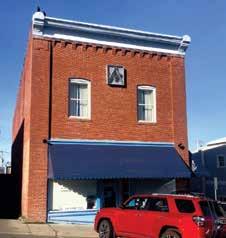
The Ladysmith Museum is a beacon of learning in the heart of the town. Located on the corner of Buller St. and First Ave, it’s a prioritized stop for thousands of tourists and locals each year who wish to explore the town on a deeper level. Ladysmith markets and prides itself on its heritage, but unfortunately that pride does not translate into security for the Museum as the building it is housed in may be slated for demolition sooner than later.
Volunteers of the Ladysmith & District Historical Society (LDHS) run the Ladysmith Museum on behalf of the Town and community through a Management and Operating Agreement between it and the Town of Ladysmith.
Since its foundation in 2012, the Museum has accepted donations of artifacts from community members with approximately 1500 artifacts making up the museum’s heritage collection which illustrates the district’s vibrant history. Quentin Goodbody, the President of the LDHS said that “the Historical Society acts as the custodian of the collection on behalf of the community, and stages heritage events and displays in the Museum building” and that “only artifacts of direct relevance to the history and heritage of the community are accepted.”
A partnership with Stz’uminus resulted in plans for an expanded Indigenous People’s exhibit space. “We are inviting the First Nations to come in and tell their story.”
Despite this collaborative approach to archiving and sharing our history, the museum faces an uncertain future.
The lot and building in which the museum operates was purchased by the Town along with several adjacent lots for the express purpose of constructing a new city hall. In 2024, the Town attempted to move forward with this agenda through an Alternative Approval Process, but its borrowing proposition was rejected by the community. At the same time, the Town overhauled its Operation and Management Agreement with the Historical Society, changing it from a two-year term to a monthly renewal, thus providing specific flexibility for museum closure and quick demolition of the building, if required by the
Town.
That year, the Historical Society sent a letter to the Town saying, “look, we recognize that there’s some immediacy to this. We need to do some preparation regarding the preservation of the Museum’s collection and continuity for the Museum itself. This will take planning and money. Who will do what?” As of today, plans are up in the air: no location has been determined as a suitable alternative for the museum and its collection.
The question of responsibility for the collection has come up through discussions, and the Town has requested both an up-to-date inventory of the artifacts, and an “expression of relevance by the community regarding the museum.”
The LDHS has a dedicated volunteer and has hired a summer student to update the inventory of artifacts so that is in hand, but the question of relevance of the Museum and its collection remains to be answered by you, the community.
To enable the community to decide how important the Museum and its collection is, the LDHS will be raising awareness of the collection throughout the summer. Weekly videos will be
posted to LDHS social media sites: Ladysmith Museum Facebook and the Ladysmith and District Historical Society Group. These posts will highlight some of the artifacts, as well as introduce the volunteers who keep the museum running. The LDHS will also be present at pop-up events to engage directly with the community.
You can have your say by participating in the Change.org online petition “Support the Ladysmith Museum’s Continued Presence in the Town” recently launched by the LDHS. The goal of this petition is to provide a measure of the support within the community for continued safeguarding of the heritage collection and maintaining a museum to tell our community’s stories.
Don’t toss it, Fix it!
BY FRANCESCA PACCHIANO
Global consumerism and fast-fashion are an accepted reality of life. If something breaks, it’s almost guaranteed to be thrown out. The Repair Cafe is a global non-profit that makes it its mission to slow the pace of waste and offers a place to repair broken items at no cost
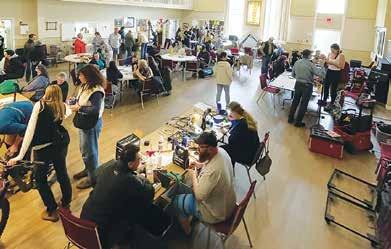
to the owner. There are almost four thousand cafes around the world, and in April, the Nanaimo Repair Café hosted its first event. This fall, a Repair Café is opening in Chemainus.
Stenson Lindal, one of the three co-founders of Nanaimo Repair Café, was delighted with the turnout at their April event. Over 100 people attended, bringing their household items, gardening equipment, jewelry and bicycles to be repaired by 30 skilled volunteers.
But it’s not just the convenience and economics of having an item fixed and reducing landfill waste. “We saw smiles, laughs, and people connecting with their community,” Lindal said.
Susan Worrall is the mastermind behind bringing this movement to Chemainus. “One of my loves is sewing, and I think, ‘Why can’t you just repair it?’” Her tendencies, paired with the practice of intentional recycling, led her to starting the cafe.
The pitch is simple: bring your broken toaster, faulty lamp, or even your torn clothing to one of the cafe events and the expert
“fixers” will mend your item or show you how to do it yourself. You can even grab a cup of coffee or tea while you’re there.
The cafe will run three to five times a year, for a three-hour period, starting in the third week of September. The location will be at the Chemainus 55+ Seniors Activity Centre. Susan was excited about this partnership because the event “brings the community together.”
Volunteers are what really make the cafe special. Fixers can be anyone who has a skill to share, whether it’s troubleshooting laptop issues, repairing jewelry, or replacing a bicycle tire. There is space for twenty-four fixers to volunteer at this event.
If you do volunteer as a fixer, Susan recommends bringing your own supplies. “As a sewer…I would bring a button box, I have extra thread, I would bring my scissors, and probably bring my sewing machine.”
If fixing isn’t your strong suit, Susan is putting together a communications committee. Alicia Martin and Andy Court are coordinating the event from the Chemainus 55+ Senior Activity Centre’s end, but she needs people to help organize the volunteers.
“I’m putting together a team that will help me with marketing, Excel, putting together phone lists and email lists.” Additionally, Susan is asking businesses and those in the community who want to support for “seed money”. Any financial donations would go towards “develop[ing] a bin of things that can be used” by the fixers, as well as event insurance and advertisement.
As for the demographics of this event, Susan anticipates a multi-generational mingling. “The whole drive to repair and recycle is hitting high school kids as well. They’re actually going back to carrying Walkmans.” Susan also believes that teens and young adults have valuable skills that could be shared with older community members. “The whole idea of the repair cafe is to repair but also teach people how to do some of the repairs themselves. I’m betting that if we could get some teenagers in there with phones and computers, they’ll be awesome.”
This is your invitation to slow down, consider if your item can be fixed before throwing it out, and come have fun with the community this fall. For more information or to volunteer, email repaircafechemainus@gmail.com.
If you’d like to attend the events or volunteer for the Nanaimo Repair Café, you can reach Stenson and his colleagues at repaircafenanaimo.ca
Below: Commodore salute at Ladysmith Yacht Club’s SailPast. Photo: Bob Burgess
Nanaimo’s Repair Cafe. Photo submitted.
None came back exhibit
BY EVAN SHUMKA
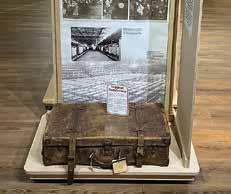
What do you put in a suitcase when you’re being sent to internment? That is one of the questions posed at a new exhibit at the Chemainus Museum.
“None Came Back” presents the story of the Japanese Canadians who once called Chemainus home. It explores how international, national and local events affected the lives of Japanese Canadians and changed the community forever.
“When the Japanese Canadians were exiled from Chemainus, they were allowed to take one suitcase with them,” said Hiram Beaubier, a volunteer with the Chemainus Valley Historical Society and project lead. “So, what do you put in a suitcase? You don’t know where you’re going. You don’t know how long
you’re going to be.”
Presented in ten panels, the exposition begins with the early arrival of Japanese Canadians and the establishment of vibrant neighbourhoods. The exhibition does not shy away from exploring the barriers in the community created by social prejudices and unequal civic rights. The uprooting, internment and dispossession of Japanese Canadians during World War II is covered by presenting how individual Japanese Canadians were affected. The exhibition addresses the question of why no one came back to Chemainus at the end of the war and concludes by encouraging reflection
about this chapter in the community’s history.
“In Vancouver Island … pre-war, there was about 3,500 Japanese Canadians,” said Beaubier. “After the war, and after freedom of movement was restored, less than a hundred came back. … Some [went] to Ucluelet, some to Nanaimo [and] some to Victoria. A family or two went into Paldi – but none came back to Chemainus.”
The reason, Beaubier explained, was that all the property of the Japanese Canadians had been sold off – the profits used to offset the cost of keeping those same people in the internment camps. Furthermore, there were hostile editorials in the Chemainus and Ladysmith papers, all culminating in a resolution passed by the municipality stating, “We don’t want them back.” Beaubier pointed out that “we tend to overlook the fact that local voices contributed a bit of a momentum to the policy formulation.”
A special feature of the exhibition is a display created by the Grade 7 class of the Chemainus Secondary School. The history of the Japanese Canadians of Chemainus was covered during the humanities class, and the students were asked to create a project that represented what they had learned. Some of these
New exhibit at Chemainus Museum.
Photo submitted.
projects are on display at the museum and at the Chemainus library.
“That was a really fun part of it,” said Beaubier. “It’s just wonderful because it conveys an understanding of the evolution of the community to … a younger group.”
The exposition draws on local voices and experiences of those living through the events. It traces the story of one family from Chemainus whose children were of school age when interned, then exiled to Japan, but who returned to Canada as young adults. The exhibition is also about resiliency and provides an opportunity for reflection relevant to today’s world.
“[Exile is] an element that not many people in Canada … realize,” Beaubier said. “One would think at the end of the war, well, internment should be over and away you go … [but] the federal government gave the Japanese Canadians a choice: You either stay in Canada – east of the Rocky Mountains – or you can go back to Japan. … All your possessions are gone, your house is gone, your jobs are gone, and there’s no welcome mat. So the choice is clear.”
The None Came Back exposition is the result of the dedication of the Chemainus Valley Historical Society volunteers and is available for viewing at the Chemainus Valley Museum beside Waterwheel Park. The museum is open five days a week from 10 a.m. to 3 p.m. Check their website for up-to-date hours of operation (ChemainusValleyMuseum.ca).
The exhibit is currently open, but a special exhibit unveiling event will be held on July 11, 2026.
Art Exhibitions: Journey Into the Wild & Unseen
This June, visitors and locals alike are invited to experience two compelling exhibitions that transform the Ladysmith Gallery into a journey through memory, movement and the wild
beauty of Canada’s natural world.
From June 3 to 17, 2026, explore works inspired by migration, emotional transition and the courage it takes to step into the unknown through layered imagery, fragmented forms and rhythmic patterns.
Alongside this moving exhibition, “Voices from the Vanishing” presents Debra Garside’s stunning photography and bronze sculptures celebrating iconic Canadian wildlife, including bears, wolves, orcas and wild horses from June 19 to 28. Through tactile sculptures, jewellery and photographs, the exhibition captures both the majesty and fragility of creatures in their natural habitats.
Debra is an award-winning artist who has shown at the Smithsonian Natural History Museum in Washington, DC, and the Natural History Museum in London, UK, and is one of Canada’s most accredited horse trainers.
Open seven days a week at Unit 7, 32 High Street, from 10 a.m. to 4 p.m. More info www.ladysmitharts.ca.
The Nanaimo Chamber Orchestra’s “Rising Strings”
The Nanaimo Chamber Orchestra winds up its performing season with a program of Baroque, Classical and 20th-century repertoire. The program “Rising Strings” begins with two Baroque works: a Sinfonia in four movements by Francesco Manfredini, a contemporary of J.S. Bach, followed by a charming “Concerto Grosso” by violinist, painter, poet and composer Giuseppe Valentini, published in 1710.
A fascinating work, Vaughan Williams’s “Concerto Grosso,” composed in 1950, is unique in that the orchestra is split into three sections, leading to some very dense musical textures. The work is in five movements: a dramatic Intrada, a sprightly
Burlesca Ostinata, a pensive Sarabande, an energetic Scherzo and a March that leads back to a reprise of the Intrada.
The featured work on this program is Joseph Haydn’s “Cello Concerto in C Major,” with soloist Daniel Rainer, winner of the NCO 2026 Young Musicians Concerto Competition. Daniel is 16 and has studied for the last eight years with Alexandra Lee. He is a gifted young Nanaimo musician whom the Orchestra is proud to present.
This concert is set for June 7, 2026, at 2:30 p.m., at St. Mary’s Church in Ladysmith. Tickets are $25 for adults, $5 for students, and free for those under 13, and can be obtained (especially “early bird”) through the NCO website (www.nanaimochamberorchestra.com) or at the door.
Summer Reading List
BY EVAN SHUMKA
Here come the long days of summer reading – and what better guides for your literary journeys than your local experts?
Ginger Warden is the customer service librarian at the Ladysmith branch of Vancouver Island Regional Library. Catherine Quaglia is the co-owner of Boundless Books. We asked them for their recommended reads in multiple categories.
The following is an abridged list of their recommendations.
Non-fiction
VIRL Ladysmith: “Searching for Serafim” by Ruby Smith Diaz. A local Ladysmith author recounts the story of Vancouver’s first lifeguard – Serafim “Joe” Fortes, an Afro-Latino man from Trinidad – through a rich blend of historical research, personal reflection and poetry.
Boundless Books: “Two Women Living Together” by Kim Hana and Hwang Sunwoo. The bestselling South Korean memoir co-written by best friends who defied gender and social norms by choosing to live platonically together and grow old under the same roof.
Adult fiction
VIRL Ladysmith: “Real Ones” by Katherena Vermette. A deeply moving story of two Métis sisters who must confront long-buried trauma after their mother is exposed as a pretendian.
Boundless Books: “The Caretaker” by Marcus Kliewer. Vancouver’s own scribe of the unsettling returns with the story of a woman who accepts a three-day caretaking job on Craigslist, only to find herself living in a nightmare surrounded by the wilderness of the Oregon coast.
Children’s fiction
VIRL Ladysmith: “The Cartoonists Club” by Raina Telgemeier and Scott McCloud. This graphic novel combines how-to with the story of a group of kids coming together to explore comic-making, creativity and friendship.
Boundless Books: “Falling to Fairyland” by Sarah Jean Horwitz. A middle-grade novel following the sinister yet whimsical adventure of a changeling boy as he delves into a Grimminspired world of magic and self-discovery.
And here are some local authors with new books for you to check out:
Kim Bannerman’s “Circus Salmagundi” mystery series is set on Vancouver Island. The latest instalment, “Maker of Widows”, begins with a body found on a remote beach and a community gripped by fear of Sasquatch. Kim’s books are available at Boundless Books or direct from the author at www. kbannerman.com.
Naomi P. Lane’s 2084: “The Climate Chronicles” series combines spicy romance with rebellion in a future dystopian world, as two eco-warriors begin a love affair. Book three of the trilogy, Catch and Release, is out on July 15.
“Between Us Girls” is a vibrant collection of poems, chronicling experiences of womanhood, through the lens of a newcomer to the female world. Lucia Polis invites us on her journey as she leans into her metamorphosis and progresses through different stages of sisterhood. She examines aspects of femininity – victimhood, attempts to conform to traditional standards of beauty and embracing the darkness within. While Polis draws on literary inspiration from Plath, Attwood Wolfe and others, there is no doubt that this collection is her own unique voice.
The following poem is from “Between Us Girls”
Now ends the winter of our discontent
Whose terminus foretells the impish sun. Recall the debts of words that weren’t yet spent And set your mind to all you once began. The blossoms exit their erosive daze.
They shyly straighten out their sepalets
And slyly flounce their petals for your gaze
And nudge their stanzas through stigmatas’ clefts. Your spring is here: first self, first bloom, first truth. Now rest your weary frame—here’s your repose— And watch with wonder, just as you inhale, The opening of your uncommon rose.
Then see the firmament to each sense bring The queer and tender, loving touch of spring.
“Between Us Girls” is published by JLRB Press, Nanaimo. Find out more at jlrbpress.ca
And finally, our very own Jackie Sharp comes out with the third book of her Carroll and Delaney mystery series, set in 1940s London.
The Dockland Killer follows the investigation into a series of heists in London’s dockland that escalate into violence and murder.
You can find her books at www.jackiesharpauthor.com
Ladysmith Arts & Heritage Open House and Two Steppin’ for Heritage
Come watch big machines come to life at the Industrial Heritage Park. For years, volunteers of the Industrial Heritage Group of the Ladysmith & District Historical Society has been restoring equipment representing the early logging industry in Ladysmith.
On Saturday, June 6, 2026, from 10 a.m. to 1 p.m., you’ll get a chance to see them work in action. There will be demos of the tube tumbler, the Humdirgen, and the Jordan spreader. The box car and the steam locomotive will also be on display.
Next door, the Ladysmith Maritime Society’s Boat Restoration Shed will also be open for tours. Come see the 126-year-old Rainbow – a beautiful 16foot Admiralty skiff-gig that may be the only one left in the world.
While there, make sure to drop in and see the pop-up show by renowned maritime and heritage artist Michael Dean.
On June 27, the LDHS is holding a live music and dance with Petunia and the Vipers at the Ladysmith Eagles Hall. Last year’s dance filled the Cedar Community Hall and organizers are hoping for another energetic night of two-steppin’. A dance lesson is included. Tickets are $25, and all proceeds are going to the society’s work in operating the archives and museums. You can pick up tickets at the Ladysmith Archives or order through Eventbrite.
For more information, email info@ladysmithhistoricalsociety.ca or call 250245-0100.
Moon Gardens
BY EVAN SHUMKA
Moon gardens and vegetable crops are top of mind for this year’s gardeners.
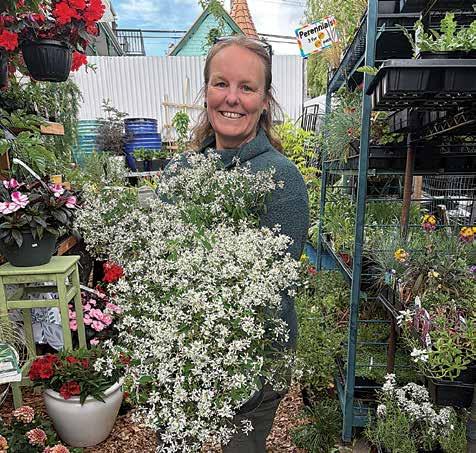
Imagine a plot of white verbena and euphorbia diamond snow, planted with other white flowers and silvery foliage, so when night falls and the moon rises, the garden glows in the moonlight.
When I asked Mieka Caskey, owner of Sandpiper Gardens and Glass, about the latest horticultural trends and she told me about luminescent “moon gardens,” I wasn’t expecting that gardeners were dreaming up such mystical concepts.
According to chicagobotanic.org, the English writer Vita Sackville-West had her own moon garden in the 1950s. In 1833, a moon garden in Massachusetts was designed by Benjamin Poore, who went the extra mile and included “a herd of white cattle, white pigeons and a white dog.” That level of lunacy has yet to be reached by local gardeners, but we can dream.
The moon garden trend has also been noted by Mei Dunlop, retail operational manager and marketing manager of Holden Lake Farm and Garden, though she hasn’t received questions about it directly from her customers. Both her and Caskey, however, are finding a definite growing interest in food crops.
“[Gardeners are] looking more into vegetable gardening – that’s for sure,” Dunlop said, and added that perennials and drought-tolerant plants are also top
of mind.
Caskey has noted the same trend, pointing to the high cost of groceries as the driving force behind more people growing their own food – something that her business promotes. Tomatoes, peppers, squash and zucchini are currently being planted, with broccoli and cauliflower already in the ground. The most popular cucumber, according to Caskey, is the four-inch-long cucino: perfect for a kid’s snack. With heat, it grows prolifically.
Gardeners are “adapting their ways,” according to Dunlop. Her business hosts a variety of workshops that teach people how to incorporate techniques such as
companion planting into their gardens. Companion planting, Dunlop tells me, is about “bringing in different varieties of plants that attract pollinators.” For instance, you might plant marigolds close to your peas to entice those precious pollinating insects. It can also be used to protect your vegetables from slugs by luring them away with the promise of an alternative treat.
It seems there is no shortage of ideas for this year’s gardens. And, perhaps, after a long, hot day of tending veggies and chomping on fresh, crisp cucino cucumbers, there may be no better repose than basking in the soft, silver light of a moon garden.
Mieka Caskey, owner of Sandpiper Gardens & Glass with Euphorbia Diamond Snow
Photo: Damen Caskey
Another owl in town
BY PAUL LEGACY
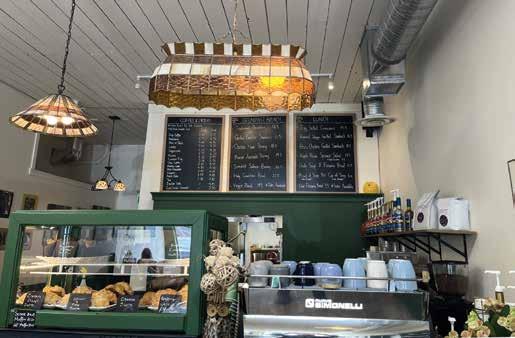
Ladysmith continues to prove that for a small coastal town, it offers an impressive and ever-growing collection of restaurants, cafés and bakery-bistro concepts that keep both locals and visitors coming back time and again. Adding to this vibrant culinary landscape is the newly opened Owl’s Nest Bakery and Bistro, located at 18 High Street – a welcome and thoughtfully executed addition to the community.
From the moment you step inside, the space makes a strong first impression. Recently renovated, the bistro is bright, clean and features an open-concept layout that feels both inviting and modern. The carefully chosen stained-glass, Tiffany-style hanging lights provide a warm contrast to the otherwise contemporary interior, adding a touch of charm and personality that elevates the room without overwhelming it.
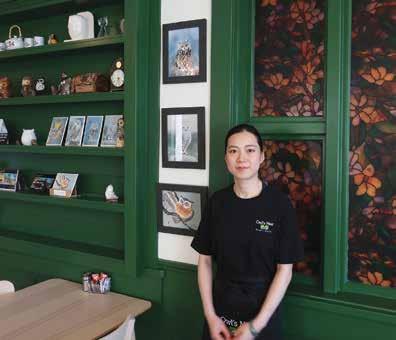
Upon entering, we were greeted warmly by Seline, whose friendly smile immediately set the tone for a relaxed and welcoming experience. The service model here is casual and efficient: guests walk up to the counter to place their orders, making it an easy and approachable spot for anything from a quick coffee stop to a more leisurely brunch.
The Owl’s Nest brand itself has an in-
teresting and steadily growing story. In 2020, Cici Ren and her family purchased the original Owl’s Nest location in Chemainus, maintaining much of its established menu while gradually refining their offerings. Building on that success, a second location opened in Saltair in 2022. With both locations well received, the decision to expand into Ladysmith was a natural next step, with this newest bistro opening its doors on March 15, 2026. Across all three locations, the menu remains largely consistent, with a few additions that give each site its own subtle character.
Cici’s journey into the restaurant world is particularly noteworthy. With a background rooted primarily in home-cooking, she pursued formal culinary and restaurant training at Vancouver Island University (VIU), an experience that clearly helped shape her confidence and direction. Her passion for food is unmistakable – when she speaks about cooking, there is a genuine enthusiasm that reflects both pride and dedication.
The menu itself is well-rounded and thoughtfully curated, covering all the essentials for breakfast, brunch or a light afternoon bite. In addition to a strong selection of baked goods, guests will find an extensive offering of coffee, teas and specialty drinks. It’s a space that lends itself equally well to a casual meet-up with friends, a small group gathering or even a relaxed office outing.
Another notable strength is the inclusivity of the menu. With vegetarian, vegan and gluten-free options available, the Owl’s Nest ensures that a wide range of dietary preferences are accommodated –an appreciated and increasingly important feature in today’s dining scene.
Ladysmith’s new Owl’s Nest Bakery & Bistro. Photo: Paul Legacy. Opposite page: Cici Ren. Photo: Evan Shumka
Throughout our visit, Seline remained attentive not only to our table but to the entire room, balancing service with an evident commitment to maintaining a clean and welcoming environment. This level of care did not go unnoticed.
The Owl’s Nest Bakery and Bistro is open seven days a week from 9 a.m. to 4 p.m., with the kitchen closing at 3 p.m. Whether you’re seeking a morning coffee, a satisfying brunch or a comfortable place to gather, this newest addition to Ladysmith’s dining scene is certainly worth a visit.
You can follow Paul Legacy’s food blog: A Legacy in Thyme at https://www.facebook.com/share/1AvhVXYW3a/?mibextid= wwXIfr
BY EVAN SHUMKA
Grab your sunscreen, your beach towel and a good pair of shoes because the “HomeTown Tourist” Weekend is back on June 20 and 21! With fuel prices soaring on the wings of eagles, more people than ever will be playing tourist in their own backyard.
Eager adventurers flock here from all over the world, so isn’t it lucky that you’re already here? There are world-class destinations right outside your door. And if that doesn’t already make you a winner, this year’s participants will have the opportunity to win five $100 gift certificates courtesy of Nanaimo Airport, which can be used at any of our participating advertisers in this issue.
Sponsored by TAKE 5 and its partners, this campaign encourages locals to discover or rediscover the area’s treasures and become ambassadors for the community.
So, get out there and visit as many of the places listed below as you can during the June 20–21 weekend. Post photos of your excursions with the hashtag #Iamtaking5 and/or email us directly at editor@take5.ca. For every location you visit, you will receive a chance to win one of those juicy gift certificates.
And if your appetite for hometown tourism still isn’t sated? Break away – pay a visit to your local visitor information centre and pick up a copy of the annual Explore Guide for Ladysmith, Chemainus, Cedar, and Saltair. Adventure awaits!
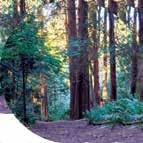
There’s a bit of a breeze under the trees, so head out for a walk along the trails, in the shade, along the creeks.
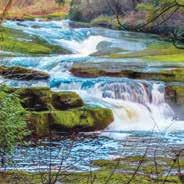
Holland Creek Trail offers views of Crystal Falls and the Colliery Dams. The trail is approximately 5.8 kilometres long and wheelchair accessible from the Methuen and Sixth Avenue entrance.
Stocking Creek Park is the jewel of Saltair, offering several kilometres of trails leading to the meditative Stocking Creek Falls. Its entrance lies in the parking lot off Thicke Road, where washrooms are available.
Haslam Creek Trail and Suspension Bridge are part of the Trans Canada Trail system. Access is at the end of Timberlands Road.
Historic Provincial Park to Hemer Provincial Park (see both below). It allows walkers to follow the 20th-century coal railway route that linked the mines of South Wellington to coal ships in Boat Harbour.
Early morning and evening are good times to see wildlife. When you visit the same spot enough times, you get to know the individual animals in an area. Where do they like to perch? Or hunt? And how do you fit into their routines?
Swallowfield Road offers access to the Chemainus River Estuary. There are extensive trails over the bluffs, providing a good vantage of the landscape where river meets the sea.
Nanaimo Estuary supports an abundance of wildlife and is the largest estuary on the Island. The short trail along the Nanaimo River features viewing platforms and is a popular spot for birding. Bring your binoculars and cameras.
Hemer Provincial Park has easy walking trails that are mainly forested. It is a peaceful setting for walkers, paddlers, boaters and anglers and includes a bird-watching platform.
Bury your feet in the rocks and let the waves lap over them. Listen. Now, get in the water. Don’t be shy. You live on an island – make the most of it!
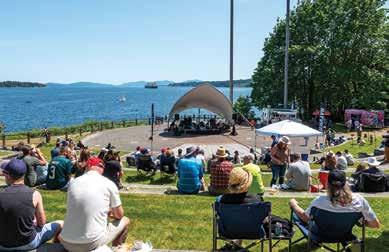
Elliots Beach Park on Elliot Way, off Shell Beach Road, is a great spot for picnicking, swimming, snorkelling and kayaking.
Transfer Beach Park is the perfect spot for a family picnic. It features a water park and playground, trees providing shade, fields and coastline. The park is wheelchair accessible and is equipped with washroom facilities and picnic tables.
Kin Beach in Old Town Chemainus is a rocky, easily accessible beach with a playground. At low tide, you can walk over the sand to the lighthouse on Bird Rock – just be sure to watch the tide so you don’t get marooned.
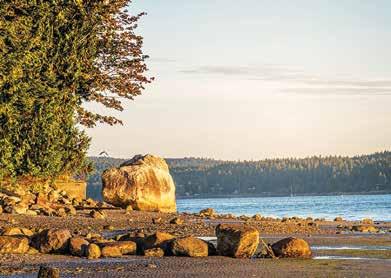
Boulder Point, or Big Rock Beach, is a favourite among children. Plenty of wildlife can be spotted – watch for otters and seals swimming and great blue herons fishing in the shallows. Boulder Point is an excellent swimming spot. Mind that pets must be leashed.
With so much natural beauty around us, it’s no wonder we’re inspired to create so much art.
Chemainus Theatre and Gallery is a world-class performing arts centre and is home to the Playbill Restaurant and a delightful store and gallery.
Ladysmith Gallery hosts a variety of art exhibitions throughout the year.
Rainforest Arts is a gallery that supports Island artists. The Chemainus Mural Walk features over sixty murals depicting the town’s history. An official mural guide can be
Transfer Beach Park; Photo: Bob Burgess. Boulder Point, Saltair; Photo: Bob Burgess.
picked up at several locations, including the Chemainus Visitor Centre and Museum.
Take a walk through the past and contemplate the heritage of this land.
Chemainus Museum has a new exhibit called “None Came Back,” detailing the stories of the Japanese Canadians who once called Chemainus home before internment. The exhibit features artifacts from the families and a display created by the Grade 7 class at Chemainus Secondary School.
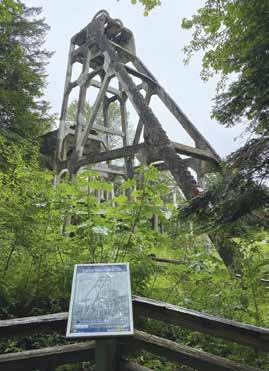
Morden Colliery Historic Park is home to the Morden Mine. Its tipple and headframe are among the few surviving concrete headframes in the world.
Ladysmith Museum & Archives feature great and informative exhibits on local history. Entry by donation. Leave the landlubbers behind and spend a day out on the water.
Boat Launches are available at Ladysmith Fisherman’s Wharf, Cedar by the Sea, and Chemainus Kin Beach Park. Fuel docks are located on Thetis Island. Telegraph Marina on Thetis Island has visitor boat space and a thriving social dock that includes the Ladysmith Maritime Society’s heritage boats as well as a Sea Life Centre.
Bute Island Marine Park in Ladysmith Harbour is only accessible by boat and offers a day-use dock for people with small vessels. There are walking trails and beautiful views of the Gulf Islands and mountains.
Thetis Island is accessible by ferry from Old Town Chemainus. This little island is quieter, with rural farm stands and calm beaches. It’s a good place to slow down and relax.
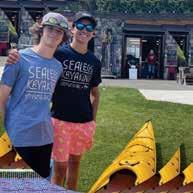
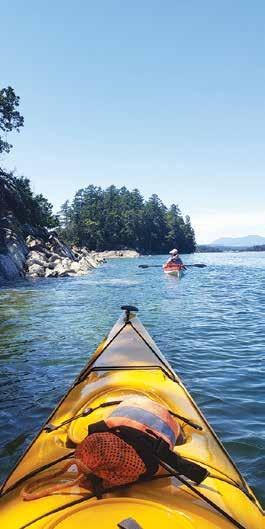
Sealegs Kayaking out of Transfer Beach offers fun paddle around the islets in the bay and offers a discount during June 20 & 21.
While you’re on the water, here’s some fishing spots for your next big catch.
Nanaimo River is regarded by anglers as one of the best steelhead rivers in the country.
Fuller Lake is prized for the sandy beach, warm water and good fishing. There are also tennis and pickleball courts.
Chemainus Lake Park is located west of town. It features a dock that’s great for fishing and a 2.5-kilometre loop with multiple trails encircling the water.
Porlier Pass is a popular fishing spot that separates Galiano Island from Valdes Island.
There are still more attractions and activities to try out.
Wildwood Ecoforest boasts a rich diversity of wildlife, from the little brown bats and banana slugs to the towering old growth Douglas firs. Established in 1938 by Merv Wilkinson, it is operated by the Ecoforestry Institute, which hosts vacation stays, workshops and tours.
WildPlay is for those hometown tourists feeling especially brave. They offer bungy jumping over the Nanaimo River and adventure courses up in the trees.
Mount Brenton Golf Course features shaded fairways flanked by towering trees. A challenge for golfers of all proficiencies, there are plenty of creeks to hurdle and ponds to putt around. An extensive drainage system makes Mount Brenton one of the most playable, yearround golf courses on the Island.
Ladysmith Golf Club is open to golfers six and older. It takes approximately one hour to complete this nine-hole, par-3 course and includes the challenge of driving over two ravines and large, tricky greens. This course will test both your short-iron game and putting skills.
Happy exploring!
For more information, and for your chance to win, follow our Facebook Page at TAKE5.ca/HomeTownTourist
Left: Morden Colliery Park. Photo: Marina Sacht.
Right: Sealegs Kayaks. Photo Submitted.
End of the Line? Concerns over steam power
FRANCESCA PACCHIANO
The piercing whistle of the steam train draws Duncan residents and tourists alike to the BC Forest Discovery Centre. Riding the train is a once-in-a-lifetime experience for some and a holiday tradition for others. Either way, the magic of the glossy black engine is undeniable.
“Samson,” as the train is called, is one of the few remaining living historical artifacts. With the modernization of transport over the last two centuries, steam-powered vehicles rose in popularity and fell off after the development of cheaper and more effective diesel- and gas-powered tractors, cars and trains.
Today, the artifacts that remain are often static displays in museums or abandoned in fields with grass growing over them. There are a few organizations, like the BC Forest Discovery Centre, that have teams of volunteers keeping these trains going. There are also a few hobbyists who have painstakingly rebuilt and restored engines.
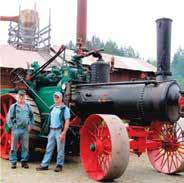
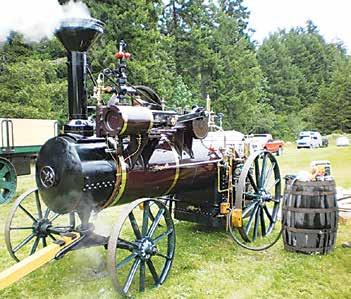
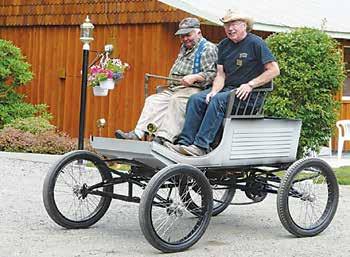
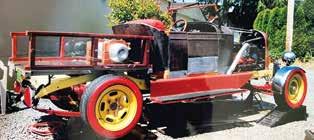
The Blackstaffs are known for their heritage restoration projects. Shirley and Harry have spent their lives building their collection. Currently, they have three steam-powered machines: the Locomobile, the George White Portable and the 1916 Waterloo Traction Engine.
Shirley enjoys the Locomobile because “it shows the beginning of vehicles. It looks like a horse-drawn wagon, but it’s not pulled by a horse.” The 1904 George White Portable is a tractor that was used on the First Nations Reserve in Duncan. Harry and his late brother, James, restored it in 1991.
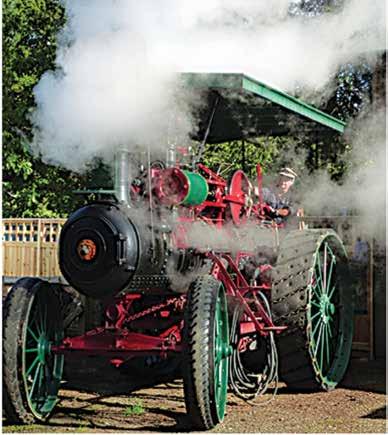
The Blackstaffs run a private, annual showing for their friends. Photos from the event show steam billowing around the green-and-red-painted frame of the Waterloo. It’s the past brought back to life. But even on their own property, they’re having trouble getting their machines certified for operation.
In a letter written to Technical Safety BC in 2017, Harry expressed some of his concerns regarding the amount of care the organization and its inspectors put into determining if these machines are in safe hands.
“In the last few years, my steam engines have been inspected
at a minimal level by untrained inspectors. I feel I have more knowledge and experience about steam inspections and what needs to be done to make them safe than the current inspector. … I have my steam locomotive ticket and 50 years of experience operating steam engines safely.”
Shirley mentioned that the problem isn’t just that the inspectors are untrained on the old systems; they also often have limited experience with small machines. “They’re used to inspecting in mills or in factories.” It’s this disconnect between the government inspectors and the hobbyists that leaves the Blackstaffs, and others, feeling like the government doesn’t care about them.
The unaffordability and the lack of reliable certification is causing Shirley to rethink hosting her annual events. As for the fate of the machines, “they’re probably just gonna sit in a museum building with their information. They might have a video showing them running. That’s about all you can do.”
Ross Murdoch has been working with the Blackstaffs on restoration projects for decades. Harry and James were the ones
1904 George White Portable owned by Harry and Shirley Blackstaff. . Photo submitted.
who got Ross interested in steam. Ross spent his career working as a marine engineer and found that a lot of the skills transferred over. Now he’s working on his own restoration project.
“I’m working on a 25-ton steam tractor now. … I bought one off of a museum in Vancouver. That was just parts. It’s a very painstakingly long process to find pieces.” He’s been working on this project for 35 years and estimates that he’s only halfway to completion.
One of the issues with hobby restorations is that pieces can be expensive or nearly impossible to find. Ross gets pieces made in the US and then shipped across Canada. “I’ve been waiting for pieces for five years. … The only way I can get the parts is [by having] to wait until there’s a truck coming out here.”
Harry Blackstaff (left) on 1901 Locomobile steam run-about. Photo submitted.
The process of restoration is further stalled by the government’s safety regulations. The move away from steam to oil, gas and electric means that pressurized systems are almost exclusively high-pressured systems. He has also found that the inspectors often don’t even fully know how these older machines work.
“These boiler inspectors don’t even know which end they’re looking at.” He expressed frustration at the fact that his life of experience working with these machines and his certification as a marine engineer is ignored. “I’m a marine engineer … but according to the boiler branch, the BC safety authority, it doesn’t count.”
Ross also noted that the cost for an inspection is roughly $400 annually. “Once you start this process of being into their little regime, you just gotta keep paying the money, and they won’t come and look at the boiler.”
This process has led several of his fellow hobbyists to throw in the towel. Ross also didn’t have much hope. “They’re just gonna get parked as far as I’m concerned.”
Despite this, Ross still thinks the preservation of these machines in their full operational form is valuable and wanted by the public. “If it’s just a static display, a lot of people are not interested. It’s just a big hunk of iron, [and] they have no idea what it did or does.” He says that the public is interested in these machines; they just often don’t have the ability to commit to these great works of restoration and preservation.
In the end, “it’s a love of steam” that keeps him going. “They’re an animal of their own. When you light that fire, [and] you get steam up, things change. Us crazy, old steam engineers
just love it.”
Technical Safety BC is the branch of the BC government that ensures proper safety, certification and training are taken into account before machines of this nature are operated. In a statement to TAKE 5, they addressed some of the frustrations voiced by hobbyists.
The tractors and trains worked on by the hobbyists are classed as “antique show boilers.” While this classification does include two different pressure weights – low and high –the price point is based on the size of the boiler rather than a
1916 Waterloo tractor steam engine with Ross Murdoch operating at a Blackstaff event. Photo submitted.
No. 7, 1929 Baldwin steam locomotive pulling the Santa Express in Port Alberni. Photo: Dave Hooper
flat cost. “These boilers require an operating permit, and the fee is based on the heating surface area of the boiler.”
The statement also noted that because these machines are often idle for long periods of time, deterioration can occur unnoticed. Maintaining a safe operational state is essential to avoiding possible risks. Addressing concerns that their inspectors aren’t well versed on antique systems, the statement read, “Our safety officers are National Board-certified inspectors, which includes the competency to inspect historical boilers in accordance with applicable adopted codes.”
The statement concluded by affirming that the machines are valuable markers of our history. “Antique show boilers are an excellent illustration of early boiler design, construction and operation.”
That love of steam is what drives the volunteers at the Western Vancouver Island Industrial Heritage Society. They run the heritage railway owned by the town of Port Alberni. David Hooper is an editor for the society’s newsletter and has been volunteering with them for over twenty years.
Historically, Port Alberni was an important logging town on Vancouver Island. Both steam and diesel engines were integral to the success of the industry. The 1929 Baldwin engine was used as a working train in the town, and from 2018–2020, local boilermakers donated their time to restore it.
Today, the Baldwin is a cherished feature of the Christmas train. It’s a special part of the holiday season to experience the cold December air and the white billows of steam. But despite its nostalgic charm, there are real challenges to running the engine. “It weighs 90 tons of steel with water. And in this cold weather, you have to heat the whole darn thing, including the water up to boiling temperature. It takes maybe three hours or so to start boiling the water to make the steam before you go anywhere.”
Diesel, on the other hand, is quicker. “It’s sort of like you hopping in your car.” With the added time and resources it takes to run the Baldwin, the society only runs the engine on busy days, like Christmas and Halloween.
When the Baldwin was first built, the engine was designed to burn bunker fuel. David said that during the restoration, the City of Port Alberni requested the oil be changed to diesel because of how heavy and dirty bunker fuel is. But that change also comes at a cost. “It’s more expensive than gasoline. So that puts the price up even more. It makes it very prohibitive.”
As the volunteers for the society get older and steam moves farther into the past, questions about preservation become the forefront of conversations. David noted that in Ladysmith, the decision was to make static displays. In Port Alberni, they’re still trying to keep these machines alive. “It’s a question of affordability or perceived affordability. How much do you value your history? What price is there to preserve your history?”
People who are interested in these machines don’t always have the skills or ability to restore them. At best, these machines will soon be static displays in a museum. David pointed out that even museums need to consider how many artifacts are needed to tell a story.
Today, operations continue as normal. The Baldwin sprang a leak over the Christmas holiday. The volunteer boilermakers are assessing the extent of the leak and if it’s worth saving. “That’s the world of steam and operating vintage machinery.”
Paddling on a World Stage
BY FRANCESCA PACCHIANO
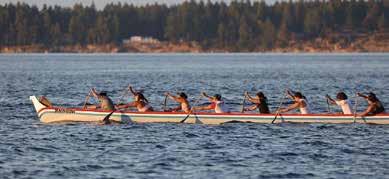
Maleah Harris was just 16 when she paddled for Team Canada at the outrigger World Distance Championships in Brazil last summer. As the only Stz’uminus member on the team, she represented her nation and honoured her family’s history on a world stage.
Her family’s ties to paddling extend back for generations. Her grandfather and her mother both paddled in the local war canoe races, even her older sister had taken up the sport. When
Maleah picked up her first paddle at the age of 11, she took to the water immediately.
“It clears [my] mind when I’m on the water. It’s relaxing and it’s fun. I also get to do it with my friends.” The war canoe racing schedule follows daily training from Monday to Thursdays, with weekends for races on the Island and mainland from
Maleah Harris with her mother Steph in Brazil. Photo submitted.
Above: War canoe races.
Below: World Outrigger Race in Brazil. Photos submitted.
May to September. But the war canoe races on their own weren’t enough of a challenge. When she was fifteen, she started outrigging.
The sport of outrigging, as it’s known today, is based on ancient Polynesian voyaging canoes. The canoes have a “ama” –a flotation outrigger that runs parallel to the canoe for stability. Maleah races in a single, known as an OC1, and with her team in a six-person canoe, OC6.
Adding the training for outrigging into her schedule wasn’t difficult; she just alternated what vessel she took out onto the water. “It’s definitely a change because you’re higher when you’re on an outrigger boat. When you’re in a war canoe … your seat is lower to the floor.” Maleah developed the techniques needed to be a skilled paddler and began racing where she could.
“For Brazil, we actually did our tryouts in the atmospheric river.” Despite the severe rain, Maleah qualified for Team Canada. The Junior 16 Women’s team was all Indigenous paddlers from BC, with Cowichan and Fraser Valley athletes, but Maleah was the only one from Stz’uminus.
The World Distance Championships took place in Rio de Janeiro, Brazil, and brought together hundreds of athletes from across the globe. The race, Maleah said, was located in the bay, with Christ the Redeemer in the mountains above them. “It felt like I was just in another world. I was so far away from home. It was so different.”
Unfortunately for the Junior 16 Women’s team, that difference wasn’t limited to the water. Two of the athletes weren’t able to get visas for the event. A Brazilian athlete subbed in for their skipper, allowing their crew to still compete. Maleah said that despite the language barrier, the skipper was trying to coach them and give them tips ahead of the races. “She was encouraging us out there.”
During the races, Maleah used the teachings of her canoe family and traditional practices to stay focused. Her mother, Steph, explained it as, “the canoes carry life, and they sense your emotions. If you have a heavy heart or something distracting you, the canoe feels it, and it won’t carry you as well.” With each pull of the paddle and splash
of the water, Maleah remembered her training, she focused her mind, and when they crossed the finish line, her team won bronze. “There’s definitely a sense of pride to be able to carry that all over there.”
Her mother, Steph, attended the race with Maleah. “It was definitely a great experience and pride knowing that we travelled across the seas to compete in such a competition, and [I] was just in awe.” While Steph was cheering in the audience, back home Maleah’s family were watching on the TV. “It was nice connecting with [family] back at home, and they got to watch it on TV. … It’s a great pride for our family. It brought so much togetherness.”
This summer, Maleah plans on staying local. The tryouts for the World Distance in Singapore were just after Brazil, and instead of pushing herself too far too soon, she chose to take a break. She will compete in the war canoe races this summer, and she’s open to any local opportunities to race with the outrigger.
Most of all, she’s looking forward to being on the water. “I love it.”
Another Story Relating Ladysmith’s Maritime Heritage: SS Princess May –a Frequent Visitor to Ladysmith and a Famous Shipwreck
BY QUENTIN GOODBODY
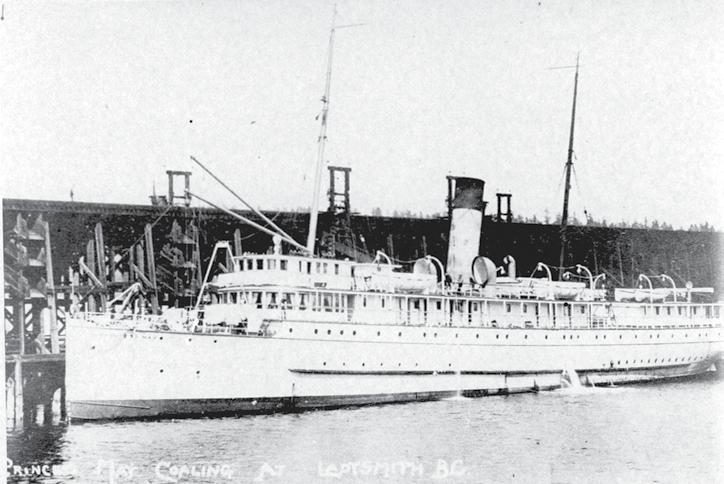
This is the story of SS Princess May, a Canadian Pacific Railway Company (CPR) coastal steamer that used to frequent Ladysmith in the early 1900s for coaling.
Built in 1888 by Hawthorn Leslie & Company Ltd. at Newcastle on Tyne, this steel-hulled ship measured 249 feet long, had a 33-foot beam, a draft of 18 feet and a capacity of 1,708 gross registered tons (1,022 net registered tons). She had two propellers, each powered by a three-cylinder 125-horsepower triple-expansion steam engine, which gave her a speed of 15 knots.
Originally named Mei Shih and employed by the Formosa Trading Company, the ship had 60 first-class staterooms and ample second-class accommodation, and was operated as a China coaster plying between Hong Kong, China and Taiwan, transporting freight and passengers. This she did for 13 years under several successive owners and names, ending up as the Hating owned by Canadian Pacific Railway Steamship Services (a similarly named but different company than the CPR).
In 1901, the CPR wanted to establish a coastal steamer service in British Columbia to ply the Inside Passage between Vancouver and Alaska. To do this, the company – under the leadership of Captain James William Troup – intended to build a fleet of small ocean liners (nicknamed “pocket liners”), the names of which were to start with “Princess.” At that time, the CPR was already operating a magnificent fleet of full-sized ocean liners plying the transPacific routes between the Orient and Vancouver; the names of the ships in that fleet began with “Empress.”
While building the first ship of his intended “Princess” fleet, Troup urgently needed a vessel to take advantage of the ongoing opportunity afforded by the Klondike Gold Rush. To fill this need, in April 1901, the CPR purchased the Hating from Canadian Pacific Railway Steamship Services and, on June 21, 1901, placed her on the 800-mile route between Vancouver and Skagway.
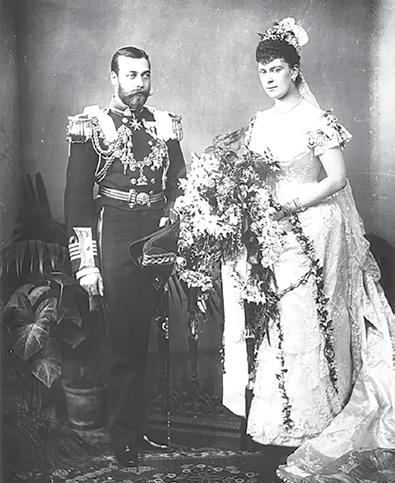
In February 1902, the CPR renamed the ship “Princess May” after Victoria Mary of Teck, Princess of Wales (whose full string of first names was Victoria Mary Augusta Louise Olga Pauline Claudine Agnes), informally – and thankfully, for that’s a bit of a mouthful – known by the diminutive name “May” after her birth month. Later, in 1910, when her husband ascended the throne as King George V, Princess May became Queen Consort of the United Kingdom and the British Dominions, and Empress Consort of India. She held these titles until her husband’s death in January 1936, after which she became Queen Mother of Edward VIII. Follow-
Wedding portrait (1893) of George and Victoria Mary (May), future Prince and Princess of Wales and later King and Queen Consort of the United Kingdom and British Dominions, and Emperor and Empress Consort of India. Photo: Wickipedia. U.S. Library of Congress Public Domain. Photographers: W. & D. Downey, Photographers by Special Appointment.
ing his abdication in December 1936, she became Queen Mother of King George VI, who reigned during World War 2.
In 1905/06, the ship Princess May underwent a significant refit. Nearly her entire superstructure was rebuilt, her promenade decks were done away with, and two new first-class berth staterooms for 150 passengers were added, along with a double row of staterooms extending from one end of the ship to the other that opened into social halls. Two new triple-expansion steam engines and an extra boiler were installed to accompany her existing two.
After this refit, she continued to ply the Pacific Northwest coast on alternate weeks, serving the many small mining,
Princess May coaling in Ladysmith Harbour, circa 1905. Photo: Ladysmith Archives
fishing and lumber settlements along the way between Vancouver and Skagway, Alaska. Princess May also continued to frequent Ladysmith for coaling.
She was considered a lucky ship. Legend had it that if prospectors travelled aboard her, they were certain to bring back gold. Her luck was, however, to have its limits. …
At nine p.m., on August 4, 1910, Princess May left Skagway bound for Vancouver, carrying 80 passengers, 63 crew members and cargo of mail and mineral ore containing gold. At two a.m. that night, Pilot John Richardson was on the bridge, navigating the ship at a speed of 12 knots through probably the most dangerous stretch of the Inside Passage – the approach to Sentinel Island at the southern end of the Lynn Canal, not far from Juneau, Alaska.
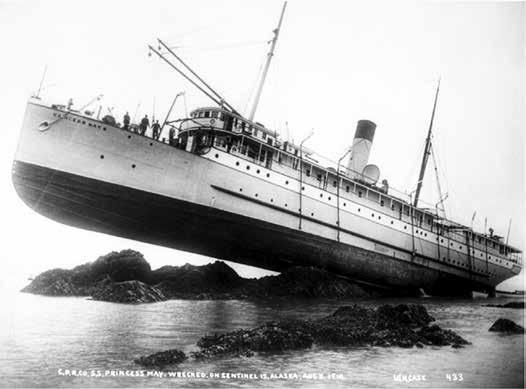
That night, a combination of the highest tide of the year and fog made it difficult to see ahead of the ship. When nearing the northern end of Sentinel Island, Richardson spotted rocks, but it was too late: Princess May struck a hidden reef with such force that the ship climbed halfway over the rocks, leaving her bow jutting up at about a 23-degree angle. There was a massive 55-foot gash in her hull on the starboard side, through which water entered. The port propeller blade hit the rocks so hard that it left the shaft twisted and bent.
Wireless Operator W. R. Keller succeeded, under difficult circumstances, in getting a distress call out: “SS Princess May Sinking Sentinel Island Send Help.” Meanwhile, all passengers and crew members were ordered into life boats, which hugged Sentinel Island till daybreak – when they could safely land and be taken to the nearby lighthouse.
Soon, vessels from nearby Juneau and other surrounding ports rushed to aid the stricken ship. The passengers were brought to Juneau, where they stayed in hotels paid for by the CPR before being conveyed to Vancouver. Not only did all passengers and crew survive, but the gold ore and mail shipment were also saved.
While the ship’s engine room and saloons were completely flooded, the ship did not fully sink. Later that day, the 16-foot tide dropped, leaving her high and dry out of the water, except for a few feet at her stern.
Word of the grounding spread, and local photography studios went to the site to capture photographs, which were published and sold around the country on postcards, as standalone prints, and in magazines. The photo shown here taken by William Howard Case is one of the most famous. Posing on the bow is Captain John McLeod and some of his officers.
The CPR hired the Seattle-based wrecking steamer Santa Cruz, under the command of Captain W. H. Logan, along with the William Joliffe – one of the most powerful tugs on the BC coast – to salvage the Princess May from the reef. The gash in the hull was patched, and all the water pumped out. Wooden shipways were built around the ship, and rocks were blasted so she could slide off at high tide.
On September 3, after several unsuccessful attempts, Princess May was refloated and towed into Juneau. Thirty hours after salvage, one of the heaviest gales of the season occurred – one with the power to destroy the stranded vessel had she still been on the rocks.
In Juneau, her port propeller was removed and her hull further reinforced to allow the ship to be towed to the BC Marine
Railway Wharf in Esquimalt, where a thorough inspection and repairs were performed. Total cost of the salvage and subsequent repairs was $115,000 (approximately $4 million today). At this time, the ship was converted from burning coal to oil – the first of the Princess fleet to have this done – thus ended her trips to Ladysmith for coaling. Other ships in the Princess fleet also visited Ladysmith for coaling until they, too, were converted to oil; the Archives has a photograph of Princess Royal steaming in the harbour.
Fully repaired, Princess May entered back into service in 1911 and served the CPR for eight more years until she was sold to the Princess May Steamship Co. to be managed by the Standard Fruit Co. for Caribbean freight and fruit service. In 1931, she was owned by Di Georgio & Co. Ltd. of Port Maria, Jamaica. She was scuttled off Jamaica in 1935.
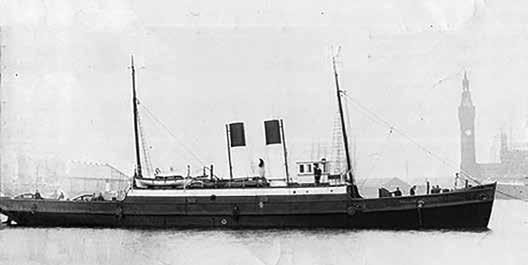
As a further epilogue to this story, the tug William Joliffe, which had featured prominently in the salvage of Princess May, was purchased in 1913 by the CPR, renamed “Nitinat” and was used to tow rail barges between Vancouver and the Transfer Wharf in Ladysmith – after which our beloved Transfer Beach Park is named.
The steam tug William Jolliffe – later called Nitinat after purchase by CPR in 1913 – was used to tow barges carrying railcars between Vancouver and Ladysmith’s Transfer Wharf. Photo: http://www.tynetugs.co.uk/williamjolliffe1885-2.html courtesy of Richard Cox.
Princess May on the rocks of Sentinel Island. August 5, 1910.
Photo: Wickipedia. Public Domain. Photographer: W.H. Case.
RDN Area A
The Electoral Area Directors are reviewing potential changes to the RDN’s Building Bylaw (No. 1976) and Building Regulations Fees and Charges Bylaw (No. 1968). Both items came forward at the Electoral Area Services Committee on May 7, 2026, and both were referred to staff for the creation of a community consultation plan. I will highlight some of the main recommendations in this article.
However, I want to be clear that those interested should be alert for the consultation process to get a full understanding of the changes and so you can provide your feedback. You can also read the reports in the Special EASC May 7th agenda that can be found on the RDN webpage under meeting calendar. While this information tends to be dry, it can have significant impact on those build-
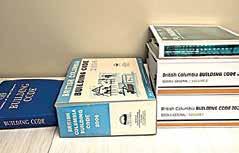
Through the years, the BC Building Code dramatically increased in size and complexity. Photo: Jessica Stanley
ing a home or in the building industry. By sharing it here, I am hoping to increase awareness and community engagement with the consultation process.
The Building Bylaw dictates how the RDN provides building inspection services and administers the British Co -
lumbia Building Code (BCBC). The Building Bylaw contains permits, inspection and enforcement provisions, including conditional occupancy and temporary buildings.
The proposed changes follow guidance from the Municipal Insurance Association of BC (MIABC) model building bylaw and is in response to significant legislative (e.g., the Building Act, the Professional Governance Act, the Energy Step Code) and industry changes. Much of the RDN’s Building Bylaw is dictated by the provincial legislation (e.g., the Building Act and the BCBC), leaving little local government discretion. Local representatives have influence where there are service level or policy decisions. I’ll describe the key changes and the policy level decisions.
Key areas of change include: ensuring consistency with relevant legislation updates; clarifying the responsibilities and liabilities of owners, constructors, registered professionals and building officials; creating a clearer differentiation between simple and complex buildings; clarifying utilization of professional reliance; and updates for the application, inspection and enforcement process.
The proposed changes that are policy decisions are described below:
1. Provisional occupancy, which allows limited occupancy of a building where all fire, life-safety and health requirements have been completed, but minor outstanding items remain with clear safeguards, time limits, securities and a defined closure process.
2. Owner plumbing plans, which requires plumbing plans for simple building permits where a qualified plumber is not retained.
3. Double permit fees, where construction starts without a permit.
4. Remove appraisal requirement and implement a new valuation and fee approach based on new construction only for Moved-On buildings.
5. Permit exemption for one-storey, uninhabited accessory buildings under 20 m² (215 square feet) that do not con-
tain plumbing or constitute a hazard.
6. Reference CSA Z240 MH Series-92 or newer as the minimum construction standard, with older units proceeding through the moved-on building process with engineered review.
7. Allow optional permit pathway for remote and limitedaccess properties.
8. Exempt decks 600 mm (2′) or less above grade from building permit requirements, while retaining permitting and inspection requirements for elevated/attached decks.
9. Strengthen provisions for the use of security deposits to secure completion of construction, correction of deficiencies and compliance with permit conditions where there is increased risk of non-completion or where incomplete work that could impact public safety or enforcement outcomes.
10. Clarify requirements for temporary buildings and structures, including time limits (generally up to two years) and the use of security deposits to ensure removal or conversion at the end of the approved period.
The second bylaw being reviewed is the Building Regulation Fees and Charges Bylaw (No. 1968). The first thought for some will be that this is just a “government cash grab.” However, the core issue here is the question: How should costs be shared between permit applicants and the broader community?
Building Inspection Services has been delivered by the RDN for several decades. Permit and inspection fees are intended to cover the costs of service delivery, supplemented by minimal taxation for administrative expenses. However, recently the cost of providing the service has increased significantly, while permit fees have not changed. Reserves have been used to cover the shortfall to maintain the service level, but this is not sustainable. So, now we have a decision to make that considers who should pay for the building inspection service – people building, all taxpayers or some balance between?
If we moved to having the building inspection service being fully funded by permit fees, the cost of permit fees will increase significantly, which may have broader impact on the industry and housing costs. However, is it fair to fund this service entirely through taxation?
It can be argued that there is general community benefit to a service that ensures the safety of buildings and establishes and maintains community design standards (e.g., how far should houses be setback from their neighbours’ property?). The current staff proposal is to increase permit fees to cover the increase in service cost and continue service supplementation from general taxation. So, do you agree with that approach? Ultimately, it comes back to the question of how should costs be shared between permit applicants and the broader community.
To be clear, the proposed changes to the bylaws as discussed above have not been accepted by the Board. The Electoral Area Directors received the reports on these proposed changes and requested that staff propose a community engagement plan so that we can receive feedback before considering these changes. As always, I am open to your feedback. Please feel free to contact me about any community concern.
I also want to thank all of you who read Director’s Notes. I am grateful for your time spent learning about our community. jessicastanley@rdn.bc.ca, Phone: 250-268-7359
CVRD Area H
Listening Before Deciding
Over the past month, I have received emails, phone calls and had many conversations about very different topics: the Official Community Plan, the Comprehensive Zoning Bylaw, a Notice of Motion to recognize Mary Marcotte’s contributions to our community.
On the surface, they seem unrelated. But underneath them is the same message: people want their voices heard before decisions are made, and they want decisions to reflect the community they live in. That may sound obvious, but recent events have reminded all of us how important it is.
One of the concerns I have heard repeatedly is that people want to be involved earlier in the conversation. Not after a document is drafted. Not after positions have hardened. Earlier. To be honest, that has always been my approach to representing Area H. Over the past several years, that has meant regular town halls, monthly articles, an email distribution list, community workshops and maintaining an open door for emails, phone calls and conversations whenever residents want to reach out. No single meeting or survey can ever capture the full voice of a community. The goal is to keep listening, keep learning and understand not only what residents think, but why they think it.
The recent pause on the Comprehensive Zoning Bylaw and discussions around possible OCP amendments create an opportunity – not to stop talking, but to talk differently. An opportunity to engage earlier, ask better questions and ensure residents understand issues before decisions are made.
That brings me to Temporary Use Permits, or TUPs. The Electoral Area Services Committee has begun discussing whether TUPs should be available in electoral areas and has recommended early public engagement before any decisions are made. The issue arose because many property owners find themselves in situations that do not fit neatly within existing zoning bylaws. It might be someone living in an RV. It might be a short-term rental operator. It might involve temporary worker housing, a food truck, a seasonal business or a community event like a market or festival. Today, there is no Temporary Use Permit option available in Area H.
A TUP is simply a tool that allows a temporary use that would not otherwise be permitted under existing zoning. It does not determine whether a use is appropriate. It simply provides a process to consider it.
Some residents may see TUPs as a practical way to address real-world situations. Others may worry they could gradually change the rural character of our community or may wonder whether they solve anything at all.
Those are exactly the kinds of questions that should be discussed. What interests me most is not whether residents ultimately support or oppose TUPs – but the opportunity to have that conversation before any bylaw changes are drafted and before positions become entrenched.
In many ways, this is the first opportunity to demonstrate what early public engagement can look like, not consultation after the fact. Conversation before decisions. That does not mean everyone will agree. Nor should they. Healthy communities can handle disagreement. What matters is that people feel their voice matters and that decisions are informed by more
than the loudest voices in the room.
One challenge in public life is knowing whether strong opinions represent the majority view, a minority view or something in between. The only way to know is for more people to participate. So, when opportunities arise to discuss Temporary Use Permits, I encourage residents to get involved. Whether you support them, oppose them or are still undecided, your perspective matters.
The same lesson recently applied to my Notice of Motion regarding Mary Marcotte. While there was widespread support for recognizing Mary’s extraordinary contributions to our community, there was not universal support for renaming the North Oyster Fire Hall. After hearing those views, I revised the motion and asked staff to explore other options for recognizing Mary’s legacy.
Listening changed the proposal. That is exactly how representation should work. For me, both discussions point to the same principle. Listening should come before deciding. Area H has always valued common sense, independence and a strong sense of place. If recent discussions have taught us anything, it is that residents care deeply about the future of their community.
That is not a problem to solve – it is a strength to build on.
ben.maartman@cvrd.bc.ca; 250-510-5930
CVRD Area G
Serving as your Electoral Area G director has been the greatest honour of my life.
This community is more than a place on a map. It is where I grew up, where my parents live, where my wife and I are raising our children. From Saltair’s shoreline to the islands that make this area so unique, this community has shaped who I am.
It is with gratitude, humility and a renewed sense of purpose, I am announcing my candidacy for re-election as your CVRD Electoral Area G director.
Together, we have accomplished a great deal.
We invested in our parks and public spaces. Saltair Centennial Park received major upgrades, including resurfaced tennis courts, improved basketball courts and new pickleball facilities. We supported important improvements along the Cowichan Valley Trail, making it safer and more accessible for residents and visitors alike.
We strengthened the foundation of our community by establishing long-term reserves to help protect key assets, such as the Saltair Community Centre and the Thetis Island community dock.
We advanced critical water infrastructure planning and secured momentum towards the replacement of the Stocking Lake Dam, helping protect one of our most important community resources.
We maintained one of the lowest taxation levels in the region while continuing to invest in the services and infrastructure that matter most.
Most importantly, we worked to bring local government closer to the people it serves. Through community meetings, open houses, newsletters, videos and countless conversations, I committed to keeping residents informed and involved in decisions that affect our future.
But the job is not finished.
The next four years will require steady leadership, practical solutions and a renewed focus on rebuilding public confidence in local government.
If re-elected, my priorities will be clear.
First, we must rebuild trust. Recent planning debates exposed a growing disconnect between residents and decision-makers across the region. Trust is not something governments can demand. It must be earned. I will continue to advocate for transparent decisionmaking, meaningful public engagement and a culture that listens before it acts.
Second, we must finish what we started on water. Securing a reliable, affordable and sustainable source of clean drinking water remains one of our most important responsibilities. Completing the Stocking Lake Dam replacement and advancing the water filtration solution will remain a top priority.
Third, we must continue investing in the places that bring our communities together. Parks, trails, gathering spaces and recreational facilities improve the quality of life for residents of all ages. I will continue working to expand recreational opportunities, including the creation of dedicated dog parks within
Ladysmith Ratepayers Association update
BY JOHN CRAIG
Area G.
Fourth, we must focus on practical improvements that make everyday life safer and better. From road ditch safety and pedestrian infrastructure to responsible asset management and long-term financial planning, I will continue advocating for common-sense solutions that deliver real results.
Throughout this term, I have tried to lead with a simple principle: listen first, act thoughtfully and always remember who I work for.
The decisions ahead will shape Area G for decades to come. We need leadership that respects our rural character, protects what makes our communities special and embraces opportunities that improve quality of life without losing sight of our values.
I remain optimistic about our future. We live in one of the most beautiful places in Canada. We have strong communities, engaged residents and tremendous potential. The best chapters of Area G’s story are still ahead of us.
I would be honoured to continue serving as your director and earning your trust for another term.
If you have any questions please reach out. 250-252-6525 | jesse.mcclinton@ cvrd.bc.ca
What do Barriere, Kelowna, Jasper, Lyton, Fort McMurray, and Slave Lake have in common? These are towns and cities that have been significantly damaged by wildfires. We have seen how a wildfire catches hold of a community and spreads with resulting catastrophic loss of homes, businesses and infrastructure. On June 24, 7 pm the Ladysmith Residents Association is hosting a Firesmart evening starting at 7pm. Representatives from Cowichan Emergency Management will present an evening devoted to presenting home owners with techniques and modifications to reduce their risks from wild fires.
On May 11, we had an enthusiastic crowd at the Ladysmith Eagles Hall to learn more about the complex matter of Aboriginal Title. Thomas Isaac, a lawyer from Vancouver and one of Canada’s foremost experts in Aboriginal land issues spoke to an attentive audience of Ladysmith and area residents. The recent history where the province of British Columbia adopted the “Declaration of the Rights of Indigenous Peoples Act” (DRIPA) was the backdrop for several trials, one dealing with land ownership in Richmond and another dealing with mineral rights in Norther BC.
In both cases the judges decided in favour of the First Nations who were advancing their cases under the provisions imbedded in the specific wording of DRIPA.
Our public meeting on May 11 was insightful, Thomas Isaac led us through the historical background of BC’s land title system and the background of the government’s laws that got us to this point.
Encountering the magic of Wildwood
BY EVA STANGER-ROSS, WILDWOOD SUMMER INTERN
Nine months ago, while searching for an environmental internship, I came across Wildwood. It was a cold and grey September in Toronto and the pictures of Wildwood’s majestic forest immediately drew me in. I study environmental ethics and environmental biology at the University of Toronto, and I was looking for a summer internship that would allow me to draw on my knowledge from school, as well as return me to my home in Victoria, BC.
Wildwood was perfect. Combining my passion for biology and conservation with education and advocacy, I knew immediately it would be a great fit.
A few things hit me as soon as I stepped into the beautiful forest that makes up Wildwood. Though I had read over the Wildwood website extensively, watched multiple YouTube videos on the practices and importance of Wildwood’s ecoforestry, and read over the harvesting and educational plan, I still could not fully comprehend how extraordinary Wildwood is until I was there in person.
On April 20, my first day, I shadowed a field trip of a local school. As I familiarized myself with the forest, I watched kids of all ages marvel over ant hills filled with millions of acid-spitting thatching ants (don’t worry they’re not harmful to humans, just super cool to look at), run to see a woodpecker drilling away at a tree and sit silently, listening to the sound of wind blowing through the trees around them. They left with wide smiles, asking when they could return to Wildwood once more.
By the end of the field trip, I had learned something too. While Wildwood is important on many levels – from ecoforestry and Garry Oak restoration to education and wildlife monitoring – what really struck me was the delight and calm it allowed these kids to feel. I saw the same phenomenon during our recent wildflower walk. Participants came out beaming, cameras full of photos of little flowers and plants.
In my classes, I have learned continuously about the importance of being out in nature, and especially among trees. I have read that forests affect our moods, making us happier. Yet it took Wildwood to show me how true this is.
The woods of Wildwood are filled with massive and breathtaking western red cedars and Douglas firs, delicate fairy slippers and Nootka roses, stinky skunk cabbage and loud woodpeckers.
The magic of Wildwood for me is not any one of these amazing organisms, but the effect they create together.
Together, along with the millions of other organisms that live inside Wildwood, they create a space of learning, magic and peace.
Come to Wildwood, and you’ll see what I mean.
On the third Sunday of every month, Wildwood offers guided tours of the forest.
For more information and to register, please visit www.ecoforestry.ca/tours/public-tour.
Wildwood is offering summer camps from July till September. For more information and to register your children, please visit www.ecoforestry.ca/summer-camps-2026.
Grand Fir at Wildwood. Photo: Lorraine Scollan
Graphic: Ecogreenlove
Night Light Terrors
BY PAMELA WALKER
We can all imagine that light pollution affects people. Our biological clock – which coordinates our sleepwake cycle, our digestion, our molecular processes, our body temperatures, our hormone releases, and all our circadian rhythms – is controlled by darkness and light. When we disrupt things with shift work or street lights that stream into our bedroom, motion detectors that go on and off, or even nighttime cell phone use, things do not go so well with us. Shortened life expectancy, mental health problems such as schizophrenia, bipolarism and demen-
tia, fatigue, diabetes, heart disease and obesity are some consequences when sleep becomes problematic.
And if people have problems with light pollution, how harmful is it on wildlife – tiny birds, bats and insects? You guessed it: it’s catastrophic.
Many species of birds and bugs depend on the night sky as a navigation device that guides them to their migra-
tory homes. When they can no longer see the Milky Way (when was the last time you saw it?), they have no way of knowing which way they should go. They end up crashing into buildings, being drawn miles off their path or becoming so exhausted that they just fall out of the sky and die. And that is on us. Everyone has seen a moth circling a porch or patio light. Ever wonder why?
Moths navigate their world by keeping their backs towards the moon. When a light – even if it’s just a solar one set up in the yard to make things look pretty – gets in their way, they get confused and attracted to the artificial light. Instead of doing things that moths should be doing like looking for a mate, laying eggs, navigating to food, pollinating our fruit trees or making themselves available as dessert for a hungry bat, they endlessly circle the bulb until they die of exhaustion. Statistics show that moth pollination drops by as much as 62 per cent when there are artificial lights introduced into the equation. And insect populations in general are experiencing catastrophic decline due to nighttime lights.
Perhaps everyone has heard of the sea turtle hatchlings drawn, not towards a moonlit sea, but towards artificial lights on the shore, leading to a high mortality rate due to exhaustion and predation. But did you know that artificial light at night can also affect vegetables and even the microbiome in the soil?
There’s a fancy name for all those lights that we string around our patio decks, line our pathways, illuminate our front doors and decorate our trees, bushes, hot tubs, greenhouses, stairs, carports and rocks. It’s called anthropogenic light pollution.
Anthropogenic light pollution creates catastrophic consequences for all of us.
Yet, unlike other pollutants in the air and water from microplastics or CO2 emissions, light pollution can be easily controlled by NOT doing things: Don’t go out and buy more lighting. Don’t turn on unnecessary lights either inside or outside your home. Consider how your needs affect those in the natural world. If you must have light, choose warm yellow or amber lights rather than cold white or blue ones, as they are not as harmful to all of us. Shield lighting so it is directed down instead of up into the sky and make sure the light isn’t reflecting off other surfaces. Add timers and motion sensors. Avoid solar lights if they don’t have off switches. Talk to urban planners to ensure the night sky is considered when it comes to street lighting, illuminated billboards and proposed greenhouses. Start to imagine a night sky full of stars again. It’s up there. All we have to do is turn off the lights so that we can see it.
Welcome to the 21st Century
“Open the pod bay door, Hal” - Astronaut Dave to HAL9000 computer from ‘2001:A Space Odyssey’, Stanley Kubrick 1968
Well, my plea for a Dictaphone might have paid off. I received several helpful suggestions. The easiest solution for most folks would probably be to set it up on your cell phone. Now when I say ‘most folks’ that could mean any 5-year- old. Not me! And there are options (please no). There’s voice recorder or snazzy voice-to-text dictation like I talk and my secretary types up what I say. Except the secretary is a computer. Hmmm. My thoughts immediately go to the quote above and my first (and lasting) vision of the great computer world. It also reminds me of a funny-but-true tale of my initiation into the cyber-computer-techno age. It probably explains my nervous nelly feelings when dealing with all things hi-tech.
Way back in the early 70’s there were no home computers or printers for us cash-strapped students. But we did have a typewriter for assignments (white-out
was my very good friend). At Waterloo University there was a whole building for the computer science ‘nerds’ and they let all students into a couple of rooms with access to a computer system. That system meant floor-to-ceiling massive mainframes with a bank of blinking indicator lights, buttons, nobs and magnetic tape drive reels and wheeling spools. You get the picture: straight out of Dr. Strangelove. Students could sit at a desk and dial up on a phone to connect and then just type away. When you were finished just press the print button and your paper was ready to hand in. Simple.
Laurie had a final paper due so we decided to give this new service a whirl. I was his two-finger-typing secretary as he walked back and forth dictating from his crib notes. It was simple and I was excited about this space-age invention. Everything was going perfect. At the 2-hour mark Laurie was wrapping it up. And then it happened: the lights in the room flickered, my monitor went black and then 5 capital letters appeared on the screen, one at a time descending top left to bottom right – CRASH. The student beside me (obviously in the program) said, “Rats, well I only lost the last 5 minutes”. It was when I asked him “why is that?” that I was introduced to the ‘save’ button. When the power was restored moments later my pages, Laurie’s entire paper, was blank. There was no built-in backup option 52 years ago.
We did progress with the times – our own home computer and printer, from cassette tape to floppy disc to hard drive to USB flash drives. And then the advent of the cell phone, with all it’s capabilities. Originally we used them, well, as a phone. I especially liked mine, a Motorola, with a built-in ringer. The first day I had it we were shopping at Canadian Tire. All of a sudden I heard a tune and then someone said, “Hello Moado”. Lovely personal touch, don’t you think? Eventually, they stopped making the battery for that ancient model and that’s when I met my computer guru Jason.
Laurie had recently joined the angels and, as I love to tell people, my worried sisters dragged me kicking and screaming into the 21st century! I needed a reliable cell phone and our computer, the storage point for years of precious pictures, was on the fritz and I needed to upgrade. Jason listened patiently and
came out to the farm. He disconnected my computer, transferred everything to a new home computer, brought it back here to the farm and reconnected it. Then did the same for my cell phone. But the best part, besides not losing any of my treasured memories was that he taught me how to use my new devices. That’s when he told me of his hobby –refurbishing hardware and donating it to people young and old alike who can’t afford to buy their own. I think it’s called The Tech-Forward Computer Donation Program. Giving back to the local community - I liked that the most!
He now has his own business (Harbour City Computers) and you can guess who’s going to install that speak-to-text dictation from my cell phone right into my Take5 file. Of course he’ll then not only teach me how to use it, but watch me do it until I’m comfortable. Thistledown Farm home-pressed apple juice, Scottish shortbread and a pie of his choice as a tip!!
Save.
Jackie Moad is looking forward to her new techno-future. Whenever ideas about a good Take5 piece pop into her head, she’ll just whip out her trusty cell, push a button and talk talk talk, as she continues to farm that 20-acre organic slice of Paradise in Cedar.
Jackie Moad embracing modern technology. Photo submitted.