Beyond the Pale of Sight: My Thoughts on the B.C. Medical Primary Care Crisis in 2026
“The more helpless a creature, the more entitled it is to protection from the cruelty of man.” – Mahatma Gandhi
Like many Canadians, I’m from elsewhere. I’ve seen healthcare in the U.S.S.R., Israel and across this country. To be clear, I’ve received excellent urgent and surgical care in Nanaimo. Still, there’s a world of difference between systemic issues (staffing, funding, demand) and the slide – from pragmatic, ethical considerations to the reframing of humans as clients and practitioners as vendors – that I’ve watched for eight years (an odd sight for a system not yet privatized).
We’ve long known the effects of practitioner empathy on everything from pain reduction to patient compliance. So, while I was denied painkillers for my spinal compression fracture at St. Paul’s in Vancouver in 2017, I can’t, in good faith, raise any concerns about the help I got, the staff or the triage process. Their calculus was difficult but rational and just: I was understood and given a small measure of support and kindness.
In contrast, in 2022, a certain cavalier Nanaimo dentist burst into the room, berated all present and performed a procedure that resulted in severe infection, costing me a tooth. Good bedside manner matters.
Recently, after losing my liquids to what I believe is acute viral gastroenteritis, after calling the 9-8-8 hotline, after summoning an ambulance and being brought to the NRGH (a future $80 cost – watch this number), I was shocked to find an assembled crowd waiting. None of those present had been in-
formed that a B.C. nurses’ job action had been ongoing since July 2. Numbers floated across the room – a seven-, eight-, or even ten-hour wait (I once waited for eight hours myself).
The Island Health website states, “We are continuing to provide safe, person-centred care.” The words seem corporate, irrational: Why would such a busy hospital not advise patients clearly and in advance to stay home except for life and death? Given no help, I would have rather suffered at mine. As for ethics? Any request for a minor accommodation, such as a recliner, was refused (recall my spinal compression fracture). I called a cab and thought I’d return home to rest, but this was only the beginning of a long night.
Halfway to my house in South Wellington, I realized there’s an urgent care centre in Ladysmith. But according to Google, it closes at 9:30 p.m. I then recalled the ER in Cowichan. My pain came in waves, and without the slightest idea of what to do, I redirected the cab driver.
One hour and $151 later, I was in a much quieter ER. Wait time? Three to four hours. At this point, I had been dehydrated for seven hours, so water? No. Lie down somewhere? I couldn’t help it. I’m normally equally comfortable with waiting – whether in Soviet bread lines as a child in 1989 or in 2023 at the predawn walk-in clinic queue at Port Place (their waitlist system wasn’t created until 2025). I wrote a lovely, satirical poem about waiting there: mig81.com/mourners. But this was a different kind of hell.
After the first hour, I had to lie down on the dirty floor, using my coat as a pillow. Medical and security staff walked around me; no one checked on me. To them, my grotesque, pavemental shape was commonplace. I asked for water or ice chips three times but was given none – I had been dehydrated for ten hours by then. They told me that the doctor would give me an IV. When? As long as it takes.
I’d never seen such lack of care. But even in Perestroika-era, poverty-stricken U.S.S.R. – where suffering couldn’t always be fixed – suffering was always witnessed.
Here, all I could do was wait and grow more dehydrated (I wasn’t sure the tap water was potable) and more desperate.
At 4:30 a.m., I gathered my things. I was stranded in Duncan, as neither of the two cab companies was open. I pulled myself together and called a $125 Nanaimo cab to take me home. I had no idea what was wrong with me. I felt humiliated. My suffering seemed insignificant. I’d lost the will to live.
Finally, I reached out to a friend for help and then forced myself to write the story you hold in your hands.
I am still ill. It might be cruel to imagine someone older, with mobility issues, more heavily afflicted, or simply unwilling to spend $356 on a night of useless transports in my place. But in this “Don’t get sick!” era, you could be next.
Times are always tough. The first solution to our hospitals’ acute conditions is for staff to show a modicum of compassion – to simply witness us: not as a means to an end, not as something making the shift longer, not as an MSP checkmark, not as a ragged pile of limbs on the floor. – Lucía
M.
Polis, PhD Poet
Letters to the editor are always welcome. This is an open forum for readers and do not necessarily represent the opinion of TAKE 5 or its affiliates. Letters are subject to editing for space and legality. Email us at editor@take5.ca
Cowichan Craft Beer and Food Festival is back
Cheers to the Cowichan Craft Beer and Food Festival
On any other day, Chemainus is the kind of town where the loudest thing is the ocean. But this August 15th, it becomes something else entirely. A mass of 30 breweries, 100+ craft beers, 15 food trucks and local restaurants, three
live bands, and thousands of people from Vancouver Island and beyond flock into a town most people don’t even slow down for.
The largest craft beer festival on Vancouver Island, the Cowichan Craft Beer & Food Festival (CBFF) returns on Saturday, August 15, 2026, transforming Doc Lewis Park into a six-hour celebration of craft beer, regional food, and live music from 12 PM to 6 PM.
“We are ecstatic to host an event of this scale in our charming town of Chemainus,” says Krystal Adams, Executive Director of the CBIA. “It’s grown into one of the most anticipated celebrations on the Island, and we can’t wait to welcome everyone to Cowichan’s Chemainus this summer.”
The 2026 music lineup brings a powerful mix of Vancouver Island talent to Doc Lewis Park. The headliner, Quadra Sound, delivers 90s grunge-meets-70s rock swagger — a band that caught the ear of Grammy/Juno-winning producer Brian Howes and has earned radio play across Canada. Maverick Cinema, a folk-inspired indie-rock quartet with Canada-wide tour credits and a spot in the CBC Searchlight Top 100, brings high-energy crowd engagement. Local favourites Dirty Harriet — Cowichan
Valley’s own hard rock powerhouse since 2011.
The CBFF is once again proud to support the Canucks Autism Network (CAN). Donations can be made through the ticket portal, and CAN will host a Mystery Prize Wall at the festival with prizes big and small. Every dollar raised stays on-Island to support local programs.
Shuttle services will run from Duncan, Ladysmith, Crofton, Maple Bay, Cowichan Bay, and Nanaimo, as well as from designated parking areas around Chemainus — making it easy to get there and get home safely. The CBFF has partnered with Country Maples RV Resort, offering campsites at $54.60 per night with dedicated shuttle service to and from the festival.
“This year’s event will feature an incredible mix of hand-selected breweries from across BC, delicious food vendors from all over the Island, and an exciting live music lineup. It’s going to be a full day of flavour, fun, and unforgettable experiences in the heart of the valley, ” said Adams.
Tickets for this non-profit event are on sale now at www.craftbeerandfoodfest. com. Pre-sale pricing is available for a limited time starting at $28 per person for admission.
Group Forms to Save Second Cedar Trail
BY KERITH WADDINGTON
A growing group of Cedar residents is hoping that goodwill, community interest and progressive public planning can save a bit of local history.
Just weeks after public hearings to save Cable Bay Trail from development wrapped up, it appears a large segment of another Cedar trail, described as “a generational treasure” by an area advocate, is under threat: the historic railway grade from Hemer Park and Holden Lake to its terminus in Boat Harbour.
A subdivision application for 24 fiveacre lots (with access from Holden Corso), totalling 186 acres at the far end of Hemer Park, is currently under review by the Ministry of Transportation and Transit (MOTT) – an application that includes property that many local residents believe is public land.
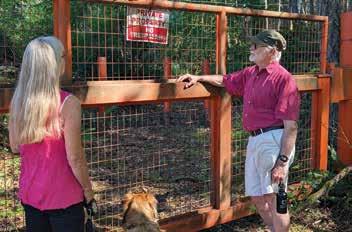
The land in question is the portion of the railway trail at the end of Holden Lake, which several years ago was blocked off with a metal fence by the landowner to prevent access by pedes-
trians. It is approximately 1.6 kilometres in length and would allow the current walking trail – which starts at Morden Mine and traverses most of Hemer Park alongside Holden Lake – to extend to Boat Harbour, the natural final leg of the Morden Colliery Regional Trail (MCRT).
The former rail trail was built over 100 years ago by Pacific Coast Coal Mines Ltd. to carry coal from South Wellington to Boat Harbour. Today, four kilometers of the line are managed by the Regional District of Nanaimo (RDN), from Morden Mine to Hemer Park, and make up the MCRT. When Morden
Mine closed in 1930, the former railway grade became a valued pedestrian pathway.
Concerned area residents are mobilizing under the name “Cedar Rail Trail Preservation Group” to draw attention to the application and the importance of preserving this historic route.
“This trail connects the Cedar area to its history and residents to each other, now and in the future,” said Jane Mowbray, who is a member of the group, along with her husband, Cochrane. “Additionally, in a rural area where roads are narrow and unlit, having a safe, active pedestrian route is of huge importance and a very attractive plus for future residents.”
Members of the group are asking the MOTT to turn down the proposal as it currently exists so that a second, modified proposal could be put forward by the landowner that acknowledges the historical and recreational importance of the entirety of the trail and the historical right-of-way along the old railway grade all the way to Boat Harbour.
Jessica Stanley, the RDN director of Electoral Area A, has submitted a request to the MOTT for just that.
“There is a multitude of evidence to sustain the assertion that the railway corridor is of sufficient heritage value to justify its conservation,” said Stanley. She is requesting that MOTT’s Approving Officer “recognize that the current subdivision proposal would erase the significant historical and culturally value of the former railway lands,” and to utilize the powers granted by the Land Title Act to reject the proposal as it stands.
Stanley welcomes the submission of a new subdivision layout proposal that allocates land along the former railway corridor
Jane and Cochrane Mowbray at fenced portion of Cedar Rail Trail.
Photo: Kerith Waddington
and makes that land “available for acquisition by local and provincial governments for the purposes of preserving the cultural landscape. I have no other opposition to development of these properties provided that public infrastructure (e.g., roads) is deemed appropriate and other development issues (e.g., sufficient water) are satisfied. I would be pleased to work with the proponent to support the realization of what I believe to be mutually beneficial goals.”
Also of importance in this case is historical “right-of-way.”
Stanley acknowledges that “it appears that the right-of-way between Hemer Park and Boat Harbour has not been preserved for unknown reasons. Further, documentation of the extinguishment of the right-of-way was not found in research efforts. Community historians believe the entirety of the PCCM railway was transferred to the provincial government. This was also the belief of Jim Fiddick, descendant of the founding family, as was communicated directly to me (Fiddick, J. personal communication, 2024). In my opinion, finding the legal documentation that clarifies why and when this important cultural landscape became private land is important. We know the railway right-of-way existed. We know that some of that land was available for the RDN to acquire for the purposes of the Morden Colliery Regional Trail. So what happened to the rest of it?”
Members of the community wanting to get involved are invited to write to the Ministry of Transportation and Transit Approving Officer regarding the subdivision application for properties identified as PID 088-991-260, PID 002-564-734 and PID 002-564-530, requesting that the application as it stands now be turned down due to the tremendous historical importance of the railway line to the community.
Additionally, interested residents are invited to join the Cedar Rail Trail Preservation Group’s Facebook page.
Mowbray is hopeful that the landowner builds goodwill in the community and submits another application preserving the historic trail. “The goal is to meet the needs in the community for active pedestrian links. Imagine being able to walk from the Coco Cafe all the way to Boat Harbour through Hemer Park. Active transportation equals healthy communities and healthy Canadians.”
Register for Football
BY EVAN SHUMKA
“We just want kids to have a place where they can all come participate,” said Jacob Legault. “Doesn’t matter the skill level and whatnot – [everyone] gets their fair share.”
Jacob is one of the dedicated volunteers running the Ladysmith Steelers Youth Football Program.
Registration is currently open to both boys and girls. Children born in 2017–2018 are eligible for the Atom team, while those born in 2015–2016 can join Peewee. All equipment is provided.
Jacob wants to see the team grow. He calls football the ultimate team sport, saying it helps kids build confidence. “Working with others, working with themselves, seeing what they can do … building that confidence that you can have physical contact and not get hurt.”
Registration costs $125, but Jacob says if families can’t afford it, his team can find donations for them. “We’re always
willing to work with people regardless of what their financial situation is.”
Jacob and the other volunteers can even provide kids with rides to and from practice if needed. “If [the kid] wants to play football, he’s gonna get there.”
Practice starts in the summer. Games run from September to November.
Chellew retires from Chamber
Seventeen years have gone by quickly, said Jacquie Chellew, at a goodbye cake-cutting on July 10 at the Ladysmith Chamber office. Business and community leaders gathered to wish her well and thank her for her years of service.
“I’m thankful for the opportunity to work with such dedicated people and to help showcase everything that makes Ladysmith so special. I’ll miss sharing my passion for our community and supporting local businesses through my role with the Chamber and Visitor Centre. It’s been rewarding, and I will always be grateful for the people, experiences, and friendships I’ve gained along the way. “
Jacquie said she was looking forward to the boating adventures ahead, and spending time with her family and new granddaughter.
Help Reduce the Curbside Contamination Rates
Although the RDN has long provided recycling education, the region’s contamination rate exceeded acceptable thresholds for an extended period in 2025 and remains above allowable limits. Should contamination rates continue to exceed the maximum threshold, Recycle BC may fine the RDN. Fines could total $120,000 per year, increasing operating costs and future utility fees for all RDN curbside customers.
Contamination in carts is often a result of wish-cycling (the practice of placing materials in the curbside recycling cart, hoping they will be recycled). Disregard for what materials can and cannot be placed in the recycling cart and general misuse of the recycling cart must end immediately to avoid fines.
RDN Receives Provincial Approval for Minor Boundary Redefinition
The Regional District of Nanaimo (RDN) has received approval for a minor boundary redefinition between Electoral Area A (Cedar, South Wellington, Yellowpoint, Cassidy) and Electoral Area C (Extension, Nanaimo Lakes, East Wellington, Pleasant Valley) from the Province of British Columbia. The change affects 16 properties along Plecas and Evans Roads. This minor boundary redefinition will resolve long-standing boundary misalignments and address existing inconsistencies and service-related challenges.
U19 Women’s Western Canadian Softball Championship coming to Ladysmith
From August 6-9, 2026, Ladysmith will host the U19 Women’s Western Canadian Softball Championship, welcoming top teams from across Western Canada along with hundreds of athletes, coaches, officials, families, and spectators.
This multi-day event will bring significant visitor-generating opportunities for local businesses while showcasing everything Ladysmith has to offer.
Experience the Arts
August is all about the arts. Start at the Ladysmith Gallery with “Around Town,” a member exhibition from August 5 to 19, showcasing how local artists interpret the places, landmarks and everyday moments that make our communities unique. From familiar streets to hidden gems, the exhibition offers visitors a fresh perspective on the region through a variety of artistic styles and mediums. The gallery, located at Unit 7-32 High St., is open seven days a week from 10 a.m. to 4 p.m. and will also feature a special guest exhibition, “Half a Century in Watercolour,” by Jennifer Lawson.
On Sunday, August 23, from 10 a.m. to 4 p.m., head to the 28th Annual Arts on the Avenue Festival, where visitors can explore and shop original works by
over 65 juried artisans from Vancouver Island and the Gulf Islands. Enjoy live music, art demonstrations, paint competition, a youth art zone and delicious food. For more details, visit www. artsontheavenue.ca and www.ladysmitharts.ca.
Monet and Van Gogh team up for immersive show
BY JACKIE ELLIOTT
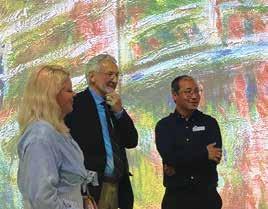
If your experience of art exhibitions and galleries is limited – then the new “Beyond Van Gogh and Beyond Monet” exhibition, now open at Vancouver Island Conference Centre until August 29,
may turn you into an art aficionado. The premise is simple enough. Instead of showing static paintings, the exhibition projects them across screens that surround you. Van Gogh’s starry skies swirl above, and Monet’s water lilies drift across the floor – all set to music. You don’t observe the work so much as stand inside it. It’s breathtakingly wonderful, and an emotional experience, even if you know nothing about Van Gogh or Monet. When a painting is forty feet tall and moving, you don’t need anyone to explain why it’s remarkable. Immersive exhibitions of this scale
Painting at Arts on the Avenue in downtown Ladysmith.
Photo: Lawrence Phillips
Opening of the Beyond Van Gogh and Beyond Monet show. Photo: Angie Haslam
normally land in large city centres. Getting both shows to Nanaimo took a huge act of collaboration: the Vancouver Island Conference Centre, alongside the Port Theatre, the Nanaimo Museum, Tourism Nanaimo and the City of Nanaimo and a host of student volunteers. Together, the exhibition takes up nearly the whole second floor of the centre.
The run is expected to draw around 15,000 visitors and deliver roughly a $3 million boost to the local economy.
It’s a not-to-be missed experience. Take someone who says they don’t like art and watch what happens.
Concerts in the Park
BY EVAN SHUMKA
This summer, Concerts in the Park has consolidated its regular four concerts into two. The first, on July 12, featured Nate Harris, with opening act Sarah Leo and the Young Wolf Dancers. The next is August 16. Its start time is being pushed from 4:30 to 5:30 p.m. Nancy McIntyre, LRCA’s executive director, said the decision is to prevent a gap between performers.
Victoria band Demographix is set to return, playing classic rock hits and today’s popular tunes. Local solo act Nathan Andersson will open for them, performing folk/rock covers as well as his own original music. There will also be familyfriendly activities, including a banner created by the Ladysmith Arts Council for everyone to colour and games to keep the kids entertained.
“Mind you,” said Nancy about July’s show, “a lot of [the kids] were kind of up front, dancing and running around while the music was playing, which was really amazing.”
Be sure to bring cash for donations for the LRCA. Additionally, a dollar from every item bought at the food trucks supports the LRCA’s community programs.
Musicians in the Age of Streaming
BY EVAN SHUMKA
“My name is James Vickers. I am 16, turning 17 in August. I play music. I write music. I love music. My main instrument is guitar and vocals.”
“My name is Ryan McMahon from Ladysmith, British Columbia. I am a robust 46 years old. I’ve been in the industry for 26 years, and I think I’m gonna keep doing it until I’m in an urn.”
“My name is David Gogo, and I’m a blues guitar player, singer-songwriter. I’ve been doing this for many, many decades now.”
I had the opportunity to speak with three local musicians about making a living in this age of streaming services and what it means to live a successful life.
“It’s been a very difficult transition,” said David Gogo, the six-time Juno nominee who’s performed with B. B. King and had a song covered by Buddy Guy. “In the old days, you’d make a record, and if you were lucky enough, you sold a bunch of records … and that’s becoming more and more difficult to do, because physical sales just aren’t there. And, unfortunately, the streamers just don’t pay very much at all. So you have to adapt, which is difficult.”
According to Spotify’s website, they pay artists based on a percentage of streams in a given country. So, if your music makes up one per cent of annual streams in Canada, you earn one per cent of the royalties paid in Canada (not including the company’s share). Artists with fewer than 1,000 streams get nothing, as the payout would not be greater than the associated bank charges.
James Vickers, whose formidable voice and skill have brought him as far as Memphis for the International Blues Challenge, told me that the accessibility of music through streaming is a perk, but pointed out how the ease of access comes with stiff competition.
“There’s always gonna be like a million other people doing the exact same thing as you,” he said. “So if you’re an independent artist, there’s gonna be struggles with trying to make a name by yourself. And that’s not to say you shouldn’t try. Because if you’re an independent artist, that’s amazing.”
He recalled receiving some money from streaming one time. “I got, like, a hundred bucks or something,” he said. “But, I mean, I’ll take it! … I didn’t expect it.”
Ryan McMahon, Ladysmith’s own folk/rock songsmith, who has supported national tours of Tom Cochrane and Burton Cummings and appeared on Chesapeake Shores (where our paths first crossed while I was working as an extra), said that streaming has been going on so long now – over 20 years since Napster – that he doesn’t give it much thought.
“I only try to control the things that I can control, which is how good or bad the show is and how often I kind of do things and release things. And the rest of it, just like anything else in this world, is changing so fast. … If free music gets people to the show – if it’s a sort of electronic business card – then so be it.”
According to Ryan, touring makes up 80 per cent of his annual income. But, as he remarked, he’s not 25 anymore.
“I used to go 35 days. And then a couple months later, you do another 35 days, almost like oil-man hours. Just a different tool belt, right?” Nowadays, he’s found more of a balance with it. “I try to kinda do shorter runs, so I’m a more present dad, and also so I don’t go nuts.” He tours off-island 60 to 70 days out of the year and does a lot locally.
But even touring can be more difficult in this changing landscape.
“Traditionally,” said David Gogo, “if you could sell enough merchandise – being CDs, vinyl, or T-shirts – that usually covers your expenses, just to keep the show on the road, you know? Paying for fuel to put into the van, paying for hotel rooms – all that kind of stuff. And as that diminishes, it makes it more and more difficult to tour, and touring’s the only way we can make a living. So it’s a real kind of a catch-22 in a lot of ways.”
He’s seen a resurgence of interest in CDs, but noted new vehicles no longer have CD players.
“In the old days, I could chuck, say, a hundred CDs in my guitar case when I go on the road and fly out to Ontario –and you could sell those. Well, you can’t do that now because people aren’t buying them as much. But also, the thing that is selling is vinyl. But vinyl’s such a … pain because of the size, the weight, the fragility of the product.”
He’s noticed that, these days, people buy physical media more as mementos, so he tries to make himself available to audience members during breaks or after his performances to say thank you, sign CDs and pose for pictures.
“I always say a smile and a Sharpie is your best salesman.”
Both David and Ryan have been finding opportunity in smaller, local venues.
“House concerts saved my house, you know, about a decade ago,” said Ryan. “I started adding those to my tour schedule during the year, and then, all of a sudden, I’m sleeping in my own bed. Maybe I’m gonna go and rip up to Comox and play a show, and then I’ll come back to Ladysmith, and I’m back home [the] same night. It’s really great.”
David Gogo did a solo show in Cobble Hill recently.
“They were an older demographic,” he said. “But that’s, you know, my demographic, I suppose. … They’ve got a little community centre hall there, and they just put it on themselves. … Hell, I’d rather do that, definitely: playing for 150 people that are really into it … rath-
er than playing some shitty venue where no one’s listening and no one wants to pay five dollars to get in the door.”
Although 150 listeners won’t get you any cheddar from Spotify, performing a live show with a paying audience? Not too shabby.
As someone hoping to make a living in the arts myself, I’m inspired by these local musicians, and I want to get their perspectives on what it is we’re after. The fear of failure looms large, but what does success even mean?
“I think for my twenties and thirties,” said Ryan, “I was a careerist, and I would’ve done anything to advance my career. I would’ve done anything to play the big festival, meet a hero or just advance. If it meant that I was sacrificing even family and friends, sometimes … I would choose always career, always career, always ambition. Really, really hungry guy.”
He tells me there comes a time when you start saying no to things that don’t line up with your values. “Some days are mine,” he said. “They’re not for the public.”
Success, for him, means coming back to the relationships he once sacrificed.
“I’m re-establishing really solid bonds with even my parents, making time to … listen to my mom tell me what salad my dad had at Mr. Mikes last Thursday. Whatever they want. And I just want to be present, and I want to be a better dad. And whatever my daughter needs, I want to be able to support that. If I was only career all of the time, the ship tips over onto itself, right? And it doesn’t work. And it took me forever to figure that out.”
He told me he doesn’t even have as much money as he did ten years ago, but he’s happy. He’s drawing on all the good things in his orbit: hikes in the woods with his buddy or going for a drive with his kid. And yes, sometimes playing a festival for a thousand people.
“I’m not just my job,” he said. “For me, I’ve found happiness in that.”
Meanwhile, James Vickers is at the beginning of his journey, following the path as far as it will lead. The James Vickers Band assembled three years ago, unplanned.
“It’s funny,” he said. “Nobody was ever really like, ‘We’re a band now.’ … I met all of the members through the Blues Jam at the Queen’s, here in Nanaimo.”
One show led to another. Before long,
Ryan McMahon. Photo: Ashley Marston
they’d released an EP and their first album. James continues to write songs as much as he can.
“I want to keep going with the music and take it as far as I can, and play to as many people as I can, and have the biggest audience that I possibly can,” he said. “When people leave my shows, I want them to walk out feeling good. … I just want to have a lasting, positive impact and be a positive force.”
David Gogo has been in the business the longest. His Juno nominations would number seven, were it not for one disqualification due to a technicality. He signs off his emails: “2025 Juno Loser, King of Boogie.”
“Well, you know,” he said, “especially in the Canadian music business, if you can’t laugh, you’ll cry yourself to death.”
For him, it’s all about making enough to fund the next project. In an age where his friends in the industry are questioning whether it’s even worth it to record new albums, David is still doing it. He shares something his friend Tom Wilson, of Blackie and the Rodeo Kings, told him.
“He looked at me one day, and he said, ‘Gogo. You’re like me. … We have to do this. We’re lifers.’ And it’s true. … You can’t start it like a car. You can’t stop it with a pistol. We are musicians, and we have to do this. We have to create.”
Carson Maertz with James Vickers. Photo: Tim Maertz
David Gogo, King of Boogie. Photo submitted.
Eagles fuel feast at Ladysmith Farmers Market
BY PAUL LEGACY
As we wander the streets of Ladysmith, there are so many places to eat with a very wide range of restaurants, cafés, delis, bakeries and eateries. We also have a wide range of ethnic flavours to meet most of our needs.
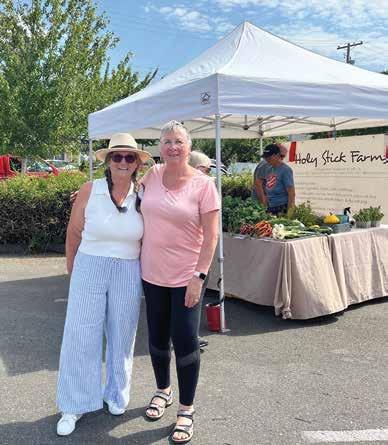
I recently visited the Ladysmith Farmers’ Market at the Eagles Hall, which offers a wide range of vendors. You can find fresh vegetables from Valley Roots Farm and Holy Stick Farms, breads and sweets by Sweet Treats by Tracy, awardwinning peanut brittle by Salt Spring Snack Shack, fresh coffee by Axe to Grind Coffee Company, pierogis by
Mamma Musey, microgreens and produce by Mike Grow Greens, farm-crafted apple cider vinegar by North Haven Orchard and Cidery, smoked gourmet seafood by Flurer Smokery, smoked olives by Appy Hour and Mediterranean desserts by Rawans Riches. There’s also the Eagles’ hotdog booth, Yaya’s Thai food truck and Ohana Ice’s shaved ice treats.
I met up with Eva Vincent, the market manager, who is an active Eagles member. She was asked by the Eagles to run the market due to her extensive farmers’ market background. Moving here some 25 years ago, Eva feels the market brings the community together. The vendors are all very knowledgeable about their products, and it shows in their words and the passion for their products. These hard-working people are often seen helping each other during setup and welcome new vendors.
As a vendor, it takes days of preparation – baking, making new products, picking up supplies, cleaning your food truck and so much more. It’s a passion that fuels the fire, not only to provide income for their families but also to boost Ladysmith’s local economy and attract outside visitors.
As a chef and baker, I found the qual-
ity of the garden vegetables amazing –vibrant colours and bursting with freshness. As I wandered through the market, the aroma of fresh breads and sweets, accompanied by Tom Crowder’s music, filled the air, bringing it all together. For me, two food vendors stood out.
The Salt Spring Snack Shack’s peanut brittle was outstanding. They won the top award in Texas for their peanut brittle. Also fabulous was Ohana Ice Shave Ice Trailer, owned by Lexie and Greg Puttich, serving Hawaiian shaved ice and signature fizz sodas. On a warm day, there’s nothing better than something cold and refreshing – though, let’s be honest, it would be delicious any day.
I ordered the “Hard Mango and Coconut Ice Ice Baby.” Served in a very large cup, it features a scoop of ice cream at the bottom, topped with shaved ice. Besides mango and coconut, there are many other flavours to choose from. OMG — this treat was incredibly refreshing, and the taste second to none.
The market operates every Tuesday from 3 p.m. to 7 p.m., until the end of September. You can reach out to Eva through the Ladysmith Farmers Market’s Facebook page.
You can follow Paul Legacy’s food blog: A Legacy in Thyme at https://www.facebook.com/share/1AvhVXYW3a/?mibextid= wwXIfr Eva Vincent with Susan Kulrsheski at Ladysmith Farmers Market. Photo: Paul Legacy
Summer on Vancouver Island is one of life’s great pleasures: longer days, warm breezes, and the simple joy of stepping outside and breathing it all in.
One of the season’s rituals is dining al fresco, where a meal becomes an experience. Fortunately, our area is brimming with wonderful options for enjoying a meal beneath the open sky. So here are just a few of our favourite places to enjoy this summer.
See ads below.
Changes To Pleasure Craft Licencing
SUBMITTED BY RCMSAR STATION 29 LADYSMITH
Your Royal Canadian Marine Search and Rescue Station here in Ladysmith does free pleasure craft safety checks to help you keep your vessel compliant with Transport Canada regulations. We want to advise you of licencing regulation changes that are in place or coming.
What is a Pleasure Craft Licence (PCL)?
It is a unique number assigned to a pleasure craft that remains with the boat for its lifetime. When the boat is sold, the new owner MUST transfer the existing licence document into their name within 90 days. Changes to the licence holder information – name or address change, phone number, email address or pleasure craft details – must be updated in the Pleasure Craft Electronic Licencing system within 30 days of the name or address change. The PCL document MUST be kept on board.
You will require a PCL if your boat is used for pleasure or recreation use, principally operated and maintained in Canadian Waters, powered by one or more motors adding up to 7.5 kW (10HP), even if temporarily, and not registered in the Canadian Register of Vessels (see the website links below).
On the vessel, the licence number must be written in block letters at least 7.5 centimetres (3 in) high, in a colour that contrasts with the bow, on both sides of the bow and as far forward as practical, where it can be easily seen.
Transport Canada is changing the requirement and validity period for PCLs. This change impacts those vessels previously having a licence with no expiry date, which now will have an expiry date that must be renewed within 90 days after expiration. All new or transferred PCLs will now be valid for five years. You must update your licence information within 30 days (no fee to up -
date). You can renew your licence three months before expiry date.
The cost is $24.41 to complete a new, renewed, transferred or duplicated PCL.
Expiry dates for licences without an expiry date will now have an expiry date as shown below
Licence Issue Date Licence Expiry Dec. 31, 1974 or earlier, March 31, 2026
Jan. 1, 1975 to Dec. 31, 1985, Dec. 31, 2026
Jan. 1, 1986 to Dec. 31, 1995, Dec.31, 2027
Jan. 1, 1996 to Dec. 31, 1999, Dec. 31, 2028
Jan. 1, 2000 to Dec. 31, 2005, Dec. 31, 2029
Jan. 1, 2006 to April 28, 2010, Dec. 31, 2030
**Starting December 31, 2027, wind powered pleasure craft over six metres long will also need a PCL.
A PCL allows Search and Rescue per-
sonnel and other agencies to access information about the boat and owner in order to help you in an emergency. It also provides for identification of the vessel if lost or stolen. In addition, the licence number Identifies owners that abandon their boats in order to hold them responsible for cleanup and damages, which means cleaner and safer waters
Apply for or manage a PCL (information): https://tc.canada.ca/en/marine-transportation/vessel-licensingregistration/licensing-pleasure-craft/ apply-manage-pleasure-craft-licencepcl/apply-manage-pleasure-craft-licence-pcl
Note: We offer free Pleasure Craft Safety Checks; contact us at PCSCStn29@gmail.com.
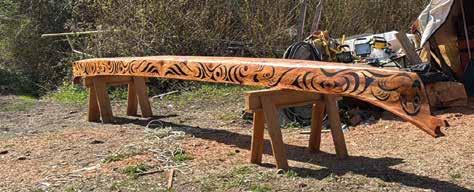
Beau Wagner’s new dugout canoe in Kulleet Bay, adorned with an otter design. The canoe has gone to its new home at the recently opened Lifeways Art Gallery, where Beau will be running workshops this summer. He is also completing a residency at Brentwood College and carving another canoe for the new Quw’utsun Valley Hospital/Quw’utsun Hulitunew’t-hw. Photo: Beau Wagner
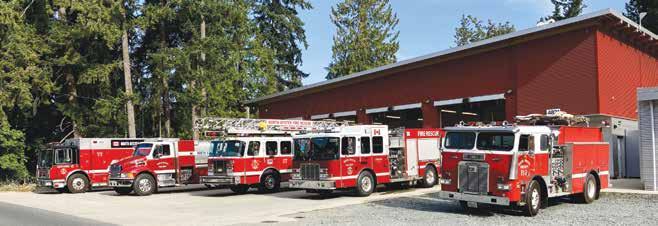
RCMSAR Station 29 Ladysmith rescue craft. Photo: Bob Burgess
The Good House of Design
BY FRANCESCA PACCHIANO
The heart behind Ay Lelum is family. Founded by sisters, Aunalee Boyd-Good and Sophia Good, the clothing is printed with their late brother’s traditional Coast Salish art. Located on the bank of the Nanaimo River, Ay Lelum – The Good House of Design reflects the natural landscape and beauty of their Coast Salish heritage.
Aunalee and her siblings grew up in their parent’s art studio surrounded by the intercultural mix of their father’s storytelling, carving and music, and their mother’s oil painting and clothing designs. The pursuit of art was a family tradition more than an inspiration.
“My parents were mentors for everything we did. … This is a way of life for us,” said Aunalee.
The intercultural co-mingling of mediums from their parents led directly into the way pieces are designed at Ay Lelum. “Traditional Coast Salish art is a visual written language,” she said. “Every piece of art that we have has a mean-
A family forged in traditions creates wearable art
ing, has a story.”
Each item of clothing that carries this art is telling that story to the world. “Sometimes we start with a song and then that informs what the garments will tell in a story. But then sometimes it’s a story of my dad’s or a piece of artwork and then the song comes after. It’s all created hand-in-hand,” said Aunalee. Colours are also significant for telling stories. The artwork printed on the clothing at Ay Lelum comes from the collection of the late W. Joel Good, ts’usqinuxun. Joel was a master carver, and his work can be seen across Nanaimo, from the Totem Pole House Posts at Departure Bay to the manhole replacement project implemented by the city of Nanaimo. In his carving and paintings, Joel used traditional Coast Salish colour schemes, such as blue, red, black and white.
When traditional, non-ceremonial art is turned into clothing, there’s opportunity for a variety of vibrant colours to be incorporated into the designs. “When we make our wearable and shareable art, we have the flexibility of using different colors,” said Aunalee.
Their goal for making traditional but non-ceremonial clothing is that it’s not limited to only Indigenous people. “We want everybody to wear our clothing. It’s not restricted to any person.” That diversity also extends to their sizing and their models. The sizing of their garments ranges from XS to 5XL, and their runway models reflect both that size range and a variety of ethnicities and genders.
“People should just be comfortable in their own skin. I really [believe] it’s important to bring diverse models to the stage so that people can see that we believe in that … and that we create a safe space,” she said.
Ay Lelum is based on the Island and primarily made locally, but Aunalee wants to push against the limit of being only made in Canada. “We are also looking at diversifying. I did a collaboration with a silk weaver in Cambodia, and I’m trying to look at different ways of working with other textile artists … and, at the same time, maintain that a lot of things are made here too.”
There are challenges to being on the Island. “The logistical challenges of not being near a fashion district” is
Ay Lelum The Good House of Design Inc. on the runway. Photo: Derek Larmour
hopes to inspire other women to take a leap of faith and trust their own ideas. “Women have a lot of intuition and instincts and nurturing skills that are very valuable in business. And I’m not wanting to take away from men, because they deserve their space too. But I think that women should learn to listen to themselves and follow their instincts and to go for it.”
As Ay Lelum continues to grow over the next decade, they have a hard path ahead. The Good family is still mourning the recent passing of their father, the late Dr. William Good, ts’usqinuxun, and brother W. Joel Good, before him. As the family learns to walk with their grief, Aunalee is hopeful for the future. “I’m looking forward to how we recalibrate from our recent losses … how all the kids are going to play into their various roles within the family of artists.”
the most consistent challenge that the company has faced in its first ten years of business. “If I’m in the middle of a production run and we run out of something, I can’t just run out and get it and drive it over there. It takes multiple people and shipping.”
After 10 years of business, Aunalee
It’s a job that Aunalee is dedicated to completing. Carrying the memory of those they lost, giving the next generation access to their art and making space for their own creativity is “how legacy is carried on and preserved.”
The Ay Lelum storefront offers clothing and jewellery. Their music, which inspires and is inspired by their designs, is available on all major music platforms.
Founders Aunalee Boyd-Good and Sophia Good. Photo: Derek Larmour
RDN Area A
Water is, and will increasingly be, one of the most important issues we face in the RDN and across Vancouver Island. This summer, the BC Government reported elevated drought conditions across much of the province and asked people to reduce water use to help protect local watersheds and reduce the risk of water becoming scarce.
Water is a declining resource and should be foundational to land-use decisions made by local governments. Over 40 per cent of RDN residents rely on groundwater for their water supply, including the North Cedar Improvement District and private well users. The vast majority of Area A is reliant on groundwater.
The RDN Drinking Water and Water Protection (DWWP) program monitors groundwater levels in 13 surficial (sand and gravel) aquifers and nine bedrock aquifers across the region to understand water levels and changes in water availability over time. Data from a network of 30 volunteer observation wells in the RDN supplements the information provided by 32 provincial observation wells. Data between 2013 to 2026 is used to understand seasonal trends and historical patterns observed in the aquifers within our region. The RDN funds this work through a $16 parcel tax, and I would argue that it is money well spent.
This year we’ve had a drier-than-average winter, with little snowpack, and
a hotter-than-average spring in the context of a multi-year drought. Weather conditions and water use impact water levels. Of the 22 aquifers in the RDN, one is much above normal range, five are within normal range, five are below the normal range, while 11 are reporting much below normal levels. (“Much below normal” indicates levels between the zero to 10th percentile; “below normal” is the 10th to 25th percentile, “normal” is 25th to 75th percentile, “above normal” is 75th to 90th percentile, and “much above normal” is 90th to 100th percentile.)
For Area A, the groundwater data for five aquifers reported below describes groundwater levels in comparison to previous years data and the longer-term historical trend.
Aquifer 160 – Lower Cassidy – surficial is seasonally much below normal with stable or decreasing historic trend, with two monitoring wells reporting: one stable, one moderate decline.
Aquifer 161 – Upper Cassidy– surficial is seasonally within normal range with a stable or decreasing trend, with two monitoring wells reporting: one stable, one moderate decline.
Aquifer 162 – Cedar Yellow Point –bedrock is seasonally below normal with a variable historic tread, with eight monitoring wells reporting: four increasing, two stable, one moderate decline, one large decline. Aquifer 162 had considerable variation among the
observation wells, which is common with a bedrock aquifer. The observation wells in the middle of the aquifer area (#6, #19 and #21) had the lowest water availability.
Aquifer 163 – Cedar – surficial is seasonally much below normal with stable historic trend.
Aquifer 165 – South Wellington – bedrock is seasonally within normal range with increasing historic trend.
The main conclusion from this data is the increasing importance of water conservation for all areas, but especially for those in areas of declining water levels or where water is below average seasonal levels (which is the majority of the RDN). Effective water conservation measures include efficient irrigation, rainwater harvesting, soil improvements, efficient appliances and eliminating leaks. Those who receive their water from a water system get reminders to conserve from their water purveyor. Those of us on wells will also benefit from conservation efforts.
The RDN website has information about water conservation tips for indoor and outdoor water usage under “water smart.” Did you know that toilets are the most likely largest source of water usage in your home and that you can reduce 65 per cent of flushed away water by using a low-flow toilet?
Although it is important for all of us to conserve water and practise water ef-
ficiency year-round, it is also important to have water-centred policy discussions about development and land use in the RDN and Vancouver Island as a whole. The RDN has taken important steps to create land use policies that protect water ways and riparian areas when in the building process.
While these policies may be limiting for builders, taking steps to tread more carefully on the land will help to retain moisture in the ground. However, water conversations need to go a step further into considering water availability in development decisions, ways to encourage groundwater recharge across the region and proactive drought planning in the context of changing weather patterns.
Surely, this will be an ongoing conversation, and your thoughts and opinions on this (and all topics) are welcome. You can reach me at jessica.stanley@rdn.bc.ca or 250-268-7359.
Separately, I wanted to share that I am running for re-election this fall. I look forward to the opportunity that the election provides to review community priorities and to hear feedback on the work I did for our community. There is always something new to learn. I hope you all enjoy the rest of your summer.
jessicastanley@rdn.bc.ca. Phone: 250-268-7359.
CVRD Area H
Before sharing this month’s article, I want to announce that I will be seeking re-election this October. If the community chooses, I would be honoured to continue serving as your Area H Director.
When the Snow is off the Mountain
An elderly farmer once gave me some advice that has stayed with me for many years. She said, “You don’t plant your garden until the snow is off the mountain.”
It was a simple observation, but it carried a lot of wisdom. She wasn’t talking about dates on a calendar. She was talking about paying attention, understanding the conditions around you and knowing that some things cannot be rushed.
She had another saying too: “You only plant something that produces something.” That was her practical farming side. There was no point putting time and effort into something without thinking about what it would produce.
But the lesson I remember most from her had little to do with farming. It was about community. When my wife and I first came to the area, she invited us into her home. We thought we were simply coming for a visit. What we did not realize was that she had also invited many of our neighbours. It was her way of welcoming us into the community. Of course, being a practical farmer, she was also quietly assessing us. “Hmmm,” she thought, “he’s a paramedic. Good. We could use one of those.” Then she looked at my wife. “Hmmm. She’s a teacher. We already have two of those.” Then, noticing that my wife was wearing jeans, she made her final assessment: “That’s a good sign.” That was her way – warm, welcoming, practical and always paying attention.
I have thought about that story often as we work through the decisions facing Area H today. Communities are built by neighbours who open their doors, volunteers who give their time, families who put down roots and people who decide this is where they want to belong. But communities also change. The questions we are dealing with today are not the same questions we faced 20 or 40 years ago. Housing, families, ag-
riculture, climate and the expectations placed on rural communities have all changed. Many residents are facing very real challenges. Young families are trying to find ways to stay in the communities where they grew up. Seniors are looking for options that allow them to remain on their properties. Farmers and rural businesses face their own pressures.
These are not abstract discussions. They affect real people. That brings us back to the lesson from the mountain. Before planting, the farmer looked at the conditions: Was the ground ready? Was the timing right? Would the effort produce something worthwhile? These discussions require that same approach. When we talk about housing, there are important questions to consider: How do we create opportunities for people to live here while also considering water, septic, fire protection, emergency access and neighbouring properties? When we talk about growth, how do we make sure new development fits with the character and services of a rural community?
These are not easy questions, and reasonable people can come to different conclusions. Recent discussions about the Official Community Plan and Comprehensive Zoning Bylaw have shown that many residents want to be involved. That is a positive thing. Local knowledge matters. The work already done also matters. Many residents invested time in previous planning discussions. The question now is what we have learned and what direction the community wants to take next.
The pause in the Comprehensive Zoning Bylaw process gives us time to ask important questions: What is working? What have we learned? Are we creating the outcomes we want? A pause does not mean ignoring the challenges people are facing today. It means taking the time to make sure that the solutions we choose actually address the problem and do not create new ones. Also, local government cannot solve all the problems on its own. Understanding what local government can and cannot do helps us focus on what can be changed, where those changes need to happen and how we move forward together.
In September, the Electoral Area Services Committee is expected to receive information about what a repeal and replacement process for the Official Community Plan could involve. The broader conversation about future changes and how those discussions should happen will require direction from the Board in place when that process formally moves forward. Those conversations need clear questions, good information and meaningful opportunities for people to share their experiences and perspectives. Area H is fortunate to have people who know this place well. Their local knowledge is one of our
greatest strengths. The decisions ahead will shape our community for many years. The challenge is not whether we grow, but how we grow in a way that reflects what we value.
The snow will eventually leave the mountain. Before we plant, we need to listen to those who know the ground and, when we do plant, make sure it’s something that produces what the community wants.
Those lessons came from my friend and neighbour Irene Trudell, and they have stayed with me ever since.
ben.maartman@cvrd.bc.ca 250-510-5930
CVRD Area G
Rebuilding Trust at CVRD Starts With Accountability
I’m going to say publicly what I’ve been saying privately for months. One of the greatest challenges of serving in local government is holding two truths at the same time.
In Area G, we have much to celebrate. Over the past few years, our community has benefited from significant investments in water infrastructure, including upgrades at the Stocking Lake Dam, the water filtration interconnect, the Saltair Centennial Revitalization, the Thetis Island Community Dock and other major initiatives. Those accomplishments happened because dedicated staff worked hard to deliver them, and they deserve sincere recognition.
But two things can be true at once.
We can celebrate those successes while also acknowledging that recent land-use planning processes have seriously damaged public confidence in the CVRD.
I don’t make that criticism lightly. I make it reluctantly because rebuilding trust begins with acknowledging where trust has been lost.
Every organization makes mistakes. What troubles me is the absence of meaningful public reflection afterward.
Whether it was the Comprehensive Zoning Bylaw, the Modernized Official Community Plan or growing frustration with development application timelines, many residents came away feeling their voices were not heard, their concerns were not respected and their time was not valued. The Comprehensive Zoning Bylaw was halted, and the Board has since directed staff to begin repealing the Modernized Official Community Plan. Regardless of where one stood on those issues, both processes fell well short of earning broad public confidence.
That is why I found the recent Land Services Strategic Plan Update disappointing. It reads as though none of those events ever happened. There is little acknowledgment of the loss of public confidence, little reflection on what went wrong and little indication of how the organization intends to rebuild trust.
Where is the institutional accountability? What lessons have been learned, and how will they shape future decisions?
These are not political questions. They are leadership questions.
Residents are not asking for perfection. They are asking for a system that works.
They want timely decisions, clear communication, predictable processes and confidence that their applications will not become stalled in an opaque and frustrating system.
Every month, I hear the same message from residents, builders and business owners: nothing seems to move forward. Some have become so discouraged that they’ve simply given
up. Whether that perception perfectly reflects reality is almost beside the point. In public service, perception matters because public confidence matters.
Administrative delays postpone housing, delay business investment, increase costs and create unnecessary stress for families trying to move forward.
Earlier this year, the Board directed staff to prioritize clearing in-stream development applications. That was exactly the kind of practical action residents wanted to see. Now it is time to ask equally practical questions.
How many applications have been completed? How much have processing times improved? Have backlogs been reduced? If we are going to celebrate success, we also need to measure it. Residents deserve clear answers, not vague assurances that work is “ongoing.”
One of the most valuable lessons I’ve learned in business and public service is that accountability is never a sign of weakness. It is one of the clearest demonstrations of leadership.
When an organization stumbles, the response should not be to pretend nothing happened. It should be to acknowledge the problem, understand its causes, explain what has changed and demonstrate how the organization will do better next time.
That is how trust is rebuilt.
Reports to the Board should not only describe ongoing initiatives but also examine the lessons learned from major planning processes that failed to earn broad public confidence. That reflection is essential if we hope to restore trust and avoid repeating the same mistakes.
Accountability also requires measurable standards. Resi-
dents should know how long applications take, whether service targets are being met and what improvements are being made. Government should measure its own performance with the same commitment to continuous improvement it expects from everyone else.
I take no joy in writing this. I respect the people who work at the CVRD, and I know many staff members care deeply about our communities. My concerns are not personal, nor are they directed at front-line employees.
It disheartens me that I have to say these things publicly. I have raised these concerns quietly, respectfully and repeatedly for many months because meaningful change is almost always best achieved through cooperation.
But when quiet diplomacy fails to produce meaningful change for the people I represent, public accountability becomes one of the few tools an elected official has left.
Our residents expect us to ask difficult questions, insist on better performance and respond to setbacks with humility rather than defensiveness.
The good news is that trust can be rebuilt. It starts with honest reflection, transparent reporting, measurable performance standards and a culture that views every setback as an opportunity to improve.
Now it is time to acknowledge where we fell short, learn from those mistakes and move forward. Accountability is not about assigning blame. It is about building a better organization. Our communities deserve a land use system that is efficient, responsive, predictable and accountable. Our residents deserve nothing less. AreaG@JesseMcClinton.com 250-252-6525
Wildwood’s Mortgage
BY KATHY CODE, CHAIR, ECOFORESTRY INSTITUTE SOCIETY
It was November 2016, and tensions were high in BC Supreme Court. At stake was the future of Wildwood Ecoforest. The Ecoforestry Institute Society (EIS) had been asked to submit our best purchase price bid and materials to show we were the right choice as future stewards of this iconic forest. The Justice had just reviewed the two sealed bids and was now ready to announce her decision. Our bid consisted of $800,000 in cash, a Land Trust Deed that guaranteed Wildwood would be held forever in the public domain, and a detailed eco -
forestry management plan approved by none other than esteemed ecologist Herb Hammond himself. Would it be enough?
Still, it was quite the shock to hear EIS announced as the winner. It had taken us years to get to this point, but the strong support from the community never wavered. The $800,000 (only $30,000 more than the other party) came from a variety of personal donations, creditor debt forgiveness and a $450,000 mortgage from Vancity. Without this support, Wildwood would not exist as it does today, and we thank everyone who supported Wildwood during this time.
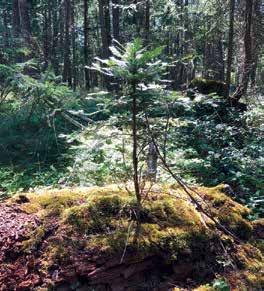
Since then, thanks to a variety of revenue streams, including the Homestead bookings, EIS has never had a problem paying the mortgage. But after 10 years, we’ve paid down only $114,000, leaving a balance of $336,000. The time has come to spend those funds on expanded education programs for kids and adults and building projects that can teach ecoforestry to the next generations. There are no grants or foundations available to pay down debt, so the only alternative is a dedicated campaign to pay down the mortgage.
Therefore, from September 1 to 30, EIS is holding a Burn the Wildwood Mortgage Campaign! All donations will be gratefully accepted, and every penny will be applied to the mortgage.
We know a lot of people are having difficulty paying their mortgages and rents. Believe me, we get that, and we don’t want to make life harder for anyone. But there are folks out there who have told us they would love to give to this campaign. Considering the diminishing existence of old-growth forests, let’s make the best of what we have.
Nurse log at Wildwood. Photo: Kathy Code.
A MuchNeeded Win
BY EVAN SHUMKA
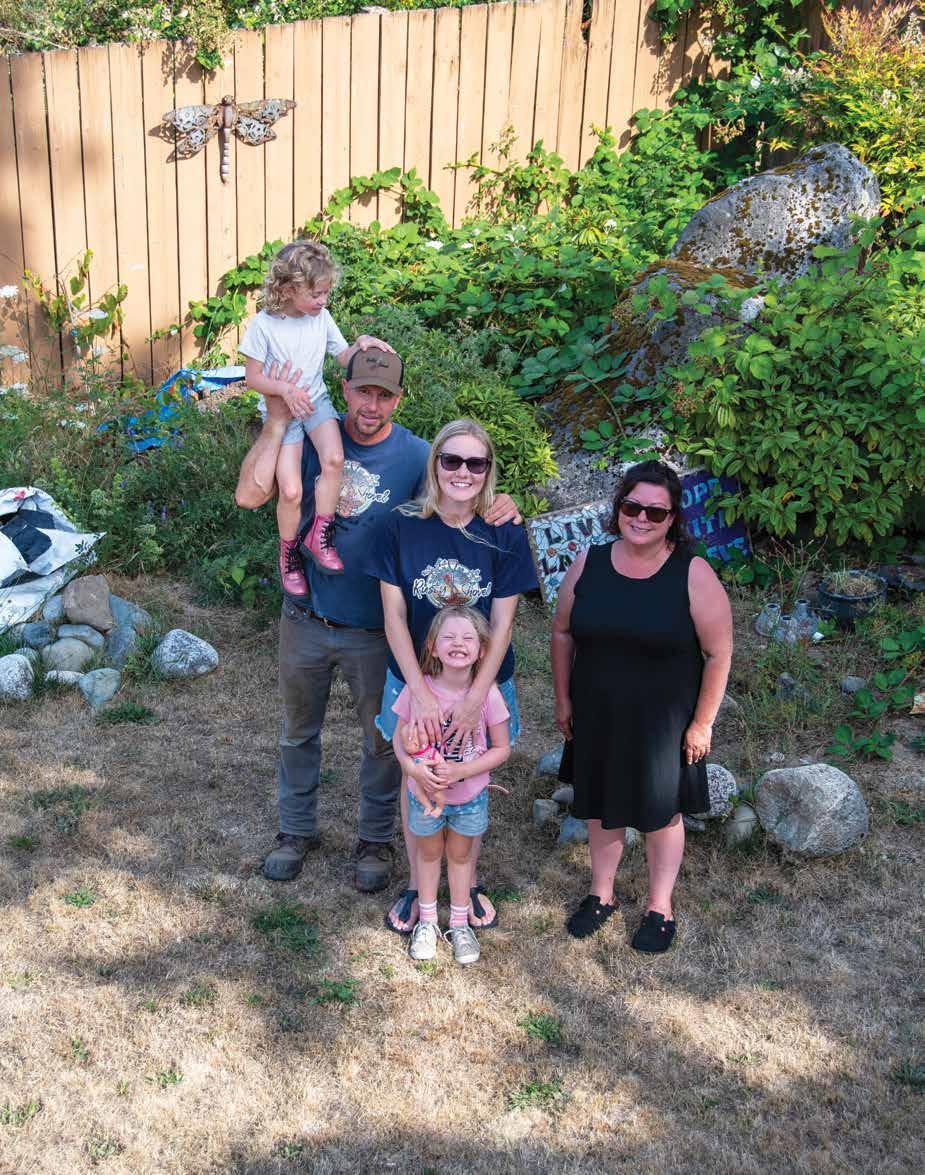
“My feet haven’t really hit the ground,” said Aimee Morry, winner of the Rusty Shovel’s Yard Makeover Contest.
Aimee has spent years as a caregiver, advocate and social worker. She lives in Cedar with her son, Dallen, and daughter Mia. Mia has Down’s syndrome, and Dallen has multiple developmental disabilities, which require him to have roundthe-clock care.
“Sometimes the question is, do people see me?” said Aimee. “And it’s an amazing feeling just to be seen.”
The last two years have been incredibly difficult for Aimee and her family. Her partner, Mike, died last year of the rarest form of leukemia. Aimee had to temporarily relocate to Vancouver during his treatment, while still paying her mortgage back home and having a caregiver come in for her children. She spent all of her savings.
Now, her yard will be getting a $10,000 makeover, courtesy of Rusty Shovel. She was nominated for the contest by her hairdresser, Paddy MacNeill, who owns Cedar Holistic Salon and Barbershop. “I was just blown away that she would think of our family,” said Aimee. “That she would take the time to do something like that for us.”
Aimee has always been a giver. When she was five, somebody gave her a $2 bill. She looked at her brother and felt bad that he didn’t have one, so she ripped it in two and gave him the other half. “I learned that it wasn’t good that way,” she said, “so we had to tape it back together and buy something to share instead.”
Her story is exactly the kind that Matt Tufts, Rusty Shovel owner, was hoping to find. “[I] felt like she was very deserving,” he said. “If we can kind of brighten her world for a little
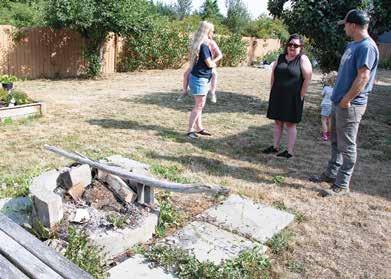
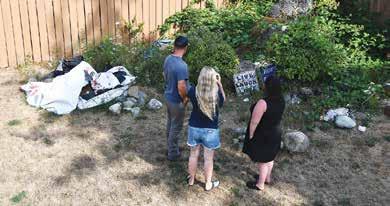
Left: Aimee Morry (in centre) surveying her yard with Rusty Shovel Landscaping’s Krystal and Matt Tufts. Firepit is in foreground. Above: Healing Garden with overgrown brambles.
Photos: Marina Sacht
bit, that’s our goal.”
Matt received around 40 or 50 nominations. He narrowed that down to three and visited the nominees in their yards before making a final decision.
Rock features peek out of the greenery in one corner of Aimee’s yard. She calls it her healing garden. Since Mike died, it’s been overgrown with prickle bushes.
“Our goal is definitely to enlarge that area,” said Matt. “Do some more planting; give it a good rock wall.” He’s also thinking of putting in a swing for Mia and possibly a pad where Dallen, who’s a sports guy, can practise.
Aimee looks forward to having a peaceful place to just breathe – a place where she and her children and grandchildren can gather, laugh and make new memories after so much stress and grief.
“To be chosen for this feels like something good has finally found us,” she said. “This is so much more than a yard makeover.” Watch for updates in the fall.
Water – A Precious Resource
BY CAROLYN HERRIOT
Climate change means less rain for us, and less rain means water shortages on our island, a popular destination for retirees who love to garden! You may think commercial and industrial demands put the most strain on the water supply, but it’s actually Canadian households that use 60 per cent of all the water (second per capita use only to Americans).
British Columbia residents use on average 440 litres (96 gal) of water per day, but at least half of this is wasted in some part due to leaking faucets, high flush toilets and excessive outdoor water use – especially in summer, when
we move outdoors and the use of water more than doubles. Imagine nine billion bathtubs full of water – because that’s the amount of water wasted each year in Canada!
Stage 3 watering restrictions are now upon us, which can be a death knell to a lush garden which depends on lots of water. It’s time to employ the principles of xeriscaping and follow the three fundamental rules of watering: water early in the day, water deeply, and apply water directly to the soil rather than over the leaves. Watering early in the morning – before 9 a.m. – means less water is lost to midday evaporation, and plants get time to hydrate before the afternoon heat.
The bane of my existence is hoses that kink! I now fork out for higher-quality unkinkable hoses. Hand-watering puts you in touch with your plants. While watering, you can make observations and take mental notes. Which plants need more light? Which need a good soak? Which need feeding? Which need moving? Observation is the key to a healthy garden by avoiding plant stress. The best $2,000 I ever spent was on installing an irrigation system on a computer-operated programme, which watered the garden while I slept (you
should see a ditch witch in action!). Of course, that employed wasteful overhead watering, while we should best consider drip tape, which applies water directly to the roots of the plant with no evaporation.
We usually get lots of rain in winter, but in summer, we can go three or four months with almost none. One family’s
Follow the principles of xeriscaping. Photo: Carolyn Herriot.
well might produce ten gallons a minute, and another’s less than one. This makes rainwater harvesting essential. When we moved to Yellow Point, I knew water was going to be an issue, as our well only provides half a gallon per minute. We are fortunate that the previous owners, who were avid gardeners, provided three storage tanks for outdoor watering, but they empty quickly in a period of drought, and we have to purchase delivered water. We also have chains hanging from our roof gutters that deliver rainwater into barrels for watering.
Principles of Xeriscaping
• Map out your yard to group plants with similar watering needs together (hydrozoning).
• Add organic matter or compost to improve soil texture, which helps soil retain moisture while ensuring good drainage.
• Use drip systems or soaker hoses to deliver water directly to the roots.
• Apply a layer of mulch (bark, wood chips or gravel) around plants to retain soil moisture and prevent weed growth.
• Limit water-thirsty lawns opting for gravel or ground covers or hardscaping instead.
• Choose native or adapted droughttolerant plants that thrive in your local environment.
Driving into Nanaimo recently, I was inspired by a lovely display of xeriscape plants on the boulevard. These included plants such as Allium, campion, Eryngium, Euphorbia, grasses, Kniphofia, lavender, Phlomis, Rudbeckia, Salvia, Scabiosa, Sedum, Verbascum, yarrow and Yucca. There’s lots to choose from – a useful guide is that grey-leaved plants are drought-tolerant.
All plants need regular watering from the time they are planted until they are well rooted, so there’s no such thing as a drought-tolerant plant until it is well established. Most plants take just one growing season to establish, while trees and shrubs can take two or more seasons. Once established, plants can be weaned off watering to the point where natural rainfall will satisfy their needs. Follow the principles of xeriscaping to save time and water and avoid kinked hoses! With an increasing population and a decreasing supply, using water sparingly now will ensure there will be plenty for others to enjoy in the future.
Ladysmith’s City Hall
The Town of Ladysmith’s Committee of the Whole meeting on July 14, 2026 made one thing abundantly clear: despite years of discussion, tens of thousands of dollars spent and repeated attempts to build momentum, Ladysmith is nowhere near a community consensus on building a new city hall. On July 21, Council considered a motion to borrow money for a new city hall. After reviewing the consultant’s report on four options – maintaining the status quo, leasing more office space, building a new city hall or purchasing additional office space – Council ultimately voted not to advance the borrowing question to the October ballot. It was the right decision.
Let’s start with the numbers. The Town spent $40,000 on consultants and held three public meetings, yet only 238 surveys were submitted. Even if we add the estimated 110–130 people who attended the open houses, the level of engagement is still far too low to justify a major capital project. Many of those attendees likely filled out the survey online anyway, meaning the true number of unique participants may be even smaller.
For a project that could cost taxpayers millions, this level of public input is not just underwhelming – it’s a warning sign. If residents were truly clamouring for a new city hall, the survey results would have reflected that enthusiasm. They didn’t.
The consultant’s report itself offered no compelling mandate. The community was split, uncertain and, in many cases, disengaged. Yet some councillors still pushed ahead, attempting to place a borrowing question on the October ballot. However, the motion failed by a narrow 3–4 vote, with Councillors Gourlay, McKay and Paterson in favour of sending the question to the ballot, and Councillors Jacobson, Stevens, Virtanen and Mayor Beeston opposed.
The close vote shows how divided Council is – but division is not a justification for rushing a referendum. If anything, it reinforces the need for caution. A borrowing question on the ballot without strong public support would have been a recipe for confusion, frustration and likely defeat.
Ladysmith has pressing issues: housing, infrastructure, downtown revitalization and the ongoing need to support local businesses. A new city hall may someday be necessary, but right now, it is simply not the priority. The public has spoken through its silence, and Council – by majority vote – listened.
The decision not to proceed with a borrowing question is not a failure. It is a recognition of reality. Before asking taxpayers to take on long-term debt, the town must first build public engagement, present clear cost comparisons and demonstrate why a new city hall is essential rather than merely desirable.
For now, the message is simple: Ladysmith isn’t ready. And until the community shows otherwise, Council should focus on the issues residents actually care about.
At least that’s as I see it.
Ladysmith City Hall is running out of space. Photo: Francesca Pacchiano