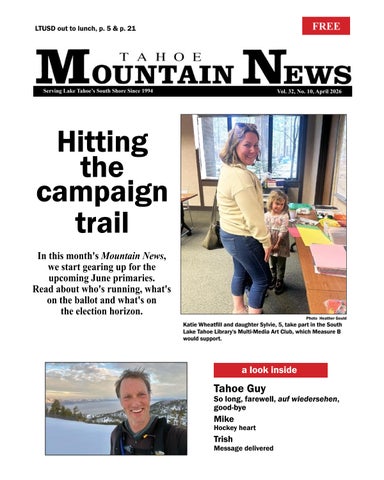
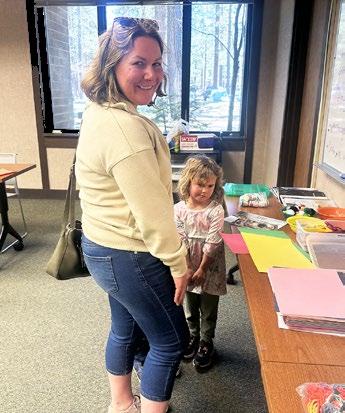
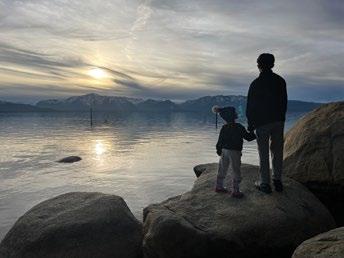
Katie Wheatfill and daughter Sylvie, 5, take part in the South Lake Tahoe Library's Multi-Media Art Club, which Measure B would support.
Serving Lake Tahoe’s South Shore Since 1994
Groceries, dairy, bulk food, organic beer and wine, coffee, energy bars, cereal, snacks, body care products
PRODUCE DEPARTMENT
One of the largest selections of organic produce at Tahoe
NUTRITIONCENTER
Complete selection of vitamins, supplements & herbs SCAN FOR
In a story last month, I wrote that the community-based Title IX Task Force, formed to promote gender equity in local school sports, had been waiting more than a year for information requested from the Lake Tahoe Unified School District. I was right and also way offbase. In delving into back issues of the Mountain News and talking to task force members, I discovered they have been waiting at least three years for the information requested, with their request passed through a revolving door of administrators, none of whom have actually fulfilled it. They were given the sop of a “puffy PowerPoint presentation” at a board meeting, which was long on self-congratulation and short on actual data.
I can’t say I’m surprised. LTUSD has little respect for its obligations to ensure the transparency essential for the community and the public to judge its performance as a government institution and act accordingly as parents, employees, voters, community members and taxpayers.
The Mountain News has been trying to get information from the district under the California Public Records Act for going on more than six months and has been turned down for reasons that my experts tell me are specious. Recent reporting in the Tribune revealed that the Community Advisory Committee of the Special
Education Local Area Plan has been out of compliance with the Brown Act, a law that dates to 1953 to ensure that the public’s business is conducted openly and with the opportunity for informed public participation, for 46 years! (And when LTUSD did try to bring the CAC into compliance recently, their approach was so high-handed and insulting that it ended up having to issue an apology to committee members). LTUSD also seems to not fully understand California law regarding access to school sites by journalists. And these are just the examples I know about.
While South Lake Tahoe City Clerk Sue Blankenship has descended into the bowels of city hall to dig through boxes of archived files and find information requested by the Mountain News, while the Douglas County Sheriff’s Office has provided raw, unvarnished documents to the Mountain News, usually within 48 hours, sometimes within 24 hours of our request, the Lake Tahoe Unified School District finds ways to deflect, deny and delay. It throws into relief that other, small local agencies understand the importance of public disclosure and are finding ways to say “yes,” while LTUSD seems bent on finding ways to say “no.”
I am sorry to announce Tahoe Guy’s last column
runs in this month’s issue. Over more than a decade, he has chronicled the nitty-gritty of parenting (not just the Instagram highlights) mixed with an idealism deepened by his children about being a better person and building a better world with panache, a little bit of heartbreak and a lot of hope. He is moving on to bigger, though not better things (nothing could be better than the Mountain News! Ha). Au revoir, Gantt, with my deepest appreciation for your time in our pages.
Needless to say, we are on the lookout for a new columnist — parenting or otherwise. If you have an idea for an ongoing column, please email me a letter outlining your concept and a 750-ish word sample column.
One quick correction. In last month’s cover story, we wrote that West Slope winery Narrow Gate Vineyards had to replant 75 percent of its crop after series of setbacks a few years ago. Instead, we should have written they had to rehabilitate 75 percent of their vineyard. We look ahead this month to the upcoming June election with a suite of stories. We are planning more election coverage next month. So another au revoir to our readers. See you in May!
Our town, our choices
ON THE BALLOT
On June 2, SLT voters will decide two local tax measures. For some, any tax measure is an automatic “No” vote, but even the most fiscally conservative make exceptions for things worth funding, especially if the amount is modest and the cause benefits the broader community or themselves.
The two measures are renewals of existing parcel taxes that have been previously approved by voters. Measure B is a flat-rate $25.50 parcel tax paid by property owners. Since 1994, voters have overwhelmingly supported this special tax to supplement funding for the EDC library in SLT. Libraries ensure everyone, regardless of income, has free access to essential information, education, internet and children’s programs. Measure G is a flat-rate $18.00 parcel tax paid by property owners. It is an extension of Measure S that voters passed in 2000 to fund a bond initiative to build the ice arena, new ball fields (two community fields were built at LTCC) and maintain existing bike trails. This measure would continue a dedicated source of maintenance and improvement funding for bike trails (including snow removal), community play fields, and
Tahoe Paradise Park. I’m in.
HOW WE ROLL
It is ironic that three council members voted to approve 900 VHRs in residential neighborhoods so investors can profit from expanded tourism, using existing housing stock, while at the same time, the city is using public funds to pay other property owners to rent their homes full-time to locals (Long-term Rental Incentive Program) because we don’t have enough housing. Let me say that again. We are reducing the availability of housing by council policy while offering $4,500 to property owners willing to long-term rent their homes to locals. Council members with a colon obstruction should not be making contradictory policy decisions.
Reading Pals is a volunteer program sponsored by the Marcella Foundation. The program is coordinated by executive director Melissa Uppendahl, along with “super volunteers” Renee Gorevin and Linda Wysong. This year, 60 people signed up to work one-on-one with kids at Tahoe Valley Elementary School to improve their
reading skills. When 12 high school kids found out about Reading Pals, they asked if they could help —evidence that kindness and generosity come in all ages.
The Ukulelians are back for another season.
Join the fun with Diane and Bob Fannan at the American Legion. First ukulele gathering is April 15 at 6:00.
HAPPILY, EVER AFTER
It all started in 1971 when a young man was interviewing for a ski patrol position at Heavenly. Teresita Jover (already a patroller) was talking with her boss Stan Hansen who was about to take this tall, skinny, new guy up on the mountain for a test run. Tere and Stan both had their doubts he’d make the cut. As it happened, Malcolm was just out of the Army, where he was in charge of the European Division of the National Ski Patrol in Garmish, Germany and a skier since the age of four in his home state of New Hampshire. He passed the test, no problem. It wasn’t long before Tere and Malcolm struck up a friendship that grew into a romance. Living and skiing in
Tahoe in the early ‘70s was often referred to as “Living the Dream,” and they were. By 1976, it was time to make it official. The night before the wedding, 90 friends and family gathered in their small house (with almost no furniture) in Al Tahoe to celebrate the occasion. The ceremony was held the next day (April 12, 1976) when the six-person wedding party hiked into the woods off Chimney Rock Road. There was a view of the lake and snow flurries to make for a magical beginning of what has been a 50-year adventure.
Malcolm stayed with Heavenly, working his way up to VP of operations, while Tere became a beloved educator and champion for local immigrants. They raised two great kids (Cristie and Andrew) and are now having fun with their four grandchildren.
To celebrate their anniversary on April 12, 2026, Malcolm and Tere hosted a lavish party in the Grand Hall at Valhalla. It was a festive affair with family and friends to toast the couple in Cuban style, with Mojitos raised high. Fifty years later, they are still living the dream. Congratulations!
To be continued….
“A clerk at the South Lake Tahoe post office informed me outgoing mail no longer is sent for processing and postmarking in Reno the same day. Doubtful most folks are aware of this change in outgoing mail policy and are deserving of an explanation.”
—Steve Bridges
Postmarks have often been the proof, so to speak, of when a letter, card or package was first put in the mail. Or so many people believed. According to the U.S. Postal Service, that has never truly been the case.
Shore mail—be it from California or Nevada—goes to Reno. It's highly probable the postmark will be dated the day after it left the basin.
Recent and ongoing changes to the
and ballots. Don’t wait until the last day to mail those items, is the Postal Service’s recommendation.
“Most importantly, for domestic, nonmilitary voters who choose to use the
week before the deadline by which their completed ballot must be received by their local election office,” Patton said. “Some states may recommend allowing even more time for mailing completed ballots.”
For those who didn’t plan far enough in advance, don’t worry. People may go to a local post office to request a manual postmark from the person working the counter. There is no extra charge for this service.
It was in 1792 that the postal system officially started in the United States. It’s been evolving ever since. Mail has been delivered by horseback, ship, train, automobile, plane and truck.
“In Colonial America, mail was often brought to local taverns and inns which doubled as post offices. Local residents would gather to socialize and collect their mail—if there was any,” according to the
National Postal Museum in Washington, D.C.
Stamps as a prepaid form of delivery were invented in 1837 by Rowland Hill, with the British government implementing his idea two years later. Until then, mail recipients usually paid the postal fee. ZIP (zoning improvement plan) codes became a reality in the United States in 1963 to make it easier to sort mail to specific areas.
Home delivery started in South Lake Tahoe in 1990, though it’s still not available in some areas on the South Shore.
“There is no change in postmarking policy with regard to how or what we postmark. Given the variety of ways mail pieces enter the postal network, the U.S. Postal Service has never guaranteed sameday postmarking,” Meiko Patton, USPS spokesperson, said.
Still, it was just last December that the USPS updated its policies to underscore the above statement. It added section 608.11 Postmarks and Postal Possession to the Domestic Mail Manual.
“This new language in the DMM does not change any existing postal operations or postmarking practices, but is instead intended to improve public understanding of postmarks and their relationship to the date of mailing,” the USPS’ website says.
Postmarks are usually applied by a machine at a processing facility. South
USPS regional transportation system is definitely causing a delay in postmarks.
“These transportation changes can change the timeline for the postmark. As we modernize our transportation network and our mail processing network, most mail and package volume will be processed more quickly, but it is becoming more common that the date on the postmarks applied at those facilities may not necessarily match the date on which the mail piece was collected by a letter carrier, dropped off at a retail location, or placed in a collection box,” Patton said.
Confusion in postmarks is not uncommon, with the USPS updating its “Changes in Service Standards – FAQs” in February.
Some of the most common mail people want postmarked involve tax documents
mail to return a completed ballot, our general recommendation is that, as a common-sense measure, they should mail their completed ballot before Election Day, and at least one
Email: mountainnews2@gmail.com
Mail: P.O. Box 8974, South Lake Tahoe, CA 95618.
Photo Kathryn Reed
The National Postal Museum in Washington, D.C., which opened in 1993, is housed in what was the city’s post office from 1914-86.
Fiery speech matters to legislative leaders
To the editor, As wildfire season ramps up, so do concerns about the cost of defensible space and home hardening prevention measures and the availability and affordability of insurance in high-risk communities. On April 2, 2026, Al Tahoe Firewise USA participated in a Town Hall event hosted by California State Senator Marie Alvarado-Gil. Senator AlvaradoGil, and city and county residents, shared passionate accounts and frustrations with the high costs of building and fire mitigation efforts for home hardening, vegetation management, the permitting process, and limited and expensive insurance options. Senator Alvarado-Gil urged all stakeholders to write letters of support for bills that are currently up for review in the legislature, since these support letters “go to the top of the pile”
and gain importance during the legislative process.
Bills currently under consideration: SB 1084 — The Fire Safe Home Tax Credit Act; SB 1118--Generator and Backup Power Tax Credits Act; SB 1162 —Fair Plan & Wildland Urban Interface Prioritization; and SB 904 — Disaster Recovery & Wildfire Rebuilding Act. Full context of the bills is available on the California Legislative Information website — https://leginfo.legislature.ca.gov. For instructions on how to complete the onetime registration and submit your letters of support, use the Position Letter Portal — calegislation.ic.ca.gov. Your voice matters!
Dianne Rees, Al Tahoe Firewise Core Team Leader
Measure B an investment in ourselves
To the editor, On June 2, voters in South Lake Tahoe will be asked to renew a parcel tax of $25.50 that the community has been funding since it was first introduced in 1994 to support the El Dorado County Library on Rufus Allen Blvd. A parcel tax is paid for by the property owners in the district of the measure. As a property
owner, I support the renewal of this tax to fund what I consider to be an investment in our community and the people who live here. Libraries provide free access to information and technology and should be supported. Join me in voting Yes on Measure B.
Andrea Olsen
Measure B for more than books
To the editor,
We must all vote yes on Measure B on Tuesday June 2 or we may have our library services, hours, and staffing severely reduced!! For little more than $25 a year, Measure B can maintain the funding that has kept our library open six days a week, put new books on our shelves, provide programming for all ages and support our community's freedom to read. Measure B funds only support the South Lake Tahoe Library and cannot be used for anything else. It will allow
our library to maintain current hours and staffing, purchase new books, audiobooks, magazines and research materials, provide early literacy/children's story hours, provide public computers and printers for access by any library user, and provide loads of programming for children, teens and adults. The South Lake Tahoe Library is a valuable asset for our community. So please vote yes on Measure B on June 2 to keep our wonderful library and all its programs!
Catherine Whelan
Leaving means opportunity and absence
Publisher’s note: This is one in a series of stories written about immigrants living on the South Shore. Names are being withheld to protect the individual who wrote the story and their family.
I did not come to the United States with the intention of staying. I came with the certainty that my life, my career, and my identity belonged somewhere else. America was not supposed to be my future. It was supposed to be a temporary stop along the way.
The first time I arrived, I was a teenager—an exchange student in a small Michigan town. I was trying to understand snow, lockers and cafeteria food. I was the girl with the accent, the one who paused before speaking, translating thoughts in my head before giving them voice. I quickly learned how differences reveal in small moments—when I was asked where I was from and realized my answer would always set me apart. A constant reminder that belonging is not automatic. It is something immigrants must grow into.
Long before that exchange year, something had already nudged me toward thinking beyond borders. As a child, I entered an essay contest marking the International Year of the Child. I wrote about what children need— not only food and clothing—but education and opportunity. When I won, it was the first time I realized that ideas could travel farther than people, and that opportunity was not evenly distributed. It made my world feel larger, and it planted the first seed of purpose.
Still, when I finished my exchange year, I returned home certain that my life would unfold there. At 17, I had briefly contemplated the possibility of studying in the United States, visiting a university so vast it felt like a city unto itself. The campus stretched further than I could walk in a day, filled with thousands of students who moved with confidence through a world that felt unfamiliar to me. I remember realizing, with quiet clarity, what it would mean to live there alone, an ocean away from my family. The distance felt immense, not only in terms of geography, but also in terms of identity. I was not ready
to carry that kind of separation. Instead, I chose to continue my studies in a third country closer to home, where the distance felt more manageable and the path forward less daunting.
But life has a way of reopening doors you thought you had closed. A few years later, I transferred to a university in the United States. This time, I arrived with two suitcases and a clearer sense of purpose, but with the same goal of returning home.
Being an immigrant student was a test of resilience. There were obvious adjustments— language, customs, and unfamiliar traditions—but there were also invisible pressures. The constant awareness that my visa had rules. That my future depended not only on my effort, but on approvals, deadlines, and decisions beyond my control. I understood that no matter how hard I worked, my ability to remain depended on permission. Opportunity, I learned, was never guaranteed.
Over time, what began as a temporary chapter stretched longer. Graduate school followed, and then a job opportunity. Every step made me choose between my old life and starting anew. Staying meant accepting distance from the people who had shaped me. It meant missing birthdays, family gatherings, and ordinary moments with childhood friends that cannot be recovered.
Immigration is not only the pursuit of opportunity, but also the acceptance of absence.
Choosing to remain required faith in the future I could not yet see. It was not a decision made lightly. I chose to follow a lawful path toward immigration,
respecting every requirement and step of the process. I filled out forms carefully, met deadlines, and built my life inside the rules. I understood how fragile opportunity can be, and I never took it for granted.
As my journey unfolded, I became involved in programs that supported small businesses overseas.
In West Africa, I met women who pooled savings together because formal banking was out of reach.
In Central America, I saw how access to credit could transform small family farms. In parts of the Middle East and Asia, I witnessed resilience in environments shaped by uncertainty. In their determination, I saw reflections of my own journey. I understood what it meant to navigate unfamiliar systems, to build stability step by step, and to create a future that once seemed uncertain.
Living as an immigrant teaches you to observe closely. You learn how systems function because you must navigate them. You learn humility because you begin again,
often without the networks or support that others take for granted. You learn resilience because there is no alternative. There were moments of homesickness that never appeared on resumes. Holidays spent calculating time differences to call family. Milestones marked with friends who became chosen family. Over time, I stopped measuring progress only through professional achievements. I measured it through quiet victories such as the ability to create stability, to contribute meaningfully, and to feel a sense of belonging.
I still return to the country where I was born. Each visit reminds me of the person I was before I crossed my first border and the person I have become since. I do not feel divided between two countries. I feel connected to both. Immigration is often
discussed as a policy or statistic. But behind every number is a person building a life, step by step. I came to the United States to study. I stayed because I found purpose and because I believed I could contribute. I followed the law. I worked hard. I built a life slowly and deliberately. I never set out chasing the American Dream. I set out seeking education and a way to serve others. Along the way, the United States stopped being a temporary destination and became home. Immigration did not erase who I was. It expanded it. I remain shaped by the country I came from and strengthened by the country that allowed me to stay. That is what it means to be an immigrant—to carry your past forward while building something new.
Chief champions community policing
Visibility. This is South Lake Tahoe Police Chief Jeff Roberson’s No. 1 goal.
He wants people to see his officers, know them and for everyone to be comfortable with each other.
Roberson was appointed police chief a year ago this month, with his start date in June 2025. He joined the department in 2003 as a patrol officer.
“For me, community policing is really a philosophy. When I started in the ’90s that is what it was,” Roberson said. “We are an intelligence¬-led agency. We solve crimes from connections and relationships built long before it happens. We are going back to what is the core of what we do. The community needs to know you for them to support you.”
One of the first things he did was to have an officer in school parking lots at drop off and pick up. This allows students to see police as a positive, and for parents to be reassured someone is watching. It’s all about building community.
“Visibility on the highways encourages better motorist behavior,” Roberson said. “We saw a decrease in the number of traffic accidents. There is a direct correlation to officers’ presence.”
Officers are being encouraged to get to know business owners and managers. It’s about those people having a sense of safety and knowing they can rely on officers to be
stance of not engaging with the public. Young officers only know a nation in turmoil with hostilities toward the police as the norm. Roberson wants to change that to show it’s not an us v. them reality in South
there when they need them.
Roberson, as was the custom with chiefs before him, is a frequent visitor at the Family Resource Center, especially in the wake of beefed-up federal immigration threats.
While nationally it might be the norm for minority neighborhoods to fear police presence, Roberson said, “They told me they love when we come through.”
Lake Tahoe. He is trying to restore goodwill between the department and community that was there when he was patrolling the streets.
The Washington Post reports that on average, police in the United States shoot and kill more than 1,000 people every year.
The last officer-involved shooting in South Lake Tahoe was March 19, 2021, at Three Peaks Resort. A suspect trying
Lake Tahoe Police Chief Jeff Robeson
Roberson points to the distrust between police and the public escalating in 2014 following the fatal shooting of 18-year-old Black teenager Michael Brown by white police Officer Darren Wilson in Ferguson, Mo.
Tensions between police and communities nationwide only got worse with the deaths of George Floyd, Tamir Rice, Breonna Taylor and so many others.
“With all of these high-profile deaths we then started seeing de-policing because cops saw no benefit of being in the community,” Roberson said. While this phenomenon was more at the national level and not locally, rising tensions still had a ripple effect on the South Shore. The pandemic reinforced officers’
Patrol boat staffing in jeopardy
CalPERS, California’s public employee retiree fund, is making it more difficult for law enforcement agencies to staff boat patrols with retirees.
“PERS has said they want (retired annuitants) replaced with full time people who will be paying into the PERS system. Pure greed if you ask me; with no regard for public safety,” said Joe Sherry, who as a retired sergeant with the local California Highway Patrol office has worked on the El Dorado County Sheriff’s Department’s boat for ten years. “I had pushed this up through my chain of command and I’m waiting for an official response to see if I’m personally finished and what will become of the marine program.”
The sheriff’s office didn’t respond to an inquiry.
Sherry said CalPERS changed the policy in 2023 so starting that year retired annuitants could work no more than four years. This means this could be his last year on the lake.
A retired annuitant is a retiree who returns to work with a CalPERS employer in a designated position, collects a pension, but no longer pays into the system.
“Our unit utilizes ten to twelve retired annuitants a year to cover the many lakes throughout El Dorado County, as well as serving to help in the courts and other assignments when needed,” Sherry said.
The change at the state level will also affect the boat programs within South Lake Tahoe Police Department and Placer County Sheriff’s Department.
“I’m really concerned for marine safety on the South Shore in the next few years,” Police Chief Jeff Roberson said. He said things are in place for this summer, but changes will need to be made for 2027. SLTPD uses two annuitants for the boat patrol.
Roberson said the California Police Chiefs Association is working with legislators to come up with a workable solution.
Necessary force a rarity for SLTPD
in the use of force.
to break into a room pointed a rifle at an officer, fired, and the officer fired back, wounding the man.
While Roberson wasn’t initially a fan of police body cameras, now he is a strong proponent.
He remembers in 2018 saying they weren’t needed. By 2021, the city council wanted them and they became part of the uniform.
“They have resolved so many complaints so quickly. Things that would have been a lengthy six-month investigation (are) done in five minutes because of those cameras,” Roberson said. “It’s resolved a lot of
issues for us so fast.”
“The lowest level force is to grab them and try to change their mindset; whatever their bad behavior is by trying to control them,” Lt. Russell Liles told
the South Lake Tahoe Police Advisory Commission at its first meeting of 2026. This may include having the perpetrator on the ground.
Thirty-two of the force incidents involved males. Most of the individuals
(21) were white, 11 Hispanic, four Asian/Pacific
and three African American.
Officers are legally allowed to use force to effect a lawful arrest, detention or search; overcome resistance or to prevent escape; to prevent the commission of a public offense; in the defense of others or in self-defense; or to gain compliance with a lawful order.
In the city last year, the main reason for officers to use force (87 percent) was to overcome resistance, 84 percent of the time was to effect arrest, 58 percent to prevent escape, 18 percent to protect self, 13 percent to protect the public, 8 percent due to the seriousness of the crime, and 5 percent to prevent a crime. Often, more than one reason applies to a given incident.
SLT officers responded to these situations first by always using verbal commands, which can be as simple as
Jeff Roberson
Photo Hall Creations
The South Lake Tahoe Police Department has been located at the El Dorado County Government Center on Johnson Boulevard since April, 1973.
TMN File
South Lake Tahoe officers will help when a highway needs to be closed to allow other emergency personnel to do their jobs.
Photo Kathryn Reed California law enforcement agencies may no longer be able to use retirees on patrol boats.
In 2025, the South Lake Tahoe Police Department responded to 26,405 calls for service, with 39 or 0.15 percent of them resulting
Islander,
Russell Liles
The free South Tahoe Earth Day Festival is April 18 from 10 a.m. to 3 p.m. at Lake Tahoe Community College. Go online (https://southtahoeearthday.org/ earth-week) to learn about Earth Week Challenge.
After a multi-year closure due to a waterline replacement project, D.L. Bliss State Park will reopen for camping and day use on May 21.
Tahoe Blue Event Center is the site of the May 7 Go Local Business Expo The all-day Tahoe Economic Summit hosted by the Tahoe Prosperity Center is the same day. Buy tickets online: https://shorturl.at/ Q7Bi6.
For the sixth consecutive year Newsweek recognized Barton Memorial Hospital as one of the best.
South Lake Tahoe’s new aquatics and rec center grand opening ceremony is April 18.
In March, Douglas County commissioners allocated a $21,686 grant from One Nevada opioid settlement funds to the Tahoe Douglas Fire Protection District to buy narcotic storage equipment to support opioid prevention, treatment, and recovery efforts. TDFPD had been storing narcotics at Barton Memorial Hospital, but the DEA now says storage must be in Nevada.
The building once known as The Attic thrift store is going to become The Atrium. The Marcella Foundation is creating a youth and community hub in collaboration with South Tahoe High School. More details are online: https:// atrium.marcellafoundation.org/.
a wilderness first aid training May 9-10 in Stateline. For more info and to register, go online: https://tahoerimtrail.org.
The Sugar Pine Foundation (https:// sugarpinefoundation.org/) is hosting plantings April 19 in the Caldor Fire scar area in Strawberry Canyon below Lover’s Leap and on April 24 in the path of the Tamarack Fire at Indian Creek Reservoir near Markleeville.
El Dorado County Community Action Council is seeking three members. For more information or to receive an application, email CAC@edcgov.us or call (530) 621-6150.
Blaze, a Douglas County sheriff’s K-9, passed away at home on March 15. Blaze came to DCSO from Slovakia in 2021 as a puppy. The Belgian Malinois/ German Shepherd mix, who was certified in patrol, narcotics and tracking, was deployed 175 times, assisted in 13 arrests and seized heroin, cocaine, fentanyl, methamphetamine and mushrooms.
After nearly a decade as president of Lake Tahoe Community College, Jeff DeFranco is leaving at the end of this school year.
The U.S. Forest Service is seeking comment until April 23 on plans to redefine Round Hill Pines Resort by demolishing some aging buildings and remodeling and repurposing others. Email alexandra.wenzl@usda.gov.
FishingBooker ranks Lake Tahoe among the 15 best trout fishing lakes in the United States, highlighting local trout fisheries, scenery and overall angling experience.
duced by Sen. Catherine Cortez Masto, D-Nev., passes, 67 acres could be added to Lake Tahoe Nevada State Park April 27 is the deadline to comment (tahoe.ca.gov/van-sickle-improvements) on the draft environmental document for the Van Sickle Bi-State Park safety and equitable access improvements project. Out of more than 600 entries from across the country, Stateline’s Fox & Hound’s High Altitude Heat sauce earned second place at the National Barbecue & Grilling Association Awards of Excellence in Nashville.
Children who will be in grades 1-8 this fall are being sought for the Children’s Summer Theater put on by Tahoe Arts Project and Tahoe Valley Performing Arts. For more info, call Peggy Blowney at (530) 542-3632 or email tahoearts@gmail. com.
Volunteers are needed to spruce up the grounds at Valhalla Tahoe on April 19 from 8:30 a.m. to 1 p.m. For info, email info@valhallatahoe.com.
Barton Health has named hospitalist Bradley Gray its physician of the year for his commitment to exceptional patient care and his role in supporting patients throughout their hospital stay.
Porter Neira 9, of South Lake Tahoe recently found the wedding ring of Meyers resident Paul Nielsen, who lost it three years ago while digging out during a storm. Porter was exploring with a metal detector in the yard of his grandparents’ house next door when the discovery was made, earning Paul and his wife, Caroline’s, eternal gratitude.
though conditional registrations will be accepted through June 2. Visit registertovote. ca.gov. In Nevada, voter registration is accepted in-person or by mail through May 12, online at registertovote.nv.gov through June 4 and voters with a Nevada -issued license or identification can register and vote same day as the June 9 election at their assigned polling place.
Through May 31, Untethered Workspace will match up to $25,000 in contributions to the Boys & Girls Club of Lake Tahoe. Visit https://bit.ly/untethered-bgclt-2026 to donate.
The Tahoe Community Emergency Response Team is holding a volunteer training in late May and early April. To apply or for more information, contact tahoecertinfo@gmail.com.
Barton ER doc, avid climber and occasional Mountain News contributor Michael Habicht is set to climb the fifth highest mountain in the world, Mount Makalu in Nepal, as a fundraiser for pediatric emergency services. Visit https://bartonhealthfoundation.org/climbing-to-support-pediatric-emergency-services/ to donate.
Gaia-Licious and its owner Kelly Brosch were recently featured in Sunset Magazine along with other local businesses including Pine Nut Cycle Café, Camp Rich, Black Bear Inn, OMNI, Verde, Divided Sky and Cuppa.
The Tahoe Art League is hosting its Adventures in Art show, sale and community mingle on April 16 at 5:30 p.m. at the mid-town museum. Bring a friend and some food or drink to share.
Connecting Students to Careers
Career & Technical Education at LTUSD
Did you know LTUSD students have amazing opportunities to jump -start their career choices?
The Career & Technical Education (CTE) programs give students real-world skills in grades K-12, culminating in four industr y-aligned pathways at South Tahoe High School: Allied Health, Engineering, Hospitality & Tourism, and Ar ts, Media & Enter tainment STHS students earn college credit through dual enrollment with LTCC, pursue industr y certifications, complete internships, and get valuable work-based learning.
Tahoe Rim Trail Association and NOLS Wilderness Medicine are putting on
If the Douglas County Economic Development and Conservation Act intro-
May 18 is the last day to register to vote in California for the June 2 primary,
We're not just teaching skills — We're launching careers.
CTE @ South Tahoe Middle School
Culinary Arts Video Production
Got a community item for Heard?Email mountainnews2@gmail.com, subject line Heard. STEM Night
May 8 @ STMS at 5 30 h
Come see what students are bu lding & learning
Photo Indigo Photography: Brandi Caskey Sunset Magazine recently featured Gaia-Licious and owner Kelly Brosch.
For love not for glory
A quick school note:
We teachers also have conflicting thoughts on the built-in or scheduled “snow days,” and no, this change was not demanded by the “teachers’ union,” as some have opined.
Theoretically, it balances out missed classes more equitably throughout the year, and it seeks to avoid those “tacked on” days at the end of the year that aren’t always the most productive.
The format hasn’t yet been tested by a bigger winter, and there’s always the chance that storms won’t cooperate with pre-scheduled snow days. For example, say a three-day storm comes a week after the first scheduled “snow day,” so we close school for those three days. There would be two more scheduled snow days left, so that would still leave one day to make up at the end, even if no other closures happened.
And if that scenario plays out again, well, do the math. You end up with one or more wasted days off and a bunch you still need to make up in late June.
The counterargument says the state likely won’t require those days to be made up, which remains an open question.
Spring?
It’s that time of year — especially in such an outlandishly early spring — when you convince yourself you can access trails that really aren’t yet accessible and instead end up in the mud. And because you have a self-imposed rule about not backtracking, you end up in more mud. And muck. OK, seasonal swamp.
But it has been weird, hasn’t it?
I found myself up Tahoe Mountain on March 11 with the only snow to tromp through on the lake side. We’ve had light winters before, but I can’t remember it quite like this.
Having said that, there’s every chance that winter isn’t done with us and will pay a visit later in April or May . or even June. In fact, seeing that the tulips are starting to bloom, I’d say snow is definitely on the way.
Now for a little Tahoe Knight Monsters update.
As of this writing, the Knight Monsters have five games left in the regular season with their final game on April 18 in Rapid City, South Dakota, one of the teams nipping at their heels for playoff contention.
For the moment, though, the Knight Monsters are holding at fourth place in their division and will make the Kelly Cup post-season, but it might come down to those final games against Rapid City in South Dakota. While we’re at it, a shallow dive on the life of an ECHL player
Even though their housing is primarily in Reno and Carson City, these guys are part of our community as many of you have embraced them as your own and the TBEC is their home rink, after all. So, we should probably have some sense of the challenge of an ECHL existence.
I don’t have current year salary figures, but the median annual ECHL salary seems to be around 45K. It’s true that they are provided furnished housing and family health benefits, but these are generally only during the season. They earn a small per diem — around $55 typically — for food and incidentals. Naturally, this means off-season jobs in addition to maintaining fitness for the coming season.
Of course, they play for the love of the game, but the hope and dream is for bigger opportunities and bigger pay-
checks via the American Hockey League or National Hockey League — or perhaps an overseas contract, where they might find better pay and/or benefits.
The long odds
On average, one in three ECHL players will play in one AHL game. The odds are much lower for reaching the NHL.
The harsh reality is that playing in the ECHL generally indicates that your level of speed, skill, developmental level — but especially speed in decision-making — is below the level of the AHL, so you are not likely to get noticed for opportunities.
I don’t want to say the ECHL is a career “death knell,” as some would, but it’s usually not a sign that you’re bound for glory. And this should make us all appreciate the heart and determination we see on the ice regularly at this level.
Having spelled out the doom and gloom, it’s worth noting that 778 former ECHL players have advanced to the NHL, and 10 former ECHL players have made their debuts during this 2025-26 season.
As always, feel free to email mikesmutterings@gmail.com
Two candidates vie for historically under-the-radar position
The office of El Dorado County Treasurer-Tax Collector is generally lowprofile, often filled by appointment or by an uncontested candidate in an election, which is why Corey Leikauf is running.
“I want voters to have a choice. TreasurerTax Collector should be decided by the taxpayers.”
Leikauf’s opponent is incumbent Sean Coppola, who was appointed unanimously by the El Dorado County Board of Supervisors last year after K.E. Coleman, the previous treasurertax collector, retired. Leikauf currently works in the El Dorado County AuditorController’s Office, where his portfolio includes helping special districts manage and oversee their finances.
Both men grew up in El Dorado County, playing youth sports. After graduation (Leikauf from Union Mine
High School, Coppola from the El Dorado Adventist School), both headed out of state for college. Coppola went to the University of Nevada, Reno after earning an associate degree from Sierra College. At UNR, he majored in finance with an emphasis in economics. Leikauf set off for Boise State where he earned a bachelor’s degree in business administration in accountancy. Both felt drawn to return home to El Dorado County and their roots where each looks forward to starting a family with his partner — Klerisa for Leikauf and Stephanie for Coppola.
Following graduation, Coppola worked for seven years at FPI Management, a top ten real estate firm, where he rose to the position of controller and managed a team of 200 employees, overseeing dozens more. A desire for a more meaningful career led to a job with the treasurer-tax collector three years ago and then to his current position.
Leikauf’s career began with US Bank and continued through Eide Bailey, a government and financial auditor to Deloitte Touche, where he handled audits and IPO offerings and then to the auditorcontroller’s office.
In Coppola’s estimation, the main mission of the treasurer-tax collector is “safeguarding the county’s assets.” His top three priorities, if elected, are: continued modernization of operations, optimization of efficiency and maximizing revenue. Over the last fiscal year, in which he said he played a key role, the treasurer-tax collector has realized $38 million in investment revenue on the county’s approximately $1 billion budget. Though many state and county regulations limit how county
revenues can be invested, Coppola said a knowledge of larger political issues — such as the war in Iran — are necessary to fully inform how county dollars should be invested.
Leikauf also said “safeguarding public funds” is the most important function of the treasurer-tax collector. He said, if elected, he would prioritize “transparency” about how county funds are protected, how financial solvency is assured and how county monies are invested. He said on the tax-collector mission of the job, he would work to make the office more “user friendly” and “make clear deadlines and penalties so people are not caught off guard.”
Coppola said it’s not all about the numbers but about managing the people who work in the treasurer-tax collector’s office. In his career, he said he has had to work with a lot of “Type A” personalities and has developed an approach that both respects and holds accountable various temperaments.
Leikauf said if elected he would work to strengthen internal controls and processes and seek efficiencies in operations to make the treasurer-tax collector’s office as highly functional as possible. His background in banking, public accounting and government finance gives him the ability to evaluate the county’s finances from numerous, relevant angles, he said.
Leikauf is the son of El Dorado County Sheriff Jeff Leikauf and terms like “nepo baby” and “political dynasty” have been thrown about online. While proud to be associated with his father, Leikauf said he wants to compete for treasurer-tax collector on his own terms. He wants voters to judge him based on his own credentials and accomplishments, regardless of his parentage. As sheriff and treasurer-tax collector carry out entirely separate functions, there would be no conflict of interest between himself and his father if elected, Leikauf said.
As there are only two candidates, the race will likely be decided in the June 2 primary.
The Mountain News ran both candidates’ names through the El Dorado County court case index. Neither has had so much as a traffic ticket.
Library parcel tax up for renewal
The budget for the South Lake Tahoe Library for the current fiscal year is $1.43 million of which about 40 percent, or $579,000, comes from a special parcel tax first approved by voters in 1994. That tax is set to expire a little over a year from now and Measure B would extend it an-
terials then learned about and listened to music by a famous composer while getting creative. This month’s featured musical artist was Frédéric Chopin.
To be able to offer all that the South Lake Tahoe Library does, just keeping the doors open is key. The local library is
other 20 years. The base fee would be $25.50, with annual increases tied to inflation in the consumer price index or three percent, whichever is less.
If Measure B doesn’t pass, said Library Supervisor Katharine Miller, “it would have a strong negative impact on our ability to provide services, our collections and our staffing and hours of operation.”
Beyond the bookshelves, the library provides numerous programs for the community, said Cindy Ochoa, Measure B cochair. “We have the Lego Robotics Club, senior story swap, four book clubs, four (children’s) story times, a chess club, a fiber arts group, ATLAS (At the Library After School), a program for teens, and I have no idea how many more programs. It’s a place in the community for everybody.”
On a recent Monday afternoon, about 20 children and parents gathered for the monthly multi-media art club led by Library Assistant Sydney Mlodnosky. Participants selected from a variety of ma-
one of only two libraries among El Dorado County’s six branches that is open six days a week. Weekend and evening hours accommodate users in a town with a large proportion of odd work schedules.
“It’s a valuable asset for the community,” said Ochoa. “For our children to be well educated, for people to update their skills, for computer connectivity.”
Money raised by the parcel tax could only be spent in support of the South Lake Tahoe Library, but otherwise there are no restrictions on funds raised. The measure needs a two-thirds majority to pass in the June 2 election.
There is no organized opposition to Measure B at this time, though Ochoa noted “there are always those people out there who are not going to vote for a tax no matter what.” Perhaps, though, she said this quote from Albert Einstein will motivate them. “The only thing that you absolutely have to know is the location of the library.”
Photo Heather Gould
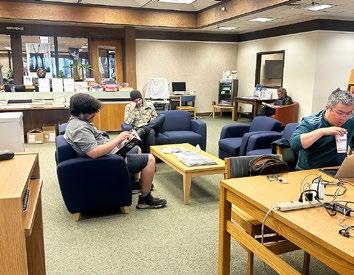
Patrons take advantage of the amenities and space at the South Lake Tahoe Library.
Corey Leikauf Sean Coppola
Photo Heather Gould
A patron browses the new book offerings at the South Lake Tahoe Library.
Following up and following through for Lake Tahoe
This summer will be the first in over 50 years without lead cables in the waters of Lake Tahoe.
The removal of over six miles of legacy infrastructure proved that tangible environmental change is possible. Our community will forever appreciate this accomplishment and what it means for future generations. We’re grateful to AT&T for upholding its commitment to execute this important work, especially since they didn’t have to. We can also be appreciative and not overlook how the work was ultimately executed. There is plenty to be learned from the five-year road to removal and questions that remain unanswered. After all, the outcome here was always obvious. Lake Tahoe is no place for lead. The cables were decommissioned in the 1980s. Why did it take so long to get the job done? We started the Tahoe Lead Removal Project to address the lack of urgency regarding a profound risk. We emerged in 2023 after AT&T withdrew from its initial legal commitment. For years, we had watched that lawsuit contort the path forward. Key deadlines were missed, but extensions were always granted and the volume of lawyers on both sides increased. A Wall Street Journal investigation transformed this into a nationwide issue,
providing impetus for further delay. Rather than accept the situation, we saw a path to deliver the right outcome through a community-driven project. As someone who was fortunate to spend many summers in Lake Tahoe and grew up swimming by the cables, I was eager to organize these efforts. The support was immediate from the public to third party partners and agencies. Within ten months, we proved the power of our approach by securing the first of seven required authorizations.
Within days of that big moment, AT&T reversed course, entered a new consent decree and mobilized teams. After years of waiting, the actual marine construction work was executed in just 17 days. A wave of media pieces ranging from the USA Today to Smithsonian Magazine declared the lead cables “out of the water.” The League to Save Lake Tahoe characterized them as “successfully removed” and championed work “behind the scenes.”
But our community had learned to focus on the frontlines, not the headlines. Articles and FAQs made references to a remaining segment in Baldwin Beach. We stayed action-oriented and contracted a utility locating firm to confirm. When we arrived, we didn’t need their ground
penetrating radar; the lead cable was sitting in the water for all to see.
We shared pictures with the agencies and media. In September 2025, AT&T contractors performed additional removal on Baldwin Beach. After our organizers were denied access and misled about when work would occur, we followed up with the U.S. Forest Service and League to Save Lake Tahoe. While both were onsite, they directed us to ask AT&T our questions. In December, the Tahoe Lead Removal Project submitted its final report to seven government agencies. Our due diligence over the preceding years exposed two key findings, both future risks to Lake Tahoe.
The first finding was nonprofit lobbying. For years, AT&T donated to local non-profits, including the League to Save Lake Tahoe. In reviewing annual reports, we found AT&T in the League’s highest donor bracket of $10,000+ from 2014-2020. We reached out to their executive director. How much were the aggregate donations? Did any AT&T executives give directly after 2020? Did the League stand by the work AT&T completed?
Across seven follow-ups, they refused to answer.
This period coincided with prosperity for the organization. Revenue grew from $1.9 million
in 2014 to $5.9 million in 2024.
They opened a new $6.9 million headquarters. Non-profits can take corporate donations, but when they are also engaging regulatory agencies on permitting and speaking to the media, they should disclose obvious conflicts of interest. This dynamic matters because removal wasn’t carried out with an abundance of caution, but in a manner consistent with the conclusions of AT&T’s paid scientists — that the cables posed no risk.
We proposed a conflict of interest self-disclosure policy for all non-profits operating in the Lake Tahoe Basin prior to engaging public officials. This should extend to media engagement as well.
The second finding was legacy leases. The lead cables ran through the waters that required a lease from the California State Lands Commission. But this lease was considered a public benefit, which expired by definition once the cables were no longer in use.
Once discovered, it shouldn’t have been AT&T’s choice whether to remove, and certainly not when.
We proposed a cross-agency review of existing corporate infrastructure leases in Lake Tahoe.
We’ve never blamed AT&T.
Corporations are obligated to operate in shareholder interests and uphold fiduciary
responsibilities. If provided a path to status quo, we should expect them to walk it. But as they reflect, the accounting will be challenging to accept. The initial consent decree cited $1.5 million as a conservative cost of removal. In the end, AT&T was ordered to pay the opposing lawyers over $1.2 million, before their own legal and removal costs. They would have been better off financially and reputationally by just getting the lead out themselves.
For Lake Tahoe, such a status quo could be even more expensive. If local leaders choose to forge mutually beneficial partnerships with polluters rather than hold them accountable, the lake we love doesn’t stand a chance. Organizations that claim public interest shouldn’t operate “behind the scenes” with impunity. Leases shouldn’t sit unattended to for decades. If this continues, we can expect the unintended consequences to amplify as the money gets bigger and incentives outside the basin evolve. Lake Tahoe is a paradise, if we can keep it. And our community effort proved that we can. We don't have to sit around and wait. We can lead. We can organize. We can make a difference together. It's never been easier to get started.
NECESSARY FORCE
Continued from page 11
shouting “stop.”
Liles said officers strive to deescalate a situation. It’s about choosing words carefully.
“We are contacting people on the worst day of their lives,” he said. “Having empathy and understating their crisis is real, even if from the outside looking in (it doesn’t seem like it).”
Control holds or takedowns were implemented 95 percent of the time, tasers 15 percent, impact weapons 8 percent and personal body weapons (hands, feet, elbows) 8 percent.
The department doesn’t have a K-9, though deploying the animal would fall under use of force, as does using chemical agents.
Force involves physical techniques and tactics, including using batons, chemical agents and guns. The last time a SLTPD officer was involved in a shooting was 2021, where the individual was wounded.
It is not force when someone allows themselves to be searched, escorted, handcuffed or restrained.
In these force encounters, all of the people were physically resisting or fleeing, with 54 percent demonstrating verbal resistance and aggression, according to Liles.
Forty-five percent of the individuals sustained no injuries, 38 percent minor or non-incapacitating injuries, 14 percent complained of being injured, and 3 percent had serious injuries.
All uses of force must be documented and reported to a supervisor.
“With a new chief this year, there’s a new focus. Our new focus was proactive cop work,” Liles said. “Let’s go out and put people in jail that need to go to jail. We increased proactive cop work and the uses of force were flat.”
With the mantra to round up the bad guys, SLTPD’s number of incidents increased 12 percent from 2024 to 2025, with calls increasing 7 percent, traffic stops up 38 percent, collisions down 11 percent, total arrests up 33 percent, and citations up 95 percent, Liles reported.
South Lake Tahoe Police Advisory Commission
• The purpose of the commission is to advise, assist and collaborate on police/community issues.
• Inaugural meeting was Jan. 19, 2022.
• Meetings are quarterly, with the next ones on May 6, Aug. 5 and Oct. 28 at 4 p.m. at council chambers.
• The City Council appoints the five members, with the goal of having two people from the multicultural alliance.
• Instead of making a report at each council meeting, the commission provides an annual report in November.
• Agenda items are determined by the police chief and commission chair, with input from the entire commission.
Best In Basin Awards
Evan Dreyer
Dennis T. Machida Memorial Greenway Best Environmental Improvement Program Project
Photo by: California Tahoe Conservancy
2022 Winner
Source: South Lake Tahoe
Focaccia bread for rookies
LTUSD students eating their fruits and veggies
Let’s just get this out of the way—I’m not a bread maker. That’s my mom, my sisters and my niece.
I’ve watched the process numerous times. I’ve been the beneficiary of eating the end product my whole life. I’ve had lessons from my mom, with the latest being for this recipe.
She got the recipe from Veronica, her granddaughter, my niece. Veronica gave her grandma a lesson at Christmas, mom gave me one a couple months later.
Mom used to be a prolific bread maker. Growing up, breakfast was her homemade cinnamon bread. Sometimes she made what was like English muffins in an old-style coffee can where the top poofed over the edges. Her dinner rolls at holiday dinners, the cinnamon rolls the next
morning, the sandwich buns that turned up in my school lunches—all such delicious memories. I was spoiled.
If you think breadmaking is beyond your skill set, think again. I did it, so I know you can.
You need time for this recipe. It takes at least 18 hours, but could take three days. That’s because the dough needs time to rise. The actual work is neither hard nor time consuming. Still, it is best to make this a two-day process.
You can make this in one 9 x 13 pan or two 9-inch pie pans. Mom and I did the latter.
For those baking this at higher elevations like Lake Tahoe, consider putting your oven at 450 degrees, with baking time 45 minutes—though check it periodically.
Ingredients
4 C all-purpose flour or bread flour
2 to 3 tsps kosher salt
1 package instant yeast
2 C lukewarm water
Butter for greasing, optional Olive oil
Flaky sea salt or kosher salt
2 tsps finely chopped rosemary
Directions
In a large bowl whisk together flour, salt and yeast. Add the lukewarm water.
Use a spatula to mix until the ingredients form a sticky ball of dough.
Pour olive oil in one hand and then use both to rub the surface of the dough so it is slick with the oil.
Cover the bowl tightly with plastic wrap or something else; place in the refrigerator for at least 12 hours, and up to three days.
Prepare two 9-inch pie plates or one 9 x 13 pan by cutting parchment paper to fit in each, leaving a lip for the dough to rise. It’s also possible to use butter or cooking spray to coat the pan instead of parchment paper.
After the dough has risen, pour a tablespoon of olive into each pie pan or 2 tablespoons into the larger single pan—
even if you are using parchment paper. Use two forks to deflate the dough; then pull the dough toward the center with the forks, turning the bowl to release it from the sides, and form it into a rough ball. It may be necessary to use more oil because the dough is sticky.
Coat ball of dough with olive oil so it is slick. Let the dough rest for 3 to 4 hours uncovered in a warm kitchen.
After it has sat, preheat oven to 425 degrees; with rack in the center.
Use forks to split the dough into equal pieces if using two pans. Roll the dough ball in your hands that are coated with olive oil, placing one ball in each of the pans; or the one large ball into the 9 x 13 pan.
The dough will naturally start to spread.
Evenly sprinkle rosemary on the dough.
Coat your hands lightly with oil, then press straight down with fingers multiple times to create deep dimples, while at the same time pushing the dough to fill the surface of the pan. Sprinkle salt over the dough.
Bake for 25 to 30 minutes, until the bottom is golden. Let cool for 10 minutes before serving.
Bread should be kept in airtight bag at room temp or frozen for future use.
As soon as the bell sounded, it seemed like hands were reaching for the containers of
ings have expanded throughout Lake Tahoe Unified School District.
“Strawberries and watermelon are always favorites at all of the sites. We have been really lucky to be able to provide these for most of the school year,” Tammy Miller, LTUSD’s director of food services, said.
“The students really enjoy mandarin oranges, stone fruits such as peaches and plums. Cantaloupe and honeydew melon have been a hit with all of the students. We consistently provide seasonal fresh fruit and vegetables.”
The district is ahead of the game when it comes nutrition in school breakfasts and lunches. LTUSD is already in compliance with Assembly Bill 1264 that was signed by Gov. Gavin Newsom last year. It bans ultra-processed foods in school meal programs in a phased approach, with full implementation required by 2035.
“We have made a deliberate shift away from processed foods to prioritize freshness, quality and student wellness,” Miller said.
“Additionally, we do not sell snack items at any of our campuses, allowing our staff to focus their time and expertise on preparing nutritious, scratch-made meals that best support student health and learning.”
In announcing the changes, the state mentioned 73 percent of U.S. adults 20 years and older are overweight or obese, and 38 percent of those ages 12 to 19 are prediabetic.
Some of those meals in March included chicken rice bowls with fresh vegetables and steamed zucchini, meatball sub, slop-
“We are currently receiving our produce from a vendor out of Turlock which sources locally grown produce. Anything
Tahoe Middle School
were also eager to grab the fresh apple slices.
In the last few years, fresh fruit offer-
“The National Institute of Health and the Centers for Disease Control & Prevention has also identified the link between healthy eating and lowering an individual’s risk for heart disease, stroke, diabetes, and other chronic health conditions,” the governor’s office said.
LTUSD has obtained grants to replace
py Joes, teriyaki chicken bowl, pasta with meatballs, baked ziti, minestrone soup and grilled cheese.
Elementary schools have the same menu, STMS has a separate menu and South Tahoe High offers what Miller calls “a variety of compliant entrees along with a daily fresh fruit and salad bar.” Mount Tallac students are delivered meals from STMS.
within 100 miles is considered locally produced. We are working to source more from small farms in the Central Valley,” Miller said. Fresh fruits and vegetables are provided every day.
Miller creates the menus using spe-
Photo Kathryn Reed
Fernando Gallardo, food supervisor at South Tahoe Middle School, is ready for the lunch rush.
Photo Kathryn Reed
Fresh fruit is a popular item at all schools in LTUSD.
mandarin chicken with brown rice. These
South
students
outdated kitchen equipment, allowing the team to cook more meals from scratch— which happens two or three times a week.
Miller hopes to bring the salad bars back to STMS and all elementary sites next school year.
Photo Kathryn Reed
Mandarin chicken is a favorite with students at South Tahoe Middle School.
Measure G would extend existing measure by 30 years
In 2000, voters on the South Shore approved Measure S, which funded construction of the ice arena, two new playfields and miles of bike path as well as financing
tenance and upkeep of the various existing facilities, such as maintaining turf on fields, repairing and resurfacing bike paths and financing snow removal in the winter
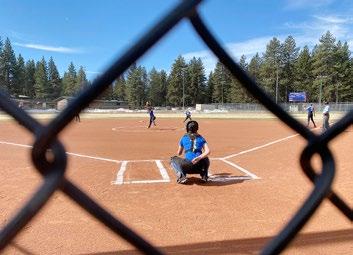
Measure G would provide funding to maintain local ballfields.
preserving and protecting various recreational assets. Measure S expires in 2030.
Measure G would continue this funding through 2060 with a yearly tax that starts at a maximum of $18 per residential parcel, depending on property type, and increases up to two percent annually. It would bring in approximately $645,000 every year.
Instead of building more facilities,
Measure G would provide for the main-
and maintaining the pickleball courts and other recreation amenities at Tahoe Paradise Park. “It isn’t about promising some big, grand capital improvements, it’s about continuing what we already have,” said key proponent Nick Speal. “It’s not a new tax.”
Though the money could not be spent directly on new recreational construction, having a dedicated funding source for maintenance and upkeep would make the
Organizations that would benefit from Measure G include the city of South Lake Tahoe, El Dorado County, the community playfields consortium and Tahoe Paradise Park.
So far, there is no organized opposition to Measure G nor even much negative feedback, informally. Organizations that have endorsed Measure G to date include the Tahoe Chamber, the South Tahoe Alliance of Resorts, the Lake Tahoe Bicycle
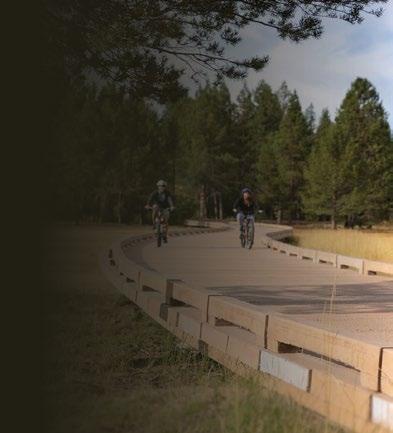
Making sure bike paths stay clear in the winter is one aspect of the
initiative.
community eligible for various grants for building even more bike paths said Speal. “This has already been happening. We’ve seen tremendous improvement in the bike path network.” Passage of Measure G would allow the community to pursue additional funding to expand the matrix. If Measure G doesn’t pass, said Speal, the community would see a “serious decline in what we have come to value.” Facilities, fields and infrastructure could degrade to the point where they pose a safety hazard, said Speal. For instance, said Speal, the freeze/thaw cycle creates potholes that if left unrepaired, will lead to a breakdown in the pavement that would render bike paths and other surfaces unusable and dangerous.
Coalition, the Meyers Community Foundation, the South Tahoe Futbol Club and the South Tahoe Quarterback Club. The measure needs a two-thirds majority to pass
Next year South Lake Tahoe’s sales tax could increase to 9.125 percent from 8.75 percent.
plish is good. Our board and district has not taken an official stance because we are very conscious of any tax increase to the public,”
This is because Marshall Hospital in Placerville is in the process of collecting signatures to place a measure on the November ballot that would raise the sales tax
Lake Valley Fire Chief John McNamara said.
The county board of supervisors also has not taken a position. County officials
rate by three-eighths of one percent in every community in El Dorado County.
Like the majority of hospitals in California, Marshall is facing a 2030 deadline to seismically retrofit its facilities in order to comply with state regulations.
Barton Health would receive zero dollars from this proposal.
“While Barton has no official position on the initiative, we recognize and respect the importance of emergency preparedness, wildfire mitigation and health care modernization across the region,” Barton spokesperson Mindi Befu said. “Barton is addressing our community’s need for modernized health care services and seismic upgrades by proposing a new hospital at our Stateline campus. Barton intends to fund this project through direct investment and philanthropy.”
To make the tax proposal more palatable to the entire county and not just those who go to the West Slope medical facility, Marshall plans to allocate a portion of tax proceeds to all 13 fire agencies in the county.
However, neither the South Lake Tahoe City Council, which approves the city fire budget, nor Lake Valley Fire Protection District has endorsed the measure. The council has not requested it be on a future agenda.
“What Marshall is trying to accom-
are waiting to see if this passes before determining the administrative impact.
The El Dorado County Fire Chiefs Association supports it.
The plan is to sell bonds so Marshall, the largest private employer on the West Slope, can raise the $125 million it needs to complete the necessary upgrades. This would be done in three stages: $75 million in first quarter of 2027, wait three to four years, then $25 million, with the remaining $25 million in another handful of years.
Even though the bonds will be staggered, the sales tax hike would end in 2027.
“Based on conservative estimates modeled by our financial experts, El Dorado Ready will generate approximately $13 million in the first year and grow to approximately $30 million annually by the measure’s sunset date,” Maia Schneider, executive director of business and strategy development at Marshall, said. “In total, the initiative is estimated to provide over $600 million in new dedicated revenue for emergency preparedness and wildfire prevention over the 30 years.”
Revenue must first be used to make payments to cover the bond debt. If the sales tax is less than projected, the bond indebtedness is not in jeopardy, but all other beneficiaries could be. Schneider, though, doesn’t foresee that scenario happening.
Dollars flowing to fire departments
will be based on the number of engine companies each has. Over the course of the initiative’s lifespan, South Lake Tahoe Fire is projected to receive nearly $36 million, Lake Valley almost $24 million and Fallen Leaf Lake about $12 million.
Schneider says funding entities for the fire departments will not be able to do to a shell game of sorts by pulling back dollars and letting this new revenue source replace what’s already the norm.
“We drafted language so the funds can’t be redirected or supplanted. They can’t take away existing funding streams,” Schneider said.
If this passes, starting next year, people would pay about four cents more on every $10 or 38 cents on $100 of goods bought in the county.
“On average, most households spend
about 20 percent of their income on taxable purchases. With the median household income in El Dorado County of $106,000, the typical county resident would pay about $5 per month,” Schneider said. “Note that essential purchases such as groceries, prescriptions and diapers are examples of essential items not subject to sales tax. Visitors will pay their share, also. An estimated $1 out of every $3 in sales tax in our county is paid by someone living outside of the county.”
The base sales tax rate in California is 7.25 percent. The maximum it can be is 10.25 percent. This new initiative would leave South Lake Tahoe 1.125 percentage points if it were to propose a sales tax initiative of its own like it did in 2020 when voters agreed to raise the rate from 7.75 percent to 8.75 percent.
Photo Provided
Measure G
Photo Provided
Like most senior citizens, I’ve been spending a lot more time with pigeons. And as much bad press as they get, pigeons have more in common with us seniors than we realize. To begin with, we both like parks and people who throw free food at us. And even though pigeons are classified as an avian species, they’re actually considered dinosaurs, like us. And we both have skin tissue resembling dinosaur scales.
True, we can be a health hazard. Pigeons, and some seniors, are rumored to have waste droppings linked to 60 transmittable diseases, with enough acid content to erode stone, metal and LaZ-Boy recliners. And though pigeons are rumored to cause urban decay, we are the symbol of human decay. We both like to gather in flocks for protection. While pigeons carry messages over great distances to a specific location, seniors carry verbal messages doing their errands around town. To the pigeons’ credit, they’re not easily distracted and seldom get
Message delivered
lost, whereas seniors eventually find their destination, but then forget the message.
And pigeons were again in the news this week, specifically in a New York Times article titled, “What you have in common with a pigeon and why it’s a problem for you.”
Let me break this to you gently. Humans and pigeons are so preoccupied with shiny, buzzy things, that we neglect the things we really need. The good news is, rats also are obsessed with flashy things, so we’re not alone.
Long before scientists started drinking the contents of their test tubes, they made a discovery. Pigeons in a long box quickly learned that a flashing light at one end signified the appearance of food at the other end of the box. The flashing lights became the signal for reward, like the drive-thru lights at McDonald’s.
Shockingly, upon arriving at the pick-up window, the pigeons ignored the fast-food buffet. Absorbed by the flashing lights, they preferred to sit in a box with long
lines and complain. Again, similar to McDonald’s.
Faced with this same experiment, humans aren’t as silly and shallow as the pigeons, pecking at lights that tease with the promise of gratification. Being a more advanced species, we carry those lights with us wherever we go. They’re called cell phones. And we peck and tap at that flashing screen incessantly, hoping for the dopamine fix of social interaction rather than being forced to eat alone in the dark confines of a box or car. Or boxcar.
Although our behavior appears as bizarre as the pigeons’, it’s not. Because we are humans.
Bizarre behavior is expected and considered normal.
This same phenomenon was
noted by the late social scientist, Hugh Hefner, who discovered that most men would rather look at pictures of 25-year-old women than ask them for directions. These experiments were performed over 50 years ago. But now we know. Our cell phones barrage us with bells, chirps and buzzes to signal the potential for human interaction. Yet, like finding something edible at a fastfood restaurant, it rarely happens.
I recklessly sought human interaction last fall by joining some friends for a senior camping and bike trip. Within 50 yards of camp, we were lost. Straddling our bikes, stabbing at our phone screens furiously. With conflicting phone maps, we were swerving into traffic, eliciting hand gestures from drivers who felt the need to relay their feelings to us. Meanwhile, those of us in this senior posse, confused by our phones’ multitude of directions, were wishing we had a paper map, or even a globe, in our pocket. Finally, to avoid being roadkill, we were forced to
put down our phones and actually talk to each other to find our way back to camp.
There, in a pigeon-approved flock, we gathered around the campfire. And we officially had social interaction, combined with fermented liquid in a box. Which is better than in a test tube. Just ask the pigeons. And that’s something your cell phone won’t give you, no matter how much you punch and threaten it.
We spent the evening sharing stories and laughing at corny jokes, as they’re the only jokes seniors remember. High on dopamine, we were happy to be together. And that’s the real message.
PS: For readers under the age of 65, a globe is a spherical model of the world’s surface. It can be located at your grandparents’ house or an antique shop. Which is often the same thing.
Green Waste Season is Back!
Goodbye Gantt!
We’ll miss you!
It’s been a great ride. I’ve really enjoyed writing this monthly column for the past 12 years, but it’s time to pass the torch.
That’s right. If you’ve got funny anecdotes to share about raising kiddos in the mountains, please reach out to Heather and let her know that you’d like to be considered for writing the next Tahoe Dad or Tahoe Mom or Tahoe Something column for the Mountain News . I can’t promise that you won’t occasionally receive some potent hate mail, but I can promise that you’ll be happy to record some of the misadventures and craziness that result from raising children in a place where bears roam neighborhoods and the wild all around us is just as instructive as a chore chart.
I started writing for lots of reasons, but part of it was to give something to this wonderful community in South Lake Tahoe, even if all I offered was an occasional laugh or acrimonious opinion. But, it’s time.
We’re getting older. Wifey recently had a hysterectomy and we both had MOHS surgery on our faces.
“That’s quite the setup you’ve got,” I comment after checking out Wifey’s side of our bed.
“I call it my Pillow Palace.”
“More like Pillow Fortress,” I laugh. “The doctor really said six weeks with no sexy time?”
“That’s right. My pillows will
protect me.”
Wifey’s MOHS surgery is right in the middle of her forehead and suspiciously aligned with a childhood scar that her millennial surgeon asked about. Wifey said that she was Gen X and was unsupervised as a child and walked into an active muffler at three years of age. The younger doctor responded with, “Oh, I see.”
The MOHS scars are gnarly, but I feel oddly proud of the band-aid across my nose. It’s a symbol of more than just inattention to sunscreen or not wearing the right hats; it’s a hallmark of life in high altitude. I’m glad to have it done and I don’t regret the experiences that put the cancer there in the first place.
Our kiddos are getting older, too, looking at colleges, getting driver’s licenses, and using debit cards.
“Don’t we feed them?” Wifey ponders while scrolling through their Taco Bell purchase history.
“Apparently we don’t use enough preservatives and colorful packaging,” I respond.
“Oh, I see.”
Sharing family events and challenges, like Covid chicken farming or bicycle protests, has been wonderful.
Writing is cathartic and has helped me as a father and us as a family to process our emotions after loss or pain, celebrate events and joys, and be open with the community that we call home. South Lake Tahoe is unique. We are a mountain town vibrantly full of working and middle-income real people with real struggles and real lives. While many mountain communities around the country have been vaporized by obscene wealth and overtourism, South Lake Tahoe has preserved its gritty and glorious identity, and I feel incredibly fortunate to contribute to this beautiful place in the world.
One of the reasons that I’m stepping back from writing this column is that I’m planning on running for city council and I should not have the platform that the Mountain News provides if I am seeking public office. It’s been great, but I feel like it’s time for a different sort of involvement in the future of South Lake Tahoe.
Gantt Miller – Just a guy, lucky enough to live, work, play, and contribute in South Lake Tahoe. www.behmbooks. com and mcbehmbooks@gmail.com
Photo Gantt Miller
Time for a change
“Transition: passage from one state, place, stage or subject to another: change” (Merriam-Webster Dictionary). It is that time once again, sort of! There are those who would say there isn’t anything to transition from, since winter never got real. Oh yes, there was a whole lot more whining going on this winter than normal, but there were a whole
lot of folks out enjoying it for everything they could squeeze out of the meager snowpack, too. But yes, it is that time when we transition everything from our car tires to our clothing; our clocks change, the critters in our yards change, but most importantly…
our toys change. It’s exciting, fun and sad all at the same time; more than that, it is also really hard on our toys.
I say this because so often it works like this. It is the last couple of days in March. We head out to Carson Pass for some backcountry skiing. Getting started, we walk on a bit of dirt, snow, mud, put the skis on and ski the rest of the day. Really good corn snow, exciting steep lines, we hit a few rocks here and there, slide over some dirty snow once or twice, slog back to the parking lot, big smiles and happy dogs.
The gear has basically been abused so we could be amused and then leaned against the wall dirty and left without any attention at all, not even a thanks for making the day so wonderful.
The very next day after work I pull my mountain bike out and take the dog out for a couple of hours. Guess what? Mud, snow, sand, fun. Put it away wet
and dirty because it’s late and I’m ready for a beer. It is what we do, right? Abuse our toys and keep right on going, then a week later we are baffled by that obnoxious noise the bike keeps making, just before it breaks! It's bad enough in the middle of the season, whichever one it is, when we run ‘em hard and barely manage to take care of that one toy well enough. Now it is transition season and we may be running several seasons’ toys all at once and really not taking care of any of them at all. This is when it gets tough on our toys. The problem is that you are sitting there on the couch, feeling all sad that that season is over and the new one hasn’t started yet, feeling all sorry for yourself ‘cause you never got that epic pow day. Well, get over yourself, spunky! Didn’t mom always say, “Go put your toys away?”
What she really meant was take a damp rag and wipe all that late season grit off your skis and out of the bindings. That stuff is really hard on bases and just like any other mechanical thing, grit gets into the bindings and will begin to grind the moving parts to death. The same goes for the boots. Get the buckles, the cuff and the soles clean. Of course,
Report: SLT Airbnb owners cashing in
South Lake Tahoe is one of the best places to own an Airbnb when it comes to daily profit margin and how many rental days it takes to cover a mortgage, according to a recent study.
even higher—$845 median, about $714 net daily profit—but so is the cost of capital—$280 per day in mortgage payments—leaving investors with an estimated $434 daily margin.”
Also in the Top 10 for highest daily profit margins are Mammoth Lakes, No. 4 at $385.27 and Truckee, No. 8 at $251.66.
lucrative mountain towns for Airbnb owners, where the Western U.S. makes up the majority of mountain towns where Airbnbs may be more difficult to turn a profit,” the study concluded.
When it comes to the number of days needed to cover the median monthly mortgage payment, South Lake Tahoe needs 5.96 days; this is second to Jim Thorpe, Pa., at 4.35 days.
ernment regulations, or supply and demand.
South Lake Tahoe has had a yo-yo approach to short-term rentals rules, with new regulations becoming effective this month.
some P-Tex work, edges and some fresh wax would be awesome too. The bike is waiting too, all gritty and dry — yuck! I know it is tempting and so easy to just hose it off, but it isn’t good for the bike. That hose forces too much water into the cables, the small drivetrain parts and even though they are sealed, the bearings will take some water in too. It’s the same story: a rag and an old toothbrush are very helpful. Clean all of the drivetrain, gears, chain, derailleurs. Clean around the seals of both front and rear shocks, and if it is full suspension, the pivot points on the rear swing arm need a little love too. A bit more time consuming, but it really goes a long way to making your bike happy. Then don’t forget to put a good quality lube on the chain and shazaam, happy bike!
Soon enough, we will be out of the transition and the sticky yuck factor will be gone. We won’t be having FOMO (fear of missing out) because we won’t be wondering if we should have gone for that one more corn run — how boring. Let’s play!
“South Lake Tahoe leads the list with a $711 median nightly rate and roughly $601 in daily profit after the platform fee, against a $119 daily mortgage payment. That works out to be $481 in daily profit margin,” the study says. “Park City, Utah, isn’t far behind. Its nightly rates are
Sera Capital analyzed about 9,000 Airbnb listings in 50 popular U.S. mountain towns. Median nightly Airbnb rates minus fees were compared against estimated daily mortgage costs based on local home values, a 20 percent down payment and current interest rates.
Sera Capital specializes in exit planning for people selling highly appreciated real estate, businesses and concentrated stock positions.
“Generally, the Eastern U.S. is full of
The company used $635,000 as South Lake Tahoe’s median home value, a $3,581 monthly mortgage, and a median nightly rental of $711 to come up with the 5.96 days.
The least lucrative town in the study, Big Sky, Mont., needs 26.48 days.
What the study doesn’t take into consideration are the actual expenses to operate a successful Airbnb, like cleaning, insurance, repairs, wear and tear, utilities, snow removal, and so much more depending on the property.
Nor did it consider permit fees, gov-
Seth Dallob posted earlier this year in the Facebook group Tahoe VHR Club: “Congratulations on SLT creating a system where even high performers can't make a 3 percent mortgage work. The only winners are my house cleaner and the city.” His plan was to put the house up for sale.
Dallob isn’t the only short-term rental operator fearing the city allowing 900 vacation home rentals will saturate the market, drive down the nightly rate and make it a less than profitable endeavor.
Photo Gary Bell I want to ride that one!
One, Two, Three
Well, the Oscars have come and gone and went mostly as expected, so this month I thought I’d write about some films that are a bit off the radar.
There’s a timely film from the 2024 Venice Film Festival called September 5 now out on Paramount. On September 5 during the 1972 Olympic Games in Munich, Germany, a group of terrorists called Black September raided the Israeli team apartments, killing two and taking nine athletes and coaches hostage. The Olympics were being televised live for the first time by ABC sports and as the hostage situation unfolded, they were the only ones able to cover the story live. They were a sports division, not a news division, yet they had to capture the story and send it out to the anxious public.
The film covers the moment the story breaks in the predawn hours, and the crew that has been getting ready to cover another day of Olympic events has to scramble to try and get footage of the situation and information about the evolving story. Most of the film takes place in the Munich offices and control room of ABC. What really strikes you is seeing how things worked in the days before the internet, cell phones and dig-
ital media. Everything was film, tape and analog communication.
ABC Sports’ president Roone Arledge communicates through phone calls and walkie talkies to the control room. Peter Jennings, the one actual news reporter they have with them, slips into the compound and reports over a phone line with smuggled film footage taken back to the studio to be developed, edited and put on the broadcast.
The entire film is caught up in the fast, hectic pace, with everyone outside their comfort zone, trying to think on their feet. There are no backstories, no exploring character relationships and it is almost documentary in its style. Actual footage from the original ABC broadcast makes it even more authentic.
Overall, September 5 is a tense chronicle of a tragic event from history, which puts you in the midst of broadcasters trying to do their best. Teresa also thought this was a great film.
There’s a film that was a hit at Sundance last year and is now on HBO called Sorry, Baby, which focuses on Agnes, a literature professor at Fairport University, a liberal arts college in rural Maine. She lives alone with her cat Olga and leads a quiet, unassuming
life. When her former roommate Lydia visits her, we discover that something bad happened to Agnes some four years ago and still leaves its shadow on her.
The film is divided into five chapters, each one devoted to a year. It begins with Lydia’s visit where Agnes finds out Lydia is pregnant. Lydia and Agnes are still best friends and they re-connect with some fellow grad students over dinner where tensions still exist between Agnes and another former student, Natasha (and we’ll find out more about that a bit later).
The film then jumps back to when Agnes and Lydia were roommates during grad school and we find out the bad thing that happened to Agnes. We don’t witness it as it happens and must wait until later to know the details. We follow Agnes as she tries to move forward and experience the callousness of both a doctor and the university as Agnes tries to find some kind of justice for what happened. The next chapters move her forward as her trauma begins to fade, but is never gone.
The film deals with that trauma in a candid, unpretentious way, with soft humor that isn’t overplayed and without any heavy Hollywood tropes. The characters
all fit the rural setting they live in and there are no big, dramatic moments, no climactic scenes or revelations, just Agnes, who is smart, pragmatic, funny and trying to get past what had happened to her.
Overall, Sorry, Baby takes a difficult subject matter and handles it with a light, delicate touch, exploring trauma in an honest relatable way.
A film made last year has recently been out on Hulu called Rental Family. The film stars
Brendan Fraser as Phillip, an American actor in modern day
Tokyo who has been spiraling into a long, dry spell. He sits in his apartment and in a tribute to Rear Window looks out across the other buildings, watching other people’s lives.
After seven years living by himself, he struggles to find purpose until a chance meeting lands him an unusual gig, working for a Japanese "rental family" agency, which provides actors to play stand-in roles for real life people. The company hires actors to portray anything from wedding guests to estranged parents or romantic partners.
Initially Phillip finds it very difficult to be acting with people who don’t all know he’s acting, but as he immerses himself in his
clients’ worlds, he begins to form genuine bonds that blur the lines between performance and reality, creating a moral quandary. As he tries to keep the professional line between himself and his clients, he begins to rediscover purpose, belonging, and the quiet beauty of human connection.
The film’s general plot tends to be rather formulaic, especially with a mother and young daughter, where Phillip is asked to play an absent dad. But when he is hired to play a journalist writing a biography of an old Japanese film star who is losing his memory, the relationship, though still formulaic in action, gets to a more interesting level, which surrounded by the Japanese culture, moves it beyond its formulaic plot.
The film has a soft and easy approach to the action, taking time in moments, both humorous and heartfelt, with Fraser being the perfect actor for Phillip. His sensitive compassion shows through his slightly awkward American. Overall, you could say that Rental Family is a bit overly sentimental, but it still works as a gently pleasing comedy/drama that reaffirms your faith in humanity.
Photo Seachlight Pictures
Brendan Fraser takes a job as an impersonator in Japan in Rental Family.
from page 21
cialized software to remain compliant with state and federal regulations. The teams at the schools prepare the meals. Each elementary has two employees, STMS four and STHS five.
and breakfast sandwiches with pork sausage, egg and cheese are popular breakfast items.
He said the mandarin chicken he was watching the kids grab is a lunch favorite, as are chicken tenders, chicken sandwiches, hamburgers, teriyaki beef and pizza.
Starting with the 2022-23 school year, California began offering free breakfast and lunch to all students, thus eliminating the income requirement. It was the first state to do so. Miller says this change resulted in a one percent increase in participation.
Overall, about 20 percent of LTUSD students eat a school-provided breakfast, while 46 percent participate in the lunch program.
No students have volunteered to pay since the free program was instituted. Adults, though, must always pay.
The food services expenditures for this school year are budgeted at more than $2.3 million. However, it’s likely the department will be overbudget due to a roughly 17 percent spike in food costs this year, according to Miller. Even so, the state and federal government is responsible for covering the expenses of the meals.
So, what do the kids think? Multiple school sites would not allow the Tahoe Mountain News to speak with students during lunch, so we were unable to find out.
Fernando Gallardo, STMS food supervisor, said bagels with cream cheese
Two classics
Photo Hearher Gould
Jim Schmit with a one of only 18 Dorval Shadows which he is donating along with other memorabilia to the Tahoe Paradise Park.
Photo Kathryn Reed Tammy Miller is director of food services for Lake Tahoe Unified School District.