Well, maybe not in Tahoe. We take a trip to El Dorado County's West Slope to check out its wineries and see how the local industry is faring in the wake of various challenges.
a look inside
Since Unlocking the Mayor's chosen few Peggy The courage of their convictions Gary Snow Syntax a look inside
Photo Kathryn Reed
At Boeger Winery, a riot of wildflowers adorn its vineyards.
Serving Lake Tahoe’s South Shore Since 1994
Groceries,
PRODUCE
One
NUTRITIONCENTER
Complete
Over the years, I like to think the Mountain News has made a difference. We’ve always taken the news (if not ourselves) seriously and believed local issues deserve quality coverage. We’ve asked the hard questions and reported on tragedy, corruption and inequality in our pages and prompted important conversations, change and awareness. It’s not always fun or easy, but we feel it’s important, and that’s why we do it.
Just as we were going to press, I was contacted about a difference we made in someone’s life that was a lot more uplifting. In 2000, a local Tahoe musician, Darin Talbot, released an album entitled Tahoe Backcountry We wrote an article about the album and about Talbot with the headline “Tahoe’s Jimmy Buffet.” (Yes, we omitted the additional “t” in Buffett’s name. I’m gonna blame that one on Paperboy.) Well, our headline lit a spark in Talbot’s mind and he later developed a Jimmy Buffett tribute act under the title Becoming Buffett, which he now performs at venues around the country. It’s nice to hear the role we played in Talbot’s success — even if
it was just a headline — and we’ll be revisiting Talbot and where he is today in an upcoming issue. Look for it.
Back to important conversations. This past month, I was contacted by people unhappy with our coverage of this story or that. On particular issues, some people felt we went too far, some felt we didn’t go far enough. I always value reader feedback. We print stories and columns and spread them throughout the community, so I think it is incumbent on us to listen to people who disagree with what we say. I am always willing to discuss our reporting and coverage and why we chose to approach an issue from a particular angle or why we chose to include certain information and not other information. (We have limited space and can’t always print every detail, so we have to evaluate what to leave in and what to leave out.) Readers should feel free to get in touch with questions, criticisms and perspectives. It helps us fine tune our coverage regarding what is important to the community. I generally try to hear everyone out, including critics, and while I understand emotions can sometimes run high,
leading to passionate reactions, I am less likely to engage with those who are insulting, disrespectful and who seek to spew vitriol rather than engage in dialogue. We always aim to report fairly, honestly and ethically and I think we largely succeed, but are always open to reader input. This month, we take a look at some under-the-radar issues in town. Kae Reed’s survey of alcohol consumption locally shows Tahoe is still a party town and a look at the LTCC Duke Theatre renovations asks if it can continue to fulfill its original purpose as well as meet the larger needs of the community.
We have all our favorite columnists, as usual, writing about snow and more snow, (Gary and Mike) tropical getaways, (Trish and Tahoe Guy), the latest on the Measure T lawsuit (Peggy) and screentime recommendations (Dave).
It’s an ever-changing mix in our pages. Enoy this month’s cocktail! -Heather
Behind closed doors
On January 13, three council members (David Jinkens, Keith Roberts and newly appointed Heather Horgan) directed the city attorney in closed session to present legal opposition to the court against the appeal of Measure T by the Tahoe Neighborhoods Group (TNG). They decided to keep their decision a secret by having the city attorney state in open session that there was “no reportable action.” Their cover-up was discovered three weeks later on February 6 when the court notified the TNG of the city’s opposition filing. The backlash came at the February 10 city council meeting where members of the public took the council to task for violating the public’s trust with their lack of transparency and willingness to deceive the public.
What were Mr. Jinkens and Mr. Roberts even thinking when making a bonehead move like this with so many eyes on this case? If they believe opposing the appeal is justified, they should have the courage to defend that decision publicly. It was Ms. Horgan’s first full meeting, and she jumped into the fire with both feet. Since Ms. Horgan lacks any elected governmental experience, one might be willing to excuse her rookie move, except that she stated in her job interview that she would bring
“integrity, competence and steady leadership to the city.” While the jury is still out on those claims, Ms. Horgan has announced her plans to run for city council in November.
I suppose we shouldn’t be surprised when public officials fail to act with integrity. Once some people get a little bit of power, they start believing they are the deciders and voters no longer matter. That may work in the short term, but when they face reelection, the voters become the ultimate deciders.
The council is currently debating how many VHRs to allow in the neighborhoods with no buffer and no regard for residential zoning. Two questions: What else has this council hidden from the public and should Jinkens, Roberts and Horgan decide if people’s neighborhoods are going to be used for tourism expansion when the voters have already said what they want? No VHRs.
THE APPEAL
Measure T was enacted into law in 2018. The SLT Property Owners Group
(Bob McIntyre, Mark Salmon, Duggan Smith and others) sued the city, saying Measure T was unconstitutional. The Measure was successfully defended as constitutional by City Attorney Heather Stroud for six years until one piece of the measure was found to be unlawful. Because the judge did not allow the severability clause provided in Measure T to stand, the entire measure was overturned. The appeal will ask a higher court to reconsider the lower court’s decision on severability in order to allow the rest of the measure to be restored.
Despite legal maneuvering and attempts to have this case dismissed by three members of the council and the SLTPOG, the appeal is moving forward on behalf of the voting majority who passed Measure T. On December 31, the SLTPOG submitted a Motion to Dismiss the appeal. On January 7, the TNG submitted its Opening Brief to the appellate court. On January 14, the TNG responded to the Motion to Dismiss and on February 11, the appellate court officially denied the SLTPOG’s motion. The SLTPOG has until April 7 to respond
to the Opening Brief and then a trial date will be set.
COMING SOON
More than a decade ago the city invited the community to explore the idea of a new recreation center with a possible budget of $30M. In 2016, voters approved a two percent increase on Tourist Occupancy Tax (Measure P) to provide a funding source. Now, nine years later, the doors are about to open on the city’s largest and most costly ($82M) municipal building. At approximately 65,000 square feet, the annual utility costs alone are estimated to be $550,000.
The value of a ginormous steel structure with a swimming pool and a gym that becomes a gathering place for families, young adults, and active seniors to find connections and a shared sense of community pride is elusive but likely priceless. Let’s hope we avoid becoming a place where pickleball players go berserk over a line call, swimmers complain about the pool temperature and drivers display road rage when they can’t find space in the too-small parking lot. Anticipation is building.
To be continued….
“What’s up with all the keys to the city being handed out lately?”
—South Lake Tahoe resident
South Lake Tahoe, which has been an incorporated city since 1965, has given out three keys to the city, all in the last few months and all to white men.
It wasn't until December 2024 that the city council put the “key to the city” program into its protocols. During his first term as mayor, Cody Bass brought forward the idea of a key to the city program.
“It is a good record of great people who have served the town or visited the town,” Bass said.
Recipients include Dave Stevenson, former police chief; Tom Davis, former council member and mayor; and Joe Irvin, former city manager. Stevenson and Irvin received their keys at their last council meetings, while Davis, who is experiencing health issues, received his in January outside Barton Health facilities.
Bass expects more people to receive a key while he serves out this one-year
could have been such an individual up for consideration for a key.
term as mayor. At the same time, he does not want to dilute the significance of the honor by handing out keys on what could be considered a regular basis.
“It is part of the mayor’s authority,” Bass said of who gets a key. “It’s definitely on behalf of the City Council, but it is at the mayor’s discretion.”
With the position of mayor usually changing on an annual basis, it will be up to that person to designate who, if anyone, gets a key during his or her term.
While the honor so far has gone out to people who were directly involved in city government, future honorees could be a contributor to South Lake Tahoe in some other way. Bass said someone like the late Lisa Maloff, who gave millions of dollars to various entities on the South Shore,
The criteria to receive a key is a bit subjective. The city’s protocols say,
“The key to the city honors distinguished persons, honored guests and outstanding civic contributors to the city of South Lake Tahoe. The mayor shall administer the key to the city. The mayor, or their designee, shall present the key to the city to the recipient at an appropriate function and report back to City Council at the next regular meeting under council member reports.”
In other words, a public ceremony is not guaranteed.
Each of the gold keys costs $34.
“City of South Lake Tahoe” is engraved on the shaft, while the circular top is the city’s logo.
Irvin, who left the city last month
to take on the same role in Malibu, was selected by Bass because of what he brought to the city and all of the obstacles he navigated during his tenure here.
“Joe Irvin in his six years with us gave a lot to the city. He brought change to our culture, our staff,” Bass said. “We went through some of the hardest times in the city’s history—Caldor, Covid, the 50year snowfall and an embezzling mayor.”
Bass singled out Davis for being instrumental in the Heavenly Village redevelopment project, including the gondola, as well as his history with what was Sahara Tahoe and is now the Golden Nugget casino.
It was now-disgraced and admitted embezzler Tami Wallace in her tenure as mayor last June who presented the key to Stevenson. The proclamation he received in part says, “The city of South Lake Tahoe recognizes and celebrates the invaluable impact of David Stevenson’s service, leadership, and recognizes the immeasurable value of three decades of public service, which have left a lasting
impact on generations of residents which will be remembered for years to come.”
At the March 31 council meeting, policies and procedures are expected to be on the agenda. It’s possible any updates or changes to the key initiative could be discussed then.
Anyone wanting to nominate a recipient may email Bass at cbass@ cityofslt.gov.
GOT A QUESTION?
Email: mountainnews2@gmail.com
Mail: P.O. Box 8974, South Lake Tahoe, CA 95618.
Tom Davis Joe Irvin Dave Stevenson
Councilmember, Clerk erupt over cellphones
About 40 minutes into the Feb. 24 meeting of the South Lake Tahoe City Council, Mayor Cody Bass was speaking on an item with the camera trained on his face. Background audio captures the beginning of an unfolding conflict between Councilmember Scott Robbins and City Clerk Sue Blankenship. It is difficult to make out the exact conversation, as Bass is still speaking, but it goes something like this: Robbins: “Stop taking pictures.” Blankenship: “... going on your phone ...” Robbins: “Excuse me, you don’t take pictures of ...” Bass hears the conflict, calls a recess and the screen goes blank. What followed according to Blankenship, was Robbins yelling at her in heated, minutes-long exchange in a side room.
Blankenship laid out the issue this way to the Mountain News: “Scott recently moved to sitting next to me and every single council meeting he’s scrolling on his phone. It’s against City Council protocols. I have reminded him numerous times it’s not allowed.”
Blankenship said she finally pulled out her phone to record Robbins on his phone. She said she didn’t have any particular purpose in mind, but just wanted to document Robbins’ behavior. “I just wanted to have a record of it,” she said.
“I have sat next to (Councilmember)
Keith Roberts, I have sat next to (former Councilmember) Cristi Creegan, I have sat next to (former Councilmember) Devin Middlebrook and (Robbins) is the only one who has been on his phone doom scrolling.”
Blankenship explained the City Council protocol prohibiting cell
phone use during a meeting this way:
“Councilmembers are supposed to be paying attention to the meeting. It’s also to
prevent them from conspiring with another councilmember surreptitiously or obtaining information other councilmembers don’t have that could sway their judgment, and other councilmembers and the public aren’t aware.”
Robbins told the TMN he is in fact checking information on agenda items and information presented. “It’s part of my responsibilities as an elected official to fact check staff reports and claims made by callers. The idea that staff is the only source of information is not appropriate I feel,” he said.
Robbins said recent items he has fact checked include whether corrugated metal culverts or reinforced concrete culverts have a longer life expectancy and whether Mountain Postal in fact offers financial services to people who otherwise don’t have access to banking services, as was stated during a discussion about the city possibly providing such services.
Robbins says when he discovers relevant information online he shares it with the rest of the council and the public. Robbins said he does a lot of his fact checking on issues prior to the meeting, but sometimes questions or claims that aren’t fully addressed beforehand arise during a meeting.
Robbins said a provision of the Brown Act protects an individual councilmember’s notes and research from public dissemination, and Blankenship violated the law by filming him with his jottings and information visible.
Robbins said he knows going on a cell phone is prohibited by city protocols, but indicated such a provision is outdated.
“That’s the world we live in. We all go on our phones.”
He also feels singled out. He said
other councilmembers over the years have used their phones during meetings with no objections from Blankenship or anyone else.
“Clearly, this is not actually about enforcing the rules. They haven’t said anything about (Bass) having his laptop up there for seven years. Only me.”
Bass told the Mountain News he only uses his laptop to work through the agenda as he elects to receive his agenda electronically and not in paper format — “to save trees.” He said he’s no different than councilmembers who have a paper agenda in front of them.
During the outburst, Robbins also trained his ire on City Attorney Heather Stroud, who he said failed to speak up to advise Blankenship that filming him and his materials was prohibited under the law. Blankenship was critical of Robbin’s anger toward Stroud, as she is technically a subordinate of Robbins and berating an underling is not ok, according to Blankenship. “I can take the hits,” said Blankenship, since she herself is an independent elected official.
Bass said he will probably try to calm the conflict by moving Robbins and Blankenship away from each other but didn’t contemplate any further action at this time. A few years ago, Robbins and former Mayor Tamara Wallace were separated on the dais as they also failed to get along when seated together.
Asked whether he let his temper get the best of him, Robbins said no. “I don’t think I was too angry. I was the right amount of angry.”
The death of due process
Publisher’s note: This is one in a series of stories written about immigrants living on the South Shore.
If you have taken time to read the previously published columns sharing the experiences of immigrants living in our community, you may have observed that the immigration system in the United States of America is broken. This is nothing new.
Backlogs in immigration courts can span years. The application process is expensive and complicated, full of fraud and byzantine rules that only an Einstein can understand.
The southern border fluctuates between being “open” or “closed” with no obvious motivation by elected officials to make the compromises needed to fix the system. This is our norm.
The last time the immigration system was reformed in any meaningful way was in 1996 with the passage of the
due process look like? People who are protesting the unjust treatment of their neighbors are denied their right to peaceful assembly, and have faced jail, physical assault and death.
Children are swept up in these mass deportations. These innocent children are jailed, sometimes without their parents. They are held in conditions that can only be described as inhumane: filthy, with poor food, lack of health care, and no educational programs. Try to imagine the trauma.
some applicants will be waiting until 2030 to have their cases heard.
According to NPR, “The result is that courts across the country are starting 2026 with fewer than half the judges from a year ago as judges were fired, resigned or were reassigned. At least two courts—in Aurora, Colo., and in Oakdale, La.—have no judges left, just the court supervisor.”
The lack of due process afforded individuals on our soil, allowing the government to uproot hardworking people and innocent children from their homes, schools, and communities without providing the protections guaranteed in the U.S. Constitution is not only un-American, but also explicitly prohibited in our Constitution.
Illegal Immigration Reform and Immigrant Responsibility Act.
Since the 2024 presidential election, we have seen what the promise of “mass deportations” actually looks like. Cruelty and fear are the policy. The lack of due process afforded individuals on our soil, allowing the government to uproot hardworking people and innocent children from their homes, schools, and communities without providing the protections guaranteed in the U.S. Constitution is not only un-American, but also explicitly prohibited in our Constitution.
I call this the death of due process.
But what does the death of
Homes are torn apart by aggressive federal agents who break down doors, entering with tear gas and weapons drawn. There is no concern about collateral damage to innocent bystanders. There is no recourse or accountability for these actions when mistakes are inevitably made.
The latest symptom of the impending death of due process is the disassembly of immigration courts in America. Already choked with a backlog that numbers over one million cases, with many applicants waiting years for a court date, the Trump administration fired 100 immigration judges in 2025. Now it is estimated that
The court in San Francisco was the first to close, with cases moved to Oakland. The fear is that a further consolidation of immigration courts will result in justice that is not only delayed, but moved so far away as to make it inaccessible.
Adding insult to injury, the Trump administration has begun a hiring campaign that seeks to recruit “deportation judges” as opposed to the currently named
“immigration judges.” It seems the fix is in. The system is rigged, and our hardworking neighbors are caught in the crosshairs.
A recent government report showed that only 14 percent of the people detained in these mass deportation sweeps have a violent criminal record. Remember the promise to target the “worst of the worst”? Well, it seems there are simply not enough dangerous criminals to meet the quotas set by the administration for deportations.
Begging another question: In what world should we be using quotas for law enforcement? Shouldn’t deportations target those individuals who have actually broken criminal laws?
What can we do? Can due process be saved? Yes!
First, thank you for reading this article. Knowledge is power.
If you agree with the Fifth Amendment of the Constitution that “No person shall … be deprived of life, liberty, or property, without due process of law,” please get involved. Let your federal and state representatives know how you feel. 5calls.org is a one stop shop for information about how to contact your elected officials, and even provides information to help you craft a message about specific issues. I strongly encourage you to give it a try. Politicians hearing from their constituents is the way our country was built and one key way we can effect change. For more information about due process in America, check out the website represent.us. You can support their work to hold Congress accountable to the Constitution and to the people of America.
Scott Robbins Sue Blankenship
Wild DNA reveals information about the Tahoe ecosystem
DNA isn’t just a human trait associated with health/family issues or solving crimes. Scientists are also using it to better understand animals. They call it eDNA for environmental DNA.
“We can collect it from water or soil. It can come in different forms, so, skin cells and hair from humans, but when you think about fish or other wildlife, their mucous, feces or urine or gametes all have DNA,” explained Andrea Schreier during a recent talk hosted by the Tahoe Environmental Research Center.
Schreier is an adjunct associate professor at UC Davis and director of the Genomic Variation Lab at the university.
“We can learn what species are present at that location where you are sampling. We can do that because each species has unique DNA sequences that are not shared with any other species. We call these DNA barcodes,” Schreier said.
trapped at the bottom of this 1,645-footdeep body of water.
“So, we want to know if we take a water sample from the surface, can we detect things that live in deeper water or do we have to grab a sample of the deeper water to detect some invasive species that live down there?” Schreier said.
The study’s focus area will be marinas and boat launches because that is usually where invasive species are introduced.
On TERC’s boat, Francot will be able to take samples mid-lake and deeper with a specialized apparatus. Sediment samples may have a story to tell as well.
Once the eDNA is extracted, a PCR, or polymerase chain reaction, is used that can give a “snapshot of all of the species in an area.”
This process will also be able to detect if there are species in the lake previously unknown to scientists.
(DNA stands for deoxyribonucleic acid.)
She calls eDNA “exciting new technology.”
“You could take a sample at a location and ask what species live here? Do communities change over time in space? So you could sample in one location at different seasons of the year to see if different species are present at different
times or you could sample say along the length of a stream to see if the organisms at different points in the stream are different or if they're the same,” Schreier said in explaining what answers could be forthcoming. “What is a species eating?
So you can collect poop samples from the environment or swab parts of an animal's body to see what they have been eating. Has an invasive species entered an area?”
Schreier points to how eDNA collection is not invasive and isn’t stressful compared to when samples are taken after animals are trapped. This newer method can be more reliable than trail cameras, while at the same time costing less money. She admits it comes with flaws. Scat from a predator reveals another animal’s presence, but it doesn’t mean the prey was ever actually where the feces was located.
Researchers are also extracting eDNA through footprints. Spider webs have been used to discover critters in the area besides the arachnids.
In murky water where it’s impossible to see what all is living below the surface, eDNA techniques can be revealing.
Grace Rosburg Francot, who was born and raised in South Lake Tahoe, is a doctorate student of Schreier’s doing a fellowship at TERC. Francot and others are trying to determine the best ways to sample eDNA of the various invasive species at Lake Tahoe. This includes plants, fish, invertebrates and amphibians.
Francot was not at the talk because she just became a mom.
Lake Tahoe no longer mixes every year, which means some eDNA can be
Photo Provided
Andrea Schreier, an adjunct associate professor at UC Davis and director of the Genomic Variation Lab at the university, goes in the field for research.
Photo Provided South Lake Tahoe native Grace Rosburg Francot
Trevor Coollidge-Deangelis of South Lake Tahoe finished first in the Fresh Tracks 5K Snowshoe Race at Camp Rich on March 1. Samina Quidwai of Stateline took second place in the women’s division, while 71-year-old Jennifer Locke of South Lake Tahoe finished third.
The City of South Lake Tahoe Finance Department received the Distinguished Budget Presentation Award from the national Government Finance Officers Association for the 18th year in a row.
The El Dorado County Transportation Department is hosting a meeting on March 18 to discuss proposed changes to its Tahoe no-parking ordinance. The meeting will be held at Meyers Elementary School at 6pm.
Also on March 18, The Lake Tahoe Unified School District will be holding its State of the District event. The program will feature a meet and greet, interactive panels and keynote address by Michelle Trujillo, a national advocate for social and emotional wellbeing of children and how schools can contribute. The evening begins at the South Tahoe High School Student Union at 5:30pm. Refreshments and childcare provided.
“Our Revolution: Revolutionary War from a Black Soldier’s Point of View” will be presented in LTUSD schools this month, with a community presentation at LTCC on March 25, 6:30 p.m. sponsored by the local chapter of Daughters of the American Revolution. For more info, email jinibecktell@gmail.com.
A literary journal featuring local writers who live in or have ties to Douglas County and the surrounding area is being launched by Douglas County Public Library. Submissions will be accepted through May 31. Details at https://shorturl. at/YclcD.
Are you eligible for unclaimed assets from California Controller?
People and businesses in the Lake Tahoe Basin are owed thousands of dollars. All one has to do is file a claim with California’s Controller’s Office.
“My office is safeguarding more than $15 billion in unclaimed property, representing over 84 million individual properties waiting to be returned to nearly 39 million Californians. In these uncertain times, taking a few minutes to visit claimit.ca.gov could mean reconnecting you or your loved ones with money that’s rightfully yours,” Controller Malia Cohen said in a statement.
Monetary amounts range from a few cents to thousands of dollars.
Sierra Nevada Alliance in partnership with the League to Save Lake Tahoe is hosting community litter cleanups on the South Shore on March 27 and April 6. To learn more or register, go here: https:// shorturl.at/d5wgY.
South Lake Tahoe received a $15,000 check for participating in South Tahoe PUD’s turf buyback program for properties on Ski Run Boulevard, Park Avenue and Pine Boulevard.
South Lake Tahoe Friends of the Library (1000 Rufus Allen Blvd.) is hosting Bob Sweatt on March 24, 5:30 p.m. as he shares photos and talks about his wildflower big year
On March 17, Rotary Clubs of Tahoe Douglas and South Lake Tahoe will host a presentation at Bally’s focused on the global fight to eradicate polio, featuring an actual iron lung. The keynote speaker is David Gallagher. The $25 tickets, which include dinner, parking, and the talk, must be bought in advance: https://shorturl.at/ fZLUt.
In February, Douglas County commissioners unanimously voted to create a full-time licensed clinical social worker position within the Douglas County Sheriff's Office to staff the Mobile Outreach Safety Team with funds from the Nevada opioid settlement.
Tahoe Douglas Fire Protection District now has a chief and interim fire chief. Bryce Cranch moved up a rung from assistant chief/fire marshal even though Scott Lindgren is still on the payroll as fire chief until June.
One of the nine people who died in an avalanche near Truckee in February was backcountry guide Nicole Choo of South Lake Tahoe.
Take this survey https://shorturl.at/ GZy7h if you want to help South Lake
Tahoe form its economic strategy. `AARP Tax-Aide of South Lake Tahoe continues to provide free tax preparation for local taxpayers of all ages (not just seniors) at the Rec Center. Certified volunteers are meeting with taxpayers on Mondays and Thursdays from 10am to 2pm. Bring: photo ID (for adults on the return); Social Security/ITIN cards for everyone on the return; your complete 2024 tax return; and all your 2025 tax documents. Electronic documents must be provided as a hard copy or as a screenshot on your phone. Questions? Email SouthLakeTahoeLC@gmail.com.
The Tahoe Regional Planning Agency Governing Board adopted new standards for forest health and water quality, including a plan to treat 90 percent of forests around developed communities and along evacuation routes. It also approved the new Public Safety Training Complex at Lake Tahoe Community College and adopted new fees for its boat inspection program
The Cancer League has ceased operations after 40 years and is transferring its assets to Barton Health, earmarked for cancer treatment and patient services. Barton has plans for improved cancer diagnostics programs and providing chemotherapy locally.
The Lake Tahoe Community College Fire Academy was recently reaccredited by California State Fire Training. The Lake Tahoe Unified School District’s latest school accountability report cards are available at https://www.ltusd. org/schools/school_accountability_report_ cards__sarc_
The California Tahoe Conservancy’s most recent annual report is available at https://storymaps.arcgis.com/stories/064f8c12a6e541f397b0b3698d0236fb?utm_ medium=email&utm_source=govdelivery
The UD Davis Tahoe Environmental Research Center is hosting a talk entitled “Who Cares? Lessons on Parenting From Frogs” on April 2 at Sunnyside Restaurant and Lodge in Tahoe City. More information at https://tahoe.ucdavis.edu/ events/who-cares-lessons-parenting-frogs.
The nomination period for the Tahoe Regional Planning Agency’s Best in the Basin awards runs through April 30. The awards showcase projects throughout the basin that exhibit exceptional planning, implementation and compatibility with the Tahoe environment. Visit https://www.trpa. gov/how-we-operate/awards/#best to file a nomination in any one of the six categories.
South Tahoe High School’s production of “The Importance of Being Earnest” will be performed March 20-22 and March 27-29.
The Tahoe Art League is hosting a presentation by Dave Justice on March 19. Justice will share his personal as well as his artistic journey. Bring an appetizer or beverage to share. TAL Gallery, 5:30pm. Tahoe CERT Team (Tahoe Community Emergency Response Team) is offering a free Basic CERT Academy Training on April 28 and April 30 from 5:30pm to 8:30pm and May 2, 9am to 5pm (must attend all 3 trainings) as well as a 12hr. online hybrid training. Be prepared during an emergency or disaster to help yourself, family, neighbors & friends. Training includes disaster preparedness, fire safety, utility control, disaster medical operations, light search & rescue. To apply and for more information, email tahoecertinfo@ gmail.com
Got a community item for Heard? Email mountainnews2@gmail.com, subject line “Heard.”
It’s easy to look up a business— and it doesn’t have to be one that still operates—or an individual. The process to file a claim online is also straightforward. The real work begins after receiving a
• Tahoe Chalet Inn has five possible claims, four of which are from Groupon. The total is $2,256.57.
• Tahoe Keys Liquors could make 14 claims between Fiserv Solutions and Commonwealth Brands for amounts ranging from one cent to $108.72.
• Lake Tahoe Lodging Company could make three claims each valued at more than $1,200 from First American Title.
• The now defunct South Lake Tahoe Cancer League has rights to $2,000 from Caesars and $183 from Nonprofits Insurance Alliance of California. The state says the unclaimed property program was established in 1959 to ensure “businesses and other entities return property belonging to customers with whom they have lost contact. Common types of unclaimed property include forgotten bank accounts, stocks, bonds, uncashed checks, insurance benefits, and safe deposit box contents.”
More than $8 trillion in property has been returned through the years.
• Tahoe Wellness Cooperative has seven checks waiting for a total of $2,381.07, with the largest single claim of $1,714.71 from California Physicians Service.
El Dorado County's Top 100 cost taxpayers millions
El Dorado County’s mental health medical director is the only employee with a compensation package that tops a half million dollars.
The $513,889 total is up from a year ago when it was $495,784.12. Base pay in 2024 was $367,245, bumping to $380,655
in 2025. Included in the total is $1,000 annual lump sum, $55,725 in other pay, and $76,509 other benefits.
County Auditor-Controller Joe Harn in February released a list of the top 100 compensated employees based on salaries and benefits. These numbers represent a fraction of the county’s more than 2,000 workers last year.
Overtime is a huge expense for the county, with 38 individuals on the top 100 list racking up $1,618,520 just last year. All but a senior civil engineer works either in the sheriff’s or district attorney’s office.
Several deputy II sheriff’s positions are on the list. They have the lowest annual base salary of the top 100 at $111,693.
The mental health director ($380,655), psychiatrist II ($330,574) and county counsel ($301,430) are the three with a base pay in the $300,000s. The sheriff is close at $298,462; making him
The county’s CalPERS cost for 38 people on the list was $314,067 for 2025.
“The cost of each employee’s CalPERS benefit is included on the list, but the reported retirement cost should be reviewed with some skepticism,”
Harn said in the announcement. “CalPERS has intentionally understated the actual cost of its retirement programs statewide. Undoubtedly, higher costs for the county’s retirement program and retirees’ health stipend will need to be paid in the future.”
Photo Hall Creations
The Lake Tahoe Community College Fire Academy was recently reaccredited for another five years.
Malia Cohen
Mark Darling Painting
Ski-Presidents’-Holiday Snow-stravaganza
It happens, once in a great while, that the designated “President’s Week” off school in February actually coincides with what would have been “snow days” anyway. And boy, did it go that way this time.
A little history from one who started teaching here in . . let’s just say a while back. In school districts where I taught before moving up here, I saw variations of three- and four-day weekends around the presidents’ birthdays.
Part of the sales pitch to lure us up here was this magical week off school in February, which folks referred to back then as “ski week.” Now, I know many people still call it that, and some urban schools have such a week and call it that as well. But those are usually affluent, private schools where they can openly acknowledge both attributes by announcing that they’re all jetting off to exotic ski locales . or just to Tahoe.
But at some point over the years, folks in Tahoe became aware that it wasn’t the best idea to call it “ski week” any more — probably because it sounded too indulgent, privileged and bougie, which no doubt offended some people, and probably because we finally started to acknowledge that a large portion of our student body and community does not get to ski all week — or ski at all. Now it’s officially called “Presidents’ Holiday Break.” Sounds more patriotic and federally sanctioned that way.
Another interesting twist I noted back in those early years after moving here was how folks around the school district would justify the entire week off. I mean, let’s face it, some parents and others probably resented it, which caused some defensiveness for decision-makers. But the line we often heard was that whatever week it happened to fall on any given year was likely to receive the heaviest snowfall of the year and school would have been cancelled anyway . . likely, probably, surely . . maybe. So, it made more sense to just roll it in with the presidents, whom we all celebrate enthusiastically. And then from other sources over the years, we would hear a different twist on that reasoning — one that holds up better under scrutiny as it’s about school funding, which is based on “average daily attendance” or the Almighty ADA. This was the rationale that so many families were
School beat keeps officer busy
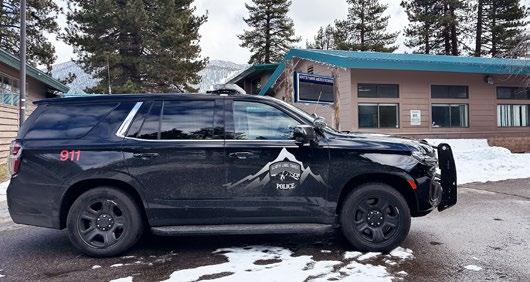
Don’t worry if you see a police car parked in front of a South Lake Tahoe school. To foster better community relations, a concerted effort is being made to
using the Presidents’ holidays to extend into full-week vacations already, so rather than get slammed by the drop in ADA, it made more sense to just sanction a week so everyone could go get their jollies without hurting the schools. Besides, the days get made up elsewhere in the calendar; that’s how it works when you have state-required instructional minutes (yes, not days but minutes — it’s quite the math challenge). This, by the way, is how the Thanksgiving break got stretched into a week as well, and it’s why we start in the August 20s and continue past mid-June. Again, the required minutes thing.
Don’t get me wrong: if it sounds otherwise, I’m not griping about the calendar configuration — other than maybe wishing we started later in Sept just because of how fantastic the late summer-early fall is in Tahoe. It’s just about trade-offs, none necessarily better than others.
And so back to this year’s Ski-Presidents’-Holiday Snow-stravaganza Week. If you’re anything like us, it got old by about Wednesday as the snow continued to come and most resorts were off limits, what with road closures, wind holds and still digging out. Yes, all of which we “signed up for” — something flatland family members will snarkily remind you during these times . . . right before they gleefully exclaim how great it is because of the “snowpack” that is so needed “for the state,” which is code for “so we can hose down the driveway whenever it gets a few blades of grass on it.”
But then, just when you’ve had enough, the storm passes and you’re left with those days that follow, and “bluebird” doesn’t go far enough to capture their majesty.
Happy hosing, flatlanders!
Now for a little Tahoe Knight Monsters update.
As of this writing, the Knight Monsters’ record is 26 wins, 21 losses and two overtime losses, placing them 4th in the Mountain Division, 6th in the Western Conference and 13th overall of 30 teams in the ECHL.
As always, feel free to email mikesmutterings@gmail.com
show up when not needed.
“First and foremost, my primary duty is to maintain the safety at the school site. The best way to do that is to be on a campus,” South Lake Tahoe Police Officer Tim Peterson said.
This is Peterson’s third year as a school resource officer. He goes to all Lake Tahoe Unified School District campuses except Sierra House and Meyers elementary schools because they are outside the city limits. El Dorado County sheriff’s deputies handle those schools.
Police Chief Jeff Roberson said if money were available, he would love to have more school resource officers.
could be because the individual couldn’t otherwise get help.
Peterson’s job isn’t traditional police work. His roles include therapist, counselor, friend, community liaison, and he attends events outside of normal school hours like athletic competitions.
In a report recently presented to the city’s police commission, Peterson mentioned three arrests in 2025 (calendar year, not academic)—which he said is more than usual.
SLTPD’s 2025 statistics at LTUSD schools
• South Tahoe High School: 37 reports, 170 incidents, 28 citations
• Mount Tallac High School: 3 reports, 47 incidents
• Tahoe Valley Elementary School: 2 reports, 23 incidents
• Bijou Community School: 2 reports, 26 incidents
Source: Tim Peterson, SLTPD SRO
South Tahoe High is where Peterson spends most of his time, the middle school comes in second, and elementary schools are on an “as needed basis.”
He investigates incidents on and off campus involving students. The latter
A 12-year-old girl at South Tahoe Middle School was taken to the juvenile detention center for reportedly resisting arrest. While that was the charge, another officer said that’s a mild description of her behavior.
A 17-year-old at South Tahoe High ended up in the same facility for allegedly repeatedly driving without a license.
The other incident involved an arrest on of an adult not involved with the schools—the victim, a student.
Most of the time Peterson can diffuse the situation, but when it escalates, students often receive a citation and referral to probation.
“This school year I’ve seen an improvement regarding vaping and gang associations,” Peterson said. “That could be for a variety of different reasons. It’s just not as prevalent. It’s still happening. It would be naïve and inaccurate to say vaping and gangs are not a problem. It still is.”
Incidents Peterson singled out last year include: a STMS student threatening and pushing him, a STHS student possessing a knife, a student using a pretend rifle to search rooms for a senior project, a dog attack off campus, and a parent attempting to fight a student on campus.
School fights, vaping and marijuana are the biggest issues Peterson deals with at STHS.
Students driving without a license— some as young as 14—was common until a parking permit program at the high school was instituted this school year. Permits are available to those who provide a driver’s license and proof of insurance. The permit comes with a designated parking spot.
A big issue Peterson and school staff are working on is e-bike regulations, with a focus on safety and laws. He was part of community conversation at STMS in the fall that led the school district to form an e-bike safety committee.
“They are planning on starting a pilot program this spring to see how that works and tweak it if necessary, and then fully roll it out in the fall,” Peterson said. In the mornings he finds kids arriving on bikes without helmets, riding double, and on e-bikes they aren’t legally supposed to be riding.
• Campus safety and law enforcement
• Safety planning and threat assessment
• Incident investigation
• Collaborative education
• Mentoring and counseling
• Community liaison
• Extracurricular engagement
Source: Tim Peterson, SLTPD SRO School resource officer duties
Photo Kathryn Reed
SLTPD Officer Tim Peterson parks his vehicle in a prominent location at South Tahoe Middle School.
Tim Peterson
EDC wineries in recovery
Wine sales are down, people are drinking less, publicly traded companies are suspending dividends, vineyards and wineries are on the market, tariffs are impacting the export market, grapes are rotting on the vine, entire vineyards are being uprooted and wineries are shutting down.
This is the state of the California’s wine industry, which produces more than 80 percent of the wine sold in the United States.
El Dorado County wineries are still recovering from the 2020 pandemic, smoke taint and lack of visitors following the 2021 Caldor Fire, and a double frost in 2022 that ravaged the crop. After that spring, Narrow Gate Vineyards had to rehabilitate 75 percent of its vineyard.
In the first two months of this year, four major California wine companies— Jackson Family Wines, Gallo, Folley Family Wines & Spirits (owner of Minden Mill Distillery in the Carson Valley) and Constellation—announced major layoffs.
The downturn isn’t supposed to begin reversing course until after 2027 or 2028, according to the 2026 State of the U.S. Wine Industry Report published by Silicon Valley Bank.
People still imbibing
While fewer people are drinking wine, they are still drinking.
Seated around a picnic table at
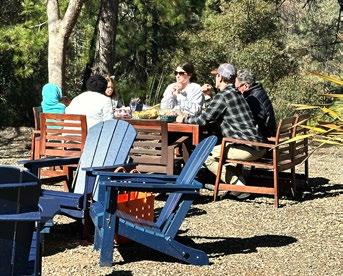
Holly’s Hill Vineyards and Brewery were three generations of the Mangiardi family, two well below drinking age. And that’s what the adults love about this El Dorado County winery—it’s family friendly. April Mangiardi was there with her husband, their two kids, and his parents.
The youngsters were entertaining themselves with toys provided by the winery. The adults were enjoying the relaxed atmosphere, the ability to bring their own food, and tasting an array of wines.
“I think people are more inclined to drink when there’s an event,” Mangiardi said. Bubbles and Bites is the event that brought the group out this particular Sunday.
The Folsom resident has been part of the wine club for two years after being introduced to Holly’s Hill by a friend. This was the first time for her in-laws from Pismo Beach to visit the winery.
“Here we are at 2,400 feet. You don’t have that in Paso Robles,” Heidy Mangiardi said. She was effusive about the scenery, the views and how everything is so green.
Dave and Pat Derossier of El Dorado Hills have clearly not stopped drinking wine, as they belong to five wine clubs. In one weekend, they attended wine club
events at El Dorado County’s Madrona and Holly’s Hill wineries.
They like sharing winery experiences with family and friends, as well as meeting new and interesting people. Their guests at Holly’s Hill were their daughter and two of her friends.
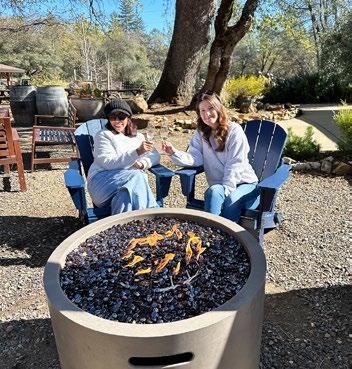
Best friends Jennifer Grogan and Jessica Dalton were spending an early afternoon at Boeger Winery in Placerville in February.
“I grew up here in El Dorado County. Boeger to me is my happy place,” said Dalton, who now lives in Sacramento.
Both continue to drink wine for the flavor and social aspects.
Mike and Amy Weidner of Gardnerville were at Boeger on the same day to pick up their wine club allotment. They also belong to wine clubs at Lava Cap and Starfield Vineyards in the area.
“I love the people and the atmosphere,” Mike Weidner said. They come to this wine region every few months; he prefers going to events, she likes it when the wineries are quieter.
Now they are starting to enjoy this
WINERIES
Continued on page 22
Tahoe says pour me another
Alcohol consumption and sales on the South Shore are going up, exactly the opposite direction of national trends.
every weekend. Even so, Divided Sky benefits from having a strong year-round local clientele.
Event Center have been higher than budgeted by a couple percentage points,” spokesman Bill O’Malley said.
Sherri Hopper, a clerk at King’s Beverage Center, said, “Nothing much has changed in the alcohol world. Bars are less popular because it’s so expensive to go into a bar.”
She said it helps being located next to a drinking hole because her experience is when they are done spending money at the bar, they go to King’s for a bottle to take home.
Cork & More, which turns 50 this summer, has long had one of the best wine selections on the South Shore. Sales are boosted with tastings and a monthly wine club. While the club is mostly locals, outof-towners also participate.
“I think people come up here and they are with friends, and they just want to enjoy nice wines,” Karla Brennan said. She and husband Jeff have owned the shop for nearly a decade.
She credits the wine manager’s expertise for the rise in wine sales—even in Dry January. Still, she acknowledges younger people are not buying wine, calling it a “generational thing.”
What the numbers say
In the nearly 90 years Gallup has asked people in the United States about their alcohol consumption, 2025 was the year with the fewest number of affirmative
responses at 54 percent.
The percentage of respondents who consume alcohol was 58 in 2024 and 62 in 2023, according to Gallup. Young adults and women are leading the movement. Health concerns—physical and mental—are a big reason people are just saying no. More studies are coming out about the short- and long-term dangers of alcohol. When people say yes to alcohol, beer is the No. 1 choice (38 percent), then liquor (30 percent), followed by wine (29 percent).
Pollsters don’t believe marijuana is being substituted for alcohol because those usage numbers have been consistent the last four years.
While that might be true for the country as a whole, those in the Golden State have a name for people choosing pot over alcohol—California Sober, or Cali Sober.
Bo Young Northcut, a sommelier for Caesars and former general manager for Gordon Ramsay Hell’s Kitchen in Stateline, believes people younger than 30 are choosing marijuana over alcohol. Even so, she doesn’t believe the bottom line of local food and beverage establishments is being affected much.
“We don’t have young people. We have close to or after retirement. Those people are not changing their lifestyles,
Continued on page 23
Wine sales were up six percent at Cork & More in 2025 compared to 2024. All alcohol sales increased ten percent at Lake Tahoe Golf Course in the same time span. More adult beverages are being bought at the Tahoe Blue Event Center than predicted. Booze sales at Dart Beverage Center and King’s Beverage Center are holding steady.
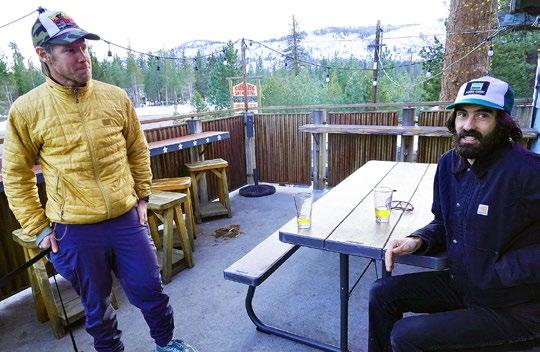
“We live in a unique culture. I think here alcohol is a celebratory thing,” Adam Henriques of Meyers said while having a beer on the deck at his hometown bar, Divided Sky. “It’s a great community space.”
His buddy Erik Norberg, who was there with his dog Rockit, agreed, saying he enjoys the social aspect of drinking at this neighborhood bar.
Bartender Mark Kline believes mountain towns are a little different than other areas, what with a steady influx of tourists bringing in new potential partiers
Krissy Love, bartender at Brooks’ Bar & Deck, echoes Kline’s perspective that those on vacation help keep the taps flowing. Locals tend to come out for happy hour for discounted food and drinks. In summer, this bar acts as the 19th hole.
Tahoe perspectives
Lake Tahoe Golf Course’s clubhouse restaurant is open year-round even when snow covers the course. Indoor golf simulators and snowmobiling are the sports activities this time of year.
“We have a younger crowd. It seems they come to Tahoe to drink. Maybe when they are at home, they don’t drink as much,” Kevin Sommerfield, general manager of the facility, said.
Bachelor parties also help with increased alcohol sales figures. Groups are known to drive alcohol consumption.
“Alcohol sales at the Tahoe Blue
POUR
Photo Kathryn Reed
Jessica Dalton and Jennifer Grogan meet at Boeger Winery for friendship over a glass of wine.
Photo Kathryn Reed
The Mangiardi family enjoy an afternoon at Holly’s Hill.
Photo Kathryn Reed
Krissy Love makes a hot buttered rum at Brooks’ Bar & Deck, where the butter for the mix is made in-house.
Photo Kathryn Reed Friends, all with connections to Tahoe, gather at Brooks’ Bar & Deck at happy hour.
Redefining recreation
Construction workers expect to cram months’ worth of work into the remaining few weeks before South Lake Tahoe’s nearly $83 million recreation and swim complex opens in April. This facility replaces the dilapidated, outdated rec center built in 1975. The aquatics area includes this lazy river, with the lap pool beyond it as well as a low entry pool. Upstairs is the indoor running track. The exercise room comes with all new equipment. The event area may be rented for weddings, quinceañeras, and the like, as well as provides space for public meetings. The commercial kitchen will support the senior nutrition program five days a week. Downstairs will be a dedicated room for arts and crafts, while another will have bars and mirrors catering to dance. This floor is also where the climbing wall is located. Measure P, passed by voters in 2016 to increase the transient occupancy tax by two percent, all goes to the center. It was estimated to generate $2 million annually, while in reality is has brought in more than $3 million all but fiscal year 2019-20.
ABC Mini Storage
Carla Marie Zezula lived many lifetimes, and still not long enough for friends and family who were forever changed by her kindness.
Born to James and Mary Zezula, Carla’s midwest childhood with her brother Jim included ski jumping and sailing on Lake Minnetonka and Sunday dinners at her Grandmother’s farm.
Carla completed a BS in Oceanography at Humboldt State University and began a long summer love affair with rock climbing and Tuolumne Meadows. She scaled “The Zodiac” route of El Capitan in Yosemite National Park.
Carla’s post-university adventures included fisheries biologist on the Bering Sea, English teacher in Japan, aquaculture farmer in San Diego, and food server at Tuolumne Meadows Lodge.
Carla earned her teaching credential at San Francisco State University and taught Science at South Tahoe High School for over 22 years. Carla inspired students to care for the earth and served as a role model encouraging young women to pursue science.
Carla also established her business, “All Ducts in a Row,” completing energy-efficiency compliance verifications, work consistent with her respect for the earth.
Carla worked hard and played harder. An expert telemark skier, mountain biker, and sailor, she enjoyed road trips and exploring the world.
She shared her handywoman skills by supporting friends in need of household repairs. Carla was a devoted animal mom to Shelby and Jules. Her home was a gathering place for all, with good coffee, delicious meals, great music, and meaningful conversation. Carla welcomed everyone she met with her shining blue eyes and warm smile.
Carla was predeceased by her parents James and Mary, and her brother Jim. She is survived by her beloved nephew Joseph, and leaves a deep community of family and friends.
Carla was diagnosed with Stage IV Lung Cancer in July 2025, and fought hard through every step of her treatment. Throughout it she continued to shine her exceptional light of compassion, generosity and strength.
Carla passed Saturday, December 6, 2025, outside in the hospital courtyard, listening to Joni Mitchell. She was surrounded by her dear friends and the love of all who knew her. The sun was setting. The birds were flying overhead. It was peaceful. And, Carla was at the center of this beauty.
Photo Kathryn Reed
An eggcellent dinner option
Eggs make for a perfect meal no matter the time of day.
As someone who prefers not to cook every night, making a frittata is my solution to easy protein, a good way to use veggies that might seem past their prime, and the opportunity to have leftovers. Plus, it’s relatively easy to make.
The main difference between a frittata (which is Italian) and a quiche (which is French) is the former has no crust and the latter does. No crust makes the whole process easier and healthier.
I tend to use so many veggies that the eggs act more like a binder than being the star of the show. For the recipe below, it would be easy to use half the amount of vegetables for it to still be satisfying –even a quarter for those who are more into eggs than veggies.
Use this recipe as a suggestion for what to do. In other words, look around to see what veggies you have that pair well with each other, as well as how many eggs and what fresh or dried herbs are in the kitchen.
My frittatas are never the same because what’s in the crisper and what’s in season changes.
For meat lovers, bacon, ham and sausage would be good. Cook them separately before adding to the mixture. You might also want to reduce or eliminate added salt as those meats probably provide enough.
Cheese could be another addition. Without serving anything else with this, like toast or potatoes or fruit, a quarter of a 9-inch pan is one serving for me.
Mixed reviews on LTCC theatre improvements
The official word from Lake Tahoe Community College and the reported experience by people intimately involved with the campus theater don’t jive.
“The green room, dressing rooms, and wardrobe room remain in place, as does the scene shop behind the stage, and continue to function as originally intended. The green room was most recently remodeled in 2019, adding comfortable guest amenities,” LTCC spokesman Mark Thomsen said.
Performers hired by Tahoe Arts Project this year used the concession stand as a dressing room because the old ones were not available. A last-minute purchase of a full-length mirror by TAP allowed actors to see what they looked like before going on stage.
Peggy Blowney, executive director of TAP, was told by college personnel that the dressing rooms are closed and are being used for storage and offices.
Ingredients
2 T olive or avocado oil
1 medium red onion
1 red pepper
1 small-medium yellow crookneck squash
1 small-medium zucchini
6 medium-large white mushrooms
5 ounces spinach
½ C fresh basil
8 eggs
1 tsp sea salt
½ tsp ground pepper
1 tsp oregano
¼ tsp chili powder
Cooking spray
Salsa (optional)
Avocado (optional)
Directions
Chop all vegetables except spinach into bite size pieces. Chop basil and set aside. When ready to sauté veggies, preheat oven to 350 degrees.
Heat oil in large skillet on medium. Add onion and pepper to pan, stirring until onion is translucent. Add remaining chopped vegetables. Cook just a few minutes before adding basil and dried seasonings. Mix well. Taste and adjust to your liking.
Add spinach, stirring until it’s wilted. Remove from heat.
Whisk eggs together; it’s OK to use a fork to blend them.
Spray 9-inch pie pan with cooking spray or use some other means like butter or oil to ensure mixture will not stick.
Pour veggie mix into pan, smoothing it out to distribute it evenly. After another whisk of the eggs, pour them over the veggies, making sure everything is coated. Bake for at least 20 minutes. Egg mixture should not be jiggly. Remove from oven and let stand for 5 minutes.
Cut into pieces, serve with salsa and/ or sliced avocado.
The college recently completed a $380,000 modernization project at the
and video capabilities throughout the theater, introducing fully digital technology that improves
increasingly difficult to maintain and no longer aligned with current production standards or instructional needs; the new system addresses all of those gaps with a user-friendly platform that expands flexibility for performances, speakers, and community events.”
The Engineering Enterprise designed the electrical configuration, while EIDIM Group Inc. installed the equipment. What happened to the hundreds of lights that were removed was not disclosed.
community as a director at Valhalla. His last involvement with the LTCC theater was in 2024 as an actor in Peter and the Starcatcher and a contract employee to build sets. He is also the movie reviewer for the Mountain News
“It’s a space they now have to do ceremonies, state of the college, TED talks,” Hamilton said. “It no longer has all the resources it used to have to create the big productions.”
IT department is capable of operating the new system.
theater, a facility that opened in 1996.
“The upgrade included new LED theatrical lighting, updated controls, improved power distribution, and enhanced sound
reliability, efficiency, and flexibility while reducing energy use and streamlining operations,” Thomsen said. “Over time, the original equipment had become
Most everyone in the local theater world agrees the improvements were long overdue. But not everyone believes the large-scale productions LTCC has put on in the past could be staged today because of the new lighting system.
Dave Hamilton, who was part of the college theater department for 20 years, is still an integral part of the theater
The lighting system, though, might be enough to do a small show like the ones Valhalla hosts.
“I could tell it was basic lighting — nothing like they had back in the day when the college had its own theater department,”
Blowney said. “The way I see it is No. 1 a lot of equipment is gone that they had in the past, and No. 2 they don’t have a tech person to run the equipment.”
The college contends the multimedia specialist in the
“The college is open to working with outside lighting and sound contractors; however, coordination with the media specialist is required to ensure system compatibility, proper operation, and protection of the theater’s recently upgraded equipment,” Thomsen said. Blowney hopes going forward the college will actually allow outside tech people to run things because that has not been the case so far this year. Hamilton laments the fact the college does not reach out to the broader theater community for input on changes, even though many no longer consider it a community facility.
“The lack of planning and collaborative planning is doing them a disservice,” Hamilton said. “It took us about a year and a half just to figure out
LTCC Theater
Continued on page 29
Photo TAP
TAP Executive Director Peggy Blowney, right, with the Ugandan youth based cultural touring ensemble Dance of Hope in September 2023 at Lake Tahoe Community College.
Photo Kathryn Reed
LTCC student Mannix Behrendt talks about his vision for the college theater.
Continued from page 16
adult grape juice with their 23-year-old daughter, who with her friends Is getting into wine.
EDC wineries persevere
While “pivot” was the word of the year in 2020, it is very much the word d’jour for
now making decisions on what they can financially do,” Teena Hildebrand said. She and husband Frank founded Narrow Gate Vineyards in 2004 in the Pleasant Valley area. “They want an experience, but it does not have to be a big dog and pony show. They love to sit on the deck, they love the sounds, the pines, the ambiance here.”
It's not uncommon for a tasting in Napa or Sonoma counties to top $100. In El Dorado County it’s closer to $15 a person, often with the fee waived with the purchase of a bottle.
That price point is a factor when it comes to attracting people to the area. It’s still unpretentious in El Dorado County. Conversing with the owners and/or winemaker is common.
Heidy Mangiardi was thrilled to meet Holly Cooper, who with husband Tom, founded Holly’s Hill. Now the operation is run by Josh and Carrie Bendick, their daughter and son-inlaw.
“I feel like we don't sell wine, we sell an experience,” Josh Bendick said. “We want them to be part of our family. Young people are coming up for the experience.”
Still, he admits sales and wine club memberships are down.
POUR
Continued from page 17
they are not going to cannabis,” Northcut said.
She also pointed out how an older demographic usually has a more stable financial situation, so the outlay for a bottle or couple cocktails isn’t as impactful as it might be to others.
None of the Stateline casinos responded to inquiries, but plenty of people are gambling with one hand and drinking with the other.
Looking for alternatives
While alcohol purchases continue at a good clip locally, non-alcoholic drink consumption is growing as well. N/A beers as they are known, as well as mocktails, usually cost as much as the leaded varieties because of the work involved on the manufacturing end to remove the alcohol.
One week in December, non-alcoholic beers were the No. 1 seller at Divided Sky, something that had never happened before.
Brooks’ sells some N/A beers—with older, male golfers requesting them the most.
Lake Tahoe Golf Course is planning to increase its N/A beer selection, as it only has one available now.
El Dorado County’s wine industry. They are looking for ways to bring people to the wineries, join their clubs, and buy bottles at restaurants and shops.
“People don’t want to go to a winery and pay $150 and taste a couple wines. They don’t value the wine that much. They are
Adding a brewery has helped bring a different crowd to Holly’s Hill. The beer taps are just behind the traditional wine tasting counter. Providing a daily food menu and allowing people to bring their own food is attractive to people.
Younger people are also paying attention to what’s in the bottle beyond taste.
“The best thing we have done is
become biodynamic certified. And we are going for organic certified because not everyone understands biodynamic,” Hildebrand said. “The younger generation
main activity is for adults only. While El Dorado Winery Association still puts on the annual Passport wine festival in April, it’s now one weekend
doesn't just drink wine. They care if you are using Roundup.”
Winery owners know they have to do more than produce quality wine. They are making a more concerted effort to be welcoming to families even though the
instead of two. The annual barrel tasting is no longer a region-wide event. The organization has downsized, turning its
WINERIES
Continued on page 27
Beer is the only N/A option at King’s liquor store, with several choices available because this is something customers have asked for.
“We have trouble keeping them on the shelves,” Nate Riffle, owner of the
“The first year we were open, we didn’t carry non-alcoholic beer, but have started in the last two years. We have a variety of N/A options from Athletic and an N/A seltzer from Golden State,” the event center’s O’Malley said. “N/A sales make up less than one percent of food and beverage revenue. So, although it is an option for guests coming to events, it is not a popular option and alcohol sales are higher than projected.”
Hangar brewery said of N/A beers. “The liquid has improved over the years—it actually tastes like a beer now—so I'm sure that has helped. There is also the pendulum effect of the sober crowd. We see customers that go back and forth between dry spells and drinking. A few long-term sober folks grab those all the time.”
Photo Kathryn Reed
Mark Kline pours a beer for a customer at Divided Sky in Meyers.
Photo Kathryn Reed
Erik Norberg, left, and Adam Henriques, both of Meyers, enjoy a beer on the deck at Divided Sky.
Photo Kathryn Reed
Signs direct people how to find the various El Dorado County wineries.
Photo Kathryn Reed
Jim Czachorowski’s Sierra Vista Vineyards and Winery is aptly named.
Photo Kathryn Reed Brooks’ Bar & Deck in Stateline has an array of alcohol choices.
Photo Kathryn Reed
Heidy and April Mangiardi, mother- and daughter-in-law, enjoy some bubbly at Holly’s Hill.
If you ever want a break from Tahoe’s wintery freeze, you might consider thawing out in the silky floral air and baby bath waters of Hawaii, a tropical island that embraces your rubbery chicken skin, snow-blind eyes and shivering soul. Just pack some shorts, SPF, a sunhat and leave your brain behind. No worries! Hawaiians are used to ignorant mountain hillbillies and bizarre tourist antics. And they will happily tell you where to go. My decision to spend a month on the Big Island was easy. Convincing Hubby would require a blow torch to release his ice-encased Sorels from Tahoe’s terra-slippery-firma.
Or so I thought.
Before I could say “Aloha, brah,” Hubby was in his surf shorts and rubber “slippers.”
“Are you already packed for Hawaii?”
“Yep.”
“How’s that possible?”
That’s when he gave me a list of everything he didn’t pack. No
Hillbillies in Hawaii
bath items. No grooming equipment. And most of his wardrobe was missing. Like pants. And underwear.
So I made him carry mine. Including jars of cosmetics, a month’s worth of panties and a rainbow selection of bras. This achieved two goals: it lightened my backpack while making his vastly more amusing for the TSA agents.
If you’re airplane virgins like us, I must warn you. TSA will confiscate suspicious liquids — particularly flammable liquids like rum, vodka and gin. As well as delicious semi-liquids (a TSA agent found my peach yogurt lunch highly suspicious, so he took it and then requested my plastic spoon).
Also cosmetics, as Valentine’s Day is just around the corner and their wives will be expecting some expensive, though clearly dangerous, contraband moisturizer.
But once you’ve landed in Hawaii, all TSA hissy fits and airline Ritz cracker-Oreo cookie lunches are forgiven. Grab your-
self a rental car so you’re officially branded a tourist.
However, keep in mind the first rule of Hawaiian driving: NEVER honk your horn. Honking is forbidden in their deeply rooted cultural “Aloha Spirit.” If you choose to honk your horn, you may be greeted by a native Hawaiian who will probably skip the lecture and simply rip off the steering wheel and skid you across the closest lava field. Also, don’t underestimate the fierce “titas” — homegrown women of formidable strength and attitude. They will drop you in the Puna jungle where both beer cans and bodies dissolve in record speed.
So obey all the unwritten rules. And enjoy the road signage
as you go, like “Don’t be a stinka, use your blinka” and “Drive Aloha.” We should bring these signs to Tahoe. They’re a gentle reminder to be a courteous driver and would be a great fit for Tahoe, along with a few Hawaiian natives for enforcement.
Be assured that if Hawaiians really like you, they will warn you not to sit under a coconut tree. A coconut is similar to a bowling ball in shape, weight and flavor.
And, since coconuts drop with the force of one metric ton, it appears to be the serial killer of the Hawaiian Islands. Along with the “landlord” (sharks), rip currents, rogue waves, undertow and an inflated ego about your ability to tread water while being swept out to Japan. If you’re fortunate, you will spend time with some locals. They have the intel on the most varied and authentic farmers’ markets, fishing spots and hidden trails to pristine beaches dotted with “Queen’s bowl” bays. Here, no one will ridicule your feeble attempts to boogie board or lack of swim-
ming skills. Everyone, including your husband, is too busy watching the local butt floss parade.
As any good traveler knows, respect the culture, even if it means forfeiting a free ride on a passing sea turtle. And resist petting the rare and endangered monk seals. Hawaiians retain the right to shred tourists who break this rule. Then, in a traditional spiritual offering, they will feed the tourist’s bits and pieces to the seals.
Embrace the language to find common ground. Hubby jumped at every opportunity to converse with locals. As one Hawaiian laughed appreciatively, “AHHH. Look at your husband! He talk story with da kine!”
Because as fiercely protective as Hawaiians are of their ocean island paradise, they always retain their aloha spirit. Even if you choose to flout tradition, ignore local rules and let your tourist freak flag fly, they will still ask you to join them. And they will offer you a place to sit, under the coconut tree.
What the F#@& could he have gotten into in only one evening?
I love being a dad of teenagers. I love everything they are into: the music, the sports, the movies, the conversations. I volunteer. I coach. I can’t get enough. I’m a total dork. As a former high school teacher, I even love the homework. Really… I buy the books that they are reading. “Dad, that’s like selling the clip, Bruh.”
Even the slang and evolution of language I love; it’s “lowkey fire.”
I say this because I also hate being a dad of teenagers, and both realities can exist in my head at once. Their prefrontal cortex sitch is real and… well, to use a term from my youth, “gnarly.”
“Is that the phone?” Wifey bolts upright from deep sleep.
I roll over, “I didn’t know our room had a phone.”
“It’s 11:30 at night. Why is the phone ringing?”
“Hello?” I answer.
“Is this Gantt Miller?”
“Yes.”
“This is Royal Caribbean security. We have your son. Please join us at Guest
Services on deck five.”
“Of course,” I stammer. “Right away.”
“What is it?” Wifey asks.
“It’s only the first night on the ship. What the F#@& could he have gotten into in only one evening?”
Wifey and I rushed down and met with the chief security officer for the Icon of the Seas, a gentleman whom we later found out used to run an entire division for 20 years with the Indian Navy. Fortunately, nothing was too grave, just some antics in one of the many hot tubs that appeared a bit too raucous for Royal Caribbean. We assured the team assembled to deal with our son and the older boys that he was trying to impress that we would clamp down on our offspring’s behavior. We thanked them and said our good nights and marched our child to his bed.
“But the curfew isn’t until 1am.”
“Not for you,” Wifey and I responded in unison.
Despite the first night’s scare, our whole extended family (all 16 of us) had an amazing winter break cruising to St.
Thomas, St. Marteen, and Coco Cay on the behemoth monstrosity known as the Icon of the Seas. Wifey and I never were that into the idea of cruises, but they really are amazing for teenagers; the structured independence and opportunity to mingle with kids from all over the world is amazing. One of our brood ended up hanging out with a boy from Ukraine who came with his mom and whose father is in the army. My 13-year-old niece, who has always been shy and cerebral, had her first crush and kiss with a boy from Sweden who was brave enough to come to dinner one night with our whole crew.
No other real trouble ensued on the trip, but I feel like I’m holding my breath sometimes, waiting for the next dumb teenage decision.
They’ve all screwed up in varying capacities and they’ve all made decisions that have left Wifey and me wondering if they even considered the ramifications of going skiing without gloves or wearing giant cookie monster bed slippers to softball practice.
I guess that’s the thing about
parenthood: you have to be willing to accept the good with the bad. It doesn’t mean that you condone it; it doesn’t mean that you don’t have consequences for behavior. It doesn’t mean that you don’t love them; it just serves as a reminder that they are still kids. As much as they might be kicking your butt down the mountain on skis, or debating politics with grandparents, or raging on a mountain bike with a level of coordination that left you at least a decade ago, they are still adolescent knuckleheads whose highly active amygdalae crave risk and novelty. It’s these lessons, like coming faceto-face with an assertive Indian naval officer, that will hopefully stay with them as they mature and their brains stop ricochetting around like pinballs in an empty, sugar-free Monster can.
Gantt Miller – Just a guy, lucky enough to live, work, play, and protest in South Lake Tahoe. www.behmbooks.com and mcbehmbooks@gmail.com
Photo Gantt Miller Cruisin' with the kiddos
Snow by any other name
Snow, snow, snow – I love snow! I like to call it “lubrication for the earth.” The stuff is simply magic, how it transforms the terrain and affects our attitudes; it is so beautiful in all its forms, and there are many.
This is one of the things I find fascinating about snow, its many personalities. We who play in the snow have a whole language used to describe the exact condition of the magic white carpet. Lore has it that the Inuit people of the northern territories and the Sami of northern Scandinavia and Russia have a hundred different words to describe snow. There is great debate whether they are actually different words or just
derivatives used to describe a condition of the snow. Well, in my mind, that is the idea, right? To understand the differences using words and variations of those words. I also firmly believe we skiers and boarders here in North America probably have just as many words for snow. I have never tried to count but maybe I could get a government grant to study this theory. I also firmly believe that the number of words is directly related to how much time one actually spends on the snow. Everybody’s favorite, as evidenced by the huge numbers of people lining up at the resorts on the morning of a fresh snowfall (exactly what has made this my second favorite snow condition), is powder, blower, champagne — delightfully light snow that feels like you’re floating when dropping through it, until those one-thousand other overly-excited powder hounds track it all up — done, not pow anymore. It sure was fun for a short bit in mid-February, wasn’t it?
Then we enter the food groups: sugar, corn (my favorite), mashed potatoes, butter, death cookies, cream. Non-foods: wind buff, chalk board, rime, slush. And some we really do not like: ice, boiler plate, breakable crust, chunder, death crust, rain-soaked mush WTF!
We have been finding a little bit of one of my personal fa-
vorite snow types, not a favorite to ski but one of the most beautiful forms of snow. In fact, it is a type of snow that is sometimes impossible to ski or board and is even difficult to just walk through! The Inuit word is “kalutoqaniq,” and we call it “sastrugi” (sounds like something good to eat); some snow cultures call it “zastruga” (sounds like a gastrointestinal ailment), actually a Russian-based word. This is snow that has been blown by strong winds into ridges and contours and spikes and valleys that resemble jagged sand dunes. But sastrugi ripples run parallel to the wind direction instead of perpendicular like sand dunes or sand ripples.
Sastrugi is generally a few inches to eight or ten inches tall or deep. We have seen it two feet deep and looking like some other planet. And don’t confuse it with sun cups, usually found in the late springtime and summer. Sun cups are just annoying roundish depressions melted into the snow. On the other hand, if you have seen sastrugi, you can’t help but be drawn in momentarily by its striking beauty, and you just didn’t know what to call it except
“Aw, crap, we don’t wanna cross that!”
It is so amazing how snow can change, and frequently it happens overnight. What was the best little secret stash one day turns into this nearly unskiable, trying to rip your leg off muck (I don’t know if that is really a snow word.) the very next day, especially since you brought your buddy there to show them how excellent it is. We have even all seen the same thing happen in a matter of hours . . ecstasy to “oh s#@t, I am going home to watch skiing on TV.” Or three feet of snow in my yard today, dirt two days later; did that really just happen or was it a dream — ah no, a nightmare?
Amazing act of nature, almost like it was designed for us to play in – so fun, so beautiful and yet so dangerous, as we have all experienced recently with the loss of some of our snow-loving brothers and sisters. With unbelievable sorrow, our hearts go out to their families, and we must all learn from that terrible situation. Yes, most of us around here love nieve, niege, schnee, neve, sneeuw – now, let’s get some more of it soon!
Let’s play
WINERIES
Continued from page 22
focus to keeping the website (https:// eldoradowines.org/ ) updated and providing an easy-to-use map, creating brochures, and placing directional signs throughout the region.
Hildebrand is the outgoing president
of the association, with Liz McCartney, administrative assistant, taking over until a winery executive steps in.
Wineries have discovered it's more lucrative to have individual events than big group ones. Every Friday, Saturday and Sunday, Narrow Gate has seasonally inspired charcuterie picnic board or box pairings. Boeger offers Stories in the
El Dorado County wine grape
Red Wine Grapes:
2024: 2,146 acres, 4,842 tons, $1,604 price per ton, total value $6,887,878
2023: 2,176 acres, 5,093 tons, $1,982 price per ton, total value $8,849,921
2022: 2,357 acres, 2,152 tons, $2,022 price per ton, total value $3,863,249
White Wine Grapes:
2024: 352 acres, 687 tons, $2,061 price per ton, total value $1,168,488
2023: 358 acres, 733 tons, $2,003 price per ton, total value $1,255,647
2022: 355 acres, 175 tons, $2,425 price per ton, total value $ 317,117
*All
Wine Grapes
2024: 2,498 acres, 3,529 tons, $1,832 price per ton, total value $ 8,056,366
2023: 2,534 acres, 5,826 tons, $2,992 price per ton, total value $10,105,568
2022: 2,712 acres, 2,327 tons, $2,223 price per ton, total value $ 7,180,366
2021: 2,696 acres, 6,432 tons, $1,604 price per ton, total value $ 7,207,273
2020: 2,624 acres, 6,235 tons, $1,802 price per ton, total value $ 9,663,459
2019: 2,636 acres, 7,023 tons, $1,671 price per ton, total value $12,092,373
*Prior to 2022 red and white grape harvest information was combined.
**2025 numbers not available until July.
Source: El Dorado County Crop Report
Cellar three days a week. Toogood this month is letting people bottle their own wine, Shadow Ranch is having a wine and food pairing, Skinner is pairing wine with soup every Saturday, and Nello Oliva is hosting a release party.
While Sierra Vista Vineyards & Winery has been around since 1977, Jim Czachorowski has only owned it since 2019. So, he’s been through a few rough years.
His emphasis has been on creating ways to draw people to the Pleasant Valley property. During Covid he erected heated, private pods that would be sterilized in between guests. Those igloo shaped structures remain seasonally so people can still be outside without being cold.
“I like being new, novel and creative,” Czachorowski said while walking the property.
Comedians, a hypnotist, musicians— they are part of the lineup at Sierra Vista.
Sip and stroll events are common, where food stations are set up in the vineyards, each paired with a specific wine.
From the pods and along the strolls, people can enjoy the views which stretch out to the snow-covered Sierra.
A large pizza oven allows people to eat and sip, with chef Jason Clevenger whipping up food for special events like surf and turf for Valentine’s Day.
Food is a big part of what Narrow Gate is all about as well. Hildebrand believes one of the pieces missing in the conversation about alcohol consumption, and wine in particular, is that wine is food. Wine is also shared cultural and familial experiences.
In 2019 she published a cookbook titled The Kitchen and the Cellar, with the second edition being released this month. Stories are woven through the 100 recipes. Lava Cap’s Nolan Jones, who is director of national sales, says it’s important to meet people where they are— to make wine accessible in terms of ease of tasting, price points, and atmosphere. “Younger generations want an Instragrammable experience, but they also want it to be authentic and real,” Jones said. “If you look at El Dorado County as a wine region, it offers more value where you have high quality wine at a fairer price compared to anyplace in California.”
Photo Gary Bell
Photo Kathryn Reed Amy and Mike Weidner with their Boeger wine club pickup at their feet.
Photo Kathryn Reed Dave and Pat Derossier belong to multiple wine clubs including Holly’s Hill.
There is a new documentary that just dropped on Netflix called Breakdown 1975 The film chronicles the year 1975, looking at our society through the films that came out that year and how they reflected not only the changing society, but the changing film industry. It was a time when directors of the New Hollywood like Martin Scorsese, Steven Spielberg, Robert Altman and Francis Ford Coppola made their presence felt. Many films like Taxi Driver, One Flew Over the Cuckoo's Nest, Chinatown and Network reflected changing American attitudes toward society and the government in general, as well as new ways of filmmaking. Watergate, Vietnam and the ‘60s counterculture were in the rearview mirror, but we had a tanking economy, a gas crisis and cities like New York came near to bankruptcy, highlighting a level of urban decay.
The film is narrated by Jodie Foster and features early interviews with some of the directors, also providing current thoughts from people who were there, such as Oliver Stone, Martin Scorsese, Ellen Burstyn and Albert Brooks, as well as some people who weren’t there, like Seth Rogan,
From 1975 to today
Patton Oswalt and Josh Brolin. There are other journalists and authors as well.
The film basically picks out the major events from that year (and there were a lot) and then shows the films that, in some way, reflected those events. Included are clips from a bazillion films. Everything from All the President’s Men to Monty Python and the Holy Grail, Chinatown to Towering Inferno
Those of us of a certain age will remember all the films and the events that inspired them. But even for those of you who see 1975 as ancient history, this film is a pretty cool time capsule of a fascinating time in American film history. It is a bit comforting in today’s intense world to see how crazy intense it was in 1975, and yet we somehow got through it. There are a couple of quirky films you may have not noticed that are currently streaming: Good Fortune and Blow the Man Down Written, directed and starring Aziz Ansari, Good Fortune (out on Prime) stars Ansari as Arj, a low-income gig worker who has reached an even lower point in his life. After losing a one-week job as an assistant to rich tech mogul, Jeff, played by Seth Rogan, Arj
has had to move into his parents’ very small apartment, then has his car towed from a Denny’s, and is hitting rock bottom with nowhere to turn. But the Angel Gabriel, played by Keanu Reeves, who normally just helps prevent people who text and drive from getting into accidents, notices Arj, and seeing him as a lost soul, wants to help him. Gabriel comes to him and tells him that his life is worthwhile and having wealth and success like Jeff will not fix his problems, so Gabriel switches Arj’s and Jeff's lives to prove his point.
However, Arj sees that being rich actually does solve most of his problems and doesn’t want to go back. In the meantime, Jeff wants his old life back and has to try and survive with nothing. Gabriel gets in trouble for the switch with his angel supervisor, Martha (played by Sandra Oh), and loses his angel status, becoming human. So, how will they all get things to work out in the end?
The film is basically It’s a Wonderful Life meets Trading Places with a fair amount of comedy throughout. The comedy is smart and the film moves well, even if it is somewhat predictable and a little heavy-handed with messages about wealth, privilege
and happiness. Keanu Reeves is great fun to watch as Gabriel, a newer angel, who is sort of a mature version of Ted from Bill and Ted’s Excellent Adventure and Seth Rogan is very Seth Rogan, which also works. Overall, Good Fortune is a charming, lighthearted comedy with a strong social conscience and solid chemistry between the leads. Blow the Man Down is an independent thriller out on Prime. Easter Cove is a small fishing town on the rocky coast of Maine where everyone pretty much knows everyone else. After the loss of their mother and facing an uncertain future, sisters
Mary Beth and Priscilla Connolly are trying to make ends meet.
Mary Beth desperately wants to leave town and go to college, while Priscilla is content to stay at home. It turns out their mother took out a loan to keep the struggling family seafood shop afloat, which now means they may also lose the family home. After the funeral and an evening drinking, Mary Beth runs afoul of a guy named Gorski. Things go from bad to worse and end very badly with Mary Beth looking at a dead body. Priscilla arrives and they begin a cover-up. But the more they try to cover up, the more
they begin to uncover the town’s darkest secrets, which involve some of the pillars of the community, even as the local cops are investigating the crime.
The film begins with fisherman singing the title song, immersing you in the seafaring culture of a small fishing village. From here, we are introduced to a range of local characters from Mary Beth and Priscilla to a group of the town’s matrons, including the always great Margo Martindale, playing the cagy owner of a local brothel.
The cinematography and the music, including other well-sung sea shanties, keep you in a stylized maritime noir, while the plot moves in twists and turns that do not follow traditional thrillers, which is good. The film is very reminiscent of early Coen brothers’ noir thrillers, having quirky characters, a line of action with dark comedy overtones and a unique storyline. Overall Blow the Man Down is a fun, original thriller worth checking out.
Oh, and Teresa was gone for a week on a trip with her best friend, and so missed this bunch.
LTUSD still keeping secrets
After former Lake Tahoe Unified School District Human Resources Director John Simons was terminated last fall for a substantiated incident of sexual ha-
rassment, the district continued to inves-
tigate him, for what they would not say.
The district also declined to release additional records requested by the Mountain News surrounding Simons’ tenure, citing the “ongoing investigation" exemption under the California Public Records Act.
That investigation has been completed, stated LTUSD Public Information Officer Teresa Schow in a February 24 letter to the Mountain News but the district is still refusing to release any records, now citing attorney-client privilege.
The First Amendment Coalition’s David Loy reviewed the letter from the district at our request and said it doesn’t totally wash.
Of the 11 different items requested by the Mountain News , LTUSD provided
all or part of five. Remaining requested records that are subject to disclosure include copies of complaints filed against Simons, copies of claims filed against the district regarding Simons’ work or conduct, correspondence among LTUSD officials regarding Simons (excepting communications with legal counsel) and a photo of Mr. Simons, according to Loy. While these records may have provided the basis for the investigation and while the district does not have to release the findings of its investigation (if conducted by legal counsel), these documents are public record in and of themselves and subject to release, Loy said.
The Mountain News will be contesting the district’s denial of our request and
will continue to seek all relevant and public records.
Several recent agendas for LTUSD have listed “anticipated litigation” as a closed session item. What that all means or what withholding records under attorney-client privilege means is hard to ascertain without further information, Loy said.
The community-based Title IX Task Force, which has sought public records from the district regarding how men’s and women’s sports are funded and supported or not supported by LTUSD has been waiting over a year for the district to provide information.
To the Editor,
I voted for Measure T in 2018 because living in my Heavenly Valley neighborhood had become a living hell. The council back then believed that selling out our neighborhoods to grow tourism was more important that the quality of life for residents. It seems that since Measure T was overturned some members of the council have hit the replay button and want to bring back the disruption of vacation rentals by increasing the
total number and removing the current 150-foot buffer.
Neighborhoods are for Neighbors not a place to expand tourism. I am hopeful that the appeal of Measure T by the Tahoe Neighborhoods Group is successful. The voters said they don’t want VHRs in their neighborhoods, and this council should not be ignoring that vote.
Jerry Goodman South Lake Tahoe
LTCC
Theater
Continued from page 21
how we wanted to build the theater with architects, consultants, administrators and the community. We took a lot of time to build that space.”
The college plans to bring theatrical productions back to campus in spring 2027, according to Thomsen. This year marks the second straight year LTCC has not produced a play.
“The Duke Theater modernization represents the college's commitment to ensuring the space and its systems are fully capable of supporting future productions,” Thomsen said.
However, Erik Baker has been told theater productions are not a priority. He teaches Acting 101 and Improv, and is the only person left with a connection to what was once a robust theater department.
“It’s a nice facility. I’m glad they updated lights with modern stuff,” Baker said. “During Starcatcher the sound died for like 20 minutes, so it's great that was updated.”
Mannix Behrendt, who is in his second year at LTCC, has acted locally, but not in a college production.
“It would be nice to have a theater that is a theater and not just a speech room,” Behrendt said. “Still, to some degree it is a theater, but it’s not meant to be a performance theater.”
Thomsen said the theater is being used for acting and other courses, lectures, student movie nights, Connect summer children’s theater camps, student events like Senior Day and fire academy graduation, TAP’s community productions, Drug Store Project, and a national meteorological conference.
Photo Lionsgate Films
Keanu Reeves finds his wings as the Angel Gabriel in Good Fortune.
Photo Kathryn Reed
Lake Tahoe Community College students take advantage of a nook in the Roberta Mason Library to focus on their lessons.