Tahoe Donner is a vibrant and desirable mountain community providing attractive and well-maintained facilities, events, programs and leading customer service to its members, guests and public, all while maintaining accessible and healthy natural surroundings.
Dear Members,
On behalf of the Tahoe Donner Association Board of Directors and your management team, we are pleased to present the 2025 Annual Report. This is a comprehensive report on Tahoe Donner Association’s 2025 financial results, including the 2025 Audited Financial Statements and Independent Auditors’ Report, covering both the Operating and Capital Reserve Funds. Operational and strategic actions bolstering Tahoe Donner’s long-term viability are also highlighted.
Capital Reinvestment
Tahoe Donner’s financial strength is protected by a disciplined approach to capital planning and secure reserve investments. Core facilities, many originally developed in the 1970s, require ongoing maintenance, refurbishment, and even replacement, to meet evolving member expectations, safety standards, and recreational trends. Through structured reserve funding and long-range planning, Tahoe Donner continues to modernize its assets while protecting long-term property values.
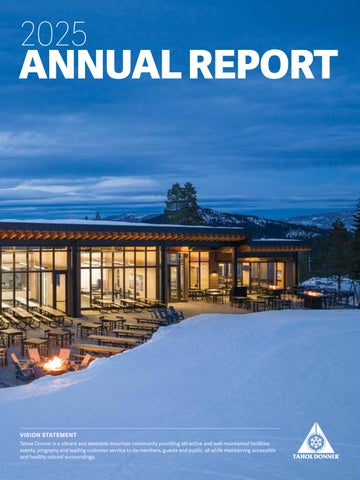
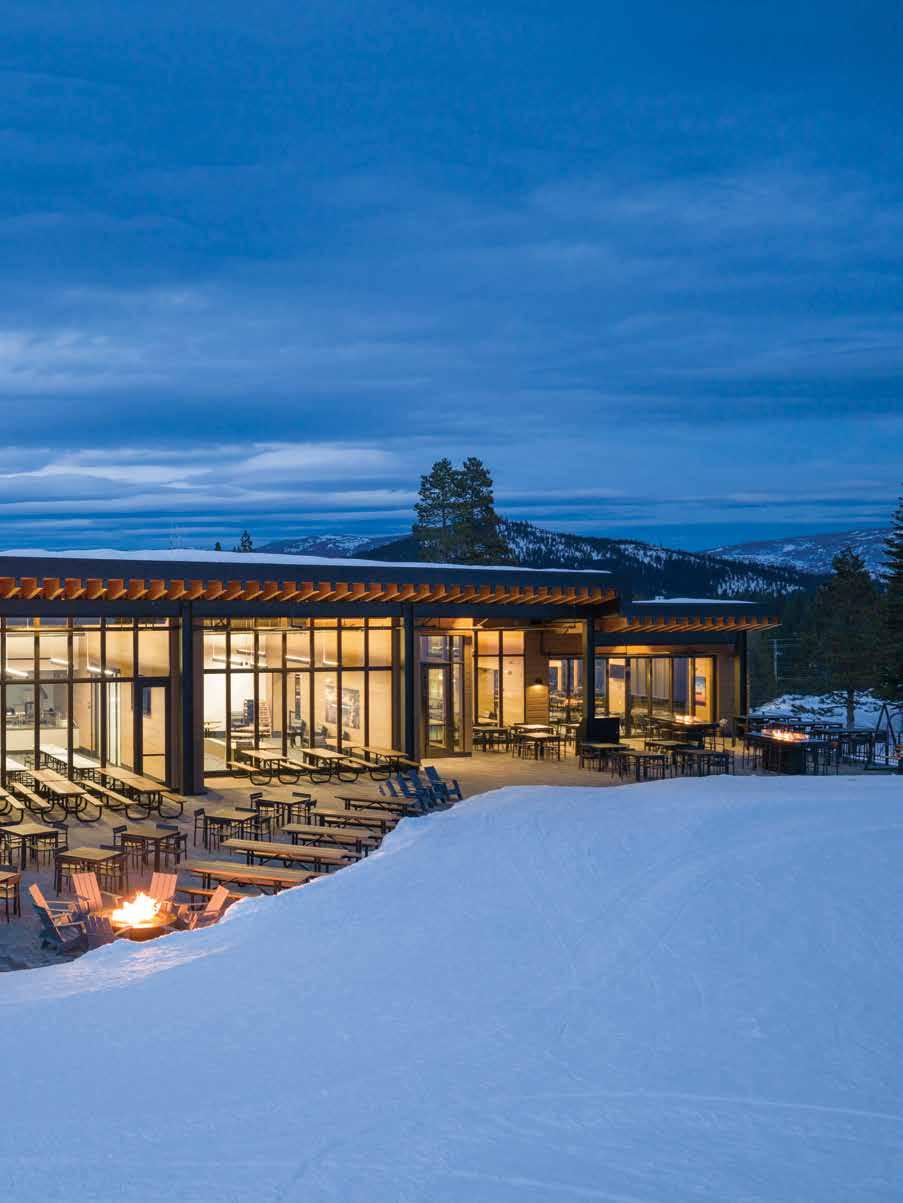
The successful construction and opening of the new Downhill Ski Lodge – ahead of schedule and under budget -- is a key example of this strategy to enhance member experience, improve operational efficiency, and align facilities with future needs.
Other key capital projects advanced in 2025 include:
EXPANSION OF THE BEACH CLUB MARINA DECK AND NEW BAR
ENVIRONMENTAL AND RECREATIONAL ACCESS IMPROVEMENT TO EUER VALLEY AT COYOTE CROSSING
EXPANSION AND IMPROVEMENT OF THE GLACIER WAY PARKING LOT
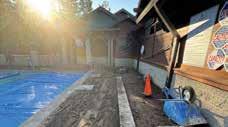
REPLACEMENT AND MAJOR UPGRADES TO THE TROUT CREEK POOL MECHANICAL ROOM AND LAP POOL DECK
These investments reflect deliberate prioritization to enhance member experience while advancing Tahoe Donner’s leadership in environmental stewardship, forest health, wildfire risk reduction, and long-term community resilience. Most notably, several of these projects leveraged $1.6 million in external funding, amplifying the impact of member assessments.
At year-end, cash and investments totaled $26.3 million, including $14.8 million in reserve accounts to support the completion of current projects and future improvements. This disciplined approach reinforces the quality of amenities, protects long-term property values, and supports the overall strength of the community.
TAHOE DONNER FINANCIAL POSITION AT A GLANCE
Tahoe Donner’s financial position remains strong, grounded in disciplined financial management and ongoing reinvestment in our physical assets through maintenance and improvements, with a clear focus on member value.
Operating Revenues
$19.2 million
inclusive of a one-time $2.0 million Employee Retention Tax credit
Operating Expenses
$25.8 million including tax provisions
Net Operating Results Compared to Budget
$1.76 million
ahead of budget, inclusive of the abovementioned tax credit
Annual Assessments
$21.4 million
$3,300 PER PROPERTY contributing to both operating costs and reserve funds
Contributions to Reserve Accounts
$12.1 million
including Replacement Reserve ($6.1 million), Development ($5.8 million) and New Equipment ($0.1 million) Funds
Investment in Tahoe Donner
$34.1 million
invested in capital projects, including continuing reinvestment in amenities, supporting infrastructure and open space resiliency
Assets + Equity
$115.3 million in total assets and $100.8 million in member equity
$15,556 PER PROPERTY both increases over prior year
Together, these indicators reflect the Association’s scale, stability, and long-term financial sustainability.
2025 Operating Year
The variability of our mountain environment was quite evident in 2025, and demonstrates the strength and adaptability of Tahoe Donner’s diversified, year-round operating model:
WINTER
With winter operations split between the beginning and end of the fiscal year, 2025 was book-ended by the construction-related temporary operations on the one end and low snowfall on the other end. Despite the low snowfall, we had a successful opening of the new Downhill Ski lodge.
SUMMER
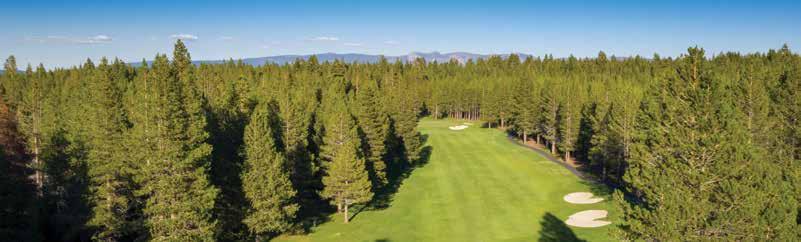
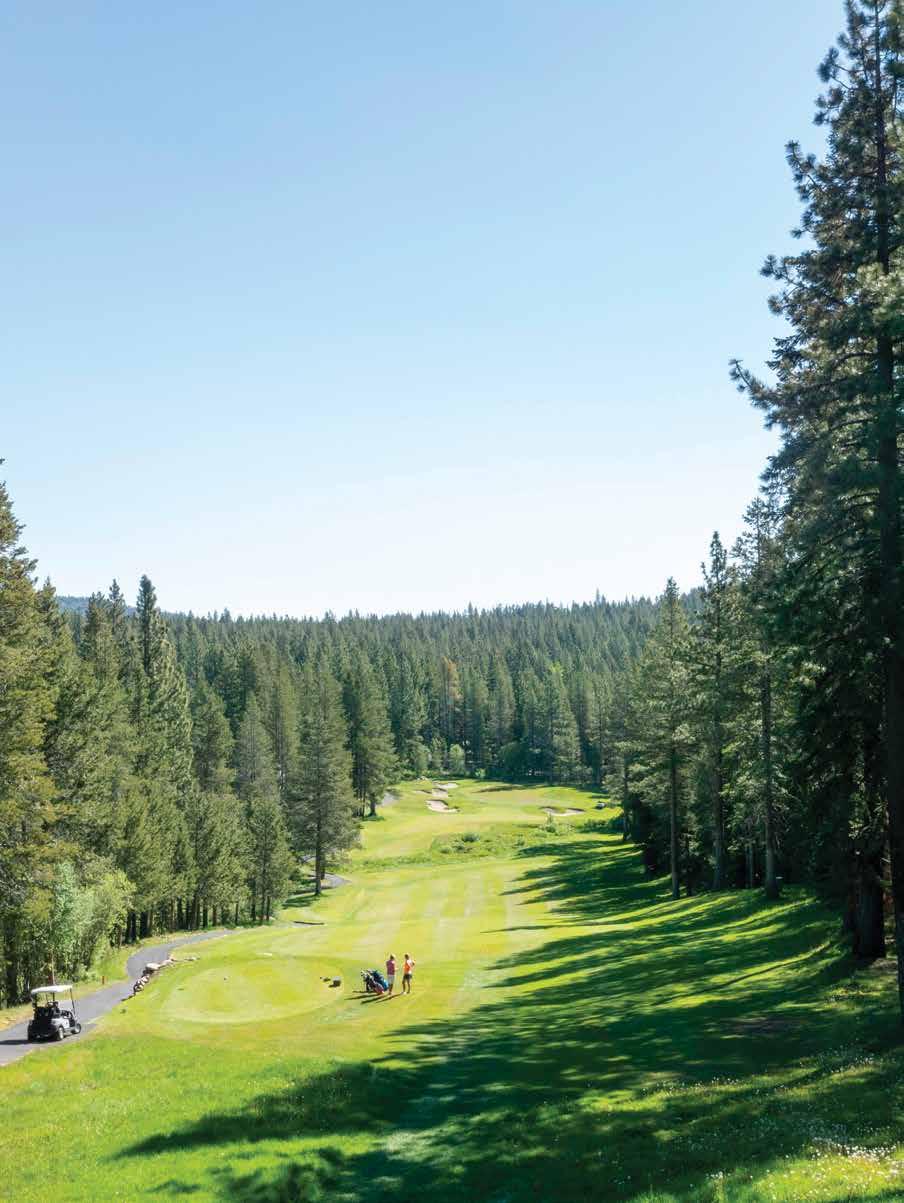
One of the strongest seasons in recent history, with the Golf Course, Beach Club Marina, and recreation exceeding expectations.
FALL
Extended outdoor activity, though dry conditions delayed the start of winter operations.
Taken together, this diversification across seasons and amenities is a key component of Tahoe Donner’s financial resilience despite weather-driven variability. Regarding the key operating results covered above, key cost pressures continue to impact operations, these include:
• Rising labor costs, driven by minimum wage increases and a competitive labor market; e.g., minimum wage increased by 3.24% in 2025 over 2024
• Increases in insurance and other operating expenses; e.g., insurance costs increased 10.0% and electricity costs increased 11.5% in 2025 over 2024
We are grateful for our dedicated staff and engaged member volunteers who continue to serve and strengthen Tahoe Donner. Your membership and participation make this community exceptional.
The following pages provide additional detail on Tahoe Donner’s 2025 financial performance, capital investments, and long-term planning. The Independent Auditors’ Report reviews the Association’s financial position and confirms that the financial statements are presented fairly and in accordance with accounting standards. Tahoe Donner is a community of 6,473 properties with approximately 25,000 members. We are a corporation with, in round figures, a $30 million budget and a $100 million balance sheet. The Board of Directors, Finance Committee, and management continuously monitor both operational and financial performance to proactively balance membership services with financial goals. Please contact our Director of Finance and Accounting, Justin Malley, at jmalley@tahoedonner.com or (530) 587-9418, anytime to discuss this report or any other financial aspects of your association.
Sincerely,
Annie Rosenfeld General Manager gm@tahoedonner.com
Don Koenes
Treasurer, Board of Directors dkoenes@tahoedonner.com
tahoedonner.com/financials
2025 COMMUNITY IMPACT BY THE NUMBERS
Here are highlights of a few ways that your ownership and experience were enhanced and enjoyed this past year.
Stewardship + Environmental Education
32 Stewardship events held
1,100 Adult and youth participants
Fire Resiliency
871 Acres of defensible space work completed 462 BY TAHOE DONNER FORESTRY 409 BY PROPERTY OWNERS
5,143 Consultation Visits with property owners
16,700 Yards of green waste removed
Recreation + Social Events
13 Active Clubs with 1,500 members and associate members
55 Music events
6,719 Downhill and Cross Country lessons, programs and race participants
8,003 Tennis + Pickleball lesson and clinic participants
14,270 Trout Creek Rec Center personal training, group fitness and kids club participants
ANNUAL BUDGET – SOURCE OF FUNDS
ANNUAL BUDGET – USE OF FUNDS DOLLARS IN THOUSANDS
OPERATING FUND
Actual Results
$30,000,000
$25,000,000
$20,000,000
$15,000,000
$10,000,000
$5,000,000
$0
Revenue finished the year $2,285,591 favorable to Budget, while total costs were unfavorable to Budget by $525,353.
NOTE: Each year is subject to volatility due to weather and other variables.
Net Operating Result (NOR) is defined as operating revenues less cost of goods sold and operating payroll and expenses. On the above graph, NOR is seen as the difference between operating revenues and operating costs.
FUND
Operating Fund Members’ Equity Accumulated Net Results
$5,000,000
$4,000,000
$3,000,000
$2,000,000
$1,000,000
$0
FUND ACCUMULATED NET RESULTS, CONTINGENCY
- $233,842 unfavorable results in 2022
- $ 0 transfers
- $233,842 (A) 2022 change in Operating Fund equity
Operating Fund Results 2025 Highlights Versus Budget
NOR = Net Operating Results. NOR is defined as the net result of operating revenues less cost of goods sold, operating payroll and expenses and any overhead allocation.
SUMMER AMENITIES
NOR $11,606
FAVORABLE $536,273
The golf course opened on schedule – one of the few in the area – and, with new tee sheet software, significantly outperformed budget and boosted summer revenue. The Beach Club Marina’s new deck and DJ increased visitation, while added programming at the Tennis + Pickleball Center and Day Camps also drove gains. These results were offset primarily by Trails and the Equestrian Center.
YEAR-ROUND AMENITIES
NOR ($1,022,585)
UNFAVORABLE ($240,590)
Alder Creek Cafe underperformed due to reduced demand and a midyear shift to a grab-and-go concept before returning to a full menu, while higher expenses further impacted results. In contrast, Pizza on the Hill delivered strong performance driven by demand, with modest cost pressures. At The Lodge Restaurant & Pub, new leadership implemented operational changes that improved cost control and reduced losses, including achieving positive NOR in August for the first time in several years. Trout Creek Recreation Center and Aquatics performed in line with expectations despite pool closures, with disciplined expense management driving improved overall results.
WINTER AMENITIES
NOR LOSS $1,245,123
FAVORABLE $46,357
The end of the 2024/25 and start of the 2025/26 winter season experienced poor snow conditions. Snowmaking and winter operations were delayed until after Christmas this year. Despite lower direct access, retail and lessons/rental activity, winter performance remained favorable to budget, supported by the opening of the Downhill Ski Lodge, and targeted expense reductions – primarily in payroll and utilities. Revenue exceeded budget, while expenses were below budget, contributing to favorable NOR performance overall. Year-over-year, NOR declined as anticipated due to prior lodge closure and construction impacts, though Cross Country Ski Center posted a year-over-year increase.
SUPPORT SERVICES
NOR LOSS ($6,493,228)
UNFAVORABLE ($48,255)
IT, Finance, and HR generated unbudgeted revenue, though expenses increased with the addition of a new controller and higher supplies and maintenance costs. Community Standards saw lower revenue due to reduced activity, but disciplined payroll management helped offset the impact. Forestry underperformed due to lower-than-expected grant revenue, with expense savings partially mitigating results. Communications exceeded expectations, driven by strong advertising activity despite modest cost increases. Additional expense pressure came from general property maintenance not tied to a specific amenity. Tahoe Donner also received one-time Employee Retention Tax credit funds during the year.
REPLACEMENT RESERVE FUND
CAPITAL FUNDS Replacement Reserve Fund
MEMBERS EQUITY (FUND
BALANCE)
AND PERCENT FUNDED
Members’ Equity YEAR-END FUND BALANCE + Percent Funded
$10,000,000 $15,000,000
The Replacement Reserve Fund (RRF) is used to account for financial resources designated for the repair, restoration, replacement or maintenance of, or litigation involving the repair, restoration, replacement or maintenance of major components that the association is obligated by state law and sound business practices to repair, restore, replace or maintain. A 30-year reserve
DEVELOPMENT FUND
funding and expenditure plan is produced every three years, and updated annually, to schedule and analyze the funding and expenditure needs. Over 2,300 individual items are tracked in this plan, with a current replacement value of $78.3 million.
2025 saw a favorable variance in expense to budget of $2.2 million, mostly due to contract
MEMBERS EQUITY (FUND BALANCE)
Development Fund
Members’ Equity YEAR-END FUND BALANCE
retainage pertaining to the Downhill Ski Lodge replacement project, to be paid out in 2026.
The year-end fund balance decreased by $5.7 million, or 30.0%, from 2024. The balance fluctuates each year due to the funding level from assessments, as well as expenditures each year, in accordance with the 30-year reserve study.
The Development Fund was established and authorized in the governing documents of the association to accumulate funds for use in the development of – and additions to – facilities identified by the Board as necessary due to new capacity requirements of the association or changing needs of the community.
The Development Fund includes funds accumulated for the specific purpose of replacing existing buildings, as only certain components of buildings are in the Replacement Reserve study.
The assessment contribution for 2025 was $5,838,646, or $902 per owner, reflecting
a 4% increase from 2024. The year-end fund balance decreased by $13.5 million. This decrease was primarily driven by the Downhill Ski Lodge replacement project.
New Equipment Fund
The New Equipment Fund is used to account for financial resources designated for the acquisition of new assets identified as necessary for the association to operate more efficiently or provide new services to members.
The year-end fund balance of $29,742 increased by $21,000, compared to 2024.
Fund
The Property Fund is used to account for the association’s investment in its fixed assets. Capital additions to fixed assets totaled $34.1 million ($13.6 million in 2024). Depreciation expense for the year totaled $3.2 million ($3.1 million in 2024).
Total gross fixed asset value of $135.2 million equates to $20,896 per owner and net book value of fixed assets and construction in progress of $85.3 million equates to $13,172 per owner (an increase of $4,353 from 2024).
CAPITAL INVESTMENT OVER THE 10 YEARS INCLUDES:
$51.0 million in Replacement Reserve Fund capital investments, including:
• $5.1 million per year with 10-year average, maintaining existing asset components (depreciation average is $3.1 million)
• $3.7 million per year for first 5 years average, maintaining existing asset components
• $6.4 million per year for second 5 years average, maintaining existing asset components
The increase from 2016-2020 average to the 20212025 average is due to the overall aging of assets, the impact of Development Fund projects on related reserve components, construction of the lodge at Downhill Ski Resort, improvements to the Beach Club Marina, Glacier Way and Golf Course cart paths, as well as investments in updated maintenance equipment.
$38.4 million in Development Fund capital investments, including:
• Solar projects at three locations (2015-2016)
• Equestrian campus relocation and upgrades (2015-2017)
• Crabtree Canyon land – 640 acres (2016)
• Alder Creek Adventure Center exterior storage building (2017)
• Equestrian campus improvements, Eagle Rock Chairlift building improvements (2018)
• Trout Creek Recreation Center building expansion (2019-2020)
• Bermgarten Trailhead paving (2020)
• Downhill Ski Lodge professional services, Cross Country Ski Center snowmaking investment (2021-2023)
• Beach Club Marina Deck Expansion (2023-2025)
• Glacier Way Parking Lot + Trailhead improvements, Golf Course cart path repair + replacement (2024)
• Downhill Ski Lodge replacement (2024-2025)
$1.4 million in New Equipment Fund capital investments, including: $138,395 per year average
• Forestry Masticator (2023)
• New Vehicles (2024-2025)
• Meissl Umbrellas (2025)
EXPENDITURES BY YEAR 10 YEAR TOTAL = $86.7 MILLION CAPITAL FUNDS
Capital Funds Expenditures by Year
$40,000,000
$35,000,000
$30,000,000
$25,000,000
$20,000,000
$15,000,000
$10,000,000
$5,000,000
$0
Ten-year total spend of $90.8 million equates to an average of $9.8 million in Capital Reserve Fund expenditures per year. The 10-year average depreciation expense is $3.1 million per year for a total of $31.5 million. Note that many older assets
are fully depreciated and have no annual depreciation expense.
The net effect is a growth in net fixed assets. Over the 10 years, the CAGR was 7.6% for net fixed assets.
Net fixed assets grew from $41.0 million at the end of 2016 to $85.3 million at the end of 2025, a 7.6% growth rate. Your association has invested in fixed assets to improve member enjoyment and protect home values.
Capital Funds Summary
YEAR ENDING DECEMBER 31, 2025
Beginning Fund Balance
Assessment Contribution
Interest Revenue
Operating Fund Transfer In Other Revenue + Expense, Net
Major Maintenance + Fund Expenses Expenditures for Capital Additions
Change in Fund Balance
ENDING FUND BALANCE
NEW EQUIPMENT FUND
Beginning Fund Balance
Assessment Contribution
Interest Revenue
Operating Fund Transfer In Other Revenue + Expense, Net
Major Maintenance + Fund Expenses Expenditures for Capital Additions
Change in Fund Balance
ENDING FUND BALANCE
DEVELOPMENT FUND CAPITAL FUND TOTALS
Beginning Fund Balance Assessment Contribution
Interest Revenue
Operating Surplus Transfer In Other Revenue + Expense, Net Fund Expenses
The variance between Actual and Budget capital expenditures is primarily driven by the timing of projects between years, weather delays and contractor availability.
The Board has a fiduciary responsibility (by law) to do what is best for the Association both now and for the future. Current owners have the responsibility to pay for the depreciation of Association assets, not defer the burden to future owners. Properly maintaining our assets protects owners’ property values
INDEPENDENT AUDITORS’ REPORT
To the Board of Directors
Tahoe Donner Association
OPINION
We have audited the accompanying financial statements of Tahoe Donner Association, which comprise the balance sheet as of December 31, 2025, and the related statements of revenues and expenses and changes in fund balances and cash flows for the year then ended, and the related notes to the financial statements.
In our opinion, the financial statements referred to above present fairly, in all material respects, the financial position of Tahoe Donner Association as of December 31, 2025, and the results of its operations and its cash flows for the year then ended in accordance with accounting principles generally accepted in the United States of America.
BASIS FOR OPINION
We conducted our audit in accordance with auditing standards generally accepted in the United States of America. Our responsibilities under those standards are further described in the Auditor’s Responsibilities for the Audit of the Financial Statements section of our report. We are required to be independent of Tahoe Donner Association and to meet our other ethical responsibilities in accordance with the relevant ethical requirements relating to our audit. We believe that the audit evidence we have obtained is sufficient and appropriate to provide a basis for our audit opinion.
RESPONSIBILITIES OF MANAGEMENT FOR THE FINANCIAL STATEMENTS
Management is responsible for the preparation and fair presentation of the financial statements in accordance with accounting principles generally accepted in the United States of America, and for the design, implementation, and maintenance of internal control relevant to the preparation and fair presentation of financial statements that are free from material misstatement, whether due to fraud or error.
In preparing the financial statements, management is required to evaluate whether there are conditions or events, considered in the aggregate, that raise substantial doubt about Tahoe Donner Association’s ability to continue as a going concern within one year after the date that the financial statements are available to be issued.
misstatement, whether due to fraud or error, and to issue an auditor’s report that includes our opinion. Reasonable assurance is a high level of assurance but is not absolute assurance and therefore is not a guarantee that an audit conducted in accordance with generally accepted auditing standards will always detect a material misstatement when it exists. The risk of not detecting a material misstatement resulting from fraud is higher than for one resulting from error, as fraud may involve collusion, forgery, intentional omissions, misrepresentations, or the override of internal control. Misstatements, including omissions, are considered material if there is a substantial likelihood that, individually or in the aggregate, they would influence the judgment made by a reasonable user based on the financial statements.
In performing an audit in accordance with generally accepted auditing standards, we:
• Exercise professional judgment and maintain professional skepticism throughout the audit.
• Identify and assess the risks of material misstatement of the financial statements, whether due to fraud or error, and design and perform audit procedures responsive to those risks. Such procedures include examining, on a test basis, evidence regarding the amounts and disclosures in the financial statements.
• Obtain an understanding of internal control relevant to the audit in order to design audit procedures that are appropriate in the circumstances, but not for the purpose of expressing an opinion on the effectiveness of Tahoe Donner Association’s internal control. Accordingly, no such opinion is expressed.
• Evaluate the appropriateness of accounting policies used and the reasonableness of significant accounting estimates made by management, as well as evaluate the overall presentation of the financial statements.
• Conclude whether, in our judgment, there are conditions or events, considered in the aggregate, that raise substantial doubt about Tahoe Donner Association’s ability to continue as a going concern for a reasonable period of time.
DISCLAIMER OF OPINION ON REQUIRED SUPPLEMENTARY INFORMATION
Accounting principles generally accepted in the United States of America require that Required Supplementary Information on Future Major Repairs and Replacements on pages 19 and 20 be presented to supplement the basic financial statements. Such information is the responsibility of management and, although not a part of the basic financial statements, is required by the Financial Accounting Standards Board, which considers it to be an essential part of financial reporting for placing the basic financial statements in an appropriate operational, economic, or historical context. We have applied certain limited procedures to the required supplementary information in accordance with auditing standards generally accepted in the United States of America, which consisted of inquiries of management about the methods of preparing the information and comparing the information for consistency with management's responses to our inquiries, the basic financial statements, and other knowledge we obtained during our audit of the basic financial statements. We do not express an opinion or provide any assurance on the information because the limited procedures do not provide us with sufficient evidence to express an opinion or provide any assurance.
OTHER INFORMATION
The information included on pages 17 and 18 is presented for purposes of additional analysis and is not a required part of the basic financial statements. Such information has been subjected to the audit procedures applied in the audits of the basic financial statements and, in our opinion, is fairly stated in all material respects in relation to the basic financial statements taken as a whole.
SUMMARIZED COMPARATIVE INFORMATION
Information for the year ended December 31, 2024 is presented for comparative purposes only and was extracted from the financial statements presented for that year, on which we expressed an unmodified opinion on our report dated March 20, 2025.
McCLINTOCK ACCOUNTANCY CORPORATION
STATEMENTS
AUDITOR’S RESPONSIBILITIES FOR THE AUDIT OF THE FINANCIAL
Our objectives are to obtain reasonable assurance about whether the financial statements as a whole are free from material
We are required to communicate with those charged with governance regarding, among other matters, the planned scope and timing of the audit, significant audit findings, and certain internal control related matters that we identified during the audit.
Tahoe City, California March 21, 2026
Tahoe Donner Association Balance Sheet
FOR THE YEAR ENDED DECEMBER 31, 2025 (WITH COMPARATIVE TOTALS FOR 2024)
ASSETS
Cash and cash equivalents, unrestricted (Note 3)
Cash and cash equivalents, designated and restricted (Note 3)
Investments, unrestricted (Note 3)
Investments, designated and restricted (Note 3)
Assessments and other member receivables, less allowance for credit losses of $160,929 in 2025 and $178,621 in 2024
MEMBER ASSESSMENTS AND ALLOWANCE FOR CREDIT LOSSES –
Tahoe Donner Association (Association) is a California nonprofit mutual benefit corporation. The Association’s members own the 6,473 membership properties within the Tahoe Donner subdivision in Truckee, California. The Association was organized to provide management services and maintenance of certain common area and other real property owned by the Association. A significant portion of revenue is derived from the assessment of member dues.
The Association operates and maintains facilities, which include a golf course and pro shop, restaurants, downhill ski area, clubhouse, Nordic ski area, beach and marina area, equestrian center, campground, tennis facilities, recreation complex, pools, and parks. Revenues are derived from member and non-member usage of these facilities.
The Association’s Board of Directors is comprised of five members elected to serve three-year terms by a vote of the members. The Board of Directors governs in accordance with the Association’s bylaws and declaration of covenants and restrictions. The Board of Directors establishes members’ dues and user fees and has the ability to enter into long-term contracts. Along with other actions, closing an Association amenity (as defined by the governing documents) requires a vote of the members.
2
SIGNIFICANT ACCOUNTING POLICIES
BASIS OF PRESENTATION – The Association’s governing documents provide certain guidelines for governing its financial activities. To ensure observance of limitations and restrictions on the use of financial resources, the Association maintains its accounts using fund accounting. Financial resources are classified for accounting and reporting purposes in the following funds established according to their nature and purpose:
OPERATING FUND – Used to account for financial resources available for the general operations of the Association.
REPLACEMENT RESERVE FUND – Used to account for financial resources designated for the repair, restoration, replacement, or maintenance of, or litigation involving repair, restoration, replacement, or maintenance of, major components which the Association is obligated to repair, restore, replace, or maintain and for which the replacement reserve fund was established.
NEW EQUIPMENT FUND – Used to account for financial resources designated for the purchase of new machinery, equipment, furnishings, and fixtures.
DEVELOPMENT FUND – Used to account for financial resources designated for use in the acquisition and enhancement of facilities, equipment, and other resources.
PROPERTY FUND – Used to account for the Association’s investment in its common property and equipment, and other Association real property.
Association members are subject to annual assessments to provide funds for the Association’s operating expenses, major repairs and replacements, development, and purchase of new equipment. Accounts receivable at the balance sheet date primarily represents amounts due from unit owners. The Association’s collection policy includes, among other things, assessing a late charge and interest, filing a lien, and assessing a lien fee on payments not received within the allowable time periods. In certain instances, foreclosure may be necessary.
The Association treats uncollectible assessments as credit losses. Methods, inputs, and assumptions used to evaluate when assessments are considered uncollectible include close monitoring of outstanding assessment balances by management, member payment history of outstanding assessment balances, and susceptibility to factors outside the Association's control. An allowance for credit losses is created when an account’s collectability is uncertain. Accounts are written off when the Association’s management determines that an account is uncollectible due to an event such as bankruptcy or foreclosure proceedings.
Allowance for credit losses as of December 31 was as follows:
Beginning balance
Provision for
REVENUE RECOGNITION – The Association’s accounting policies with regards to revenue from contracts with customers are discussed in Note 3.
CASH consists of cash on hand, demand deposits at banks and money market funds.
The Association minimizes credit risk associated with cash by periodically evaluating the credit quality of its primary financial institution. The balance at times may exceed federally insured limits. As of December 31, 2025 and 2024, cash balances exceeded federally insured limits by approximately $10,303,786 and $10,910,000, respectively. The Association has not experienced any losses in such accounts and management believes the Association is not exposed to any significant credit risk related to cash.
INVESTMENTS consist of debt securities and certificates of deposits, which are carried at amortized cost as the Association has the positive intent and ability to hold all debt securities and certificates of deposit until maturity.
INVENTORIES consist of food, beverage and retail goods and are stated at the lower of average cost or market.
PROPERTY AND EQUIPMENT of the Association includes certain facilities and land contributed by the developer in prior years. Such contributed assets were recorded at the developer’s historical cost basis at the date of transfer. Subsequent acquisitions and construction of real property, facilities, and equipment are recorded at cost.
Notes to the Financial Statements
The Association capitalizes expenditures for property and equipment with an individual cost of $5,000 or more. Depreciation is computed using the straight-line method over the estimated useful lives of the related assets, which range from 3 to 60 years. Property and equipment are recorded within the Association’s property fund. The Association owns approximately 5,048 acres of common area and other Association real property, all of which are governed by the Association’s declaration of covenants and restrictions and bylaws.
INTEREST INCOME and the related income tax expense is allocated to the operating, replacement reserve, new machinery and equipment and development funds in proportion to the interest-bearing assets of each fund.
ASSESSMENTS PAID IN ADVANCE AND DEFERRED REVENUE primarily represents funds received for assessments, amenity and newsletter fees received in the current fiscal year, which apply to the subsequent fiscal year.
DEPOSITS FROM MEMBERS held by the Association are primarily security deposits from members for the construction of residential real property. The deposits are used to ensure that construction is completed in accordance with the guidelines established by the Community Standards Office. The funds are deposited in a separate trust account and are refundable upon satisfactory completion of construction.
ADVERTISING COSTS are expensed as incurred. For the year ended December 31, 2025 and 2024 advertising costs total $47,547 and $43,834, respectively.
INCOME TAXES – For California purposes, the Association is taxed as a membership organization. As such, the Association is generally taxed only on non-member income, such as investment earnings, advertising revenue and gains on sales of assets at regular state corporate tax rates. For federal tax purposes, the Association has tax-exempt status as a non-profit organization under Internal Revenue Code 501(c)(4). Unrelated business income earned by the Association, such as advertising revenue, is taxed net of related expenses at regular federal corporate tax rates.
The Association has applied the accounting principles related to the accounting for uncertainty in income taxes and has determined there is no material impact on the financial statements. With some exceptions, the Association is no longer subject to U.S. federal and state income tax examinations by tax authorities for years prior to 2019.
CARRYING AMOUNTS OF FINANCIAL INSTRUMENTS, including cash and cash equivalent, accounts receivable and accounts payable approximate their fair value due to the short-term maturities of these instruments.
USE OF ESTIMATES – The preparation of financial statements in conformity with accounting principles generally accepted in the United States of America requires management to make estimates and assumptions that affect certain reported amounts and disclosures. Accordingly, actual results could differ from those estimates.
RECLASSIFICATIONS
– Certain reclassifications have been made in the 2024 financial statements to conform to the classifications used in 2025. The reclassifications had no impact on the financial position or results of operations for 2024.
REVENUE RECOGNITION
– The Association adopted the provisions of Accounting Standards Codification Topic 606, Revenue from Contracts with Customers, (“Topic 606” in the Accounting Standards Codification (ASC). Topic 606 superseded the revenue recognition requirements in FASB ASC 972-605, Real Estate—Common Interest Realty Associations, Revenue Recognition. Under Topic 606, the Association must identify a contract with a customer, among other things, and recognize revenue as the Association satisfies a performance obligation.
As described above, Association members are subject to annual assessments that provide funds for the Association’s operating expenses and major repairs and replacements. Association management has considered Topic 606 and concluded that Association members are not customers as defined in the ASC. As such, all assessment revenue, including amounts allocated to the replacement fund, is recognized in the period in which it is assessed, regardless of when it is collected or expended.
REVENUE FROM CONTRACTS WITH CUSTOMERS
REVENUE RECOGNITION
The following provides information about the Association’s composition of revenue recognized from contracts with customers, the performance obligations under those contracts, and the significant judgments made in accounting for those contracts: Downhill Ski, Cross Country and Golf revenue is derived from a wide variety of sources, including, among other things: lift, trail, and course access revenue, which includes sales of lift tickets, trail access, golf course access and pass products; ski school and lesson revenue, which includes the revenue derived from ski school and lesson operations; food and beverage sales; retail sales and equipment rental revenue. Revenue is recognized over time as performance obligations are satisfied as control of the goods or services (e.g. access to ski areas, trails and golf course, provision of ski school and lesson services, etc.) is transferred to the customer, except for the retail sales, rentals and food and beverage operations revenue which are recognized at a point in time when performance obligations are satisfied by transferring control of the underlying goods to the customer. The Association records deferred revenue primarily related to the sales of the pass products. Deferred revenue is recognized throughout the ski and golf seasons as the Association’s performance obligations are satisfied as control of the service (e.g. access to the ski areas throughout the ski season) is transferred to the customer. The transfer of control is based on the number of days that have passed in the season relative to total expected season days. Total expected season days are based on historical data, and the Association believes this estimate provide a faithful depiction of its customers pass product usage.
Trout Creek Recreation Center and aquatics, Snowplay, Marina and Tennis are accessible via an annual recreation pass or daily access fees. Revenue is derived from recreation pass usage, daily access fees, lessons, classes and trainings, retail sales, equipment rentals and food and beverage sales. Revenue is recognized over time as performance obligations are satisfied as control of the goods or services (e.g. access amenities, provision of lessons, classes, and training services, etc.) is transferred to the customer, except for the retail sales, rentals and food and beverage operations revenue which are recognized at a point in time when performance obligations are satisfied by transferring control of the underlying goods to the customer. The Association records deferred revenue primarily related to the sales of the recreation pass. Deferred revenue is recognized throughout recreation pass period as the Association’s performance obligations are satisfied as control of the service (e.g. access to amenities throughout the pass period) is transferred to the customer. The transfer of control is based on an estimated number of pass holder visits relative to total expected visits. The total expected visits are estimated based on historical data, and the Association believes this estimate provides a faithful depiction of its customers’ pass product usage.
Food and beverage revenue (The Lodge and Summer F&B, Alder Creek Cafe, and Pizza on the Hill) is derived from restaurants and cafes, room rentals and banquets. Revenue is recognized at a point in time when performance obligations are satisfied by transferring controls of the underlying goods to the customer.
Communications revenue is derived primarily from newsletter ad sales. Revenue is recognized over time as performance obligations are satisfied as control of the good (e.g. inclusion of ad in the monthly newsletter) is transferred to the customer. Deferred revenue relates sales of newsletter ad space for multiple monthly publications in advance.
Other revenue sources not previously mentioned provide revenue from a variety of means including other amenity access fees, lessons and camps, retail sales, equipment rentals, special events and concerts, food and beverage sales, architectural fees, and forestry grants revenues. Revenue is recognized over time as performance obligations are satisfied as control of the (e.g. completions of lessons or camps) is transferred to the customer, except for retail sales, equipment rentals and food and beverage sales which are recognized at a point in time when performance obligations are satisfied by transferring control of the underlying goods to the customer.
ARRANGEMENTS WITH MULTIPLE PERFORMANCE OBLIGATIONS
Some of the Association’s contracts with customers include multiple performance obligations, primarily related to bundled services such as multiple events, camps, class and lesson packages. For such contracts, revenue is allocated to each distinct and separate performance obligation based on its relative standalone selling price. The standalone selling prices are generally based on observable prices charged to customers or estimated based on historical experience and information.
Notes to the Financial Statements
CONTRACT BALANCES
Contract liabilities are recorded primarily as deferred revenues when payments are received or due in advance of the Association’s performance, including amounts which may be refundable. The deferred revenue balance is primarily related to accounts receivable or cash payments recorded in advance of satisfying the Association’s performance obligations related to advance purchase products consisting primarily of recreation passes, ski and golf passes, amenity related lessons and programs. Deferred revenue balances related to contracts was approximately $1,492,000 and $2,047,000 as of December 31, 2025 and 2024, respectively. For the years ended December 31, 2025 and 2024, the Association recognized approximately $2,047,000 and $2,288,000 of contract revenue that was included in the deferred revenue balance as of the previous fiscal year, respectively.
Contract assets are recorded as trade receivables when the right to consideration is unconditional. Trade receivable balances were approximately $45,000 and $-0- as of December 31, 2025 and 2024, respectively. Payments from customers are based on billing terms established in the contracts with customers, which vary by the type of customer, the location and the products or services offered. The term between invoicing and when payment is due is not significant. For certain products or services and customer types, contracts require payment before the products are delivered or services are provided to the customer. Impairment losses related to contract assets are recognized through the Association’s allowance for doubtful accounts analysis. Contract asset write-offs are evaluated on an individual basis.
COSTS TO OBTAIN CONTRACTS WITH CUSTOMERS
The Association expects that credit card fees paid in order to obtain season pass products contracts are recoverable. Accordingly, the Association recognizes these amounts as assets when they are paid prior to the start of the pass season. As of December 31, 2025 and 2024, approximately $-0- of costs to obtain contracts with customers were recorded within prepaid expenses and other current assets, respectively.
Utilizing the practical expedient provided for under Topic 606, the Association has elected to expense credit card fees related to nonpass products and services as incurred, as the amortization period is generally one year or less for the time between customer purchase and utilization. These fees are recorded within departmental expenses on the Association’s Statement of Revenue and Expenses and Changes in Fund Balances.
Notes to the Financial Statements
CASH AND INVESTMENTS 3
At December 31, the Association’s cash and investments consisted of undesignated, designated, and restricted accounts as follows:
Replacement Reserve Fund - designated Development Fund - designated New Equipment Fund - designated
Operating Fund - undesignated and unrestricted
Operating Fund - Trust - restricted 457 (b) and 457 (f)
Operating Fund - Architectural standards deposits - restricted
TOTAL 2025 TOTAL $ 12,131,263 2,575,527 141,904 11,368,909 33,588 85,804 $ 26,336,995 INVESTMENTS $ 9,279,652 2,493,698
Replacement Reserve Fund - designated Development Fund - designated New Equipment Fund - designated
Operating Fund - undesignated and unrestricted
Operating Fund - Trust - restricted 457 (b) and 457 (f)
Board designated funds in the replacement reserve fund cannot be expended for any purpose other than the repair, restoration, replacement, or maintenance of, or litigation involving repair, restoration, replacement, or maintenance of, major components which the Association is obligated to repair, restore, replace, or maintain and for which the replacement reserve fund was established as mandated by state law. Designated funds in the development fund are controlled by Board-adopted policy that affords the Board discretion in expenditure, except where member approval is required in connection with the intended project.
Cash consists of cash on hand, demand deposits at banks and highly liquid money market funds.
Association investments consist of municipal and corporate securities, and governmental securities. Varying types and levels of safety protection cover the various Association investments, including FDIC insurance, SIPC insurance, privately funded bank insurance, and the backing of the US Treasury and its agencies.
Municipal and corporate securities, governmental securities and certificates of deposit are carried at amortized cost as they are classified as held to maturity investments since the Association has the positive intent and ability to hold all securities until maturity.
Notes to the Financial Statements
The amortized cost of held-to-maturity investment at December 31, 2025 and 2024 are securities as follows:
Held to maturity:
Corporate Notes
Corporate Bonds
Municipal Bonds
US Treasury
TOTAL HELD TO MATURITY
1,634,579 1,499,993 2,867,814 $ 11,773,350
The maturities of the held to maturity securities at December 31, 2025 and 2024 are all within one to five years.
4
PROPERTY AND EQUIPMENT
Property and equipment consist of the following:
5 6
INCOME TAXES
The provision for income taxes for the year ended December 31 is as follows:
The Association’s policy is to maintain replacement funding levels sufficient to pay for capital replacements, refurbishments, and repairs. Funds for replacement of Association property and equipment is accounted for through a replacement reserve fund. The funds are designated for major repairs and replacement. When major repairs or replacement occur, the expenditures are charged against the fund balance or, if certain conditions are met, a transfer is made for property and equipment to the property fund and the expenditures are capitalized.
Replacement funding levels, as determined by a study updated in 2025, are forecast on a 30-year basis with annual updates to replacement schedules, as they become known. The annual assessment allocation to the replacement reserve fund is determined by the Board of Directors with input from management. Actual expenditures, however, may vary from the estimated amounts and the variations may be material. If additional funds are needed, the Association has the right, subject to any necessary member approval, to increase regular dues, to levy special assessments, or modify and adjust the scheduled major repairs and replacements as necessary.
As of December 31, 2025, the association’s replacement reserve funding levels were based on a reserve study, which projects replacement requirements over a 30-year period and is updated annually as revised information becomes available, with a 3-year full study planned for 2026. Under this framework, the association established targets of a percent funded level exceeding 25% and a replacement reserve fund balance equal to or exceeding 10% of net replacement reserve assets (defined as total property and equipment less land and land improvements).
Subsequent to December 31, 2025, the Board adopted revised capital reserve fund policies with updated minimum targets and funding plans subject to an implementation plan. The implementation plans were developed as part of the annual budget development process, demonstrating how the association will achieve compliance with the updated minimum funding levels and long-term funding objectives no later than January 1, 2036.
INTERFUND
The Association maintains five funds. Portions of the overall assessment are deposited first to the operating fund and then transferred to the respective reserve funds. All fund expenses are paid first by the operating fund and subsequently paid back by cash transfer. At various times during the year there is a receivable/payable (due to/from) among the funds.
RETIREMENT PLANS
The Association sponsors a 401(k)-retirement plan for the benefit of Association employees who meet plan eligibility requirements. Under this plan, the Association will contribute a Safe Harbor match of up to 4% to all employees enrolled in the plan. Matching contributions expense was $284,679 and $257,794 for December 31, 2025 and 2024, respectively.
The Association maintains two defined contribution plans which qualify under Section 457(b) and Section 457(f) of the Internal Revenue Code, respectively (the 457 Plans). The 457 Plans allow for additional Association contributions and salary deferrals subject to limitations for eligible executive employees. Contributions to the 457 Plans funds are considered deferred compensation until certain future date conditions are met. The Association’s contribution to the 457 Plans was $25,000 and $-0- for the years ended December 31 2025 and 2024, respectively. The 2025 contribution was funded with prior plan forfeitures.
COMMITMENTS AND CONTINGENCIES –WATERSHED RESTORATION PARTNERSHIP
In April 2025, the Association entered into a Memorandum of Understanding (MOU) with the Truckee River Watershed Council (TRWC). The MOU establishes a long-term partnership and allows for multiple envisioned improvement and restoration projects. The Association also entered into a series of related agreements (the "Agreements") with TWRC for the Euer Valley Phase 1 Project. This project includes significant environmental restoration of approximately 30 acres of meadow and stream habitat, as well as infrastructure improvements including a new 150-foot bridge at Coyote Crossing and a 512-foot boardwalk.
Project Funding and Grant Income: The total projected cost for Phase 1 construction is approximately $3,014,000. The project is being funded through a cost-sharing partnership:
• Grant Funding: TRWC has secured grant funding from various sources totaling approximately $2,539,000 to cover the majority of construction, restoration, and soft costs of which $1,607,000 has been granted to the Association.
• Association Match: The Association has committed a matching contribution not to exceed $475,000, which was funded from the Replacement Reserve Fund in 2025.
Terms of the Agreements:
• Reimbursement Agreement: Under the terms of the project's reimbursement agreement, the Association acts as the lead for certain infrastructure components (bridge and boardwalk), with TRWC reimbursing the Association for costs exceeding the $475,000 match.
• License Agreement: The Association granted TRWC a nonexclusive license for a term of 10 to 20 years to access Euer Valley for project implementation, environmental monitoring, and followup maintenance.
• Liability: TRWC has assumed responsibility for all restorationspecific costs and potential overages related to the restoration components of the project.
The Association was eligible for the Employee Retention Credit (“ERC”) under the Cares Act. During 2025, the Association received a refund of approximately $2,362,000 (including interest of approximately $352,000) for pay periods spanning from the first quarter of 2021 through the second quarter of 2021.
SUBSEQUENT EVENTS
Subsequent events have been evaluated through March 21, 2026, the date the financial statements were issued.
Tahoe Donner Association Balance Sheet
FOR THE YEAR ENDED DECEMBER 31, 2025 (WITH COMPARATIVE TOTALS FOR 2024)
OPERATIONS
REVENUE
Assessments
Access and use fees
Retail sales
Lessons and rental revenue
Late charges, fines and fees
Other revenues
Interest income
Total Revenue
Salaries and wages
Cost of goods sold
Payroll taxes and employee benefits
Supplies and maintenance
Utilities
Other employee expenses
Insurance
Income tax
Other expenses (recoveries)
Total Operating Expenses
FUND EXPENSES
(Gain) Loss on disposal of assets
Depreciation
Fund expenses
Total Expenses
REVENUE OVER (UNDER) EXPENSES
PROPERTY FUND ADDITIONS, NET FUND BALANCES (DEFICIT), BEGINNING OF YEAR
Required Supplementary Information on Future Major Repairs and Replacements
DECEMBER 31, 2025 (UNAUDITED)
It is the policy of the Association to fund a reserve program that will adequately provide for repair and replacement of existing Associationowned assets. A 30-year reserve funding and expenditure plan is produced every three years, and updated annually, to schedule and analyze the funding needs. The Association updated the study in 2025 to estimate the remaining useful lives, the lives after replacement, and the replacement costs of the components of common property. The estimates were based on estimates from management, contractors, and historical costs. Estimated current replacement costs have been adjusted to reflect a 3% inflation factor, 4.5% investment interest rate, and an 2% tax provision on investment income.
The Association does not designate the balance of the replacement fund by component. The total available for major repairs and replacements as of December 31, 2025, is $13,395,027. The 2026 budget includes $6,693,082 of dues allocated to the replacement reserve fund.
The Association has not included the replacement of building structures as a component of the replacement study. These structures generally have an original useful life greater than 30 years.
The following table is based on the study and presents significant information about the components of common property.