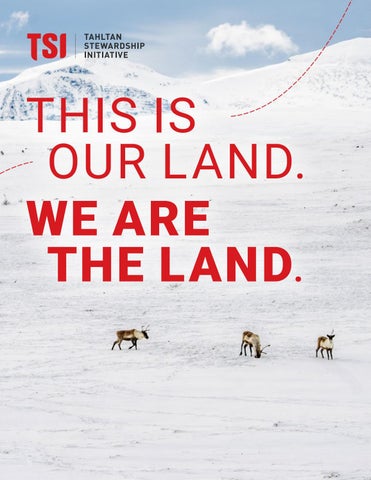
THIS IS OUR LAND. WE ARE THE LAND.
73
TAHLTAN STEWARDSHIP INITIATIVE
The Tahltan Stewardship Initiative (TSI) is our opportunity for transformative change based on the recognition of Tahltan title and rights. Now, we can have a say in decisions that matter for our people in accordance with our values and knowledge. We decide how to protect our culture, care for our lands, water, fish, and wildlife. We decide how to sustainably manage our natural resources and economic development in our territory. We can meet our responsibilities, make decisions, and manage our lands. Through TSI, the rules are changing. And we are shaping the process.
VI SI ON STAT E ME N T TSI will support the Tahltan Nation to assert selfdetermination and fulfill our inherent stewardship and caretaking responsibilities for our territory. The preliminary initiative vision is:
“The Tahltan Nation will fulfill its inherent stewardship responsibilities for all lands, water, wildlife, fish and natural resources in Tahltan Territory.” Stewardship is the careful and responsible management of something entrusted to one’s care. The TSI will help the Tahltan Nation to plan for and manage our land, water, wildlife, fish, and natural resources. It will ensure we take care of Tahltan Territory now and for future generations. By protecting our environment and relationship with the land including culturally significant areas, conserving wildlife, managing economic development, and asserting jurisdiction over Tahltan Territory, we will advance our role in and refine shared decisionmaking processes.
74
TAHLTAN CENTRAL GOVERNMENT – FIS H & WILD L I F E NEWSL ETTER 2021
BAC KG RO U N D Tahltan Nation is founded on sacred responsibilities and inherent rights granted to us by the Creator. The desire of our Nation is to become a fully selfdetermined and self-governed people. As reflected in our 1910 Declaration of the Tahltan Tribe, our leaders have worked for generations to build a strong system of governance that is true to our unique values as a Nation while being responsive to the realities of Tahltan people.
The TCG is working to modernize its relationship with the Province of British Columbia and the Government of Canada to achieve effective shared decisionmaking and collaborative stewardship for Tahltan Territory. At the core of our government-to-government relationships will be respect and recognition of Tahltan title and rights. TSI will advance Tahltan interests and further reconciliation. The opportunity to further advance shared decisionmaking in Tahltan Territory has arisen from the Province of British Columbia’s Declaration on the Rights of Indigenous Peoples Act (DRIPA). Brought forward in 2019, this legislation intends to harmonize provincial laws with the United Nations Declaration on the Rights of Indigenous Peoples (UNDRIP).
This means the TSI framework will support recognition of the Tahltan right of free, prior, and informed consent regarding lands, water, and natural resource use, the preservation of Tahltan culture, traditions and ceremonial practices, and the right for Tahltans to participate in determining outcomes in decision-making matters which affect their rights. Recognizing the timing of this opportunity and building upon the progress of previous work, the TCG is supporting TSI to advance Tahltan interests. The message from the Nation is clear: Tahltans have never ceded or surrendered our lands and continue to exercise our rights and jurisdiction over Tahltan Territory. The Nation is vested with the sacred responsibility to manage our lands and resources for the benefit of all Tahltans.
75
TAHLTAN STEWARDSHIP INITIATIVE
Foundational Efforts & Initiatives Initiatives that have contributed to this work include:
1980s
Tahltan Ancestral Study with Elders
2003
Out of Respect Report
2013
The Shared Decision-Making Agreement with the Province of British Columbia
2016
Wildlife Department formed within the TCG
2018–2021
The Collaborative Stewardship Framework with the 3Nations and the Province of British Columbia
2020
1987
Resource Development Policy
2005
Formation of the Tahltan Heritage Resources Environmental Assessment Team (THREAT)
2015
Lands Department formed within the Tahltan Central Government
2017
The Klappan Plan and the Klappan Management Board
2019
Culture & Heritage Department formed within the TCG
Fisheries Department formed within the TCG
Each of these projects and efforts has helped to advance our Nation and support our unified goals founded on the principles of mutual respect, recognition, and reconciliation of Tahltan title and rights. Together, we work to protect the environment, safeguard our culture and heritage, ensure shared revenues and other benefits from sustainable development, and strengthen the well-being of our Tahltan Nation family.
76
TAHLTAN CENTRAL GOVERNMENT – FIS H & WILD L I F E NEWSL ETTER 2021
Current TSI Projects & Agreements TSI will align related Tahltan
TSI will also include related activities
governance, reconciliation, land
and projects initiated with the
management projects and activities
Province of British Columbia and
from the TCG Communications
Canada by agreement.
and External Relations, Culture and Heritage, Fisheries, Lands, and Wildlife Departments.
THIS INCLUDES (BUT IS NOT LIMITED TO) THE FOLLOWING: •
Canada Nature Fund Target 1 Challenge: Establishing Tahltan Indigenous Protected & Conserved Areas (IPCAs)
•
Ice Mountain Agreement / Conservancy
•
Shared Decision-Making Agreement (SDMA)
BELOW IS A LIST OF PROJECTS UNDER THE TSI:
77
•
Assessment of Ecosystem Services & Climate Change Resilience
•
Capacity Development Project
•
Shared Prosperity Agreement (SPA)
•
Caribou Stewardship Project
•
Tahltan Nation Land Use Planning (TLUP)
•
Communications and Engagement Project
•
Tahltan-BC Joint Land Use Plan (TBCLUP)
•
Cultural Heritage Project
•
Wildlife Accord
•
Ecosystem & Climate Project
•
Fisheries Stewardship Project
•
GIS Spatial Database Project
•
Land Governance Framework & Operational Policies Project
•
Predator Program
•
Tahltan Guardian Program
•
Tahltan Infrastructure Assessment (Energy, Access, & Mineral Potential)
•
Tahltan Indigenous Protected & Conserved Areas (IPCAs) Project
•
Tahltan Land Stewardship Plan
•
TCG Archives Project
•
Water Resources Project
•
Youth Stewardship Program
COMING SOON
The TSI Website – G E T I N VO LV E D !
Coming soon, the TCG will launch a brand new TSI website with members only information on each of our projects, current and future engagement opportunities and more. The cornerstone of the TSI is community involvement. Questions? Comments? We want to hear from you: CONTACT TCG TSI COMMUNICATIONS:
communications@tahltan.org 78
TAHLTAN CENTRAL GOVERNMENT – FIS H & WILD L I F E NEWSL ETTER 2021
•1 •
TSI BASE M A P DR AF T MAP v1.1 – 2021/06 LOCA L I T Y LAKE L A NDFOR M TA HLTA N N AT ION T ER R I TORY Charlie Crole Creek Ecological Reserve
EC OLOGICA L R ESER V E PR OT EC T ED A R E A PR OV INCI A L PA R K
NA
NA H LIN MOUNTA IN
KAWDY MOUNTA IN
HL IN
Chickens Neck Ecologica Reserve
RI VE R
D EAS E L A
LEVEL MOUNTA IN RA NGE
A RIVER
YR IVE R
S H ES L AY
Z AN
TA HLTA N
LA
S
S HE
DE A SE
TUY
Tahltan Nation continues to do research and assemble further information and data, and adjustments to the boundaries reflected in this map may be made in the future where appropriate and supported by evidence.
T
This map represents the general boundaries of Tahltan territory based on the information available and reviewed as of the date of its creation. It does not represent a definitive or final statement of the areas to which Tahltan Aboriginal title and rights apply.
T UYA M O UN TAI N PARK
IL
LA
R
IVER
TSENEGLODE M O U N TAI N
KL AS TLI N E PL ATEAU
T EL EG RA P H C REEK
•51 •
TSAZIA M O U N TAI N
•37• ISKUT
C H U TINE RIVER
TODAGIN LAKE
ED Z I Z A MOUNTA IN
TODAGIN M O U N TAI N TAD OG LI N S . SLOPE PARK K IN ISK AN LAK E PARK
ISKUT
RIVER
LITTLE K L A
S T I K INE RIVER
MOUNT EDZIZA PARK
PP
I SKU T RIVER HOT SPRIN G S PARK
NIN
GUN
SA
RIV
UK U
N
LAVA FORKS PARK
ER
Craig Headwaters Protected Area
BO RDE R LA KE S PA RK
79
TRE
ER
NIN NI N GUN S AW PARK
RIV
Ningunsaw River Ecoogical Reserve
W
GRE AT GLACIE R & CHO Q UE TT E HOT SP RINGS PA RK
AT
Y C REEK
SECTION TITLE
•97•
T
AKE
E L AKE
UR
NAG
AIN RIV ER
D ENETI AH PAR K
ST I K I N E R I V E R PA RK
Pitman River Protected Area
STIKINE RIVER KLA
P PA
IVE NR R
PA
Chukachida Protected Area Gladys Lake Ecoogical Reserve
50
100
KI LO M ET ER S
FINLAY RUSSEL PA RK
S PATS IZI PL ATEAU W I L D E R NESS PAR K
N
0
SPATSI Z I M O U N TA IN
YT
NT
K L A P PA N M O U N TA I N R
ER
UPP
IV
NA
VE
I S R
RI
NAS
EE
ER
SK
S PAT S I Z I HE ADWAT E R S PARK
TATL ATUI PARK
AB
R
BC
VE
R
80
TAHLTAN CENTRAL GOVERNMENT – FIS H & WILD L I F E NEWSL ETTER 2021
Media Engagement
– TA H LTA N N AT I O N & TSI IN THE NEWS The Tahltan Stewardship Initiative (TSI) will further the interests of the Tahltan Nation through its projects and related agreements. TSI has a unique media strategy to bring attention to this important initiative and support generational change.
REACH / NUMBER OF MEDIA IMPRESSIONS
Tahltan land to be protected in partnership with conservation organizations, Industry and the Province
93,167,311
Tahltan Nation Demands Bell Media Cease Airing of 'Jade Fever' and the Province to Suspend all Jade and Placer Mining in Tahltan Territory
90,026,275
Province of B.C. and the Tahltan Nation begin talks on shared decision-making
77,500,329
BC, Tahltan Nation step up wildlife patrols after ‘contentious’ hunting season
11,374,023
Tahltan and B.C. further their vision of shared prosperity
3,253,862 2,729,120
Province teaming with Tahltan Nation on wildlife stewardship
2,979,501
Protecting the Sacred Headwaters of the Klappan Valley
185,735
Tahltan Nation Introduces Predator Management Policy
139,519
0
81
200,000
1,000,000
25,000,000
75,000,000
95,000,000
TAHLTAN STEWARDSHIP INITIATIVE – MEDI A ENGAGEMENT
PR E SS R ELEASES Tahltan land to be protected in partnership with conservation organizations, Industry and the Province Tahltan Central Government – News Release | April 8, 2021
A new conservancy to protect the environment and wildlife on Tahltan Territory has been created in an area of northwestern B.C., historically known as the Ice Mountain Lands, adjacent to Mount Edziza Provincial Park. The Tahltan Central Government, the Province, Skeena Resources Limited, the Nature Conservancy of Canada and BC Parks Foundation have worked in partnership to create the conservancy.
BC, Tahltan Nation step up wildlife patrols after ‘contentious’ hunting season The Canadian Press | September 3, 2021
There will be more provincial conservation officers and Tahltan guardians patrolling the nation’s territory in northwestern British Columbia this hunting season. The province and the Tahltan Central Government say in a joint statement they’re working together on wildlife stewardship and furthering their commitments to reconciliation. thestar.com/life/2021/09/03/bc-tahltan-nation-step-up-wildlifepatrols-after-contentious-hunting-season
tahltan.org/tahltan-land-to-be-protected-in-partnership-withconservation-organizations-industry-and-the-province
Tahltan Nation Demands Bell Media Cease Airing “Jade Fever” and the Province to Suspend all Jade and Placer Mining in Tahltan Territory Tahltan Central Government – News Release | May 18, 2021
The Tahltan Central Government has contacted Bell Media, the Discovery Channel, and Omnifilm Entertainment to demand that these companies suspend airing the show “Jade Fever”, which follows a jade operation in Tahltan Territory and fails to demonstrate any consideration of impacts to Tahltan rights and title or depict responsible environmental stewardship. tahltan.org/tahltan-nation-demands-bell-media-cease-airing-jadefever-and-the-province-to-suspend-all-jade-and-placer-mining-intahltan-territory
Province of B.C. and the Tahltan Nation begin talks on shared decision-making
Tahltan and B.C. further their vision of shared prosperity Tahltan Central Government – News Release | June 10, 2021
The Tahltan Central Government, Iskut Band Council, Tahltan Band Council and the Province have entered into a Shared Prosperity Agreement (SPA), setting the foundation to collaboratively achieve long-term comprehensive reconciliation and land-use predictability. tahltan.org/tahltan-and-b-c-further-their-vision-of-shared-prosperity
Province teaming with Tahltan Nation on wildlife stewardship Min. of Forests, Lands, Natural Resource Operations and Rural Development / Tahltan Central Government – News Release | September 3, 2021
There will be an increased presence of Tahltan guardians and B.C. Conservation Officers within Tahltan Territory this year, as the Province of British Columbia and the Tahltan Central Government work together towards cooperative wildlife stewardship and continue their shared commitments to further reconciliation.
Tahltan Central Government – News Release | June 15, 2021
The Tahltan Central Government and the Province of British Columbia are starting negotiations on the first consent-based decision-making agreement ever to be negotiated under the Declaration on the Rights of Indigenous Peoples Act.
tahltan.org/province-teaming-with-the-tahltan-nation-onwildlife-stewardship
tahltan.org/province-of-b-c-and-the-tahltan-nation-begin-talks-onshared-decision-making
82
TAHLTAN CENTRAL GOVERNMENT – FIS H & WILD L I F E NEWSL ETTER 2021
Tahltan Land Stewardship Plan The Tahltan Land Stewardship Plan (TLSP) is one of the main projects under the TSI. The TLSP will be based on Tahltan knowledge and worldview, local knowledge and science and will describe how we will continue to take care of our land, water, fish, wildlife, and other natural resources. This is an important document that will, among other things, identify and ensure that the most sacred parts of our territory are protected for all generations to come. The TLSP is being developed by Tahltans for Tahltan. The TLSP working group is assisting the Fish and Wildlife Departments to develop survey questions to include on the new Tahltan Stewardship Initiative (TSI) website. These surveys will be part of the first round of questions that will assist the TLSP working group to determine what is important to Tahltans and how membership would like to participate in and contribute to the TLSP project. The responses to these initial survey questions will also help us to create more in-depth interview questions when we begin to develop land and resource management direction in later stages of the planning process. COVID-19 has significantly impacted our plans for engaging with membership and has limited our ability to meet with you in person. It is critical that Tahltans have input into this process. The upcoming surveys on the TSI website will be one of many ways that community input will be incorporated into the process. Please take the time to inform yourself on the TSI, the TLSP, and think about how you can contribute to these important initiatives.
83
TAHLTAN LAND STEWARDSHIP PLAN ( TLSP) / TSI : F I SHERI ES DEPARTMENT PROJECTS
TSI: Fisheries Department Projects Fisheries Stewardship Project The Fisheries Stewardship Project brings Tahltan knowledge, worldview, and science together to ensure that we are taking care of and protecting our fish and their habitat. As First Nations Peoples, we have always honoured, protected, and relied upon our lands and our resources. These resources are vital to the nutritional, social, economic, and cultural well-being of our Nation. As our Ancestors were before us, we are responsible for protecting our land, water, and resources for the purpose of passing on our traditional values and practices to our future generations.
– PROJECT BACKGROUND We are all connected to our fish as they are integral to our food security, and our spiritual and cultural well-being. They are part of who we were and who we are as Tahltan people. We are fish people of the mighty Stikine River. We defended our territory and our resources, often at the cost of our own blood. We will continue to defend our fish and the habitat they rely on to ensure that our future generations will be able to practice the spiritual and cultural connection to our land and aquatic resources.
Below: Hackett River rainbow trout juvenile.
– PROJECT OVERVIEW To uphold our obligations as fisheries stewards, we must have both knowledge of the status and strength of our fish stocks, as well as the condition of their habitats and any past, existing, or foreseeable threats to the health of that environment. The objective of our field investigations within our Traditional Territory is designed to answer these key questions: Fish population assessments to ensure fish stocks are sustainable with the harvest rates that they are subject to; Habitat assessments to identify if their habitat has been impacted by development or natural barriers to assure vital protection; and, If necessary, rehabilitation of their habitats.
84
TAHLTAN CENTRAL GOVERNMENT – FIS H & WILD L I F E NEWSL ETTER 2021
FISHERIES DEPARTMENT
TSI Project Updates Through TSI, several subprojects are occurring led by the Fisheries Department. During the busy summer and fall season, the Fisheries Department operated a number of TSI field projects in the focused fisheries areas of interest as listed below:
Sheslay
Klappan Sacred Headwaters
HATCHAU LAKE
RAIL GRADE SURVEY
(located at the headwaters of the Hackett River) July 5–15. Surveys of salmon habitat were done including sediment quality sampling, bathymetric (lake depth) mapping, fish passage, and hydrology. Patrick Hudson and John Nole staffed this project.
HACKETT RIVER
Below: Klappan rail grade survey.
July 16–August 13 and October 1–21. Focus here was on the assessment of both juvenile (rearing) fry and adult (spawning) salmon for age class composition, spatial distribution, and relative abundance. We also did additional hydrology work, looked for potential fish access restrictions and sought to improve field crew mobility options. Richard Erhardt, Drew Inkster and Sheldon Dennis worked on this project.
August 10–20. Conducted a rail grade inspection with an engineer to assess fish passage issues and develop reclamation prescriptions to restore fish passage where appropriate. Also, re-sampled the groundwater wells at Kluakaz strip, downloaded data loggers and installed additional temperature loggers and groundwater wells. Patrick Hudson, Fabian Vance and Roy Keery staffed this project.
KLUATANTAN & KLUAYAZ LAKES May 17–24 – Kluatantan Smolts. Spring field work to test juvenile capture methods, and a site recon. Kerry Carlick, Sheldon Dennis, and Kyle Inkster contributed to this project. September 26–October 4. Performed new or additional bathymetric mapping in the Lakes. Assessed for fish presence / spawning, habitat conditions and passage in Kluatantan Lake, along with water chemical profiling and sediment sampling. Patrick Hudson and Peter Carlick-Beck worked on this project.
Little Tahltan Watershed August 24–27. Conducted an overview watershed assessment to determine post-fire impacts. This included a day of overflight flown by Patrick Hudson, gauging of river discharge, water quality sampling and downloading a data logger at the Hydrometric station.
85
TSI: FISHERIES DEPARTMENT PROJECT UPDATES
Tahltan Lake September 9–15. Accomplished detailed spawning area surveys, additional bathymetric mapping, groundwater / surface water investigations and sampling. Also did an overflight of the Trib 2 and lower Johnny Tashoots Creek to assess for the presence of spawners. Patrick Hudson, Drew Inkster, Ayce Dennis, Ken Izzard assisted with this project.
Capacity Building In addition, as part of our ongoing capacity building strategy, this season we continued to develop the means to conduct drone surveys. This included the purchase of an initial drone unit, training and Remotely Piloted Aircraft System licensing of staff member Drew Inkster, and the implementation of pilot / test surveys at sites of key interest to direct future use and application. These included Tahltan Lake spawning grounds, Tahltan River slide, Hackett River main spawning area at Pyrrhotite Creek. The drone surveys will be used to estimate/track changes at the slide, analyze Tahltan Lake spawning depth estimates to support the dam redesign, and to pilot test using the drone to estimate spawner numbers at the Pyrrhotite Creek spawning area.
Fisheries Guardian June 15 – August 6. Margaret Asp patrolled the food fishery, relayed fisheries information to members, and reported any infractions.
Right: Fisheries technician Sheldon Dennis with Hackett River Coho.
86
TAHLTAN CENTRAL GOVERNMENT – FIS H & WILD L I F E NEWSL ETTER 2021
TSI: Wildlife Department Projects The Wildlife Department currently has several projects that are a part of the TSI including the following initiatives:
Caribou Stewardship Project Northern Mountain Population (NMP) Woodland caribou are currently designated as “Special Concern” under the federal Species at Risk Act (SARA). In Tahltan Nation, there are seven herds, all important to the Nation for traditional uses, food security, and sustenance needs.
– PROJECT OVERVIEW The Level Mountain-Kawdy Plateau, Tseneglode, Spatsizi, and Edziza Woodland caribou herds have limited current information on population numbers, habitat use, and predation over the last ten to twenty years. Three of the four herds are found in Tahltan spiritually and culturally important areas, one of the populations is declining, and two of the herds are in relatively heavily impacted areas from mineral development and licenced hunting/access. Tahltan knowledge, community knowledge, and Tahltan Guide & Outfitter knowledge are the robust data sources being used to support management, land use, and conservation planning while the scientific knowledge is being collected by Tahltan.
– PROJECT BACKGROUND Limited knowledge on wolf numbers, pack sizes and movements, and the predation rate on culturally important ungulates such as Woodland caribou and moose are affecting Tahltan management abilities to ensure sustenance needs are met, food security, and to ensure land use management strategies and conservation areas are addressing habitat needs, critical habitats, movement corridors, and seasonal ranges in light of climate changes and human activities. Above: Caribou on Level Mountain.
87
Tahltan have traditionally managed these herds through our knowledge and understanding of the historic seasonal ranges, movement periods and corridors, and changes in range use and numbers over time. However, Tahltan citizens are expressing concern on the apparent changes to seasonal range, movements, and declining numbers of caribou herds for over ten years which are not consistent with long term traditional and community knowledge.
Through TSI, the process of Tahltan Land Use Planning and furthering the establishment of Tahltan Indigenous Protected and Conserved Areas (IPCAs) is developing management direction, zoning, and conservation goals for the herds. Information is needed to create an updated understanding of the Woodland caribou herds and their relationship with wolves to support the advancement of Tahltan IPCAs through a Tahltan land use planning process.
TSI: WILDLIFE DEPARTMENT PROJECTS
Predator Program In response to dwindling wildlife populations and increased conflict between community members and predatory species, the Tahltan Central Government introduced the Tahltan Predator Management Policy. This robust policy encourages and incentivizes Tahltan members to exercise their constitutionally protected Aboriginal hunting rights to harvest predatory species, including black bears, grizzly bears, and wolves.
– PROJECT OVERVIEW
– PROJECT BACKGROUND The TCG Wildlife Department will be responsible for implementing the Tahltan Predator Management Policy and will record harvest numbers from the Tahltan people. The initiative will help stabilize wildlife populations, protect local communities, encourage culturally important Tahltan practices, and aims to set a strong foundation for future wildlife management practices and initiatives.
The Predator Management Policy requires Tahltan members to harvest predatory species in compliance with Tahltan cultural practices and provincial regulations, to the extent that the regulations do not contradict Tahltan law or rights. Members are required to utilize each species to the extent possible for cultural purposes such as food, clothing, regalia, tools, medicine, and/or ceremony.
88
TAHLTAN CENTRAL GOVERNMENT – FIS H & WILD L I F E NEWSL ETTER 2021
WILDLIFE DEPARTMENT
TSI Project Updates Tsenaglode Caribou Update The Tahltan Central Government (TCG) started a study in 2019 to: Collect information on the movements, seasonal range use, and population of the herd; Engage with the communities, Elders, and Youth on caribou and climate changes both historic and current; and, Collaboratively develop climate change and caribou management strategies.
Since 2020, with the advancement of the Tahltan Stewardship Initiative (TSI), Tahltan Indigenous Protected and Conserved Areas (IPCAs) Initiative, and TCG’s engagement in the 3Nations BC Collaborative Stewardship Forum (CSF), additional collars and seasonal monitoring have been expanded for the study.
To view the Caribou Monitoring Program video, visit: tahltan.org/ tahltan-wildlifeguardians-communitybased-climate-changemonitoring-program
In April 2019, 10 caribou were captured, collared, and body condition measured by the Guardians (Clements Brace), and monitored by the Wildlife Department. A video was done by the TCG Multimedia Department (Adam Amir, Multimedia Director) about the capture, and it is available on the TCG website. In October 2020, an additional 20 collars were deployed in partnership with BC to collect additional information on the herd. Currently 20 collared caribou are still active (Map 1) with one collar dropping off the caribou, and the other 9 collars being predated. This represents annual mortality of approximately 21%. Seasonally, the caribou are predominately staying within Dark Mountain to the north, Turnagain River to the east, Midway Ranges and Stikine River to the south, and Tsenaglode Mountain to the west. However, there are several caribou who are moving well to the north in winter and spring and across the Stikine River in the south (Map 1). The seasonal movements indicate there is a great deal of mixing between caribou herds to the north (Horseranch and Little Rancheria) and to the south with the Spatsizi herd range.
89
Tahltan Guardians and Wildlife Department continue to conduct seasonal classification surveys to determine the number of bulls, calves, and cows to determine population trends. Since 2019, generally 400–700 caribou have been observed during the seasonal surveys (calving, rut, and late winter) in the Tsenaglode area. Population indicators to assess population status and trends are based on the rationales and indicators identified for the NMP Woodland caribou herds (Environment Canada 2012, Hatter 2019). These indicators are ≥ 35 bulls: 100 cows and/or > 25 calves: 100 cows. Herds with fewer than 25 calves/100 cows for several years (three years) and small herds (<200) are more stressed by harvest (Environment Canada 2012). The recent monitoring on Tsenaglode caribou has indicated bull ratios in the high twenties/low thirties and calf ratios in the high teens/low twenties, which are both considered below stable population indicators. However, more monitoring is occurring to assess population status. While the Tahltan monitoring has only commenced since 2019, Tahltan knowledge and local knowledge have identified potential declining trends for an extended period. As part of the collaborative working relationship with the Province, a population estimate is being planned for the herd in October 2021. This will be the first estimate for the herd and will be used with Tahltan knowledge and local knowledge to support management actions. Community engagement is being planned in winter of 2021–22, when COVID-19 restrictions allow us to discuss caribou management and climate change strategies. In addition, there is planning to develop community-based caribou habitat mapping in the winter of 2021. These activities, as well as other related caribou study items will be discussed this winter with communities.
TSI: WILDLIFE DEPARTMENT PROJECT UPDATES
TSE N AG LODE WOODL A ND CA RIBOU SE ASON A L MOV E ME NTS APR I L 2019–OCTOBER 2021 TA HLTA N N AT ION T ER R I TORY
R
SE ASON CA LV ING
E
R
V
RUT
U
E
R
I
B
L
S PR ING S U MMER W IN T ER Cassiar
A S D E
Map 1 – Tsenaglode Woodland caribou seasonal movements from April 2019 –October 2021.
E
K E
C H
I
R
I
A
V E R
K
Dease
G
A
I N
Lake
A
Dease Lake T U
R
I
V
E
R
N
R
Iskut
K
L
A
SPATSIZI
P
P
S
I Z I
R
90
TAHLTAN CENTRAL GOVERNMENT – FIS H & WILD L I F E NEWSL ETTER 2021
YU KO N (C ANAD A)
Te slin
R
Lake
L
U
E
R
B
LE V E L – K AWDY CA RIBOU MOV E ME NTS A ND LOCATIONS
N L I T E S
OCTOBER 2020–OCTOBER 2021 TA HLTA N N AT ION T ER R I TORY
Cassiar SE ASON
R
CAELV ING A S E D RUT S PR ING
R
S U MMER
R I V E
R
W IN T ER
Dease Lake
Dease Lake
T U Y A
T U
R
I
91
N
E
I
V
E
R
R
N
Map 2 – Level Mountain-Kawdy Plateau Woodland Caribou seasonal movements from October 2020–2021.
TSI: WILDLIFE DEPARTMENT PROJECT UPDATES
Caribou & Wolf Monitoring Programs TCG has commenced their own caribou management program based on management concerns identified with Tahltan knowledge, guide outfitter knowledge, and local knowledge indicating changes in population numbers, decreased recruitment, and changes in seasonal ranges. It is believed the changing climate and increasing predator numbers are some of the primary causes for these changes. TCG have identified the Tsenaglode, Edziza, Level Mountain-Kawdy Plateau, and Horseranch herds as priorities in 2020 initially, with the inclusion of Spatsizi in 2021. The herds are found in Tahltan spiritually and culturally important areas. One of the populations is declining, and two of the herds are in relatively heavily impacted areas from mineral development and licenced hunting and access.
CARIBOU MONITORING PROGRAM The Tahltan Wildlife Department has been monitoring the Level Mountain-Kawdy Plateau, Tsenaglode, Edziza, and Spatsizi Woodland caribou herds through seasonal surveys, GPS collars, and population surveys.
10
Since 2019, 10 collars have been deployed on the Tsenaglode herd, and in 2020 an additional 40 collars were deployed on the Tsenaglode and Level MountainKawdy Plateau herds with the initial seasonal range information below. 95% Kernel Seasonal Ranges
COLLARS DEPLOYED On the Tsenaglode herd since 2019.
40+
ADDITIONAL DEPLOYED In 2020 on the Tsenaglode and Level Mountain-Kawdy Plateau herds.
Caribou
Year
Herd
Collar
Season
sq km
N N (caribou) (fixes)
2020/21
Level
Lotek
Winter
5,069.0
20
9,923
2020/21 Tsenaglode
Telonics
Winter
2,065.3
20
12,570
2019/21 Tsenaglode
Vectronic
Winter
2,035.1
10
7,871
is developing management direction,
2019/21 Tsenaglode
Vectronic
Spring
1,991.4
10
4,367
zoning, and conservation goals for
2019/21 Tsenaglode
Vectronic
Calving
1,674.0
10
2,010
the herds. Information is needed to
2019/21 Tsenaglode
Vectronic
Summer
1,306.4
10
5,149
2019/21 Tsenaglode
Vectronic
Rut
1,099.8
10
1,604
2019/21 Tsenaglode
Vectronic
Annual
2,847.2
10
21,003
The Tahltan Stewardship Initiative (TSI)
create an updated understanding of the Woodland caribou herds and their relationship with wolves to support the advancement of Tahltan Indigenous Protected and Conserved Areas through the Tahltan land use planning process.
Seasonally, Level Mountain-Kawdy Plateau caribou have greater seasonal movements with caribou moving from alpine and subalpine habitats in the rut, to lower elevation forested winter habitats north and west of Level Mountain and Kawdy Plateau towards Teslin Lake, Swift River and Watson Lake to the north. Most of the caribou are located between Teslin Lake and Level Mountain in winter but a number still moved further north into the Yukon (Map 2). In the spring, caribou moved to alpine and subalpine habitats in and around Tuya Lake, Kawdy Plateau, and Snow Peak Range. Caribou stayed in these areas until late summer where most collared caribou moved to Level Mountain and Kawdy Plateau for the rut. Like the Tsenaglode herd, the seasonal movements indicate there is a great deal of mixing between caribou herds to the north (Swan Lake, Horseranch and Little Rancheria).
92
TAHLTAN CENTRAL GOVERNMENT – FIS H & WILD L I F E NEWSL ETTER 2021
Additional information on the herds has been collected by aerial seasonal surveys. The surveys use the collared caribou data to locate the animals and the groups they are found with to record population demographics such as bulls, cows, and calves. Conducting surveys across seasons, provides estimates of survival rates, reproduction, population counts, and seasonal habitat use. Surveys have occurred for the Edziza, Tsenaglode, and Level-Kawdy herds since 2020, with the addition of Spatsizi herd in 2021. These will continue through the three years of the project.
WOLF MONITORING PROGRAM Tahltan Nation has identified predator management as a wildlife management priority with a focus on greater management in and around community use areas and culturally important species such as moose and Woodland caribou. A predator management framework which includes management plans, policy development, traditional management practices, and monitoring has been developed by the Tahltan Central Government (TCG). A component of this framework is monitoring wolves and their movements, predation rates, and home ranges in and around community use areas, and where other monitoring programs are active such as the Tsenaglode, Edziza, Horseranch, Spatsizi, and Level Mountain-Kawdy Plateau Woodland caribou herds. In year one (2020), the focus was on deploying 15 collars on wolves, monitoring movements and where feasible, predation sites, in relation to ongoing wildlife initiatives, along with collection and review of historic and current scientific, local and Tahltan knowledge. The planned engagement by the Guardians with Youth, Elders, and with local school programs to share information on the project and seek input for the second and third year of the project was delayed to 2021 due to COVID-19 restrictions. Year two and three will include the continued monitoring of collared wolves with engagement and capacity development through on the land programs, field work, and community engagement by Guardians. Additional collars will be deployed depending on mortalities of collared animals.
Above: Caribou collaring on Kawdy Plateau.
Population monitoring to date has indicated the caribou herds have bull/cow ratio below 35 bulls/100 cows and the calf/cow ratio below 25 calves/100 cows. In addition, wolf density for the area is estimated at 13–24 wolves/1000 km², well above the wolf densities identified for recovering caribou populations (3 wolves / 1000 km² Environment Canada 2012) and stable caribou populations (6.5 wolves/1000 km² Hatter and Bergerud 1991, Hatter 2019). The mortality rate for the herds is approximately 20% based on the sample of collared caribou. Licensed harvesting is still being assessed but is estimated at 1.5–2% harvest (Hatter 2019) and it is known that Tahltan harvest is occurring on the herds. All these factors, when combined with Tahltan, local, and scientific knowledge parameters, support the management concerns that the populations are possibly in decline or have negative population growth.
93
Since November 2020, 18 GPS collars have been deployed by Guardians and Wildlife Department on wolves with 3 collars being redeployed on new packs after mortalities (Map 3). Average movement between locations is 2.3 km ± 4.4 km (90% CI) (N=3,793) and average home range size is 560 km2 ± 249 km² (90% CI) (N=18) which are like other northern boreal ecosystems. Wolf densities in northern boreal ecosystems are estimated with a range of 5–15 wolves/1000 km² in northwestern BC, 10-20 wolves/1000km² in Alaska, 9 wolves/1000 km² in Yukon (Hatler et al. 2008, BC FLNRO 2014, TCG Tahltan Predator Management Plan in preparation). Pack sizes in the Yukon are estimated in the range 7–9 wolves in Yukon and ranges of 5-30 wolves in Alaska (Hatler et al. 2008).
TSI: WILDLIFE DEPARTMENT PROJECT UPDATES
Map 3 – Estimated wolf locations, movements, and pack home ranges from November 2020–October 2021.
WOLF LOCATIONS – NOVEM BER 2020–OCTOBER 9, 2021 Wolf ID
Movements
95% Kernal Home Range
18 M H 37
18 M H 37
18 M H 37
30 Mile
30 Mile
30 Mile
40 Mile
40 Mile
40 Mile
Dease R1
Buckley
Dease R1
Dease R2
Dease R1
Dease R2
Dease L1
Dease R2
Dease L1
Dease L2
Dease L1
Dease L2
Dease West
Dease L2
Dease West
Gnat Pass
Dease West
Gnat Pass
Gnat Pass-2
Gnat Pass
Gnat Pass-2
Goldpan
Gnatt Pass-2
Goldpan
L Klappan
Goldpan
L Klappan
Level Mt
L Klappan
Level Mt
Mess Creek
Level Mt
Mess Creek
New Collar
Mess Creek
New Collar
Spats-1
New Collar
Spats-1
Todagin Mt
Spats-1
Todagin Mt
Todagin-1
Todagin Mt
Todagin-1
Todagin-1 Todagin-2
Wolf densities in Tahltan Nation, based on a pack size range of 7–9 wolves associated with each collared wolf home range, results in a density estimate of 12–17 wolves/1000 km² (N=18). Wolf densities based on capture information, local knowledge and Tahltan knowledge through the Predator Management Plan and associated wolf trapping program have estimated pack size to range from 8–18 wolves with each collared wolf for the study area. Based on this range of pack size and the home range areas results in a density estimate of 13–24 wolves/1000 km² (N=10). Densities summarised by Hatler et al. (2008) indicate that wolf densities observed in Northern British Columbia have ranged from 10–44 wolves/1,000 km² (TCG Tahltan Predator Management Plan in preparation).
Estimated wolf density estimates are higher than the provincial estimates and are higher than wolf densities identified for recovering caribou populations. (3 wolves/1000 km² Environment Canada 2012) and stable caribou populations (6.5 wolves/1000 km² Hatter and Bergerud 1991, Hatter 2019).
94
TAHLTAN CENTRAL GOVERNMENT – FIS H & WILD L I F E NEWSL ETTER 2021
Expected Outcomes for Caribou & Wolf Monitoring Outcomes include the following: Capacity and training for Tahltan Guardians on wildlife management techniques and assessing information to support management strategies using Tahltan, local, and scientific knowledge; Improved and current information collection, analysis, and strategies based on Tahltan, local, and scientific knowledge to support future management and research actions for wolves, caribou, and predator-prey ecosystems in Tahltan Territory; Development of caribou conservation goals, management strategies, conservation areas, and climate change adaptation strategies through a community led Tahltan land use and candidate Indigenous Protected and Conserved Areas (IPCAs) process; Refined and improved information on pack movements, distribution of packs, predation rates, prey sites, and home ranges for management of wolves in the Nation; Refined and improved information will reduce the population and habitat information uncertainties, habitat use, movements, and seasonal range use information for management of Woodland caribou in the Nation; Additional information on site specific habitat uses, and movement corridors to support management decisions considering ongoing industrial and human disturbances in caribou ranges in the Nation; and, Assessment of long- and short-term climate change trends for the herds and bioclimatic region in relation to Tahltan knowledge of the caribou herds in the Nation.
95
SECTION TITLE
96
TAHLTAN CENTRAL GOVERNMENT – FIS H & WILD L I F E NEWSL ETTER 2021
September 3, 2021 Ministry of Forests, Lands, Natural Resource Operations and Rural Development Tahltan Central Government
JOINT NEWS RELEASE
Province teaming with the Tahltan Nation on wildlife stewardship VICTORIA – There will be an increased presence of Tahltan guardians and B.C. Conservation Officers within Tahltan Territory this year, as the Province of British Columbia and the Tahltan Central Government work together towards cooperative wildlife stewardship and continue their shared commitments to further reconciliation. These joint efforts are to respect and support the Tahltan Nation’s ongoing work to improve wildlife populations, food security and community safety while ensuring hunting access for licensed hunters visiting Tahltan Territory this upcoming hunting season. “Wildlife and wildlife management is critically important to the Tahltan way of life” said Katrine Conroy, Minister of Forests, Lands, Natural Resource Operations and Rural Development. “The BC and Tahltan governments are committed to working together on wildlife management for the benefit of the Tahltan and all British Columbians. This is part of the reconciliation path that we all walk together in support of prosperity for future generations.” The Tahltan guardians will be working together with B.C. Conservation Officers to coordinate efforts and conduct joint patrols throughout the hunting season. The Tahltan Central Government and the Province of British Columbia are collaborating on this work to ensure that Tahltan and licensed hunters can enjoy access to sustainable hunting opportunities in the region.
97
“From birth, Tahltans are taught of their responsibility to steward our land,” said Chad Day, President of the Tahltan Central Government. “The Tahltan Central Government will continue working with the Province to improve wildlife management in Tahltan Territory grounded in the principles of respect and recognition of Tahltan rights and title. The Tahltan Nation is committed to building a world class wildlife management regime to help ensure there are plentiful wildlife populations that are properly managed using Tahltan knowledge and modern day science. I am proud of our accomplishments and excited for what the future holds as we work to evolve and strengthen our relationship with the Province of British Columbia.” Safety within the Tahltan Territory is of high concern going into the 2021 hunting season. After a contentious hunting season last year, both governments hope that a unified approach which is respectful of Tahltan traditional and cultural practices on the land will support a better experience for all hunters in the region, including visitors and Tahltan members as they exercise their constitutionally protected Aboriginal hunting rights. Learn More: Current Provincial Hunting Regulations & Restrictions: www2.gov.bc.ca/gov/content/sports-culture/ recreation/fishing-hunting/hunting
SECTION TITLE
98
FISH & WILDLIFE NEWSLETTER 2021 /tahltangovernment
Follow us and stay up-to-date with Tahltan Nation news, events, and job postings.