C H RO N O L O GY : F RO M D EC L A R AT I O N TO I M P LE M E N TA T I O N
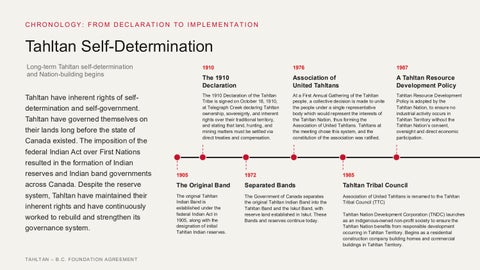
Tahltan Self-Determination Long-term Tahltan self-determination and Nation-building begins
1910
1976
1987
The 1910 Declaration
Association of United Tahltans
A Tahltan Resource Development Policy
Tahltan have inherent rights of selfdetermination and self-government. Tahltan have governed themselves on
The 1910 Declaration of the Tahltan Tribe is signed on October 18, 1910, at Telegraph Creek declaring Tahltan ownership, sovereignty, and inherent rights over their traditional territory, and stating that land, hunting, and mining matters must be settled via direct treaties and compensation.
At a First Annual Gathering of the Tahltan people, a collective decision is made to unite the people under a single representative body which would represent the interests of the Tahltan Nation, thus forming the Association of United Tahltans. Tahltans at the meeting chose this system, and the constitution of the association was ratified.
Tahltan Resource Development Policy is adopted by the Tahltan Nation, to ensure no industrial activity occurs in Tahltan Territory without the Tahltan Nation’s consent, oversight and direct economic participation.
their lands long before the state of Canada existed. The imposition of the federal Indian Act over First Nations resulted in the formation of Indian reserves and Indian band governments
1905
1972
1985
across Canada. Despite the reserve
The Original Band
Separated Bands
Tahltan Tribal Council
system, Tahltan have maintained their inherent rights and have continuously
The original Tahltan Indian Band is established under the federal Indian Act in 1905, along with the designation of initial Tahltan Indian reserves.
The Government of Canada separates the original Tahltan Indian Band into the Tahltan Band and the Iskut Band, with reserve land established in Iskut. These Bands and reserves continue today.
Association of United Tahltans is renamed to the Tahltan Tribal Council (TTC)
worked to rebuild and strengthen its governance system.
TA HLT AN – B . C. FOUN DA TI ON A GRE E MEN T
Tahltan Nation Development Corporation (TNDC) launches as an indigenous-owned non-profit society to ensure the Tahltan Nation benefits from responsible development occurring in Tahltan Territory. Begins as a residential construction company building homes and commercial buildings in Tahltan Territory.
1988
1998 to 2001
Economic Opportunities
TTC Dissolved
Tahltan blockades the Golden Bear access road over concerns about access to economic opportunities associated with the project.
The Tahltan Tribal Council (TTC) is dissolved.
2005
2015
Protest Methane Drilling.
Tahltan Central Government (TCG)
Tahltan evicts Shell Canada from the Sacred Headwaters (Klappan) to protest coalbed methane drilling.
Tahltan Central Council (TCC) changes its name to Tahltan Central Government (TCG)
Tahltan blockades Fortune Minerals from accessing the Klappan, beginning a years-long struggle to protect the Sacred Headwaters.
The Province of B.C. purchases Fortune Minerals’ coal licences in the Klappan in 2015, halting the proposed Arctos development and opening the way for long-term planning between the Tahltan Nation and the Province.
1997
2001 to 2002
2013
2020
Golden Bear
Tahltan Central Council (TCC)
Shared Decision-Making
Shared Prosperity Agreement (SPA)
Tahltan blockades the Golden Bear access road over concerns regarding prime moose habitat
The Tahltan Tribal Council is reinstated and its name changed to the Tahltan Central Council (TCC).
Shared Decision-Making Agreement between B.C. and the Tahltan Nation. It established a government-to-government framework to collaborate on natural resource management, mineral exploration, and environmental protection in northwest British Columbia.
The Tahltan Central Government, Tahltan Band, Iskut Band and the Province of B.C. enter into a Shared Prosperity Agreement (SPA), setting the foundation to collaboratively achieve long-term comprehensive reconciliation and land-use predictability. The SPA is another important chapter in a continuing Tahltan story.
TA HLT AN – B . C. FOUN DA TI ON A GRE E MEN T
2021
2023
2026
Consent-based Decision-making
Second Section 7 Agreement
Declaration Act Section 7 Agreement
The Tahltan Central Government and the Province of B.C. begin negotiations on the first consent-based decision-making agreement ever to be negotiated under the new provincial Declaration on the Rights of Indigenous Peoples Act (2019).
The second section 7 consent-based decision-making agreement is signed to cover major amendments and operational changes for the Red Chris copper-gold mine.
Tahltan Nation and the Province of B.C. reach a historic milestone by jointly making regulatory decisions on the reopening of the Eskay Creek goldsilver mine through the first-ever Declaration Act Section 7 agreement.
Hard-fought, concrete implementation and tangible realization of Tahltan title and rights
TCG and B.C. commit to begin discussions regarding a third decision-making agreement between the two governments related to the collaborative assessment of proposed changes to the previously approved Galore Creek copper and gold mine.
As Tahltan continue to exercise our sovereignty, title and rights, the Foundation Agreement provides another important tool to help us achieve our goals.
2022
2024
First Section 7 Agreement
Tahltan Stewardship
The historic first-ever section 7 consent agreement in B.C. is reached for the environmental assessment of the Eskay Creek Revitalization Project (which reached its formal joint decision milestone in January 2026).
Modern Tahltan stewardship and land use planning center on the Tahltan Stewardship Plan, approved in July 2024, which guides government-to-government work with British Columbia to protect vital cultural and ecological areas like Mount Klappan, Level Mountain, Sheslay, and Tahltan Lake while managing sustainable economic growth
TA HLT AN – B . C. FOUN DA TI ON A GRE E MEN T
The Tahltan Nation has worked to build an effective government-to-government relationship with the Province of B.C. over many years, protecting critical land and watersheds while at the same time creating thousands of good paying jobs.