FALL 2026
Liam Marku ’27 takes the baton during a
FALL 2026
6
Alumni Spotlight
INSIDE
Read about four interesting alums and their work. P
42
Alumni Weekend 2026 Reunion & event highlights in photos P
48
136th Commencement Celebrating the Class of 2026 P
OTHER DEPARTMENTS 3 14 32 40
On Main Hall Around the Pond Sports Taft Fund Report
meet against Andover and Deerfield on April 11. KAIYUN XU ’27
FALL 2026
Volume 96, Number 2 DIRECTOR OF MARKETING AND COMMUNICATIONS Kaitlin Thomas Orfitelli SENIOR ASSOCIATE DIRECTOR OF MARKETING AND COMMUNICATIONS Debra Meyers
FALL 2026
EDITOR Linda Hedman Beyus ASSOCIATE EDITOR Lee Juvan WEBSITE AND SPORTS INFORMATION MANAGER Seamus F. Conway
CLASS NOTES DEADLINES Winter–September 1 Spring–December 1 Fall–May 1
860-945-7777 TAFTALUMNI.COM
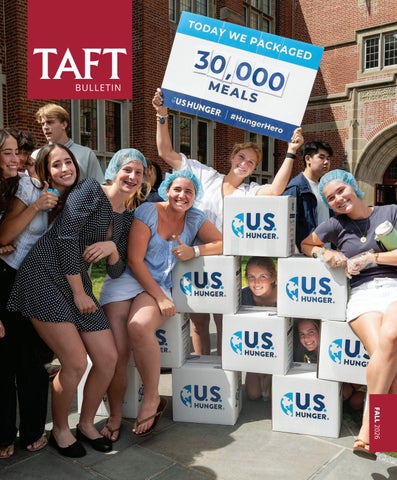
successfully packaged 30,000 meals on Taft’s campus in just one grant and logistics and supplies from U.S. Hunger. Local nonprofit agencies and Taft service partners distributed the meals throughout the region to individuals and families in need. ROBERT FALCETTI
DESIGN Good Design, LLC | gooddesignusa.com
taftbulletin@taftschool.org or write Taft Bulletin 110 Woodbury Road Watertown, CT 06795-2100
Taft’s Human Geography students, joined by faculty and staff volunteers, hour, supported by a Class of 1970 Live Our Motto Fund leadership
PHOTOGRAPHY Robert Falcetti
SEND ALUMNI NEWS TO
ON THE COVER
CONTACT EDITOR
Email lindabeyus@taftschool.org or write Linda Hedman Beyus, editor Taft Bulletin 110 Woodbury Road Watertown, CT 06795-2100
SEND ADDRESS CORRECTIONS TO
TAFT ONLINE Find a friend or past Bulletin: taftalumni.com Visit us on your phone: taftschool.org
taftrhino@taftschool.org or write Alumni Records The Taft School 110 Woodbury Road
What happened at today’s game? taftsports.com
Watertown, CT 06795-2100
facebook.com/thetaftschool
Shop online: taftstore.com
instagram.com/taftschool linkedin.com/school/the-taft-school The Taft™ Bulletin (ISSN 0148-0855) is published three times a year by The Taft School, 110 Woodbury Road, Watertown, CT 06795-2100, and is distributed free of charge to alumni, parents, grandparents, and friends of the school. All rights reserved.
2
Taft Bulletin / FALL 2026
vimeo.com/taftschool
On
MAIN HALL
A WORD WITH HEAD OF SCHOOL PETER BECKER ’95
Find Joy in Purpose “We are asserting that life has a purpose beyond existence alone, and that it exists outside the self, that students—and adults!—discover purpose in community and in service to those around us,
DEAR TAFT COMMUNITY,
First, please join me in congratulating the Class of 2026 on a great finish to their time at Taft and welcome them into the family of Taft alumni. You will love getting to know this class! As we begin the 2026–27 school year, Taft’s 137th, I want to focus on a third element of the Portrait of a Learner, “Find Joy in Purpose” (having addressed “Live with Honor” and “Strive for Wisdom” in my two prior columns). As with each element of the Portrait, the use of the first word, “Find,” suggests that developing this element requires active work—a kind of seeking—by the student. These capacities don’t appear magically or passively. Moreover, the Portrait emerged from the conviction that forces are competing for the attention of Taft students that run counter to what we—educators, parents,
and alumni—want for them. Therefore, it is incumbent upon us to equip and encourage students to pursue the elements of the Portrait as a way of resisting inferior alternatives. More on that below. Joy in Purpose is unique among the elements in connecting two ideas: the path to joy runs through discovering purpose. Like the other elements, this one is also an assertion—actually at least two assertions: the possibility of joy and the existence of purpose. It is worth noting that, like “Excellence,” “Purpose” also appears in Taft’s Core Values. Specifically, the Core Values state, “Taft’s motto calls everyone at Taft to be intentional about who we are, how we conduct ourselves, and how we build our intentionally diverse community at Taft, in our communities outside of Taft, and beyond.” The value of “Build Purpose” states, “We believe that our highest purpose lies beyond
our neighbors.”
Taft Bulletin / FALL 2026
3
FROM THE
Head of School
“It is not overstating things to say that naming ‘find joy in purpose’ is an assertion by Taft that nihilism is not the final word … and that students can and should seek purpose and can and should seek joy.”
4
Taft Bulletin / FALL 2026
the self and we discover who we are in a diverse and resilient community where we each matter; where we find joy, hope, and meaning in our everyday work to serve others, explore our interests, navigate challenges, and celebrate accomplishments.” In other words, we are asserting that life has a purpose beyond existence alone, that it exists outside the self, and that students—and adults!—discover purpose in community and in service to those around us, our neighbors. I belabor this because these ideas, though implied in Non ut sibi ministretur sed ut ministret, are no longer taken for granted in society broadly, if they ever were. Students are growing up today in a culture that models, celebrates, and reinforces self-centeredness, self-promotion, and a Hunger Games-like ethos of survival of the fittest in a world of scarcity over a “but to serve” ethos in a world of abundance. It is imperative that we assert Taft’s values—including service and that joy can be found in purpose—that we make them explicit and understand how to equip adolescents to find joy in purpose in the context of 2026. The long-form version of the Portrait spells out five practices in support of finding joy in purpose: > Explore interests to build self-knowledge and set meaningful goals. > Prioritize active learning over passive observation or consumption. > Develop skills to innovate, construct new knowledge, and/or create something new. > Practice hope and humor to stay engaged in growth. > Draw inspiration and wisdom from nature and from diverse cultures, philosophies, and religious traditions. Undergirding all of them is conviction that soulsatisfying, joy-creating purpose stems from pursuing the good of other people and communities, rather than simply pursuing one’s own satisfaction or pleasure or more instrumental goals. This is important to state and to help students understand today because most students experience unrelenting pressure to satisfy the human craving for purpose through instrumental goals, such as admission to an elite college. It is not stating it too strongly to say that today’s students experience this pressure more than any group of adolescents in history. This move to instrumental pursuits substituting for older purposes has a backstory. As developed countries have become more diverse and pluralistic over the last hundred years—a good thing—it has
become increasingly difficult to settle the inevitable differences that exist on questions like what constitutes a good life and the sources of meaning and purpose. This is certainly true in elite independent high schools, especially boarding schools—among the most diverse high schools on the planet. Out of a kind of respect for difference, the institutions that organize students’ lives have largely gone quiet or passive on these deep questions. Whereas these questions used to be answered by the shared assumptions that informed the founding of so many schools—ideas like not to be served but to serve and their sources—there is now a void. I addressed this phenomenon in my Commencement address this year. I shared the following with the Class of 2026:
•••
As we prepare to send you out into the world, it’s worth taking stock of the world you’ll enter. In a nutshell, it’s kind of a mess out there. Political culture wars and attention-decimating endless scrolling and real wars ... all the bad things. The underlying reason for all of this is what Paul Kingsnorth describes in his book, Against the Machine, as “an obsolete story.” The sources of meaning and purpose—the stories—that fueled the creation of the modern world we live in today—have been drained. As a result, we face a void. The strife we see all around us is a function of that void. In his recent book, Democracy and Solidarity, the UVA sociologist James Davison Hunter states that this void has been filled by “the cultural logics of nihilism.” Hunter writes that nihilism is the spirit of our age and is a combination of “four themes” that follow from the death of the stories, the sources, “that had provided … universal conceptions of truth, value, and purpose. Nihilism is what happens when the stories that provided the source material for society become obsolete” … unless we create and discover new sources. Hunter says that the four themes of nihilism include: 1. The recognition that there are now no objective, knowable truths … He calls this epistemological failure. 2. Ethical incoherence: the recognition that there are no absolute moral or ethical values but rather that right and wrong, good and evil are, in the end, nothing more than vague constructs tied to social circumstances and emotional states.
FROM THE
3. Existential despair, which denies any intrinsic meaning or ultimate value or purpose to individual or social life. The world and life within it are void of significance or purpose, and therefore all that we do, all that we achieve, and all that we endure in suffering is pointless. 4. Political annihilation: derives from these prior themes and manifests itself in a will to obliterate all that obstructs the will to power, the will to bring enemies to nothing, to destroy completely. Even if the combination of these themes doesn’t lead to destructive forces—and it clearly is—many people experience this nihilistic spirit of the age as a kind of “exhaustion; the draining of the imagination of animating pictures of a truly beautiful life of flourishing; in place of beauty, we default to utilitarianism, commodification, cynicism, selfishness, consumerism and control.” These forces surround us and act on us relentlessly—Kingsnorth describes them as the Machine, capital “M.”
•••
This describes the environment that most boarding school students have grown up in. It’s no wonder that they—and us as parents—latch on to concrete outcomes like grades, college outcomes, and securing internships during college—what David Brooks defined as “résumé virtues”—especially as the competition for college placement in particular is more intense than ever. Yet we know that when a productive career is the only imaginable purpose, we run the serious risk that our kids will, in the words of Walker Percy, succeed in “getting all As and still flunk life.” We know that these goals, though important, will not ultimately sate the human need for meaning and purpose—that achieving them will not, alone, actually lead to joy. It is not overstating things to say that naming “find joy in purpose” is an assertion by Taft that nihilism is not the final word, that its four themes are not true, and that students can and should seek purpose and can and should seek joy. Put another way, this is what it looks like for Taft, and all of us who work here, to be countercultural, in as much as nihilism describes the prevailing culture today. In some sense, we believe that it is possible for students to have it all—the college placement and the great job—and purpose and joy, but only if they seek purpose and joy from serving others rather than from building their résumé. We believe that the better we get at equipping students to seek and find joy in purpose in our diverse community, the happier
Head of School
PORTRAIT OF A LEARNER
Taft Graduates Will: > Strive for Wisdom > Practice Humility
> Find Joy in Purpose > Pursue Excellence > Nurture Relationships > Live with Honor > Build Resilience
and healthier they and our community will be. This is simple, hopeful, really hard, and, I am convinced, the real heart and motivation of everyone who works at Taft and the deepest longing of Taft parents. Finally, it is important to note that as with all the elements of the Portrait, we believe that finding joy in purpose is the result of intentional habit formation. It requires that we identify the microhabits that constitute “finding joy”—exploring interests to build self-knowledge, active learning over passive consumption, creating, practicing hope and humor, and drawing inspiration and wisdom from the natural world and from diverse cultures. This is the work of translating the Portrait into what it means to be a great teacher today. Figuring out how to find joy in purpose is also available to all of us in the Taft community, to you reading this right now, and can be a collective endeavor. To that end, I invite your input and feedback—how have you found joy in purpose? What habits have you discovered make this possible? What habits do you wish you’d been introduced to while at Taft? If you were advising a Taft student today, what dead-ends would you encourage them to avoid? Thank you, as always, for your support of Taft. Please come visit us in Watertown!
“We believe that the better we get at equipping students to seek and find joy in purpose in our diverse community, the happier and healthier they and our community will be.”
Peter Becker ’95
Taft Bulletin / FALL 2026
5
Alumni
SPOTLIGHT
2666b1
Above: Juliane Jones ’01 plays interactive piano games with children using the Panda Corner app. Below: Jones, the creator of Panda Corner, a children’s music brand
Where Music Meets Learning “SONGWRITING HAS ALWAYS BEEN
the space where I have explored ideas and experimented creatively,” says Juliane Jones ’01, the creator of Panda Corner, a children’s education brand introducing the next generation to music from around the globe while also equipping them with the tools to express themselves. “For me, songwriting is the perfect space for imagination and different types of 6
Taft Bulletin / FALL 2026
storytelling, exploring characters, and understanding different cultures.” Founded in 2017, Panda Corner was born out of Jones’s desire to write an album that would teach basic Chinese language skills and help children learn about Chinese music and culture. Nearly a decade after the release of that first record, Adventures in China, Panda Corner’s ever-expanding catalog now comprises a dozen kids’ albums
Right: Jones and a star singer record “Puppy Promise” for Panda Corner’s animated musical, ValenSky.
featuring the voices of leading Broadway youth performers, as well as an extensive library of online video content, interactive multimedia apps, and music and reading curricula tailored for children up to 8 years old. “Music is a really powerful way to unlock learning,” Jones explains. “It increases your focus and improves shortterm and long-term memory, so if you learn something with music, you recall it more quickly. It’s this amazing hack for learning.” The daughter of a speech pathologist and a pediatric ear, nose, and throat surgeon, Jones was exposed to principles of childhood development from an early age. At the same time, her home was filled with music—from opera and rock to the stylings of folk singer-songwriters like Joni Mitchell, Paul Simon, and James Taylor— and she, too, played piano and guitar and began writing her own songs as a child. “Songs felt like their own small worlds—places to test emotions, language, stories, and different perspectives,” she says. At Taft, her passion for composition only grew, and after graduation, she
Above: Children play an interactive piano game in the Panda Corner app. Right: Adventures in China in the Panda Corner app, featuring traditional instruments like pipa and erhu
continued her studies at the University of Chicago, before earning a Fulbright grant to study at the Shanghai Conservatory of Music and completing her doctoral work at the University of British Columbia. Influenced by her time in China, Jones was particularly interested in incorporating global musical traditions into her work, even forming a band that blended pop with Chinese instruments like the stringed pipa and flute-like dizi. So it was only natural that she would combine her passion for music and interest in early education into Panda Corner. Nine years later, Jones continues to compose, record, and mix the music of
Panda Corner, but she’s now joined by a network of eight developers, animators, and educators spread across three continents. Each album they produce features a main story, accompanied by six instantly indelible songs and interactive games that teach everything from basic language skills to introductory piano technique and fundamentals of rhythm, inviting children to discover the music and cultures of Los Angeles, Rio de Janeiro, Beijing, and beyond. The team has also placed its materials directly into classrooms, with lesson plans designed for preschool and elementary school teachers that require no previous background in music. “It’s a very old story: You pair information with music to help people remember it—think about The Iliad or The Odyssey. At Panda Corner, we’ve taken that idea and brought it to another level,” Jones says. “But unlike a lot of material for kids, children don’t just consume our content; they actively participate in it. Music becomes a tool for expression, learning, and imagination!” B —Christopher Browner ’12
Taft Bulletin / FALL 2026
7
Alumni SPOTLIGHT
The Columnist’s Craft BEING OPINIONATED IS PART OF
Eric Roper ’05’s job as a columnist for The Minnesota Star Tribune. Each week, he has to take a stance on an issue, relying on reporting and data to shape and support it. Then comes the writing itself—the “art of columning,” as he calls it—where his personality shines through: witty, approachable, and informed. A veteran urban affairs reporter at the Star Tribune, Roper joined the paper in 2009 after graduating from George
Washington University. He also oversaw the Star Tribune’s “Curious Minnesota” project exploring eccentric, local stories and helped create the narrative podcast Ghost of a Chance, which pieced together the lives of the former Black owners of his 113-year-old Minneapolis home. Along the way, Roper developed plenty of opinions about the Twin Cities. Now, as a news columnist, he gets to share them. “Columning is an interesting craft,” he says. “The writing is different from a
news article, since it emphasizes my own voice—sometimes in the first person. I enjoy the flexibility the most. Sometimes I can make people laugh or smile while they’re reading, even if it’s a really tough piece.” During his Election Day “Mobile Newsroom” bike ride, news columnist Eric Roper ’05 stopped at a voting precinct in every ward of Minneapolis to interview voters about the city’s mayoral election. Roper made the microphone flag and the “mobile newsroom” sign in his woodshop. ERIC ROPER
Alumni SPOTLIGHT
Left: Roper pages through city workhouse records while reporting for the podcast Ghost of a Chance. ANGELINA KATSANIS/THE MINNESOTA STAR TRIBUNE
Below: Roper speaks during the kickoff event for The Minnesota Star Tribune’s first narrative podcast, Ghost of a Chance, about a Black couple who lived in Roper’s south Minneapolis house a century ago. CARLOS GONZALEZ/THE MINNESOTA STAR TRIBUNE
In May, Roper penned a blistering yet nuanced critique of Minneapolis Mayor Jacob Frey, calling on the mayor to propose bigger, more meaningful solutions to the city’s mounting challenges. Striking the right tone—critical without being overly heavy-handed— required careful balance, and Roper leaned on humor to lighten the piece. “My approach is, let’s have a little fun as we talk about these really serious topics,” he says. As he narrows down potential column ideas—he keeps a lengthy Google Doc of contenders—Roper relies on offthe-record conversations to better understand various angles of local issues. “I find myself drawn to really tough topics,” he says. “I have this philosophy that if it makes me uncomfortable, I should probably be going toward that thing. A big part is figuring out what my perspective is and if I can make an argument to defend it. I have to ask myself: Is this the stand I want to take?” Roper sees the columnist’s role as twofold. “We live in an age of information overload,” he says. “A columnist can connect the dots, look for patterns, and try to make some sense of it all for the public.” At the same time, he believes columnists can help shape public discourse around divisive issues. “A columnist can take an acrimonious topic and share some perspective
on it, and it might improve the discourse or help generate more discussion,” he says. Roper first honed his writing and communication skills at Taft, where he wrote for The Papyrus and helped reinstate the school’s radio station. His affection for the school still runs deep: a Taft pennant hangs in his home office today. “My days at Taft were some of the most creative in my life,” he says. When he and other students pitched the radio station idea, “Taft opened all the doors and got the
equipment we needed. They went all in.” In the process, he says, he learned “how to oversee content and take responsibility.” Now a proud Minnesotan, Roper lives with his husband, practices woodworking as a hobby, and continues trying to move the needle on the issues he cares about most. “I’m so fond of Minneapolis,” he says, “and I’m honored that I can be a part of trying to improve the discourse here.” B —Megan Tady
Taft Bulletin / FALL 2026
9
Building Community Outdoors
AS THE NEW YORK AND NORTHEAST
regional coordinator at Latino Outdoors—a community-led organization committed to celebrating Latino culture, history, and leadership within the outdoors— Melodie Mendez ’09 couldn’t feel more fulfilled. In her words, her job exists “at the intersection of joy and discovery.” Mendez, who grew up in the Bronx, spent her summers enjoying concerts in the park and swimming at the many sandy beaches the city has to offer. After designing her major in environmental anthropology at Davidson College, Mendez moved back to the NYC area, where she discovered Latino Outdoors. “I was so excited to find other people like me who liked to go outside and experience nature, who were eager to explore different green spaces in the city, and who celebrated their culture proudly,” she says. 10
Taft Bulletin / FALL 2026
Mendez has always prioritized community engagement work—harkening to Taft’s motto as some of her earliest understanding of service. She was quick to get involved as a volunteer leader for Latino Outdoors, where she helped organize an array of events like hikes, camping, and birding, to name a few. Four years later, she had the opportunity to transition her volunteer role into a full-time position. Mendez, who’d been working in communications up until that point, jumped at the offer. Despite pursuing classes in the arts and environment while at Taft and as an undergrad, Mendez chose to focus on building a corporate career in media and marketing. “When I entered the workforce, there wasn’t the same level of support or pipelines that overlapped with what I considered my ‘passion projects’ at the time. Now, I’m seeing and even helping build
Above: Melodie Mendez ’09, New York and Northeast regional coordinator for Latino Outdoors, on a personal trip to North Cascades National Park
out viable pathways into the outdoors that we haven’t had access to before.” Mendez accepted a role at a global public relations agency right out of college focusing on consulting and branding, and she slowly started working with companies and clients to build their multicultural markets and outdoor divisions. Her work ultimately led her to a strategic communications role at the Natural Resources Defense Council, where Mendez reminisces about feeling like she “won the lottery” by merging her professional experience with her passion for the outdoors. But after more than a decade in the field, she was coming to
Alumni SPOTLIGHT policies and infrastructure don’t support that work, then it’s all meaningless.” In New York state, 74% of those living in nature-deprived areas are people of color; despite the fact that the Latino community is one of the fastest-growing in the U.S., it remains underrepresented in conservation and outdoor spaces. Mendez knows it shouldn’t be this way. “At the end of the day, I want to put Latino Outdoors out of business.” She Below: Latino Outdoors’ (NYC) first winter backpacking trip in Lake Placid, New York, where participants learned to snowshoe, filter water, navigate with compasses, and more. They partnered with the Nature Conservancy and the Adirondack Mountain Club.
Above: A Latino Outdoors community hike at Inwood Hill Park in northern Manhattan to enjoy the fall foliage Below: Mendez visits the commitment wall at the Climate Museum, the first museum dedicated to climate change and climate solutions in the U.S. The sticker was part of an installation that encourages visitors to state their climate action intention.
terms with the fact that her heart wasn’t in the media and marketing side of the work. Now, Mendez is gratified to have taken a leap out of the corporate setting and literally into the field—that is, into meadows, forests, and mountains. A huge part of her role at Latino Outdoors—which now has 250 volunteer leaders and 30 chapters across the country—is advocacy. “Spending time outside is so important and can truly change people’s lives,” she says. “I can connect people with nature all I want, but if the
says this with a laugh, but her intent is serious—she hopes for a time when there isn’t a need for an organization like Latino Outdoors. “Outdoor spaces should be equitable, safe, and welcoming for all,” she says. “And those most directly impacted by the many serious issues changing our natural spaces should have front-row seats and mics when it comes to building a greener, more conservation-focused outdoors for our future generations.” B —Carola Lovering Crane ’07
Taft Bulletin / FALL 2026
11
Alumni SPOTLIGHT
12
Taft Bulletin / FALL 2026
Leadership That Changes Lives GAYLE HORWITZ ’82 doesn’t describe
her career as a straight line—and that’s part of what makes it so compelling. What has remained constant, though, is her deep commitment to public service and her belief that leadership, when done well, can truly change lives. That commitment started early. In her family, giving back wasn’t optional—it was simply part of who you were. “It was in my DNA,” she says. She credits Taft’s motto, “Not to be served but to serve,” as another inspiration for her dedication to helping others. That foundation stayed with her, even as her early interests leaned in a different direction. As a college student at Mount Holyoke, she imagined a creative career, perhaps writing liner notes for albums or working in the arts. Then came a turning point: an internship in Washington, D.C. Immersed in the work of a congressional office, she found herself drawn to the substance of policy—banking, taxes, legislation. It wasn’t just interesting; it felt important. Her path from there was anything but predictable. Financial challenges prompted a semester at the State University of New York at Albany, where she worked at the state capitol and deepened her
understanding of government. After her return and graduation from Mount Holyoke, she tested the private sector through Macy’s executive training program, managing a multimillion-dollar business. It didn’t take long to realize that wasn’t where she belonged. “I didn’t care how many jeans we sold,” she says. That clarity led her back to purpose, rather than profit. Graduate work at NYU and a role in the Dinkins administration marked the beginning of a career defined by complexity, responsibility, and impact. Over the next three decades, Horwitz moved between government, nonprofit leadership, and the private sector—often stepping into challenging situations where steady leadership and clear thinking were needed most. Even in the private sector, where she found success leading global expansion and high-level investigative work, something was lacking. “I really missed mission-driven work,” she says. That desire to serve brought her back to what matters most to her. Today, in her CEO role at JASA, she oversees programs that serve tens of thousands of older adults across New York City. From housing to social services to large-scale meal delivery, the work is both broad and deeply personal. JASA provides services including housing, free legal services, health and mental health services, home-delivered meals, social programming at senior centers, community trainings on elder abuse, peer health support, and caregiver assistance. It’s work she finds deeply meaningful. And it is urgent, she says.
Horwitz notes that aging in America isn’t easy. Affordability is a growing concern, and many older adults experience isolation. But she also sees something else: connection, resilience, and a strong desire to stay engaged. Many of the people JASA serves also volunteer—giving back to the same communities that support them. That sense of connection shapes how she leads. She describes herself as collaborative, direct, and grounded in the belief that the best solutions come from working together. “Nobody does it alone,” she says. Her perspective has also been shaped by personal experience. Having faced cancer herself, and now walking alongside her husband during his treatment, she brings a sense of urgency and clarity to her work. Life, she says, is not something to put off. “You get one chance,” she says. It’s a simple idea, but one that defines her approach to leadership—and her life. Each day is an opportunity to make a difference, to lead with purpose, and to ensure that the decisions made at the policy level translate into real support for real people. For Horwitz, that is success. B —Bonnie Blackburn-Penhollow ’84
Opposite page: Horwitz at JASA’s Gala at Guastavino’s in NYC in May NICK CARTER Above: Gayle Horwitz ’82, CEO of JASA, a nonprofit that serves older adults across New York City COURTESY OF JASA Left: Horwitz, far left, with JASA Golden Impact Award Winners, Yee Kam Ng, Elizabeth Rivera, and Stuart Lahn
Taft Bulletin / FALL 2026
13
Around
THE POND BY DEBRA MEYERS For more information, visit www.taftschool.org/news.
1
Serve Generously
30,000 Meals Strong LAST SPRING, THE TAFT COMMUNITY
came together for a meaningful and monumental challenge: package 30,000 healthy meals for distribution across the greater Watertown/Waterbury community in just one hour. The extraordinary undertaking was built on an extraordinary foundation: Taft’s Human Geography course curriculum, a global nonprofit, student partnership with the alumni community, and the Taft school motto, Not to be served but to serve. Human geography is an interdisciplinary field that combines the study of cultural and economic geographies in an exploration of the multifaceted relationships 14
Taft Bulletin / FALL 2026
between people and their environments. In simple terms, human geography examines where people live, why they live there, and how they interact across space. “Our final unit of the year is Agriculture,” explains History Teacher and Human Geography Section Head Megan Valenti. “We talk about different types of agriculture, the impact of agribusiness, the Green Revolution, and most importantly, we talk about food insecurity.” Enter U.S. Hunger. Since 2010, U.S. Hunger has been working to provide healthy meals to those who need them most. Their work began with efforts to send food to then earthquake-ravaged Haiti. In the past
Around THE POND 1 Taft Director of Community
2 Taft students, faculty,
3 Crystal Alacantra ’28
Engagement Kevin Danaher, right,
and staff scoop, measure,
helped box meals to
with Tom Strumolo ’70. Strumolo
and fill bags with the
deliver to the community.
represented the Class of 1970,
ingredients to make
whose grant program helped
red lentil jambalaya
fund the Hunger Project at Taft
for 30,000 meals.
2
15-plus years, they have delivered more than 200 million meals to 53 countries across the globe. They are committed to solving the root causes of food insecurity and creating a hunger-free world. One of the ways they do that: Hunger Projects—high-energy and hands-on meal packaging events that empower volunteers to make a tangible difference in the fight against hunger. In 2025, members of Taft’s Class of 1970 established the Class of 1970 Live Our Motto Fund, a leadership grant program. The grants are designed to fund innovative and meaningful student projects built around the Taft School motto. Supporting Taft’s Human Geography students in a Hunger Project created by U.S. Hunger fit the bill to a T. With support from a Class of 1970 leadership grant and logistics and supplies from U.S. Hunger, Human Geography
3
students along with faculty and staff volunteers, successfully packaged 30,000 meals—red lentil jambalaya—on Taft’s campus in just one hour. Local nonprofit agencies and Taft service partners distributed the meals throughout the region
to individuals and families in need. “I believe this is really a testament to how we operate as a school,” notes Crystal Alacantra ’28. “We’re always willing to take time out of the day to go out and do something that will better someone else’s life.” B
A sampling of other projects and programs funded by the Class of 1970 Live Our Motto Fund since its inception in 2025: > Freshwater lake quality testing program supplies > Global Leadership Institute (GLI) mental health project > GLI dance therapy project > GLI community resources fair > GLI grief support program > Taft Global Journal > Paws for Mental Health canine-assisted program > WorldFest > Taft student-led squash program in Peru
Taft Bulletin / FALL 2026
15
Around THE POND
Education for Life A Focus on Faculty
EDUCATION FOR LIFE, Taft’s new strategic plan, prioritizes faculty development to drive student learning. As we move through the implementation phase of the plan, we do so with thoughtful intention, rigorous preparation, and a focus on faculty development. Last spring, faculty members engaged in deep learning processes, which included professional development training led by Glenn Whitman, author, history teacher, and director of the Center for Transformative Teaching and Learning (CTTL) at St. Andrew’s Episcopal School. Foundational to Whitman’s work is the understanding that, the brain is the organ of learning and, because of neuroplasticity, continues to evolve, grow, and adapt throughout a person’s lifetime—most critically, during the formative school-age years. Every day, then, school should have
a “brain-changing effect” on every student. These changes happen not by accident, but because research-informed teachers and school leaders challenge, support, and work with each of their students every day. The instructional decisions educators make each day can significantly impact each student’s learning and life trajectory. (according to CTTL's website, thecttl.org). Whitman’s work with Taft faculty provided research-informed tools to help deepen their understanding of the science around the teaching, learning, and instructional design that can lead Taft toward the plan’s transformative vision. The work included discussion around topics such as “What makes you a good teacher?” as well as reflection and sharing. what mind-brain education really is, and concept- and vocabularydefining and understanding exercises.
Faculty members also connected with their peers to share insights into various areas of study through Taft’s Faculty Speakers Series. Among this year’s presenters were Associate Dean of Students Shavar Bernier, who spoke on Boys in a Box: A Mixed Methods Study on Masculinity; Assistant Head for Student Life Ozzie Parente, who delivered Keeping Culture: Using Culture to Provide Learning, Connection, and Belonging Through the Taft Boys’ Soccer Program; and Mathematics Department Head, Director of Taft Educational Center, and Wrestling and Cross-Country Coach Al Reiff ’80. Reiff imparted wisdom gleaned during his more than 40 years as a Taft faculty member through a program entitled, Lessons I’ve Learned About Teaching. B Below: Glenn Whitman leads a professional development workshop for Taft faculty members.
HISTORY TEACHER GREG HAWES ’85
hosted an open academic session on campus to help the community better understand unrest across the globe. On the agenda: An exploration of the roots of the conflict between the United States and Iran. In addition to examining the history of the conflict, Hawes also considered how current actions might reshape Iran and the Middle East going forward. B
Read With Us! TAFT’S 2027 SUMMER READING
selections were chosen around the guiding question that will shape campus conversations during the coming school year: “What does creativity look like in the 21st century?” Students, faculty, and staff chose between The Anthropocene Reviewed by John Green and The Correspondent by Virginia Evans. This fall, students and faculty members will explore each book through small-group discussions. Students will also have an opportunity to engage in the tangible activity of letter writing or reviewing to express their own creativity within these mediums. In addition to the artists we most readily associate with the concept of creativity, we will also consider the role and power of creativity in technology, politics, religion, capitalism, and mathematics through our speaker series, classroom work, special programming, and mandatory grade-level summer reading selections. Incoming lower mids read Everything Sad is Untrue by Daniel
Nayeri; rising mids read Black Swan Green by David Mitchell; rising upper mids read There There by Tommy Orange, and all seniors and PGs read Jhumpa Lahiri’s In Other Words. B
Below: In addition to choosing between one of two all-school summer reading selections, incoming lower mids will read Everything Sad is Untrue by Daniel Nayeri, the 2025 all-school summer reading selection. Nayeri was in residence at Taft last fall.
Taft Bulletin / FALL 2026
17
“You dance love, and you dance joy, and you dance dreams.” —Gene Kelly
THREE TIMES EACH YEAR, THE STAGE IN BINGHAM AUDITORIUM IS TRANSFORMED AS TAFT’S DANCE PROGRAM BRINGS PASSION, IMAGINATION, CREATIVITY, AND EXTRAORDINARY TALENT TO LIFE—LEAVING AUDIENCES TRANSFIXED. THROUGH MOVEMENT AND SONG, THEY LAY BARE THEIR EMOTIONS—EXPLORING PAIN, REFLECTING ON THEIR LIVES, CELEBRATING JOY, AND CREATING ART THAT IS DEEPLY PERSONAL. THE FINAL TWO CONCERTS OF THE YEAR ARE FEATURED IN THESE IMAGES.
Around THE POND
1
2
3
Academic Life
Engaging, Empowering, Collaborative AT TAFT, LEARNING IS ANYTHING BUT ELEMENTARY. IT IS EXPERIENTIAL, ENGAGING, INNOVATIVE, AND DRIVEN BY CURIOSITY. HERE IS A SAMPLING OF THE WORK DONE BY TAFT STUDENTS LAST SPRING. 1
The Pilgrimage
The Pilgrimage is a senior elective in Taft’s English department. The curriculum includes literature of transformative journeys of the spirit and body, from The Canterbury Tales and Siddhartha to Circe, Wild: From Lost to Found on the Pacific Crest Trail, and A Walk in the Woods. Along with engaging in experiential learning opportunities in nearby wilderness areas, students wrote one chapter of their own memoir about a journey or personal movement. The learning and personal exploration culminated in a challenging outdoor experience, as teacher Roddy Pratt and his students hiked Connecticut’s Bear Mountain. 2
Avian Nation
Scientists working at Bent of the River Audubon Center in Southbury, Connecticut, banded birds with students in Michael McAloon’s Honors Inquiry in Applied Biology class. They attached data bands 20
Taft Bulletin / FALL 2026
to the birds’ legs, which included an age, health, and reproductive status assessment for each bird. Students participated in the assessments, then, Mr. McAloon notes, “had the chance to release captured birds back into our increasingly bird-friendly campus.” The project was part of a broader, more in-depth study of avian life, as well as theoretical and applied conservation practices. Students also presented individual research findings based on thousands of data points developed using data collected from the eBird repository of avian observations, one of the world’s largest biodiversity projects.
Alumni Connections, Mentorship, and Inspiration 3
Students in Alex Rivenburgh’s Legal Studies class were honored to welcome to Taft federal judges Hon. Karen L. Stevenson ’75, Chief United States Magistrate Judge, Central District of California, and Hon.
Sarah Merriam, U.S. Court of Appeals for the Second Circuit. The two talked about the work they do as federal judges, rule of law, and the importance of the U.S. Constitution in our democracy. Stevenson, who was among the first group of girls admitted to Taft in the 1970s, also talked about how Taft prepared her for her role as a federal judge.
Global Leadership, Local Impact 4
Global Leadership Institute (GLI) Scholars presented culminating projects last spring, each a reflection and representation of each scholar’s dedication to intellectual curiosity, research, leadership, and service, and their commitment to creating a meaningful impact on the lives of people in their community throughout the two-year program. Among the topics and projects completed by this cohort of GLI Scholars: Sustainable Deicing in Winter; Clothes for Confidence: A Prom Drive for Children in
4
5
A Walk Through Taft
Foster Care; Elevating Emotional Literacy Among Youth; Restorative Practices in Dance; Elderly Isolation; Adolescent Grief Outreach; Music Therapy; Helping Low-Income Families at Home; Supporting Early Education and Diverse Minds; Mental Health & Self-Care; A Partnership Approach to Ending Hunger; and The Youth Opportunity Gap: Hidden Barriers to Internships for Teens. Congratulations to Taft GLI Scholars Bernice Zhang, Thomas Shin, Janet Wanyonyi, Preston Yow, Maya Woodhall, Scout Milner, Carson Chen, Anny Qian, Veronica Antov, Zoë Woodhall, Dylan Meullers, Sam Crocker, Taft GLI Director Bri Foley, and Assistant Director Pilar Santos. 5
A Walk Through Taft
April was National Poetry month, and when Justin Hudak asked seniors in his poetry elective how a class dedicated to studying poems, poets, and poetry at Taft should celebrate, their idea was, well, poetic: write a community poem. Hudak’s students invited each Taft English class to collaborate on a single verse about a location on campus. The senior scholars then arranged the submissions to create the poem, “A Walk Through Taft.” B
Welcome to Taft, where fear turns to flowers as new buds blossom Bring in new, bring in good Look up! Lucky Lincoln’s gold nose, this is the start of it all Stately, routine gathering for listening or blathering Squirrels, girls, and the voice of Bridger’s chorals—as you walk by, sound sings! Students explore the world under ripples—quack—careful, don’t fall Tour guides go in and out, prospective students fill the couch The place where constant chatter flows, different language, different tones History on the walls, gather and meet, on a comfy couch Community resource and a tradition, of course What’s up, Marty? These bacon-egg-and-cheeses make me wanna party Students’ laughter fills the air, the smell of coffee everywhere Up the steps, serene silence—shhh . . . scholars scolded softly. Bang! Whooosh—a world gone still; ceiling high as wonder, brush strokes fill A whiff of ancient history, study, while books bask in light Closed windows, rust fountains, spiral staircase, and genius on walls Under golden letters, barren is the path to Paradise LAXadaisical beasts indeed. I’d only show face for a Fino’s feed Sandwiched between DoorDash and Dining A forbidden zone, unknown, the last frontier; girls are dear Crazy corridors crash with chaos and laughter Little house at the edge, between the walls alive with friendship Class of ’38, Wade through tough terrains, house made in his name Sisterhood thrives where KJM lies; legacy never dies Vibrant courts withstand it all, where champions play Frew it all Squash courts’ glass, works like a mirror as you pass Spirit, pride, strength, and passionate roars—Taft always scores Players collide, puck hits the net, horn blares, white shirts roar—“Rhinos!” Chants of “We are!” echo where we are.
Taft Bulletin / FALL 2026
21
Around THE POND
What Does It Mean to Be Human? WHAT DOES IT MEAN TO BE HUMAN? THAT WAS THE QUESTION AT THE HEART OF THE WORK WE DID ON CAMPUS THIS YEAR, IN PART THROUGH THE 2025–26 SPEAKER SERIES. THE SERIES BROUGHT DANIEL NAYERI TO CAMPUS LAST FALL TO LEARN FROM HIS EXPERIENCES AS A REFUGEE, AN IMMIGRANT, AND NOW A SUCCESSFUL AUTHOR. MAX STOSSEL TALKED ABOUT HOW SOCIAL MEDIA IS CHANGING THE WAY HUMANS CONNECT. AND PILOBOLUS GAVE VOICE TO HUMAN CONNECTION THROUGH MOVEMENT. (EACH COVERED IN THE FALL AND WINTER BULLETINS.) LAST SPRING, THE SERIES CULMINATED WITH AUTHOR, JOURNALIST, POET, AND SCHOLAR CLINT SMITH, WHO, IN AN ALL-SCHOOL TALK AT TAFT, TRACED THE LEGACY OF SLAVERY, AND AUTHOR AND JOURNALIST JENNIFER WALLACE, WHO SHOWED US THAT TO BE HUMAN IS TO MATTER. 1 This History Was Not That Long Ago
In an all-school talk, award-winning author, poet, and scholar Clint Smith shared stories, insights, and revelations from his personal journey across the United States and beyond to more fully and deeply understand the extent to which the legacy of slavery continues
to “shape the contemporary landscape of inequality in the United States.” That journey became the foundation of Smith’s book, How the Word Is Passed: A Reckoning with the History of Slavery Across America. Smith spoke of his visit to Monticello, the dichotomy of Thomas Jefferson, and of his time at Angola—the Louisiana prison built on a former plantation where 75%
of those held are Black men and 70% are serving life sentences. He wrote of his experience visiting a confederate cemetery and his time at the National Museum of African American History and Culture. “I started this book by thinking about how the scars of slavery are etched into the physical landscape of our country,” he said. “That everywhere you turn—whether
1
2 22
Taft Bulletin / FALL 2026
Around THE POND
3
5
4
6
it be Georgia or Connecticut—you will find the history of slavery if you look hard enough. But part of what also happened is I got a clearer sense of our temporal proximity to this history. How it’s not only our physical history—how the ground we walk on was once walked on by these people—but it is also recognition that this history was not that long ago.” 2 An Idea Called Mattering
Jennifer Wallace is an award-winning journalist and author of The New York Times bestselling books Never Enough: When Achievement Culture Becomes Toxic—and What We Can Do About It and Mattering: The Secret to a Life of Deep Connection and Purpose. While conducting research for her book, Wallace found a Washington Post article identifying students in highachieving schools as two to six times more likely to suffer from clinical levels of anxiety and depression, and two to three times more likely to suffer from substance abuse disorder than the average American teen. “For the book—and as a parent—I wanted to know: Who are the kids who are doing well in these high-achieving communities? And these ‘healthy strivers,’ as I call them in the book, had a lot in common, but it all boiled down to an idea called mattering,” Wallace told the Taft community. “Mattering gave the healthy strivers a kind of ‘protective shield,’ when they bombed a test or didn’t make a team or get a part in the play. These setbacks—these failures—didn’t define them, because they felt like they mattered no matter what. Our kids are bombarded with messages on the importance of achievement; home needs to be a safe place to land, a place where their mattering is never in question.” B
A Sampling of Spring 2026 Morning Meeting Talks 3 Albert Family Holocaust Study/ Yom HaShoah speaker Hana Keshet reminded Taft students to “Stand tall. Remain strong and safe. Choose kindness. Practice tolerance.” 4 “Today, 12 years after my first day at Taft—with an abundance of happy memories from Taft and UChicago, longstanding friendships, falling in love, heartbreak—I can’t even begin to think of how much I would’ve lost by staying in the closet through the most formative years of my life, ”Zach Mariani ’18 shared.
5 New York Botanical Garden (NYBG) Scientist Dr. Brad Oberle presented a Morning Meeting talk entitled, “Plants and People: Ecology In, Of, and For Cities.” Dr. Oberle is associate curator at the Center for Conservation and Restoration Ecology at the Garden, and serves as mentor to many of the Taft/NYBG summer interns. 6 Jenny Rowe P’26,’29 spoke to students about how vulnerability, resilience, and authentic connection can transform lives. With only four months to train, Rowe signed up for the Great World Race, which includes seven full marathons on seven continents over a seven-day period. By the end, she ran 182 miles over more than 34 hours, finishing fourth among the female competitors. B PHOTO COURTESY JENNY ROWE @JENNYRUNS7
Taft Bulletin / FALL 2026
23
On Stage! TAFT THEATER STAGED TWO PHENOMENAL PRODUCTIONS IN THE SECOND HALF OF THE ACADEMIC YEAR: THE MULTI-AWARD-WINNING (SEE SIDEBAR) FARCICAL ROMP MOON OVER BUFFALO AND 13, A COMING-OF-AGE POP-ROCK MUSICAL. BOTH FEATURED EXCEPTIONAL TALENT AT EVERY LEVEL, FROM THE CAST AND CREW TO THE PIT MUSICIANS, COSTUMERS, AND CHOREOGRAPHERS.
EACH YEAR, THE SEVEN ANGELS THEATER CELEBRATES ARTISTS FROM MORE THAN 100 HIGH SCHOOLS ACROSS THE STATE OF CONNECTICUT WITH HALO AWARDS FOR EXCELLENCE IN EVERY ASPECT OF THEATER PRODUCTION. THIS YEAR, TAFT EARNED 12 NOMINATIONS. CONGRATULATIONS TO THE WINNERS: 1 Jabari King ’26 Best Performance in a Leading Male Role in a Classical Musical for his turn as Leading Player in Pippin
1 2
2 Eleanor Newhall ’27 Best Performance in a Leading Female Role in a Contemporary Play for her work as Charlotte Hay in Moon Over Buffalo
3 Anny Qian ’27 “Up and Coming” Halo Award
4 Taft Theater Best Contemporary Play, Moon Over Buffalo
3 4
Around THE POND
#WeAreTaft 1
2 Taft musicians joined the Waterbury Symphony Orchestra (WSO) for its season finale, “Simply Fantastique,” at the Fine Arts Center of Connecticut State Community College. The concert opened with the side-by-side collaborative performance Advanced Topics in Ceramics students spent the
As part of their study of French culture, students
featuring WSO and Taft Chamber Orchestra
semester exploring what makes a strong ceramic
in Mr. Romangin’s Honors French II class made
musicians performing the first movement
form. They presented their culminating projects—a
(and devoured!) fantastic crêpes. Délicieuse!
of Mozart’s Symphony No. 35 “Haffner.”
functional teapot—through a unique café-style art installation/tea party in The Jig. Each teapot was
Prior to the concert, WSO Music Conductor Leif Over the past four years, Melissa Maselli ’26
Bjaland visited Taft for a special rehearsal on
paired with a dish and inspired by one of five themes:
(photo 1) has dedicated herself to a personal passion
campus; Taft students later rehearsed with
savory, soft, liquid, sweet, and experimental.
project: studying fashion design. In addition to
the full orchestra at the Fine Arts Center.
Taft coursework and extracurriculars (including spectacular turns on the Taft stage), Melissa completed an ISP last year in fashion design and garment production. This year, with funding from a Class of 1970 Live Our Motto fund grant, Melissa created a stunning and deeply personal collection. “I created this collection around the topic of mental health,” Melissa explains, “specifically, recovering from depression. I designed all the pieces and curated the order to show the darkest dress first, then slowly moved toward brighter colors. The collection culminates in a white beaded piece. My goal was to emphasize that even though dealing with mental illness can be really difficult, eventually you can get better, or at least reach a point where you have more good days than bad days.” If you can, use both photos…
1 Melissa Maselli introduces her collection. 2 Model Estelle Magnan ’27 walks the runway in one of Maselli’s creations.
Around THE POND
WorldFest is a Taft tradition celebrating the diverse global community that makes Taft, Taft—this past year, Tafties hailed from 56 different countries across the globe. Students showcased the food, cultural celebrations, clothing, arts, music, unique joys, and experiences from the places they call home. Taft Dining brought back the campus Farmers’ Market last spring! Students, staff, and faculty were excited to shop for locally grown produce and Connecticut-made goods at Taft. The Public Health Club Health Corner featured a kindness wall, where Tafties left notes of kindness and support for the community. It became a place to uplift, connect, learn, and support. The club has given away stress balls, collected donations for the American Cancer Society, and brought community members together in the interest of health education. The Red Rhino Fund’s annual Spring Fling is always a great night for a great cause: Proceeds from the event support the Fund’s annual grants to local nonprofit organizations working with youth programs in the Greater Waterbury area. This year, board members (most shown in photo) awarded a total of $16,000 to four local organizations. The “Final Countdown” for the Class of 2026—two weeks of programming and activities dedicated to the senior class—kicked off with the planting of the class tree. Taft’s annual end-of-year celebration around Potter Pond happens each year in the days after Commencement. It brings rising mids, upper mids, and seniors together to form an unbroken circle, where they share words of wisdom and inspiration and set intentions for the next school year. B
Taft Bulletin / FALL 2026
27
Robert Ganung
Beginnings “There will come a time when you believe everything is finished. That will be the beginning.” —Louis L’Amour AS MEMBERS OF THE CLASS OF 2026 PREPARE FOR THEIR NEXT BIG ADVENTURE, SO DO THIS YEAR’S RETIREES. WE WISH THEM ALL THE VERY BEST ON THE NEXT LEG OF THEIR JOURNEYS.
Robert Ganung
School Chaplain, History, Global Studies, and Service For almost 20 years, the Rev. Robert Ganung—Bob to many, Rev. G to two decades of Tafties—has enriched our community with words of wisdom and understanding, comfort and care, and insight and reflections in good times and as we have collectively faced challenges on our campus, across our nation, and throughout the world. Rev. G has been a student of world religions focusing on Eastern religions since his days as an undergraduate. He earned a doctorate in pastoral counseling and care, and he has traveled to temples, churches, and monasteries across the globe. All of this has nourished his deep understanding of our global community and the spiritual and cultural diversity that shapes it. Sharing that understanding with us has made Taft a stronger, wiser, and more deeply connected place. Rev. G has been an ordained minister in the United Methodist Church and the United Church of Christ for more that 25 28
Taft Bulletin / FALL 2026
years. He was chaplain at Milton Academy and the Punahou School before coming to Taft. He holds B.A., M.Div., and Ph.D. degrees from Boston University. At Taft, he has been a chaplain, teacher, mentor, spiritual guide, advisor, thirds hockey coach, JV baseball coach, guitar player in the faculty band, and much more over so many over the years. He and his wife, former faculty member Catherine, made a deep and lasting impression here. During his final Commencement benediction this year, Bob shared his wishes for the Class of 2026 through a poem inspired by the Diné people. On the occasion of his retirement, our wish to him is the same: “May you walk in beauty all around you; may beauty also walk with you—the beauty of steadfast love.”
Thomas Albon
Assistant Director of Facilities For two decades, Tom Albon has worked tirelessly, with a hand in everything that makes Taft tick—the things many take
for granted because they run so smoothly: our buildings, grounds, event spaces, and vehicles, all under his care as assistant director of facilities. “It is with great appreciation that we say goodbye to Tommy Albon,” says Facilities Director Jim Shepard. “Everyone knows Tommy, everyone respects Tommy. He will be truly missed at Taft.”
Elizabeth Barber
Evening Library Assistant “In her more than 40 years as a member of the Taft community, Betsy was the friendly, welcoming face of the library,” says Library Director Sean Padgett. “Betsy’s student focus was undeniable, and she had a true gift for making them feel comfortable asking questions, even when they may have felt silly doing so. Her warmth, generosity of spirit, and compassionate approach to interactions with students and faculty alike serve as a continuing guide to those of us lucky enough to have worked with her. The world just might be a better place if more of us asked ourselves WWBD (what would Betsy do)?”
Thomas Albon
Elizabeth Barber
Robert Gignac
Robert Gignac Groundskeeper
After 41 years of helping make Taft’s campus one of the most beautiful anywhere, Robert Gignac has retired. Through his work as a groundskeeper, Bob helped make Taft a place of natural beauty. Says Facilities Director Jim Shepard, “He has been a go-to employee that the entire community knows, respects, and will truly miss.”
Frank Trosky
Associate Director of Technology, Systems Administration Reflections from Director of Information Technology Tom Chestna: Frank joined Taft after serving as a U.S. Army Airborne communications specialist during Operation Desert Storm. The discipline, attention to detail, and sense of duty that defined Frank’s military service continued to guide him throughout his career at Taft. One of the original members of Taft’s technology services team, he helped transform technology from a support function into an essential part of school life, building the systems and infrastructure on which the school depends today. Known for his dedication, attention to detail, and willingness to help others, Frank has been a trusted resource for colleagues across campus. After 29 years of service, Frank Trosky leaves a lasting legacy of commitment, leadership, and kindness that has touched every corner of the Taft community. B
The Class of 2026
is off to their next adventure! The class was reflective, thoughtful, and ambitious in their approach to the college process, and they found great success. From Stanford to Fordham, and Williams to Yale, the class is poised to take advantage of the opportunities wherever they go. Students submitted over 2,400 applications and received almost 700 acceptances. Headed to 93 different institutions, they will study medicine, finance, education, public policy, and more. Taft is incredibly proud of the community they built on our campus, and we look forward to hearing about the impact they will have on their colleges and the world beyond. Cheers, Class of 2026!
Frank Trosky
Winter
SPORTS
wrap-up
BY SEAMUS F. CONWAY Photography by Robert Falcetti
Girls’ Skiing SECOND PLACE, NEPSAC CLASS B CHAMPIONSHIPS Isa Hadden ’27 carves through a tight turn on the way down the mountain at Ski Sundown on February 11.
30
Taft Bulletin / FALL 2026
Girls’ Squash
8–4
Girls’ squash defeated Sacred Heart Greenwich 6–1 in the final to secure the New England Class B title.
Boys’ Skiing TENTH PLACE, NEPSAC CLASS B CHAMPIONSHIPS Harris Schwab ’27 races down the mountain at Ski Sundown on February 11.
Boys’ Squash
4–7
THIRD PLACE, NEPSAC CLASS C CHAMPIONSHIPS Jayden Oon ’27 in action against Westminster on February 25 WILLIAM YANG ’26
Taft Bulletin / FALL 2026
31
Winter SPORTS
Wrestling
13–4
Ben Kaskin ’28 looks to pin his opponent from Suffield during a match on January 21. ALEX ZARAZUA ’28
Boys’ Hockey
13–15–1 Jason Rothstein ’26 heads into
the offensive zone against Choate on January 17. KAIYUN XU ’27
Girls’ Hockey
14–10–1 NEPSAC LARGE
SCHOOL TOURNAMENT SEMIFINALISTS Phoebe Weisman ’27 cuts across the neutral zone against Choate on February 21.
Winter SPORTS Girls’ Basketball
12–11 NEPSAC CLASS
A TOURNAMENT SEMIFINALISTS Sara Santimaw ’27 pulls up from three-point range against Deerfield on January 14.
Boys’ Basketball
12–14 Ren Marchetti ’26 drives to the basket against Suffield on January 10.
Former Rhino Selected in 2026 NFL Draft Former Rhino Skyler Bell ’21, a standout student-athlete at Taft, achieved a major milestone in his football career when he was selected by the Buffalo Bills as the 125th overall pick in the 2026 NFL Draft. His journey from Taft to the professional level reflects both his talent on the field and his dedication to continued growth, serving as an inspiring example for current and future Taft athletes. B
WINTER 2025–26 ATHLETIC AWARDS Girls’ Basketball
1978 Girls’ Varsity Basketball Cup—Emma Strub ’26
Boys’ Basketball
James Paynter Logan Memorial Basketball Trophy—Medi Angyal ’26
Girls’ Squash
1986 Girls’ Squash Award—Micaela Ponce Rabinovich ’28
Boys’ Squash
Boys’ Squash Award—Jayden Oon ’27
Girls’ Hockey
Patsy K. Odden Hockey Award—Julianna Picard ’26
Boys’ Hockey
Angier Hockey Trophy—Lincoln Durfee ’26, Carson Lowry ’26 Coach’s Hockey Award—Jason Rothstein ’26, Brady Smith ’26
Skiing
Boys’ Ski Racing Award—Wats Littman ’26 Girls’ Ski Racing Award—Isa Hadden ’27
Wrestling
Harry F. Hitch Wrestling Award—Ryan Heintz ’27 John L. Wynne Wrestling Award—Michael Werblow ’26
34
Taft Bulletin / FALL 2026
Spring
SPORTS
wrap-up
BY SEAMUS F. CONWAY Photography by Robert Falcetti
Boys’ Lacrosse
11–7
FOUNDERS LEAGUE SEMIFINALISTS Brett Feldmaier ’26 puts a shot on net against Brunswick on April 15. KAIYUN XU ’27
Girls’ Lacrosse
9–7
FOUNDERS LEAGUE FINALISTS Juliette Lebel ’27 looks to dodge against her Westminster defender on April 22.
Baseball
12–7
FOUNDERS LEAGUE SEMIFINALISTS Owen Palmer ’26 throws an out at first against Choate on April 8.
Boys’ Golf FOURTH PLACE, FOUNDERS LEAGUE CHAMPIONSHIP 2026 boys’ varsity golf team
Girls’ Golf
14–1–1 FOUNDERS LEAGUE CHAMPIONS 2026 girls’ varsity golf team
Boys’ Track
7–5
FOUNDERS LEAGUE TRACK & FIELD CHAMPIONSHIP,
Softball
SIXTH PLACE
CHAMPIONSHIP,
5–9
13TH PLACE
makes the catch to
NEPSTA DIVISION I TRACK & FIELD
Julianna Picard ’26
Liam Marku ’27 takes the baton
record an out against
during a meet against Andover and
Canterbury on April 8.
Deerfield on April 11. KAIYUN XU ’27
Girls’ Track
9–3
FOUNDERS LEAGUE TRACK & FIELD CHAMPIONSHIP, SECOND PLACE NEPSTA DIVISION I TRACK & FIELD CHAMPIONSHIP, FIFTH PLACE Sarah Rochester ’26 charges toward the finish line during a meet against Andover and Deerfield on April 11. KAIYUN XU ’27
Boys’ Crew
11–1
DUPONT CUP CHAMPIONS 2026 boys’ varsity crew team
Girls’ Tennis
10–3
Koni Kucz ’26 in action during a match against Northfield Mount Hermon on April 4 KAIYUN XU ’27
Boys’ Tennis
8–2
Martin Seetso ’28 serves against Westminster on April 22. ALEX ZARAZUA ’28
Girls’ Crew 2026 girls’ varsity crew team
SPRING 2026 ATHLETIC AWARDS Baseball
Boys’ Tennis
Softball
Boys’ Golf
Stone Baseball Award— Owen Palmer ’26
Softball Award— Julianna Picard ’26
Crew
Girls’ Crew Award— Abigail Butler ’26 Boys’ Crew Award— William Post ’26
Girls’ Lacrosse
Wandelt Lacrosse Award— Liv Samuelson ’26, Emma Strub ’26
Boys’ Lacrosse
Alrick H. Man Jr. ’09 Award— Kaiel Casserly ’26
Galeski Golf Award— Lincoln Durfee ’26, James Hagberg ’26
Girls’ Golf
Girls’ Golf Award— Caroline Traina ’26, Eleanor Puricelli ’26
Boys’ and Girls’ Track & Field Seymour Willis Beardsley Track Award— Colin Overy ’26, Sarah Rochester ’26
Odden Lacrosse Award— Angus Brown ’26
Girls’ Tennis
George D. Gould Tennis Award— Callie Curtis ’27
Taft Bulletin / FALL 2026
39
Taft Fund REPORT 2025–26
Taft Roots. Bold Futures. Your Impact. The Taft Fund reflects the strength of a community that believes deeply in the school’s mission and in the transformative power of a Taft education. Throughout the year, alumni, parents, grandparents, faculty, staff, and friends came together in support of today’s students and tomorrow’s possibilities. Your generosity helps sustain every aspect of school life, from academics and athletics to the arts, residential life, and financial aid. We are grateful to every donor and volunteer whose commitment continues to define the Taft experience and strengthen the future of our school.
$6,063,762 Taft Fund Cash
$2,920,536 contributed by Alumni
40
Taft Bulletin / FALL 2026
$2,590,860
contributed by Current Parents
$552,366
contributed by Former Parents, Grandparents & Friends
Taft Fund REPORT 2025–26
2026 Taft Fund Class Awards Chair of the Board Award
McCabe Award
Spencer Award
Largest Taft Fund amount contributed
Highest percent of gifts from classmates
Young Alumni Participation Award
Highest percent participation from a class
by a non-reunion class
who have not given in the last five years
Highest percent participation from a class
50 or fewer years out
Class of 1990: $157,845
Class of 1976: 19%
10 or fewer years out
Class of 1991: 37%
Kathy Kwei Wong
Steve Starnes
Class of 2018: 25%
Romano Award
Welch Award
Peter Bowden
Class of 1920 Award
Joe Hardison & Maddie Savage
Greatest increase in participation from a
Honors a long-serving class agent for their
Greatest increase in Taft Fund dollars
non-reunion class 50 or fewer years out
dedication to fundraising over the years
from a non-reunion class
Class of 1979:
Hank Jenkins ’84
Class of 1992: Increase of $34,308
Increased participation by 5%
Kerr Award
Patty Buttenheim & Pamela Cole
Young Alumni Dollars Award
Highest percent participation from a class
Snyder Award
more than 50 years out
Largest Taft Fund amount contributed
from a class 10 or fewer years out
Class of 1958: 62%
by a reunion class 50 or fewer years out
Class of 2016: $9,023
Charlie Yonkers
Class of 1996: $255,430
Teddy Zoellner
Largest Taft Fund amount contributed
Roo Reath
Awards determined by dollars raised as of June 30, 2026
Parents’ Committee Whitney and Raja Chatterjee, Chairs
Courtney Gerber Kunzelmann
Charlotte and Douglas Snyder
Allison and Matt Abbott
Geoffrey Kao and Grace Cheung
Anne and Wally Sze
Andy Bernard ’94
Man San Law and Lillian Wang
Chihiro and Teppei Takanabe
Mandy Shepard Brooks ’91
Sumner and Yein Mei Lemon
Sharon and Tom Teles
Victoria Larson Maggard ’94
Annette and Mitch Theiss
and Rhys Brooks Mona and Simon Brown
Raja Chatterjee, at Commencement with son Xander ’25 and daughter Cece ’27
2,744 Taft Fund donors
Maggie Van Ert
Gina and Steven Burrows
Rina and Brian McNamara
Tara and Paul Vittone
Martha and Jeffrey Busconi
Derek McNulty and Catherine Corry
Roy Wang and Cindy Hu
Kim and John Church
Aaron Dickson Millhiser ’98
Anne and Charlie Watson ’88
Hélène and Stuyvie Comfort
Parents’ Committee chairs, Whitney and
and Jeff Maggard
and Ross Millhiser
AnaPaula and Mark Watson
Rudette Dias
Anne and Jim Murdica ’97
Kristen and Dan Williams
Tammy Shewchuk Dryden ’96
Kay Noh and Chloe Kang
Jason Xu and Yilei Sun
Liza and Dan Oneglia ’95
Lida Yan and Zheng Wan
Meaghan and Scott Elwell
Meredith and Andy Petitjean
Liana and Derek Yeung
Stephanie and Dan Fougere
Adrianne and Brian Raphalian
Megan and Erik Young
Adrienne and Ted Goldthorpe
Karen and Andy Richard
Joanne and Wayne Yow
Katie and Doug Harris ’97
Emma Risley and Scott Schereschewsky
Zhanna and Dauren Zhaksybek
Bing Hsu ’83 and Christine Wai
David Sim and Sarah Kim
Nupur Jindal
Shannon and Aaron Simpson
and Michael Dryden
25%
Alumni participation
61%
Current Parent participation
177
First-time donors
1,812
Donors with at least 3 consecutive years of Taft Fund giving
$200
Median Gift Amount
Taft Bulletin / FALL 2026
41
2026 Photography by Robert Falcetti, Seamus F. Conway, James Shannon, Kay Bermudez-Pires, Anne Walluck, and Neil Simpson
45th Reunion
15th Reunion
CLASS OF 1981
CLASS OF 2011
THANK YOU FOR THE MEMORIES! Alumni Weekend was truly a weekend to remember— filled with contagious smiles, cherished memories, meaningful connections, memorable moments, and a whole lot of fun. To view more photos from Alumni Weekend, scan the QR code. > Taft Bulletin / FALL 2026
43
60th Reunion
CLASS OF 1966
20th Reunion
40th Reunion
CLASS OF 1986
CLASS OF 2006
50th Reunion
30th Reunion
CLASS OF 1996
25th Reunion
CLASS OF 2001
CLASS OF 1976
5th Reunion
55th Reunion
CLASS OF 1971
35th Reunion
CLASS OF 1991
CLASS OF 2021
CLASS OF 1961
10th Reunion
CLASS OF 2016
HORACE DUTTON TAFT ALUMNI MEDAL
65th Reunion
Paul Klingenstein ’74 was honored with the 2026 Horace Dutton Taft Alumni Medal at the Old Guard Dinner on Alumni Weekend in recognition of a lifetime of service and his steadfast dedication to Taft; pictured with Award Committee Chair Laura Black Holt ’85 and Head of School Peter Becker ’95.
Taft Bulletin / FALL 2026
47
136th Commencement Photography by Robert Falcetti
2026!
CLASS OF
Congratulations to the
^ For more photos, visit TaftPhotos.com.
NONPROFIT ORG U.S. POSTAGE PAID
The Taft School 110 Woodbury Road Watertown, CT 06795-2100 860-945-7777 taftschool.org/bulletin
BURLINGTON VT PERMIT # 101