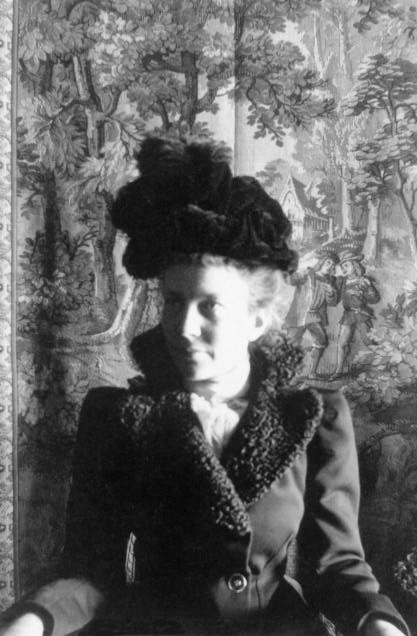
Front: A rare photograph of Winifred Taft, wife of the school’s founder and first headmaster.
The Taft Bulletin is published quarterly, in February, May, August, and November, by The Taft School, 110 Woodbury Road, Watertown, CT 06795-2100 and is distributed free of charge to alumni, parents, grandparents, and friends of the school.
E-Mail Us! Now you can send your latest news, address change, birth announcement, or letter to the editor to us via e-mail. Our address is TaftRhino@aol.com. Of course we’ll continue to accept your communiqués by such “low tech” methods as the fax machine (860-945-7756 ), telephone (860-945-7900), or U.S. Mail (110 Woodbury Road, Watertown, CT 06795-2100). So let’s hear from you!
By Debora Phipps
By Anne Romano
POOLE FELLOWSHIPS
Seven Student Perspectives
MANY NAMES OF TAFT
Charles Phelps Taft and Hulbert Taft,Jr.
TheMoveto
A COEDUCATION COEDUCATION
By Debora Phipps
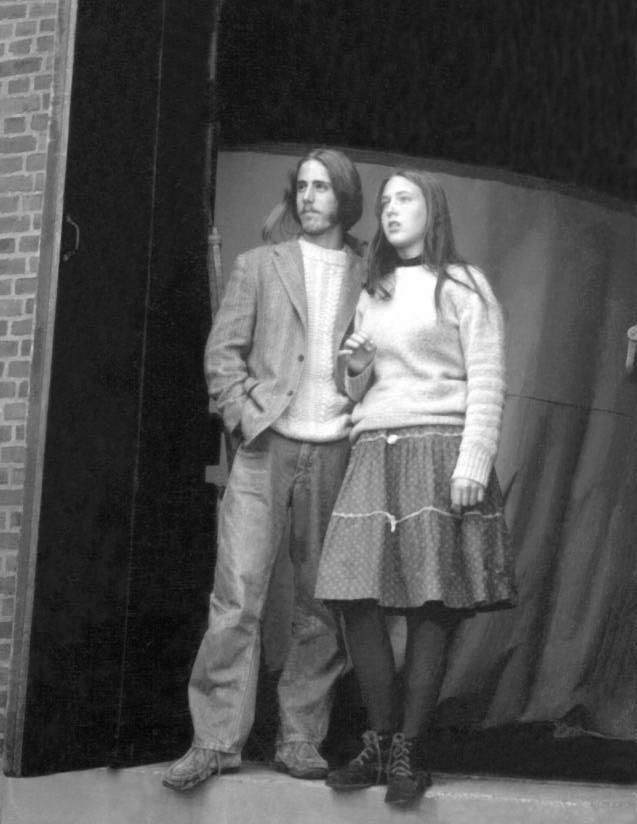
nyone observing the first day of school this year, as returning students dir ected new arrivals toward the dor ms that would be their homes for the next nine months—girls to Pond Wing, Cruikshank, and Mac House; boys to HDT—would find it difficult to believe that it was only twenty-five years ago that Taft first admitted female students. Last November, as part of a celebration of the decision to become coeducational, the committee on coeducation mailed a brief survey to graduates of the last thirty years, asking their help in constructing a social history of those times based on their answers to six open-ended questions. The overwhelming response has led to a history that will be available in its entirety in a separate publication this spring. In recognition of the anniversary of the first year of coeducation, however, a brief description, culled from the recollections of those who were part of this bold experiment, follows.
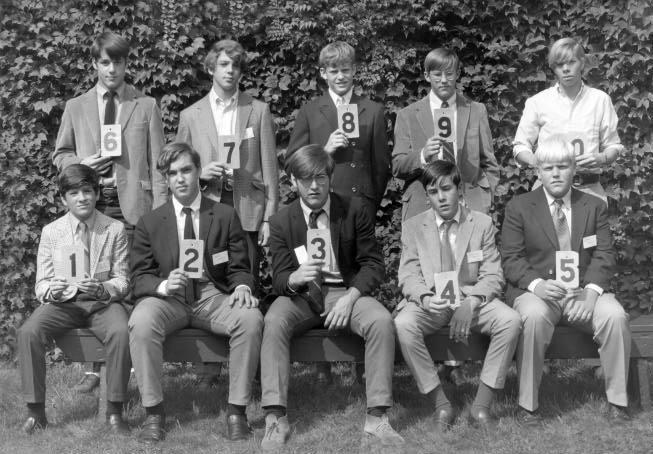
Members of the Class of ’72 as middlers, before the school went coed. The numbers were used for identification (an early form of today’s facebooks). For the record, this group is 1) Matthew Lefkowitz, 2) Andrew Marks, 3) R. Christopher Minor, 4) Derrick Niederman, 5) Randall Petter, 6) Geoffrey Piel, 7) Jon Pollack, 8) Stephen Pond, 9) Gilbert
In order to have some base point against which to measure the changes brought about by coeducation, we surveyed the Classes of 1965 through 1971, those years directly preceding the arrival of girls on campus. The picture that emerges from those responses—which included some of the most eloquent and humorous writing I read all summer—is of a time of turbulence in the world, years when political and social events greatly affected students’ perceptions of their lives. A 1971 graduate comments, “Our time was difficult. The Vietnam War separated the generations. Political leaders were out of touch. Authority was questioned, not admired. And we knew the tradition of an all-male prep school needed to evolve to a balanced, co-educational environment. Our class was the last of an era. And
it was past time for that era to change.”
Certainly there were those who worried about the loss of the traditions of an all-male Taft. They reminisce about the annual “raid on Wade” House at the first snowfall, Sunday nights spent pacing and writing the “theme” they’d put off all weekend, “Packs of us running loudly through the dorms, lashing out against the school,”
feeds in Paradise W ing with Leslie “Beezer” Manning, exploring the steam tunnel system, per fecting their bridge games, and playing evening stickball. The atmosphere was decidedly male, which, for one graduate, was “like watching a movie which had gone from color to black and white—the very air seemed drained of life.” One respondent speaks for many
“…we knew the tradition of an all-male prep school needed to ev olve to a balanced, co-educational environment. Our class was the last of an era.
And it was past time for that era to change.”
Simpkins, 10) Spyros Skouras.
“Taft’s
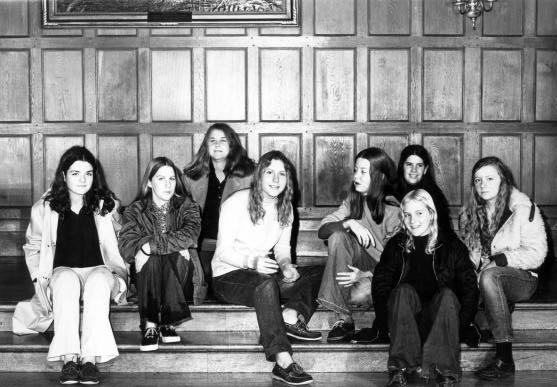
happy experience with coeducation is in large part attributable to that early decision to accept girls individually. It meant that people were to be taken on their own terms – another good message….” Here, the “Pioneers” of Mac House. Can anyone identify the entire group? Photo by Brad Joblin ’73.
graduates of those years: “The boarding school experience I got in the mid ’60s was the genuine ar ticle: hierarchical, homogeneous, highly regulated, and all male. I am grateful to have been one of the last to share an experience that will never come again.”
From a social standpoint, many students from those years felt a change was absolutely necessar y. Men wr ote, with varying degrees of humor and distress, about the Satur day night mixers with local girls’ schools, as they were matched with “dates” assigned by the faculty member on duty at the door way—prompting one graduate to muse about the comic potential of being assigned chaperone duty, which involved pairing up male and female students from the participating schools by height. While some
suggest that the absence of dating pressures during the week allowed for greater concentration on academic work, there is concurrently a shared sense that they arrived at college “somewhat backward. How boys and girls should behave together had to be learned just as other aspects of behavior have to be learned,” an observation amply borne out in the early years of coeducation at Taft.
A male graduate of the Class of 1974 remembers sitting in Vespers during his first year at Taft and hearing John Esty announce Taft’s decision to become coed.
“He informed us of the deliberations that led to the decision, and of Taft’s companion decision, unlike that of other schools going coed at the time, to admit classes of applicants rather than to merge with one or another of the girls’ schools nearby. I
remember thinking that was smart, and to this day I believe that Taft’s happy experience with coeducation is in large part attributable to that early decision to accept girls individually. It meant that people were to be taken on their own terms— another good message—and meant, too, that Taft had no other school’s culture to contend with or to overcome. I am a member of the last class to have entered Taft as a boys’ school; I recall the transition to coeducation as seamless, natural.”
The next year, in the fall of 1971, 82 girls arrived at Taft, and while a few shared the pr evious writer ’s sense of the “transition” as “seamless,” others saw those first few years as ones of constant challenge. Perceived as “pioneers” who “helped make the school a better place for women who would follow them,” the relatively small
number of female students led to some ambivalence; writes one man, “The major issue was 400 guys and 70 girls. Talk about competition. Because it was the first year, they (the faculty and administration) had no experience with coeducation, so anything w ent.” Yet there was an immediate positive effect, writes a male graduate: “It was so great to have these women on campus because it made you feel connected to the real world again. They were live and not some posters on the wall. I will say that a lot of guys started to clean themselves up a little more.... It really was a different school at that point, and I am glad I was there at the start.”
Still, it became rapidly clear that coeducation would be a process, and perhaps a long one. One male graduate wrote, in response to a question asking about people he admired, that “if you’re looking for females who stood out, it was too early for them to do much more than sur vive. They had a lot to overcome, and while they were welcomed with open arms on one level, they had to fight for every small step on another.” The early 1970s were a difficult time to be an adolescent any-
where, but to be one of the first females in that environment led one woman to respond, “ We were so ‘special’ then and the place was so male.... We were pioneers in a cultural climate that was really hurting.” Another alumna adds, “The boys were so shocked when we arrived. They did not know how to treat us. With the ratio of 10 to 1, it was difficult for them.”
An appreciation for the adjustments necessary for each group—as boys sympathized with the girls’ adjustment, and girls understood some sense of ownership on the parts of the boys— characterized the responses from students in the first five years of coeducation; this sense of genuine empathy was a major contributor to the success of Taft’s newest experiment. Challenges arose in nearly every area of the school as the community sought to respond to the presence of girls. The girls’ dorm—decidedly differ ent-looking, “done in Marimekko fabric and purple rugs”—was a place for escaping that sense of being differ ent and for smoking Marlboros, yet socializing took place more and more often outside of the dorms for both boys and girls. Athletics—consis-
tently listed as the most impor tant activity during their Taft years for many male graduates—became equally important to the women, for whom teams were formed to respond to their interests. Though at first they had no locker rooms and wore “middies and blouses” as uniforms, the girls rapidly learned to take initiative in creating opportunities; the legacy of the girls’ ice hockey team began when girls sought permission to play intramural hockey and, one short year later, formed their own team using the boys’ old equipment, enjoying equal ice team even in those first years. “Being among the first female students,” writes one alumna, “what stands out in my mind the most was the ‘we don’t know what to do with you’ attitude. I remember that whatever we asked for we got, no questions asked. So, we asked for a kitchen in the dorm and they gave it to us and the boys were mad, mad, mad.” Another female student adds that the reallocation of facilities and rewriting of rules increased the already present feelings of difference and competition. “ This might seem petty, but things such as giving the girls the best dorm and
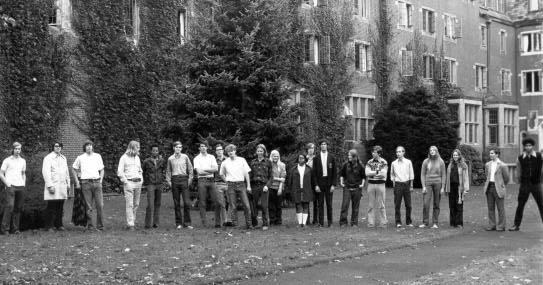
The Upper Middle Class Committee for the Class of ’73, during the first year of coeducation. Photo by Brad Joblin ’73.
the best playing field, letting us have kitchens but letting the boys have laundry service, and trying to figure out whether to lock the girls in or the boys out made for interesting dynamics in the first year or so. Luckily, we were great jocks and lousy cooks, so it all smoothed out.”
That sense of humor and flexibility were essential in the early days of coeducation. While “being the first women/ girls was exciting certainly, it was a constant battle paving the way. For a community that had been geared towards
large— to represent an entire class of people proved overwhelming for some alumnae. Still, the difference in environment was “dramatic—coeducation created a happier school, a more relaxed environment.” A graduate who spent two years at Taft before the arrival of girls suggests, “When coeducation arrived, it did tone down the school, which was good. The angst level lowered as show-off maleness was not necessarily a good thing anymore. Having girls as friends, not just objects of adolescent desire, changed the whole atti-
“We were so ‘special’ then and the place was so male.... We were pioneers in a cultural climate that was really hurting.”
boys for so long, it was a big shift to have to consider the female.” It would be a number of years before girls and boys were equally considered for leadership r oles in some activities, particularly as “most males, including me (a male graduate of 1972), were not ready to give up turf in certain areas of the school: stuff like The Papyrus, Masque and Dagger.” The response? To create different places in which girls could lead as well, a partial cause of the proliferation of extracurricular activities during these years. Teachers, too, had to respond to new challenges: “Many of the masters were used to teaching boys, and there had to be some physical and language adjustments. No one was used to the girls being there, and it took a lot of growing in a short time period to make it work.” In those early years, there may have been only one or two girls in a par ticular class, and they w ere sometimes singled out to provide a “female perspective” on a topic, a treatment which, while designed to be inclusive and responsive, only ser ved to make some females feel more alienated and different. The sense that they were called upon—not only in the classroom, but in the social world of the school at
tude of the school.” Issues such as “breaking the stereotype that girls weren’t as strong as boys in math” and the small number of adult females in the community—one woman writes, “It would have been wonderful to have a strong woman in a leadership role”—continued to pose challenges, as they would for many years.
Yet in listing favorite activities, girls and boys describe the same sorts of traditions with which students passed the time during the all-male days: sneaking in the other dorms (although now the challenge was getting into, and out of, dorms of students of the opposite sex), studying— “I may have a selective memory”—and playing stickball. Some changes in traditions occurred, but these are often described in positive terms. For example, Vespers and formal dinner became “a time of coming together as a Taft family where and when social games were at a minimum and mutual respect was instilled (of course, there was still plenty of flirting!).” These years also saw a large growth in the Taft tradition of community ser vice. One female graduate describes the relative efficiency with which the school adjusted to coeducation: “Seeing the transition from the first year to my graduation year was tremendous. The first y ear, you could sense the caution teachers and male students had with women around,” but that changed as they came to know one another as part of a community. She adds, “It was a great time to be at Taft.”
Winnie Taft
On the norther n slope of Evergreen Cemetery, bor dering The Taft School on North Street, three identical and ordinary headstones clustered together mark the lives of Harley Fish Roberts (18611930), Horace Dutton Taft (1861-1943), and W inifr ed Thompson Taft (1860-1909), Horace’s wife of seventeen years. While r eminders of Horace Taft and his great friend and colleague Harley Roberts are ever present here at the school, nothing marks Winifred’s passage—not a portrait, a room, or a garden. Most ar e unawar e that Horace was married.
By Anne Romano
[From the Preface of her new book]
Upon r eading Horace Taft’s Memories and Opinions, one is str uck b y the few wor ds written about Winifr ed. Although the memoirs are about a headmaster and his school, about American histor y and not about priv ate liv es, the lack of information about Mrs. Taft spar ks one’s imagination. Who was Winifred Thompson? What did she look like? Wher e did they meet? Where was she educated? What role did she play in our school’s early histor y? What presence did she have in the Warren House and in Water town? Why Watertown? Did they have children? Wher e did they
summer? How did she die? What was her legacy to the school? How should she be remembered?
This book is a por trait of the woman whom Horace married and a chr onicle of her remar kable presence at The Taft School betw een 1892 and 1909. While Winifr ed has remained a myster y for most of this centur y, a great deal has been written about Horace’s endearing traits—his lofty idealism, tow ering str ength, and determined yet unassuming personality. To these virtues, Winifred Taft added an intellectual, fiscal, ar tistic, and social depth. In
the practical matters of building and operating a boarding school, Winifred met with architects, managed the daily account books and endless details, while Horace saw to the scholarship, lessons, and ideals. Together they formed an exquisite balance. And so it was that a dream took root and flourished under the joint leadership of two individuals who dedicated their liv es to their school.
Of special interest to the social histor y of The Taft School in the 1900s is the following letter from Winnie to Louise [her mother-in-law, Mrs. Alphonso Taft]:
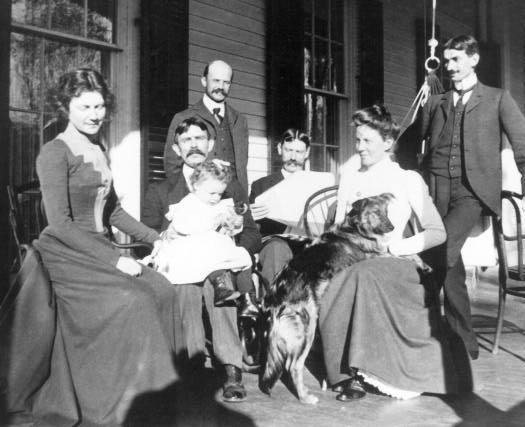
Winnie Taft, as seen here with Sandy 2 nd, the Scotch Collie that Horace gav e to her on her birthday, sits with her husband, Horace (reading the paper), and members of the faculty. From left are Mr. and Mrs. Paul Klimpke with their daughter, Harley Roberts, and Olin Joline. The photograph was taken between 1900 and 1905.
June 23rd [1900]
Before Breakfast
My only time now-a-days
Watertown, Connecticut
My dear Mrs. Taft,
While we have been having our winding-up festivities—we have not been unmindful of your sadness and anxiety about Aunt Annie, and it is only because we have both and all been on the keen jump that we have not written oftener. It is very painful to think of Aunt Annie lying there breathing away her last hours and no one able to help her. Aunt Eliza’s condition was just the same for a week before she died—and it seemed so hard to see her. One can only hope that the suffering may not be prolonged if there is no remedy. She has been your care and Aunt Delia’s for so long that is doubly hard for you, and poor Louise [Mrs. Alphonso Taft’s niece and Aunt Annie Dutton’s daughter] is heart-broken I know. Her happiness came providentially between her two sorrows to help her bear them. Our usual festivities came off last week and now we are waiting for the last boys to go. Horace has been so miserable with his throat and consequent debility that I have been afraid he could not pull through. We went to New London as we did last year for a “bracer” before beginning the cramming of the boys for examinations, but it did not have the same tonic effect it had last year However, he is getting on with care and you must not worry about him. I am puzzled to know what will be the best thing for him this summer. We have given up the rooms at Seal Harbor because the Kingsburys decided to go to Gloucester. Sherman Thacher writes we ought to go somewhere with them and suggests the coast of Maine—but I do not entirely favor the plan We must decide pretty soon Sherman will be in New Haven tomorrow and here after Commencement for a few days. My sister has been here for three weeks and expects to stay one more before going home We met in Springfield with Mrs. Wallace and Thea Clark and had ten days of jollification there. Then I had to come home for the reunion of old grads on Decoration Day. That was a very pleasant occasion and we must keep it up as a regular feature of the school. Besides cultivating school spirit, it gives the old boys a good time and gives them a chance to know each other better. Did you know I had a puppy? Horace gave him to me on my birthday and though I was rather appalled at the thought of training so young a being, I have enjoyed him immensely. My time has been rather broken up by taking him up and down stairs and whipping him for making puddles on the rugs He persists in coming upstairs for that special purpose and going downstairs to play. We shall put him out to board for the summer and when we come back he will be in fine training He is a Scotch Collie of fine breed and looks not unlike the old Sandy we used to have at home, so I have named him Sandy 2nd Will’s [Horace’s brother William Howard Taft] two letters have been so interesting and we are looking forward to the one from Manila with unusual pleasure. He gets so much out of even the trip that it will be worth everything to him in that line. The problems seem to have been divided pretty fairly—but I do not envy Will the friars. What do you think of the Republican ticket? Isn’t it a pity for Roosevelt to be [original word is illegible] in that way! Such a useful man can ill be spared from the active ranks. Now I suppose we shall get some vile politician as governor of New York. To go back to Manila—I met Mr. and Mrs. Atkinson of Springfield very pleasantly when I was there. The farewell festivities were going on and we were included. Mr. Atkinson you know was appointed Superintendent of Education in the Philippeans [sic]. He is a great favor-
no thoughts for such things now.
Walbridge [Class of 1902, Horace’s nephew and Harry’s son] was taken away to go with Julia to Murray Bay. It had been arranged for him to stay here for two or three weeks and study hard to make up his lost time so as to be able to go on with next year’s work. Harry suddenly telephoned one morning that Walbridge must be sent down at once and start next day with Julia. The reason he gave was that Walbridge was depending too much on Horace to pull him through and that if he was ever going to do anything he must work for himself. If Walbridge didn’t care enough about going into the next class—to work hard all summer—he must fall back and suffer the consequences. In a way he is right—but with the influences at work at Murray Bay it seems rather hard to put a boy there and expect him to study. We think the real reason was that Julia wouldn’t go without him. She has not been very well this winter and had postponed her going several times. Poor Howard [another nephew, Charlie’s son] is still in hot water and I’m afraid he will not be allowed to come back. He wants to now—but he really has been so insolent to the masters and so insubordinate that Horace thinks he cannot take him back. It is too bad, but I really think that Horace would be better without him. He has been in constant worry and between affection for the boy—who is so lovable when he isn’t bad—and for Charlie—and the constant battle with the masters to keep him—it has been dreadful—and I’m sure responsible for much of Horace’s bad health. We had cards for Lilian’s wedding but of course there was no thought of going. Harry Hillard is a classmate of Horace’s and a very nice fellow. Do give our love to Louise and Jan as well as Aunt Delia. We have the keenest sympathy for you all WAffectionately, inifred T. Taft
ite of President Eliot’s [sic] and was suggested by him. Mr. Atkinson seems to be a man of good sense but not specially forceful. However I ought not to judge him for I saw him for only a few moments and he is so quiet that he does not show what he is worth. His wife is a very pleasing woman. Springfield people say that she is very formal and does not make friends easily—and I felt sorry for her when I heard it. she will have a hard time. I liked her We have our house filled with laurel. It is particularly beautiful this year— very pink—and Anna has reveled in it. One day we drove over to Thomaston and Anna was so wild to climb the road banks to get some that she disrobed herself of her long skirt and all superfluous clothing right in the middle of the road—and plunged in. No one came by fortunately, and she came back with her arms filled. We had a very pleasant visit with Lily and Mr. Grosvenor and I wish we may have stayed longer. They have a very pleasant house and Lily knows my family. She gave a reception for us one evening which was very pleasant and we were glad to meet the Amherst faculty. Amherst itself is a beautiful village as you know. I have never seen a more beautiful campus—except perhaps Princeton. Unless Louise has her chairs already covered I wish she would reconsider the leather question. I’m afraid the leather will hardly harmonize with the more or less frivolous backs. Something durable will be found in linen—or silk and linen which would be more appropriate. The new figured hair cloth in green is very effective and has not a heavy look, although something lighter would be better. But you have
Material for this documentary essay was culled from the vast collection of the William Howard Taft Presidential Papers housed in The Library of Congress. Much of the particulars about the early history of The Taft School, specifically the years between 1890 and 1909 (the year that Winnie died) came to light through the wealth of family correspondence.
Anne Romano was granted a sabbatical leave for the 1994-95 academic year. She spent five weeks studying in Florence and the remainder of the year researching and writing her biographical essay on Mrs. Horace Taft. The book will be available in early 1997.
The ROBERT K. POOLE ’50 Fellowships
Interest in the Poole Fellowships has gr own over the years , and to r eceive one has become one of the school’s major honors. This year, Taft awar ded summer grants to the lar gest number of students ever. Almost never does the fellowship underwrite the entir e cost of the experience , and students do a substantial amount of fundraising themselves. Many find opportunities to serve on their own; others look to established organ izations. All find ways to help communities, scientific as well as thir d world, and, in the process, discover for themselves what the value of service r eally is.
When w e left for Trinidad, w e didn’t kno w exactly what to expect. The extent of our knowledge about this country was that it would be an eight-hour trip. S o, full of uncertainty and a bit nervous, we boarded a plane and headed for Trinidad. This project had started about six months before, when neither of us thought we would ev er see it through to completion. All we knew is that we wanted to work with kids and to see the world from a different culture. H aving both grown
up in small New E ngland towns, we tended to liv e with the illusion that most towns looked like ours with big colonial houses and a small countr y church on the green. It was time to see life from a different perspective, which we found at St. Dominic’s orphanage in Port of Spain.
As Trinidad’s largest orphanage, housing 300 abandoned, abused, and star ved children fr om ages 3 months to 17 years, it accepted any help it could get. We wer e immediately put
Caitlin Pollock ’97, Hinsdale, MA
After receiving the Poole Grant, I signed up for a World Horiz ons trip to Guadeloupe and decided that this would be my big chance to make a differ ence in the world. I was prepared to return home completely changed as a r esult of the experience. Although World Horizons sends groups all o ver the world, this was the first year a group would be sent to Guadeloupe, a third-world, French-speaking countr y south of the U.S. Virgin Islands. At first w e stayed in a community center, which was less than a five-minute walk to a beautiful beach and was located in a town of about 3,000 people, all of whom were ver y helpful and friendly. We soon star ted a day camp for local kids of all ages where w e taught English and played spor ts and games with all who
to work in the nurser y. O n a typical day, w e wor ked from seven in the morning until noon in the nurser y and then spent the afternoon tutoring kids who needed extra help in school. At the nurser y, w e would clean, dress, and feed the children, make beds, fold laundry, clean the bathrooms, and— most important—play with the children. Almost instantly we w ere str uck b y the children’s desire for attention and love. The moment we entered the nurser y we were greeted b y thir ty outstretched arms screaming “mommy” and tugging at our arms. The children seemed not to lack the material necessities of life so much as they lacked attention. So, w e spent as much of the morning as possible playing with the kids. The older children, whom we tutored, w ere all ver y behind in their education, and they benefited merely from having conversations with us to develop their social skills.
Although many people come back to Taft and rav e about what they learned on their Poole Fellowships, w e are not quite sure what we learned. We ar e positive, however, that w e learned something. We don’t think w e are mor e courageous or outgoing, or that w e learned ne w things about ourselv es. Maybe we just have a better understanding of the world outside Ne w E ngland, or perhaps we hav e mor e patience for children and we value them even more. This was the chance of a lifetime, and these three w eeks will never be forgotten.
attended. Usually for lunch we w ent to the houses of local families for cultural exchanges. Here, w e talked extensively about our different countries and their customs, food, and
people, which I found extremely interesting and challenging since we spoke only French by necessity.
Ev en though my group did not help this place or its people in radical ways, I do believe they enjoy ed o ur visits and the childr en did learn some English. I n addition to the small influences w e may hav e had on the people of Guadeloupe, I know that they had a profound impact on me. I am returning resentful of the U.S for its extr eme influence over other cultures. I went to Guadeloupe wanting to experience only the Guadeloupian and French cultures. N ow I kno w that, be it good or bad, this is no longer possible. When I first arrived I was astounded and some what disap-
Cully Platt ’98, Concord, NH
I spent four and a half weeks this past summer working with Dublin’s unemployed and homeless. I worked with a non-profit magazine, The Big Issues, during the day and the Society of St. Vincent de Paul at night. The Big Issues sells their magazines for half the cover price to the unemployed and homeless who in turn sell them on the streets; their slogan is “A hand up not a hand out.” While there, I helped with the building and electrical wiring of their “Mile-Long Project,” which will provide office space and jobtraining and is expected to produce about a thousand jobs. I also helped distribute the magazines, explaining what the magazine was all about and helping vendors.
In the mornings, I did work with the publicity department, informing people of the magazine’s cause and current efforts. The public’s support in turn enables the magazine to provide job training and to continue work on pr ojects such as housing the homeless. I also worked with the advertising department, helped to make the mile-long project handicapped accessible, and tried to make a vacant building fit the necessar y standards to become a night shelter. I also worked in a St. Vincent de Paul night shelter, booking people in, intervie wing them (only so many beds are available each night), making conversation with them, and looking for alternative places for some to stay. I spoke one-onone with some of the elderly who will be forever homeless. My experience awakened me. Much of the Irish population currently lives in poverty, facing the worst of predicaments. I saw ever y type of crime while I was there. I walked through riots. Where I was working, heroin was everywhere; the police turn their backs on ever ything because, as one homeless man explained to me, “ The prisons are overflowing,” leaving no
pointed by the sophistication and industrialization of this society compar ed to my pr evious image of it. O ne aspect of this cultur e that str uck me the most was the open-mindedness and eagerness of the children to learn new things that I see as so often missing from American children.
I also learned to appreciate simple things a lot more than befor e my trip . It has also given me a taste of what it feels like to make a difference in people’s lives, and it has increased my desire ev entually to find a job that will allow me to do this. More than anything, though, it has opened my mind to differ ent cultures and taught me that I must experience them to understand them.
room for justice. However, the I rish sensitivity on the overall subject and the press’s obsession with the IRA leaves these crises unnoticed. I regularly met up with anti-American sentiments. The typical American stereotype comes from Beverly Hills 90210. Many immediately assume Americans are all rich snobs. The big joke over there is: “How can you tell a rich American from a poor one? The poor one has to wash his own
“Today, for the first time, I really appreciate the oppor tunities I have, which many people in the world could and will nev er imagine, and for all of this I am extremely grateful to Taft and for everyone who made this possible. ”
Cadillac.” I saw how many more job opportunities there are in the U.S. I worked with psychiatric people who were kicked out of their homes, beaten up, and too afraid of life to collect their welfare checks. It is scar y to think how easily and quickly some end up on the streets, and the simple fact that it happens to all kinds of people; one of the regulars at the night shelter had a master’s degree from one of Ireland’s best universities. Anything and ever ything negative you can think of happens to the homeless, from being attacked in their sleep to how they are treated by the Irish upper class. I returned to Taft much more optimistic. Today, for the first time, I really appreciate the opportunities I have, which many people in the world could and will never imagine, and for all of this I am extremely grateful to Taft and for everyone who made this possible.
Stephen Sandvoss ’98, Yorktown, NY
For most of this past summer I was in Gabor one, Botswana, at a school called M ar u a P ula. The morning hours of each day were spent in the classr oom, but each afternoon I was inv olv ed in some form of community ser vice. Ever y day of the week, I was assigned a different activity; my duties ranged from working with disabled children in an orphanage to teaching E nglish to twelve-year-olds. I befriended people whose perceptions of the world were limited to their immediate surroundings. I learned that where there is little oppor tunity, hope is scarce. Yet, I found that even life in a prestigious priv ate school, such as the one I visited, was ar-
Alison Shreefter ’97, Pittsfield, MA
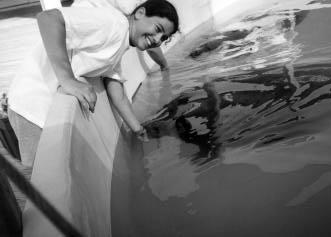
This summer I volunteered at Mote M arine Laborator y in S arasota, Florida. I participated in a manatee research project working with a local marine biologist. The goal of this project was to discover more about manatee behaviors, preferences, and incidence of injuries and scars, and to use this information to better manage and protect the manatees, who are an endangered species native to Florida. I spent most days on a small boat in Sarasota Bay tracking manatees. We r ecorded the location, habitat, behavior, and interaction betw een manatees. We often collected grass samples from where they wer e feeding. We also sketched scars caused by collisions with boats, and we checked on manatees with tracking devices on them to make sur e they wer e safe. At night w e helped take care of two manatees who r eside in tanks at the lab and who eat up to 120 heads of lettuce a day Thr ough this trip I learned a great deal about the manatee population and the fragility of life.
duous. Gaborone is isolated from any major city, almost dev oid of v arious cultural amenities, and master ed by a harsh climate.
My experience has taught me so much about what I can endur e. I consider it an outstanding success—one best described as character building. More impor tant, I have come to r ealize the magnitude of the blessings which God has besto wed on me. A great thank you to Mr. McKenzie and the faculty at M ar u a Pula, to Mr. Odden, and to all those at Taft who, like Mr Poole, hav e set an example of ser vice to others.
The manatees had no natural enemy until humans began to use their water ways. Now the population is suffering. After spending all day with these peaceful creatures I realiz e that their extinction would be a great loss to the waters. People need to star t taking r esponsibility for the trouble they are creating for animals. We need to find a way to liv e that can be safe both for us and for them.
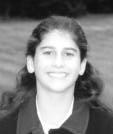
Renee Young ’97, Beverly Hills, CA
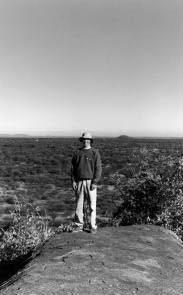
It was so foreign and so magnificent at the same time. It was a return to my “homeland” but I felt like an outsider Although my appearance may have left me unnoticed by most people, the mainland Chinese knew immediately that I was American-born. Upon arriving at Yanji airpor t, located in the Jilin P rovince of Northern China, my initial feeling was one of fear. Not being able to speak the language was definitely one of the major problems, for my native tongue was Cantonese, and Potunghua was the only dialect spoken in this part of China. English was not an option. With some difficulty, I managed to communicate with people b y twisting my Cantonese into an understandable form of the national language. From the moment I stepped off the plane, the adventures never ceased. For twelve days I lived among a group of seven people from all over the world. Three Chinese scientists were also there to assist us in our research. Our accommodations
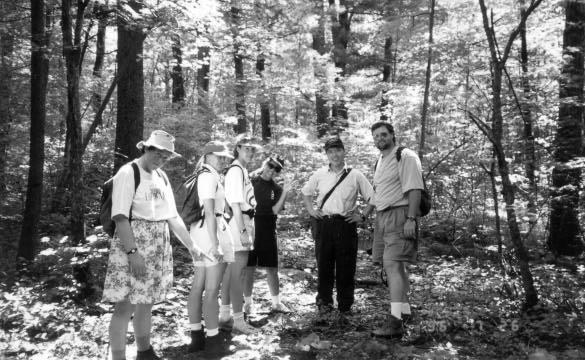
were modest yet clean, and the vie w from our room was exquisite. Every morning we were out in the field by eight o’clock and did not return until five PM . Our wor k consisted of tagging trees, identifying tree species, plotting distances between trees, and measuring their diameter at breast height. Eventually, the data collected from our research will be processed and entered into a computer that will build a three-dimensional model of the forest canopy.
A deep satisfaction gre w inside me as each passing day gave me a new understanding of myself and of my cultural heritage. I t was hard to imagine that within such a short period of time I was able to discover so much about China and her people. I also acquired a profound sense of humility comparing my life to the lives of the average Chinese. Leaving the Changbai Mountain Research Station, an air of extreme accomplishment swelled within me. I had successfully ventured into an unknown countr y to work in nature for twelve days with ten strangers. The most remar kable aspect of my entire experience was the fact that I did all of this, by myself.
Molly Simmons ’96, who also received a Poole Fellowship, is using it to spend the year in South Africa at the Tiger Kloof School, along with Jonathan Gyurko ’92. They will hopefully provide us with an article about their work there for a future issue.
The Many Names of Taft
Mor e than any other, it is the Taft name that finds its home all over campus. Certainly, one expects to find a building named after the founder, Horace Dutton Taft. But who are all the others we hear so much about, especially those whose names ador n Charles Phelps Taft Hall and the Hulbert Taft, Jr., Library? Horace Taft was loyally supported by his family, a tradition that continues long after his own tenure as headmaster here.
CHARLES PHELPS TAFT 1843-1929
Although other members of this prestigious family made names for themselves as justices, ministers, senators, and pr esidents, it was Charles Phelps Taft who made the family’s influence most deeply felt in Cincinnati. A half-brother to Horace (his mother was Fannie Phelps; Horace’s—and William’s—was Louise Marie Torrey), Charles bought the Cincinnati Times and later the Star and soon conceived the idea of leasing wir es to gather news for his papers. He later became a director of the Associated Press.
Along with his wife, Annie, he supported every phase of cultural and business life in Cincinnati, including the Cincinnati Symphony, the University of Cincinnati, the zoological society, museums, and an opera. Together, they traveled the world building an ar t collection they later gave to the city. Charles briefly tried his hand in politics as a congressman from 1895 to 1897.
After his brother Peter died, Peter’s son Hulbert went to work for Charles at the Times-Star and stayed there for mor e than fifty years. Hulbert, Jr. ’26 followed in his fathers’ footsteps. Charles had four children: Jane, David, Anna, and Charles Howard [Charles Phelps Taft II ’13 was his nephew, son of William].
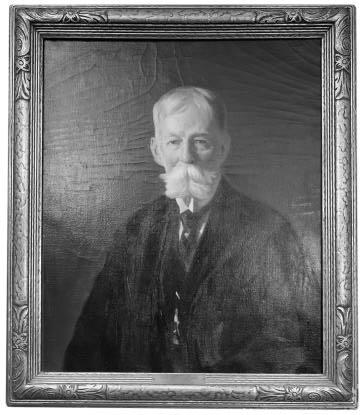
There is no long dedication to this philanthropic brother, only an oil portrait of him in the lobby and a beautifully carved cornerstone that bears his name and the year it was built—1929. Long referred to as the “ne w building” [as opposed to the 1912 Horace Dutton Taft Hall, which was called the “old building”], today it is commonly called CPT and encompasses the Woolworth Faculty Room, the Choral Room, history and language classrooms, Bingham Auditorium, and three floors of dormitor y rooms upstairs for upper middle and senior boys.
HULBERT TAFT, JR. ’26
1907-1967
His yearbook page bears the unforgettable line: “Who can compete with a person who calls the King ‘Uncle Horace’? It can’t be done. Formidable as this advantage is, it is all but intolerable since he never uses it at all.” In fact, Horace and Charles Phelps Taft were actually his great uncles.
Hulbert’s family has become as synonymous with communications as other branches of the family have with politics. Although Hulbert, Jr., also got his start [with some previous experience at the Yale Daily News] at the Times-Star, his father— the editor and publisher of the family-owned Cincinnati paper founded by Charles—encouraged him to move into radio and later television. This was the beginning of the Taft Broadcasting Company, a pioneer in electronic communication, of which he became chairman. During his tenure, Taft Broadcasting controlled, in whole or in part, WKRC AM-FM and TV in Cincinnati; WTVN AM and TV in Columbus; WBRC AM-FM and TV in Birmingham, AL; WGR AM-FM and TV, Buffalo, NY; WDAF AM-FM and TV, Kansas City, MO; and WNEP TV in Scranton, PA. The company also acquired Hanna-Barbara Productions of Los Angeles. He had three children, Dudley ’58, Mary, and Nellie.
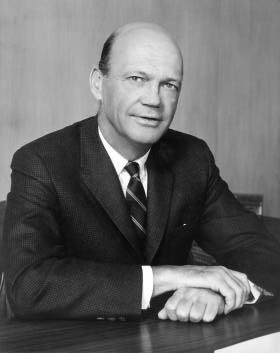
In addition to creating a broadcasting empire, Hulbert, Jr., was also a trustee of the Cincinnati Conservatory of Music. The Taft School library was dedicated in 1969 as memorial to Hulbert Taft, Jr. photo courtesy of Dudley Taft ’58
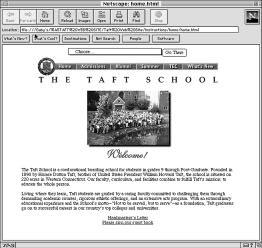
Want to know the latest Taft sports scores, or if the school is organizing a dinner in your hometown? You can find all that out and more on the new web site. Hook in to the library’s on-line catalog, check out the weekly calendar, or read what Lance Odden had to say at Morning Meeting last week. You can even find the current weather conditions in Watertown and the latest forecast. You’ll know more about what’s going on on campus than you did when you were a student.
Any alumni who wish may add their own e-mail addesses to an on-line director y to share with other alumni. You can find it in the Alumni section of the pull down menu. The area is password protected to restrict access to members of the Taft community. If you would like to add your own addr ess, or to find a classmate, use the password “Dutton”.
Do you have a w eb site of your own? Why not shar e your pride in your alma mater by adding a link to the Taft site and helping to spread the word. And please fill out our guestbook. Let us know what you think.
Taft Welcomes New Board Members
The Taft School welcomes Jeff Levy ’65 and Toni and Chuck Peebler, parents of Todd ’99, as its three newest board mem-
bers. As Annual Fund chair and head of the Alumni Association, Jeff will direct the overall fundraising effort of 225 class
agents and assistant class agents as they seek to raise $1.3 million toward this year’s goal of $2 million. “ Taft is one of the best schools in the countr y,” said Levy, “and it’s a privilege to work with a dedicated group of volunteers.”
The Peeblers head what is arguably the strongest Parents’ Fund in the country. Last y ear, par ents of Taft students raised over $730,000 with 95 percent participation. No other major independent school can match either of those levels. “The strength of the Parents’ Fund is a positive endorsement of the vision of Lance Odden and his faculty,” said the Peeblers, “and w e look for ward to helping sustain the quality of education that benefits our children.”
Annual Fund Chair Jeff Levy ’65
Chuck and Toni Peebler (Photo: Star Black)
Community Spirit Renewed With Second Service Day
Blake DiM ar co ’00, Samantha Hall ’00, and Katie Putnam ’00 help close down the local YMCA camp for the winter on Community Service Day.
“I have never been a part of an event that brings this community together more than Community Service Day does,” said organiz er Jean Str umolo P iacenza ’75, who even convinced her parents to pitch in. “Everyone is tired at the end of the day—blisters on their hands, backs sore from lifting logs, and shoulders aching from painting overhead all day—and yet, somehow, the day was invigorating in a way that even a free Monday never really is. I think giving time to make things happen for local organizations that do good work made us feel really good. Doing helpful things for others, even if it made us tired, pumped us up because it took us outside of ourselves and made us realize that we can make a difference in our community.”
Last year’s Ser vice Day was such a success, according to Jean, that even more local non-pr ofit organizations asked for helpers this year. S ome of the organizations students worked with last year liked them so much that they asked the school to send students on a r egular basis through Taft’s afternoon Volunteer Program. And, some students enjoyed the day so much that they became regular participants in the Volunteer Program.
“We did not call this day ‘ Volunteer Day;’ This is not an oversight,” Jean adds. Students are not asked to volunteer; they are only asked their preference in assignments. “We require everyone to participate because we think that it is an important part of the education this school has to offer.”
Save the Dates
December 16............Holiday Party in New York January 12................. Alumni Games at Taft Men’s Ice Hockey and Men’s Squash February 15..............Mothers’ Day February 26-27.........NYC Telethon May 24.....................Alumni Day May 31.....................Commencement
South African Soccer Team Challenges Varsity
On Sunday, September 29, the v arsity soccer team hosted a visiting squad of play ers from S andringham School, an integrated public school in Johannesburg, South Africa. The team was brought to
the United States by Intersport, the same group that organized games for Taft with teams from Vietnam and Uzbeckistan.
After a good game, although Taft lost 20, the Taft team gave the visitors a tour and dinner. The South Africans were here as part of a 16-day tour and played a mix of prep school and public high school teams. Intersport arranges for players to stay with host families during the trip “A few years ago this never would have happened,” Coach Willy MacMullen ’78 said, “considering the political issues involved. It’s not unlike playing the Russian team last year or the Hanoi team a few years ago.” The teams sponsored by Interspor t are typically ver y strong, he adds. “What’s important is not the outcome of the games, but the simple fact that soccer can bring people of all cultures together.”
In Search Of… All Taft School Alumni
Taft coaches Willy MacMullen ’78 and Tom Woelper and captains Doug Blanchard ’97 and Lee Whitaker ’97 greet John Salvatore of Interspor t (Cuban National Team goalie), and the Sandringham coaches and headmaster.
Have you ever tried to get in touch with an old classmate only to find that the last address you have in your telephone directory is eight years old? Well, your troubles are over. Soon an impressive directory of alumni will be available to help you locate all your old friends.
The new Taft School Alumni Directory, scheduled for release in July 1997, will be the most up-to-date and complete refer ence on over 6,500 Taft alumni ev er compiled! This compr ehensiv e v olume will include current name, addr ess and phone number, academic data, plus business information (if applicable), bound into a classic, librar y-quality edition.
The Alumni Office has contracted the prestigious Bernard C. Harris Publishing Company, Inc., to produce our directory. Harris will soon begin researching and compiling the information to be printed in the directory by mailing a questionnaire to each alum. (If you prefer not to be listed in the directory, please contact the Alumni Office in writing as soon as possible.)
The new Taft School Alumni Directory will soon make finding a fellow alum as easy as opening a book. Look for more details on the project in future issues.
Sara A. Beasley
M.A., Davidson, University of Pennsylvania English
Jennifer H. Bolz
M.S.F.S., Georgetown History
Bruce Fifer
B.M.E., Westminster Choir College Head, Arts Department; Music
Helena Fifer
B.A., New York University Acting
Garrett A. Forbes
M.S., Tufts, University of Illinois Chemistry
Volker Krasemann
M.S., Ernst-Moritz-ArndtUniversitat (Germany), University of Montana Physics
Yong Li
M.A., Jilin University (China), Beijing University for Foreign Languages (China), University of Tsukuba (Japan) Japanese
Alexander Lyapin
M.A., Moscow Institute of Physics and Technology (Russia), Harvard Physics
William T. Miller
M.A., Tufts, University of Virginia French
Brian T. Moriarty
M.F.A., New York University, Yale Photography
Jairo R. Rivera
M.A., National Agricultural University (Nicaragua), Indiana University at Bloomington Spanish
New Faculty
Robert B. Wheeler
M.A.T., Yale College Counseling
Jonathan Willson ’82
M.A., Amherst, Brooklyn College History
Elson Y. Liu
M.S., Stanford, Massachusetts Institute of Technology Teaching Fellow, Mathematics; Technology
Shelley A. Hull
B.A., University of New Hampshire Teaching Fellow, English
Stephen A. Levey
A.B., Princeton Teaching Fellow, English
Leonard Tucker ’92
A.B., Princeton Teaching Fellow, History
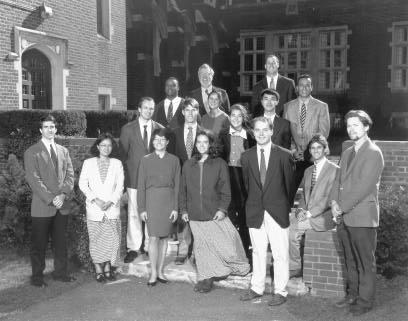
Several retirements last spring as well as a banner crop of teaching fellows brought about the arrival of sixteen new faces on campus this y ear. They are 1. J on Willson ’82, 2. Yong L i, 3. Volker Krasemann, 4. Lenny Tucker ’92, 5. Bruce Fifer, 6. Sara Beasley, 7. W. T. Miller, 8. Helena Fifer, 9. Shelley Hull, 10. Jennifer Bolz, 11. Sasha Lyapin, 12. Elson L iu, 13. Garrett Forbes, 14. Jairo Rivera, 15. Stephen Levey, and 16. Brian Moriarty.
Winter Athletic Schedule 1996-97
This schedule is subject to change. If you would like to verify the time and location of any game, please contact the school at 860-945-7707.
*Mothers’ Day, Saturday, February 15
W, Jan. 292:30Hopkins H
Boys’ Varsity Basketball
S, Dec. 74:00Canterbury H
T, Dec. 104:00Choate H
W, Dec. 114:00Kingswood H
Dec. 18-20Loomis Invitational
W, Jan. 84:00Kent H
S, Jan. 114:00Hotchkiss A
W, Jan. 154:00Berkshire A
S, Jan. 184:00Trinity-Pawling H
M, Jan. 204:00Canterbury A
W, Jan. 224:00Berkshire H
S, Jan. 254:15Trinity-Pawling A
W, Jan. 294:00Hotchkiss H
W, Feb. 54:00Deerfield H
F, Feb. 77:00All Stars H
S, Feb. 84:00Avon A
M, Feb. 104:45Salisbury A
W, Feb. 124:00Kent A
S, Feb. 15*4:00Loomis A
W, Feb. 194:00Avon H
S, Feb. 224:00Westminster H
Girls’ Varsity Basketball
W, Dec. 42:30Canterbury A
S, Dec. 72:00Suffield H
W, Dec. 112:30Kingswood A Dec. 19,20Tabor Tournament
W, Jan. 83:30Deerfield A
S, Jan. 112:30Berkshire H
W, Jan. 152:30Kent H
S, Jan. 182:30Loomis A
W, Jan. 222:30Canterbury H
S, Jan. 252:30Hopkins H
W, Jan. 292:30Kent A
W, Feb. 52:30Westminster A
S, Feb. 82:30Hotchkiss A
W, Feb. 123:00Williston A
S, Feb. 15*2:30Choate H
W, Feb. 192:30Berkshire A
S, Feb. 222:30Hotchkiss H
Updated scor es are available at the school’s new website: http://www.Taft.pvt.k12.ct.us, or call the sportsline at 860-945-6047 for the latest results.
S, Feb. 15*4:00Hotchkiss A W, Feb. 194:00Westminster A
Girls’ JV Squash
S, Dec. 73:00Choate H
W, Dec. 114:15Rye CD A
W, Jan. 84:00Greenwich Ac. H
S, Jan. 112:30Kingswood H
W, Jan. 154:00Loomis H
S, Jan. 184:00Hotchkiss A
S, Jan. 252:00Greenwich Ac. H
W, Jan. 292:30Kent H
W, Feb. 53:00Choate H
S, Feb. 82:30Miss Porter’s H
W, Feb. 123:45Deerfield A
S, Feb. 15*2:30Hotchkiss H W, Feb. 192:30Westminster H
Varsity Volleyball
S, Dec. 7 2:00 Play Day @ Miss Porter’s W, Dec. 113:45St. Margaret’s A W, Jan. 83:00Hopkins H
S, Jan. 112:30Westminster H W, Jan. 153:00Westover A
S, Jan. 182:00Hotchkiss H
W, Jan. 223:00MacDuffie A
S, Jan. 253:00Ethel Walker A W, Jan. 292:30Berkshire A W, Feb. 53:15Choate A W, Feb. 123:00Canterbury H
S, Feb. 15*2:30Miss Porter’s A W, Feb. 193:00Choate H S, Feb. 222:30Hotchkiss A
JV Volleyball
S, Dec. 72:30Berkshire A W, Dec. 113:45St. Margaret’s H W, Jan. 83:00Hopkins H
S, Jan. 112:30Westminster H W, Jan. 153:00Westover A
S, Jan. 182:00Hotchkiss H
W, Jan. 224:30MacDuffie A
S, Jan. 253:00Ethel Walker A W, Feb. 53:15Choate A
W, Feb. 124:30Canterbury H
S, Feb. 15*2:30Miss Porter’s A
W, Feb. 193:00Choate H
S, Feb. 222:30Hotchkiss A
Varsity Wrestling
Su, Dec. 812:00Taft Invitational
W, Dec. 113:00Taft Quads
S, Jan. 113:00Loomis/Tabor A
W, Jan. 153:00Gunnery A
S, Jan. 182:30Hopkins H
W, Jan. 223:00Hotchkiss A
S, Jan. 25New Milford Tournament
W, Jan. 292:30Williston A
W, Feb. 53:00Avon A
S, Feb. 82:30Trinity-Pawling H
W, Feb. 123:00Choate H
S, Feb. 15*2:30Suffield H
S, Feb. 23WNEISWA Tournament H
JV Wrestling
W, Jan. 154:30Gunnery A
S, Jan. 184:00Hopkins H
W, Jan. 224:00Hotchkiss A
S, Jan. 252:30Taft JV Tournament
W, Jan. 294:30Williston A
W, Feb. 54:00Avon A
S, Feb. 84:00Trinity-Pawling H
W, Feb. 124:30Choate H
S, Feb. 15*4:00Suffield H
S, Feb. 22Mt. Hermon JV Tournament
—By Sam Hsiao
Itrust that most of you have begun to get settled into your grooves; every day you wake up, go to classes, go to assembly or morning meeting, eat lunch, do a sport or some other activity in the afternoon... etc. You know the routine. For those of you who are new this year to Taft, you probably remember clearly your first couple of days here. Everything was so new and unfamiliar. When you walked into the cafeteria you didn’t know whom to sit with. You were hesitant to call some one by their name because you weren’t sure what their name really was. It can be a very scary feeling. You may feel alone and unhappy because you miss the familiar surroundings of your home. You may feel odd, different, that no one here is like you, that no one understands you, where you come from, your family culture. In short, life can be very hard when you are new. I’m sure all of you, freshmen and seniors alike, have stories to tell about your experiences as persons new to a place. I would like to share with you some of my stories and how they’ve affected my life.
I was born on the island of Taiwan, which is located right off the coast of China. My father is a native of Taiwan, and my mother is American, originally from North Carolina. Taiwan was my home for twelve years. I was educated in its public school system, where I learned to read and write Chinese fluently. In fact, that was the primary language I used to communicate with people. En-
glish was used only around the house with my parents. My life at home was pretty care free, and at school I had a lot of good friends, although academically I was close to the bottom of the class. But I didn’t mind. Grades didn’t matter to me back then. One day my parents told me that we’d be moving to the United States. For me it wasn’t great news because I had such a happy life where I was, but I guess it was time for us to move on.
So the summer after I finished seventh grade my family moved to New Jersey, and I started eighth grade at the local public middle school. Now, to get an idea of how different things are here
hall started at 7:00 am. At 7:50 the bell would ring and students in each class would line up outside their classrooms and march off to morning assembly, which was always held out on the playing field. Students would remain standing on the field in orderly rows and columns while the principal and dean would get on stage and give morning announcements. After the announcements the school band would play the national anthem and we would all salute as and sing along as the national flag was raised.
First period I had geography. My geography teacher would typically start a class by asking the entire class to stand.
“…Taiwan was my home for twelve years. I was educated in its public school system… One day my parents told me that we’d be moving to the United States. For me it wasn’t great news because I had such a happy life where I was, but I guess it was time for us to move on. ”
than they were in Taiwan, let me run you through a typical day for a seventh-grader in Taiwan.
As a seventh-grader, I woke up at the crack of dawn and rode my bicycle for about ten minutes to get to school. EVERYONE rode a bicycle to school, so to accommodate the influx of bicycles, each student was assigned a slot in one of hundreds of bike racks in the big bicycle parking area. Mandatory morning study
Then she would start handing back quizzes, in descending order by grades. When you received your quiz you got to sit down, and so the students who did most poorly would stand for the longest. Those who failed had to remain standing for the entire class period. I was often in this category. It was pretty humiliating, but after a while I got used to it.
Second period, biology. My biology teacher was fond of a particular
style of Japanese martial arts called Kendo. The weapon used to train in Kendo is a bamboo sword that is about three and a half feet long. My biology teacher would bring his Kendo sword to class every day, and if he felt you deserved punishment for any reason, be it unruly behavior or poor performance, he would call you up and ask you to assume the position, which is basically how I’m standing now except a bit more hunched over. Then he’d take his bamboo sword and start whacking away. Whack, whack... sometimes five lashes, sometimes ten. Let me tell you, it really hurt!
miliating you, or sometimes by just being kind and understanding and talking to you.
To some of you this may sound like a prison camp. But it really didn’t feel like that. That was just the way things were there; you got punished for not living up to certain standards and that was that. In fact students showed tremendous respect for their teachers. For example, as a sign of respect, students always stand up whenever they are talking to a teacher, or when a student passes a teacher in the hall way it is expected that the student bow courteously to greet the teacher.
“After all, wasn’t I the victim of a cr uel social str ucture, wasn’t I in the best position to criticize the world since I had experienced its cr uelty first hand?”
Third period, art. My art teacher had a small tree branch that she brought with her wherever she went. If you forgot to bring your art supplies to class, like colored pencils, or drawing paper, or scissors, she would call you up and give the branch to you and tell you to hit yourself twenty times in the palm for every item you forgot to bring. She wouldn’t be satisfied until she heard the loud smack each time the stick hit the flesh.
So the day went on and on like this. Teachers demanded discipline and attentiveness in class, sometimes by using physical force, sometimes by hu-
The school days were long. We’d be done with classes at around four o’clock, then for half an hour the entire student body would get involved in cleaning up every corner of the school. There was no need for any janitors at our school. At 4:30 we’d have a closing assembly with brief announcements. And that would conclude the school day.
As you may know , things are a bit different in the American public school system. There I was, in Montclair, New Jersey, a tiny thirteen-year-old; I was tremendously insecure and shy at that age as many thirteen-year-olds are. On top of this, I didn’t have a clue about
how American kids lived. My English was quite poor at the time, since I had grown up speaking mostly Chinese and Taiwanese. Instead of a regular English class I was enrolled in an E.S.L (English as a Second Language) class. On the first day of school, I was sitting in my first period class and the teacher was handing out little index cards for us to write our name, our year, our hobbies, and stuff like that. Well, I didn’t even know enough English to fill out one of those cards. It was embarrassing. So I asked the guy next to me to help me fill it out. He looked at me strangely, like I was stupid or something, but he finally helped me out. Then the teacher walked over to me and asked what was going on. I immediately stood up (like every good student did in Taiwan when speaking to a teacher), and said, “Teacher,” (by the way, that is how students in Taiwan address their teachers, not like here where we use last names, the way you would call me Mr. Hsiao) . “Teacher, I no speak good English.” I didn’t really have an accent and my grammar wasn’t that bad, but I faked it just to drive the point across that I wasn’t your average Joe Smith. Of course the entire class by this point was staring at me like I was some kind of freak. “Why is this kid standing up?” “Why is he calling Mr. Robeson ‘teacher’ ?” I wanted to crawl in a hole and die.
In my second period math class my teacher was going down the rows asking the kids to read the word problems out loud. My problem was, I couldn’t really read. So when it came time for me to
read, I was silent. My face turned bright red. Fortunately my mother had written a little note for me to take around school and show teachers at times like this. The note read something like this: “Please excuse Sam from reading aloud in class. He is new to this country and doesn’t read or write English very well.” Well, I had to get up, walk over to the teacher, show her the note, and return to my seat. All the while every eye in the class was fixed on my every move; my face was red, and I was almost in tears. It was so humiliating.
You could say that I was an unhappy eighth grader. Kids teased me about ev-
group of kids walked up to me and one of them started pulling at a loose piece of yarn from my sweater. The sweater started to fall apart a little bit, so I grabbed onto the yarn so he wouldn’t pull it any more. Well then another boy said in a husky voice, “What’s the matter, don’t want to ruin mommy’s sweater?” Now I’m not a violent person by nature, but never in my life had I come so close to kicking some one in the face. In Taiwan I had taken six years of Karate lessons, so I suppose that I was prepared for this kind of thing. But I resisted the urge and swallowed my anger, and I concluded at that moment that American boys are the
“…there are those skeptics who just sit on the sidelines and jump at ever y opportunity to criticize the world, and there are those who actually get off their butts and make a difference.”
erything. They teased me about not having the right kind of sneakers, about not having that cool hair cut, about being small and puny. Many of them just assumed that I was stupid or somewhat retarded because I couldn’t read in class and I didn’t know how to speak the slang that they used. They would flick their middle finger at me and laugh because they knew that I didn’t know what that gesture meant. One day I wore a sweater that my great aunt had knitted for me. It wasn’t fancy, not like an L.L. Bean sweater or anything. During my free period after lunch I was standing in the school yard, minding my own business, when a small
meanest boys in the world. “What about the girls?” you ask. The girls just ignored me. It was the boys who were actively mean to me.
As the months went on, my anger and resentment grew. I remained pretty much an outcast. No more than a handful of kids ever bothered to ask me where I was from, what my family background was like. Most kids probably just saw me as a strange boy and left it at that.
After middle school I went to the local public high school. Many of the same faces that terrorized me in middle school came back to haunt me in high school. By the end of my freshman year
I had shut myself off from what I thought was a dark and ugly community. I was a very sad and angry teenager. I had this friend that I would go skateboarding with every day after school. All we’d do was skate around town and talk about how dark the world is and how meanspirited some of our fellow students were. We’d talk about how those lacrosse players thought that they were the hottest things in the world, and we’d hate them and ridicule them. We’d talk about those pretty-face preppy boys who thought that the world revolved around them. We’d talk about everyone and pass quick judgments on their character. I’d feel completely justified in everything I said. After all, wasn’t I the victim of a cruel social structure, wasn’t I in the best position to criticize the world since I had experienced its cruelty first hand?
Toward the end of my high school career it dawned on me that I was nothing more than a skeptic. I was a vigilant observer on the sidelines, waiting to spot an act of social cruelty or injustice and immediately criticize the offenders. But that was all I was, just an OBSERVER. As Mr. Odden said last week at morning meeting, there are those skeptics who just sit on the sidelines and jump at every opportunity to criticize the world, and there are those who actually get off their butts and make a difference. I did very little in high school to make a difference in my life, to pursue the kind of life that I desired. I wanted friends, good friends, friends who would accept me without pressuring me to surrender myself completely to their ways. I wanted friends
who wouldn’t mind that my sneakers were $10 K-mart-brand rather than the $100 Nike-brand, who didn’t mind that I was half-Asian, who didn’t mind that I wasn’t a six-foot tall iron man. I complained about how my peers didn’t bother reaching out to me. Well, you know something, I didn’t exactly reach out to them either. I was so consumed with being angry and critical that I never even bothered to poke my head out of the front door.
Physicists have observed that particles tend to travel in the path of least resistance. I believe that human beings have the same propensity to walk on the path that offers the fewest obstacles. For me, it was easier to see peers as enemies than as friends; it was easier for me to criticize rather than harmonize; it was easy to wallow in self-pity. I was in an invincible position because any time anyone questioned my criticisms I would peel off my bandages and show them my wounds and say, “Here, look! This is how society has hurt me.”
Think about your life at Taft. Think of the many paths that you have walked to get to where you are. Are you playing a certain role simply because that is the easiest role for you to play? Are you an apple falling from a tree that is obediently following the law of gravity? Are you surrendering yourself for the sake of a comfortable social status? Are you be-
ing true to yourself or are you yielding without a fight to the colossal impetus of this fast-moving culture?
We all know that there are boundaries here at Taft, some painfully visible and some more subtle. There are different social circles, some more exclusive than others, depending on the criteria for acceptance. Whatever magnetism it was that drew you and your friends together, I’m sure that you are aware of the tremendous power it has that keeps you bound together. But perhaps sitting five rows back from you and ten seats to the right is a person whom you do not know well, but who embodies certain personal qualities that you also embody, or who grew up in a family environment like the one you grew up in. Behind every face here in this auditorium is a story of growing up, a story of triumph or failure, a story that may be worth getting to know!
One of the most difficult things to do as a student at Taft is to reach out and get to know someone whom you do not know. And one of the easiest things to do is to yield to the social forces at work in the community, to remain comfortably in your place and never bother to step outside of your familiar surroundings to seek new experiences. When I was in high school I was weak spiritually. I didn’t have the strength to reach out and cross those boundaries. I did the
easiest thing to do, which was to sit there and complain and never lift a finger in an attempt to change my predicament. I didn’t have the courage to look deeply within myself to find that strength. I let the wind blow me in whichever direction it pleased.
After high school, I knew that it was time to change my ways. Most of my growing took place in college, where I rid myself of the negativity that was so much a part of my high school personality. I won’t go into my college life now, but I will tell you that my life was a billion times better than it was in high school because I mustered up the courage to take a path that was harder for me. I tried hard to be outgoing, to open myself up, not to judge those whom I wasn’t in a position to judge. I gave myself a face lift, and that has made all the difference.
Despite what some of the twentieth century naturalist writers have said, I believe that human beings are not always at the mercy of those bigger social or natural forces. Within each of you is something precious and unique called your soul. Find it, make peace with it, nurture it, and use its raw strength to make a difference in your life.
Sam Hsiao is a member of the Mathematics Department. He came to Taft two years ago from Haverford College. The remarks above were given at Morning Meeting in October.
“Behind every face… is a stor y of growing up, a stor y of triumph or failure, a stor y that may be wor th getting to know!”