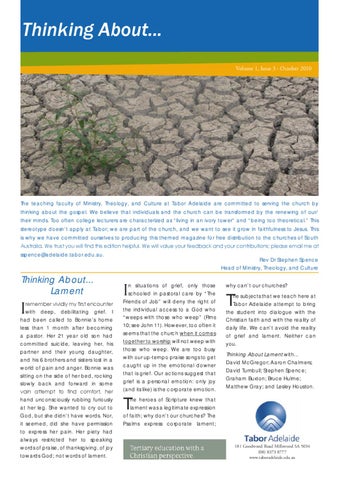
Thinking About... Volume 1, Issue 3 - October 2010
The teaching faculty of Ministry, Theology, and Culture at Tabor Adelaide are committed to serving the church by thinking about the gospel. We believe that individuals and the church can be transformed by the renewing of our/ their minds. Too often college lecturers are characterized as “living in an ivory tower” and “being too theoretical.” This stereotype doesn’t apply at Tabor; we are part of the church, and we want to see it grow in faithfulness to Jesus. This is why we have committed ourselves to producing this themed magazine for free distribution to the churches of South Australia. We trust you will find this edition helpful. We will value your feedback and your contributions; please email me at sspence@adelaide.tabor.edu.au.
Rev Dr Stephen Spence Head of Ministry, Theology, and Culture
Thinking About... Lament
I
I
remember vividly my first encounter with
deep,
debilitating
grief.
I
had been called to Bonnie’s home less than 1 month after becoming a pastor. Her 21 year old son had committed suicide, leaving her, his partner and their young daughter, and his 6 brothers and sisters lost in a world of pain and anger. Bonnie was sitting on the side of her bed, rocking slowly back and forward in some
n situations of grief, only those schooled in pastoral care by “The
Friends of Job” will deny the right of the individual access to a God who “weeps with those who weep” (Rms 10; see John 11). However, too often it seems that the church when it comes together to worship will not weep with those who weep. We are too busy with our up-tempo praise songs to get caught up in the emotional downer that is grief. Our actions suggest that grief is a personal emotion: only joy
vain attempt to find comfort, her
(and its like) is the corporate emotion.
hand unconsciously rubbing furiously
he heroes of Scripture knew that
at her leg. She wanted to cry out to
why can’t our churches?
T
he subjects that we teach here at Tabor Adelaide attempt to bring
the student into dialogue with the Christian faith and with the reality of daily life. We can’t avoid the reality of grief and lament. Neither can you. Thinking About Lament with... David McGregor; Aaron Chalmers; David Turnbull; Stephen Spence; Graham Buxton; Bruce Hulme; Matthew Gray; and Lesley Houston.
T
lament was a legitimate expression
God, but she didn’t have words. Nor,
of faith; why don’t our churches? The
it seemed, did she have permission
Psalms express corporate lament;
to express her pain. Her piety had always restricted her to speaking words of praise, of thanksgiving, of joy towards God; not words of lament.
181 Goodwood Road Millswood SA 5034 (08) 8373 8777 www.taboradelaide.edu.au
“How long, O Lord?” L
Rev Dr Stephen Spence, Head of Ministry, Theology, and Culture Stephen will teach Romans Exegesis and Pauline Theology in Semester 1, 2011.
amenting – giving voice to our deepest
And this is where lament differs from grief. Grief
grief and hurts before God – is a cry of faith.
expresses our sorrow to God. (And is, therefore,
Lamenting acknowledges that evil and suffering is
a legitimate part of any Christian’s prayer.) Yet,
part of our present experience while, at the same
lament cries out to God to establish his justice
time, expressing a hope in a future that God has
and mercy and reign over all the earth. We
planned for us when “mourning and crying and
lament because we believe that God will act to
pain will be no more” (Rev 21:4). It says that the
overcome the evil that is very much part of our
world is not as it should be (Rms 8:19-23). Yet, it also
present experience. Lament is our cry for God
says that God cares and that God can (and will)
to come in justice and righteousness. It is a cry in
do something about our situation.
the present for God’s future to come. We lament
Some well meaning Christians, and most Sunday morning services, choose praise over lament because they see praise as honouring to God and lament as questioning God’s goodness and greatness.
Yet, the martyrs of Revelation chose lament because they believed wholeheartedly in God’s goodness and greatness.
because life is not as it should be, as it will be! We look forward to the Second Coming of Jesus not just so that we will not have to experience death (that would be self-centred of us). No. We look forward to Jesus, as Judge of the earth, righting wrongs and establishing God’s eternal kingdom reign in all its fullness. Until then, we will continue to lament as our cry of faith in a God who will come.
sspence@adelaide.tabor.edu.au
“Sovereign Lord, holy and true,” they cried in a loud voice from beneath God’s altar, “how long will it be before you judge and avenge our blood?” (Rev 6:9-11).
2
Considering your options for study? Enrol now for 2011 Tabor Adelaide offers fully accredited courses in: • • • • •
Teacher Education Social Science - Youth Work Social Science - Counselling Ministry, Theology, and Intercultural Studies Humanities: English, Creative-Writing, History, and Philosophy • TESOL • Certificate IV in Training and Assessment • VET Christian Life and Ministry
www.taboradelaide.edu.au
181 Goodwood Rd Millswood SA 5034 tel. 08 8373 8777 CRICOS provider No 00946E
Lament and Remembrance in Ministry B
ehind the deep cries of lament that afflict us
human beings and their God is the notion of
all at times lie the pain and grief of feeling
remembrance: the people dare to recall their
abandoned. But in the face of such lament we
God as one who will still act for them, and the
do well to recall that there is a God who has not
God to whom they cry still remembers his people.
forgotten us: “Can a mother forget the baby at her breast and have no compassion on the child she has borne? Though she may forget, I will not forget you!” (Isaiah 49:15).
Rev Dr Graham Buxton is the Director of PostGraduate Studies
We are a remembered people … all of us.
Remembrance and compassion are in fact two sides of a single coin. Walter Brueggemann points to the Israelites of old who cried out to God in lamentation and complaint, reminding him of their sense of forsakenness. In his faithfulness and unchangeableness, God offered both assurance and promise to his people. His loving-kindness, goodness and promise of peace are “more than enough to override the flood, to overcome the absence and shame, and to overmatch the terror
Parker Palmer once said that “remembered means to re-member. It means to put the body back together. The opposite of remember is not to forget, but to dis-member. And when we forget where we came from … we have in fact dismembered something.” To remember someone in this way is to be a part of their healing. To respond to a person’s cry of lament, “Remember me!”, is to live in solidarity with that person in their struggle and pain; to tell someone that we will not forget them offers hope and reassurance in the midst of loneliness and despair. In pastoral ministry, not only do we remember who we are as God’s people, we also ‘re-member’ one another.
gbuxton@adelaide.tabor.edu.au
of exile.” Implicit in Brueggemann’s understanding of the relationship between disconsolate
TABOR ADELAIDE 2011
Enrich your Ministry with International Scholars Professional Development for Clergy and Church Leaders Tabor Adelaide is bringing to Adelaide a number of internationally respected scholars whose research and writings have greatly contributed to the church. These are rare opportunities to hear from people who are helping the church think through its life and mission. It is possible to enrol for 1-week intensives with these scholars for credit or as an audit student.
Monday, 17 January with Dr Colin Greene Engaging Biblically and Creatively with the Digital World Monday, 28 February with Dr Edith Humphrey The Spirit and Spirituality in Biblical Perspective Monday, 1 August with Dr Soong-Chan Rah Freeing the Church from Cultural Captivity Monday, 17 October with Dr Pete Phillips Biblical Literacy and Communication in a Digital World Monday, 21 November with Olive Drane and Dr John Drane Mission and Discipleship in a Liquid Culture 9:30am - 3:00pm; $60 (lunch provided)
Register now with bhulme@adelaide.tabor.edu.au
3
Learning to Lament L
earning to lament feels unnatural. It runs
our disorientation, but encourage us to do so.
against the grain of our upbeat secular and
They even include Psalm 88, an embarrassment to
religious cultures. While occasions for lament are
conventional faith. Typically lament psalms have
invitations in our humanity to get deeply honest
an address, complaint, petition and motivation,
with God, ourselves and our world, the territory
before finishing with a confession of trust and
seems so foreign and terrifying that avoidance is
vow of praise. Psalm 88 omits this conclusion,
often our instinctive response.
ending with “You have taken from me friend
Bruce Hulme is a lecturer in Practical Theology and is studying towards an MTh in Spiritual Theology
Yet lament is a critical discipline for our spiritual
In 2010, Bruce is responsible for the Spiritual Formation Program, which involves all MTC’s degree students, and for the Supervised Field Education Program
circumstance stands unique, the dark thread of
formation. Three occasions in particular – my dad’s untimely death when I was 13, our fourth miscarriage, and my wife’s hospitalization with severe post-natal depression – have spawned occasions for deep lament in my life. Though each lament is the gut response weaving the three together in the tapestry of my walk with God. There will be more. No doubt such occasions exist in your life too. In these times, and in those of devastation in others’ lives, we can be particularly thankful for the dialect of the lament psalms as God’s primary tool
and neighbour–darkness is my closest friend” (Ps 88:18). The Benedictine Sebastian Moore comments that “God behaves in the Psalms in ways he is not allowed to behave in systematic theology.” (Hopkins, Journey through the Psalms, 10.) Psalm 88, the embarrassing psalm, is not the full story, of course – but thankfully, it does exist.
Even in deepest despair, God welcomes honest engagement.
Lament may feel unnatural, but it is pure gift for life lived well in the face of the darkest mysteries of life. How are you learning to lament?
bhulme@adelaide.tabor.edu.au
for learning to lament. They not only help us voice
4 SEMESTER ONE 2011
Study Opportunities at Tabor Adelaide Tabor Adelaide’s School of Ministry, Theology, and Culture offers degrees and diplomas in Ministry, in Theology, in Intercultural Studies, and in Christian Studies. It is possible to study on campus or through the external studies program. (Or a mixture of both.) APPLY online. FEE-HELP is available for eligible students.
TM1101 CREATIVE LIVING Discover the God of grace and his love for us. Explore how it is in Jesus that we discover who God is AND who we are. Practice living gratefully in the grace of God. Consider how all this applies to the practice of prayer and knowing (and doing) God’s will. Suitable for Christians who are looking to build (or rebuild) their faith on God’s grace. TUESDAY, 1-4pm.
TM1103 CHRISTIANS IN A MULTICULTURAL WORLD Explore what it means for the whole church to be caught up in God’s Trinitarian ministry to the world, promoting the gospel in life and word. Explore your own personal calling to be a part of that ministry. This subject is suitable for anyone exploring God’s call on their life. THURSDAY, 130-430pm.
TM1102 INTRODUCTION TO CHRISTIAN MINISTY Explore what it means for the whole church to be caught up in God’s Trinitarian ministry to the world, promoting the gospel in life and word. Explore your own personal calling to be a part of that ministry. This subject is suitable for anyone exploring God’s call on their life. TUESDAY, 6-9pm.
TM2115 INTRODUCTION TO THE OLD TESTAMENT Learn about the world, significant people, events, and message of the OT, with a particular emphasis upon seeing how the OT can continue to speak into our lives and ministries. This subject is suitable for Bible study leaders and those wanting a better understanding of the Bible. THURSDAY, 10am-1pm.
Too little too late! T
he Psalms contain more anguished complaints
C. S. Lewis wrote two very different books on
than hymns of praise. For Israel, complaining
suffering. His first, “The Problem of Pain,” is an
to God was part of their liturgy. But, as Helmut
apology for belief in God. One critic commented
Thielicke observes,
that the problem of pain was bad enough
many of us would rather talk about God than to him.
David McGregor is Senior Lecturer in Theology. He is enrolled in the PhD theology program at Newcastle University David will teach Creative Living, Jesus the Christ, and Kingdom of God in Semester 1, 2011.
without Lewis adding to it by writing a book on the subject! His second, “A Grief Observed,” is a
Is complaining to God lack of faith in him? Walter
heart-rending complaint to God over the death
Brueggemann says Israel complained to God
of his beloved wife. One is an argument for faith
because they believed in him. Their laments rise
attempting answers, but the other is an expression
from their unshakable belief that God is good: “the
of faith despite the lingering questions.
very premise of the accusatory prayer of petition is that Yahweh is indeed steadfast and faithful.” Complaining to God was Israel’s way of naming their pain. Eugene Peterson tells us that four of the five chapters of Lamentations are alphabetical acrostics. In reciting these words the Israelites rehearsed their pain from aleph to tau (A to Z). Cliched answers to life’s profound tragedies often betray a misguided need to “justify God” and a nervousness with the inexplicability of suffering.
Karl Barth has reminded us that
we do not complain alone. God takes up our laments and feels them more deeply than we do. Jesus’ terrible cry of dereliction voiced the misery of us all. Now our complaints are always too little and too late. Too little –for now they can only be a mere echo of his. Too late - for now they have already become God’s concern!
dmcgregor@adelaide.tabor.edu.au
5 SEMESTER ONE 2011
Study Opportunities at Tabor Adelaide
February 14 - June 3 181 Goodwood Road Millswood SA 5034
WANT DETAILS? contact Samantha
TM6330 INTRODUCTION TO ADULT EDUCATION Explore the current theories and practice of adult teaching and learning. Discover the characteristics of adult learners and the nature and contexts of life-long learning and apply the concepts to your own ministry field. Suitable for anyone interested in teaching adults. TUESDAY, 1-4pm.
sdocherty@adelaide.tabor.edu.au
Tabor Adelaide Semester One, 2011
(08) 8373 8777
TM5210 POVERTY and INTEGRAL MISSION God cares for the poor, and he requires that his people do too! This hope-filled class will explore practical options that contribute to bringing healing and dignity through an integral mission framework. Students typically leave this class with a new appreciation of their life and work. WEDNESDAY, 6-9pm.
www.taboradelaide.com.au
TM4215 WORSHIP Explore how worship shapes us (and how we shape it), its biblical foundations, its rich history, and the many practical aspects of worship ministry. This subject would be excellent for pastors, worship leaders, worship team leaders, and anyone who wants to explore how to give our best to God in worship. THURSDAY, 6-9pm.
Listen to Lament L
amentation seems to be a rather antiquated
hears. Perhaps His silence is just Him listening to
idea. The need to lament is still around, but
our lament.
our society seems to hide away life’s personal tragedies. The closest thing to lamentation these days is satire. Satire laughs at agony and injustice. Nobody wants to listen to lament. The Church is much the same. Our songs, our
Matthew Gray is Lecturer in Church History. He is enrolled in the PhD history program at Adelaide University. Matt will teach Introduction to Christian Ministry and Reformation History in Semester 1, 2011.
services, our sermons, often have no room for lamentation (where would it go? Before the
. “Weep with those who weep” (Rom 12:15) has been replaced by “rejoice with those who weep, until they start rejoicing too.”
offering, or after?)
Nobody wants to listen to lament in Church. At the heart of lamentation is the recognition that God actually does hear, and wants to hear. CS Lewis remarked, “Our struggle is... to believe that, whether He can grant them or not, God will listen to our prayers... Even to go on believing that there is a Listener at all.” Scripture insists God
Perhaps that’s why Job has to wait so long until God speaks. Of course, the other reason could be that God expected Job’s four friends to listen to his lament. Instead, they gave advice – unlistened advice. We are sometimes called to just listen, understand and lament with the broken. The Desert Forebears understood this: “In Egypt once Abba Poemen passed by and saw a woman sitting on a grave and weeping bitterly. And he said: ‘If all the delights of this world should come, they would not bring her soul out of sorrow. Even so the monk should ever be sorrowful within his heart.’” Listen to lament, then lament as well. The power of the Church is that it speaks of a God Who not only hears our pain, but participates in it, most obviously through the cross, but also through His Spirit entering into us, including our laments. And part of the way that happens is when we hear others’ pain, and participate in it. To weep with those who weep, to listen to their lament.
mgray@adelaide.tabor.edu.au
6
Lamenting is a Cultural Action T
he experience of loss and great sorrow is a
Australia our family’s grieving was not recognised
universal one. Yet, as we read our Bibles, it is
because we had “come home” and that, to
clear that individuals and cultures express their grief in very different ways. Neither the “stiff upper lip” of the Englishman or the loud wailing of the Middle Eastern peasant can be characterised as “the right way to lament.”
David Turnbull, Senior Lecturer in Intercultural Studies David will teach Intercultural Life and Work, Christians in a Multicultural World, and Poverty and Integral Mission in Semester 1, 2011. David was an Australian delegate to the 2010 Lausanne World Evangelisation Conference (South Africa).
We know this. However, too often our pastoral care
everyone else, seemed to be a good thing.
It is challenging for a church to provide culturally competent and appropriate pastoral care to those outside its dominant culture.
seems to deny the truth of this. At times we do not
Increasingly, in our churches there are people
recognise when people are grieving because we
from Africa, Asia, and the Pacific. These people
do not recognise their loss. At other times, we try to
will lament in ways different from the dominant
shape a person’s lament to fit our expectations.
Australian culture and from one another. Such
The grief and loss of cross-cultural workers who return home often goes unrecognised. Grief and loss occurs with the loss of status on return and the things left behind (possessions, memories and friendships). This grief is heightened when the return is sudden and unexpected. This was the case for my family when we had to leave Nigeria suddenly (and without opportunity for closure) when our new-born son, Matthew, was diagnosed with disability issues. However, when we returned to
differences can be confusing or misjudged. Before the crisis comes, our churches need to be prepared. How does this subgroup within our church lament? How are we, as their family and community, meant to grieve with them? How can we best care for them in a way that they will appreciate?
dturnbull@adelaide.tabor.edu.au
Psalms of Lament S
ince the pioneering work of the German
temptation to ignore or skip over them (much like
scholar Herman Gunkel (1862-1932), it has
there is a tendency to skip over Good Friday –the
been common practice in OT studies to group the
day of lament par excellence in the Christian
psalms according to their various genres. Six major
calendar - and go straight to Easter Sunday).
genres have been identified (hymns, laments, songs of thanksgiving, wisdom and Torah psalms, royal psalms, and liturgies) and of these the most
Dr Aaron Chalmers is Senior Lecturer in Biblical Studies. Aaron has recently contributed articles to Tyndale Bulletin and to Vetus Testamentum. Aaron will teach Introduction to the Old Testament, Biblical Theology, and Understanding the Biblical Narrative in Semester 1, 2011.
common (by far!) is the lament.
Yet by ignoring these texts
of lament we may actually be doing our people a profound disfavor.
Such psalms, however, can make confronting
It seems likely to me that one of the primary
reading:
reasons why Israel was able to maintain her
•
faith throughout the vicissitudes of her long and
•
“O God, why do you cast us off forever? Why does your anger smoke against the sheep of
challenging history was her ability to lament.
your pasture?” (Ps 74: 1),
If we wish to be involved in raising up and shaping
“O God, you have rejected us, broken our
individuals into mature, faithful believers who
defenses; you have been angry; now restore us!” (Ps 60: 1).
are there for the long haul, perhaps we should consider the psalms of lament and the kind of faith they embody as something worth exploring.
Because such Psalms do not mouth the comfortable religious platitudes we are used to hearing, because they may not fit our Sunday morning worship theology, there is always the
In our desire to “protect” our people from such texts, perhaps we are only hamstringing them.
achalmers@adelaide.tabor.edu.au
Meeting God in the mystery of grief...
Frank A. James III is a preacher, a professor of historical theology, and the provost of Gordon-Conwell Theological Seminary in the USA.
In December 2006 his brother died in a climbing accident on Mount Hood. He writes, in Christianity Today (September, 2010), “One question haunts me: Where was God when Kelly was freezing to death on Mount Hood? For me, it is not whether I should ask such a question, but how I ask it. One can ask the question in a fit of rage, shaking one’s fist at God. Many of us, if we are candid, have done that. But once the primal anger settles to a low boil, we can—and, I would submit, should—ask the question. I am not suggesting that mere mortals can stand in judgment of God or call him to account. God does not report to me. But an honest question posed from a broken heart is to my mind a good and righteous thing. To ask this hard question is an act of faith. It presupposes a genuine relationship in which the creature actually engages the Creator. If God is my Father, can’t I humbly ask why he did not come to Kelly’s rescue? For me, to not ask this question would be a failure to take God seriously.” Read the full article at... www.christianitytoday.com/ct/2010/september/36.58.html
The Story Behind the Story In December 2006, Kelly James and his climbing partners, Brian Hall and Jerry “Nikko” Cooke, died on Mount Hood in northern Oregon. Their expedition was intended to prepare them for their lifelong dream of climbing Mount Everest. The climb began on December 8, but they encountered a rogue blizzard of enormous intensity and duration. They burrowed into a snow cave to wait out the storm. But the storm was unrelenting. Apparently Kelly had been injured, so the hard decision was made that Brian and Nikko should go for help. Sensing the gravity of their situation, Kelly must have released Brian from their longstanding pact never to leave one another. Alone in the snow cave, Kelly made desperate calls on his cell phone. On
7
Sunday, December 10, against all odds, one call mysteriously connected, and he was able to speak to his wife and two of his sons for six minutes. It was the last time they would hear Kelly’s voice. From the outset, the story captivated the national news media, and the three families asked if I would serve as the public spokesperson. A massive search was launched, and finally, on December 17, we were notified that a body had been discovered. The fateful call came that evening, informing us that the recovered body had a signet ring with the initials JKJ—Jeffrey Kelly James. The search for Brian and Nikko continued, but their bodies were never found. I preached at my brother’s funeral on December 27, 2006.
A Song of Lament Lamentation has many forms: silent screaming at the loss of a loved one; groanings over a failed plan; wailing at the death of a dream and lost hope.
When we lament there is the sense of isolation, of being alone.
Some years ago I came across this poem. There is no
Leslie Houston is the program director for Teaching English to Speakers of Other Languages (TESOL). She is enrolled in a PhD program at Flinders University. Leslie will teach Adult Education in Semester 1, 2011.
explanation of the origin of the grief; no overt cause with which the reader can sympathise. But still the
Creative Commons License We are happy for you to reuse any of the material in this journal. We do require, though, that you clearly identify the source by “author’s name,” Tabor Adelaide, School of Ministry, Theology, and Culture (November 2010)
words speak... I’m lonely Lord In the bustle of life, I stand alone And weep inside Here in your house Among your people, I’m lonely Lord And weep inside
This work is licensed under the Creative Commons AttributionNoncommercial 2.5 Australia License. To view a copy of this license, visit http://creativecommons.org/licenses/ by-nc/2.5/au/ or send a letter to Creative Commons, 171 Second Street, Suite 300, San Francisco, California, 94105, USA.
Their laughter is warm An offering to you My silent wail, I weep inside Were you lonely Lord In Gethsemane? When the soldiers came Did you weep inside? Were you lonely Lord
8
When Peter cried “I know him not!” Did you weep inside? You were alone Lord When you hung on the tree WHY HAVE YOU ... FORSAKEN ... ME! It’s less hard to bear, ... you understand ... You join the lament And weep with me When confronted with grief, are we like Job shouting and shaking our fists at God, demanding an explanation? Or like Job’s friends looking for spiritualised explanations and easy solutions? Or do we turn to the one who understands, who has journeyed through Gethsemane? When we share Christ’s cross, we hear God’s heartbeat. Let us embrace the lament, and like Job we will be able to say, “My ears had heard of you but now my eyes have seen you.”
lhouston@adelaide.tabor.edu.au
www.taboradelaide.edu.au 181 Goodwood Rd Millswood SA 5034 tel. 08 8373 8777 for further information contact Samantha Docherty sdocherty@adelaide.tabor.edu.au