





Did you know that even though certain types of claims are beyond your control, there are some that can be prevented? Here are some common causes of home insurance claims and some tips to help prevent them.
Bathroom leaks
Water damage claims can be extremely costly. Never let the bath run unattended, repair small leaks immediately and, if your bathroom is in the basement, make sure your appliances are protected by anti-backflow valves.
Leaking dishwasher or washing machine hoses
Hoses and pipes can leak due to corrosion, a damaged fitting, or just wear and tear. Check the condition of the hoses and pipes regularly and consider replacing them with metal-reinforced hoses. Avoid using these appliances if you aren’t home during their operation.
Kitchen fires
Cooking fires are the number one cause of home fires – with the leading cause of fires in the kitchen being unattended cooking. When cooking, never leave the stove unattended and when cooking with oil, use a CSA or ULC-certified deep fryer with a thermostat as it’s much safer.
If not used properly, barbeques can pose a safety and fire hazard. Only use your BBQ in a well-ventilated area, away from flammable materials, making sure to lift the lid before opening the valve of the tank. When finished using, make sure the pipes and hoses are empty by first closing the tank’s valve and then shutting off the burners. Ensure you clean the burner pipes every year using a brush. Always check for leaks after opening the valve using a brush full of soapy water over all moving parts – if there’s a leak, bubbles will appear.
Cigarette
Did you know that it can take four to five hours from the time the butt is extinguished to the time a flame starts? If you’re a smoker, never smoke lying on a bed or sofa. Make sure to always wet the cigarette butts before throwing them in the trash, and never extinguish them in flowerpots or planters outside. Peat, moss or wood chips are combustible materials and can pose a fire hazard. They may also contain chemical fertilizers which could ignite.
Temporary electrical installations or overloaded connections are significant fire hazards. Ensure that high-energy appliances do not operate at the same time on the same circuit. Use an extension cord with enough capacity for the appliance and never slide the cord under a carpet. You may need to add more electrical outlets instead.
Accidental fires are the second most common type of insurance claim after water-related claims. When burning a candle, never leave it unattended and use candlesticks that are not made of wood or plastic. Keep your candles in a non-passing area at least 30 cm from draperies or woodwork.
To prevent theft, invest in an alarm system, lock all your windows and doors, and do not leave a key outside. If you’re going away for more than a few days, inform a trusted neighbour.
Hailstorms, violent winds, and other natural disasters can severely damage your property. If a storm is coming, minimize the potential damage by storing patio furniture and BBQ (without the tank) inside. Make sure you have enough supplies for the first 72 hours of an emergency.
Need help finding the right home insurance coverage? Contact me today for personalized service. And, for more helpful safety tips, visit desjardins.com/en/tips.html


Jennifer Miles, Agent 125-15 Circle Dr
St. Albert 780-460-2279
jen@jmilesinsurance.com jmilesinsurance.com
MBroadbent Insurance Agency Inc.
Michelle Broadbent, Agent 3523 Tudor Glen Market St. Albert 780-470-3276
michelle@michellebroadbent.com michellebroadbent.com



T8N MAGAZINE
VOLUME 13 ISSUE 3
July 2026
PUBLISHER EDITOR
Rob Lightfoot Gene Kosowan
DESIGN & PRODUCTION MANAGEMENT
Isaac White
PHOTOGRAPHY
Malcolm Azania, Stephanie Cragg, and Gloria Ge-Weald, Adobe Stock: Lukas Gojda and Nataliia_Trushchenko
CONTRIBUTORS
Malcolm Azania, Stephanie Cragg, Gloria Ge-Weald, Gene Kosowan, and Tom Murray
OFFICE MANAGER
Janice Lightfoot
CONTRIBUTING AGENCIES
Adobe Stock
ISSN 2368-707X (PRINT)
ISSN 2368-7088 (ONLINE)
For editorial inquiries or information, contact T8N magazine at info@t8nmagazine.com. Have something to say? Letters, suggestions or ideas can be sent to letters@t8nmagazine.com
FOR ADVERTISING INFORMATION
Rob Lightfoot rob@t8nmagazine.com 780 940 6212 or visit t8nmagazine.com
T8N magazine is published 5 times a year by T8N Publishing Inc. Copyright ©2026 T8N Publishing Inc. Reproduction in whole or in part without permission is strictly prohibited. Content marked by the Sponsored Content icon was produced in partnership between content producers and T8N magazine.
PRINTED IN CANADA
T8N PUBLISHING INC
PUBLISHER & PRESIDENT
Rob Lightfoot: rob@t8nmagazine.com Mailbox #215, 3-11 Bellerose Drive, St.Albert T8N 5C9


CONNECT WITH US /t8nmagazine
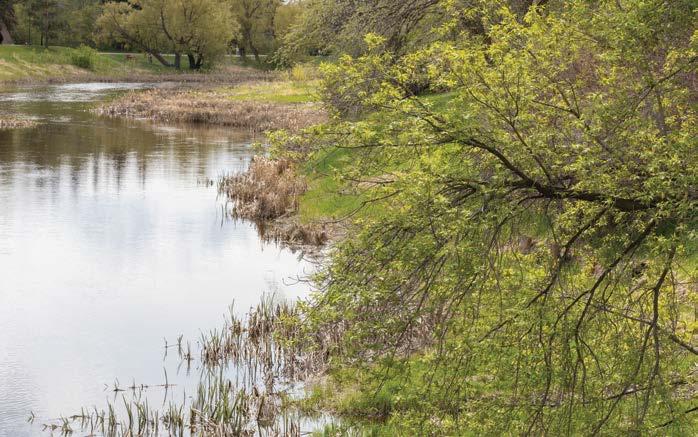
6 TROUBLED WATERS?
Despite declining water quality, the Sturgeon River is still technically safe according to experts
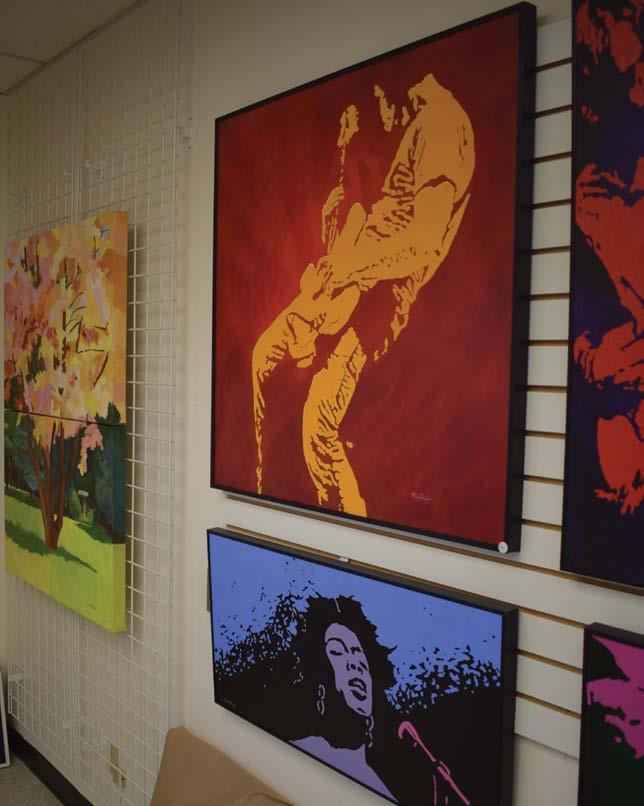
10 CONNECTION THROUGH CREATIVITY
VASA facilitates an environment to enhance the artistic process
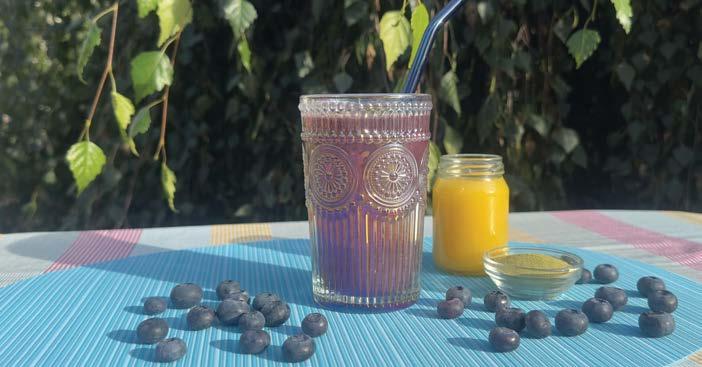
14 SUPERFOOD SMOOTHIES
Don’t tell anyone these drinks are also good for them!
20 THE 8S
Doing Summer
Nifty items to get the most out of the sunny season
22 MEET YOU THERE
Arcane al fresco
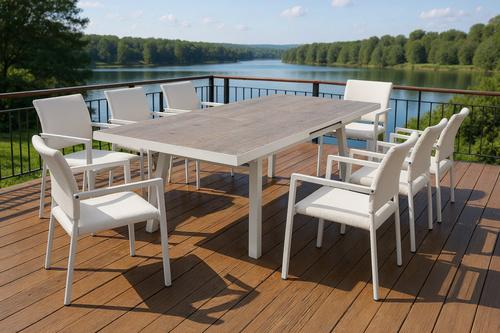
Some of this region’s more unusual patios add to the outdoor dining experience
26 THEN & NOW
250 years of Treaty 6 One of Canada’s most controversial agreements remains more relevant than ever
28 HIKE ON THE WILD SIDE
Wilderness backpacking offers its own rustic rewards
30 UNDER THE SUN
Find 49 words that best describe summer

ALBERTANS ARE SPOILED when it comes to outdoor recreation, taking advantage of such amenities as the Rocky Mountains and the multitude of lakes in the province. Here in St. Albert, we can canoe and kayak on the Sturgeon River, the most visible natural landmark in the city.
But older folks still recall swimming in the river during the summer and skating on its icy surface during the winter. Those pastimes are riskier these days, primarily due to the gradual accumulation of contaminants in the water that’s much shallower than the days when St. Albert was founded. On page 6, we address safety issues concerning the Sturgeon, trace its overall decline in water quality, and what’s being done to mitigate these problems.
This summer also commemorates the 150th anniversary of Treaty 6, which was created to solidify the rights of aboriginal people facing an influx of settlers heading west. Because the federal government had other ideas, the Treaty has been wrought with controversy for years. However, recent events surrounding Alberta secession have elevated the Treaty as a formidable power player, as documented on page 26.
Thankfully, we ease up on the heavy stuff to offer you such lifestyle fare as super-healthy smoothies (page 14) and sunshine-oriented merch (page 20). More destination-minded readers might either want to chill out at some unusual dining patios in the region (page 22), explore what’s adorning the interior at VASA’s gallery (page 10), or experience a weekend of wilderness backpacking (page 28).
Enjoy the read and make the most of the summer! t8n





If you're going to get a brain freeze from enthusiastically slurping a smoothie, make sure the nutrients in that drink compensate for that effect. We offer six tasty options on page 14.



Your article on the separation groups and Mr. Lukaszuk’s Forever Canadian group is quite misleading. It would hold a lot more credibility if you had actually interviewed both sides of this issue.
Focusing on the very far right separatists and not the Stay Free Alberta group that has over 300k worth of verified signatures is rather poor journalism.
Disappointed I am.
Brent Brodeur
I read the article by Gene Kosowan called “Separation Anxiety,” where he interviewed Thomas Lukaszuk, and while I don’t consider myself a separatist, and haven’t signed a petition for either side of the issue, it does bother me to see inaccurate information.
Mr. Lukaszuk stated that, when referencing people of Judeo-Christian backgrounds, it means “Caucasian Christians.” It may interest both Mr. Lukaszuk and Mr. Kosowan to know that Christianity spread through Africa before reaching Europe, and is not related to ethnicity. In fact, a large number of Nigerians are coming to Canada to escape the persecution of Christians, and Christianity is one of, if not the most, persecuted religions in the world.
It is worth trying to understand facts before publishing articles to the public around such things. I’m sure you care about journalistic integrity and have no intention of misleading anyone, so it won’t surprise me if I see a correction in your next issue.
Danica Marlow
The above-mentioned article was excellent. Thank you for publishing it. Many people are very concerned with talk of separation, especially now when we have a premier and government that is using taxpayer money to appeal a court decision.
It would be very beneficial to have an article explaining all the things we would lose if separation did occur. Please continue to publish articles regarding this non-democratic issue. The T8N magazine is a very worthwhile magazine for our community. We read every issue.
D. & M. Atkeyw
Despite declining water quality, the Sturgeon River is still safe according to experts
BY: GENE KOSOWAN | PHOTOGRAPHY: STEPHANIE CRAGG
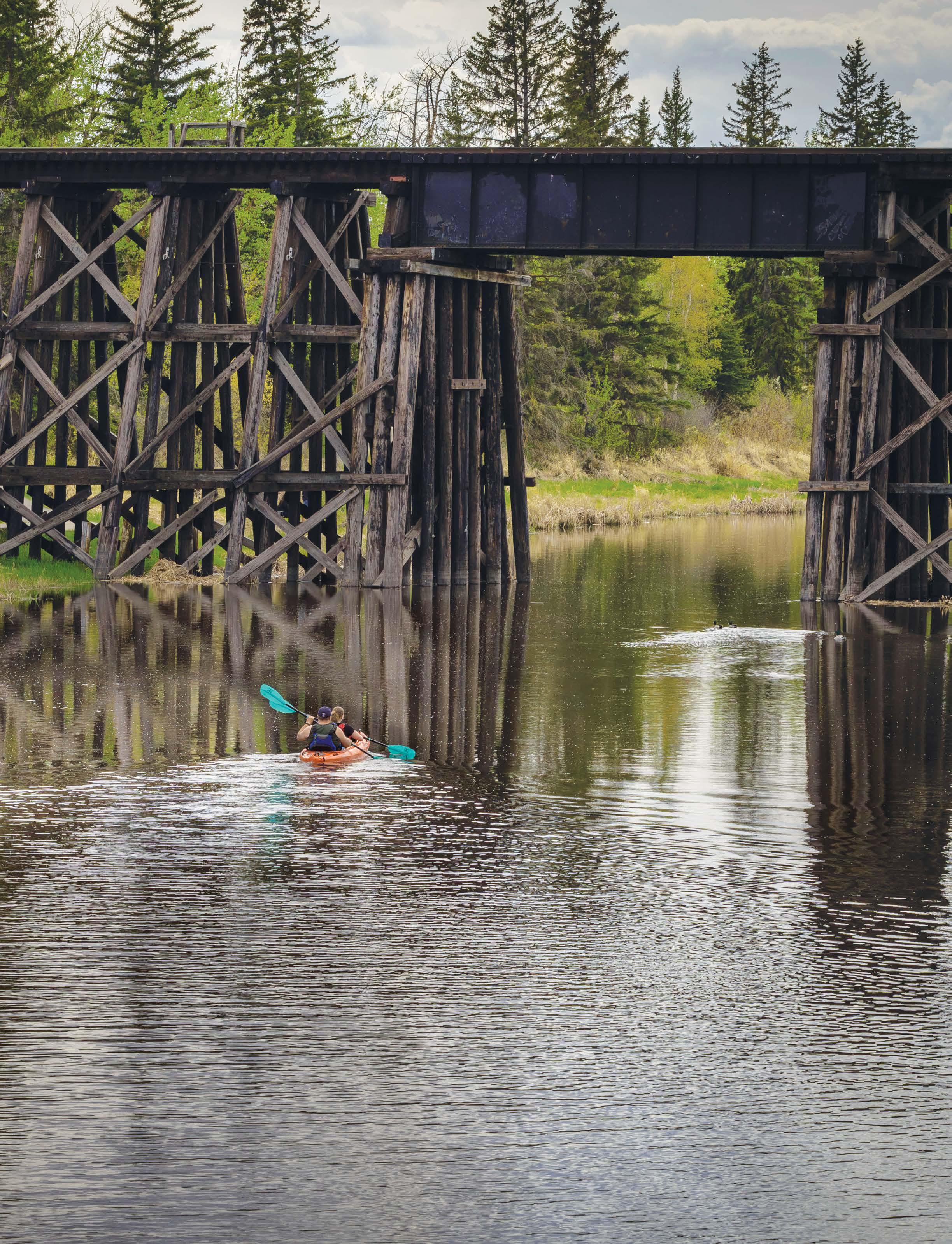
SCOTT MILLAR HAS no issue with folks taking to the flowing waters of the Sturgeon River. “I would not hesitate to recreate, or go kayaking on the Sturgeon River,” said Millar, a fisheries biologist and executive director of the North Saskatchewan Watershed Alliance (NSWA). “Would I dip my cup in and drink untreated river water? No, I probably wouldn’t. But I probably wouldn’t recommend that to anybody on any river.”
“It’s a fine, smaller river for kayaking, paddleboarding, and canoeing,” added Melissa Logan, environmental coordinator at the City of St. Albert. “It’s fine for fishing and for humanpowered recreational activities.”
Both cautionary endorsements address a waterway that has frequently been declared to be slowly deteriorating. It hasn’t helped matters that on June 1, a damaged pipe resulted in a wastewater dump in the Sturgeon, prompting Alberta Health Services to issue a water quality advisory.
The leak was hardly an isolated incident. The past 15 years alone have witnessed several sewage spills, and episodes involving toxins from transmission fluid in 2014 to an unknown contaminant the following year. Accounts of dead fish floating in the Sturgeon have occasionally surfaced as have high concentrations of E. coli bacteria, including one instance that warranted a provincial advisory in 2025.
Observers have been up in arms over the Sturgeon’s flagging health for years, however. A 2014 Tech Life Today story, published by the Northern Alberta Institute of Technology, stated that the Sturgeon was “dying.” The St. Albert Gazette bemoaned the plight of the Sturgeon in 2017, noting “we may lose this link to the past unless we come together to protect it.”
Far less dramatic was a 2023 NSWA study that reported its overall water quality appeared to be “acceptable, although some parameters of interest should be further investigated.” And the latest update on the City’s website commented that the river “faces many pressures,” both natural and human-made.
The City’s monitoring efforts check several indicators, including fertilizer ingredients like nitrogen and phosphorus, chloride from road salt, and bacteria—particularly strains associated with E. coli. Its most recent findings in samples drawn four times annually where the Sturgeon zigzags through the municipality—and measured against Alberta water quality standards—reveal that levels of nitrogen and “suspended solids” were rated as good, with phosphorus readings ranked as fair. Concentrations of chloride and E. coli bacteria received passing marks.
I would not hesitate to recreate, or go kayaking on the Sturgeon River
Scott Millar NSWA Executive Director
Recent NSWA data, using 149 monitoring stations located at various sites along the 260-km river, revealed more inconsistent results. Some spots had low reading of contaminants. Others occasionally exceeded provincial safety standards.
One December 2023 report stated that E. coli bacteria levels crossed that threshold at the Big Lake outlet, just upstream from St. Albert, although Millar hinted that such microbes were more likely to have originated naturally.
“E. coli could be an issue because that’s an indication of fecal contamination which could come from animals or wildlife, or people—hopefully not people,” Millar said.
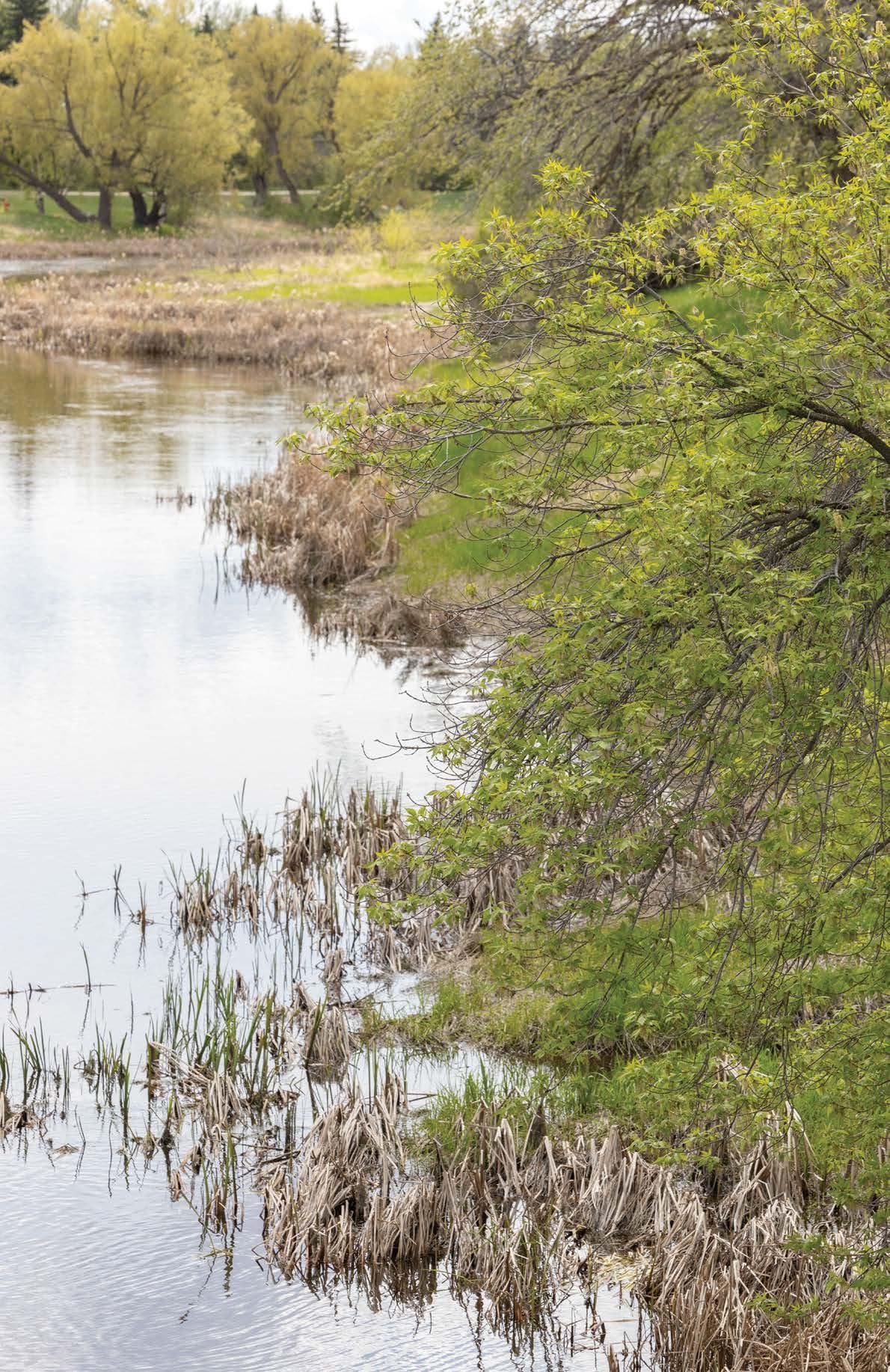
Millar noted that the Sturgeon’s water quality is a manifestation of its surrounding 3,300 square km watershed, which filters runoff. It’s also a reflection of adjacent land use, much of it agricultural, given that around 70 percent of property bordering the watershed is occupied by some 1,200 farms. Millar said that overall land use hasn’t varied much in recent years.

“There hasn’t been a lot of big changes in that over the last few years, so I wouldn’t say that the water quality is a lot worse than it has been. It’s just typical of the land use. And that would be the same for other watersheds as well.”
However, Millar is particularly concerned about dissolved oxygen, which aquatic life needs to breathe—at least five milligrams per litre, according to Alberta surface water quality guidelines. But it’s rough going for them if the climate gets hotter than usual. “High temperatures and low oxygen are tough on aquatic life, fish and invertebrates,” said Millar. “All of those critters need oxygen; increasing temperature reduces oxygen at the same time.”
If those critters don’t get enough dissolved oxygen, they die. In 2002, Alberta Fish and Wildlife determined that low oxygen levels were responsible for killing a plethora of dead fish drifting past the city’s railroad trestle, an event mentioned in the City’s 2012 report.
While conservation groups like the Alberta Wilderness Association blame higher temperatures on climate change, the NSWA has been more cautious about that assessment. “However, results seem to suggest that the effects of human activities on stream flows (through landscape changes and increased water use) might be having more of an effect than climate variability,” said the organization in a June 2017 report.
Increasing temperatures also play havoc with water levels, which the City stated on its website in 2023 had dipped by as much as 60 percent since its watershed report was published in 2012. Logan noted that depth measurements taken at the Perron Street Bridge register at about 1.2 metres on average, taking seasonal fluctuations into account.
Notwithstanding the record rainfall in June that resulted in the Sturgeon levels rising by roughly a metre, the river has been susceptible to a series of droughts over the past quarter-century. According to Canada Water Portal, Alberta has faced several draughts during that time, including a current period that’s existed since 2022. As the Sturgeon isn’t glacially fed, it’s particularly vulnerable to hotter, drier conditions.
Enjoy Sundays on St. Albert’s only riverfront patio
Brunch: Sundays 9 AM to 1 PM
Dinner: Tuesday to Sunday 4:30 to close
8 Mission Avenue
St. Albert | 587.290.1655 riverbankbistro.ca
Book your next private event
“It is completely dependent on precipitation, so we’ve been in multi-years of drought.” noted Logan. “There just hasn’t been the water there to keep feeding the river.”
Back when St. Albert was little more than a mission in 1861, the water was certainly deeper, although such statistics are hard to come by. However, Musée Héritage Museum curator Vino Vipulanantharajah said that photographs taken during the early years revealed that the waterway was much wider than it is today, large enough to accommodate steamboats.
“It was definitely much bigger than it is today; there’s evidence of that,” said
Vipulanantharajah. “They had recreation, a clubhouse, a canoe club, and they had paddlewheel service there. It must have been wide enough for all that to happen.”
According to The Black Robe’s Vision: A History of St. Albert & District, a lot more things happened on the river, many of them destructive. Clearcutting to establish a river lot system for agricultural use, and operations like grain mills and a dump site dotting the banks caused harmful effluence to trickle into the river, sharply reducing the fish population. By 1919, the Provincial Medical Health Officer declared that the Sturgeon water was unsafe to drink.
St. Albert’s development throughout the 20th century continued to wreak havoc on the river. Sewer lagoons were built during the ’50s to treat water subsequently dumped into the Sturgeon. Starting in the ’90s, protesters for years fought developers and City Council over road construction, including what is now Ray Gibbon Drive.
They feared not only would that activity trigger those since-capped lagoons to leak effluence down the banks, but the completed artery would also increase the use of road salt already responsible for making the river’s ice surface unsafe for skating.
These days, the City has taken precautions to mitigate such events. It continues to monitor contaminants, and has upgraded storm and sewage systems to boost responses to clogs and spillage. Storm lines now have interceptors to reduce sediment and grit that could reach the river.
“Our responsibility as a municipality is to make sure our inputs to the river through storm water are as clean as possible,” said Logan. “However, that doesn’t account for anything that occurs upstream of the city.”
Kate Polkovsky, CEO of Arrow Utilities, which owns the affected infrastructure involved in the June wastewater spillage,

said that the system features redundancy safeguards to lessen the leak. “The incident occurred during a period of significant rainfall and unusually high river flows, which provided significant dilution,” Polkovsky added.
The City also enforces an annual fishing ban April 1-May 14, enabling fish stocks to spawn, while a volunteer cleanup campaign during the fall removes material littering the riverbanks. It may take the Sturgeon years to recover, but Millar is encouraged by the City’s efforts.
“The City has an impact on water quality, but they’re trying to mitigate all the impacts,” he said. “They’re monitoring water quality, they’re treating it, they’re doing all the things that they can to make sure that whatever impacts they’re having are as minimal as possible.” t8n
The Sturgeon River originates at Hoople Lake near Entwistle, flowing east through Lake Isle, Lac Ste. Anne, Big Lake and St. Albert before emptying into the North Saskatchewan River near Fort Saskatchewan.
The Cree called the river mihkwapemak , (red willow). Early explorers named it after the large fish that dominated the waterway.
Sturgeon have been absent from the river for decades, due to overfishing and water pollution. Additionally, according to Logan, road construction and culvert installation have blocked spawning paths to the waterway from the North Saskatchewan River.
St. Albert doesn’t get its drinking water from the Sturgeon River. Instead it’s delivered via EPCOR from the North Saskatchewan River to the Sturgeon Reservoir and Pump Station.


BY: MALCOLM AZANIA | PHOTOGRAPHY: MALCOLM AZANIA
IN AN AGE when people can type a few sentences so plagiarism software can belch replicas or warped versions of any poem, novel, comic book, or painting, some people truly don’t understand why art—and making art—matters so much.
But for the last 21 years, members of the Visual Arts Studio Association (VASA) have been demonstrating just how deeply they understand that art changes who we are and what we think we can become—not only by experiencing, but by creating it
Take Melanie Hsiao, an artist I witnessed creating mixedmedia work at her own VASA studio. Hsiao also designs her own resin jewelry, which, like her paintings, contain actual, embedded flowers. Her jewelry is particularly striking, not only for its beauty, but because it offers people the chance to go beyond treasuring art in the privacy of their homes, and turn themselves into human art galleries as they wear it wherever they go.
Despite having painted for only about 10 years, Hsiao creates work at a skill level that seems it should have taken a lifetime to develop. When I ask her what propelled her artistic growth, she gives two answers without hesitation.
“Cancer,” she says first. Creating art “was the last thing I wanted to do, because I was stage three. I didn’t know if I would live.” But despite the effects of cancer treatment, she still had the strength to learn to paint. “Yeah, I love it. I think it’s a kind of therapy for sure.”
Second, her membership in VASA, which offers both social and artistic connection. “I think it’s such a nice community,” she says, “that we grow by inspiring each other.”
For VASA president Carol Johnson, art’s profound connection to humanity isn’t merely symbolic, it’s literally organic. “I think every artist’s work probably has a bit of DNA on it,” she says, “because how often do we touch it to see if it’s dry? Or when you’re framing the back and poke yourself with the wire and bleed on it?”
Like any other “product,” art requires convenient space for conception, experimentation, production, and presentation. Providing that space is a key component of VASA’s mission. “It’s very difficult to find affordable studio space and also a showing space, because not all artists can get into a gallery,” says Johnson.
Like most workers, artists also need to connect with others in their field who understand what they do and why. Johnson explains that at one point in her artistic career, she shifted her studio from VASA to home, but “I found that the drive to create was dying because there was nobody to share it with. I’m not opening my house to the general public. I’m not showing anywhere.”
While working from home was “meeting the need to physically create,” it couldn’t fulfil “the need to interact with the public about how they perceive my work, what it does for them.” Johnson says that regaining studio space at VASA, she “started getting excited about art again. I need the interaction. It gives my art a reason.”

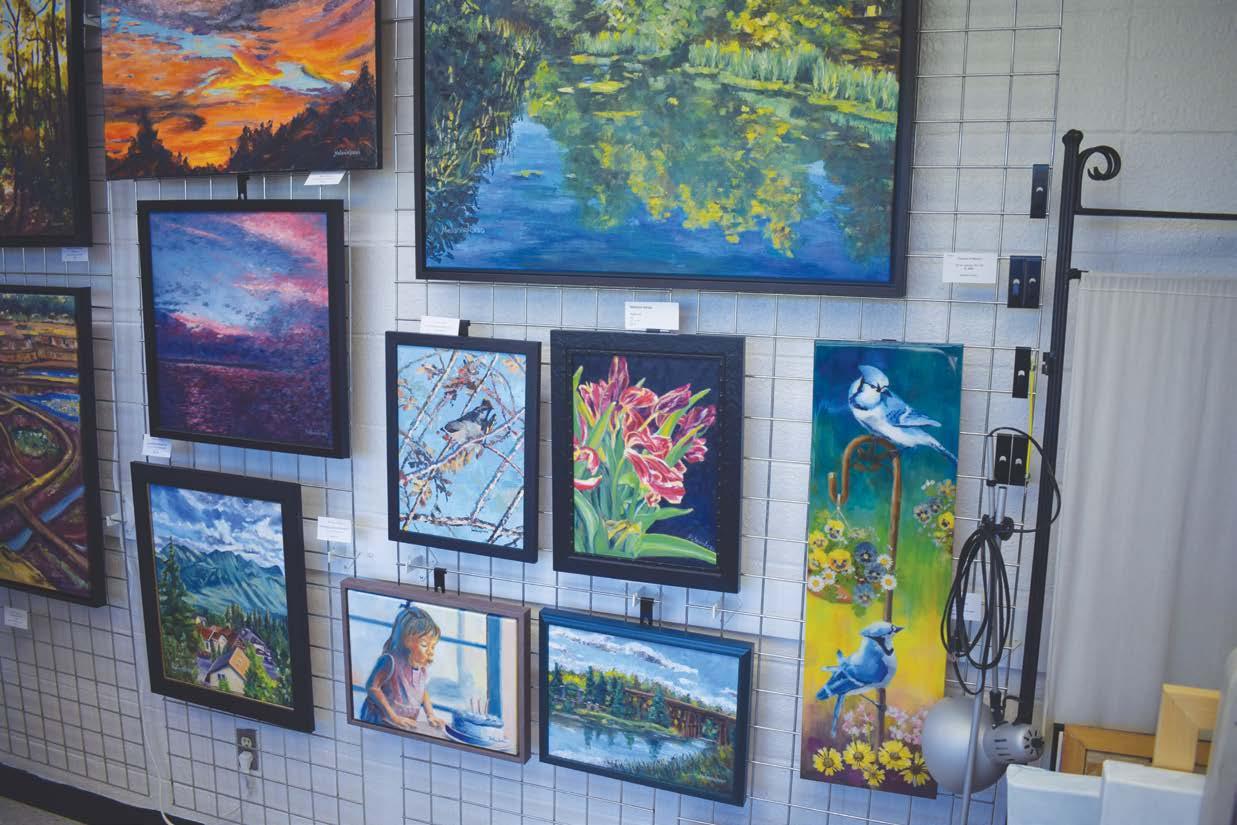
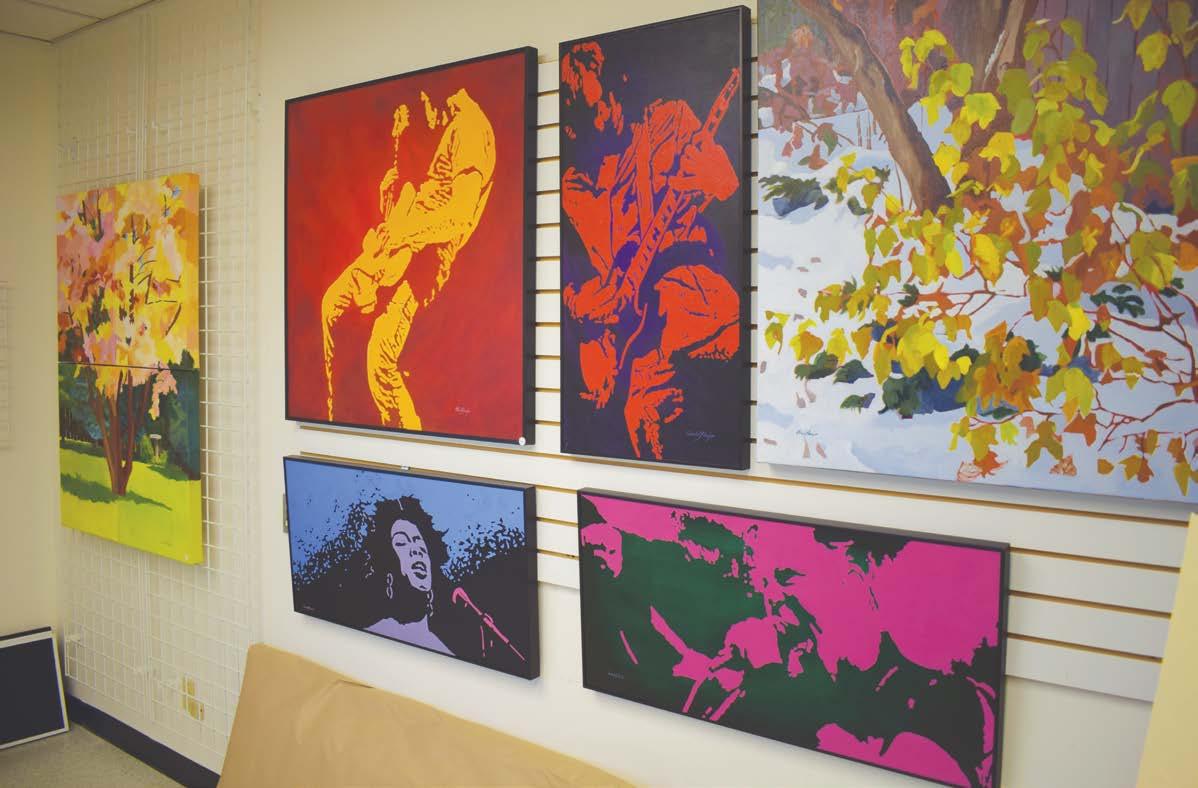
She’s not alone in finding inspiration in the community and facility that VASA provides. Johnson expresses almost motherly delight in the artistic growth of Miles Constable, who’s transitioning from geometric sculptures of shaped-copper on black backgrounds to abstract acrylic paintings. While some artistic hubs blunt innovation due to rigid conformity, at VASA, artists include potters, painters, a quilter, a felter, a mosaic-maker, a fused-glass creator, and a sculptor who creates parakeets from fibre.
While as president, camera-shy Johnson continually emphasizes her job is promoting VASA and its members, she embodies VASA’s artistic pluralism and innovation. A digital painter, sculptor, mixed-media artist, and traditional painter, Johnson has created a spectacular series of nebulae paintings, and a series called Finding Dragons: “If you look closely enough, you’re going to see a dragon.”
With its current roster of more than 100 members who pay a mere $50 ($25 for students) per year, VASA offers the opportunity to work in any of its 22 studios and participate in 11 annual group exhibitions for local and distant artists. Member exhibitions are unjuried “so people can put in whatever they want,” while paying lower commissions, using discounts for VASA workshops and occasional training in “art skills education, art business education, and other related topics,” receiving the newsletter, joining in governance, and attending drop-in sessions on Tuesday, Thursday, and Saturday mornings, which are “kind of like a quilting bee,” says Johnson.
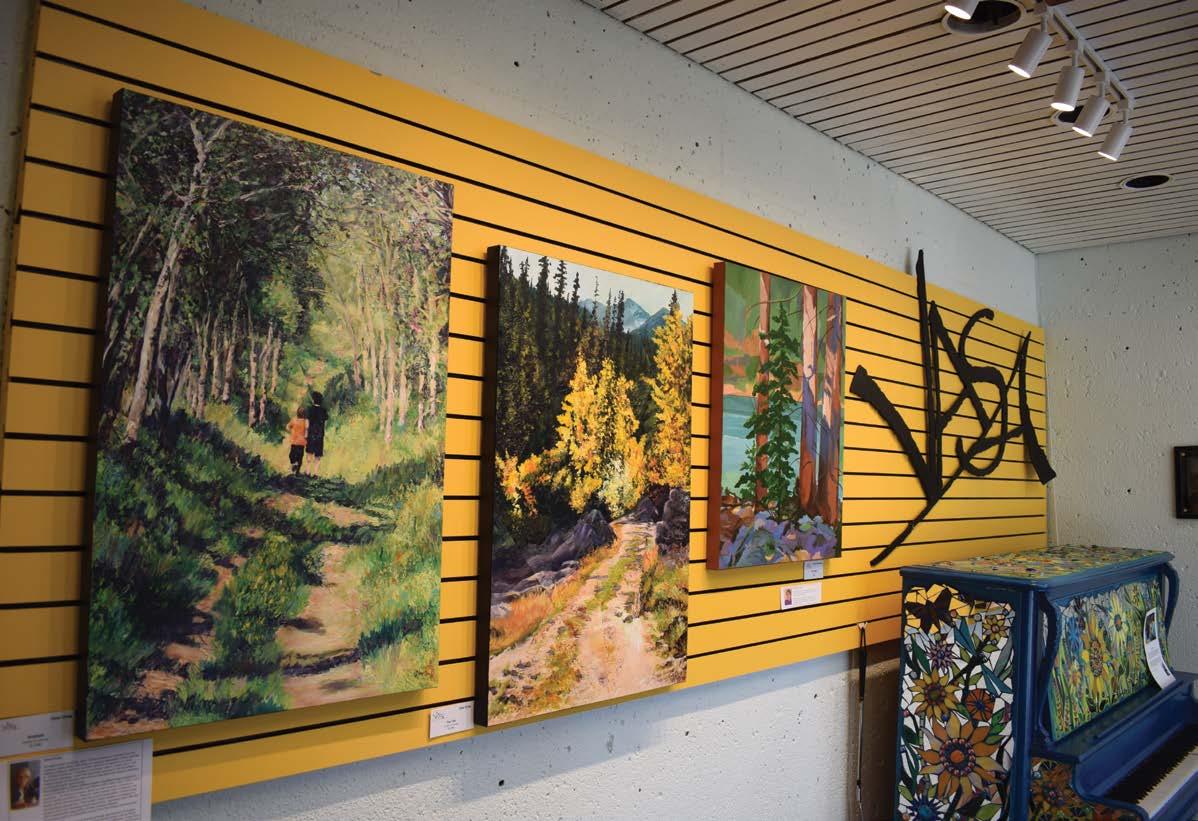
“Everybody brings a project! They’re nattering, talking about life, about art, sharing experiences, sharing art, giving advice, and asking for advice. It’s very dynamic,” she says. Because membership fees are so low, members also provide sweat equity through cleaning, buying supplies, and working shifts at the building Tuesdays through Saturdays.
Beyond helping established and highly trained artists, VASA hosts eight-week Authentic Art classes for adults with developmental disabilities, whose themes students choose while learning design principles and colour theory as they creating work suiting their own vision.
In addition, there’s Artful Connections, which VASA’s website describes as “a welcoming creative program designed for adults who want to explore personal themes, deepen self-awareness, and support their well-being through expressive art-making. Through simple guided activities and gentle reflections, these sessions offer a safe, spacious environment to reconnect with yourself—and with others—through creativity.” Whether you’re an artist or simply someone who loves beauty, there’s something for you at VASA. t8n
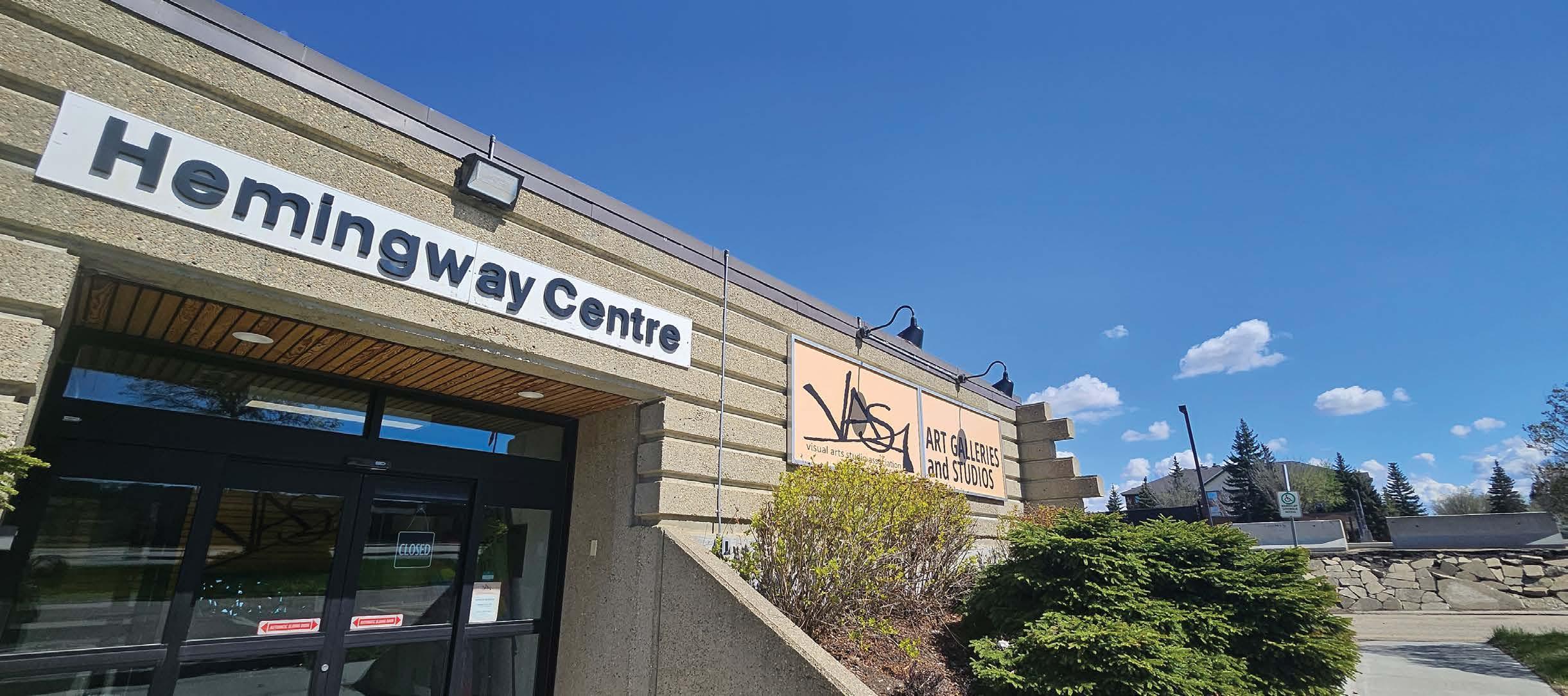
Visual Arts Studio Association (VASA) 25 Sir Winston Churchill Ave (780) 460-5990 | vasa-art.com


















Don’t
tell anyone these drinks are also good for them!
BY: GLORIA GE-WEALD | PHOTOGRAPHY: GLORIA GE-WEALD
AN ICE-COLD BEVERAGE is never far from the forefront of most of our minds on a hot summer’s day. Often times, that sought-after beverage may just be cool, clear water, but a frosty beer, cocktail or iced tea are surely yearned for as well. Smoothies are distinct from these other libations as they have some bulk to them, as well as a ton of nutrients (especially these!), but don’t let the fact they’re good for you scare you off! A rich or fruity smoothie still gives that revitalizing kick we covet on a blistering day, and then some.
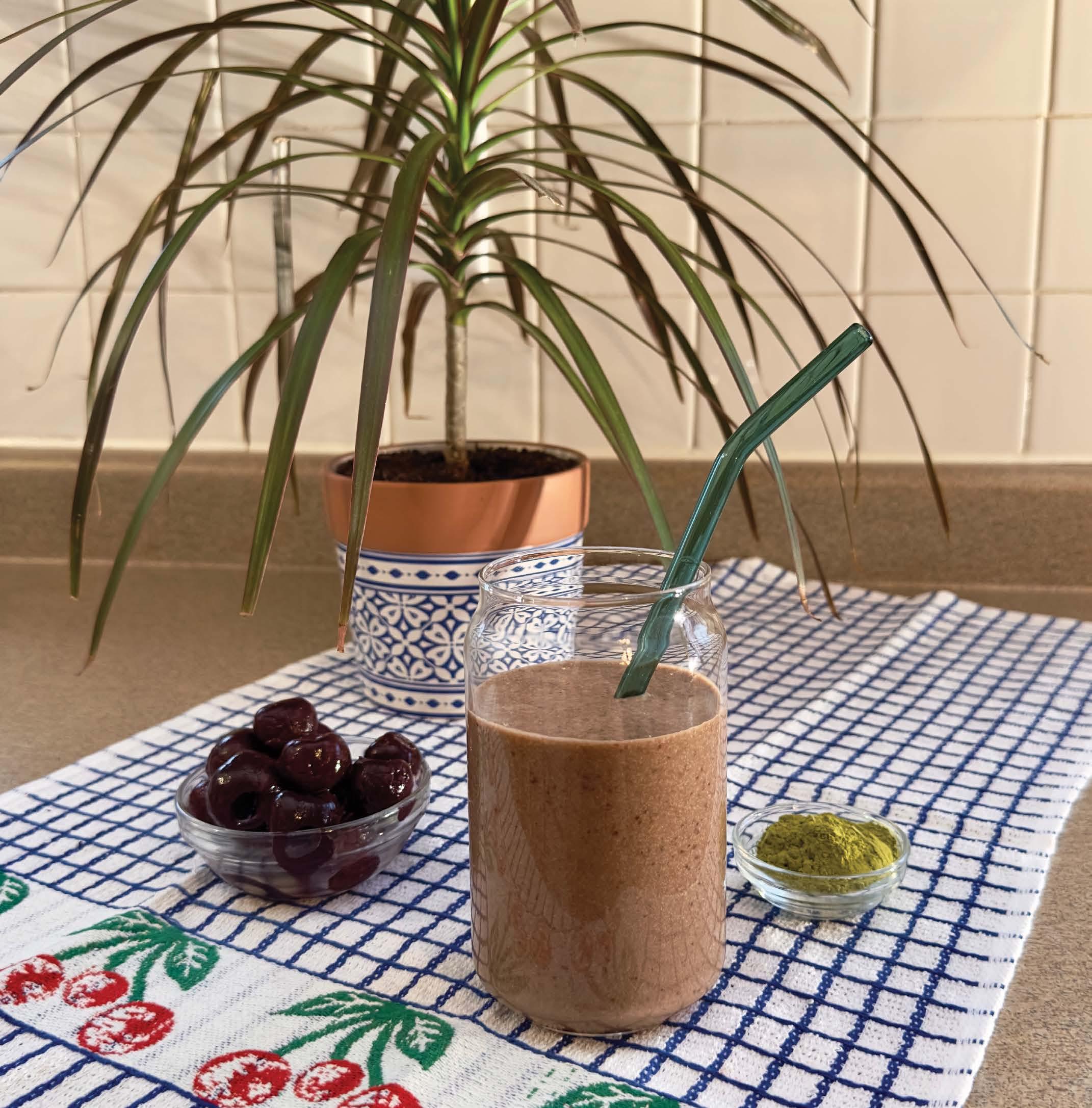
Matcha tea has a long and revered tradition in Japanese culture. Every aspect of the tea ceremony is conscientiously observed, including the whisking of the tea, the appreciation of flowers that beautify the space and gratitude to the universe before you take your first sip. Like other sources of caffeine, matcha is somewhat bitter, yet paired with rich coconut milk, honey and the full-bodied flavour of cherries, that mild bitterness only adds depth. This concoction may be more casual than tradition, but it will be easy to show gratitude for this smoothie of refined palette!
3/4 c. cherries, frozen
1/2 c. full fat coconut milk
1/4 to 1/2 c. milk of choice, depending on thickness preference
1.5 tsp. matcha
1 tsp. honey
Optional: collagen protein powder
Mix the matcha and liquids first, until the matcha is blended into a silky smoothness. Add the remaining ingredients and blend.
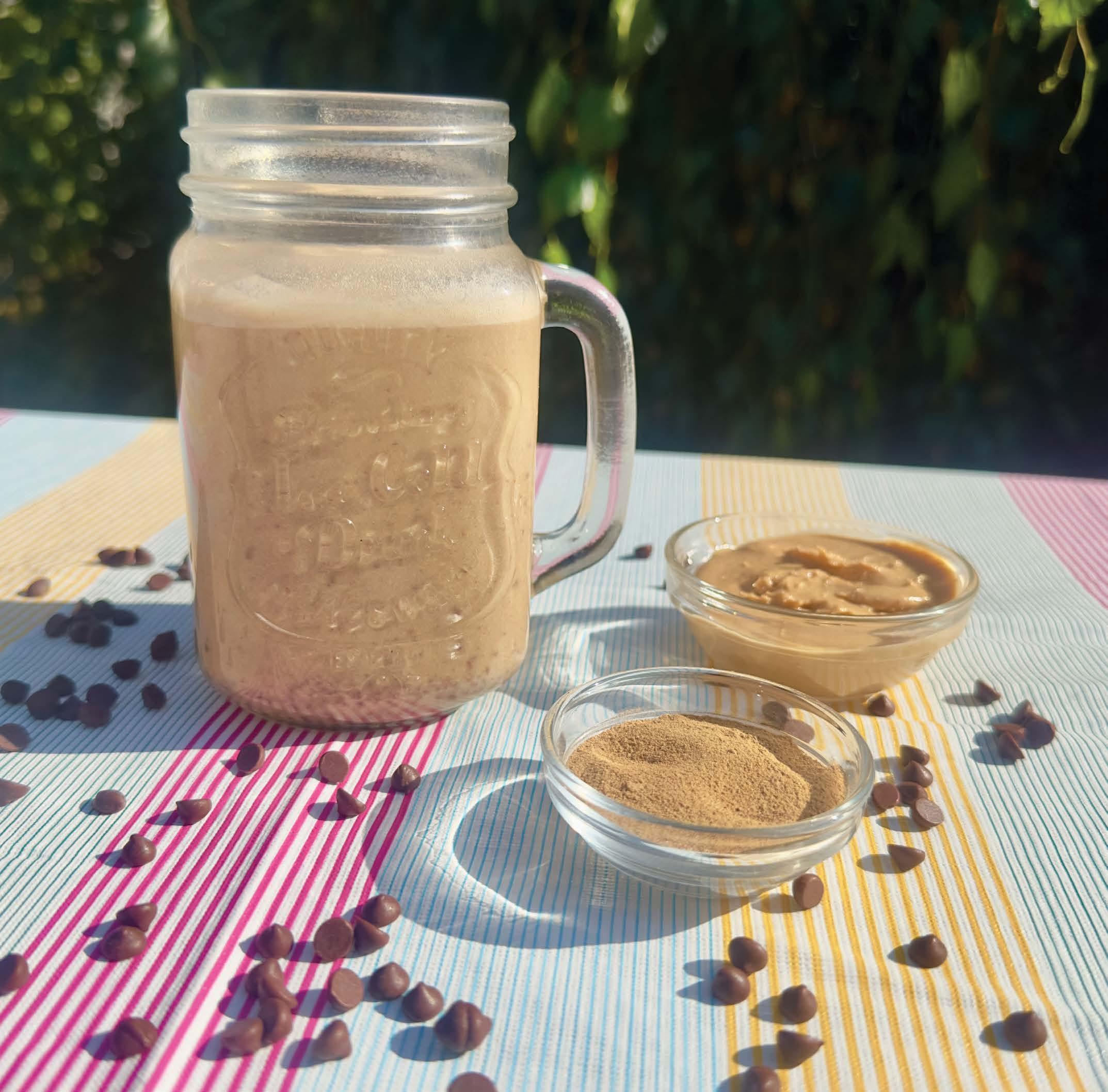
As the liquid version of chocolate chip cookie dough, this smoothie is very comforting. The chips give it a bit of a crunch on the tail end of your slurps, rich in cashew and banana. With the other ingredients being so strong and hearty, the camu camu powder gently loads your drink up with nutrients, leaving you none the wiser and your skin glowing. Camu camu is said to be the highest vitamin C-rich food on Earth!
2 tsp. camu camu
3 tbsp. cashew butter
3 tbsp. chocolate chip cookies
1 frozen banana
1/2 to 3/4 c. milk of choice, depending on thickness preference
Optional: vanilla protein powder or 1/4 tsp. vanilla extract
Blend everything but the chocolate chips, then add the chocolate chips and blend a bit more.
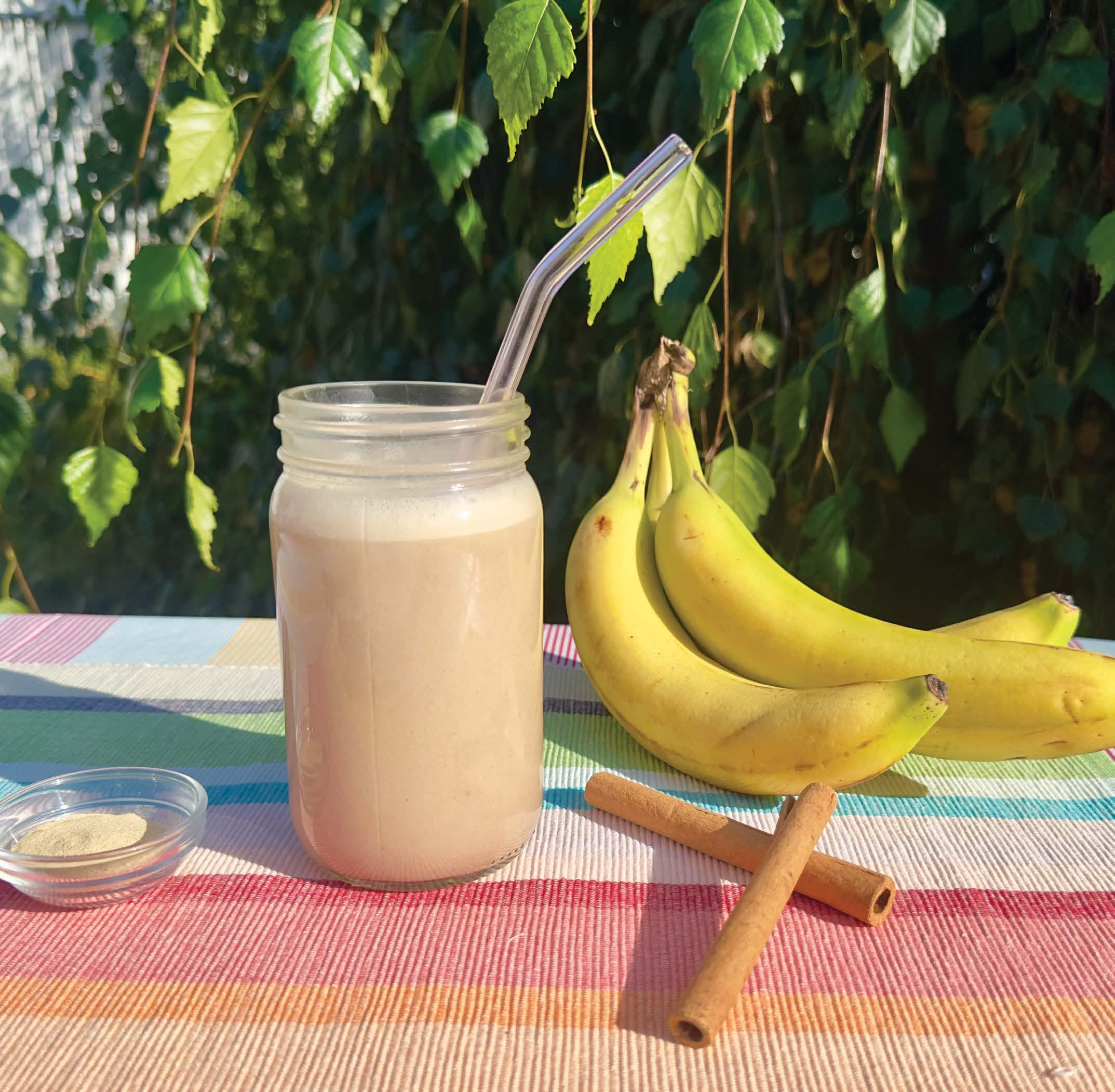
Energy! Libido! Hormone health! Maca has been studied to do wonders in these areas, in which we are eager to maintain and boost. Another powerhouse ingredient, cinnamon, has been studied to have a positive impact on blood sugar levels, so this smoothie is a tasty boost to our body’s balance.
1 frozen banana
1 tsp. maca powder
3 tbsp. cashew butter
1/4 tsp. cinnamon
1 c. milk of choice
Mix all ingredients in a blender and pour!
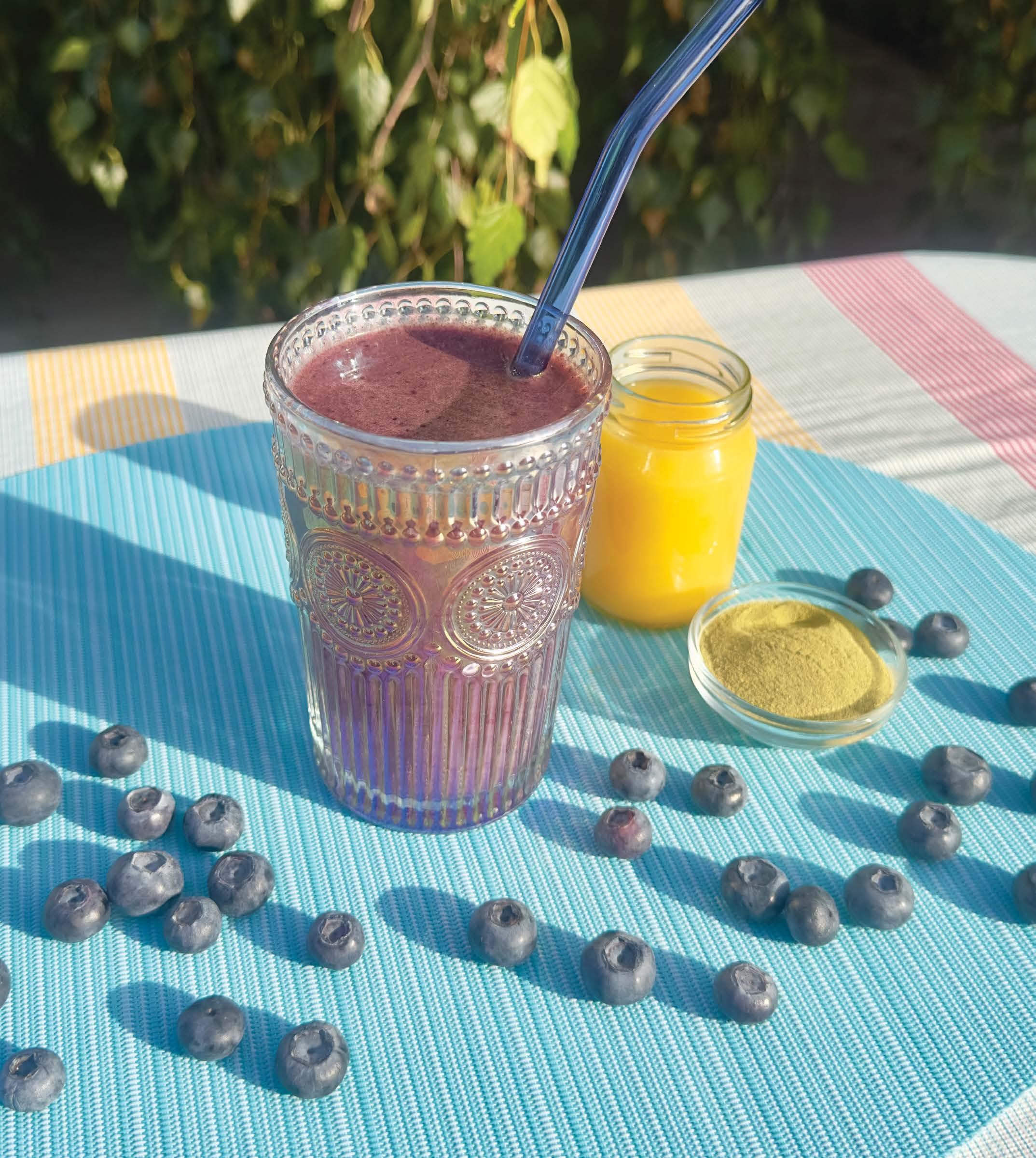
This is probably the weirdest offering on this list, but it sure is invigorating! The orange juice and blueberries do a solid job of masking the fairly strong flavour of the broccoli powder, but stick to only 1/2 tsp. if you aren’t feeling too adventurous. Something about this combo just clicks, but it is hard to pinpoint exactly why. Interesting and energizing nonetheless!
1 c. frozen blueberries
1/2 to 3/4 tsp. broccoli powder
1/2 c. orange juice
1/2 c. milk of choice
Mix all ingredients in a blender and pour!
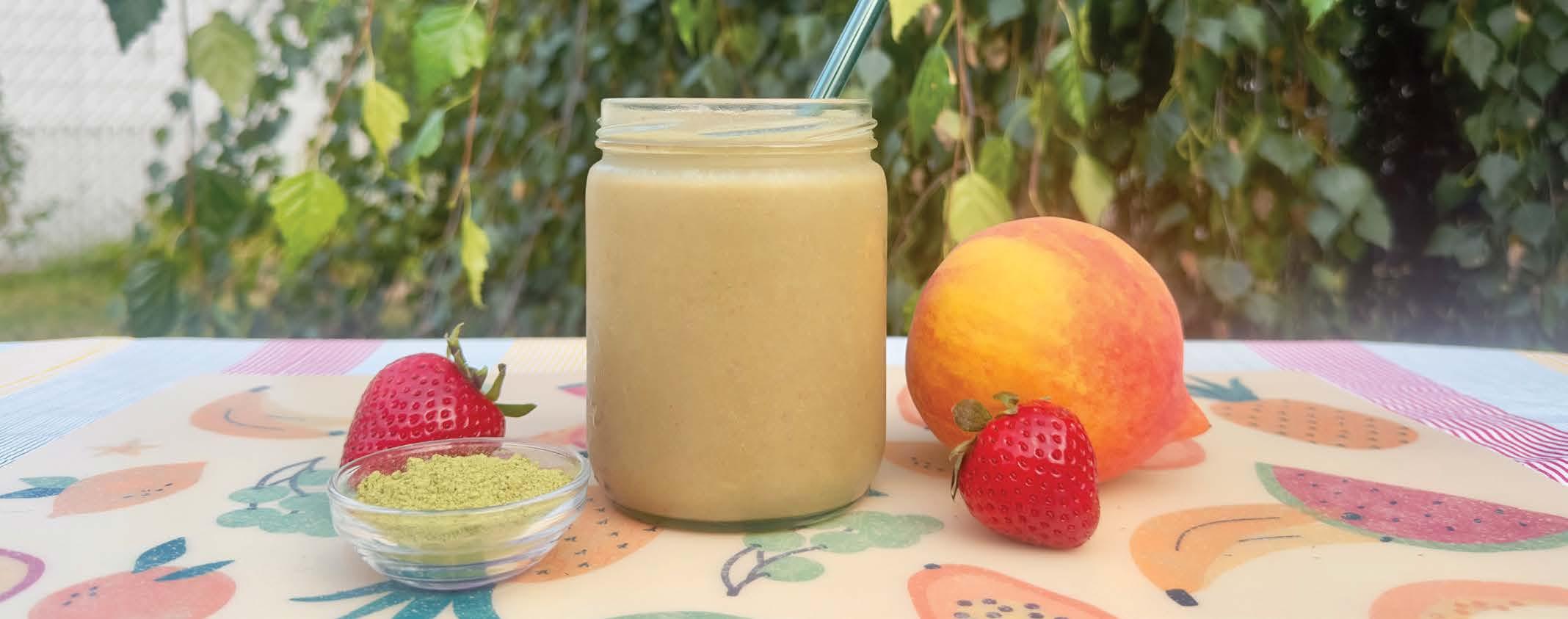
The fan favourite of my smoothie testers, this one is reminiscent of an Orange Julius, only without the watery ice filler, and with a green moringa hue. Moringa has a gentle, earthy flavour that is very versatile. It also makes a wonderful tea! It is a nutrient powerhouse, loaded with vitamin K, E, A, Bs as well as many minerals, including iron, calcium and magnesium.
1 c. strawberries, frozen 1 c. peaches, frozen 1 tbsp. moringa powder
1/2 c. milk or choice 1/2 c. orange juice
Mix all ingredients in a blender and pour!
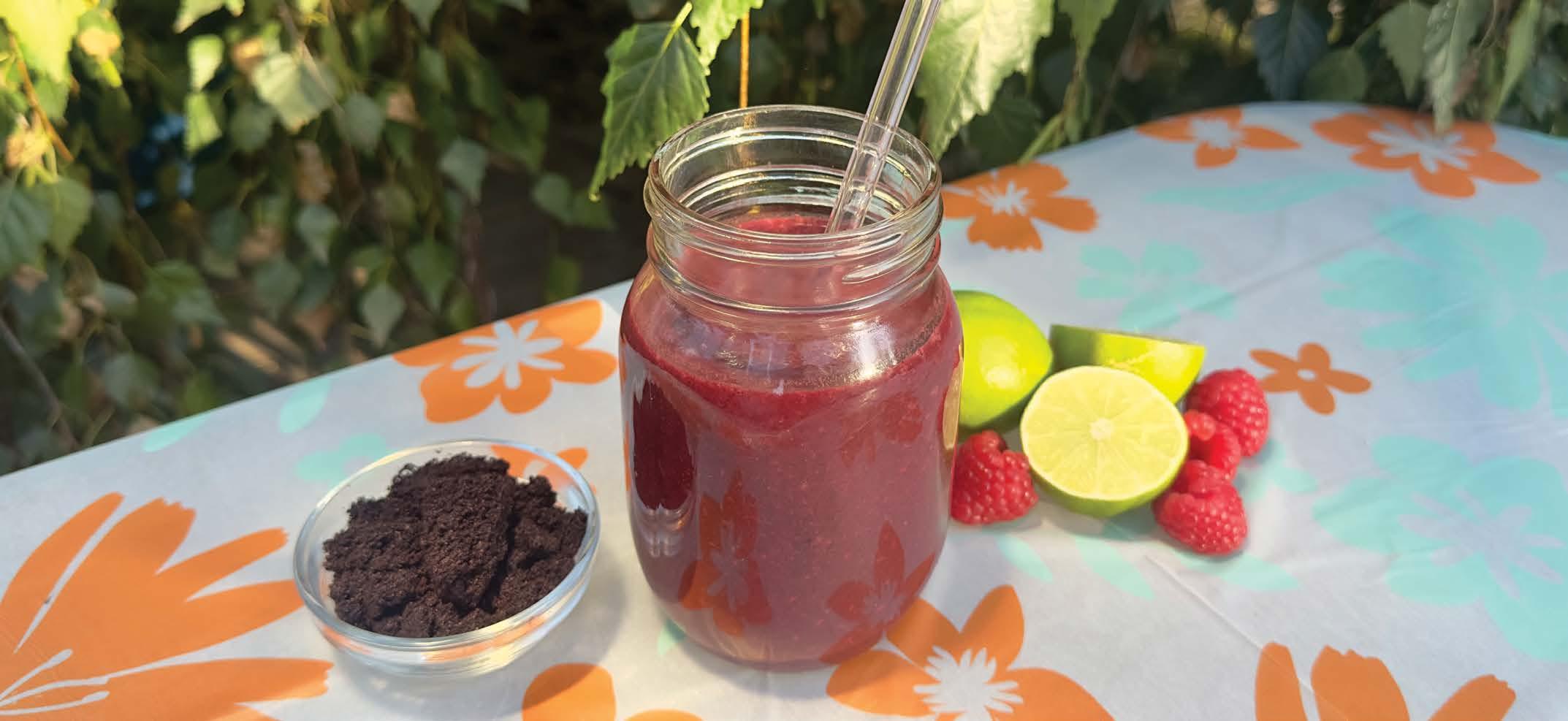
Pronounced ah-sah-ee, açai is absolutely brimming with some of the most potent antioxidants known to man, many of which are even harder to pronounce than this berry itself! A deeply rich, dark purple colour with an equally rich and captivating taste, the açai berry may just be the tastiest way to boost your daily ORAC (Oxygen Radical Absorbance Capacity) intake! Paired with juices of orange and lime, this smoothie enjoys a tartness, a fitting pairing with the vitalization it will bring!
3 tbsp. açai powder
1.5 c. raspberries, frozen 1/2 to 3/4c. milk of choice, depending on thickness preference
1/3 c. orange juice 2 tsp. lime juice
Mix all ingredients in a blender and pour!
BY: STEPHANIE CRAGG | PHOTOGRAPHY: STEPHANIE CRAGG

Driftwood hummingbird feeder ($65) frogalley.ca* Moonshine ($34/750 ml), crabbiegoat.com*
WE’VE BEEN LOOKING around the neighbourhoods and backyards of St. Albert to see how our residents do summer. One thing is clear: grabbing a lawn chair and a book in which to escape, will never get old! May we suggest adding a made-in-Alberta adult beverage in seasonal flavours?
Be prepared for the neighbours chatting you up over the fence to be curious about your summer recreation regimen (and drop hints for an invite to join you!). You could, of course, encourage them to bring along a unique and flavourful food item, and an impromptu summer gathering just might begin.
And what’s a party without music? This year is different, though, because no matter the ages of your family and friends, you can all partake in playing the tunes instead of just listening to them!

paperbacks (start at $10), used hard covers (start at $15), Bailey Books, 29B Rowland Cr.

($3.49/100 g), Grapevine Deli Chicken, 10B Perron St.

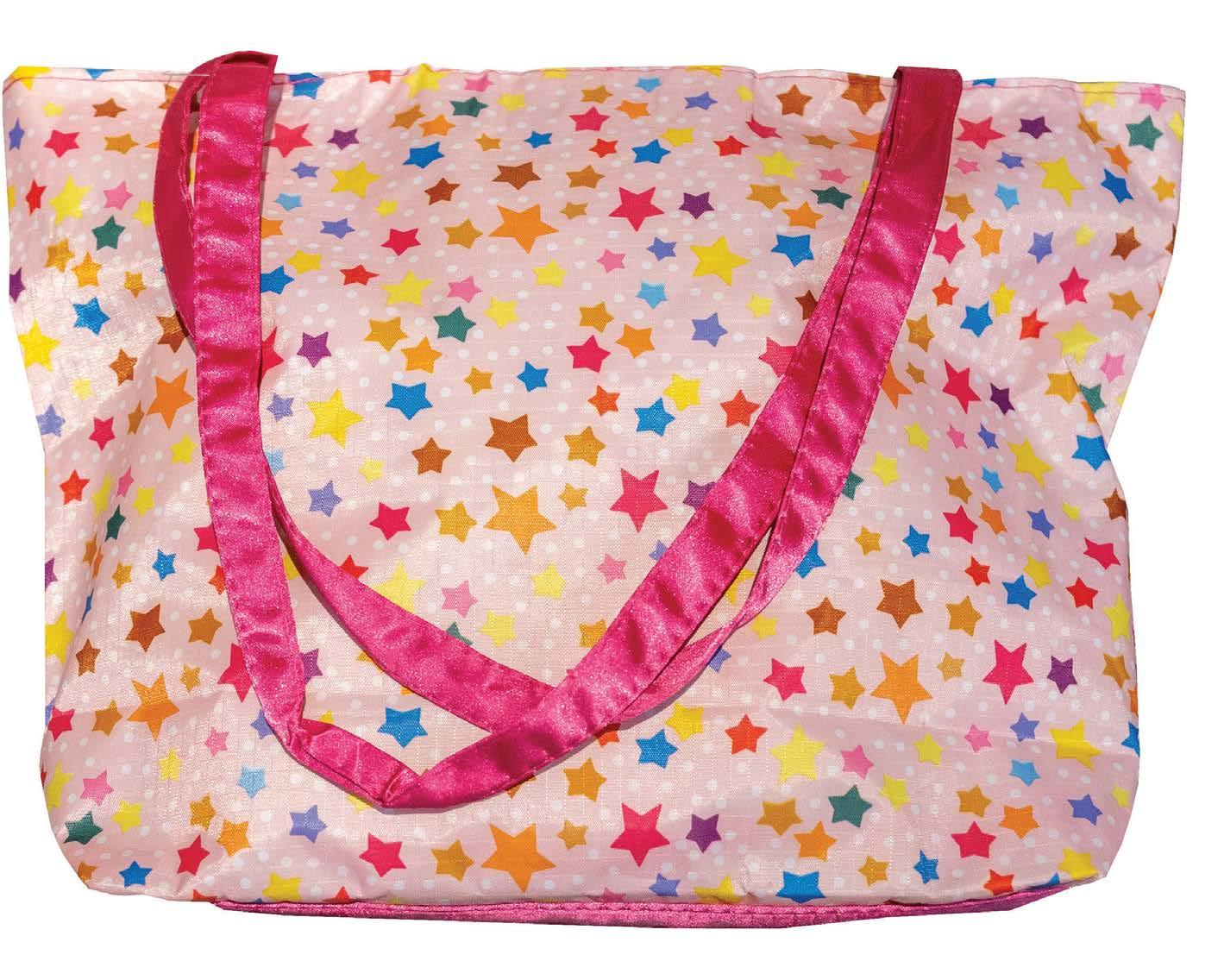
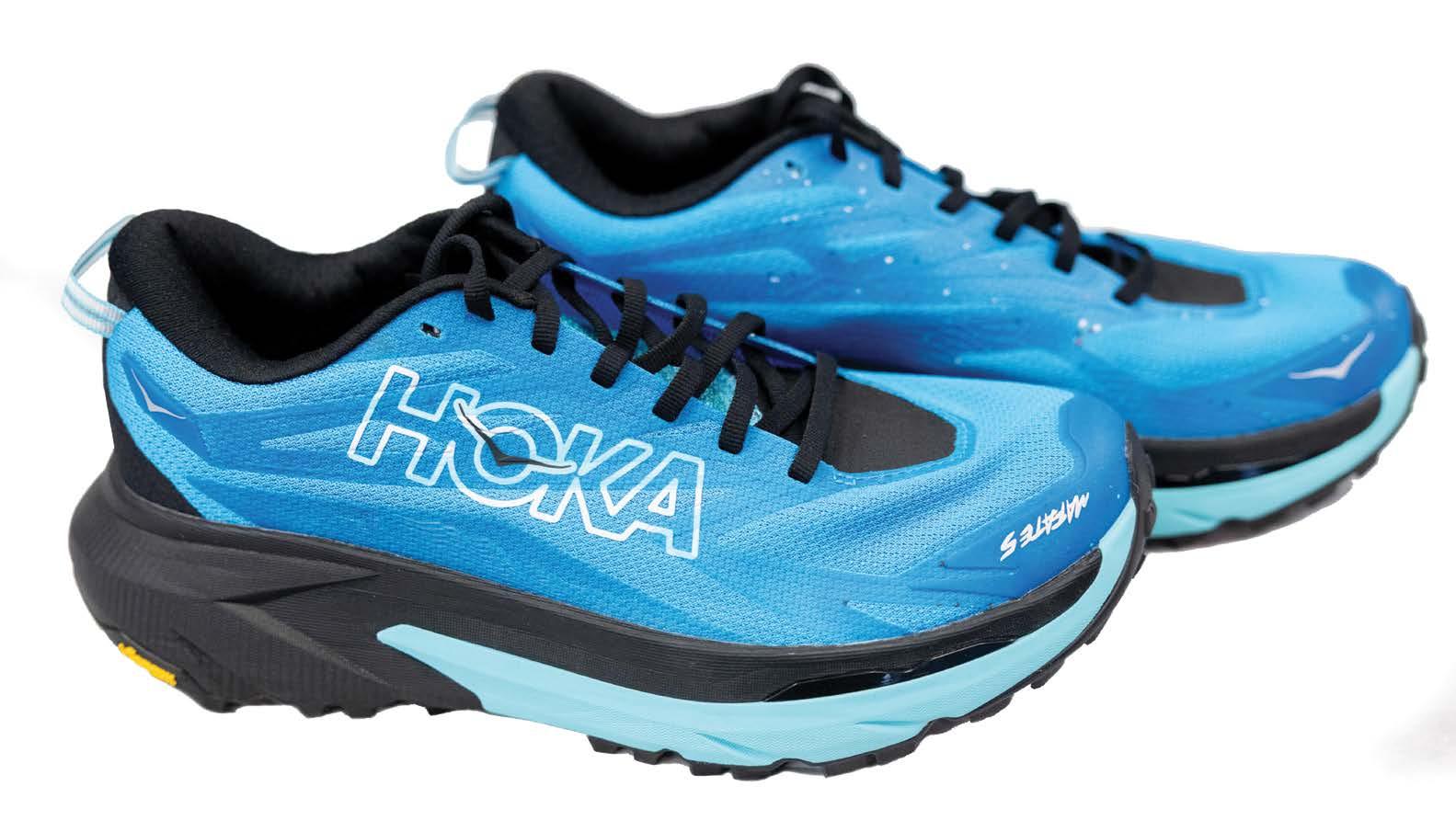

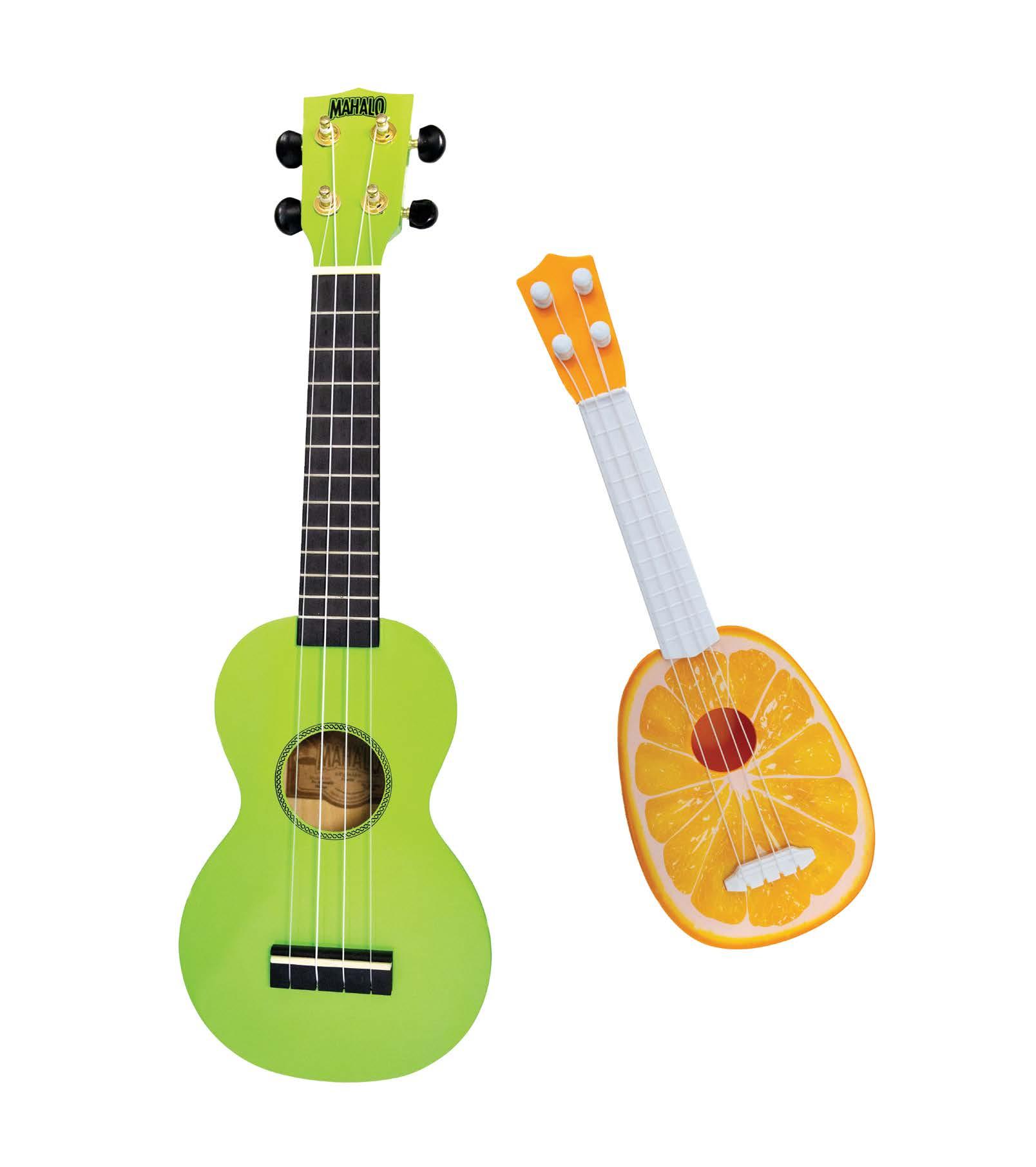

BY: TOM MURRAY PHOTOGRAPHY: STEPHANIE CRAGG
PATIOS ARE A dime a dozen, especially in Northern Alberta, where even the hint of warmth has us out enjoying a beverage or two while it lasts. The best part? With the extra sunlight we enjoy through the summer, we can potentially milk it until as late as we want, hopping from patio to patio in a glorious flaneur fashion. Here’s a few of the more interesting places for coffee, wine, snacks or whatever stirs your fancy as you enjoy the outdoor life.
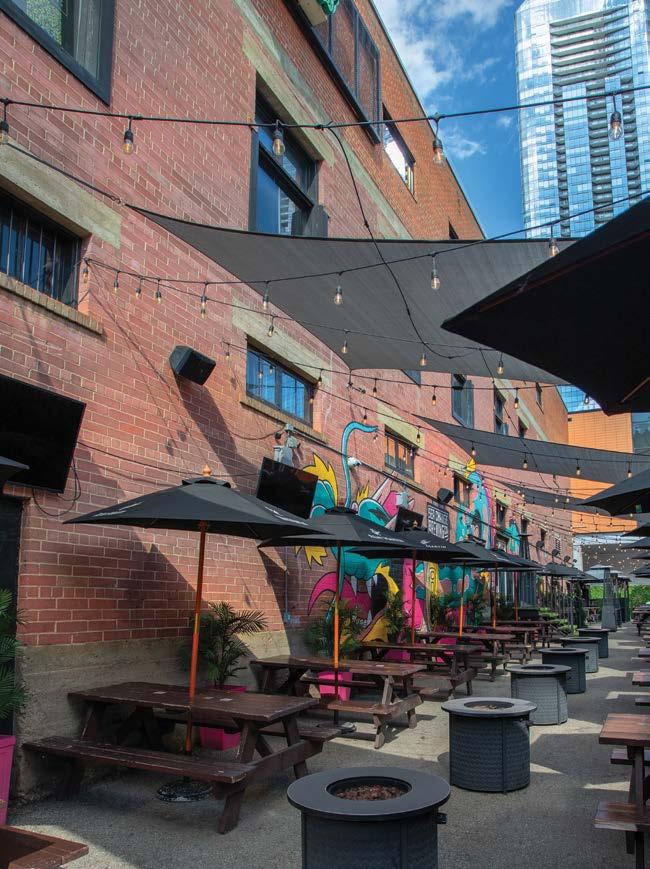
Baijiu (10359-104 Street)
Rows of picnic tables, colorful graffiti, strings of lights and firepits set in the middle make Baijiu’s side patio a must-visit, but the downtown cocktail bar next to Rogers Place hasn’t left it at that. They’re also one of the first spots in North America to make use of a Tubbo enclosure, a long tunnel that engulfs the area and keeps patrons warm. Not unlike an elongated igloo, this gerbil tube-like structure only appears in the winter months, but the patio has plenty of urban outdoor charm for visiting in the warmer seasons as well.
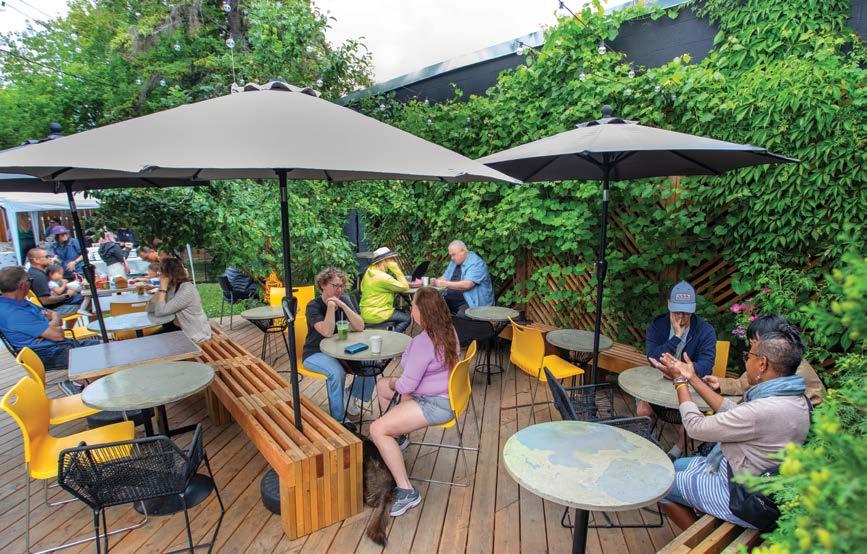
Boxcar Coffee Shop (11926-129 Avenue)
“Northside still alive,” as the Edmonton community just to the south of St. Albert likes to say. That’s true for many reasons, including this cool cafe in Calder, which features a fenced-in patio that looks a little like someone’s backyard. Someone’s backyard, if it was designed for 30 or 40 people, that is, with trailing vines, lights that twinkle in the summer evenings, and plenty of room for your pooch to stretch out if you decide to bring it along.

Boxer - Albertan Kitchen & Bar
(10315-83 Avenue)
Next time you’re in Old Strathcona look up, look waaay up and you’ll see Boxer’s new 50-person capacity patio overlooking the Arts Barns. It’s literally elevated dining and drinking while you gaze down on the peons, a weatherproof glass tube holding 24 for when it rains, with a little bar and warming area for the food set to the side. Word is there’s the possibility of music as well, as owner Josh Meachem ponders the idea of bands playing on weekend afternoons.
(8627-91 Street)
Nestled beside the complex that is La Cité francophone in the French Quarter, the patio of Cafe Bicyclette has a quaint, homemade feel to it with wooden beams, old windows, and, of course, a hanging bicycle. It’s expanded with picnic tables a little beyond where it used to be as more and more people have discovered it, but the best place to sit and chat with a latte or perhaps a French rose are the tables next to the entrance.
Brick (10004-90 Street)
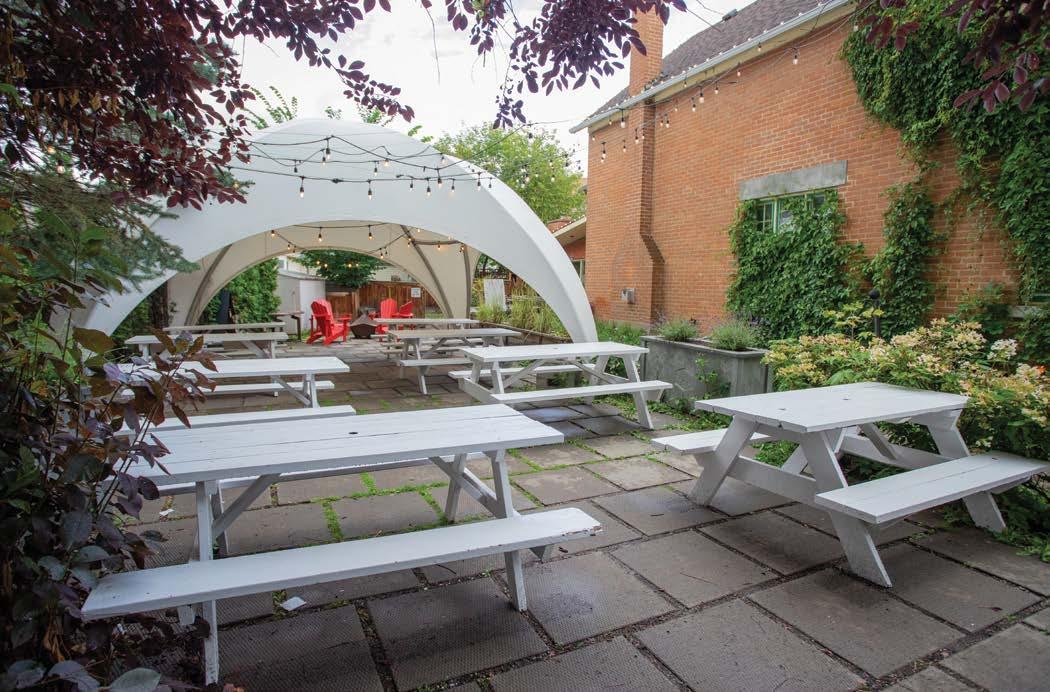
A building with a lot of history behind it, Riverdale’s Little Brick has been around since 1903. Originally the home of businessman J.B. Little, the house has now been converted into a cafe, general store, and multi-use space with one of the larger outdoor patios in the city. Set in a large grassy backyard, overlooked by neighboring houses, Little Brick has picnic tables, a large canopy, and greenery spreading over the brick edifice.
AB-16, Sherwood Park)
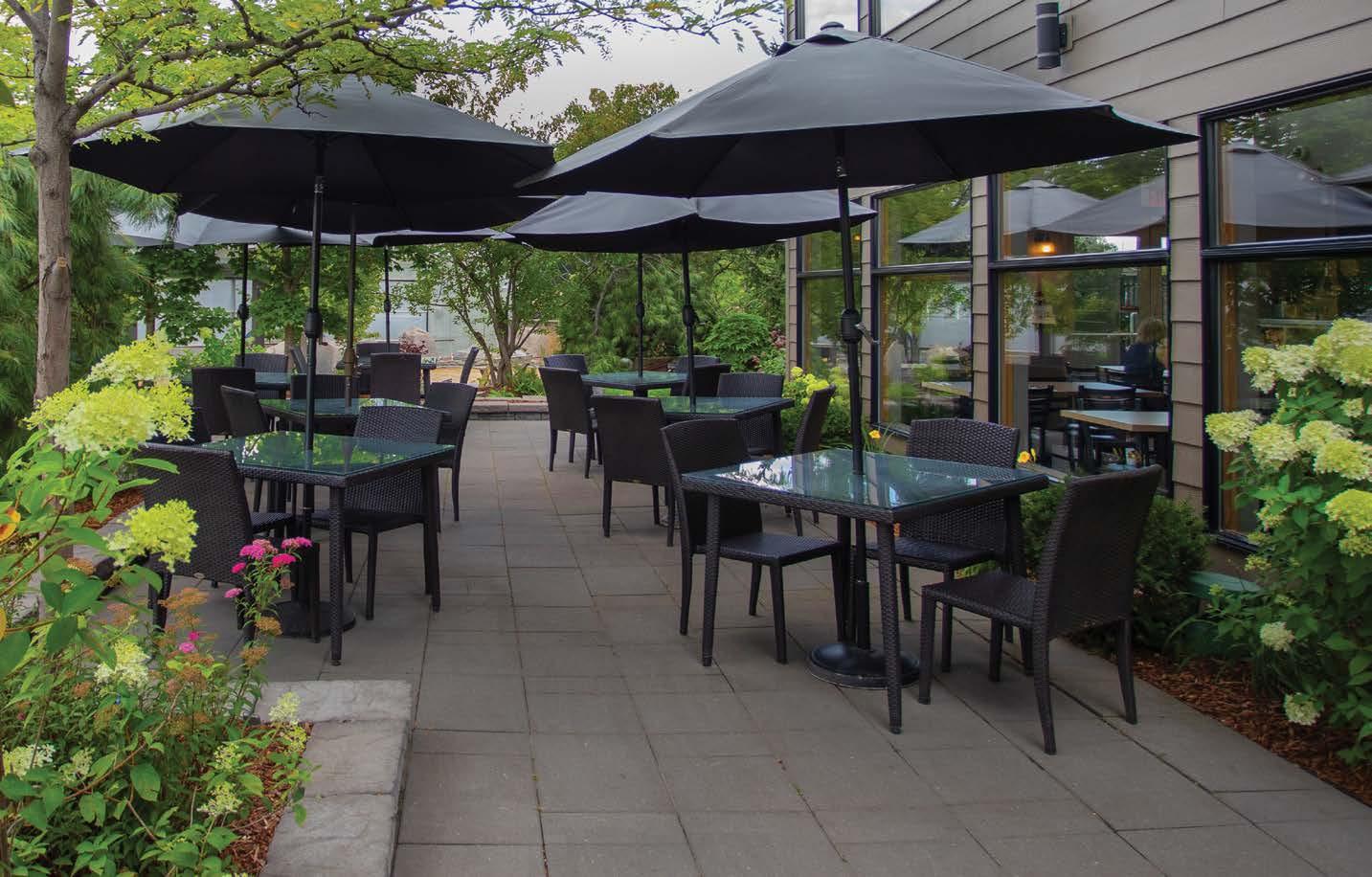
At heart, the patio experience is about relaxation, lolling at a table and enjoying a coffee or a more adult beverage. What better way to do that than in a space that also holds thousands of plants? Branches Fresh Food Experience in the Greenland Garden Centre complex is perhaps one of the most calming patios you’ll find in the greater Edmonton area, helped out by the outdoor garden centre and water feature on the side.
(9902-109 Street)
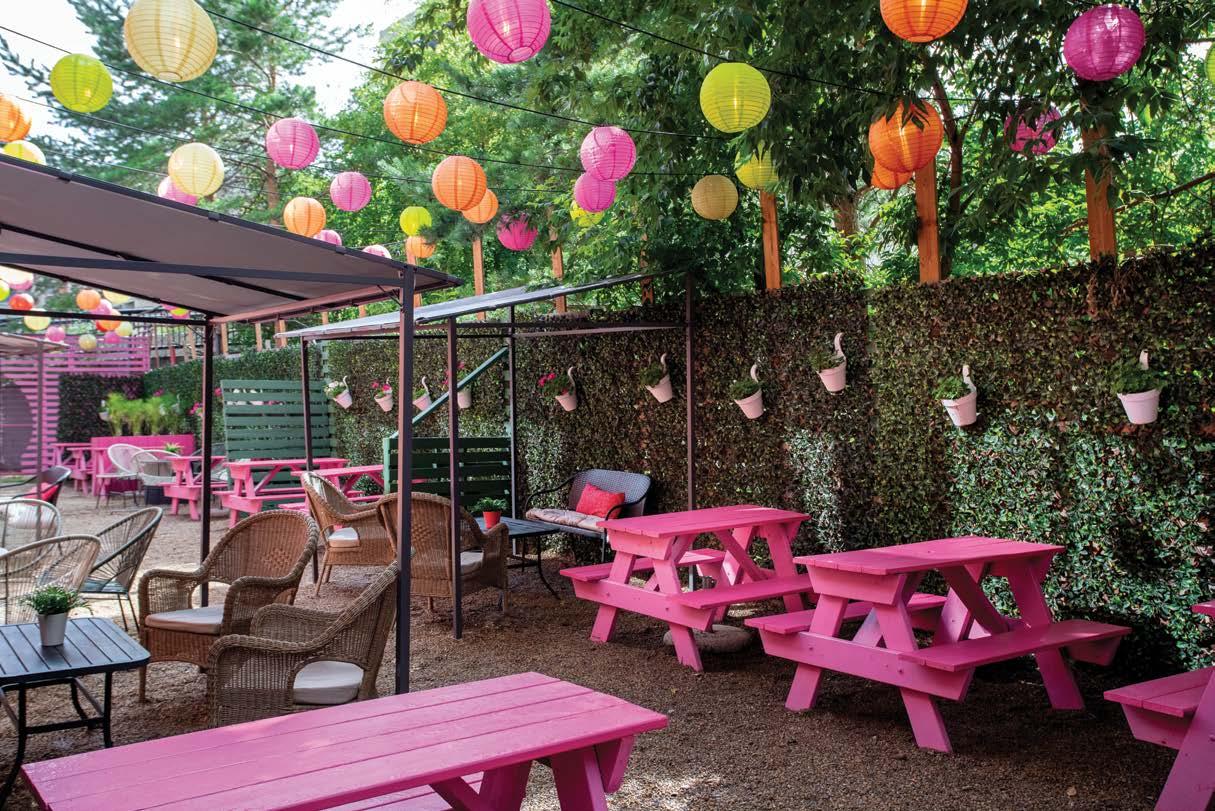
One of the more colourful downtown patios you’ll find in Edmonton, the long backyard of Dolly’s Cocktail Bar is a pink paradise filled with Chinese lanterns and hanging flowers. The other side of the fence that separates it from the neighborhood of Wîhkwêntôwin is against the trolley tracks, so if you close your eyes while sipping one of the restaurant’s house cocktails you can imagine yourself on a boozy adventure into unknown lands.

(1 Thornton Court)
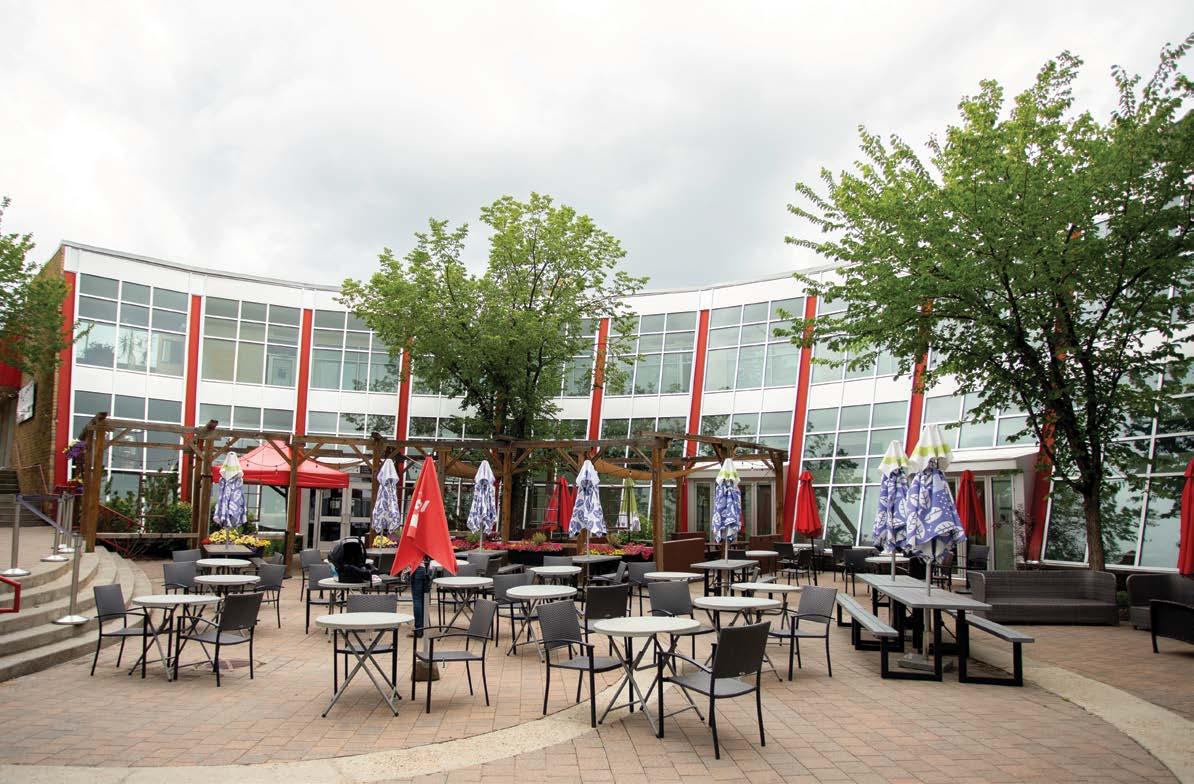
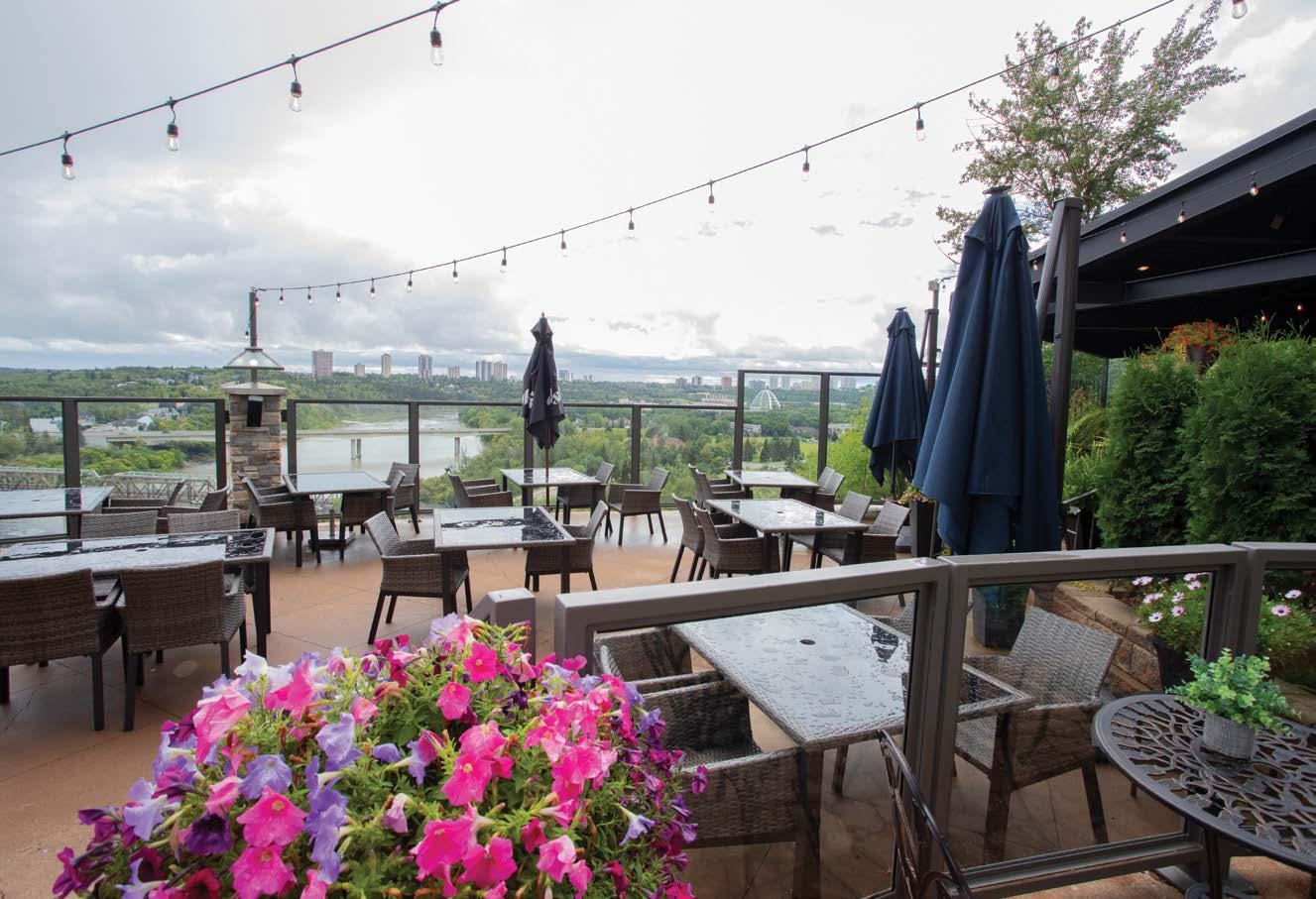
If Edmonton has one selling point, it’s the river valley, but there really aren’t a lot of patios that take advantage of those gorgeous views. One that does is the Riverside Bistro in the Courtyard by Marriott Edmonton Hotel. A half-circle on the north side of the river overlooking the Tawatinâ LRT Bridge, the bistro also boasts heated six-seater dining igloos for those looking for cozy dinner options in the non-patio seasons.
(8 Mission Ave., St. Albert)
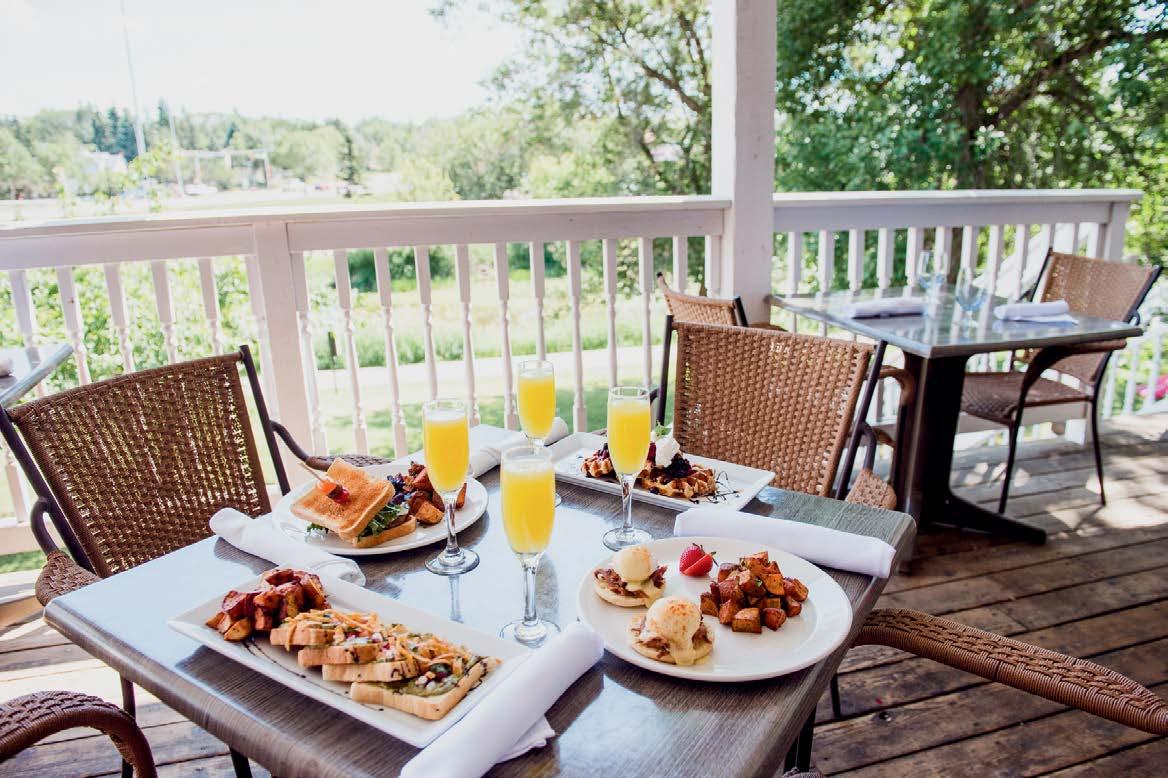
It’s one of St. Albert’s most recognizable buildings, so whether you’ve ever thought of eating at the Riverbank Bistro or not, your eyes have likely been drawn to it many times if you live in St. Albert. For summer months, a massive outdoor patio wraps around threequarters of the building, and the interior boasts a few nooks for cosy dining.
(9621 Whyte Avenue)
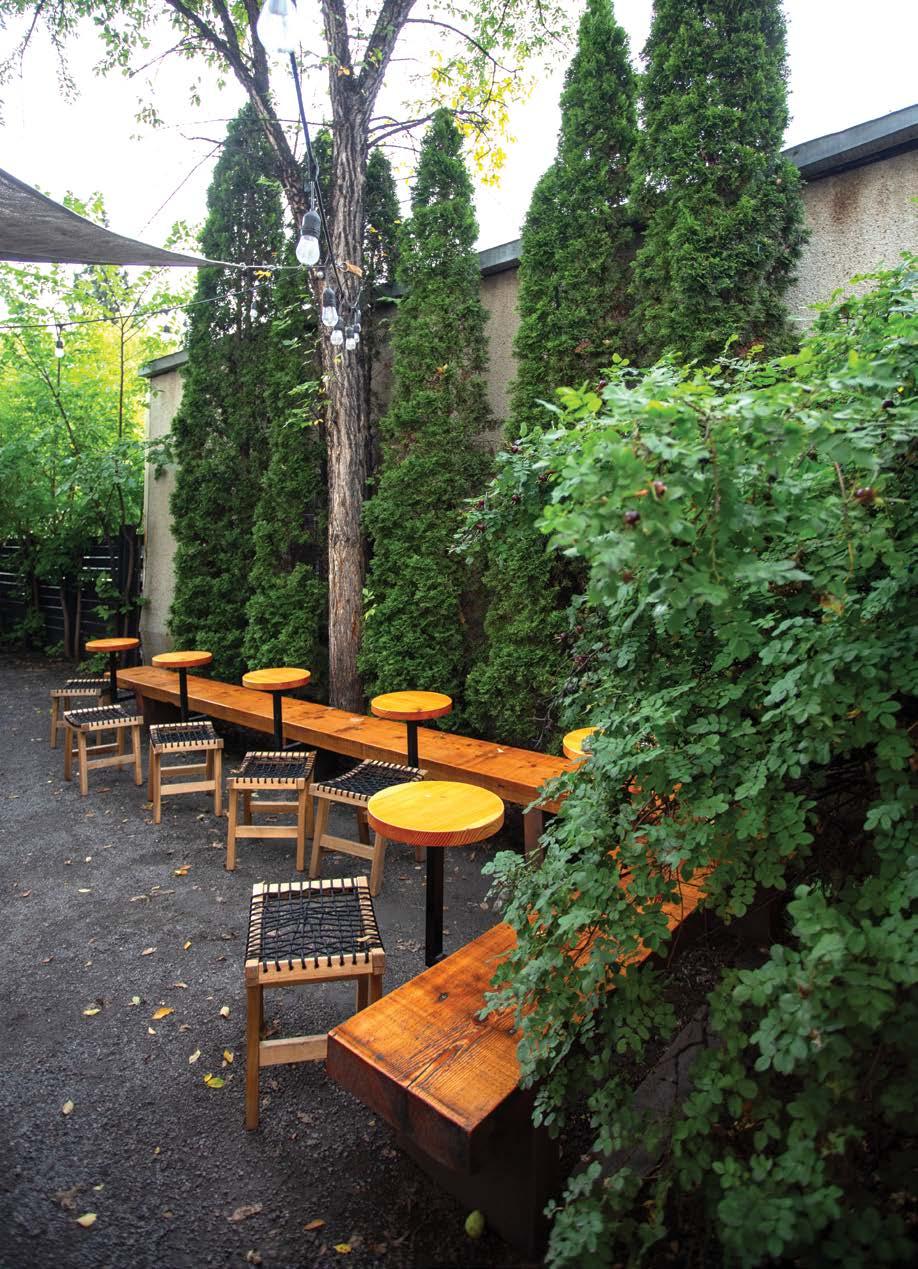
We’re trying to avoid using the term “hidden gem” as much as possible, but Take Care’s back alley patio definitely qualifies for the cliche. Walk past the cafe itself and the hair salon it shares a space with and you’re in an oasis of calm with long benches, tables, and a tree that takes up a small corner of the courtyard. They can fit around 30 people in this hidden enclave, making it great for the occasional summer evening dinner from the likes of Vagabond Pop-ups, giving the space something of a funky European vibe.
Tiramisu Bistro (10750-124 Street)
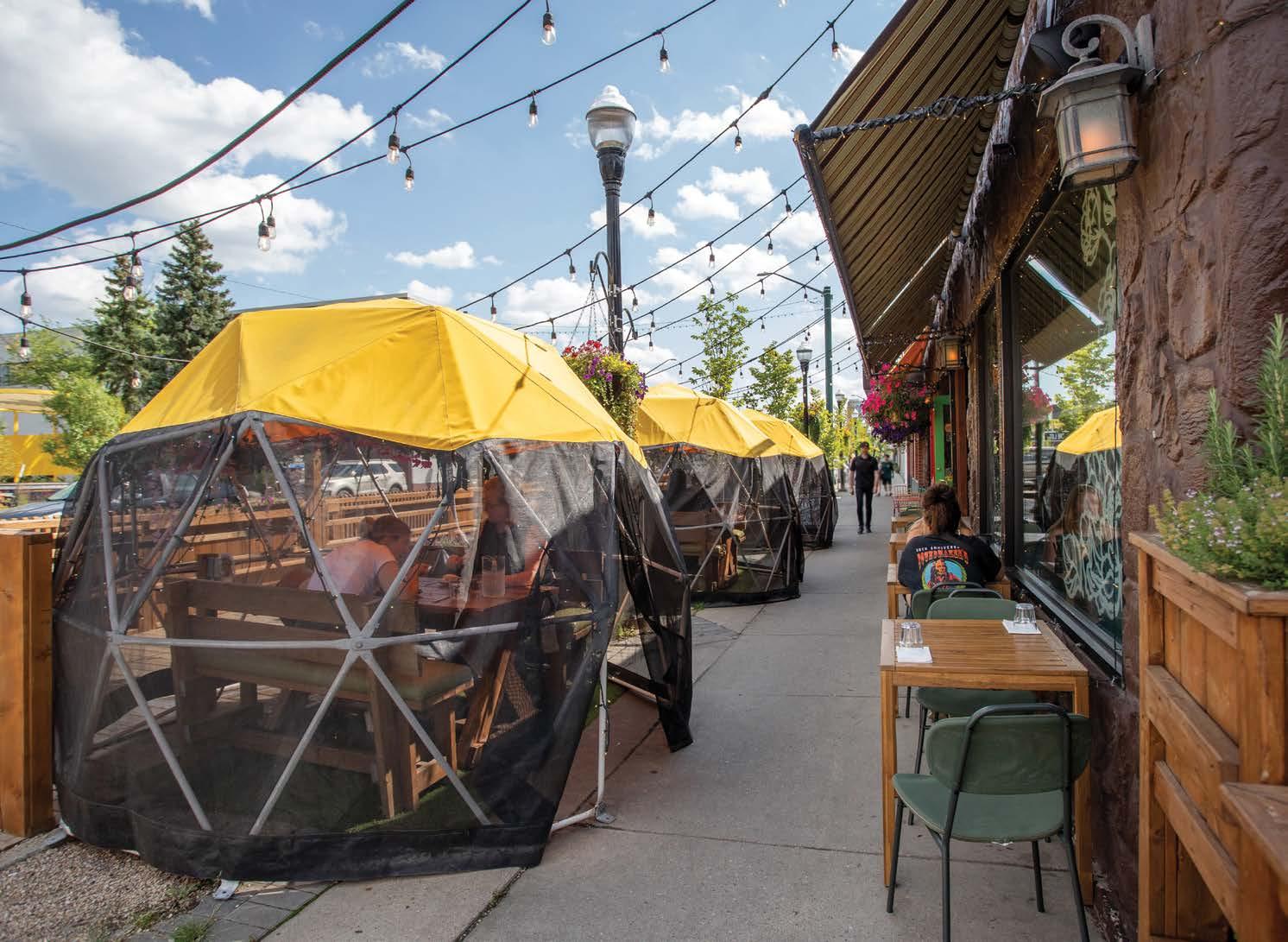
This cute little street-side patio was one of the first to pivot to heated geodesic domes during the second winter of Covid, giving exhausted Edmontonians a chance to dine out or sip a drink while complying with the safety laws. The laws have since relaxed, but the igloos still exist as a nice cold weather option for individual dining. But even if you’re not interested in being encased in a bubble as you enjoy your bubbly, Tiramisu’s 50-seat patio in itself is enticing, with wooden pergola, trees, and lights entwined for pure sparkle effect.


LADIES’ TUESDAY SPECIAL
Make Tuesdays your time to play.
Enjoy 9 holes for $50 or 18 holes for $62 from noon to 8 PM—each round includes a ½ power cart and a $10 food and beverage voucher.
MORE VALUE WITH EVERY ROUND
Every paid adult 18-hole green fee comes with a $10 food and beverage voucher—because a great round deserves a great finish.
TWILIGHT SPECIAL – $82
Available Thursday through Sunday and holidays. Take advantage of our Twilight Special: 18 holes, a ½ power cart, and a $10 food and beverage voucher—all for one great price. Tee times vary throughout the season.
Discover our newly renovated clubhouse—perfect for relaxing after your round. Enjoy daily features in a modern, welcoming atmosphere.
Bring the whole family—juniors 17 and under play free when accompanied by a paid adult.

One of Canada’s most controversial agreements remains more relevant than ever
BY: GLORIA GE-WEALD | PHOTOGRAPHY: MUSEE HERITAGE MUSEUM

IN 1876, 15 YEARS after the founding of a tiny mission called St. Albert and nearly 30 years before Alberta became a province, representatives of the Canadian government and indigenous nations signed Treaty 6. This agreement, stretching across much of central Alberta and Saskatchewan, is one of the most thoroughly documented treaty signings in history. And 150 years later, despite numerous controversies, Treaty 6 still has a voice, thanks to the advocacy and strong voices of the people it is meant to protect.
Nine years before the signing, Canada acquired the lands that would fall under Treaty 6 jurisdiction from the Hudson’s Bay Company. After that, it only took a couple of years before the indigenous Plains people broached the subject of official negotiations with the Crown. With increasing encroachment by settlers into their territory, the outbreak of new diseases afflicting tribes, and an increasing scarcity of bison, the indigenous people were concerned about protecting their land.
At first, the federal government wasn’t receptive, until 1875 when the Cree—fed up over the silence—began blocking surveyors from moving through their territory. This mounting tension made all parties realize that a treaty would be a less arduous path to prosperity, leading the government to finally agree to negotiate.
Having pushed for the treaty, Alexander Morris, the lieutenant governor of Manitoba and the Northwest Territories, was tasked with negotiating with the Plains people of Saskatchewan. He arrived at Fort Carlton on Aug. 15, to meet head chiefs Mistawasis (Big Child) and Ahtahkakoop (Star Blanket), who were joined by other chiefs three days later.
Morris explained to the group the concept of reserves. He was met with fierce opposition by leader Pitikwahanapiwiyin (Poundmaker), famously quoted as saying, “This is our land, it isn’t a piece of pemmican to be cut off and given in little pieces back to us!” His comrades loudly cheered in approval, while a shaken Morris stood his ground and said that if they didn’t agree on reserves, their land would become overtaken by settlers.
For two days, the Cree leaders spoke amongst themselves, and ultimately, after adding amendments, signed the treaty on Aug. 23. These amendments were a first for any of the numbered treaties, including the establishment of a perpetual medicine chest and a “famine and pestilence” clause.
Morris and the commissioners arrived at Fort Pitt on Sept. 5, and explained to the chiefs the treaty terms, the same ones agreed upon at Fort Carlton. Likely because the terms were already accepted in Fort Carlton, the Fort Pitt chiefs took only two days to sign without further amendments.
Absent from the proceedings was Mistahimaskwa (Big Bear), who had travelled to visit tribes who had signed previous treaties and discovered that the federal government didn’t live up to indigenous expectations. Upon his return, Treaty 6 had already been signed in Fort Pitt and a few holdouts would not be enough to stop it. Mistahimaskwa eventually signed it in 1882.
What Morris never mentioned was that these treaties amounted to a land secession, something that wasn’t even a concept or word to the indigenous people. They thought all along the agreement still allowed for travel for hunting purposes and that their ways of life were immune from interference. The spoken words during negotiations did not align with what was written.
Treaty 6 faced several adhesions starting as early as 1877, continuing until the 1950s. The Indian Act, also signed in 1876, also received many amendments impacted the fulfillment of treaty obligations and Canadian-Indigenous relations.
The most violent altercation involving Treaty 6 took place in 1885, kicking off the North-West Rebellion, when members of the Métis and First Nations grew restless over the need for more adhesions to the agreement. Things came to a head when the Metis and indigenous supporters defeated the North-West Mounted Police in a skirmish later known as the Duck Lake Massacre. Inspired by that victory, Cree warriors subsequently invaded Frog Lake and killed nine settlers.
In the aftermath, Mistahimaskwa was arrested and imprisoned despite not being involved in either conflict. Eight Cree insurgents were executed in the largest mass hanging in
150 years later, despite numerous controversies, Treaty 6 still has a voice, thanks to the advocacy and strong voices of the people it is meant to protect.
Canadian history. The government also initiated the pass system, which meant no indigenous person was allowed off their reservation without a permit.
The Canadian government proposed patriation from the British Crown in 1980, despite failing to consult the indigenous population or referring to their rights and treaty agreements. Upset that the transfer of constitution power from the UK to Canada would void previous agreements, indigenous protesters mobilized with a series of demonstrations, fundraisers, and campaigns.
The Constitution Express turned out to be the most effective demonstration, which chartered two trains from Vancouver to pick up activists from the west coast all the way to Ottawa. The presence of a thousand protesters in the nation’s capital was instrumental in affirming indigenous and treaty rights via Section 35, added to the Canadian Constitution in 1982.
Recently, Treaty 6 and its represented people have shown that it is as relevant as ever. The Idle No More movement, formed in 2012 in response to a federal government bill designed to relax environmental regulations, garnered worldwide attention. The Confederacy of Treaty No. 6 First Nations dissolved its agreement with the provincial government in 2021, after Premier Jason Kenney uttered what they called insensitive remarks concerning indigenous people.
The Confederacy of Treaty No. 6 First Nations also backed the Onion Lake Cree Nation’s still-unresolved lawsuit against the Alberta government’s 2022 Sovereignty Act—legislation curbing federal involvement in provincial affairs—on grounds that it contravened indigenous rights.
And in May, Treaty 6 occupants, the Athabasca Chipewyan First Nation and Blackfoot Confederacy, got courts to overturn an Alberta independence petition, powerfully showing the importance of consultation with First Nations people, bound to rights upheld by Treaty 6. t8n
BY: GLORIA GE-WEALD PHOTOGRAPHY: GLORIA GE-WEALD
AS SOMEONE WHO started backpacking as a kid and has been traversing the wilderness for 25 years, I can safely say it is an activity that is as rewarding as it is arduous. It also demonstrates a deeper appreciation for fresh air and getting away from the hustle and bustle of cities, in favour of hitting the trails for their getaways. It’s impossible to forget the invigoration that comes from pure wilderness air!
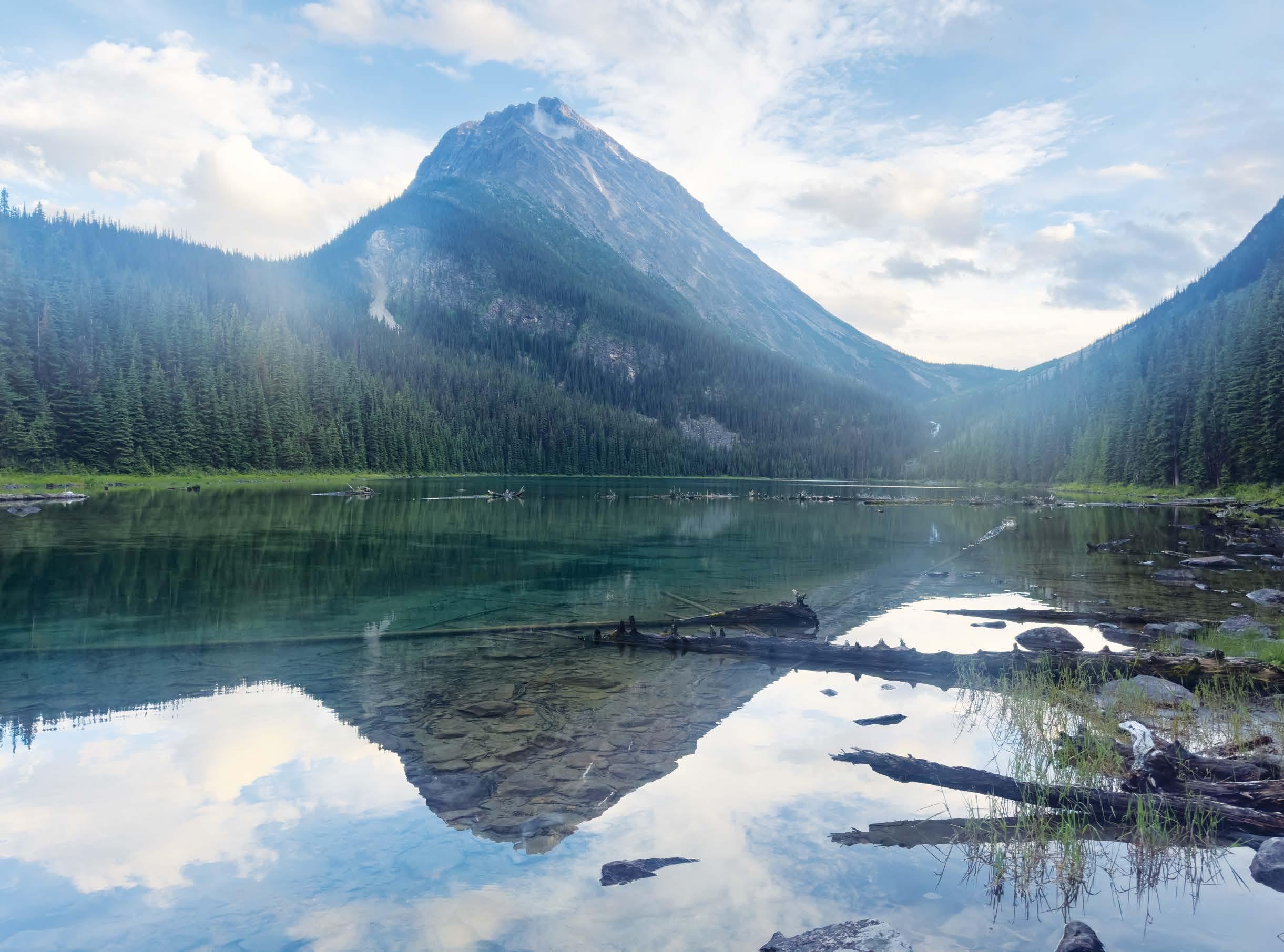
Last August, my cousin Kyle and I spent three days backpacking in Jasper National Park, more specifically, the Geraldine Lakes Trail, nearly 400 km from Edmonton. It’s hardly a walk in the park, so to speak, and definitely not for the faint of heart, regardless of experience.
The vast majority of the path to the camp consists of rocks of various shapes and sizes, requiring constant concentration, especially if you are so lucky as to catch a bit of rain, like we did. Many of these rocks, particularly when they’re slick, require leaping from one to the next, which—with a 30-50 lb. pack on—can feel more like little leaps of faith at each jump.
The drive up to the trailhead was a real hike for the Jeep. It would have been unlikely for a car without all-terrain features to make it all the way, winding through elevation and the occasionally grisly road.
Once parked, we got to changing into our boots and adjusting our packs, and we were off. Surrounded by beautiful lush forest, the path had inclines right off the hop, but that was easy compared to what was to come. There is a certain meditative comfort in putting one foot in front of the other on a dirt-laden path, the mind able to drift into the unifying ambience of nature.
In this state of contentment, we reached the first of the two Geraldine Lakes on the trail we selected (there are four Geraldine Lakes in the area). The echo there was amazing! Every funny bellow rang out time and time again; it was equally impressive and entertaining. But we had a late start to the day, so we had to carry on after a quick drink of water, following the edge of the lake until we reached the south side of it.
By then, about 2.8 km in, we faced an onslaught of rocks and steep climbs. At first, it was patches of giant rocks between
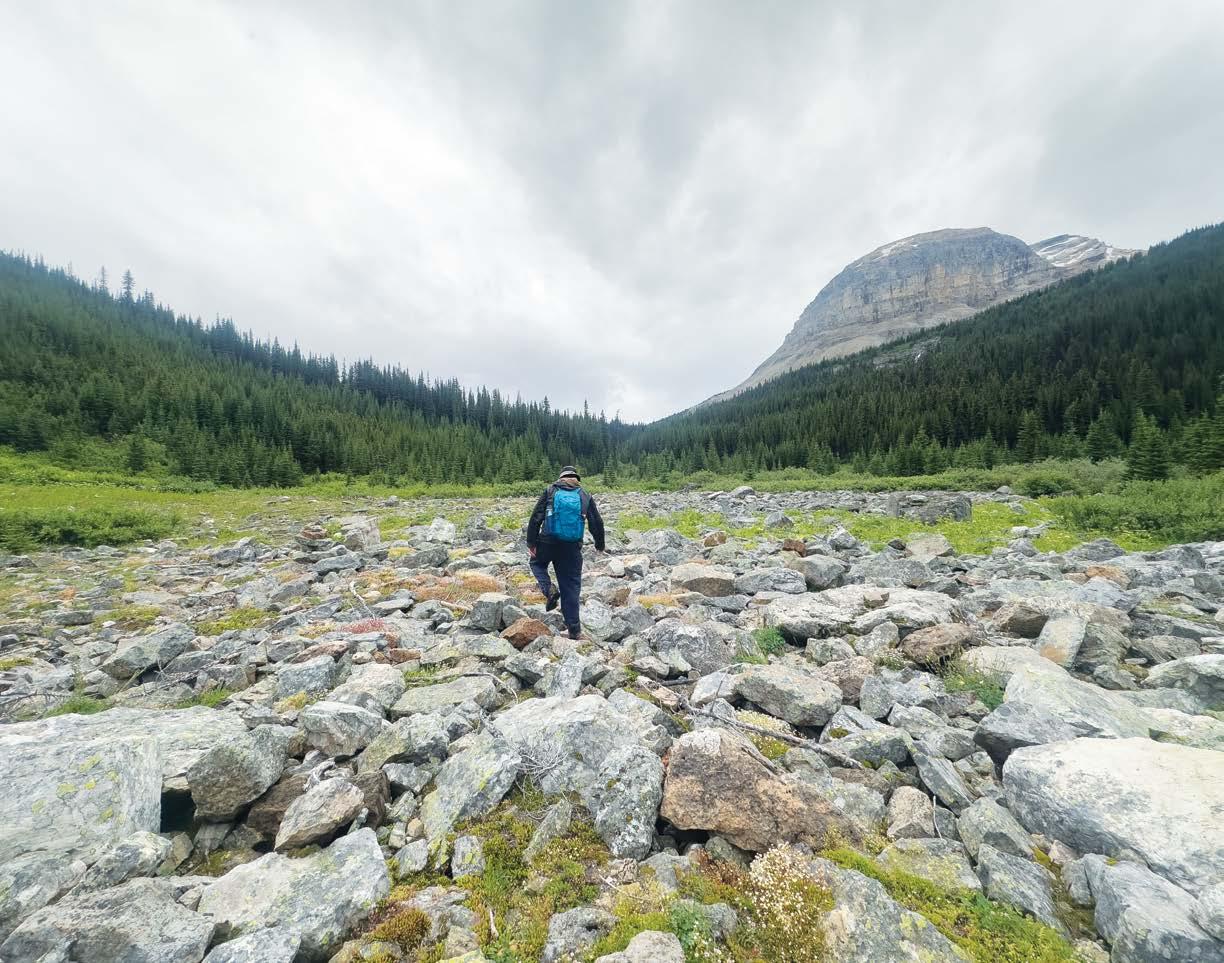
a path and another unmarked path of giant rocks, then a near vertical climb, and another. After that, the trek involved almost nearly jumping from rock to rock with a very vague outline of a path, marked by inukshuks—piles of small stones—to show the way.
It turned out to be one of the most rugged trails we had ever hiked! It was dark long before we made it to camp, nearly six hours after we had started. After setting up our tent and making a quick dinner, we went straight to bed.
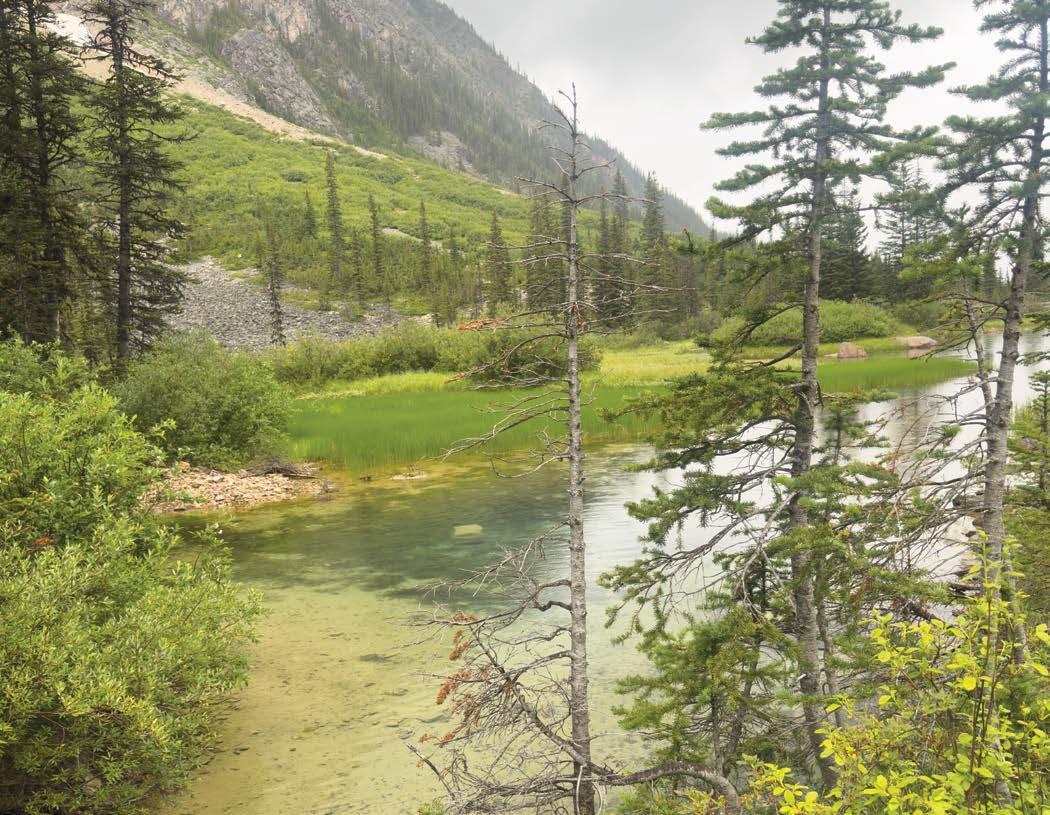
The second Geraldine Lake campsite was spectacular. The stream was right beside the picnic tables, making for quick access to water refills and dish washing, and there were lockers for the food, so we didn’t have to hang the food bags from the usual pulley system.
After a relaxing breakfast, we started on our hike to the next lake. The path was hidden, to put it mildly, and it took us a lot longer to get there for lunch than it did to get back, as we were able to follow our own trail. It may have been a pain, but carving our own way also lent us a feeling of extra adventure.
As we returned to the second Geraldine Lake camp, another group of backpackers arrived. They were from Denmark and only one of the guys really talked to us. He said he’d been to our Canadian Rockies a couple of times before and loved them so much that he wanted to show his friends. He was in good spirits, but it looked like his friends had bitten off more than they could chew.
The next morning, we ate breakfast, packed up and headed back to the trailhead. Going back down a near-vertical slope is a lot scarier than going straight up, but it certainly makes for a better time, so we managed to get some good distance in over the rocks before it started pouring. And it really, really poured. Over many slippery rocks we hopped. Thankfully, most of the types of moss on the massive boulders acted as an anti-slip grip, but we had to remain ever-vigilant, as some of that vegetation could produce opposite results.
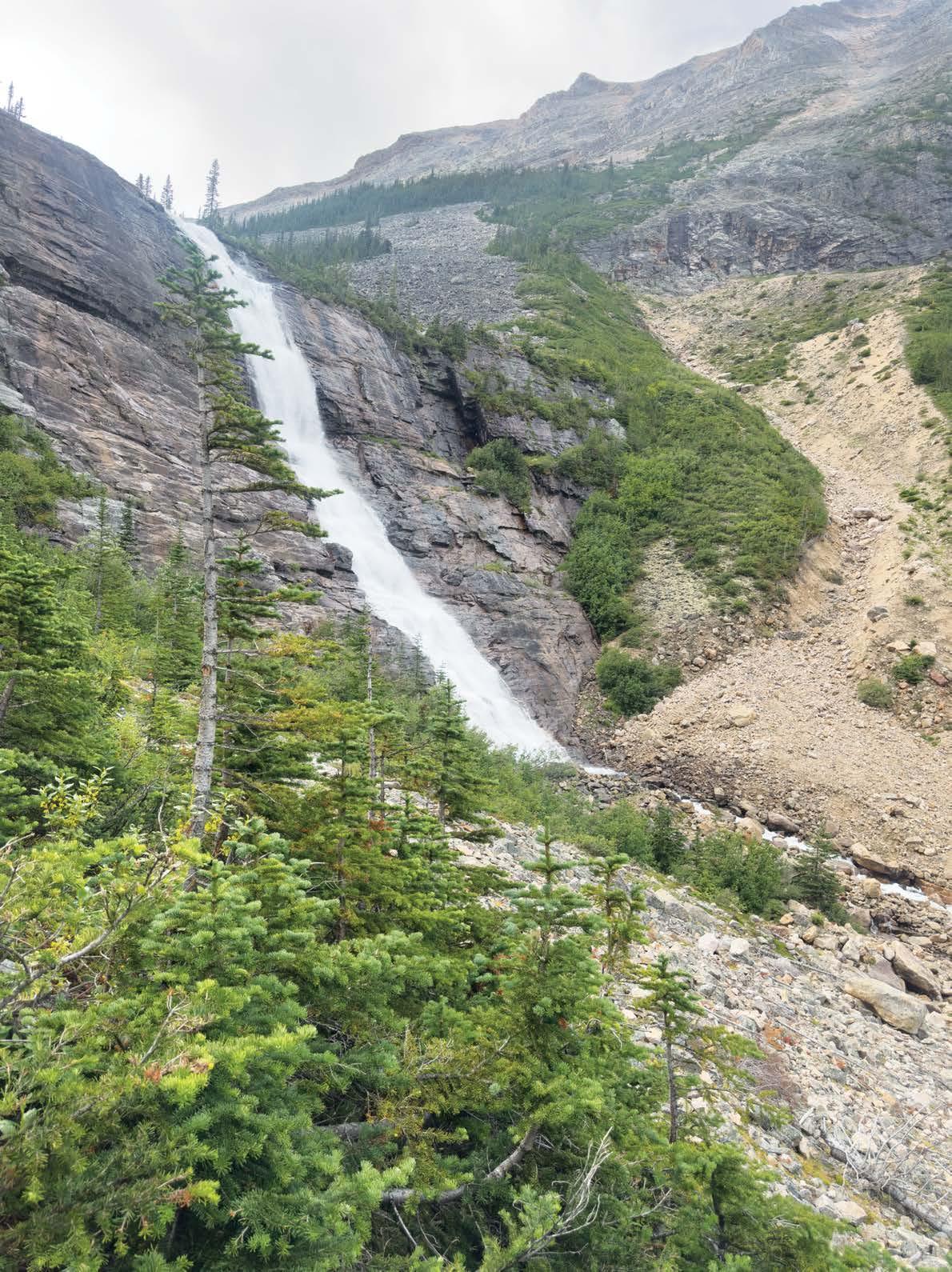
Our knees were getting pretty knackered, and we were soaked from head to toe, each step a puddle in our boots. There were wild blueberries lining much of the forested path, so I ate a bunch to give me that final push of vitality, and we made it back to the trailhead shortly after it stopped raining.
Geraldine Lake Trail is about as rugged as a short trip gets, not quite what one may want to hear when trying to work past the mental block of a daunting first trip. Still, for those willing to traverse precarious footing and climb slopes steep enough that one misstep could have you sliding down the side of a mountain, it is worth the magnificent effort. t8n
Nature doesn’t expose itself to the masses like it does during the summer, when all the vivid colours of the season sprout up in full regalia. It’s a sign to take advantage of the outdoors, partaking in everything from barbecues to golf. Others not ready to take it all in might want to complete this word search to prep for the real thing. Post your completed puzzle on our Twitter or Facebook pages (tagging T8N), to qualify for great random prizes.

Thank you St Albert for supporting local businesses









Free Upgrade to Soft Touch motorization with Hunter Douglas or Powerwand with Alta (from July 1st - September 30th, 2026)
Contact us today to explore your perfect style and enjoy limited-time savings.




Gotcha Covered Design Specialist #200 30 Green Grove Drive St. Albert
780-306-1015
gotchacovered.com/edmonton-st-albert

$100 Gift cards for $80 or $500 in gift cards for $375


A $325 voucher useable for any trips. Retail price is $325.50, offered for $239. Face value does not expire – mailed. Note, this GC offers no change, use value in full.

Battle River Train Excursions offers day train excursions that showcase the communities and scenic vistas along the Battle River Railway shortline with a super-fun twist. $550 Gift card valid for 2 and 2 kids. Purchase for $400. Note, GC does not expiry but does not allow for change or cash value