
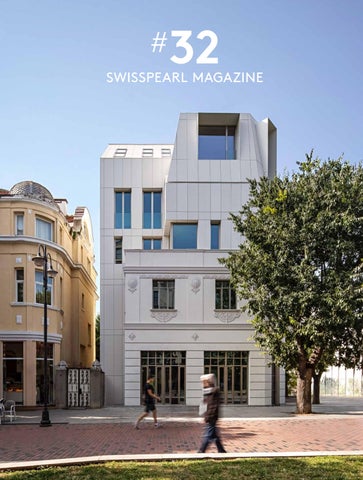
Swisspearl Magazine #32

Page 1


SWISS PEARL MAGAZINE

S WISS PEARL

PRODUCT Stable Beauty: The “Dune” seating collection

32 BL ACKCLIFF HOUSE, CANADA McLeod Bovell Modern Houses

38 STEJARII COLLECTION, ROMANIA Artline

46 MARINA TOWER, AUSTRIA Zechner & Zechner

52 MODERN HOUSE A3241, SWEDEN Nils Nordkvist

56 CESKOBRODSKA SCHOOL, CZECH REPUBLIC Ecoten

60 NATIONAL TRAIN CONTROL CENTER, IRELAND Pascall + Watson/IÉ Architects

66 HO USE 1624, SLOVENIA Coinhab

70 VILL A THULL, NETHERLANDS 3D Visie

74 RICHARD WITH HOTEL, NORWAY Arkitektene Vis-À-Vis

80 WESTHOF RESIDENTIAL COMPLEX, SWITZERLAND Conen Sigl Architekten

86 SHEPHERD PARK COMMUNITY CENTER, USA Bell Architects

90 THE GRANVILLE CENTRE, AUSTRALIA DWP Architects

94 CIT Y ZEN APARTMENTS, ESTONIA Nord Projekt

98 FRIG G APARTMENTS, SWEDEN Nordmark & Nordmark arkitekter

102 FL ASH 1: LAKESIDE RETREAT, USA 103 FL ASH 2: SUNSHINE APARTMENTS, USA

History Combined with the Contemporary

LH residential building, Varna, Bulgaria

This renovation injected fresh vitality into the building, not only restoring it but also reimagining its purpose. Far from simply preserving the original building, the project transformed it into a dynamic, rejuvenated space that radiates new energy, seamlessly enhancing its environment.

Every day brings another record high temperature or extreme weather event somewhere in the world. Studies about rapidly melting polar ice caps, the increasing frequency of wildfires, or the extinction of yet another species seem to make headlines at nearly the same pace. All of this news brings to the fore the realities of climate change, something that for years was going to happen in the future—in and beyond 2030—but it is here now, sooner and more extreme than we imagined. What are architects to do in this reality? How can they help? The construction and operation of the buildings they design has long been highlighted as a major contributor to global carbon emissions. Therefore, the most obvious of the numerous tactics addressing the climate crisis are: designing energy-efficient buildings, building structures with low-carbon materials, and renovating and/or adapting existing buildings. Given that the demolition of an old building further releases the carbon embodied in its construction, the last is increasingly a starting point with any project, regardless of the architectural or cultural importance of an existing building.

The two-story building at the corner of Slivnitsa Boulevard and Stefan Karadzha Street in the center of Varna, the Bulgarian city of around 335,000 on the Black Sea, was one such building: not considered an “immovable cultural property,” the building from 1923 had only “ensemble importance” to Bulgaria’s Cultural Heritage Legislation and was therefore not protected. But demolishing the building was never considered, STARH founder Svetoslav Stanislavov explains, “because it is a hereditary house for the client and had sentimental value to them.” And although the building’s façade was in disrepair, it featured medallions, sculptures, and other ornamentation by noted local artist Kiril Shivarov, which further enriched saving the building, repairing it, and reusing it as part of a larger residential building with three additional floors.

tended the second floor and parapet over what had been a one-story section, effectively “completing” the base for the three-story addition. What before had been mottled, almost patchwork in appearance from repairs and slight additions over the years, is now cohesive, with the existing surfaces of the building’s façade and its decorative flourishes repaired or reconstructed and treated with a consistent smooth plaster with natural white toning. The ground floor has a rusticated banding that was not present before, giving a weighty appearance that is suitable as a base for the additional floors.

The façades of the new floors are clad in three types of Swisspearl panels with colors that are identical in tone to the plaster.

STARH develops concepts for each of their projects, testing them through different iterations, and then carrying the idea of the ideal solution through to the end. Stanislavov articulates the concept for LH in such phrases as “seamless blend of past and present,” “history intertwining with the contemporary,” and “natural symbiosis”—characteristics that are evident in the final building. Although the façades of the new floors are clad in three types of Swisspearl panels with custom colors that are identical in tone to the plaster and ornamentation of the existing façades, the difference between old and new is noticeable up close. The slight setback of the new façades; the modern articulation of the vertically oriented, smooth and ribbed Swisspearl panels alternating with narrow windows; and the prominent shaping of the roof and large windows at the corner—these and more details give the addition a contemporary expression that is a perceptible departure from the original. If not for the faceted corner rising above the sculptures of two children leaning against the curved corner pediment, passersby might not know the building reaches five floors; the rest of the top floor sits behind 45-degree roofs with skylights that are out of sight from the streets below.

LH, as the building is now called, contains a café on the ground floor and three apartments across four floors, the top one being a maisonette on two floors. The café patrons, many of them walking along the busy Slivnitsa promenade leading to and from the popular and aptly named Sea Garden, enter at the corner, while the residential entry is at the rear of the building, along Stefan Karadzha Street. Here, the architects at STARH ex-

In line with contemporary concerns over climate, Stanislavov says, “preserving and strengthening the existing façade significantly reduced the carbon footprint of the construction process, aligned with our commitment to efficiency of the design process and the importance of adaptive reuse.” In the end, he hopes that LH influences future projects in Varna to “strike a balance between respecting the historical integrity and incorporating modern elements in a way that feels harmonious and thoughtful.” LH’s balancing of historical respect, contemporary aesthetics, and environmental concerns should ensure that that hope comes true.

The building skillfully interweaves old and new and sets a striking accent in the urban space.

Large windows allow plenty of daylight into the bright, modern maisonette on the top two floors.

LH residential building has been awarded the International Architecture Award 2024 in the category of Multi­Family Housing.

LOCATION: Varna, Bulgaria

CLIENT: private

ARCHITECTS: STARH, Varna

YEAR: 2023

FAÇADE CONSTRUCTION: Rav Stroy, Varna

MATERIAL: Swisspearl Largo Gravial Ivory 3090, Carat Ivory 8090, Nobilis Special Color (R)

1 Swisspearl® Largo 12 mm, Sigma 12

2 Swisspearl® Integral Crea 8 mm

3 ventilation cavity, sub framing

VERTICAL SECTION 1:30

4 moisture barrier

1 Swisspearl Largo 12 mm, Sigma 12

5 thermal insulation, mineral wool

2 Swisspearl Integral Crea 8 mm

6 reinforced concrete

3 ventilation cavity, subframe

7 panel support pro le

4 moisture barrier

8 plaster board

9 triplex glass railing

5 thermal insulation, mineral wool

10 triplex window

6 reinforced concrete

11 gutter

7 panel support profile

12 skylight window

8 plasterboard

9 triplex glass railing

10 triplex window

11 gutter

12 skylight window

Scale: 1:300

Scale: 1:300 423_Lili'sHouse_Varna_Bulgaria

The original two­story building from 1923 had only “ensemble importance” to Bulgaria’s Cultural Heritage Legislation and was therefore not protected. The old façade with its valuable ornamentation was kept and harmoniously transformed into a larger residential building. FIFTH

“ Once LH was completed and unveiled, it received a great deal of positive feedback from both the architecture community and the general public.”
Svetoslav Stanislavov

What were the circumstances of receiving the commission for LH?

The client approached our studio with a project involving an old two-story family house, where they wanted to renovate the existing structure and add another three floors in the most appropriate and harmonious way possible. Before turning to us, they had already been in touch with another architecture studio, but that project did not meet their needs and vision. This raised the expectations towards us significantly. Our studio proposed a concept that respects the existing building and incorporates a contemporary design for the addition, ensuring a cohesive look. This approach was enthusiastically embraced by the client.

How did the building’s location, on Slivnitsa Boulevard, not far from the Sea Garden, influence the project?

The location of the project was of key importance for us, as it is in one of the most central and visible parts of the city. At the same time, some of the primary views from the building are towards the busy pedestrian area and the entrance to the Sea Garden, so the design introduced large windows in these directions, which corresponded well with the building’s function. In categories of new interventions in old contexts, the building might be referred to as a “parasite”—an addition that physically depends on the existing structure but transforms it into a new entity.

Did you conceptualize it in that way?

From our perspective, the term “parasite” implies a symbiotic relationship where one entity benefits at the expense of another. However, in recent years, the existing house had not been functioning, which led to neglect and a state of disrepair. The lack of regular maintenance and use caused significant deterioration, making it imperative to undertake a comprehensive renovation to restore its structural integrity and preserve its historical value. Unlike a typical parasitic relationship, the renovation design breathed new life into the structure, revitalizing it and giving it a renewed purpose. The project didn’t merely rely on the existing building; it transformed it into a vibrant, rejuvenated space, infusing new energy into its surroundings.

Would you say that the addition is “finishing” a building that was started a century ago?

We view LH as a complete organism without a defined beginning or end, seamlessly integrating elements from two different time periods into a unified structure. This approach transcends the idea of merely “finishing” a building that was started a century ago; instead, it creates a dialogue between the past and present. In Varna, similar interventions can already be seen, reflecting a broader European trend that has been developing for decades. This trend emphasizes the preservation and adaptation of historical buildings to contemporary uses, ensuring their continued relevance and functionality.

What has been the reception of the project in Varna, within both the architecture community and the general public?

Initially, the local community was sensitive and somewhat skeptical about how the authenticity of the original building would be preserved. There is a common concern that historical elements might be neglected in favor of a new project when it comes to such interventions. Once the building was completed and unveiled,

STARH

STARH is an architectural studio based in Varna, Bulgaria, that was founded by Svetoslav Stanislavov in 2012 and employs around a dozen architects. The studio sees architecture as an art, developing concepts appropriate to each project’s size, typology, client, and location. LH stands out within STARH’s larger portfolio of predominantly new construction of commercial, residential, and hospitality buildings due to its modest scale and the complexities of working on the reconstruction of an existing building. “Despite these differences,” Stanislavov says, “it embodies our signature architectural language: concise, clear, and purposeful. Every solid, void, and detail is meticulously placed, leaving no room for unnecessary additions.”

it received a great deal of positive feedback from both the architecture community and the general public. It has received numerous local and international awards and recognition, confirming that we took the right approach from the beginning.

How did you decide on fiber cement panels for the addition?

LH is not our first project using fiber cement panels and specifically Swisspearl. From the very beginning, we had a clear vision of the look and finish we wanted to achieve, harmonizing with the original plaster façade. We chose Swisspearl because the company is the only manufacturer offering the exact color we envisioned, available in both smooth and ribbed panels. This allowed us to perfectly execute our design concept.

EOS – Chaika District, Varna, Bulgaria

Named for the Greek goddess of dawn, this nine­story apartment building on a trapezoidal lot in Varna has a dramatic prow with balconies pointing east to the sun rising above the waters of the Black Sea.

Umani Hotel – Varna, Bulgaria

STARH took inspiration from the trees surrounding this 4­star hotel by a nature park north of Varna, wrapping the entire rectilinear volume in wood slats that also form the ceilings of the balconies.

NAMA – Pamporovo, Bulgaria

This proposal for a hotel at a popular ski resort puts the rooms in eight chalet­like volumes that are clad in burnt wood siding and look onto the surrounding forests through full­height glass walls.

A WORD FROM OUR CEO

I am very pleased with the 32nd edition of the Swisspearl Magazine. The buildings presented here show how comprehensive our product range is, how versatile our products can be used, and how architects succeed in creating interesting and aesthetically convincing works with them. Currently, the corrugated fiber cement panel is widely used, especially in residential construction. I find this change in the perception of corrugated sheets and their use particularly exciting. Incidentally, the corrugated panel is a product that we have been manufacturing since 1912 and that can already be described as a classic (see article on page 26).

The 32nd edition of the Swisspearl Magazine shows how internationally active we have been for the past few years. We manufacture our products in eight factories in seven European countries and advise and supply our customers through our own distribution companies in 15 European countries. The projects presented in this magazine from the US, Australia, and Canada show that we are also well represented by agencies outside of Europe.

I am especially interested in projects in which existing buildings have been further constructed, added to, or built over such as the multi-award-winning residential building in Varna presented on page 3. These projects reflect the increasing efforts in our industry to reduce our footprint and, with regards to the reduction of gray energy, to maintain and further develop existing buildings.

We, too, are in the process of reducing our footprint with several projects, as we have set ourselves the goal of achieving zero CO2 emissions by 2040.

I hope that the 32nd Swisspearl Magazine provides you with a lot of interesting information and inspiration and brings you closer to the world of Swisspearl.

With best regards,

Gitte Herum Andersen, Head of Branding, Strategic & Product Marketing

Having started her career in Danish international companies, Gitte Herum Andersen built a strong foundation in marketing and leadership. When Cembrit was acquired by Swisspearl in 2022, a new horizon opened up for her. During the initial phase of rebranding of the company, Gitte became part of a new team. She explains that the Global Marketing Team inspires and motivates her every day. “We can overcome the biggest challenges because we share an amazing team spirit,” she says. Early on, she was entrusted with establishing Product Marketing at group level and later took on the role as Head of Branding, Strategic & Product Marketing. Her mission is to shape Swisspearl’s brand identity and ensure that every message resonates with the company’s values.

These values also shape her personal life. An avid watersports enthusiast, Gitte is particularly passionate about sailing, especially sailing races. She benefits from natural resources when sailing—only wind, no motor—out of conviction and respect for nature. Her sailing club, located in the north of Copenhagen organizes only “Clean Regattas,” which adhere to the highest environmental standards, and has been honored several times for its commitment. For more than ten years, she has volunteered as a sailing instructor, passing on her knowledge and passion to others. What drives her is bringing a team together to perform at their best, under ever-changing conditions. “Nothing is constant. The weather, the people, the conditions—everything changes,” she says. This flexibility and focus on teamwork also help her successfully navigate the complexities of global marketing. To her, business competitors are no different from rivals on the regatta course. The strategy remains the same: clear communication, quick adaptation, and effective collaboration.

Over the years, she’s came to realize that she’s using the “sailing principles” much more often than she initially thought, whether it’s in the office or on the water. “To reach a goal, we must navigate, sometime with the wind, sometime against it. To contribute to the growth and scale of Swisspearl equals the fine discipline of navigation,” she says. The principles remain the same: stay on course, respect the team, and adapt to every situation. For Gitte, sailing is more than just a sport—it’s a philosophy that she successfully applies in both her personal and professional life.

The sailing club organizes only “Clean Regattas”—only wind, no motor—, which adhere to the highest environmental standards.

“What can we improve and optimize?”

This question guides Gitte Herum Andersen both in marketing and on the water. For her, sailing is more than just a sport—it’s a philosophy.

Whether rivals in a regatta or business competitors, the strategy remains the same: clear communication, quick adaptation, and effective collaboration.

“Nothing is constant. The weather, the people, the conditions—everything changes,” Gitte Herum Andersen says. What drives her is bringing a team together to perform at their best, under ever- changing conditions.

Denmark’s long maritime tradition has made sailing an integral part of its national culture. With more than 400 islands, a 7,000-kilometer coastline, and numerous port cities, the country offers ideal conditions. In Copenhagen alone there are around 20 sailing clubs. Many Danes go sailing to experience nature and spend time with their families while also getting some exercise. That’s why many children learn to sail at an early age.

Gently Curved

Light and yet stable, flat and yet rich in structure. Rather than aesthetic considerations, technical ones led to the shaping of corrugated fiber cement panels in the last century. The waves create a stable and load-bearing panel with a small amount of material. Today, the aesthetic qualities mean that corrugated fiber cement is increasingly being used to clad residential buildings.

Rather than aesthetic considerations, technical ones led to fiber cement panels being formed into waves in the 1910s. The model was sheet metal. An English engineer had already applied for a patent for corrugated sheet metal around 100 years earlier: with relatively little material input, a sheet could be formed in the rolling machine that enabled a higher degree of rigidity and load-bearing capacity. The product was primarily used where lightweight, inexpensive, yet weather-protected shells were required. It remained a building material for sheds and backyards, barracks and temporary structures. The corrugated fiber cement panel, which used the same technical principles as corrugated sheet metal, initially positioned itself in this context. It was mainly used for roofs — until modernist architects, who were open to new building materials, discovered the potential of the material. In Switzerland, the architect Hans Brechbühler was a pioneer. After graduating from ETH Zurich, he worked with Le Corbusier in Paris and then with Albert Zeyer in Lucerne before realizing his first independent work in Köniz, a warehouse

for the Samen Vatter company, in 1935. The steel construction is clad with a façade that — apart from the ribbon windows — is made entirely of undulating fiber cement and, thanks to this surface structure, has the almost textile-like qualities of a curtain wall. The large-scale use of the building material was an absolute novelty at the time. Brechbühler’s first work was correspondingly well received, even outside Switzerland. Corrugated sheets made of fiber cement, Brechbühler wrote, were the ideal cladding: they were insulating, waterproof, had good strength, and could be attached in large sheets by any roofer within a very short time.

Corrugated fiber cement panels became a characteristic building material for exhibition buildings, as evidenced by the Swiss pavilion for the 1937 World

Exhibition in Paris, but above all by various buildings at the Swiss National Exhibition in 1939, and for commercial, industrial architecture. In the 1950s, a series of remarkable buildings clad with corrugated sheets were built in Switzerland. The company buildings for Swisspearl (formerly known as Eternit) became important showpieces. The Swiss architectural firm Haefeli, Moser, Steiger designed the administration building in Niederurnen (1953–1955), in which the parapet and ceiling zones as well as the tower-like six-story exhibition wing are clad with small, corrugated, gray sheets.

Swiss Pavilion at the World Exhibition in Paris, 1937. The building envelope was partly glazed and partly clad with white, corrugated Swisspearl panels.
(Architecture: Bräuning, Leu and Dürig)

Thanks to its surface structure, corrugated fiber cement has the almost textile-like qualities of a curtain wall.

The Swiss architectural firm Haefeli, Moser, Steiger designed the Swisspearl administration building in Niederurnen 1953–1955 (see above).

Corrugated fiber cement panels have now arrived in residential construction. Functional, urban planning and aesthetic considerations determine the latest career of corrugated fiber cement panels.

The residential building on the left on page 28 is located in Lausanne and is clad all around with corrugated fiber cement panels, which give the façade a monolithic appearance.

(Architecture: Localarchitecture)

The architects Itten + Brechbühl used full-height, green corrugated fiber cement panels framed by concrete ceilings for the courtyard building (pictures pp. 26, 28, right) in a privileged residential area of Basel. The materialization picks up on the character of the commercial buildings traditionally located in the courtyards of the quarter.

Somewhat later, Paul Waltenspühl clad the Swisspearl factory in Payerne with corrugated fiber cement panels (1956/57).

In fact, the material also began to gain a foothold in other construction projects. It was particularly popular on the typical 1960s mono-pitched roofs that peaked, kinked, and continued into the façade. However, even though corrugated fiber cement sheets had found their way into religious buildings, the building material was unable to completely shed its ephemeral, temporary, and industrial character.

NEW APPRECIATION FOR EVERYDAY MATERIALS

The perception of the material is gradually changing. For some time now, corrugated fiber cement panels have been appearing again and again in contemporary residential buildings. This new appreciation for unpretentious and everyday materials began in Swiss architecture in the 1980s. Materials with industrial connotations became more and more accepted in the residential sector. When architects now rely on corrugated fiber cement panels, they are recalling these earlier unpretentious building structures.

Functional, urban planning and aesthetic considerations are thus combined

when it comes to the latest career of corrugated fiber cement sheets as a building material. The fact that the historical use of the material always resonates is what makes it so appealing.

The architects Itten + Brechbühl used full-height corrugated fiber cement panels framed by concrete floor slabs for a residential building in Basel (2020). The building is located inside a perimeter block development; the expressive form results from the necessary boundary distances. Sheds and commercial buildings used to stand in such courtyard situations, and the architects’ use of corrugated fiber cement panels is reminiscent of these earlier, unpretentious building structures. The commercial courtyard has been transformed into a courtyard garden.

This is an abridged version of the text “stable beauty” by Hubertus Adam, published in ARCH 2021–1. Hubertus Adam is a freelance architecture critic, architecture historian, and curator.

Stable Beauty

At Swisspearl, we value design. Working with designers and architects is inspiring and the results of their creativity in combination with our material is amazing. One such collaboration with Austrian designer Rainer Mutsch resulted in the creation of the “Dune” seating collection. Dune is a modular, infinitely expandable furniture system that catches the eye with its curved form. Each piece is unique and is formed and manufactured by hand from a wet and flexible fiber cement mat. The stability of the furniture is achieved solely through the material deformation of the dried, thin, fiber cement panel and

can withstand a load of 1,000 kilogram. Four basic forms have been developed, a regular lounge chair, two asymmetrical chairs, and a low table.

The weatherproof elements can be used to create free-standing sculptural seating landscapes in private and public spaces, both indoors and outdoors. The organically curved furniture arrangement arches and sinks like a dune, changing its

appearance depending on the number, arrangement, and sequence of the elements. It not only provides a high level of seating comfort, but also allows for different orientations and positions, with constellations that give everyone their own space or encourage dialogue between people sitting across from each other.

“Dune” is available in various shades of gray, from light gray to anthracite.

Design: Rainer Mutsch

Dimensions: 96 × 95 × 60 cm

Weight: 48 kg

SELECTED BUILDINGS

Every year, many building projects are carried out with Swisspearl products around the world. We’ve selected sixteen particularly remarkable ones, which we present on the following pages.

A House Perched above the Ocean

BlackCliff House, West Vancouver, Canada

With its breathtaking panoramic views across the Salish Sea, BlackCliff House is situated on a granite outcrop that rises forty meters above the shoreline in Vancouver, Canada. The location is a geographical “mid-way” point for a dispersed family who are intermittently living and working on multiple continents.

BlackCliff House accommodates diverse living arrangements while connecting to the site’s spectacular natural terrain. With this house, the client realized his desire for a gathering place for current and future generations while still being able to accommodate a small family unit. The house takes its cues from distinct and divergent topographical features: views and light to the Southwest and the extreme terrain that plunges down to the sea. The house pivots around two axes resulting in a shifting spatial geometry at the intersection of the main and upper floors, which appears as a void in the center of the site. The upper floor supports intimacy for a small family sleeping within the core area while still being able to accommodate larger family units in the outer “wings.” These separate wings are connected externally by a shared outdoor terrace. A circulation space is located in the center of the house to take advantage of the light and views that are made possible by a deep sectional cut. The ground

floor living spaces are connected by an outdoor area with a plunge pool and auxiliary spaces arranged along this sectional cut. These spaces include an atelier and a bamboo courtyard, an office and a tearoom. The courtyards allow for the stacked volume to get light and air without impairing either views or natural light. The spatial experience of the house is both familiar and slightly disorienting. This sensation is the result of an effort to balance the relationship between the orientation of the steeply sloping landscape and the off-axis orientation of the light and views to create spaces with strong connections to the outdoor environment. The materials palette includes off shutter concrete, timber cladding, and Carat Black Opal Swisspearl panels. The smooth, dark Swisspearl panels clarify the dynamic shifting volumes and echo the rock surfaces of the cliffs below. With their strong color and textural contrasts, all the materials enhance the sleek, contemporary aesthetic of the house.

Striking, cantilevered building shapes characterize the house, while the landscape below seems to stretch away. The spacious living room opens seamlessly onto the adjoining terrace with pool, which offers a fantastic view of the ocean below.

LOCATION: West Vancouver, BC, Canada

1 cm

325_BlackCli House_WestVancouver_Canada

CLIENT: private

ARCHITECTS: McLeod Bovell Modern Houses, Vancouver, BC

YEAR: 2019

Scale: 1:400

FAÇADE CONSTRUCTION: Artwork Homes, North Vancouver, BC

MATERIAL: Swisspearl Largo Carat Anthracite 8024

White Ribbon Housing

Stejarii Collection, Bucharest, Romania

This six-story residential scheme by Artline SRL Architects is located in a deep forest on the outskirts of Bucharest. The building is like a continuous white ribbon that winds its way through the trees. With its inner courtyards, all apartments enjoy views out onto the forest.

The relationship with the exterior landscape is created by means of two types of terrace balconies, some of which are covered and integrated into the volume, while others are generated by the alternating cantilever projections across the different levels. The concept is based on the interplay of simple, rectilinear volumes which differentiate the housing units and reduce the building to a human scale.

Deep terraces with planters create a dialogue between exterior and interior, akin to living in a standalone house. With regard to the apartments, one priority was establishing a separation between daytime and nighttime spaces. Thus, the kitchen is located close to the entrance and to the dining room, which is usually also connected to a terrace.

The ensemble comprises generous twoto five-room apartments, ranging from 80 to nearly 200 square meters. Cars can only be parked in the underground parking garage, which accommodates 430 vehicles, including

electric charging stations. The intended emphasis of the volume and the pursuit of an aesthetic unity led to the use of white cladding. The building envelope functions as a ventilated façade clad with Swisspearl fiber cement panels that enhance the architectural gesture. Both the vertical and horizontal structural elements have a discreet presence. They are integrated in the walls, which ultimately contributes to the volume's precision.

Furthermore, the hybrid structure, consisting of concrete and steel trusses that support the cantilevers, offers the possibility for wide spans, eliminating the need for columns in the interior of the apartments. This allows visual communication with the surrounding nature without any structural obstacles hindering the views.

The project takes into account sustainable concepts, such as passive house principles, and has earned an “excellent” rating on the BREEAM certificate.

The large building volume with striking, pointed cantilevered roof is cleverly divided into smaller, cantilevered cubes underneath. This creates sheltered outdoor areas and plenty of privacy for the residents.

The massive, meandering building is completely surrounded by dense forest and, thanks to its white façade, stands out from the natural surroundings like a bright ribbon.

393_StejariiCollection_Bucharest_Romania 1 cm

LOCATION: Bucharest, Romania

Scale: 1:1700

CLIENT: Tiriac Imobiliare, Bucharest

ARCHITECTS: Artline SRL, Bucharest

YEAR: 2023

FAÇADE CONSTRUCTION: Glass Rom, Bucharest

MATERIAL: Swisspearl Largo Zenor 11115

THIRD AND FIFTH FLOORS

SECOND AND FOURTH FLOORS 1:1500

Large plant troughs integrated into the façade parapet define the private outdoor spaces and create intimate seating areas. The lush green of the plants contrasts with the clear, cubic forms of the façade clad in white Swisspearl panels.

High-Rise Housing on the Danube

Marina Tower, Vienna, Austria

Zechner & Zechner’s 138-meter high-rise residential tower accommodates 520 apartments of various sizes all with spectacular views across Vienna. Constructed with a concrete, load-bearing core, the architects could design flexible configurations of the apartment layouts.

Although the Danube flows through Vienna, the city has predominantly neglected the right bank, riverfront location. A major multi-lane road and a railway track create a barrier to the adjacent districts, which can be traversed by bridges at only a few points. As a result, the attractive riverside cannot fully unfold its potential as an inner-city recreational area.

The Marina Tower is one of the first projects in Vienna attempting to rectify these urban planning shortcomings on the right bank of the Danube. By covering the road and railway line running parallel to the Danube, the “Marina Deck” could be created, an attractive, public, barrier-free connection for pedestrians and cyclists directly to the Danube waterfront.

The “high-rise” and “low-rise” sections of the tower are supported on a common base that forms a multi-story arcade facing the street on the city side. From here, access is provided to the central, glass-covered atrium, where the main entrances are located.

The building was constructed in reinforced concrete construction. The dark, thermal building envelope, which is clad with ventilated Swisspearl fiber cement panels, is complemented by a white balcony-loggia structure made of thermally separated precast concrete elements. Balcony sections cantilever beyond the façade line, intensifying the experience of the spectacular view. Floor-to-ceiling woodaluminum glazed doors ensure optimal natural lighting of the apartments, and depending on user requirements, external textile sun protection is available.

The use of renewable energy sources in the form of geothermal energy for heating and cooling, along with a well-insulated building envelope, are the cornerstones of the sustainable building concept.

Marina Tower is an elegant new landmark in Vienna’s riverside cityscape revitalizing the right bank of the Danube.

A generous staircase leads from street level to the marina deck, which covers the busy road along the Danube and thus gives pedestrians access to the riverbank.

LOCATION: Wehlistrasse 291, Vienna, Austria

CLIENT: BUWOG Group GmbH, Vienna

ARCHITECTS: Zechner & Zechner, Vienna

YEAR: 2021

FAÇADE CONSTRUCTION: Erwin Wippel GmbH, Eisenstadt

FAÇADE MATERIAL: Swisspearl Largo Zenor 11006, 69046 (special color)

A Modern House in the Swedish Archipelago

Modern House A3241, Sweden

The entire house exudes modern functionalism, an architectural style that stands in stark contrast to the surrounding natural environment and its dark lake waters and tall pine forest. With its Swisspearl-clad, white rectilinear volumes, this house creates a dramatic counterpoint to the Nordic landscape.

Located on a remote site on the banks of a lake in north-eastern Sweden, this house is the perfect refuge from the stresses of city life. The entrance of the house on the ground floor is flanked by a compact guest bathroom, and storage and office space, which connects to an expansive open-plan dining, living, and kitchen area. This light-flooded communal area opens out onto a south-west facing terrace with wonderful views overlooking the lake. The house can accommodate up to five people with one double bedroom and three single bedrooms, two of which are on the upper level. This level also includes a living room and a small kitchenette to serve guests on the terrace, from where there are panoramic views of the water.

The main bedroom on the ground level boasts a walk-in closet and direct access to the pool terrace through large glass doors. Light, nature, and stunning views are integrated throughout the entire house. The merging of indoor and outdoor spaces is a central concept

of the design, with generous glass doors opening onto an expansive pool terrace, perfect for social gatherings with friends and family. The pool house includes a large sauna, storage, and a serene relaxation room. A staircase from the terrace leads down to the dock, offering convenient mooring for a boat to go on lake excursions and fish.

Architect Nils Nordkvist is known for experimenting with varying ceiling heights, creating dynamic spaces and enhancing the sense of openness. The use of white, horizontal, Swisspearl fiber cement panels adds a striking visual contrast to the backdrop of the rural landscape. The client opted to fully clad the exterior with Swisspearl panels as they are maintenance free and are a sleek and cost-effective alternative to plaster or masonry walls. The result is a clean, modern aesthetic that is practical and visually striking. Architect Nils Nordkvist in collaboration with Willa Nordic describes it as a “house with attitude.”

LOCATION: Piteå, Sweden

CLIENT: private

ARCHITECTS: Nils Nordkvist, Köping

YEAR: 2017

FAÇADE CONSTRUCTION: Willa Nordic, Stockholm

FAÇADE MATERIAL: Swisspearl Largo Carat Ivory 8099

The white summer house with its staggered volume is idyllically situated between the lakeshore and the dense pine forest. A direct path connects the wooden deck of the surrounding terrace with the private jetty on the lake.

A New Face for an Old School

Ceskobrodska School, Prague, Czech Republic

This contemporary school refurbishment in Prague by Ecoten Architects was designed with the involvement of all stakeholders from the outset: client, architect, general designer, and representatives from the school, both teachers and students, were all able to give their input.

Ecoten has upgraded this school building dating back to the 1970s into a coherent, sustainable, carbon positive and safe building in accordance with 21st-century standards. The original, rather complex layout has been replaced by a clear arrangement that respects the educational needs of the students. The spatial concept is based on transparency. Configured around an outdoor atrium at the heart of the layout, all classrooms have large windows with a view out onto the greenery. Generous circulation spaces are the spine of the building and offer ample opportunity for students to have impromptu meetings. The entrance floor offers direct connections to the atrium from the lobby, dining hall, and cafeteria. Various outdoor spaces, full of greenery, flow from the atrium, and serve both as alternative outdoor learning areas and for student recreation. The new spaces are versatile and allow the school to adapt to the future requirements of modern education.

Vertical Siberian larch wood and dark gray Swisspearl fiber cement panels are the dominant materials of the façades. These robust materials have been chosen to complement and contrast with one another. Climbing vines are intended to integrate the school building into the surrounding verdant environment and provide shade for the windows.

In terms of its green credentials, the carbon positive school received the highest SBToolCZ certificate. With its innovative timber curtain façade resulting from research at CTU in Prague—used for the first time—the building envelope complies with passive house standards. Further sustainable aspects include the installation of geothermal heat pumps, a Predictive Control System, the use of gray water from showers and wash basins for flushing toilets, and the use of accumulated rainwater for irrigation. Overall, Ecoten have created a pleasant environment that is conducive to learning.

467_ŠkolkaKontrolorkaSchool_Praha_Czechia

Scale: 1:500

The original school building from the 1970s was renovated and extended. For the new façade, the architects chose sustainable, robust materials and combined dark gray Swisspearl panels with Siberian larch. Floor­to­ceiling windows line the corridor, bringing light into the interior of the building and directing the view to the green inner courtyard.

LOCATION: Prague, Czech Republic

CLIENT: City of Prague

ARCHITECTS: Ecoten, Prague

YEAR: 2022

FAÇADE CONSTRUCTION: NEMA, Olesnice, and ILTEGRO, Brno

FAÇADE MATERIAL: Swisspearl Largo Patina Original P 070

PASCALL + WATSON/IÉ ARCHITECTS

A New Building for Tracking Trains

National Train Control Center, Dublin, Ireland

Pascall + Watson Architects believes that good design makes buildings enjoyable to use, efficient to build, and elegant to behold. These are key drivers of the design for the National Train Control Center in Dublin, with an added focus on creating an efficient and refined working environment.

Since the 1970s, Ireland’s trains have been under the control of Iarnród Éireann’s Centralised Traffic Control Center (CTC) at Connolly Station in Dublin. During the past five decades track, signaling, and communications infrastructure have been replaced and upgraded as workload at the existing CTC increased. The center reached capacity many years ago, and technology available to operatives became outdated. By 2015, just 75 percent of the rail network was controlled from the center, with the remaining 25 percent managed at a number of local stations, leading to a disjointed system.

As a result, a location appraisal was undertaken, which identified a site at Dublin’s Heuston Station as the preferred location for a new facility — the National Train Control Center (NTCC). Surrounded by railway lines on three sides and predominantly used for storage, it was an otherwise underutilized space that had potential to be developed into something unique. Each of the five floors above ground level in the main building is organized around

a spacious, light-filled lobby that provides access to shared facilities and a visual connection to Heuston Station and the city beyond.

The façades of the main building were carefully designed to ensure it would help to reduce the scale of the large volumes of windowless space housing the essential plant and equipment. Vertical aluminum louvres are incorporated at the base of the building to integrate the multiple penetrations providing access to the plant and equipment areas on ground floor level.

Swisspearl fiber cement rainscreen cladding above ground floor level is punctured by a delicate projecting detail surrounding each window, which creates a subtle relief from the overall volume. Similarly, the scale and configuration of the Swisspearl panels, which may appear to be random, were instead a considered design choice to visually reduce the scale of the building whilst still allowing the volume to be read as a coherent whole.

SITUATION 1:1000

LOCATION: Dublin, Ireland

CLIENT: Iarnród Éireann/Irish Rail, Dublin

ARCHITECTS: Pascall + Watson/IÉ Architects, Network Enhancements, Dublin

YEAR: 2022

FAÇADE CONSTRUCTION: Purcell, Dublin

FAÇADE MATERIAL: Swisspearl Largo Patina Original P 020

The five­story gray monolith of the National Train Control Center stands directly on the railroad tracks. The mostly closed façades of the large building volume are enlivened by narrow, upright windows and the slightly different shades of gray of the Swisspearl patina panels.

Juxtaposing Historic and Contemporary Architecture

House 1624, Zgornja Kungota, Slovenia

Situated in the verdant hills of Slovenia, House 1624 has been extended with a modern annex that accommodates wine tasting and a wellness spa. Ochre-colored Swisspearl fiber cement panels enclose a façade of floor-to-ceiling reflective glazing that brings the landscape into the interior spaces.

Leber Winery, run by well-known Styrian winemakers, lies in the bucolic surroundings of the Slovenian Hills in northeastern Slovenia, an area dotted with vineyards. The owners decided to renovate the historically protected vineyard cottage with its late renaissance details that dates back to the early 17th century. The brief was to transform the historic house into a boutique hotel with an accompanying wellness spa. The dimensions of the four-hundred-year-old house were not spatially sufficient to accommodate such a complex program, so the building needed to be enlarged with an extension.

Since the cottage was protected as a monument, cooperation with the Institute for the Protection of Cultural Heritage Maribor was crucial. It was necessary to set a contemporary addition to a sensitive and historically rich building in such a way that the quality of the historic building was not negatively affected.

A subtle extension located on the southern side of the existing building is clad in ochre-colored Swisspearl fiber cement panels. The earthcolored Swisspearl panels echo the ochre of the ceramic tiled roof of the old house, thereby tying the two volumes together. Reflective panoramic windows, which act as a counterpoint to the smaller historical windows of the old building, emphasize the contrast between old and new. The boutique hotel is situated in the old vineyard cottage and the contemporary extension accommodates the new wellness program, which is an entire floor lower and hidden from the entrance area. By tucking the new volume at a lower level, the extension merges with the surrounding countryside and allows the historic house to remain prominent. The interior of the vineyard cottage follows the use of original materials and color tones, thus preserving the spirit of the time, while, in contrast, the new extension has a contemporary design.

In order to respect the listed early 17th­century building, the small boutique hotel was only extended in the base area. The extension blends harmoniously into the sloping terrain.

1624_Zgornja Kungota_Slovenia

LOCATION: Zgornja Kungota, Slovenia

CLIENT: Petra and Igor Leber, Zgornja Kungota

430_House 1624_Zgornja Kungota_Slovenia 1 cm

Scale: 1:400

ARCHITECTS: Coinhab, Ljubljana

YEAR: 2022

FAÇADE CONSTRUCTION: Helbl Franc s.p, Ljubljana

FAÇADE MATERIAL: Swisspearl Largo Avera AV 070

The extension, clad in brown Swisspearl panels, houses a modern spa with pool and sauna, as well as a winetasting wing, thus complementing the boutique hotel’s offerings.

House in a Nature Reserve

Villa Thull, Schinnen, Netherlands

Designing and building a new home is often the crowning glory of a life’s dream, as was the case for a Dutch couple who realized their new dream home in a beautiful nature reserve in Schinnen, South Limburg. The combination of carefully chosen materials demarcates the various elements of the house.

The aim of architect Rich Schäfer of 3d Visie architects was to design a comfortable, lightfilled, functional, and versatile house with optimal circulation. Sustainability and the use of high-quality materials was also a priority.

The plan is configured in a U-shape that encloses a deep, outdoor terrace. The lower level of the house, where the garage, entrance, storage room, technical service room, and two bedrooms are located, is embedded into the natural slope of the terrain. A timber staircase winds its way up to the ground level where all the communal spaces are located.

An open plan kitchen, dining and living rooms are light and airy thanks to the sliding doors that open out onto the terrace patio to the rear garden where guests can be entertained. Interior and exterior spaces merge thanks to the generous glazing and flush floor height. The

partly covered terrace extends out directly onto a 122-meter-long lawn, which doubles as a driving range for the client, who is an avid golfer. Two double bedrooms on the upper floor share an en-suite bathroom and each has its own walk-in closet.

The materials palette includes off-shutter concrete, vertical wooden cladding, and gray Swisspearl fiber cement panels that frame the timber cladding and emphasize the fascia of the flat roofed house. An array of 42 solar panels provides the house with ample warm water and green energy.

The house is appealing, boasting a sleek minimalist design. The fine choice of materials with the incorporation of wooden elements combined with Swisspearl panels lends a cozy, inviting warmth to the spaces, creating a harmonious balance between style and comfort. 3D VISIE

458_VillaThull_Schinnen_Netherlands

Scale: 1:400

LOCATION: Schinnen, Netherlands

CLIENT: Johanna and Wynand Vogels, Schinnen

ARCHITECTS: 3D Visie, Sittard

YEAR: 2018

FAÇADE CONSTRUCTION: Eijkerbouw Bouw, Margraten

FAÇADE MATERIAL: Swisspearl Largo Patina Original P 020

The house is located on a slightly sloping site and makes clever use of this difference in terrain. From the driveway, the house manifests itself through a strikingly framed upper floor, below which is the ground floor with entrance and garage.

Towards the garden side, the house becomes single­story, breaking from the strict geometry of the front.

Hotel on the Water

Richard With Hotel, Stokmarknes, Norway

Intended to reinvigorate Stokmarknes, Richard With Hotel aims to attract tourists and locals alike, offering a variety of amenities. The goal was to seamlessly blend the building with its natural surroundings, incorporating elements of the landscape, light, and views into the interior spaces.

Richard With Hotel is situated amidst a diverse array of structures: offices, residences, shops, and historic wharf buildings. The architectural design, inspired by local aesthetics, ensures a sense of place while fostering innovation. The hotel’s layout is straightforward, with communal areas on the light and transparent ground floor and hotel rooms in the upper floors of the two wings. Embodying a modern interpretation of vernacular Norwegian architecture and orientated to maximize views and light, the wings open out towards the sea.

The hotel accommodates 159 hotel rooms, including standard double rooms, family rooms and suites, a conference area, and a restaurant. The conference area, which doubles as a concert venue or for dining events, accommodates a spacious hall for 150 people, four meeting rooms, a lobby area and restaurant.

Vis-À-Vis architects placed emphasis on aesthetics, durability, environmental sustainability, and ease of maintenance. Materials have

been chosen not only for their durability and ability to weather climatic stresses, but also for their eco-friendliness and their versatility that allows the desired aesthetic expression. Each material is thoughtfully integrated to evoke different spatial moods. The integration of materials between interior and exterior blurs the distinction between inside and outside spaces, fostering a seamless connection with the surroundings. The five-story-high wings of the hotel are clad in Swisspearl fiber cement panels, in vibrant blue and rustic brown hues, imparting the hotel with a strong sense of identity. Angled roofs are similarly clad in Swisspearl panels, while vertical bands framing the windows create a striking visual effect. Each room has a balcony with glass railings, seamlessly integrated into the façade. With its striking design and thoughtful integration into the natural landscape, Richard With Hotel stands as a beacon of hospitality in Stokmarknes.

The two distinctive building volumes are clad with Swisspearl fiber cement panels on the side façades and roofs—one in a vibrant blue, the other in a warm brown tone.

The narrow, high window slits are strongly accentuated by a change of color and material and extend up to the sloping roof level.

LOCATION: Stokmarknes, Norway

CLIENT: Hotel Richard With, Stokmarknes

ARCHITECTS: Arkitektene Vis-À-Vis, Trondheim

YEAR: 2023

FAÇADE CONSTRUCTION: PEAB–Bjørn Bygg, Tromsø

FAÇADE MATERIAL: Swisspearl Largo Carat Azurite 8040, Amber 8070 (special color)

The two buildings house a total of 159 hotel rooms and are connected via a recessed base level. Balconies on the fully glazed front sides offer a wonderful view of the sea and the unique landscape. Thanks to its exposed location directly on the seafront, the hotel can be seen from afar.

Forging a New Identity

Westhof Residential Complex, Dübendorf, Switzerland

Westhof by Conen Sigl Architects is situated on the site of a former plant nursery along the railway tracks in Dübendorf near Zurich. A former industrial and commercial zone, the neighborhood is undergoing major restructuring due to its re-zoning as a residential area.

Inspired by the site’s history, the cooperative housing project creates an identity-forming place that fosters a strong sense of community and ecological connectivity. The architectural language, with its robust materialization, echoes the functionality of the previous structure, while the proximity to a nature reserve reinforces its connection to the natural environment.

The heart of the development is a communal courtyard. Framed by three volumes, it blends into the surroundings with a four-story “head” building, an angled triple-story wing building, and a nine-story main building. The head building is rotated slightly, thus opening the courtyard to the neighborhood.

The flat roof terrace of the wing building, housing a semi-public level, is intended as a vibrant neighborhood social hub, providing space for events and urban gardening. The open pergola structure crowning this part of the building forms an identity-forming and architecturally mediating feature, reconnecting the upper levels with the activities below. The

project’s diverse outdoor spaces create a unique potential for various forms of communal appropriation.

The architectural design references the former nursery and the site’s commercial past. The project thus sought a robust and simple materialization. The façade showcases the use of large-format corrugated Swisspearl panels, here, in bands of white and light gray. The corrugated panels imbue the building with a contemporary, urban expression.

Westhof Dübendorf enables affordable, self-managed, and sustainable living and working environments for a variety of uses and a mixed resident population. The scheme accommodates a total of 87 apartments and six commercial spaces. The units range from one-room units to cluster units.

Built with locally sourced materials and powered by renewable energy, the complex strikes a balance between affordable housing and sustainable design, earning the project a SNBS (standard for sustainable building Switzerland) Certificate.

The residential development is grouped around a shared courtyard, which forms the protected heart of the complex. The exposed location directly on the railroad tracks required a high­quality and robust façade material.

With the corrugated sheeting, the project creates a link to the former commercial zone of the site on the one hand and presents itself as a modern residential project that, on the other hand, appeals to young families and the urban population.

LOCATION: Dübendorf, Switzerland

CLIENT: WOGENO Zurich and palmhaus ag represented by Topik Partner AG, Zurich

ARCHITECTS: Conen Sigl Architekten GmbH, Zurich

YEAR: 2017–2023

FAÇADE CONSTRUCTION: Salm Fassadenbau AG, Schinznach-Dorf

FAÇADE MATERIAL: Swisspearl Ondapress 57 Reflex Silver 9000 (special color), Nobilis Special Color (R)

Bringing the Community Together

Shepherd Park Community Center, Washington DC, USA

The Shepherd Park Community Center provides a safe and welcoming environment for Washington DC public school students, most of whom come from disadvantaged backgrounds, to gather and learn.

Bell Architects modified parts of the historic 1930s Shepherd Elementary School while adding a 1,200-square-meter addition. The concept was to create a pavilion in the park as an extension to the school, scaled to fit the neighborhood along a steeply sloped residential street. The new addition, which transforms in the evening for use by the entire community, provides a gymnasium, fitness center, multipurpose room, and two kitchens.

The transparent lobby overlooks the street, encouraging user interaction and inviting neighbors to enter via the stairs or the wheelchair-accessible ramp. A modern interpretation of the historic brick and stone school, the addition, clad in thin horizontal strips of Swisspearl fiber cement panels, provides a highperformance building that approaches netzero energy.

In varying shades of russet red and sienna, the Swisspearl panels mimic the heavy brick of the historic building, while providing a lightweight, yet durable, open rainscreen.

Although the fenestration is less than 25 percent of the wall area to protect the interiors from the intense summer heat, the spaces have views and plenty of daylight.

The building’s energy consumption has been significantly reduced (62.4 percent from median), and a photovoltaic solar roof has been installed that can generate up to 100,000 kilowatt-hours per year, equivalent to the school’s total energy needs, while reducing costs and exposure to energy prices. This helps the district decarbonize its energy supply. The project achieved LEED Gold status with near net-zero energy performance.

The team used an integrative process that engaged stakeholders in defining and achieving core goals focused on energy and waterrelated systems. Exterior retaining walls became benches to accommodate outdoor theater activities and teaching.

This school/community center reflects the belief that our children have the qualities to be the change we need.

LOCATION: 1425 Jonquil St NW, Washington, DC, USA

CLIENT: District of Columbia Government Parks, Washington, DC

ARCHITECTS: Bell Architects, Washington, DC

YEAR: 2021

FAÇADE CONSTRUCTION: Del Ray Glass, Alexandria, VA

FAÇADE MATERIAL: Swisspearl Largo Carat Coral 8030, 8031, 8032 (special color), Vintago VI 031

Thanks to the special installation method and choice of colors in different shades of red, the Swisspearl façade subtly blends into the surroundings and creates a bridge to the traditional brick houses in the neighborhood.

A New Community Hub

The Granville Centre, Granville, Australia

Situated in the heart of Granville, The Granville Centre brings together a variety of community spaces, all conveniently located under one roof. These include a library and training center, a regional art gallery, a multipurpose hall/ performance space, a co-lab space and workshops designed to be accessible to all.

Community, environmental, and social considerations combine to deliver a holistic civic experience embedded in sustainability. The center’s design and landscaping draw profound inspiration from Granville’s rich history, including its industrial heritage as a hub for tweed manufacturing, yarn making, and brick production, as well as the presence of one of Sydney’s first Olympic pools. These historical elements have been intricately woven into the fabric of the center. A selection of materials, textures, and layering emerged from consultations with the community and were embedded into the Swisspearl fiber cement and glass façade. The choice of colors, warm tones, and smooth textures foster a sense of inclusion, comfort, and well-being.

A prominent feature is the suspended ceiling in the entrance foyer, a public artwork by Leanne Tobin, representing the six seasons of First Nations culture. The Granville Center is

strategically connected to surrounding amenities. To the south and east, the center is connected to the existing Granville swimming pool, new recreational courts, and the new playground in Memorial Park.

With a 100kW solar system, heat pump recovery, rainwater harvesting, gardens, and stormwater-sensitive landscaping, the center is set to achieve a 5-Star Green Star rating. Granville multipurpose center is a place of curiosity and engagement, where people can explore various interests such as music, art, knowledge, and education. It serves as a dynamic space where visitors come with a purpose but can also discover new activities and experiences.

The Granville Centre exemplifies thoughtful design and sustainability, deeply intertwined with the historical and community fabric of Granville. It stands as a versatile and inclusive space for all, promoting a vibrant and engaged community.

The new community center offers a variety of activities for young and old. Colorful wall niches in different sizes and shapes create small oases of retreat and invite you to read. Overhanging roofs and the warm, soft colors of the Swisspearl façade promote a sense of well­being.

LOCATION: Granville, NSW, Australia

CLIENT: Cumberland City Council, Sydney

ARCHITECTS: DWP Architects, Dubai, UAE

YEAR: 2020

FAÇADE CONSTRUCTION: Auzoom Projects, Homebush, NSW

FAÇADE MATERIAL: Swisspearl Largo Carat Sandstone 7001 HR (special color)

Enlivening the Streetscape

City Zen Apartments, Tallinn, Estonia

City Zen apartment building, featuring commercial premises on the ground floor, stands proudly on the historic Kaupmehe Street in the heart of Tallinn. Surrounded by a diverse architectural urban landscape, from czarist-era wooden houses to modern glass structures, the building seamlessly integrates into its surroundings while enriching the urban fabric.

A key criterion in the building’s design was to harmonize it with the existing urban space, preserving the historical environment and enhancing the living experience in the city center.

The design ensures ample daylight into the apartments and also creates exclusive living spaces with spacious terraces and varied views of the city. The façade of the building is playful, reflecting the vibrancy of its surroundings.

A long, concrete planter with shrubs and young trees, creates a buffer to the street. By setting back the upper two levels and creating deep balconies, the scale of the building is reduced to tie in with the neighboring buildings.

Privacy was a central consideration as the neighboring houses are in close proximity. Thus, the balconies facing the street form a buffer between the living space and the street. On the courtyard side to the rear, the five-story

building features modest gray tones and setbacks in the volume, which are used as terraces that overlook the lush greenery. In contrast to the glazed street façade, here the windows are set into a primarily solid façade.

Horizontal and vertical strips of white aluminum composite panels orientated towards the street frame the fenestration. Glazed balconies contribute to the airiness and lightness, creating an everchanging interplay of light and shadow. Contrasting with the glazed elements, sienna brown fiber cement Swisspearl panels dominate the sides of the building, imparting a bright appearance and a gently reflective surface coating. The synergy between the matte white framing, the glazed surfaces, and the smooth texture of the Swisspearl panels create subtle color nuances, thereby enlivening the streetscape.

LOCATION: Tallinn, Estonia

Scale:

CLIENT: Kaamos Ehitus OÜ, Tallinn

ARCHITECTS: Nord Projekt AS, Tallinn

YEAR: 2021

FAÇADE CONSTRUCTION: Kaamos Construction, Tallinn

FAÇADE MATERIAL: Swisspearl Largo Reflex Amber 4071

FIFTH FLOOR 1:600

EIGHTH FLOOR

The volume of the building playfully picks up on elements of the immediate surroundings and responds to the different heights resulting from the heterogeneous environment with a staggered setback. The apartments have exclusive living spaces with spacious terraces and diverse views of the city.

Dense City Living

Frigg Apartments, Skellefteå, Sweden

Frigg apartment development in Skellefteå, north-east Sweden, is centrally located in the town and features both residential units and commercial spaces arranged around a lush green courtyard that provides plenty of space for relaxation and social activities.

Frigg development consists of eight buildings housing 198 rental apartments ranging in size from compact 27-square-meter, one-bedroom apartments to 91-square-meter, four-bedroom apartments. The buildings range in height, from ten floors along Kanalgatan in the north to four floors along the pedestrian street in the south, designed to harmonize with the site’s scale and pedestrian flow along the street. The tallest structure serves as a prominent landmark, marking the western gateway to Skellefteå’s neighboring town. Flat roofs on all the volumes create a modern, abstract aesthetic.

The lively façades, with light-colored finishes, recessed entrances, porticos, and greenery, create an inviting street environment for pedestrians. Openings and porticos provide sheltered access points, seamlessly connecting the residential courtyard with the surrounding urban landscape. Beneath the complex,

there is a subterranean car park, which offers access to a car and bicycle pool.

Constructed entirely in wood, the buildings feature façades clad in vertical, ochre-colored Swisspearl panels. The warm yellow and light gray façades are inspired by the many plaster and brick buildings in the area. Vertical aluminum fins integrated into the façade design create a dynamic interplay of textures and shadows on the exterior, while staggered joints ensure the façade appears as a unified surface. The matte finish of the facade panels, with subtle color variations, adds a soft, tactile quality to the buildings. The slender, gold-toned aluminum profiles cast dynamic shadows and reflections, allowing the façades to shift character depending on the play of light and the observer’s perspective. The overall effect is a golden ensemble of buildings, aptly reflecting Skellefteå’s identity as the “golden city.”

The new residential quarter blends harmoniously into the existing urban structure.

LOCATION: Skellefteå, Sweden

CLIENT: Skebo, Skellefteå

ARCHITECTS: Nordmark & Nordmark arkitekter AB, Luleå

YEAR: 2023

FAÇADE CONSTRUCTION: Lindbäcks, Öjebyn

FAÇADE MATERIAL: Swisspearl Largo Patina Original P 545

Towards the pedestrian zone, a four­story residential building takes up the existing scale of the building opposite. The corner facing the street is accentuated by a ten­story head­end building.

The Swisspearl façades of the development are in ochre and light gray. Vertical aluminum profiles create an interesting interplay of light and shadow, making the façade appear more spatial.

Lakeside Retreat, Big Sky, Montana

CCY Architects

Located in the pristine wilderness of Montana, Ulery’s Lake Lodge is a private club offering breathtaking views of Lone Mountain. The material palette, featuring wood, stone, steel, and Swisspearl fiber cement panels, was chosen to create coherence throughout the network of cabins while blending with the natural forest colors. The use of stone and wood echoes Montana’s traditional materials, while steel and Swisspearl panels add a modern touch. Initially selected to reduce costs, Swisspearl panels became a favorite for their pristine installation. The panels extend beyond the exterior façade, integrating seamlessly into the interior, cladding the massive fireplace and doublevolume entry.

LOCATION: Big Sky, MT, USA

CLIENT: Lone Mountain Land Company, Big Sky, MT

ARCHITECTS: CCY Architects, Basalt, CO

YEAR: 2021

FAÇADE CONSTRUCTION: Langlas & Associates, Bozeman, MT

FAÇADE MATERIAL: Swisspearl Largo Carat Anthracite (special color)

Sunshine Apartments, Portland, Oregon

Siteworks Architects

Sunshine Apartments in Portland, Oregon, designed by Siteworks Architects is comprised of two, four-story buildings with flat, timber roofs. The lively façades are articulated with vertical panels clad in translucent metal gauze that are attached to the front edge of the cantilevered balconies. All façades are made of brickwork and are clad in Swisspearl panels in various colors: ochre, dark gray, light gray, and white. The palette of materials creates a dynamic play of opaque and solid surfaces, creating a distinct architectural identity for the residential development.

LOCATION: Portland, OR, USA

CLIENT: Private

LEAD PROJECT DESIGNER: Jean Piere Veillet, Portland, OR

YEAR: 2018

FAÇADE CONSTRUCTION: Siteworks Architects, Portland, OR

FAÇADE MATERIAL: Swisspearl Largo Carat Anthracite 8020, Granite 8060, Special Colors

Impressum Contact

Headquarters Swisspearl CH-8867 Niederurnen

Switzerland

phone +41 (0)55 617 11 60 info@swisspearl.com www.swisspearl.com

We will be happy to advise you on our products. To find your local contact person, please scan the QR code below.

The internationally distributed magazine Swisspearl Magazine sets its fiber cement products within a contemporary architectural context.

Subscription

Swisspearl Magazine can be ordered, subscribed to, or downloaded: info@swisspearl.com or swisspearl.com/architecture-magazine

Publisher Swisspearl CH-8867 Niederurnen

Advisory board

Michèle Rüegg Hormes, Advisory

Council for Architecture, sparc studio

Martin Tschanz, architectural theorist and lecturer ZHAW

Editorial committee

Nina Speich

Hans-Jörg Kasper

Jürg Schönenberger

Project Manager

Erik Hefti

Editor

Michèle Rüegg Hormes, Zurich

Editing

Anna Roos, Berne

Marion Elmer, Zurich

Translation

Lisa Rosenblatt, Vienna

Language Wire, Copenhagen

Proofreading

Lisa Rosenblatt, Vienna

Design

Schön & Berger, Zurich

Detail plans

Deck 4, Zurich

Printing company

Vorarlberger Verlagsanstalt, Dornbirn

English edition

ISSN 1661–3260

Photocredits

Front cover, pp. 2, 4/5, 6, 8/9, 10/11, 16

Diyan Georgiev Stanchev, Sofia

pp. 18–25 Martin Kaufmann, Copenhagen pp. 26, 28 Yohan Zerdoun Photography, Freiburg im Breisgau

pp. 28 Matthieu Gafsou, Pully p. 30 Samuel Trümpy, Glarus pp. 32–37 Ema Peter Photography, North Vancouver, BC pp. 38–45 Vlad Patru, Bucharest pp. 46–51 Pierer. Net Photography, Graz pp. 52–55 Willa Nordic pp. 56–59 Martin Micka pp. 60–65 Ste Murray, Dublin pp. 66–69 Matej Lozar, Ljubljana p. 69 Tadej Bernik, Ljubljana

pp. 70–73 The Art of Living, Dre Wouters, Schinnen

pp. 74–79, 80–85, 94–97, 98–101 Meraner & Hauser, Bolzano

pp. 86–89 Tom Holdsworth Photography LLC, Baltimore, MD

pp. 90–93 Rodrigo Vargas, Brisbane pp. 102 Zakara Photography, Bozeman, MT p. 103 Josh Partee, Portland, OR Back cover: Bjorn Eid

Legal notes

Texts, images, photos, and graphic work in this publication are protected by copyright and other intellectual property rights. Rights to the texts are owned by the authors in all cases. The contents of this publication may not be copied, distributed, altered, or made available to third parties for commercial purposes. Furthermore, some pages include images, the copyrights of which are owned by third parties.

This publication has been assembled with the greatest possible care. Nevertheless, the publisher cannot guarantee freedom from error and the complete accuracy of the information it contains. The plans have been kindly provided by the architects. The detailed plans have been reworked for greater legibility; the editors are not able to guarantee their accuracy.

There may be variations in detailed plans compared to Swisspearl’s recommendations and guidelines.

Authentic Colors

Swisspearl Patina NXT is a range of through-colored façade panels, created with a refined formula that enhances durability, resistance, and color stability. Inspired by nature, these panels preserve the beauty of natural surfaces while offering a modern aesthetic.

Patina Original NXT

P 020

P 045

P 070

P 222

P 313

P 323

P 333

P 343

P 545

P 565

P 626

Patina Inline NXT

P 020

P 045

P 070

P 222

P 545

Patina Rough NXT

P 020

P 045

P 070

P 222

P 545

Each façade board features subtle variations in texture and surface, adding a distinctive character to any building and ensuring vibrant, long-lasting expressions that harmonize beautifully over time.

Natural Colors

Swisspearl Largo offers a great number of natural colors and surfaces. Most of the façade boards are throughcolored featuring several individual color schemes from colorful opaque to noble translucent and natural transparent coatings, respecting the mineral appearance

Carat

Gravial

Vintago

Sandstone 8000

Sandstone 8002

Anthracite 8020 → p. 95

Anthracite 8021

Anthracite 8023

Anthracite 8024 → p. 33

Coral 8033

Coral 8034

Crystal 8010

Azurite 8040 → p. 75

Jade 8053

Granite 8060

Granite 8061

Granite 8062

Amber 8074

Amber 8075

Limestone 8083

Ivory 8090 → p. 2

Ivory 8091

Ivory 8099 → p. 53

Crystal 125

Granite 624

Amber 723

Anthracite 3020

Ivory 3090 → p. 2

Ivory 3099

VI 001

VI 011

VI 021

VI 031 → p. 87

VI 040

VI 050

VI 061

VI 071

VI 091

VI 100

Vintago-Reflex

Avera

Reflex

of fiber cement. These façade boards’ overall visual impression is retained over time, independent of environmental influences, thus adding some stability to the architecture.

VIR 9000

VIR 9221

VIR 9292

AV 000

AV 010

AV 020

AV 030

AV 040

AV 050

AV 060

AV 070 → p. 67

AV 100

Anthracite 4021

Anthracite 4022

Coral 4031

Jade 4051

Amber 4071 → p. 95

Amber 4072

Ivory 4091

Ivory 4092

Crystal 4111

Crystal 4112

Granite 4161

Granite 4162

Crystal 122

Crystal 123

Crystal 124

Crystal 125

Anthracite 221

Azurite 421

Azurite 422

Jade 521

Jade 522

Granite 622

Granite 624

Amber 721

Amber 723

Terra

Zenor

Amber 751

Amber 752

Amber 753

Amber 754

Amber 755

Amber 756

Skylight 131

Midnight 231

Dragon 332

Crimson 333

Ruby 334

Cactus 531

Jungle 532

Sunrise 831

Sunset 832

Snowflake 930

Igloo 932

11006 → p. 47

11115 → p. 39 15015 23057

33106 35005 35154 41055 51101

63077

65061 65126

67007

67014

67159

69055

Nobilis
Planea

Turn static files into dynamic content formats.
Create a flipbook