


Lars-Eric Lindblad helped turn one of the world’s most fragile ecosystems into a living case study for responsible travel, decades before the term “ecotourism” entered common use. Today, other Swedish companies build on his legacy in the Galápagos.
By Kajsa Norman
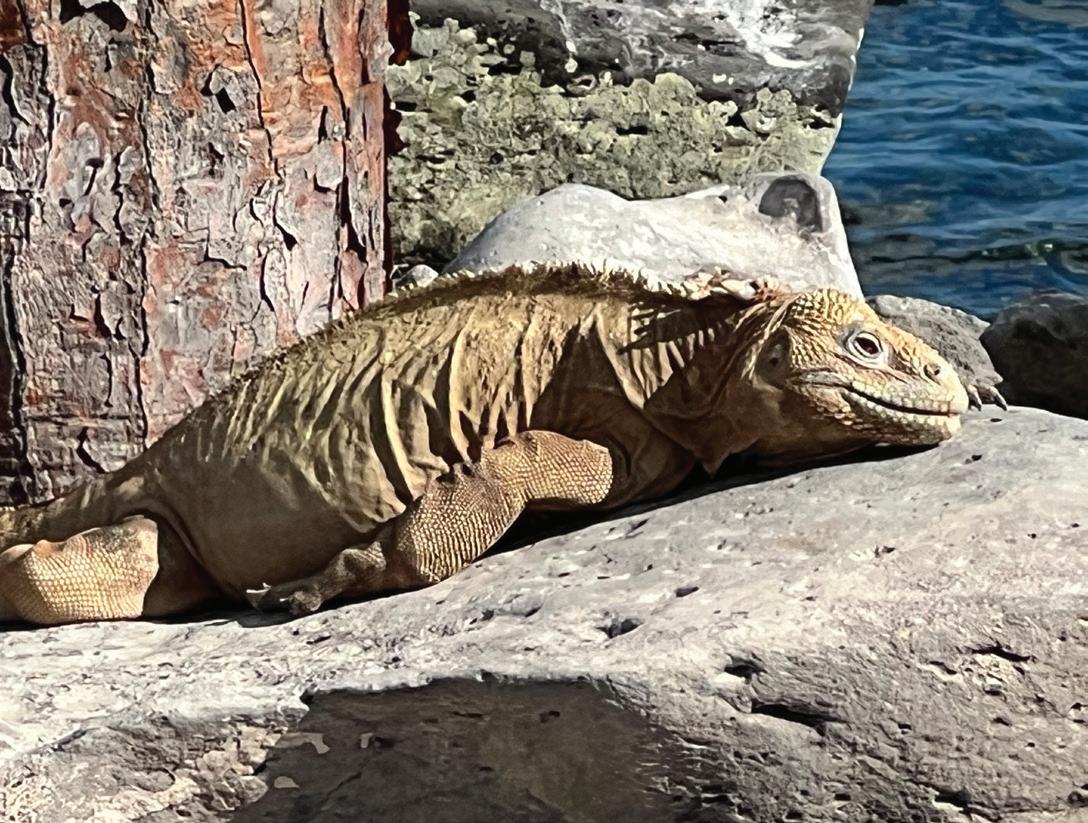
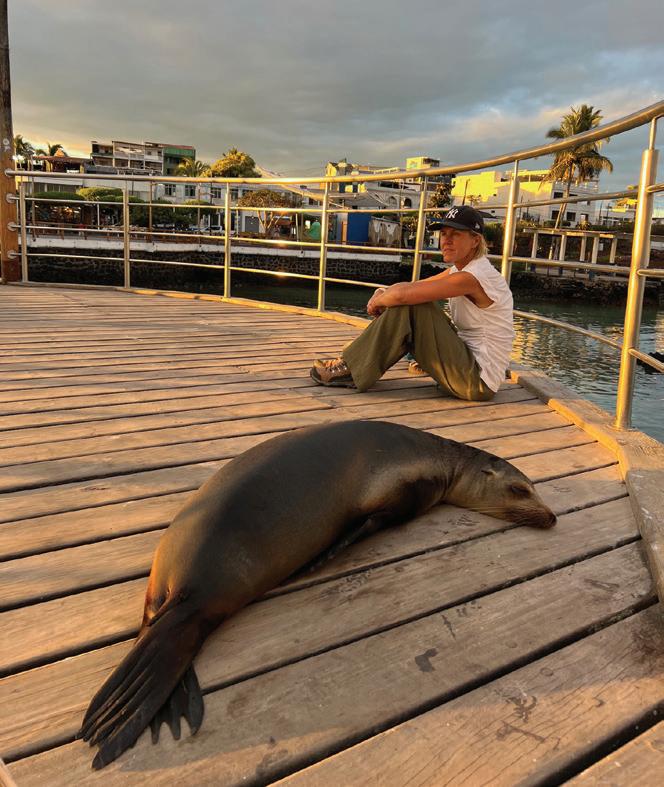
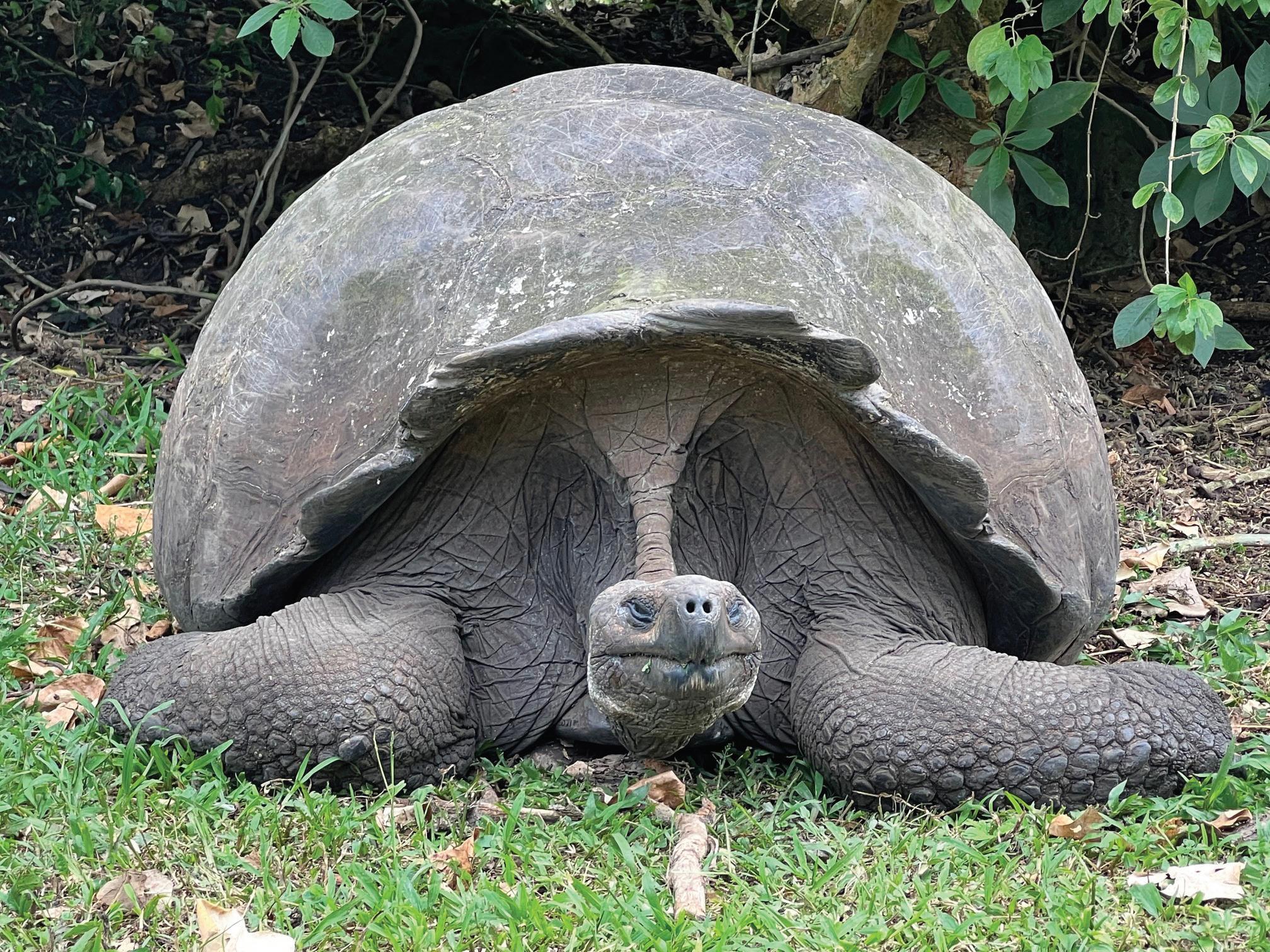
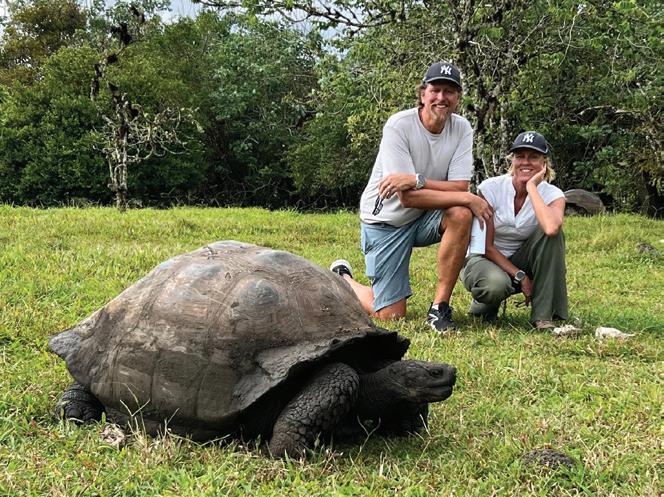
The first hint of the Swedish connection to the Galápagos is the sign at the airport on Baltra Island, wishing me Välkommen in Swedish. As soon as I step outside of the arrivals terminal it becomes clear that this place is like nowhere else I’ve ever been. A massive iguana is casually relaxing on the sidewalk, as though waiting for the bus like the rest of us. When we reach the ferry terminal, all the benches in the waiting area are taken – by sea lions. Arriving on Santa Cruz Island after the short ferry ride across the Itabaca Channel, giant tortoises are everywhere – the island’s population is estimated at 5,000 giant tortoises (up to 20,000 across the entire archipelago). Totally unfazed by our presence they go about their daily business like in a scene out of Zootopia or some other anthropomorphic fantasy film.
This is clearly an animal kingdom and as visitors we have evolution to thank for our hosts’ total absence of fear. The Galápagos evolved almost entirely without land mammals. The only native terrestrial mammal—the rice rat—was small and non-predatory. Mammals as predators simply didn’t exist. As a result, birds and reptiles never developed an instinctive fear of mammals, leaving them fatally unprepared for the predatory behavior humans and their pets later introduced.
Tomás de Berlanga, a Spanish bishop and Dominican friar, was the
first European known to have set foot on the Galápagos. He reached the archipelago by accident in 1535 when his ship was becalmed while sailing from Panama to Peru. His detailed letter to the King of Spain is the earliest known written record of human contact with the archipelago. In it he describes “tortoises so large that each could carry a man on top of itself” and birds “so silly that they didn’t know how to flee, and many were caught by hand.”
It didn’t take long before human exploitation of the archipelago followed. Tortoises fared the worst. For centuries, the Galápagos were treated as a living larder. From the late 1600s through the 1800s, pirates, sealers, and especially whalers harvested Galápagos giant tortoise in staggering numbers. The tortoises were prized because they could survive for months without food or water, making them ideal live provisions aboard ships. Their meat fed crews, and their fat was rendered into oil for lamps and cooking. This systematic extraction— combined with the later introduction of pigs, goats, rats, and dogs that destroyed eggs, young, and habitat— drove several island tortoise lineages to extinction and reduced others to the brink. By the mid-19th century, the ecological damage was already profound and largely irreversible on some islands.
By the mid-1920s, the era of
whaling was waning, but extractive thinking persisted. In 1925-1928, some 2,000 Norwegians arrived in the Galápagos hoping to industrialize what remained of the islands’ wildlife. They attempted to establish a cannery processing turtle (alongside fish and lobster) and extracting turtle oil. The effort failed quickly: isolation, supply shortages, technical problems, and a catastrophic boiler explosion made the operation untenable. It was a brief and unsuccessful chapter—one of the last attempts to extract oil from turtles. Norway’s real oil boom would come decades later – not from shells, but from the seabed in their own backyard – where Ekofisk oil field was discovered in 1969.
The Galápagos National Park was created in 1959, but in the 1960s Ecuador was still grappling with how to protect the islands and their vulnerable populations of flora and fauna. Enforcement and visitor management were limited.
It would take a Swede to change that. In 1967, Lars-Eric Lindblad organized what is widely regarded as the first expedition cruise to the Galápagos. Lindblad introduced a radically different approach focused on conservation rather than mass tourism. Small groups of visitors would travel with expert naturalist guides, following strict itineraries to approved sites, and adhering to an explicit conservation ethic. Tourists were to be treated
like students of the natural world, and needed to be briefed on wildlife behavior and biosecurity.
Lindblad’s model helped demonstrate that controlled tourism could fund protection rather than undermine it — an idea that later became central to park policy. The model laid the groundwork for modern ecotourism as we know it. Today, sixty years later, Swedes and Swedish companies are still exploring the archipelago with a focus on sustainability.
“For us, it’s the only responsible way to travel,” says Marianne Walsh, founder and CEO of Carpe Adventures, an Uppsala-based, Swedish agency. “I started the company in 2007 out of the conviction that travel should foster understanding and respect for nature, culture, and people — not merely be a form of consumption.”
For Walsh, the Galápagos archipelago holds a special place. “I have visited several times, and each time I am struck by how unique — and at the same time how vulnerable — the ecosystem is. The wildlife, landscapes, and the connection to Darwin’s theory of evolution are truly extraordinary. At the same time, the islands are threatened by climate change, invasive species, illegal fishing, and human impact. Today, at least 150 species are classified as threatened or critically endangered, making conservation efforts crucial,” she says.
Many of Carpe Adventures trips are thematic and knowledge-based, giving participants a deeper understanding of the destination and the challenges it faces. “This approach often leads to a longer-term engagement that continues even after the journey
has ended,” says Walsh.
In Puerto Ayora, on Santa Cruz island, I board one of the expedition cruises co-hosted by Carpe Adventures.
Aboard M/Y Grand Queen Beatriz, I and ten other nature enthusiasts set about exploring the southeastern islands of the Galápagos together.
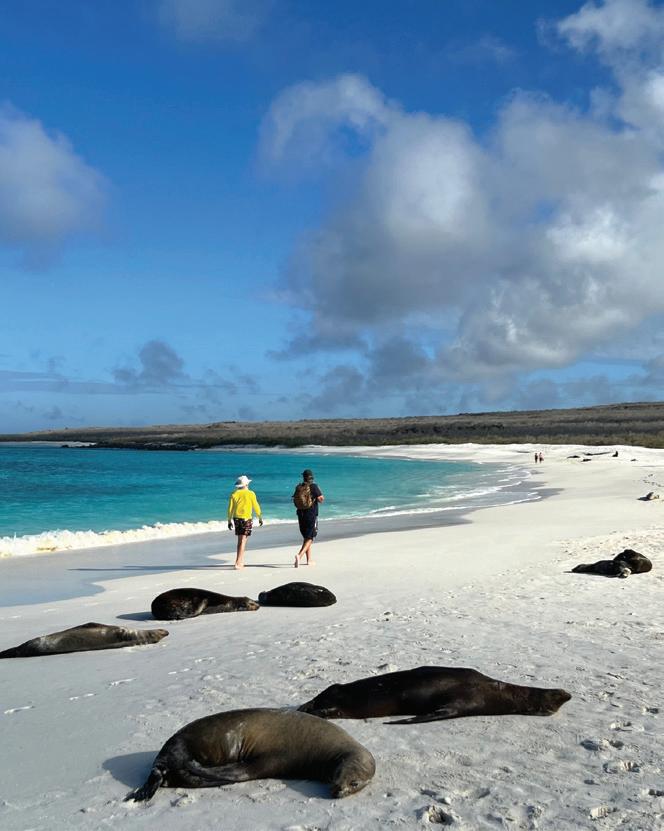
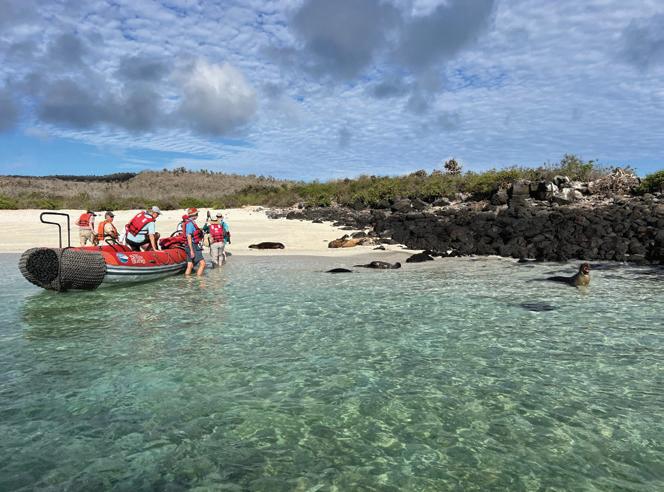
We sail overnight, waking up in Santa Fe island, which is teeming with wildlife. Our dingy cuts through the crystal clear waters towards the white sandy beach where we disembark. The beach is already packed – with sea lions. Visits are regulated and carefully coordinated by the park authorities, assuring our only company are the animal inhabitants, not hordes of other tourists.
Walking through a forest of prickly
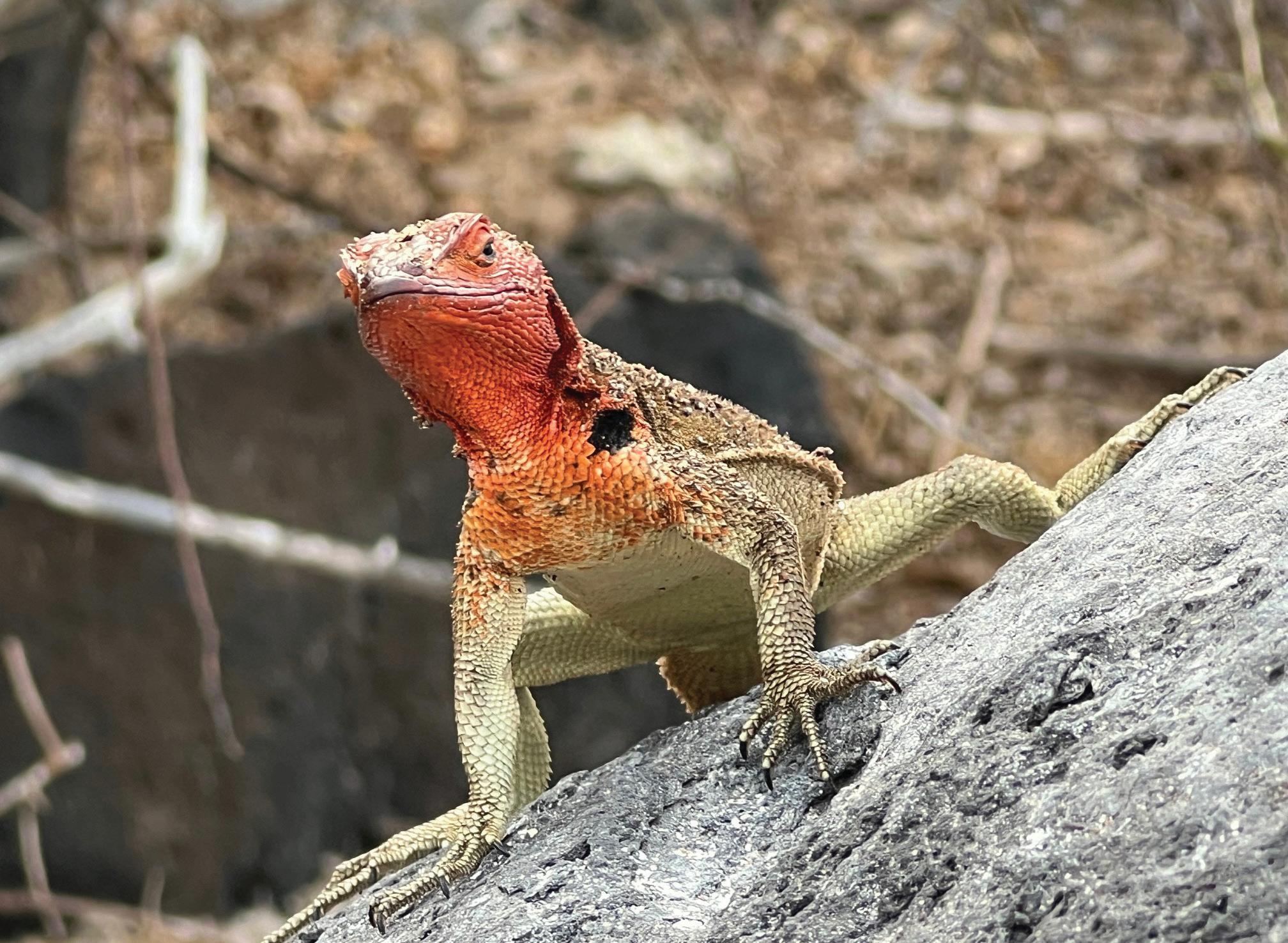
pears, we look for the unique subspecies of land iguana that live here. Within minutes we’ve spotted not only countless land iguanas endemic to Santa Fe, but also Galápagos hawks, Galápagos mockingbirds, frigate birds, Galápagos doves, and lava lizards, fearlessly approaching us from all directions – as curious about us as we are about them. With so much wildlife to enjoy, it’s easy to overlook the smaller and visually less striking finches. But to do so would be a mistake. As any student of Darwin knows, these unassuming birds proved central to the story of evolution.
When Charles Darwin arrived in the Galápagos Islands in 1835 aboard the HMS Beagle, he had no
idea how profoundly the birds of the archipelago would reshape his thinking. His stay lasted little more than a month, and at the time he regarded the Galápagos as curious but harsh—geologically young, sparsely vegetated, and biologically odd. Yet the patterns he encountered here would eventually transform how humanity understands life itself.
Among the scrub and lava fields, he collected a series of small birds— now known collectively as Darwin’s finches. They appeared similar at first glance, but careful study revealed subtle, telling differences. From island to island, finches varied in beak size and shape: thick and powerful for cracking seeds, slender and pointed
for probing insects, elongated for feeding on cactus flowers. The implication was quietly radical. If finches shared a common ancestor, then isolation and environment must have guided their divergence. Food sources, competition, and geography had not merely filtered existing traits—they had actively shaped new ones. Species, Darwin began to see, were not fixed entities but populations capable of change, branching and adapting over time. These insights matured slowly. It would take more than two decades before Darwin published On the Origin of Species in 1859, synthesizing his Galápagos observations with ideas from geology, selective breeding, and population pressure. The finches of
the Galápagos did not offer him a finished theory; they offered a contradiction to prevailing beliefs, the implications of which he would spend the rest of his life carefully articulating—and quietly defending—against a world not yet ready to hear them.
After lunch it is time to put on our snorkeling gear and explore the equally abundant marine life. Marine turtles, white-tipped reef sharks, rays, and schools of colorful tropical fish surround us. Suddenly, a Galápagos sea lion comes shooting past. So slow and clumsy on land, in the water its speed and grace are breathtaking. It’s a juvenile and it is looking to play. As I take a deep breath and dive down to swim alongside it, it begins to spiral and somersault around me, effortlessly weightless, darting close and then vanishing in a flash of silver and shadow. Suddenly it reappears again, seemingly out of nowhere, its barks and clicks ricocheting through the water like laughter. Its eyes, which had appeared an unassuming brown to me when I saw the colony on land, take on a fluorescent, almost supernatural hue underwater, catching and reflecting the blue-green light as it circles me. Our underwater games are so absorbing that I lose all sense of time. When our guide finally signals that it’s time to return to the boat, I resist as instinctively as a six-year-old being called home to dinner from the soccer pitch.
However, new adventures await. We sail to Isla Plaza Sur, home to one of the Galápagos’ largest land iguana populations. The landscape is volcanic, dotted with cacti and colored bright red and green by sesuvium. I take a seat on a rock and while I engage in
a staring contest with a massive land iguana, a mockingbird approaches trying to steal a sip from my water bottle. On the Galápagos, these birds are renowned for their intelligence and curiosity, quick to investigate anything new in an environment where opportunity is fleeting and fresh water scarce.
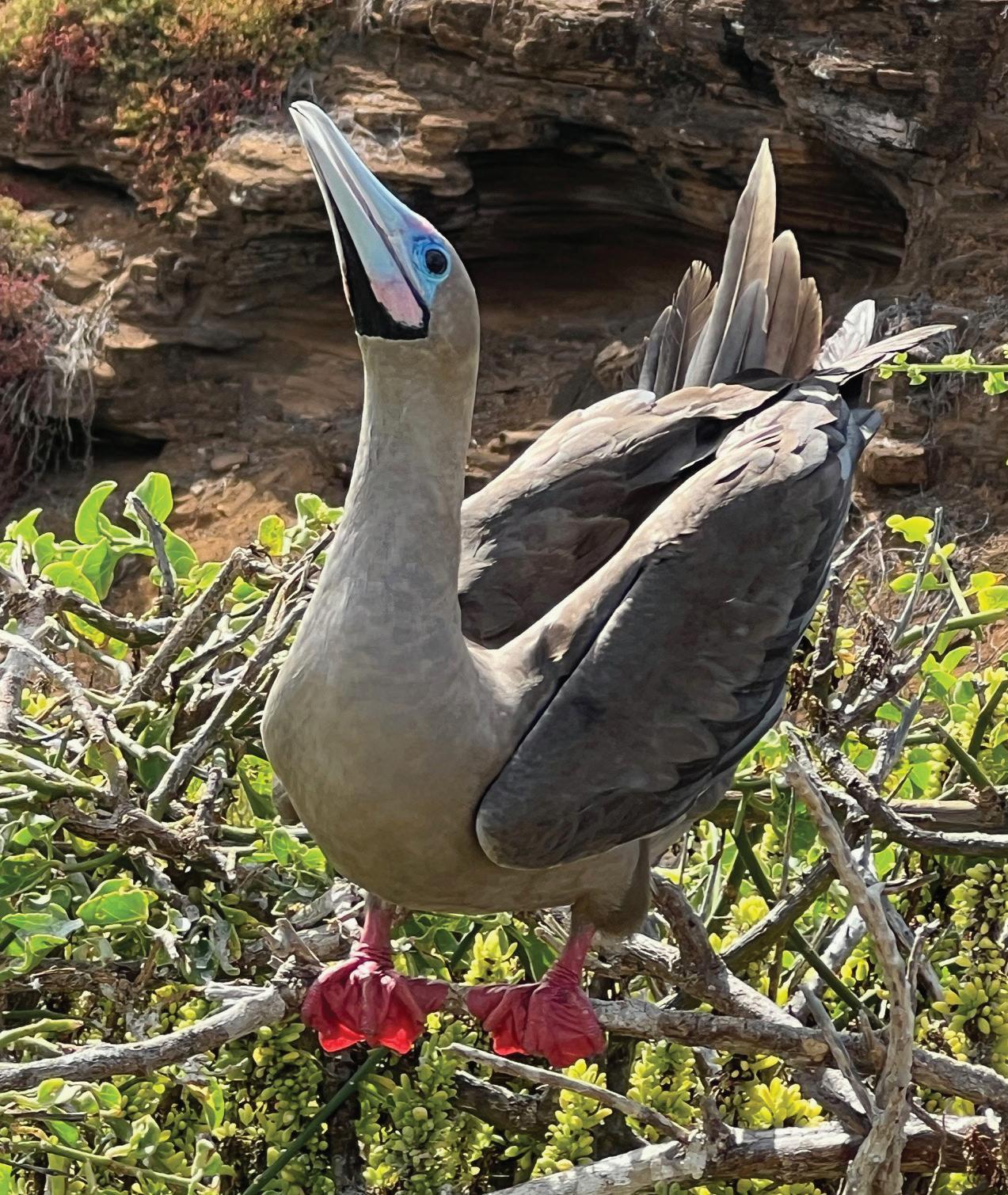
Next stop is Isla Española, the oldest and southernmost island of the Galápagos. Marine iguanas, known as Christmas Iguanas for their bright red and green colors, lie stacked along the shore and Galápagos hawks watch from knee-high perches. Blue-footed boobies nest directly beside visitor trails, completely indifferent to our presence. Their courtship is among the most theatrical in the natural world. Males goose-step across the
lava in an exaggerated high-stepping march, lifting each turquoise foot in turn as if to insist it be admired. The bright turquoise hue is so striking it almost looks artificial, but the brighter the feet, the healthier the bird, and females inspect them carefully.
Further inland, Nazca boobies engage in an elaborate dance that involves mutual sky-pointing, gentle “kissing”, and the offering and accepting of gifts such as feathers. The intimate spectacle unfolds at arm’s length from us, making it feel almost performative, but Roberto, our guide, assures us they couldn’t care less about our presence – it’s as though we were invisible.
Curiously, this dancing ritual occurs after mating, not before. Nazca boobies are strongly monogamous
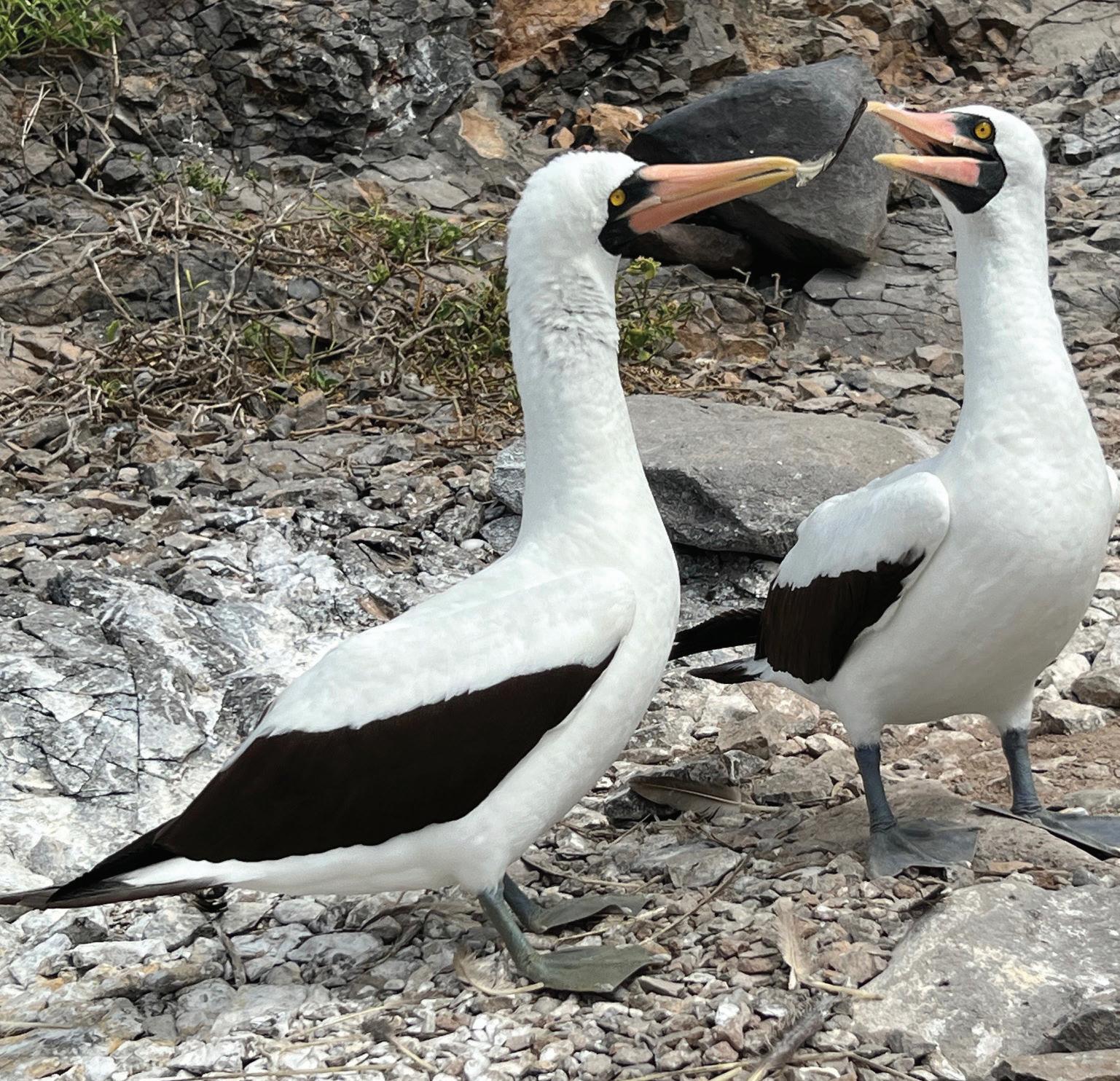
across breeding seasons. Roberto explains that the post-mating displays function less as seduction and more as memory-making—a way to strengthen recognition between partners who may spend months or even years apart at sea. When they return to Española in a future season, this reinforced bond allows them to reunite quickly and proceed directly to breeding, without renegotiating the partnership.
Because of its remote location, Española island has a large population of endemic fauna and is the breeding site for nearly all the 12,000 pairs of waved albatrosses on earth. Most adults depart en masse in late December heading to richer feeding grounds along the Peru-Ecuador upwelling. By mid-January when we arrive, the colonies are usually empty, so as we explore the island, we are not expecting to encounter any.
Then suddenly, at the edge of a cliff, we see it: a single juvenile, the
last albatross left behind. Standing where land gives way to air, repeatedly leaning into the wind, lifting, failing, settling back again. Not yet strong enough, but relentless. Each attempt filled with both hesitation and resolve, torn between instinct and doubt. And then—almost without warning—it succeeds. The wings catch the air, the body rises, and the albatross carves a wide arc above the sea before gliding out toward the open Pacific. We watch as its solitary figure disappears against the horizon, feeling blessed to have been there to witness that irrevocable moment when its childhood ended and a new life of ocean and wind began.
We end our Galápagos adventure in San Cristobal, making one final stop at the island’s interpretive center on our way to the airport. On the wall, a photo of a bird I have not yet spotted captures my attention. It’s a cormorant, with stumped wings, known as
the flightless cormorant.
For thousands of years, the western Galápagos offered the cormorant a rare evolutionary bargain: cold, nutrient-rich waters close to shore; abundant prey; and no land predators. It no longer needed to fly in order to eat or to evade danger…so it didn’t. Over time, the bird grew heavier, its wings shortened, its bones densified, until, one day, it was no longer able to fly.
In recents years, strong El Niño events have warmed the surrounding seas, weakening the upwelling currents and causing fish to retreat to deeper, cooler waters. Flying cormorants elsewhere respond by relocating—sometimes hundreds of kilometers—to find food. The flightless cormorant cannot. It must wait, or starve. During severe El Niño years, its population has crashed dramatically. Climate change now threatens to make such disruptions more frequent. Rising sea temperatures, altered currents, and increasing climatic volatility erode the very stability that once allowed the bird to abandon flight. The same wings that were no longer needed now limit escape, dispersal, and resilience. It acts as a quiet reminder that evolution does not always add. Sometimes it takes away. And, in a changing world, loss is harder to reverse than gain.
Given the species’ small population size and restricted range, extinction will almost certainly arrive long before the bird can regain its lost ability to fly.
In the shrinking wings of the flightless cormorant, we are reminded that adaptation is not always progress, but agreement—an agreement that holds only as long as the world keeps its side of the bargain.
The most famous Swede to ever live in Argentina, beloved troubadour Evert Taube, first reached the shores of South America at a young age. The colors and sounds of the continent would leave an indelible mark on his life and music. Here, Taube discovered the tango which he would go on to adapt and popularize for Swedish audiences.
By Lori Ann Reinhall, incl. song translations
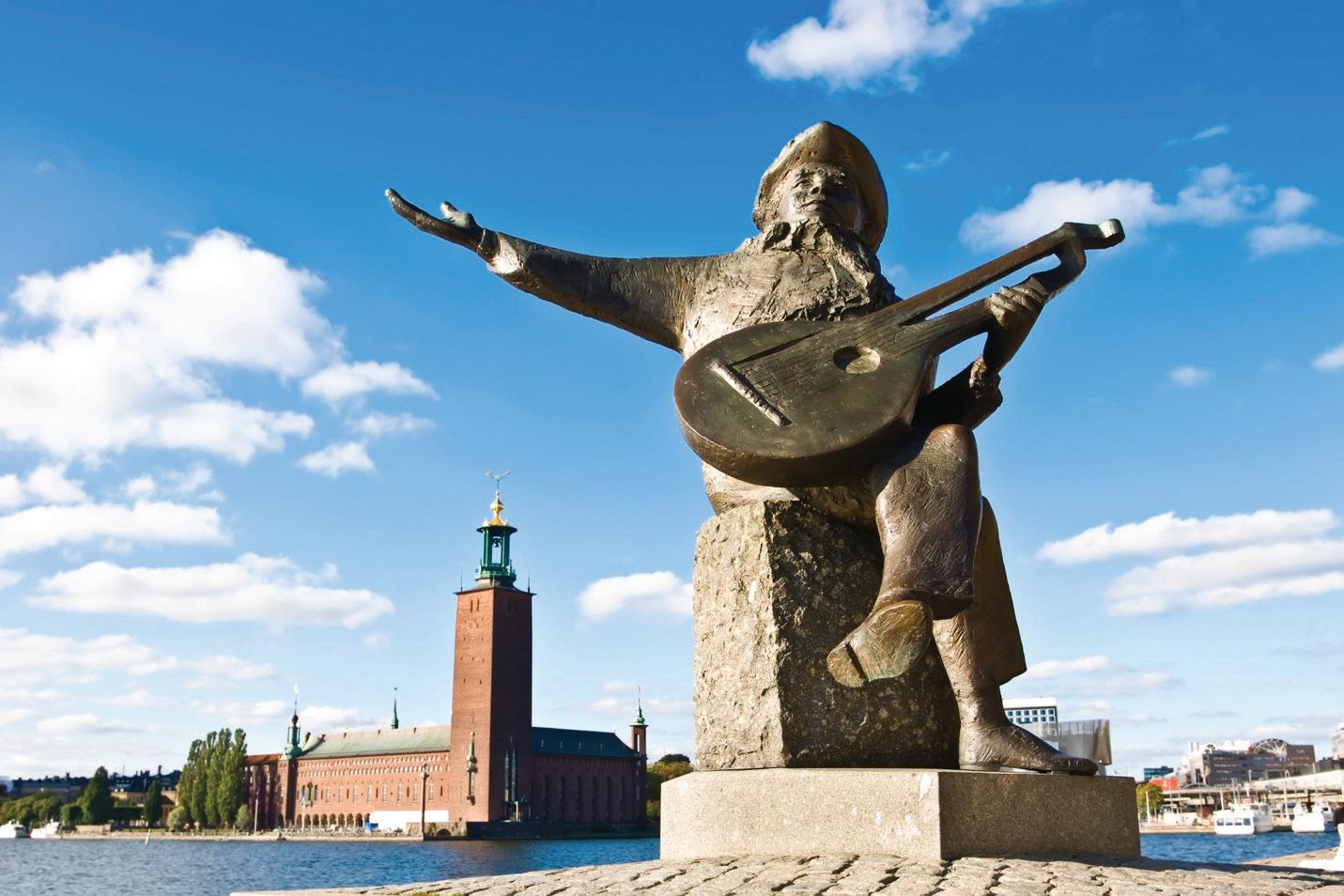
Evert Axel Taube was born in Gothenburg on Sweden’s west coast in 1890 and spent most of his life by the sea. During his lifetime, he would become one of Sweden’s most beloved troubadours, as he depicted the landscape of his home country and the faraway lands that called him.
Taube’s family was part of an untitled branch of the Baltic-German Taube aristocrats, who were inducted into the Swedish House of Nobility in the 17th century. His father, Carl Gunnar Taube, was an educated man and worked as a sea captain and keeper of the lighthouse on the island of Vinga, located near the Gothenburg harbor
entrance.
As a young boy, he received his formal schooling in the island’s little schoolhouse, along with the children of four other families. He also had private lessons at home from his father, who had a strong interest in language, literature, and culture.
Taube’s childhood home has been described as a happy place, filled with children, laughter, music, and stories about exotic places. The family often played instruments and sang together. The 18th-century Stockholm poet and troubadour Carl Michael Bellman was one of their favorites and his influence on the young Taube cannot be overstated.
The plan was for young Evert to conduct his formal studies in Gothenburg, but he failed the entrance exam in mathematics. Instead, he began to study art, and in 1907 he ran away to Stockholm hoping to become an artist. An enthusiastic student, Taube showed talent, but there were far too many distracting enticements in the bustling capital. Wanting to follow in the footsteps of Bellman, on his first night in Stockholm, Taube slept on a park bench next to the poet’s grave. Then there were late nights in the bars, filled with wine, women, and song — all in the spirit of his idol. With time, Taube’s boisterous student days in Stockholm would leave a mark on his work, but they did not make for successful studies. His father refused him permission to stay in Stockholm and gave him the choice to return to Gothenburg or go to sea. It was an easy decision for Taube who set out on a voyage that would take him around the world and change his life.
Love, sunshine, and song
Early on, Taube began singing, collecting, and composing sailor’s songs. One of his first performances was on Christmas Eve 1908 on board the ship SS Bergen as it headed to Spain with the shanty-style song Turalleri eller piken i Hamburg (Turalleri or the girl in Hamburg, released 1921). It set the
Hope you enjoyed this sample of Swedish Press.
To read more, please click the link https://swedishpress.com/ subscription to subscribe.