nordstjernan The Swedish Newspaper of America
Published by Swedish News. Volume 144 No. 07, April 15, 2016. Price per copy $2.50
This Week, Page 10
HRH Princess Sofia in her hometown.
Sweden, Page 2, 3
Viking longship will soon set sail for the New World / Stockholm festival attracts many thousands of licorice lovers / Mortgage terms shortened to just 105 years / Royal birthday celebrations during April / Avicii hangs up his headphones / Industrial unions and employers agree to wage increase
The House that wanted a garden
Photo: Bruno Ehrs
Feature, Page 4
A house isn’t really a home unless it has a garden. Louise Danielsson has devoted herself to creating a garden for the old house her husband, architect Lars Danielsson, has spent years adapting to their own individual needs, like so many home owners do nowadays. / Page 6
Genealogy research reveals a dark family secret in a small Swedish village.
Feature, Page 5
Swedish companies are honored for their high quality.
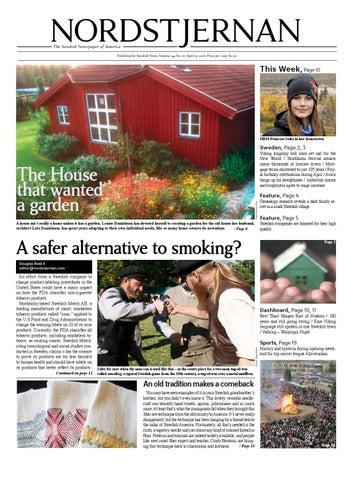
A safer alternative to smoking?
Page 2
Douglas Reid II editor@nordstjernan.com
Continued on page 12
Dashboard, Page 10, 11
Best Toast Skagen East of Hudson / 100 years and still going strong / Rare Viking language still spoken in one Swedish town / Valborg—Walpurgis Night.
Sports, Page 19
Safer for sure when the snus can is used like this—as the center piece for a two-man tug-of-war called snusdrag, a typical Swedish game from the 19th century, a tug-of-war over a metal snuffbox.
An old tradition makes a comeback You may have seen examples of it in your Swedish grandmother’s kitchen, but you didn’t even know it. This lovely, versatile needlecraft can beautify hand towels, aprons, pillowcases and so much more. At least that’s what the immigrants did when they brought this fiber arts technique from the old country to America. It’s never really disappeared, but the technique has been hanging by a thread below the radar of Swedish America. Fortunately, all that’s needed is the cloth, a tapestry needle and just about any kind of colored thread or floss. Patterns and tutorials are indeed widely available, and people like west coast fiber expert and teacher, Cindy Bentson, are bring/ Page 15 ing this technique back to classrooms and kitchens.
Photo: Telge Glima
An effort from a Swedish company to change product-labeling procedures in the United States could have a major impact on how the FDA classifies non-cigarette tobacco products. Stockholm-based Swedish Match AB, a leading manufacturer of moist, smokeless tobacco products called “snus,” applied to the U.S Food and Drug Administration to change the warning labels on 10 of its snus products. Currently, the FDA classifies all tobacco products, including smokeless tobacco, as causing cancer. Swedish Match, citing toxicological and social studies conducted in Sweden, claims it has the science to prove its products are far less harmful to human health and should have labels on its products that better reflect its products’
History and hysteria during opening weekend for top soccer league Allsvenskan.
Perspectives, Page 11
Living between Russia and the USA...
Page 10
news in brief. page 2
Swedish News
Fripassagerare till Nato. Tryggare kan Sverige vara Gästledare
Sydsvenska Dagbladet 3 April, 2016
Draken Harald Hårfagre, the worlds largest Viking ship built in modern times, will sail from her homeport in Norway in a voyage that mimics that of Viking explorer Leif Erickson.
Draken Harald Hårfagre is in the water
Slightly ahead of schedule, the Viking longship Draken Harald Hårfagre will set sail from Norway on April 24, retracing the route of the first transatlantic crossing of the Vikings more than 1000 years ago. Aiming to arrive in the “New World” in mid-June, Draken will head across the Atlantic Ocean via Iceland, Greenland and Newfoundland, then stop in various ports along the St. Lawrence Seaway and the Great Lakes. Depending on weather conditions, the Draken crew expects to be in Toronto by July 1, Airport Harbor in Lake Eire on July 8, Bay City Tall Ships Celebration on Lake Huron July 15-17, then in Lake Michigan at Navy Pier in Chicago at the end of July and Green Bay’s Tall Ships Festival by August 5, then the Lake Superior Tall Ships Festival in Duluth on August 18-21. From there Draken will sail back through the lakes and New York canals to the Hudson River in mid-September. Draken will spend the winter in Mystic Seaport in Connecticut.
Licorice lovers unite in Stockholm
Having a passion for black licorice may be a telltale sign that a person hails from Scandinavia — the special candy flavored by anise just isn’t as popular outside the Nordic region and Europe in general. In Sweden? An entire day every week is set aside for the stuff. Well, any candy can be eaten on Saturdays, but lakrits is definitely a huge part of the lördagsgodis tradition. And for the eighth year in a row, an entire festival is given to it: the 2016 Liquorice Festival takes place on April 23-24 at the Ericsson Globe in Stockholm. It is the world’s largest licorice party, which last year was attended by 11,000 visitors from around the world. With more than 50 exhibitors, taste experiences, voting for the best licorice product, exciting activities and new discoveries in the production of licorice, it’s a must-do event for any licorice lover.
Den amerikanske presidentaspiranten Donald Trump fortsätter att skapa rubriker, i lördags genom att förorda att Natomedlemmar som inte bär sin del av de militära kostnaderna – också retroaktivt – ska kastas ut ur försvarsalliansen. Om det innebär att Nato slås sönder, så får den väl slås sönder, resonerade han i sedvanlig bulldozerstil. Men till saken hör att även en mer nyanserad och betydligt mäktigare person nyligen har berört ämnet. I senaste nummer av tidskriften The Atlantic talar USA:s president Barack Obama om sin syn på “fripassagerare” i försvarssammanhang. Han satte nyligen press på Storbritanniens premiärminister David Cameron i frågan, varpå de brittiska försvarssatsningarna utökades. I helgen kom också nya uppgifter om Sveriges relation till alliansen. SVT intervjuade överstelöjtnant Ed Spinelli, hög befälhavare för Natos övervakningsoch stridsledningsflyg i Europa. Han berättar bland annat att Nato i förväg varnade om vad som var på gång inför den så kallade ryska påsken 2013, då ryskt bombflyg övade anfall mot strategiska svenska mål. Tidigare har det uppgetts att det var svensk luftövervakning som upptäckte övningen. Men trots den tidiga varningen skickade Sverige inte stridsflyg för att möta
de ryska planen. Det gjorde istället Nato, uppger Spinelli till SVT: “Jag vet att Nato skickade upp stridsflyg för att Sverige inte kunde göra det.”, Fripassagerare var ordet. Spinelli framhöll visserligen händelsen som ett gott exempel på det nära svenska samarbetet med försvarsalliansen. Men han pekade också på fördelarna om Sverige skulle välja att ta steget fullt ut och bli Natomedlem. Svensk militär skulle omedelbart kunna få del av spaningsinformation, utan att den tog omvägar eller påverkades av sekretess. Det är inte svårt att se lägen då detta skulle kunna vara en stor fördel. Rysslands militära aktivitet i Sveriges närområde har ökat tydligt på senare år. Och inte bara i luften. Enligt Natos bedömning är den ryska ubåtsaktiviteten nu på lika hög nivå som under kalla kriget. Möjligen är det en förklaring till vad danska Jyllands-Postenuppmärksammade på söndagen. Vid två tillfällen under det senaste året anses främmande ubåtar ha kränkt danska territorialvatten. Ögonvittnesskildringar tyder till exempel på att det fanns en miniubåt vid Bornholm i fjol. Enligt en rapport ska ett forskningsfartyg också ha tagit en bild av ett “120 meter långt massivt objekt” utanför Kalundborg på västra Själland. Det är talande hur konteramiral Nils Christian Wang uttalar sig i JyllandsPosten om Rysslands närhet till “Nato, Sverige och Finland”. Ur svensk synvinkelkan det stundtals vara lätt att missa att
det är så Norden ser ut, försvarspolitiskt. Genom ländernas strategiska läge fyllde svensk och finsk alliansfrihet en gång en viktig funktion. Men tiderna förändras. Finlands regering har därför beslutat att låta utreda vad ett Natomedlemskap skulle innebära i praktiken. Trots en mycket nära relation till försvarsalliansen vägrar Sveriges regering alltjämt att göra detsamma. Tyvärr – endast utifrån gedigna fakta går det att ta ställning till om och i så fall när det finns skäl att ompröva den militära alliansfriheten. Dessvärre kan det inte uteslutas att det uppstår ett läge där frågan ställs på sin spets. “Det faktum att Sverige i högre grad än tidigare befinner sig i en säkerhetspolitisk frontzon påverkar Sveriges militärstrategiska läge”, hette det i fjolårets försvarsbeslut. SVT:s uppgifter om turerna vid den ryska påsken visar vad Nato bidrar med till svenskt militärt försvar. Men vad bidrar Sverige med i gengäld? Uppenbart retar sig Barack Obama på Natoländer som satsar för lite på den gemensamma försvarsförmågan. Det påminner om att det kan uppstå en diskussion inom Nato om fripassagerare, oavsett om Donald Trump kommer till makten. I relationen till försvarsalliansen får dagens Sverige visserligen beskrivas som en nära vän. Men även vänner kan bli påfrestande i längden om de räknar med att få hjälp, utan att visa verklig vilja till motprestationer.
The stories, the traditions, the people behind the news — NORDSTJERNAN A tradition since 1872, covering three worlds: Sweden, America, and Swedish America order your own copy, $55.00 for a year (22 issues) at www. nordstjernan.com—choose 'subscribe' or call 1.800.827.9333 x10
Sweden cuts mortgage terms
Finding housing in Sweden can be a lengthy process that involves wait lists and years of planning. House prices are high and a number of banks and analysts have warned that Sweden’s housing market is overheating, perhaps headed to a bubble not unlike the one the U.S. saw in 2008. Prices have continued to rise in part because Sweden’s lending policies have traditionally been quite generous. As prices rose, banks responded by extending mortgage terms without a limit — a not uncommon term was reportedly 140 years. The practice developed as a strategy to cope with the high property prices since a longer term means monthly payments are lower. Nearly one-third of mortgages issued in 2014 allowed borrowers to repay only interest. But inheritors are left with repaying the balance of the mortgage and are often forced to sell the home. Sweden now appears to be reining in mortgage availability and restrictions with terms requiring homebuyers to clear the debt — according to a new law mortgages will have a 105year repayment limit and borrowers will be required to reimburse a minimum amount of the loan capital each year, after a five-year grace period on loans for new homes.
Nordstjernan, April 15, 2016
Founded in New York City in September 1872 Editor In Chief & Publisher: Ulf Barslund Mårtensson – www.nordstjernan.com Editor: Amanda Olson Robison (editor@nordstjernan.com) Managing Editor & Production: Everett Martin Sports Editor: Chipp Reid Art Direction: Petter Ringbom / Daniel Berubé-Arbello Contributors: Valorie Arrowsmith - Terry Lee Blunk - Claes Magnusson - Lisa Mikulski - Ulf Nilson Kristina Hall - Leif Rosqvist - Ulf Kirchdorfer - Ted Olsson - Jeanne Eriksson Widman - Olle Wijkström - Bo Zaunders Publications Director: Mette Barslund Mårtensson (mette@nordstjernan.com; 800.827.9333 x12) Nordstjernan (ISSN 1059-7670) is published by Swedish News, Inc., 570 Lexington Ave, New York, NY 10022 • Connecticut - P.O. Box 1710, New Canaan, CT 06840 Periodicals Postage paid at New York, NY, and additional mailing offices. Nordstjernan is published semi-monthly, except for the month of August. Post Master: Please send address changes to Nordstjernan, P.O. Box 1710, New Canaan, CT 06840 Subscription rates: 1 yr. - $55, - Two yr. - $99 - Outside US 1 yr. $167.
Contact us at 1.800.827.9333 — ext 10 for Reader services, ext 12 for advertising URL: www.nordstjernan.com email: subs@nordstjernan.com East coast local number: 203.299.0380 West coast: 1.800.827.9333
News in brief. page 3
read a brief interview with “our” Deputy Secretary-General Jan Eliasson in a Swedish paper the other day. He was in Stockholm with UN High Commissioner Filippo Grandi for toplevel meetings with representatives of around 40 nations about the prevention of conflicts and peacekeeping dialogue in the world. In an interview with Dagens Nyheter he voiced frustration over the prolonged conflict in Syria and felt the war had not been good for the UN’s reputation. “The war in Syria has been a burden to the United Nations. We do everything we can to push forward, although for a long time without support from the Security Council. The United Nations will only be as strong as the member states want it to be,” Eliasson said. He was concerned about the new agreement between EU and Turkey about sending refugees back to camps in Turkey. “The important Refugee Convention of 1951 and the additional protocols of 1967 must characterize our work,” he said, stressing that “Europe has to have a comprehensive policy, must share the responsibility [among member states]. This concerns about a million refugees that could be absorbed by a population of 500 million in the EU. It is a challenge the EU must meet.” I’m reminded how, while the UN has its faults and problems, under the present situation in the world nothing can be solved without working together. Last year’s 160,000 migrants and the continued pressure on housing, schools and basic needs have created a debate about the amount of asylum seekers coming to Sweden. In Sweden, in Europe and in the world. In this debate, many in Sweden defend the right to asylum. It is considered a human right to seek asylum in Sweden and therefore nothing can be done about the large number of asylum seekers. Understanding this view to be the most moral could be
questioned based on the small number of so-called quota refugees Sweden receives. A quota refugee is a person who receives a residence permit in Sweden by UNHCR resettlement programs. These are people who Sweden accepts directly from UN refugee camps. Their asylum status has been investigated by the United Nations and therefore permanent residency can be administered immediately. Asylum refugees are those who receive a residence permit in Sweden after having arrived on their own and have their asylum applications examined by the Migration Board in Sweden. Already in 2014 Sweden had 81,301 asylum seekers. Of these, 33,049 received permanent residence; the majority, however, did not. The number of quota refugees in the same year was 1,971, a number that has been constant since 2011. Accepting quota refugees is a humanitarian effort organized by the UN, and accepting resettlements has been part of Sweden’s policy since 1950 (although low per capita, the U.S. receives the highest number of quota refugees in the world). However, only a small number of nations take part in UNHCR resettlement programs, meaning they are accepting refugees in quotas on an annual basis. There’s a growing gap between resettlement needs and available nations in the world. Sweden thus gives residence permits to many more refugees who arrive on their own than to those who come from UN refugee camps. And since Sweden receives far more asylum seekers than any other European country per capita, it is an expensive process that puts stress on the migration authorities, on Swedish municipalities and it has created opposition in large sections of the population. The policy of Sweden could even be said to prioritize asylum seekers rather than quota refugees. A strange policy when you look at statistics:
Quota refugee: person whom the United Nations High Commissioner for Refugees (UNHCR) has designated as refugees or other foreigners who are in need of international protection for resettlement. • The quota refugees’ refugee status is investigated by the UNHCR (ie the UN). They won’t have to stay in asylum accommodations in Sweden for several months before being granted residence permits. They can be resettled in an organized way almost upon arrival. • Quota refugees all have a known identity. They have their papers in order. The Swedish Migration Board does not have to investigate who a person is, the person’s age or which country he or she come from. • UNHCR’s resettlement program has a significantly better gender distribution than the Swedish asylum refugees have had in recent years. • Quota refugees are retrieved from the refugee camps and are not forced to travel with smugglers. Sweden’s present policy seems to give priority to men with money without documents, while poor women with identification documents will remain in the UN refugee camps. The system with quota refugees is legally safe, cheaper and more equitable toward vulnerable groups than the present Swedish system. The UN with all its faults, bureaucracy and politics, just like EU, is what we have. Let’s hope we make the most of it. To paraphrase Eliasson, any organization will only be as strong as the members want it to be.
Ulf Barslund Mårtensson Editor & Publisher
Lars Gustafsson, scholar, poet and storyteller, has passed away May 17, 1936 - April 3, 2016. Lars Gustafsson photographed left by Henrik Olund at the renowned Algonquin round table where he would have felt perfectly at home with the “Vicious Circle” in the 1920s. He was born in Västerås, a city in central Sweden, in 1936. He studied at Uppsala University and at Magdalen College, Oxford, and was awarded his Ph.D. in Theoretical Philosophy in 1978. Along the way, Gustafsson picked up a number of prizes and awards, including the John Simon Guggenheim Memorial Fellow of Poetry in 1994, and the Italian Una vita per la Leitteratura in 1989, and he was a member of several academies, like Akademie der Wissenschaften und der Literatur and the Royal Swedish Academy of Engineering. And though a heavy intellectuality is present in many of his books, it never weighs
down the plot. Above all, Gustafsson was a masterful storyteller, an internationally celebrated writer whose books have been translated into over 20 languages. What few Americans know, is that they, too, in a way, can claim him as theirs: Lars Gustafsson spent over twenty years in a fruitful exile, teaching philosophy at the University of Texas at Austin. Gustafsson on his most well-known book, Death of a Beekeeper - “It’s a book about pain. It describes a journey into the center where pain rules, and pain can tolerate no rivals,” Gustafsson explains. “Myself, I haven’t really experienced much pain beyond the occasional dentist’s visit, but the idea was to write something in a very minimalist way. Many artists and composers work like that. It was a hard book to write but I still wrote it fairly quickly.”
Life made Sweder through NORDSTJERNAN: Call 1.800.827.9333 ext. 10, to order.
Swedish News
King Carl XVI Gustaf’s 70th birthday is April 30, and celebrations are planned for the whole week of April 25-30.
Royal birthday celebrations in April
As we await the April birth of Prince Carl Philip and Princess Sofia’s first child, who is King Carl XVI Gustaf and Queen Silvia’s fifth grandchild (all were born in the last four years), the royal house is planning the jubilee celebration of the King’s 70th birthday. He was born on April 30, 1946, the fifth child and first son of Prince Gustaf Adolf and Princess Sibylla, and was crowned king at age 27 in September 1973. Special celebrations are planned for the entire week of April 25-30, with concerts and special receptions in his honor, a new “Bernadotte Program” that highlights history of the royal family with music and the distribution of scholarships at the Royal Opera, a celebration at the Nordic Museum and a Te Deum thanksgiving service on the 30th itself. That day the Swedish Armed Forces congratulate the King with a choral tribute and the changing of the guard, and he and the Queen parade through the city in horse and carriage for a luncheon at City Hall, capping off the celebrations with a dinner banquet at the Royal Palace. Gifts, greetings and congratulations can be offered in various ways, including via social media with the official hashtag: #Kungen70
Avicii to hang up the headphones
Swedish superstar DJ Tim ‘Avicii’ Bergling says he will quit touring. In a lengthy message posted on his website on March 29, the Swedish house DJ announced his decision and while he will continue to make music, he has decided “this 2016 run will be my last tour and last shows.” “Two weeks ago, I took the time to drive across the U.S. with my friends and team, to just look and see and think about things in a new way. It really helped me realize that I needed to make the change that I’d been struggling with for a while,” he wrote. His song “Wake Me Up” won the 2014 Billboard Music Award for Top Radio Song and Top Dance/Electronic Song.
Industrial negotiations concluded
Sweden’s industrial unions and the industrial employers agreed to a deal for a 2.2 percent total salary increase over one year, including a 0.2 percent contribution to the part-time pension system. The deal covers some 600,000 workers, was the first agreement to be reached in the collective wage negotiations and sets a benchmark for other sectors. collective wage negotiations and sets a benchmark for other sectors. It was reached in the evening of March 31, hours before the old collective bargaining agreement expired at midnight. The wage agreement reached between Swedish industrial unions and employers is on the low side of what the Riksbank would have needed in order to reach its 2 percent inflation target, according to several major banks.
The Exchange Rate: $1.00 = SEK 8.14 04.06.2016
April 15, 2016 Nordstjernan
Photo: Anna-Lena Ahlström/kungahuset.se
I
perspectives.
feature. page 4
Filling the gaps in a dark family history
Nordstjernan, April 15, 2016
sense to the story. “Washington, DC is a big city where people live semi-anonymously. It contrasts significantly with coming to a small village in Västergötland, Western Sweden. People approach me and ask, “Are you the one who’s related to Ingeborg?” The story has now given rise to a manuscript titled Let the Children Come to Me, reflecting the inscription on the epitaph. When Ingeborg left the hospital, she moved in with her sister, Maria’s grandmother, and family. Her then peaceful life included needlework and handicrafts, bike rides and bus tours with the local village sewing community. But, in her final years, she returned to the institution. “Perhaps the memories caught up with her. Perhaps it’s why she would often scream for help at the nursing home. We’ll never know.” With all her research, Maria has learned much about her own family history. “Deep fear of mental illness gripped my family, making it a sensitive topic that everyone avoided. Hopefully now we have been liberated.” Maria also hopes that the children’s headstone, still buried in a graveyard in Västergötland, will someday surface. No matter how their lives ended, the marker at least acknowledges their existence and dignifies their lives. By Kerstin Weman Thornell
From her home in Washington, DC, Maria Bouroncle has traced her family history. In her upcoming book, she wants to acknowledge the three children forced to leave life before their time. Photo Kerstin Weman Thornell Right: A young Ingeborg; Far right: A wealthy farmer, Artur moved his bride to a big farm in Vesene in Västergötland.
Translated from Swedish by Juliette Balabanian
Photographs from Bouroncle’s private collection
I visit Maria Bouroncle in her home. Stacks of old photographs mound her dining room table, and after work she pores over them. They take her back in time revealing older relatives, buildings, festivities and day-to-day life in a small Swedish village. The only people missing are three small children — two young boys and a baby girl. Their portraits disappeared and their fates vanished. Until now. For the last few years Maria balanced her work at the Inter-American Development Bank in Washington, DC with filling gaps to this mystery. “It’s almost an obsession,” she says. “In each and every document that I’ve read, I’ve hoped to find an explanation as to why such unfortunate events took place.” Ingeborg, Maria’s great aunt and the mother of the three children, captures her attention. She remembers visiting her at a nursing home in her childhood. But only recently did it dawn on her that Ingeborg once married and lived on a big farm in western Sweden with her husband and three children. On the morning of March 22, 1929, Ingeborg intended to launder the family clothes while her husband Artur and his brother set out to collect firewood from the nearby forest. Before leaving, Artur helped his wife set up the copper wash basin. On his way, he realized he forgot his watch and returned home. There, something terribly odd struck him. The curtains were drawn. Stepping into the kitchen, he saw Ingeborg, head in hands. To his horror, three small, lifeless bodies draped over the basin’s edge. “Ingeborg, what have you done!?” he burst out. Cold silence answered. County authorities responded to the call taking Ingeborg into custody at the small municipality of Vänersborg where she underwent mental examination. When asked to recall the events, she only responded, “I took the eldest first.” Doctors attributed the tragedy to schizophrenia. However, Ingeborg disagreed. “No, I am the only one responsible, and I am prepared to take the punishment.” The clinicians institutionalized her in Restad Hospital. In her home village, the traumatized ran from farm to farm seeking solace among them and demanding an explanation. As answers failed to surface, people repressed their thoughts. And Artur buried the gravestone and his children’s names along with it. “They were erased from history. Perhaps that was the only way people could continue their lives,” says Maria. Initially, Maria contacted older relatives back home in Sweden. She then began combing through public archives, interrogation protocols and medical records. Over the past two years, Maria identified and visited the places where Ingeborg trod to make further
For the last 14 years, Maria Bouroncle, a native Swede, has been living in Washington, DC. Like many of us, she has been intrigued by genealogy and tracing her family tree. But her research drew her back across the Atlantic after she got wind of a disturbing event in her family’s past which lay hidden for several generations.
Easter Monday, 1929, Västergötland, Sweden. Three small white coffins lay before the altar in Vesene Church. Meanwhile, authorities held a young mother in custody. (Newspaper clipping left). Both Artur and Ingeborg invited family and friends to the funeral ceremony, but only Artur could attend.
feature. page 5
Swedish Quality Award
Warm congratulations to everyone at Volvo Cars factory in Torslanda, Sweden, which received the Swedish Quality Award 2015 in the presence of HM King Carl XVI Gustaf on March 23 at Torslandafabriken.
The Swedish Quality Award has been awarded Volvo Cars Torslanda. It is the 24th consecutive year that the Swedish Institute for Quality (SIQ) shares this award to organizations that show long-term and systematic development to improving quality. “As Economic Development and Innovation Minister, I am delighted that this year’s recipients are Volvo Cars Torslanda,” exclaimed Sweden’s Minister for Enterprise Mikael Damberg. “By constantly being at the forefront of quality work and to think in innovative directions, Volvo Cars has increased its sales and recruited big. A deserved winner, in other words.” Swedish Quality Award is the most prestigious of its kind and is awarded to organizations that demonstrate visible results of successful quality work. The award is intended to support the development of systematic improvement at the organizational level and highlight role models to inspire others, in both the private and public sectors. “The Swedish Quality Award 2015 is a confirmation that the consistent quality work at Torslanda produced results which all employees can be very proud of,” Håkan Samuelsson, president and CEO of Volvo Car Group said.” SIQ primarily awards the Swedish Quality Award. In some cases recognition for successful business development is awarded to
Vi har öppet måndag till fredag kl 9:30 till 15:00 Den mobila passtationen är i Fort Lauderdale den 13 - 15 september. Kontakta konsulatet för mera information.
Välkommen! Consulate of Sweden Tower 101, 101 NE 3rd Avenue, Suite 1700B Fort Lauderdale, FL 33301 Phone: +1 954 467 3507 Fax:+1 954 467 1731 fortlauderdale@consulateofsweden.org www.consulateofsweden-fortlauderdale.org Like us on Facebook
The IKEA vision is to create a better everyday life for everyone — the people who buy their affordable, functional home furnishing products as well as all the employees who make that happen. Not only are they making their vision a reality, but they are winning awards for doing it so well.
The best places to work L-R: Håkan Samuelsson, CEO Volvo Car Group, Michael Gustavsson, Manager Torslanda factory, HRH Carl XVI Gustaf, Jan Sundling Chairman SIQ. Image courtesy of SIQ. Photo: Tommy Holl/Stella Pictures
organizations that are well on track in their quality work. This year two organizations were recognized: Condorens Preschools in Nacka and the Universeum Science Centre in Gothenburg. “It is gratifying that the Swedish Quality Award 2015 was assigned to an international player such as Volvo Car Group … an organization that uses Business Excellence as a management philosophy, which through its systematic quality work have been able to develop the organization’s approach to achieve world class. Volvo Car Group exemplifies the effects of successful quality work and is an inspiration for more organizations to develop with the support of quality,” said Jan Sundling, chairman of the SIQ.
Life made Sweder Call 1.800.827.9333 ext. 10 for your own subscription. NORDSTJERNAN
For 19 years Fortune magazine has been ranking America’s 100 greatest places to work, an honor which measures a corporate culture of fairness, employee engagement and talent development within companies across the nation. Its unique method of comparison is based on credibility, respect, fairness, pride and camaraderie and includes an employee survey and in-depth questionnaire about their programs and company practices. The 2016 Fortune 100 Best Companies to Work For was announced on March 3, listing IKEA U.S. among the top places to work. According to a press release out of the U.S. headquarters of the giant Sweden-based home furnishing company in Conshohocken, Pennsylvania, IKEA U.S. President Lars Petersson thanked his entire American staff of 14,000 employees in its 41 stores for their contributions in making IKEA a great place to work. He said, “It’s gratifying that our unique culture and values, together with the investments that we’ve made in our co-workers, help to make working at IKEA a great experience for co-workers. And happy co-workers contribute to a good shopping experience for our customers.” That unique culture played strong in IKEA’s win. The company, which came to the U.S. in 1985 and now banks $5 billion
in U.S. sales (and $36 billion world wide), works hard to ensure that employees live the company’s Swedish values of humbleness, willpower, simplicity, togetherness and enthusiasm. All employees receive the “Little Ikea Dictionary” to remind them of these values. Praised for its egalitarian culture, IKEA provides full benefits to workers who put in 20 hours or more per week, implements a minimum wage structure based on the local living costs instead of the cost of labor and offers retirement bonuses. An emphasis on the Scandinavian ideals of the work-life balance, which discourages workaholics and encourages weeks of paid time off, is reflected in their rate of retention: The average tenure of an IKEA co-worker is 5 years, which is well above the industry and U.S. workforce average of 3.3 years. IKEA U.S. was also recently recognized as a great place to work on Fortune 20 Best Workplaces Retail list. Additionally, IKEA was third on the CareerBliss “Happiest Retailers to Work For” list and, as a company that incorporates sustainability into day-to-day business and supports initiatives that benefit the environment and children, IKEA was also recently recognized by the Human Rights Campaign Foundation with a perfect score on the 2016 Corporate Equality Index.
Reminder to send in your application for the SWEA NJ Scholarship! The Swedish Women’s Educational Association, New Jersey Chapter (SWEA NJ) scholarship amounts to a total of $6,000 each year. The scholarship can be awarded in whole or in part to qualified individuals, preferably residents of New Jersey or the Tri-State area, who are pursuing academic or professional studies or artistic endeavors pertaining to Sweden. The area of study
may include, but is not limited to, Swedish culture, history, music, visual or performing arts, literature, media, science or the environment. Deadline to apply is May 1, 2016. Scholarship(s) will be awarded in June. For application forms, visit http://newjersey.swea.org/apply-for-scholarship April 15, 2016 Nordstjernan
feature. page 6
A Tale of Organic Growth While researching summerhouses and early eco building trends in Scandinavia, we came across the book “Eco-Building: A Sustainable Lifestyle,” which tells the story of the construction of two pioneering housing developments in Stockholm and Uppsala. Next to it, we found another example of an “alternative lifestyle” on a much smaller scale. It is the story of a couple coping with the changing terms of society in their own individual way. They too published a book, “The House That Wanted A Garden — a Home in the World,” which was released in 2003 in both Swedish and English by Frommens Publishing. The book offers a couple’s life journey in a house that started as a summer house and later became their main domicile and life project. We searched for it but the book is now out of print and out of stock — which is unfortunate, since Lars and Louise Danielsson’s book is of interest to American readers, and because Lars, an architect, identifies Frank Lloyd Wright as one of his role models. The book also offers opportunities for and acceptance of unique and far from middle-of-the road housing solutions, which are much wider in the U.S. than they have ever been in Scandinavia. The authors seem to convey that where there’s a will, there’s a way, as long as you are willing to adapt, adopt and accept mistakes along the way. Their story is brought to life by renowned photographer Bruno Helgesson. Jan Danielson’s preface calls this an adventure book, and we agree: We invite you to enjoy part of the adventure here through Helgesson’s lens. The House That Wanted A Garden – A Home in the World 186 pages. By Lars and Louise Danielsson. Photos: Bruno Helgesson. Editor: Margareta Artéus Thor. Preface: Jan Danielson. Publisher: Frommens Förlag, Fagerhult. ISBN: 9789197465618
From the author, Lars Danielsson:
A house should grow from its site Our house was built in stages over many years. It is located in rural Småland, the highlands of southern Sweden. In 1976, we had moved an old summer cottage to the site. The cottage was our children’s playhouse until 1980, when we expanded and converted it into our family home, with an office for me. We added another addition in 1992, and four years later came the covered outdoor patio and the grandchildren’s attic, which we call the “Room For Small People.” I wanted to make our house expressive and graceful, like a plant growing naturally from the ground. A house should belong to the surrounding community. Each room needs to have its own character. Room design, sunlight, materials and colors were the instruments with which I wanted to compose a song — or at least a little tune — for the world. I have an old-fashioned faith that there is the potential for poetry in even the smallest building project. Over the years, I have enjoyed discussing such issues with visitors. My inspiration has been the branch of modern architecture known as “organic.” My favorite architects are Frank Lloyd Wright, whom I met during a visit to Taliesin East in 1957 (he was 90), and Alvar Aalto of Finland. They and others of the “Organic School” adapt the construction, form and function of their buildings to the inner and outer scale of the human being.
LINGONBERRIES • Fresh Frozen • Dried • Preserves www.sturdiwheat.com
Nordstjernan, April 15, 2016
Our house sits on a slight onemeter slope running from the south side of the house to the north, so as part of our first addition, I lowered the floor level by four steps. The roof was carried straight over from the cottage to the addition, provid-
ing increased ceiling height to the new living room. As the largest room in the house, it demanded extra volume. It was then possible to make the first section of the addition wider than the narrow cottage. The low bay window areas on both sides of the house have sloping ceilings. This articulates the form and light of these smaller rooms. Ceiling heights thus vary from room to room, but are normal on average. A house isn’t really a home unless it has a garden. Since her retirement, my wife, Louise, has devoted herself to creating a garden for our house. An important theme for us has become the interplay of the rooms of the house with the outdoor patio and
the various “green spaces” of the garden. This is the starting point of our book, “The House That Wanted A Garden – A Home in the World.” In it, we also talk about our experiences living in the United States and East Africa. The pictures are taken by our friend Bruno Helgesson, a well-known Swedish nature photographer. We live in forest country. Our house is built of wood. The interior walls are painted with a transparent beeswax lazur. Central heating is provided by a furnace that burns wood pellets. Solar heating panels on the roof provide us with heat and warm water from late May to October. Lars Danielsson, architect
feature. page 7
nected with boating, fishing, hunting and outdoor sports. Natural beauty is key. A respect for nature extends into homes, as well. As it turns out, sustainable, ecological living is no longer limited to “pajama-wearing environmental freaks.” In fact, the
concept of sustainable housing may well be the antidote we seek to the mental side effects of unsustainable urban lifestyles. Utopia or potential reality? The “house that wanted a garden” offers a reality seldom encountered.
Photography: Bruno Ehrs
Nature certainly plays a dominant role in the lives of many Scandinavians. Scandinavia is a region of long coastlines and deep inlets, of thousands and thousands of lakes and rivers, of forests and beaches and an abundance of natural resources. Scandinavians lead active lives con-
The House That Wanted A Garden presents one home’s journey as it organically grows and changes to mirror and sustain the life and expectations of its inhabitants. We can’t all be our own architects. But in the story of this house, and its journey from stony ground to private paradise, lies hope for us all.
April 15, 2016 Nordstjernan
feature. page 8
The story of snus in Sweden and the U.S.
A history of the stuff that’s not snuff In Sweden today, users come from all walks of life. Women are users, too: Nina Persson, lead singer of The Cardigans, Tuva Novotny, one of Sweden’s hot actresses and a former Minister of Health in the Swedish government are all known to be users. All are said to use moist snuff, the special type of tobacco the Swedes — and now Americans — call “snus.” Historically, only two countries in the world have had a hight volume of users of the product. Here’s why. among white-wigged aristocrats throughout Europe’s parlors and palaces, where the elite upper classes sniffed it from fancy jeweled mini-boxes and sneezed it onto lace handkerchiefs. A century later, when the working class folks chopped their revolutionary way through the finest heads in Europe, commoners came to detest snuff as much as they hated their overlords who used it.
Photography: Lisa Mikulski
Sweden discovers tobacco
T
he use of tobacco probably dates back to prehistory, and accounts of its modern origins vary. Rewinding the clock to the sunset of the 1400s, Columbus and those to follow were said to observe the native Arawak Taino people funneling powder into their nostrils using a Y-shaped pipe they called a tabago. The leaf they mulched to create this powder got the same name — anglicized as
Nordstjernan, April 15, 2016
“tobacco.” Another believable explanation of the name focuses on the Italian word tobacco, which existed centuries before Columbus and was used to describe medicinal herbs derived from Oriental leaf mixtures. In any case, when Columbus set foot in the New World, the American-style leaf that’s known today as tobacco had been both chewed and smoked far and wide for
centuries. And within 50 years of its debut in Europe, it was sprouting in home gardens throughout the Iberian Peninsula. Early uses for tobacco included application as an insect repellent, and in medicine it was a cure-all for maladies ranging from headaches to colds to cancer. All used forms of dried and pulverized tobacco, a preparation that was initially sniffed into the nostrils and known as “snuff.” Snuff was all the rage
Tobacco first appeared in Sweden somewhat later, in 1638, when a ship returning to Stockholm brought some back from the Swedish colony on the Delaware River. Ground and dried, tobacco found uses as a medicine by a French physician, Jean Nicot. As a result, the famous Swedish botanist Carl von Linné named the basic substance in tobacco “nicotine” in Nicot’s honor. Tobak became so popular in Sweden that it was a major farm crop within the century. By the end of the 1700s, tobacco was grown in as many as 70 Swedish towns. At that time, the Swedes invented the under-thelip alternative to snuff that is known today as “loose” snus. Rather than being sniffed, the tobacco is instead placed in the mouth against the gum line, where the nicotine is easily absorbed. Snus was originally only sold in the form of a loose, moist powder that can be taken a bit at a time with the fingertips and rolled into a small ball or cylinder (there’s a handy tool available for this today). The end result is often referred to as a pris (pinch) or prilla or prell (slang for pris) and is placed inside the upper lip. The foundation of every snus “recipe” entails choosing the very best tobacco leaves, cutting and running them through a crusher, milling them in a flour-like grinding apparatus, and sifting them over and over to obtain a fine powder. Precise amounts of water and salt are added, the mixture is spread in a flat tray and it is then allowed to “sweat” (age or lightly ferment). This phase of the process, Continues on next page
feature. page 9
conducted in temperature-controlled rooms heated by wood-burning stoves, originally took up to six months. The next step is flavoring — and the lion’s share of any snus’ appeal comes from this part of the process. After a week of sweating, the snus is blended with potash and alum. Depending on the desired taste, further additions could include cognac, whiskey, liquor, ginger or other flavored oils.
Soaring popularity
It wasn’t long before Swedes embraced this new way to enjoy nicotine. Snus became popular and ousted both the politically incorrect snuff as well as more expensive chewing tobacco. Between 1810-1820, snus consumption abruptly rose to dominate the Swedish market’s tastes. Although Sweden isn’t known anymore for growing the crop, tobacco became one of the country’s most important agricultural pursuits, and it remained so until the 19th century. The use of tobacco in various forms continued to grow, and a tax was levied on it to control consumption. The tax was progressive and linked to social rank; nobility, priests and burghers had to pay more to smoke or use snuff than farm hands and maids, for example, while soldiers, boatmen and miners were exempt from the tax. In 1822, Jacob Fredrik Ljunglöf began manufacturing snus with an entirely new production process – one that shorted the fermentation phase down to just one week and would ultimately boost the product’s popularity tremendously. His “Ettan” brand (meaning “Number One” — an indication of its superiority) overtook the Swedish market. Only one producer was larger than Ljunglöf at the turn of the 20th century, and Ettan’s world placement was second; as validation of their firm’s respect, one of its devoted customers was Pope Leo XIII. Today, Stockholm’s Tobacco Museum is home to many of the most popular recipes for snus. Ljunglöf’s Ettan is not one of them, however – the founder’s son withheld it when, in 1916, the entire tobacco industry was nationalized to pay for military and pension costs. Today’s production is said to be a close replica of the original, but according to legend, Ljunglöf burned the only written copy before dying and took the secret with him to the hereafter.
Snus in America
From the mid-1800s to the onslaught of the Great Depression, more than a million Swedes immigrated to America. They brought their yearning for Swedish snus with them (although Ljunglöf’s recipe was a secret that never left Sweden). They commiserated in their letters home. The newspaper “Göteborgs-Posten” in 1869 printed one that stated: “The real trouble for the Swedes [over here] is that tolerable snus can’t be bought for love or money.” Nearly every Swedish enclave in America had its own newspaper, and notices appeared every time a new shipment of snus arrived from Sweden. But that was a rare occasion. Snus was classified as “fresh produce” and had to be
refrigerated or consumed while fresh. Modern Sweden classifies snus as food, and its handling is regulated in the Swedish Food Act. There were no means for adequate preservation during the long Atlantic passage, so few parcels from Sweden could deliver the satisfying enjoyment that Swedish-American customers remembered from “back home.” It was not until metal foil wrapping was invented, and subsequently used by Ljunglöf for his Ettan brand, that reasonably fresh Swedish snus finally reached the Atlantic port cities of America. Still, fond memories of fresh Swedish snus did not deter Swedes from attempting to produce their own varieties. After all, the tobacco in Ljunglöf’s snus came from Virginia! But the trick of treating and preparing it defied repetition, even by American tobacco companies, who resorted to adopting Swedish brand names or buying existing factories for such brands as “Copenhagen” or “Red Seal” (the latter, under the brand Röda Lacket, is one of Sweden’s most popular brands to this day). Still, their efforts fell far short of matching the taste of the original, authentic snus. Despite complaints about poor quality by Swedish-American snus consumers from coast to coast, they nonetheless continued buying and trying new versions of the product, and did so in astounding volumes. Literal rivers of snus were flowing throughout North America — the aftermath of consuming and flinging aside the product. In Chicago, Swedes concentrated in a neighborhood along Chicago Avenue, and snus usage was so abundant that the street was nicknamed “Snoose Boulevard.” Snus-using throngs of thousands of Swedes crowded here in the 1800s as they stopped-over in their quest for opportunities elsewhere in the prairie or western states. Between the boarded sidewalks that paralleled railroad tracks in the middle of the street grew heaps of discarded snus remains. It is repulsive to imagine how the stench and mire must have wrinkled the noses of non-Swedish passersby, especially during Chicago’s sultry summer months. Neighborhoods in Jamestown, Seattle, Vancouver, Winnipeg and other towns that supported sufficiently large Swedish populations also had their own “Snoose Boulevards.” Probably the most colorful were Payne Avenue in St. Paul and Cedar Avenue in Minneapolis. In the heart of what had become America’s “Swedish Metropolis,” Cedar Avenue was a real civic entertainment center that offered attractions such as dance halls, billiard parlors, saloons, stage performers and shows from Sweden. Lively celebrations kept the beer and snus flowing for recently-landed Swedes in America.
First mail order ad in Nordstjernan on Thursday, November 1902—what else, but snus?
tins, which were lavishly made of porcelain, wood, silver or gold a century ago. Most of today’s round, thin snus canisters (which resemble a hockey puck in shape) are made of compressed paper or plastic. Last year, the world’s major snus manufacturer Swedish Match founded what is being called the world’s most advanced snus factory, with a production capacity of some 120 million cans per year, and it is devoted exclusively to portion snus packages. Mini pouches of portion snus are a more recent addition popular with women. Introduced a few years ago, these are available in flavors including mint, licorice and eucalyptus. Because it is about half the size of its big brother in the portion snus family, women can
have it under their front lip and its presence is hardly noticeable. Swedish Match and the snus General recently launched a cooperation with Swedish whisky brand Mackmyra and also launched a luxury edition of its snus flavored by chef Magnus Nilsson of Fäviken, Michelin fame. Don’t be surprised someday to find flavors like lemon, orange — or maybe even chorizo. In the old days, snus lovers judged their product by its color. But with the new packages of portion snus, it’s purely a matter of taste, so creativity and originality play a big part in the marketplace nowadays. n Ulf Barslund Martensson Is all tobacco really bad or are there safer alternatives to smoking? Swedish company Swedish Match has applied for a modicfication of the warning labels on its products. /pages 1 and 12
The future of snus
Essentially, two types of snus are still marketed today: the traditional “loose” snus, and the more popular portion snus, which was introduced in Sweden in 1973. Portion snus, as the name implies, is uniformly measured and packaged powder in small paper pouches made from the same material as teabags. It comes in smaller quantities than the loose powder, and more significantly, the little bags are easier to handle and discard. Historically, snus has been sold in small
Literal rivers of snus were flowing throughout Swedish North America. At right, the old Andersonville neighborhood in Chicago showing the south side of Clark Street with Erickson’s Delicatessen; above, Swedish American Line’s office on East Jackson.
April 15, 2016 Nordstjernan
dashboard. page 10
New York, NY
Best Skagen east of Hudson! (West of Göteborg?) Charlotte’s restaurant in Milbrook, NY offered a pleasant surprise as Chef Michael Möller brought out a perfectly balanced Toast Skagen to the table, above. Whether American, continental or European/ Swedish fare is your taste the chef’s impressive background has him prepared for just about any palate. Two hours by train from Manhattan or 1.5 by car, Charlotte’s and Milbrook offer a nice day trip. More info, see www.charlottesny.com (And page 14)
100 years and still going strong
The 100-Year-Old Man Who Climbed Out The Window And Disappeared is set for a sequel to begin filming in the summer. However, the script is still incomplete and an ending has yet to be decided. Robert Gustafsson, who plays the 100-year-old Allan Karlsson, said to Swedish evening newspaper Expressen, “We’ll see what track we go down, what turns the story takes … it’s still open.” The 100-Year-Old Man 2, written by Hans Ingemansson, is said to continue the story a year after the first film ends, with Allan Karlsson and his friends still in Bali. His next adventure takes him around the world and back to Sweden during which time he is chased by the CIA, a Balinese debt collector and becomes an executive at a soft drink company. “There is no final script as yet,” continues Gustafsson.
A rare ‘Viking’ language is alive in Sweden Local politicians have agreed to build a new preschool in the remote community of Älvdalen in central Sweden. It happens to be where some 60 children are growing up speaking Elfdalian, a language that dates back to Viking times. Politicians voted this week to try to save the dying language by setting up a new preschool where it will be taught. Pupils who begin learning the language at age 6 will keep it as part of their curriculum until they turn 18. Until recently it was regarded as a Swedish dialect, but it is now being considered a minority language; Elfdalian (or Älvdalska) could very well survive with this new effort.
“I think it will have a great impact because so far what we have seen is that children who grow up with Elfdalian at home but don’t get any in school conceive Elfdalian as unimportant and they switch over to Swedish,” said Yair Sapir, associate professor of Swedish Language at Lund University. Älvdalen is home to 2,500 people and is where Princess Sofia spent much of her childhood; it is the only place where the language is actually spoken. The princess does not speak the rare language but has expressed interest in learning it. For more info, see www.alvdalen.se or www.visitdalarna.se/en/visitidre/alvdalen/
When newlyweds Prince Carl Philip and Princess Sofia made their first official royal visit to Älvdaling in the fall of 2015, Princess Sofia said: “Sadly I grew up as part of a generation where [learning to speak Elfdalian] was not particularly cool,” she said. “So I’ve a lot of homework to catch up on to be a true Älvdaling.” Photo: SVT
Valborg-Walpurgis Night
April is here and soon Swedes and many Swedish Americans will flock to the outside; bonfires are lit, on beaches, on hilltops, in parks and on private properties and when the crackling of the fire is at its height, a number of people, often men, step forward, many of them wearing peaked caps with white tops (resembling the high school graduates caps). The group proceeds to sing a number of songs, usually the same every year and all over the country and maintain that the evening marks the end of winter and the beginning of spring. The evening of April 30 - Valborg–Walpurgis Night, when almost every singer, and everyone else, in Sweden makes his or her voice heard. The singing becomes even more organized on May First, “Första Maj” when student and men’s choirs gather on university steps and in parks all over the country. Choral singing is a late addition to the ancient practice of gathering around a fire on the evening before May Day, and probably derives from the manner in which students in Uppsala and Lund have been celebrating the arrival of spring for two centuries. But the bonfire goes back further than that. In Sweden and many other countries, the lighting of bonfires one evening in spring was an ancient custom and it is a moot point among scholars whether this was done to scare off predators before the cattle and sheep were put out
Nordstjernan, April 15, 2016
to graze, or whether there was some supernatural, magical purpose involved. For example Germans sought to protect themselves against the witches once again gathering on this very night, Walpurgis Night, to worship the devil. The Swedish custom is descended from the virulent Walpurgis fires of north Germany, and since most early German immigrants were found in Stockholmand surroundings, this is where the custom first took root. Other parts of Sweden had other bonfire evenings, such as Easter, but the capital city, of course, sets the tone and so the bonfires have now fallen in line with the Stockholm way of doing things.
dashboard. page 11
April 1
Best joke from Sweden? Two are definitely competing both for ingenuity and spread. Mark Zuckerberg and H&M: “One less thing to think about in a morning” A gender-neutral minimalistic limited edition of 7 grey Ts and a pair of jeans... and IKEA’s new transparent, ultralight and 100% renewable stool INGE ... a sure bet to raise eyebrows in the street!
Traditions
April Fool’s Day in Sweden
It’s been said that the origins of April Fools’ Day stem from the Roman festival of Hilaria, which in reality was held on March 25, and the Medieval Feast of the Fools, which was held on December 28. Be that as it may, April Fools’ Day (Första April in Swedish) is celebrated in many countries, though it is not a national holiday it is a day when people are allowed to play practical jokes and hoaxes on each other. In Swedish there’s a rhyme that goes: “April, april din dumma sill, jag kan lura dig vart jag vill” (April, April you silly herring, I
can fool you anywhere I want to), which concludes a successful practical joke. Last year’s best Swedish joke may have been “Power Outage at Skansen - over 130 animals, including monkeys, zebras and bears roaming Stockholm inner city streets ...” And this year, well, H&M and IKEA are both at the top while the joke that created the most talk among its followers may have been the Swedish church’s claim to strive to rationalize work by celebrating Christmas and Easter at the same time ...
Explore the largest display of Viking treasures ever to visit North America!
Herr & Fru | Mr. & Mrs.
“Life goes on...” “One day resembles the next.” (Same old, same old)
“I wonder, am I “What! My “I am not turning into one of wallet is gone!” entirely those zombies?” invisible to the world.”
‘Name’s days’ of the Swedish Calendar: April 16 Patrik/Patricia /Kommande två veckors namnsdagar
In New York In Stockholm In Kiruna Lund In Los Angeles
April 15: Sunrise 6.16 a.m. 5.30 a.m. 4.45 a.m. 6.20 a.m. 6.00 a.m.
Sunset 7.36 p.m. 8.04 p.m. 8.32 p.m. 6.11 p.m. 8.13 p.m.
April 17 Elias/Elis April 18 Valdemar/Volmar April 19 Olaus/Ola April 20 Amalia/Amelie April 21 Anneli/Annika April 22 Allan/Glenn April 23 Georg/Göran April 24 Vega April 25 Markus April 26 Teresia/Terese April 27 Engelbrekt April 28 Ture/Tyran April 29 Tyko April 30 Mariana May 01 Valborg
226 W 44TH STREET DISCOVERYTSX.COM
April 15, 2016 Nordstjernan
feature. page 12
A safer alternative to smoking? ers smoking because they have a financial interest in cigarette sales, or those who are pursuing tobacco prohibition and know that those goals will be unattainable if consumers have accurate information about low-risk products.”
Continued from page 1
effects. Swedish Match wants the FDA to approve a label that states, “No tobacco product is safe but this product presents substantially lower risks to health than cigarettes.” “The risk of a man dying from a tobaccorelated disease is less in Sweden than in any other European country, despite the fact that total tobacco consumption is comparable to that of other countries in Europe,” Swedish Match said in its initial application, filed in June 2014. “Researchers refer to this paradox as “the Swedish Experience,” a phenomenon which is most likely explained by the unique form of tobacco use among Swedish men, which largely takes the form of Swedish snus.”
Updated safety labels
American standards vs. Swedish data
Accurately communicating the risk
Advocates on either side of the tobacco Tobacco companies, electronic cigarette debate agree. Dr. Brad Rodu, of the School makers and anti-smoking groups are all of Medicine at the University of Louisville, closely watching the application, which is is an outspoken advocate of using Swedish the first of its kind filed under the Tobacco snus as a smoking cessation aid. While the Control Act of 2009, which gave the FDA Swedish Match application compares its authority to regulate tobacco products. Dr. products to cigarettes in terms of health Jonathan Foulds, a professor at the College risk, Foulds points out that Swedish Match of Medicine at Pennsylvania State Univer- adroitly avoided entering the smoke cessasity and an expert in tobacco effects, said tion debate in its application. he believes the application could change “The only thing Swedish Match tries to the landscape of product labels. prove is that snus is less harmful than smok“It is clear, based on the science, that ing. They don’t discuss smoking Swedish snus presents a much lower risk cessation for a reason,” he to human health than smoking,” he said. “That is a very “It would said. “I think the FDA would be controversial topic very smart to approve the apand clearly Swedbenefit the public, plication, although I know the ish Match did not who FDA and the rest of FDA tends to be cautious and want to get into our government are charged that. Its only focome down on the side of any health risk being too much.” with operating on behalf of, cus is to have the For those of you who are labels changed on particularly by improving new to it and us — we have its products, and the public’s overall covered this aspect of ScanI agree with their dinavian lifestyle at length — argument.” health” snus is a moist tobacco product Swedish Match, which that comes in two forms: loose and has its U.S. headquarters in portioned. The portioned product comes in Richmond, Virginia, filed its Modified small pouches which users place under the Risk Tobacco Product application under a upper lip. Each dose is pre-measured and section of the Tobacco Control Act that alpre-packaged for use. Loose snus is similar lows the FDA to declare a tobacco product to American smokeless tobacco products less harmful than another. Since becoming such as Copenhagen or Skoal in that the the regulatory agency overseeing tobacco user takes as much tobacco as he or she products, the FDA has followed a mantra wants. Swedish snus, however, differs from that all tobacco products are equally bad. American smokeless tobacco products as The advent of snus, which is becoming snus is essentially pasteurized in the manu- more widely available in the United States, facturing process. and more recently, of electronic cigarettes, “Although the use of Swedish snus may has forced the FDA to re-examine its nohave some negative health effects, research tolerance policy of all tobacco products. results have shown that health risks are “Harm reduction doesn’t allow us to enjoy substantially lower with the use of snus risk-free lives,” Rodu said. “It does give us compared with smoking. In light of the valuable information to manage the risks medical consensus that Swedish snus is of the activities that make life enjoyable.” approximately 90-95 percent less harmful Proponents of the Swedish Match applicathan smoking, it would be contrary to both tion say changing warning labels only makes sound science and sound regulatory policy sense. One proponent, identified as Dr. MA, to treat snus and cigarettes as equally harm- who commented on the Swedish Match ful,” Swedish Match said in its application.
Nordstjernan, April 15, 2016
application at www.regulations.gov, called the FDA practice of lumping all tobacco products into one harmful group unethical and possibly even illegal. “Instead of falsely claiming that all tobacco products are as hazardous as cigarettes, FDA must distinguish between these vastly different types of tobacco products and users,” Dr. MA wrote. “Public health benefits every time a cigarette smoker substitutes a smoke-free tobacco product for a cigarette, and FDA needs to acknowledge this important fact. Thus, FDA also should correct or clarify ALL of the many inaccurate and misleading information about the health risks of different tobacco products, including those not explicitly covered in this MRTP application.” Clive Bates, a health researcher based in Great Britain, writing on behalf of 17 British health professionals, said approval of the warning label change made sense: “The proposed changes to warnings on these snus products are justified by the low risk profile of these products.” Bates added, “The existing warnings do not adequately convey the relative risk of snus compared to smoking,” which “may have harmful consequences, such as causing people to choose smoking rather than snus use based on misunderstanding of relative risk. There is an ethical imperative to communicate risk as accurately as possible for all products.” The organization of Consumer Advocates for Smoke-free Alternatives Association belittled the FDA in particular, as well as other government health entities for not moving sooner to differentiate between tobacco products. “It would benefit the public, who FDA and the rest of our government are charged with operating on behalf of, particularly by improving the public’s overall health,” said Carl V. Phillips, PhD, the group’s chief scientific researcher. “It would reduce a persistent problem of the government grossly misrepresenting risks to the public about this category of products. We can see no apparent downside for consumers or society as a whole in FDA granting SM’s application. The only apparent downsides are for two special interest groups: those who wish to keep consum-
Although Swedish Match provided scientific evidence from studies in Sweden showing the correlation between reduced cancer rates in snus users as opposed to smokers, an FDA advisory committee in April 2015 voted to deny the application and sent its findings to the FDA. The main sticking point among the committee appeared to be whether the data gathered in Sweden was also applicable in the United States. Kurt Ribisl, a panel member and professor at the University of North Carolina Gillings School of Global Public Health, said for people using tobacco products, “We need to find a way to nudge them to the less toxic products.” Committee members said Swedish Match did not adequately test its proposed warning to ensure consumers would understand or be able to interpret it. They also said the company had not provided enough information to rule out an association between snus and tooth loss or gum disease, although four of eight panelists found enough evidence to rule out a meaningful link to mouth cancer. The apparent lack of evidence was a facet on which the American Dental Association seized its comments on the application. Dr. Maxine Feinberg, DDS, president of the ADA, and Dr. Kathleen T. O’Loughlin, DMD, said the FDA should delay making any decision until it has assembled its own research on the long-term effects of snus and other smoke-free tobacco products. “Unfortunately, there is a scarcity of published research on — and certainly no scientific consensus about — the immediate and long-term effects of these new products on oral health. The lack of published literature makes it virtually impossible to justify claims that these products are somehow less harmful to the oral cavity than combustible tobacco products, or without other adverse effects,” the ADA said. “Preventing oral cancer and other tobacco-related diseases has been a longstanding priority for the ADA. We strongly support developing the published research on the latest generation of tobacco products and the immediate and long-term effects of those products on oral health.” The panel decision disappointed many risk modification advocates, such as Rodu, who said, “The committee appears to have set an absolute standard of safety that ignores decades of evidence showing that snus is vastly safer than cigarettes.” Continues on next page
feature. page 13
The decision, however, cheered those who oppose the application. “The text changes to the warning label requested by Swedish Match would be only on the alleged reduced-risk products, meaning the primary audience receiving the proposed reduce-risk text would be those already using the product (who would likely respond to the message by being less likely to try to quit or reduce consumption) and the claim would not be effectively delivered directly to smokers (those who would be the most likely to benefit from switching to the reduced-risk product),” said Stanton A. Glantz, PhD, of the Center for Tobacco Control Research and Education at the University of California San Francisco. “Moreover, if the warning label text change were featured in Swedish Match ads, it would be seen by youth, those at risk of relapse, and all the other sub-populations that would not benefit from seeing it.” Glantz argued Swedish Match should market any new warning label with a reduced risk statement directly at a pre-identified, specifically targeted audience of snus users only, ensuring “any reduced-risk claim that obtains an MRTP order should be permitted to be delivered only to the users of the higher-risk tobacco products (the only persons who could possibly benefit from using the reduced-risk product) and be required to be delivered in such a way as to minimize any exposure to the reduced risk claim among youth or adult non-tobaccousing populations (who might be prompted to start using) or even among current users of the reduced-risk.”
Impact on other efforts
The Swedish Match application covers its snus brand General in the U.S. Not surprisingly, those products are the top sellers for Swedish Match and the 10 products most commercially available in the United States. Nine of the products are portioned, while the tenth is General Snus loose. The application could have wide-ranging impacts on product labeling of tobacco products in particular as well as for non-tobacco products. The
1.800.827.9333 ext 10 or www.nordicsampler.com
rapid growth of electronic cigarettes, which contain nicotine but only emit water vapor when lit, has put added pressure on the FDA to re-examine its policy of condemning all tobacco products as equally harmful. Lorillard Tobacco Company, which manufactures e-cigarettes under the trade name Blu eCigs, said acknowledgement of a modified risk between various tobacco products was critical for new products that have less risk and could help smokers quit. “Lorillard believes it is critical for FDA to recognize — and publicly state — that the data needed to support an MRTPA will vary according to the unique characteristics and circumstances of the product at issue. In particular, FDA should make clear that the Swedish Match MRTPA is not a benchmark or standard against which all future MRTPAs will be assessed and should not mandate the same amount or type of data that Swedish Match provided,” the company said in a statement. “The data available for Swedish snus are unique due to the long history of marketing in Sweden and other markets. Thanks to this history, Swedish Match was able to amass a significant amount of epidemiology data. Although the data available is commendable and should support approval of an MRTPA for Swedish snus, FDA should not require the same amount of data for novel products that do not share the same history of use and market penetration.” The possibility that a modified warning label on snus products could lead to modified labels on other products may be reason enough for the FDA to deny the application, argued Heidi Hanson, a citizen advocate for banning all tobacco products. “Those who work in the tobacco industry are not in the same league as the retail industry,” said Hanson. “They are not businessmen out to make a buck, or any other euphemism created to justify their existence or products. What they make and sell, when used as intended by the manufacturer, directly kills almost half a million Americans a year. Their relentless and targeted marketing paints a bull’s-eye on youth, communities of color, LGBT and the poor, including those with chronic mental illness and who are chemically dependent. These are predatory and criminal practices by executives of multi-national corporations.” Other advocates, however, believe the Swedish Match application can and will have a major impact in how the FDA treats tobacco products other than cigarettes. Olivia A. Wackowski and Cristine D. Delnevo, professors at the Rutgers School of Public Health, Center for Tobacco Studies at Rutgers University in New Brunswick, NJ, said in a statement that how the FDA treats a product such as snus would inevitably impact how it treats other less-harmful products such as electronic cigarettes. The two researchers put various warning labels before panels of smokers and non-smokers and asked them to evaluate the labels’ impact, if any. According to the researchers, slight changes in language produced widely different results. They also put the proposed Swedish Match warning label in front of the focus groups. According to Wackowski and Delnevo,
The 19th century Swedish game, here enacted by the Södertälje based Telge Glima was common at the time; farmhands often challenged the shop manager to a game of snuff tug-of-war in the hopes of winning the snuff for free. For more info on Telge Glima, which through reenacting Viking and other old Swedish games, is “combining history with bruises,” see www.telgeglima.com
they asked their participants to comment on two versions of a modified risk message as a potential warning for e-cigarettes: the proposed Swedish Match label (“No tobacco product is safe, but this product presents substantially lower risks to health than cigarettes”), and an alternative version the researchers developed which may warn about potential risks more actively (“This product may be harmful to health, but is substantially less harmful than cigarettes”). The researchers found modified risk labels “conveyed that e-cigarettes are not necessarily safe, but are safer than regular cigarettes.” According to Matthew Myers, president of the Campaign for Tobacco-Free Kids, “A properly prepared application could well have received a different result.” He would have liked to see the company separate its request for a warning label change from its request to make a modified risk claim. Myers said the application would provide a roadmap for others. “My hope is that everybody will learn from it.” Foulds, who is also an advocate of replacement therapy for smokers —namely using Swedish snus to help smokers quit — believes the FDA, despite the opposition of the advisory panel, has almost no choice but to approve the
Swedish Match application. “I think it would be very short-sighted of the FDA to not acknowledge what science can prove,” Foulds said. “This application absolutely has merit and the FDA should approve it.” As of April 2016, the FDA has not officially said anything. They may decide to reopen the case to public commentary or they could deliberate for any amount of time. In the end, smoking or using smokeless tobacco is a matter of personal choice. Rodu, Foulds and others believe the public has a right to know all the data about using those products, not just the data that one side or the other in the tobacco debate wants made available. Let’s hope all the effects of smokeless and smoked tobacco emerge — and that all individuals will then be in a position to decide for themselves. n
Women, the newest group of snus-lovers, generally carry a can in their purses or jackets, together with their cosmetics and other necessities. Nowadays, one in five snus users in Sweden is a woman; this represents a doubling of the number of female snus consumers over the past five years. Many new female snus users are former smokers. Maria in our image started to use snus in conjunction with her decision to quit smoking.
April 15, 2016 Nordstjernan
feature. page 14 perspectives.
‘Skagenröra’ (Mix from Skagen)
Official White House Photo by Pete Souza
olle.wijkstrom@nordstjernan.com
Det går att lösa knutar. Många erinrar sig ännu de dramatiska dagarna då presidenterna John Kennedy i Amerika och Nikita Chrustjov i Sovjetr höll oss i andan. Sovjet befarades att till Kuba sända robotar och avfyrningsramper som kunde nå USA. Kärnvapenkrig låg nära. Många befarade att faran var överhängande. I den sista självande minuten lyckades Kennedy få Chrustjov att stoppa leveranserna. Denna vecka gladdes vi åt att familjen Obama flög till Havanna och träffade Raul Castro. Den gamla illviljan är över. Nu skall det skakas hand och bekräftas att allt gammalt groll är glömt. Nu råder idel hjärtlighet och förståelse. I dessa dagar då det på andra håll i världen verkar vara omöjligt att lösa poliriska tvister i harmoni är det underbart att konstatera att det ändå går att lösa hårda knutar, även om det tar tid och vilja att förstå och närma sig varandra.. Under många år av ovänskap reste affärsdelegationer till Havanna i syfte att göra affärer. Tyvärr åkte de hem med väskorna fulla av cigarrer och rom men utan några kontrakt. Nu skall det bli bättre hoppas såväl Obama som Castro På väggarna i ministerierna i Havanna hängde förr tavlor med Fidel Castros ord: ”Socialism eller döden”. De planscherna har Raul Castro bytt ut mot: ”Vi skall överkomma den gamla dogmatiska mentaliteten och rätta våra fel, utan brådska men också utan paus” Efter många år som försvarsminister under brodern Fidel lärde sig Raul hur
Att lösa knutar kapitalismen och den internationella ekonomin fungerar. Enligt Raul skall dock staten även i fortsättningen vara den viktigaste aktören som styr över ekonomin. Konkret är målet att en tredjedel av ekonomin skall kontrolleras av statliga företag, en tredjedel av kooperativa och en tredjedel av privata småföretag I nuläget får Kuba som fortfarande lider av fattigdom utländsk valuta genom turismen, genom försäljning av nickel, cigarrer och rom samt via de pengar kubaner i utlandet skickar hem till sina familjer. Inte minst svarar de kubaner som nu bor i Florida för sådana transföreringar. Kuba har lyckats omförhandla eller skriva av gamla skulder till flera länder. För Sveriges del innebär den uppgörelsen att Sverige bidrar med 600 miljoner kronor. Den satsning som gjorts på att entusiasmera småföretagsverksamhet har lett till att en halv miljon människor är sysselsatta med sådan verksamhet. De flesta småföretagare arbetar inom sektorer som lever på turismen. Inför besöket av påven Franciskus förra året släppte regimen ett antal politiska fångar. Raul Castro hävdar att det inte längre finns några politiska fångar i landet. Men lagarna har inte ändrats. Det är fortfarande kríminellt att kritisera regimen och systemet. Kyrkan är den enda institution som lyckats behålla autonomi efter revolutionen. Kyrkan uppfattas som en trovärdig part av både regimen som folket. Kyrkan förespråkar nationell försoning och vill medverka i en dialog och överbrygga motsättningar. Det var därför ett listigt drag av Raul Castro att bjuda in påven till Kuba. Kanske vore det lyckosamt att använda den den modellen på andra håll. Finns det inom de islamska läran någon motsvarighet tiill kristendomens påve? Om så kanske tvister mellan olika fraktioner av islam kunde handläggas av en islametisk påve. Formellt hyr USA Guantanamobukten på Kuba för USD 3386 per år. Sedan 2002 användes basen av USA som ett fängelse för misstänkta utländska terrorister. Barack Obama har sedan han blev president velat stänga fängelset, men ännu i början av dett år fanns 91 fångar kvar.
Your newspaper. Your stories.
Submit to editor@nordstjernan.com Nordstjernan, April 15, 2016
The image from “Wonderful Sweden” by Bruno Ehrs actually shows 3 favorite mixes.
Olle Wijkström
Skagen mixture gets its name from Toast Skagen, a dish that did not originate in Denmark, in spite of its name. It was invented during the 1950s by legendary Swedish restaurateur Tore Wretman. Old man’s mix (herring-egg salad) makes Swedes think of summer inns and local hotels with white tablecloths, where people enjoyed a lunch of herring, cheese and butter chased by flavored spirits (snaps). Most people who ordered this lunch were men, which is also true of the herring-egg salad known as “old man’s mix”. Souvas means smoked in the Sami language and is coldsmoked reindeer meat. In earlier times, lightly salted meat was hung up by the smoke hole in the tent where the Sami lived. Now there are special tents for smoking.
Skagen mix
Ingredients: 14 ounces (400 g) fresh shrimp in their shells (7-8 ounces/200 g without shells) 1/2 inch (1 cm) fresh horseradish 3 1/2 tablespoons (1/2 dl) chopped dill 1/3 cup (3/4 dl) mayonnaise 2 tablespoons (1/4 dl) creme fraiche or sour cream Salt and pepper 2 teaspoons Dijon mustard Instruction: 1. Shell and coarsely chop the shrimp. 2. Grate the horseradish, chop the dill and combine with the mayonnaise, creme fraiche and shrimp. 3. Season with salt, pepper and Dijon mustard.
NORDSTJERNAN
MAIL TO: P.O. Box 1710, New Canaan CT 06840 or CALL 1.800.827.9333 - ext 10 1 year: $55 ❏ 2 years: $99 ❏ Check ❏ Credit card ❏ Regular active subscribers: call or use your personal account data, received through the mail or online. (Vasa members, call!) Please check if you are a new subscriber, this is a gift or you are renewing your present subscription Gift ❏ Renewal ❏ New subscriber ❏
Amex Disc Visa MC
❏ ❏ ❏ ❏
Name Address City State
Zip
Telephone Credit card# Signature
Exp: Sec code:
/
The Pacific states. page 15
Huck weaving: An old tradition makes a comeback The familiar proverb says, “A beloved child has many names.” Given that, it’s not a long shot to say that though it’s not widely known, huck weaving is a beloved craft. The Swedish fiber art technique has been known for generations by many names: Huck weaving or huckaback (rhymes with truck + track), huck stitching, huck darning and huck embroidery. But west coast fiber expert and teacher, Cindy Bentson, says calling it embroidery is a misnomer. “Embroidery involves a needle with its floss piercing a fabric; huck weaving weaves the floss across the top of the fabric rather than through it. The same comment applies to huck darning, in my mind.” This special kind of weaving is attributed to Sweden, but huckaback actually has roots in many traditions. Bentson has done a lot of research on its origins and admits: “Those who study ethnic needlework and other handcrafts have found no specific link between this technique and Sweden except that a lot of clothing, accessories and linens that survived the centuries came from Sweden.” This very beautiful handcraft technique could have very well originated in Sweden, or maybe Swedes simply preserved their examples better than other ethnic groups, but it’s unknown. Some antique examples date back to the 1600s. And then the craft came to the U.S. with the immigrants, developing into a thrifty, decorative and popular technique for making pleasing dishtowels in the 1930s, 1940s and 1950s, Bentson says. Bentson herself grew up making handcrafts. Her mother taught her Swedish weaving while she was still just a little girl. Her mother wasn’t Swedish, neither of Bentson’s parents were — she has Finnish, Norwegian and English roots (and later married a Norwegian-Swede) — but she “got caught up in cross stitch, embroidery, knitting, macrame, and quilling, and lost touch with (Swedish weaving).” When her mother died four years ago, Bentson inherited a large collection of fiber items. Among them, she found her Swedish weaving and thought, “I remember that!” and with her pieces and a couple of old pattern books, she retaught herself. She re-discovered that it can look very complex and complicated (and some patterns can be), but it really isn’t. This sets it apart from more involved weaving processes. There is, for example, another technique actually called “Swedish Weaving,” but it requires the use of a loom and is not needlework. Perhaps the most difficult part of huck weaving is finding the fabric. Huck fabric or toweling used to be available in the fabric departments of American stores like JCPenney and Sears, but it’s much less common now, available online at www.nordicneedle. com, for example. Today the use of Monk’s cloth is an option — it’s an even-weave fabric often used for blankets and throws. One can also use other even-weave fabrics such as waffle weave or Aida but they are difficult to stitch, Bentson warns. Recently, Bentson ran a two-hour class at the Scandinavian Cultural Center at Pacific
All ages get serious about what they’re doing in a Swedish huck weaving class.
Lutheran University in Tacoma, WA. It was hosted by her local Daughters of Norway lodge, in which most members are Norwegian, but a large number are also Swedish, Danish or Finnish. Thirty people showed up for the class, including three men. The youngest was 10 years old and the oldest in her 80s. Only one of the students had done Swedish weaving before, and most had experience with other needlework, but five of them had no needlework experience at all. Everyone made a bookmark to take home with them. It was the first time Bentson had taught huck weaving in a class setting. She hoped
to share her interest and passion for the beautiful handcraft which she loves for how relaxing, methodical and creative it is, all at the same time. And the choices of fiber colors is nearly unlimited. Maybe it will make a comeback. Do you have any memories or examples of huck weaving? Please share your story or digital photos by sending them to editor@nordstjernan.com Amanda Olson Robison Huck linen is a rare find anymore. It was valued in the 18th and 19th century for its ability to absorb water, but modern technology and mass production of commercial products have replaced the need for handmade towels.
This pattern shows how the huck weaving needle doesn’t pierce the fabric as it does in other needlework. Image artsanddesigns.com A beautiful example of huckaback.
April 15, 2016 Nordstjernan
local events. page 16
Music honored St. Urho and St. Patrick Valorie Arrowsmith, Minnesota valorie@nordstjernan.com
In mid-March, concert guests enjoyed an evening of music that focused on two traditions, that of St. Urho from Finland and St. Patrick from Ireland. At the Arts RX concert at North Country Coffee in North Branch, Minnesota, the Spirit River Scandiband performed tunes from the Nordic Countries and Ireland to honor the two saints. Listeners discovered that St. Urho was somewhat of an imposter — it is rumored that he was created by a couple Finnish-Americans from northern Minnesota because they felt it would be nice to have their own special day just like the Irish. A story line about a powerful Finn who drove the grasshoppers out of Finland was the basis of this sainthood. Apparently the insects were destroying the grape crop and inhibiting wine production. For this concert, the Scandiband dressed in green for grasshoppers and purple for grapes and included some Irish tunes in their repertoire. Part of the evening involved the creation of a paper quilt. Each person selected a color to reflect their mood before the music started, then later they chose a second color to depict how they felt after listening to the music. During intermission each person added a shamrock from one color and added it to their other color, then pieced it together with all the others, creating a strong visual image that showed robust enjoyment and music appreciation. Guests were invited to share how they felt about the music in a group discussion. We R Able offers accessible community education programs in east central Minnesota, and welcomes everyone. For more information visit its Facebook page or call (320) 358-1211.
Billigaste Priset Till Sverige.
Garanterat! 1204 Fifth Avenue San Rafael, CA 94901 415-454-4932 Fax: 415-454-5783 www.skytours.com
Nordstjernan, April 15, 2016
It was a full house at North Country Coffee in North Branch, MN when the Spirit River Scandiband performed in March.
This paper quilt design for the St. Urho’s Day Arts RX concert at North Country Coffee used shamrocks against brightly colored backgrounds to express guests’ experiences.
Any surface will do when signing autographs. Here Jeanna Litynksi signs her name for Crystal Faubre after the St. Urho’s Day concert in March at North Country Coffee.
Nordic House One of The Largest Selections of Scandinavian Foods in the US For a Mail Order form
Call: 1-800-854-6435 We ship anywhere in the us! 2709 San Pablo Ave. Berkley, CA 94702 Phone: 510-705-1932 Fax: 510-898-1753
Web Site: www.nordichouse.com Email: pia@nordichouse.com
Eva C. Eriksson DDS General Dentistry for Adults and Children Prevention Minimally Invasive Dentistry
662 Las Gallinas Avenue San Rafael, CA 94903 Phone: 415-479-6540
The Spirit River Scandiband performed music to celebrate St. Urho’s Day and St. Patrick’s Day in North Branch. In keeping with the colors of the season, they wore green for grasshoppers and purple for grapes.
local events. page 17
More events and list your own, at www.nordstjernan.com-EVENTS
l Florida
Continuously The Swedish-American Chamber of Commerce of Fort Lauderdale and Palm Beach promotes trade, commerce and investment opportunities between Sweden, Fort Lauderdale - Palm Beach and members. See www.sacc-sfl.org
lGeorgia
04.13.2016 01:00 PM - 07:00 PM SACC-Georgia Golf Tournament The Swedish-American Chamber of Commerce in Georgia (SACCGeorgia) is inviting companies and friends to join our Annual Golf Tournament at St. Ives Country Club. Each 4-person team will represent its company in an 18-hole round of golf, a best-ball competition based on HCP. We look forward to welcoming
you to a great day of golf, business networking and fun among new and old friends, acquaintances, colleagues, professionals and Chamber members in Georgia, in a relaxed atmosphere. This year, we are proud to announce that our prestigious Golf Tournament will take place at one of the finest golf courses in Georgia, the reputable and luxurious St. Ives Country Club, a private haven in Johns Creek, just north of Atlanta. The St. Ives Golf Course is of championship quality and offers the highest caliber country club experience. Cost: $125/player or $500/ foursome. Hole sponsor: $200 (includes sign at hole). Includes green fee, cart, range balls, prizes and reception with food. Format: Teams are comprised of four players. Each player on the team will play their own ball and the best 2 scores in the foursome count. We will have a net and gross division. Registration & Payment Deadline: April 6 Send an e-mail to info@saccgeorgia.org or call 770-670-2480 with all players’ names, email addresses and HCP Index. www.sacc-georgia.org | 770-670-2480 05.22.2016 05:00 PM - 06:30 PM Vasa Drängar 20th Anniversary Concert Atlanta’s Vasa Drängar will celebrate its 20th anniversary with a concert at Winters Chapel United Methodist Church. They will perform à cappella as well as with an ensemble from Atlanta Balalaika Society and pianist Gabe Granitz. A special guest is coming from the Royal Swedish Opera in Stockholm, Sweden - tenor Niklas Björling Rygert, who since 1999 sings with the permanent soloist’s ensemble at this opera house. Vasa Drängar, Swedish Men’s Choir. www.vasadrangar.org
l Illinois
l Minnesota
01.23.2016 PM - 05.22.2016 04:30 PM The Watercolor Worlds of Lars Lerin. Solo exhibition of contemporary Swedish watercolor master Lars Lerin (b. 1954). American Swedish Institute 2600 Park Avenue Minneapolis MN 55407. 612-871-4907 | www.asimn.org
l New York
04.22.2016 06:00 PM - 04.22.2016 08:30 PM Earth Day Musicale Join us for an afternoon of music, art and poetry showcasing students on organ, piano, and art, with special guests, Swedish American artists Marion Palm and Lennart Vretholm. The event will be held at St. Jacobi Ev. Lutheran Church, located in the Sunset Park area of Brooklyn. 04.29.2016 06:00 PM - 11:00 PM Valborg Gasque. The Uppsala University U.S. Alumni Chapter is proud to extend an open invitation to celebrate Swedish Valborg (Walpurgis) in good old fashioned Uppsala-style with a Gasque at Scandinavia House. Smörgås Chef will serve a fresh and unique three-course dinner based on the principles of New Nordic Cuisine. Get ready to reminisce about old times,
www.svenskakyrkan.se/newyork
Öppettider 17-30 april
14-16 Ung Svensk i NY
04.16.2016 11:00 AM - 05:00 PM Scandinavian Faire: Food, games, music, crafts, raffle drawings - Nordic culture and educational activities, handcrafted gifts and a Vikings weapons display. Fun for the whole family! $5/ adults, free/ages 12 and under. For more info, call or email, 219-923-8777. lamsmith@hotmail.com.
5 East 48th Street, New York, NY 10017 Tel: +1 (212) 832-8443
mdv xnqj
24/4 Högmässa 11.00
Continuously Step back in time in historic Bishop Hill. Utopia on the Prairie, then and now. For information call 309-927-3899 or email heritage@bishophill. com. Visit our Website at: www.bishophill.com
04.10.2016 10:00 AM - 11:00 AM Bullerbyn Taking place roughly every other Sunday in tandem with Svenska Skolan, Bullerbyn is a time for singing cherished children’s songs, reading fun tales, and having lots of fun in Swedish. Children ages 6 months to 5 years are welcome to attend with a parent. Only Swedish is spoken at this event. www.swedishamericanmuseum.org | 773-728-8111
04.23.2016 10:00 AM - 12:00 AM Genealogy Session: Swedish Organizations–Alive and Kicking Come learn more about Swedish or-
14-16 Ung Svensk i NY
04.29.2016 04:00 PM - 07:00 PM Family Night. Join us for an evening of crafts and activities for the whole family in celebration of our new exhibit, “Skål! Scandinavian Spirits.” Reservations are recommended for this free event and can be made via email to snyman@samac. org. About the exhibit: Denmark, Norway and Sweden share a “spirited” tradition of enjoying beer and aquavit– sometimes together, sometimes separately. This exhibition explores the cultural history of these beverages, follows those drinking traditions to Scandinavian-American communities, and answers questions like “What is aquavit, anyway?” and “How do you ‘skål’ correctly?” www.swedishamericanmuseum.org |773-728-8111
l Indiana
04.16.2016 08:00 AM - 04.16.2016 05:00 PM Tantalizing Treasures Sale This biannual fundraiser for the Swedish American Museum is a great place to find gently used items from jewelry and collectibles to furniture and children’s toys and more! You don’t have to be Swedish or SwedishAmerican to find some great finds at this event. Whether you are a serious shopper, a dedicated collector or a bona fide antique dealer, this event is not to be missed. Entrance is free and open to the public. Have questions or would you like to make a donation? Contact us at museum@samac.org. www.swedishamericanmuseum.org |773-728-8111
SÖNDAG
04.26.2016 06:00 PM - 08:30 PM Petite Musique Collective in Concert Join the singers of the Petite Musique Collective as they take the audience on a choral journey across Europe.
02.21.2016 12:00 PM - 04.17.2016 03:00 PM The Swedish American Museum houses the Andersonville Winter Market on the third Sunday of the month now through April.
04.15.2016 11:00 AM - 12:00 PM Hejsan–Children’s Story and Craft Hour Join us at 11 a.m. at the Brunk Children’s Museum of Immigration for a story and craft hour on the third Friday of each month, September through June. All ages are welcome. www.swedishamericanmuseum.org |773-728-8111
Caféet öppet 12-16 17/4 Taizémässa 11.00
ganizations around Chicagoland. Cost is free for Swedish American Genealogical Society members; there is a suggested donation of $10 for nonmembers to participate. Reservations appreciated and can be made via email genealogy@samac. org or by calling the Museum, 773-728-8111.
MÅNDAG
Caféet öppet 12-18 12.15 Middagsbön 18.00 Aftonbön
TISDAG
Caféet öppet 12-18 12.15 Middagsbön 18.00 Aftonbön
ONSDAG
Caféet öppet 12-18 12.15 Middagsbön 15-17 Träffpunkt 18.00 Mässa
sing traditional snaps songs, and enjoy this unique event the way it was meant to be, with friends, good food, special performances and aquavit. For those of you who have not been to a Gasque before, we promise you a memorable experience! Everyone is welcome to join the celebration this year, so please spread the word and bring a friend. We look forward to celebrating the Uppsala University U.S. Alumni Chapter’s 2nd Annual Valborg Gasque with you! Fee: $60 (three-course meal, aquavit and two drinks) to be paid by check or online. RSVP by April 23: gabriella.andersson@uadm.uu.se | 646.725.7719
Through April – Oil paintings, prints and mixed media by Karin Lithell at the Swedish Church, NYC. The exhibition ‘Home Sweet Home’ will be on display at the Swedish church, New York in April. Swedish Church, New York] 5 East 48th Street. For more info, see www.karinlithell.se
l Pennsylvania
04.23.2016 12:00 PM - 04:00 PM The Vikings are Coming! Beards aren’t just for hipsters! Join us for our Viking Day event, and get to know the original bearded warriors as we travel through time to explore Norse culture. Visitors can view a 40-foot, half-size working model of the Gokstad ship, learn the runic alphabet, compete in a Hnefeltafle or Viking Chess competition, and reflect on what is known about this often misunderstood culture. Admission: $7/adults, $5/member adults, $5/ ages 5-18 years, $3/member children, free/ under age 5. Pre-registration can be made online or by calling. American Swedish Historical Museum. 215.389.1776. www.americanswedish. org
l Washington
03.17.2016 06:00 PM - 05.08.2016 08:00 PM Exhibition— Magnus Nilsson’s Nordic: A Photographic Essay of Landscapes, Food and People. Nilsson, who was just awarded two Michelin stars for his restaurant in northern Sweden, Fäviken, will have his first museum exhibition in the U.S. www. nordicmuseum.org | 206.789.5707
l Wisconsin
04.17.2016 03:00 PM - 04:30 PM A concert of music by Scandinavian composers will be given by area musicians at the Apostle Presbyterian Church. The program features some well known and rare gems by Bernhardt Crusell, Swedish-Finnish; Edward Grieg, Norwegian; Carl Nielsen, Danish; Joachim Andersen, Danish will be played. . MacDowell Club of Milwaukee. Apostle Presbyterian Church 1509 S 76th St, Milwaukee, Wisconsin 53214
@sk.ny Svenska kyrkan i New York TORSDAG
Caféet öppet 12-18 12.15 Middagsbön 18.00 Aftonbön
FREDAG
LÖRDAG
Caféet öppet 12-18
Caféet öppet 12-16
12.15 Middagsbön 18.00 Aftonbön
VALBORGSFIRANDE I SWEDISH COTTAGE, CENTRAL PARK
April 15, 2016 Nordstjernan
local events. page 18
UN Secretary-general in Stockholm “The world is changing — dramatically, rapidly,” The world is changing — dramatically, rapidly,” UN Secretary-General Ban Ki-moon told those attending a lecture organized by the Dag Hammarskjöld Foundation in Stockholm, entitled Evolving Threats, Timeless Values: The United Nations in a Changing Global Landscape. “We are more connected than ever before. More people than ever live in cities. New economic powers are rising. There are more than
three times as many members of the United Nations as there were in Hammarskjöld’s day. New threats have emerged — climate change above all,” he said. “In all of our work, Dag Hammarskjöld remains a touchstone for courageous, principled action,” the current UN chief underlined. “When I visited his gravesite in Uppsala on the 50th anniversary of his death, I laid a wreath in honor of his life and reflected on the timeless example of his service.”
The Secretary-General also emphasized in his speech the positive role Sweden has played in the United Nations for almost 70 years and on the country’s indispensable contribution to UN humanitarian and peacekeeping efforts. “I especially welcome Sweden’s support for Security Council resolution 1325 on women, peace and security, and the network of women mediators. Sweden was the first country to appoint a female Permanent Representative to the United Nations — Ms. Agda Rössel, in 1958. Today, your feminist foreign policy is bringing new voices to the table,” he underlined. “Today I would like to highlight four areas where your contributions are crucial and where I would
like for us to work together to be even more ambitious: first, addressing the refugee challenge; second, advancing a more sustainable world; third, enhancing peace and security; and fourth, ensuring the strongest possible United Nations,” he added. Addressing the issue of human mobility, which he called one of the leading trends of our time, Mr. Ban said refugees have “fled hell.” “They need our help in a spirit of shared global responsibility,” he insisted. “I know there are tensions and difficulties with receiving great numbers of refugees. But I have been deeply moved by the many stories of Swedish hospitality and goodwill. My message to Sweden is to keep striving for solidarity. Recognize the economic dynamism that migrants and refugees make possible. Take a stand against negative and nativist narratives. Lead the way to more understanding guided by the universal values set out in the UN Charter.”
Tax & Accounting - US Tax Returns Business- Individuals- Expats • Income Tax Treaty Sweden-USA
Ann-Christine Westerlund, International Tax Advisor www.westmusa.com
235West 48th St # 42B, New York NY 10036 Tel 1 212 582 3647 Email westmusa@aol.com
Secretary-General Ban Kimoon delivers the 2016 Dag Hammarskjöld Lecture at the Stockholm City Hall in Sweden and jointly hosted by the Dag Hammarskjöld Foundation and Uppsala University. UN Photo/Eskinder Debebe
Nestled in the heart of the Swedish Village of Kingsburg...
Svensk Butik Swedish
Göran Rygert’s collection of Swedish traditional schnapps songs, in English and Swedish $8.95 + S&H.
Gifts
1465 Draper Street Kingsburg, California 93631 (559) 897-5119
A selection of new funny, and old classic Swedish snapsvisor (schnapps songs) One third of 130 songs is in English. Indispensable! Call 1.800.827.9333 x10
Complimentary USPS GROUND SHIPPING
Till vardag och fest
Crown Bakery
The Swedish Meatballs
Specializing in Scandinavian Pastries 133 Gold Star Blvd.
(1 block after Super Shaws)
Worcester, MA 01606 Tel: 508-852-0746
Open Daily 6-6. Fri till 7. Closed Sunday
EST. 1960
Try our outdoor café and new sandwich lunches <www.thecrownbakery.com> We ship UPS anywhere
Nordstjernan, April 15, 2016
1-917-968-2926 www.TheSwedishMeatballs.com
Adding fun and musical flavor to every event!
sports. page 19
Allsvenskan kicks off 2016 season There was history and hysteria as the 2016 Allsvenskan kicked off the weekend of April 2, with Östersund providing the history and Malmö the hysteria. Östersund, playing in their first-ever season in the Allsvenskan, played to a 1-1 draw against Hammarby in front of more than 31,000 fans at the Tele2 Arena. Östersund won promotion from the Superettan and showed no signs of nerves as it faced the Bajen. The most northern-based team in the league features goalkeeper Jamal Blackman, on loan from Chelsea, who many believe will inherit the England No. 1 position, and Montserrat international Alex Dyer. Jönköping Södra made history if its own, knocking off Kalmar in the first Småland derby since the 1940s. Jönköping scored a 1-0 victory over its neighbors at Guldfageln, which, since it opened in 2011, has been the toughest ground for away teams to register a victory on. Most eyes on opening day, however, were on Swedbank Arena where defending champions IFK Norrköping took on Malmö FF, the team most experts project to win the league this year. After falling behind early in the first half, Malmö rebounded in the second, scoring three times to claim a 3-1 win. The victory, however, came with controversy as Malmö took the lead on a disputed penalty kick. Both teams quickly took to Twitter and other social media outlets to dispute the call, with Peking’s squad claiming referee Stefan Johanneson allowed the crowd to sway his decision. IFK Göteborg also enjoyed a winning premier, beating Falkenberg on the road 2-0. Tobias Hysen returned to the Angels’ fold after two years in China, scoring the second goal. BK Häcken also celebrated a successful opener as Brazilian striker Paolo de Oliveira carried his scoring streak from the Swedish Cup by notching the first goal in Hacken’s 2-1 win over Elfsborg. Djurgården opened its very public quest to at least qualify for a European spot by claiming a 2-0 away win over Örebro. Not every contender celebrated on Opening Day. AIK in particular lamented numerous missed chances after settling for a 1-1 draw with GIF Sundsvall in front of nearly 24,000 fans at the Friends Arena in Solna. Helsingborg and Gelfe also played to a 1-1 draw. The 2016 Allsvenskan could well be the competition in history as nearly every team embarked on a winter rebuilding program. Hammarby, for example, decided to go the Nordic route, bringing in seven players from Iceland, Norway and Denmark while Östersund, with English manager Graham Potter taking the lead, has brought in several players with experience in the lower levels of English professional football. Few teams, however, can stand with Malmö, which set a Swedish record for profit by a sports club last year and shows no signs of suddenly squandering its riches. Malmö used its deep pockets to build a team the club’s directors believe can compete and win the UEFA Champions League and can simply overwhelm domestic competition.
Photo: Ludvig Thunman/Bildbyrån
Chipp Reid, Sports Editor chipp@nordstjernan.com
Malmö’s Jo Inge Berget scores 2-1 with a low blast to the left corner of the net in Malmö FF vs Norrköping in Malmö on April 2.
Results from April 2-4
Malmö FF 3, IFK Norrköping 1 MALMÖ - A disputed penalty allowed Malmö to take the lead and eventually beat reigning Allsvenskan champions Norrköping 3-1 in front of 21,085 fans at Swedbank Arena April 2. With 14 minutes left to play and the match tied 1-1, Malmö striker and captain Markus Rosenberg cut through the IFK penalty area where he received a pass from Jo Inge Berget. Norrköping center back Andreas Johansson was immediately on Rosenberg, who fell to the turf as he tried to turn. With the raucous Malmö crowd screaming foul, referee Stefan Johannesson pointed to the penalty spot. Norrköping’s players erupted in fury at the call with replays on the big scoreboard appearing to show Rosenberg slipping on the ball rather than a tackle from Johansson. The Peking defender took to Twitter, telling fans “I never laid a hand on him.” He also questioned Johannesson’s courage in making a decision he claimed the crowd bullied the referee into making. Rosenberg, however, refuted any claims he took a dive, telling his Twitter followers, “It was a clear penalty. He obstructed then took my feet out from under me.” Berget took the ensuing spot kick, beating Norrköping goalkeeper David Nilsson with a low blast to the left corner of the net. The goal put Malmö up 2-1 and forced Norrköping to open what had been a very well-disciplined defensive stance to seek an equalizer. Malmö quickly took advantage of its openings and with time running out, Erdal Rakip scored to put the match out of reach of Peking. “We played much better in the second half than in the first,” said Malmö manager Allan Kuhn. “For the first 20 minutes, Norrköping really came out and played very well. They played a fantastic counter attacking style. We were clearly better in the second half.”
IFK Göteborg 2, Falkenberg 0 FALKENBERG – Tobias Hysén celebrated his return from China by scoring once to lead Göteborg to a 2-0 win over Falkenberg April 3 in front of a sparse crowd of barely 5,000 at Falkenbergs IP. Mads Allbäck put IFK on top after 39 minutes when his shot ricocheted off a defender’s leg and found the net. Hysén scored in the 58th minute. Djurgården 2, Örebro 0 ÖREBRO – Djurgården opened its 2016 campaign with a 2-0 win over Örebro April 3 at Behrn Arena. Sam Johnson scored in the 24th minute to stake DIF to a 2-1 lead. Omar Colley doubled the lead at the 55-mimute mark. BK Häcken 2, Elfsborg 1 GÖTEBORG – BK Häcken, a favored outsider for the league title, held off a late rally from Elfsborg to claim a 2-1 win April 3 at Bravida Arena. Jönköping Södra 1, Kalmar 0 KALMAR – Jönköping won an Allsvenskan match for the first time in more than half a century as it beat Kalmar 1-0 at Guldfågeln Arena April 2. Jönköping last played in the Allsvenskan in 1969. Hammarby 1, Östersunds 1 STOCKHOLM – It took 19 years, but Östersund finally played an Allsvenskan match. The most northern-based team in the Allsvenskan was second last year in the Superettan, capping a run that saw the club rise from Division Norrland to the Allsvenskan in just five years. Under guidance of British manager Graham Potter, whose wife, Rachel, is a Pilates instructor for the club, Östersunds has taken on a decidedly English flavor. Potter convinced
Chelsea to loan highly regarded goalkeeper Jamal Blackman to the club and has signed several players with experience in the lower divisions of British football, including leading scorer Jamie Hopcutt and Montserrat international Alex Dyer. Östersund opened its first Allsvenskan taking on a new-look Hammarby, which has its own dreams of a return to the top of the standings. Hammarby radically revamped its roster over the winter, scouring Scandinavia for bargains in a Billy Beane-like search for talent. Much like the Oakland A’s general manager, Hammarby found seven Icelandic, Norwegian and Danish players it brought in along with a pair of South Americans. Norwegian midfielder Lars Saetra needed just 14 minutes to make his impact as he scored in the 14th minute. Östersund tied the game in the 35th minute as Saman Ghoddos scored off a pass from Dyer. Östersund played without Hopcutt, who broke his leg in training the day before the opener. Hopcutt is likely out for the season. AIK 1, GIF Sundsvall 1 SOLNA – AIK was successful in every way but scoring as it thoroughly outplayed but could not defeat Sundsvall, settling for a 1-1 draw April 3 at Friends Arena. Despite long periods of dominance, AIK was unable to find a way past GIF net minder Tommy Naurin. Gefle FF 1, Helsingborgs FF 1 GÄVLE – Jordan Larrson, son of manager Henrik Larsson, scored his first career Allsvenskan goal as Helsingborg played to a 1-1 draw with Gelfe April 3 at Gavlesvallen. Larsson struck in the ninth minute. Gefle tied the match at the 79-minute mark as Simon Skrabb found the net. April 15, 2016 Nordstjernan
Explore Europe in your new volvo THE ALL- NEW VOLVO XC90
When you pick up the Volvo of your dreams in Sweden, you’re in for the adventure of a lifetime. The roads of Europe beckon and you’re free to discover anything from breathtaking natural beauty and historic heritage, to fabulous shopping and vibrant cities. And best of all: the Volvo Overseas Delivery Program takes care of everything. There are savings off your U.S. MSRP, complimentary round trip tickets for two, European car insurance and registration as well as home shipment services, all included. Order your new Volvo from your local dealer and pick it up at the home of Volvo in Sweden – or anywhere else in Europe. Then experience the continent at your own pace, in your own personalized car and on a dream vacation in first class. And back home, you’ll enjoy your Volvo as the ultimate souvenir of Scandinavian luxury.
VISIT WWW.VOLVOCARS.US/MYBAGSAREPACKED OR JOIN US ON FACEBOOK .COM/VOLVOOVERSEASDELIVERY
THE NEW VOLVO V60 CROSS COUNTRY
VOLVO OVERSEAS DELIVERY Visit your Volvo retailer and ask about the Volvo Overseas Delivery program or call (800)631-1667.