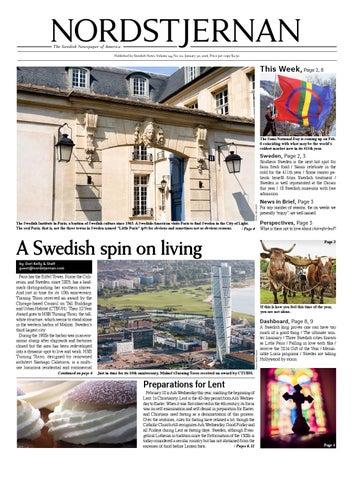
nordstjernan The Swedish Newspaper of America
Published by Swedish News. Volume 144 No. 02, January 30, 2016. Price per copy $2.50
This Week, Page 2, 8
The Sami National Day is coming up on Feb. 6 coinciding with what may be the world’s coldest market now in its 411th year.
Sweden, Page 2, 3
Photo: Nils Boldt
Southern Sweden is the next hot spot for farm fresh food / Samis celebrate in the cold for the 411th year / Some cancer patients benefit from Swedish treatment / Sweden is well represented at the Oscars this year / 18 Swedish museums with free admission
The Swedish Institute in Paris; a bastion of Swedish culture since 1965. A Swedish-American visits Paris to find Sweden in the City of Light. The real Paris, that is, not the three towns in Sweden named “Little Paris” (p9) for obvious and sometimes not so obvious reasons. / Page 4
News in Brief, Page 3
For any number of reasons, the ox weeks we presently “enjoy”, are well named.
Perspectives, Page 3
What is there not to love about skärmförbud?
A Swedish spin on living
Page 3
by Dori Kelly & Staff guest@nordstjernan.com
Continued on page 6
If this is how you feel this time of the year, you are not alone.
Dashboard, Page 8, 9
Just in time for its 10th anniversary, Malmö’sTurning Torso received an award by CTUBH.
Photo: David Castor
Paris has the Eiffel Tower, Rome the Coliseum, and Sweden, since 2005, has a landmark distinguishing her southern shores. And just in time for its 10th anniversary, Turning Torso received an award by the Chicago-based Council on Tall Buildings and Urban Habitat (CTBUH). Their 10 Year Award goes to HSB Turning Torso, the tall, white structure, which seems to stand alone in the western harbor of Malmö, Sweden’s third largest city. During the 1980s the harbor was in an economic slump after shipyards and factories closed but the area has been redeveloped into a dynamic spot to live and work. HSB Turning Torso, designed by renowned architect Santiago Calatrava, is a multiuse luxurious residential and commercial
A Swedish king proves one can have too much of a good thing / The ultimate winter luminary / Three Swedish cities known as Little Paris / Falling in love with fika / receive the 2016 Gift of the Year / Memorable Lucia programs / Swedes are taking Hollywood by storm
Preparations for Lent
February 10 is Ash Wednesday this year, marking the beginning of Lent. In Christianity, Lent is the 40-day period from Ash Wednesday to Easter. When it was first observed in the 4th century, its focus was on self-examination and self-denial in preparation for Easter, and Christians used fasting as a demonstration of this process. Over the centuries, rules for fasting have relaxed a bit, though the Catholic Church still recognizes Ash Wednesday, Good Friday and all Fridays during Lent as fasting days. Sweden, although Evangelical Lutheran in tradition since the Reformation of the 1500s is today considered a secular country but has not abstained from the / Pages 8, 11 excesses of food before Lenten fasts.
Page 4
news in brief. page 2
Swedish News Utveckla det Nordiska samarbetet Gästledare
Sydsvenska Dagbladet 15 January, 2016
There’s an abundance of fresh, simple food in Skåne in the south, often considered the “garden province” of Sweden. Above, harvesting tomatoes. Image: visitskane.com
Skåne offers the best Nordic food
The 2016 New York Times list of places to visit includes a spot they identify as Nordic cuisine’s next big thing: Skåne, Sweden. The NYT article promotes the “almost mythologically Swedish … coastline, mushroom-filled forests and red wooden houses” of the southern Sweden area, where farmto-table food preparation has been gaining popularity. They name Horte Brygga for serving fresh, simple seafood right on the shore, and Talldungen, a country hotel and restaurant whose chefs creatively and expertly make use of their onsite garden and bakery. “But the real stunner is the 25-seat Daniel Berlin Krog. The namesake young chef hunts most of the game he serves and grows many of the vegetables; but his sophisticated, deeply layered cooking is more worldclass than rustic.” For more on Skåne’s food culture and the other 51 must-see places to visit in 2016, see www.visitskane.com or www.nytimes.com - “Places to visit”
Swedish market is 411 years cold
It won’t be long before the 2016 Jokkmokk Winter Market will be held — for the 411th consecutive year. On the first weekend in February, every year since 1605, the Jokkmokk market is held in northern Sweden, about two hours north of Luleå in Lapland. It’s cold. February temperatures average -5-10˚F. But 400 years ago February was a necessary time for trading. The Sami people met to trade goods, taking advantage of the opportunity to gather and socialize as well. Eventually the government caught on and were curious about exacting more taxes on the trading, so planners kept the market during the coldest time of the year — the most undesirable time for the law makers to travel so far north. And so this particular weekend has remained a tradition. Visitors can roam the market stalls for knick-knacks, novelty items and sweets as well as beautiful Sami handicrafts and art.
Killing cancer with heat
Researchers at the Karolinska Institute in Stockholm have discovered a promising new method in treating cancerous tumors. First testing only on breast cancer patients, the Swedish team developed the means to insert an electrode into the infected area with greater precision, potentially killing the whole tumor with heat. In every one of the 50 trial cases, MRIs show the tumors have disappeared with this treatment. The researchers estimate that up to half of all breast cancer patients may benefit from it; now patients with some other forms of cancer can seek the treatment. One advantage of KI’s new method is it is very mild for the patient and does not require more than an hour in the hospital. So often, the three main methods of treatment for cancer — surgery, radiotherapy and chemotherapy — result in severe side effects and require longer hospital stays. Patients who can no longer tolerate other treatments may benefit by heating away the so-called residual tumors that remain after other treatment, extending their lives by several years.
Nordstjernan, January 30, 2016
Våga förändra i gemensamma modellen. Det har gnisslat i relationen över Öresund under hösten. Likafullt står de nordiska länderna – stabila demokratier med en stark välfärd och snarlik samhällsmodell – närmare varandra än några andra. Och måste fortsätta att utveckla samarbetet. Danmarks högljudda signalpolitik i flyktingfrågan och den svenska regeringens omsvängning och införande av id-kontroller har lett till att ovanligt hårda ord har uttalats från de två grannländernas ministrar. Men vänner måste kunna vara uppriktiga. Och i grunden är relationen mellan Sverige och Danmark fortsatt god och långsiktigt slitstark. Därmed inte sagt att den inte kan bli bättre. Större ansträngningar krävs för att dagens id-kontroller ska bli en kort parentes i Öresundsregionens historia. “Den nordiska modellen har skapat en enorm utveckling i våra länder”, sade Sveriges statsminister Stefan Löfven (S) när han under torsdagen invigningstalade i Stockholm där nordiska socialdemokrater håller ett årligt möte. Så sant. Och det gäller både välfärdsstaterna skilt för sig – och samarbetet mellan dem. De nordiska länderna har en lång tradition av samarbete, formellt inom ramen för Nordiska rådet sedan början
av 50-talet. Den fria rörligheten och den öppna arbetsmarknaden har gynnat både de nordiska medborgarna och företagen – och därmed ländernas utveckling. Även på försvarsområdet finns ett samarbete, även om länderna har valt olika väg när det gäller EU och Nato. Sverige har slutit försvarsavtal med Finland och nu senast ett avtal med Danmark om försvarssamarbete i fredstid. Men totalt sett riskerar det nordiska samarbetet ofta att komma på undantag. Potentialen tas inte tillvara fullt ut. Möten mellan politikerna blir ofta mer som pliktskyldiga släktträffar, inte riktigt på allvar. Det borde kunna vara betydligt mer än så, det borde kunna betyda mer. De nordiska länderna som har så mycket gemensamt kunde stärka varandras goda sidor i en skakig omvärld. De kan påminna om att ekonomisk utveckling, jämlikhet och social välfärd fortfarande är en framgångsrik kombination. I en debattartikel i Aftonbladet inför torsdagens möte konstaterade de nordiska S-ledarna att Norden i internationella rankingar ofta placerar sig som världens bästa region att leva i. Hög levnadsstandard, hög sysselsättningsgrad, relativt jämställt, hög grad av individuell frihet. “Det är resultatet av de nordiska socialdemokraternas och arbetarrörelsens kamp för frihet och jämlikhet, och av miljontals människors hårda arbete och fasta beslutsamhet om gör din plikt, kräv din rätt”, hävdar S-politikerna. Och visst har socialdemokratin haft
en avgörande roll i skapandet av den nordiska välfärdsstaten, den nordiska modellen. Men de har inte gjort det på egen hand. Tvärtom vilar den modellen på pragmatism och ett brett samarbete i samhället, över blockgränser och med näringslivet. Svepande påstås i debattartikeln att “högern” inte längre vill upprätthålla en hög välfärd utan vill montera ner den genom sänkta löner, enkla arbeten och fler tillfälliga anställningar. Men den som verkligen vill värna den nordiska modellen måste hela tiden våga förändra för att möta nya utmaningar. Som nu när tillväxt måste förenas med klimatomställning, när trösklarna till arbetsmarknaden måste sänkas om alla – också nyanlända – ska få jobb och bli delaktiga. Just där, i förmågan till omställning utan att offra vare sig trygghet eller individuell frihet, avgörs om modellen är slitstark. Stefan Löfven är nu ensam i Norden om att vara S-märkt statsminister. Han leder en svag regering och har riktigt dåliga opinionssiffror. I Norge och Danmark förlorade S-ledda regeringar de senaste valen. Skiftande regeringsinnehav och politiska samarbeten av olika slag har blivit det nordiskt normala. Och det är alldeles utmärkt, för hela Norden: Socialdemokraterna har inte monopol på den nordiska samhällsmodellen, den hör inte hemma på ett S-museum utan lever och utvecklas vidare.
The stories, the traditions, the people behind the news — NORDSTJERNAN A tradition since 1872, covering three worlds: Sweden, America, and Swedish America order your own copy, $55.00 for a year (22 issues) at www. nordstjernan.com—choose 'subscribe' or call 1.800.827.9333 x10
Founded in New York City in September 1872 Editor In Chief & Publisher: Ulf Barslund Mårtensson – www.nordstjernan.com Editor: Amanda Olson Robison (editor@nordstjernan.com) Managing Editor & Production: Everett Martin Sports Editor: Chipp Reid Art Direction: Petter Ringbom / Daniel Berubé-Arbello Contributors: Valorie Arrowsmith - Terry Lee Blunk - Claes Magnusson - Lisa Mikulski - Ulf Nilson Kristina Hall - Leif Rosqvist - Ulf Kirchdorfer - Ted Olsson - Jeanne Eriksson Widman - Olle Wijkström - Bo Zaunders Publications Director: Mette Barslund Mårtensson (mette@nordstjernan.com; 800.827.9333 x12) Nordstjernan (ISSN 1059-7670) is published by Swedish News, Inc., 570 Lexington Ave, New York, NY 10022 • Connecticut - P.O. Box 1710, New Canaan, CT 06840 Periodicals Postage paid at New York, NY, and additional mailing offices. Nordstjernan is published semi-monthly, except for the month of January. Post Master: Please send address changes to Nordstjernan, P.O. Box 1710, New Canaan, CT 06840 Subscription rates: 1 yr. - $55, - Two yr. - $99 - Outside US 1 yr. $167.
Contact us at 1.800.827.9333 — ext 10 for Reader services, ext 12 for advertising URL: www.nordstjernan.com email: subs@nordstjernan.com East coast local number: 203.299.0380 West coast: 1.800.827.9333
News in brief. page 3
Swedish News
That really long time between holidays, Swedes have a name for that, too: When the holidays are finally, actually over, when the winter darkness falls heavily and the snow and cold settle in, there’s a really, really long wait until the next major holiday. Enter the so-called oxveckorna (ox weeks): According to the Institute for Language and Folklore of the old Swedish peasant society, this was the time after the Christmas holidays — different accounts indicate various weeks-long periods — when everyone had to wait and work hard until Easter, toiling like an ox. Others indicate it’s the time between Epiphany and Lent that is sluggish and heavy, like an ox. No matter which holidays are implicated and how many weeks there are between them in any given year, the time is sluggish and heavy, and people are toiling like oxen. Hence the name oxveckor.
Understandably, it has become the most popular time of the year for those lucky Swedes who can manage it to take a vacation to warmer, sunnier climes. And for many others, its oxveckorna’s end that marks the opportunity for the traditional winter holiday called “sportlov” (similar to Americans’ spring break) when schools close for a week and families travel if they can. If a getaway isn’t possible and one must stay in Sweden during the dark oxveckorna, psychologists have a few suggestions to stay healthy: * Do not bury yourself in negative thoughts even if you are sad. * Structure daily life and take time to relax, especially on the weekend. * Go outside in the middle of the day and catch what little light there is.
* Take a nap, listen to music or just relax. * Enjoy the art of doing nothing to benefit your well-being.
perspectives.
Screen Prohibition I love the term skärmförbud, which I recently came across in the Swedish newspaper Sydsvenskan. I was peeking into a brief column by Andreas Ekström, because a headline about swimming caught my attention, along with the subheading of “Is it reasonable or unreasonable that one is not allowed to read the digital version of the newspaper at Högevallsbadet [an aquatic center in Lund]” Like a good and reasonable Swede, Ekström is able to see both sides of the issue — or beyond the newspaper one holds in one’s hands that serves as a shield that would prevent one from watching to make sure one’s child does not drown while playing in the water but is no match for the hypnotic effect of a smartphone that likely would distract enough to cause a drowning. Ekström is a peacemaker of sorts with his concluding statement that if the personnel of the aquatics center deem parents under the spell of smartphones to be a risk factor, then his stance is that the good authorities of the bath house have sufficient reason and mean well (and presumably this means we should follow the rules: no smartphones while any children splash in the water). Things cannot get any more Swedish than Ekström’s piece, and I say that with a smile both with and at Ekström and myself. There is an innate compass for wanting to do right, to follow the
rules, while also complaining a little for good measure, ultimately folding like a towel. But back to skärmförbud. In the middle of Ekström’s oh-so-Swedish column, I saw in blue a command for me to also read Skärmförbud på Högevall. In this article by Görel Svahn we learn that starting in February, no smartphones or similar electronic devices will be allowed at the aquatic center. According to the aquatics center manager, many parents have been upset and became argumentative when they have been reminded by aquatics personnel that it is their responsibility to watch their children, as the parents insisted that is what lifeguards are for. Another reason to implement a skärmförbud, according to the chief of bath, as reported by Svahn, is that broken glass from the smartphone screens is dangerous and the aquatics center would have to be closed for seven days [to presumably make it safe for swimming again]. Even the faintest suspicion of a screen splinter would cause this elaborate shutdown. Now the last reason for disallowing smartphones sounds like a Swedish bureaucrat’s, and maybe even something we would hear out of the mouth of an American administrator. But skärmförbud? This word translates roughly into “screen ban,” and having been so long gone from Sweden and
not grown up with the word (or any iPhone or computer, for that matter), I associate skärm mostly with lamps, as in “lampshade,” or maybe the visor of a cap. The use of this Swedish term sounds extra ludicrous and also forbidding at the same time, so I feel a Boston Tea Party coming on. Swedes, who have adopted so many English terms, surely could have passed on the word skärmförbud. Not only that, but can you imagine Americans giving up their smartphones and tablets poolside? Americans will not give up their right to bear arms, and these days, the privilege of the use of smartphone has translated into a right. The chief of bath would be under water if he insisted on such compliance over here, Sir. Meanwhile, across the vast ocean, perhaps, perhaps, the good Swedes will morph into Vikings just this once and grow a pair (those alleged horns on the helmets), and smack the bath meisters of their land with a paper copy of the paper they are allowed to bring in and then resume their vacation on their smartphones? This has been your skribent, once again peering across the Atlantic. Ulf Kirchdorfer ulf.kirchdorfer@nordstjernan.com
Swede Among the Rednecks - Ulf Kirchdorfer’s book on the language that just won’t stay buried ... really, the Swede inside us all, is now available through amazon.com or NORDSTJERNAN: Call 1.800.827.9333 ext. 10, to order.
Photo: Lena Lindgren
The Ox Weeks
Robert Gustafsson playing the main character in a still from Felix Herngren’s 2015 movie, “The 100-Year-Old Man Who Climbed Out the Window and Disappeared.”
Sweden at the Oscars
Two Swedes are favored nominees for this year’s Oscars on Feb. 28. Alicia Vikander was nominated for her part in “The Danish Girl,” and the Swedish hit comedy The 100-YearOld Man Who Climbed Out the Window and Disappeared (”Hundraåringen som klev ut genom fönstret och försvann”) could win for best makeup and hair. Robert Gustafsson, who plays the 100-year-old has said he had to sit many hours in make-up every day to be able to play everything from 20 to 100. Eva von Bahr and Love Larson, the film’s makeup artists, were previously nominated in the same category at Guldbaggegalan 2014. Vikander, who some call the next Ingrid Bergman, has two Golden Globe nominations and British Bafta awards, and is now in the running for Best Supporting Actress. The last time a Swedish actress was nominated was 1990 when Lena Olin was in “Enemies: A Love Story.” And the last time a Swedish actress won an Oscar for best supporting actress was in 1974, when Ingrid Bergman starred in Murder on the Orient Express. “100-year-old,” starring Robert Gustafsson in the main role, is one of three films nominated for Best Hair and Makeup, praising Swedes Love Larson and Eva von Bahr for their work. Official trailer: 100-åringen
Best Foreign Language Film
Sweden’s selection, Roy Andersson’s artsy “A Pigeon Sat on a Branch Reflecting on Existence” (Original title: “En duva satt på en gren och funderade på tillvaron”) was not nominated. The film, about Sam and Jonathan, a pair of hapless novelty salesmen that embark on a tour of the human condition, concludes writer-director Roy Andersson’s Living trilogy in style. Well received by critics and considered “indelibly original and expertly assembled” the sales men’s tour is depicted both in reality and in a fantasy that unfolds into a series of absurd episodes. Among Scandinavian countries, the Danish movie “A War” became nominated in the category, together with films from Colombia, France, Hungary and Jordan.
Free admission at Swedish museums
When the culture budget was passed in Swedish parliament last year, it was decided that 18 state museums would annually share 80 million kronor ($9.4 million) to allow free admission. “We do it to open our heritage, we own these combined taxes together. To make them available is an important step,” said Culture Minister Alice Bah Kuhnke. As of January 1, 2016, each of the 18 museums now has its share of the money, and on February 1 they will open their doors free of charge for all. “If there are special reasons (temporary exhibitions, for example), museums are allowed to charge fees to people over 19 years of age.
The Exchange Rate: $1.00 = SEK 8.57 01.18.2016
January 30, 2016 Nordstjernan
feature. page 4
A Swedish American in Paris In the 17th century, the great French philosopher Descartes was invited to enlighten the court of Queen Christina. He caught a cold, unfortunately, in the cold Stockholm winter and died soon thereafter. In the 18th century, the Swedish kings were heavily influenced by French culture. Indeed, Gustav III became the king of Sweden in 1770 while he was visiting in Paris and his father died unexpectedly. The new king came to Paris several times and got to know the city’s literary, musical and artistic life. The Bernadottes, Sweden’s royal family for the last 200 years, is of French origin and one can still visit the family home in the town of Pau in the Pyrénées. It is an extraordinary fact that Paris as we know it is because to Sweden’s intervention. At the end of World War II, as the allies advanced, Hitler commanded his general in Paris to reduce the city to rubble. The Consul General of neutral Sweden, Raoul Nordling, persuaded the German general, in an all-night negotiation session, to spare the city. This episode is documented in a recent film, “Diplomacy” (2014) and in Larry Collins and Dominique Lapierre’s famous book “Is Paris Burning,” also made into a movie.
Photo: Nils Boldt
James Kaplan, Moorhead JKaplan@nordstjernan.com
The closed in cobblestoned interior courtyard of the Swedish Institute in Paris is a popular destination.
Cementing these friendly relations is the fact that Sweden is about the only country in Europe that France has never fought a war with. Therefore, just as one sees in Stockholm many touches of French presence, one can expect to see in Paris a vigorous Swedish presence. The chief agencies are the Swedish Institute, the Swedish Club and the Swedish Church. The Swedish Institute (Institut Suédois), at 11 Rue Payenne, is located near the Place des Vosges and the Musée Picasso in the historic Marais district of Paris. It is filled with magnificent townhouses from the 16th and 17th centuries. A wonderful day can be spent following the lead of the Michelin Guide book through these small, crowded streets where behind massive walls, quite unexpectedly, magnificent palaces preside over exquisite formal gardens. A good place to start is the metro (subway) stop St. Paul Le Marais. In the metro station is a map showing the 10 minute walk to the Swedish Institute. On the way you pass through the quaint old Jewish Quarter, a good opportunity to stop for some delicious falafel, cheesecake or other delicacies. The Institute is located in the Hôtel de Marle, built in 1572 and purchased by the Swedish government in 1965. It is a stately and airy building, with large bright rooms for SI’s many exhibits and activities. I was very impressed with how well this old building has been adapted for putting on a lively and modern cultural program. The original catalyst for the founding of the center was Gunnar Lundberg, the
Nordstjernan, January 30, 2016
Exhibition photography: Luca Lomazzi
The Swedish Institute
The “Institut Suédois” offers Parisians and local Swedes alike an impressive tablet of exhibitions while the café serves up Swedish specialties for lunch or afternoon fika. (Exhibition images here from a 2015 exhibit on Swedish fashion.)
cultural attaché at the Swedish Embassy. He amassed a remarkable personal collection of art and a handsome library that he bequeathed to the Tessin Institute which still forms the permanent collection of the center today. It was Lundberg too who found the Hôtel de Marle at a time when the Marais district was not at all in vogue as it is today. He pushed for the Swedish government’s acquisition of this magnificent building as a cultural center. I was impressed with the importance of a single person’s initiative in the shaping of an institution that has done so much good. You come into SI through a paved courtyard. At the right is a small gallery where art exhibits are shown. To the left is the main area of the center. Up one flight is a splendid exhibition hall with a ceiling of painted beams from the 16th century, a real treasure
that was discovered only during the restoration. There is also an auditorium for concerts, films, plays, lectures, etc. It is remarkable what a preponderant role art has played in contacts between France and Sweden. These two countries never had very important political, commercial or ideological dealings, but from the beginning the cultural contacts have been rich and constant, and artists have formed a steady stream in both directions. Aside from the excellent exhibits of Swedish art and handcrafts, there is also a nice little Swedish café that offers coffee or lunch. In the summer you can take your tray outside to the very pleasant courtyard.
A community’s club
Another important Swedish spot in Paris is Svenska Klubben-Le Circle Suédois, at 242 Rue de Rioli. The club was founded in 1891 and faces the famous Tuileries Gardens and the Jeu de Paume Museum. Easily identified for its big Swedish flag hanging out front, the club has a large facility with a lounge, salon, ballroom and spacious restaurant serving Swedish home cooking. Immediately on entering one notices their wonderful collection of Swedish art that is worth a visit in itself. Another treasure to be seen at Svenska Klubben is the desk at which Alfred Nobel signed the famous will
feature. page 5
same color. There is a pretty courtyard with a fountain where Midsommarfest is held every year. In the building is a Swedish school that goes through junior high. The ministry of the Swedish Church in Paris differs somewhat from that of an ordinary parish. This is chiefly caused by the mobility of the members. Many Swedes are in Paris for a work assignment of one or two years, or they are among the hundreds of Swedish au-pairs in Paris. It is hard to build a solid church membership when most people are either coming or go“Le Cercle Suedois”—the Swedish Club is home to ing. Problems involve culture shock in mixed marriages where one spouse is the desk at which Alfred Nobel signed the famous French and the other Swedish, or difwill that started the Nobel prizes. ficulties for the teenage girls (I never that started the Nobel prizes. heard of an au-pair boy) living with The club has a heavy schedule of activities, and caring for a family in another country. lectures, French cheese and wine tastings, The parish also runs a senior living home art exhibits, fashion shows and dinners, west of Paris; every Sunday morning there bridge tournaments, dances, weekly mixers; are services; every Thursday evening there their program offers something for every is a program in the church hall with concerts, taste and age group. If you are in Paris lectures, films, etc. Afterward, there is a cofcheck their website and you will always find fee hour for members of the Swedish colony something fun to do there. in Paris to meet one another. In a rather out of the way part of Paris, but just 20 minutes by foot from the Arc de Triomphe is Svenska Sofiakyrkan. Sofia Church enjoys a long and rich history starting in 1626, when Sweden was a great European power and an important ally of France. Cardinal Richelieu accorded to the Swedish Embassy the special privilege of holding Lutheran worship. This privilege has been maintained for hundreds of years, even during periods when holding Protestant worship was a serious crime in France. They are proud to be the oldest non-Catholic foreign church in France. Among the pastors who have served this congregation was Nathan Söderblom who later became Archbishop of Sweden. The current church dates from 1911 and is designed in the national romantic style by Ragnar Östberg, architect of the famous City Hall in Stockholm; even the brick is of the
1.800.827.9333 ext 10 or www.nordicsampler.com
More Swedish treasures
Near the church at 3 bis Rue Léon Jost is a store called, appropriately enough, Afferent, where you can get all sorts of Swedish food, treats and handcrafts. It is also a good source of information on all things Swedish in Paris. Another fine place to visit is Maison du Danemark near the Arc de Triomphe. They have exhibits and cultural events and two excellent restaurants — one informal, one very elegant. I loved the tea room with quietly refined Danish service. It looks out on a tranquil garden courtyard, a pleasant way to escape the hubbub of the Champs Elysées for an hour or so. In the Latin Quarter is the Bibliothèque Nordique, the Nordic Library, right in the shadow of the Panthéon. It has a rich collection of books, periodicals, maps and documents relating to all the Nordic countries. The collection covers the whole gamut of history, art, literature, geography, etc. However, like most specialized libraries in France, entrance is strictly limited, and you may have to talk your way in the door. You might get a one or two day visitor’s pass on a weekday afternoon. Swedes love all kinds of “godis” and candy like salty licorice, jelly raspberries, sour bombs and more. In Paris you can get them at a charming little store, Caramel. Another Swedish shop is right in the heart of historic St. Germain des Prés, the well known Kerstin Adolphson Boutique. It is right down the street from the famous Brasserie Lipp restaurants and right across the street from the renowned Café de Flore where important writers and philosophers meet. Kerstin Adolphson has a wonderful selection of Swedish wooden shoes, socks, slippers, traditional sweaters, and handmade leather handbags, a fun place to visit. Native Swedish women can visit the Paris SWEA chapter (Swedish Women’s Educational Association) for community, culture and social programs for which SWEA is
Photo: Stefan Kamensky
The Swedish Church
You don’t have to be an architect to see the resemblance to Stockholm City Hall in the Paris Swedish Church’s facade.
famous. There may be more Swedish places in Paris. Swedes who have lived there for years might be able to add some items to this list. But for a Swede or a Swedish American or anyone who loves Sweden, it is delightful and touching to find traces of the homeland in the north amid the glory and splendor that is Paris. Indeed these traces are part of what makes, and always has made Paris the crossroads of the world, the City of Light. By James M. Kaplan Ph.D. The Swedish Institute, 11 Rue Payenne, 75003 Paris (www.si.se) Svenska Klubben-Le Cercle Suédois, 242 Rue de Rivoli, 75001 Paris (www.cercle-suedois.com) Svenska Sofiakyrkan, 9 Rue Mederic, 75017 Paris (www.svenskakyrkan.se/Paris) Affären, 3 bis Rue Léon Jost, Paris 75017 (www.affarenparis.com) Maison du Danemark, 142 Avenue des ChampsElysées, Paris 75008 (www.maisondudanemark. dk/en) Bibliothèque Nordique-the Nordic Library, 6 Rue Valette, 75005 Paris (www-bsg.univ-paris1.fr) Karamell, 15 Rue des Martyrs, 75009 Paris (www. karamell.fr) Kerstin Adolphson Boutique, 157 Boulevard St. Germain, 75006 Paris (www.kerstin-adolphson.c.la) SWEA, Paris (www.paris.swea.org)
Lena Rosen of sweets store Caramel offers a mindblowing amount of Swedish, and Swedish inspired candy.
For a travel update on Paris post-November 2015, see page 8
January 30, 2016 Nordstjernan
feature. page 6
Twist and Shout: A spin on 21st century living “On a clear night when all of the stars in the universe have turned on their own natural display of bursting lights, the view will take your breath away.”
Towering over the city and dwarfing even the Öresund bridge in the background, the 623 feet high Malmö skyscraper has become a symbol of the new and revived Malmö. Continued from page 1
building which makes a bold and innovative statement for this transformation into the 21st century. HSB Turning Torso is the vision of Spanish architect and engineer Calatrava. Art, music, sculpture and a fascination with the natural movements of the human form inspired Calatrava to combine these influences for a light and organic feel. Turning Torso is a beautiful, elegant structure, which defines sculptural expression as it gently turns 90 degrees to resemble the position of the spinal column of someone hitting a backhand in a tennis match. Turning Torso was first conceived by then managing director of the Swedish housing co-operative HSB, Johnny Örbäch, after he saw a photo of a sculpture created by Calatrava. He convinced the architect to design a new building in Malmö based on the piece. The vision became a reality and the resulting structure stands 623 feet (190 meters) high with a circular central core wrapped by nine individual cubes, each slightly skewed and balanced on the one below it, resulting in a slow twist upward. Each cube contains five floors; the two lowest cubes comprise office space, and the seven other cubes were designed with 152 apartments with ultimate luxury and convenience in mind. Not only do residents enjoy sweeping views of the surrounding Öresund area, but a 24-hour concierge, a gym with a Jacuzzi, two obser-
Nordstjernan, January 30, 2016
vation floors, and a temperature-controlled wine cellar are part of the rent! It goes without saying that the interior is just as intriguing. Samark Arkitektur & Design AB of Sweden developed 33 unique floor plans with varying sizes between 500 and 2000 square feet. Samark director Stefan Bergkvist said the firm developed each apartment based on its own unique place in the building, positioned to benefit from the dramatic panoramic views. Each apartment has a relaxed open plan with large windows and high ceilings that accentuate the openness of the space. Not the typical contemporary square box – gen-
tly curving walls, slightly oblique window frames, and circular ceiling soffits maintain the organic quality reflecting the spinal twist of the exterior’s shape. “It was really a great challenge to design the apartments,” says Bergkvist. “It’s not just a building, it’s a sculpture. We followed the curve of the structure and each floor plan is unique. No two are exactly the same, and that makes them rather special.”
Far from average
Two years after the building opened to residents, we were shown a generously sized apartment – close to 1,100 square
Sofa “Domino; Coffee-table “Vertigo” design Eero Koivisto; the black chair “Oto” design Peter Karpf. The vases, of paper-thin transparent glass on the windowsills, on the coffee table bearing tulips, are all called “Slowfox” – by Swedish designer Ingegerd Råman for Orrefors. The large vase on the floor between the windows is designed by Russian artist and designer Olga Popyrina.
feet – which serves as a second home for the couple who resides in it when visiting Sweden. The 52nd floor apartment, which has stunning views of the Öresund Bridge and Copenhagen, is equipped with furnishings and fixtures that incorporate the couple’s lifestyles abroad and in Sweden. It is a complimentary mix of ideas from Italy, Sweden and Denmark that brings different parts of the room together in both color and form. The architects used a high standard of materials and finishes in all the apartments, giving attention to even the smallest of details. They wanted to uphold a luxurious but affordable atmosphere, Bergkvist says. The first impression upon entering this apartment is the quality of natural light coming from the generous windows all along the walls. Floor-to-ceiling translucent screens, by Swiss company Creation Baumann, are designed to slide on ceiling tracks in front of each set of windows if one needs to subdue bright sunlight at different times of the day. Beautiful polished ledges made of Swedish limestone grace the sill of each window, providing the perfect spot for a special object d’art or a tasteful set of potted plants. The living room is purposely large. Bergkvist said the plan was to make the space in every apartment as open and airy as possible and to take advantage of the panoramic views. The ceilings have been raised in beautiful curvaceous shapes contrasting the dramatic angles in the room. Doors and Continues on next page
feature. page 7
wardrobes extend from floor to ceiling, keeping the visual height. It is obvious the view outside is the desired focal point and each unit has its own degree of a breathtaking view accommodated by the generous banks of tall, wide windows. The kitchen and bathrooms are exclusively custom designed by Samark for this buiding. Bergkvist insists on only the best state-of-the-art appliances: refrigerator and freezer, oven, microwave and dishwasher from Gaggenau and Bosch. The faucets are by French designer Philippe Starck. Ample kitchen cabinets are an oiled oak with the grain running horizontally to parallel the long horizontal aluminum fixtures. Underneath the cabinets are strategically placed recessed down lighting that illuminates the generous amount of granite workspace. Clean and efficient, and designed on the basic work triangle to allow for ease of cooking and clean up, the kitchen exemplifies modern living.
Sofa “Domino; Coffee-table “Vertigo” design Eero Koivisto; the black chair “Oto” design Peter Karpf. The vases, of paper-thin transparent glass on the windowsills, on the coffee table bearing tulips, are all called “Slowfox” – by Swedish designer Ingegerd Råman for Orrefors. The large vase on the floor between the windows is designed by Russian artist and designer Olga Popyrina.
is the window, and are crowned with stately mixing taps by Starck. A recessed mirror reflects the window, thus increasing the visual space and quality of light. A built in bathtub and shower unit with glass walls is equipped with heated towel rails, another simple but not overlooked detail of ultimate comfort.
The bathroom is a delightful surprise and a true showcase of simple luxury. The “wow” effect of the room is a large, deep, round window reminiscent of a porthole on a ship. A true contrast to the linear quality of ceramic tiles on the walls and floor of the room, the window brings natural light into a room that is usually neglected in most apartment buildings. Two wall-hung circular washbasins beautifully mimic the circle that
Vi har öppet måndag till fredag kl 9:30 till 15:00 Kontakta konsulatet för mera information. Välkommen!
Consulate of Sweden
Tower 101 101 NE 3rd Avenue, Suite 1700B Fort Lauderdale, FL 33301 Phone: +1 954 467 3507 Fax:+1 954 467 1731 fortlauderdale@consulateofsweden.org www.consulateofsweden-fortlauderdale.org
Like us on Facebook
that can accommodate a variety of lifestyles. The Turning Torso quickly became a symbol for a new Malmö, Sweden’s most talked about building and one of the noted landmark buildings worldwide. Photographed by James Silverman
Florida Polytechnic Campus, Lakeland and the new World Trade Center Transportation Hub, with the somewhat controversial Oculus structure, set to open in March 2016.
For more information see: www.turningtorso.se
You deserve a Sweder Life: From the gorgeous Italian bed in the masSantiago Calatrava has been the architect ter bedroom, one can view the smattering of Call 1.800.827.9333 ext. 10 twinkling lights of Copenhagen across the of choice for several public projects in the for your own subscription. bay. On a clear night when all the stars in the U.S., too: The Quadracci Pavilion of the NORDSTJERNAN universe have turned on their own display Milwaukee Art Museum, 2001, the Sunof lights, the view will take your breath dial Bridge at Turtle Bay, California, South away. The residents have linked together in perfect harmony their life abroad with their life in Sweden. HSB Turning Torso may be the most remarkable residential and commercial property in the region. In addition to its 10 Year Award in 2015, it won awards for the Best Residential Development at an international real-estate forum in Cannes, and in 2005 Santiago Calatrava was awarded the prestigious Gold Medal by The American Institute of Architects for Turning Torso. The notable building is within walking distance of Malmö’s city center, cultural diversities, restaurants, shops, and area beaches. Residents enjoy a high standard of living in a comfortable environment While reclining in the master bedroom, you can view the long, expansive bridge to Denmark and the
smattering of twinkling lights in the capital city, Copenhagen, on the other side. On a clear night when all of the stars in the universe have turned on their own natural display of bursting lights, the view is breathtaking.
January 30, 2016 Nordstjernan
Photo: Ulf Kirchdorfer
dashboard. page 8
Åre, Sweden and elsewhere in Scandinavia
The official Sami flag. The first, unofficial Sámi flag was designed by Sámi artist Synnøve Persen from Porsá in 1977. It was used as a national symbol in the demonstrations against the planned Alta Dam in Norway. The first official flag, above, was recognized and inaugurated on Aug.15, 1986 by the Nordic Sámi Conference in Åre, Sweden. Sámi álbmotbeaivi, the national day of the Sami, is the 6th of February, when the memory of the first Sami congress, in Trondheim in 1917, is celebrated. The decision to have a national day was made at the 15th Sami conference in Helsinki in 1992.
Seattle, WA
Nordic Museum’s popular Mostly Nordic concerts and a smörgåsbord will have Laura Loge, above, as new artistic director after this season. The program originated 20 years ago with its present director, Lisa Bergman and the late Olaf Kwamme at the helm. More info, see www.nordicmuseum.org Ät hälften så mycket, sov dubbelt så mycket, drick tre gånger så mycket och le fyra gånger så mycket—så kommer du leva tills någon slår ihjäl dig. [Eat half the food, get twice the sleep, three times the drink and smile four times as much—you’ll live until someone beats you to death.] — Unknown
Paris, France post-November 2015
For those who go to Paris, there’s still much to see and experience from a Sweder point of view, but it deserves to be mentioned that the state of emergency imposed by President François Hollande on November 13, 2015 remains in effect. The Swedish Foreign Office and the local Paris Embassy call on Swedish travelers in the country to be attentive, well-informed and aware of the threats and risks that exist. “You should always be aware of your surroundings and be on the look out for what seems odd and out of the ordinary, especially in places with large crowds such as public places, in and around public buildings, at tourist sites, on public transportation, at markets and shopping centers. There is an increased police presence and surveillance in the country. Further acts of violence or threat of attacks in Paris and France can not be excluded and it is therefore wise to remain vigilant and be extra attentive to what appears out of the ordinary.” The atrocious Paris terrorist attacks in November sadly also dealt a blow to France’s tourist industry and the overall economy in the country. Airlines reported more cancellations than bookings following the attacks, and according to MKG Hospitality, the occupancy rate at Paris hotels fell 23 percent after Nov. 13 and remains lower than usual. About 500,000 people in Paris alone have jobs linked to tourism and with fewer visitors everyone from restaurants to retailers have a hard time coping. The image, above, submitted by one of our colleagues from a major U.S. airport on Nov. 15 tells the story.
King-sized meal: a cautionary tale
Tore Johnson – Images of Paris Paris of the 1940s through Tore Johnson’s street photography is showing at the Nordic Museum until May 8, 2016. Tore Johnson (1928-1980) was one of the foremost figures in a generation of Swedish photographers who sought out new paths in the years after the Second World War. Johnson traveled to Paris in the late 1940s to earn a living as a freelance photographer. He felt strongly for the people in the margins of society and was inspired by Photographie humaniste, a form of street photography that wanted to depict everyday life with a combination of realism and poetry. The present exhibition at the Nordic Museum covers 48 of his pictures from Paris, all part of the Tore Johnson archive in the Nordic Museum collections. For more info, see www.nordiskamuseet.se
Nordstjernan, January 30, 2016
and publishing the first issues of Nordstjernan. But an observant, fasting Christian won’t eat them during Lent, so the king really stocked up, probably in hopes of making it through the 40 days until Easter. He reportedly had a king-sized meal of lobster, caviar, sauerkraut, smoked herring and champagne, followed by 14 super-sized servings of what was probably called “hetvägg” at the time — semlor. Unfortunately, King Adolf Fredrik, age 60, suffered such severe indigestion or food poisoning that he died. Swedes remember Adolf Fredrik as the king who “ate himself to death.” Was it the semlor? Even though you’ve probably been enjoying semlor all year (and who can blame you), don’t let history repeat itself this Fettisdagen, which falls on Feb. 9 this year. We recommend you eat your dessert first.
Photo: Tore Johnson/Courtesy Nordisk Museet
King Adolf Fredrik at the time of his coronation in 1751. Twenty years later he managed to eat fourteen (14!) semlor, or hetvägg as they were called at the time, before falling to his death.
Adolf Fredrik, the king who “ate himself to death,” quite possibly after eating 14 helpings of the popular dessert of the time. There’s been a little dust-up over the exact date — February 10? February 11? February 12? — of Swedish King Adolf Fredrik’s death in 1771, and it’s not clear what specifically killed him, but it is known that he had eaten his favorite dessert — a lot of it — just before he died. Is that what killed him? Was it poisoned? Can a person over-dose on semlor? Goodness knows semlor are so good, one semla is never enough. Who can blame the king for wanting more? The sweet, cream-filled bun served with milk in a bowl has been the food-ofchoice to indulge in on “Fettisdagen” (aka Fat Tuesday, Mardi Gras and Shrove Tuesday), the last day before Lent, for hundreds of years — even as our forefathers were sailing to America
dashboard. page 9
The ultimate Swedish luminary
The Swedish snowball lantern (snölyktan) is popular with young and old alike during the long, dark winter nights in the north. With some snow and a candle, building a snowball lantern is easy: Make a batch of snowballs and stack them up like a pyramid, leaving an opening in the back to place the candle inside. It’s not surprising that this lovely but simple, fun idea is very popular in Sweden, where neighborhoods are usually dappled with snöbollslyktor. Not unlike snowmen and snow angles, they are staples of outdoor play — and a beautiful winter decoration.
Food
A car ferry is used as a temporary bridge over the Göta River, which connects Lake Vänern with Göteborg and the North Sea, in Vänersborg one of the three Swedish cities a.k.a “Little Paris.” As for Vänersborg and the second city, Haparanda in the absolut north, a river runs through it - in the latter case the mighty Torne River and the third city, Kristianstad in the south, has its name from the many tree-lined boulevards, a dominant feature of the cityscape. Today, however, Kristianstad’s nickname has fallen somewhat into oblivion, mainly due to Vänersborg being more known under the name.
Falling in love with fika
even exchange important ideas. It may be only 10 minutes (according to the Annual Fika Report the average duration is actually 52 minutes), but its rewards are many. Some Swedish companies even make coffee breaks mandatory and offer New York employees free hot based FIKA drinks. entrepreneur Lars Åkerlund is a Lars Åkerlund. modern day fika pioneer. He moved from Sweden in 2001 and opened New York’s first FIKA coffee shop in 2006 near Central Park. He wanted to sell New Yorkers really good coffee, but that’s not all: He wanted to give them a new perspective on life. With coffee from a specialty roaster in Brooklyn and pastries made onsite, he encouraged customers to sit and enjoy their coffee and bun. He said, “In New York it was all about grab and go, but I thought that if I offered something really good I could change people’s way of doing things, make them stop and relax.” Perhaps the success of Åkerlund’s intentions shows in the fact that he now has 17 cafes with another two on the way. For fika. And whether you’re in Sweden, in New York or anywhere else, you can rest assured there’s plenty of evidence that reveals taking a break makes you more productive when you return to work. And it just feels good. So go “take a According to the so-called “fikarapporten 2012,” the average Swede spends 10 work days a year on fika.”
It wasn’t so long ago that another Swedish invention started making its way to the rest of the world … which is a good thing, because such a tradition shouldn’t be exclusive to one country. We’re talking about fika — a rather important concept, really, that has slowly been catching on around the globe. Recently, the BBC got wind of it and found one of the pioneers who brought fika to London and the United States, where its waves of success have been rippling from an increasing number of cafes in New York. Fika, which the BBC described as being comprised of three key ingredients — coffee, munching and chatting — is an important part of Swedish culture, a key player in personal, social and professional environments. It’s more than just a coffee break. It’s time set aside to relax, turn attention to tasting something delicious, have intentional conversation, maybe
fika alone.
Vänersborg, Sweden
One of the many wide boulevards of Kristianstad, which earned the coastal town it’s nickname, Lilla [Little] Paris.
Herr & Fru | Mr. & Mrs.
Her: “Asparagus from Gambia.”
“Ham from Italy. Wine from Australia.”
‘Plates from China…”
‘Name’s days’ of the Swedish Calendar: /Kommande två veckors namnsdagar
In New York In Stockholm In Kiruna Lund In Los Angeles
January 30: Sunrise 7.08 a.m. 8.03 a.m. 9.04 a.m. 8.04 a.m. 6.52 a.m.
Sunset 5.10 p.m. 3.58 p.m. 2.40 p.m. 4.35 p.m. 5.22 p.m.
“Husband from Borås. Dinner is ready!”
February 01 Max/Maximilian February 02 Kyndelsmässodagen February 03 Disa/Hjördis February 04 Ansgar/Anselm February 05 Agata/Agda February 06 Dorotea/Doris February 07 Rikard/Dick February 08 Berta/Bert February 09 Fanny/Franciska February 10 Iris February 11 Yngve/Inge February 12 Evelina/Evy February 13 Agne/Ove February 14 Valentin February 15 Sigfrid February 16 Julia/Julius
January 30, 2016 Nordstjernan
feature. page 10 perspectives.
Olle Wijkström olle.wijkstrom@nordstjernan.com
Många av oss som levt tillräckligt länge kan påminna oss att bussning förekom i Amerika. Tanken med bussning gick ut på att utjämna sådana klyftor som stundom uppstår mellan människor. I den djupa södern i Amerika förekom bussningar. På liknande sätt hände det i Kapstaden att folk tvingades bussas från ort till ort. Orsakerna har varit flerfaldiga. Mestadels har orsakerna gällt hudfärg eller religion. Vita vill inte bo där svarta bor. Svarta varken trivs eller har råd att bo där vita bor. Skälen varierar. Några söker sig bort från områden där de flesta var judar. Speceributikernas hyllor svämmade där ofta över av judiska rätter och delikatesser. Skälen till att människor vill bo på en plats och ogärna på en annan har själklart olika orsaker. Ibland kan det ha med hudfärg att göra. Svart, vit eller blandad. Ibland med ren högfärd. Klasskänsla och utbildning spelar också in. Tyvärr bär också religions tillhörighet ansvaret. Såvitt jag vet förespråkar alla religioner kärleken till nästan. Därför är det ofattbart att den kärleken lätt försvinner olika religioner emellan. Naturligtvis betyder sådana ting som hyrespriser och samhällstrygghet stor roll i beslutet om var man vill bo. För inte så många är sedan ansågs det bland stockholmare fint att bo på Östermalm eller i Djursholm. Nu pekar trenden mot Söder och nybyggda tätorter. Problem uppstår när alltför många människor vill slå sig ner på en och samma plats. Då uppstår en snedfördelning av raser, religioner och pengar. Islamer lika väl som djupt troende kristna samlar sig gärna nära familjer som har likasinnade inställningar. Samma gäller norrlänningar som gillar renskav och afrikaner från Mali som föredrar pepparstarkare föda. Att baptister upplever stor samhörighetskänsla med likasinnade är inte att undra på. Det ligger i människans natur I sådana sammanhang när snedfördelningen av folk i ett samhälle når besvärande gränser kommer tanken på bussning in. Det är nyttigt att folk redan i ungdomen lär sig att umgås med varandra och förstå att världen blir bättre om man redan från början känner till olika sätt att bete sig. Tanken är att vi blir bättre som medborgare när vi lär oss förstå att smaker och värderingar som tillämpas av andra ganska ofta kan vara såväl läckra som förnuftiga. Till Sverige har de senaste åren mängder av flyktingar sökt sig. Antalet ungdomar i behov av utbildning som kommit har varit särskilt stort. Den som följer statistik vet att det i vissa svenska skolor finns fler ungdomar med utländsk bakgrund än det finns svenska lintottar. Självklart uppstår då problem i såväl utbildning som samvaron studenter emellan. Inte heller leder det till förståelse och förbättrar segregationstendenser om inte ens barn träffas i samma skolor. För att lösa den nu uppkomna snedfördel-
Nordstjernan, January 30, 2016
Bussning och diplomati
ningen har en del kommuner i Sverige bestämt sig för att inrätta bussning. Elever skall transporteras till olika läroanstalter. Därigenom skall ungdomar med skiftande bakgrund kunna spridas, få samma undervisning, och umgås med andra svenska barn. Ett samhälle i samförstånd är tanken. Det ligger förvisso mycket gott i själva tanken att genom bussning kunna åstadkomma ett bättre samhälle. Ändå är det någonting bakvänt med bussning. I ett bra samhälle skall alla individer känna sig hemma. Ingen skall behöva bussas till en annan ort. Det är något fundamentalt fel när människor måste transporteras från plats till plats för att kunna leva i endräkt. Även om jag förstår att bussning kan vara svaret på att lösa uppkomna problem hävdar jag bestämt att vi måste sträva efter mål där bussning ej blir nödvändig. Det kanske tar sin tid att nå dit. Men det måste vara målet för vårt tänkande. Det sägs att diplomati är konsten att kunna säga brutala sanningar till sina motståndare och trots det behålla deras förtroende och respekt. Om detta påstående är korrekt har vår utrikesminister många terminer kvar att öva sig i den diplomatiska konsten. Hon har genom sitt agerande lyckats reta upp såväl palestinier som judar på samma gång. I Östersund träffades nyligen ett antal politiska förståsigpåare till en konferens om Fred och Försvar. Vår utrikesminister, Margot Wallström, höll då inledningsanförandet. I sitt tal slog hon bl.a. fast att hennes regering, den rödgröna, inte hade några planer på att Sverige skulle bli medlem av NATO. Som skäl angav hon att detta skulle vara ett alltför drastiskt beslut. Fru Wallström har uppenbarligen missat att den frågan har ältats fram och tillbaka i många år och decennier. Hon har tydligen också förträngt att våra grannländer, Norge, Danmark, Estland och Litauen efter noggrann undersökning icke funnit det drastiskt att söka medlemskap. Tydligen är Wallström av den uppfattningen att våra grannländer gjort drastiskt överilade beslut. Norrmän, danskar och finnar ser ofta med andra ögon på oss och de beslut vi fattar. Därför är det särskilt uppfriskande att höra deras åsikter. Ibland blir vi kanske hemmablinda. Vi håller på våra ledare. Vi vill ogärna medge att våra valda politiker stundom pratar i mössan. Eller beter sig tveksamt. Att vår utrikespolitik är befängd. Vi tror gärna att vi vet bäst. Ibland inbillar vi oss t.o.m. att det faktiskt ligger till på det sättet. Det finns fler personer inom vår regering som jag vet att många i våra grannländer har intressanta synpunkter på men eftersom jag tycker att Stefan Löfven är en utomordentligt duktig karl får det räcka för den här gången med kritik mot hans besättning.
Traditional food from Skåne
It could be the abundance of pork and chicken in the rural farm country of Sweden’s south that created this dish, certainly not something for those of us mindful of cholesterol and fat. Be that as it may, almost every classic Inn you visit in Skåne will have their own take on Äggakaka, literally Egg cake and a distant relative to the more common oven baked panncake. The most basic recipe around:
Äggakaka
1 1/2 cups whole milk 1/2 cup all-purpose flour 1/2 tsp salt 5 eggs 1 tbsp butter
Instruction: Whisk half the milk with the flour and salt. Add the rest of the milk and eggs and beat until smooth. Fry the butter in a frying pan and pour in the egg mixture. Lower the heat and cook over medium heat until the mixture has set. Stir gently into the batter a few times. Turn out and invert the cake onto a plate or lid. Let it slide down into the pan again and cook for a few minutes on the other side until browned. Serve egg cake with fried pork belly or bacon, lingonberries and shredded cabbage.
NORDSTJERNAN
MAIL TO: P.O. Box 1710, New Canaan CT 06840 or CALL 1.800.827.9333 - ext 10 1 year: $55 ❏ 2 years: $99 ❏ Check ❏ Credit card ❏ Regular active subscribers: call or use your personal account data, received through the mail or online. (Vasa members, call!) Please check if you are a new subscriber, this is a gift or you are renewing your present subscription Gift ❏ Renewal ❏ New subscriber ❏
Amex Disc Visa MC
❏ ❏ ❏ ❏
Name Address City State
Zip
Telephone Credit card# Signature
Exp: Sec code:
/
feature. page 11
February 9, 2016 is Shrove Tuesday! If you’re in Sweden (or anywhere in Scandinavia) you celebrate with a ‘semla’ or ‘fettisdagsbulle.’ They have been eaten already since January or December but no one can deny the lure of the semla ... traditionally eaten on Shrove Tuesday, “Fettisdag” in Swedish (Mardi Gras or Shrove Tuesday in English) is a time to celebrate! If you’re in Sweden (or anywhere in Scandinavia) you do it best with a semla. A semla or fastlagsbulle (Swedish), laskiaispulla (Finnish) or fastelavnsbolle (Danish and Norwegian) is a traditional pastry made in various forms in Finland, Sweden, Latvia, Norway, Denmark and Estonia, associated with Lent and especially Shrove Monday or Shrove Tuesday. The name semla (plural is semlor) is a loan word from German semmel, originally deriving from the Latin semilia, which was the name used for the finest quality wheat flour or semolina. In the southernmost part of Sweden (Skåne/Scania) and by the Swedishspeaking population in Finland, the pastries are known as “fastlagsbulle,” in Denmark and Norway they are known as “fastelavnsbolle” (“fastlagen” and “fastelavn” being the equivalent of Shrovetide). In Scanian, originally an Eastern Danish dialect, the feast is also called “fastelann.” In Finnish the pastry is known as “laskiaispulla,” in Latvian as “debeskūka” and in Estonian as “vastlakukkel.” King Adolf Frederick of Sweden died of digestion problems on February 12,
until golden brown and the center has firmed. Cool the buns on a cooling rack. Cut of the tops of the buns, about 1/2 inch. Scoop out some of the center of the buns, leaving a shell of at least 1/2 inch thick. Moisten the bread crumble with some of the milk in a bowl. Grate the almond paste coarsely and mix with the bread crumble until smooth. Whip the cream to stiff peaks. Fill each bun with a spoonful of the bread filling and pipe the whipped cream on top. Replace the tops onto the buns and sift over confectioners sugar. Eat Semlor with coffee or tea or with warm milk - then also called “hetvägg” (literally “hot wall”).
1771 after consuming a meal consisting of lobster, caviar, sauerkraut, smoked herring and champagne, which was topped off by “hetvägg,” the king’s favorite dessert. This was the sweet chosen to represent Finland in the Café Europe initiative of the Austrian presidency of the European Union, on Europe Day 2006. Swedish private detective Ture Sventon is famous for liking semlas.
Recipe for semlas
(makes 12-15 buns) 1 Stick Butter 1-1/4 Cups Milk 4 Cups All-purpose Flour 50g Dry yeast 1/2 Cup Sugar 1 tsp ground Cardamom 1/2 Tsp Salt 1 egg 1-1/2 tbs Baking powder
SEMLOR, FIKA style
Brushing: 1 egg - beaten Filling: 5 oz Almond paste Crumble bread 1/4 cup milk – or as needed Garnish: 1 Cup Whipping Cream confectioners’ sugar for dusting Instruction: Melt the butter and add the milk. Heat to 115˚ F. Combine Flour, sugar, salt, Cardamom, baking powder and yeast. Add the egg and All of the Swedish institutions in the U.S. will offer semlas in the milk mixture. February. For those lucky enough to be close to Linnea Bakery, half-way between Chicago and Milwaukee, we recommend you Knead the dough until smooth and elastic. call ahead to make sure there are still semlor left when you Cover bowl and allow to rise visit — they go fast. www.linneabakery.com
How the pros make a semla.
Last year’s trend in Sweden was what’s called a semmelwrap, originally created by award-winning baker Mattias Ljungberg of Tössebageriet — possibly inspired by Atkins, with more cream and more of the almond paste .... less of the bun. Maybe something for the carb-hunting crowd?
in a warm spot for 30 minutes. Move the dough to a lightly floured surface and knead until smooth. Form into round balls and place on a greased baking sheet. Cover and allow to rise until doubled for 35 to 40 minutes. Preheat the oven to 475˚ F. Brush the buns with beaten egg. Bake in preheated oven for 5 -10 minutes,
LINGONBERRIES • Fresh Frozen • Dried • Preserves www.sturdiwheat.com
January 30, 2016 Nordstjernan
local events. page 13
A New Year It’s a new year and we usually say that when we put the old year behind us. I know very few [actually] do that. On the contrary; we continue to carry everything that happened last year. Especially the negative and difficult. We dwell on and regret and wonder if we could have done otherwise. If it’s been an extremely bad year, we talk about an “annus horribilis,” just as the Queen of England did in her speech when she had sat on the throne for 40 years. If you think back many years, you will often only remember the good and happy memories, but in the early morning darkness the negative thoughts will easily catch up with you. Many of us not only carry the past year, we carry a full line of years on our shoulders. The backpack becomes heavy, and we can soon not bear it to go on. You cannot do anything about what has happened but you can choose how you want to shape your life from here onward. Let us leave the old year behind! Come here and have a seat with me. Relieve yourself of all the heavy burdens you carry, the sadness of a life that was not what you expected, harsh words said in effect, faulty priorities that injured you and your family. What’s in your particular bag may vary. Now it’s once and for all time to distinguish between problems we can do something about and those we cannot do anything about. That which has been, what happened last year or long ago falls into the category of problem that you can not do anything about. Instead, accept that just as it was, and from there move on and focus on what you can change or shape as you would wish. So with all the heavy burdens put aside, how is your life? Are you happy, do you live up to your full potential, or are you living only at a low percentage? It is never too late to take control of your life and realize that you are the protagonist. How good do you want your
Billigaste Priset Till Sverige.
Garanterat! 1204 Fifth Avenue San Rafael, CA 94901 415-454-4932 Fax: 415-454-5783 www.skytours.com
[Ett Nytt År]
life to be from today forward? Allow yourself to create that dream. You are not an extra in your life or playing a supporting role. You are the protagonist and as such you should live to the best of your ability. We can all help and contribute to create a good world in big and small ways. We are a single humanity and as such have been set to take care of our earth. Now a new year is here and the goal is to live now, not in the past or the future. For many of us, life is filled with “musts” and the tremendous pressure of time. “I’m just going to,” said Alfon Åberg in the children’s book. “I’ll just do this first then I’ll ... “ The present is the only time you have for eternity. The goal is to live right now. Not to live in what is past, not live in that which is to come, but literally live in the present. With eternity ahead, the stress disappears and life becomes every moment, now. I wish peace upon the old years we have left and the blessing of this New Year 2016! Let us now leave the old year and turn toward the future. Now is your time! Now is God’s time. The God who is never far from each of us. Good year wishes, Louise Linder Pastor of the Swedish Church in Florida The Swedish church in Florida is youngest among the Swedish churches in the U.S. and is more mobile than its equivalents in California or New York. Sermons in Swedish are held in Fort Lauderdale, Boca Raton, Miami or Sarasota but every so often also in Atlanta, Houston, New Orleans and Mobile, Alabama. For more info, see www. svenskakyrkan.se/florida
Nordic House One of The Largest Selections of Scandinavian Foods in the US For a Mail Order form
Call: 1-800-854-6435 We ship anywhere in the us! 2709 San Pablo Ave. Berkley, CA 94702 Phone: 510-705-1932 Fax: 510-898-1753
Web Site: www.nordichouse.com Email: pia@nordichouse.com
Louise Lindner.
Det är ett nytt år och då brukar vi säga att nu lägger vi det gamla året bakom oss! Jag vet att det är väldigt få som gör det. Tvärtom fortsätter vi att bära på allt som hände förra året. Speciellt det som var negativt och svårt. Vi ältar och ångrar och funderar på om vi kunde ha gjort på något annat sätt. Om det har varit ett extremt dåligt år talar vi om ett ”Annus horribles”, precis som the Queen of England gjorde i sitt tal när hon hade suttit på tronen i 40 år. Om man tänker tillbaka många år bakåt kommer man ofta bara ihåg goda och glada minnen, men i morgonens mörker kommer lätt de negativa tankarna ifatt en. Du kan inte göra något åt det som har hänt men det du kan göra, är att välja hur du vill forma ditt liv nu och framåt! Förresten så är det många av oss som inte bara bär på det gångna året utan vi bär en hel rad med år på våra axlar. Ryggsäcken blir tung och vi orkar snart inte gå. Det är ett nytt år och vi lämnar det gamla året bakom oss! Kom här så sätter vi oss. Ta av dig allt det tunga du bär på, livssorgen över att livet inte blev som du tänkt dig, hårda ord som sades i affekt, fel prioriteringar som skadade både dig och din familj. Vad som finns i just din ryggsäck kan skifta. Nu är det hur som helst en gång för alla dags att skilja mellan problem vi kan göra något åt och de som vi inte kan göra något åt. Det som har varit, det som skedde förra året eller för länge sedan är passé och hör till kategorin av problem som du inte kan göra något åt. Istället ska du acceptera att just så blev det för att därifrån ta dig vidare och istället fokusera på det som du kan förändra eller forma som du vill.
Så nu när allt det tunga ligger här vid sidan, hur har du det i ditt liv? Är du nöjd, lever du utifrån din fulla potential eller lever du bara till ett par procent? Det är aldrig försent att ta kommandot över sitt liv och inse att du är huvudrollsinnehavare. Hur bra vill du att ditt liv skall utformas från idag och framåt? Tillåt dig skapa den drömmen. Du är inte någon statist i ditt eget liv eller innehar en biroll. Du är huvudrollsinnehavare och som denna ska du leva efter bästa förmåga. Vi kan alla hjälpa till och bidra så att vi får en bra värld i smått och stort. Vi är en enda mänsklighet och som denna är vi satta att ta hand om vår jord och vår värld. Nu är det nya året här och framtiden strömmar emot dig och målet är att kunna leva nu inte då och sedan. För många av oss är livet fyllt av så många måsten och en oerhörd tidspress. Andra är inte pressade av tiden på det viset men lever ändå inte nu. ”Jag ska bara ” sa Alfons Åberg i barnboken. Jag ska bara göra detta först sen ska jag…” Mamma hur länge är två snart och tre strax? Frågar barnet sin stressade mamma. Nuet är den enda tid du har i evighet. Kanske är målet att kunna leva just nu. Inte leva i det som har varit, inte leva i det som skall komma utan bokstavligen leva i nuet. För många av oss är livet fyllt med all måsten och en ständig tidspress. Andra är inte pressade av tiden på det viset men lever ändå inte nu. Så med evighetens perspektiv för ögonen försvinner stressen och pressen och livet blir varje nu. Jag önskar frid över de gamla åren vi har lämnat och välsignelse över detta nya år 2016! Nu lämnar vi det gamla året och vänder oss mot framtiden. Nu är din tid! Nu är Guds tid. Den Gud som inte är långt borta från någon enda av oss. Ett gott år Önskar Louise Linder Kyrkoherde i Svenska kyrkan i Florida The Swedish church in Florida is youngest among the Swedish churches in the U.S. and is more mobile than its equivalents in California or New York. Sermons in Swedish are held in Fort Lauderdale, Boca Raton, Miami or Sarasota but every so often also in Atlanta, Houston, New Orleans and Mobile, Alabama. For more info, see www. svenskakyrkan.se/florida
Eva C. Eriksson DDS General Dentistry for Adults and Children Prevention Minimally Invasive Dentistry
662 Las Gallinas Avenue San Rafael, CA 94903 Phone: 415-479-6540 January 30, 2016 Nordstjernan
local events. page 14
Public Library. 650-697-7607.
More events and list your own, at www.nordstjernan.com-EVENTS
l California
01.25.2016 06:00 PM - 08:00 PM Scandinavian Crime Fiction Today Scandinavian crime novels have had successes as books, on TV and in films. Their main characters like Lisbeth Salander, Kurt Wallander and Harry Hole have gained international attention. Featured in this program will be “The Draining Lake” by Icelandic author Arnaldur Indridason, “Redbreast “ by Norwegian author Jo Nesbø and “The Girl With the Dragon Tattoo” by Swedish author Stieg Larsson. The program is free and open to the public. Burlingame Public Library. 650-558-7448. kaplan@ mnstate.edu.
01.27.2016 07:00 PM - 01.27.2016 09:00 PM Scandinavian Crime Novels Today at Milbrae
02.03.2016 07:00 PM - 09:00 PM Scandinavian Crime Novels Today at the Parkside Branch, San Francisco Public LIbrary. 415355-5770.
l Connecticut
02.07.2016 12:30 AM - 03:00 PM Valentine’s Brunch with Connecticut District #1, Vasa Order of America is hosting a Valentine Brunch at the Manor Inn to raise money for their District Scholarship Award. Brunch $30.00 per person. There will be a raffle. For more info on the Manor Inn, see www.manorinnrestaurant.com. CT District #1, Vasa Oder of America. 860.563.0040. steinmillerl@gmail.com. For more info, see www. manorinnrestaurant.com
l D.C.
01.30.2016 01:00 PM - 01.30.2016 04:00 PM Nordic Winter Wonderland Embark on a family friendly art adventure to celebrate the delights of the Nordic Winter! Stay warm and join the Nordic Embassies in Washington, DC and Phillips Collection for a day of family fun inside the museum’s galleries. Enjoy traditional art and crafts projects, stories, films and performances from Denmark, Finland, Iceland, Norway, and Sweden. Recommended for ages 4 and up. From Sweden - FAUNA AND ME - a dance performance about animals and us by Minna Krook Dans. www.phillipscollection.org. 202-387-2151
l Florida
Continuously The Swedish-American Chamber of Commerce of Fort Lauderdale and Palm Beach promotes trade, commerce and investment opportunities between Sweden, Fort Lauderdale - Palm Beach and members. See www.sacc-sfl.org
l Illinois
01.15.2016 - 03.26.2016 MIgrating Visions: The Art of Indira and Karl Johnson. Living and creating together in India, Sweden and the United States for over 40 years has had a profound influence on the work of wife and husband artists Indira and Karl Johnson. They met at the School of the Art Institute of Chicago in the late sixties and as their work evolved over the next four decades, their individual thoughts and ideas have migrated back and forth appearing in different forms in each other’s art. 773-728-8111 | www.swedishamericanmuseum.org
01.11.2016 10:00 AM - 11:00 AM Bullerbyn Swedish Language Playgroup Taking place roughly every other Sunday in tandem with Svenska Skolan, Bullerbyn is a time for singing cherished children’s songs, reading fun tales, and having lots of fun in Swedish. Children ages 6 months to 5 years are welcome to attend with a parent. This class will be conducted only in Swedish! All children participating should have Swedish spoken regularly at home in order to get the most out of Bullerbyn. We meet in the gallery space or the Children’s Museum. Kids are welcome to stay and play in the Brunk Children’s Museum after the program. The classes are free for members. Non-members pay $5 per child/class; payment can be made on-site at the Museum.. Swedish American Museum. 773-728-8111 | www.swedishamericanmuseum.org Continuously Step back in time in historic Bishop Hill. Utopia on the Prairie, then and now. For information call 309-927-3899 or email heritage@bishophill. com. Visit our Website at: www.bishophill.com
l Kansas
02.06.2016 12:30 PM - 04:30 PM Lindsborg Swedish Folk Dancers Sweden Tour Auction. Lindsborg Swedish Folk Dancers, a group of 40 high school-aged students, performs locally, nationally and internationally promoting Lindsborg and its unique SwedishAmerican heritage. Every four years this group of young community ambassadors travels to Sweden. The auction and bake sale makes this possible. www.visitlindsborg.com
l Minnesota
01.23.2016 PM - 05.22.2016 04:30 PM The Watercolor Worlds of Lars Lerin. Solo exhibition of contemporary Swedish watercolor master Lars Lerin (b. 1954). American Swedish Institute 2600 Park Avenue Minneapolis MN 55407. 612-871-4907 | www.asimn.org 02.13.2016 10:00 AM - 02.14.2016 03:00 PM Vasaloppet USA: vasaloppet.us/race-weekend/
l New York
01.25.2016 07:00 PM - 01.25.2016 09:30 PM Scandinavian American Staged Reading Series. Scandinavian American Theater Company (SATC) introduces a new generation of Nordic playwrights. Admission: free “White Baby” on Jan. 25 by Sofia Fredén (Sweden 2005) and
Söndag 14 februari kl 11.00
Kyrkoherde Staffan Eklund, Organist Ragnar Bohlin och Diakon Åsa Sjöberg Familjerna Beck, Faut, Johannesson och Wiborg inbjuder till kyrkkaffe. VÄLKOMMEN!
Öppettider 31 jan - 13 feb SÖNDAG
Caféet öppet 12-16
31/1 Högmässa 11.00 14-16 Ung Svensk i NY
7/2 Familjemässa 11.00
MÅNDAG
Caféet öppet 12-18 12.15 Middagsbön 18.00 Aftonbön
14-16 Ung Svensk i NY
SEMLOR!
Nordstjernan, January 30, 2016
www.svenskakyrkan.se/newyork TISDAG
ONSDAG
01.28.2016 06:00 PM - 08:00 PM Swedish American poet Marion Palm will be the first featured reader for Ken Siegelman’s Brooklyn Poetry Outreach at at the Park Slope branch of Barnes & Noble, located at 267 7th Avenue (at 6th Street) 11215. Start time 6:30 pm, featured poet followed by an open mic. 01.28.2016 07:00 PM - 09:00 PM Excuse me, does my piano count as one carryon? It did, again. Musical comedian and musician Magnus Martensson brings his show to New York City a second time in January. 212.757.0788.www.donttellmamanyc.com 2.03.2016 07:00 PM - 09:00 PM Film: Raspberry Boat Refugee at Scandinavia House. (Also showing Friday, Feb 5 at 6:30 PM) 212779-3587. www.scandinaviahouse.org 02.04.2016 07:00 PM - 10:00 PM Music on Park Avenue: Pianist Per Tengstrand The Beethoven Sonatas: The Tempest Pre-concert talk at 7:15 pm. www.scandinaviahouse.org
l Pennsylvania
09.12.2015 04:30 PM - 02.28.2016 04:00 PM United Stockholms of America See Stockholm like you’ve never seen the city before! ... a large-format photography exhibition by Swedish photographer, Charlie Bennet, who beautifully documented the wildly varying degrees of Swedishness of the different Stockholms. American Swedish Historical Museum. 215.389.1776. www.americanswedish.org
02.13.2016 11:00 AM - 02:00 PM Semlor and a Movie. Experience a decadent Swedish treat at the American Swedish Historical Museum! American Swedish Historical Museum. 215.389.1776. www.americanswedish. org
Church of Sweden at Norwegian Seamen’s Church 2454 Hyde Street, San Francisco • Tel: 415-632-8504 Mer information: www.svenskakyrkan.se/sanfrancisco
5 East 48th Street, New York, NY 10017 Tel: +1 (212) 832-8443
translated by Edward Buffalo Bromberg (USA 2007). Pre-reception at 7 pm. 212.779.3587. www.scandinaviahouse.org
01.30.2016 06:00 PM Pea Soup and Punch Supper: Ärtsoppa och Punsch at the museum. Warm up on a chilly winter’s night with a bowl of Swedish yellow pea soup and a cup of punsch. Dinner is served with sharp cheese, bread, and dessert. Tickets are $20 for members and $25 for non-members. Register by phone or online by January 25th. American Swedish Historical Museum. 215.389.1776. www.americanswedish.org
Gudstjänst på Alla Hjärtans Dag
mdv xnqj
Through Feb. 2 “Innerlighet - the art of being nordic” There is no specific word in English to translate Innerlighet, but put the word somewhere in between genuine, sincere, honest or authentic. The people portrayed in this photo exhibition are a mixture of famous and not so famous people. Swedish photographer Martin Lindeborg is exhibiting at the Swedish church in Manhattan until Feb.2. www.svenskakyrkan.se/newyork
@sk.ny Svenska kyrkan i New York TORSDAG
FREDAG
Caféet öppet 12-18
Caféet öppet 12-18
Caféet öppet 12-18
Caféet öppet 12-18 5 feb 18.30 Open Mic
12.15 Middagsbön 18.00 Aftonbön
12.15 Middagsbön 15.00 Träffpunkt 18.00 Mässa
12.15 Middagsbön 18.00 Aftonbön
12.15 Middagsbön 18.00 Aftonbön
LÖRDAG
Caféet öppet 12-16
local events. page 15
Nordic Spirit Symposium The year 2017 will mark the 500th anniversary of the Reformation in Europe, and some scholars are already researching how this movement changed Christianity. The Scandinavian American Cultural and Historical Foundation is organizing an indepth discussion and study of how Martin Luther’s ideas spread from Germany to Denmark and beyond. To provide a comprehensive presentation, SACHF, also known as the Scandinavian Center, is devoting two of its annual Nordic Spirit Symposiums to this history. Scheduled for February 12 and 13 at California Lutheran University in Thousand Oaks, the first symposium will focus on Denmark, Norway and Iceland. The second symposium, to occur in 2017, will concentrate on Sweden and Finland. “Power, Politics and Belief in Reformation Scandinavia” is the title of the two-part Nordic Spirit Symposium. Rev. R. Guy Erwin, of the Evangelical Lutheran Church in America, will intro-
duce the topic. Erwin, a former professor of California Lutheran University, is bishop of the ELCA’s Southwest California Synod. He is expected to talk about the beginnings of Martin Luther, who dramatically nailed 95 theses to a church door in Wittenberg, Germany, in October 1517. Luther’s writings and sermons, which rejected certain practices and dogma of the Catholic Church, led to the development of Protestant churches. Other Nordic Spirit Symposium speakers include religious leaders, professors, theologians and experts from England, Denmark, Norway and Iceland. Lectures will take place at California Lutheran University’s Samuelson Chapel. The program on Friday, Feb. 12 is scheduled from 5:30 p.m. to 9:30 p.m., and Saturday’s hours are 8:15 a.m. to 5:15 p.m. The cost depends on whether people attend all lectures both days and/or whether they choose to pay for meals and receptions. A “no frills” package of lectures only costs $60 for both days. Early registration dead-
line is January 20. Details are available from Howard Rockstad, director of the Nordic Spirit Symposium, who can be reached at hrockstad@gmail. com or 805-497-3717. Although SACHF has a website, www.scandinaviancenter. org, it won’t show information about the 2016 and 2017 Nordic Spirit Symposiums until early or mid-January. Rockstad serves on SACHF’s board of directors. California Lutheran University and SACHF collaborate on various educational events highlighting Scandinavia, with Scanfest being the most famous. Despite the popularity of the annual two-day medievalstyle fair for the past 41 years, it will not be held in 2016. SACHF’s board of directors decided new leaders and volunteers are needed to maintain the spring festival’s high quality and to strengthen future programs.
Martin Luther (1483-1546). Painting by Lucas Cranach the Elder, 1529
The year 2017 will mark the 500th anniversary of the Reformation in Europe. How Luther’s ideas spread through the Nordic region will be the focus of the 2016 Nordic Spirit Symposium
The Samuelson Chapel at California Lutheran University in Thousand Oaks.
Göran Rygert’s collection of Swedish traditional schnapps songs, in English and Swedish $8.95 + S&H.
Dala Horses and much more!
©
A SWEDISH AFFAIR swedensfinest.com Toll Free: (888)867-9567
www.swedishkurbits.com | 630-443-4086 Till vardag och fest
Crown Bakery
Specializing in Scandinavian Pastries 133 Gold Star Blvd.
(1 block after Super Shaws)
Worcester, MA 01606 Tel: 508-852-0746
Open Daily 6-6. Fri till 7. Closed Sunday
EST. 1960
Try our outdoor café and new sandwich lunches <www.thecrownbakery.com> We ship UPS anywhere
A selection of new funny, and old classic Swedish snapsvisor (schnapps songs) One third of 130 songs is in English. Indispensable! Call 1.800.827.9333 x10 A quarterly journal devoted to Swedish American biography, genealogy, and personal history. Founded in 1981.
Subscription Subscription $28 per$30 calendar year. per year Subscribers Subscribers are areinvited invited to to aa genealogical genealogical Workshop Salt Lake Lake workshop in in Salt City City each each autumn. October.
Swedish American Genealogist Swenson Center Augustana College Rock Island, IL 61201-2296 Phone 309 794-7204 www.augustana.edu/sag
January 30, 2016 Nordstjernan
sports. page 16
Americans hungry for Swedish crown
Robbie Earle skates down ice in a December game against Rögle. Earle has 20 points in 31 games in first season in Sweden. Bildbyrån photo Chipp Reid, Sports Editor chipp@nordstjernan.com
A pair of American players might be just what Färjestad needs to once again life the Le Mat Trophy. Forwards Travis Turnbull and Robbie Earle signed with the perennial Swedish hockey power in December and arrived in the Swedish Hockey League with a common goal. “We’re here to win. We want the championship,” said Earle, 31. “That’s why we’re here.” Earle joined Färjestad after four seasons in Switzerland and one in Austria. He played 38 games for the Minnesota Wild and nine for the Toronto Maple Leafs before moving to Europe. He said moving to Sweden was another step up in his career. “My first year in Europe I played against Swedish teams and the level is very impressive,” said Earle, who was born in Chicago, and grew up in Los Angeles before moving to Wisconsin where he attended the University of Wisconsin and was part of the U.S. National development team. “What I found most impressive was the consistency. Every day, day in, day out, the players here keep a high level. Plus it’s a very fast game. I would put the SHL right up there with the best leagues in the world.” So would Turnbull, who moved to Karlstad from Duesseldorf in the German league.
Nordstjernan, January 30, 2016
“I came here wanting to help this team make the playoffs and contend for championship,” said the 29-year-old St. Louis native. “One of the reasons I decided to come to Färjestad was I won a championship in Germany and I’m hungry for a championship here.” Turnbull appeared to be on track for a long NHL career in 2011-2012 when the owners locked out the players, disrupting the 20122013 season. Rather than sit around waiting, Turnbull said he decided to accept an offer to play in Germany. He said he enjoyed it so much he decided to stay, but when he was unable to come to new terms with Duesseldorf, Färjestad was there to snap him up.
Fast game, smart guys
“To be honest, the SHL did remind me of when I got called up to the NHL because it’s so fast and the guys are so smart,” said Turnbull, who played three games for the Buffalo Sabers before the lockout. “Nobody takes shift off and the hockey is very structurally tight. There’s a really high level of skill. It’s really great hockey.” Turnbull and Earle play on either side of Swedish center Michael Johansson, with Turnbull on the right and Earle on the left. Turnbull said fitting in with his new linemates was almost seamless. “I played against Robbie in college,” said Turnbull, who played for the University
of Michigan while Earle played for Wisconsin. “We knew about each other. The hockey world is pretty small and it was good Former Buffalo Saber Travis Turnbull works the puck during Färjestad’s to have another 4-3 win over Linköping Jan 14 in Linköping. Bildbyrån photo. American here. He called me in the league. The Wolfpack are coming off a up the day I signed and invited me over for tough home-and-home series with Linköping, Christmas dinner. winning on the road in overtime January 14 The familiarity off ice has translated easily before dropping the return match January 16 at to the rink as Turnbull has five points in his the Löfbergs Lila Arena in a shootout. Despite first six games, meshing seamlessly into a line the loss, FBK picked up a point, which Turnwith Earle, 20 (6 goals, 14 assists) points in bull said is the most important thing. 31 games, and Johansson, 25 points (9 goals, “No one likes to lose, but the point is impor16 assists) in 33 games. tant,” he said. “We’re just four points out of “Travis has a great hockey IQ and so does third place so every point matters.” Mikael,” Earle said. “That’s one of the things Linköping holds third place while Frölunda that really surprised me about Swedish hockey and Skellefteå continue to set the pace at the — all the guys have really good hockey IQs. top of the standings with 76 points. Linkoping Travis and I have the same mentality and it’s has 60 points while Brynäs and Luleå are level not hard to gel with a player like that. Mikael with 58. Färjestad is sixth with 56 points. With is highly skilled playmaker. He plays a solid 14 games remaining, Turnbull and Earle both game at both ends of the ice. He’s very creative said Färjestad has everything it needs to hoist the Le Mat trophy for the tenth time. and he likes to pass.” “I think we have everything we need. I really Since head coach Tommy Samuelsson put the Turnbull-Johansson-Earle line together, do,” Earle said. “That’s why we’re all here. We FBK has gone 3-3 and remains in sixth place want the championship.”