nordstjernan The Swedish Newspaper of America
Published by Swedish News. Volume 143 No. 18, October 30, 2015. Price per copy $2.50
This Week, Page 3
World’s best dressed hockey player is a Swede.
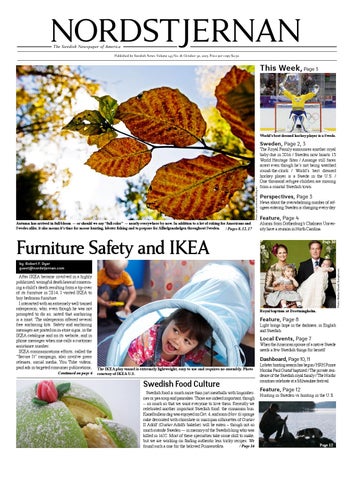
Autumn has arrived in full bloom — or should we say “full color” — nearly everywhere by now. In addition to a lot of raking for Americans and Swedes alike, it also means it’s time for moose hunting, lobster fishing and to prepare for Allhelgonahelgen throughout Sweden. / Pages 8, 12, 17
Photo: Lisa Sundström/Bildbyrån
Sweden, Page 2, 3
The Royal Family announces another royal baby due in 2016 / Sweden now boasts 15 World Heritage Sites / Assange still faces arrest even though he’s not being watched round-the-clock / World’s best dressed hockey player is a Swede in the U.S. / One thousand refugee children are missing from a coastal Swedish town
Perspectives, Page 3
News about the overwhelming number of refugees entering Sweden is changing every day.
Feature, Page 4
Alumni from Gothenburg’s Chalmers University have a reunion in North Carolina.
Furniture Safety and IKEA
Page 10
After IKEA became involved in a highly publicized, wrongful death lawsuit concerning a child’s death resulting from a tip-over of its furniture in 2014, I visited IKEA to buy bedroom furniture. I interacted with an extremely well trained salesperson, who, even though he was not prompted to do so, noted that anchoring is a must. The salesperson offered several free anchoring kits. Safety and anchoring messages are posted on in-store signs, in the IKEA catalogue and on its website, and in phone messages when one calls a customer assistance number. IKEA communications efforts, called the “Secure It” campaign, also involve press releases, social media, You Tube videos, paid ads in targeted consumer publications,
Continued on page 6
Photo: Mattias Edwall, Kungahuset.
by Robert F. Dyer guest@nordstjernan.com
Royal baptism at Drottningholm.
Feature, Page 8
Light brings hope in the darkness, in English and Swedish.
Local Events, Page 7
When the American spouse of a native Swede needs a few Swedish things for herself.
Dashboard, Page 10, 11 The IKEA play tunnel is extremely lightweight, easy to use and requires no assembly. Photo courtesy of IKEA U.S.
Swedish Food Culture
Swedish food is much more than just meatballs with lingonberries or pea soup and pancakes. Those are indeed important, though -- so much so that we want everyone to love them. Recently we celebrated another important Swedish food: the cinnamon bun. Kanelbullens dag was enjoyed on Oct. 4, and soon (Nov. 6) sponge cake decorated with chocolate or marzipan silhouettes of Gustav II Adolf (Gustav Adolfs bakelse) will be eaten – though not so much outside Sweden — in memory of the Swedish king who was killed in 1632. Most of these specialties take some skill to make, but we are working on finding authentic less tricky recipes. We / Page 16 found such a one for the beloved Princesstårta
Lobster hunting season has begun / HRH Prince Nicolas Paul Gustaf baptized / The private residence of the Swedish royal family / The Nordic countries celebrate at a Milwaukee festival.
Feature, Page 12
Hunting in Sweden vs hunting in the U.S.
Page 12
news in brief. page 2
Swedish News
Dags att mötas i mitten om flyktingkrisen. Gästledare
Sydsvenska Dagbladet 15 October, 2015
H.R.H. Prince Carl Philip and H.R.H. Princess Sofia announce their pregnancy on Oct. 15, 2015. Photo Kungahuset.se.
More royal baby news
Prince Carl Philip and Princess Sofia are expecting their first baby. Prince Carl Philip, 36, and Princess Sofia, 31, who were married this summer on June 13, have been together for five years and are overjoyed to be starting a family. Princess Sofia is doing well and the birth is estimated for April of next year, just one month after the birth of Crown Princess Victoria’s second child. This royal baby will alter the succession of the Swedish throne. He or she will become fifth in line for the throne after Crown Princess Victoria, Princess Estelle, Victoria’s second child due in March, and father Prince Carl Philip. When Prince Carl Philip and Crown Princess Victoria both have children next year, Princess Madeleine and her children get further away from the throne. The reason is simply that the crown princess and the prince are older than Madeleine. “Older siblings and older siblings’ descendants have precedence over younger siblings and younger siblings’ descendants,” says the Order of Succession. Succession to the Swedish throne is the oldest existing law. It remains controversial and is a recurring topic of debate; while parliamentary bills are occasionally presented to abolish the monarchy, the Bernadotte dynasty is growing fast .
Sweden’s World Heritage Sites
Among the eight Nordic and Baltic countries that UNESCO (United Nations Educational, Scientific and Cultural Organization) identifies as Northern Europe, Sweden has the most — 15 — World Heritage Sites. UNESCO World Heritage Sites are unique places that bear witness to the history of humanity and the world. They identify priceless locations, protecting and preserving them for the future. There are now 800 sites around the world, 36 of them in Northern Europe. The first sites from this region were inscribed in 1979, and each year, UNESCO’s World Heritage Committee can inscribe new sites on the list, or delist sites that no longer meet the criteria. Selection is based on 10 criteria for cultural or natural heritage. In Sweden, the 15 locations include 13 cultural sites, one natural site and one mixed site.
Assange’s round-the-clock surveillance stopped
British police have removed the 24/7 surveillance outside the Ecuadorean Embassy where WikiLeaks founder Julian Assange has been hiding for more than three years. Assange, 44, sought refuge there in June 2012 while facing extradition to Sweden for questioning about alleged sex crimes. The Metropolitan Police said it was no longer “proportionate” to keep up the costly operation when no resolution to the three-year stalemate is in sight, but Assange still faces arrest if he tries to leave the embassy. In August, Swedish prosecutors dropped cases of alleged sexual misconduct but still want to question him about accusations of rape. Assange denies all the allegations and believes extradition to Sweden is merely the first step in efforts to bring him to the U.S. over WikiLeaks’ computer hacking secret-spilling activities.
Nordstjernan, October 30, 2015
Det är oroligt i leden hos Moderaterna, som inledde sin partistämma 15 oktober. På ett övergripande plan beror motsättningarna på skilda uppfattningar om vad en aktiv och effektiv oppositionspolitik innebär. “Jag tänker inte kasta Sverige i en politisk kris nu”, har Moderatledaren Anna Kinberg Batra sagt mer än en gång de senaste dagarna inför propåer om att rikta misstroendeförklaring mot regeringen och på så sätt tvinga fram ett extra val. Alla i partiet ser inte lika pragmatiskt och ansvarsfullt på saken. Hetsporrefalangen vill att Moderaterna så fort det bara går fäller den regering som alla inom partiet är ense om leder Sverige i fel riktning. En av de sakfrågor där de interna motsättningarna kommit upp till ytan är migrationspolitiken. “Med tanke på hur hårt pressade kommunerna är måste M och S göra upp. Antalet personer som kommer in i landet måste begränsas snabbt”, sade Lars-Ingvar Ljungman, ordförande för Skånemoderaterna i torsdagens tidning. “Tidpunkten när vi måste gå mot färre händer i äldreomsorgen och större klasser i våra skolor rycker allt närmare”, skriver i Aftonbladet Patric Åberg, ordförande (M) i kommunstyrelsen i Östra
Göinge, en av de kommuner som under lång tid tagit på sig ett stort ansvar när det gäller mottagandet av flyktingar. Vill inte Socialdemokraterna “diskutera en konstruktiv uppgörelse om hur den akuta migrationskrisen ska lösas” så bör Moderaterna fälla regeringen, anser Åberg. En omprövning har varit på väg ett tag hos Moderaterna. I en debattartikel i torsdagens Expressen beskriver partisekreteraren Tomas Tobé (M) hur partiet omprövat hela sin integrations- och migrationspolitik. Tobés artikel kan ses som att en definitiv parentes nu sätts kring den migrationspolitik som drevs av Kinberg Batras företrädare Fredrik Reinfeldt i samråd med Miljöpartiet. Situationen spetsades till ytterligare när Sverigedemokraterna mitt under Moderaternas inledande stämmodag, meddelade att partiet nu drar igång två stora kampanjer. Den ena riktar sig mot utlandet och är avsedd att avskräcka människor på flykt från att söka sig till Sverige. Den andra är en kampanj för att få till stånd en folkomröstning om invandringen. Under fredagen möts riksdagspartierna – utom SD – för ett samtal om mottagande och etablering. Syftet är att så småningom nå en bred politisk överenskommelse. En blocköverskridande uppgörelse är nödvändig och önskvärd. Påfrestningarna som det stora flyktingmottagandet
innebär för det svenska samhället under överskådlig tid kräver nationell samling och avtal med lång hållbarhet. Då måste en sådan uppgörelse vila i politikens mittfält och riksdagens två största partier, S och M, utgöra kärnan. Moderaterna har föreslagit att tillfälliga uppehållstillstånd istället för permanenta ska vara regel. Partiet vill även införa tillfälliga kontroller vid Sveriges yttre gräns. Även om Socialdemokraterna hittills varit avvisande är detta förslag som förtjänar att diskuteras. Om annat är de två partierna i stort sett eniga, som vikten av att effektivisera avvisningarna av dem som fått avslag på sina asylansökningar. Att upprätta en lista över säkra länder, vars medborgare får en snabbehandling av sina asylansökningar, verkar både S och M kunna tänka sig. Integrationen, där M vill se sänkta trösklar till arbetsmarknaden och fler enkla jobb, medan S prioriterar utbildningssatsningar, kan bli knivigare att enas om. Många väljare är osäkra på hur politikerna vill hantera flyktingströmmen och förbättra integrationen. Sverigedemokraterna försöker ta initiativet genom att fråga folket om invandringen. Det bästa sättet för övriga partier att bemöta denna kampanj är att ge svar på människors berättigade frågor. Bra svar. Det borde – trots allt – vara fullt möjligt.
The stories, the traditions, the people behind the news — NORDSTJERNAN A tradition since 1872, covering three worlds: Sweden, America, and Swedish America order your own copy, $55.00 for a year (22 issues) at www. nordstjernan.com—choose 'subscribe' or call 1.800.827.9333 x10
Founded in New York City in September 1872 Editor & Publisher: Ulf Barslund Mårtensson (editor@nordstjernan.com) – www.nordstjernan.com Assistant Editor: Amanda Olson Robison Managing editor & Production: Everett Martin Metro Editor: Eva Stenskär Sports Editor: Chipp Reid Design: Daniel Berubé-Arbello Contributors: Valorie Arrowsmith - Terry Lee Blunk - Julie Lindahl - Claes Magnusson - Ulf Nilson Kristina Hall - Leif Rosqvist - Ulf Kirchdorfer - Ted Olsson - Jeanne Eriksson Widman - Olle Wijkström - Bo Zaunders Publications Director: Mette Barslund Mårtensson (mette@nordstjernan.com; 800.827.9333 x12) Nordstjernan (ISSN 1059-7670) is published by Swedish News, Inc., 570 Lexington Ave, New York, NY 10022 • Connecticut - P.O. Box 1710, New Canaan, CT 06840 Periodicals Postage paid at New York, NY, and additional mailing offices. Nordstjernan is published semi-monthly, except for the month of November. Post Master: Please send address changes to Nordstjernan, P.O. Box 1710, New Canaan, CT 06840 Subscription rates: 1 yr. - $55, - Two yr. - $99 - Outside US 1 yr. $167.
Contact us at 1.800.827.9333 — ext 10 for Reader services, ext 12 for advertising URL: www.nordstjernan.com email: subs@nordstjernan.com East coast local number: 203.299.0380 West coast: 1.800.827.9333
News in brief. page 3
New arrivals in Malmö, Sweden. Guest perspective on Sweden’s growing asylum situation, Viewpoint /Page 15.
So fluid is the news in Sweden these days that it changes hour by hour as municipalities outline the critical state of healthcare, education, social services, and accommodations resulting from the overwhelming number of refugees entering the country. “Sweden is preparing for a crisis situation,” Prime Minister Stefan Löfven said in a press conference on Friday, October 9, 2015. The newest figures released this weekend by Sweden’s Migration Agency (Migrationsverket) show that 86,223 people have applied for asylum in Sweden so far this year. This figure surpasses the previous record set in 1992 when 84,016 people sought asylum following the fighting in the Balkans. The figure also surpasses earlier predictions that 74,000 refugees would apply for asylum in 2015, according to Migrationsverket. Last week alone, more than 9,600 people applied for protection in Sweden, including 2,369 unaccompanied children, which exceeds the one thousand refugees a day reported by this correspondent just two weeks ago. “Our focus is now on providing an organized reception,” said the Prime Minister. “First of all, to ensure there are accommodations, the standards are being lowered. It is a matter of providing a roof over heads. The government today has commissioned that Migrationsverket set up tents if necessary.”
Search for more resources
Sweden is the only EU country which promises to provide Syrian refugees automatic permanent residence; however, it is not just Syrians who are flooding the nordic country as
large numbers of people from Iraq and Afghanistan are also seeking asylum. Some of these migrants hold fake or stolen Syrian passports which are easily obtained and which then qualifies them for asylum and thus permanent residence. In addition to creating winterized and heated tented refugee communities, the government has given Migrationsverket the task of locating any and all possible facilities around the country to house new arrivals. This includes camp sites, apartment buildings, industrial buildings, office spaces and sports arenas. As the processing time for asylum applications now extends into one- or two-year waiting periods, it is hoped that this, along with the tent announcement, will send a signal discouraging people from coming to Sweden. While Löfven does not exclude the notion of introducing border controls, and he explains that they are prepared to do it, he refers the problem back to the authorities and police as it is they who must make that assessment. Meanwhile, municipalities across the country are reporting that the situation is already severely strained and at great risk to worsen. Healthcare, education and social services are all facing enormous pressure according to the most recent report that country administrative boards have submitted to the Swedish Civil Contingencies Agency (MSB). “It shows that society is heavily loaded and this should be taken very seriously,” said Anneli Bergholm Söder, operations manager MSB, reports Göteborgs Posten.
School systems in need
Housing accommodations are not the only urgent situation facing municipalities. Due to the sharp increase in young refugees, the school systems are running out of educational resources — not just teachers and supplies, but space. Maria Edman is headmistress at Center för Språkintroduktion in Gothenburg, where assessments are made regarding the educational status of prospective students. Edman has seen a sharp rise in the number of pupils and reports to SVT that some have had schooling in their home country and others still can not read or write. Center för Språkintroduktion is a portal whereby students are assessed and then reassigned to one of the other eleven secondary schools which has induction programs for new immigrants in Gothenburg, but it also serves as a secondary school. According to Edman, the center has the staff to accommodate students but lacks the facilities. Elsewhere, as in Bräckegymnasiet, the situation is opposite, reports the news broadcaster. Here is the bottleneck, and when the situation can be rectified is unknown. “Today in the current situation, there is nowhere to place the students,” Edman said. This situation exists not only in Gothenburg but across municipalities in the country. “Municipalities need more space, more teachers, more social workers. We need more of everything, and it’s very difficult, in the short term anyway,” Hokan Söderholm, of the county administrative board in Västernorrland, told Göteborgs Posten. By Lisa Mikulski, Göteborg
NORDSTJERNAN: Alltid mer att läsa—There’s always more to read! Call 1.800.827.9333 for your own copy.
Photo: Migrationsverket, Tomislav Stjepic
Sweden prepares for crisis
Best dressed of the NHL: New York Rangers’s Henrik “Henke” Lundqvist and wife Therese Lundquist arrive to a gala dinner in NYC.
Best dressed of the NHL: ‘Henke’
A Swedish hockey player cleans up best. New York-based Rangers goalie Henrik Lundqvist is regarded as the NHL’s best-dressed player. The 33-year-old, who grew up in Åre, Sweden with his identical twin brother, Joel, has helped the league move off the sports pages and into fashion magazines. None of this comes as a surprise, really: In the last 10 years, the snappy dresser who owns a lot of suits has been named “Best Dressed” in Sweden, one of People’s World’s 100 Most Beautiful People and one of Page Six magazine’s Top 25 Best Dressed. Lundqvist could be viewed as the symbol of how modern NHL players have dressed up their image, leading to more commercial and corporate opportunities for the league and its athletes. In fact, in June 2015, Lundqvist was a finalist for the ESPN Humanitarian of the Year Awards for his commitment to “using the power of sports to transform lives and uplift communities” through his Henrik Lundqvist Foundation and as an ambassador for the Garden of Dreams Foundation which impact the lives of children in need of education and health services.
Missing refugee children
Officials in Trelleborg reported on Oct. 15 that around 1,000 unaccompanied refugee children and young adults have gone missing. The small coastal town in southern Sweden has been experiencing its biggest influx of refugees to date, and about half the children who arrived in the last month without parents or older relatives are believed to have left the area without alerting officials. Sweden is the most popular destination in Europe for unaccompanied minors, and the youngsters did have temporary accommodation in Trelleborg, but their wherabouts are now unknown. Agneta Sjölund, director of Trelleborg Municipality, said most of the refugees arrived in southern Sweden via ferries from Germany and had been registered in the town but their paperwork was not yet processed by Sweden’s Migration Agency (Migrationsverket), which made it more difficult to keep track of them.
SD plans campaign to deter refugees
Anti-immigration party Sweden Democrats (SD) said on Thursday, Oct. 15 they plan to launch an international campaign in foreign newspapers warning refugees not to come to Sweden. “Here, it’s tent camps, winter and cold … there is a shortage of resources both for our own population and for those who come here,” said party leader Jimmie Åkesson, adding the Danish government had done a similar thing earlier this fall. The Sweden Democrats, the country’s third-largest party that has seen growth to 20 percent voter support, said it would advertise in Jordan, Lebanon and Turkey where thousands of refugees are living in camps.
The Exchange Rate: $1.00 = SEK 8.32 10.21.2015
October 30, 2015 Nordstjernan
Photo: Hanna Aqvilin for Nordstjernan
Swedish News
perspectives.
feature. page 4
To the left on the right side Göran Rygert goran.rygert@nordstjernan.com
Gothenburg (Göteborg) is Sweden’s second largest city. Many people consider it the most important — especially locals and people from west Sweden — because although on the left coast, it’s located on Sweden’s “right side,” welcoming seafarers since 1621 when the city was founded by King Gustaf II Adolf. Located in Göteborg are companies such as Volvo and SKF — and Chalmers University of Technology. The school was founded in 1829 through a donation by William Chalmers, the Swedish born son of a Scotsman who created a great fortune in his work with the Swedish East India Company in the late 18th century. A great number of graduates from Chalmers (in Swedish “chalmerister”) have reached top positions not only in Swedish companies, but all over the world. In fact, today there are engineers and architects from Chalmers in no less than 116 countries.
CING alumni
Chalmersska Ingenjörsföreningen (CING), started in 1907, is the name of Chalmers’ alumni organization, including more than 50,000 civil engineers and architects. The 100th anniversary was celebrated in 2007 with pomp and circumstance. About 1,100 chalmerister attended the opening ceremony at Götaplatsen, in which William Chalmers himself, by chance emerged again, delivered a welcome speech, hoisted up in a crane. There were participants of all ages, the oldest was 92 years old, and from all over the world including Australia and the United States. In the crowd were a few of Sweden’s top executives, such as Volvo’s CEO Leif Johansson and others, all of them chalmerister. CING’s annual meeting was held in presence of the 1,100, all in their traditional white tufted caps. It was not going to be an ordinary meeting. In true chalmeristic spirit it was decided it should be the shortest meeting ever. The minutes were distributed and approved in advance; the meeting was finished in 20 seconds flat, a true record. From Götaplatsen to the convention center, the location for the big banquet is about 700 yards. To prevent the 1,100 participants from getting lost along the way, everyone was told to walk single file along the entire half-mile, holding a guide rope, and lead by a bagpipe orchestra. Many heavily trafficked streets were delayed, and chastened Gothenburg citizens in cars, buses and trams found themselves in the worst traffic jam of the year. This is an example of what can happen when you deal with chalmerister!
CING North America
CING USA-Canada is Chalmersska Ingenjörsföreningens local alumni association on this side of the Atlantic Ocean, 900 members strong. Once a year we meet for an annual meeting, study tours and socialize. This year
Nordstjernan, October 30, 2015
Meeting Karin Markides
A group of merry Chalmers alumni in their tufted caps.
we met in Greensboro, NC, home of Volvo Trucks Corporate Headquarters, for four days of intensive programs, tours, CING’s annual meeting and of course the big event, the “Gasque,” a traditional chalmeristic dinner party with a lot of singing and fun, maybe a schnapps or two. Not long ago Chalmers still had their traditional “sections” of electrotechnology, building technology, chemistry, architecture and more. I graduated in 1961 from the architecture section. In 2006, Chalmers got a new president,
Karin Markides, who also became Chalmers’ first female in this position. She found it hard to connect different fields of activities across the section boundaries, which informally still existed though her predecessor Jan-Eric Sundgren had already done away with the traditional sections. After a
Above: The author with Karin Markides. Left: Chalmers’ President Karin Markides in a Volvo truck.
few years Markides initiated a completely innovative, new organization, Chalmers’ eight Areas of Advance: Built Environment, Energy, Information and Communication Technology, Life Science, Material Science, Nano Science and Nanotechnology, Production, and Transport.
I had the opportunity to meet President Markides at a couple events in the United States. She is now, after nine years as Chalmers’ president, retiring. I We recently exchanged the following questions and answers: Göran Rygert (GR): What are you most proud of having accomplished during your nine years as Chalmers’ president? Karin Markides (KM): In cooperation with teachers, researchers, students, colleagues and leaders, I have succeeded in the development of a trust and a mindset which makes us understand each other’s roles. Our joint strength in competence, knowledge and usefulness are factors in the attaining of complex goals and increased attraction. In our mindset it is obvious that economical, ecological and social durability are natural elements in the growth we create. Systematic leadership and agile driving forces now are disseminated within Chalmers and I am very proud of having taken part of it. GR: We alumni from Chalmers believe — of course! — that Chalmers is the best. But KTH (Royal Institute of Technology in Stockholm) is better ranked, in “The World University rankings.” Do you think Chalmers will overtake KTH? Why should Chalmers deserve a better ranking? KM: Chalmers’ reputation, partly reflected in ranking lists, is of importance when it comes to international visibility and ability to attract students and international researchers. It is true that KTH still, in the larger comprehensive ranking institutes, has a higher ranking than Chalmers. The question whether Chalmers can climb more is always on the agenda and we hope the upward trend of the last years will continue. At the same time we are paying attention to the fact that Chalmers is ranked highest in Sweden if you study specific areas in which we have high ambitions, such as international students, our innovation system, the Swedish people’s trust, and last but not least, the students’ ability to reach the national education aims. GR: Will your successor, Stefan Bengtsson, continue your tradition to visit CING USA-Canada? KM: The cooperation with universities and other organizations in the United States will continue to grow and its development possibilities are good. Stefan Bengtsson Continues on next page
feature. page 5
The “Quatrocyklotron,” Chalmers’ conveyance for four, used at ceremonious occasions, is being chased by a somewhat older bicycle.
will continue to give precedence to North America in the collaboration with Chalmers. Two travels next spring are in the planning for him, to California and to the annual meeting in May with US-Friends and CING. GR: Did you have time to visit also the other (six) local branches of CING outside Sweden? KM: When traveling I always gave priority to the opportunity of meeting with Chalmers alumni, such as in the United States, China and England. GR: Are engineers and architects from Chalmers more disseminated over the world than graduates from other technical universities in Sweden? KM: Chalmers is proud of how our alumni tend to move to countries all over the world. They greatly contribute in social development and as ambassadors for Chalmers. GR: What is your opinion about Chalmersspexet [the organization at Chalmers that produces the “spex”]. They set up two big productions every year. Does it give any PR to Chalmers? KM: Chalmers’ student engagement in spex and other activities — including international exchange programs — strengthens Chalmers’ good name and adds to its visibil-
ity among prospective students in Sweden and abroad. Such engagement also provides to the students a network and experience of leadership, project management and working in committees. Together with a world class education, this makes them even more attractive on the labor market. In the future the demand for additional improvement beside the studies will possibly increase, as the role of the engineer more and more will be connected with coordinated economical, ecological and social sustainability in products, functions and leadership. GR: Are the average results from a chalmersspexare’s [a student at Chalmers who is active in “spex” productions as an actor, author, stage designer, musician, etc] studies better or worse than the average student at Chalmers? KM: Without a scientific analysis it is obvious that Chalmers students I meet in leading positions in society very often have been active in Chalmersspexet.
Välkommen!
Consulate of Sweden
Tower 101 101 NE 3rd Avenue, Suite 1700B Fort Lauderdale, FL 33301 Phone: +1 954 467 3507 Fax:+1 954 467 1731 fortlauderdale@consulateofsweden.org www.consulateofsweden-fortlauderdale.org Like us on Facebook
GR: Finally, in what area(s) would you say Chalmers is a world leader? KM: Chalmers has many great researchers within all the Areas of Advance. Some have
the capacity of being awarded scientific prizes. Others contribute in the Swedish industry, to the providing of continuous prosperity in our country. Many are active in international research. This ability to combine scientific profundity and breakthrough with our Areas of Advance and in that way get influence on the global progress is possibly Chalmers’ characteristics and makes us a world leader.
GR: Which is the best of all the Chalmersspexes you have seen? KM: So far it has always been the most recent one, and it will most likely remain so! GR: You were Chalmers’ first female President. Do you have any comments? KM: I have often received acknowledgements from our female students that it was of a great importance to them that I happened
SCANDINAVIAN BAZAAR SATURDAY, NOVEMBER 14, 2015 10 AM – 4 PM at
Finnish Center Association 35200 W. Eight Mile Road Farmington Hills, MI 48335 248-478-6939 or 734-834-6085 $1 donation at the door Featuring:
November 20 - 21
Vi har öppet måndag till fredag kl 9:30 till 15:00 Kontakta konsulatet för mera information.
to be a woman. I also feel good that I have been able to help eliminate this issue as a risk factor. I think it is good to the environment of male engineers to stop focusing on the sexes and instead focus on the engineer’s important role in the world.
Norwegian, Swedish, Danish, Icelandic and Finnish Imports and Crafts, Baked Goods, Pasties, Food, Hand woven Rugs, Decorative Arts, Pottery, Lavender soaps and lotions, Crafts and more... Scandinavian music by Finnfolk
Start thinking Christmas 2014: Swedish Table!
For all your Christmas needs, please order early. Last day for ordering Swedish cured ham is Nov 30. God Jul! 349 Main Ave. | Norwalk, CT 06851 | Phone: 203-529-3244 Email: info@scandinavianbutik.com | www.scandinavianbutik.com October 30, 2015 Nordstjernan
feature. page 6
IKEA’s crisis in furniture safety Continued from page 1
and emails to Ikea Family members and its large consumer data base. Corporate crises call for effective communication to shelter or restore a company’s reputation. The use of corporate social responsibility (CSR) claims may provide an effective tool to counter the negative impact of a crisis, but knowledge about its effectiveness is scarce and lacking in studies that consider CSR communication during crises.
The worst legal fear in the U.S.
“Ask a Swedish executive about his worst legal fears when it comes to the U.S. market, and he will say product liability lawsuits. Ask an American executive about the Swedish market, and he will either say lifetime employment or unions on the board. Both these scenarios are scary, but luckily not scary enough to stop companies from crossing the Atlantic and prospering abroad. For sure Swedish companies are highly internationalized and are ready to face most legal aspects of being global. But even for a thoroughly globalized company like IKEA, foreign cultures and legal traditions do pose challenges. Swedes are not as litigious as Americans. In Sweden a lawsuit is usually seen as the last resort after working with an ombudsman or regulatory official, while in America a lawsuit is often seen as a tool in the process of negotiations.” (Currents, Swedish American Chamber of Commerce, summer 2006) Most accidents and injuries occur at home. Many of these accidents involve furniture or household objects. This includes unsafe toys, issues with flammability, improperly assembled furniture and lightweight, unstable bookshelves or tall chests of drawers that are not properly anchored to a wall. Do-ityourselfers may skip the safety aspects and skip over the instructions about anchoring. Sweden’s IKEA is, of course, a huge manufacturer and retailer of furniture and household goods all over the world. North America is a primary market with 42 of its 361 stores around the world. IKEA’s products are purchased by people of all ages, genders, marital situations — walk through any IKEA and you will see many young families, often with children. It is worth mentioning that IKEA is a huge advocate of Corporate Social Responsibility. CSR advocates for three overarching performance benchmarks in a corporation: people, profit and the planet. “People” refers to a firm’s role as an employer and a generator of customer satisfaction; “profit” is understood and without which a firm cannot exist in the long term; “planet” is building a supply chain and distribution network with an emphasis on sustainability including sourcing raw materials, product manufacturing, use and disposal. For many years IKEA has been frequently mentioned in academic and business publi-
Nordstjernan, October 30, 2015
This is what it’s all about; whether a dresser, chest of drawers or other tall or top heavy furniture, secure it to the wall. You find a slew of practical tips and free tools at the website www.IKEA-USA.com/saferhomestogether. Photos courtesy of IKEA U.S.
cations as a model CSR firm; annually it publishes a CSR scorecard report on itself, reporting its own annual performance against a variety of metrics. It has won a variety of awards by business and NGO organizations for its CSR initiatives (CSR Wire, PRNews Online, Global Award by Global Forum for Swedish companies). Of importance to IKEA’s current furniture safety crisis is a finding by an academic research study suggesting there is a strong connection between how long a firm has had an active CSR program and the type of stakeholder response that crisis communications receive. More specifically, the use of CSR claims in crisis communications is more effective for companies with a long CSR history than those with a short CSR history, and consumer skepticism about claims lies at the heart of this phenomenon. (Vanhame and Grobben, Journal of Business Ethics, 2008)
IKEA and the U.S. Product Safety Commission
The entity for regulating product safety in America is the U.S. Consumer Product Safety Commission (CPSC). They receive reports about dangerous products and link injury data to specific situations and causes. The complaints may lead to a recall order and could require companies to undertake product modification or create communica-
tions directed to current and prospective product owners. The CPSC also publicizes its own findings and recalls about products it deems unsafe, requiring modification or removal from the market. Clearly the USPSC is a regulatory agency that has clout in the U.S. marketplace. If one goes online and searches the USPSC website, a number of CPSC directives show up for IKEA product recalls during a specific time period (see www.cpsc.gov). For example, if you ran a search for 2015, a large number of hits for IKEA recalls and safety warnings will come up. These range from a recall of crib mattresses for flammability and child entrapment issues to a recent announcement by IKEA offering free wall anchoring repair kits for Malm and other chests and dressers needed because of tip-over hazards.
The tip-over crisis: A very, very big issue
On July 15, 2015 IKEA and the CPSC made an announcement recalling 27 million chest and drawer sets (7 million Malm and 20 million other models) due to safety hazards. IKEA has acknowledged that certain furniture pieces may not be safe if they remain free-standing. In February and June 2014, prior to the recall announcement, two children died and others were injured due to drawer sets tipping over and pinning children underneath. One of the deaths triggered a lawsuit by a mother from West Chester, Pennsylvania alleging wrongful death and negligence. Her son died in 2014 after he climbed a 136-pound Malm chest and it tipped over pinning him against his bed. A year elapsed between the deaths and the re-
feature. page 7
steps to prevent other tragedies like this from happening in the future. IKEA’s store staff has been educated to talk to all wardrobe, shelving and chest of drawers customers about the critical importance of furniture anchoring. IKEA already has an ongoing campaign in place which addresses general home safety issues, and has been posting new information about the anchoring kits to the campaign’s page on its website. Scott Wolfson, communications director for the CPSC stated: “We do not want people to put this (low) on their to-do list. This is so critically important that they need to contact IKEA, order the kit and install it.”
IKEA’s performance in a crisis situation
The Malm dresser.
call announcement. The lawsuit charged that the IKEA chest purchased by the plaintiffs came with no hardware to secure it to the wall, nor warnings or instructions to do so. To be fair, it needs to be pointed out that falling dressers, chests of drawers and other furniture is a major hazard that involves the entire furniture industry, not just IKEA. The CPSC estimates that more than 43,000 consumers are injured in tip-over accidents each year, with more than 25,000 of those injuries to children under the age of 18. In 2011, for example, furniture and television set tip-over accidents resulted in 49 deaths and 38,000 hospital visits. The CPSC chairman Elliot Kaye asked the entire furniture industry to make more stable furniture; although low prices are highly valued, CPSC would like IKEA and other furniture retailers to focus more on offering stable furniture even if that means slightly higher prices. Another nonprofit group, the American Home Furnishings Alliance, believes the safety of home furnishing can be improved through innovations in materials and technology. It has encouraged IKEA and similar furniture retailers to invest in research and development efforts to find ways to decrease furniture tip over accidents.
A major mandate for crisis communications
Even though IKEA is highly respected and a leader in the CSR area, it has had to embark on a vast crisis communications program. Although the IKEA case is considered a recall, consumers are being asked not to return the furniture to the store. Instead, IKEA is using another remedy to make the product safer. Nevertheless, IKEA has had to create a major internal and external communications program related to furniture safety in general, and tip-overs in particular. Its goal is to notify buyers of the availability of a free furniture wall anchoring kit. The kit can be obtained free by visiting an IKEA store, registering at www.IKEA-USA.com/ saferhomestogether, or calling toll-free (888) 966-4532. In addition, the company is taking major
Although huge oil companies, auto manufacturers and politicians alike have been issued very poor marks for their crisis management and communications practices, has IKEA done any better? Has IKEA’s stellar reputation for its long-time CSR efforts enabled it to forge a more credible and impactful crisis communications program surrounding its furniture’s safety? As previously noted, an academic research study has found that the longer a firm has been strongly engaged across the organization in CSR, the better their crisis communications messages are received by their stakeholders. This bodes well for a continuation of IKEA’s strong corporate image if they continue to be forthright, continue their consumer education efforts, and track the results of their communications program. Although there are a large number of “crisis communications checklists,” an interesting one is summarized below: PANTCHEK is an acronym to keep in mind when managing communications in a crisis — and not getting caught with your pants down. (www.finemanpr.com/crisischecklist/) • Public welfare is the first priority • Assemble the facts. Once they are verified, announce all bad news at once • No blame, no speculation, no repetition of negative charges or questions • Tell your side of the story or take responsibility • Care and concern for those affected — express it sincerely and at the outset • High-level organization spokesperson — let the public see the crisis has top-level attention • Ensure that it will not happen again with a solid plan that will generate confidence • Keep a separate plan for moving daily business ahead Of course, the grade someone gives IKEA is a very personal judgment call and there is no shortage of public criticisms of IKEA in terms of how it handles customer service communications (see http://www.corporateofficeheadquarters.com and specific comments about tip-overs). This author (a
marketing professor who focuses on public policy, marketing strategy and communications) is prone to give the firm fairly good preliminary marks on the PANTCHEK criteria. IKEA appears to come up short on two factors: 1) there is an absence of a high level person as IKEA’s spokesperson who will demonstrate that IKEA has very senior people focused on the safety issues; 2) IKEA is vague about new directions the firm will take to make safety a primary factor in designing, testing and merchandising more safe, stable furniture, particularly regarding tip overs and children. Realistically, it is too early to issue a final grade. One has to
see if IKEA treats its safety communications program not as a sprint but rather a marathon with a multimedia approach and heavy message repetition. Further, IKEA’s program needs to be scored not just on what they are sending out to stakeholders. The highest grade can only be earned if the program works! How many kits were actually delivered and installed before and after the initiation of the campaign? Only time will tell. By Dr. Robert F. Dyer Professor emeritus of marketing, George Washington University, Washington DC CSPC on Youtube: (Graphic material)
Tipover tragedies CSPC
IKEA U.S. addresses product safety concerns IKEA U.S. declined to comment further on Dr. Dyer’s story but through its communication department stressed that, “We want as many people as possible to hear the message that it is essential that dressers and chests of drawers are attached to the wall in order to prevent tip over accidents. Please note that although we very much would like to
give you all the information you requested, we are unable to because it is confidential business information, and some of it can’t be disclosed because of our agreement with the US Consumer Product Safety Commission.” We also received the following response from the IKEA U.S. president:
A letter from the IKEA U.S. President
October 17, 20115
The aim of IKEA is to be the leader in life at home, which includes helping people have a safe life at home. To that end, we have launched our Safer Homes Together campaign to educate consumers on how they can make their homes safer. According to data from the US Consumer Product Safety Commission, a child dies every two weeks in the U.S. from furniture, appliance or TV tip-overs. We believe that by working together, we can help prevent these tragedies and make the home a safer place. This is why the first campaign under Safer Homes Together, Secure It!, was launched in winter 2015. The goal of Secure It! is to raise awareness of this serious home safety issue. Since wall attachment is the best way to prevent these accidents, we also want to motivate people to anchor their chests of drawers and dressers to the wall. We have invested in a comprehensive communication campaign to reach as many people as possible with this important message. In July, together with the US Consumer Product Safety Commission, we announced a free wall anchor kit program for all IKEA dressers and chest of drawers. The kits will be available on-line and in stores for those who have previously purchased chests of drawers but not yet attached them to the wall. Customers purchasing new chests of drawers in IKEA stores and on line will also receive this kit. We are pleased with the response from consumers so far and we will continue to invest in communications to reach more Americans with this important message. I urge all customers to inspect their IKEA chests and dressers to ensure that they are securely anchored to the wall. Move unanchored chests and dressers into storage or other areas where they cannot be accessed by children until the chests and dressers are properly anchored to the wall. Lars Petersson IKEA US President To receive a free wall-anchoring kit, consumers can visit an IKEA retail store, register at www.IKEA-USA. com/saferhomestogether or call toll-free (888)966-4532.
October 30, 2015 Nordstjernan
The Pacific states. page 8
Light in the darkness [Ljus i mörkret] As Nordics who are so influenced by living where the dark season is so long, we need the light from candles - and the hope it carries.
Som nordbor som påverkas så mycket av att leva där den mörka årstiden är så lång behöver vi levande ljus – och hoppet som det bär.
We Swedes are said to be the people in the world who light the most candles, and it’s probably not just thanks to IKEA and other vendors. As Nordics who are so influenced by living where the dark season is so long, we need the light from candles. Although we now have electricity to light up our homes and communities and cities, we still light a lot of candles. In the past, we made them in our homes, making use of old candle stubs; and now it is just so easy to get ahold of candles, even abroad.
Vi svenskar lär vara det folk som tänder mest ljus, och det är nog inte bara IKEA:s och andra försäljares förtjänst, det är så lätt att få tag i ljus – även utomlands. Förr i tiden tillverkade vi dem själva – vi tog vara på de gamla ljusstumparna och stöpte ljus i våra hem. Och ljus behöver vi Nordbor som är så präglade av att leva där den mörka årstiden är så lång. Fastän vi numera har elektrisk ström som lyser upp våra hem och samhällen och städer, så tänder vi ändå en massa ljus.
Why do we do it? There are certainly a lot of different answers to that question. I think that candles first and foremost light up in a soft way. It develops comfort, it feels cozy and snug when the candles burn. But candles are also very important, even almost necessary at our feasts and holidays. We are in the time of the year when All Saints Day (Allhelgonadagen) and Halloween are celebrated. Back home in Sweden, All Saints has become the third largest church holiday of the year after Christmas and Easter. Hundreds of thousands of people seek out our cemeteries across the country on Friday or Saturday night and decorate the graves with fir twigs and heather and light candles and votives. People wish to honor family members who have died. People want to be there, close, remember and mourn, but also light candles. I think the candle lighting is a kind of protest action, when we light candles in the darkness. We all know the power of light: It only takes a spark from a match to get a completely dark room to become enlightened. The Swedish Church Abroad has this year adopted three key values that should characterize all foreign parishes throughout the world and its activities. These core values are: trust, transparency and hope.
Eva C. Eriksson DDS General Dentistry for Adults and Children Prevention Minimally Invasive Dentistry
662 Las Gallinas Avenue San Rafael, CA 94903 Phone: 415-479-6540
Staffan Eklund
For me, all the bright lights of our cemeteries during the All Saints weekend are an expression of hope. Likewise, when we light the candles in our candelabra at the church service of All Saints’ Day for each of our parishioners who died in the past year, we express hope. Hope is fundamental. You used to say: “Where there’s life, there is hope.” Imagine if we would turn the words around: “Where there’s hope, there is life”? It is hope that makes us see the points of light, the possibilities! It is hope that makes us imagine the life, when we face darkness and adversity in life of various kinds. It is also the hope we must cling to when death visits us. The hope of the victory of life over death! As Christians, we have every reason to hope, because Jesus conquered death through the resurrection of life, so we may all rise when our life on earth is over. What if you and I could rest safely with that thought, now that we are in the dark season, as we light our candles: It is the light that carries us, it is the hope that carries us! Staffan Eklund is the pastor at the Church of Sweden/Svenska Kyrkan in Los Angeles and San Francisco
Varför gör vi det? Det finns säkert en massa olika svar på den frågan. Jag tänker att de levande ljusen först och främst lyser upp på ett mjukt sätt. Det skapar trivsel, det känns mysigt och ombonat där de levande ljusen brinner. Men ljusen är också jätteviktiga, ja, nästan nödvändiga vid våra fester och högtider. Kan det finnas flera anledningar? Vi lever i Allhelgonatid och här i USA firas Halloween. Hemma i Sverige har Allhelgonahelgen blivit den tredje största kyrkliga helgen under året efter Jul och Påsk. Hundratusentals människor söker sig till våra kyrkogårdar över hela landet på fredag eller lördagkvällen och smyckar gravarna med granris och ljung och tänder ljus och ljuslyktor. Man vill hedra de familjemedlemmar som gått bort. Man vill vara där, nära, minnas och sörja, men också tända ljus. Jag tror att ljuständning är en slags protesthandling, när vi tänder ljus i mörkret. Alla känner vi till ljusets kraft: det behövs bara en liten tändstickas ljuslåga så kan den få ett helt mörkt rum att bli upplyst.
We would like you to join in the fun among old friends & listen to Scandinavian Christmas carols while we serve you great food, coffee & æbleskiver.
2015 2010 OPEN O PEN HOUSE H OUSE
Svenska kyrkan i Utlandet har detta år antagit tre värdeord som ska prägla alla Utlandsförsamlingar över hela världen och dess verksamhet. Dessa värdeord är: Tro, Öppenhet och Hopp. För mig är alla ljus som lyser på våra kyrkogårdar under Allhelgonahelgen ett uttryck för Hopp. Likaså när vi tänder ljus i vår ljusbärare i Gudstjänsten på Allhelgonadagen för var och en av våra församlingsbor som avlidit det gångna året. Vi tänder ljus – vi uttrycker hopp. Hoppet är fundamentalt. Man bruka säga; ”finns det liv - så finns det hopp” Tänk om vi skulle vända på orden: ”Finns det hopp - så finns det liv”? Det är hoppet som får oss att se ljuspunkterna, möjligheterna! Det är hoppet som får oss att ana livet, när vi möter mörker och motgångar i livet av olika slag. Det är också hoppet vi får klamra oss fast vid när döden besöker oss. Hoppet om livets seger över döden! Som kristna har vi all anledning att hoppas, eftersom Jesus besegrade döden genom att uppstå till liv, för att vi alla skall uppstå när våra liv här på jorden är slut. Tänk om du och jag kunde vila i den tanken, nu när vi befinner oss i den mörka årstiden, när vi tänder våra ljus: det är ljuset som bär oss, det är hoppet som bär oss! Staffan Eklund Kyrkoherde Svenska kyrkan i Los Angeles och San Francisco
Billigaste Priset Till Sverige.
Garanterat!
Friday, November 27 ••Saturday, Saturday,November November27th 28 ••Sunday, Friday, November 26th Sunday,November November 29 28th Our holiday hours are Mon - Sat from 9 to 5, Sun from 10 to 3.
Remember to order our Christmas specialties such as Flæskesteg, Juleskinka, Hamburryk, Fenalaar, Pinnekjott, Spekeskinke and Ribbe in plenty of time!
Your newspaper. Your stories. Submit to editor@nordstjernan.com
Nordstjernan, October 30, 2015
2 7 0 9 S A N PA B L O AV E N U E B E R K E L E Y, C A L I F O R N I A 9 4 7 0 2
800.854.6435 • 510.705.1932 • fax 510.898.1753 web www.nordichouse.com email orders @ nordichouse.com
1204 Fifth Avenue San Rafael, CA 94901 415-454-4932 Fax: 415-454-5783 www.skytours.com
feature. page 9
Lindsborg Moments
A Swede and an American walk into a store Being Swedish and periodically feeling I need another Swedish CD or some Felix cranberry jars, I have relied on a store in Lindsborg, Kansas for years. And my American wife, who lived with me in Gothenburg in the early 1970s immediately after graduating from college in Ohio, also loves Swedish crafts and foods. Ironically, Paula was the catalyst in the spring with, “Let’s go to Lindsborg this year.” As we started to research this idea, we quickly learned after talking to someone in the Lindsborg tourist office that this fall, October 8-11, would be the biannual Hyllningsfest, which is “more popular than Midsummer here.” Since we both like road trips, we decided to drive, even though it was 980 miles each way. We broke it up into two days, driving eight hours each day, so it was very manageable. Driving through Kansas is truly relaxing ... just wide open, tall grass fields for miles. (And what a great bonus to discover that just 25 miles from Lindsborg, in Abilene, are the wonderful Eisenhower Museum, library, his home and the chapel where President Eisenhower and his wife Mamie are buried.)
Our three Lindsborg days
I am glad we arrived on Thursday, a day before the celebration started. We explored Lindsborg, which is so pleasant with Dala horses in front of many stores and on corners, all painted by local artists. We also enjoyed seeing all the restaurants and the popular Öl Stuga, deciding we would return for a cold beer before we go home, and maybe even buy a T-shirt like the owner “Swede” and his staff wore. We also got a preview of the street dancing on the square — hundreds of school children dancing, swinging and having fun in the perfect 75 degree weather! Paula was determined to go to her favorite catalog store, the catalyst for our trip: Hemslöjd. I certainly was looking forward to this, too — and finally, we were there. Somehow, before we walked away from the store with three bags of things we both “really need,” I seem to have met all the employees, including Shirley, who paints the Dala horses and adds your name or what ever you want. We had a great dinner at The Swedish Crown, where our host was Tomas, a 28-year-old school teacher. We also learned that he is one of the instructors for some of the kids we had seen dancing earlier today ... and of course he visited Sweden during a Lindsborg dance tour
Above: Corey Peterson of Hemslöjd. Above right: Swedish ambassador Björn Lyrvall and wife Madeleine at the parade (Swedish Secret Service followed, right) Left Happy participants of the parade ab every float you could think of.
as a 10-year-old and as a student at Bethany College in town.
The weekend
On Friday the grandstands were full and the festivities formally began at 10 a.m. with dancing, and later in the day the king and queen of this years Hyllningsfest were on stage to huge applause and music, especially when we all sang the American and Swedish anthems and Kansas’ song (Home on the Range)! Speeches by Lindsborg’s mayor, the former mayor of Lindsborg’s Swedish sister city in Munkfors, Värmland, Björn Olov Hallberg, the Swedish Ambassador from Washington, DC Björn Lyrvall and other dignitaries. I caught some Kodak moments and met so many interesting Swedes, Swedish Americans, and local people who just enjoy a party. The weather continued to be perfect and I decided to celebrate with a beer at Ölstugan — and I did get
my official yellow and blue T-shirt. On Saturday morning, we lucked out with a genuine Swedish smörgåsbord at The Swedish Country Inn, even though we could not stay there (they rent out all 19 rooms the very first day reservations are available, I learned). We had heard the parade was something not to be missed and we enjoyed every minute of it. It was longer than we expected it to be, but once again, it was such fun to see the floats — my favorite was a Dala horse in the Rough — and many high school bands, state and county leaders sitting on an old Mustang convertible, a 1965 Pontiac GTO and for Bjorn Olov, a 1941 Lincoln limousine. I’m pretty sure he has never even seen this classic before. If you are Swedish, or married to a Swede, or you know how to say “Hej” you need to add this town to your Bucket List. I am very glad my American born wife Paula did. Ingemar Svala
October 30, 2015 Nordstjernan
dashboard. page 10
Westcoast, Sweden
The start of the lobster fishing period is a celebration not unlike the annual moose hunt or even Christmas — especially on the west coast — where it is just as longed for and, of course, as full of wonderful taste experiences. The cold, clean North Atlantic waters of western Sweden are second to none when it comes to the quality of the region’s seafood. Gothenburg and all of the west coast are famous for their exquisite fish and in particular the shellfish. The coast north of Gothenburg and the Bohuslän coastline toward the Norwegian border are scattered with thousands of rocky islands, uninhabited but for traditional fishing villages. Locals say this is the home of the world’s tastiest seafood — scallops and mussels, oysters and herring, and especially lobster. They have learned to leverage this national treasure with their “seafood safaris” where you can join an experienced captain to rake oysters, visit mussel farms or hunt for lobster. On these excursions, you can help pull in the lobster pots and discover the catch, then prepare your own supper before sitting down to savor it. To catch lobster is unexpectedly exciting. And to eat the freshly caught lobster is the greatest reward an occasional fisherman can get.
D Be Fro o a m W or uti is Co fu co u l ns nt in y, !
A Swedish Family Tradition to Remember!
Stockholm, Sweden
Prince Nicolas’s christening day, October 11, 2015 with Princess Madeleine, Christopher O’Neill, and Princess Leonore. Photo Mattias Edwall, Kungahuset.
A Swedish prince is baptized H.R.H. Prince Nicolas Paul Gustaf was baptized on Sunday, October 11, 2015 in a splendid service attended by about 150 people in the Drottingholm Palace chapel. Prince Nicolas, who will be known as the Duke of Ångermanland, was born June 15 to Princess Madeleine and Christopher O’Neill. He is sixth in line to the Swedish throne after his sister, Princess Leonore; their mother is fourth. The baptism of royal Swedes has for centuries been considered a state ceremony, welcoming new Christians into the state church, according to the Order of the Swedish Church. In other royal traditions, the ceremony is often private, as new Christians are baptized into the worldwide Church. Archbishop An-
tje Jackelén officiated the ceremony, and six godparents, several government officials and other friends and family, including sister Leonore and cousin Estelle, were also there. The baptismal gown was first worn by the prince’s great grandfather, Gustaf Adolf, in 1906 — now total of 14 babies in four generations have worn it. And Nicolas is the second generation of a tradition started by his maternal grandparents: His baptismal water was obtained from a spring on Öland, an adaptation from a previous royal tradition that used water from the Jordan River. Following the service, Prince Nicolas’ parents and both sets of grandparents welcomed guests to a luncheon reception in Karl XI’s Gallery at Drottnignholm.
Herr & Fru | Mr. & Mrs.
Swedish Julbord (Christmas Smörgåsbord)
A Swedish Christmas buffet featuring traditional dishes like pickled herring, cheeses, breads, beet salad, baked ham, roast pork, potato sausage, meatballs, red cabbage, Jansson’s Temptation, rice pudding,and Swedish Glögg, the delicious Christmas drink. Adults $22.95 • Reservations Suggested Sat., Dec. 12, 5:30 & 7:00 Seatings • Sun., Dec. 13, 5:30 Seating
3 tips on how to lose weight.
NEW!
Al’s Swedish Pancake Mix
Flip cakes like a pro, using our original recipe at home! Find this item and other great Scandinavian goods like lingonberries online at aljohnsonsshop.com.
10698 N. Bay Shore Dr. • Sister Bay, WI 54234
920.854.2626 • www.aljohnsons.com
Nordstjernan, October 30, 2015
Be happy the way your are.
‘Name’s days’ of the Swedish Calendar: /Kommande två veckors namnsdagar
Est. 1949 Pick up an Al Johnson's gift certificate! Available in the Butik and online at aljohnsonsshop.com.
Guide: How to increase your salary.
In New York In Stockholm In Kiruna Lund In Los Angeles
October 30: Sunrise 7.23 a.m. 7.03 a.m. 7.42 a.m. 7.09 a.m. 7.11 a.m.
Sunset 5.55 p.m. 3.59 p.m. 3.03 p.m. 4.31 p.m. 6.03 p.m.
The wild party life of the Princess.” Her: “Finally something worth reading!”
November 01 Allhelgonadagen November 02 Tobias November 03 Hubert/Hugo November 04 Sverker November 05 Eugen/Eugenia November 06 Gustav Adolf November 07 Ingegerd/Ingela November 08 Vendela November 09 Teodor/Teodora November 10 Martin/Martina November 11 Mårten November 12 Konrad/Kurt November 13 Kristian/Krister November 14 Emil/Emilia November 15 Leopold November 16 Vibeke/Viveka
dashboard. page 11
SWEDISH ANTIQUES & GIFTS
Drottningholm, Sweden
The private residency of the Swedish royal family, Drottningholm Palace is also a popular tourist attraction. The name Drottningholm (which means Queen’s islet) came from the original building, a stone castle built by King Johan III in 1580 for his wife Katarina Jagellonica. Festival
Swedish Caribbean
Swedes have liked to travel since the day of the Vikings. Wintertime is also travel time and usually only every other Swede wants to remain at home for Christmas, while those who want to travel abroad want to go somewhere nice and warm. In an upcoming issue we’ll take you to the only one of the five foreign possessions in Swedish history to last any considerable time. Unbeatable, warm sun, beach and Swedish street signs. (And yes, as for Christmas, according to polls, almost 50% of the Swedish population would travel abroad to get away from the Christmas hysteria and pressure.)
Handcrafts & Gifts from Sweden — Vintage Art, Ekelund Linens, Bengt & Lotta Designs Gotland Fur Creations — all displayed in a historic Victorian farmhouse in Olney, MD near Washington D.C. Local on the Web!
Scandinavian Entertainment in the Midwest
The Nordic Council of Milwaukee organized the 2015 Scandinavian Festival with help from local chapters: the Swedish Linde Lodge 492; the Danish Sisterhood; the Finnish American Society; and the Sons of Norway Fosselyngen group. Scandinavian Festival 2015 was attended by Swedes, Norwegians, Danes, Finns, maybe a Sami or two, and many others who may or may not claim any Scandinavian heritage. A few friends came all the way from Sweden to enjoy the day, which was full of food from each of the countries, many vendors selling new and unique items (more than a few Christmas gifts were purchased throughout the day),
great raffle items, ethnic costumes and dancing, genealogy research and of course the cover band ABBA Salute, which was great fun to sing along with. Happy Swedish Linde Lodge 492 food servers with organizer and promoter Liza Ekstrand. Photo by Bill Robison
Gustavian Furniture Mora Clocks Ekelund Linens Jobs Purses & Trays Paintings Mona Svard Products
Handcrafts & Gifts from Sweden displayed in an 1870 yellow Victorian farmhouse in Olney, MD, near Washington D.C.
16644 Georgia Ave., Olney, MD 20832 301.570.2557 • www.klaradal.com
“Livet ger oss tillbaka det vi ger till andra” [Life returns to us what we give to others]
A hat for all seasons (spotted in the Swedish food area at the Scandinavian Festival, Milwaukee). Norma, a member of both the local Swedish and Norwegian clubs, was helping children color flags and national symbols of the Scandinavian countries. Photo by Laura Wengler
A Gift of Nordstjernan Is a gift of shared fun that keeps coming. 800-827-9333
October 30, 2015 Nordstjernan
feature. page 12
Culture and hunting in Sweden and the United States
The gun, the dog and the thermos
Hunting in Sweden and Wisconsin are in many ways very similar. In Sweden, hunting plays an important role in both rural and urban culture. The moose is a highly visible symbol, featured in advertising, pictures, tourist trinkets and road signs. The newspapers cover the moose hunt as page-one news. Prominent people, including the king, hunt. Some businesses close on the opening of the moose season. There are five Swedishlanguage hunting magazines. Hunters have had considerable influence in the political process, recently opening up small-game hunting in the mountains. Hunting issues cut across all political parties in Sweden and none has taken an anti-hunting position. Hunting is also part of the dominant culture in Wisconsin. During the deer season, some schools and businesses close for the entire nine-day period. Hunting discussions dominate the newspapers. Only in Wisconsin would the question of the effect of the Green Bay Packers-Denver Bronco football game on the deer kill be seen worthy of discussion on the front pages of newspapers. Governor Doyle hunts and has been active to reintroduce elk (Cervus elaphus) into the state. In both societies, wildlife is managed scientifically. Scientific knowledge is used to set harvest levels and make sure that the sport harvest does not harm the wildlife population. The seasons are set according to science and the hunting rules have the force of law. In Wisconsin, wildlife agents have law-enforcement responsibility. In both societies, the wildlife is managed and regulated according to rational scientific principals. In spite of many similarities, however, there are strong differences in hunting practice and culture. The Swedish moose hunter dropped into the middle of a Wisconsin deer
Nordstjernan, October 30, 2015
hunt will find common practices strange, just as the Wisconsin deer hunter will be puzzled by what happens during a typical Swedish moose hunt. These misunderstandings go beyond the difference in prey species and ecosystems and help us better understand human-nature relations. I have categorized these differences in terms of three important symbols of the hunt in Sweden: the dog, the gun and the thermos bottle.
The dog: Fair chase and efficiency
Wisconsin hunters are shocked that Swedes hunt moose with dogs. Swedish hunters are equally appalled that dogs are illegal in the deer hunt. The contrasting role of the dog is explained by the origins of sport hunting, social values and economic realities. Ungulates (hooved, plant-eating animals such as deer and elk) and predators were hunted on the American frontier for food and safety, not for sport and recreation. A new class of industrialists who had the leisure and wealth to pursue game for sport emerged as America urbanized in the mid19th century. For this group, the pursuit of game was to be done in a stylish way with costume and ritual—orientations imported from European hunting aristocracy. To climb a tree and shoot an animal at a water hole was not the way of the sportsman. Nor was hunting deer at night with torches blinding the animals considered appropriate. But most despicable was the tradition of “crusting” deer—chasing them with dogs on the deep-crusted snow until the animal could go no farther. Using dogs for deer hunting symbolized the rural subsistence hunter who would kill an animal in any way possible. The fight between the urban sportsmen and the rural
subsistence hunter lasted more than 20 years at the end of the 19th century, but in the end the urban dominance won. Banning dogs for deer hunting was one of the major battlegrounds in this conflict. Rural people denied by law opportunities for efficient hunting and for market hunting began to adopt the sport hunting tactics after the turn of the century. This new style of hunting was popularized by the urban sportsman in national magazines and through the advertisements of the arms and ammunition companies. The emphasis in hunting was on sport. The idea of sport is to place limitations on oneself to make the objective (be it dropping a white ball in a small hole, as in golf, or bringing home meat for dinner, as in hunting) more difficult. These limitations included restricting the number of shells a shotgun could hold for waterfowl hunting, establishing shooting hours, limiting live decoys, outlawing baiting—and outlawing dogs. This conflict between frontier and city, between rural and urban hunters, is not part of the Swedish legacy. The dog for the Swede is the symbol for efficiency, rationality and humanity. You can stand in the forest all day, or you can be efficient by using the dog to chase the moose. If a moose is wounded, you can reduce its suffering by finding it quickly with a dog. Most important, a wounded moose is valuable. An average moose could produce 130 kilos of meat. With meat selling for 110 SEK per kilo (approx $6.50/pound), a moose could be worth 14,300 SEK or, at 8 SEK per dollar, nearly $1,800. Why would one risk the loss of nearly $2,000 worth of meat by not using a dog? In contrast, the average white-tailed deer yields about 55 pounds of meat; at $2/pound, the downed deer is worth about $110. If a lost deer were worth $1,800, would Americans use dogs to
Is hunting with dogs efficient or unethical? Is the hunt a social event or an individual challenge? Thomas A. Heberlein, a professor of rural sociology at the University of Wisconsin-Madison, asks these questions as he compares the white-tailed deer hunt of Wisconsin with the moose hunt of Sweden. Even among avid hunters, cultural differences play an important role in how people view and pursue hunting in the two countries. find the killed or wounded animal? Hunters in both societies get visibly emotional about the use or non-use of dogs. We move here from tradition and economics to sentient beings—the prey. The Wisconsin hunters tend to feel that chasing the prey with dogs is taking unfair advantage of the quarry—not stalking or killing the game in a “natural” state. The Swedish hunter is willing to give ground on the fair chase issue and say if Americans want to make it more difficult to kill a deer by not using a dog, that is their business—like playing a round of golf with only irons. But when it comes to the loss of valuable meat and the suffering of a wounded animal, the Swedish hunter shows strong reactions. Wisconsin hunters defend banning dogs even for tracking wounded animals by claiming that few animals are lost because they can be tracked by hunters on snow. They also claim that few are lost because of the high hunter densities—someone will find and recover the dead deer. Wounded deer not found are supposed to feed predators. The best estimates, however, from a review of over 50 hunting studies conclude that “on average, 30 percent of the legal harvest remains in the woods.” If Wisconsin is average, that means we lose between 60,000 and 90,000 deer a year to crippling loss from the hunt—enough meat to feed the 200 wolves in Wisconsin many times over. Without dogs, the Wisconsin deer hunt has evolved practices that take advantage of the natural movements of deer in the morning and the evening. Hunters go to their stands in the dark long before the opening time of half an hour before sunrise. Likewise, they stay on stands with loaded guns until long after dark hoping to see a deer. The Swedish hunter usually does not begin hunting until well after sunrise on organized hunts where the dog chases the moose past stationary hunters. Because of the twilight nature of the deer hunt and other factors, 925 hunters have been wounded and 58 killed since 1985. Continues on next page
feature. page 13
Note:
In this article, the word moose has been used to refer to the Swedish älg (Alces alces). In North America, the elk is another species altogether (Cervus elaphus). In Sweden, the common name for the American elk is kronhjort. This can result in all sorts of confusion when Europeans and North Americans speak in English about elk and moose. The animal hunted in Wisconsin is the white-tailed deer (Odocoileu virginanus) or, in Swedish, vitsvanshjort. These animals are not found in Sweden outside of zoos and parks. To combat these risks, states have been requiring hunters to wear bright colors. In Wisconsin, more than 50 percent of the coat must be blaze orange, and if you wear a hat it must be blaze orange. Many hunters wear pants of blaze orange as well. The Wisconsin deer hunter is dressed up in a fiery suit like a jack ‘o’ lantern and can be seen for miles in open country. Thus, not using dogs leads to long hunting days in strange costumes, with higher accident rates and more lost wounded game. This is a powerful legacy from a 19th-century conflict.
The gun: Freedom and the Wild West
In both Sweden and Wisconsin, the hunter needs to be certified, to have a place to hunt and to have access to the most necessary and symbolic element of the hunt—the gun. America has the international image of the Wild West, while Sweden has the image of a controlled and regulated society. It follows that the hunting rules governing guns and access in Wisconsin are designed to promote and protect individual freedom and increase hunting opportunities. In Sweden, rules tend to promote safety and protect public and private interests. The wildlife in America belongs to the state, not the landowner. In colonial America, the people replaced the king and ownership of wildlife fell to the states. This tradition makes all wild animals specified by the state as legal game accessible to the hunter. The complication is that the animals that belong to the public may reside on private land. The hunter may be denied access to private land by the owner.
Conclusion
Wisconsin has several million acres (2.2 acres = 1 hectare) of national, state and county-owned forests that are open for hunting to all. One can hunt anywhere on public land (except for parks and designated reserves) during the nine-day deer season. Private lands are generally hunted by the landowner and his or her relatives and friends. Only a small amount of land is leased for deer hunting in Wisconsin. With a place to hunt deer assured, the Wisconsin citizen who wants to hunt must have a hunting license. To obtain the license a resident pays the state $20 for a permit to take one antlered deer during the nine-day season. Other permits may be available to take an antler-less deer at a cost of $12 each. If you were born before 1973, nothing more is required. There is no training or shooting proficiency required. You may obtain a license even if you are legally blind. And there are blind deer hunters in Wisconsin. This is actually touted with some pride by the Wisconsin Department of Natural Resource, as giving recreational access to the handicapped. Physically handicapped people can get special permits to allow them to shoot from vehicles and use crossbows rather than rifles. The overarching value here is to promote access: No one should be restricted from hunting for any reason, even lack of vision. If you are born on or after January 1, 1973, you must take a hunter training course to hunt. This course includes a minimum of 10 hours of instruction (the average is 18 hours) and possibly a shooting opportunity. (This is not a shooting test, since there are no proficiency standards required.) One need only take a course and have a supervised shooting experience once in a lifetime. No renewals are required. Most of the students in these classes are under 16, since more than 90 percent of the hunters in the U.S. learn before they are 20. Eventually, as the hunter population ages, every hunter in Wisconsin will have had to go through this program. But today, most hunters have no formal training. Gun ownership in America is protected under the U.S. Constitution and has a strong interest group, the National Rifle Association, actively defending these rights. In Wisconsin, anyone over 18 years old can purchase a rifle or shot gun simply by showing identification and stating that he is not a convicted criminal or drug addict. The firearms are not registered. A person may own any number of firearms. Guns do not have to be stored in locked areas, or with trigger locks or be otherwise disabled. In Sweden, the wildlife is owned by the landowner, not the general public. There
So what does this little tale of the dog, the gun and the thermos bottle tell us? Is there anything important here or is it simply the entertaining tale of a traveler? Looking at hunting in two countries helps us understand ourselves in a way that one more survey of national hunting attitudes and practices can never show. The analysis shows dramatically how tradition and culture influence how different groups influence nature through wildlife management and hunting. Even ideas about wilderness per se are culturally bound. Wisconsin hunters think the way they hunt
is little if any public land open for moose hunting. To hunt moose you must own land, lease land or be a member of a hunting team with land access. Because Sweden is a rural society with low population density and people have ties to the land, access is not a major problem, but structurally it acts as a barrier. The private land restriction also reduces hunter conflict by separating hunting groups. Other hunters can not legally hunt in your moose management area. Licensing, testing and gun ownership all converge to limit hunting access to only the most committed. A basic hunting permit can be bought at any post office for 200 SEK ($24). Nothing is required but identification. In order to hunt, however, you need a firearm, and firearm ownership and storage are strictly controlled in Sweden. Firearms are registered with the local police. To get a permit to own a firearm, you must have a reason. Hunting is a legitimate reason, but you must demonstrate a regulated amount of training. All hunters have to pass a theoretical examination with five parts. Typically, preparing for this exam takes months; the manual has 355 pages and deals with wildlife biology as well as firearm safety. Applicants must also pass a shooting test;
they must show proficiency shooting at a standing moose at 80 meters and at a moving moose at the same distance. Re-certification can be required by landowners or the leader of the hunting team every year. Having passed the written and shooting tests, you can get a permit to own a hunting firearm. The number of sporting firearms is restricted to six without special permission. Firearms must be stored in a locked safe or disabled (bolts removed) and with trigger locks. You may lose the right to own a firearm if you are convicted of driving under the influence of alcohol or if the firearms are not stored properly. From a Swede’s point of view the American deer hunt would be very strange. You would go out early in the morning in the dark on public land and have the very real possibility that another hunter, from another party unknown to you, could be standing within a hundred yards. There is no assurance that the other hunter has had any training, has fired a gun recently or is not legally blind. The American hunter hunting in Sweden, on the other hand, knows that the hunters are trained and have practiced with their firearms and that only those in the hunting party will be hunting in the same area.
deer is right. Dogs are wrong, party hunting is a bother, drinking coffee around a fire is a waste of time and a big deer should be shown off. The Swedish hunter thinks the opposite. Dogs are necessary for the hunt, the hunting team is the most efficient way and safest way to hunt, coming together at a fire is an important part of a hunt and showing off a trophy moose would not be lagom. The role of culture is obvious in hunting. It may be a bit less obvious in other human-nature relationships. But the analysis should make us question American ideas of National Parks, species restoration and wildlife preservation and management. Perhaps they, like hunting, are just a wee bit culture bound.
The Thermos: Collective and individual interests
If a Swedish moose hunter were forced to choose between carrying his gun or his thermos, it would be a difficult choice. The campfire and gathering to drink coffee together are as much a part of the Swedish hunt as the moose itself. The American hunt, on the other hand, is governed by fierce individualism and competition. When the Wisconsin Continues on next page
October 30, 2015 Nordstjernan
feature. page 14
Culture and hunting in Sweden and the United States
WEAR OUR HERITAGE
The gun, the dog and the thermos Continued from previous page
Nordstjernan, October 30, 2015
T-Shirts by NORDSTJERNAN
Photography: Nordic Reach/Svensk Jakt
hunter returns home, the common question is, “Did you get your deer?” Note the personal pronoun: “Your” deer, not “a” deer. Is there really a deer running wild with the hunter’s name on it? Wisconsin hunters hunt hard in part to avoid the stigma of coming home with out “their” deer. The Swedes hunt moose in teams. The teams have an official legal standing linked to a particular piece of land. The team leader is formally responsible for representing the team and making rules for the conduct of the hunt and the safety of team members. The permit that allows one or more moose to be taken is issued to the hunting team, not any one individual. Moose are managed collectively by the landowner, the hunters association and the state. Nearly two-thirds of the hunters in Sweden are dues-paying members of the Swedish hunters’ association. This organization has responsibilities for game management. Moose hunts, like most activities in Sweden, are carefully organized. Special places to stand are built before the hunt begins. The shooter is positioned at one of these and usually can not leave without the permission of the hunting leader or dog handler. Aimless wandering in the forest is not permitted as part of the hunt. Often the shooting direction from the stand is restricted to protect other hunters. Shooters are assigned to stands either by the team leader or by lot and hunters are taken to or directed to the stands. Guns are usually not loaded until the hunter reaches the stand and they are unloaded when the hunter leaves the stand. What is “hunting” and what is “not hunting” are sharply defined. Even when they are alone in the woods, the Swedish hunters stay in touch using walkietalkies. Moose sightings are reported to the dog handlers, and when a moose is killed all are notified. Using the dog, each hunt is a driven hunt—a certain piece of land is covered with the dog handler and moose are supposed to move past standing hunters at specific locations. After each hunt, the team usually gathers around a fire to drink coffee, discuss the hunt and plan the next one. Often there are two hunts during a day, sometimes three. The typical hunt takes between one and three hours. The collective nature of the Swedish moose hunt increases the social control. Actions are not private and any shot taken must be explained and accounted for. Missing a moose means either a lack of shooting skill or bad judgment for taking a poor shooting opportunity. A wounded moose is seen as a serious ethical and economic problem. Shooting more than once is a concern because of the waste of meat. In my experience on 15 hunts in six days of hunting in three locations where seven moose were taken, all but one was taken with one shot. The other was a huge bull that was shot a second time when it did not fall or move after the first shot. This animal was taken down by another
FYI: I am Swedish!
If a Swedish moose hunter were forced to choose between carrying his gun or his thermos, it would be a difficult choice. visiting foreign hunter. That evening after the hunt there was a fairly lively discussion about whether a second shot had been necessary. The collective nature of the Swedish moose hunt focuses on the meat, not the trophy. After each hunt, the dead moose were taken from the woods to a building with equipment to lift the animal and were quickly skinned, with the lower legs and head removed. Within two hours of falling, the moose was a hanging carcass. I was the only person who took pictures on any of these hunts. There were no pictures even of the trophy moose. Although the Swedish hunter takes pride in a good shot, the ownership of the animal and the ultimate success go to the team. Because the individual hunter does not get recognition, there is less incentive for the hunter to take low probability shots. The Wisconsin deer hunt reflects the individual freedom that is the hallmark of American society. Permits for deer are issued to the individual, not the party. Although hunting parties are common in the deer hunt, they have no legal standing or formal leader, and membership changes from year to year. They are never referred to as teams. While some hunts are organized as drives, where moving hunters play the same roles as does the dog in the Swedish hunt, most hunting is done on an individual basis, or informally organized among other hunting partners. Guns are often loaded in the dark at the car to take advantage of the possibility of seeing a deer while going to a deer stand. Hunters are free to leave stands when they wish. Moving hunters are not seen as disrupting the hunting opportunities of others. Indeed, roaming hunters are more likely to push deer past the standing hunters. In short, once in the woods the Wisconsin deer hunter is pretty much free to do what he or she wants and to go where he or she will. The hunt lasts all day long. There are no collective campfires (at least I have never
seen one, heard of one or seen one pictured in a sporting magazine). Hunters may come back to their cars or cabins to drink coffee and have lunch. But this is done on an individual basis. Hunters with thermos bottles will drink coffee alone on the deer stand. Indeed, the hunter that gets the most admiration is the one that can go in the woods in the dark in the morning and stay all day, alone on the same deer stand and leave the woods only after dark. One of the obvious consequences of individual competition is that the Wisconsin hunter is willing to take shots with a low probability of success. He or she may never get a chance at that deer again. Our research on over 2,000 deer hunters in a controlled hunting area over 10 years showed that over 50 percent missed their first shot at a deer. A deer that is killed is tagged by the individual. The deer are taken from the woods and sometime before the hunting season ends they have to be registered a government sanctioned a check station (often a gas station, bar or grocery store). At that station, a second tag is put on the deer and it has now been officially counted. It cannot be butchered before it is registered. Either before or after the registration (or both) the deer with hide and head on is hung (usually head up) from a “buck” pole in they yard of the hunting camp or at the hunter’s home. Deer may hang there for days to be admired by passers-by. In many small towns in rural areas the registered deer are listed in the newspaper along with the name of the hunter. Deer with large antlers are photographed and published in rural newspapers. This is especially true when the successful hunter is very young or when the deer is the first a hunter has shot. Professor Thomas A. Heberlein
A sense of being Swedish! Adult sizes: S, M, L, XL / $19.95
“Grandma’s Darling” (For Your daughter’s child) / $16.95
Black print on white 100% cotton • T-Shirt, “Känsla för Svenskt” S, M, L, XL (Svensk! on back) $19.95 x __ • T-Shirt, “FYI: Jag är Svensk” S, M, L, XL $19.95 x __ (Adult sizes) • T-Shirt, “FYI: Jag är Svensk” 3T, 4T $16.95 x __ (Child sizes) • T-Shirt, “Farmors Älskling” 3T, 4T, 5T $16.95 x __ (For son’s child) • T-Shirt, “Mormors Älskling” 3T, 4T, 5T (..daughter’s child) $16.95 x __
Please circle your size. (order online at www.nordicsampler.com)
Check enclosed ❏ Name Address City State
Zip
Telephone Credit card# Exp Sec code
Amex Disc Visa MC
❏ ❏ ❏ ❏
Signature MAIL TO: Nordstjernan, P.O. Box 1710 New Canaan, CT 06840
1.800.827.9333 - ext 10
viewpoints. page 15
More than trust in asylum policy is at stake
Peter Santesson is Head of Public Opinion Analysis, Demoskop / PhD, political scientist, author and former publishing director at Timbro. Columnist Dagens Samhälle, www.dagenssamhalle.se
Officials in power must consider the huge amount of trust put in them by the population they have to live up to. If they are not able to meet the demands of the situation, the outcome may have political and social consequences that extend far beyond the refugee issue. How is it possible that everything is so deceptively calm on the surface, while the drama of recent events is breathtaking! I think there is a simple explanation. We’ll get back to that. The first warning came at a press conference with Minister for Home Affairs Anders Ygeman and Minister for Gender Equality Åsa Regnér, when the Home Affairs Minister said the reception can cause “tremendous economic hardship” if it does not improve. Such language about migration is not an everyday occurrence by the government.
But the likelihood of a betIf you read The Sports Administrater reception of refugees only the big headlines tion in Stockholm, for seems remote. The same of the national newspaexample, forewarns that day came a cry for help pers in Sweden, it’s easy to booked rooms may be from the southern city Trelleborg. A letter to miss the extent of the change, canceled with three the Swedish Migration the full implications of how the hours notice to be mobilized for the accomBoard the municipalcrisis in the reception modation of refugees. ity among other things of refugees in explained that more Sweden has entered than 100 unaccompanied The questions pile up. a new phase. They can be summarized youth and children arrive as: What happens next? How to the municipality every day. long can people live in crowded gymnasiums and foyers before they canFor a community with 43,000 inhabitants, this demands so much of the municipal- not stand it any longer? (And what happens ity’s capacity that “there is a great risk that then?) How are the living conditions? How the ordinary services and society suffer.” long will they stay? And how will they get Temporary accommodations for the new ar- away from there? Where will they go? rivals are improvised — in sports hall lobbies, Remember that homeless newcomers got at Sturup Airport Hotel. stuck in refugee lodging after official permits Perhaps Trelleborg was just slightly ahead of residence had been given even before the of the process? A few days later the shoe latest crisis. Scenes come to mind from the lodropped. The Migration Board’s Director gistical nightmare when poor neighborhoods General Anders Danielsson announced that in New Orleans were evacuated to Louisiana the reception of refugees is entering a new Superdome after Hurricane Katrina hit the phase. It has become so big that normal city in 2005. places to house migrants will not suffice. Despite the staggering turnaround in “It means that we, in the framework of the the reception of migrants, a peculiar calm system that everyone is familiar with, are prevails. I guess the Aftonbladet editorial now beginning to reach the end of the road.” writer Ingvar Persson happened to pinpoint an important part of the explanation: “The End of the road? What happens in that case? challenges are great, but this will work,” he At this point mattresses in gymnasiums and declared confidently. community centers await the newcomers’ arrival — things that normally represent Why? Well, “we are after all in Sweden.” society’s evacuation preparedness. It gives How could it not function in such a country? 10,000 more spots, which may correspond to about one week’s additional arrivals. Trust in the social system — the belief that
somewhere higher up in the house is always a wiser and more informed decision-maker who lives up to his responsibilities and really makes sure that it all works — runs deep in the Swedish psyche. There’s trust that the responsible decision makers would never plunge society into a serious crisis that cannot be handled. When the Minister of Justice says “crisis,” the audience can then quietly fills in: “... but they probably know what to do.” Somewhere there’s someone in the know. Responsible decision makers must consider the great trust the population is now putting on their shoulders and they have to manage this difficult crisis. The people’s trust would be shaken severely if those in charge don’t meet the requirements of the situation — if Sweden proves to be an inadequate miracle ingredient and the crisis becomes unmanageable — the outcome may have political and social consequences that extend far beyond the issue of refugees. Peter Santesson is Head of Public Opinion Analysis, Demoskop / PhD, political scientist, author and former publishing director at Timbro. Columnist Dagens Samhälle
Your newspaper. Your stories. Submit to editor@nordstjernan.com
Välkommen till
Söndag 1 november, kl 11
Nordisk Gudstjänst
Minnesgudstjänst, tema “Hopp” Kören medverkar och kyrkkaffe serveras. Efter gudstjänsten (13.30) blir det luciaövning. Lördag 14 november, kl 12
Svensk gudstjänst i House of Sweden
Balboa Park i San Diego med kyrkoherde Staffan Eklund och Maja Eklund. Tisdag 17 november, kl 18.30
Veckomässa med kyrkkaffe
Fredagar kl 11-13: Öppna Förskolan i kyrkan med sång, lek, samling och enkel lunch. Senaste nytt om alla våra aktiviteter hittar du på vår Facebook- och hemsida!
Svenska kyrkan, Los Angeles 1035 South Beacon Street, San Pedro, CA 90731 Tel. 310-832-6800 • Epost: losangeles@svenskakyrkan.se Hemsida: www.svenskakyrkan.se/losangeles På facebook heter vi “Svenska kyrkan i Los Angeles”
October 30, 2015 Nordstjernan
local events. page 16
The classic Swedish Princesstårta
Every birthday is a milestone, and since Sept. 21 (when we celebrated our 143rd anniversary in print!) we started celebrating another milestone with our 144th year of bringing to Swedish America news, traditions, events, community and recipes (... including this not-so-tricky recipe for the classic Swedish celebration cake, Princesstaarta).
1/2 cup milk 1 teaspoon vanilla extract 1/4 cup butter
At the time I had decided it was finally time to make a Princesstårta myself. I needed an uncomplicated recipe for my first attempt, and this recipe, inspired by Judith Pierce Rosenberg’s Princess Cake recipe in “A Swedish Kitchen, Recipes and Reminiscences,” yielded excellent results. It wasn’t too tricky, it tasted fabulous and it even looked pretty good – I was pretty proud of myself. If you’re a novice Princess Cake baker looking for an authentic, delicious recipe, I highly recommend this one.
Swedish Princess Cake Vanilla pastry cream 1/3 cup whipping cream 1/3 cup milk 2 tablespoons cornstarch 2 tablespoons sugar pinch of salt 2 egg yolks 1 teaspoon vanilla extract Cake 1-1/2 cups sifted cake flour 1-1/2 teaspoons baking powder 3 eggs 1 cup sugar
Bake 30 minutes, cool on rack.
Filling 1/2 cup heavy cream 3/4 cup vanilla pastry cream, chilled 1/3 cup jam (raspberry is best) Top 2 7-ounce packages marzipan green food coloring Vanilla pastry cream: Fill a large metal bowl with ice cubes. In a small pan, blend the first five ingredients, adding the egg yolks last. Cook over low heat, stirring constantly with a whisk, until the custard thickens. Do no allow the custard to boil, as it may curdle. Remove the pan form the heat and stir in the vanilla extract. Immediately place the pan in the bowl of ice cubes. Continue whisking; the custard will continue to thicken as it cools. Chill in the refrigerator until ready to use. Cake: Preheat oven to 350F. Grease bottom and sides of 9-inch springform pan. Mix four and baking powder, set aside. Whisk eggs and sugar until foamy. Whisk milk, vanilla extract and butter into egg mixture. Stir dry ingredients into wet mixture. Mix with spoon until smooth, pour into pan.
Like every other Swedish American I enjoy the traditional Swedish cake, Princesstårta.
Assembling: Whip the filling’s heavy cream and stir half of it in to the chilled pastry cream. With a bread knife, slice the cake in half horizontally, then place the bottom layer on a platter. Spread the jam on the bottom layer, then cover with half the filling mixture. Lay the second cake layer on top, cover with the rest of the filling, then spread the remaining whipped cream on the top and sides. Top: Knead a few drops of food coloring into the marzipan until the color is as even as possible. Between two sheets of plastic wrap or waxed paper, roll out the marzipan as thin as possible, a little larger in diameter than the cake. Carefully lay the marzipan sheet on top of the cake. With flattened palms, gently stretch the marzipan to cover the top and sides of the whole cake. Yields 8 servings If not serving immediately, cover well in plastic wrap and refrigerate. By Amanda Olson Robison Up next: Hasselback potatoes , made famous by Stockholm’s Hasselbacken restaurant.
Dala Horses and much more!
Göran Rygert’s collection of Swedish traditional schnapps songs, in English and Swedish $8.95 + S&H.
A SWEDISH AFFAIR swedensfinest.com Toll Free: (888)867-9567
A quarterly journal devoted to Swedish American biography, genealogy, and personal history. Founded in 1981.
Subscription Subscription $28 per$30 calendar year. per year Subscribers Subscribers are areinvited invited to to aa genealogical genealogical Workshop Salt Lake Lake workshop in in Salt City City each each autumn. October.
Swedish American Genealogist Swenson Center Augustana College Rock Island, IL 61201-2296 Phone 309 794-7204 www.augustana.edu/sag
A selection of new funny, and old classic Swedish snapsvisor (schnapps songs) One third of 130 songs is in English. Indispensable! Call 1.800.827.9333 x10
Till vardag och fest
Crown Bakery
Pamela J. Irving Founder
Specializing in Scandinavian Pastries 133 Gold Star Blvd.
(1 block after Super Shaws)
Worcester, MA 01606 Tel: 508-852-0746
Open Daily 6-6. Fri till 7. Closed Sunday
Women's • Children's • Men's All sizes and exciting patterns
Try our outdoor café and new sandwich lunches <www.thecrownbakery.com> We ship UPS anywhere
For Orders Visit www.capeclogs.com or Call 1-800-380-5977
EST. 1960
Nordstjernan, October 30, 2015
PO Box 3081 Bourne, MA 02532 1-800-380-5977 www.capeclogs.com info@capeclogs.com
perspectives. page 17 perspectives.
All Saints’ Day traditions Olle Wijkström olle.wijkstrom@nordstjernan.com
Att bli förbannad kan varenda människa bli någon gång. Vi har alla åtminstone någon gång tappat humöret. Det händer ibland, när man pratar med en människa och denna människa inte förstår, vad man säger. Enligt vad jag läste i tidningen hände det för Bert Karlsson i en intervju, som han hade med en journalist häromdan. Bert Karlson är, som många svenskar vet, en mångsidig entreprenör från Skara. Han har under sin levnad gett sig i kast med det mesta. Under några år var han en kändis. Det hände, när han och greven Ian Wachtmeister reste runt i landet och bildade det politiska partiet, Ny Demokrati. När de åkte från stad till stad berättade och illustrerade de på torgen med hjälp av ölbackar och annat lämpligt material hur illa ställt det var med ekonomin i landet. Deras syfte var att bilda ett nytt politiskt parti. De gjorde, vad man kallar succé pyramidale. De blev så populära, att svenska folket valde in dem att representera landet i Sveriges riksdag. Framgången varade dock inte i evighet. Något, som framgångar sällan gör. Nu existerar partiet som bekant inte längre. Bert Karlsson kliver ej heller längre in i riksdagshuset som riksdagsman. Detta har emellertid ej på något sätt hindrat honom från att agera. Han fortsätter ständigt att hålla svenska folket underättat om, att han har famnen full av idéer. Bert Karlsson är en sann entrepenör. För några år sedan skapade han ”Sommarland”. Med frustande energi gav han sig fanken på, att alla som längtar efter underhållning och glädje i tillvaron, borde resa till Skara. Skara skulle bli platsen, dit alla unga som gamla önskade resa för vederkvickelse. I Sommarland skulle de kunna besöka vikingaborgar, bli roade av underhållare, åka karusell, äta god mat och tillfredställas till såväl kropp som själ. Bert Karlssons drömmar om, att Skara skulle växa till samma popularitet som Disneyland i USA infriades tyvärr icke. Så är det olyckligtvis ofta med många fina drömmar. Men en entrepenör får aldrig ge sig. Det känner Bert till. Ett annat av hans projekt – nämligen lanserandet av sångartister och populära underhållare har av allt att döma gett bättre kosing. Han blev en känd talangscout. Mycket av vad vi lyssnar till och tittar på i våra svenska TV apparater har Bert varit med om att lansera.
Att bli förbannad Ett just nu synnerligen aktuellt problem är omhändertagandet av den mängd av flyktingar, som strömmar in till vårt land. Myndigheter har svårt att ta emot det stora antalet som kommer. Bert har tydligen upptäckt myndigheternas skriande behov av att få fram tak över huvudet och mat till alla som kommer. Som entrepenör vill han söka vägar att lösa just det problemet. Därför hyr han lokaler och anställer folk, som kan ta emot flyktingar. På så sätt kan han erbjuda myndigheterna, att mot skälig ersättning per flykting ta emot flyktingar och erbjuda dem bostad och mat. Hans initiativ på detta område måste betraktas som hedervärt. Den fråga, som i Sverige tyvärr ofta kommer upp i sådana här sammanhang, är om Bert Karlson försöker skapa sig själv en oskälig vinst på sin verksamhet. Svenskar är mestadels emot personer som tjänar pengar. När Bert blev intervjuad om sin verksamhet och frågorna ställdes, om han gjorde oskälig vinst i en behjärtansvärd fråga, blev han förbannad och avslutade samtalet till reportern med orden ”Du är dum i huvet”. Eftersom jag inte vet, om journalisten ställde insinuanta och anklagande frågor eller ej, kan jag varken döma journalisten eller Bert. Min enda kommentar blir därför: Vi bör alla vara tacksamma över att det finns människor, som försöker hjälpa till att lösa allvarliga problem. I den mån Bert och andra entrepenörer gör detta bör vi ta emot deras ansträngningar med entusiasm och glädje. Vi bör ej betvivla att det finns människor, som gör goda ting utan oskälig vinning. Hyggliga människor existerar också. Man bör heller aldrig avsluta ett samtal med att påstå att den man talar med är dum i huvet. Även om man befarar, att så kan vara Den förbannade, problemfallet. lösaren, entreprenören Bert Karlsson
Your newspaper. Your stories.
Submit to editor@nordstjernan.com
While Americans are preparing their costumes and Jack-o-lanterns for Halloween, Swedes are more likely planning a day off from work, eating together and gathering candles in anticipation of “Allhelgonahelgen” (All Saints’ weekend). Although Halloween is now a secular observance, it shares religious origins with All Saints’ Day traditions: In 731 AD, Nov. 1 became the day to remember saints of the church, eventually recognizing Nov. 2 as a “Allhelgonahelgen” is day dedicated to remember all the dead — All Souls’ celebrated on the weekend Day. In Sweden during the 1900s, people began closest to Nov. 1 with putting lighted candles on the graves of loved ones candlelight and lanterns at the headstones of loved ones in on All Saints’ Day, and now the entire weekend is a cemeteries all over Sweden. time of reflection and remembrance, with cemeteries full of light from candles and lanterns placed on graves, sometimes in the snow, sometimes under a full moon.
Lodge Linné’s 37th Annual
SCANDINAVIAN IMPORT & GIFT SALE
One Day Only SATURDAY, NOVEMBER 21 10 AM to 3:00 PM Admission Free Salt Brook School 40 Maple Street, New Providence, NJ
Linens • Crystal • Pewter • Tomtar • Sweaters Wooden, Paper & Straw Decorations • Kitchen & Housewares Cash and Checks only • Lunch 11:00 AM - 1:30 PM FROM NY: Lincoln Tunnel, Tpk to Exit 14 (Newark Airport). Route 78 & 24 WEST to Summit, Springfield Ave. to Maple St. INFO: Karen Jenshoej (908) 665-1292 or Sandy Olson (973) 479-7873
NORDSTJERNAN
MAIL TO: P.O. Box 1710, New Canaan CT 06840 or CALL 1.800.827.9333 - ext 10 1 year: $55 ❏ 2 years: $99 ❏ Check ❏ Credit card ❏ Regular active subscribers: call or use your personal account data, received through the mail or online. (Vasa members, call!) Please check if you are a new subscriber, this is a gift or you are renewing your present subscription Gift ❏ Renewal ❏ New subscriber ❏
Amex Disc Visa MC
❏ ❏ ❏ ❏
Name Address City State
Zip
Telephone Credit card#
Exp:
/
Signature
October 30, 2015 Nordstjernan
local events. page 18
More events and list your own, at www.nordstjernan.com-EVENTS
l California
11.20.2015 11:00 AM - 04:00 PM Scandinavian Christmas Fair. Everyone welcome !. Norwegian Seamans Church. 310.467.6800 11.22.2015 11:00 AM - 05:00 PM SWEA Christmas Fair Enjoy Swedish Christmas traditions at SWEA Orange County Christmas Fair (Swedish Women’s Educational Association). Decorated exhibits, food, arts and crafts, traditional music, dancing, activities for children and visits from both St. Lucia and the Swedish Santa Claus (Jultomten). . SWEA Orange County . 949-2445887.
l Florida
10.24.2015 06:00 PM - 12:00 AM Crayfish Party .. although Crayfish or Crawfish is always the question do not miss the party!! We are happy to brag about our crustaceans: They
are exclusively harvested and prepared in Oregon, USA. Reception at 6 p.m. Dinner at 7 p.m. Happy Hour Bar all night Eating, singing snaps song and enjoying our Swedish tradition - what can be better! . Swedish Club of Sarasota. www.swedishclubsarasota.org Continuously The Swedish-American Chamber of Commerce of Fort Lauderdale and Palm Beach promotes trade, commerce and investment opportunities between Sweden, Fort Lauderdale - Palm Beach and members. See www.sacc-sfl.org
l Georgia
10.25.2015 05:00 PM - 10:00 PM The Seventh Annual Scandinavian Show For the seventh consecutive year the Nordic Lodge will present an hour of great music. This time the Atlanta Balalaika Ensemble will perform music from Sweden and other European countries. Cost: $13/ individual, $25/couple, $5/children under 12. Nordic Lodge #708. 770-361-1074. www.vasaorderatlanta.org 11.15.2015 05:00 PM - 09:00 PM Genealogy Genealogist Dianne Barfield will talk about genealogy and answer your questions. Göran Rygert will assist with his experience of family genealogy. Potluck dinner. The event is FREE. Nordic Lodge #708. 770-361-1074. www. vasaorderatlanta.org
in the gallery space or the Children’s Museum. Kids are welcome to stay and play in the Brunk Children’s Museum after the program. The classes are free for members. Non-members pay $5 per child/ class; payment can be made at the Museum. Reservations are recommended and can be made by emailing lnordstrom@samac.org BULLERBYN FALL SCHEDULE: Oct. 4, 18 and 25 Nov. 8 and 22. Swedish American Museum. www.swedishamericanmuseum.org | 773.728.8111 11.15.2015 04:00 PM - 06:00 PM Candles and Christmas Crafts Candle making has a strong tradition in Sweden. With the long, dark winter nights, candles were essential for lighting and are associated with many of the oldest festivals. Light up the winter by making hand-dipped candles. Additionally, we will create paper heart baskets and Christmas ornaments. You will also learn how to make a traditional Swedish Christmas treat. Bring a pair of sharp scissors. Coffee and sandwiches will be served. Cost is $10/members and $15/non-members. Reservations are recommended. www.swedishamericanmuseum. org | 773.728.8111 11.20.2015 07:00 PM - 09:00 PM Got Glögg? Tasting & Competition Glögg, or mulled wine, is a vital part of the Christmas season for Swedes. Join themeuseum for this competition to see who really has the best glögg in Chicago! www.swedishamericanmuseum.org | 773.728.8111
l Iowa
11.21.2015 11:00 AM - 12:00 PM Dala Horse Craft and Story time; Come learn about the story behind the ubiquitous Dala horses of Sweden. The Kerstin Andersson Museum Store will have a one-day-only sale on Dala horses on Saturday, Nov. 21 only www.swedishamericanmuseum.org
l Illinois
11.22.2015 10:00 AM - 11.22.2015 11:00 AM Bullerbyn Swedish Language Playgroup. www. swedishamericanmuseum.org | 773.728.8111
09.19.2015 01:00 PM - 04.17.2016 09:00 PM Woodcared Figures, Nordic Roots Delight in the distinctive and often whimsical figure carvings by past and present artists from the Nordic countries and the U.S. Vesterheim Norwegian-American Museum. 563-382-9681.www.vesterheim.org. 11.08.2015 10:00 AM - 11:00 AM Bullerbyn Swedish Language Playgroup Taking place roughly every other Sunday in tandem with Svenska Skolan, Bullerbyn is a time for singing cherished children’s songs, reading fun tales, and having lots of fun in Swedish. Children up to 5 years in age are welcome to attend with a parent. Only Swedish is spoken in Bullerbyn, so Swedish should be also be spoken regularly at home too! We meet
Continuously Step back in time in historic Bishop Hill. Utopia on the Prairie, then and now. For information call 309-927-3899 or email heritage@bishophill. com. Visit our Website at: www.bishophill.com
Välkommen till
Söndag 8 november kl 11.00
Gudstjänst i Allhelgonatid
l New Jersey
11.21.2015 10:00 AM - 03:00 PM Saturday, November 21, the 37th Annual Scandinavian Import and Gift Sale. One Day Only. SALT BROOK SCHOOL , 40 MAPLE ST., NEW PROVIDENCE, NJ. Features merchandise from Norway, Sweden, Denmark, and Finland. Lunch served at 11:00 a.m. Sponsored by Lodge Linne No. 429, Vasa Order of America; benefits cultural programs and facilities. FREE ADMISSION, Cash and checks accepted, For Info. Call: (908) 665-1292 or (973) 539-4066.
l New York
10.03.2015 07:00 PM - 10.29.2015 08:00 PM August Strindberg’s “Burnt House”—the story of a dyer of fabrics whose house has burned down. There are a number of suspects and anyone could be the culprit. Adultery, family criminal activity and old sibling rivalries emerge as the mystery unfolds.Tuesdays, Thursdays and Saturdays at 8 p.m., Sundays at 4 p.m. $18/ general admission; $12/seniors and students; $9/student groups Box office: SMARTTIX, 212-868-4444; www.smarttix. com. Gene Frankel Theatre. (212) 924-0496. www. jsnyc.com/season/burnt_house.htm 10.09.2015 11:00 AM - 10.29.2015 06:00 PM Symphonic Abstractions by Swedish artist Linda Nilsson Chelsea’s at Agora Gallery. (212) 2264151 | www.agora-gallery.com
l Pennsylvania
11.14.2015 09:00 PM - 11.15.2015 04:30 AM New Sweden History Conference The 15th annual New Sweden Conference will be held at the historic Lazaretto Ballroom (“the Ellis Island of Philadelphia”) in Essington, PA. The conference title is Power and Politics in New Sweden,1638-1655, emphasizing the governing of New Sweden by all five of the commanders/ governors (Minuit, Ridder, Printz, Papegoja, and Risingh). Four European scholars as well as Professor Soderlund and the Rev. Dr. Kim-Eric Williams will be presenting. This conference will no doubt be historic.. Swedish Colonial Society @ Lazaretto Ballroom. (301) 570-3084. j1m2a31@ verizon.net. www.colonialswedes.net
l Wisconsin
12.04.2015 10:00 AM - 12.05.2015 02:00 PM Nordic Coral: Swedish/Scandinavian Linnea Bakery in Kenosha together with other vendors are arranging a “Nordic Coral” with live reindeer on Friday night and Icelandic horses on Saturday. They are working with vendors for typical Christmas market goods, and will of course have the bakery open for guests to warm up with Swedish coffee and all kinds of goodies. Linnea Bakery. (262) 484-4203. info@ linneabakery.com. http:// linneabakery.com
Ljuständning för nära och kära som lämnat oss. Kyrkoherde Staffan, Organist Ragnar, Diakon Åsa och Församlingskören. Svenska Klubben inbjuder till kyrkkaffe. Därefter “Kära svenska visor” allsång tillsammans med Församlingskören. VÄLKOMMEN!
< 7 november: Autumn Celebration - Fundraising event, information on our website. >
Church of Sweden at Norwegian Seamen’s Church 2454 Hyde Street, San Francisco • Tel: 415-632-8504 Mer information: www.svenskakyrkan.se/sanfrancisco
Hos oss kan du ta en svensk fika, läsa tidningar,
Öppettider 25 okt – 7 nov SÖNDAGAR
MÅNDAGAR
låna böcker samtala och tända ljus i kyrkan och
be för något som är angeläget
5 East 48th Street, New York, NY 10017 Tel: +1 (212) 832-8443
www.svenskakyrkan.se/newyork
TISDAGAR
ONSDAGAR
TORSDAGAR
FREDAGAR
LÖRDAGAR
25 okt Högmässa 11.00 Caféet öppet 12-18 Caféet öppet 12-16 Ung Svensk i NYC 14-16
Caféet öppet 12-18
Caféet öppet 12-18
Caféet öppet 12-18
Caféet öppet 12-18
Caféet öppet 12-16
1 nov Ljusmässa 18.00 12.15 Middagsbön Kyrkokören medverkar 18.00 Aftonbön Caféet öppet 12-18 Ung Svensk i NYC 14-16
12.15 Middagsbön 18.00 Aftonbön
12.15 Middagsbön 15-17 Träffpunkt 18.00 Veckomässa
12.15 Middagsbön 18.00 Aftonbön
12.15 Middagsbön 18.00 Aftonbön
Nordstjernan, October 30, 2015
sports. page 19
Transatlantic Facelift for the SHL
Luleå forward Jacob Micflikier takes a shot on goal against Färjestad net minder Lars Haugen during the Wolf Pack’s 5-1 Oct. 19 in Karlstad. AnnaLena Bergqvist/Bildbyrån
North American players are once more all the rage in Sweden.
Frölunda winger Spencer Abbott. Carl Sandin/Bildbyrån Chipp Reid, Sports Editor chipp@nordstjernan.com
The Swedish Hockey League opened the 2015-16 season and after 10 games, it’s clear that once more, North American players will be center stage in the circuit. No team relied more on North American talent last season than surprise champions Växjö Lakers. Four of the top six scorers on the team were Canadian or American and the North Americans played with a physical edginess not often found in Swedish hockey. Two of the biggest departures came when team captain Tommi Kallio decided to retire and Noah Welch jumped to MODO Hockey. Kallio, a former Pittsburgh Penguin, spent three seasons at Växjö and helped turn the team into a winner. Welch, meanwhile, leaves a gaping hole on the blue line as he turned down several offers to return to the American Hockey League and chose instead to take his talents to the “hockey factory” in Ornskoldsvik. With the departure of North Americans Rhett Rakhshani, Jeff Tambelllini and Nick Johnson, Växjö’s first six will have a whole new look and much of their offense will now ride on the reunited combination of Robert Rosen and newly acquired Richard Gynge. Rosen and Gynge were a successful duo for AIK in 2011-12, in which the pair took a clean sweep of the league’s scoring awards. The turmoil on the scoring lines has been evident as Växjö has stumbled out of the game, winning just three of its first 10 games, while tying two. Goals
have been few and far between, and to bolster its offense the Lakers picked up Joey Crabb, a free agent the Phoenix Coyotes cut just before the start of the NHL season. The 32-year-old American had 28 points last season for the Hartford Wolf Pack of the AHL and in 2011-12, played 67 games for the Toronto Maple Leafs, scoring 26 points. Frölunda is already shaping up as the team to beat, with seven wins in its first 10 games. The Chiefs made an early statement, knocking off Skellefteå, Luleå, Växjö and Färjestad. Frölunda is looking to improve on its past three season which have seen the Chiefs finish in the top four during the regular season only to crash out of the playoffs in the first round. American Ryan Lasch currently leads the team in scoring with 11 points while new signing Spencer Abbott has 8 points. Abbott, a Canadian, joined Frölunda from the Rockford IceHogs, but spending the majority of his pro career in the Toronto system, Abbott has a knack for creating space for his teammates in scoring positions and plays the point on the power play. Meanwhile, MODO, once the powerhouse of the league, has undergone a complete makeover, bringing in eight North American players. General Manager Per Svartvadet also hired Canadian coach Larry Huras and brought in experience with his Transatlantic deals, signing in the NHL merited Ryan Whitney, Bobby Butler and Maxim Lapierre to try to settle the ship and take MODO back to a playoff contender. MODO also boasts one of Sweden’s youngest talents, Carl Grundström, who is set to be one
of the top prospects heading into the 2016 NHL. MODO has gotten off to a slow start, with just three wins in its first 10 games and taking a blow on Oct. 20 when Whitney decided to retire after just two games, citing injuries as the reason. American Bobby Butler currently leads the team in scoring with 16 points on eight goals and eight assists. The Malmö Redhawks are also going American. The newly promoted Redhawks grabbed up Canadian defenseman Derek Meech to stabilize its blue line and American winger Peter Mueller to bolster the attack. Meech played in 144 NHL and 455 AHL games and his knowledge and ice-cold demeanor is just exactly what the Redhawks need. Mueller, meanwhile, spent the last two years in Switzerland, working his way back from a concussion that ended his career with the Colorado Avalanche. The Minnesota-born winger was the final piece in Malmö’s first-line pairing up with Canadian T.J. Galiardi, who he played with during his time in Colorado, and also Andreas Thuresson. Mueller has five points in the Redhawks’ first 10 games. Linköping has gotten out of the gate almost as fast as Frölunda, winning six of its first 10 games, thanks in large part to the arrival of Andrew Gordon. A defensive-minded center, Gordon had five goals and three assists in LHC’s five preseason games and hasn’t slowed down. He has notched two goals and eight assists in 10 regular season games, and along with Americans Derek Roe and Chad Billins, and Canadian Broc Little, leads the team in scoring. Linköping took a blow on Oct. 20 when Roe
ruptured his Achilles tendon and will miss 12 weeks of the season. For all its preseason talk of being one of the top contenders, Luleå has been something of a flop in the early going, losing six of first 10 games. Luleå also gambled big on North Americans, signing Jacob Micflikier, Toni Rajala, Bill Sweatt and Jacob Lagace, who led the Allsvenskan season in scoring with 20 goals and 37 assists. Like his team, however, Lagace has gotten off to a slow start, scoring just two goals and notching one assist in 10 games.
LINGONBERRIES • Fresh Frozen • Preserves www.sturdiwheat.com
October 30, 2015 Nordstjernan
Explore Europe in your new volvo THE ALL- NEW VOLVO XC90
When you pick up the Volvo of your dreams in Sweden, you’re in for the adventure of a lifetime. The roads of Europe beckon and you’re free to discover anything from breathtaking natural beauty and historic heritage, to fabulous shopping and vibrant cities. And best of all: the Volvo Overseas Delivery Program takes care of everything. There are savings off your U.S. MSRP, complimentary round trip tickets for two, European car insurance and registration as well as home shipment services, all included. Order your new Volvo from your local dealer and pick it up at the home of Volvo in Sweden – or anywhere else in Europe. Then experience the continent at your own pace, in your own personalized car and on a dream vacation in first class. And back home, you’ll enjoy your Volvo as the ultimate souvenir of Scandinavian luxury.
VISIT WWW.VOLVOCARS.US/MYBAGSAREPACKED OR JOIN US ON FACEBOOK .COM/VOLVOOVERSEASDELIVERY
THE NEW VOLVO V60 CROSS COUNTRY
VOLVO OVERSEAS DELIVERY Visit your Volvo retailer and ask about the Volvo Overseas Delivery program or call (800)631-1667.