
TTHistory May 2026

Page 1


May 2026

Welcome to the nint of Table Tennis History

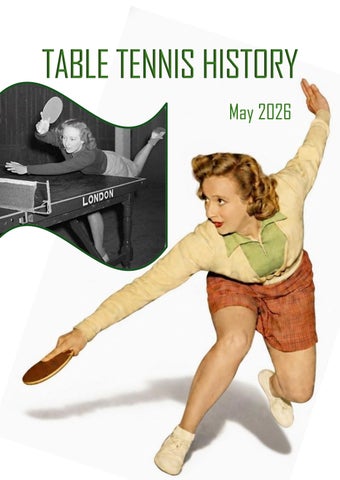
One article idea often leads to another. enjoyed researching the 1940s/’50s English table tennis stars Peggy Franks (seen here and on the cover) and Pinkie Barnes. Their exploits make fun reading. But the investigation also uncovered unpleasantness that Peggy faced at the 1954 world championships, which required a separate examination of Gamesmanship. Naturally our readers would then demand a third article guidance on keeping

A Japanese attempt at Ping Pong Diplomacy first, and we tell you all about it. But the year was 1940.

The Finding Aid for the first eight issues is at the end of the January 2026 issue. There you can browse the list of contents or use the search box.

Next issue is September 1. Your articles, ideas and comments are welcome. Contact info and past issues can be found at our website. The issues are also archived on the Swaythling Club International publications page. ----- Steve Grant

ENGLAND’S SMASHING SUCCESS

England’s women won the first Corbillon Cup competition after the eight-year war interruption, opening a streak that saw them placing in the top three for ten straight years. The number of teams competing each year ranged from seven in out-of-the-way 1952 Bombay to 23 in 1954 London.

Peggy Franks was the stalwart for the first six years, aided most by Vera Dace Thomas, Dora Beregi and then the Rowe twins. The Rowes grabbed the baton and ran with it, with Ann Haydon a strong addition for the final three years.

Diane Rowe was on the team for 11 straight world meetings. In her final year, 1965, she helped England finally win one more medal, a bronze, with Mary Shannon, Lesley Bell and Irene Ogus, in a field of 31 teams headed by China and Japan. England has not since placed in the top three.

Speaking of Japan, they medaled in every one of their first 14 appearances, 1952 to 1975, winning the Corbillon eight times. They have since medaled 12 more times, but only silvers and bronzes. (See the January 2025 issue, page 25, for a table showing Japanese team members, women and men,1952-1965.)

Of course China has the most astounding record, medaling in every Corbillon Cup appearance since 1957, 75% of them gold. (They did not compete in 1967 or ‘69.)

1948 Corbillon Cup champions: Peggy Franks, Betty Steventon, Dora Beregi and Vera Thomas. Team captain Margaret Knott stands behind.
1956: Rosalind, Ann Haydon, Diane

Lifting Wartime Spirits, Then Winning 13 World Medals

Peggy and Pinkie

England urged its people to avoid unnecessary travel, so as to conserve fuel and other resources for the war effort. In 1943 the Ministry of Information promoted a “Stay At Home Holidays” campaign. (The U.S. initiated a similar push, prompting the first use of the term “staycation.”)

Two table tennis players were enlisted in the promotion, Peggy Franks, 19, and Pinkie Barnes, 28. The resulting seven photos on these two pages demonstrated how to have fun without travel.

This talented pair had already been lifting English spirits by performing table tennis

exhibitions at London firehouses, where Peggy was known as the Blonde Bombshell and Pinkie as Black Beauty. Tens of thousands of volunteers were fighting the fires resulting from German bombs, a dangerous, stressful and crucial job that took over 300 lives. The firehouse exhibitions led to the Ministry’s discovery of the pair for the new Stay At Home campaign.

Double date: Two servicemen take Peggy and Pinkie to tea, the new Bette Davis movie “Watch on the Rhine,” and rowing in Hyde Park.

After the war, Peggy and Pinkie made the English team for the first time. The bigger star was Peggy. At the 1947 Worlds, she was on the winning Corbillon Cup team and won bronze in mixed doubles with Victor Barna. In 1948, she helped England keep the Cup and also took gold in doubles with Vera Dace Thomas. In 1949 through 1952, Peggy’s English teams won a silver and three bronzes, and she added bronzes in doubles and mixed doubles. That’s ten World medals in all. Pinkie won a couple of silver medals herself, one for the 1949 team and a second for 1949 doubles with Joan Crosby, as well as a bronze for the 1950 team. After her marriage to actor Sam

Kydd in 1952 (left), Pinkie concentrated on her career as an advertising copywriter, though she later did some junior table tennis coaching.

Peggy’s 1949 mixed doubles bronze was with Johnny Leach (below), as was her 1950 English Open mixed doubles championship.

Bill Pope, ITTF Secretary, presents the newly created Pope Trophy to 1948 doubles champions Vera Dace Thomas and Peggy Franks.

Her 1949 ITTF world ranking was #7:

In the 1940s Peggy became good friends with Ronnie Hook, Kent County champion. They went into the doll business, along with Peggy’s mother, and then married in 1950, honeymooning at the world championships in Budapest. The doll venture survived ups and downs before they hit upon the winning formula making doll clothes. Their 1950s, ‘60s and ‘70s products under the “Faerie Glen” brand name, such as the tennis outfit at right, are still sought by collectors. Hook and Franks Ltd. was a big operation, employing over 350 workers. At left Peggy and Ronnie examine doll dress material in a 1960 video that begins with them playing table tennis (below).

The doll business kept Peggy busy in 1953 and ’54, but she made a table tennis comeback in 1955, winning enough trophies to return her to the English top five. As for the new sponge bat, she said, “I have tried it but found it unwieldy and missed the familiar click ... However Ronnie has taken to sponge, which means I get plenty of practice against it.”

Then pregnancy intruded, a baby boy Tony born in 1956 (who took over the family business in the 1980s). In the next few years, Peggy won a few more doubles trophies and did some summer camp coaching.

Both Peggy and Ronnie were quite athletic, staying in shape with rowing and tennis and later adding golf trophies to their cabinet. In 1952 Peggy made a deal with Olympic sprinter McDonald Bailey, trading table tennis lessons for running and fitness lessons, which she believed significantly helped her game. She inherited athleticism and fighting spirit from her father Harold Franks (1891-1973), who won bronze in 1920 Olympic boxing and was the first-ever ABA light-heavyweight champion.

Is Gamesmanship Poor Sportsmanship?

In 1954, our good Peggy Franks ran into a bit of Gamesmanship. She wrote about it seven years later in the English TTA magazine:

But perhaps even a “most vivid” memory, raked across seven years of emotions and experiences, could have become a bit muddied. For one thing, there’s no crying in table tennis, is there? We checked contemporary accounts. Neither of the two English table tennis magazines even mention this match. But newspapers do. Here’s the journalist and table tennis player Harold Evans (who later moved to the U.S. and became hard-bat friends with Marty Reisman) in the Manchester News:

“The day exploded with sensation ... England’s former No. 1 Peggy Franks and the Japanese hitter Kiiki Watanabe were involved in unpleasant scenes which had the crowd jeering at the Japanese ... The first incident came when a volley was awarded against the Japanese girl and the Japanese team rushed over to protest that the ball had not hit Watanabe’s bat ... The umpire refused to change his ruling ... In the third game [with Franks ahead in games, 2-0] it was 18-18. Franks waited for the Japanese girl to serve but instead Watanabe walked to the back of the arena and kept her waiting. When Watanabe did serve, Franks lost the point and in disgust hit the ball at Watanabe’s face. ... Said Franks afterwards: ‘The umpire should have penalized Watanabe.’ Said Mr. Hasegawa, Japanese team manager, ‘Watanabe was only planning her strategy. It is normal in Japan to allow a player a few seconds between points. We will try to adapt ourselves to English habits.’”

Here’s the London Evening News, under the headline “Delaying Tactics Upset Miss Franks”:

“On several occasions the umpire motioned to Miss Watanabe to proceed with the game when she was serving. The Japanese girl did not appear to understand, and caused frequent delays by doing up her shoelaces, putting her bat down to look around and patting her hair. The continued hold-ups upset Miss Franks’ concentration and she surrendered the initiative and the match.”

Neither 1954 account reports the sit-down crying that Peggy described. But the 1956 Tokyo Worlds had crying, at least according to one account, and perhaps she was conflating the two incidents. Watanabe was again the featured performer, with her teammate playing a supporting role. This was the championship singles match. From Peter Wilson in the Daily Mirror, headlined “Tokio’s Big Show Ends with a ‘Weepy’”:

Our colleague in Japan, Jota Ito, is dubious about the crying accounts. “It has always been common, both in the past and today, for Japanese women to break down in tears after a match. However, it is very rare for them to cry during a match.” Referring to the above final, he states, “I simply can’t think of any reason both of them would burst into tears during a match, and if something like that had actually happened, I believe it would have been reported in the Japanese newspapers … Isn’t it possible that, from a distance, the two of them crouching might have mistakenly looked as if they were crying?” especially to a journalist seeking a particular story line.

At left, Ella Zeller of Romania, who wanted Okawa to win, helps her with a support bandage during the break. Wilson, the reporter, wanted Okawa to win, too. Before the match he had written, “ ... if Watanabe beats her countrywoman ... it will be a travesty of justice, and a slap in the face for sportsmanship.”

Okawa holds her ankle while Watanabe looks on.
Zeller, Okawa

Wilson wrote that there was additional gamesmanship in the men’s final between Ichiro Ogimura and Toshiaki Tanaka. Wilson was seated next to Victor Barna and Diane Rowe: “... At 10-9 in the final set Ogimura decided he wanted to move the bench on which we were sitting. After a little break he constantly interrupted the game to mop his face, table, anything else handy, with a towel which is always some way off. In the end it seemed to me Tanaka had lost all patience, and most uncharacteristically threw away the last two points.”

The 1957 Stockholm Worlds had no sob stories, but more Gamesmanship. The Daily Herald described the women’s final between Ann Haydon of England and Fujie Eguchi: “In the vital fifth game Ann led 4-1 and 6-2 but Eguchi, using every method of gamesmanship, pulled it off.” A few days earlier, he wrote of the team final against Romania, “Eguchi and Watanabe brought out their usual quota of spectacular grimaces and delaying tactics.” The Daily Express wrote about Japan winning both the Swaythling Cup (against Hungary) and the Corbillon: “The Japanese time-wasting tactics at vital points in both Cups had the Swedish crowd whistling and jeering.” The spectators (and others) wanted enforcement of the rule that play must be continuous.

The term Gamesmanship was first popularized in 1947 by Stephen Potter of England with his book The Theory and Practice of Gamesmanship or The Art of Winning Games Without Actually Cheating. Years later, not much past boyhood, I acquired a used copy of this best seller, eager to learn. Had I unknowingly been engaging in this fine art, just as I had unknowingly been writing prose? If so, the book made clear that I was a rank amateur. Potter’s techniques of psychological warfare went far beyond anything I could imagine.

But the basic Gamesmanship tactics are well known. Throw the opponent off his rhythm, undermine his confidence, distract his attention. Call a time out right before the opposing kicker is about to attempt a field goal. Tell your opponent how great he is performing a particular stroke, making him overthink it.

Spectators, too, engage in Gamesmanship. A crowd’s deafening roar, the shouting of abusive epithets and the waving of objects (say, to distract the free-throw shooter) can play a role in outcomes. Watanabe’s delaying tactics were rule-breaking poor sportsmanship. As for the other charges against her, well, times have since changed. Some players today embrace “bobbing up and down” as best-practice service-receive preparation; watch Felix Lebrun, for one. Maybe Watanabe was just ahead of her time. Shouting has become commonplace, too, although that’s not to say it has no gamesmanship component. As

Haydon, Eguchi

for that kid at your local tournament who screams after every point he wins, disrupting all the other tables and chasing away spectators, that’s just poor sportsmanship. The tournament referee should quash it.

The most infamous table tennis gamesman of the 1960s/’70s was Connie Warren of England. Here’s January 8, 1966, coverage of the English Closed by the Liverpool Daily Post:

More than three years later, in November 1969, Warren made no friends with his win of the Ulster Open, as reported by multiple Irish newspapers. Jim Langan, who lost -12, 14, 19, “complained about the blatant gamesmanship of Warren, who foul served, talked and ‘needled’ his way through a final that had all the atmosphere of a big soccer match.” Langan said, “What’s the use of trying to beat Warren? He uses every unfair trick there is and it takes as much effort to play him as to play 20 other people who are better players. He wouldn’t get away with it on the continent and that’s why he has poor results in Europe. If that’s the way to win, then I’d rather lose.”

Warren’s answer was, “That’s how I play the game. If Jimmy didn’t like it, he should have complained to the umpire.” The umpire gave Warren two warnings but no penalties. “Some people believed I didn’t deserve to win the title ... That’s rubbish.”

A year later, in November 1970, Warren again upset the crowd and more than one opponent on his way to winning a different Irish tournament. With the score 14-14 in the final game of a semifinal against tournament favorite Malcolm Sugden of Scotland, the “chunky little Londoner brought the match to a halt for fully four minutes as he clowned around to unsettle Sugden. He drank milk, polished the table, chatted with the umpire and drew howls of disapproval from the packed crowd.”

Warren

From the ETTA obituary of Warren (1940-2021): “He was one of the great characters on the tournament circuit in the 1960s and ‘70s, a player who delighted in leading officials a merry dance but always with a twinkle in his eye.” This “led to clashes with authority which resulted in him not being selected for England as often as his ability warranted.” He did make the 1967 Swaythling Cup team. In his mature years, he became an admired contributor to English table tennis.

Do extreme gamesmen have an extreme desire for victory? Perhaps it’s better understood as an extreme hatred of losing. Watanabe ran off the court crying. Warren was notorious for a bad temper, table abuse and foul language. Milk soothes an angry stomach.

It’s quite possible that Warren read Ken Stanley’s 1959 book Table Tennis: A New Approach. A former English international, Stanley wrote that his country needed more Gamesmanship if it was to be successful internationally (right):

The editor of the book happened to be Harold Evans, one of the journalists we quoted earlier. And a photo in the book shows Peggy Franks as a summer camp coach alongside Stanley. She surely knew of his controversial stance before writing the essay that opened this article.

Peggy concluded that essay with, “Perhaps gamesmanship is the thing I should have practised.” Perhaps. But perhaps, Peggy, the thing to practice is shrugging off the opponent’s gamesmanship. Let him be distracted by his own antics. You focus on your game. With his tactics, the opponent is admitting weakness, admitting he needs help to win. Don’t give him that help.

That 1947 Gamesmanship book states, “Perhaps the most difficult type for the gamesman to play is the man who indulges in pure play. He gets down to it, he gets on with it, he plays each shot according to its merits, and his own powers, without a trace of exhibitionism, and no by-play whatever ...”

From a more recent book, see page 17 for advice on keeping “A Quiet Mind.”

From the website Shots Table Tennis, by Bruce Downs (USA), who creates new table tennis cartoons almost daily.

This 1936 Colorado photo features a famous quote by sportswriter Grantland Rice.

A Quiet Mind

Edited excerpts from a new book published last year:

Pressure does not change the table, the physics, or the rules. It changes only the way you think. And the moment your thoughts start to chase outcomes, your body begins to follow. Every great player knows this battle well the tension that rises when you need one final shot to win, the rush of adrenaline that tightens the muscles, the voice in your head that whispers what happens if you miss. That voice is your teacher. It’s showing you the part of yourself that still needs discipline. The goal is not to silence it, but to see it for what it is fear disguised as thought.

A quiet mind produces a smooth stroke. A restless mind produces chaos.

Focus, Confidence and Composure are the keys to a quiet mind.

Focus is not something you try to have. It’s what remains when you remove distraction. The mind cannot hold two clear thoughts at once. If you are thinking about missing, you cannot be thinking about execution. If you are focused on score, you cannot be fully aware of stroke. True focus happens when your awareness narrows to a single intention the ball, the line, the motion. In that state, time feels slower. Breathing deepens. Movement becomes fluid. It’s not a gift it’s a skill. And like all skills, it is built through repetition, not theory.

Forget the match, forget who is watching. Just play this shot, right here, right now. When you start living shot by shot, your game begins to feel effortless.

Confidence is not arrogance. It’s not even certainty. It’s trust trust in your preparation, your process, and your instincts. Confidence is built in practice but proven under pressure. It’s that quiet voice that says, “I’ve been here before. I know what to do.” The most confident players are rarely the loudest or most expressive. They carry themselves lightly, but their presence fills the room. You can see it in how they walk around the table calm, measured, almost meditative.

They don’t force confidence. They cultivate it. Every practice session is a seed. Every disciplined repetition adds a layer of trust. By the time they enter a match, they are not hoping to play well. They are simply allowing themselves to. That is real confidence earned through consistency, not talk.

Composure is a simple matter of interpretation. The champion feels the same adrenaline as everyone else they just read it differently. Where others feel fear, they feel readiness. Greet pressure like an old friend. Take a deep breath and say silently, “Good. I’m alive in this moment.” That single mindset shift transforms anxiety into presence.

Pressure isn’t your enemy. It’s proof that you care. It is not something to eliminate. It’s something to understand. It sharpens some players and crushes others, depending on how they interpret it. The secret is not to fight pressure, but to reframe it. Pressure is energy. You can’t stop it, but you can channel it. Pressure simply means that the moment matters to you. When your heart races, it’s not a sign of weakness. It’s a sign that your body is preparing to perform.

Focus, Confidence and Composure are not separate skills. They are three parts of the same discipline: Awareness. When you are aware of your thoughts, emotions, and rhythm, the stroke moves honestly. The best players are not calm because they never feel pressure. They are calm because they know who they are when it arrives.

When the match tightens and every shot begins to feel heavier, vision falters. The table looks smaller, angles blur. Under pressure, the body will always try to move faster than the mind. The heart speeds up, the breath shortens. To counter this, slow your rhythm intentionally. Align yourself with patience, discipline, and truth.

Mastery begins when you realize the game is about mastering yourself, not about beating others. Flow happens when your awareness is so complete that thought becomes unnecessary. The body and mind move together in perfect timing. You cannot force flow. You invite it through preparation. When your fundamentals are sound, your rhythm natural, and your focus sharp, the game begins to play itself through you. Those moments of effortless perfection when the ball moves exactly as imagined, when time slows, when every shot feels inevitable --- are the reward for thousands of disciplined hours.

Every player lives in two worlds: the quiet world of practice and the electric world of performance. In practice, time feels infinite. There are no eyes watching, no scores kept. You are free to explore. In competition, every stroke carries weight. There is no room for hesitation. The challenge is to connect these two worlds to make the competitive table feel like an extension of your practice table. That connection is built through preparation, awareness, and trust. Preparation builds the body. Awareness builds the mind. Trust builds the bridge between them.

Nervousness fades when repetition takes over. Once your body remembers what smooth feels like, the mind quiets down. The opening points are about establishing trust not in the score, but in yourself.

Competition is rhythm a constant shift between control and reaction. When momentum favors you, stay composed. Don’t rush to celebrate. Continue playing as if you’re still behind. When momentum turns against you, don’t force recovery. Regain rhythm slowly, one shot at a time. Every match swings back and forth. The winner is not the one who dominates early it’s the one who stays patient longest. Patience under pressure is the rarest and most powerful weapon in competitive play.

--- Stillness in Motion: The Inner Path to Mastery in Billiards and Life, Bill A. Polcen, 2025

Updates

Our January 2025 issue showed several book autographs by Marty Reisman. At left is another, recently listed on eBay.

In that issue we previewed the Marty Supreme movie, for which we were a history consultant. Now, widely published writer Alex Zubatov (USA) gives us an exclusive review of the film see the next page. The cartoon at right was created by Bruce Downs (USA) at Shots Table Tennis. *********************

Staying with the rubber question: The May issue of the leading Japanese table tennis magazine, World Table Tennis, published “The 1950s Arms Race: The Sponge Revolution Part 1 Steve Grant” (right). Our colleague Jota Ito did the translation. For the 2015 original, see Table Tennis Collector.

Chopblockers have continued to rock the world since A.J. Scott (USA) wrote his analysis in the May 2025 issue, page 36. He updates us on one in particular: “My article mentioned the recent switch to backhand anti-spin by Sabine Winter of Germany, whose world ranking had already risen to 51st. Her ascent has since accelerated, vaulting her at age 33 into the world’s Top-10. In April Winter beat 8th-ranked Wang Yidi of China 4-0 at Macau to become the first native European woman to win a World Cup medal since former teammate Petrissa Solja 11 years ago. That moved Winter’s world ranking up to 9th. Her German National Team Coach Tamara Boros made the Top-10 in 2006; since then, the only other native European to break into that elite circle was Bernadette Szocs (Romania) in 2024, who is now out of the Top-20.”

Correction: Our January 2026 issue mistakenly described the player/actress Lilli Palmer as Austrian. Thank you to the readers who alerted us. Of course she was German see the fullpage article about her in the May 2025 issue, page 24. From that article: “She never liked referring to herself as German or even mentioning the country. During the war, she told people she was from Vienna, probably at the encouragement of her film studio.”

Marty Not So Supreme

Because I choose to spend three to four evenings per week playing table tennis and watch table tennis matches both in person and on YouTube with some regularity, one would think a big budget feature about a table tennis icon would be a surefire adrenaline rush that hits the spot. Yes, one would think…. And yet I found myself reacting to Josh Safdie’s Best Picture-nominated Marty Supreme with no more than lukewarm enthusiasm.

It wasn’t any one thing.

Certainly it wasn’t the extent to which this quasi-biopic based on the life of legendary table tennis prodigy and hustler Marty Reisman was only loosely tethered to the factual details of that life. I have no problem with the fact that fiction is fiction.

Nor was my issue the extent to which the film was stuffed silly with high-octane incidents, whether amorous misadventures or goons and gunplay. I get that most audiences uninitiated into the distinct magic of this sadly esoteric sport need something more to keep them hooked than the coiled-serpent-like tension of waiting for a deadly skilled table tennis pro to unfurl a devious serve and the ensuing staccato rhythm of a little white ball zipping back and forth at improbable trajectories cutting through the enraptured spectators’ pregnant silence.

Nor, indeed, was my issue with the movie the sheer shortage of quality table tennis points shown from beginning to end in the way they’d be captured by a steady camera faithfully recording the action for the educated eyes of true aficionados. I would’ve loved to have seen such points, of course, but I understood the director’s choice to focus us elsewhere.

And elsewhere … and elsewhere. And, yet again, elsewhere. And maybe that begins to get us closer to the essence of the fundamental problem with this film. The camera kept shifting, swerving and cutting elsewhere, as though no single shot was worthy of its or our sustained attention. The pristine path of the table tennis ball arcing through the air was just as fair game for interruption as the path of cars screeching along the pavement or the path of people striding across marble floors. The result: the frenetic, A.D.D.-style camerawork turned much of the movie into undifferentiated porridge in which the individual ingredients were reduced to indiscernible, bland mishmash. The sound design was likewise maximalized, while the story, as above, was thoroughly sensationalized. When the knob is dialed up to 10 the whole way through from start to finish, the viewer simply ends up going numb. Just like Marty’s spur-of-the-moment idea to introduce orange balls that goes nowhere and culminates only in a flurry of orange balls scattering aimlessly in all directions, the movie’s flurry of relentlessly amped-up visuals doesn’t amount to anything that matters.

Now, I can grasp that incessant jump-cuts are just this director’s style; I can grasp it, but I can’t really appreciate it. Like anything that comprises part of a work of art, style has to be aesthetically justified. An artist’s choice must make sense within the context of the whole. In, for example, Daron Aronofsky’s Requiem for a Dream (2000), a film that must be seen uninterrupted in a dark room on a large screen with crisp surround sound to work its magic, the sound and the visuals expertly propel the viewer toward a ferocious emotional climax by carefully modulating their steady acceleration before they go into overdrive. In Marty Supreme, on the other hand, there is no particular reason for the overthe-top theatrics that pulse along pointlessly from the opening bell to the closing credits. And style bereft of aesthetic purpose is a mere affectation, a distracting tic.

Nor is the character arc of the film’s central protagonist sufficiently compelling to carry us forward through the sheer force of empathy. Thoroughly irascible, impulsive and selfish, treating others either as obstacles or as means to an end, the movie’s Marty is unlikeable through and through. Safdie, I suspect, wants us to see the last scene where Marty stands transfixed by the coming of his child into the world as some sort of Hollywood-style redemption arc, where Marty is finally ready to take responsibility for his actions, but I, for one, remained unconvinced due to everything we had seen to that point that the child would be, for this self-absorbed hustler, anything more than a shiny bauble capturing his attention for a few moments before he moved on to his next momentary fixation. Table tennis, we sense, is this guy’s only abiding love though, I should add, those of us who have cast aside relationships and other like obligations for the sake of this addictive, beautiful game can surely understand Marty’s passion better than most.

That the director, despite himself, stayed faithful to this depiction of an unlikeable lout and failed to convince us with his intended redemptive arc storyline is, I suppose, a kind of unintentional accomplishment. And the film has to its credit other very intentional accomplishments, most palpable of these being Timothée Chalamet’s committed performance and the gorgeous sets and costumes conveying a vivid sense of a post-World War II New York City. That, combined with the sheer fact that here was a movie that aspired to turn a legendary table tennis player I had once met shortly before his death into a more widely known commodity, was sufficient to keep me entertained … but not, as I would have hoped indeed, as every filmgoer hopes at the inception of every feature as the stream of previews finally concludes and the lights go dark excited, enthralled or remotely amazed.

Alexander Zubatov is an attorney, writer and OX long pips defender, not necessarily in that order.

101 ISSUES

Updates, Elaborations, Corrections

Part Nine, Issues 95 thru 98

We continue our analysis of the 101 issues of Table Tennis Collector/Table Tennis History Journal. Those issues can be viewed at https://www.ittf.com/history/documents/journals/.

Issue 95 ***Page 34. A two-part, 26-page study of Ivor Montagu, the founding ITTF president, covers various aspects of his very varied life. But there’s still something never discussed: Montagu’s 1967 resignation. It was rancorous and premature. See “Ivor the Injured,” page 38.

Issue 95 ***Page 51. “Table Lawn Tennis” was advertised as early as 1884 by a New York City department store. Presumably, this was a board game or card game. But how about just plain “Table Tennis”? TTC 95 shows this 1887 Table Tennis board and dice game (left) and states that this is the earliest known game to use the name “Table Tennis.” But there are earlier ads for “Table Tennis,” probably board or card games. This is from the December 17, 1885, Olean (NY) Democrat:

And a month later, the ad below (Issue 96, page 22) appeared in the Baltimore (Maryland) Sun every day for a month:

Issue 96 ***Page 4. Shows the cover of the 1902 game Bing Bang. See page 40 to learn more.

Issue 96 ***Page 25. Our colleague Russ Walker (USA) shows this 1902 set by John W. Iliff & Co. of Chicago. The company had been a publisher of non-fiction books

since 1883 and was headed by Mr. Iliff (1861-1935) until 1934. The magazine Geyer’s Stationer ran this puff piece for his Table Tennis:

Unfortunately, four months later, a fire consumed the firm’s building on Wabash Ave., including its entire stock, only partially insured. Mr. Iliff soon found new Chicago quarters.

Issue 96 ***Page 27. In the same issue, Russ showed this unusual 1902 ball retriever with an unusual name, Whisk-In-Skie, produced by the New York firm McLoughlin Bros. The first thought is that the name was just a play on the newly popular term “buttinski,” a person who butts into other people’s business. But the term “Wiskinski” had already been used for many years by New York’s famous Tammany Society. The Wiskinski was the officer in charge of collecting dues, an avidly sought position that awarded him a percentage of the collection. The Wiskinski gathered dues; the Whisk-In-Skie gathered balls.

Issue 96 ***Page 73. Shows the 1948 doubles world championship medal won by Peggy Franks and Vera Dace. They were also presented with the newly established W.J. Pope trophy; we show the presentation photo on page 8.

Here’s another medal from that year, identical except for the inscription “Men’s Doubles Runner Up.” Ferenc Soos of Hungary and Adrian Haydon of England fell in the final to Ladislav Štípek and Bohumil Váňa of Czechoslovakia. This piece was surely Soos’s keepsake, given that the eBay seller was located in Hungary.

The previous year, 1947, Haydon had taken bronze in doubles with Victor Barna. He naturally expected the same 1948 partner. Meanwhile, Richard Bergmann had hoped and expected that his partner would be Tage Flisberg of Sweden, the left-hander with whom he had easily won the recent English Open doubles. But the English powers that be decided that Bergmann would be Barna’s new doubles partner. So Haydon had to last-minute scramble to recruit Soos.

To reach the finals, Soos and Haydon pulled off five-game upsets over József Kóczián / Ferenc Sidó of Hungary and Ivan Andreadis / Jozef Turek of Czechoslovakia. Haydon, the non-playing captain of the English team, was 36 and had already been winning world championship medals for 20 years. He would win four more (doubles and team) in 1952 and ’53, for a total of 14. Soos, 28, was to win a total of 12 medals.

Štípek/Váňa shrugged, not caring who partnered whom, beating everybody 3-0Flisberg/Arne Niedenmark, Barna/Bergmann and Soos/Haydon. Soos got revenge in 1950, teaming with Sido to knock out Štípek/Váňa in a five-game semifinal and beating another Czech pair in the finals, defending champions Ivan Andreadis / František Tokár.

Issue 96 ***Page 73. Shows a Europe Cup medal (left) won by the English women in 194647 and 1947-48. Corbillon Cup champions Peggy Franks, Vera Dace and Betty Blackbourn were among the key players for England. For the scoop on this competition, see our May 2024 issue, page 32, where we also show the 1948-49 medal won by the English men.

Soos

Issue 97 ***Page 8. Provides supplemental biographical information on Kathleen Berry, English champion several times in the early 1920s and mixed doubles bronze medalist with Laszlo Bellak at the 1933 Paris world championships. We can add a bit more:

In 1952, age 44 and now named Mrs. Kathleen Graves, she attended a reunion of sorts in London, the 25-year jubilee celebration of the English TTA. Fred Perry was there, as were the Rowe twins. Kathleen reported that she no longer owned the car she won at age 15 in the huge 1923 Daily Mirror tournament, but she “still loves the game, its friendships and the memories.”

Later in 1952, her brother Reginald Henry Berry made the newspapers, too, but in an unwanted way. This was the older brother, a former member of the All-England club who had partnered Kathleen in mixed doubles at the 1926 Worlds. In 1923 he was Hon. Secretary of the Table Tennis Association, while also winning a silver medal in that Daily Mirror tournament. He had been a tournament tennis player, also, and had a career with the Bank of England. In 1952, age 49, now retired according to the papers, he was arrested four times in one week for public drunkenness in London and Eastbourne.

Issue 97 ***Page 42. Shows strung table tennis rackets made by the German firm Roithner, date unknown. Here is Roithner equipment in the 1930 Universal Toy catalog:

Issue 98 This 94-page issue was devoted entirely to Fabio Marcotulli’s table tennis museum in Aruba, a vast collection that is astonishingly comprehensive for the early years. Fabio and Laila see the museum as a work in progress, always growing. They welcome visitors if you let them know you can make it to their historically important Casa Rosada, a lovely home/museum. You might play table tennis on one of the tables or even get a personal tour around the beautiful island, a popular stop for cruise ships.

(Left) Fabio recently received recognition for the museum from the Aruba Minister of Kingdom Relations, Education, Youth, Innovation & Sports.

Before the Storm

When you first hear about Japan’s 1940 invitation to U.S. table tennis players, your natural thought is, “Hmm, Pearl Harbor was 1941.”

Certainly storm clouds were gathering, fed by increasing Japanese aggression in Asia. In July 1940 the U.S. restricted exports of iron and certain other raw materials to Japan. By October, the U.S. was urging citizens to evacuate Japan and much of Asia.

A little sports background: Japan was originally chosen to host the 1940 Summer Olympics (right). But its 1937 military incursions in China led to boycott threats from Western nations, which wanted no repeat of the 1936 Berlin nationalist propaganda. So Japan relinquished the Games, which were then given to Finland but later canceled due to world turmoil. As a modest substitute in June 1940, Japan hosted the six-country East Asian Games, part of the 2600-year anniversary celebration of its mythical first emperor.

The invitation to the U.S. was not for those East Asian Games (which, yes, did include table tennis) but rather for the so-called Pan-Pacific Table Tennis Championships, a three-week traveling event that began at about the same time. Just three nations participated, Australia being the third. (New Zealand’s invitation suffered a fatal postal delay.) Not coincidentally, Japan’s expansionist strategy relied heavily on the natural resources of these particular invitees.

In his Tokyo welcoming speech, the Japan TTA president Mr. Okuma said, “Taking the geographical situation of the United States, Australia and Japan into consideration, a friendly triangle can be formed in the Pacific and a friendly meaning nominally and

substantially can be found in this Pan-Pacific tournament. I sincerely hope that we strengthen the international friendly relationship.”

Of course the Japan TTA was excited about an opportunity to play the star Americans, specifically requesting World gold medalists Jimmy McClure, Sol Schiff and Buddy Blattner. Unfortunately, those players were not available (for one thing, Blattner had given up table tennis for pro baseball in 1939), nor was U.S. #1 Lou Pagliaro. But two Chicago teenagers said yes to the once-in-a-lifetime, all-expenses-paid Japanese offer: U.S. # 5 Bob Anderson and his doubles partner, #7 Billy Holzrichter. Ruthe Brewer, #2 woman, and #4 Mildred Wilkinson Shipman also accepted. Captain was Bill Gunn.

Meeting in Chicago, they made several exhibition stops on their journey to San Francisco. Mid-journey, Mildred quit when she learned she was pregnant. Last-minute replacing her was 20-year-old Mayo Rae Rolph of Portland, Oregon, ranked #12 among U.S. women (but previously as high as 6th), with her unusual grip (below). She and Anderson had been mixed doubles finalists at the recent U.S. Open. Rolph needed time to make arrangements and get a passport but caught up with the team in Osaka.

Holzrichter, Anderson: Doubles champions back home
Ruthe Brewer Mayo Rae Rolph, 1936
Rolph, Holzrichter, unknown, Anderson, Brewer
Bob Anderson
Billy Holzrichter

Representing Australia were their #1 Kenneth Adamson (right), 20, recently coached by the transplanted Hungarians Miki Szabados and Istvan Kelen, and Arthur Bowe, 21.

A number of different Japanese players saw action, including their #1 Takashi Kon, his #1 doubles partner Suekichi Suyama, Konko Sai, Tadaaki Hayashi, and women Koyu Yasuhara and Kiyoko Nishiyama.

Since the Japanese had never competed on the world stage, everyone was curious about their strength. That curiosity became partially satisfied. The Japanese made an excellent showing, both In the Pan-Pacific team matches and in the individual tournaments that were held. But one can debate the meaningfulness of the results. The U.S. was missing its top four players, while Australia trailed many countries in overall strength. Also, the table characteristics were unfamiliar to the visitors, so ball speed and bounce height caused difficulties and favored certain styles.

In an interview 40 years later, the American woman Rolph said, “Their tables were slow. I’m not making excuses, but it was a different kind of game that they were playing and so we did not do very well at all.”

Still, the Japanese strength certainly impressed observers. Bowe, the Australian, wrote in the Sydney Herald, August 7: “Kon, the national champion for the past two years, is particularly strong and did not lose a match to the visiting players. The concentration,

Sai
Suyama
Yasuhara
Holzrichter
Adamson

quickness and correct footwork of the Japanese are amazing, and their fighting spirit is second to none. They have three coaches and a captain to advise them on tactics and technique ... As the game is played they [the four advisors] take up favourable positions to do their work ... Although they all use the old penholder grip with ordinary wooden or cork bats, their control and allaround skill are remarkable, and they attack and defend with equal ease.”

Cartoon in Sydney Daily Telegraph, July 21, 1940

In the final of the individual Tokyo tournament, Kon met Konko Sai. Bowe: “I considered this the best match I had witnessed. The driving, counterdriving, retrieving and fighting spirit were remarkable ... I have never seen so much excitement in any sport. The atmosphere was tense … After a terrific battle, Sai won at 18 in the fifth ... At all times we found these players sporting and likable.”

“Three coaches would watch for any weakness in their countryman’s play, or that of their opponent,” reported the other Australian team member, Adamson. “They would call the Japanese player from the table in the middle of the game and advise him on tactics ... We played in six exhibition matches as well as the championships and were completely outplayed. Consistency and speed of movement was the secret of Japanese success. They drive continually, only rarely turning to sound defence ... The players’ control and all-round skills are remarkable ... The speed of their game and their intense concentration are amazing. The singles final between Kon and Sai was the most spectacular and thrilling game I have ever seen.”

Bill Gunn, the U.S. captain, wrote an article for the Japan-California Daily News, October 13: “Without exception, all the Japanese have very fine forehand drives, and from the standpoint of forehand consistency are among the greatest in the world. However, with the exceptions of Mr. Kon and Mr. Suyama, I saw no players with a complete all-around game. In

Penholder battle: Kenneth Adamson of Australia vs. Tadaaki Hayashi, who won 17, -18, 20, 14.

Kuniko Osada, Ruthe Brewer

the very strength of some players also lies their weakness. Lacking adequate defenses, they can be caught unprepared and out of position by sharp and sudden counter-attack. A conspicuous example of this would be Mr. Sai, who is one of the great forehand hitters of the world, for consistency. His swing is so long, however, and he often leaves the table so wide open that he becomes easy prey for a sharp counter-drive. If I may take the liberty of making a suggestion, I would advise most Japanese players to practice hard on the development of good chop defense on both sides. Retaining their marvelous forehand driving ability, they would, with good defenses, soon take their place on the list of the world’s greatest players.

“I am very glad to have this opportunity to pay particular tribute to your Mr. Kon and Mr. Suyama. They are truly great all-around players, capable of worthy performance in any competition. Both have great fighting spirit and wonderful generalship. In teamwork and tactics they make a super doubles combination. In addition, their gentlemanly conduct and sportsmanship is unexcelled. I am proud to call them friends.”

Bowe again: “That table tennis could have so much popularity amazed us.” Spectators at each event numbered from 1500 to 6000. “The crowds are excitable and were worked up by the play. We were amazed, especially on the opening night, when we found every rally applauded while it was being played. Some of the rallies were not worth the applause, but the people were so keen that their interest never slackened... The number of reporters who sat at the end of the stage reminded me of big boxing contests... The number of photographs taken of us during our tour was uncountable... We were grandly welcomed at every city and found the people courteous and friendly.”

Said Rolph: “The Japanese just loved it. It was completely sold out wherever we went. They would watch every point and then suddenly they would go [makes sound]. Sounds

Kon

like “boo” if you’re out there playing, but it wasn’t. They were just so involved, and this was their way of showing it. They gave us presents and they were just so kind.”

The JTTA president wrote to the U.S.: “Goodwill between U.S.A. and Japan, promoted by means of the table tennis matches, is a most valuable result ...

With this aim in view, let us hope for the continuation of the Pan-Pacific table tennis matches and also the exchange of players for the sheer purpose of developing amity between the two nations."

Gunn: “It is my earnest hope that next year the USTTA will be in a position to extend to the Japanese Association a similar invitation to send several players to the U.S. You may be assured that I will do my utmost to bring this about.”

Ruthe Brewer, 20, came away from the trip with an unexpected prize: her future husband Dyer Crist, 25, of Michigan, found playing table tennis on a ship in Yokohama harbor. They married just three months later.

Two scenes from the East Asian Games held at about the same time, June 5-16, with table tennis in Tokyo and then Kashihara.

Brewer/Anderson vs. Nishiyama/Sai

STRANDED

Of course the war intervened before the USTTA could reciprocate that 1940 Japanese invitation. But in 1950 they invited one of the 1940 Japanese participants to compete in the March U.S. Open. That was 29-year-old Konko Sai, who had since moved back to his native Korea and started a family in Seoul. This July 1950 photo of him, taken by a photographer for the Los Angeles newspaper Rafu Shimpo, is found on the website of the Japanese American National Museum. If Sai looks very serious, consider that just a week earlier the North Koreans had overrun Seoul as the Korean War began. According to newspaper reports, at some point he learned that one of his children was dead, as were his parents and more than one sibling. His wife and other child escaped south to Pusan.

We should no longer be calling him Sai, because he was using his Korean name Kuen Hang Choi. Americans called him Kenny or Choo Choo Choi. He was unable to return home until at least mid-1952, or perhaps not until the armistice was signed in July 1953.

Meanwhile, table tennis was a welcome distraction from his troubles, as well as a modest means of support. Newspapers stated that he had several times been Korean champion. He was unbeaten in California tournaments but fared less well in the two or three U.S. Opens he entered. At the 1951 Open he faced Marty Reisman. From USATT Historian Tim Boggan’s book: “In the 8th’s, Marty played Choi a 22, 20, 22 talked-about crowd-pleaser. Ask Marty about that match 50 years later, and what does he say? ‘Sure I remember Choi. I was a total lock over him. I had the impression he was overrated. Lefties, penholders, I never had trouble with. Why should I? I’d played hundreds of money matches against all kinds of opposition.’”

Choi, reportedly a Japanese law school graduate, knew little English but enrolled at a local college to obtain a student visa. Table tennis players and organizations aided him financially, in part through exhibitions. We saw Choi in the September 2024 issue, page 13 (left), playing a 1951 exhibition with Bob Ashley.

NEW CUPS FOR A NEW CENTURY

The ITTF is celebrating its centenary. Great, congratulations! The Swaythling Cup is also exactly 100 years old, and the Corbillon Cup nearly as ancient. Not so great. Updates are overdue! The game has evolved; so should its trophies.

1. Rename both Cups. You may happen to know that these are the trophies presented to the winning men’s and women’s teams at the world table tennis championships. But their names are certainly no clue, and which is which, men’s or women’s? Moreover, the obscure English/French references no longer mean anything to the great majority of the 227 ITTF member associations

2. Create new physical Cups. The old-fashioned, uninspiring trophies are piling up too many winners’ engravings. Even 20 years ago, the oddly tall and unwieldy Swaythling was falling apart, as seen at right with concerned coach Liu Guoliang. Our sport needs a unique look, a happening image. Start over with elegant 21st-century cups that proudly proclaim “Table Tennis is Now!”

The Proposed New Cups and Proposed Names

Simple, yet full of meaning and unforgettable.

(To the ITTF: Please resist the temptation to sell that beautiful white space.)

Gentlemen’s Table Tennis Team World Cup
Ladies’ Table Tennis Team World Cup

Mechlovits, the Man

Zoltan Mechlovits won the 1928 world singles championship. But he was just as well known for his early leadership role in international and Hungarian table tennis.

In 1954 Victor Barna recorded his thoughts on this rather controversial man, whom he knew well. We present those thoughts here, from Barna’s privately published memoirs. (See our January 2025 issue, page 19, for information about this source.)

Alongside, we also give the perspective of Ivor Montagu, president of the ITTF, from his lengthy Mechlovits obituary in the May 1951 issue of the English TTA magazine.

Barna starts us off:

Bellak, Mechlovits, Barna

“Despite the fact that we juniors played well and aroused considerable interest, the elders and officials did not support us. Quite the opposite! Dr. Pécsi, Dr. Jacobi and Zoltán Mechlovits considered it beneath them to play with teenagers, and therefore the Association made a new rule. According to this, junior players under 18 were not allowed to participate in adult competitions. The only exception was made for Laci Bellák, who was already a first-class player by then and therefore his exclusion could have caused a complication. Imagine: It was not adults who were excluded from youth competitions, but the younger generation who were banned from playing with adults!”

Montagu:

“Mechlovits was a penholder, the only one ever to gain a world title. He was a perfect master of varying speed, varying length, varying placement. His knowledge was immense. He was a tremendous fighter and inflexibly calm.

“But it was as a captain, trainer, discoverer and inspirer of young people that he was truly marvelous. What an eye he had for seeking out the weakness of an opponent, the exact moment at which pressure must be applied, precisely the tactics or strokes that the enemy did not want, the moment to continue inflexibly and the moment to change. What an eye for the youth with talent and inward fire who would repay fostering. At all this there was not, and could never be, anyone like Mechlovits.”

In 1929, Barna, Mechlovits, Sándor Glancz, István Kelen and Miklós Szabados were named to the Hungarian world team.

Barna:

“… Bellák, on the other hand, was not included in the team. Even after several competitions, there was no noticeable difference between him and Glancz and Kelen. Mechlovits was the big boss of Hungarian table tennis, the team captain, the organizer of the national team and generally the driving force behind the scenes. It was no big secret that he and Laci did not like each other.” [Bellak led Mechlovits 2-0, 20-17 in the 1928 final. In 1929, though not on the team, Bellak won two silver medals: doubles with Glancz and mixed doubles with Magda Gal.]

At the Hall of Fame exhibit of the ITTF Museum, Mechlovits and Bellak rest side by side:

Montagu:

“Inflexibly loyal to his friends, with a sense of humour that sometimes only made his tongue more cutting, Mechlovits was not to all an easy man to get on with. He was too dictatorial, stubborn. He led the young players under him a dog’s life. On tour he would rule them with a rod of iron and sometimes make them beg for tuppence of pocket money. How they hated it. Victor would tell you! Some never forgave him, but the friendship of others (although he was by temperament a lonely man) he retained to the end. Still others would admit it was the making of them …”

Barna:

“What kind of person was Mechlovits? First I must say that he was feared and disliked. But it is undeniable that he was a great player and an even better organizer. As an expert and team captain, he became a strong, decisive personality … He had a rigorous training regimen to which we had to adhere. The game itself was only part of it. Since most of us were working or going to school, most of our physical training had to be done on Sundays. Long walks in the mountains, sometimes in the snow, only strengthened our endurance and allowed the fresh air to penetrate our lungs. Short runs increased our speed and other exercises perfected our skills. They were never boring, because Mechlovits always had stories to tell and simply loved to joke. He would make fun of anyone, regardless of their person, title or position. Ice skating, any form of skating, was forbidden. He told us to always drink soda [rather than alcohol] because, according to our captain, it would make us think less about ‘the girls’ …

“My association, MTK, which was of course under the leadership of Mechlovits, traveled to Yugoslavia for two matches. When we left Yugoslavia, we arrived at the border at around three in the morning, where it turned out that our visas had expired at midnight. A petty official was hesitant, but he was not prepared for Mechlovits. Mechlovits did not even speak to him. He instead demanded to be allowed to telephone the King, since he would not discuss this insult with anyone else. Mechlovits insisted that they were happy when we left in the end!”

Barna, late 1933:

“The news reached me from Budapest that the ‘Mechlovits reign’ had suddenly ended. While

Mechlovits' unpopularity was growing, one of his main enemies, Glancz, learned that an English sports equipment manufacturer had paid Mechlovits some money, which he pocketed. He was given a choice: Either resign or be publicly accused. He chose the former. Andor Wilcsek became Hungary's non-playing team captain for the World Championships in Paris.”

Montagu:

“Zoltan survived the war after escaping twice from transports to the death camps (once leaping from a moving train), but having undergone nameless horrors and privations and with his health permanently ruined. A taxi bump in the back, shortly after liberation, nearly finished the job. When he came to England in 1948 as the guest of Bill Pope and myself at the Wembley Championships, he was already very ill. He lay full of toxins in my cottage and the doctor despaired of his life. Nevertheless, he insisted on rising to play his first round in the first-ever Jubilee Cup (restricted to players who took part in the first World Championships 21 years before). He proposed to me (with tongue in cheek) that we carry him there on a stretcher and he would rise dramatically when his name was called! … I shall not easily forget the sick man’s scorn as an obtuse acquaintance asked him why he was so insistent on playing as, surely, he did not expect to win.

“He lived another three years or as he would put it another three championships, and he still had his triumph training the Hungarian team two years running. He was there last year, in Budapest, as sage, deliberate and dignified as ever. Players of all nations who knew him still sought his counsel. And several of ours, not least Johnny Leach, will remember his encouragement.”

Barna:

“Ivor Montagu and Zoltán were great friends. This friendship remained unbroken until the end, but Zoltán is no longer with the living. He died three years ago, after a long illness. Despite their lasting friendship, something of an eternal mystery has remained to me. As you probably know, our Ivor has an extremely strong personality. He prevails in every argument and despite (or perhaps because of?) his democratic convictions, his will always prevails. There was only one man I knew, Mechlovits, who could stand up against him at will. I often asked him, ‘How do you do it?’ To which he smiled mysteriously and replied simply, ‘Individuality, my boy.’ I wish he had told me the secret. I could have benefited from his method, for I could never, in any argument, have the upper hand over Ivor.”

Montagu:

“Our lifetime friendship [Montagu/Mechlovits] was not only personal, but extended to cover a special and intimate mutual interest between our two countries that was to prove a tower of strength to the development of the game in both, and indeed, of the Federation itself … In the foundation years he was an invaluable, discriminating, able and intelligent counsellor.”

Barna:

“He and Ivor Montagu led the way for the ITTF, and very few people appreciate the hard work and effort they put into making table tennis what it has become. Without them, table tennis would probably not be a worldwide sport.”

We’ll give Barna the final word: “It was impossible to get bored with Mechlovits. He loved to entertain other people, sometimes more than a little ‘boldly.’ We played in a small town in Sweden and, as usual, a banquet followed the game. Dinner was a very important part of the whole event, as the Swedes are exceptionally kind and enthusiastic hosts. They enjoy it, and it also gives them the opportunity to throw in a drink or two.

“But the Swedes present on that evening spoke only Swedish, with the exception of one person who spoke very broken German. This obviously made communication quite difficult. The president gave his speech in Swedish, and then Mechlovits took the floor. He started his speech in German but asked to continue in Hungarian instead. ‘It doesn't matter to you whether I speak Hungarian or German.’ He addressed his speech to Miki [Szabados] and me and mostly discussed the possibilities of future relationships between us and the other guests present - and I don't mean just the men. He was so bold and outspoken.

“Miki and I fell under the table because we couldn't hold back our giggles. The Swedes were confused, but Mechlovits continued his speech with all seriousness and even gesticulating. At the end, he asked us to shout ‘hurray’ three times with him (but not exactly ‘hurray’). Since we were under the table, he ended up having to do it alone and then sat down. The Swede who knew a little German asked if the speech could be translated. To this Mechlovits politely replied that ‘unfortunately, this cannot be translated.’ There was agreement among all of us on this.”

British intelligence MI5 had their eye on Montagu and Mechlovits early on Montagu for his leftist activities and Mechlovits for his association with Montagu, however innocent. Our English colleague Alan Duke showed us the intriguing Montagu agency files in TT Collector 95. One 1932 memo stated, “I wonder if you could get us anything on Zoltan Mechlovits of Budapest ... The reason for our tentative interest will appear rather quaint. [He writes] interminably to Ivor Montagu about Table Tennis and the trying out of Table Tennis balls. The exercise of this occupation over many months has so eaten into Mechlovitz’s time that he has informed Montagu that he cannot go on with it ... Even in England, which is not noted for sanity in this respect, we find it hard to believe that a gentleman can spend weeks upon weeks upon weeks testing Table Tennis balls ... We should be grateful if you could tell us whether these individuals in Budapest are known to be queer in any other way.”

A month later, “the Hungarian Police authorities” stated that enquiries have turned up no information. No one seems to have noticed that Mechlovits was the 1928 world champion of this obscure sport.

History Coverup, Uncovered

Ivor the Injured

Afterward, it was never mentioned again. Six decades later heck, six weeks later it was lost history. But now, here, lost no more.

Ivor Montagu, founding head of the International Table Tennis Federation since 1926, intended a smooth transition to a hand-picked new ITTF president on April 13, 1967. Instead, a month prematurely, he resigned abruptly. Ouch. Not only that Montagu flung back his English TTA Life Member badge. Double Ouch.

That was because the ETTA backed a different successor, Roy Evans of Wales, who had been Hon. Secretary since 1951. Montagu had long favored Ake Eldh of Sweden, who was deputy president of the ITTF 1959-1971, president of the Swedish association 1958-1970 and one of the founders of the European TT Union in 1957.

Just a few months before, at age 62, Montagu had resigned the presidency of the ETTA, also founded by him, something he had been contemplating for years. Perhaps it was a strategic error to dismount his ETTA platform soon before he most needed it.

At that time chairman Ivor Eyles wrote, “It is most pleasing to me that as a Life Member of our Association, Ivor Montagu will still be there for guidance and advice and for this I shall be forever grateful.” Of course not even Montagu himself had any inkling that he would soon quit that membership.

None of the controversy was ever revealed in the ETTA member magazine, not a word. But newspapers published the general outline on April 11, when the ITTF released a press statement. Eyles is quoted: “It is regrettable that such a long and valuable association with

Ake Eldh
Roy Evans
Montagu's move

the sport should end in such an unfortunate manner.”

Only from the April 13 ITTF meeting minutes (below) do we learn an important detail hidden from the public: Montagu actually resigned in mid-March, four weeks before the news was released at the Stockholm world championships.

Evans won the rather close election 57-49 over Eldh, who remained deputy president. What was Montagu’s objection to Evans? No answer was made public.

Perhaps a clue can be seen in one of Evans’ first actions as president. Just a week into his term, he agreed with a French TTF proposal and with the majority of national federations to seek Olympic recognition for table tennis. That was contrary to Montagu’s inclinations.

The ETTA magazine, May 1967, ran a tribute from the ITTF to Montagu, misspelling his name in the heading. The magazine made the identical tribute headline mistake in 1966 when Montagu retired from the ETTA presidency. Surely unintentionally?

The amateur/professional question delayed entry of table tennis into the Olympics for another 20 years. Eldh died in 1974 at age 62. Evans remained president until 1987, when he lost a 65-39 vote to Ichiro Ogimura of Japan.

Before letting Mr. Montagu go, you may take the opportunity to see and hear him speak five identityconfirming words in his younger days (right): Go to the Amazon website of a 2018 book about him, Codename Intelligentsia, scroll down and view the six-minute video, about 20 seconds in.

BING BANG!!

“Ping Pong” was protected by trademark, and “Table Tennis” was not such a catchy name, so companies came up with new names. Whereas “Bing Bong” might violate the trademark, the slightly more altered “Bing Bang” certainly works. This 1902 game was shown in TT Collector 96:

Here is another one, showing the contents. Since the early 1890s, Clark & Sowdon of New York had been producing a variety of games, known for beautiful cover art. The firm’s distribution channel reached across the entire United States. Edgar Olcott Clark (1847-1922) and his wife’s relative William Sowdon (1855-1899) were the partners. The publisher of Bing Bang was Edgar O. Clark, the successor firm.

We thought at first that the strung rackets were not original to the set, but then Clark’s great-grandson sent us a photo of his own set, which includes the same primitive rackets.

A Maine furniture store advertised Bing Bang frequently in 1902-03.

A store in Cedar Rapids, Iowa placed this ad:

There was actually another Bing Bang produced in 1902, by C.J. Downing of New York, very similar to table tennis but using feathered birdies.

Quite different were this 1914 war puzzle advertised in Winnipeg, Canada (below left), this 1938 game of shooting corks at celluloid birds (center) and the more recent games pictured below right:

A Table Tennis Rite of Passage

To attend the 1938 US Table Tennis Nationals in Philadelphia, Carl Heyl “traveled 996 miles…by route of thumb; 27 rides, 47 hours, 46 cents transportation expense.”1 Yet Mr. Heyl was not exceptional. Superfan David Doll, for example, hitchhiked the 800 miles from Chicago to New York for the 1933 Nationals. As he explained to a reporter after his arrival in the Big Apple, “Had to get there, just had to.” Evidently, table tennis addiction is at least 90 years old. And Mr. Doll was willing to share tips on how to feed this addiction: He helpfully advised fellow hitchhikers that nighttime drivers are more generous than those in the daytime. Speaking of generosity, upon hearing about his lengthy journey, the players took up a collection to send him home after the tournament, via train.2

Although the days of hitchhiking to the US Nationals have long passed, the Nationals remains a landmark event for American table tennis players, and attending one’s first Nationals is often a memorable milestone. At a recent academic workshop, I had the unusual opportunity to reflect on what it means, as a player, to compete in the US Nationals. The workshop, held at Harvard University’s Human Flourishing Program, focused on rites of passage, those rituals that effect a transition between two life stages, roles, or statuses. We are all familiar with these rites: weddings, graduation ceremonies, presidential inaugurations, as well as those with less pageantry, such as becoming an Eagle Scout or black belt. Table tennis doesn’t officially support any rites of passage, modest or otherwise—although I suspect adorning black belts after breaking 2000 would catch on quickly if introduced but as I’ll discuss below, they undoubtedly exist informally within the table tennis world.

The motivation for the workshop was a recognition that young people, especially boys, are struggling to transition into adulthood. In many traditional societies rites of passage served to demarcate this transition, but such rituals have largely disappeared from contemporary societies. The workshop sought to explore whether rites of passage would be effective today in providing purpose, identity, and meaning as youth transition to adulthood. Indeed, historically, these rituals didn’t simply demarcate or symbolically indicate a new status for youth initiates; they literally transformed girls into women and boys into men.

The organizers brought together psychologists, psychiatrists, neuroscientists, theologians, religious studies scholars, sociologists, and a table tennis-playing anthropologist to try to understand why rites of passage into adulthood have mostly vanished, or in the few cases in

1 See Boggan, Tim (2014). History of U.S. Table Tennis, Vol. 1: 1928-1939, p. 299.

2 ibid., p. 50.

which they’ve endured, become somewhat meaningless. A case in point: Despite rabbinic assertions about the meaning of a bar mitzvah, I surely didn’t feel like a man after my own after all, I had just entered my teens, I was still sporting braces and pimples, and even if my life had depended on it, I probably couldn’t have assembled an edible peanut butter and jelly sandwich. The organizers, however, were not just focusing on the past, trying to understand how we got to where we are; they also looked toward the future and sought to explore whether reimagined rites of passage could serve the social, moral, and cognitive development of today’s youth. Could such rites be effective, and if so, what would these rites of passage look like?

As the organizers wrote in the introductory materials they provided,

Outside the military, few young men in the contemporary US experience a challenging rite of passage. At the same time, boys and men are facing a seeming crisis of maturation and identity. Markers of adulthood, such as owning a house, getting married, and having kids, are falling further and further out of reach for many young men, even as the parameters of manhood seem more nebulous and harder to define. With drug addiction, compulsive video gaming, and suicide spiking to catastrophic levels, it’s become clear that young men need help. Could initiation rites for the modern world be part of the solution? And why aren’t they already?

I certainly didn’t have the necessary wisdom to address such complex and weighty issues. Nor did the other attendees have definitive answers. We were simply there to present our research, debate, and exchange ideas. As an anthropologist I shared some insights on rites of passage in the small-scale societies where I’ve worked. But my talk largely focused on what we could learn from the informal rites of passage I had experienced as a table tennis player, coach, and dedicated ping pong pop; specifically, attending the US Nationals.

By the summer of 2016, my 14-year-old son, Eliel, had been playing in tournaments for about a year. He was learning and improving at every tournament so we decided he was ready to compete at the national level. In recent decades the US Nationals has been held annually in Las Vegas, with a few exceptions. Nobody would confuse Vegas with the Holy Land, but the pilgrimage to Las Vegas for the US Table Tennis Nationals is a ritualized and sacred annual journey for many players. There is nothing quite like the experience. For Eliel and I, attending the Nationals felt like a rite of passage for legitimate entry into the US table tennis community.

Rites of passage are a favorite topic of study among anthropologists because they capture cultural experiences that socially transform individuals. In a classic early 20th century monograph,3 Arnold van Gennep showed that rites of passage comprise three stages. They begin with a separation from the community. This is followed by a transitional stage, typically described as liminal, where initiates are betwixt and between. For example, the transition from

3 Van Gennep, Arnold (1909/2019). The Rites of Passage. University of Chicago Press.

bachelorhood to married life typically includes an engagement period where one is neither married nor single. Rites of passage conclude with a reintegration phase where an individual reenters the community, now as a woman, man, spouse, graduate, member, and so forth. The organizers of the workshop noted that contemporary societies often have institutions and experiences that effectively remove young people from established communities (i.e., a separation phase) and break down expectations and beliefs during a liminal period (i.e., a transition phase), yet they struggle with the reintegration phase of rites of passage. Examples abound, including Outward Bound programs, the annual Burning Man festival, and military service.

As it turns out, my experiences within the US table tennis community offered some insights on reimagining the reintegration phase for contemporary rites of passage. Part of the reason the Nationals served as a rite of passage for us, and presumably for others, is because at clubs throughout the US players tell stories of past Nationals: the great victories and upsets they witnessed, as well as their own embellished triumphs and dramatic losses. This turns out to be common of religious pilgrimages throughout the world as well, whether the Hajj to Mecca or the Buddhist Shikoku pilgrimage in Japan: The experience of one journey provides a lifetime of stories. Through recounting experiences, individuals solidify their status as insiders within a community. During my workshop presentation I suggested that storytelling is a critical aspect of the reintegration phase in contemporary rites of passage, and social media, for all its ills, offers countless ways in which today’s youth can share their stories as they rejoin old communities, enter new ones, as well as mature into adulthood.

After the Nationals Eliel and I returned to the table tennis clubs we regularly frequented in Massachusetts, and now we had tales of our exploits to share. At times I’ve tried to take poetic license with some of my own, but there is nothing like children to humble parents and keep them honest. Thanks Eliel.

Here’s one story, graciously vetted for accuracy by Eliel.4

We attended the 2016 Nationals for Eliel, but I signed up for several events as well. After more than a two-decade hiatus from competitive play, I was nervous but excited to return to national competition. On the first day I faced a player who was rated about 2100, slightly lower than my own rating at the time. He had a very strong forehand attack but he was inconsistent. I was able to keep the ball on the table and simply wait for him to miss, which he did plenty during the first two games. I lost the third game but he had scored six points from nets and edges, and it was still a close game, so I was unconcerned. As I expected, without his abundance of net and edge points in the fourth game, I maintained control. Up 10–5, I had five match points and assumed the match was over, but he had other plans. Without the help of a net or an edge I don’t think he had strung together more than two consecutive points the entire match, yet suddenly he became an unstoppable freight train and I dropped the next seven points. Eliel, who was coaching me for the match, called a timeout during this stretch, but even this did not break my

4 This story was previously recounted in Sosis, Richard (2023). The Ping Pong Player and the Professor. Wildhouse Publications.

opponent’s momentum. In the fifth game, however, I regained my composure and took a comfortable 7–3 lead. But clearly I had not learned the appropriate lesson from my game four loss: No lead is comfortable. I managed to lose eight out of the next nine points. My opponent was justifiably elated at the improbable victory; I was in shock and furious at myself.

I was ready to drop out of the tournament. Who needs this stress, pain, and self-loathing? I had known for a while that I had difficulty holding onto leads. My mind has a will of its own, so to speak, and it wanders toward thoughts of spectacular defeat as I approach the finish line. This was not a problem I had as a Junior player in fact, I used to pride myself on my mental toughness but as an adult my mental game was as firm as miso soup. At this time, 2016, I was still able to beat Eliel on occasion (those days are long gone!), but only if I gave him a lead. If I had the lead I would consistently lose it, but if he had the lead I at least sometimes was able to claw my way back into the match and emerge victorious.

So rather than drop out of the tournament, I decided that for my next match I would play from behind for the entire match by literally giving my opponent the first two games. I of course would have to play the games, but I would make no effort to compete. I told Eliel that I would not need his coaching services for my next match he would surely disapprove of such tactics and I set my plan in motion, scoring less than five in each of the first two games. Now that my back was against the wall I decided to play, much to the astonishment of my opponent, who was the top seed in the round robin and rated more than one hundred points higher than me. Before he knew what happened I won three straight games and had my best victory of the tournament.

Later in the day, in another event, I played a Junior who was much stronger than me (rated nearly two hundred points higher), but my style is a little unusual and I was giving him considerable trouble. I had won the first game and was up 10–7 in the second. I was on the verge of taking a 2–0 lead in games when a cosmic force in the universe shifted. I lost the next five points to drop the second game, and in the third game I quickly found myself down 0–4. I finally broke the string of consecutive points at nine, but my opponent had broken my spirit, and I knew it was over. Another match slipped through my hands like sand on a beach. Slightly less painful than my earlier loss, yet I could not help but beat myself up for my second collapse of the day.

Shortly after this match I noticed that the two players whom I had blown big leads against were talking to each other. I walked over to them and said with a smile “Hey, are you guys telling stories about your amazing comeback wins?” The elder player looked at me, grinned, and said, “This is my son.” Unbelievable. Cosmic forces indeed.

At least I had a story to share at our local club. And when I did, I knew I truly belonged.

Ping Pong Clothing Ads

1966 Shirts

1964 Stretch Pants ...

The Hammer Grip is surprisingly popular in ads. .........for big stretches

1963 Shirt

1963 Matched set, work/play

1963 T-shirt 1960 Shirt 1940
1949 T-shirt, Cardigan, Shorts
1952 Girdle

“For the Tourney” refers to a big upcoming tournament in Victoria.

1940 Girdle
1936 Corset
1902 Corset

Turn static files into dynamic content formats.
Create a flipbook