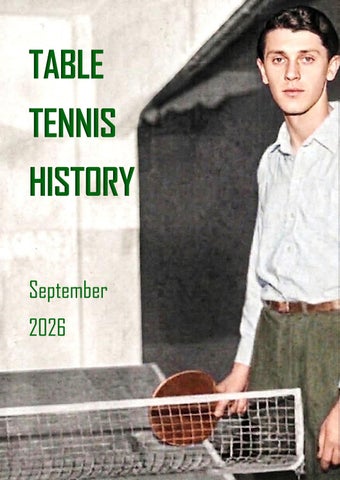
TABLE TENNIS
HISTORY September 2026
Welcome to the tenth issue of Table Tennis History. Our readers are privileged indeed. First we brought you the privately published memoirs of the virtuoso Victor Barna. He continues to be a lively and revealing history source for us. Now we have successfully negotiated access to the unpublished memoirs of the great Alex Ehrlich of Poland, three-time World singles finalist in the 1930s. Later, physically broken by the concentration camps, he recovered to win the English Open and other titles.
Barna’s memoirs are on the conservative side, discrete, careful not to offend. Ehrlich was much older when he wrote down his story, battling illness that he knew would soon take his life. You will appreciate his frankness in coming issues, as he opens up about everything, unfiltered.
The cover photo shows Ehrlich, age 19, at his first world championships. In this issue he tells you all about that memorable Paris trip.
Next issue is January 1. Your articles, ideas and comments are welcome. Contact info and past issues can be found at our website, while the Finding Aid for the first eight issues is at the end of the January 2026 issue. The magazine is also archived on the Swaythling Club International publications page.
-----
Steve Grant
----2
CONTENTS Cover: Alojzy Ehrlich of Poland, 1933, Paris
Ehrlich’s Own Words 5 A Sticky Story 6 We’ll Always Have Paris 8 Updates to TT History 14 That First Trophy 15
:Updates, Elaborations, Corrections, Part Ten 20
Keeping Score 22
3
Hungary vs. England, 1953 24 A Superfan Pauses for an Interview 27 Put Zing in Your Ping 32
Inventing Table Tennis 36 Examining Gossima Claims in TTC 101 38 An Unhappy Outcome 40 Aruba Museum in the News 43 Kindergarderobe 44 Trippin’ 46
Back Cover: 1914 Japan
What is O-KOKU? 49 4
Ehrlich’s Own Words Alojzy Ehrlich of Poland (1914-1992) won three silver medals in 1930s world singles championships. In 1944-45, the concentration camps knocked this six-foot man down to 82 pounds (1.83 meters tall, 37 kg). After the war he bounced back to win numerous singles titles, including his second English Open win. Ehrlich (left, and on the book cover below) had an important story to tell, and finally in 1991 he wrote his memoirs through1945. He was encouraged in this by friends like Arnaldo Morino, well known in Italian table tennis circles, with whom he entrusted the manuscript. Also, he had promised a dying friend in the camps to tell their story. Enrico Pedemonte of Italy turned the memoirs into a novel. From that book, L’ultima partita (The Last Match), translated from Italian: “Arnaldo Morino delivered Alex Ehrlich's lengthy memoirs—the original French text and its Italian translation—to me in the spring of 2019. What convinced me to accept the offer to turn it into a novel was not only the astonishing story told but, above all, the sincerity, at times naive, at times brazen, with which Alex recounts his life. Feeling his end, with a serious illness consuming him, Alex decides to reveal the plot of his existence to the world, but above all to himself, without ever indulging in facile rhetoric, without censorship, without hiding the ambiguity of his choices and the contradictions of his personality … Youth, love, sex, sporting triumphs, even the drama of the concentration camp—everything is described with disarming candor. Alex reveals the dark sides of his character, in a long self-awareness that leads him to confront the fierce desire to win that underlies his sporting triumphs and the animalistic survival instinct that allowed him to endure even the hell of Auschwitz. I tried not to betray the spirit of his memoirs, to bring out the contradictions of his personality, that naive cunning that was the hallmark—and the greatness—of his life. I hope I succeeded.”
Mr. Morino had held onto the memoirs for over 25 years, seeking the optimal publishing opportunity. Now an author had presented the story to the world, albeit in fictional form. I have read the novel, and it seems faithful to Ehrlich’s intent. But there is nothing like seeing a memoirist’s actual words. Moreover, the table tennis in the novel was rephrased and much abridged. We wanted to see the original memoirs. After finally connecting with Mr. Morino, communication remained sparse. At last, he agreed to provide Ehrlich’s manuscript, but only the table tennis parts and only under restrictive use terms. Fortunately, the terms allow sharing those parts with readers of Table Tennis History. We will do exactly that, through curated selections. The 48,000 words --- translated from Ehrlich’s French --- illuminate the 1930s table tennis scene, while divulging intimate details of this talented player’s struggles and victories. He holds nothing back. Neither will we. Well, except the few dull parts.
5
That Honey Scene in Marty Supreme
A Sticky Story Coming out of the Marty Supreme movie, many were asking, Is that honey story true, the concentration camp scene? Short answer: kinda sorta. Long answer: The film writers took the tale directly from Marty Reisman’s 1974 book, The Money Player, which mistakenly states that Alex Ehrlich spent four years at Auschwitz, an error repeated elsewhere. In reality, he was in the camps, Auschwitz and Dachau, for less than one year, following his 1944 arrest by the Gestapo for his French Resistance activity. From Reisman’s book: “The Nazis assigned Ehrlich a job defusing bombs, a job he often accomplished in 20 minutes. He would then spend the rest of the day fiddling with the bomb and pretending it was not defused. … Once, Ehrlich … found a honeycomb nearby. He smeared the honey all over his body and when he got back to camp, inmates licked the honey off his body for nourishment.”
From Marty Supreme
Reisman did not fabricate this story. Yes, he was known for exaggerating tales about himself --- but not stories about others. The tipoff to his credibility here is the phrase “pretending it was not defused.” He surely got that directly from Ehrlich, who wrote about this daily pretense in his unpublished memoirs, as revealed in the memoirsbased novel by Enrico Pedemonte (see previous page). The bomb-defusing period of Ehrlich’s imprisonment takes up a good chunk of the novel, so we learn many details. But the honey episode is missing. The memoirs have not been made public, but Pedemonte probably would have used the sticky story if it were there. This does not, however, invalidate the story. One thing is certain, though: The Marty Supreme movie got it wrong. If it happened as Reisman wrote --- and it probably did --- it was not nearly as dramatic or intentional as
6
portrayed by the screenwriters. (By the way, the writers changed Ehrlich’s name to Béla Kletzki, played by Hungarian actor Géza Röhrig, with country of origin changed from Poland to Hungary.) In the movie, the Ehrlich character works alone in the forest and lights a cigarette (right) to smoke out the bees. Impossible. First, from the memoir we learn that the prisoners always worked in groups of ten. Second, the guards assiduously kept watch, albeit from a safe distance. Third, prisoners obviously had neither cigarettes nor matches. Moreover, the huge unexploded bombs, weighing tons, buried themselves up to six feet in the ground. The team had to dig down, defuse the bomb, then lift it to the surface and onto a truck. Nothing like the movie scene (left). There is something more basic off-base. We all want to believe in the portrayed altruism, where Ehrlich selflessly shares the honey. But camp life was every man for himself. Survival under the hostile starvation conditions required 24-hour-a-day effort, energy conservation, utter selfishness. Social bonds surrendered to base animal instincts. From the novelized memoirs (translated from Italian): "You're there, alone with yourself, surrounded by a crowd of human beings who are almost all dying, but their fate doesn't interest you because your only goal is to survive and that's all you think about. Then you realize you have resources you never imagined you had, and you discover another person, someone you didn't know before. It's as if you were observing yourself in a state of nature ... And you might not necessarily like what you discover." Here is a more plausible scenario: Honeycombs occasionally fall to the ground due to hive failures, predators, storms, etc. Ehrlich found a piece but had no opportunity to consume it unseen, so he crushed it under his shirt, smearing the honey on his torso. Back at barracks, he was not able to remove it all --- try licking your own torso --- so he let one or more bunkmates have a turn. Perhaps he received something in trade. Fidelity to truth was not the screenwriters’ priority. The honey story serves a purpose in the movie, contrasting Marty’s selfishness with Kletzki’s selflessness. But the reality was less sweet. (And the real Marty was more sweet.) (One more note about the movie’s Ehrlich character: He is shown playing at many Harlem Globetrotters basketball halftimes with Marty. But Reisman’s regular Globetrotters partner, 1950-53, was actually Doug Cartland of the U.S.)
7
We’ll Always Have Paris Three Polish college kids living in Lille, France, surreptitiously team up to represent Poland at the Dec. 1933 world championships and --- shockingly --- almost win a medal. Their leader: Alojzy Ehrlich, 19, who always puts table tennis ahead of schoolwork. Their post-tournament reward: an unexpected, memorable evening. From Ehrlich’s unpublished memoirs (translated from French): … That year, the World Championships were held in Paris ... I was incredibly lucky that they were taking place barely 200 kilometers from where I lived. In the past, I could only follow them through the press. [Poland had never sent a team; it entered in 1931 but withdrew.] I inquired with the organizers about how things worked, and they sent a whole set of documents. They would cover the accommodation for all ten participants of a women's and a men's team --- four women and six men. I immediately wrote to the Polish federation at Lodz, asking them to send two players; together with me, we would form a decent team. They responded that they didn't have the financial means to send anyone. [The Polish sports newspaper Przegląd Sportowy, Dec. 13, 1933, stated that the federation could barely pay its ITTF dues, and that no local club answered the financial plea for travel to Paris.] In reality, they were completely incompetent, because there were plenty of wealthy people in Lodz who would have provided the necessary funds for travel expenses of two players. But the federation wasn't capable of such an idea.
POHORYLES, 1935
In their letter, they didn't object to my participation, provided it didn't cost them anything. I read this letter to Popo [Simon Pohoryles, left], who jokingly said, "We can form the team ourselves, just you and me, and we'll even find a Pole who wants to go and stay for free in Paris for 10 days." As it happened, we knew a Pole who played a bit of ping-pong, named Hillel. He gladly accepted our proposal. I said that this is on condition that you both train seriously, because we need to improve to be able to represent our country with dignity. They promised to train several hours a day, and since we still had a few months until the championships, I was optimistic.
I sent Popo to Paris to talk with the main organizer, Mr. Marcel Corbillon, president of the French Table Tennis Federation. Corbillon was thrilled to have another nation participating in these championships, as very few nations were taking part—barely nine or ten [the final total was 13], and Germany participated only in the women's event. I didn't inform the Polish federation about our team's participation.
We trained hard and every day spent our afternoons and evenings at the club playing pingpong, which was becoming true table tennis—something much more serious, worth investing a lot of time and effort in. I was starting my coaching career, but knowing little and having absolutely no one to teach me anything useful. I was still winning tournaments. Popo and Hillel
8
came with me to all the tournaments, where they were learning the ropes, and it was surprising to see how much progress they were making. They were becoming the strongest in Lille. There was a tournament almost every week, and sometimes I'd find Popo in the final. This confirmed for me that table tennis was all about practice, practice and more practice. There was no question of me pursuing my studies or preparing for exams; I was preparing for the World Table Tennis Championships. A few days before we went to Paris, Popo and I decided, since we were allocated six free spots, to ask our club president Mr. Van de Heule to act as our manager and another Polish student who was visiting Paris to serve as a reserve player for the team. While our club president played a little table tennis, our reserve man didn't play at all. (At the event, he carried the towels and rackets and tried to make himself useful.) Two days before leaving Lille, Mr. Corbillon called and told me he had just received a telegram from the Polish federation advising that they were not entering any teams; they had learned through the press that a team was entered and scheduled to play. I wanted to reply immediately that no one knew this federation existed either. Instead I first gathered Popo, Hillel and our manager to discuss the news. We decided to go anyway. If the organizers didn't accept the Polish team, we would try to play outside of competition, but we were hopeful they would accept us ... Popo would travel ahead to deal with the French officials and demonstrate that his political science studies weren't just for show.
So I called back Mr. Corbillon, first asking if he had received a registered letter from the Polish federation. He replied that he hadn't. Then I asked him if the telegram was with return receipt requested. He replied that it wasn't. So I told him that he must have dreamt about the telegram, because it never arrived, and that the Polish team was already on its way. The next day he called to say that everything was in order and that we had been accepted. The tournament was in the large Garage Marbeuf at 34 Rue Marbeuf, next to the Champs-Élysées. When we arrived, Popo met us and took us directly there, where we were photographed and given official identification cards. We were each given a reserved room at the Hôtel Edouard VII on Avenue de l'Opéra and the right to enjoy three meals a day there.
EHRLICH, Garage Marbeuf, 1933
All in all, we really couldn't have dreamt of any better setup … We were impressed by the perfect organization and happy to be in Paris, the most beautiful city in the world, on a sunny day. We walked to our hotel, strolling along the Champs- Élysées … And all of this was free except for our train tickets, a small price to pay. These championships were a huge success, helped by their location in the heart of Paris. All the journalists were there, as were the beauty queens, and tourists from the participating countries didn't want to miss the opportunity. The stands, specially built at the last minute due to ticket demand that far exceeded the most optimistic forecasts, were constantly packed, holding 2,500 people.
9
The championships started on a Saturday morning. The only thing missing was the Czech team, a serious contender, with men's and women's teams, managers, coaches and supporters coming from Prague. They thought it would be much cheaper to rent a bus than to travel by train, so they left two days early. But at that time, highways didn't exist yet, not even in the planning stages. Snow fell very heavily, because weather forecasting didn't exist either, and they were still somewhere on the road in a Siberian climate. Our first match pitted us against the Dutch, a team made up almost entirely of beginners, as table tennis was still in its infancy there. We won 5-0 without effort. In the afternoon, we played the Indian team, which, like us, was composed of students, since it was easy for them to come from London to Paris as tourists. We beat them 5-0 also. The organizers displayed a large board with results. We found ourselves at the top of the board, tied with the Hungarians for first place with two wins, 20-0 in games, attracting everyone's attention. [Ehrlich’s memory, 58 years later, fails him on the game tally; Poland gave up two games each to Holland and India.]
That evening the Czech team finally arrived. They were exhausted after three days and two nights spent on the unheated and overcrowded bus. All they wanted was to go to bed, but the check-in process was slow. They had to be photographed and issued entry passes. Journalists, wanting to give these title contenders a heroic image, were interviewing them about their epic journey across Europe. Moreover, the organizers wanted to show the public that the Czechs had finally made it, that the postponements were over. So they requested that they play right away against Poland. La Popo demonstrated to us that his studies in politics weren't for nothing. He spoke a little Czech, explaining to that mighty team that we didn't know how to play, that even with their eyes closed they would easily beat us. The Czechs finally agreed to play without rest. The first match pitted Kolar, the world runner-up ten months earlier, against Popo. Kolar was a very friendly student who wore thick glasses. Popo asked him not to make him look foolish, as he hadn't been playing for very long and only played for fun. Kolar promised not to, and he wasn't suspicious at all, KOLAR, Garage Marbeuf, 1933 because Popo was almost deliberately playing worse than usual. Popo lost the first set decisively, looking like a beginner, but in the second game he hung on more and more. Since the overconfident Kolar wasn't putting in much effort, Popo won the game and looked completely surprised. The deciding game began, and Popo literally lulled his opponent to sleep, always appearing not to be seriously trying. In reality, he was trying his hardest. He took advantage of every lapse in concentration from his opponent, every moment of relaxation, to chip away point after point, and won the match. [If the official results are correct --- Popo winning 14, -17, 15 --Ehrlich has the first two games reversed.]
10
It must be pointed out that in table tennis, adapting to the environment, to balls of varying weight and to different tables requires time. Here the Czechs, besides their fatigue, hadn't had time to adapt to anything. Next I played the No. 2 Czech, Hamr, who was already normally weaker than me, and now fatigued. He had no chance, and I won 2-0 [14, 15]. Our third player, Hillel, faced the No. 3 Czech, Svoboda. This very tall player, though good, was also exhausted from the travel, barely keeping his eyes open. He didn't seem to realize he was playing a crucial match, and he lost [13, 17]. Poland led 3-0. Word of this ongoing huge surprise spread, and a big crowd gathered on center court, where I faced Kolar. I was in top form, while he was fading. Nevertheless, it was an even match … In the deciding game, fatigue was working in my favor, and we went to 15-15, even 19-19, before I won [27, -16, 20]. Poland led 4-0.
Spectators flocked from all the several venues. Everyone wanted to witness the biggest sensation in the world of table tennis. Journalists from all the participating countries stood ready to send this amazing result to their newspapers. Hamr easily beat Hillel [actually not so easily: -19, 20, 16], which was expected, and salvaged some pride. But then Popo beat Svoboda, and we won 5-1. Radio and the press devoted a lot of space to this upset. Poland could even dream of the world champion title. The idea was so unreal, but that is precisely what is appealing in sport, and everyone clings to it if there is the slightest possibility. The next day I received a telegram from the Polish federation, congratulating us and asking who Popo and Hillel were, as they had never heard of them. They seemed to have completely forgotten that they had done everything they could to prevent us from playing. The following Sunday, the Polish ambassador, the consul and many employees of these institutions were among the spectators. A huge number of young people asked me for autographs, journalists asked for interviews, and photographers and cartoonists were constantly fussing over me. Sunday morning, after a very long match, we beat England 5-4 [actually 5-3]. I won all three of my matches again. [Hillel scored the other two wins and almost beat Findon, losing 19 in the 3rd.] For the only time, we took a taxi to our free hotel lunch because we were running very late. We were still undefeated. But a Scottish shower [cold shower] fell upon us in the afternoon … Latvia beat us 5-3 [actually 5-2]. I won all three [two] of my matches, even defeating Finberg, their well-known champion [19 in the 3rd]. My friends didn't win anything, and I was genuinely angry with them. But that was completely unjustified, because our little team had prepared very well for these championships and had a pretty good record. In the evening, in front of another very large crowd, we faced the French team, considered the favorites by everyone. While I could potentially win all three of my matches, no one could see how Popo or Hillel could win even one .... But nobody anticipated Michel Haguenauer's "mood swing." The undisputed French champion for the past two years [actually it was only earlier that
11
year at age 17 that Haguenauer won his first of many national titles], he was determined to win, as was I. We battled for three-quarters of an hour, and I won [11, 21]. Then he tried to prove to everyone that it was due to his having an “off” day. As proof, he also lost to Popo and Hillel [each by 2-0], while I won against Dubouille and Pedoc [actually Verger and Guerin], and we won 5-4. [From Victor Barna’s privately published memoirs: “The problem with Michel Haguenauer was (and still is) that he was terribly hot-tempered. One mistake of the referee would be enough to throw his whole game into oblivion. He was also stubborn. I tried to strengthen his self-control … “]
HAGUENAUER, Garage Marbeuf, 1933
So, because Haguenauer lost his temper, we finished third and won the bronze medal. [Poland actually finished fourth at 8-3, with no medal; Austria and Czechoslovakia tied for silver, behind Hungary.] Even fourth or fifth place would have been a success, and this far exceeded our expectations.
For the day off, before the individual events, we were invited to the Polish embassy by the ambassador himself, which deprived us of the coach tour of Paris and Versailles organized for tournament participants. Meanwhile, having now established myself as one of the world's top ten, I was giving my address to anyone likely to organize tournaments, hoping they'd invite me and promising to come.
In the Men’s Singles event, I was under no illusions. I knew there were, in principle, four players stronger than me and as many of equal strength. I advanced through several rounds and reached the quarterfinals, where I faced the second-ranked player in the world, the Hungarian Szabados. I was leading 2-0 but lost 3-2 [actual scores: 11, -9, -17, 16, 13] despite a heroic display. I was weaker, mainly because I didn't know how to train, and also because I didn't have any high-level opponents in Lille who could give me any advice, no one capable of analyzing the game, which I myself didn't understand at the time. Szabados, exhausted from the match against me, then lost in the semifinals against his compatriot Bellak. In doubles, we lost quickly. But in mixed doubles, where I signed up without a partner, I had success. Not the kind the reader might imagine, nor the kind the reader didn't imagine, but for me, it was a success. It was Popo who found me my partner, a very pretty girl with gorgeous slicked-back black hair, probably the prettiest girl in the practice hall. We called her "Maruchka" [Maroutchka Azcue de Lezo of France, left], and she was a close friend of Haguenauer. Popo asked her if she wanted to play mixed doubles. She hesitated, so he quickly added, "Not with me, but with Alex Ehrlich." We won our first two matches. In the third round, we faced a strong Czech team, whom we beat after a match full of unexpected twists and turns and a fierce fight. My partner was so happy that she jumped on me and kissed me on the mouth, something I would never have dared to do. I was completely stunned and very happy. Later, we became excellent teammates, but I never spoke to her again about that first encounter, which she has certainly forgotten, and which I remembered fondly. Unfortunately, in Maroutchka, 1938 the quarterfinals, we lost against an excellent Hungarian team. [The record shows that they actually lost in the round of 16 to Hyde/Osborne of England, 15 in the 5 th.]
12
Our captain from Lille was more than happy with his team. He wanted to show his appreciation by taking us to a luxurious brothel, which wasn't illegal at the time. All three of us gladly accepted. We were presented with several ladies, each more beautiful than the last. I chose a stunning blonde who took me to her room—a room filled with mirrors everywhere, on the walls and even on the ceiling above the bed. She was a champion-level player, yet I won, beating her 5–0 in an hour. I certainly would have kept playing with her, as I felt no sign of fatigue, but I had to join our friends in the living room to catch the train back to Lille.
On the train, I reflected on what this Frenchwoman had done to me. Sleeping with similar women had, until then, been rather banal, a psychological [sic] necessity and nothing more. I had only ever dealt with Polish women, mainly prostitutes. I was used to women who, once they had a client's money in their pocket, no longer cared about him. They were barely kind to men, and making love with these women was a chore a young man was forced to perform if he didn't want to be "spoiled," which in our circles was considered an unhealthy act that led to idiocy. The poor creatures weren't at fault; they were raised in an atmosphere of humility and lived constantly exploited. But now I had discovered for the first time a great physical pleasure. France owes much to Paris, to the river, to its cuisine, its wines and perfumes, but that is nothing compared to what it owes to its women. Anyone who disagrees is either a hypocrite or has never known how to enjoy life. As someone who loves to please others, I naturally think that if I were to build such a house in Poland, how many people I would make happy, how many hypocrisies and religious taboos I would shatter, and how quickly I would find myself in prison, since such houses are forbidden. Unfortunately, after fruitless searching, I never found the address of that house again, and I had to make do with others, which were almost as welcoming. --------------------------------
After the tournament, Victor Barna, living in Paris, published his personal rankings of the world’s top players in the French Ping Pong magazine (left). His closing line translates, “May my comrades now not contradict me!” Comrade Laci Bellak was quoted in the same magazine: “To answer your question about the comparative strength of the best world players, I would be tempted to classify them into three categories. The first would include the particularly gifted players, the exceptional, and I would include Barna, Szabados, and myself. I would place in the second the very strong players who, however, lack the spark of genius: Hazi, David, Kohn, Ehrlich, Kolar, Hamr. Finally, in the third, I would place the best international-class players such as: Glancz, Boros, Haguenauer, Verger, Finberg, Liebster, Svoboda.” Our young Polish hero will soon climb higher on his comrades’ ladders. Next issue: “Ehrlich’s Great Sacrifice, London 1935.”
13
Updates You may have read the Gamesmanship article in the last issue, page 10. If you have since failed to read the mentioned 1947 book by that name, you can still partially redeem yourself by watching the fun, welldone 1959 movie based on the book, School for Scoundrels (pictured), on YouTube, or the 2006 remake. ******************** In our September 2025 issue, page 22, we showed an illustration from a 1904 book together with a postcard that displayed a rather altered and mysterious version of it. Recently, an Australian eBay seller offered a like postcard (below) mailed in that country in 1906, on which someone has written “Deakin & Reid.” This gets us closer to solving the puzzle. George Reid (right), of Scottish origin, was a leading Australian politician of the time, briefly prime minister. Alfred Deakin, also a prime minister, was a Reid opponent. Deakin bears no resemblance to the kilted gnome, who possibly represents a group or nation rather than a particular person.
******************** Correction: In the September 2025 issue, page 48, the article on Gertrude Kleinova stated that her doubles partner at the 1935 World Championships was Kathleen Berry. It was actually English international Marjorie Berry (left), who also made the round of 16 in mixed doubles with Laci Bellak.
14
That First Trophy Especially at an impressionable young age, that first trophy or medal can flip a switch in the novice athlete’s mind. Here are a few stories from early winners, mostly in their own words. Victor Barna (Hungary), Future World Champion Let me go back to the early stages of our game. After initially playing on dining tables, we increasingly wanted to pursue more competitive table tennis. In 1926, Laci [Bellak] joined a club, which I was not allowed to do, as I had to continue my studies. At that time, students could not be members of clubs, not even those that were involved in sports. Laci soon became one of the best players in the country, and his success inspired me to get involved in competitions too. I will never forget my first one [at age 15]. I entered the individual youth competition during the Christmas break, and the first round was scheduled for 9 a.m. Needless to say, I barely slept and was already standing in front of the hall at 8 a.m., waiting for the doors to open. Of course, I know there is nothing special about a young person being excited about their first competition and dreaming of success. Nevertheless, these happy memories that live inside me are perhaps worth mentioning at the end of a career that has seen me travel almost the entire world and play in front of huge audiences. When I played the very first round, no one was in the hall except my opponent and the referee. Yet I was more nervous than I have ever been since, including the 1935 World Championships at Wembley, when 10,000 people watched the final for the first time in the history of table tennis! Incidentally, my first tournament was also the first time Kelen and Szabodos had met. I came third after losing to Szabodos in the semi-finals, 30-21 and 31-29. Kelen then beat him in the final. I remember the scores very well for two reasons. Firstly, at that time, all matches, including the senior ones, were played to two sets out of three and every game went to 30 points or more. It was also the first time I had played against Szabodos, and many more followed. As third, I received a small, engraved bronze medal. I carried it in my pocket for months and showed it to all my friends --- and strangers --- whenever I had the chance. It is invariably my most cherished award. After the above, you will surely understand why I am against giving "dinners," "savings stamps" or other, so to speak, "useful things" as awards. It is true that there are players who are fed up with cups and medals. But I am thinking of those players who only rarely achieve something great, perhaps only once in their entire lives. They would certainly be prouder to win something that will remind them of the euphoria of victory than something that offers practical benefit! --- from Barna’s privately published memoirs
15
Ruth Aarons (USA), Future World Champion Just a few weeks before her 15th birthday, she’d had her first “bewildered” glimpse of the Sport at the NYTTA’s May, 1933 National’s. Here, she was to write later, she played her “first match in a tournament --– against a girl as scared as I was.” This other “scared” girl was Iris Little, who next year would be the NYTTA National Champion. Ruth was beaten by Iris in this match, a quarterfinal because there were so few entries–and so was ranked by the NYTTA #5 for the 1932-33 season. Following that, her “first and most pleasant table tennis thrill” had been winning her “school tournament.” Once she’d brought home this victory she was hooked --- ready to compete in earnest. Playing the entire 1933-34 season with what she would afterwards decide was the “incorrect” penholder grip, she began a streak that would culminate in incredible successes. --- from Hall of Fame profile by Tim Boggan
Martin Reisman (USA), Future English Open and U.S. Champion I lived with my mother until I was 14 and then moved in with my dad at the Broadway Central Hotel, Broadway and West Fourth Street, which at that time was not run down. It had magnificent ballrooms. In the regular rooms there were always poker games and craps games going. My dad never put pressure on me. He let me do what I wanted, which was to play table tennis, and he paid my way to tournaments all over the country. Occasionally he went with me. The first trophy I ever won, the New York City Junior Championship, when I was 13, he carried around in his cab. “This is my son Marty,” he would introduce me. “He’s the table tennis champion.” --- from The Money Player by Marty Reisman (1974)
Emily Fuller (USA), Future World Team Champion She’d “played her first [table tennis] tournament in 1933 on a boat to California” where she was going to take “tennis lessons.” After winning that tournament, she “felt so good about it” that when she was in Hollywood and “the manager of the country club where she had been playing tennis suggested she take part in a table tennis tournament” --- one in which celebrities “Ginger Rogers, Fay Wray, [and] Alice Marble…were competing” --- she couldn’t resist. The rest, as they say, or will say after Emily’s been coached by New Yorker Sam Silberman, is History. --- from Hall of Fame profile by Tim Boggan
16
Tim Boggan (USA), Future U.S. Top-10 Player and USTTA President One night my father beat me in a game, which --- though he might by then have been giving me less than 15 points --- was very unusual. To make matters worse, it was the last game of the evening and I had no chance to get back at him. As he moved heavily up the cellar steps, I stood there at the bottom and cried and carried on terribly. When my dad got to the top of the stairs, he turned slowly around and said, “You didn’t want me to let you win, did you?” And I, looking up, sobbed, “No!”
Boggan the golfer, age 18
Naturally, my father, quite contrary to what he’d said, had indeed let me win almost all the games we’d ever played together. Only this particular night for some reason he hadn’t. And because he hadn’t, I’d started to learn more about winning—how it wasn’t any good if you didn’t do it by yourself.
Age 23
In the fall of 1940, sometime after my Sept. 25th birthday when I was 10 years old, I won a tournament at my grade school on an improvised table the nuns made atop some student desks. I still have the small cup I was awarded (minus the arms) that many years ago I used as an ash tray. --- from Hall of Fame profile by Tim Boggan
Bobby Gusikoff (USA), Future U.S. Champion Early in 1949 at his first Eastern Open, in Springfield, MA, young Gusikoff, not quite 13, was runner-up in the Boy’s to a local lad, George LaPierre. Bobby remembers coming home on the subway, holding on his lap the little 4-inch trophy he’d received. He still has it, though now it doesn’t look as it did 50 years ago --– the handle on one side’s missing. --- from Hall of Fame profile by Tim Boggan
Jasna Reed Rather (Yugoslavia), Future Olympic medalist I was eight years old when my Mom and Dad decided that I should play some sport. My sister already played table tennis and my uncle was a coach, so it was not a really difficult choice for them to send me to the same place. At first I did not really like table tennis. As soon as my parents would leave the training hall, I would leave too, and usually sneak next door where there was Karate and Gymnastic training. Everything changed after my first tournament for kids under 10, which I won. I really liked the feeling of winning and that kept me in this sport for such a long time. --- USATT magazine, July/August 2001
17
Karenza Smith Mathews (England), Future English and Commonwealth Champion It was in the summer of 1960 that I went on holiday with Mum and Dad to a Butlins Camp at Clacton-on-Sea in Essex. For the first few days I think that we walked about and did the kind of things you do at holiday camps, swim a bit, eat a bit, watch the Redcoats entertaining the kids and going to the Redcoat shows in the evening. After a few days I probably got a bit bored and noticed that there was a hall with some table tennis tables set up. There were some children playing and there seemed to be someone, a woman, who was giving them some instructions about how to play. Mum and Dad asked me if I would like to have a try --- and so I did. The lady doing the coaching was Joyce Fielder. I had no idea at the time but she was a very experienced coach and had played regularly for the Kent County first team. I seemed to be able to get the ball back on the table fairly well, and Joyce realised that I might have some talent for the game. I really enjoyed playing and I spent a good bit of the rest of that holiday in the table tennis hall. As the end of the holiday approached, Joyce spoke to Mum and Dad about getting some more coaching for me. She asked where we lived and recommended a club at Bethnal Green in East London. I was really looking forward to going to the club, called the Albion. When we got there the playing hall was bigger than I thought it would be --- there were six green tables down the length of the hall and they were all brightly lit. All the tables were in use --and the players seemed incredibly good. I had never seen the game played properly. These players were hammering the ball backwards and forwards --- a bit daunting for me, a little ten year old! Dad spoke to a lady who came forward, Elsie Carrington, and told her that the coach at Butlins, Joyce Fielder, had said that she thought I might be able to play a bit. I have to confess that Elsie did seem to be a bit intimidating! She was polite of course but very clear about the fact that Wednesday was beginner’s night --- I could come back then. I would have to be properly dressed with a tracksuit, white socks and plimsolls. Plimsolls were rubber-soled gym shoes that had to be all-white and kept white; Elsie said that black rubber soles would mark the floor. I also would need a bat! Dad took me to the sports shop near the end of our road, where we found everything, including a Victor Barna pimpled rubber bat. Barna had been five times World Men’s Singles Champion and so a Barna bat was the thing to have! In November 1961, after some serious training, several of us from the Albion were entered into the Kent Junior Open Table Tennis Championships. I had never been to a tournament before and had no idea what to expect. When we got there I couldn’t believe how many tables there were and how many players! I was entered in the Under 11’s. The first time I went out to play I was really nervous –-- but somehow I managed to win that first round. In the following matches I didn’t seem to be quite so jittery and, well, I went on to win the under 11’s! My prize was what was called a swivel trophy: a little plastic stand with a silver-coloured medal on top that turned round and round. I was really thrilled! I liked table tennis and enjoyed playing against the kid at the other end of the table, but until the Kent Junior Open I had thought of it as just a fun game. Winning that competitive event changed all that. I suddenly couldn’t wait to get back to the Albion! Could I improve still further? I looked
18
around me at the older players who seemed to be so talented and confident. Could I someday beat any of them? It seemed a huge mountain to climb! That first little swivel trophy still exists in my thoughts, but I later divided up all the trophies I won and gave them to my two daughters. --- as told by Karenza to Table Tennis History, 2026
Alex Ehrlich (Poland), Future English Open Champion and World Singles Finalist [No trophy, but…] I was 14 when I entered my first ping-pong tournament. It was a club championship, and it's worth noting that our club had the strongest table tennis section in town. Out of 150 participants, I finished 14th. It was a resounding success for me, with victories and a few defeats that left me with a desire for revenge and to beat those who had defeated and humiliated me. This experience irresistibly drew me to the sport where I later achieved so much success, joy and contentment. --- from Ehrlich’s unpublished memoirs W.T. Walton, Future Nothing Here’s one example to offset the others, showing that early success does not inevitably produce a future table tennis champion. As stated on the pictured trophy, W.T. won this for taking third place in the fifth-grade ping pong tournament. That was in 1963 at Blessed Sacrament school in San Diego, California, at age 10. Unfortunately, his first table tennis trophy was also his last, marking the peak of an enthusiasm that nevertheless continued throughout his life. The photos at right show him at age 12 and age 65. W.T. held onto that trophy for over 60 years, until dying at age 71 in 2024. One hopes it provided inspiration in his other lifetime endeavors. Bill Walton became one of the most successful basketball players of all time.
Please send us your own first-trophy story to share with the class in the next issue.
19
101 ISSUES Updates, Elaborations, Corrections Part Ten, Issues 99 thru 101 We conclude our analysis of the 101 issues of Table Tennis Collector/Table Tennis History Journal. Those issues can be viewed at https://www.ittf.com/history/documents/journals/. Issue 99 ***Page 4. This fun listing of movies that contain ping pong, running from 1902 to 2022, makes no claim to be exhaustive. To learn about one film not included --- starring Liz Taylor --- see “Keeping Score” on page 22. We will feature more films in future issues. The last movie on the Issue 99 list, “Mr. Ping Pong,” dated as “2022?”, is still in development, if not abandoned. Unfortunately, the listed 1902 films appear to be forever lost. Below is a 1902 Scottish newspaper mention of one more now-lost film. “Sir T. Lipton” is the mogul founder of the famous Lipton tea company. The full title of this short was “Sir Thomas Lipton Playing Ping Pong on the Erin.” The “Erin” was one of his yachts.
Sir Lipton
Issue 99 ***Page 23. Supposedly shows “Flyer for the new Swiss Table Tennis Museum, Montreux.” But there is no such museum. Rather, the flyer references a permanent exhibit at the long-established Museum of Montreux.
20
Issue 99 ***Page 26. Our English colleague Graham Trimming discusses the pioneering Cavendish Table Tennis Club of 1900-02 London and speculates about several possible inspirations for the name choice. Yet little inspiration was needed: “Cavendish” was simply a popular, fancy-sounding English club name at the time, used by tennis, football, rugby, cycling and cricket clubs.
Issue 100 ***Page 6. Our colleague Michael Thomson of Scotland delivers a verdict of Not Proven on the claim that James Devonshire of London invented table tennis. We examine flaws in Michael’s reasoning on page 36.
Issue 100 ***Page 13. Shows the mention of Gossima in a December 1892 publication. Michael Thomson quotes a colleague as saying this is the first known use of “Table Tennis” to describe “a table version of tennis using rackets.” To see that this quote was already outdated, we need only look at the image that Michael himself showed four pages earlier, where Foster’s rules, dated April 1891, refer to “Table Tennis.”
Issue 100 ***Page 13. Shows several mentions of Gossima in 1890s publications. Here are two more:
Above, Tasmania, Australia, Ladies’ Column. Left, British India, 1899, oddly called “The Gossima.”
Issue 101 *** Page 8. Michael Thomson presents Part 2 of his early table tennis history, centered around Jaques and Gossima. While providing some interesting information, the study is unfortunately marred by errors and unjustifiable conclusions. See page 38.
Issue 101 *** Page 34. It’s difficult to support the oft-told tale that James Gibb brought celluloid balls back from a U.S. visit and introduced them to table tennis in 1900 London. Our colleague Alan Duke adds information about Gibb’s life but is unable to find any visit to the U.S. after 1887. The Gibb story may be apocryphal. But here’s a possibility: Maybe Gibb stopped in the U.S. on the way back home from his 1890 trip to Argentina, where he had a business deal. Admittedly, the timing is a decade off. One more speculation: Perhaps one of Gibb’s machinery products used plastic balls, thereby acquainting him with celluloid balls, whatever their source.
Issue 101 *** Page 47. Shows this 1920s Table Tennis by H.P.G. & Sons, Ltd. (left). We met Harry Percy Gibson (right) in the January 2025 issue, page 18, which pictured another of their sets. Founded in 1919, the firm is today known as Gibsons, producing jigsaw puzzles and board games (no table tennis) and still family-owned and -run.
1919
At the 1929 British Industries Fair, the company was described as Manufacturers of the "International Series" of Indoor Games. Puzzles, Dover Patrol and L'Attaque Games, Travelling Chess, Chess and Draught Boards, Loto, Tiddly Winks, Ludo, Halma, Snakes and Ladders, Auction Bridge and Patience Sets, Table Tennis (Stand No. B.53).
21
The Games They Play
Keeping Score
Table tennis is an excellent game choice for cinema --- compact, intimate, action-packed and personality-revealing. X Y & Zee opens with a floating table tennis ball. All the ping pong in this 1972 film occurs in the first three minutes, as the credits and title roll. Even though in slow motion, it’s an energetic three minutes that introduces the contours of the central couple’s relationship. The table tennis is intense, foreshadowing the drama to come. Michael Caine plays a London architect who has an affair with a young widow (Susannah York). His wife (Liz Taylor) seeks vengeance. Their life is a ping-ponging of insults and emotional warfare. Keeping score is everything. Liz Taylor is fierce, a woman not to be taken lightly. She is of course great in this kind of role --- see Who’s Afraid of Virginia Woolf (1966). The real-life Liz enjoyed ping pong. Maybe you know the story of her ping pong diamond ring, won by beating her husband at the game in 1969. “From time to time Richard
The English table brand Jaques fits the London shooting location.
22
[Burton] and I would get into a wicked game of Ping Pong at our home in Gstaad. I know that on more occasions than one, being the actor he was, he would fake letting me win. But in all fairness, I was good at Ping Pong, so some of my wins were legit. On this particular occasion, he said to me, ‘If you can get 10 points off me [game to 21], I’ll give you a perfect diamond.’ Well, that’s not the sort of thing a woman walks away from. So I not only got those 10 points, I also beat him. He lost. I won. Time to go shopping!” The last laugh was that the promised “perfect” diamond was only about 1/8 carat.
Getting back to the movie intro: The chalkboard scoring method is as illogical as some of the storyline.
Anyway, Zee beat Robert. He then chased her, attempting an illegal use of bat.
To view, try X Y & Zee or X Y & Zee.
23
Hungary vs. England, 1953 This is a ticket for one of the biggest football matches of all time. At stake was England’s record of never losing in 90 years of matches on its home ground.
The ticket (from the collection of our colleague Laszlo Polgar of Hungary) is signed by the Hungarian goalie Grosics Gyula and the popular Hungarian radio football announcer Georgy Szepesi. In Hungary, factories and schools were closed that day to listen to the radio broadcast. Right afterward, Szepesi wrote a book about the game, Match of the Century. The ticket is also signed by Hungarian table tennis player Eva Koczian. Table tennis? That same day, November 25, 1953, after the game, the football teams (and some fans) walked across the street to the Empire Pool arena to view Hungary vs. England table tennis, featuring some of the world’s top players. Hungary won the football, 6-3, before 100,000 spectators in a contest that was never close. The result was not a surprise, because Hungary, the 1952 Olympic champion, had already established itself as the top team on the Continent. Some viewed this as a triumph of the Communist bloc over western Europe. Englishman Jimmy Hogan, considered by some to be the best Filby and Barna, 1937, football coach of all time, brought with the Chelsea team the winning formula to Hungary many years before. It turns out that Hogan was Victor Barna’s first coach
24
--- in football, not table tennis -–- when Hogan worked for the MTK club in 1925-27, before young Barna (born 1911) turned to table tennis full time and started winning world championships. In the late 1930s, Barna occasionally took his English teammates to train with the Chelsea football club to get in shape. He was a big Chelsea fan, which he said may have unconsciously been due to their colors of blue and white, the same as MTK. If the evening’s table tennis was not the match of the century, a lot was still at stake. England craved revenge for the football loss, and Hungary craved revenge for its loss to England in the Swaythling Cup final eight months earlier, as well as the loss to England that kept them out of the Corbillon Cup final. Nearly all participants were past or current world champions. Leading Hungary was the 1953 titlist in singles, doubles and mixed doubles, Ferenc Sido. He had to leave his suspended doubles partner Jozsef Koczian at home, but Koczian’s sister Eva, a fast-rising 17-year-old star, made the trip. Hungary also had Gizi Farkas, who had reached the world singles final every year since the war, winning three times out of seven. She had beaten England’s Rosalind Rowe in the 1953 semifinals; now a rematch was in the offing. England could boast of former world champions Richard Bergmann, Johnny Leach and the Rowe doubles team of Rosalind and Diane. Then there was Aubrey Simons (right), voted English Player of the Year for key contributions to his country’s 1953 Swaythling Cup victory. A journalist --- was he prescient? --- mused that “Simons’ flair for rising to the occasion could earn him a narrow victory in the opening match and set England on the way to a 5-4 win.” Simons did win the opener, over attacker Elemer Gyetvai -10, 15, 15. But then England lost the next four matches. That included two very close doubles contests (Leach/D. Rowe blew a 20-16 lead in the 3rd) and a loss by Rosalind in her rematch with Gizi. Diane Rowe then beat Koczian to keep England alive, down 4-2:
25
Next came the match of the night, Sido vs. Bergmann. Sido won the first game 21-19 but scored only 14 in the second. In the final game, Big Sido’s blasts from both sides sent Bergmann, the world’s greatest defender, scrambling everywhere. Sido mixed in drop shots to pull Bergmann racing back to the table. These images from the ETTA magazine, though poor in quality, give an idea of Bergmann’s court coverage in the match. With Bergmann up 13-12, they had “a stupendous rally, the most astounding ever,” according to Table Tennis Review, “with Richard making fantastic, impossible, incredible returns. It ended only when Dick fell near the umpire after making a galvanic leap towards a ball which seemed to be whizzing out of the stadium at an acute right-angle to the table. For a full minute every person in the stadium applauded thunderously.” Tiring, Bergmann (right) then fell behind 20-18. He needed shorter points. Could he make the switch to offense? On the next point, Bergmann hit six hard forehands that all came back, before a seventh made it 20-19. A Sido error brought deuce. Bergmann fought off a third match point, before successful attacking gave him the win, 23-21. That made it Hungary 4, England 3. England easily grabbed the final two matches and revenge for the football loss:
26
A Superfan Pauses for an Interview A.J. Scott of New York was a fine club player in his day. But his real expertise has been as a fan of top-level table tennis, stretching back 40 years. For our May 2025 issue, A.J. kindly wrote the insightful chopblockers article. We wanted to delve deeper into his knowledge of the game, and he agreed to an interview. TT History: You’ve obviously witnessed many changes over time. Do you think the changes overall have been good or bad? I started playing this game in the early '80s. For me, the vast majority of the changes since then have been good. One change I disagreed with, though, was the speed glue ban, though I understood the ITTF's health concerns. Back in the day, I cannot say how much I used to love to run down to the club after work and hit with a freshly glued racket. I loved that speed glue sound --- just a great sound! Certain solvents were banned in 1995, and then speed glue was eliminated entirely in 2008. At the 1995 World Championships, Kim Taek-soo (left), Korean no. 1, had his quarterfinal win tossed out for violating the rule. In those days, racket testing took longer and was random, done after the match instead of before. So the Chinese suddenly had four men in the semi-finals instead of three. Then there was the 2001 change from the 21-point game to 11. That was rough. I actually agreed with that change, but it was a hard adjustment because it totally altered the rhythm of the game. But now when I look at old 21-point matches, I find them unwatchable --- because they're too long. We saw the switch to the larger 40 mm ball in 2000 and then to the 40+ plastic ball around 2014. This led to larger rackets and faster, grippier rubber. The intention was to slow the game down, but from my vantage point, the game today is the fastest it's ever been. Rule changes have reduced the effectiveness of pips-out and anti-spin rubbers. As a player, I agreed with the changes, because I absolutely hated playing against those rubbers at tournaments. But now I'm just a spectator and I miss the variety that defensive players brought to the game. I was really sad when the great chopper Joo Se-hyuk of South Korea announced his retirement. Years have passed and nobody has stepped up to replace him. That said, Sabine Winter, the German no. 1 woman, switched to anti-spin in late 2024 and has shot up in the rankings, currently 8th in the world. There are now three choppers in the women’s top 20. TT History: Living in the U.S., what kind of table tennis viewing opportunities did you have in the 1980s and '90s? TV, videotapes, travel to tournaments?
27
All of the above! I started watching TT on TV back in the mid-‘80s. Back then, it was on ESPN. A few people told me at the time that they had seen TT previously on ABC's Wide World of Sports. In the late '70s, Danny Seemiller of the U.S. was in the world top-20, and then a clone of him, Eric Boggan, made the top-20 in the '80s. So TT was regularly being shown on TV in the '80s. At one point, after an unsuccessful stint in the German League, Boggan came back home and shocked everyone by retiring. I think he was under a lot of pressure as the U.S. No. 1 and just couldn't deal with it. He briefly came out of retirement and then played on the U.S. Team at the 1991 Worlds in Japan, before retiring for good. Soon, most of the corporate sponsors (largely beer companies) pulled out of TT, and it ceased to be shown on U.S. TV. In the 1990s, a California outfit called Reflex Sports got the North American rights to major TT events, so we had to order videotapes from them to watch the top players in the major events. I amassed a massive video library, purchasing a big bookshelf to put them all on. But that would all change around the year 2000. On a big online TT forum, I started to notice that foreigners were posting videos of matches from, say, the World Championships. It took me a while to wrap my head around the new technology --- it wasn’t just click and play like today. You needed the right software for that particular video, and meanwhile of course streaming speeds were much slower. But I did start watching them. At some point, Reflex Sports, who still had the rights to major TT events, threatened legal action against the video posters. We customers fought back, complaining about the low quality of Reflex’s videos and their poor match choices. In 2001, the next new technology from Reflex was videodiscs. They didn't work on my machine, so one of my hitting partners made videotapes from them for me. That was the last time I ordered anything from Reflex. At the end of 2004, I happened to catch a commercial by Fox Sports for a retrospective of all that year’s Pro Tour events. It was to start on Thanksgiving Day and go thru Xmas. Of course I was in heaven. The Pro Tour started in 1996, but it was impossible to follow in the U.S., so there was a lot of great TT that I unfortunately missed. Now Fox Sports had the North American rights. I watched it for a year or two before it disappeared. Fortunately, around 2005, the ITTF itself had started posting videos online. At first it was just a trickle, but a little over a decade later, it became a flood. Now it's so much that I'm unable to watch everything. I will be forever grateful that they post videos publicly and free of charge. TT History: Did you have any in-person viewing opportunities back then?
28
I attended the 1999 Worlds in Eindhoven, Netherlands. Liu Guoliang beat Ma Lin in the final. If I'm not mistaken, that was the last time two penholders met in the World Championship men's singles final, and it was the last time a pips-out player won that title---Liu had short pips on the forehand (what we today call medium pips). A memorable match there was the semifinal between J-O Waldner and Ma Lin (photos). It was tough to find a seat as the hall was jam-packed, but I lucked out and found myself next to former USATT President Tim Boggan, Eric’s father. He had a notebook and pen in hand. I was a little on edge because Boggan had a reputation for being kinda crazy, but we had a long conversation during the match and I found him to be surprisingly reasonable. Waldner went up 2-0, 16-11 but lost 3-2. TT History: Great that you made it to the '99 Worlds. Any other memorable in-person experiences? In August 2003, I happened to be vacationing in Tokyo. Walking down the street, I saw a giant billboard advertising the 2003-2004 season-opener of the Kenshoen Super Circuit, the Japan premier league. There was a lot of money in that league, so most of the top men in the world were playing. I went to watch and I was in heaven. As I was waiting for the matches to begin, one of the commentators motioned to me to follow him out back. Being non-Asian, I may have stood out as a superfan. What was out back? Only some of the best TT I had ever seen. World top-20 men were playing pickup games. And they were having a ball--literally and figuratively! They were joking, laughing, teasing and taunting --trash-talking --- and it was great. I had never imagined them that way before. Vladi Samsonov was, I believe, the highest ranked. And then you had Kalinikos Kreanga, Jorgen Persson and Johnny Huang, who played with pips on both sides and was the last Canadian player to make the top-10. You also had Ding Song, the Chinese chopper who in the mid-‘90s ushered in the age of the modern defender --- chops on the backhand, attacks on the forehand. And there was Kim Taek-soo and JeanMichel Saive. It was one of the best TT experiences I've Samsonov/Kreanga ever had. 2003, for me, was a great year, because the good times didn't end there. In late December I attended the Killerspin Open in Chicago. Good money, so a lot of top players in the world came. Moreover, on the other side of the venue was a "special session" of the Kenshoen Super Circuit. I played in the tournament, but whenever I had a break I would go watch the Super Circuit. Waldner was there as well as a new Ding Song-clone from South Korea by the name of Joo Sae-hyuk, plus his top teammates, Oh Sang-eun and Ryu Seung-min. Samsonov was there, too, as was Chiang Peng-lung of Chinese Taipei, who I believe was the No. 2 or 3 penholder in
29
the world at the time. He was a J-pen who had what I considered to be the best traditional penhold backhand of all time. Right now, he's the head coach of the Chinese Taipei team. He and Samsonov were practicing on a side table, with a large crowd watching. Seeing them live, even just practicing, made me realize they were even better than I thought. It's one thing to watch the top players on TV, but it's totally different to see them live right in front of you. TT History: Great experiences. So you were saying that ITTF videos started about 2005. Yes, and 2005 was a great year to view. The Worlds were held in China in the beginning of May. The semifinals featured my two favorite players --- Wang Liqin (right), World No. 1, just edged out Oh Sang-eun, World No. 3. Then in the final Wang took out Ma Lin in a spectacular duel to the distance. The fun didn't end there, because two weeks later the Kenshoen Super Circuit began their 2005-2006 season with their first two "Sessions." Wang and Oh met again in both finals, with Wang squeaking out wins both times. In my perpetual search, it occurred to me to look for livestreams of national leagues. I had started watching the Kenshoen Super Circuit in about 2002. At the same time, I was watching the Chinese Super League, televised online on CCTV5, the Chinese sports channel. One Chinese-language cable station based in New Jersey showed some CCTV programming, which luckily also included some Super League matches. I also found the online channel for the Bundesliga, the German League. I've been watching that for most of the last 20 yrs, but not lately because it's now behind a paywall. The same applies to the Japanese League, which has morphed into the "T-League." I suppose the "T" stands for "takyuu," the Japanese word for "table tennis." Actually, it's the Japanese pronunciation of the Chinese word "zhou qiu," which literally means "[the sport of] table ball." If you want to watch it, you have to go to Amazon Japan and buy a subscription. Or you can wait until after the season has finished for them to upload videos. I also have watched the Pro-A --- the A-league of France --- and the Pingisliga, the Swedish League. I don't really watch the leagues so much anymore, because the ITTF has dramatically increased livestreamed events. It's so much now that I am having a hard time keeping up. I truly love it! I totally love this game and do all I can to watch as much as possible. To be honest, I don't really get as much sleep at night as I should, because I stay up late watching livestreams. So I'm tired all the time, but happy, as this is one of the few pleasures I have in life. I will be eternally grateful to the ITTF/WTT leadership for providing so many livestreams free of charge. TT History: Has the language barrier been an obstacle? I love to listen even in a language I don't understand. I studied linguistics in school and speak a few languages, so I've always been comfortable with that. And I enjoy now when the players and coaches are "mic'd up" in the breaks between the games, because we can get insights into their thinking processes. Even if they're speaking a language I don't understand, I can sort of guess what they're saying from their gestures.
30
What additional changes would you like to see, either in the game itself or in viewing opportunities? I'd like to see three changes to the service rule: •
•
•
Replace the 6-inch toss with the over-the-head toss. This was almost implemented about twenty years ago. Most top players already have an over-the-head toss, so it wouldn't be a major change. I've noticed for the past few years that umpires have been telling players to toss the ball higher. It seems the ITTF is trying to force a higher toss without changing the rule. At the same time, eliminate the 30-degree angle rule on the toss. After decades of not enforcing this rule, they've started to do so in the past couple of years. This rule is intertwined with the toss height rule, because the higher you toss the ball, the less of a chance you're going to the throw it sideways. Eliminate "without imparting spin" in the service rule, while keeping the "from the open palm" language. Players are unable to impart heavy spin with an open palm. This rule change would perhaps most benefit players who serve with pips-out/anti-spin rubber, who otherwise can’t put much spin on their serve.
These days the big controversy is the hidden serve, keeping the opponent from seeing the point of contact. The inconsistency of enforcement is a major problem. I think the coaches are ultimately to blame. What happens is players learn how to serve a certain way and, apparently, nobody around them tells them that their serves are legal or illegal. So they're in a state of shock when they get called in a match for an illegal serve. Umpires should be especially strict when it's lefthander vs. righthander. It's very difficult for either one of them to see the other player's toss. The ITTF should make a video showing exactly what a legal serve looks like, and then increase enforcement. Another change I'd like to see is more accommodation for those who don't speak English. Whenever possible, they should use umpires who speak the language of the players. In those cases where they can't, then have "canned messages" in the computers that umpires can "play" when the players don't understand. As for the viewing experience, we need changes to the display of names that are written in non-Roman script. Most East Asian players (Chinese, Japanese, Koreans, and ethnic Chinese in Southern Asia) write their names in Chinese characters. To make it easier for fans, the on-court and on-screen graphic displays should alternate flashing their names in Roman alphabet and Chinese. I first saw this decades ago, so it's nothing new and wouldn't be difficult to implement. This should also be done for players who write their names in other non-Roman script --- West Asian, Indian, etc. Lastly, I'd like to see an age 12 or 13 minimum for ball kids. Hand-to-eye coordination and depth perception take time to come together in the brain of the developing child. Many times, a ball kid runs too close to players who don't see them. I'm amazed there haven't been any serious accidents. TT History: Thanks for all your illuminating thoughts, A.J. I always enjoy talking about table tennis. Let me close by saying that the game today is the most entertaining it has ever been.
31
Put Zing in Your Ping 1938 1946
1940
32
1949 1943
1969
33
1960s, Turkey
“Nestle’s delicious milk chocolate … gives you strength.”
“… Provides energy because each bar contains a glass of fresh milk, with everything to replenish proteins and vitamins…”
1980
1980
34
1947
But these gleeful U.S. stars know the real energy-boosting secret sauce. (Admittedly, future vegetarian John Tannehill --- the back-row blonde --- and Korean-born Dal-Joon Lee, front right, seem less thrilled.) --- cover of Tim Boggan’s History of U.S. Table Tennis Volume IV
35
Inventing Table Tennis A very successful new product comes on the market. Its maker credits someone else --an unrelated someone else --- for its invention. That is highly credible, powerful evidence that this someone else did indeed play the leading creative role. Such was the case for table tennis. Jaques & Sons of London introduced table tennis in 1891 and to the present day continues production. Before that, a few others made attempts at a table tennis game but with zero commercial success. Solid success had to wait for the Jaques/Hamley 1900 introduction of celluloid balls to the game. In an interview published in the May 9, 1901 Echo, Mr. Jaques stated, “A lot of people are claiming to have invented the game, but it was a Mr. James Devonshire, an electrician, who invented it.” The 2012 book Ping Pong Fever: The Madness That Swept 1902 America first uncovered this interview, as well as Devonshire’s 1885 patent filing. In truth, table tennis was an idea that had multiple “inventors” in the 1880s and ‘90s. Did Thomas Edison invent the light bulb? As with many great ideas, others had been creating light bulbs for decades. But Edison created the first commercially viable light bulb. Devonshire was surely not the first to conceive of table tennis, but his creation was the first successfully put into production. He never followed through legally on his patent filing, so we don’t know its details. We know only the details of Jaques 1891 Gossima (left), a miniature lawn tennis on a table. Sometime between 1885 and 1891, Jaques must have acquired the game from Devonshire. Jaques and Devonshire realized that a patent would be of little use --- too easy for imitators to sidestep. So Jaques instead trademarked the title “Gossima.” Its later partner, retailer Hamley Brothers, trademarked a new name, “Ping Pong.” All pretty straightforward. Yet in Table Tennis Collector, Issue 100 in 2023, our colleague Michael Thomson of Scotland, a Jaques expert, rendered a verdict of “Not Proven.” Michael’s alternative theory speculates that Jaques and Devonshire were friends in the 1880s, given that they lived in the same London region and were about the same age, not much past 20. Jaques, the theory goes, played the table tennis invention with Devonshire at that time, and then years later --- though no longer communicating with Devonshire --- remembered the general idea and developed it commercially without any reference to Devonshire’s details. In the 1901 interview, Jaques was “merely giving credit where credit was due,” writes Michael, who is unimpressed by that credit.
36
It’s an awkward theory. But Michael claims he has evidence. If Gossima were based on the Devonshire creation, he writes, the men would still be friendly in 1901. Really? Well, that doubtful logic is moot anyway, because Michael’s “proof” of their (non)friend status fails. In that newspaper interview, Jaques called Devonshire “an electrician.” Michael calls this “incorrect and demeaning” for a man who “had become famous as a businessman and pioneer in the new technology of the day.” Michael’s mistake is applying today’s tradesman term “electrician” to its usage in the exciting, fast-developing Electronic Age of Jaques’ time. In those days, “electrician” was a term of distinction, often modified by the words “distinguished” or “eminent.” As just one example, consider the famous Nikola Tesla in the 1901 article at right (in one of his less distinguished moments). The correct verdict: Devonshire’s invention was the first commercially successful table tennis. By the way, Mr. Jaques’ descendants quickly and conveniently forgot his Devonshire statement in the Echo interview. The company has long since claimed that Jaques himself and his father were the inventors. See their website: Jaques Ping Pong Story. Corporations concoct the history that best suits corporate goals: See, for example, “Busting the Hamleys Myth” in our September 2025 issue. In 2012, I pointed out to Joe Jaques that his story contradicts his great-grandfather’s statement. Part of our Twitter conversation (read it from the bottom up):
37
Examining Gossima Claims in TTC 101 In the 1890s, the London games-maker J. Jaques & Son sold about 3000 sets of Gossima, the first commercially successful table tennis. This modest start ballooned into a craze when Jaques/Hamley switched to celluloid balls in 1900. We need to address statements about Gossima and Ping Pong made in the final issue (101) of Table Tennis Collector in 2023. Our brave colleague Michael Thomson of Scotland tackled origin questions head-on, providing much food for thought and helpful images. Unfortunately he went astray on both the evidence and the conclusions. Moreover, the article spurns flexibility/nuance in favor of overprecision and false certainty. *** Page 10. States: “The change to vellum or parchment drum battledores was the key to the game’s success. They made it more fun to play … “ Michael states that Gossima used strung rackets. As proof, he points to the strung rackets portrayed (right) on the fanciful box cover of the 1890s Gossima, which were changed to drum battledores on most “Ping Pong or Gossima” lids in 1901. “This provides graphic evidence,” he writes, “that the change to vellum or parchment drum battledores was the key to the game’s success [beginning in 1900].” Yet the only two known surviving Gossima sets used drum battledores (see photos), which Michael chooses to ignore. The strung rackets in the original drawing are exactly what one would expect from an uninformed artist, who surely was told simply to portray a miniature game of tennis. The 1900 breakthrough was driven by the switch to celluloid balls, not a racket change. (Michael does mention heavy balls as a flaw in Gossima.) ***Page 11. Declares with certainty that Thomas Maybank is the artist of the Gossima box drawing, based on content and style. Michael is not the first to have the idea: In TT Collector 35, Gerald Gurney wrote that an artist friend puts a 40% probability on Maybank being the illustrator. The true probability is closer to 1%. Maybank’s style was rather different. For a start, you need only look at his creatures’ wings (left), always featuring insect-like transparency, to see that the solid avian wings on the Gossima characters (right) were by a different artist. Moreover, Maybank’s earliest known published illustration was in 1898 or ’99. A surveyor by profession, he didn’t
38
become a full-time artist until 1902. The Gossima drawing was made in 1891. As was customary, it was probably created by anonymous studio illustrators, influenced and inspired by numerous artists’ fairies, elves and goblins, very popular subjects at the time. *** Page 10. States: “The question of how, why and when Jaques and Hamley became ‘Jointly Concerned’ recurs throughout this Part 2 of the story.” This detective work may be fun, and the resulting deductions may or may not be correct, but the question hardly matters. The phrase was a legalism adopted to satisfy technicalities. What’s important is that the two firms clearly partnered powerfully in August 1900 (even if they didn’t become “Jointly Concerned” in legal terms until the following summer) and remained Ping Pong partners for many years. In 1922 they were still calling themselves Jointly Concerned in ads. Soon thereafter, though, Jaques and Hamley went their separate ways, and we hear no more Jointlys or Concerneds. They then called their sets Table Tennis in recognition of the favored UK custom, though the 1940s set at left shows the trademarked Ping Pong name hanging on in smaller typeface. In the U.S., the Ping Pong trademark owner Parker Brothers held out longer, but by the late 1930s recognized that the value of the name was limited. *** Page 17. States that a Ping Pong or Gossima set with no-illustration lid was made for export to the U.S., based on the eBay seller’s U.S. location. That evidence alone is obviously inconclusive, and it’s easily outweighed by the non-export wording on the lid: The Hamley address is missing the country of origin, England, so this set would have been barred by U.S. trade regulations (Tariff Act of 1890). In addition, the set’s Globe Metal Polish ball points primarily to the UK. *** Page 23. Discusses the 1894 article about a new table tennis set that used celluloid balls. This 2023 discovery was important because it had previously been thought that celluloid balls were first introduced to table tennis in 1900. Unstated was that the finding was first announced on page 4 of the inaugural issue of this magazine, Table Tennis History. Michael downplays the revelation, mistakenly stating that the set had very tiny equipment, with a net only three inches high. He was confusing this set with an unrelated discovery announced in the adjacent article in that issue. *** Page 9. Shows a “Gossima or Ping Pong” set that names only the manufacturer Jaques on the lid. This title can also be found with retailer Hamley’s name added. Likewise, “Ping Pong or Gossima” can be found in both versions --- Jaques only, or Jaques and Hamley. It was probably a simple case of eliminating the Hamley name on any sets delivered to non-Hamley retailers. Hamley owned the Ping Pong trademark, so perhaps it got a profit share even from those sets. *** Page 27. States that Jaques first began using its new address, 20/21 Kirby St., on precisely 27 October 1914. In truth, Jaques was already using this address in late 1913, as seen in its game rules for croquet and ads for “Manifesto”.
39
The ITTF Museum Move to China
An Unhappy Outcome by Fabio Marcotulli (Aruba Table Tennis Museum) First, some background: 1991 Proposal for ITTF Museum in Japan At the 1991 World Championship at Chiba, Japan, Mr. Yu Tanaka had hoped to spur the establishment of an ITTF Museum in the Nagano Prefecture by arranging a large Hall-of-Fame-like exhibition in the Chiba Stadium. ITTF President Ichiro Ogimura wanted this Museum. There was an international call for display items, particularly, photos, medals and other memorabilia of past champions. But plans (drawing at right) were abandoned or put on hold. ITTF Museum in Lausanne, Switzerland Around the turn of the century, Chuck Hoey (USA), owner of the Heritage Table Tennis Collection, the world's most important collection of table tennis memorabilia, started thinking over the idea of selling his fabulous collection and finding a suitable home for it in the United States. After all, his collection had been assembled there by an American citizen. It possessed considerable monetary value, attracting interested Asian buyers. But what mattered most to Chuck was that his collection remain intact and be shared with the world, not tucked away privately. Finally, the ITTF agreed to acquire the collection and hire Chuck Hoey for a period of ten years as the museum's curator. Chuck moved to a historic 1690 mansion (left) in Lausanne, Switzerland, modernized over the years, acquired by the ITTF. The museum was on the ground floor in ten large rooms, the ITTF offices on the first floor, and the curator's residence on the top floor, with a magnificent view of the French Alps and Lake Geneva. For details of the Museum’s displays and the great website constructed by the late Chuck Hoey, see TT Collector 100, page 34. Transfer of ITTF Museum to China
40
Later that summer, from #69 of the ITTF's "Table Tennis Collector" magazine, edited by Chuck Hoey:
These hopes and expectations of Chuck were not met, with the exception of the TT Collector publication. Why Transfer to China? The prevailing reason for the relocation was economic. The ITTF needed funds and estimated that the Swiss mansion could be sold for around $8 million. (But at last report, they still own the mansion.) Furthermore, the thought was that a China location would have significant monthly income due to the increased number of visitors, whereas in Switzerland the museum had high expenses and few visitors. Another argument was that the space in Switzerland could not be expanded, while in China they would have much more space to display the entire collection. Addressing the interested parties who had donated many items to the museum, they implied that Chuck Hoey, with his expertise, would be the ideal person to organize the relocation and installation of the new museum, serving as its curator. Doubts and Questions It is interesting to note that the first announcement was made by the recently re-elected President of the ITTF, Adham Sharara of Canada, and that the Vice President was Shi Zhihao of China. Apparently, these two individuals made this important decision without any mention of Chuck Hoey. Instead, the person in charge of moving and installing the new museum was Shi Zhihao, who, according to experts, had no experience in this regard. Immediately the plan sparked doubts and questions among numerous table tennis associations, collectors, sports historians, donors and enthusiasts. Many wondered why it was necessary to move this incredible collection of a game that originated in England in 1890—a European country considered the cradle of democracy—to China. The sport developed for over half a century without participation in this fascinating history by China, a country that, besides being very distant, had a political system so different from our own democracies. What Happened Next? a) The Museum did indeed move to Shanghai, opening on March 31, 2018, under the name “The New ITTF Museum and The China Table Tennis Museum,” in a new 110,000-square-foot building. b) The true monetary value that China contributed to acquiring the ITTF collection remains unknown to this day. The ITTF financial statements carry this paragraph: “ITTF Museum Equity Guarantee and Term Deposit Fund. An agreement was signed in August 2014 with the Shanghai Municipal Education Commission and the Chinese Table Tennis Association. According to this agreement, a new ITTF Museum opened in Shanghai and is run by the local authorities. ITTF relocated its collection to this new Museum and receives an equity guarantee amounting to US$ 2 million split over a 5-year period (from2014 to 2018).” c) Visitation soon dwindled and is reportedly still low. Admission is free. The gift shop has closed. The café has closed. Like many new China buildings, there is much empty space.
41
d) The excellent Museum website created with great effort by Chuck Hoey disappeared without explanation. No one has been able to recover this magnificent resource used by collectors, researchers and fans. With a virtual tour and its appendices, all the Museum's holdings could be viewed. We have recently learned what apparently happened: The ittf.com servers were located in Ottawa, Canada, where the aforementioned Adham Sharara owned the software and managed the ITTF website's information. In 2017 he demanded a large payment, but the ITTF refused to pay for software they considered obsolete. In response, he shut down the servers due to the high unreimbursed cost. The website and its entire database were thereby lost. e) In 2019, Sharara was suspended from ITTF activities for four years. The stated reason was a breach of his fiduciary duties, including a conflict of interest in business agreements, interference in a bidding process and inappropriate use of ITTF funds, causing damage to the ITTF. (In 2020 he reached a settlement to be reinstated.) f) Most of the museum's traveling exhibitions organized by Chuck were discontinued, especially those at the World Championships, which were the most effective way to spread the history of our sport. g) Regarding the Shanghai exhibition of the "early days" of table tennis (1890+), any expert or collector immediately recognizes that Chuck Hoey did not participate in its curation. Although he was named Honorary Curator, his opinion regarding the installation in China was never considered. h) According to testimony from collectors and experts in the field, the Museum lacks qualified staff with knowledge of the history and evolution of our sport. They also point out that some highly important pieces in the collection are not on display, such as the 1891 Gossima set and the wooden box that contained the 1890 Foster set, donated to the museum by Chuck Hoey, which features the first known image of people playing table tennis. This may lead one to think that they have been lost or that there is no interest in them. Donations to enrich the “early days” collection have essentially stopped because of the Museum’s new location and emphasis. i) The much more popular Olympics Museum in Beijing gets priority. When Deng Yaping recently donated her 1992 bat, it went to the Olympics Museum, not the ITTF Museum. A 2026 celebration of the ITTF centenary, with a playing exhibition by several stars, was held at the Olympics Museum, not the ITTF Museum. j) Another practice that ceased some years after the museum moved to China was the publication of the ITTF magazine "Table Tennis Collector/History Journal," which ran from 1993 to 2023. Edited since 2006 by Chuck Hoey, it was for many years the most comprehensive resource for fans of our sport. Fortunately, independent of the ITTF, a new "Table Tennis History" magazine was launched by historian Steve Grant in September 2023. This free online periodical has become an invaluable resource. CONCLUSIONS The Chinese TTA should be congratulated for achieving something that seemed impossible and is now irreversible. Their approach is consistent with the goal of placing the most important collection of world table tennis history in their country, focusing primarily on the period when China became a significant player in the sport, while giving less importance to the 1890-1959 period. Only 30% of the items owned by the ITTF, all of which were housed in the Swiss museum, are on display in the Chinese museum. But what is indeed open to criticism is the ITTF attitude, which, due to a confluence of factors --political, personal and economic --- along with flawed decisions and arguments that proved largely invalid, managed to place a European heritage, birthplace of table tennis, in such a distant, expensive and difficult-to-appreciate location. It is hoped that, with all the observations made here, necessary steps will be taken to correct the numerous deficiencies. To start, create a virtual online tour, similar to that offered by the former Museum, for the appreciation of those unable to make the trip to China.
42
Aruba Museum in the News At right is an article published in June by the Aruba newspaper Diario, in which our colleague Fabio Marcotulli discusses the creation of his table tennis museum in his adopted home country. Here are excerpts, translated from the island’s Papiamento language: “According to Fabio, the idea for creating the museum was born not only from his love for table tennis, but also from a deep curiosity to know and preserve the history of the sport … “The collection, which includes more than 3,000 different racquets, shows how the sport has evolved over more than a century … The design and material of the racquets reflects the constant search of players to improve their game and achieve advantage over the competitor. “He explained that his passion for collecting comes from his Italian roots, where appreciation for antiques and cultural heritage is part of upbringing. There is also a great motivation to share knowledge: ‘When a visitor discovers things he never knew, that's the greatest satisfaction,’ he said. “Fabio revealed that, despite interest from international collectors, including Arab countries, he has no intention of selling his collection. His greatest wish is to reach an agreement with Aruba to ensure that the museum and all its historical pieces remain permanently on the island. “‘Aruba has given me happiness. I want the work of a lifetime to stay here for future generations to enjoy and learn from,’ Fabio concluded.” (See TT Collector 98 for a 94-page photo essay of the Museum.)
43
44
Children’s Wardrobe magazine
Drumhead bats
Vienna November 1904
45
TRIPPIN’ Our month-long trip in May began with a stop in Minneapolis, where our colleague Russ Walker (right) graciously invited us into his home. Nearly every nook and cranny is filled with his table tennis collectibles. (The other crannies, and one nook, contain antique lawn tennis rackets.) We enjoyed viewing the 1902 boxed sets, but his one-ofa-kind piece is this 1940 U.S. championship trophy, three feet tall and, we can attest, very heavy. Four little ladies, centrally located, stand guard against all attacks. The trophy winner was Sally Green of Indianapolis, Indiana. She later wrote: “My goal, even before I was a teenager, was to become a United States Table Tennis Champion. I won the title in 1940 at age 17 and continued to defend it for the next four years. Rather than retire after winning the title for five consecutive years, I only relinquished it by being defeated in 1945. I did not easily hand this great honor to anyone else. They had to earn it!”
Sally Green, 1941
Onward: Next was our first-ever visit to Japan. In Tokyo, Takkyu Okoku magazine (Table Tennis World) was running our three-part article on the 1950s sponge revolution in its May, June and July issues. The magazine’s founder/editor-in-chief Noboru Konno (right) invited us to his office, joined by our journalist colleague Jota Ito, who had translated that article from its 2015 appearance in “Table Tennis Collector.” Konno founded the magazine in 1997. It soon became the world leader of its kind, currently with a monthly circulation of roughly 60,000. Content is now available online in many languages (see page 49). Mr. Konno took us out for a noodle lunch, followed by a visit to a busy table tennis store founded in 1946, T.T. Kokusai, where high-end Butterfly rubber costs half the U.S. going price. Major Japanese cities have multiple table tennis stores. At left was the sign at a quiet secondfloor Osaka shop, which had two table tennis tables on the third floor.
46
In Kanazawa our guide, learning of my table tennis interest, surprised us with a visit to another table tennis store, Shimizu Sports, established 1975. The proprietor watched this Westerner inspecting the merchandise. I was actually looking for the Takkyu Okoku magazine and didn’t find it, so I asked. His English was just good enough, and he dug inside a large box and pulled out the latest issue. I turned to the article and showed him my photo. Suddenly I was a celebrity in his eyes. He asked for my autograph and for a photo together, which he posted to Twitter (left; my daughter later pointed out that my shirt exactly matched the blade handle). But we had it backwards. I should have been asking for HIS autograph. Saito Akira is the coach of Kanazawa Port, the 2025-26 runner-up team in Japan’s top league, the T-League. His players include a World Top 10, Jang Woo-jin of Korea, as well as three other Top 50 players, plus Kenta Matsudaira, who was Top 10 in 2017. He showed me the photo of his team in the same issue. Akira took us up the stairs to a large room with three tables. Af left, his wife coaches in the background. Another player was coached on the adjacent table; both tables were using large 44 mm balls. Akira explained that the balls’ lesser spin and speed make them desirable for teaching lower-level players, until they progress well into intermediate level.
We were back in the car when he ran out and gave me this towel.
That same city, Kanazawa, is the gold leaf capital of Japan, so our schedule called for us to do our own goldleafing at a store. I was not enthusiastic about it. At least, though, one of the craft choices was this four-inch mirror that I could pretend was a table tennis mini-bat. Aided by a stencil, I nevertheless botched the goldleafing --- that’s supposed to be a tree.
47
A few days later, at a crowded Kyoto shrine, a boy approached and asked, “Can I interview you?” (He is nearest me in the photo, wearing the Yankees cap.) I was a bit surprised that my fame had already spread so widely. His generic questions quickly dashed that notion, though, revealing that I was just a random Westerner satisfying the student’s English class assignment.
A Nod to History --- This is the entrance of TaKuSuRu, a three-table club in Tokyo Dome City, which describes itself as a “stylish ping pong space inspired by England, the birthplace of table tennis.” Presiding is a British Foot Guard, a species of penholder rarely seen in the wild.
On the way home we stopped in Chicago. Across a gallery at the Art Institute, I saw a mirage, left. Either that was Mima Ito serving or I was trippin’. I rushed closer. It was only a Picasso.
Trippin’ on the world’s best drug, table tennis.
48
What is O-KOKU? by Noburu Konno In January 1997, we launched the table tennis magazine Takkyu O-KOKU (English name: World Table Tennis). At that time, there had been no table tennis magazine available at ordinary bookstores in Japan for more than 10 years. There were magazines published by table tennis manufacturers, but it was not easy to find neutral information. From the beginning, Takkyu O-KOKU, with the cooperation of various Japanese table tennis manufacturers, deliberately did not take the form of an "official publication endorsed by the Japan Table Tennis Association." We wanted to be an "independent specialized media" outlet that could, at times, offer constructive criticism of the association's basic policies and the selection of national team players. About 30 years have passed. We have traveled to venues all over the world, including not only the World Championships and Olympics, but also the Bundesliga in Germany and the Super League in China. We continue to cover not only Japanese players, but also top players in Europe and China in depth. Print media have struggled to hold readership. But unlike online news focused on speed, the "quality of print" leaves a deep impression on readers and is still extremely valuable. Since our founding, friends in Germany, France, Taiwan, South Korea, and elsewhere have repeatedly urged us to release local-language editions. Now, with the dramatic improvement in AI-powered automatic translation, we can finally launch "O-KOKU," the multilingual global edition of Takkyu OKOKU, which has long been a dream. For 30 years, we have accumulated a vast archive of articles and photos. If we had started out as an easy-to-launch online media outlet, we would never have been able to build up such rich data by going on location and conducting high-quality photography and in-depth interviews. This means we can now pour top-tier content into this new "O-KOKU." We will share our vast archive and the latest information on this new website. We are proud to offer information denser than anywhere else, worthy of a paid subscription service. Japanese table tennis entered its golden age in the 1950s and was called the "table tennis kingdom" by the world. Later, that title moved to China. The background behind launching the magazine in 1997 included the hope that, while Japanese table tennis was in decline, "someday Japan will make a comeback and once again reclaim an era worthy of that name." Since the 2010s, Japan has produced superstars such as Jun Mizutani, Ai Fukuhara, and Kasumi Ishikawa, growing to the point where it could catch up to the undisputed king, China. And now, in the field of table tennis "information," it is time for our media to aim for the true kingdom (OKOKU) in the world. We hope that companions who share table tennis information with us will emerge around the world, and that this "O-KOKU" will become an indispensable presence for table tennis families everywhere. Please find us in 14 languages at https://o-koku.com.
49
Posing in a studio with the newly popular table tennis was a way of showing they were modern, privileged Japanese girls. On the photo back are the girls’ names, their ages (17 & ?) and the date April 30, 1914. Top: colorized Center: close-up of the matching wood rackets Right: the back
50