GAMERS NEVER DIE, THEY

FEBRUARY, 2025

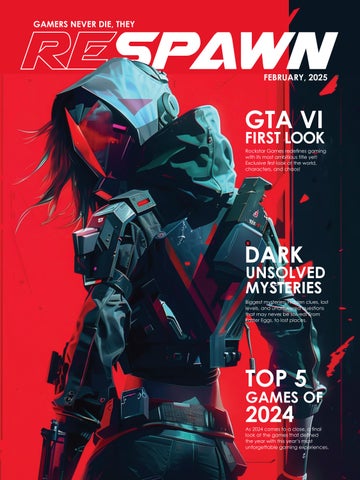
GAMERS NEVER DIE, THEY
Rockstar Games redefines gaming with its most ambitious title yet! Exclusive first look at the world, characters, and chaos!
Biggest mysteries: Hidden clues, lost levels, and unanswered questions that may never be solved! From Easter Eggs, to lost places.
As 2024 comes to a close, a final look at the games that defined the year with this year’s most unforgettable gaming experiences.


Editor-in-chief and Publisher
Swar Kulkarni
Creative Director
Swar Kulkarni
Content Google
Chat GPT
Wikipedia
Images Pinterest
Wallhaven
Google Cover By
Swar Kulkarni
Special Thanks
Sachin Kelkar Sir
Why Vyse deserves more recognition in the Sentinel role.
How mobile gaming continues to dominate the industry.
How gaming has evolved and where it’s headed next.
The timeless sandbox game that keeps players coming back.
The first glimpse of Rockstar’s most awaited game ever.
The scariest games that will keep you up at night.
UNSOLVED
Gaming’s greatest unsolved mysteries that still haunt players.
TOP GAME CHANGERS OF 2024
The biggest innovations and trends shaping gaming this year.
FPS HEROES
Celebrating the most iconic titles in first-person shooters.
A deep dive into the legendary franchise and its scenic beauty.
How PewDiePie became one of the biggest gaming icons.
DOES BLACK MYTH WUKONG LIVE UP TO THE HYPE
Does the long-awaited game meets expectations?
MORTAL KOMBAT XI
The brutal fighter that continues to evolve the franchise.
THIS MAGAZINE IS DESIGNED ONLY FOR EDUCATIONAL PURPOSES AND NOT FOR SALE AND CIRCULATION.
GAMING & MENTAL HEALTH
The positive and negative side of gaming on mental well-being.


While most of the players state the opposite. Vyse as a Sentinel shines in team compositions that prioritize adaptability. Paired with traditional Controllers or Initiators, she can supplement their utility with her own, creating a web of defensive options. Her ability to delay and disrupt also makes her a great counterpick against aggressive duelists who rely on fast-paced site takes.
Moreover, Vyse’s versatility allows her to rotate between roles mid-match, providing additional layers of unpredictability. A team using Vyse as a hybrid Sentinel can adjust strategies dynamically, exploiting opponents who underestimate her utility. Part of what makes Vyse an underrated pick as a Sentinel is the reluctance of players to experiment with non-meta roles. The gaming community often pigeonholes characters into predefined archetypes, overlooking creative strategies that can redefine how a character is played. Vyse’s Sentinel potential exemplifies how thinking outside the box can lead to innovative team compositions that catch opponents off guard.
Her ultimate, Quantum Divide, creates a massive energy barrier that cuts through the map. While traditionally used for retakes or isolating duels, this ability can also function as a defensive tool. For example, it can divide bomb sites to buy time for rotations, delay aggressive pushes, or deny information to attackers. When combined with a team’s utility, Quantum Divide creates layers of confusion that give Vyse’s team an undeniable strategic edge.
Vyse’s signature ability, Void Shroud, allows her to deploy temporary zones that obscure vision and disorient enemies. This works similarly to how a Sentinel might delay or disrupt an enemy push. Placing Void Shrouds at key choke points makes it challenging for opponents to execute coordinated entries, forcing them to waste utility or reconsider their approach. In the constantly evolving landscape of competitive gaming, especially in tactical shooters, team compositions often gravitate towards predictable meta picks. Choices are driven by familiarity and established success, leaving room for creative strategies to exploit


overlooked characters. However, those willing to think outside the box can uncover hidden gems among undervalued characters who bring unique advantages to unconventional roles. One such overlooked contender is Vyse as a Sentinel. Known primarily for her prowess as a Controller or Initiator, Vyse boasts a versatile toolkit that, when reimagined, offers incredible value as a defensive anchor. Her potential as a Sentinel, capable of disrupting enemy plays and creating tactical opportunities, deserves a closer examination.
Vyse’s ability to control the battlefield, delay pushes, and disrupt enemy plans makes her a sleeper pick in the Sentinel role. Her unique utility offers a fresh approach to site defense and team. Players willing to experiment with Vyse as a Sentinel may find themselves pioneering a new meta and, more importantly, reaping the rewards of their creativity. By leveraging her area-denial tools and unpredictability, Vyse’s impact extends beyond individual plays in a game where surprise often trump predictability, Vyse proves that being underrated is good.
A battle is just a conflict in need of resolution. Focus on the fix, then execute. -VYSE


Jett, Duelist in Valorant, is one of the most iconic and controversial agents in the game. Known for her exceptional mobility and ability to outmaneuver opponents, Jett’s abilities are often considered overpowered (OP) in the right hands. Here’s a breakdown of her kit and why each ability can feel really overwhelming to play against. Sometimes so intimidating that you are forced to surrender.


CLOUDBURST: Jett throws a projectile that creates a brief smoke upon impact, obscuring vision. She can steer the smoke mid-air to place it precisely. The ability to steer the smoke allows Jett to create unconventional angles and cover for herself or her teammates, making it unpredictable. Cloudburst activates almost instantly, letting Jett quickly block sightlines or escape sticky situations. In the hands of a skilled player, it can be used to fake plant, deny information, or block an enemy’s line of sight for aggressive pushes.
UPDRAFT: Jett propels herself into the air, gaining vertical elevation. Jett can take highground positions that most agents cannot access without specific setups or abilities. The sudden elevation can confuse opponents, making it difficult to land shots. Combined with Cloudburst or her ultimate, Jett can create outplays.
- Sentinel TenZ
Tailwind: It is arguably Jett’s most defining ability and a major reason why she is considered overpowered by many players. Dash makes her the most mobile agent in Valorant, dominating engagements and escape unfavorable situations with ease.j Jett dashes a short distance in the direction she’s moving. This dash occurs almost instantly, making it incredibly difficult for opponents to react. The dash happens faster than most players, often leading to whiffed shots that feel unfair.
BLADE STORM: This ability allows her to equip a set of deadly throwing knives that offer unparalleled accuracy, versatility, and lethality. In the hands of a skilled player, Blade Storm can be a gamechanging tool capable of turning the tide of a round. Each knife deals enough damage to kill an opponent instantly with a headshot, making it as powerful as the Sheriff or Guardian but with far more flexibility. Even body shots deal significant damage, allowing Jett to kill weaker enemies in just two hits.


While Jett can feel overpowered, she also demands a high level of mechanical skill and game sense. Additionally, utility from agents like KAY/O, Sova, or Breach can neutralize her effectiveness.

Among Us is a social deduction multiplayer game developed by Innersloth that experienced an explosive surge in popularity during the COVID-19 lockdowns in 2020. Despite being released in 2018, it went largely unnoticed until two years later, when its unique blend of strategy, deception, and humor captivated players worldwide. With people staying home due to pandemic restrictions, gaming became a primary form of entertainment and social interaction. Popular streamers like xQc, Pokimane, Valkyrae, Dream, LazarBeam and Disguised Toast brought massive attention to the game by hosting entertaining sessions with friends and other creators.

Mobile gaming has come a long way since the early days of simple, pixelated games on early mobile phones. What began as a niche pastime has evolved into a multi-billiondollar industry, with mobile games now reaching billions of players worldwide. From the launch of iconic titles to the latest advancements in technology, mobile gaming’s past, present, and future are a reflection of how far gaming has come, and where it is headed in the coming years.
Subway Surfers is a wildly popular endless runner mobile game developed by Kiloo and SYBO Games. Released in 2012, it remains one of the most downloaded games worldwide, simple mechanics, and addictive gameplay The player controls a mischievous character caught spraypainting, who must escape from a pursuing inspector and his dog. The goal is to run as far as possible while avoiding obstacles, collecting coins, and achieving high scores.
Some players have achieved astronomical high scores by mastering techniques like corner jumping and hoverboard stacking, reaching scores in the billions. However, the legitimacy of some scores is debated due to possible hacks or cheats.
While Subway Surfers peaked in cultural visibility years ago, it still has a large, dedicated player base. The drop in media coverage or social media presence compared to newer viral games (e.g., Among Us or Genshin Impact) might create the perception that Subway Surfers is less popular. The core mechanics remain largely unchanged, which might lead long-time players to lose interest. Returning cities in the World Tour can feel repetitive to veteran players, But it still remains in the hearts of all the 2000s mobile gamers.

Battlegrounds Mobile
India (BGMI) is the ultimate adrenaline-pumping, heartracing experience that transports you to a virtual battlefield where only the strongest, sharpest, and most strategic players survive. As the Indian version of PUBG Mobile, BGMI brings a fresh yet familiar thrill, blending fierce competition, breathtaking landscapes, and high-octane action into one immersive package.
Picture this: you’re hurtling through the sky, your parachute billowing against the wind, eyes scanning the expansive, ever-changing terrain below. The world of BGMI is a sprawling, detailed battlefield, with every corner and crevice hiding secrets, loot, and threats. This is how much fun it brings to everyone who plays BGMI.

The evolution of gaming has been a remarkable journey, transforming from simple graphics and mechanics to the immersive, high-tech experiences we enjoy today. Advancements in technology and player interaction have pushed the boundaries of what games can achieve.

THE LEGEND OF ZELDA: Benchmark of the gaming world.

MINECRAFT: One of the oldest open-world block survival game.
The 2010s marked a turning point as gaming became more inclusive and diverse. Mobile games like “Angry Birds” (2009) and “Candy Crush Saga” (2012) reached new audiences, while indie titles like “Minecraft” (2011) showcased the creativity of small developers.
Technological advancements brought forth virtual and augmented reality. Games like “Pokémon GO” (2016) blurred the line between virtual and real-world interactions, while they demonstrated the pinnacle of storytelling.
The gaming industry traces its roots to the early 1970s with the creation of “Pong” (1972) by Atari. This simple yet addictive table tennis simulation became a cultural phenomenon, sparking the first wave of gaming enthusiasm. As the industry matured, games like “Space Invaders” (1978) and “Pac-Man” (1980) brought innovation and mass appeal. “Space Invaders” introduced high-score tracking, fostering competition among players, while “Pac-Man’s” iconic characters cemented gaming as a cultural touchstone.
As internet connectivity improved, gaming took center stage. Blizzard’s “World of Warcraft” (2004) became a cultural phenomenon, drawing millions into its massive multiplayer online world. Bungie’s “Halo 2” (2004) popularized online multiplayer on consoles, laying the groundwork for competitive esports. The 2000s also saw the rise of immersive singleplayer experiences. “Grand Theft Auto III” (2001) openworld gameplay, allowing players full fledged freedom in the world of crime.


By 2024, video games are more immersive and diverse than ever. The rise of cloud gaming, spearheaded by platforms like Xbox Game Pass and NVIDIA GeForce Now, has made gaming accessible across devices. Titles like “The Last of Us Part II” (2020) and “Elden Ring” (2022) pushed the envelope of emotional storytelling and gameplay design. The emergence of artificial intelligence has also transformed gaming. Procedurally generated worlds and AI-driven NPCs create dynamic experiences. In addition, games like “Starfield” (2023) showcase the potential of expansive, player-driven exploration. Throughout the decades, the gaming industry grew exponentially, ushering in the rise of home consoles, the internet age, and the advent of immersive 3D environments with titles like Super Mario 64 and The Legend of Zelda. The late 90s and early 2000s brought multiplayer online gaming and the beginning of eSport revolutionized accessibility, making gaming a global phenomenon.


The future of gaming is set to be defined by immersive technologies, greater accessibility, and innovative experiences. Virtual Reality (VR) and Augmented Reality (AR) will offer fully immersive worlds, blurring the lines between the digital and real. Cloud gaming will enable seamless play across devices without the need for powerful hardware, democratizing access to high-end games. AI-driven narratives and procedurally generated worlds will create dynamic, personalized gameplay experiences. Social and multiplayer experiences will continue to evolve, integrating more cross-platform play and interactive, community-driven content. As the industry embraces emerging tech like haptic feedback, neural interfaces, and advanced AI, gaming will become even more immersive, connected, and transformative, offering players new ways to explore, create, and interact with the gaming world.

Minecraft, the iconic sandbox game developed by Mojang Studios, has captured the hearts of millions worldwide since its release in 2011. Its simple, blocky graphics belie the complexity and creativity it offers. Players can explore endless procedurally generated worlds, mine for resources, craft tools, and build structures—from humble houses to massive castles.
The beauty of Minecraft lies in its freedom. You can choose to survive against mobs and hunger in survival mode or build and create without restrictions in creative
mode. It’s a game of endless possibilities, limited only by imagination. For many, Minecraft is more than just a game—it’s a platform for creativity, storytelling, and creative collaboration.
Minecraft consistently holds a spot at the top of the gaming leaderboards, thanks to its massive player base and enduring popularity. Its influence extends far beyond the game itself. Minecraft has inspired countless YouTube channels, including those of Dream, who popularized Minecraft Manhunt and speedrunning. Additionally, Minecraft’s community-driven
content, like mods, skins, and custom servers, continues to expand the game’s universe. As Minecraft continues to evolve with regular updates and new features, it remains one of the most beloved games in history, offering something for everyone.
”
I don’t play to win. I play to make the other person lose.
- Technoblade


Speedrunning Minecraft is like playing chess, but the board is random, and everything is trying to kill you. Every run is a gamble—good seed, fast portal, blaze rods, pearls, stronghold, boom. But one mistake? It’s over. Then there’s Manhunt—pure chaos. Beating the game while my friends chase me down is the ultimate challenge. Every second matters—clutches, traps, escapes, and Sapnap screaming in my ear. One wrong move, and it’s game over. Just when I think I’m safe, George appears out of

nowhere, and suddenly, I’m running for my life. But that’s what makes it so fun. The rush, the strategy, the insane plays that somehow work—it’s all addicting. Whether I’m speedrunning or trying to survive a Manhunt, it’s the ultimate test of skill, luck, and creativity. And no matter how many times I win or lose, I always come back. One more run. Just one more.” I never thought i would die and respawn in this amazing respawn magazine, gaming has always been my life.
- Dream


Hey, Minecraft fans!
It’s been a while, hasn’t it? I hope you’re all doing well and having a blast in your blocks. As always, we’ve been hard at work behind the scenes, planning some really exciting updates that’ll make your Minecraft experience even more fun, weird, and (let’s be honest) chaotic. And what better way to catch up with you all than in the pages of your favorite magazine?
We’re adding some really cool biomes! Think towering mountains, lush, enchanted forests, and caves so deep they might just lead you to a whole new dimension (okay, maybe not that deep, but you get the idea). And yes, you might want to start bringing more torches. You know how it gets when you decide to “just dig a little bit further”… next thing you know, you’re in the middle of a huge lava lake with no way out. Hahaha Classic Minecraft, am I right?

Alright, here’s the thing: we know you love crafting, and we’re taking it to the next level. More blocks, more items, and yes, we’re finally making that crafting table less… confusing. We know, it’s been a few years. I mean, why does a crafting table need to be made of wood? Shouldn’t we be crafting tables out of tables? Anyway, keep an eye out for even cooler ways to craft and build in the next update!
When I first started creating Minecraft, I could never have imagined the incredible journey it would become. What started as a personal project turned into a global phenomenon, and it’s all because of you, the players. Your creativity, passion, and enthusiasm have shaped this game into something beyond my wildest dreams, I never thought was possible. Thank you, I LOVE YOU ALL!


Rockstar Games has officially unveiled the first trailer for Grand Theft Auto VI (GTA 6), providing fans with an exciting glimpse into the upcoming installment of the iconic series. The trailer showcases a vibrant setting reminiscent of Miami’s Vice City, featuring alligators, palm trees, and lively party scenes. The new protagonist, Lucia, appears to be a former inmate with a witty personality. Visually, the game demonstrates significant graphical improvements from its predecessor, GTA 5.
As for the release date, GTA 6 is slated for a fall 2025 launch, with availability on PlayStation 5 and Xbox Series

X|S. While there hasn’t been an official announcement regarding a PC release, it’s anticipated that a PC version will follow sometime after the initial console launch. The trailer has generated immense excitement, amassing over 100 million views on YouTube within just 24 hours of its release. This overwhelming response underscores the high expectations and enthusiasm surrounding GTA 6. In terms of setting, GTA 6 returns to Vice City, the Miami-inspired location from the 2002 game. Unlike its predecessor, the new installment is set in the present day, offering a modern take on the iconic city.
The game is expected to feature a broader map, allowing players to explore diverse environments beyond the urban landscape
.Adis es denis dis il moluptate eniminvenim ipsundis videre lam velit, nis evenim doluptus, solor si odit fugia quibus et dolupta tquidionsed esseq sequiat emporibus, et, cuptas volores nos nonsequam essit eliquamus surrounding GTA 6. In terms of setting, GTA 6 returns to Vice City, the Miami-inspired location
from the 2002 game. Unlike its predecessor, the new installment is set in the present day, offering a modern take on the iconic city.
The game is expected to feature a broader map, allowing players to explore diverse environments beyond the urban landscape
The introduction of Lucia as the central character marks a significant milestone, as she is the first female protagonist in the main series. Rockstar has hinted at a dynamic storyline where Lucia and her partner, possibly inspired by the infamous Bonnie and Clyde duo, navigate the criminal underworld of Vice City. This new narrative approach could introduce fresh gameplay mechanics, including heist missions and relationshipdriven choices.
While Rockstar has yet to reveal detailed gameplay mechanics, the brief glimpses in the trailer suggest that GTA 6 will maintain its signature open-world experience with enhanced realism. The level of detail in the trailer—ranging from bustling nightlife to wildlife interactions and an even more immersive world.


The annals of survival horror gaming, few titles stand as iconic as Resident Evil 2. First released in 1998 and later reimagined in a stunning remake in 2019, the game plunges players into the heart of Raccoon City, a once-thriving metropolis now overrun by the living dead. The story begins on a stormy night, introducing two protagonists, rookie cop Leon S. Kennedy and college student Claire Redfield, whose fates intertwine in their desperate fight for survival. At its core, Resident Evil 2 is a tale of human resilience amidst unrelenting terror.
The outbreak, caused by the sinister Umbrella Corporation’s T-virus, transforms ordinary citizens into grotesque creatures. From the decaying, shuffling zombies to the towering, relentless Tyrant (or “Mr. X”), every corner of the game oozes tension and dread. The developers masterfully blend atmospheric sound design, intricate puzzles, and dynamic encounters, ensuring players are never truly safe. The setting itself is a character. The Raccoon City Police Department (RPD), housed in a converted art museum, is a labyrinthine nightmare. Its design embodies the series’ ethos—a perfect mix of beauty and decay, where players must balance exploration and resource management to survive. The 2019 remake elevated this beloved classic to new heights. With the RE Engine, Capcom brought unparalleled realism to the environments, characters, and gore. Shadows flicker ominously, rain slicks the streets, and every bloodied detail immerses players in the chaos of Raccoon City’s downfall. Yet, Resident Evil 2 is more than just jump scares and grotesque monsters. It’s a story of courage.
Whether it’s Leon’s unwavering sense of duty or Claire’s determination to find her brother, their journeys resonate with players long after the credits roll. Resident Evil 2 isn’t just a game—it’s a legacy. A cornerstone of the horror genre, it set a benchmark for storytelling, atmosphere, and immersive gameplay that continues to influence games today. For fans of the macabre and lovers of gripping narratives, the chronicles of Raccoon City remain an unforgettable dive into the depths of fear and ultimate survival from the gruesome zombies


Silent Hill 2
Widely regarded as one of the greatest psychological horror games ever made, Silent Hill 2 takes players on a haunting journey through the fog-shrouded town. With its deeply emotional story, unsettling atmosphere, and iconic monsters like Pyramid Head, it explores themes of guilt, grief, and redemption.

Outlast
Step into the abandoned halls of Mount Massive Asylum in Outlast, a first-person survival horror experience that redefines terror. Armed only with a camcorder, players must uncover dark secrets while evading the asylum’s deranged inhabitants. Every moment is a test of courage and endurance.

Amnesia: The Dark Descent
A pioneer in modern horror gaming, Amnesia: The Dark Descent thrusts players into a nightmarish castle where darkness hides unspeakable horrors. With no weapons to defend yourself, the game challenges players to rely on wits, stealth, and a flickering lantern to survive an unforgettable descent into madness. The oppressive atmosphere, chilling sound design, and a story.

Video games are designed to challenge us, entertain us, and immerse us in their worlds— but sometimes, they leave us with questions that linger long after the credits roll. Across the history of gaming, developers have hidden cryptic clues, unexplained phenomena, and puzzling details that players have yet to fully unravel. Whether these mysteries were intentional teases, forgotten scraps of unfinished content, or secrets left behind by design, they’ve sparked countless debates and theories among fans. From secret rooms to cryptic messages, these riddles remind us that sometimes, the best part of a game isn’t beating it, it’s the thrill of discovering its deepest secrets. Ready to press start? Let’s explore the unknown.
The mystery of Herobrine is one of Minecraft’s longest-running urban legends. It started as a creepy myth in the community and turned into a worldwide phenomenon, with players reporting eerie sightings of a ghostly figure with empty white eyes.
Herobrine first appeared in a post on 4chan in 2010, where a user claimed to have encountered a mysterious figure in their single-player world—one that looked like the default Steve skin but with glowing white eyes. This figure would silently stalk the player, creating strange structures (such as small pyramids and tunnels), removing leaves from trees, and generally acting like a ghostly presence. Soon after, a now-famous screenshot of Herobrine was posted, fueling the myth.
The mystery of the hidden secret door in The Legend of Zelda series is a long-running enigma that has intrigued fans for years. While Zelda games are full of secrets, hidden rooms, and cryptic messages, some rumors about a secret, undiscovered door continue to spark speculation among players. One of the most wellknown rumors stems from a claim that Shigeru Miyamoto, the creator of The Legend of Zelda, supposedly mentioned a secret room or door in one
of the games that no player has ever found. However, no official source confirms this statement—it’s more of an urban legend that took on a life of its own, fueled by fan speculation and the series’ history of hidden secrets.
The Mount Chiliad Mystery is one of the biggest unsolved enigmas in Grand Theft Auto V (GTA V). Since the game’s release in 2013, players have been searching for the meaning behind strange symbols, cryptic murals, and possible hidden secrets surrounding Mount Chiliad, the tallest mountain in the game. If players achieve 100% completion in the game and visit Mount Chiliad at 3:00 AM, they can see a ghostly UFO hovering above the mountain. It is just an Easter egg with no reward.
Giygas is the main antagonist of EarthBound, appearing as an all-powerful cosmic horror that has lost all rational thought, existing only as an embodiment of pure evil and destruction.
He was once a sentient being but became so powerful that he transcended physical form, turning into a chaotic force that corrupts everything around it.
In the game’s final battle, Giygas is unkillable through conventional means, forcing the protagonist, Ness, and his friends to pray for help, calling upon the collective strength of those they met throughout their journey. This is the only way to defeat him, emphasizing the game’s deeper theme of hope against darkness.


The year 2024 has been a groundbreaking one for gaming, bringing players an incredible mix of innovation, nostalgia, and next-level storytelling. From highly anticipated sequels to fresh new IPs, developers have pushed the boundaries of what video games can achieve, delivering stunning visuals, immersive gameplay, and unforgettable experiences. Whether you’re a fan of actionpacked adventures, deep RPG narratives, or creative indie gems, this year had something for everyone. Here’s a look at the top five games that defined 2024 and captured the hearts of game lovers and all gamers worldwide.
Astro Bot, developed by Team Asobi, has redefined the platforming genre with its charming protagonist and innovative level design. The game’s delightful art style and fluid mechanics have garnered critical acclaim, securing multiple Game of the Year awards and the “Best Audio Design” accolade at the Golden Joystick Awards.
Drawing inspiration from the classic Chinese novel “Journey to the West,” Black Myth: Wukong offers players an immersive action RPG experience. Developed by Game Science, the game has been lauded for its stunning visual design and engaging gameplay, earning the prestigious “Ultimate Game of the Year” award at the 2024 Golden Joystick Awards.


With its expressive animations and playful personality, Astro is the most lovable.


Balatro stands out as a unique entry in the roguelike genre, blending elements of poker with strategic gameplay. Developed by LocalThunk, this indie title has captivated players with its originality and depth, earning accolades such as “Best Indie Game” at the Golden Joystick Awards.
Final Fantasy IV (originally released as Final Fantasy II in North America) is one of the most iconic RPGs in gaming history. Developed and published by Square (now Square Enix) in 1991 for the Super Nintendo Entertainment System (SNES), it introduced


many elements that became staples of the Final Fantasy series, including a deep, character-driven story and the revolutionary Active Time Battle (ATB) system.
Dr. Henry “Indiana” Jones, embarks on a quest to prevent various factions from harnessing a mysterious power linked to the Great Circle—a series of enigmatic sites forming a perfect circle on the world map. Players navigate through diverse real-world locations, including Vatican City, Thailand, Egypt, and China, engaging in both combat and puzzle-solving.
In conclusion, 2024 has been a landmark year for the gaming industry, offering a rich tapestry of experiences that cater to a wide array of player preferences. From innovative indie titles to adventures to open world games.


First-Person Shooter (FPS) games have been a cornerstone of gaming for decades, evolving from pixelated corridors to hyperrealistic battlefields. These games provide a unique perspective, placing players directly in the action, testing their reflexes, strategic thinking, and marksmanship.
From their humble origins as simple, sprite-based shooters to today’s immersive, high-fidelity experiences, FPS games continue to define and reshape the gaming landscape. Their
impact extends beyond entertainment, influencing esports, game design, and even pop culture. The evolution of FPS games has been marked by several groundbreaking titles that introduced new mechanics, set industry standards, and captivated millions of players and streamers.
Among the legends of the genre, titles like Quake, Counter-Strike: Global Offensive (CS:GO), CounterStrike: Condition Zero, and Valorant stand tall as pioneers and masters of their craft.

Each of these games has contributed to the genre’s rich history, refining gameplay mechanics and fostering competitive gaming. These games have taught gamers how to deal with enemies of all kinds, kill them and conquer.


The FPS genre began in the early 1990s, with Wolfenstein 3D (1992) often credited as the game that laid the foundation. It was DOOM (1993) that truly popularized the genre, delivering fastaction, gruesome enemies, and intense multiplayer gameplay. The late 90s saw the rise of Quake (1996) by id Software, which revolutionized multiplayer gaming with its fast movement mechanics and skill-based combat.
When Quake arrived, it brought real-time 3D graphics and a skill-based arena shooter experience that rewarded precision, movement, and reflexes. The game’s deathmatch mode became a staple of competitive play, influencing titles like Unreal Tournament and Counter-Strike. Its influence on modern shooters, particularly in movement mechanics, remains evident even today.


The 2018 reboot of God of War not only redefined the action-adventure genre but also delivered one of the most breathtaking visual experiences in gaming. Set in the mystical world of Norse mythology, the game’s environments are nothing short of a visual spectacle, blending stunning landscapes with intricate details that immerse players in a truly cinematic journey. From towering mountains to ancient ruins, every frame in God of War is a masterpiece
of artistry and storytelling.
The game’s protagonist, Kratos, alongside his son Atreus, embarks on a journey through the realms of Norse mythology. Each realm offers a unique aesthetic and atmosphere, adding depth and variety to the visual experience of the game.
Midgard, the central realm, is a beautifully realized wilderness filled with dense forests, tranquil lakes, and icy tundras. The Lake of Nine, with its ever-changing


water levels, serves as a breathtaking focal point, reflecting the grandeur of the surrounding mountains and ancient Norse architecture. The realm’s dynamic weather and lighting effects further enhance the immersion, making it feel alive and everchanging, like real life.
Alfheim, home of the Light Elves, offers an ethereal beauty characterized by bioluminescent flora, shimmering golden light, and elegant architecture. The contrast between the serene elegance of the Light Elves and the encroaching darkness of the Dark Elves creates a visually stunning and emotionally compelling environment, filled with joy.
Helheim stands in stark contrast to other realms, evoking a chilling sense of desolation. The icy wasteland, engulfed in an eerie green glow, is filled with ghostly apparitions and massive, frozen structures. The oppressive atmosphere


perfectly encapsulates the realm’s purpose as a land of the dead, leaving players in awe of its haunting beauty.
Jötunheim, the final destination of Kratos and Atreus, presents some of the most awe-inspiring landscapes in the game. Towering mountain ranges, vast open fields, and colossal remnants of the ancient giants make this realm feel truly mythic in scale. The use of warm, golden hues contrasts with the game’s darker tones, creating an unforgettable visual climax.

The scenic beauty of God of War (2018) sets a new benchmark for visual storytelling in gaming. Through breathtaking landscapes, intricate worldbuilding, and masterful use of lighting and color, the game immerses players in a world that feels both mythical and real. It’s the serene beauty of Alfhelm and Helhelm leaves a lasting impression, solidifying God of War as one of the most visually stunning games.


What started as a guy recording gameplay in his bedroom became a revolution that reshaped gaming culture forever. With over 110 million subscribers and a decade of viral moments, Pewds built an empire powered by unfiltered energy, chaotic humor, and a connection to the gaming community like no other.


Felix Arvid Ulf Kjellberg, better known as PewDiePie, is one of the most influential figures in YouTube history. From humble beginnings as a passionate gamer to becoming the most subscribed individual creator on the platform, PewDiePie’s journey is a testament to hard work, adaptability, and an unbreakable bond with
his fans. Born on October 24, 1989, in Gothenburg, Sweden, Felix had an early interest in video games and digital art. Initially pursuing a degree in industrial economics and technology management at Chalmers University of Technology, he eventually dropped out to focus on his passion for gaming and content creation.
In 2010, he created the

PewDiePie YouTube channel, with the name inspired by the sounds “pew” (a laser gun noise) and “die” (a reference to video games). His earliest videos featured gameplay of Minecraft, Call of Duty, and Amnesia: The Dark Descent, with his over-the-top reactions and commentary quickly gaining attention amongst teenagers and adults too.
By 2012, PewDiePie’s “Let’s Play” videos, particularly his horror game playthroughs, had exploded in popularity. His genuine personality, comedic style, and signature phrases

like “BROFIST!” resonated with millions of viewers. In 2013, he became the most subscribed YouTuber in the world, surpassing Smosh, and his fanbase, the Bro Army, continued to grow exponentially.From 2014 to 2017, PewDiePie diversified his content, incorporating meme reviews, and satirical commentary. His influence on YouTube was undeniable, setting trends and inspiring countless creators.
PewDiePie’s legacy as the “King of YouTube” lives on, forever etched in the history of digital entertainment.
Mortal Kombat 11 (MK11), released in 2019 by NetherRealm Studios, is the eleventh installment in the legendary Mortal Kombat franchise. Known for its brutal combat, deep storyline, and jaw-dropping Fatalities, MK11 took the series to new heights with enhanced graphics, refined gameplay mechanics, and a massive roster of fighters, including Scorpion, Sub-Zero, and Liu Kang— three of the most iconic characters in the franchise.
When it comes to fighting games, few franchises have had the cultural impact of Mortal Kombat. Known for its intense battles, deep lore, and, of course, its brutal Fatalities, the series has remained a dominant force in gaming for decades. With the release of Mortal Kombat 11 (MK11) in 2019, NetherRealm Studios pushed the franchise to new heights, delivering cinematic storytelling, refined combat mechanics, and some of the most gruesome finishing moves ever seen. MK11 isn’t just a fighting game—it’s an evolution of the series’ legacy, featuring a massive roster of fighters, stunning visuals, and an engaging time-bending narrative. Among the legendary warriors, Scorpion, Sub-Zero, and Liu Kang stand out as three of the most important and beloved characters, each playing a vital role in both the story and gameplay. And, of course, Fatalities return in all their glory, bringing bone-crushing, blood-soaked spectacle to every battle. For nearly three decades, Mortal Kombat has reigned as one of the most iconic and controversial fighting game.


I will scorch this realm with hellfire!

Real Name: Kuai Liang
Affiliation: Lin Kuei
Powers: Ice manipulation, cryokinesis, weapon creation
As the sworn rival of Scorpion, Sub-Zero has long been one of the most important characters in the Mortal Kombat series. However, the Sub-Zero in MK11 is not the same man who killed Scorpion’s family—that was Bi-Han, the first Sub-Zero, who later became Noob Saibot. The current SubZero, Kuai Liang, is Bi-Han’s younger brother, who has since redeemed the Lin Kuei clan and turned them into a force for good, and still remains a rival to Scorpion.
In Mortal Kombat 11, Sub-Zero stands as a disciplined warrior and a protector of Earthrealm. Unlike his older brother, he believes in honor and seeks to mend the feud between the Lin Kuei and Shirai Ryu.


Real Name: Liu Kang
Affiliation: White Lotus Society, Earthrealm Powers: Martial arts mastery, fire manipulation, dragon transformations
Liu Kang has been the main protagonist of Mortal Kombat since the very first game, originally designed as a tribute to Bruce Lee. He has always been Earthrealm’s greatest champion, standing against evil forces such as Shang Tsung, Shao Kahn, and Shinnok.
However, Mortal Kombat 11 introduces a darker twist to Liu Kang’s story. In previous games, he was corrupted and killed, turning into a revenant under the control of Quan Chi. But with Kronika’s time manipulation at play in MK11, Liu Kang reclaims his destiny and merges with Raiden, becoming Fire God Liu Kang, the most powerful version of himself yet. As Fire God Liu Kang, he is no longer just a skilled fighter—he wields divine fire, can summon massive dragons, and possesses god-like strength.
Real Name: Hanzo Hasashi
Affiliation: Shirai Ryu
Powers: Hellfire manipulation, teleportation, spear attacks
Scorpion is, without a doubt, the face of Mortal Kombat. Once a human warrior and the leader of the Shirai Ryu clan, Hanzo Hasashi’s life was tragically cut short when his family and clan were slaughtered by the Lin Kuei assassin Bi-Han (the original Sub-Zero). Manipulated by Quan Chi, Hanzo was reborn as Scorpion, a vengeful specter fueled by hatred and hellfire. In Mortal Kombat 11, Scorpion struggles with his past, torn between his quest for vengeance and the possibility of redemption. With time manipulation at
the center of the game’s story, MK11 features both the vengeful specter Scorpion and a younger, more human version of Hanzo Hasashi, leading to a powerful character arc.
Scorpion’s fighting style remains one of the most aggressive in the game, with his signature spear (“Get over here!”), teleportation, and fiery attacks making him a deadly opponent. His Fatalities are among the most brutal, often involving setting his enemies ablaze or slicing them apart with his katana.

Step into the mystical realm of Black Myth: Wukong, where ancient legends collide with brutal combat and Play as the legendary Monkey King.
Released in August 2024 by Game Science, Black Myth: Wukong has captivated the gaming community with its rich narrative and stunning visuals. Drawing inspiration from the classic Chinese novel Journey to the West, the game offers players an immersive experience into ancient folklore. In Black Myth: Wukong, players step into the shoes of the “Destined One,” an anthropomorphic monkey warrior reminiscent of Sun Wukong, the Monkey King. The narrative unfolds after the events of the original Journey to the West, presenting a world where the Destined One embarks on a quest to uncover hidden truths and confront celestial adversaries. Throughout the journey, players encounter a myriad of mythical beings, each contributing to a complex and layered storyline. Developed by the Chinese studio Game Science, inspired by the classic novel Journey to the West, it offers a fresh take on the legendary tale of Sun Wukong, the Monkey King.
With multiple gameplay showcases over the years, each revealing new mechanics, stunning environments, and intricate boss battles, excitement for the game only grew. But now that Black Myth: Wukong has finally been released in August 2024. Let’s take a deep dive into its story, and overall reception.

Set after the events of Journey to the West, Black Myth: Wukong follows the journey of the “Destined One,” an anthropomorphic monkey warrior reminiscent of Sun Wukong. After successfully completing the pilgrimage to retrieve sacred Buddhist scriptures, Sun Wukong attains Buddhahood but chooses to return to his home on Mount Huaguo. The Celestial Court, mistrustful of his intentions, sends an army led by Erlang Shen to subdue him. During the ensuing battle, Wukong is incapacitated by a binding circlet and sealed in stone, with his six senses fragmented into relics scattered across the land.
Centuries have passed since Sun Wukong, the legendary Monkey King, was sealed in stone after a climactic battle against the Celestial Court. Now, his homeland—Mount Huaguo—is left in turmoil, with its inhabitants desperate to restore their fallen leader. The only hope lies in gathering the scattered fragments of his six senses, powerful relics that contain pieces of his soul, mind, and strength.
Players step into the role of the Destined One, a mysterious warrior resembling Wukong, though their true identity remains shrouded in mystery. Tasked with an epic journey, they must traverse a world filled with mythical creatures, ancient deities, and forgotten realms to retrieve the lost relics. Each recovered sense brings them closer to unlocking Wukong’s true power and unraveling the fate that binds them together.


Upon its release in August 2024, Black Myth: Wukong garnered significant attention and sparked extensive discussions within the gaming community. The game achieved remarkable commercial success, with an estimated 4.5 million copies sold on launch day and a peak of 2.2 million concurrent players on Steam, marking it as the platform’s second-highest concurrent player count, surpassed only by PUBG.
Critically, the game received generally favorable reviews. On Metacritic, it holds an 81 rating, indicating positive feedback from critics.
Players have praised its engaging combat system, beautiful graphics, and immersive narrative rooted in Chinese mythology. However, the game has not been without criticism. Some players have noted technical issues, including occasional game crashes and animation glitches. Additionally, discussions have arisen regarding the authenticity of some reviews, with debates about the possibility of botted reviews influencing perceptions.
Black Myth: Wukong is undeniably an ambitious and visually stunning game that successfully brings Chinese mythology to life in an interactive format. However, technical issues, glitches and concerns over review authenticity have dampened some of its initial excitement, but it still continues to be #2 in PC games of 2024.
Ultimately, whether Black Myth: Wukong lives up to the hype depends on individual expectations. If you enjoy Soulslike combat, stunning environments, and mythological storytelling, this game offers a rewarding experience. However, those looking for a perfectly polished game may want to wait for patches and updates before diving in.

Video games have long been a source of entertainment, providing an escape from reality and a way to connect with others. However, their impact on mental health is a subject of ongoing debate. While gaming can offer numerous psychological benefits, excessive or uncontrolled gaming can lead to serious consequences. This article explores both sides of gaming—how it can be beneficial, and how it can become a dangerous addiction if not managed properly.
Contrary to the stereotype that gaming is a mindless activity, research has shown that video games can have several cognitive and emotional benefits. One of the most significant advantages of gaming is its ability to relieve stress. Many people turn to video games as a way to unwind and escape from daily pressures. Immersing oneself in a fictional world, whether it’s the open landscapes of The Legend of Zelda or the fast-paced action of Call of Duty, can provide a temporary break from real-world problems.
Beyond stress relief, gaming also enhances cognitive skills. Puzzle-solving games, strategy-based simulations, and fast-paced shooters require critical thinking, quick decision-making, and hand-eye coordination. Games like Portal and Civilization challenge players to think creatively, strategize, and anticipate outcomes, which strengthens problem-solving abilities. Another major benefit of gaming is its ability to foster social connections. Online multiplayer games allow people to interact with others around the world, forming friendships and communities. For those who struggle with social anxiety or have difficulty making friends in real life, online gaming provides a comfortable space to build relationships. Many games encourage teamwork and communication, which can improve interpersonal skills and create a sense of belonging.
Gaming has also been explored as a therapeutic tool. Some games are designed specifically to help players cope with anxiety and depression, such as Celeste, which explores themes of mental health and perseverance. Additionally, virtual reality (VR) technology is being used to treat PTSD, phobias, and other psychological conditions by immersing individuals in controlled environments that help them confront their fears in a safe way.
While gaming can be beneficial, there is a darker side that emerges when it is not kept in check. Excessive gaming can lead to addiction, negatively impacting mental and physical health. Gaming addiction is now recognized as a disorder by the World Health Organization, with symptoms including loss of control over gaming habits, neglecting responsibilities, and prioritizing gaming over essential daily activities.
One of the most severe consequences of excessive gaming is its impact on physical health. Long hours of screen time can lead to sleep deprivation, eye strain, and poor posture. Many gamers
Uncontrolled gaming can create a cycle of escape. “

neglect exercise and proper nutrition, which can contribute to obesity and other health issues. Additionally, some individuals experience increased anxiety and depression as a result of isolating themselves from real-world social interactions in favor of virtual ones. In extreme cases, gaming has even led to fatalities. One well-known incident occurred in 2005 when a South Korean man, Lee Seung Seop, died after playing the online game StarCraft for nearly 50 hours without proper rest, food, or hydration. His tragic death highlighted the dangers of uncontrolled gaming, emphasizing the need for moderation and self-discipline.
Video game addiction can also have severe consequences on mental well-being. Some players become emotionally attached to their in-game progress, experiencing extreme frustration or even depression when they lose or fail. This emotional rollercoaster can lead to increased aggression, stress, and in some cases, violent behavior. Additionally, excessive exposure to violent video games has been linked to desensitization towards real-world violence, although this remains a debated topic among researchers. Gaming is not inherently bad—it is how it is used that determines whether it is beneficial or harmful.


Alright, let’s talk about It Takes Two. This game had no business being THIS good. If you’re into co-op games that actually force you to work together (instead of just running around doing your own thing), this one is an absolute must-play. It Takes Two is a co-op-only action-adventure game from
Hazelight Studios, the same people who made A Way Out. But instead of escaping prison, you’re playing as Cody and May—two parents on the brink of divorce who get turned into tiny dolls thanks to their daughter’s tears (yeah, it’s deep). Now, they have to work together through a series of insane levels to get back to their real

bodies. This is where the game shines. Every level is c ompletely different. One second, you’re shooting sap and lighting it on fire; the next, you’re flying through a clock tower in a time-bending puzzle. There’s never a dull moment. You literally can’t play this game solo—it REQUIRES teamwork. Communication is key, so if your co-op partner is useless... good luck.WvWWMinigames? Bangers. Throughout the game, you’ll find little competitive challenges against your partner, and honestly, I could’ve played those for hours.
They’re lowkey one of the best parts of the game. The game’s visuals are straightup beautiful. Every level feels handcrafted, with crazy details that make it feel like a Pixar movie. The environments are creative, from wild fantasy settings to everyday objects turned into massive landscapes.
At first glance, It Takes Two looks like a fun, lighthearted platformer about a tiny couple navigating oversized environments. But beneath the quirky visuals and chaotic
gameplay, there’s a genuinely heartfelt story about love, relationships, and learning to appreciate each other. This might be one of the best co-op games EVER made. The level design is incredible, the mechanics never get old, and the story is surprisingly touching. Plus, it’s one of the few games that actually forces you to communicate and work together to solve problems. One of the most impressive things about It Takes Two is how effortlessly it blends gameplay and storytelling.
The mechanics aren’t just fun—they’re meaningful. Each new ability Cody and May gain is directly tied to their relationship struggles. For example, one level gives May time-based powers while Cody controls plants, symbolizing their past issues of feeling out of sync. These mechanics aren’t just gimmicks; they reinforce the game’s themes in a way that feels natural and satisfying. It’s rare to see a game where the narrative and gameplay are so deeply intertwined, making every moment feel impactful. At the end of the day, It Takes Two isn’t just a fantastic co-op game—it’s a masterpiece.

