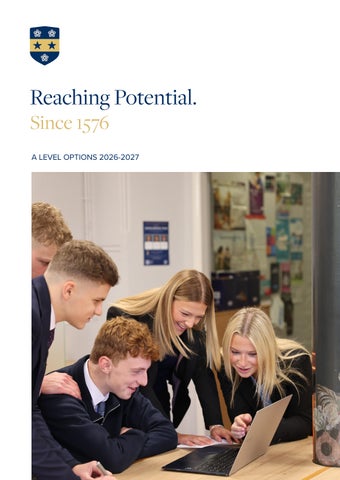
Reaching Potential. Since 1576
A LEVEL OPTIONS 2026-2027
svs.org.uk
1
2
svs.org.uk
CONTENTS
2026
Message from the Head of Senior School
4
Welcome to our Sixth Form 6 Options and Qualifications 8 Careers & Futures 9 Cultural life, Combined Cadet Force (CCF), Volunteering Wednesday PM 10 Chartered Institute of Securities and Investment (CISI) Fundamentals of Financial Services, Young Enterprise 11 Games and PE 12 Sports Leaders Programme 12 Boarding at Sutton Valence School
14
Options
16
Art 18 Biology 20 Chemistry 21 Design and Technology 23 Drama and Theatre 24 Business 26 Economics 27 Level 3 Extended Certificate in Business 28 English Literature 30 Further Mathematics 32 Geography 34 History 35 ICT 36 Mathematics 38 Media Studies 40 Modern Foreign Languages (MFL) - French and Spanish 42 Music 45 OCR Level 3 Cambridge Technical Introductory Diploma in Sport 46 Photography 48 Physical Education 50 Physics 52 Psychology 53 Religious Studies 54 Extended Project Qualification (EPQ) 56 Sixth Form Activities Programme 57 svs.org.uk
3
Message from the Head of Senior School The Sixth Form at Sutton Valence School is a brilliant educational and personal experience. Although the Sixth Form at Sutton Valence is first and foremost a place of learning, the additional availability of our broad range of enrichment activities, including leadership opportunities and our excellent careers service, considerably enhances the Sixth Form experience. All this gives our pupils the very best preparation for entry to higher education and the world of work which lies beyond. As you may be aware, there has been a significant upheaval and restructuring of A Levels, with modular
courses no longer existing. Most A Levels are now linear and with AS exams and grades now defunct except for the International A Levels (Geography), university admissions departments are more reliant on pupils’ GCSE grades. They are very keen on pupils taking an EPQ (Extended Project Qualification), which is mentioned later in this booklet. This booklet will give you an overview of the courses we currently offer, but in order to find out what makes our Sixth Form so successful, there is no substitute for coming to visit us. We hold at least one Open Morning every term but I, or the Deputy Head (Academic), or the Head of Sixth Form are happy to see you at any time for a personal discussion. You will also be able to tour the School with a Prefect, who will give you a pupil’s perspective on the School. I look forward to welcoming you to Sutton Valence School.
David Sansom Head of Senior School
To arrange a visit, or for information on the scholarships that may be available to you, please contact Mr Will Radford, Director of Admissions and Development, 01622 845206 or admissions@svs.org.uk.
4
svs.org.uk
svs.org.uk
5
Welcome to the Sixth Form It is our belief that pupils should take a different perspective on School life once they are in the Sixth Form. Now they are entering a time when our young people choose to take greater ownership of their studies and take on positions of prestige within our community. It is important that Sixth Form pupils feel that they have greater freedom and powers of decision-making. As well as this being evidenced in their choice of study, it is also presented through their independence and conduct around the school. As such, we believe the Sixth Form should take responsibility for shaping their community, arranging their own events and activities and making the most of the warm, collegiate atmosphere at Sutton Valence School.
Leadership Opportunities Consequently, leadership opportunities abound in academic departments, on the Sports field, in the Music School and Theatre or on a variety of committees. There are opportunities to influence the life of the Chapel, to shape the School’s charitable initiatives or to serve on the School Council. Lower Sixth pupils can act as mentors or become Well-Being Ambassadors whilst the Upper Sixth fulfil a variety of roles as Prefects, Heads of House or by joining the organising committee for the Spring Ball. Both exciting and daunting, the Sixth Form represents a pivotal point in any pupil’s educational career. Sixth Form pupils enjoy increased independence and responsibility but are met with a raised bar of expectation from their very first day in the Lower Sixth. As senior members of the pupil body, the Sixth Form must lead by example in all their academic, enrichment and social pursuits. 6
svs.org.uk
21st Century Skills This expectation reflects the belief that is at the heart of our Sixth Form provision: to equip our pupils with the competencies and experiences required to embrace the opportunities and challenges of life in the 21st Century. Our purposeful programmes of academic study and enrichment, careers provision, together with scheduled visits from inspirational speakers, aim to provoke a sense of intellectual curiosity that will inspire and challenge our pupils to achieve their academic potential.
Responsibility Our Sixth Form pupils’ first encounter with responsibility comes during their selection of – and commitment to – their A Level courses. With greater competition for university places and an increasingly saturated graduate market, pupils must make sensible and informed A-Level choices that align with their future goals. Our expectation of mature A Level study, therefore, extends well beyond the classroom. During non-teaching periods, Sixth Form pupils are encouraged to take active responsibility for their learning in the Sixth Form Study Centre, the Library, the ICT facilities or in various departmental work areas.
Whether it be in the pursuit of an additional qualification in volunteering or CISI, or as a member of the CCF or the Sports Leaders programme, opportunities for self-direction abound in the Sixth Form. We expect the Sixth Form to take a leading role in all areas of School life and actively promote opportunities for mentoring their younger peers and assisting with the leadership of enrichment activities. In their Upper Sixth, pupils have the opportunity to apply for the coveted position of School Prefect – a role that embodies the core values of respect and responsibility that are cherished at Sutton Valence.
A Culture of Care Sutton Valence Sixth Form acknowledges that whilst our pupils take their final steps in their schooling journey, they may need help along the way. Alongside our teaching and academic support, we provide exceptional pastoral care. We consider the support pupils may need with learning how to best utilise independent study, how to prioritise tasks with socialising or event management and we run a thorough programme helping pupils apply to UCAS or apprenticeships post 18.
Tailored Guideance We are proud of the diverse destinations of our leavers. Pupils are encouraged to take advantage of the annual schedule of visits, talks and internal lectures that explore the myriad of options available to them after School. Our calendared Higher Education and UCAS days give all Sixth Form pupils the additional opportunity to receive individual support via their Tutor, Housemaster/ mistress, the Careers and Futures Leader
and myself to guide them through their higher education, apprenticeship or employment applications. Our School Subscription to Unifrog also provides careers and university guidance to our pupils. Our Oxbridge and Medicine applicants benefit from a supplementary programme of specialist support and meet regularly throughout their Lower and Upper Sixth years with the Head of Academic Enrichment.
A Time for Priviledges In exchange for their contributions to the academic and enrichment programmes on offer, the Sixth Form enjoy certain social privileges. During break times, they have access to the TC’s Café in addition to the House Common Rooms. In the Upper Sixth, pupils have the opportunity to serve on various committees that shape the Sixth Form social calendar – the highlight being the annual black-tie charity event, which takes place every spring.
Confidence to do More The successful Sutton Valence Sixth Form pupil is purposeful, self-directed, and ambitious in all avenues of their education. They develop confidence through curiosity and embody the values SVS encourages further down the school. As the pathway to undergraduate study and future employment, our Sixth Form seeks to develop mature and independent individuals that are prepared for the next chapter in their lives. Emily Court-Wilson Head of Sixth Form
svs.org.uk
7
Options and Qualifications Sutton Valence School offers a broad, flexible menu of A Level and CTech subjects. Most pupils choose three A Level and/or CTech subjects with the exception of those who wish to take Further Mathematics who may take four. Each subject has six hours of timetabled teaching time. We also offer a very successful Extended Project Qualification, CISI and other courses which will add to a pupil’s skill set and enhance a CV or university application. At School we regularly monitor all our pupils so that they and their parents are kept fully informed of their individual progress. We expect our pupils to work hard and to show complete commitment to their studies. We believe that constant feedback is one of the most effective ways of ensuring that all the pupils give of their best.
8
svs.org.uk
Pupils are graded three times in the Michaelmas Term, and twice in the Lent and Summer Terms for academic attainment and effort in lessons and for independent work in their own time. Parents and pupils are also kept informed by the use of termly reports and Parents’ Evenings. We are a small community that gets to know its pupils very well. Lessons are most often delivered in a seminar style which helps to foster the feeling that we work together in a partnership. We look forward to working with both existing and new pupils as they start or continue their academic journey here with us in the Sixth Form. Amanda Sunde Assistant Head Academic
Careers & Futures The Sixth Form follow a comprehensive post-18 preparation programme, designed to support them in realising their individual ambitions for life after School. This begins early in the Lower Sixth with informal meetings with the Head of Sixth Form, one-to-one careers counselling with our Careers & Futures Lead, PSHE, access to the comprehensive Unifrog platform and talks from a variety of internal and external speakers. As a partner school with InvestIn Education, our pupils also benefit from discounted access to the prestigious work placement programmes offered by InvestIn, in addition to workshops on interview skills, time management and work experience. Pupils are encouraged to explore work experience during the Summer Holiday to enhance their application for their chosen pathway beyond School.
Careeers and Future Leaders Our Careers and Futures Leader, Mrs Ring, is a highly qualified and experienced specialist who is available Monday to Wednesday, based in the Lambe’s Building. She works with pastoral and academic staff to help deliver specific careers guidance to the Sixth Form, as well as being available to meet with pupils on a one-to-one and group basis.
University During the Lower Sixth, we prepare our pupils for the university application process in three stages: research, prepare and apply. During the preliminary stages, pupils attend internally delivered talks on the application process and lectures on course and university selection. During the Summer Term of the Lower Sixth, pupils begin their UCAS application and attend personal statement workshops. During the Upper Sixth, pupils attend a weekly timetabled session for further application and personal statement support. To enable our pupils to achieve the best range of university offers, we set an internal submission deadline of mid-November. Our Oxbridge, Medical and Veterinary applicants receive additional, tailored support from the Head of Academic Enrichment, who provides a bespoke programme of application preparation and guidance. We invite all parents of the Lower Sixth to an annual Higher Education Morning and we hold regular UCAS Update Meetings throughout the course of the year in the lead-up to key deadlines.
Apprenticeships and Direct Employment
All Sixth Formers will have at least one designated, individual meeting with Mrs Ring during their time here and can liaise with her as needed. Parents can also contact Mrs Ring for help when assisting their child in taking the next steps beyond School.
We promote a range of alternative options to university, including apprenticeships, gap years and direct employment. Our pupils enjoy a mix of guest speakers and internally delivered talks on the range of options available to them, including speakers from Old Suttonians who have successfully opted for alternative routes.
Unifrog
Preparing for Life Beyond School
All pupils are enrolled on the Unifrog online platform, which bridges the gap between School and pupils’ ‘next step’ in their careers. This is a self- paced and self-managed resource, with interactive content on university, apprenticeships, gap year and employment options available to them after School. These resources complement our one-to-one and group sessions on careers and futures advice, allowing us to push bespoke content to pupils after these sessions. Parents can also access the platform to view and support their child’s research.
Our Sixth Form enrichment programme aims to prepare pupils for life after School. Pupils are taught essential life skills such as cooking, budgeting, first aid and wellbeing. We welcome guest speakers to talk to our Sixth Form on areas such as identify theft and scams, personal safety, consent, personal finance, or road safety, equipping them with the knowledge and competencies to thrive as young adults. Becci Ball Deputy Head Teaching and Learning svs.org.uk 9
Cultural Life Life at Sutton Valence School extends well beyond the academic curriculum. Anyone who is part of this community has the opportunity to involve themselves fully in a range of activities - from sport to the arts. Music, Drama and Art allow pupils to develop their talents and skills in workshops, performances and exhibitions which take place throughout the year both in School and at a variety of external venues. Visiting artists, actors and musicians are invited to Sutton Valence for specific events or, in the case of Music, as part of a professional series of concerts.
There is also a voluntary non-uniformed Adventure Training week in the Easter holiday and Army and RAF camps in the summer. Cadets can also opt to participate in rifle shooting. If a Lower Sixth pupil wishes to join the CCF, he or she makes a commitment for two years. If they have no previous CCF experience they will undergo leadership training in the first term and then put those skills to use leading and instructing junior cadets. Lt Col Glen Millbery Contingent Commander
In addition to GCSE and A Level classes, the cultural life of the School relies particularly on pupils who wish to ‘have a go’ and develop skills through experience. Enthusiasm is the essential requirement for any practical work and all departments welcome the keen novice as much as the experienced performer. Plays and reviews, concerts, and cultural trips as well as annual European Music and Art tours all form a substantial part of the cultural life here at Sutton Valence School. Regular clubs, societies and musical activities take place weekly, and the Chapel Choir sings almost daily, as well as taking on many external events. Phil Horley Director of Music
Combined Cadet Force (CCF) Sutton Valence School has a strong Combined Cadet Force (CCF) which comprises three sections; the Royal Navy, the Army and the Royal Air Force. Sixth Form pupils, with or without previous CCF experience, are welcome to join in order to gain valuable experience and leadership skills. We have field weekends when each section goes away on training. 10
svs.org.uk
Volunteering At Sutton Valence School, Lower Sixth pupils can take part in volunteering on Wednesday afternoons. This co-curricular activity helps pupils contribute to their community while developing valuable life skills. Pupils enrol in the ASDAN Short Course in Volunteering, which combines practical volunteering with reflective activities to create a portfolio of achievements. A key feature of the programme is its pupil-led approach – pupils are responsible for finding a placement that interests them, managing their time, and arranging transport.
Volunteering provides a fantastic way to explore potential career paths, gain new experiences, and build independence. It also enhances key skills such as organisation, communication, and leadership, all highly valued by employers. Whether supporting a local charity, mentoring younger pupils, or assisting with community projects, volunteering allows pupils to make a meaningful impact while growing as individuals. Lauren Harris Teacher in charge of Volunteering
Wednesday Afternoon Wednesday afternoon is used for a variety of activities that allow our pupils to contribute to the wider community or to extend their education in interesting and diverse ways.
Fundamentals of Financial Services
Chartered Institute of Securities and Investment (CISI) This is a professional qualification for Lower Sixth pupils interested in entering the financial services sector and takes place on a Wednesday afternoon. The Level Two course is an introduction to: ethics and integrity in financial services; saving and borrowing; banking; equities; bonds; markets; fund management; foreign exchange; insurance and retirement planning. There are seven levels altogether, which pupils can continue at any point during their career, whether or not they decide to work in the financial services sector. Many universities are interested in this course because few schools offer their pupils the opportunity to study a professional qualification alongside their A Levels.
It is anticipated that the course may give pupils an advantage when applying to university or in job applications. The course is designed to be studied independently. Pupils will complete the course workbook and sit the professional examination online near the end of the Lower Sixth. Mike Metcalfe Head of Business and Economics
Young Enterprise Young Enterprise offers pupils the opportunity to experience running their own business, choosing a product to either create or buy and then sell, hopefully for a profit. Established for over 60 years, the Young Enterprise charity provides resources to support pupils to set up and run their business, to open up a real business bank account and also provides public liability insurance so the team can sell products to people both in school and to the general public. Young Enterprise teams then compete in competitions at a local level and then, if successful, both regionally and nationally. The scheme requires pupils to put in efforts outside of lesson time in marketing and selling their products but is also very well recognised by businesses and universities when recruiting. The Young Enterprise scheme brings to life the scenarios covered within the Business Studies curriculum, it will challenge pupils’ ability to work together in teams, prioritise effectively and deal with business problems in real time as they occur. Mike Metcalfe Head of Business and Economics
svs.org.uk
11
Games and PE
Sports Leaders Sutton Valence has a well-earned reputation Programme for excellence in sport. Teams are offered a competitive fixture list in a wide variety of disciplines and we have achieved great success in regional, county and national competitions.
The major sports of Cricket, Tennis, Rugby, Hockey and Netball take place on our excellent outdoor facilities. Aside from team games, Sixth Form pupils can participate in many other activities such as Badminton, Basketball, strength and conditioning, cardiovascular conditioning, Swimming, Yoga and Football. The fitness suite is used to the full by the Sixth Form, many of whom follow a planned health- related fitness programme. Strength and conditioning coaches are on hand to assist pupils in their training athletic conditioning goals and aims. Hopefully this gives you an understanding of how important sport is as a part of life at Sutton Valence, teaching pupils about teamwork, fair play and how to deal with both triumph and disaster. It is our wish to continue our tradition of sporting excellence and success.
The Sports Leaders UK Level 3 Award in Higher Sports Leadership is a nationally-recognised qualification that gives our Sixth Form pupils the opportunity to learn the skills needed to plan and deliver sport sessions for younger pupils and to develop their knowledge on leading and coaching various sports. Our sports leaders coach the junior pupils on Wednesday afternoons and will attend at least half a term coaching at the Prep School. This is combined with theory where they complete a workbook and then practice planned sessions on the pitches and courts under the supervision of our sports staff. Our sports leaders endeavor to be positive role models to their younger peers, whilst developing invaluable skills such as communication, teamwork, leadership, and initiative. Those who possess an aptitude to become positive leaders and role models within our community are ideal candidates for the course and will be monitored to ensure they display these characteristics by the Sports Department throughout the course. There are a limited number of places available each year, so this is a coveted opportunity for our aspiring leaders of the future. Vince Wells Director of Sport
12
svs.org.uk
svs.org.uk
13
Boarding at Sutton Valence School Sutton Valence School has a large boarding community with pupils boarding for a minimum of three nights up to full time boarding. Accommodation for senior pupils is provided in two Houses: one senior boys’ House - St Margaret’s and a senior girls’ House - Sutton. The aim within all boarding houses is to ensure that every pupil receives the necessary care to develop and mature into well-adjusted individuals who have achieved their full potential both academically and socially. We therefore endeavour to promote an atmosphere within the Houses which makes the boarders feel secure and happy, whilst keeping parents and guardians well informed. In Sixth Form, many pupils benefit from boarding; some all week, others from three nights or more to fit in with their family and School life. Less travelling time enables a structured focus on academic work whilst managing and accommodating other School commitments.
Additionally, learning to be a part of a diverse and vibrant community brings knowledge and experiences that are very useful for university or business life. Each House is the responsibility of a Housemaster or Housemistress, supported by one or two resident tutors, one non-residential member of staff and a matron. Each House is led by its Head of House and supported by a team of Prefects. St Margaret’s offer single shows (bedrooms) for all Sixth Form pupils. Sutton offers individual or twin accommodation. All of the Schools’ sporting and cultural facilities are available to boarders after prep at 8.15pm, so that during their free time, boarders can take part in a range of activities using everything that we have on-site. In addition, there are amenities to help them to relax in their House common rooms, where there are smart TVs with access to Sky, Netflix and TNT sports and games consoles. At weekends, things are more bespoke and relaxed for the pupils, they include minibus runs to the local supermarket, shuttles to the local train station and we can facilitate specific requests to sports centres. Boarders have the freedom to leave campus, provided they get permission from House staff and agree details of destination and time of return. London is approximately one hour away by train and Maidstone, Canterbury and Bluewater are all within reach of the School. Director of Boarding Compliance - Mr Steven Head Housemaster of St Margaret’s - Mr Mark Howell Housemistress of Sutton - Mrs Sophie de Castro
14
svs.org.uk
svs.org.uk
15
Options Because our pupils choose a very personal and bespoke curriculum, we do not place subjects into option blocks until pupils have made their choices. Please see below for the subjects we offer. The following 24 subjects are available at A Level or CTech level. •
Art
•
Media Studies
•
Biology
•
•
Chemistry
Modern Foreign Languages (French)
•
Design and Technology
•
•
Drama and Theatre
Modern Foreign Languages (Spanish)
•
Economics or Business or CTech Business*
•
Music
•
•
English Literature
OCR Level 3 Cambridge Technical Introductory Diploma in Sport
•
Further Mathematics
•
Photography
•
Geography
•
Physical Education*
•
History
•
Physics
•
ICT
•
Psychology
•
Mathematics
•
Religious Studies
*A level Physical Education, Psychology, Economics and Business have specific entry requirements, there is no entry requirement for CTech courses. We aim to offer all subjects, but where there are very small numbers of pupils opting to take a subject - three or fewer - we cannot always guarantee to run the course. Where this may occur, the Assistant Head Academic will contact relevant pupils and parents to discuss options as early as possible. All queries concerning the subjects on offer should be addressed by email to sundea@svs. org.uk.
16
svs.org.uk
svs.org.uk
17
Art
Specification: OCR
Aims
Art at Sutton Valence aims to develop core skills in areas such as drawing, painting, printing, photography and sculpture whilst also engaging pupils to think about personal expression through developing a sophisticated visual language. Pupils are challenged and enriched by a positive and lively environment.
Entry requirement
Ideally, those wanting to study Art A Level should have attained at least a grade 6 in GCSE Art. However, exceptions may be made at the discretion of the Head of Department. Sound observational drawing and a good grasp of the formal elements are essential at this level.
Course structure
The coursework unit, worth 60% of the total marks, will follow a theme and candidates are required to show evidence of strong visual and verbal recording, research, development of ideas and use of a variety of media. To access top grades a candidate will be expected to produce a coursework portfolio of sophisticated developmental work which leads to a final piece, as well as a sketchbook which shows clear evidence of research and analysis both practical and written. There is a 1000 - 3000 word written component (related study) that pupils are required to complete as part of the coursework unit. The examination unit requires candidates to respond to a topic from an examination paper and build a portfolio of work which culminates in a final piece. The work will be supported by a sketchbook showing research and development of themes and ideas.
Career opportunities
Studying Art opens up a vast number of creative career opportunities, including interior, fashion or theatre design, architecture, exhibition curator, art historian, graphic design, advertising and of course being an artist. If you choose this course, there will be opportunities for optional enrichment trips for which there will be an additional charge.
18
svs.org.uk
“Art is a unique subject in providing tangible
and impressive evidence of your development throughout the course, on top of your qualification, which I feel makes the whole process really rewarding and exciting.” svs.org.uk
19
Biology Specification: OCR
Aims
The aims of the A Level specification are to encourage candidates to develop their interest in and enthusiasm for Biology, including developing an interest in further study and careers in Biology. They are encouraged to appreciate how society makes decisions about scientific issues and how the sciences contribute to the success of the economy and society; develop and demonstrate a deeper appreciation of the skills, knowledge and understanding of how science works; develop essential knowledge and understanding of different areas of Biology and how they relate to each other. Pupils develop abilities in experimental work as well as in other transferable skills.
Entry requirement
Ideally, those wanting to study A Level Biology should have attained at least a grade 7 in GCSE Biology or Double Science. Ultimately, what is required is a combination of academic ability in the subject along with a committed interest to its study.
Course Structure
Career opportunities
There are many careers that can follow on from the study of Biology. Some of these require other specific A Level subjects to be studied, such as Chemistry and Mathematics. Opportunities include medicine, dentistry, veterinary scientist, biologist, geneticist, microbiologist, pharmacist, sports scientist, physiotherapist, zoologist, ecologist, environmental officer; science journalist, teacher or lecturer, nutritionist, biochemist, biotechnologist, forensic scientist.
20
Biology requires a lot of dedication and hard work, but opens up a huge range of exciting opportunities for the future. Biology is a subject that has intrigued me all the way from GCSE through to A Level. I would urge anyone svs.org.uk with a curious mind to explore Biology at A Level.
Chemistry Specification: AQA
Aims
Chemistry underpins our everyday existence. It is responsible for advances in the quality and comfort of our lives and is central to our understanding of the natural world. It is an exciting, challenging subject with the potential for developing many useful transferable skills.
Entry requirement
Ideally, those wanting to study Chemistry A Level should have attained at least a grade 7 in GCSE Double Science or Chemistry. Exceptions may be made at the discretion of the Head of Department.
Career opportunities
There are many careers that can follow on from the study of Biology. Some of these require other specific A Level subjects to be studied, such as Chemistry and Mathematics. Opportunities include medicine, dentistry, veterinary scientist, biologist, geneticist, microbiologist, pharmacist, sports scientist, physiotherapist, zoologist, ecologist, environmental officer; science journalist, teacher or lecturer, nutritionist, biochemist, biotechnologist, forensic scientist.
One great thing about Chemistry is the intrinsic feeling of achievement after a successful practical Chemistry lesson; it is a great reward for the work put in. Chemistry has taught me to think like a proton - always positive. svs.org.uk
21
22
svs.org.uk
Design and Technology Specification: AQA
Aims
Design and Technology (Product Design) requires pupils to have good background knowledge, a passion for design, and the ability to work independently, consistently, and manage their time well within given deadlines. Design Technology encourages pupils to take a broad view and interest in products; to develop their capacity to design and make innovative products, and to appreciate the relationship between design, materials, manufacture, and marketing.
Entry requirement
Those wishing to study Design and Technology A-Level should have studied and achieved at least a Grade 6 in GCSE Design and Technology or other associated Design and Technology specification. It is also favourable to have achieved at least a Grade 6 in GCSE Mathematics.
Course structure
Career opportunities
This creative and thought-provoking qualification gives pupils the practical skills, theoretical knowledge and confidence to succeed in various careers. With skills in designing and manufacturing, problem solving, and time management, the options for further study are broad. In addition to Product Design, pupils have a worthy foundation to study engineering, architecture, graphic design, and user-experience design. svs.org.uk
23
Drama and Theatre Specification: AQA
Aims
Drama and Theatre A Level is designed to develop a pupils’ understanding of Theatre through History and into the 21st Century, as well as allowing them to explore what is required to effectively bring to life a variety of play texts.
Entry requirement
Pupils wanting to study Drama and Theatre A Level should have attained at least a grade 6 in GCSE Drama and have participated in co-curricular productions in either a performing or supporting role, in or out of School. However, exceptions may be made at the discretion of the Head of Department. Above all, pupils should have a passion for the theatre and be able to demonstrate high levels of self-discipline and co-operation.
Course structure
Component One: Pupils are asked to study a play text and then devise their own piece of theatre using this text as a stimulus. For example, pupils could take a theme, the narrative or a moral within the text and develop this into their own piece of work. The work that they produce must be in the style of a chosen practitioner. They will also submit a portfolio of written evidence detailing the process as it happens. Design options are also available in this unit. Component Two: Pupils will study two texts and perform these for an external examiner. One of the performances is either a monologue or a duologue and the other performance asks pupils to perform an extract as part of a group. Design options are also available in this unit. Component Three: At the end of the Upper Sixth, pupils will sit a written examination. This will consist of the study and exploration of two play texts in relation to their historical context and an evaluation of a live performance.
Career opportunities
Drama and Theatre A Level links well with any humanities subject and is not just for people wishing to enter the performance industries. It comes as a surprise to some that A Level Drama and Theatre is looked upon favourably by universities offering Law degrees. Theatre pupils work cooperatively, think critically, learn to organise their time to meet deadlines and communicate effectively. If you choose this course, there will be opportunities for optional enrichment trips for which there will be an additional charge. There is, however, a compulsory trip to a live theatre performance as part of the course requirement and this will incur a charge to the bill.
24
svs.org.uk
“A-Level Drama has helped me across all of my subjects. I am more self- aware and have gained really strong working relationships with my classmates. I also get to explore theatre and human behaviour in a variety of by all THE CORE CURRICULUM - studied ways. The trips are great, too!”
svs.org.uk
25
Business Specification: Edexcel
Pupils should have achieved at least a grade 5 for Mathematics and a 6 for English to study Business at A-Level. Please note that pupils cannot take more than one Business or Economics qualification.
Aims
By studying Business, pupils are given an awareness and understanding of the commercial world in which they will one day make their mark. The courses aim to inspire pupils to understand how businesses work and to be able to apply their knowledge to a range of business contexts. The course should give them some of the key knowledge and skills to flourish into successful adults in an ever-changing world. Being able to understand the theories and reality of motivation, leadership, finances, conflicting stakeholder demands and tools for strategic decisions as a business endeavours to achieve its goals are skills that the course aims to develop. At the completion of the course, pupils should have the skills and knowledge to be alert to the machinations of business as it seeks to maximise profits.
Entry requirement
Please see specific non-negotiable entry requirements above. Due to the fact that the subject relates to the real world, an interest in current affairs would be an advantage.
Course structure
Theme One - Marketing and people Theme Two - Managing business activities Theme Three - Business decisions and strategy Theme Four - Global business Assessment for the course is entirely by three, two-hour examinations.
Career opportunities
An A Level in Business could give pupils an enhanced career choice and progression opportunities. The course will help pupils gain a greater understanding of the business and economic environment, as well as acquiring essential skills for further study. The course could lead pupils to progress on to degrees in business management, finance, accountancy, as well as marketing, international studies, or even politics or history. If you choose this course, there will be opportunities for optional enrichment trips for which there will be an additional charge.
26
svs.org.uk
Economics Specification: Edexcel
Pupils should have achieved at least a grade 6 in Mathematics and 7 in English to study Economics unless a pupil has studied GCSE Economics in which case as an alternative they need to have achieved at least a grade 6 to progress to A-Level. Please note that pupils cannot take more than one Business or Economics qualification.
Aims
By studying Economics, pupils are given an awareness and understanding of the financial world in which they will one day make their mark. The course aims to inspire pupils to understand how an economy works and how they will negotiate the maze of policies, competitors and an ever-changing world to flourish into successful adults. Being able to understand the motivation and strategies of the government as it attempts to achieve its goals, is a skill that the course aims to develop. By studying Economics pupils come to an understanding of the problems and solutions faced by governments, enterprises and consumers.
Entry requirement
Please see specific non-negotiable entry requirements above. Pupils will need to be both numerate and able to write well. Due to the fact that subject relates to the real world, an interest in current affairs would be an advantage. The courses offer pupils a path to a new way of thinking and a window through which to view the world around them. There will also be opportunities to put pupils’ knowledge to the test in a variety of national essay competitions.
Course structure
The course is divided into four themes. Theme One - Markets, consumers and firms Theme Two - The wider economic environment Theme Three - The global economy Theme Four - Making markets work Assessment for the course is entirely by three, two-hour examinations.
Career opportunities
An A Level in Economics could give pupils an enhanced career choice and progression opportunities. The courses will help pupils gain a greater understanding of the business and economic environment, as well as acquiring essential skills for further study. The course could lead pupils to progress on to degrees in economics, business management, finance, accountancy, as well as marketing, international studies, or even politics or history. There is an overlap with the human aspect of A-Level geography and a number of recent pupils have gone on to study joint honours courses across geography and economics. If you choose this course, there will be opportunities for optional enrichment trips for which there will be an additional charge. svs.org.uk
27
Level 3 Cambridge Technical Extended Certificate in Business (2016 suite) Specification: OCR CTech
There is no entry requirement for this course. Please note that pupils cannot take more than one Business or Economics qualification.
Aims
The Cambridge Technical Extended Certificate in Business has been designed to develop a thorough knowledge, understanding and relevant competences for the business sector. The coursework elements of the course include opportunities which allow learners to demonstrate their practical skills and to apply the subject to real life situations.
Entry requirement
The Cambridge Technical is open to all pupils in the Sixth Form and is recommended to those pupils with the highest level of self-motivation, as a lot of work is pupil centred and driven. In addition, knowledge of one or more real world businesses would be a distinct advantage, asbeing able to apply real world examples to business theory is a crucial element for gaining the higher achievement grades.
Course structure
This course is made up of five units in total of which three are mandatory and two are optional units chosen by the School. Two of the units are examined and three are coursework based. The Unit One examination will be sat in the Lower Sixth and the Unit Two examination will be taken in the Upper Sixth. Each unit is graded Pass, Merit or Distinction. To achieve the overall qualification, pupils must achieve at least a pass in all internally assessed units of which there are three, and at least a near pass in the externally assessed (examination) units of which there are two. External examinations can be retaken. The overall grades for the qualification are Pass, Merit, Distinction or Distinction*. A Distinction* carries 56 UCAS points, Distinction carries 48, Merit carries 32 and a Pass carries 16. Mandatory Units The business environment; Working in business; Customers and communication.Optional Units: Marketing and market research; Being entrepreneurial – evaluating viable opportunities
Career opportunities
A CTech qualification is welcomed by universities as a qualification with the same value as an A Level. The course could lead pupils to progress on to degrees in business management as well as marketing as well as being a good grounding for an apprenticeship or apprenticeship degree. If you choose this course, there will be opportunities for optional enrichment trips for which there will be an additional charge. There may be compulsory field trips as part of the course but these will not incur a charge to the bill. 28
svs.org.uk
“Studying Economics has widened my understanding and opened my eyes to localand global issues that affects our economy. It unlocks both debating and numerical skills and has made me realise the importance of resilience and change.” “Business has taught me the key aspects of how businesses operate and utilise this knowledge to work on setting up marketing sites. It has allowed me to explore the edge between operating in the business field and working on key mathematical skills.” svs.org.uk
29
English Literature Specification: Edexcel
Aims
The course broadens the experience of literature in English that pupils have had at GCSE and develops their critical sense and analytical response to the texts that they study during the course. The range of literature studied in the course broadens pupils’ cultural experience, covering a time span from the Renaissance to the 21st century. While broadening their critical response to texts, pupils will also develop the ways in which they express themselves and articulate their ideas with an increasing degree of sophistication.
Entry requirement
A Grade 6 or above in both GCSE English Literature and GCSE English Language is strongly advised. The most successful candidates, and for those whom the course is most rewarding, are those who can approach a wide variety of different literary genres with an open mind and who can develop their own critical technique. A candidate with insight and perception and an ability to see beyond the surface of a text to identify wider meanings and implications will certainly enjoy the course. It is important that candidates already have an enjoyment of reading and a readiness to undertake significant independent reading and research, as these will have a significant influence on candidates’ success at A-level.
Course structure
The course comprises four components. The examined components represent 80% of the overall A Level, and coursework makes up the remaining 20%.
Career opportunities
English Literature combines well with a wide variety of subjects and naturally complements scientific disciplines. An A Level in English Literature shows potential universities and employers that the candidate has an ability to write fluently, structure an argument effectively and read critically. These are valuable skills for any degree course or profession. If you choose this course, there will be opportunities for optional enrichment trips for which there will be an additional charge.
30
svs.org.uk
“I have enjoyed exploring new, interesting and challenging texts that I would otherwise not come across, and the immersive discussion that follows. It provides the opportunity to improve writing skills as well as offering exciting theatre trips.”
svs.org.uk
31
Further Maths Specification: Edexcel
Aims
To extend the range of mathematical skills and techniques and use them in more difficult, unstructured problems. To develop an understanding of coherence and progression in Mathematics and of how different areas of Mathematics are connected.
Entry requirement
Ideally, those wishing to study Further Mathematics A Level should have attained at least a grade8 at GCSE. The study of the Level 2 Further Mathematics course is advantageous. Pupils should also have a commitment to the subject and thirst for Mathematics.
Course structure
Mathematics is a linear course. Pupils will take the three Mathematics A Level units, in addition to four Further Mathematics units. Two of the units are compulsory and are based on the fixed pure content, which will focus on number and algebra. There is then some flexibility in the other two units with options of taking either: Further Mechanics, Further Statistics, Further Pure or Further Decision units. The decision between which of these two modules will be taken will take place in the Summer Term.
Career opportunities
Pupils who study Mathematics and Further Mathematics at A Level will find the topics covered useful in fields such as engineering, the sciences, psychology, geography, and economics. However, they can always study the subject for its own sake, which in turn, can lead to careers in accountancy, business, and education. 32
svs.org.uk
“Further Mathematics has taught me how to effectively solve problems and think logically. I have always had a passion for Mathematics but taking this subject at A Level has really helped me to realise how useful it can be in everyday life.” svs.org.uk 33
Geography Specification: CIE
Aims
Geographers develop skills in analysis, interpretation, evaluation and decision–making whilstbecoming ever-more informed about the world.
Entry requirement
Ideally, those wanting to study Geography A Level should have attained at least a grade 6 in GCSE Geography. Pupils need to develop essay-writing skills and cope with using advanced statistical techniques under timed conditions.
Course structure
Our pupils sit the core modules at the end of the Lower Sixth Form and the advanced modules at the end of the Upper Sixth Form. This is a broad, knowledge based A Level providing a perfect platform for continuing to study Geography at university. There will be fieldwork opportunities in Lower Sixth Form. There are four components: Paper One - Core Physical Geography (1 hour 30 minutes) - 25% Paper Two - Core Human Geography (1 hour 30 minutes) - 25% Paper Three - Advanced Physical Geography (1 hour 30 minutes) - 25% Paper Four - Advanced Human Geography (1 hour 30 minutes) - 25%
Career opportunities
Geography offers a broad range of career paths, many of which will be critical in the 21st century. UCAS states that Geography has one of the highest employability rates of all undergraduate degrees and offers great flexibility . Careers in finance, business, marketing, sustainability, urban development and planning, environmental management, politics and social sciences are just some of the routes that Geography can lead to. If you choose this course, there will be opportunities for optional enrichment trips for which there will be an additional charge.
34
svs.org.uk
History
Specification: AQA
Aims
The past is worth studying for its own sake. We can have no true sense of our own identity without an awareness of where we came from. However, those who study History A Level also learn to develop valuable, transferable intellectual skills.
Entry requirement
Ideally, those wanting to study History A Level should have attained at least a grade 6 in GCSE History. However, exceptions may be made at the discretion of the Head of Department. Above all, pupils should have a love of the past, the ability to express themselves well in writing and the capability to think critically. Pupils that study History must be prepared to read.
Course structure
The course is comprised of two units, one depth and one breadth, that will be examined and one piece of coursework on Tudor Rebellions. The coursework will comprise 20% of the overall grade. Both of the examined units will be taken at the end of the second year of study. The units combine political, social and cultural history enabling pupils to take an overview of critical developments and foster a strong sense of historical change and continuity over time.
Career opportunities
Studying History builds a number of vital intellectual and personal qualities. Historians can write and argue effectively, assimilate, and organise information and think critically. History is therefore an excellent subject to study at university level. It also combines well with such subjects as Politics, Psychology, Geography, Economics, English, Art and Music. Individuals with History degrees work in several different career areas, including the media, education, business and legal sectors. If you choose this course, there will be opportunities for optional enrichment trips for which there will be an additional charge.
svs.org.uk
35
ICT
Specification: AAQ Cambridge
Aims
In today’s world, where Information and Communications Technology (ICT) is constantly changing, individuals will increasingly need technological and information literacy skills that include the ability to gather, process and manipulate data. Such skills are now as essential as the traditional skills of numeracy and literacy.
Entry requirement
There is NO requirement to have completed GCSE ICT. If you have an interest in developing your knowledge and understanding of how ICT can be applied to the workplace and developing tools and techniques that will assist you both at university and beyond then this is the course for you.
Course structure
The course is broken down into five modules - two examined and three coursework. There are exams in January and June with one retake opportunity allowed for each module.
Career opportunities
ICT has now become an accepted and important facet of society and permeates much of the culture of both university and the workplace. There are a wide range of opportunity prospects within ICT - programmers, ICT support, web page designers, graphic designers are but a few of the exciting career prospects on offer. Having a good knowledge of ICT is essential for many careers – the is not a career you can go into where having an ICT qualification, along with the skills, knowledge and understanding that it brings will not be of benefit. If you choose this course there is a compulsory trip to London for a series of lectures on future developments as part of the course requirement and this will incur a charge to the bill. 36
svs.org.uk
“In an ever-changing world, we are becoming more and more reliant on technology. Studying ICT offers the chance to know more about computers and their systems, learning about the technology you use in everyday life.”
svs.org.uk
37
Mathematics Specification: Edexcel
Aims
To develop an understanding of mathematical processes, the ability to reason logically and to generalise and construct mathematical proofs. You will discover how to use Mathematics as an effective means of communication and to understand the relationship between real-world problems and mathematical models and how these can be refined and improved.
Entry requirement
Ideally, those wishing to study Mathematics A Level should have attained at least a grade 7 in GCSE Mathematics, studying the Level 2 Further Mathematics is advantageous. However, exceptions may be made at the discretion of the Head of Department. More importantly, pupils need a commitment to work hard and with determination, as this is not a course for the faint- hearted.
Course structure
Mathematics A Level is a fully linear qualification. This is a two-year course, with all three units being examined at the end of the Upper Sixth. There are three compulsory units, two of which are Pure Mathematics (focusing on number and algebra) and the third unit is a mixture of Statistics and Mechanics. Each paper accounts for a third of the total mark. Pupils will need a graphical calculator for this course.
Career opportunities
Mathematics is required in all walks of life; however, it is widely used in the fields of engineering, the sciences, psychology, geography, and economics. Pupils may choose to study it for the love of the subject itself. Pupils who graduate from university in Mathematics are greatly sought after in all areas of employment including accountancy, business, and education.
38
svs.org.uk
“Mathematics teaches us so much more than just calculating. It teaches us to keep going and to try until we get the correct answer. The feeling of achievement after solving a difficult calculation is why I would never change Mathematics for another subject.” svs.org.uk
39
Media Studies Specification: Eduqas WJEC
Aims
The Media Studies specification develops analytical and creative skills and provides pupils with a grounding in the theoretical approaches that support the study of media products. The course will improve creative and technical skills, critical thinking and analytical skills and the ability to develop and sustain arguments in writing.
Entry requirement
It is not necessary for pupils to have previously studied GCSE Media Studies.
Course structure
The Media A Level course comprises of three components. Two of these are exam based (70%), while the third component focuses on practical coursework (30%). Component One (35%) explores the key media concepts of representation and audience. Pupils will develop their ability to examine media products using media language and an analytical framework, including the exploration of genre and narrative. Texts studied will include music video, video games, advertising, film marketing, newspapers and radio industry. Component Two (35%) particularly focuses upon the media concepts of audience, genre and narrative representation and the media industry itself. Texts studied will include Peaky Blinders, The Bridge, magazines and online media for example vloggers and news websites. Component Three (30%) is the coursework production unit. Pupils will complete two individual media productions that are linked. For example, they might choose to create a marketing campaign for a film including a DVD cover, three posters and a short documentary about the making of the film or, four pages of a new magazine and a short documentary about the launch of the new magazine.
Career opportunities
Media Studies A Level provides an excellent platform from which to take the study of the subject further at university. Many past pupils have gone on to study media-related courses at university, such as media or film production, journalism, and marketing. These courses naturally lead on to careers within the burgeoning media sector. However, Media Studies A Level also builds skills of value to many university courses and employers such as the ability to work creatively, read critically, summarise arguments and use initiative to problem solve. If you choose this course, there will be opportunities for optional enrichment trips for which there will be an additional charge. 40
svs.org.uk
“A Level Media is a fascinating subject that explores television, online media, magazines and more. We learn how to apply key theories and ideas to real media texts, gaining a deeper understanding of how media shapes our lives. It’s engaging, creative, and offers a fresh perspective on the media we interact with everyday” svs.org.uk 41
Modern Foreign Languages (MFL): French and Spanish Specification: AQA
Aims
Learning a language is a fantastic way to gain insight into other cultures and ways of life. Being able to communicate in another language opens up a whole new world of opportunities, not only for work and travel, but also for film, literature, history, music, art and sport.
Entry requirement
Ideally, those wanting to study Modern Foreign Languages at A Level should have attained at least a grade 7 at GCSE. However, exceptions may be made at the discretion of the Head of Department. Above all, pupils should have a love of language learning and a desire to learn about other cultures. The ability to learn independently and the highest degree of self-motivation are also essential to succeed in the A Level course.
Course structure
The course is linear with all examinations taking place at the end of the second year. Pupils cover a wide range of topics related to contemporary issues in the relevant country. They also study film and literature as well as undertaking an independent research project as part of the speaking examination.
Career opportunities
In addition to mixing well with most other degree courses, the study of Modern Foreign Languages at university furthers pupils’ cultural awareness and develops their communication skills. The ability to communicate accurately in a modern language is a skill for life. In an increasingly globalised world, having a second language will prove to be a real asset to all pupils and will open up a whole world of opportunities in the future. If you choose these courses, there will be opportunities for optional enrichment trips for which there will be an additional charge. 42
svs.org.uk
“A-Level French allows you to further progress in the language, exploring topics in greater depth and developing a wider vocabulary. It greatly expands your horizons for future employment, career options and opens up international svs.org.uk 43 opportunities.”
“I can confidently say that Music is one of the most diverse and interesting A Level subjects. It has deepened my understanding of music and tightened my bond with the music school, leading to a number of incredible opportunities.” 44
svs.org.uk
Music Specification: AQA
Aims
The aim of the Music department is to encourage pupils to discover for themselves the excitement and fulfilment gleaned from music. Pupils will develop performance skills, compose music and learn about traditional harmony. They will build up their aural and analytical skills by studying a wide range of music. Studying Music offers pupils the unique opportunity to combine creativity with a strong academic focus, which is why music is considered a strong academic A Level at most universities. Pupils leaving the Music department have gained places at various top universities and conservatoires, including in recent years, the Royal Welsh College of Music and the Guildhall School of Music.
Entry requirement
Ideally those wishing to study Music A Level should have attained at least a grade 6 in GCSE Music. Pupils should also be at approximately grade 6 in at least one instrument. However, exceptions may be made at the discretion of the Head of Department. Above all, pupils should have a love of music and be enthusiastic in joining in the various ensembles which we offer.
Course structure
The course is comprised of three units spread over two years.
Ensembles and Concerts
Pupils in the Sixth Form are expected to take a lead in ensembles. There are opportunities to form their own groups and every term there are informal concerts organised and run by the pupils. Ensembles that they are expected to contribute to are the Concert Orchestra (all instrumental players), String Orchestra (Strings plus others at the invitation of the Head of Strings), Chapel Choir, Chamber Orchestra, Girls’ Choir, Chamber Choir and Jazz Band. If you choose this course, there will be opportunities for optional enrichment trips for which there will be an additional charge. svs.org.uk
45
Level 3 Cambridge Technical Introductory Diploma in Sport (2012 suite) Specification: OCR CTech
Aims
This qualification aims to develop pupils’ knowledge, understanding and skills of the principles of Sport and Physical Activity. Pupils will gain an insight into the sector as they investigate opportunities for delivering sport and physical activity to a wide range of participants, whilst at the same time learning about how exercise impacts on the different body systems. Pupils will also learn about how sport is organised and developed throughout the UK in a bid to ensure sport and physical activity is promoted from grassroots to elite level. Pupils will also gain core skills required for employment or further study in the sector such as communication, analysis, organisation and adaptation.
Entry requirement
The Cambridge Technical is open to all pupils in the Sixth Form and is recommended to thosewith a strong background in sport and physical activity.
Course structure
A wide range of centre-assessed units with practical and wider project-based assessment opportunities. This course is examination-free and coursework-based. Units of study include anatomy and physiology, body systems, the long and short-term impacts of sport and physical activity and how sport is organised. The purpose of sports development, sports coaching and leadership also makes up a key part of this course. This is an A Level equivalent and allows you to achieve the equivalent UCAS points for the grades A* (56), A (48), C (32) or E (16). The course covers both practical and theoretical skills and requires the pupil to reflect on their own abilities and improve them. There are a number of tasks, all graded at Pass, Merit or Distinction. Assessment is coursework based and independent study and research makes up a large part of each unit.
46
svs.org.uk
“As someone who wishes to pursue a career in sports coaching and physical education outside of Sutton Valence School, this subject has not only been enjoyable to do at school, but will also be extremely helpful so I can svs.org.uk 47 achieve my future career goals.”
Photography Specification: OCR
Aims
Many pupils are attracted to the combination of technical instruction and creative freedom that Photography offers. Pupils who choose to study Photography will have considerable scope in selecting and pursuing their own projects. As a result, the work of our pupils – and the department’s expertise – is diverse.
Entry requirement
The willingness to get fully involved and work consistently hard throughout the course, combinedwith a desire to be creative.
Course structure
During the course, pupils will begin by focusing on the development of photography from simple beginnings to the pervasive activity that it is today. The workings of the camera will be explained, together with the processes that allow photographers to realise the images that they have in their mind’s eye. Pupils will work in a traditional darkroom before moving on to work with digit cameras and computers. We will work in a studio environment where you’ll learn to work withcontrolled lighting, as well as carrying out some experimental assignments. We will also work extensively out of doors and will make good use of Field Days and gallery visits.Pupils will build up a portfolio of work that combines their own art together with investigations into the work of established photographers. As the course progresses, there will be an increasing emphasis on the quality of your final prints in anticipation of an exhibition at the end of the Summer Term.
Career opportunities
Studying Photography opens up a wide range of creative career opportunities including freelance or agency photographer, in-house communications, media production, electronic imaging, journalism and teaching. If you choose this course, there will be opportunities for optional enrichment trips for which there will be an additional charge. 48
svs.org.uk
“I really enjoyed taking photography as a GCSE subject. So much so, that I decided to take it on at A Level. I like being able to express my creativity and present my book artistically, to show off and be proud of something I have done.” svs.org.uk 49
Physical Education Specification: OCR
Aims
To enhance pupils’ knowledge and increase their understanding of the factors that affect performance and participation in physical education. To address current contemporary topics in sport such as the impact in the use of ergogenic aids, technology and increasing commercialisation of sport. To equip pupils with the skills and knowledge required for higher education or the world of work.
Entry requirement
Do you have a real interest in sport and can apply biological facts in a sporting context? Do you tend to watch sports programmes, read about sports medicine research, follow athletes’ achievements and take part in sport? Do you have good GCSE passes in the Sciences? Do you have a very good understanding of a least one sport, as a performer or coach? Are you interested in the history, psychology and social aspects of sport in addition to the physiological aspect (how organs function)? Can you learn a lot of factual material in detail, apply the knowledge and interpret data? Can you communicate information graphically and by written prose? Can you think independently and scientifically, but also utilise numerical skills and analyse source material? If you can answer yes to most of these questions, then A Level Physical Education is for you!
Course structure
Career opportunities
Science subjects, including human biology, psychology and most other A Level subjects go well with A Level Physical Education. It will help you prepare for studying a variety of courses at university like sports science, sport studies, leisure management, teacher training, sports therapy, physiotherapy, and many other combinations. If you choose this course, there will be opportunities for optional enrichment trips for which there will be an additional charge. 50
svs.org.uk
“A Level Physical Education has developed my understanding and knowledge of the different muscle groups used, as well as certain skills and strategies to benefit and improve performance. This knowledge has helped me to improve my own performance when I play sport.” svs.org.uk 51
Physics Specification: OCR A
Aims
We aim to deliver the Physics specification in a stimulating way using specialist teachers who will always endeavour to relate knowledge to the world around us.
Entry requirement
Ideally, those wanting to study Physics A Level should have attained at least a grade 7 in GCSE Physics or Combined Science and also a grade 7 in GCSE Mathematics. However, exceptions may be made at the discretion of the Head of Department. Studying Mathematics at A Level is an advantage, but not essential. Above all, pupils should have an inquiring mind and a desire to discover more about the world around them.
Course structure
Career opportunities
Studying Physics builds a number of intellectual and practical skills, which will be vital in studying at university and in many future careers. Physics is an essential subject to study atA Level if wishing to study engineering, architecture, communications, and many science-based degree courses. It also combines well with such subjects as Mathematics, Design Technology, Chemistry and Geography.
A-Level Physics has been really interesting and the range of topics covered throughout the course has meant you are always learning new things. It is such a great experience and the subject has taught me many new skills that I have been able to transfer into all of my other subjects 52
svs.org.uk
Psychology Specification: AQA
Aims
Psychology is a fascinating science concerned with the study of the mind and behaviour. Psychologists study thought and behaviour at many levels - from the detailed structure and function of the brain, through to social and cultural processes in an attempt to gain a clearer vision of who we are and why we do what we do. In pursuing this science of the mind, Psychology, we discover how to decipher the world around us and, of course, our world within. In doing so, we gain a completely different idea of the things we know best. The skills you learn at A Level will readily transfer to many other careers.
Entry requirement
Above all, pupils should have an interest in learning about ‘what makes humans tick’, the ability to express themselves well in writing, be analytical and have an interest in scientific enquiry, be able to cope with a high level of subject content and have the capability to think critically. Pupils should have achieved at least a grade 6 in Science and a grade 7 in English to study Psychology.
Course structure
The A Level comprises of three examinations at the end of the two-year course.
Career opportunities
Studying Psychology enables pupils to develop their abilities to analyse and evaluate information, think critically and apply theories to everyday situations. It combines well with such subjects as History, Geography, Business, the Sciences, Philosophy and Ethics, Mathematics and English. Psychology offers good career prospects as it bridges the natural and social sciences, applying scientific methods to human behaviour, and interfaces with fields such as education, health, information technologies, philosophy, and social policy. If you choose this course, there will be opportunities for optional enrichment trips for which there will be an additional charge. svs.org.uk
53
Religious Studies Specification: Eduqas WJEC
Aims
Religious Studies A Level is intended to allow pupils to think about and debate some of the most fundamental questions of human existence; questions which have occupied the minds of philosophers and theologians for centuries and which continue to do so today. The course is also designed to enable learners to develop their interest in, and enthusiasm for, a study of Christianity and its place in the wider world.
Entry requirement
Ideally, those wanting to study Religious Studies A Level should have attained at least a grade 6 in GCSE Religious Studies. Above all, pupils should have an interest in religious and philosophical and religious issues, the ability to express themselves well in writing and an aptitude for critical thinking.
Course structure
The course is divided into three units. Each unit is a written examination worth 33.3 % of the overall mark.
Career opportunities
A Level Religious Studies would be a good preparation for any Arts degree and is a recognised subject for university entry. There are many degree courses in theology, religious studies and philosophy throughout the country, with a range of entry requirements. Most importantly, however, Religious Studies is a stimulating area of academia in its own right and teaches the sort of critical thinking skills which are immediately transferable into any discipline.
54
svs.org.uk
“Through a mix of logic, reason and debate you can gain a deeper understanding and a clearer picture, of the big questionsthat dictate your reality. Whether you are religious or not, this form of thinking is so beneficial as you gain knowledge that you will have for the rest of your life.” svs.org.uk
55
EPQ Specification: AQA The Extended Project Qualification (EPQ) is a research qualification for which pupils undertake research into a topic of their choice and then develop a product with their findings. This product can be a 5,000-word written report or an ‘artefact’, such as a film, play script, lecture, exhibition or piece of art. Throughout the project, pupils set their own deadlines under the guidance of a supervising teacher, with whom they meet on a weekly basis. The project concludes with a verbal presentation, to a small audience, during which pupils honestly review their EPQ journey. At the end of the project, pupils should have learned how to manage their time, complete research effectively, reference sources accurately and present to an audience with confidence. For some we use the wealth of expertise of our own staff and for others we bring in experts from outside. Due to the independent nature of the EPQ, this qualification acts as a useful bridge between A Level and university-style study. It is looked upon very favourably by most universities, including Russell Group establishments. The qualification carries up to 70 UCAS points. Pupils at Sutton Valence tend to begin their EPQ in the Lent Term of their Lower Sixth year, aiming to complete by the Lent Term of the Upper Sixth. To ensure that a pupil is suited to the independent-study aspect of an EPQ, they are asked to achieve a high average class-effort and prep-effort grade in their first full School report; the exact details of this requirement will be explained to pupils when they begin their Sixth Form study.
Matt Gossage Head of EPQ
56
svs.org.uk
Sixth Form Activities programme The extensive co-curricular programme at Sutton Valence presents pupils with challenge and opportunity. The emphasis is on breadth of participation in a range of activities, electives and sports, major and minor. This is the chance to develop new skills and interests, to risk the unknown in areas never previously considered and to take responsibility by building capacity in leading younger pupils. A detailed list of all that is on offer is published each term including music groups, drama, many sports, linguistic, mathematical,
science and literary clubs. A strong cohort follow the Duke of Edinburgh’s Award Scheme, with its emphasis on skills, service, physical recreation and expedition training. Many pupils have been richly rewarded by their time in the Combined Cadet Force, which is tri-service. This is the perfect conduit to develop team and leadership skills. Foreign travel and adventure are on offer with organised trips, either for language or history learning and general cultural study, or music groups performing within Europe. Exploration and adventure trekking of a more physically demanding nature is offered on a biennial basis with recreational skiing also appearing on the menu.
Amanda Sunde Assistant Head Academic
svs.org.uk
57
58
svs.org.uk