Did you use this guide in your classroom? If so, tag SVMoA on social media (@sunvalleymuseum) or email us at education@svmoa.org
Uncharted:ArtistsasWayfinders SVMoA Exhibition Engagement
APR 11 - JUL 5, 2025
Uncharted:ArtistsasWayfindersexplores the themes of migration, displacement, and navigation, as reflected in the work of six contemporary artists. Their multifaceted practices challenge traditional conceptions of borders, cultures, and identity, shedding light on the personal and collective stories behind migration. The exhibition invites us to reconsider the meaning of place, cultural memory, and the power of art in mapping the complex journeys of human movement.
The artists featured Tiffany Chung, Tristan Cai, Sandy Rodriguez, Jaune Quick-to -See Smith, Kevin Umaña, and Consuelo Jimenez Underwood use maps, textiles, photography, and stoneware to examine both historical and contemporary experiences of migration. They guide us on a journey through shifting landscapes and question how art can act as a tool for resistance, remembrance, and cultural connection.
Essential Questions Addressed in this SVMoA Exhibition:
• What does migration mean to you personally or culturally?
• How do artists use mapping and geography to express migration stories?
• How can art help us understand the complexities of identity, displacement, and home?
• What role do historical narratives play in shaping the current experience of migration?
• How does art help us imagine new futures for communities in movement?
How to Use This Guide:
SVMoA encourages educators to actively engage students in the themes and concepts explored in Uncharted:ArtistsasWayfinders. The following questions and activities are designed to encourage critical thinking and artistic expression, and can be adapted to fit various educational settings.
Artist Spotlights
Tiffany Chung
Did you use this guide in your classroom? If so, tag SVMoA on social media (@sunvalleymuseum) or email us at education@svmoa.org
Focus: Migration, geography, and the history of the spice
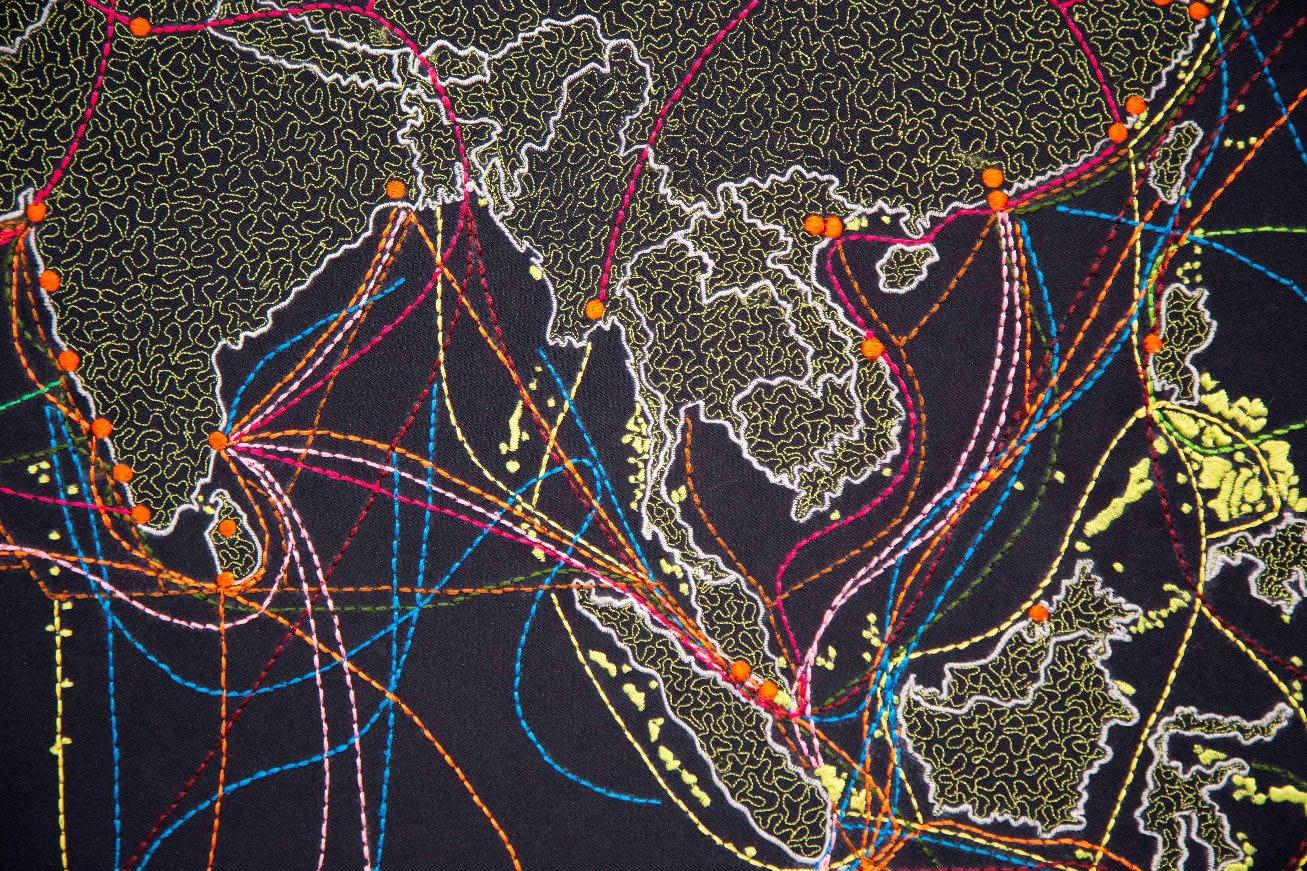
Key Work: GlobalSpiceTrade:RoutesfromAncientTimestotheAgeofExploration/Exploitation(2025)
o This work uses intricate hand embroidery to trace historic spice trade routes, bringing attention to the movement of people and goods across borders, and highlighting the experiences of refugees and displaced peoples.
Discussion Points:
o “How do the maps in Chung’s work redefine our understanding of global trade?”
o “What does the act of stitching add to the storytelling of migration?”
o “How can embroidery be used to challenge traditional historical narratives?”
Tiffany Chung, GlobalSpiceTrade:RoutefromAncientTimestotheAge ofExploration/Exploitation, 2025, embroidery on fabric, courtesy the artist
trade.
Did you use this guide in your classroom? If so, tag SVMoA on social media (@sunvalleymuseum) or email us at education@svmoa.org
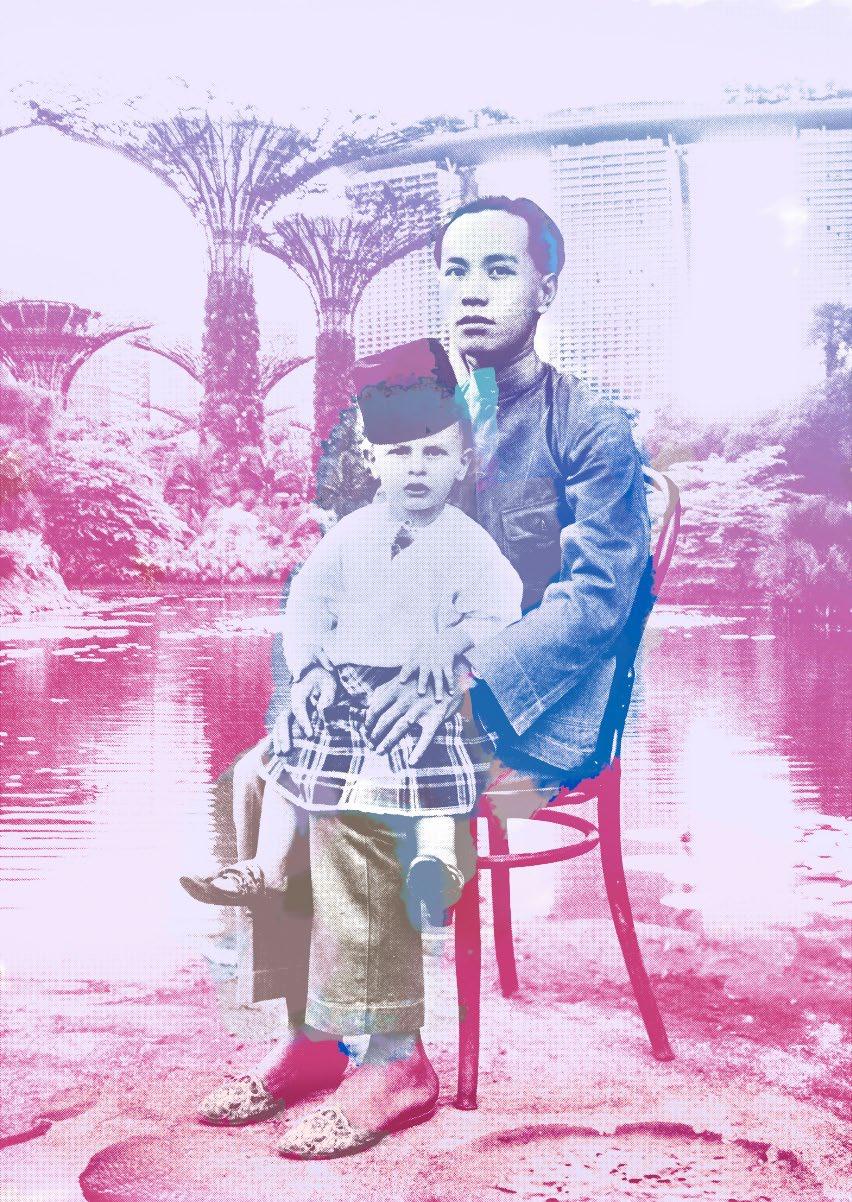
Tristan Cai, MayAllWindsFavorOurShips#6, 2019, archival giclée on Baryta paper, courtesy the artist.
Focus: Forced migration and resistance.
Key Work: MayAllWindsFavorOurShips#6,(2019)
o Cai’s archival giclée prints reframe colonial documentation to expose the exploitative structures underpinning migration and domestic labor in the British Empire. These images prompt viewers to reflect on the intersections of memory, power, and historical erasure.
Discussion Points:
o “What is the significance of reframing historical images? How does it shift our understanding of migration?”
o “How does the idea of resistance challenge the traditional narratives of labor and servitude?”
o “In what ways does visual art contribute to the preservation and reinterpretation of forgotten suppressed histories?”
Tristan Cai
Sandy Rodriguez
Did you use this guide in your classroom? If so, tag SVMoA on social media (@sunvalleymuseum) or email us at education@svmoa.org
Focus: Colonialism, mapping, and cycles of violence.
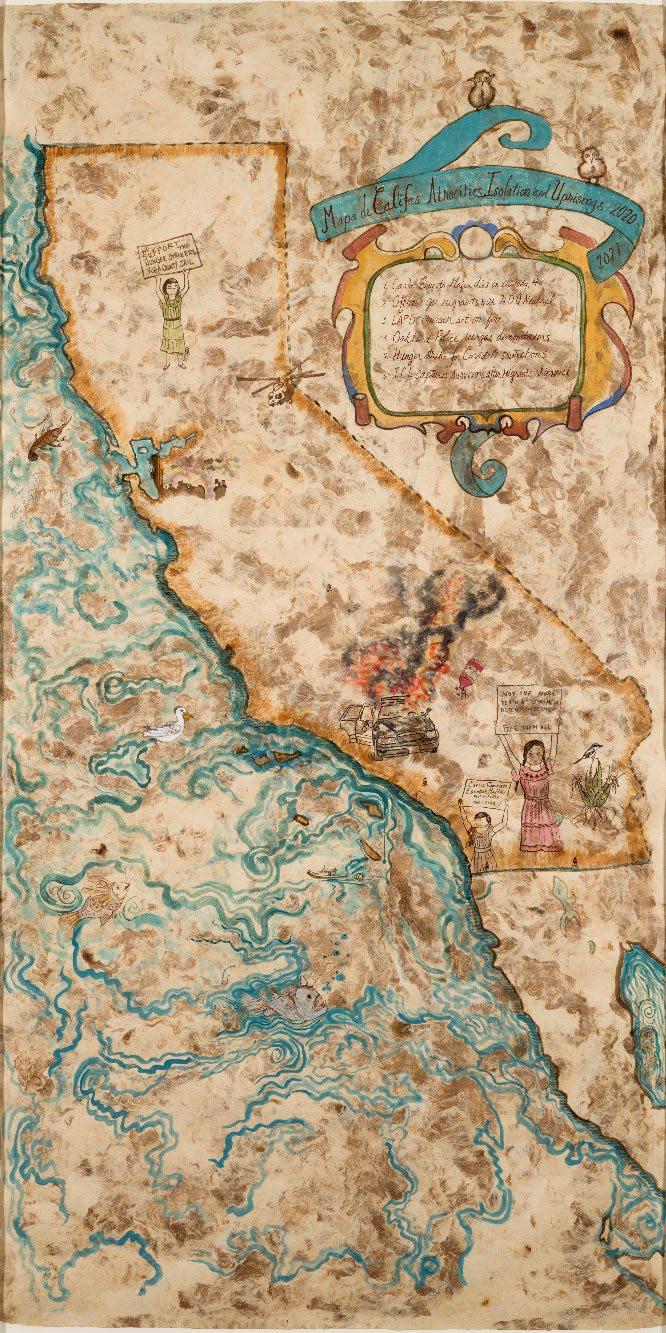
Key Work: MapofCalifas:Atrocities,Isolation,andUprisings(2020)
o Rodriguez’s watercolor map connects the history of California’s violence and unrest to the broader context of migration, highlighting the impact of colonization on Native communities.
Discussion Points:
o “How does the map function as both a historical document and an artwork?”
o “What emotions do you experience when you view these maps?”
o “What role does land play in the histories of colonization and migration?”
Sandy Rodriguez, MapofCalifas:Atrocities,Isolation,andUprisings,2020, hand processed watercolor on amate, courtesy the artist
Did you use this guide in your classroom? If so, tag SVMoA on social media (@sunvalleymuseum) or email us at education@svmoa.org
Focus: Indigenous history and mapping.
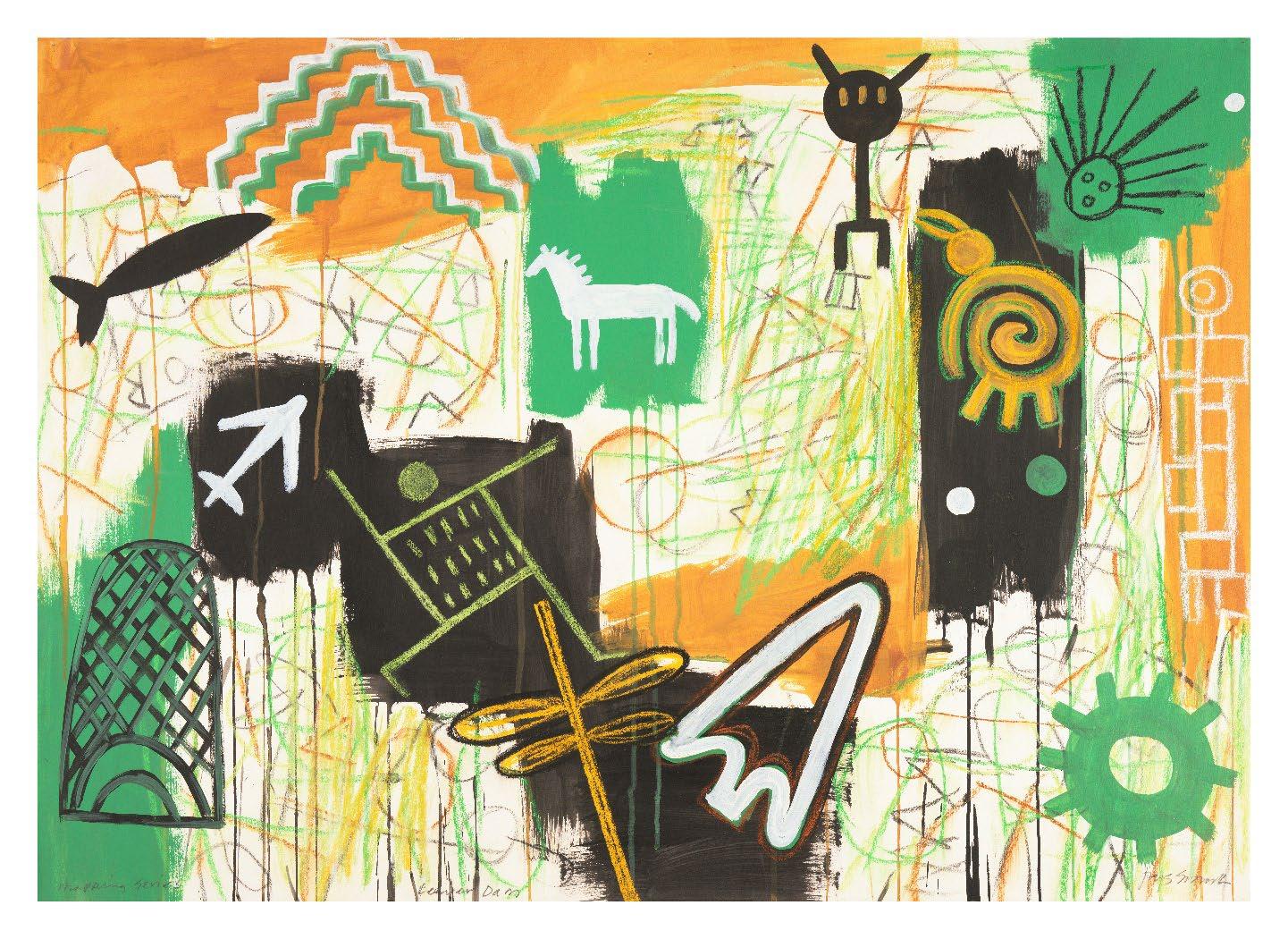
Key Work: Mapping:BeaverDam(1988)
o Smith’s work uses indigenous symbols and abstract forms to map Native North American experiences, representing the deep connection between land and culture.
Discussion Points:
o “How do the symbols in Smith’s work offer a different perspective on maps and geography?”
o “What can we learn from indigenous ways of knowing and mapping the land?”
o “What is the significance of using abstraction to represent migration and displacement?”
Jaune Quick-to -See Smith
Jaune Quick-to-See Smith, Mapping:BeaverDam, 1988, acrylic and pastel on paper, courtesy the artist and Garth Greenan Gallery, New York.
Kevin Umaña
Did you use this guide in your classroom? If so, tag SVMoA on social media (@sunvalleymuseum) or email us at education@svmoa.org
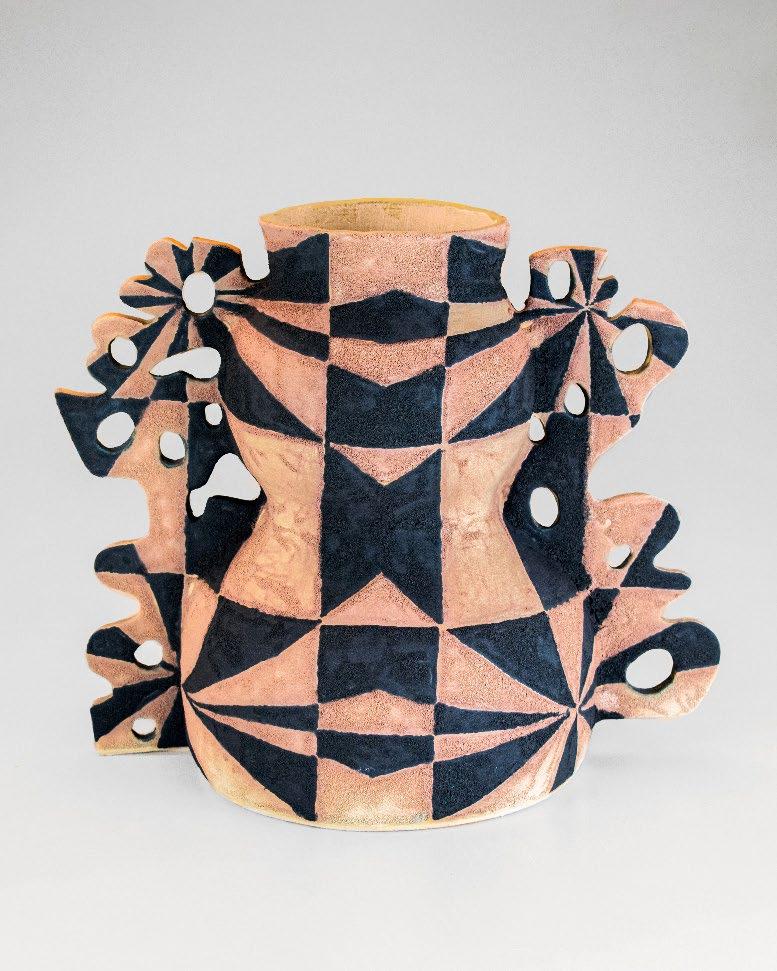
Kevin Umaña, SourceofDirectionThroughtheLuminousBlack,2023, glaze on stoneware, courtesy the artist and Sperone Westwater
Focus: Personal history, abstraction, and Mesoamerican influences.
Key Work: SourceofDirectionThroughtheLuminousBlack(2023)
o Umaña’s glazed stoneware sculptures combine geometric abstraction with themes of migration, drawing from his family’s history and cultural roots in El Salvador.
Discussion Points:
o “What role do personal histories play in art about migration?”
o “How do Umaña’s sculptures bridge the gap between personal and collective histories?”
o “In what ways do geometric forms convey meaning and cultural identity?”
Did you use this guide in your classroom? If so, tag SVMoA on social media (@sunvalleymuseum) or email us at education@svmoa.org
Focus: Cultural intersections and migration.
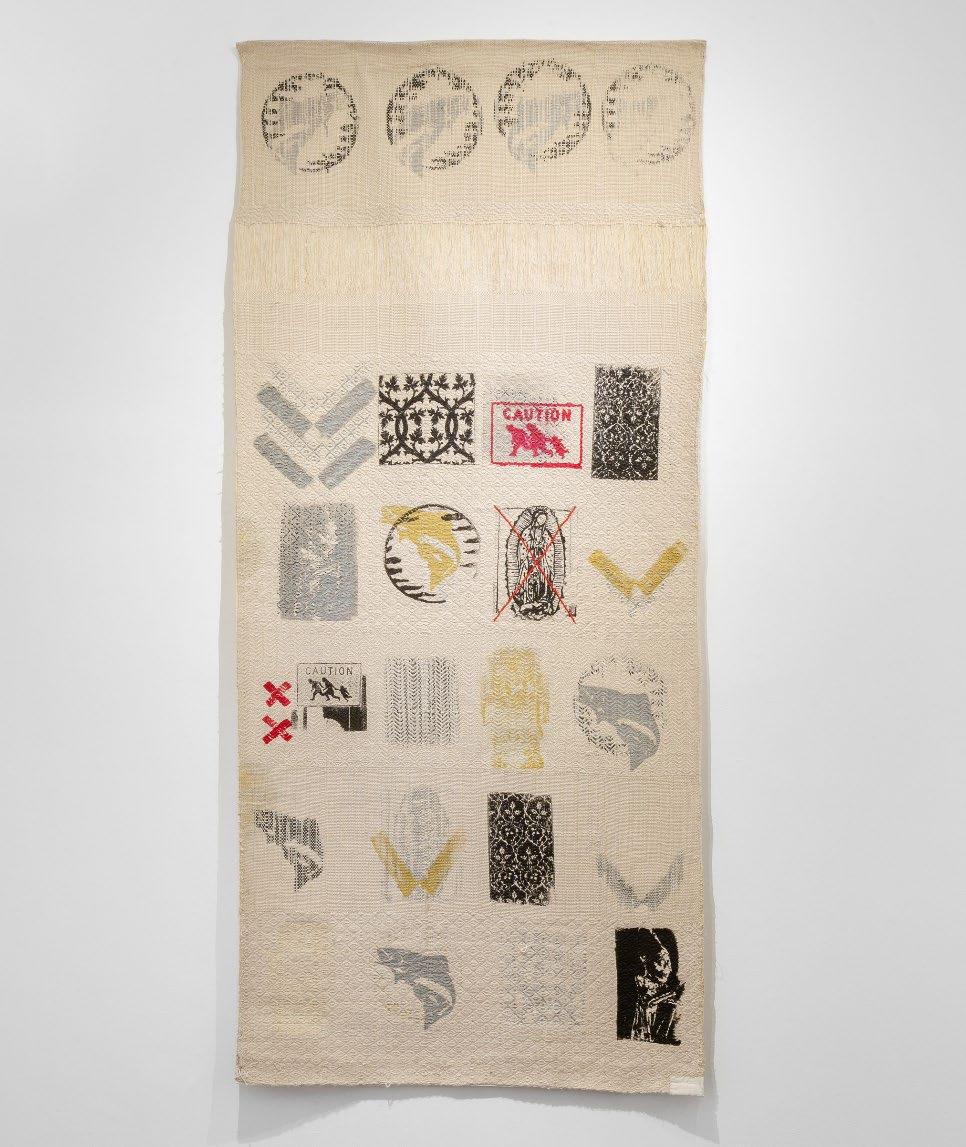
Key Work: SacredJump(1994)
o Underwood’s woven artworks engage with themes of the U.S./Mexico border, using textile to reflect on the emotional and physical landscapes of migration.
Discussion Points:
o “How does weaving serve as a metaphor for migration and cultural connection?”
o “What symbols in Underwood’s work speak to the complexity of life along the U.S./Mexico border?”
o “How can art shape our understanding of complex socio -political issues?”
Consuelo Jimenez Underwood
Consuelo Jimenez Underwood, SacredJump,1994, woven pattern weaves and exposed warp; silkscreened, embroidered; silk threads, courtesy the artist and Ruiz-Healy Art
Link to Matterport Link to Photo Gallery
Did you use this guide in your classroom? If so, tag SVMoA on social media (@sunvalleymuseum) or email us at education@svmoa.org
If participating in a Student Exhibition Tour or Classroom Connections, students will re-visit and discuss these works as well as others during the SVMoA tour/visit and project. They will also create their own visual and/or written work that reflects the ideas explored by artists in the exhibition.
Uncharted:ArtistsasWayfinders
Before Your Visit
Prepare participants to think critically about migration, identity, and the significance of place.
General Questions:
•“What does migration mean to you personally or culturally?”
•“Can you think of any stories or experiences that highlight the importance of maps or directions?”
•“How do you define home? How might that definition change if you were displaced?”
Artist-Specific Prompts:
•Tiffany Chung: “What stories do you think are often left out of history? How can maps reveal those stories?”
•Tristan Cai: “What does resistance mean in the context of migration?”
•Sandy Rodriguez: “How does land tie into migration stories, especially for indigenous communities?”
•Jaune Quick-to-See Smith: “How can art help us understand the connection between land and identity?”
•Kevin Umaña: “What personal histories are important in understanding migration?”
•Consuelo Jimenez Underwood:
“How does the symbolism in weaving help tell migration stories?”
During Your Visit
Encourage active engagement through close-looking strategies and group discussions.
Close-Looking Strategies:
Observation Pairs: Pair students and have one person observe the work for 30 seconds, then describe it to the other person, who adds their own observations.
Think, Feel, Wonder:
Think: What do you notice? Feel: How does this work make you feel?
Wonder: What questions does it raise for you?
Artist-Specific Prompts:
Tiffany Chung: “What elements of Chung’s maps make the histories of migration stand out?”
Tristan Cai: “How does Cai’s manipulation of historical images change your perception of labor and migration?”
Sandy Rodriguez: “What can you learn from the way Rodriguez combines history and geography in her work?”
Jaune Quick-to-See Smith: “How do the abstract symbols in Smith’s work challenge traditional maps?”
Kevin Umaña: “What story do Umaña’s sculptures tell about cultural identity and migration?”
Consuelo Jimenez Underwood: “What emotions are evoked through the use of textiles and weaving?”
After Your Visit
Encourage students to reflect on their experience and how it has deepened their understanding of migration, mapping, and cultural identity.
Reflection Questions:
• “Which artist’s work spoke to you most? Why?”
• “How did this exhibition challenge or expand your understanding of migration?”
• “How do the themes of memory and identity appear across the different artists’ works?”
Related
Activities
Did you use this guide in your classroom? If so, tag SVMoA on social media (@sunvalleymuseum) or email us at education@svmoa.org
Engaging in creative activities after exploring SVMoA exhibitions can reinforce learning and stimulate ideas. SVMoA encourages educators to adapt any of the following activities to their classrooms:
Mapping Our Journeys (Inspired by Tiffany Chung)
• Objective: Create a map of your own personal journey or migration story, considering significant places or events.
• Prompt: “What does your map of migration look like? How do you represent the places that are important to you?”
Resistance Collage (Inspired by Tristan Cai)
• Objective: Create a collage using historical images or symbols that represent acts of resistance or survival.
• Prompt: “How can art tell the story of resistance in the face of displacement?”
Cultural Identity Sculpture (Inspired by Kevin Umaña)
• Objective: Design a sculpture using geometric forms that reflect your cultural background or experiences with migration.
• Prompt: “How can abstraction represent your journey or cultural identity?”
Through these activities and reflections, Uncharted:ArtistsasWayfinders encourages participants to explore the personal and collective nature of migration, using art as a lens to navigate the complexities of identity, history, and cultural exchange.
Did you use this guide in your classroom? If so, tag SVMoA on social media (@sunvalleymuseum) or email us at education@svmoa.org
Educator Guide to Idaho Content Standards Uncharted:ArtistsasWayfinders
The following Idaho standards align with the themes, activities, and engagement strategies in Uncharted:Artistsas Wayfindersexhibition. These standards are designed to foster critical thinking, creative expression, and cultural understanding across multiple disciplines, including Visual Arts, Science, Social Studies, and English Language Arts (ELA). The exhibition explores the intersection of art, science, geography, and the concept of uncharted territories both physical and conceptual.
Idaho Content Standards for Visual Arts Grades K -5
• K- 2.VA.1.1 Use observation and investigation in preparation for making a work of art. Students will apply critiques of their own works, drawing on concepts from the Unchartedexhibition, exploring how revisions can strengthen their artistic representation of themes like exploration, geography, and discovery.
• K- 2.VA.4.2 Interpret art by identifying subject matter and describing relevant details. Students will interpret and describe artworks depicting uncharted lands, maps, and journeys, helping them understand the symbolic significance of exploration and discovery, whether physical or intellectual.
• 3- 5.VA.5.1 Identify how art is used to inform or change beliefs, values, or behaviors of an individual or society. The exhibition invites students to consider how artists use maps, representations of unexplored territories, and creative visual techniques to communicate ideas about adventure, identity, and the unknown, potentially changing viewers' perceptions of the wo rld.
Idaho Content Standards for Visual Arts Grades 6-12
• 6-8.VA.1.1 Utilize the creative process to design a work of art. Inspired by the Unchartedexhibition, students can create their own visual representations of exploration whether through traditional or digital mediums capturing their own ideas of the unknown and the concept of discovery.
• 6-8.VA.4.1 Analyze and/or interpret works of art, and/or how art influences viewers. Students will analyze how artists in the exhibition use different media, styles, and themes to convey the idea of uncharted territories whether physical (geographical) or intellectual (scientific, cultural, personal). They can also discuss how art challenges perceptions of the unknown.
• 9-12.VA.1.1 Develop skills with various materials, methods, and approaches in creating works of art or design. This standard encourages high school students to experiment with diverse artistic materials and techniques, potentially inspired by the approaches observed in the exhibition.
• 9-12.VA.2.2 Through experimentation and practice of techniques, make multiple works of art that explore a meaningful theme, idea, or concept. Students can explore the themes of exploration and the unknown by creating a series of artworks that reflect their personal interpretation of uncharted territories. This can include mapping, abstraction, or visual storytelling.
• 9-12.VA.2.3 Apply relevant criteria to examine, reflect on, and plan revisions for works of art and design in progress. Students will apply critiques of their own works, drawing on concepts from the Unchartedexhibition, exploring how revisions can strengthen their artistic representation of themes like exploration, geography, and discovery.
Did you use this guide in your classroom? If so, tag SVMoA on social media (@sunvalleymuseum) or email us at education@svmoa.org
Idaho Content Standards for Social Studies Grades K-5
• K.SS.5.1 Name traditions that came to the United States from other parts of the world. The exhibition’s exploration of mapping and discovery connects to this standard by prompting discussions about global exploration and the cultural exchanges that shaped the United States. It may also lead to explorations of how explorers brought new traditions , knowledge, and mapping techniques to different regions.
• 2.SS.2.2 Compare how environmental conditions affect living styles and clothing in different parts of the country. Students can examine how explorers’ experiences in uncharted regions influenced their survival strategies, clothing choices, and tools. This standard connects to the ways exploration and uncharted territories have impacted human societies and lifestyles.
• 3.SS.1.4 Describe how migration and immigration are continuous processes and how they are influenced by voluntary and involuntary movement of people. This standard connects with the exhibition’s exploration of geographic discovery, migration, and the reasons people venture into uncharted lands whether driven by curiosity, necessity, or exploration.
• 4.SS.5.1 Analyze the roles and relationships of diverse groups of people from various parts of the world who have impacted the state's history and contributed to Idaho's cultural heritage. Students can explore how the idea of uncharted territories ties into the history of exploration in the United States, particularly focusing on how maps and discoveries influenced Idaho’s development.
Idaho Content Standards for Social Studies Grades 6-12
• 6-12.GEO.1.1 Explain the spatial patterns of Earth’s physical and human systems. This standard connects directly to the Unchartedexhibition, as it explores the spatial patterns of geographical discovery. Students can analyze how maps, exploration, and the representation of geographic locations have changed over time and influenced the world.
• 9-12.US2.1 Evaluate the effects of exploration on Native American communities and how their culture, identity, and land were impacted. Students can engage in discussions around the impacts of early exploration on indigenous cultures, exploring how new mappings and exploration affected both the land and the cultural heritage of Native American groups, particularly in the context of Idaho's history.
• 9-12.US2.44 Evaluate how the rise of alternative media, social media, and technology have affected United States culture, society, and politics. Students will examine how exploration and mapping have evolved with new media like satellite imagery and GIS technology and how modern interpretations of exploration can be seen in the rise of digital maps, social media, and other technologies.
Idaho Content Standards for English Language Arts (ELA) Grades K-5
• K.RL.5 With support, use evidence from literature read aloud to demonstrate understanding of grade- level texts. Students can use the artwork in the Unchartedexhibition as a stimulus for reading related texts, discussing how explorations are depicted in literature, and connecting those themes to visual representations in the gallery.
• 2.RL.7 Use information gained from illustrations and the words in a print or digital text to demonstrate understanding of its characters, setting or plot. Students will analyze how visual elements from the Unchartedexhibition enhance their understanding of narrative settings and the idea of uncharted spaces in both fiction and nonfiction works.
• 3.RL.9 Compare and contrast the themes, settings, and plots of stories written by the same author about the same or similar characters. This standard connects with exploring different artistic portrayals of exploration, comparing how various artists or writers handle similar themes of adventure, the unknown, and mapping.
Did you use this guide in your classroom? If so, tag SVMoA on social media (@sunvalleymuseum) or email us at education@svmoa.org
• 5.RL.9 Compare and contrast stories in the same genre on their approaches to similar themes. Students can compare different artistic interpretations of exploration and the unknown, reflecting on how artists and writers tackle these themes in their work whether through abstract or realistic representations.
Idaho Content Standards for English Language Arts (ELA) Grades 6-12
• 6.RL.7 Trace and evaluate the argument and specific claims in a text, distinguishing claims that are supported by reasons and evidence from claims that are not. Students will analyze the curatorial statements and artist commentary in the Unchartedexhibition, evaluating how the themes of exploration, mapping, and discovery are supported by visual evidence.
• 8.RL.9 Analyze how a modern work of fiction draws on themes, patterns of events, or character types from myths, traditional stories, or religious works from different cultures, including describing how the material is rendered new. Students can explore how the concept of exploration and the unknown is rooted in mythological and cultural traditions, and how modern artists and authors reinterpret those traditional themes.
Idaho Content Standards for Science Grades K-5
• K- ESS - 1.1 Use and share observations of local weather conditions to describe variations in patterns throughout the year. This standard can be linked to the exploration of uncharted territories, especially in extreme or remote environments, encouraging students to discuss how weather patterns affect travel, exploration, and settlement.
• 3- ESS - 2.1 Make a claim about the merit of a design solution that reduces the impacts of a weather- related hazard. Students can examine historical and modern examples of how explorers faced natural hazards in uncharted territories and how these challenges have been addressed through technology, preparation, and design.
Idaho Content Standards for Science Grades 6-12
• MS-ESS-2.5 Construct an argument supported by evidence that changes to physical or biological components of an ecosystem affect populations. Students can research how exploration and uncharted territories have impacted ecosystems, from the introduction of new species to the degradation of untouched environments due to human activity
• HS-ESS-3.5 Analyze geoscience data and the results from global climate models to make an evidence-based forecast of the current trends in global or regional climate change. The concept of "uncharted" can be extended to current climate change and environmental degradation, allowing students to explore how new data and mapping technologies are used to understand and predict global climate trends.
Did you use this guide in your classroom? If so, tag SVMoA on social media (@sunvalleymuseum) or email us at education@svmoa.org
Online Resource for Exploring Art, Images, and Objects
Project Zero Thinking Routines Toolbox
Link to Exploring Art, Images, and Objects
This resource provides various thinking routines to engage students in deep observation and critical thinking about art. It helps students interpret, question, and connect with the artworks in the Uncharted exhibition.
1. Looking Ten Times Two
Purpose: Encourages detailed observation and helps students practice noticing multiple aspects of an image, promoting careful and deliberate engagement with art.
Steps:
• Look at the image for 30 seconds, letting your eyes wander.
• List 10 words or phrases about any aspect of the image.
• Repeat the process, adding 10 more words or phrases. Focus the second round of observation on specific features (e.g., colors, shapes, or lines).
Skills Developed:
• Observation: Students practice noticing fine details.
• Interpretation: The variety of words and phrases helps students interpret what they see from different perspectives.
• Questioning: Encourages curiosity as students ask themselves about specific aspects to focus on (e.g., why are certain elements prominent?).
2. Think, Feel, Care
Purpose: This routine is aimed at understanding the emotional and personal context of the artwork, fostering empathy and deeper engagement with the content.
Steps:
• Think: Ask students, "If you were this person (in the artwork), what would you think?"
• Feel: Ask, "How would you feel? Why would you feel this way?"
• Care: Ask, "What would be important to you? What would you care about?"
Skills Developed:
• Observation: Students focus on interpreting the emotions conveyed by the artwork and its subject matter.
• Interpretation: Students interpret emotional and personal aspects of the artwork.
• Questioning: Encourages questioning of the subject’s mindset, values, and motivations.
3. Find, Capture, Explain, Wonder
Did you use this guide in your classroom? If so, tag SVMoA on social media (@sunvalleymuseum) or email us at education@svmoa.org
Purpose: Promotes deep reflection and inquiry by guiding students through a step-by-step process of identifying, creating, explaining, and reflecting on the artwork.
Steps:
• FIND: Ask, "How would you describe this artwork in a word or phrase?"
• CAPTURE: Students make a drawing of the artwork, paying attention to detail.
• EXPLAIN: Ask students to explain how the artwork is complex considering the multiple elements or ideas involved.
• WONDER: Encourage students to ask new questions about the artwork and explore areas they find intriguing.
Skills Developed:
• Observation: Through drawing, students practice observing the artwork closely.
• Interpretation: Encourages reflection on the complexity of the artwork.
• Questioning: Fosters curiosity and deeper exploration, prompting students to generate their own questions.
ThisTeacherGuidewaspreparedand writtenbyDianneSánchezShumway, April10, 2025.