ISSUE 2
CARTON CLUB
FALL 2026
FORMATIVE YEARS
2
Carton Club is the result of a collaboration between Visual Arts Press and the campus archives. Each issue includes a curated selection of materials available in the SVA Archives or the Milton Glaser Design Study Center and Archives. Many of these materials are likely stored in the boxes, or “cartons,” that give this publication its name. Featured objects are chosen for their historical significance, their weirdness, their silliness, or just because we wanted to know how many pictures of cats are filed away.
CARTON CLUB - ISSUE 2
3
Dear Reader, You have been cordially invited to “Formative Years,” an art exhibition at the School of Visual Arts. The 1975 show contained some of the biggest names in 20th-century American art, but, rather than showcase the works these artists are still known for today, Guest Director Gregoire Muller chose to highlight their earliest works. For many of these artists, it would be difficult to guess where their careers ended up taking them based on these first attempts. To show an exhibition with such big names--Ellsworth Kelly, Helen Frankenthaler, Lee Krasner--was a massive undertaking for the small art school gallery. Yet all we have of this exhibition are letters, loan forms, and faded Polaroids. If photographs of the show, its opening, or anyone attending were taken, they have since been lost. Our aim for this issue of Carton Club is a unique one: to learn some facet of art history through ephemera, correspondence, and bureaucratic paperwork and to reveal a show that can no longer be seen. There exist parallels between this goal and the theme of the show--an exhibition of works that are no longer how we view these artists. To make visible what cannot be seen is a paradox appropriate to the visionary quality of the artistic process. Sincerely, The Visual Arts Press and SVA Archives
4
CARTON CLUB - ISSUE 2
THE PITCH LETTER
In hopes of getting artwork for the show, SVA staff explain the significance of “Formative Years” in their letters asking artists to consider participating: “As the Visual Arts Museum is located within the School of Visual Arts in New York, the pedagogic purpose of this type of exhibition cannot be over emphasized. We are hoping to make the show a learning experience of very personal applicability to, perhaps, some of the best and most responsive art students in the city. The broader excitement and interest such an exhibition carries has been considered as well. It should create a special opportunity for the art-minded public to extend its perception of the growth involved in the art process as it is worked through over the years by individual artists.”
5
Visual Arts Museum
LOCATED AT 209 EAST 23RD STREET, FIRST FLOOR NOW KNOWN AS THE GRAMERCY GALLERY
6
CARTON CLUB - ISSUE 2
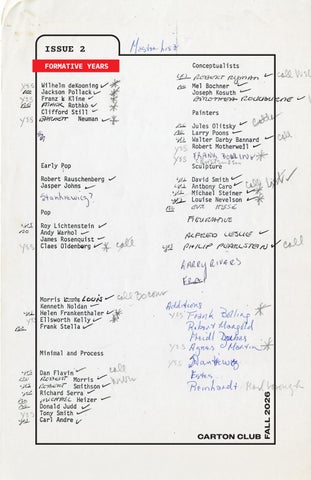
Carl Andre
Wayne Thiebaud Frank Bowling Anthony Caro Frank Stella
Helen Frankenthaler Arshile Gorky Willem de Kooning Jasper Johns Roy Lichtenstein
ARTISTS
Mark Rothko
David Smith Agnes Martin Forrest Myers Louise Nevelson Kenneth Noland Philip Pearlstein *Did Richard Serra participate? WE’RE ULTIMATELY NOT CERTAIN SERRA PARTICIPATED DUE TO THE LACK OF A LOAN AGREEMENT IN THE EXHIBITION FILE.
Larry Rivers Ellsworth Kelly
RICHARD SERRA (B. 1938; D. 2024) WAS AN AMERICAN ARTIST KNOWN FOR HIS ABSTRACT SCULPTURES. MANY OF HIS MOST ICONIC WORKS WERE CRAFTED FROM WEATHERING STEEL, APPEARING LIKE GIANT, RUSTING CHOCOLATE SHAVINGS. THESE LARGE-SCALE PIECES INVITE VIEWERS INTO THEIR SWIRLS OR BETWEEN THEIR PLATES, WHERE SHADOW AND LIGHT BECOME AS IMPORTANT AS METAL AND WHERE ONE’S SENSE OF GRAVITY DISTORTS.
7
Jackson Pollock Walter Darby Bannard
Robert Rauschenberg Richard Diebenkorn Robert Smithson Jules Olitski
Franz Kline Lee Krasner
ON VIEW
Alfred Leslie
Morris Louis Robert Mangold Robert Motherwell Michael Steiner
Ad Reinhardt Barnett Newman Richard Serra* Claes Oldenburg Richard Stankiewicz Richard Estes ON A TORN YELLOW SHEET OF PAPER IN RESPONSE TO A REQUEST FROM THE VISUAL ARTS MUSEUM, RICHARD SERRA SCRAWLED IN A LARGE AND GIDDY MIX OF PRINT AND CURSIVE. HIS SIGNATURE, FLIPPING TO THE SIDE, BENDS LIKE ONE OF HIS STEEL SCULPTURES:
ROBERT MOTHERWELL LATER RETURNED TO SVA TO GIVE A TALK. Monday, March 28, 1977, 1:00 – 2:30pm Location: Amphitheater Moderated by April Kingsley Hosted by SVA Fine Arts Department
10
CARTON CLUB - ISSUE 2
REJECTION
From reading through the ephemera and correspondence related to “Formative Years,” one gleans that planning a gallery show is as much an exercise in taking rejection as is trying to build a career as an artist.
Heide M. ColsmanFreyberger CURATOR PERSONAL ASSISTANT TO ROBERT MOTHERWELL THE SVA ORGANIZERS EVENTUALLY BORROWED A MOTHERWELL FROM MOMA.
“Unfortunately it turned out that there is nothing appropriate at hand that could be expected to fit in with your exhibition as it is planned. We will therefore have to refer you to
Charles W. Miller CHIEF CURATOR AT THE HIRSHHORN MUSEUM AND SCULPTURE GARDEN SMITHSONIAN INSTITUTION* PHOTOGRAPHER AND FILMMAKER RUDY BURKHARDT LOANED A WORK BY DE KOONING.
public collections.”
“Unfortunately, we have only two early paintings by de Kooning and both are unlendable. They are very important for our galleries and will both be used in the re-installation we intend for October.”
*NATIONAL CONTEMPORARY MUSEUM WITH A DISTINCTIVE CIRCULAR ARCHITECTURE
11
Dan Flavin (b. 1933; d. 1996)
“...my ‘very early’ material is mostly graphic and mainly uninteresting to me.
AMERICAN INSTALLATION ARTIST KNOWN FOR HIS USE OF FLUORESCENT LAMPS WRITING IN DRAMATIC CURSIVE PUNCTUATED BY ELONGATED LETTERS THAT LOOP AND SHRIEK.
“Otherwise, I’m committed to an extensive retrospective graphic review to open in the Basel Kunstmuseum during next March Ninth (to travel thereafter through mid-1976).
This exposition will have to contain the best of that earliest matter which has survived somehow. If I can find something for your mutual exposition,
Mel Bochner (b. 1940; d. 2025 AMERICAN CONCEPTUAL ARTIST WHO TAUGHT ART HISTORY AT SVA IN THE 1960S BOCHNER ORGANIZED “WORKING DRAWINGS AND OTHER VISIBLE THINGS ON PAPER NOT NECESSARILY MEANT TO BE VIEWED AS ART” AT SVA UNDER THE GALLERY DIRECTORSHIP OF SHIRLEY GLASER IN 1966. THIS LANDMARK SHOW IS CONSIDERED TO BE AMONG THE FIRST EXHIBITIONS OF CONCEPTUAL ART.
I’ll inform you accordingly.”
“Thanks for the invitation, but I will be unable to be in the exhibition. This is for a number of reasons but mainly because I am not exhibiting in group exhibitions, with very rare exceptions, as a matter of policy.
Also, I view all my work as ‘early’ work.”
12
PERSEVERANCE
The museum coordinators (Pamela Manser, Tannis Hugill, and Jeanie Blake) strategize, try different avenues for attaining art for the show, and follow up with potential leads.
CARTON CLUB - ISSUE 2
13
Who Was Leo Castelli?
LEO CASTELLI (B. 1907; D. 1999) WAS AN ITALIAN-AMERICAN ART DEALER WHO FOUNDED THE LEO CASTELLI GALLERY IN NEW YORK CITY IN 1957. THE GALLERY BECAME FAMOUS FOR SHAPING THE POST-WAR ART SCENE, WITH SPECIALTIES IN POP ART, CONCEPTUAL ART, AND MINIMALISM.
14
CARTON CLUB - ISSUE 2
SUCCESS Read All About It in The New York Times EXCERPTED FROM JOHN RUSSELL’S NOVEMBER 1975 REVIEW IN THE NEW YORK TIMES.
“The Visual Arts Gallery does more with almost nothing than many a well-budgeted museum. In the context of a school buzzing with life, it puts on just the kind of show young people need to quarrel about; in this case, a survey of the formative years of artists who ended up looking quite different. Visitors will find, for instance, a painting of a locomotive (1942) by Franz Kline1, a farm landscape (1933) by Jackson Pollock2, an expressionistic female nude (1955) by Anthony Caro3 and a mother and child (1938) by Mark Rothko4, together with early works by Roy Lichtenstein, Lee Krasner, Jules Olitski and others. There’s no catalogue, and the installation is minimal, but there’s a sense of history being made to work. Watch the hours, though: Monday through Thursday, 12 to 9; Friday 11 to 4:30; Saturday and Sunday closed.”
1 FRANZ KLINE (B. 1910; D. 1962), KNOWN FOR ABSTRACT EXPRESSIONISM (GESTURAL, NONFIGURATIVE, GEOMETRIC STREAKS), NOT FIGURATIVE TRAINS—THOUGH HE DID DO ABSTRACT LOCOMOTIVE PAINTINGS. 2 JACKSON POLLOCK (B. 1912; D. 1956), KNOWN FOR GESTURAL ABSTRACT EXPRESSIONIST SPLATTER PAINTINGS, NOT IDYLLIC COUNTRYSIDE LANDSCAPES. 3 ANTHONY CARO (B. 1924; D. 2013), KNOWN FOR METAL ABSTRACT ASSEMBLAGE SCULPTURES MADE FROM FOUND INDUSTRIAL PARTS, NOT FEMALE NUDES. 4 MARK ROTHKO (B. 1903; D. 1970), KNOWN FOR COLOR-FIELD PAINTINGS (THEY ARE WHAT THEY SOUND LIKE!), NOT FIGURATIVE FAMILIAL PORTRAITS.
15
Thank you for your attention and patience. you enjoyed the show.
We hope
Sincerely, Visual Arts Press and SVA Archives Carton Club is a collaboration between Visual Arts Press and the SVA Archives.
WRITTEN AND EDITED BY LAURA VALENZA DESIGNED BY ELEANOR LEUNG AND BRIAN E. SMITH VISUAL ARTS PRESS IN COLLABORATION WITH: BETH KLEBER, HEAD ARCHIVIST LAWRENCE GIFFIN, ARCHIVIST SVA ARCHIVES SPECIAL THANKS TO: JENNIFER LIANG, ASSISTANT DIRECTOR, VISUAL ARTS PRESS
SCAN HERE TO EXPLORE THE ARCHIVES