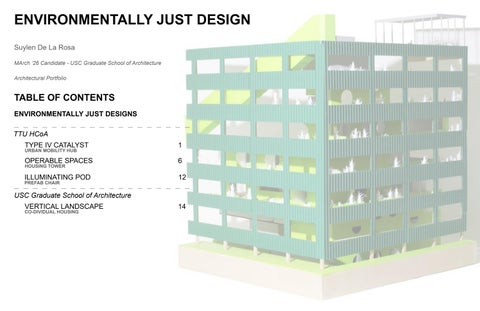
ENVIRONMENTALLY JUST DESIGN
Suylen De La Rosa
MArch ‘26 Candidate - USC Graduate School of Architecture
Architectural Portfolio
TABLE OF CONTENTS
ENVIRONMENTALLY JUST DESIGNS
TTU HCoA
TYPE IV CATALYST
USC Graduate School of Architecture
VERTICAL LANDSCAPE
RECYCLED LOW CARBON STRUCTURES
URBAN MOBILITY HUB
TERM: FALL 2022
PROJECT TYPE: ACADEMIC (INDIVIDUAL)
INSTRUCTOR: ALEXANDRA CORTEZ & PAULINA LAGOS
INSTITUTION: TEXAS TECH COLLEGE OF ARCHITECTURE- EL PASO
ARCHITECTURAL DESIGN V
Located in downtown El Paso, Texas. The hub seeks to act as a catalyst for environmentally resilient architecture to try and reduce El Paso’s massive carbon footprint. Using GLULAM and CLT wood joinery structure modeled after Shigeru Ban’s wood studies, the mobility hub makes an attempt to supply cleaner urban transit for both El Pasoans and migrant workers from our sister city, Ciudad Juarez.
1 STRUCTURE ON SITE
KEY MODES OF TRANSPORTATION NEAR DOWNTOWN AND USA-MEX BORDER
BUS ROUTES
SUN METRO BUS RAPID TRANSIT
BIKE ROUTES
US/MX BORDER
EL PASO DOWNTOWN DISTRICT
GIS mapping displays the possibility for a new urban transit system typological building in El Paso, Texas.
STRUCTURAL CONNECTIONS: JAPANESE WOOD JOINERY
Non-rotational geometry studies based on Shiguru Ban precedent. Joinery prevents rotation amongst the structural members, thus providing structural rigidity.
SECTIONAL SITE SEQUENCES
Existing garage serves civilians utilizing car infrastructure. While ground floor serves as connection points for pedestrian and transit users
1. Perimeter Fence, “pool fence” Supporting Climbers
2. Perforated Aluminum Curb w/ Drainage Fabric
3. 2’ Upstand
4. Emergency Overflow
5. Gravel
6. Roof Drain w/ Parapet Well
7. Concrete Pavement
8. Erosion Control (Jute Mesh Blanket)
9. 1’ Growth Medium
10.Filter Fabric
11.Drainage: 4” to 6” Granular (Mat system)
12.Filter Fabric
13.Thermal Insulation
14.Membrane Protection and Root Barrier
15.Green Roof Waterproofing Membrane
16.Japanese Wood Joinery Structure
Roof garden designed to be inhabited as a moment for public infrastructure as well as a necessary infusion of greenery in dowtown El Paso’s baren landscape.
Using the grid as a spatial moment rather than a rigid program divider, the freeplan idea is represented on every floor. PUBLIC ACCESS LEVEL - GROUND FLOOR
1. Entrance Hall
Outdoor Auditorium
BRT Station
Ticket Kiosk
Restrooms
Bus Station
Bike Racks
Bridge To Garage
Available Job Information Station
El Paso / Juarez Transit Info
Janitors Closet
Security
Mechanical Room
Electrical Room
Archive
Office Clusters
Conference Room
Viewing Platform
Outdoor Auditorium Space
Gathering and Seating Areas
OPERABLE SPACES
HOUSING TOWER
TERM: FALL 2023
PROJECT TYPE: ACADEMIC (INDIVIDUAL)
INSTRUCTOR: ERSELA KRIPA
INSTITUTION: TEXAS TECH COLLEGE OF ARCHITECTURE- EL PASO ARCHITECTURAL DESIGN VII
Operable spaces is a proposed communal housing tower located in Medellin, Colombia. The tower situates itself on the border of residential and communal spaces as catalysts for economic growth in an underserved and self-built community. Using such an important export crop like coffee beans, the tower serves both as a living space and export facility for the COMMUNA 13 area and the city of Medellin as a whole.
AGGREGATION SEQUENCE 1
AGGREGATION SEQUENCE 2
SINGLE BED CONNECTIONS
THRESHOLD FRAMING
AGGREGATION SEQUENCE 3
ITERATIONS
PERPENDICULAR THREADING
CANTILEVER GARDENS
CROSS-PERPENDICULAR THRESHOLD
CORNER MOMENT
Iterative design process focused on positional qualities of threshold, gardening spaces, and which walls would be operable.
Threaded enclosure systems provide differing public and private moments for social gathering and communal gardening for economic growth within the tower. Opening and closing operable walls allow for personal control of spatial elements.
OPERATIVE WALL SYSTEM - OPENED
OPERATIVE WALL SYSTEM - CLOSED
COFFEE BEAN EXPORTATION LEVEL
Site plan orientation and podium programs all serve to inform eachother as catalysts for a successful planting economy. 9 PRODUCTION + EXPORTATION PROGRAMS + DOMESTIC SPACES
TYPICAL UNIT FLOORPLAN
EXPORT PREP AREA
To allow for complete interaction within the units, each apartment is allotted space for wet areas and shed walls. Operable walls and drainage areas allow for passive watering to all the crops.
EXPORTATION SEQUENCES
Podium programs are divided by levels with the first level being farmers markets and exportation services, while the second floor is for prep work or pre-exportation area. Greenhouse roof collects rain water and acts as a passive drip irrigation system for coffee beans being grown in the second floor of the podium.
ILLUMINATING POD
PREFAB CHAIR
TERM: FALL 2023
PROJECT TYPE: ACADEMIC (GROUP)
GROUP MEMBERS: SUYLEN DE LA ROSA, VALERIA DUENAS, MELISSA LEXA
INSTRUCTOR: KIMBERLY MCGLONE
INSTITUTION: TEXAS TECH COLLEGE OF ARCHITECTURE- EL PASO ARCHITECTURAL TECHNOLOGY IV - ATMOSPHERES
Using the concept of reusable energy, the seating pod creates self sufficient lighting moments to an infrastructurally lacking park setting in Far East, El Paso. The power of solar not only provides energy to the LED lights, but also to the heated seat placed underneath the pod. As the pod users grow in quantity, so does the surrounding thermal energy, thus allowing the micro-climates to change.
Suylen De la Rosa
Suylen De la Rosa
Valeria Duenas, Melissa Lexa, Suylen De la Rosa
VERTICAL LANDSCAPE
CO-DIVIDUAL HOUSING
TERM: FALL 2024
PROJECT TYPE: ACADEMIC (GROUP)
GROUP MEMBERS: SUYLEN DE LA ROSA & AACHAL KATWA
INSTRUCTOR: HADRIAN PREDOCK
INSTITUTION: UNIVERSITY OF SOUTHERN CALIFORNIA
CORE III STUDIO
Co-living housing tower in East Los Angeles that combines private and communal spaces. Each floor features a garden along the perimeter, creating a green retreat for relaxation and connection with nature. Shared spaces like lounges and kitchens encourage social interaction among residents. The circulation is dynamic, with pathways that vary from floor to floor, offering residents moments of connection, solitude, or creativity as they move through the building. This design strikes a balance between privacy and community, fostering belonging while providing opportunities for personal reflection.
Repetitive Spaces
Clustered Pattern: Each space contains a different type of program.
Centralized Program: Program becoming the center while the garden becomes the surrounding program.
Centralized Pattern: Shared spaces happen within the center and corners.
In the first iteration, I designed the garden intervention at the scale of the unit. This allowed for the garden to be a scaler unit in the larger assembly of the building.
Clustered upon an Entry: Garden as circulation.
Interior Garden Space
PUBLIC ACCESS LEVEL - GROUND FLOOR
1. 3-4 Family Townhouse
2.Foodcourt
3. Daycare
4. Eating Area
5. Workshops
6. Community Garden
7. Main Entrance
8. 5-6 Family Townhouse
9. Below Grade Garden
10. Ramp to Entrance for Townhouses
11. Outdoor Community Garden/Farmers Market
12. Emergency Stairs
The building’s ground level, out of 8 floors, features an inviting public space with amenities such as a daycare, art workshops, a food court, and a public garden for residents and locals to cultivate their own plants. This helps for fostering community interaction. At the rear, a farmers market and additional activities further promote communal engagement and growth.
Suylen De la Rosa
RENDER
Each unit in the co-living tower has direct access to its own garden, which doubles as a circulation space. The gardens are designed to blend seamlessly with the building’s pathways, allowing residents to move freely while tending to their plants. Planters are provided for each individual or unit, enabling residents to cultivate their own plants, vegetables, and herbs. This integration of personal gardening with circulation encourages a sense of ownership and connection to nature. The garden spaces not only serve as a green sanctuary but also promote sustainability and community engagement, as residents share and care for their growing environments.


The physical chunk model uses color to differentiate spaces: neon green highlights the garden circulation between the facade, dark green represents the building’s exterior, and grey indicates the program areas. This color coding clearly distinguishes the various functional zones, enhancing the model’s visual clarity and spatial understanding.
SKIN ASSEMBLY
CORE ACTIVATION
1443 West 37th Drive sdelaros@usc.edu suylendelarosa1@gmail.com
With a heavy emphasis on social equity as it pertains to climate enfornced design, my architectural philosophy as a student expands to encompass a range of different climate mediums. My architecture is fueled by my own expierences with disinvestment and torrential weather patterns.
Master of Architecture / 4.0 GPA
University of Southern California
Texas Tech University College of Architecture - El Paso
El Paso Community College SUYLEN DE LA ROSA OVERVIEW:
EDUCATION: RELEVANT WORK EXPERIENCE:
Bachelor of Science in Architecture / 3.06 GPA
Project for Operative Spatial Technologies (POST)
Research assistant for POST Borders at the Texas Tech Univeristy at El Paso campus where explored topics of spatial, architectural, and environmental injustic in the border region through GIS mapping and data layers. also was apart of a larger team researching and putting together an exhibit on the politics of the built environment in Segundo Barrio in El Paso, Texas.
ACADEMIC AWARDS + DISTINCTIONS:
USC SCHOLARSHIP - 80% SCHOLARSHIP + ADVANCED STANDING (2 YEAR)
COLUMBIA GSAPP | UNIVERSITY OF CALIFORNIA - BERKELEY | PRATT INSTITUTE (ADVANCED STANDING + 50% SCHOLARSHIP)
UNDERGRADUATE
PROVEN EARNERS SCHOLARSHIP
PRESIDENTIAL TRANSFER SCHOLARSHIP
EL PASO ART MUSEUM EXHIBIT (SELECTED WORKS DISPLAYED)
EL PASO ART MUSEUM EXHIBIT (SELECTED WORKS + MODEL DISPLAYED)
DRAWINGS PUBLISHED IN “CROP” AN ARCHITECTURAL JOURNAL FROM TTU
WORK PUBLISHED ON @LINES.DRAWING ON INSTAGRAM
FIRST GENERATION SCHOLARSHIP
HISPANIC HERITAGE SCHOLARSHIP
DEANS LIST
SKILLS
PHOTOGRAPHY | SOCCER | FASHION
HOBBIES COMPUTER AIDED DESIGN FABRICATION LANGUAGE GRADUATE OTHER GRADUATE PROGRAMS ADMITTED INTO