

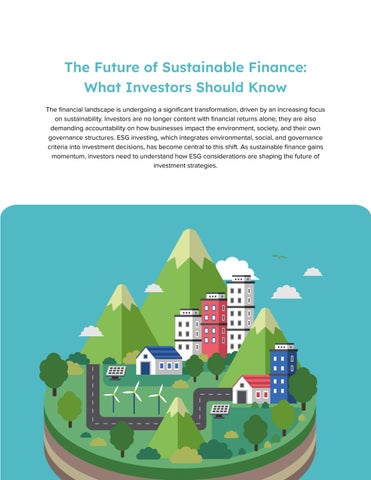
In recent years, ESG investing has moved from niche to mainstream Global investors, from institutional asset managers to retail investors, are aligning their portfolios with companies that prioritize sustainability. ESG funds, once considered a small segment of the market, now command trillions of dollars in assets under management This shift is not merely a trend but a fundamental change in how investment decisions are made
The rising popularity of ESG investing is driven by a confluence of factors. First, the growing awareness of climate risks, corporate ethics, and social justice issues
has influenced how investors perceive risk and opportunity Environmental concerns, such as global warming and resource depletion, are no longer externalities but integral factors affecting a company’s long-term viability Second, regulatory frameworks and governmental policies are increasingly pushing companies to adopt sustainable practices, further cementing ESG as a central criterion in investment analysis. Lastly, investors have recognized that companies with strong ESG profiles often outperform their peers in terms of resilience, innovation, and long-term growth.
Traditional investment approaches have focused primarily on financial returns, with success measured in terms of short-term profitability However, ESG investing reflects a shift toward purpose-driven investment, where long-term value creation is prioritized Investors are beginning to evaluate companies not only based on their profit margins but also on how responsibly they manage their environmental impact, treat their employees and communities, and uphold ethical governance standards
This shift is particularly relevant as younger generations, including millennials and Gen Z, begin to make up a larger portion of the investor base These demographics are
more likely to support companies that demonstrate a commitment to sustainability, ethical labor practices, and corporate transparency As a result, fund managers are adjusting their strategies to meet these expectations, incorporating ESG metrics into their investment frameworks.
In essence, ESG investing represents a broader perspective one that recognizes that a company’s sustainability efforts are key drivers of its long-term financial performance This aligns with growing evidence that companies excelling in ESG performance are better positioned to navigate risks and capitalize on opportunities in an evolving market.

ESG factors provide a new layer of insight into risk assessment. Investors have historically evaluated risks based on financial performance and market conditions, but ESG metrics allow for a more comprehensive understanding of a company’s operational risks. For example, a firm with unsustainable environmental practices might face regulatory fines, reputational damage, or operational disruptions, all of which could negatively impact its stock performance On the social side, companies with poor labor conditions or weak diversity and inclusion policies may struggle to attract talent and could face public backlash. Governance failures, such
as lack of transparency or unethical management practices, can lead to scandals or shareholder disputes
Moreover, ESG investing allows for the identification of "impact opportunities" investments that generate measurable positive outcomes alongside financial returns Renewable energy, for instance, represents both an attractive investment opportunity and a solution to climate challenges. Investors looking to align their portfolios with the transition to a low-carbon economy are increasingly drawn to companies that provide green technologies or sustainable solutions.

Sustainable finance is poised to reshape global markets, and several trends are accelerating this transformation. The first is the proliferation of ESG reporting standards. As regulatory bodies and industry organizations develop more robust ESG frameworks, companies are increasingly required to disclose their sustainability efforts and ESG risks In Europe, the Sustainable Finance Disclosure Regulation (SFDR) mandates that investment funds clearly communicate how they integrate ESG factors Similarly, other regions are adopting or planning their own disclosure regulations, creating a global shift toward transparency.
Another trend is the rise of green bonds and sustainability-linked bonds. These financial instruments enable companies to raise capital for projects that support sustainability goals, such as reducing carbon emissions or developing renewable energy sources. Green bonds, in particular, have grown rapidly in popularity, with issuances exceeding $500 billion in 2021 alone Investors who purchase these bonds are not only supporting environmental initiatives but also gaining exposure to potentially lucrative sectors tied to the global sustainability transition
Additionally, shareholder activism is on the rise Investors are increasingly using their influence to push for corporate change, whether through voting at shareholder meetings or engaging directly with company leadership. Climate-related shareholder
resolutions, in particular, have gained momentum, with many investors demanding that companies disclose their climate risks and outline plans to achieve net-zero emissions This trend highlights the growing power of investors to shape corporate behavior through ESG-focused engagement.

For investors, ESG investing is not just a matter of ethics it is a way to gain a competitive edge Companies that proactively address ESG issues are better positioned to adapt to regulatory changes, shifting consumer preferences, and emerging market trends They are also more likely to attract top-tier talent, build stronger customer loyalty, and reduce operational risks.
Investors who prioritize ESG factors benefit from greater portfolio resilience Sustainable companies tend to perform better in the long run because they focus on creating value through sustainable innovation, responsible resource management, and strong corporate governance Furthermore, companies that adopt ESG principles often enjoy better access to capital, as institutional investors increasingly prioritize funds with high ESG ratings
As the financial sector shifts toward sustainability, fund managers and institutional investors are adjusting their strategies to include more ESG-linked investments ESG-focused funds are no longer considered niche they are becoming central to mainstream investment portfolios, reflecting the belief that sustainability is not just an ethical imperative but also a financial one
As ESG investing continues to reshape the financial landscape, it is clear that sustainable finance is not just a passing trend Investors who fail to consider ESG factors may find themselves at a disadvantage, particularly as regulatory pressures mount and public awareness of corporate sustainability grows Those who embrace ESG investing are better positioned to navigate future market shifts and capitalize on emerging opportunities.
In the years to come, we can expect ESG metrics to become even more integrated into investment decision-making processes. With continued innovation in sustainable finance instruments, greater regulatory oversight, and increasing demand from investors, ESG investing will only continue to gain traction.
In short, the future of finance is sustainable and ESG investing is driving that future For forward-thinking investors, understanding and incorporating ESG factors into their strategies is not only prudent but essential for long-term success