Work Suspenders vs. Tool Belts: Why Suspenders
Are Better

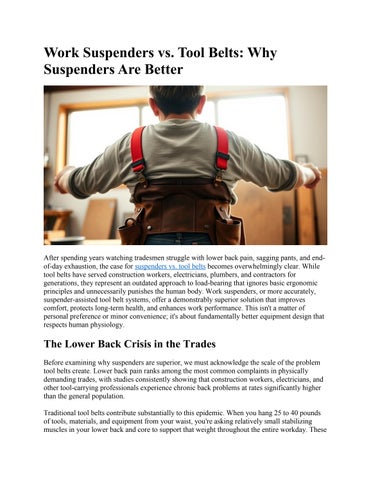
After spending years watching tradesmen struggle with lower back pain, sagging pants, and endof-day exhaustion, the case for suspenders vs. tool belts becomes overwhelmingly clear. While tool belts have served construction workers, electricians, plumbers, and contractors for generations, they represent an outdated approach to load-bearing that ignores basic ergonomic principles and unnecessarily punishes the human body. Work suspenders, or more accurately, suspender-assisted tool belt systems, offer a demonstrably superior solution that improves comfort, protects long-term health, and enhances work performance. This isn't a matter of personal preference or minor convenience; it's about fundamentally better equipment design that respects human physiology.
The Lower Back Crisis in the Trades
Before examining why suspenders are superior, we must acknowledge the scale of the problem tool belts create. Lower back pain ranks among the most common complaints in physically demanding trades, with studies consistently showing that construction workers, electricians, and other tool-carrying professionals experience chronic back problems at rates significantly higher than the general population.
Traditional tool belts contribute substantially to this epidemic. When you hang 25 to 40 pounds of tools, materials, and equipment from your waist, you're asking relatively small stabilizing muscles in your lower back and core to support that weight throughout the entire workday. These
muscles weren't designed for sustained load-bearing, they're meant for stabilization and movement, not constant weight support.
The cumulative stress from years of this unsupported loading causes genuine structural problems: disc compression, muscle strain, postural misalignment, and eventually, chronic pain that doesn't resolve with rest. Many tradesmen in their forties and fifties find themselves dealing with debilitating back issues that limit their ability to work and enjoy life, problems that suspenders could have prevented or minimized.
Biomechanical Superiority: Why Shoulders Beat Waists
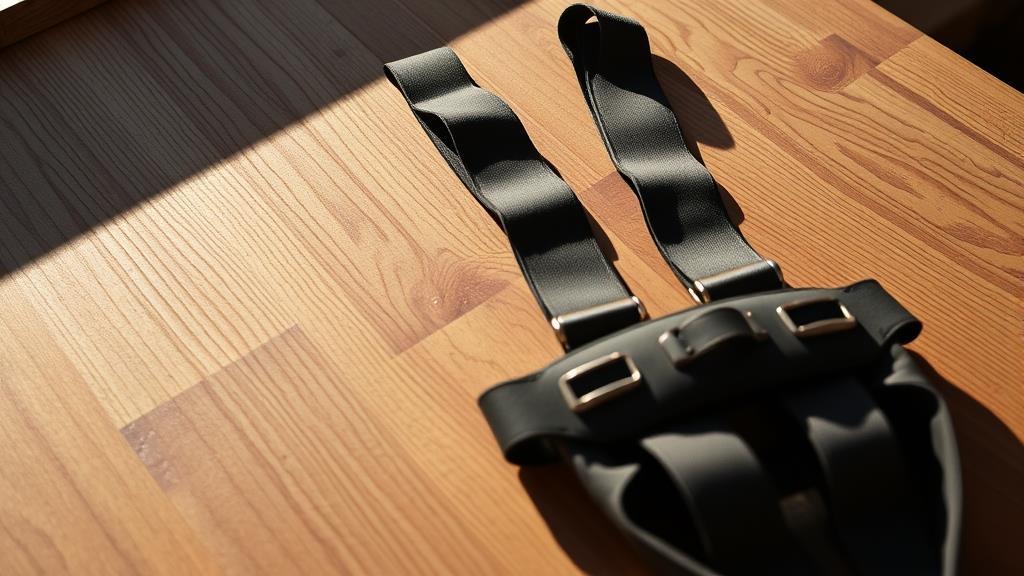
The fundamental advantage of suspenders lies in basic biomechanics. Your body has different muscle groups designed for different purposes, and load-bearing capacity varies dramatically between these systems.
The muscles supporting your lower back, erector spinae, multifidus, and various deep stabilizers, are relatively small muscles designed for stabilization and controlled movement. They fatigue quickly under sustained loads and lack the mass to comfortably handle heavy equipment for extended periods. When you load these muscles continuously, they develop chronic tension, trigger points, and eventually structural problems.
In contrast, your shoulder girdle is supported by much larger, stronger muscle groups: trapezius, rhomboids, deltoids, and latissimus dorsi. These muscles have significantly greater mass and strength, making them far better suited for load-bearing. They fatigue more slowly, recover more quickly, and can handle sustained loads without the same risk of chronic problems that plague lower back muscles.
Suspenders redirect weight from the weaker, inappropriate muscle groups to the stronger, more capable ones. This isn't a marginal improvement, it's a fundamental alignment of equipment design with human physiology. Your body already has built-in systems for carrying loads efficiently; suspenders simply utilize them properly.
Immediate Comfort Advantages
The comfort difference between belt-only and suspender-assisted systems becomes apparent within minutes and compounds throughout the workday. Ask anyone who's made the switch, and they'll describe the experience in similar terms: "I don't know how I tolerated belts alone for so long."
With suspenders, the constant downward pull that characterizes heavy tool belts simply disappears. Your pants stay exactly where they should without constant adjustment. The tight pressure around your waist that restricts breathing and digestion vanishes, replaced by gentle, distributed pressure across your shoulders. You can bend, reach, twist, and move naturally without fighting against your equipment.
The elimination of waist pressure improves breathing mechanics, allowing fuller, easier breaths during physical exertion. This better oxygenation reduces fatigue and improves endurance. It also eliminates the digestive discomfort that comes from tight belts compressing your abdomen, particularly relevant when working after meals.
Perhaps most significantly, the end-of-day experience changes completely. Instead of peeling off your tool belt with relief, feeling your back complain as blood flow returns to compressed tissues, you simply remove your suspenders without that same sense of liberation from discomfort. The absence of accumulated fatigue means you have more energy for family, exercise, or other activities after work, a quality-of-life improvement that's difficult to overstate.
Long-Term Health Protection
While immediate comfort matters, the long-term health protection suspenders provide represents their most compelling advantage. Your career in the trades should span decades, and the equipment choices you make today profoundly impact your physical condition decades from now.
Chronic lower back problems don't appear suddenly, they develop gradually over years of accumulated stress and microtrauma. Each day of supporting heavy tool belts solely from your waist adds to that accumulated damage. By the time symptoms become severe enough to seek treatment, significant structural problems may already exist.
Suspenders interrupt this damage accumulation. By redistributing weight to stronger muscle groups and reducing localized stress on your spine, they minimize the daily microtrauma that leads to chronic problems. This preventive protection becomes invaluable over a 20, 30, or 40year career.
Consider the mathematics: if suspenders reduce daily back stress by even 50%, over a 40-year career, that's the equivalent of 20 years of reduced wear and tear. That difference determines whether you finish your career with a healthy, functional back or with chronic pain limiting your ability to work, play with grandchildren, or enjoy retirement.
Performance and Productivity Benefits
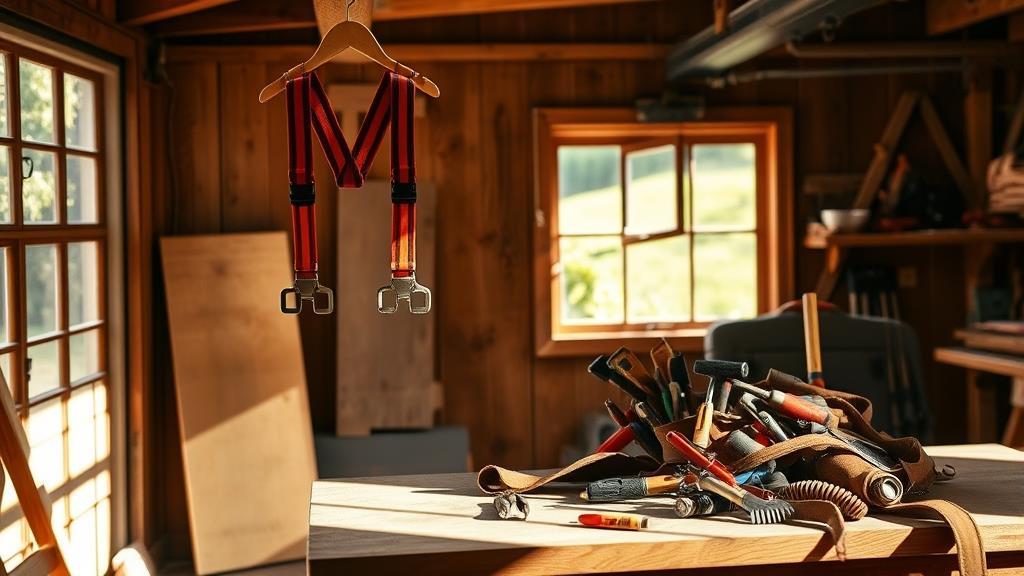
Superior comfort and reduced fatigue don't just feel better, they improve work performance in measurable ways. When you're not fighting constant discomfort and fatigue, you maintain better focus, work more efficiently, and make fewer mistakes.
Physical tasks require less effort when you're not simultaneously supporting heavy equipment from your waist. Climbing ladders becomes easier and safer when weight is distributed properly. Bending, reaching, and working in awkward positions is less taxing when your core isn't already fatigued from load-bearing.
The energy savings compound throughout the day. By afternoon, when belt-only users are fighting fatigue and discomfort, suspender users maintain morning-level energy and focus. This sustained performance means more work accomplished, better quality work, and reduced risk of the fatigue-related mistakes that cause injuries or require expensive rework.
The Pants-Security Advantage
A practical benefit that surprises many new suspender users is how effectively they solve the eternal problem of sagging pants. Heavy tool belts pull pants downward constantly, requiring frequent adjustment and often exposing more of yourself than professional situations warrant.
Suspenders eliminate this problem entirely. The upward pull on your belt keeps everything exactly where it should be, regardless of tool weight or how much you move. You'll never again need to hoist your pants mid-task or worry about maintaining professional appearance despite heavy equipment.
This consistent pant position also prevents the constant friction and wear that belt-only systems create on waistbands. Your work pants last longer when they're not constantly sliding up and down against a belt trying to support 30 pounds of equipment.
Debunking Common Objections
Despite clear advantages, some tradesmen resist suspenders based on misconceptions or outdated information. Let's address the most common objections.
"Suspenders are uncomfortable on shoulders." This criticism applied to cheap suspenders with inadequate padding, but quality modern work suspenders feature thick, cushioned padding that distributes pressure comfortably. Any initial awareness of shoulder pressure disappears quickly as you adjust to the new weight distribution, and is vastly preferable to chronic lower back pain.
"Suspenders get in the way." While suspenders do add straps across your torso, quality designs minimize interference. The reality is that minor occasional strap awareness is a tiny price for eliminating constant back strain. Most users quickly forget they're wearing suspenders while acutely remembering what belt-only discomfort felt like.
"They look old-fashioned." This purely aesthetic concern ignores that professional tradesmen increasingly wear suspenders as ergonomic understanding spreads. Functionality and health protection matter infinitely more than appearance. Besides, many modern work suspenders feature contemporary designs that look professional.
"They're expensive." Quality suspenders add $50 to $150 to your tool belt investment. Compared to medical expenses for treating chronic back problems, easily thousands of dollars in copays, treatments, and lost work time, suspenders represent possibly the most cost-effective health investment available to tradesmen.
The Integrated System Approach
The ideal solution isn't actually "suspenders versus tool belts", it's integrated systems that use suspenders with padded support belts in coordinated designs. These combination systems provide suspender load-bearing benefits while maintaining belt stability and organization.
The padded belt component distributes remaining waist pressure across a wider area while the suspenders handle the majority of weight. This division of labor optimizes comfort while maintaining tool accessibility and organization. Modern integrated systems represent the evolution of load-bearing equipment toward designs that respect human biomechanics.
Making the Switch: What to Expect
Transitioning from belt-only to suspender-assisted systems requires a brief adjustment period. The first few days feel different as your body adapts to new weight distribution patterns. Your shoulders may notice the load initially, but this awareness fades quickly as the superior overall comfort becomes apparent.
Most users report that after one week, they can't imagine returning to belt-only systems. The comfort difference becomes so obvious that working without suspenders feels like a step backward into unnecessary discomfort.
Conclusion: The Clear Winner
The comparison between work suspenders and belt-only tool carrying isn't actually close. Suspenders win on comfort, win on long-term health protection, win on sustained performance, and win on practical functionality. The only advantage belt-only systems offer is slightly lower initial cost, a false economy when considering long-term health expenses and quality of life.
For any tradesman carrying significant tool weight regularly, switching to suspenders isn't just a good idea, it's one of the smartest career decisions you can make. Your back, your comfort, your long-term health, and your career longevity all benefit substantially. The only real question is why you've waited this long to make the switch.