
2026
SUSAN SHEEHAN GALLERY
info@susansheehangallery.com www.susansheehangallery.com

2026
info@susansheehangallery.com www.susansheehangallery.com
ART BASEL 2026
SUSAN SHEEHAN GALLERY

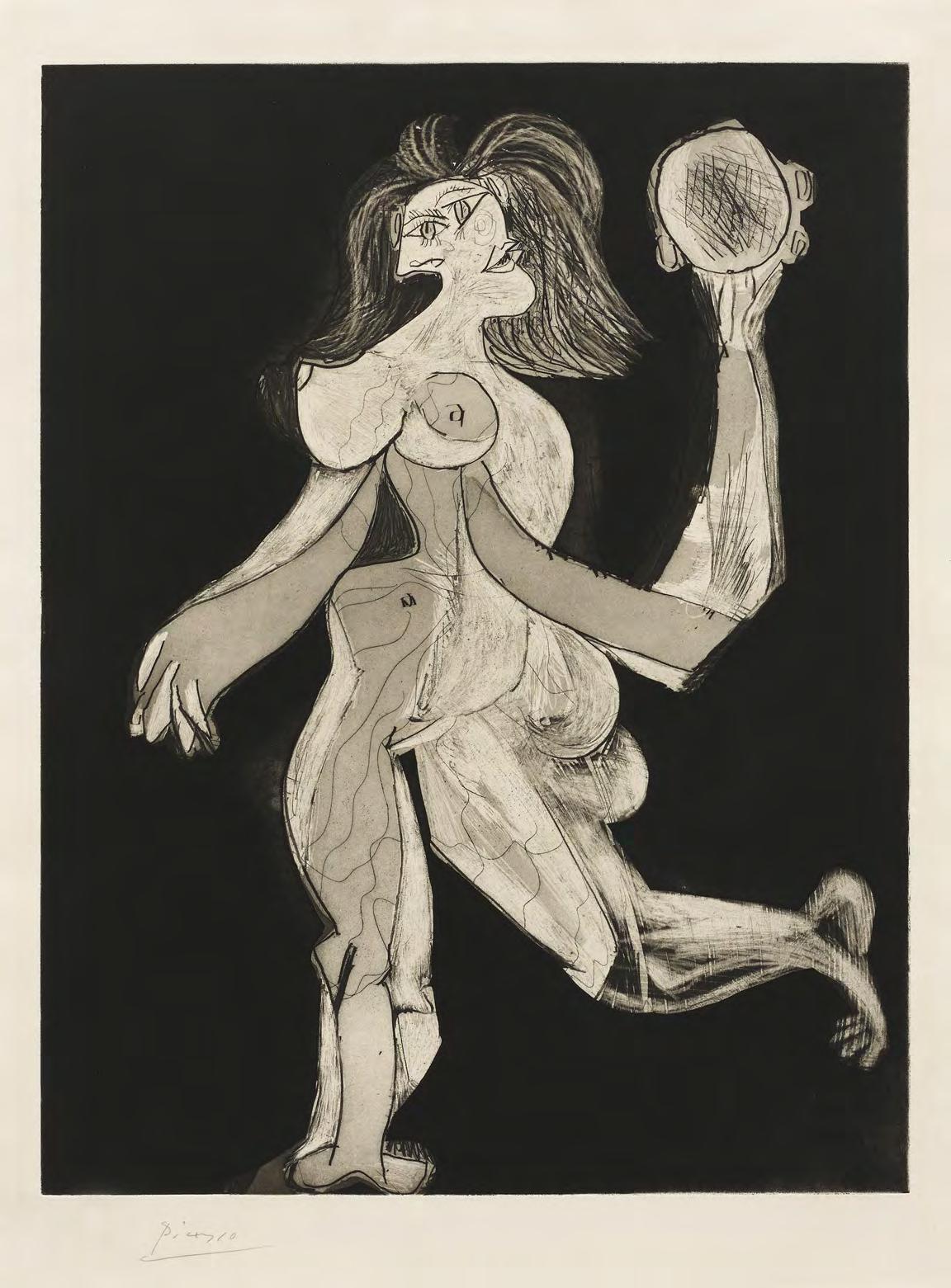
La femme au tambourin is a portrait of Dora Maar, the Surrealist artist and Picasso’s lover from the mid-1930s to the early 1940s. In this seminal intaglio print, Maar’s limbs take on the wild movement of a maenad or bacchante, a woman engaged in ecstatic worship of the Greek god Dionysus. Within the context of Picasso’s wider oeuvre, this classical trope can be interpreted as a foil to the artist’s own alter ego, the monstrous and brooding minotaur.
Picasso achieved this frenetic energy through ambitious collaboration with Parisian printer Roger Lacourière. The large size of the printing plate meant that it could not fit into a dusting box or acid bath, the standard tools of aquatint. Instead, Picasso worked directly on the copper plate with acid and scraper, alternately darkening and brightening areas across five different states. The final state, depicted here, reveals the rigorous labor that defines La femme au tambourin as a masterpiece of the medium.
Pablo Picasso
La femme au tambourin, 1939
Etching and aquatint
Sheet size: 30 x 22 1/8 inches (76.2 x 56.2 centimeters)
Printer: Lacourière, Paris
Publisher: Galerie Louise Leiris, Paris
Edition size: 30, plus proofs
Catalogue Raisonné: Bloch 310, Baer 646
Signed and numbered
Provenance:
Artist’s Estate
Collection of Marina Picasso, the artist’s granddaughter
Collection of Georges Bloch, author of the first catalogue raisonné of Picasso’s prints, with collector’s stamp on verso Jan Krugier Gallery, New York
A brilliant impression of this rare and important print.
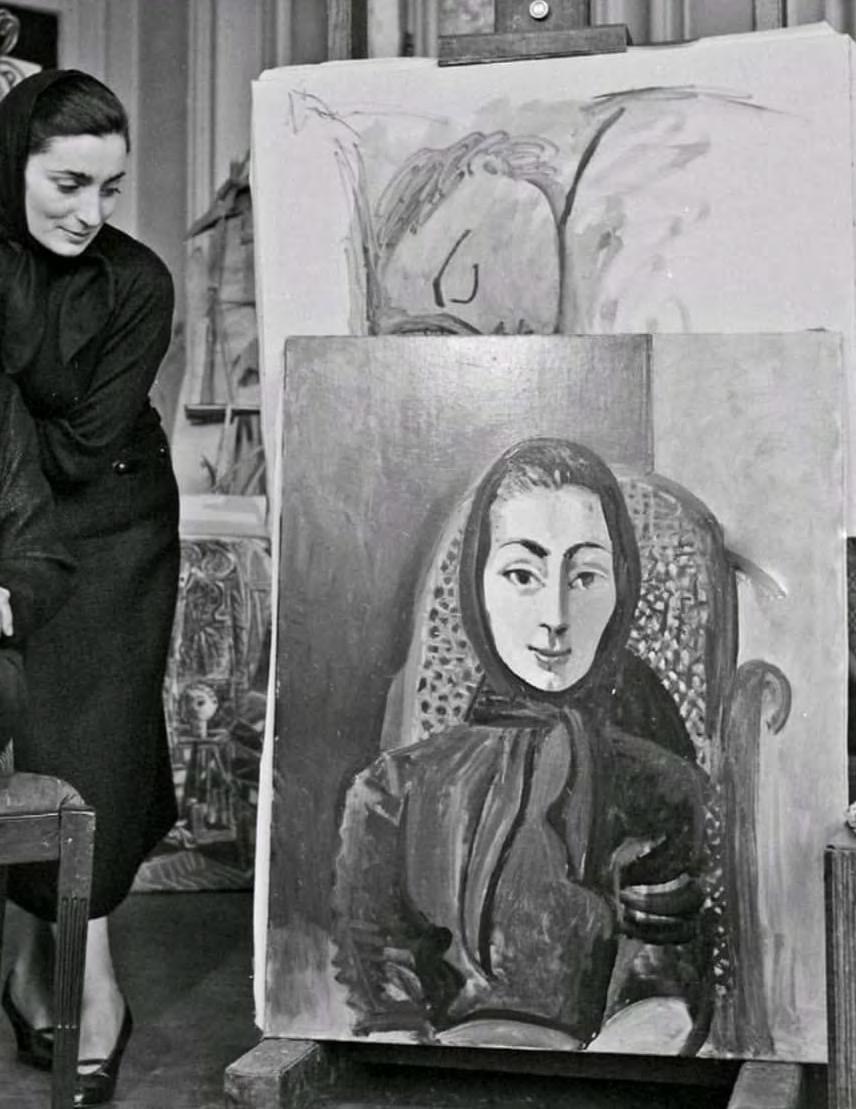
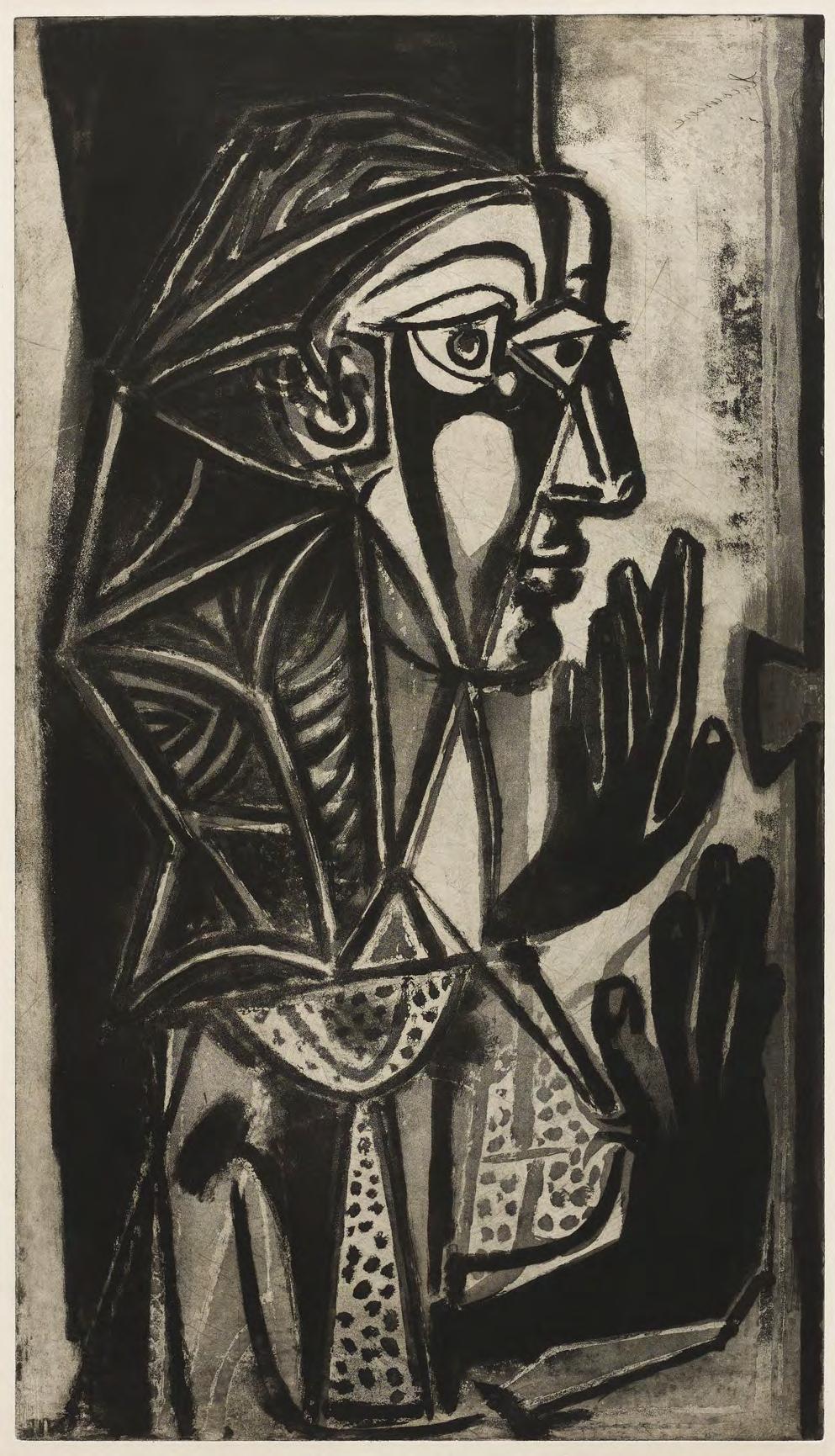
La femme à la fenêtre depicts Picasso’s muse Françoise Gilot in heavy geometric forms and a deep monochromatic palette. The somber composition marks a departure from his charming, naturalistic lithographs of Françoise from years prior, a change that reflects the breakdown of their relationship—she would leave him the following year.
The print’s tonal depth was made possible by sugar-lift aquatint, which allowed Picasso to “paint” directly on the plate with a sugar solution. In order to produce the intended edition of fifty, Lacourière employed a technique known as steel facing, which hardens the copper plate to extend its longevity, with the caveat that some finer details and textures can be lost. Only a handful of proofs were pulled before the plate was steel faced, and these exceedingly rare impressions best capture the luminous contrasts Picasso intended.
Pablo Picasso
La femme à la fenêtre, 1952
Aquatint
Sheet size: 35 3/8 x 25 inches (89.9 x 63.5 centimeters)
Printer: Lacourière, Paris
Edition size: 50, plus proofs
Catalogue Raisonné: Bloch 695, Baer 891
Marina Picasso Collection stamp on verso
Provenance:
Collection of Marina Picasso, the artist’s granddaughter, with collector’s stamp on verso Frederick Mulder, London
Collection of Catherine Woodard and Nelson Blitz, Jr., New York
American private collection
Exceedingly rare. One of four recorded proof impressions printed on Arches paper before the aquatint plate was steel-faced. Baer’s catalogue raisonné records six total impressions before steel-facing.
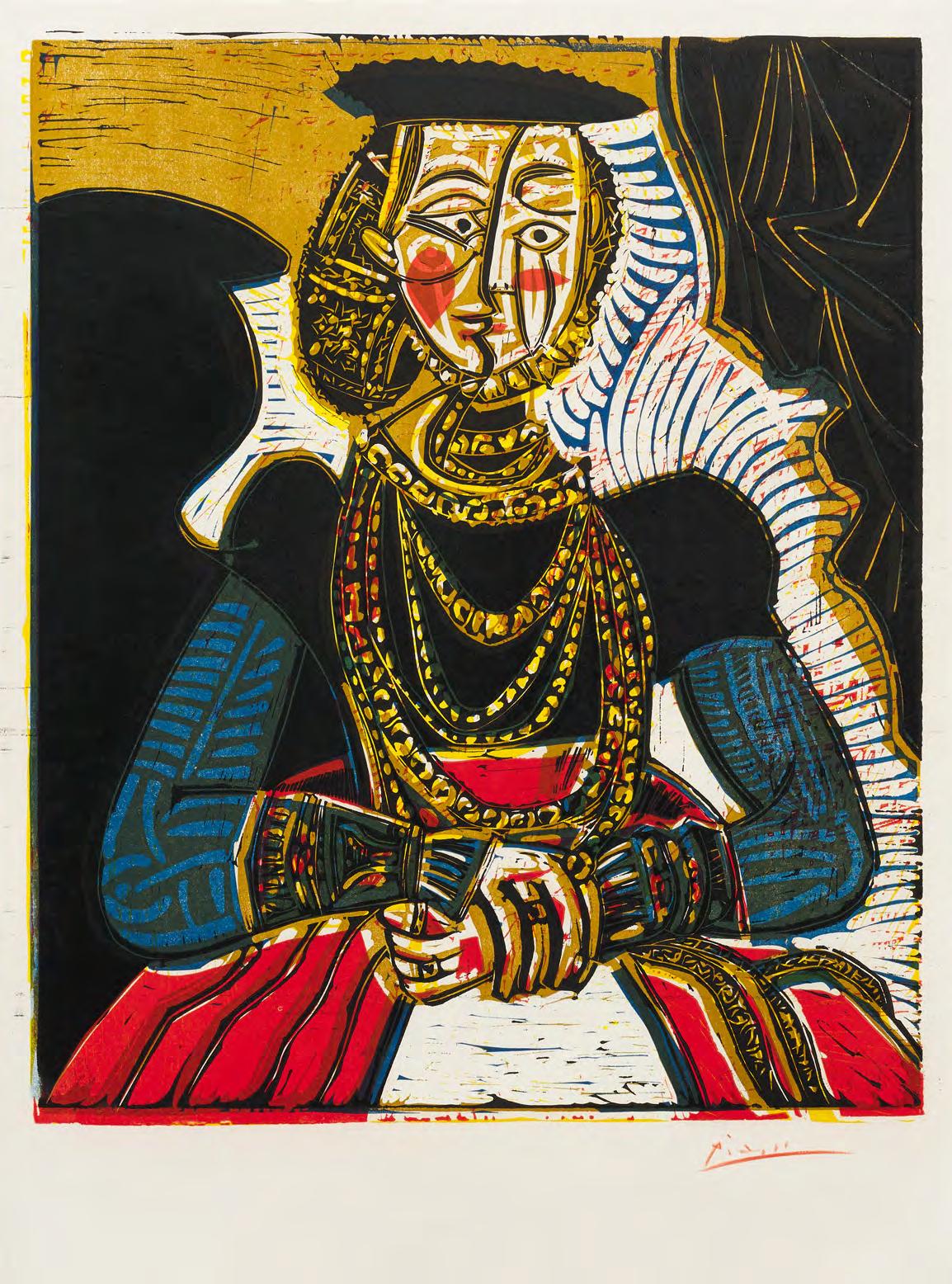
Picasso’s final paramour, Jacqueline Roque, appears in nearly all of the artist’s late portraits. Portrait de jeune fille, d’après Cranach le Jeune II was based on a postcard reproduction of Lucas Cranach the Younger’s renowned oil painting in the collection of the Kunsthistorisches Museum in Vienna. Rather than an exact translation of the Renaissance portrait, the noblewoman can be interpreted as Roque, identifiable by her almond-shaped eyes, high cheekbones, and aristocratic bearing.
This portrait is Picasso’s first masterwork in the medium of linocut, which he had previously viewed as limited, employing it primarily for exhibition posters and bullfight advertisements in the French town of Vallauris. Picasso worked closely with the printer Hidalgo Arnera, carving six separate linoleum blocks, one for each color in the composition. Each block required perfect alignment during printing, an immense challenge that drove Picasso and Arnera to a groundbreaking innovation in the years that followed: the reduction linocut technique.
Portrait de jeune fille, d’après Cranach le Jeune, II, 1958
Linocut
Sheet size: 30 1/4 x 22 1/2 inches
(76.8 x 57.2 centimeters)
Printer: Imprimerie Arnéra, Vallauris, France
Publisher: Galerie Louise Leiris, Paris
Edition size: 50, plus proofs
Catalogue Raisonné: Bloch 859, Baer 1053
Signed and numbered
Provenance:
Galerie Berggruen & Cie, Paris
European private collection
An extraordinary impression with brilliant colors.
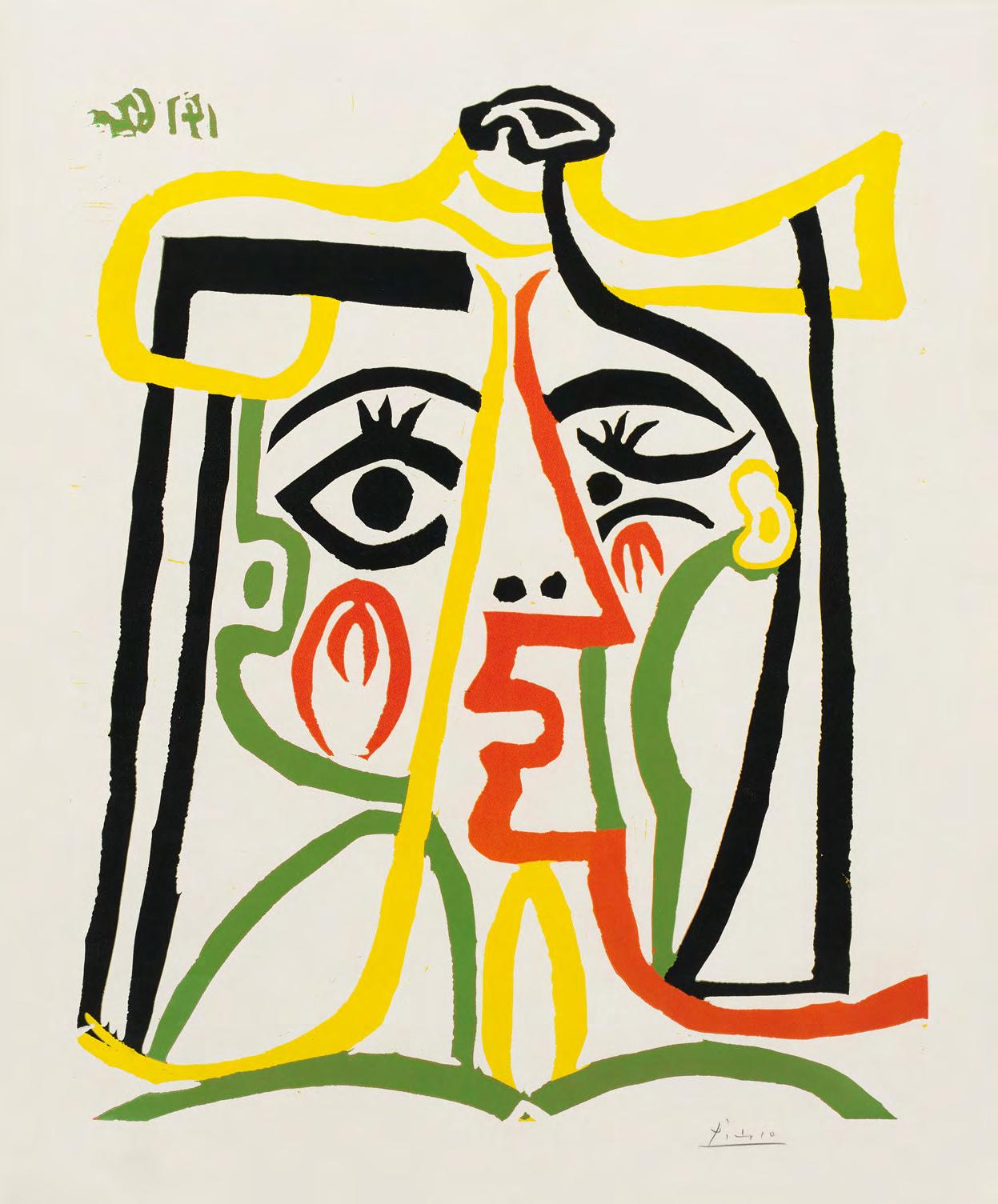
Reduction linocut simplifies color registration by using a single block to print multicolor images. Though more straightforward than traditional linocut printing, the technique requires a fully formed conception of the entire composition before work begins. Portrait de Jacqueline au chapeau de paille reflects the confidence and unrestrained vigor characteristic of Picasso’s work in this new medium. Jacqueline Roque’s distinct classical features are rendered with a simple vitality, presenting her as the rejuvenating life force she represented for the aging Picasso.
Portrait de Jacqueline au chapeau de paille, 1962
Linocut
Sheet size: 29 3/8 x 24 1/4 inches (74.6 x 61.6 centimeters)
Printer: Imprimerie Arnéra, Vallauris, France
Publisher: Galerie Louise Leiris, Paris
Edition size: 50, plus proofs
Catalogue Raisonné: Bloch 1067, Baer 1279
Signed and numbered
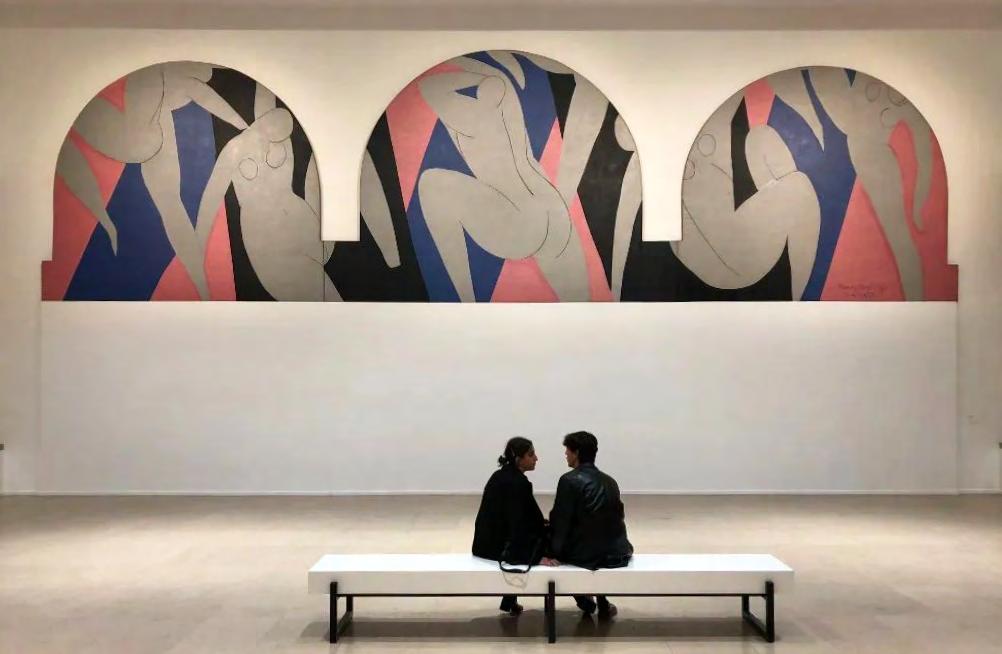
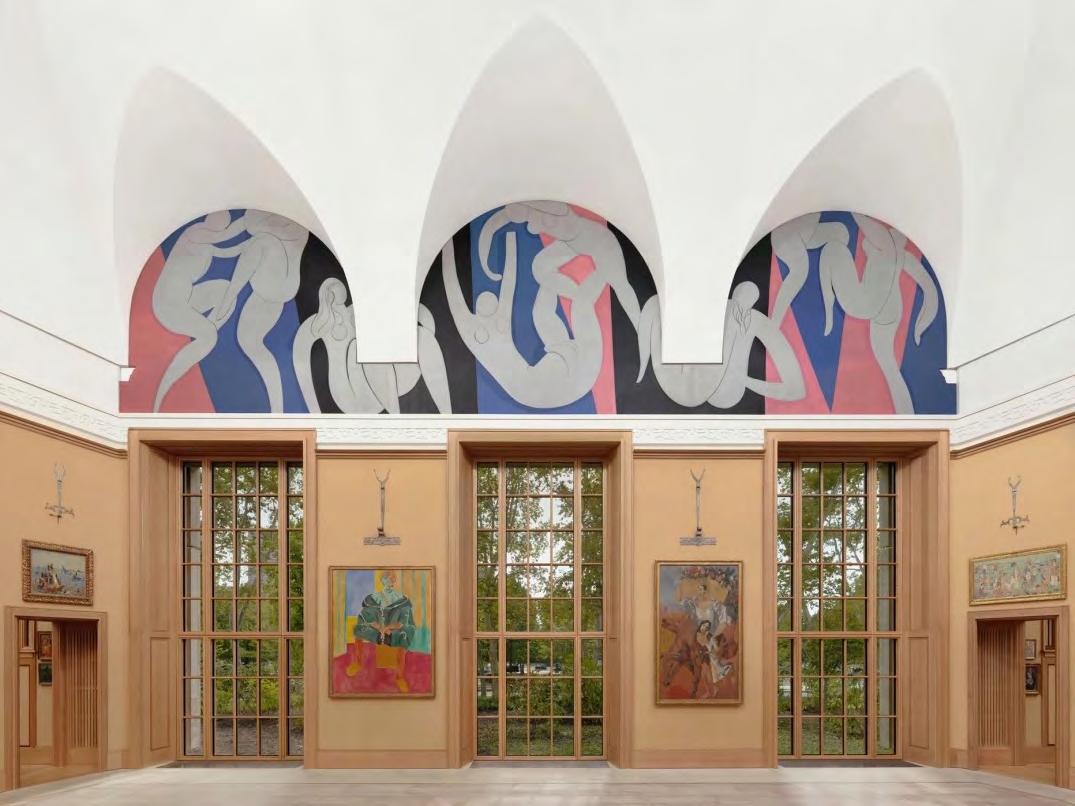
In 1930, American businessman and collector Albert C. Barnes commissioned Henri Matisse to paint an immense mural at his home and art foundation in Merion, Pennsylvania. Matisse was given free rein of the composition, but the spatial constraints were predetermined by the building’s architecture: the painting was to fill three lunettes, or semicircular arches, above the windows of the main gallery.
Rather than completing the work on-site, Matisse painted the mural on shaped canvas panels in his studio in Nice. He deemed his first iteration of La Danse overly decorative and abandoned it entirely. The unfinished canvas, now known as La Danse inachevée, can be found in the Musée d’Art Moderne de Paris. For his second attempt, Matisse employed paper cutouts to achieve the desired compositional balance. When this version was nearly complete, Barnes and Matisse made an alarming discovery: a miscommunication about the dimensions meant the panels would not fit the space. Matisse began again, and finally, nearly two years behind schedule, La Danse was installed at the Barnes Foundation in April 1933.
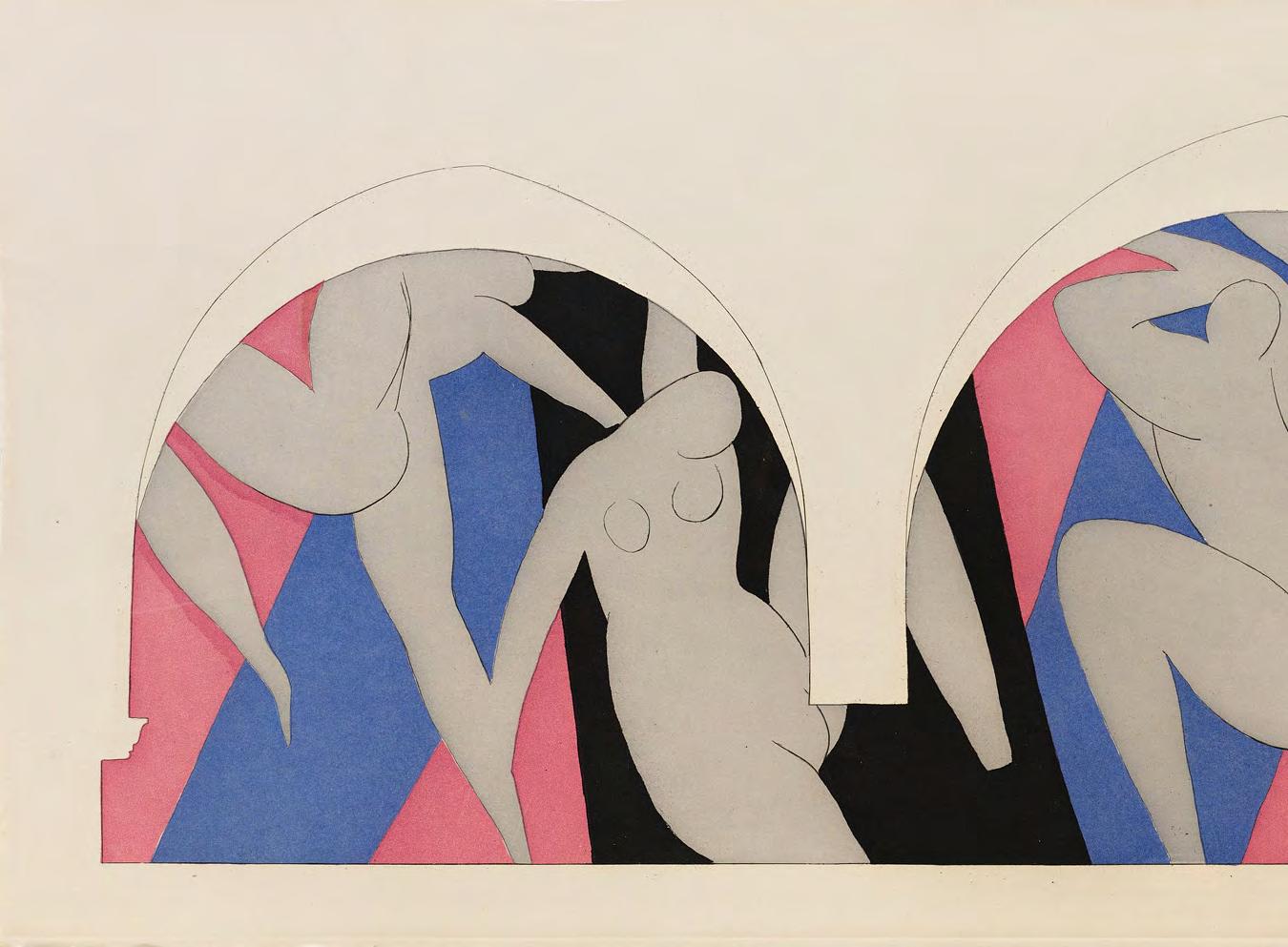
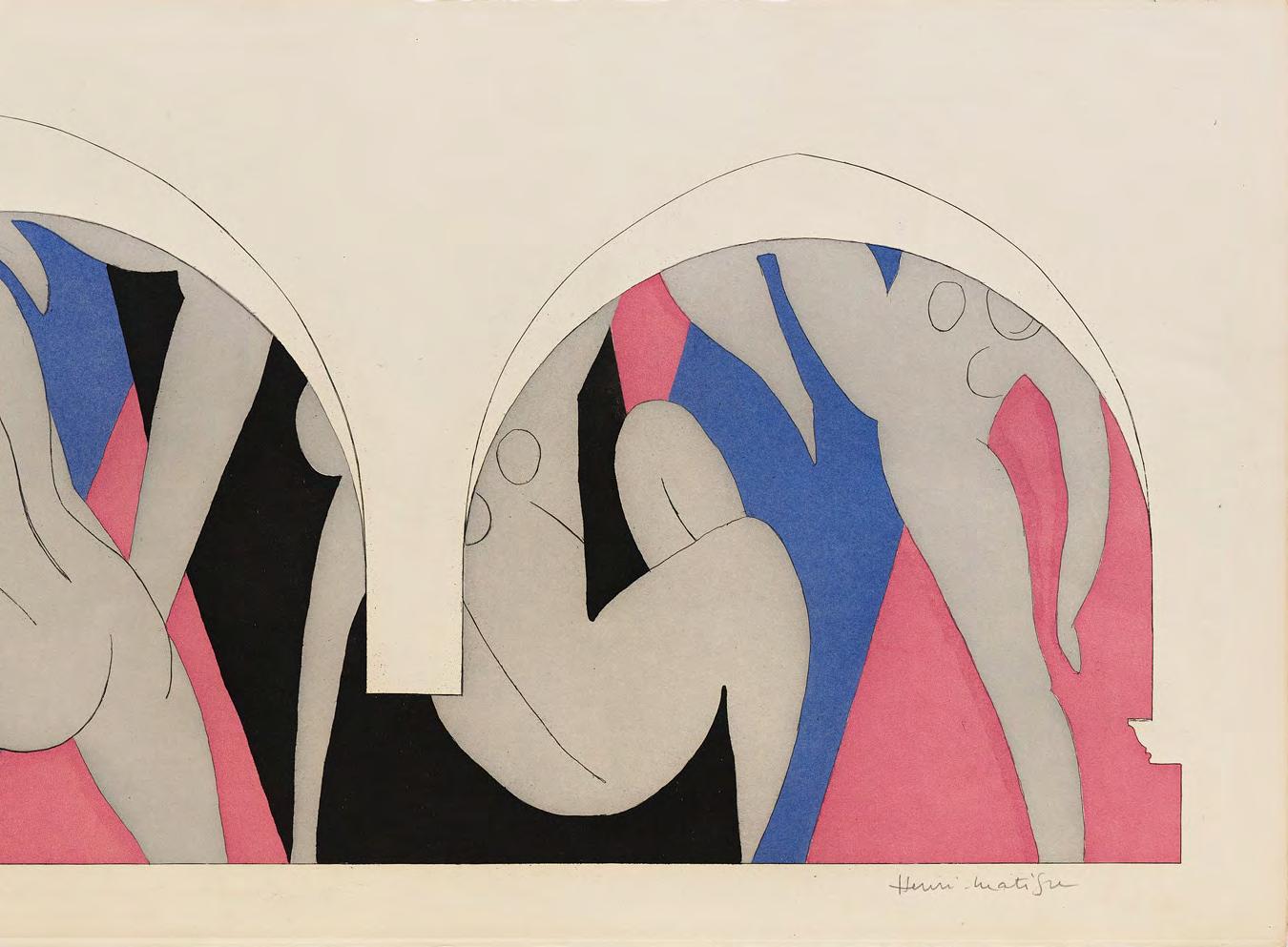
Matisse was pleased with the result, but Barnes was disappointed, going so far as to bar the public from the building. In 1935, Matisse revisited the composition in aquatint, perhaps to allow wider access to his hidden achievement. The print reproduces the second iteration of the canvas rather than the final mural. This may reflect simple accessibility—that version remained in France—but it is also possible that the third version was rushed to meet Barnes’s timeline, and that the second mural, La Danse de Paris, represents Matisse’s true masterpiece.
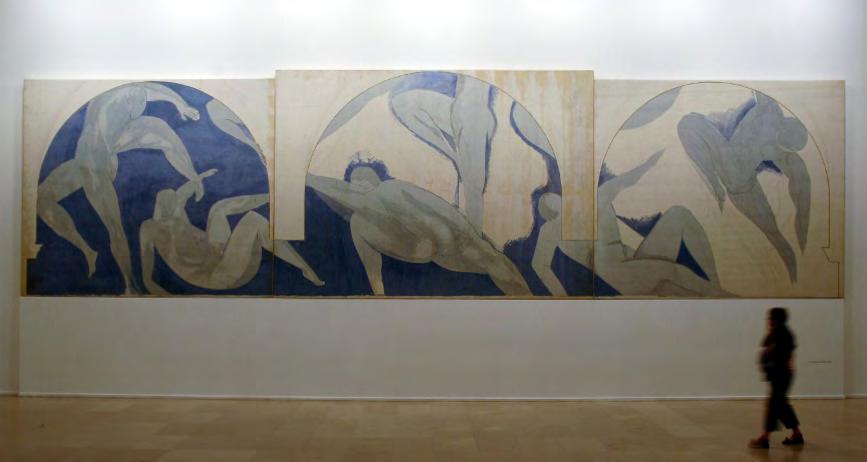
Above: La Danse inachevée, 1931, Musée d’Art Moderne de Paris
Upper right: La Danse de Paris, 1931-33, Musée d’Art Moderne de Paris
Lower right: La Danse, 1932-33, The Barnes Foundation, Pennsylvania
Henri Matisse
La danse, 1935-36
Etching and color aquatint on paper
Sheet size: 11 7/8 x 31 3/4 inches (30.2 x 80.6 centimeters)
Printer: Lacourière, Paris
Edition size: 50, plus proofs
Catalogue Raisonné: Duthuit 247
Signed and numbered
Provenance:
The Artist’s Estate
The Pierre and Tana Matisse Foundation
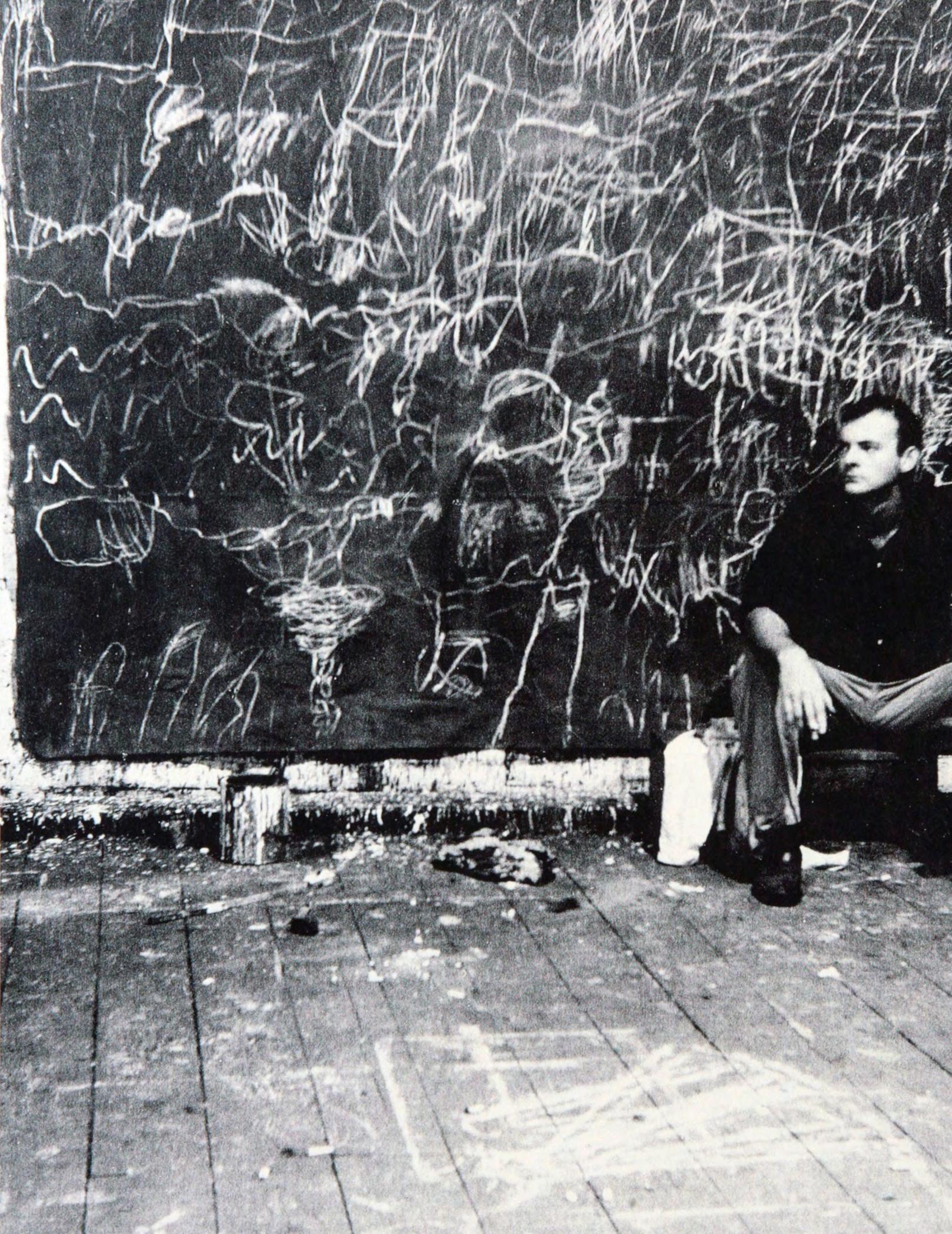

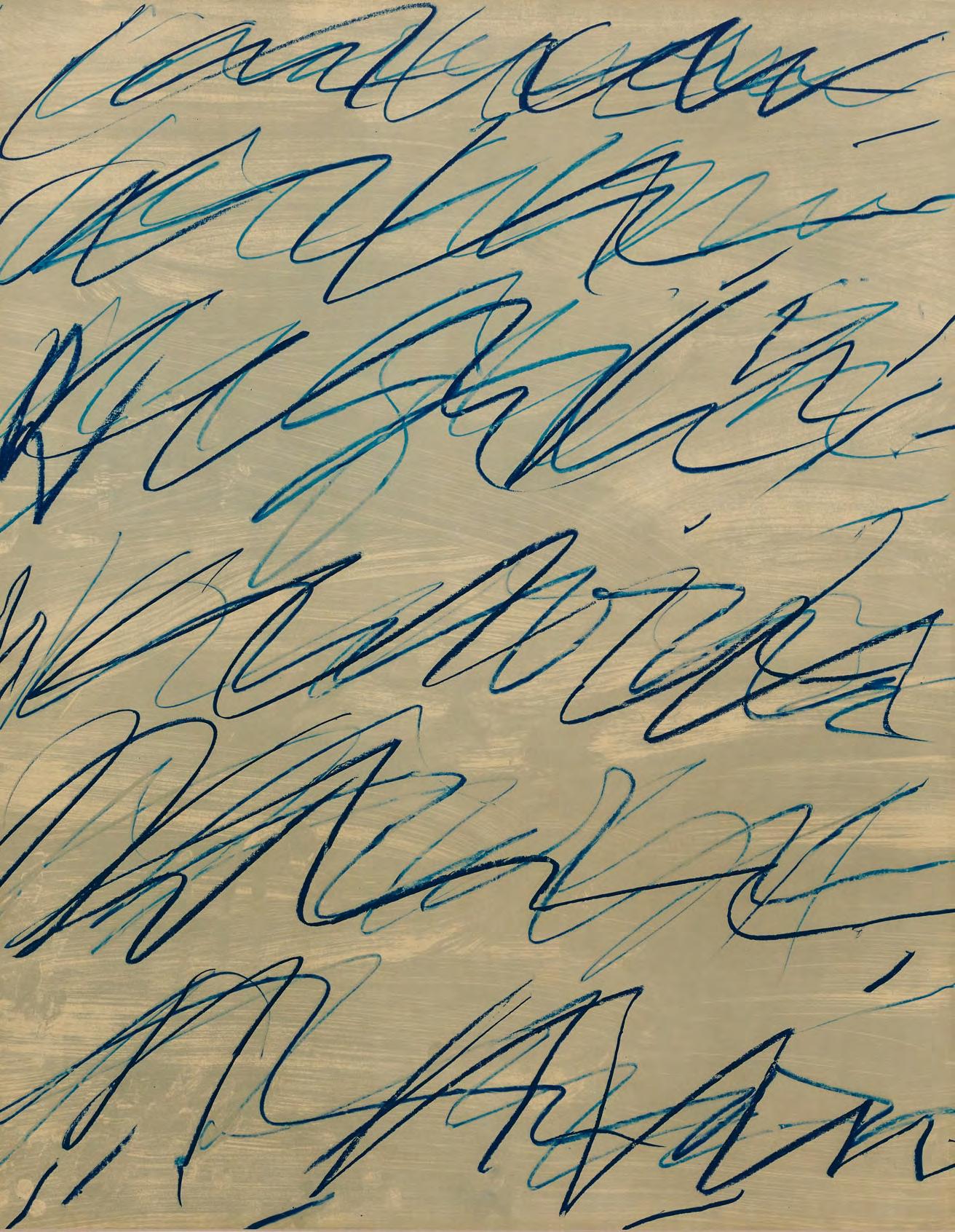
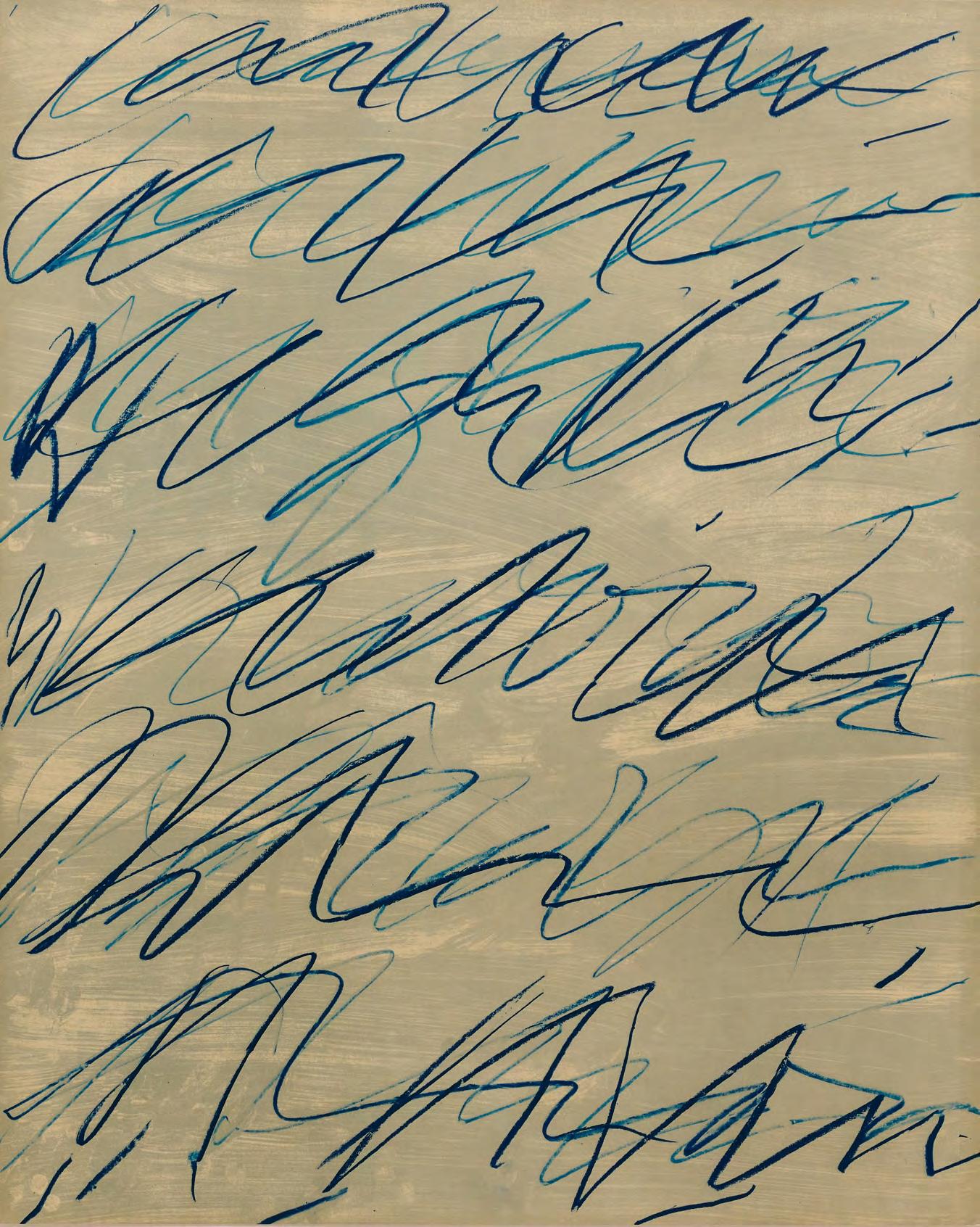
Twombly moved his primary residence to Rome in 1957, and the history and culture of the region shaped the spiraling line that emerged in his work in the years that followed. Roman Notes, a set of six offset lithographs, is a defining example of this lyricism. Like his earlier portfolio project, Sketches, the prints are ostensibly textual, but Twombly’s calligraphic marks resist a clear reading. Their allusive meaning is often interpreted as a reference to the ancient graffiti on Roman ruins and the scrolling handwriting of Leonardo da Vinci’s notebooks, while the color palette evokes the faded colors of antiquity and the sunlit Mediterranean coast.
Cy Twombly
Roman Notes I, 1970
Offset lithograph
Sheet size: 34 1/8 x 27 1/2 inches (86.7 x 69.9 centimeters)
Printer: Electa Editrice, Venice
Publisher: Neuendorf Verlag, Hamburg
Edition size: 100, plus proofs
Catalogue Raisonné: Bastian 21
Signed, dated, and numbered on verso
Provenance: The Cy Twombly Foundation, New York
Cy Twombly
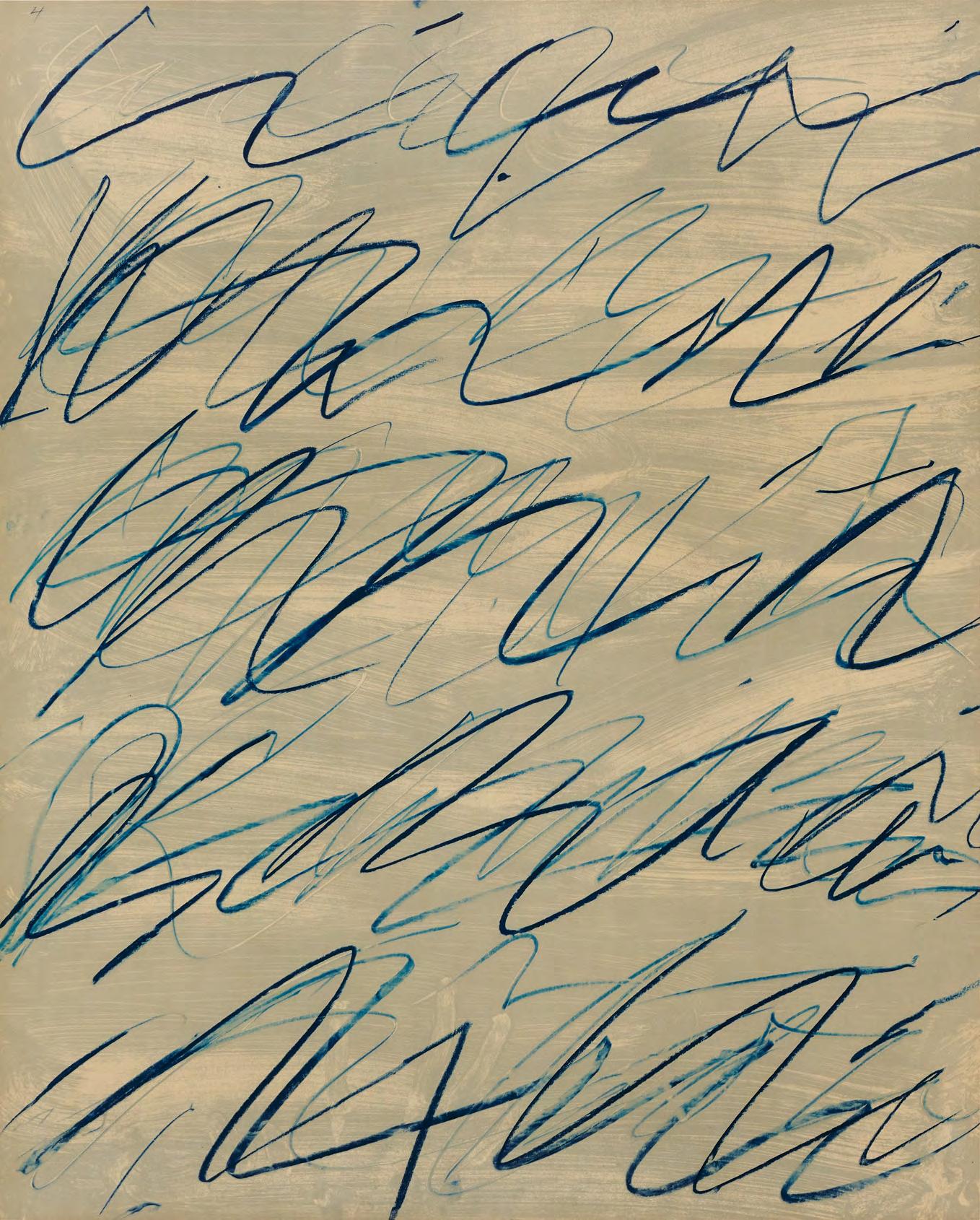
Roman Notes IV, 1970
Offset lithograph
Sheet size: 34 1/8 x 27 1/2 inches (86.7 x 69.9 centimeters)
Printer: Electa Editrice, Venice
Publisher: Neuendorf Verlag, Hamburg
Edition size: 100, plus proofs
Catalogue Raisonné: Bastian 24
Signed, dated, and numbered on verso
Provenance:
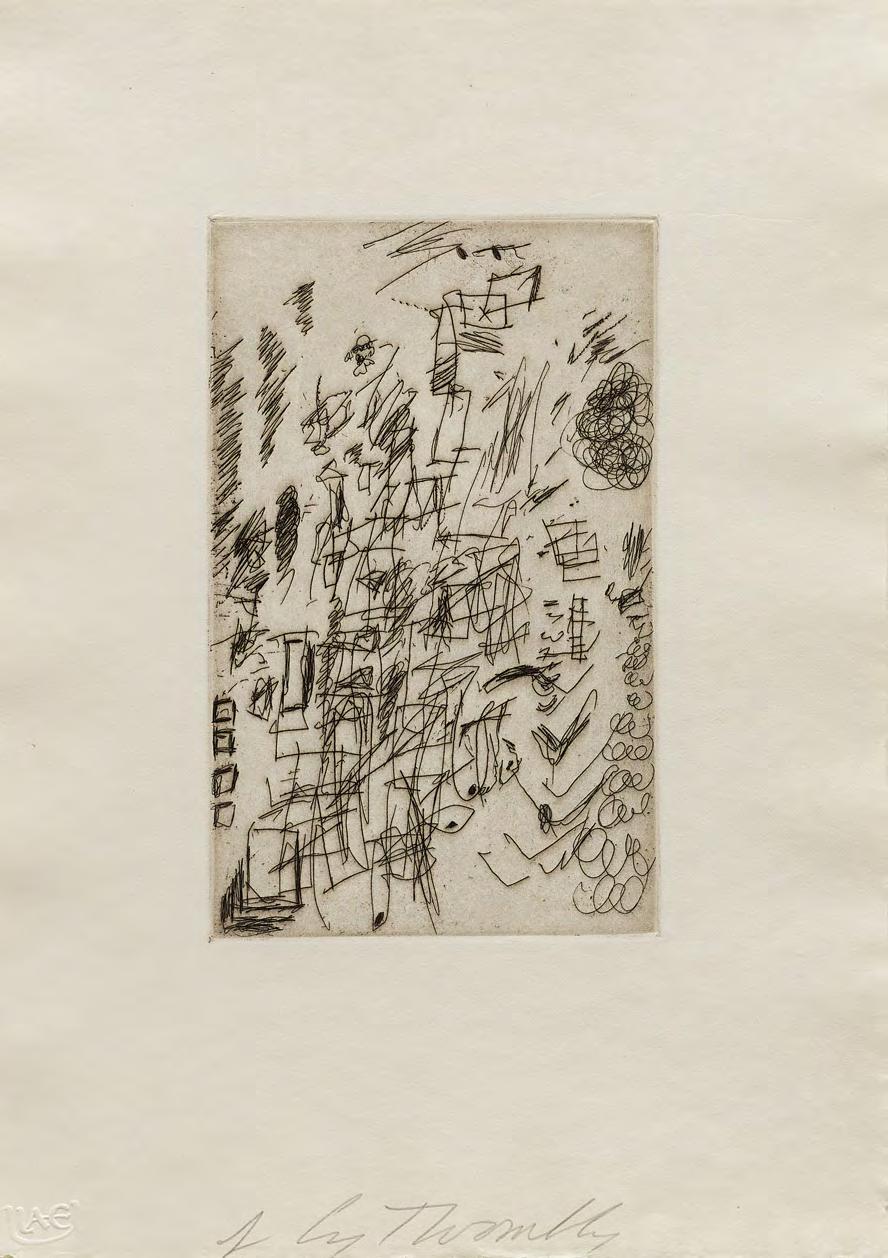
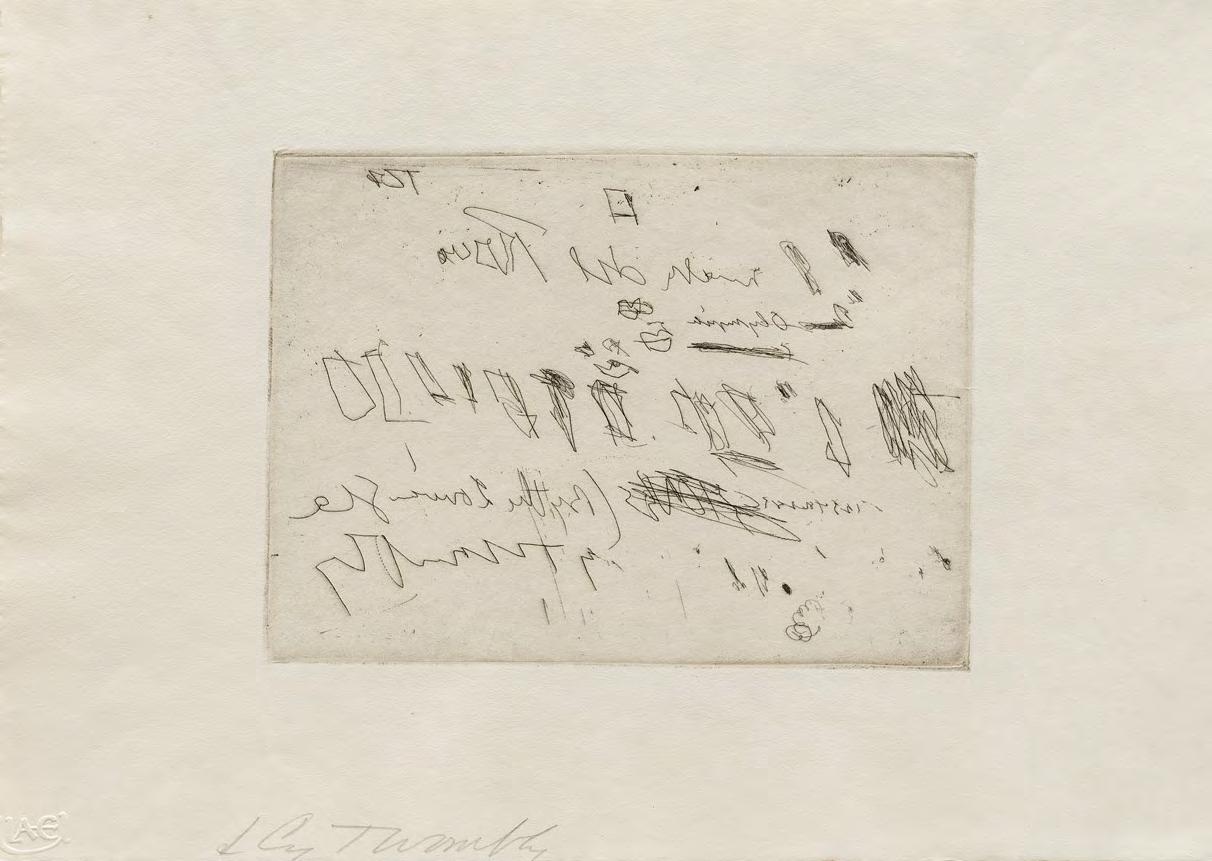
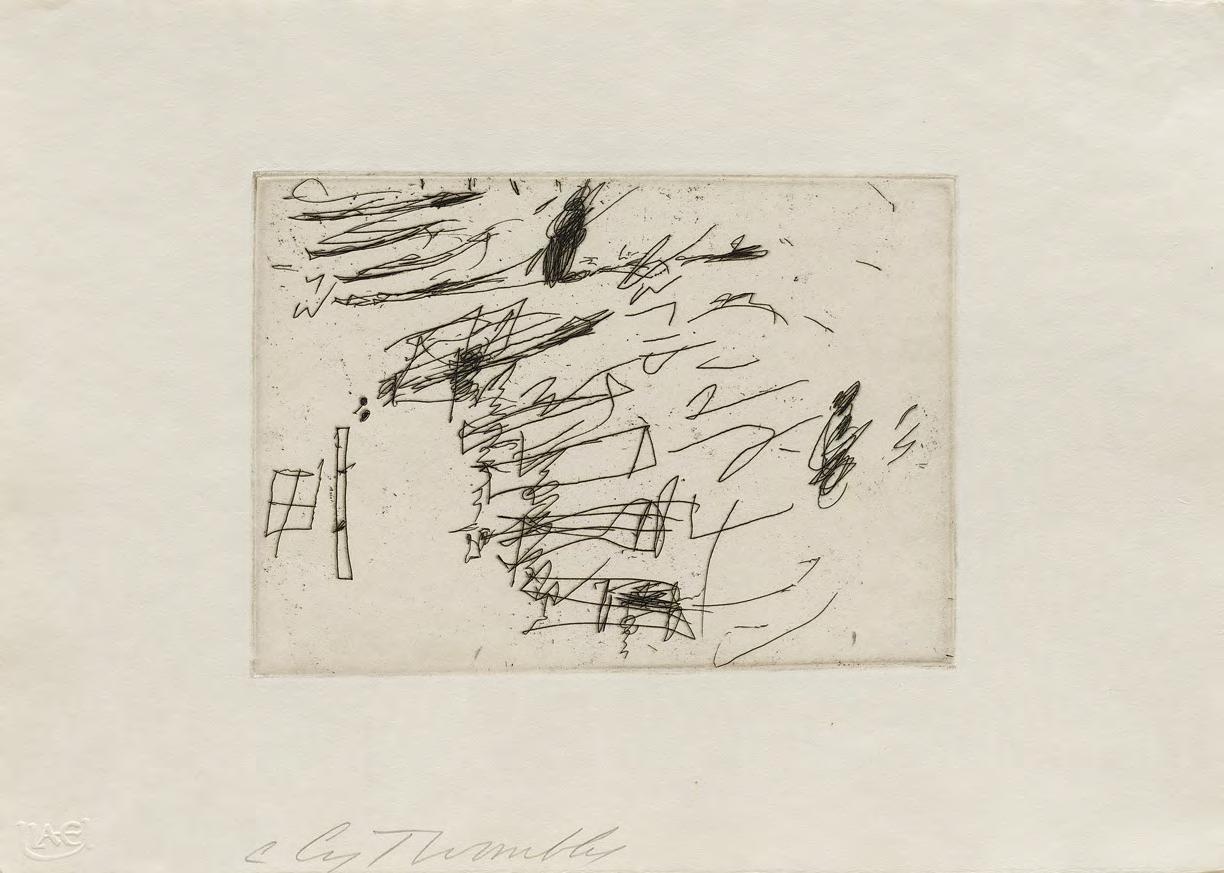
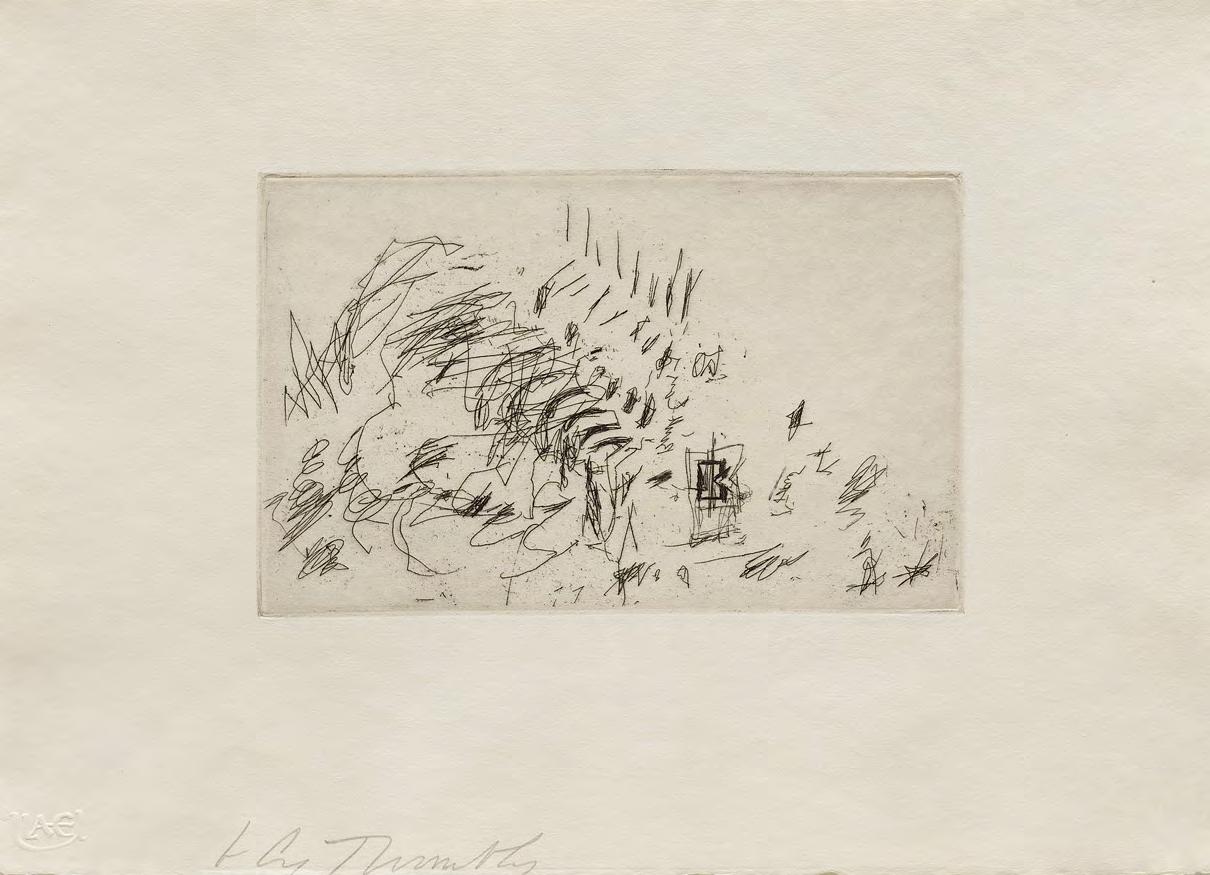
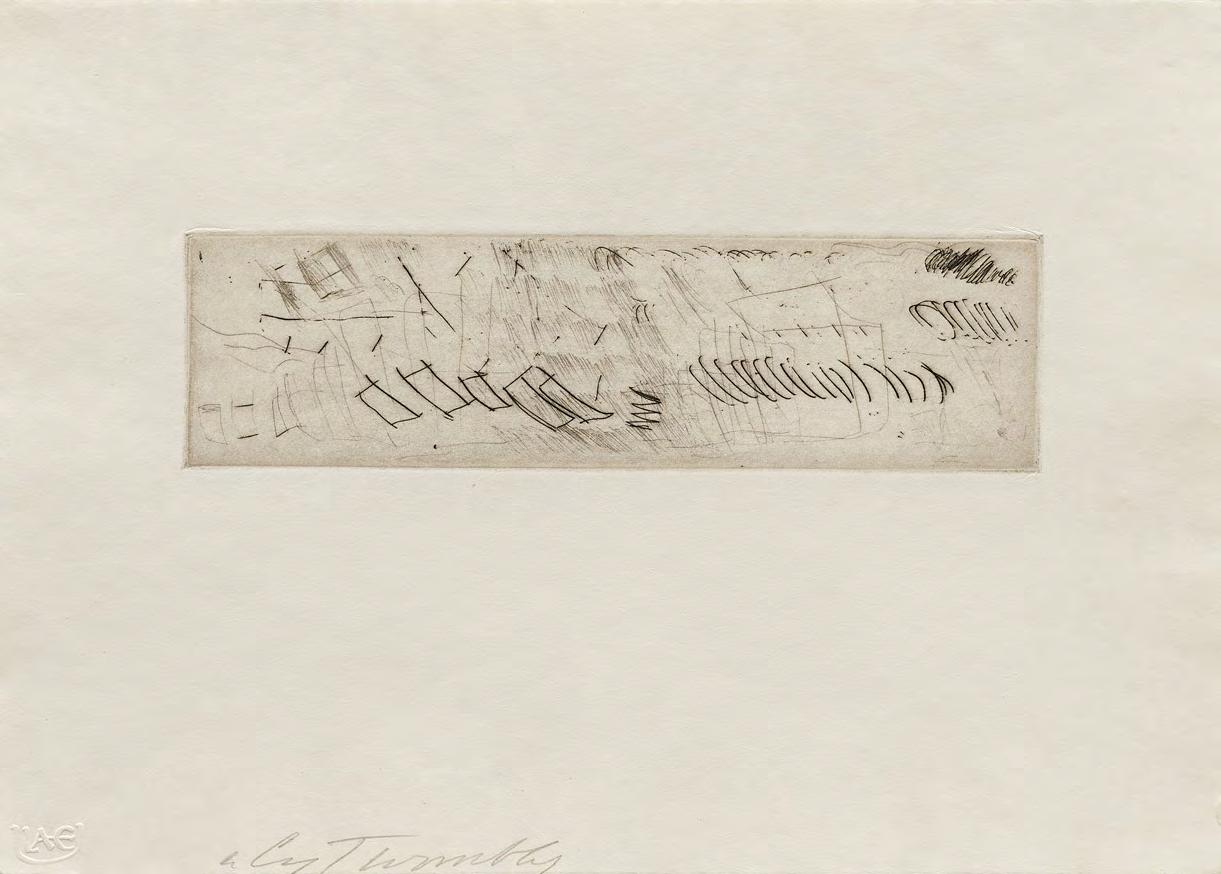
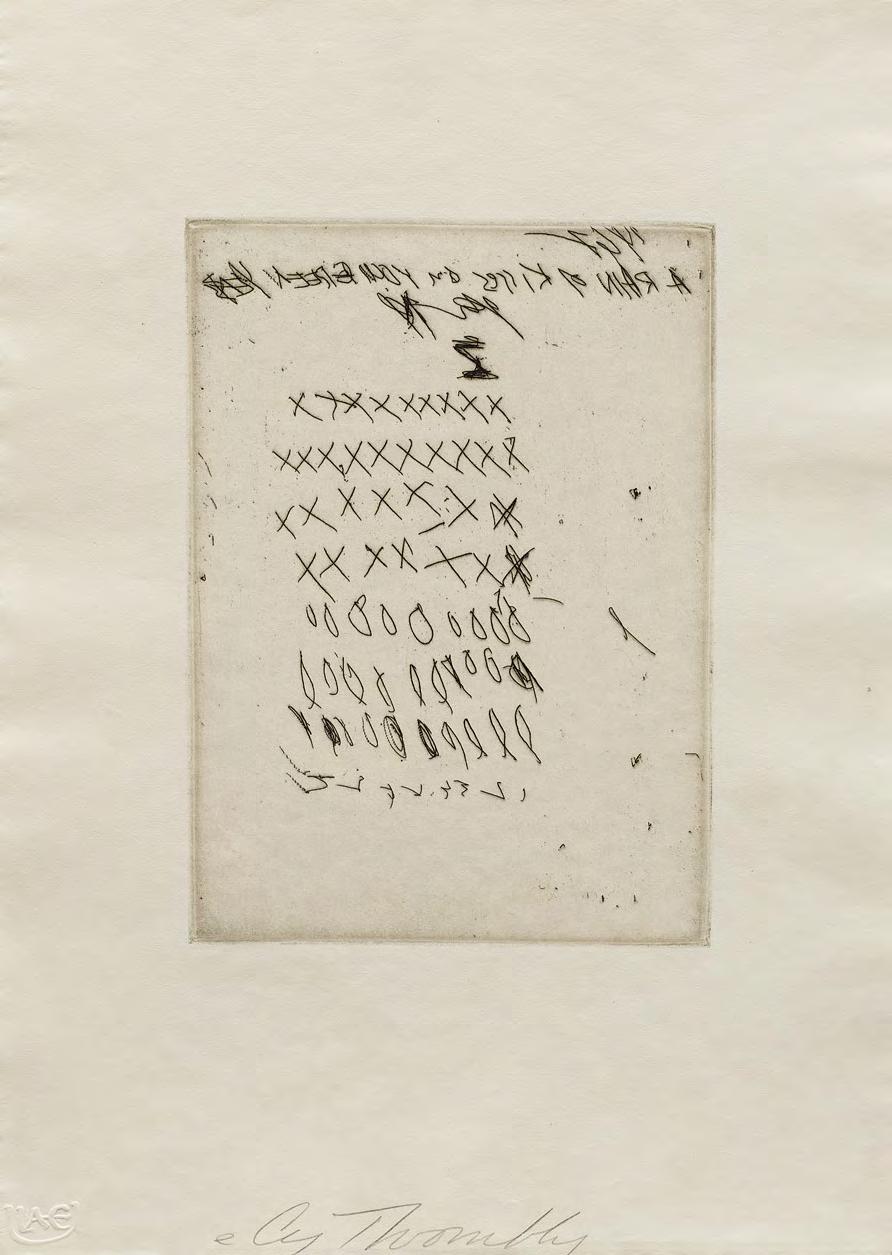
Cy Twombly’s Sketches was among the artist’s earliest attempts in etching, but it can hardly be described as elementary. Intimate and experimental, the portfolio of six etchings draws on the visual language of Twombly’s early paintings, where scribbled lines offer a critique of the formal conventions of art. As the title suggests, Sketches adopts an unfinished look. Twombly’s marks incorporate letters and shapes—sometimes legible, sometimes not—while the portfolio’s scale mimics that of the pages in a notebook.
Cy Twombly
Sketches, 1967
Etchings
Sheet size: 8 5/8 x 12 1/8 inches, each (21.9 x 30.8 centimeters, each)
Printer and Publisher: Universal Limited Art Editions, West Islip, New York
Edition size: 18, plus proofs
Catalogue Raisonné: Bastian 12-17
Each sheet is signed and numbered
Provenance: Wolfgang Wittrock, Berlin
European private collection
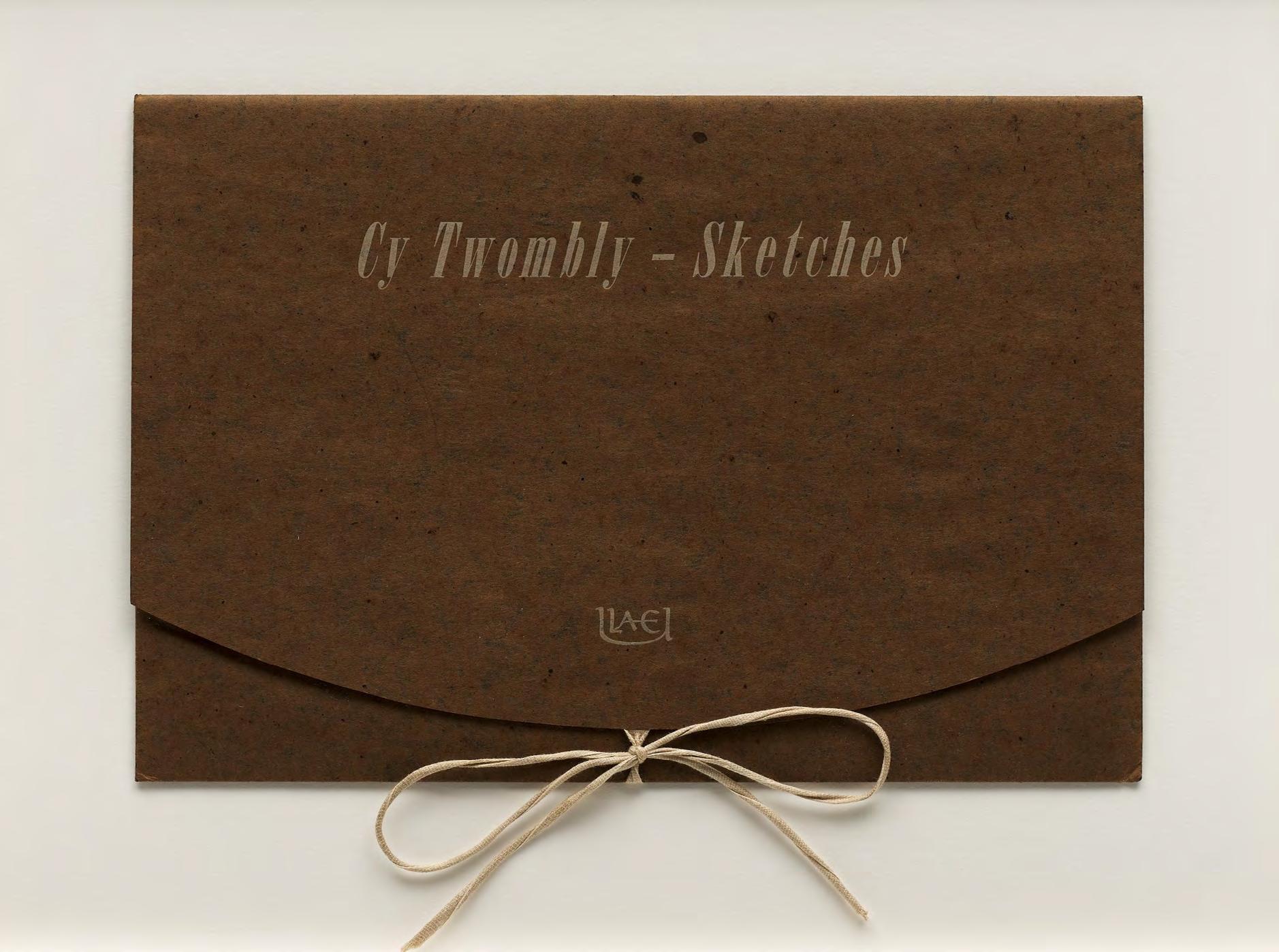
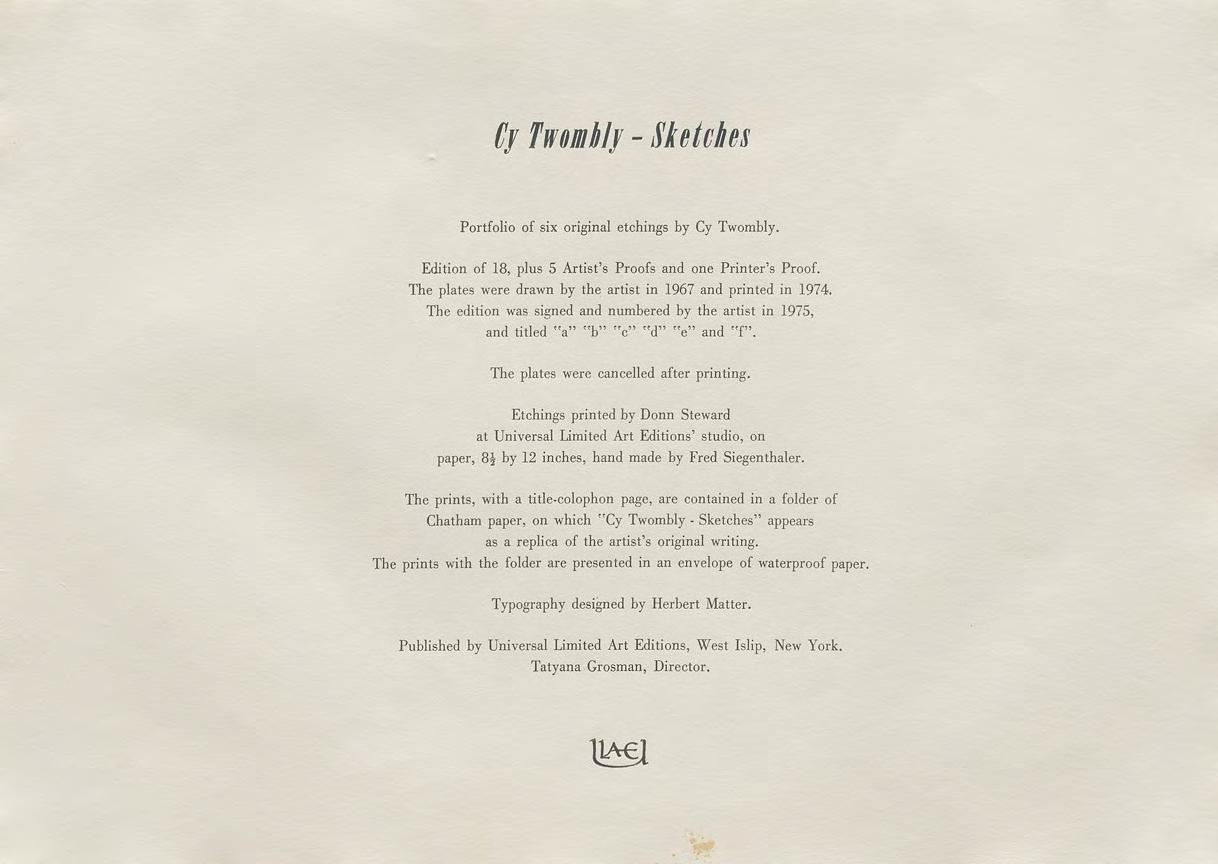
The exceedingly rare complete portfolio of six etchings which retains its colophon page, inner paper folder, and original paper portfolio.
Twombly’s looping script finds a denser counterpart in Untitled, a screenprint produced for the portfolio project On the Bowery. Organized by the German publisher Luitpold Domberger and edited by Twombly’s close friend Bill Katz, the multi-artist portfolio was conceived as an homage to the Bowery neighborhood of Lower Manhattan, a prominent hub for artists in the 1950s and 1960s. It was here, at a studio on Williams Street, that Twombly began developing the visual language of his Blackboard paintings.
Cy Twombly
Untitled, 1969-71
Screenprint
Sheet size: 25 1/2 x 25 1/2 inches (64.8 x 64.8 centimeters)
Printer and Publisher: Edition Domberger, Filderstadt, Germany
Edition size: 100, plus proofs
Catalogue Raisonné: Bastian 27
Signed and numbered on verso
From the portfolio On the Bowery, edited by William Katz, which also includes screeneprints by John Giorno, Charles Hinman, Robert Indiana, Will Insley, Gerald Laing, Les Levine, Robert Ryman, Richard Smith and John Willenbecher.
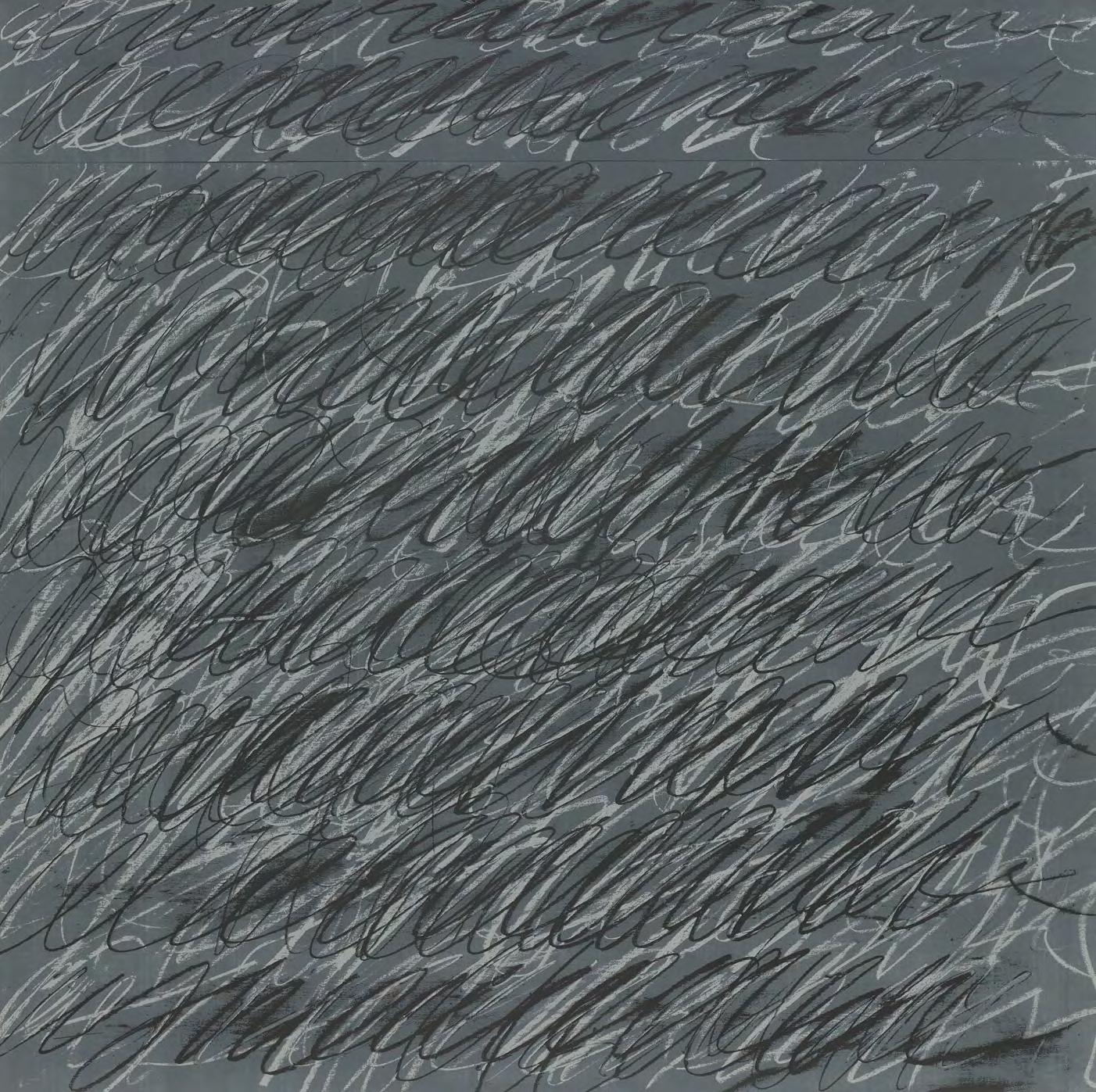
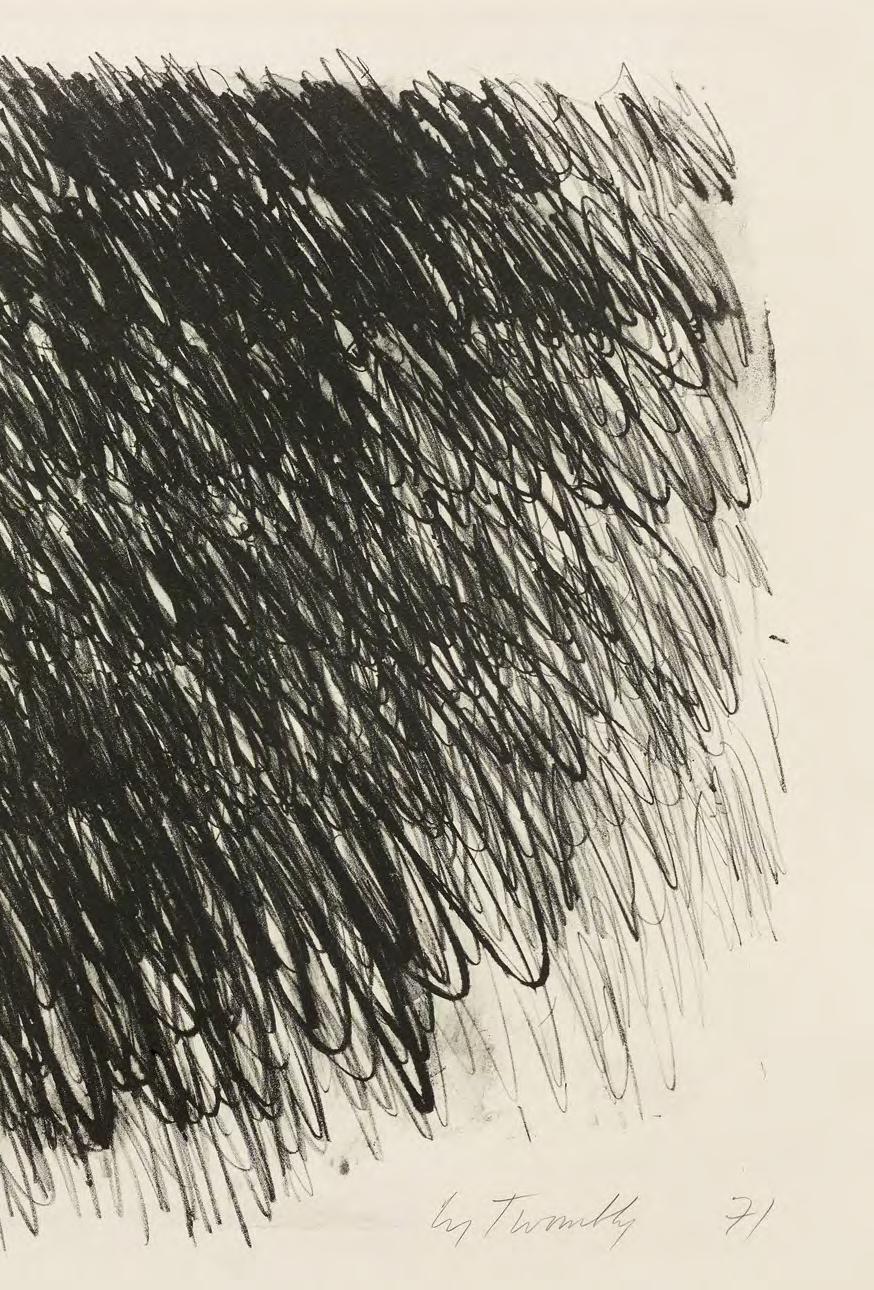
Cy Twombly
Untitled, 1971
Lithograph
Sheet size: 22 1/4 x 29 7/8 inches
(56.5 x 75.9 centimeters)
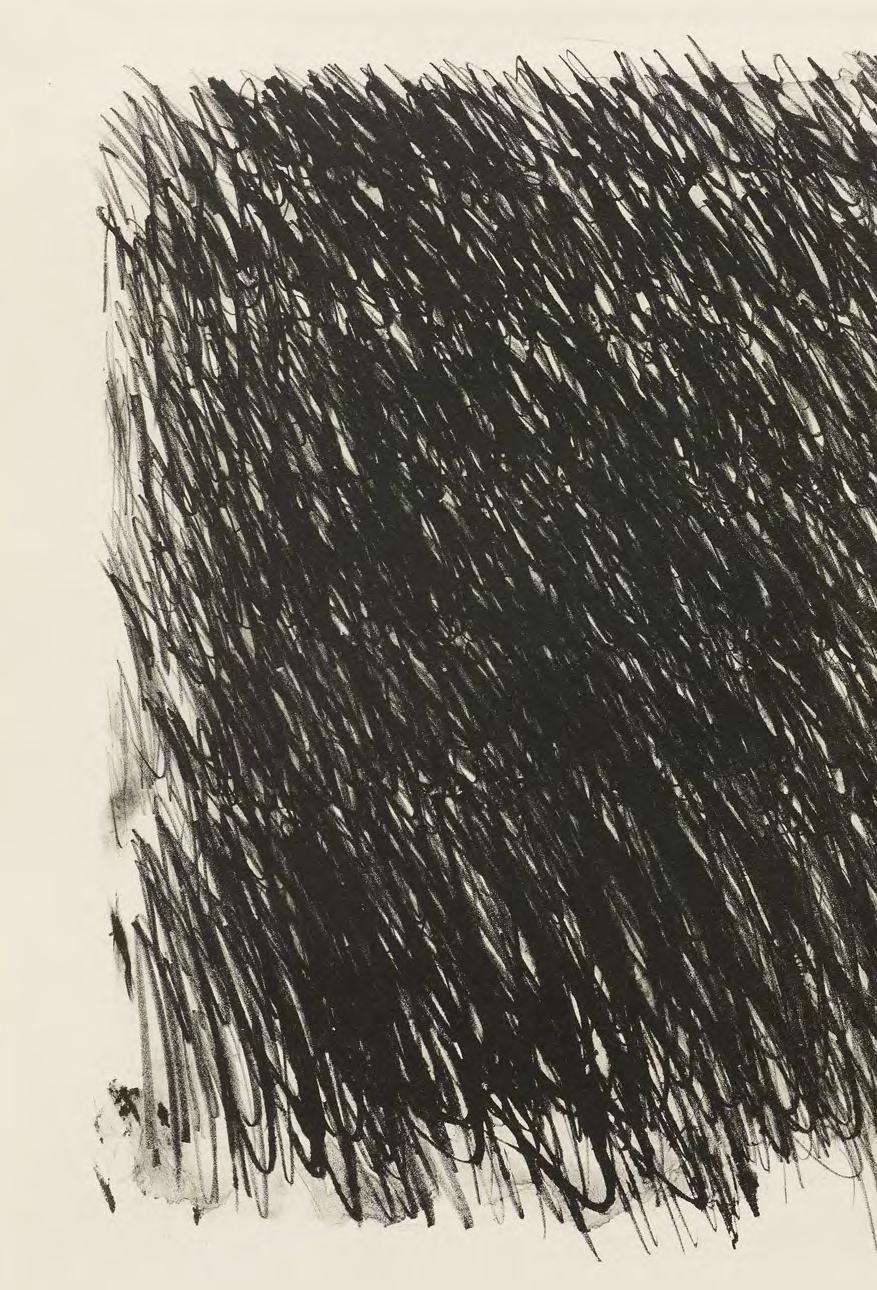
Printer and Publisher: Untitled Press, Inc., Captiva Island, Florida
Edition size: 24, plus proofs
Catalogue Raisonné: Bastian 34
Signed, dated, and numbered
After meeting as students at the Art Students League of New York, Robert Rauschenberg encouraged a young Cy Twombly to attend Black Mountain College, where Rauschenberg had previously had a formative experience studying under Josef Albers. The two artists attended the North Carolina campus together in 1951, working under the stewardship of faculty including Franz Kline, Robert Motherwell, and Ben Shahn.
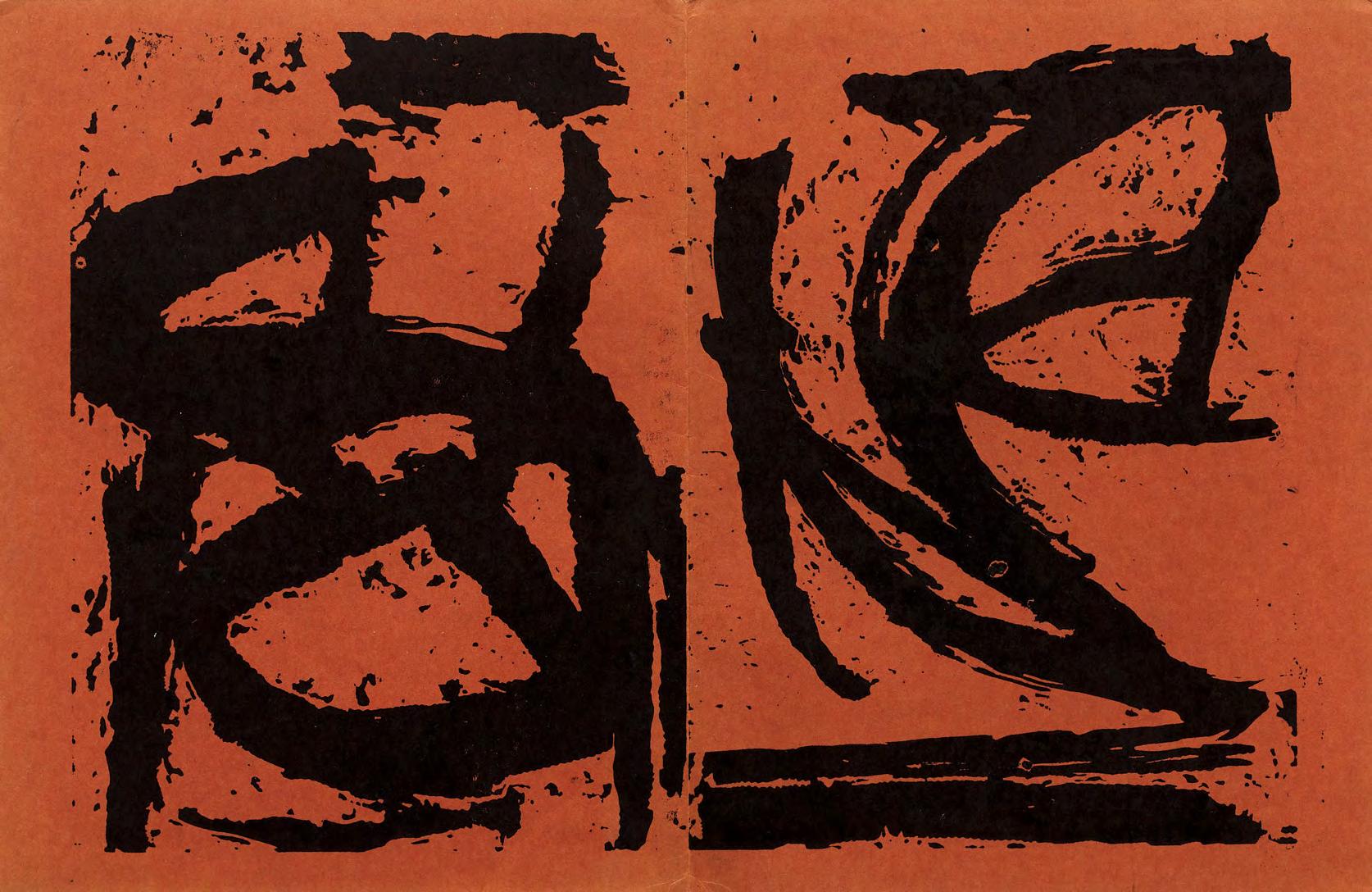
Black Mountain College was considered an American successor to the German Bauhaus, and the school encouraged cross-disciplinary collaboration. When Twombly visited the campus again in the summer of 1952, he was tasked with overseeing the design of broadsides for Robert Duncan’s poem “Song of the Border Guard” at the Black Mountain Graphic Workshop. When initial plans for the accompanying print were deemed unsatisfactory, Twombly took on the project himself, designing and printing the linocut in its entirety.
Cy Twombly
Untitled (The Song of the Border Guard), 1952
Linocut on red paper
Sheet size: 13 x 20 inches
(33 x 50.8 centimeters)
Printer: The Artist
Publisher: Black Mountain Graphics Workshop, Black Mountain, North Carolina
Edition size: Unknown, possibly 30-40 copies
Catalogue Raisonné: Bastian 1
Provenance:
Fine Arts Museums of San Francisco, Sold to Benefit the Acquisition Fund of the Achenbach Foundation for Graphic Arts
With letterpress poem “The Song of the Border Guard” by Robert Duncan inserted on a separate broadsheet.
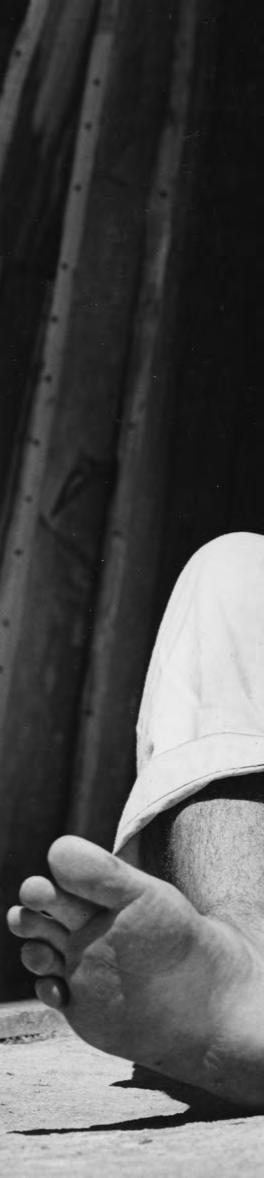
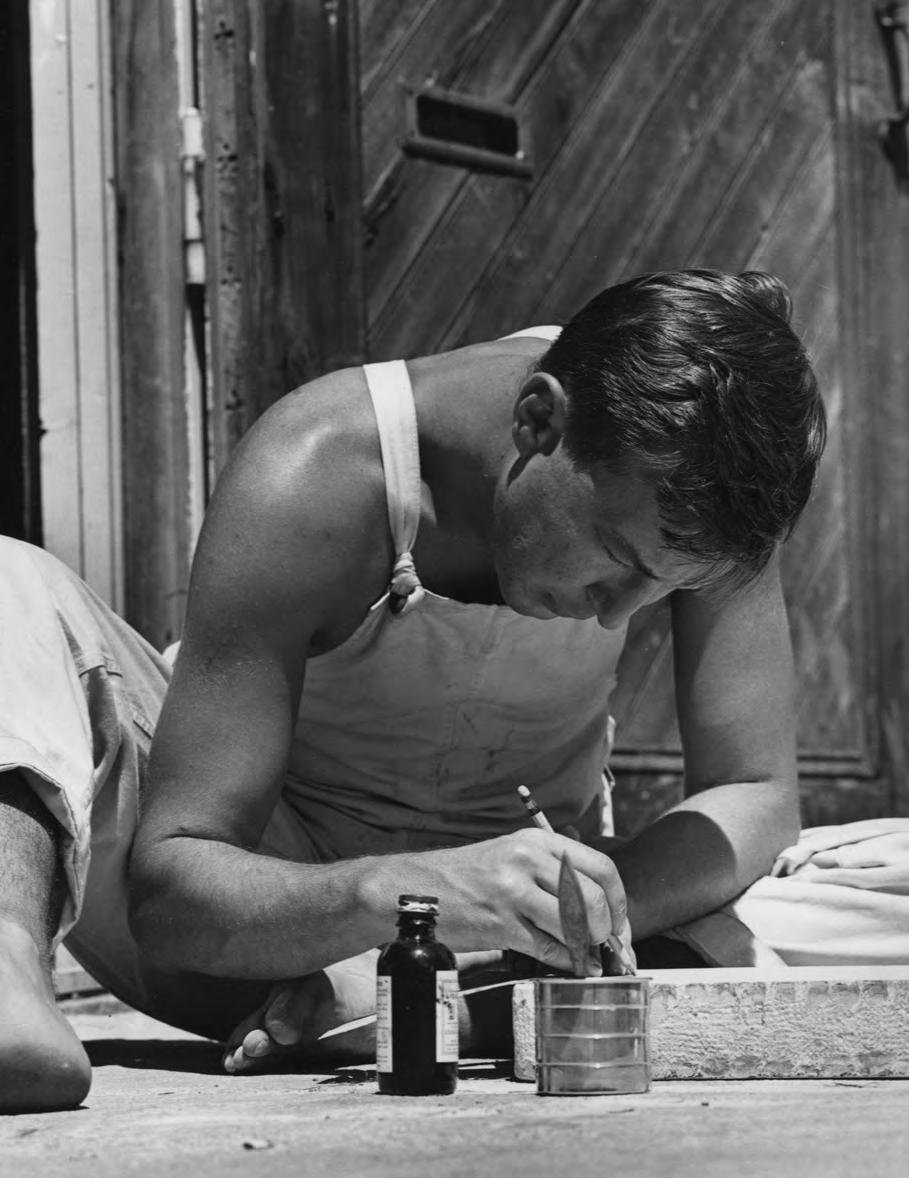
The lithographs Jasper Johns created at Universal Limited Art Editions workshop in West Islip, New York are among the most important of his graphic works. His dexterity in the medium allowed him to pursue the representation and re-representation of choice motifs.
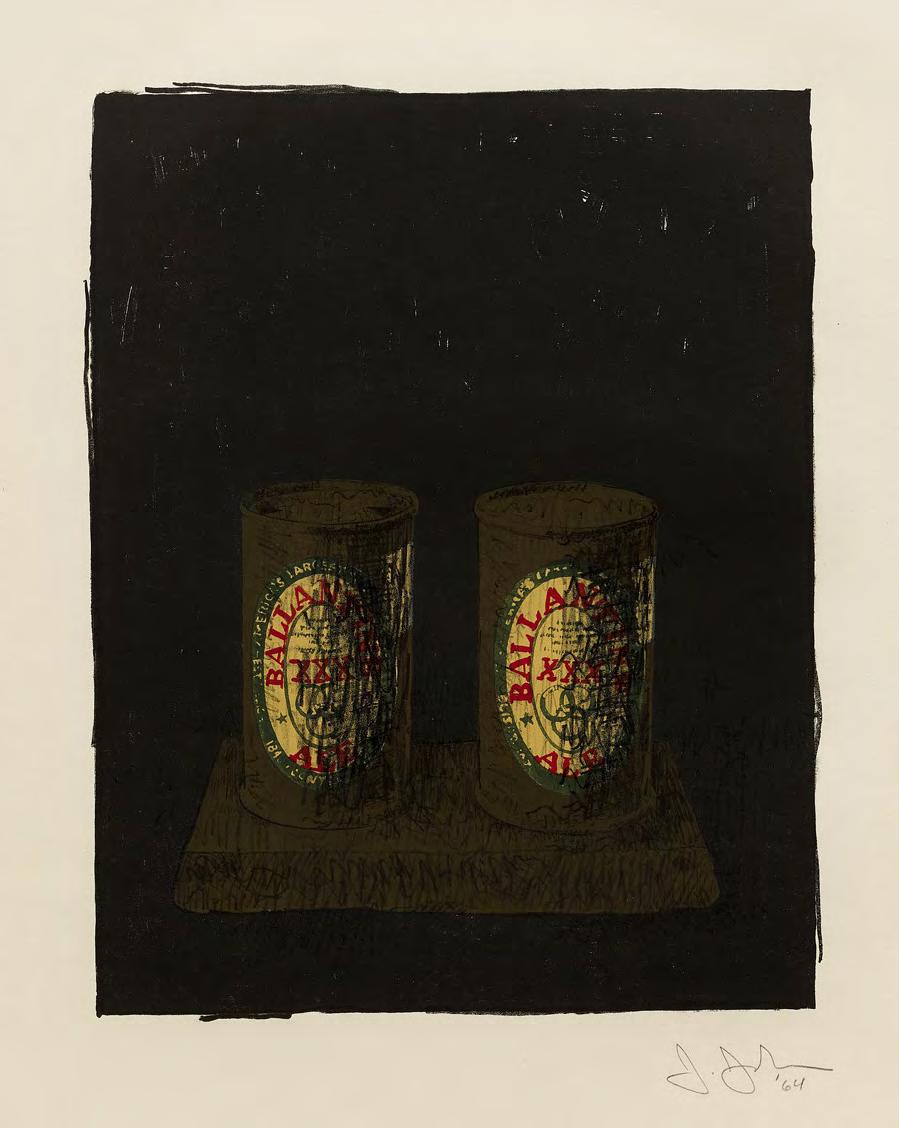
One of Johns’ earliest lithographs, Ale Cans, revisits a pair of Ballantine ale cans which first appeared in the 1960 sculpture Painted Bronze. The work was allegedly inspired by Willem de Kooning’s characterization of Leo Castelli: “That sonofabitch, give him two beer cans and he could sell them.” The lithograph closely resembles the sculpture, but the opaque black background reduces the print’s spatial depth, emphasizing the flatness of the medium rather than the dimensionality of the object.
Jasper Johns
Ale Cans, 1964
Lithograph
Sheet size: 22 1/2 x 17 3/4 inches (57.2 x 45.1 centimeters)
Printer and Publisher: ULAE, West Islip, New York
Edition size: 31, plus proofs
Catalogue Raisonné: ULAE 20 Signed, dated, and numbered
Provenance:
David Whitney, New York
David Whitney (1939-2005) was an American curator and collector. The long-time partner of renowned architect Philip Johnson, Whitney established close friendships with leading artists including Jasper Johns. He organized several important exhibitions at the Whitney Museum of American Art featuring the artist’s work.
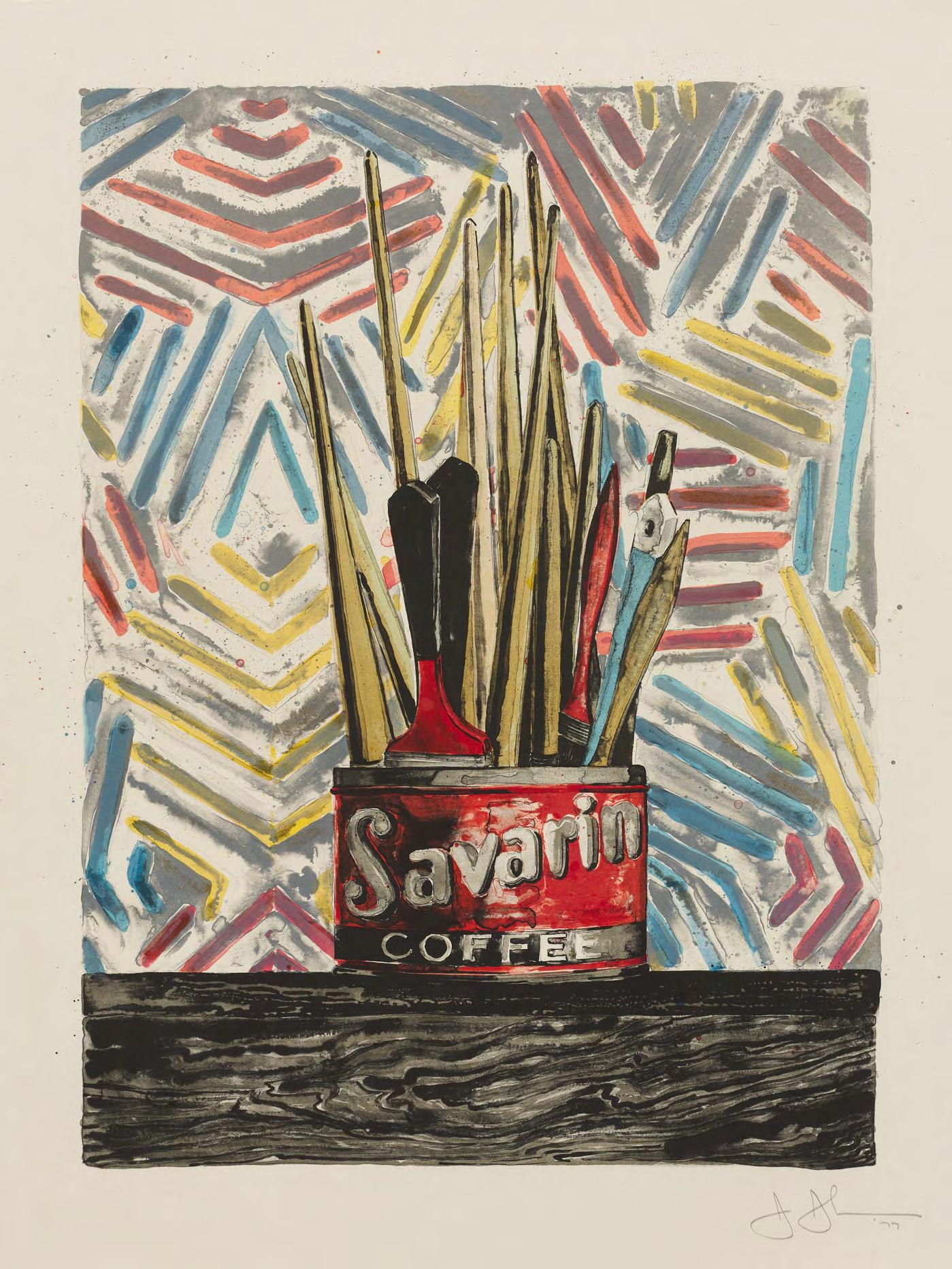
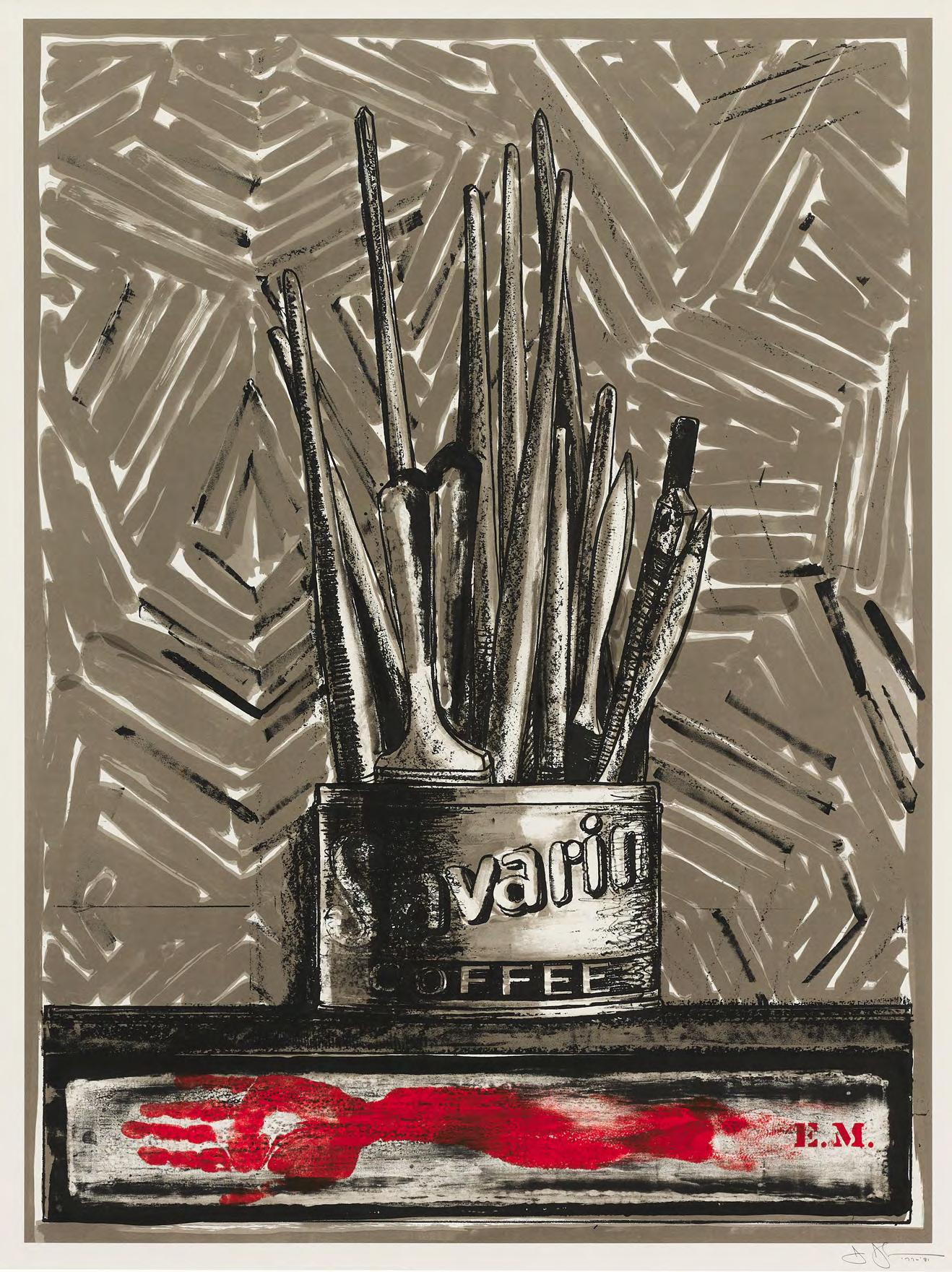
Another version of Johns’ Painted Bronze sculpture, now in the collection of the Museum of Modern Art, depicts a life-sized Savarin coffee can filled with used paintbrushes. This work was the impetus behind Johns’ sustained engagement with the Savarin image in lithography. The simplicity of Ale Cans is complicated by the inclusion of crosshatching, a recurring motif across Johns’s paintings and prints that speaks to the influence of Edvard Munch—specifically the artist’s late painting Self-Portrait: Between the Clock and the Bed The illusionistic horizontal panel of woodgrain lining the bottom of the print also serves as a tactile reference to Munch’s celebrated lithograph, The Scream.
Jasper Johns
Savarin, 1977
Lithograph
Sheet size: 45 1/4 x 33 7/8 inches (114.9 x 86 centimeters)
Printer and Publisher: ULAE, West Islip, New York
Edition size: 50, plus proofs
Catalogue Raisonné: ULAE 183
Signed, dated, and numbered
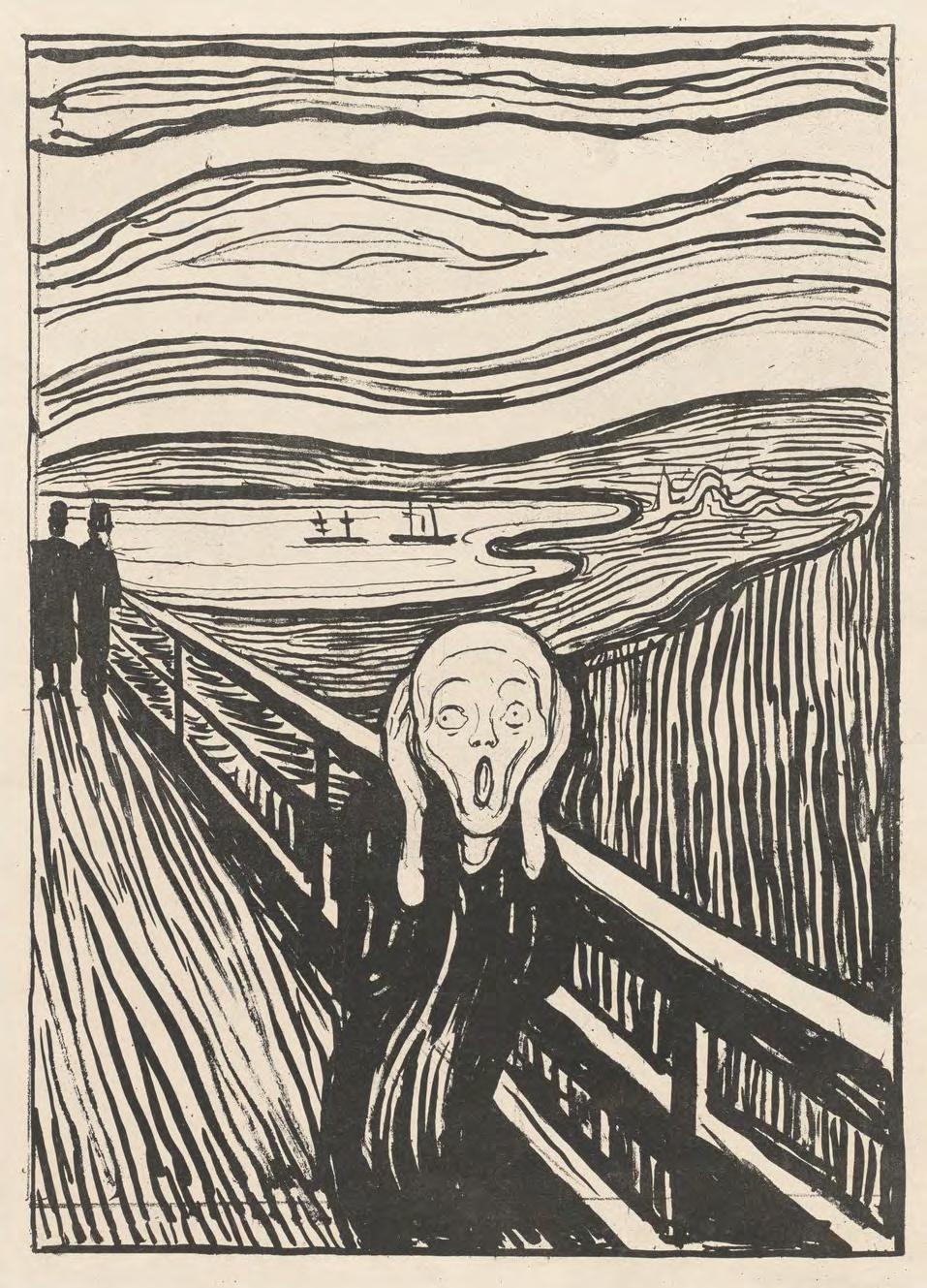
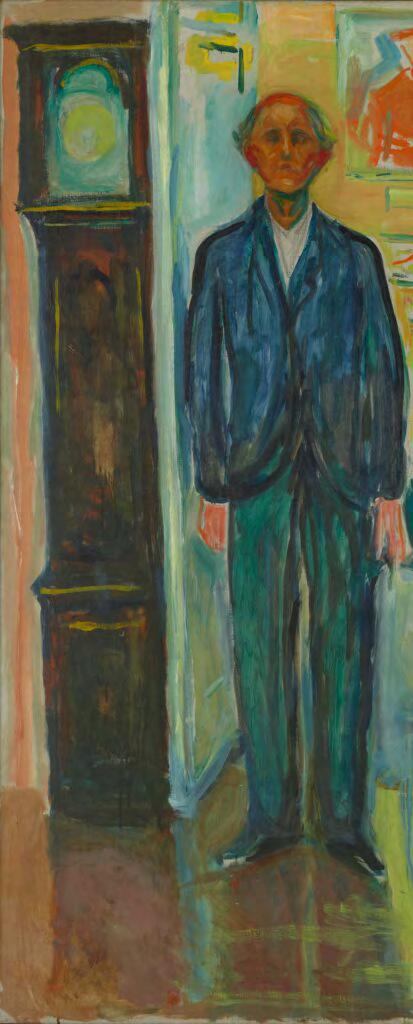
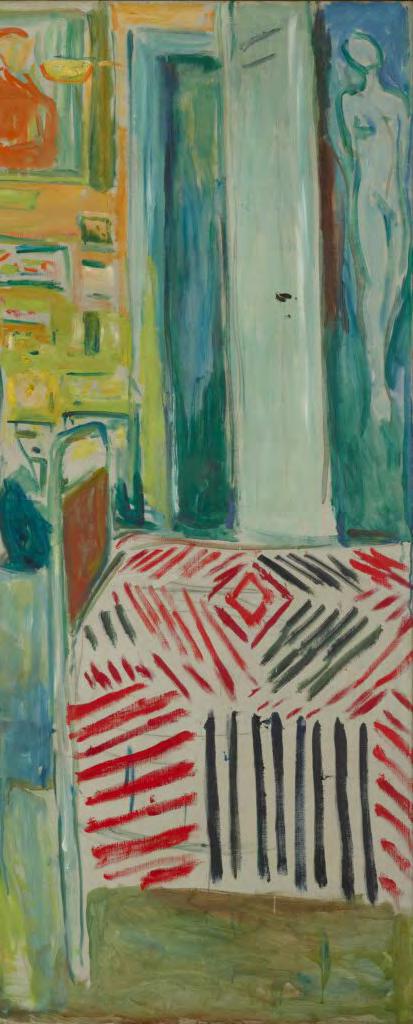
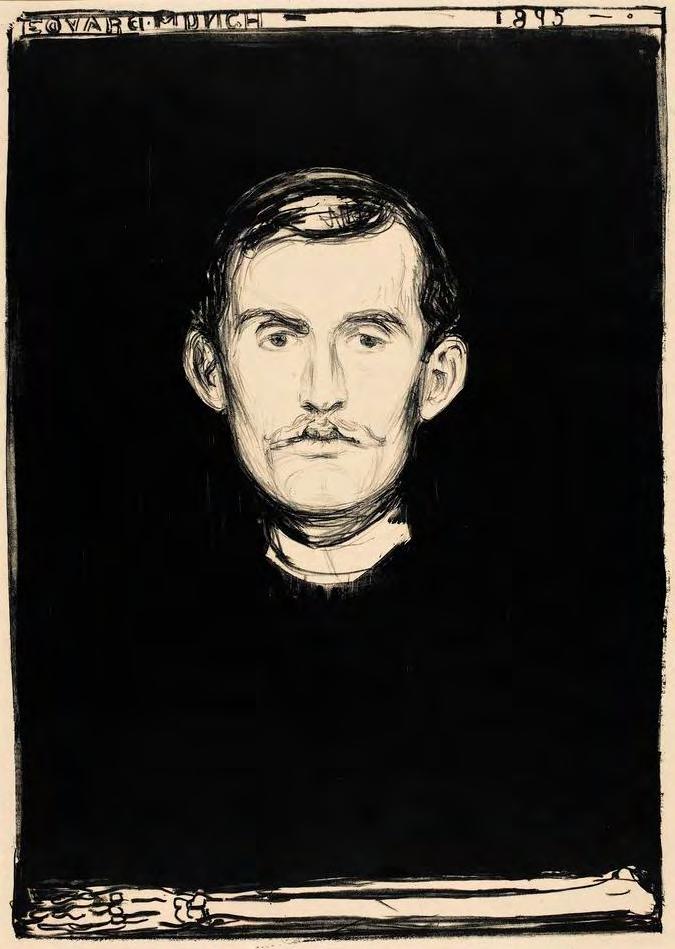
Munch’s influence is most pronounced in this version of Savarin, where the artist’s initials join a red imprint of a hand and forearm at the bottom of the composition, a nod to Munch’s 1895 Self-Portrait. In this context, the lithograph can be read as Johns’ own self-portrait, the Savarin can serving as a metaphor for the artist.
Jasper Johns
Savarin, 1981
Lithograph
Sheet size: 50 1/8 x 38 inches (127.3 x 96.5 centimeters)
Printer and Publisher: ULAE, West Islip, New York
Edition size: 60, plus proofs
Catalogue Raisonné: ULAE 220 Signed, dated, and numbered
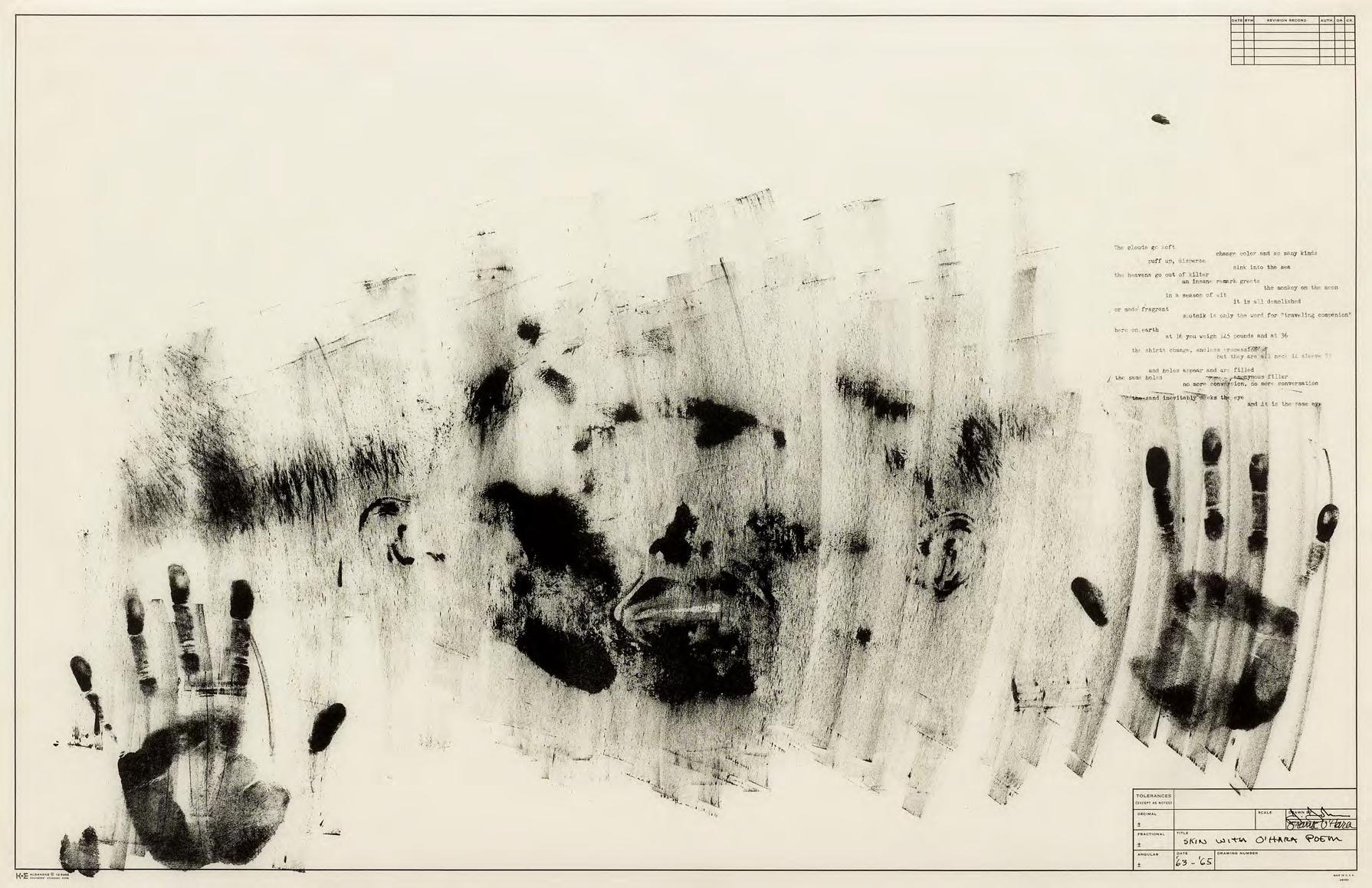
Skin with O’Hara Poem expands on the series of Skin drawings Johns completed in the early 1960s, charcoal- and oil-based works on paper created from impressions of the artist’s own body. To create the image, Johns oiled his face and hands before rolling them on a lithographic stone, then rubbed charcoal across the surface, which clung more densely to the oiled areas. In juxtaposition to this distinctly human element, Johns specified that the work be printed on a thin sheet of drafting paper typically used in industrial processes such as engineering and architecture. Returning to the personal, the image was overlaid with the text of Johns’ close friend Frank O’Hara’s poem “The Clouds Go Soft,” a meditation on life and death. The pairing of the poem with the phantom traces of Johns’ body resulted in a haunting, ghostly effect.
Jasper Johns
Skin with O’Hara Poem, 1965
Lithograph
Sheet size: 22 x 33 7/8 inches (55.9 x 86 centimeters)
Printer and Publisher: ULAE, West Islip, NY
Edition size: 30, plus proofs
Catalogue Raisonné: ULAE 21
Signed, dated, titled, and numbered by the artist, signed by the poet Frank O’Hara
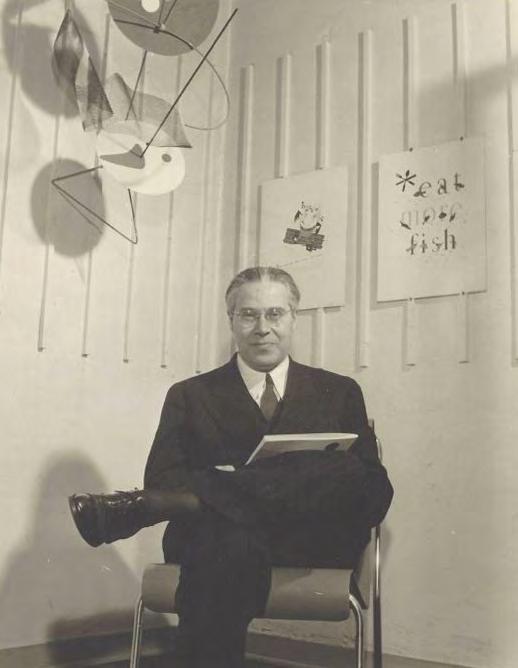
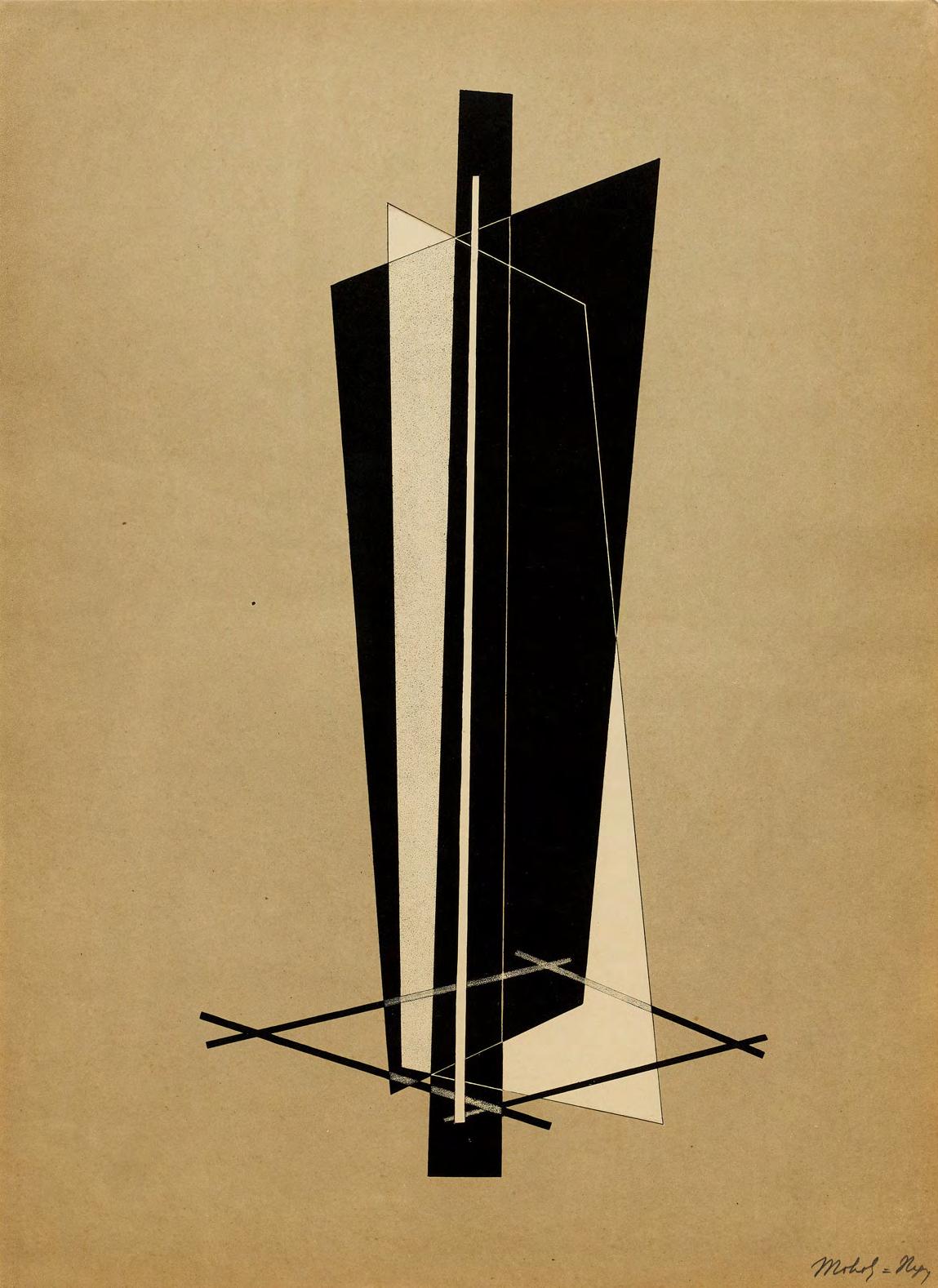
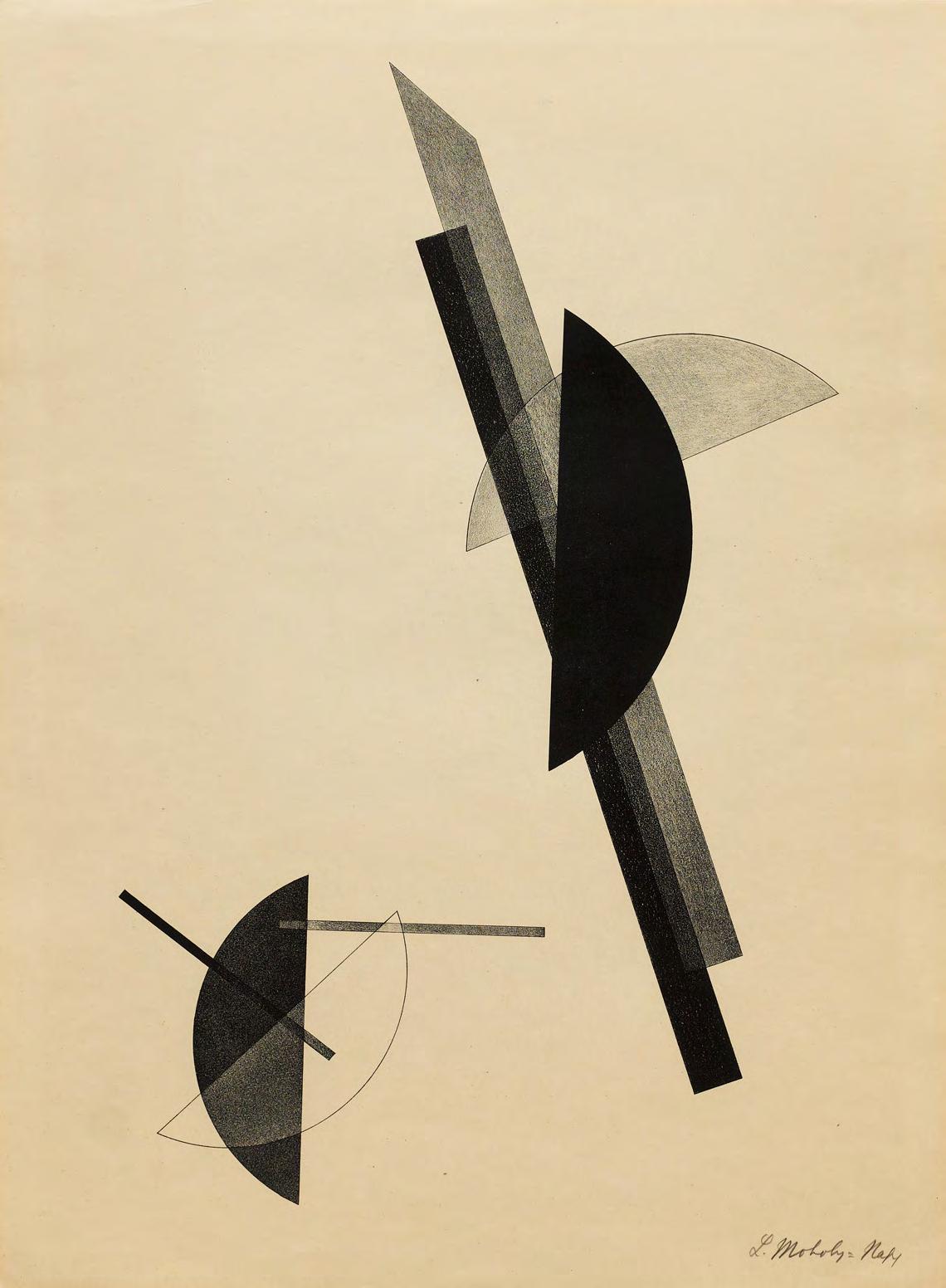
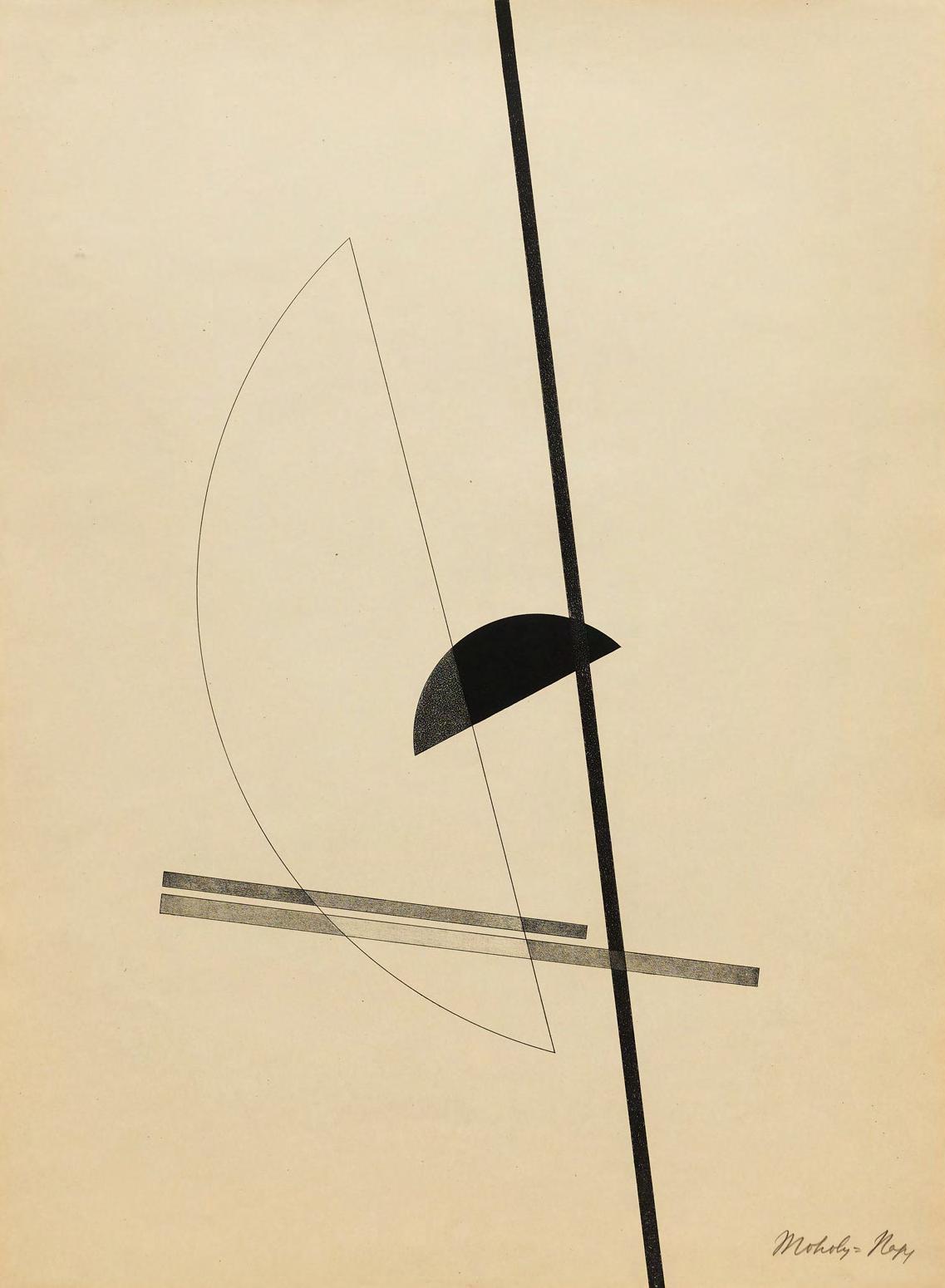
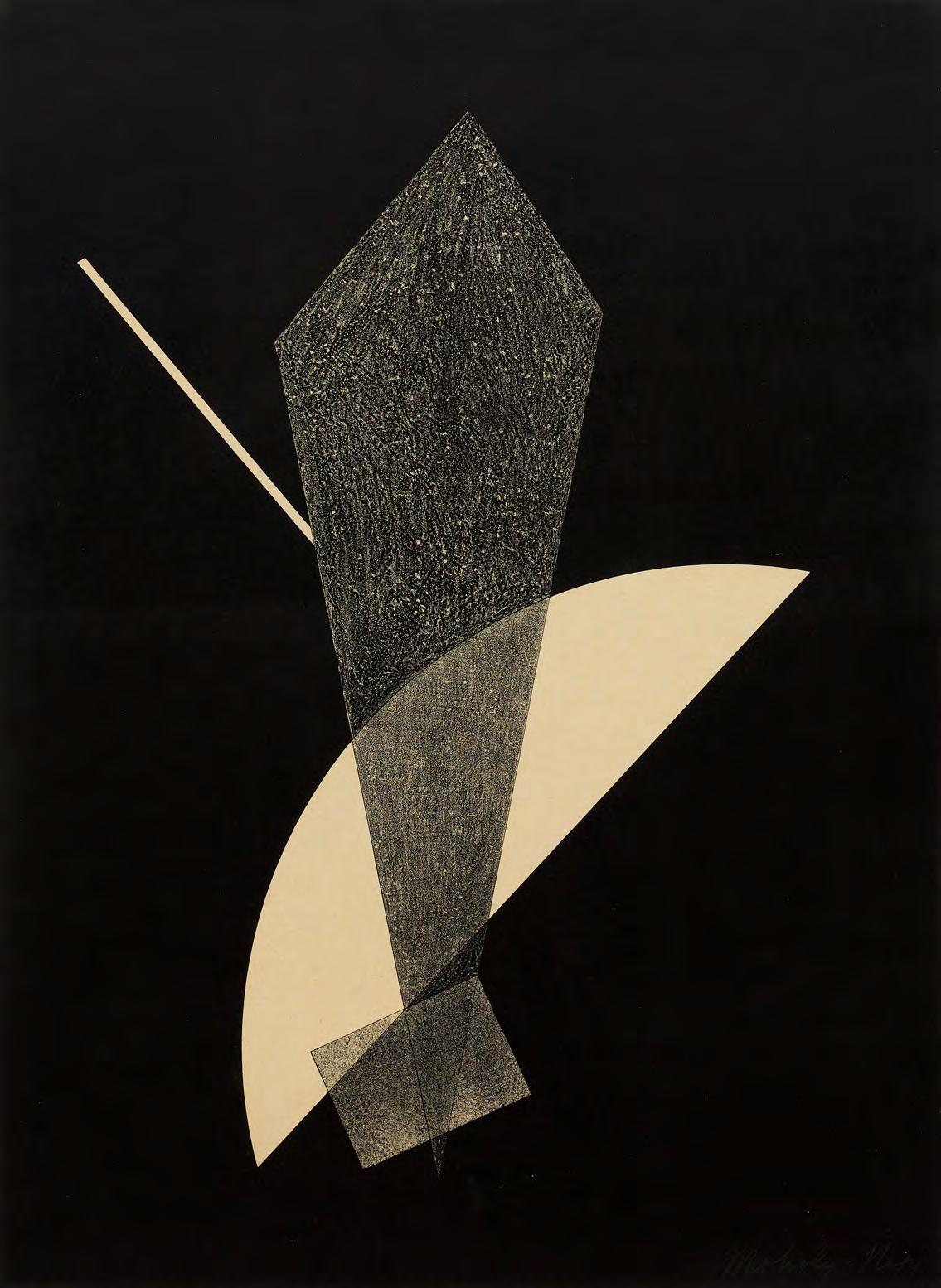
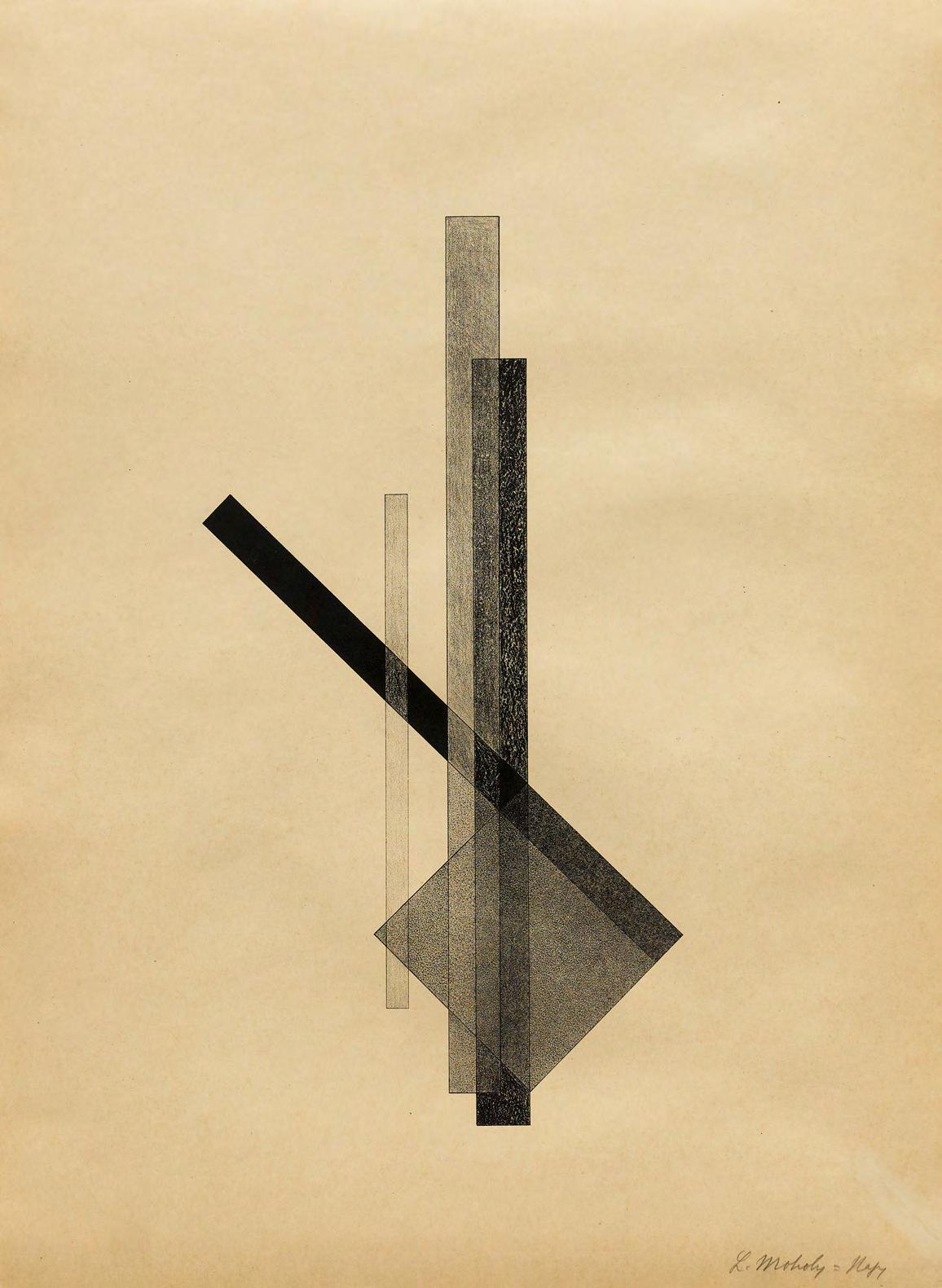
László Moholy-Nagy was a lifelong advocate for the integration of modern technology and art, as evidenced by his wide-ranging and innovative practice. Born in Hungary, Moholy-Nagy emigrated to Germany following the fall of the short-lived Hungarian Soviet Republic. Largely influenced by Russian Constructivism, Moholy-Nagy found a natural home at the Bauhaus, where he served as a professor from 1923 to 1928, first in Weimar, then in Dessau. He taught foundation courses alongside Josef Albers and edited the Bauhausbücher, a series of influential books that defined the core ideas of the movement, with founder Walter Gropius.
Photography and graphic design were central to Moholy-Nagy’s practice, but his experimentation across media was without bounds. His wife, Lucia, was an accomplished photographer who documented the Bauhaus architecture, and together they explored the use of photograms, a form of cameraless photography created through manipulation of light-sensitive paper in a darkroom.
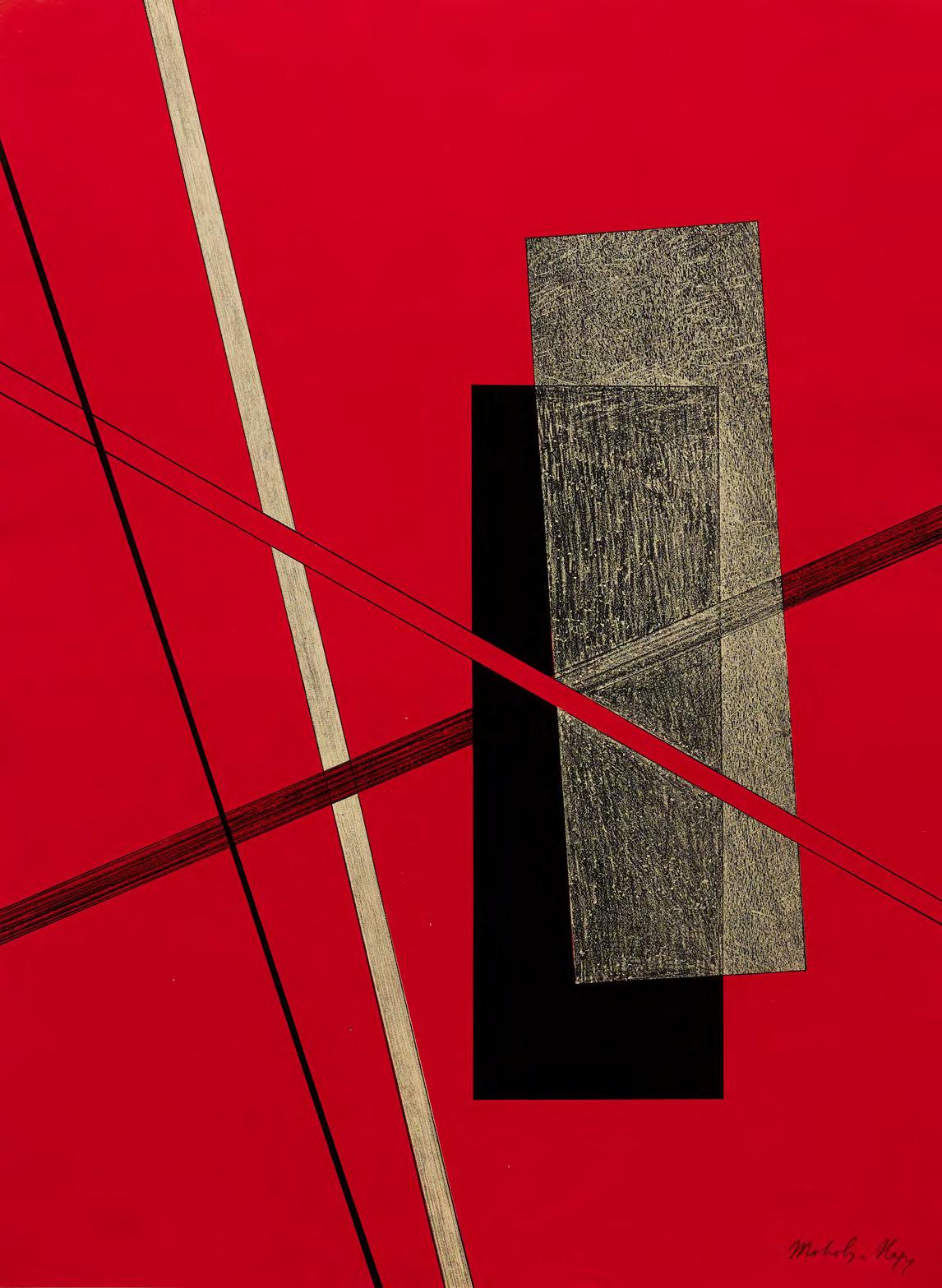
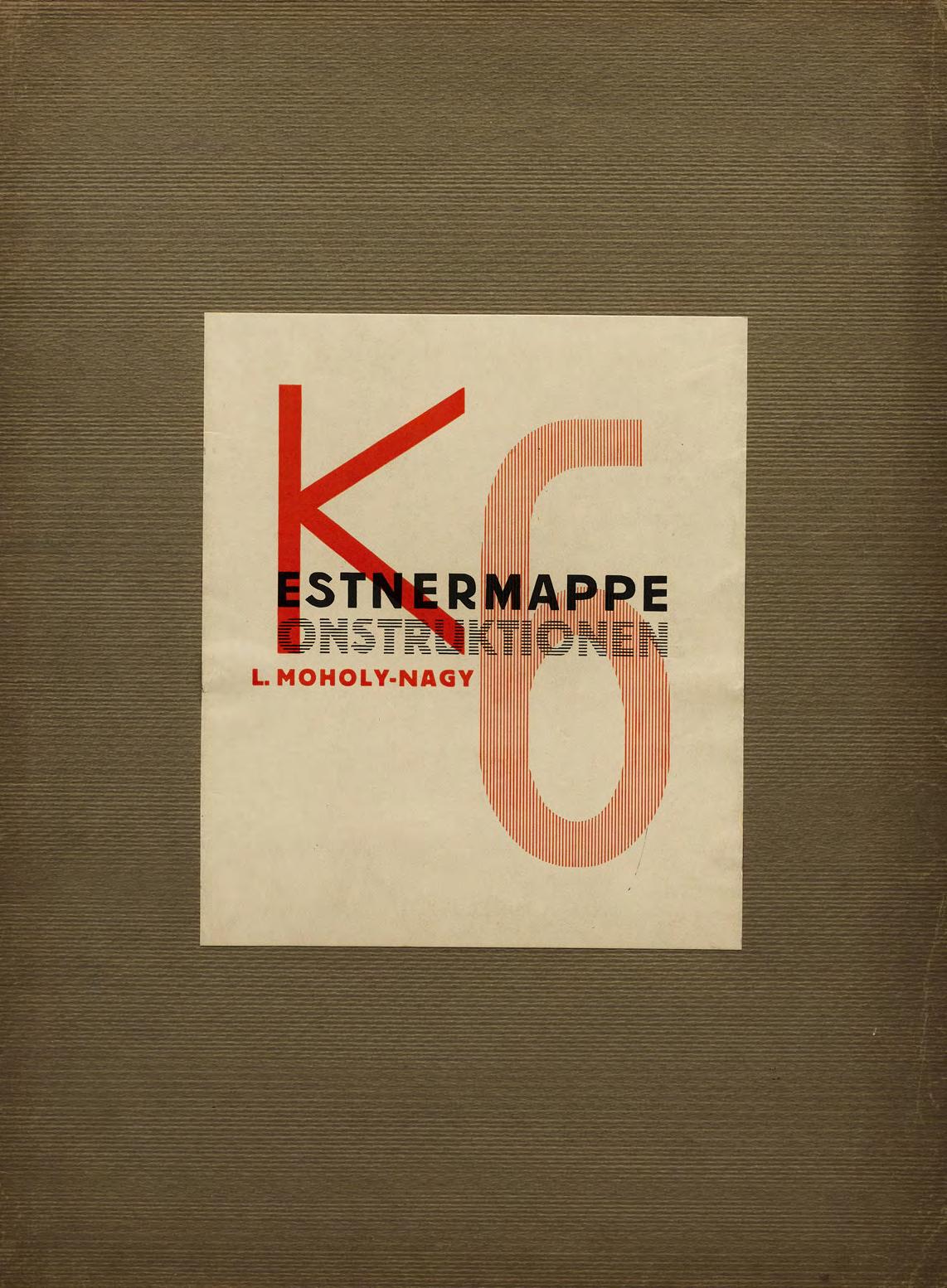
Printmaking played a smaller but no less significant role in his work. Moholy-Nagy’s early prints were mainly woodcuts and linocuts that appeared in books and journals, but his best known work in the medium is a portfolio of six lithographs commissioned by the Kestner-Gesellschaft (the Kestner Society). Founded in Hanover, Germany in 1916, the Kestner Society was a contemporary art institute that sought to promote the international avant-garde. Their early programming exhibited artists including Wassily Kandinsky, Käthe Kollwitz, and El Lissitzky. In 1923, the society commissioned a set of six prints from Lissitzky: I. Kestnermappe Proun. The success of the project led the society to commission five subsequent portfolios that year, the last of which was Moholy-Nagy’s Konstruktionen: Kestnermappe 6.
Moholy-Nagy’s compositions feature the intersecting planes characteristic of avant-garde geometry, carefully balanced to form dynamic, abstract architectural structures, while halftones and subtle color gradation recall the study of light found in his photograms. Together, Lissitzky’s and Moholy-Nagy’s Kestner Portfolios constitute two of the most important examples of Constructivist printmaking.
László Moholy-Nagy
Konstruktionen. Kestnermappe 6, 1923
Lithographs
Sheet size: 23 1/2 x 17 1/4 inches, each (59.7 x 43.8 centimeters, each)
Printer: Robert Leunis and Chapman, Hannover, Germany
Publisher: Eckart von Sydow, Hannover, Verlag des Buchhändlers Ludwig Ey, Hannover, Germany
Edition size: 50, plus proofs
Catalogue Raisonné: Passuth 122-127
Each sheet is signed, numbered on justification page
Provenance:
The Artist
Collection of Walter Paepcke, Chicago, gift of the aritst
American private collection
Walter Paepcke was a prominent Chicago-based art collector, businessman, and philanthropist. As a member of the Association of Arts and Industries, Paepcke was introduced to László Moholy-Nagy when the artist immigrated to Chicago to lead The New Bauhaus: American School of Design. Following the school’s closure in 1939, Paepcke supported Moholy-Nagy in opening the Institute of Design in Chicago.
The complete set of six lithographs that retains its original justification page numbered in pencil, and linen-covered portfolio case with text label.
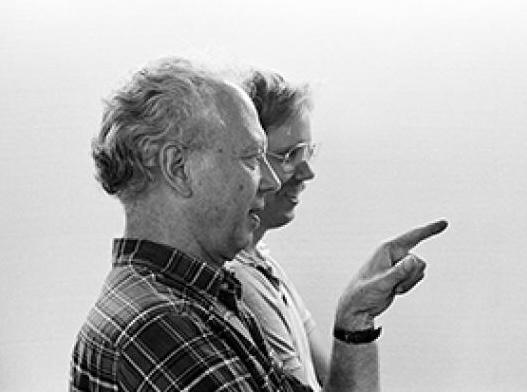
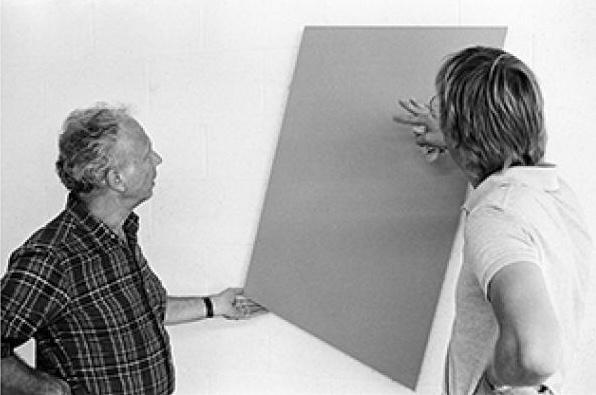
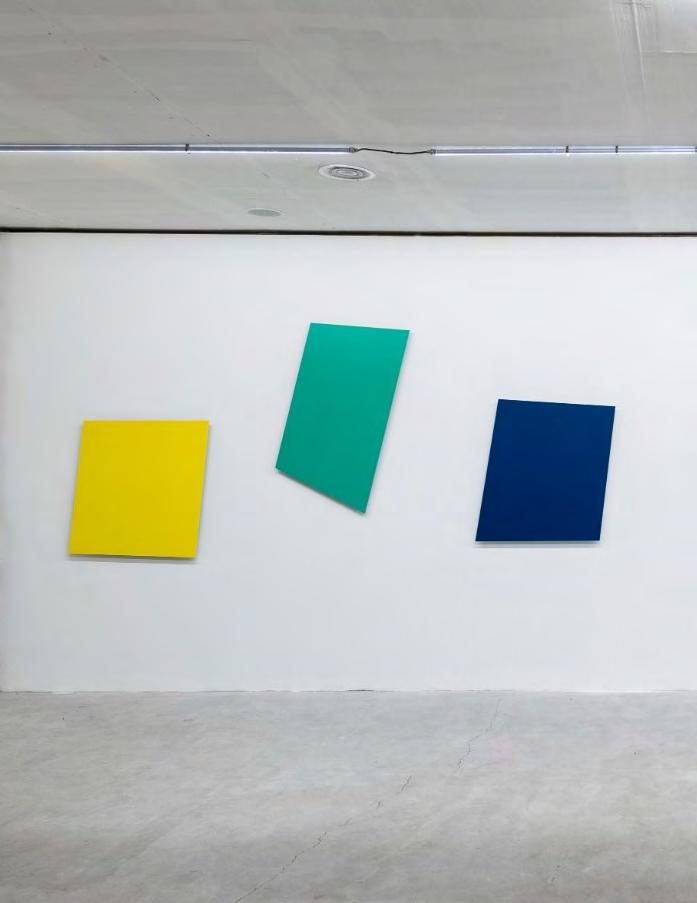
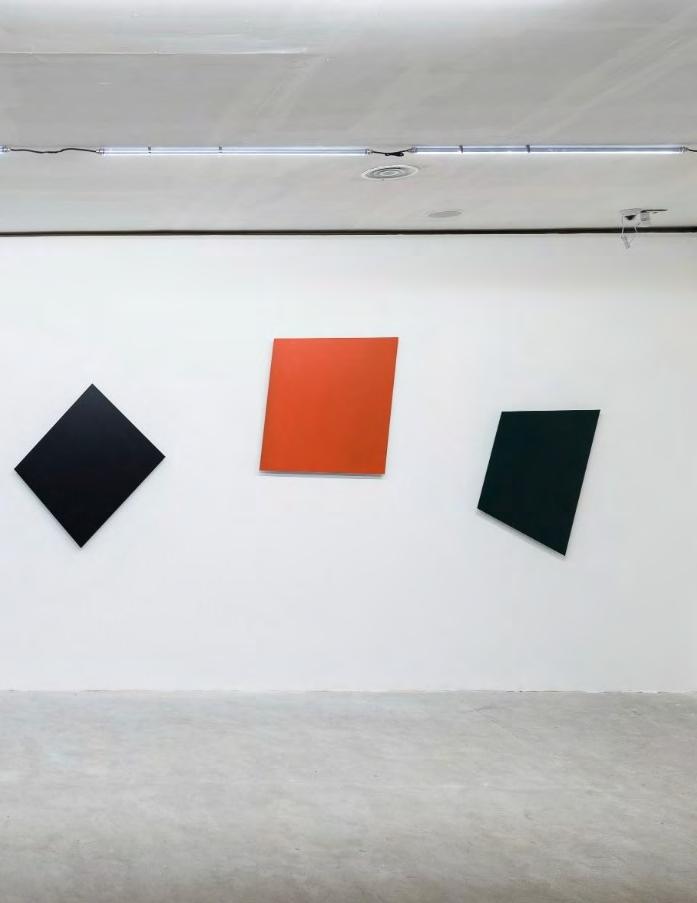
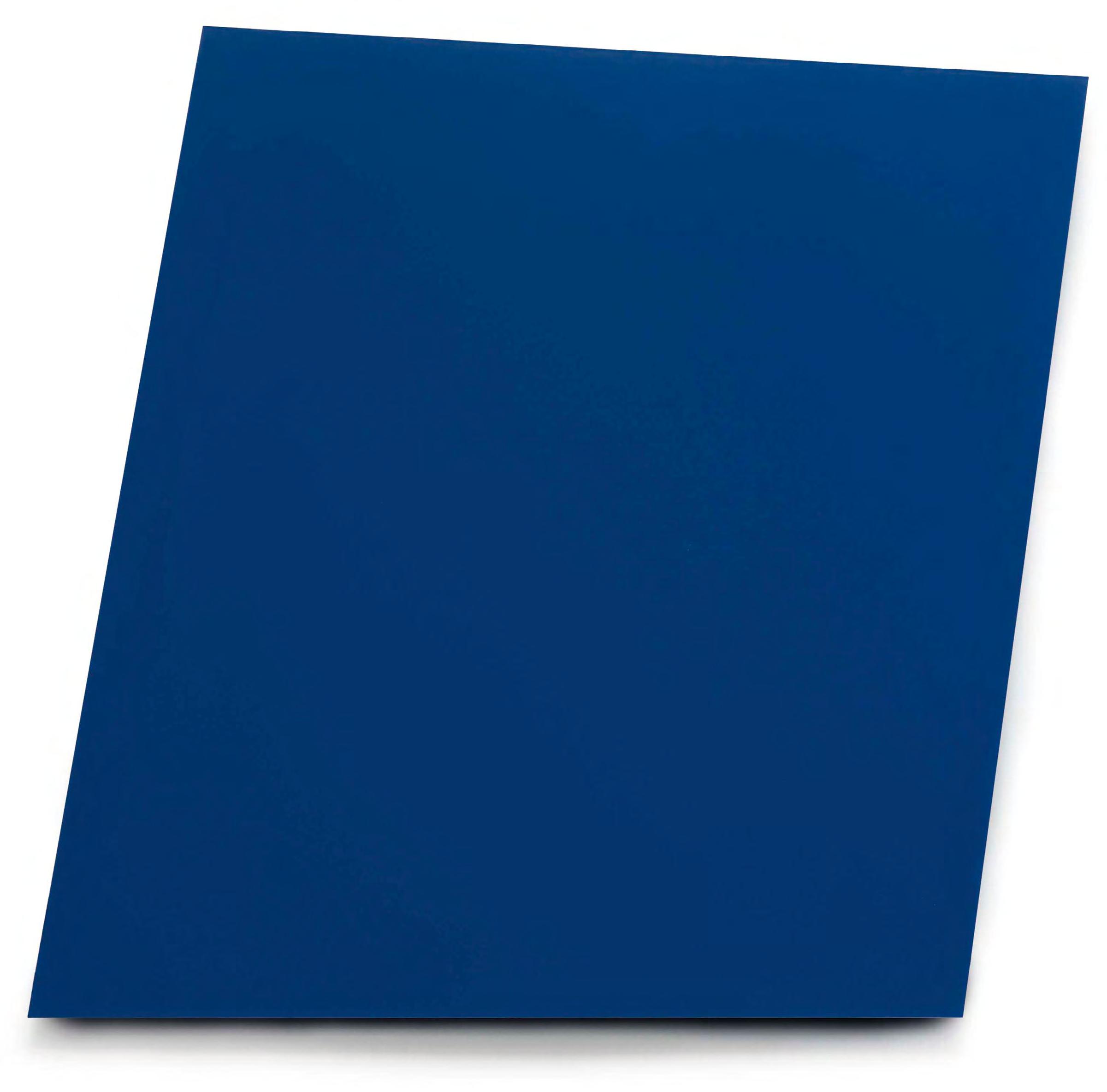
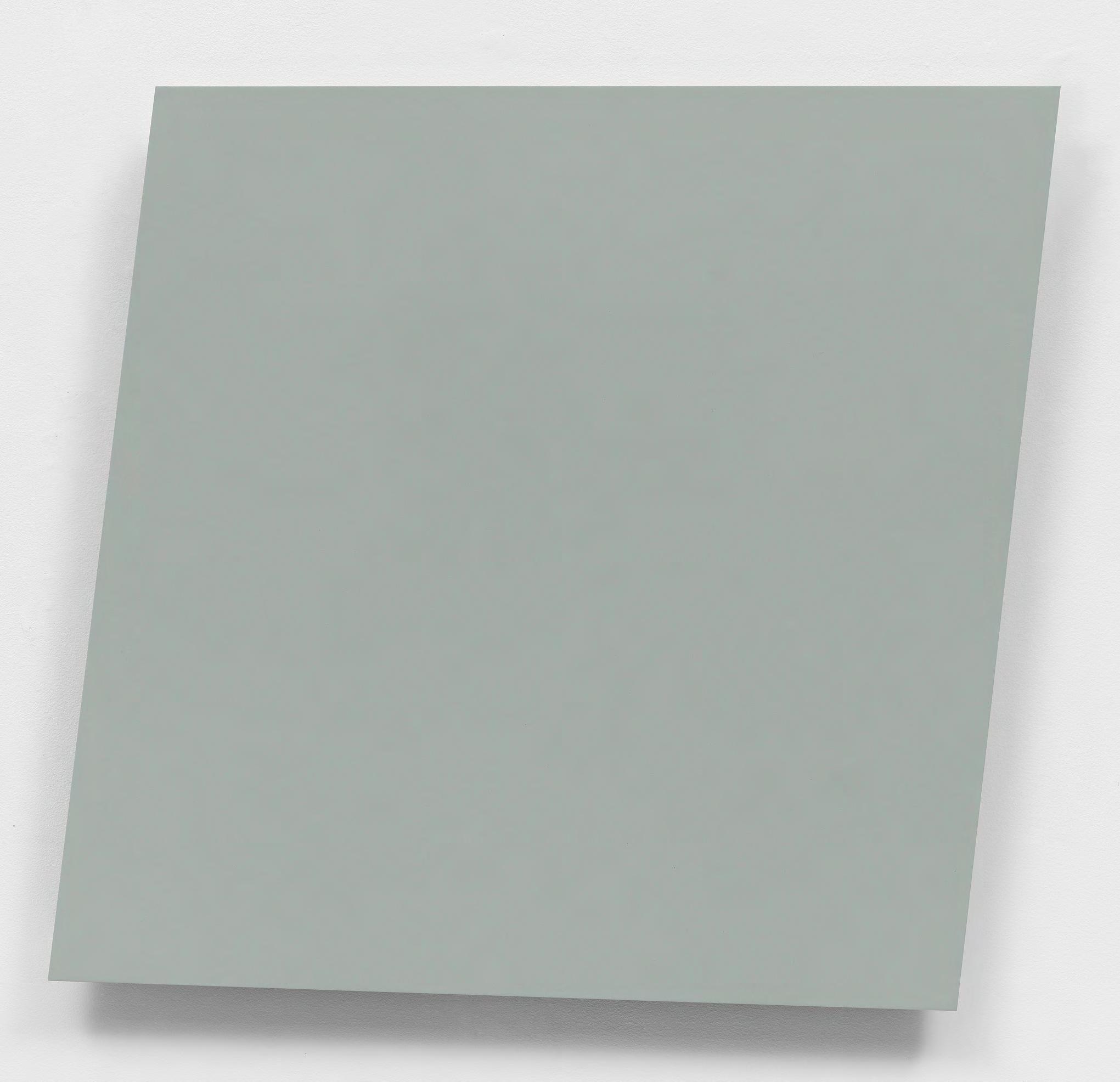
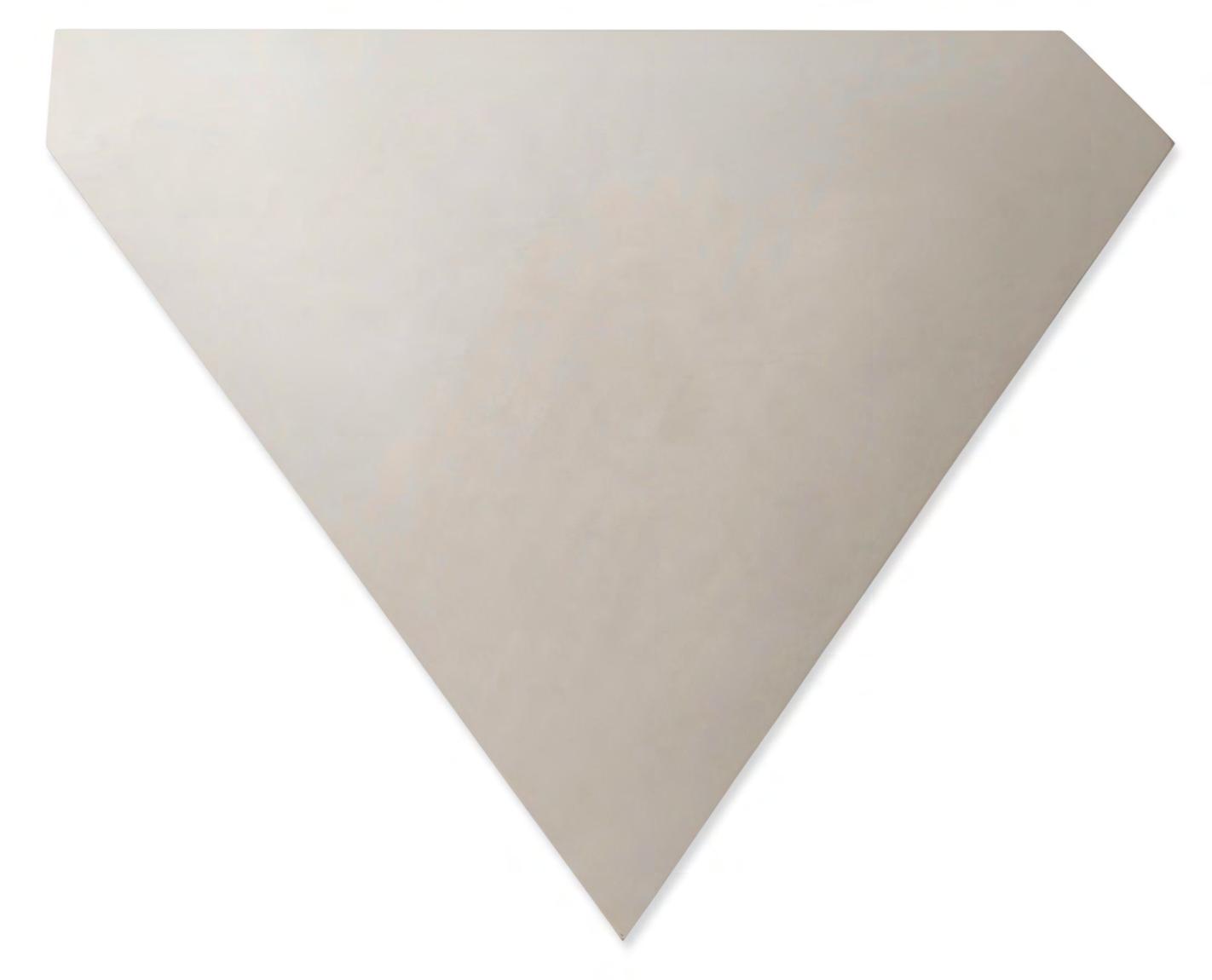
Ellsworth Kelly’s Painted Wall Sculptures, a series of eleven quadrilateral panels, was initially conceived as a portfolio of lithographs. However, Kelly was interested in a larger-scale project and decided his compositions were better suited to metal. The ambitions of the project fell outside the scope of Gemini G.E.L.’s technical capabilities, and Los Angeles-based art fabrication firm Peter Carlson Enterprises was brought on to realize the translation.
Kelly wanted to maintain the flatness and saturated color of the planned lithographs, but this goal proved challenging. Each panel was rough-cut from a large sheet of aluminum, and the shapes warped through the process. Two methods were used to flatten the metal: shot-peening, a process in which tiny steel balls are shot at the metal at high velocity causing the surface to expand, and hydraulic pressure. Matching the colors required an even more inventive solution, as the surface of paper amplifies color in a way aluminum does not. All eleven colors were specially formulated in collaboration between Kelly, Gemini G.E.L., and Peter Carlson Enterprises, with seven different paint thinners used during the application. The complex and time-consuming fabrication resulted in a small edition size: each panel was published in an edition of just nine, plus proofs.
Ellsworth Kelly’s Untitled (1986) shifts focus away from color strictly to form. Kelly drafted the precise angles with drawings and paper cutouts, and Peter Carlson Enterprises fabricated the sculptures from an alloy of stainless steel known as “French Super Bright,” which afforded the final product its pristine mirrored finish.
Both Dark Blue Panel and Untitled, exhibited here, are notable for their provenance from the personal collection of Peter Carlson. In the 1960s, Carlson fabricated multiple projects for Gemini G.E.L., working on experimental multiples such as Claes Oldenburg’s polyurethane relief Profile Airflow. After founding his own fabrication firm in the early 1970s, he maintained a working relationship with Gemini and completed projects with Robert Rauschenberg and Isamu Noguchi.
Peter Carlson’s relationship with Kelly was collaborative and prolific. Aside from projects at Gemini, Carlson fabricated large-scale, site-specific installations at the American Embassy in Beijing (2011), the Barnes Foundation in Philadelphia (2013), and at Kelly’s renowned chapel, Austin, at the Blanton Museum of Art (2015). Carlson described their relationship as follows: “My role was not interpretive in a traditional studio sense, but instead functioned as a technical problem-solver and production engineer, translating Kelly’s drawings into physical works.” Kelly, in turn, spoke of Carlson: “That’s a unique gift, to translate an idea an artist has into something tangible.”
Following page: Installation view of Painted Wall Sculptures at Fondazione Nicola Del Roscio in Rome, 2023
Ellsworth Kelly
Dark Blue Panel, 1982
Painted aluminum panel
Size: 31 1/2 x 32 x 1/4 inches
(80 x 81.3 x 0.6 centimeters)
Fabricator: Peter Carlson Enterprises
Publisher: Gemini, G.E.L., Los Angeles
Edition size: 9, plus proofs
Catalogue Raisonné: Gemini 989
Signed, dated, titled, and annotated “Special Proof” on a metal plate on verso
Provenance:
Peter Carlson, founder of art fabrication firm Peter Carlson Enterprises (later known as Carlson Baker Arts), Los Angeles, California
From the series Painted Wall Sculptures.
Ellsworth Kelly
Gray Panel, 1982
Painted aluminum panel
Size: 30 1/4 x 33 1/8 x 1/4 inches
(76.8 x 84.1 x 0.6 centimeters)
Publisher: Gemini, G.E.L., Los Angeles
Edition size: 9, plus proofs
Catalogue Raisonné: Gemini 983
Signed, dated, titled, and numbered on a metal plate on verso
Provenance:
The Greenberg Gallery, Saint Louis
Susan Sheehan Gallery, New York American private collection
From the series Painted Wall Sculptures.
Ellsworth Kelly
Untitled, 1986
Polished stainless steel
Size: 24 1/2 x 30 x 1/4 inches
(62.23 x 76.2 x 0.6 centimeters)
Fabricator: Peter Carlson Enterprises
Publisher: Gemini, G.E.L., Los Angeles
Edition size: 9, plus proofs
Catalogue Raisonné: Gemini 1260
Signed, dated, and annotated “SP II”on a metal plate on verso
Provenance:
Peter Carlson, founder of art fabrication firm Peter Carlson Enterprises (later known as Carlson Baker Arts), Los Angeles, California
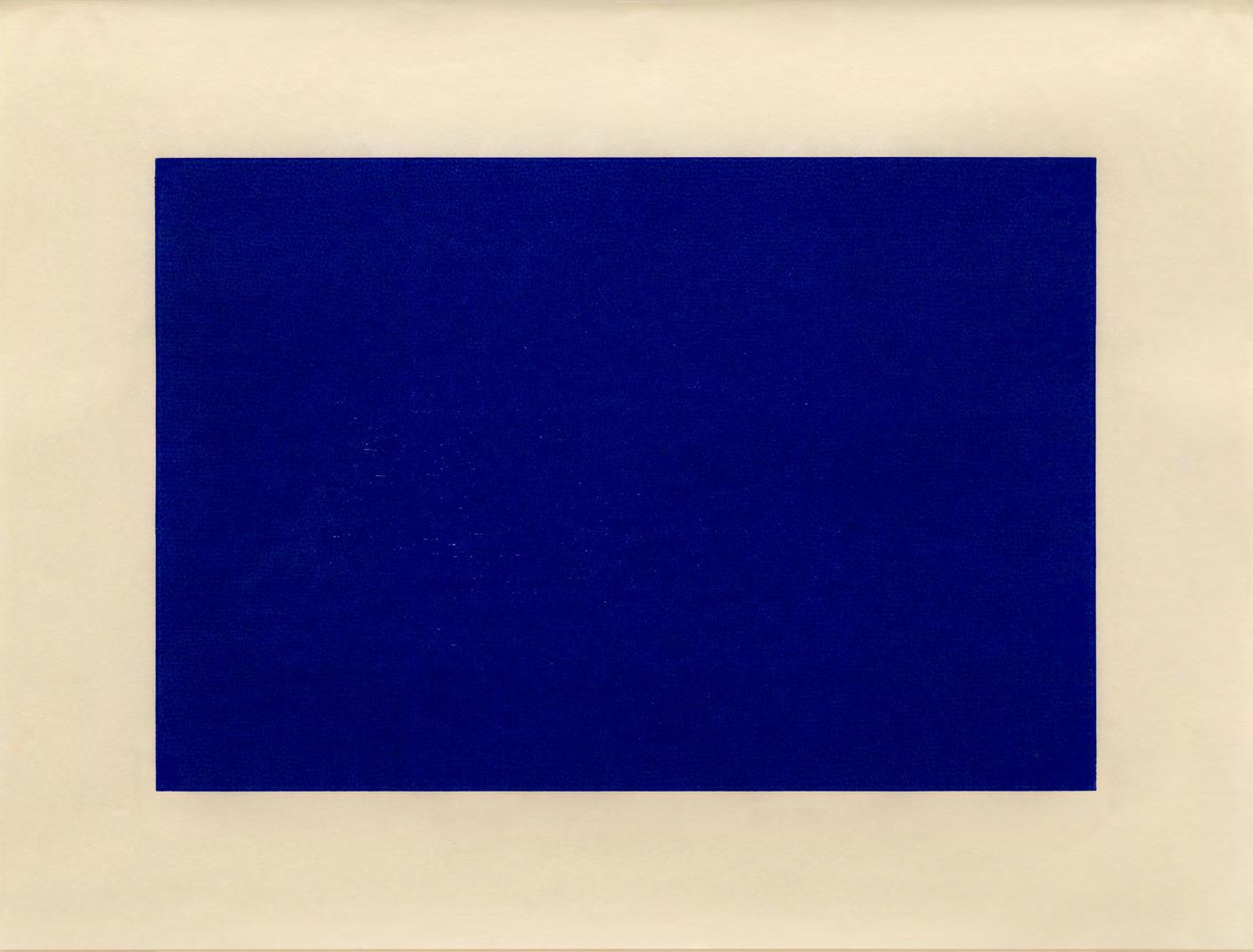
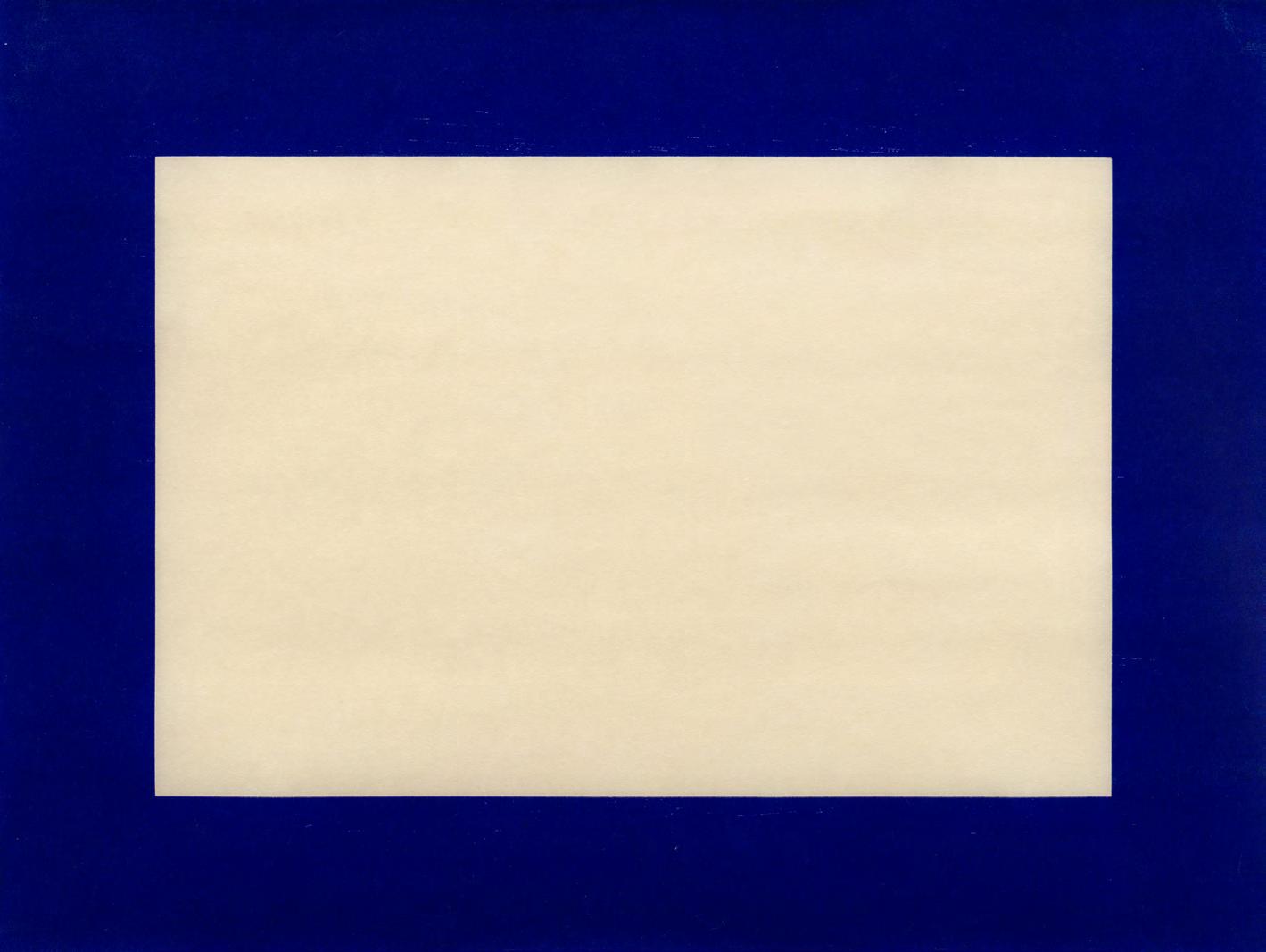
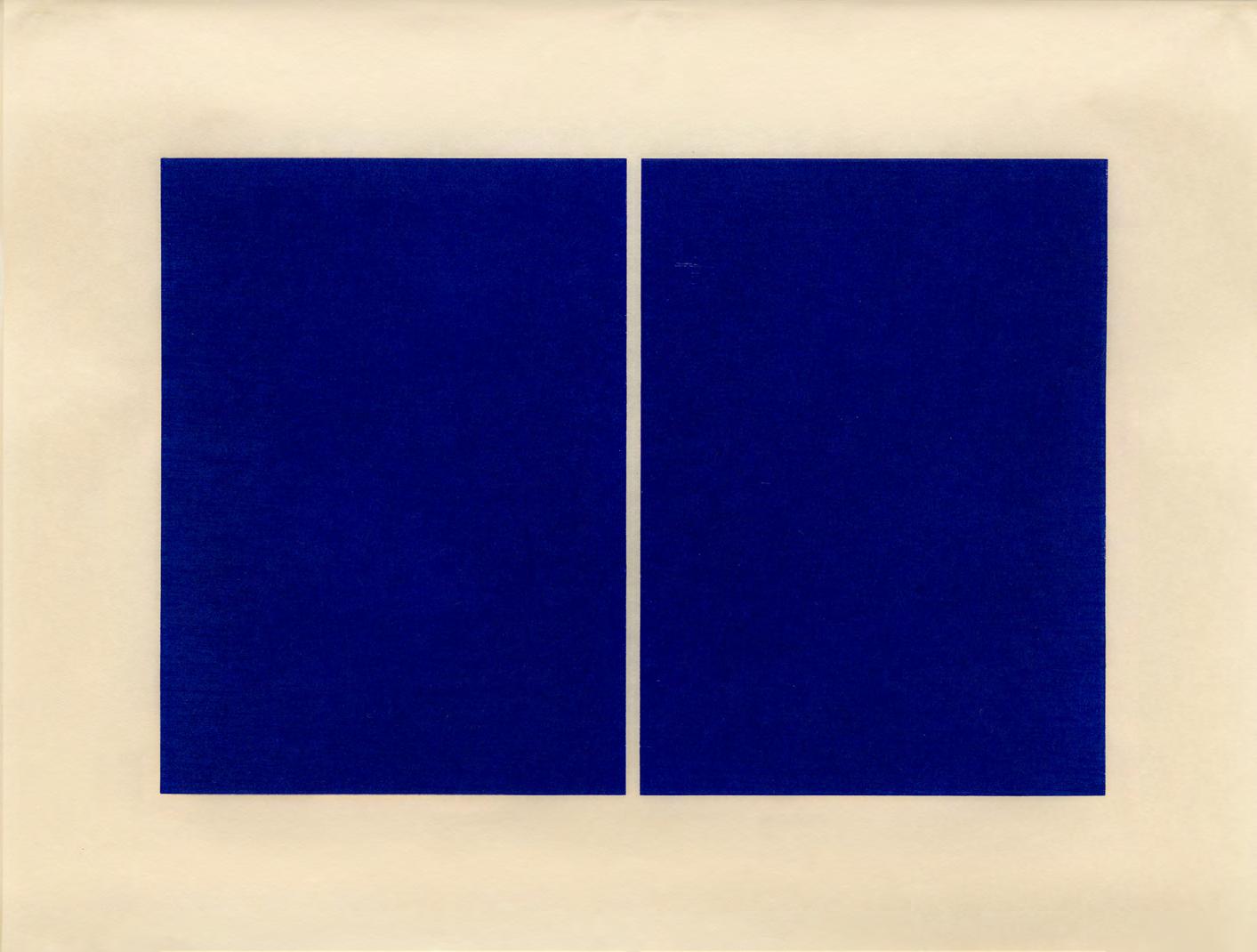
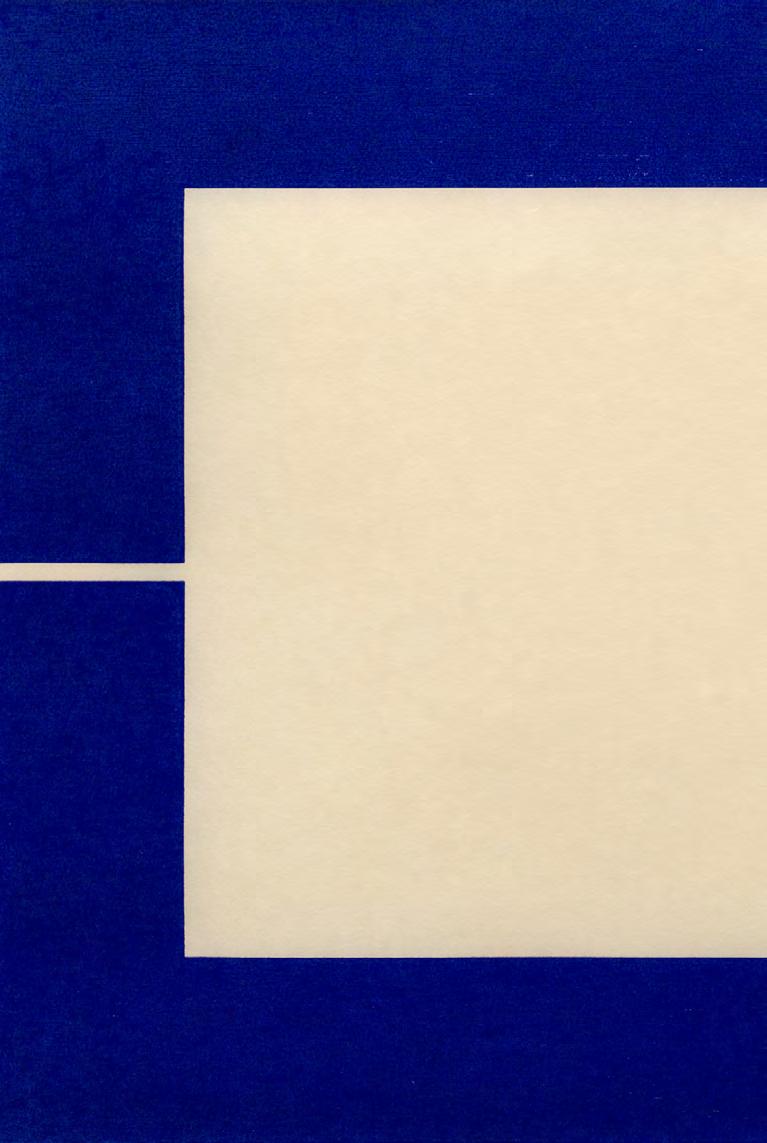
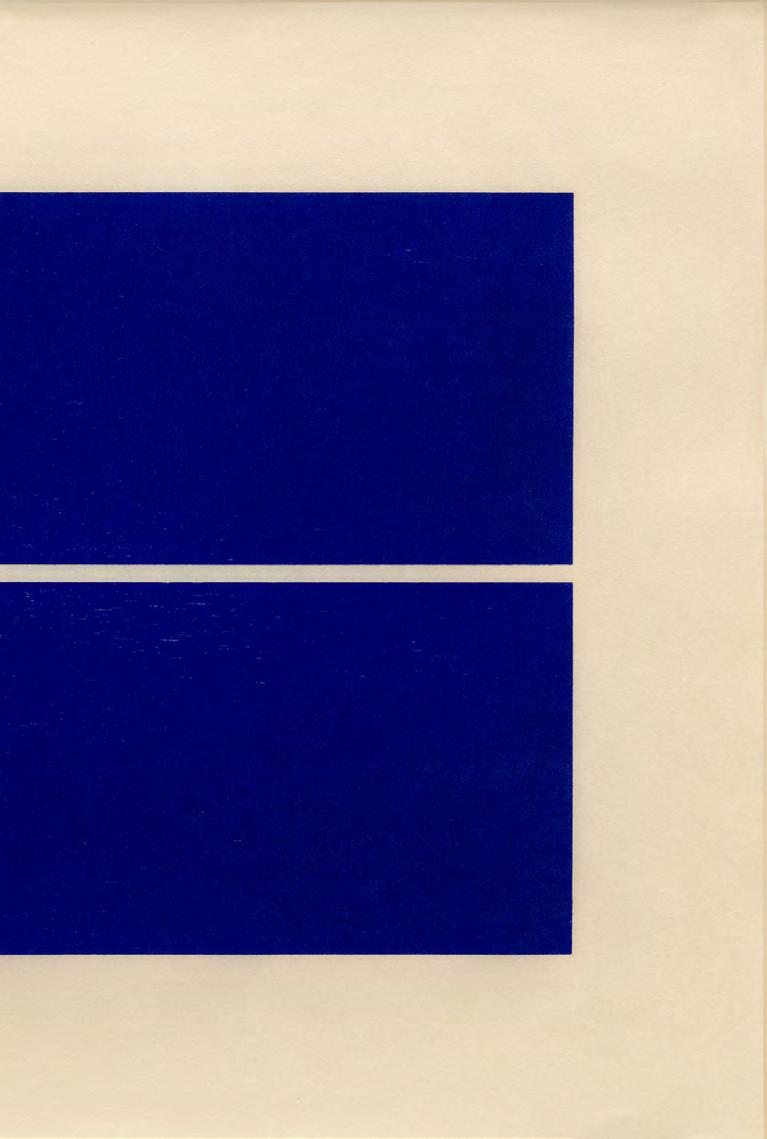
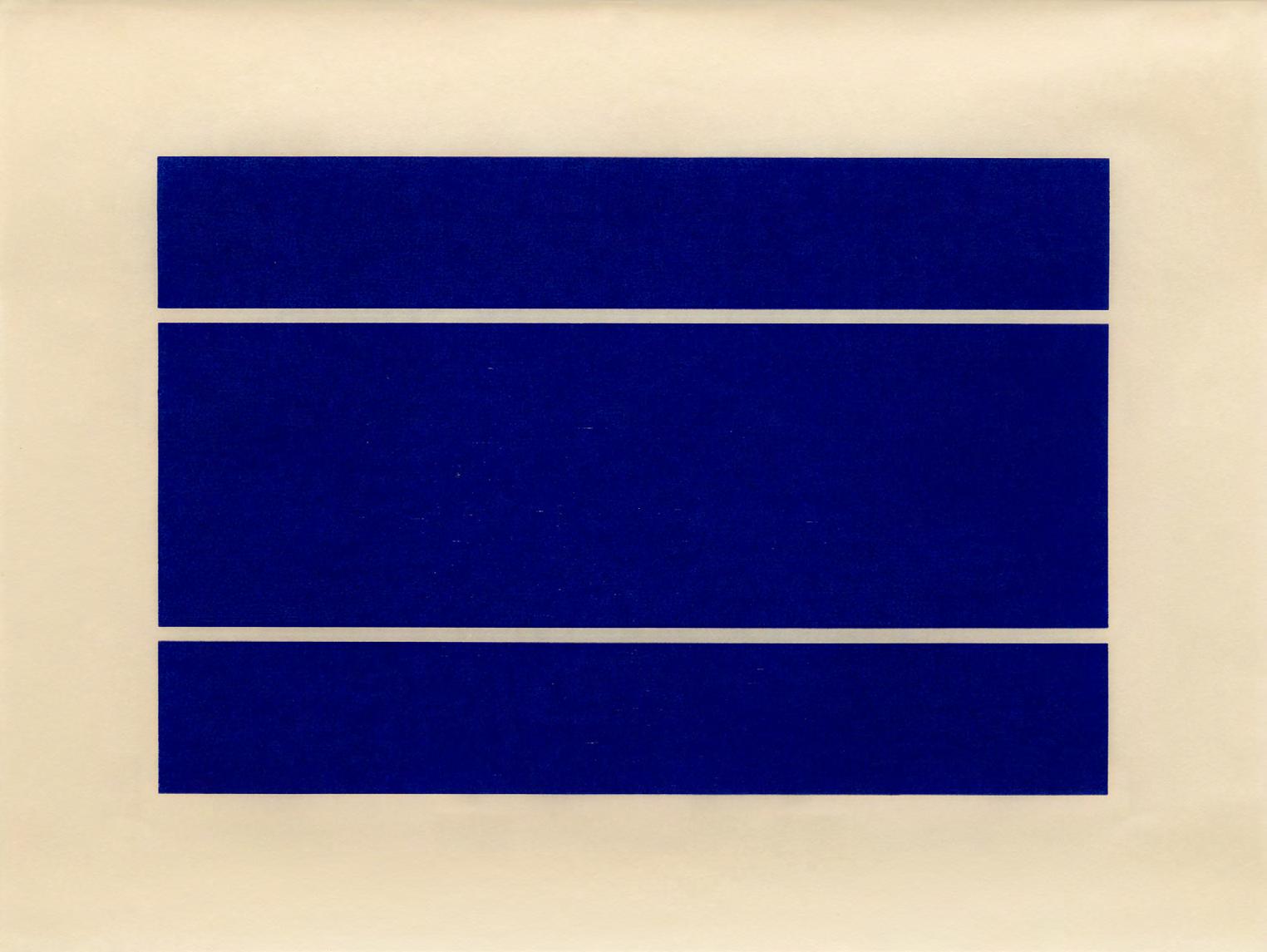
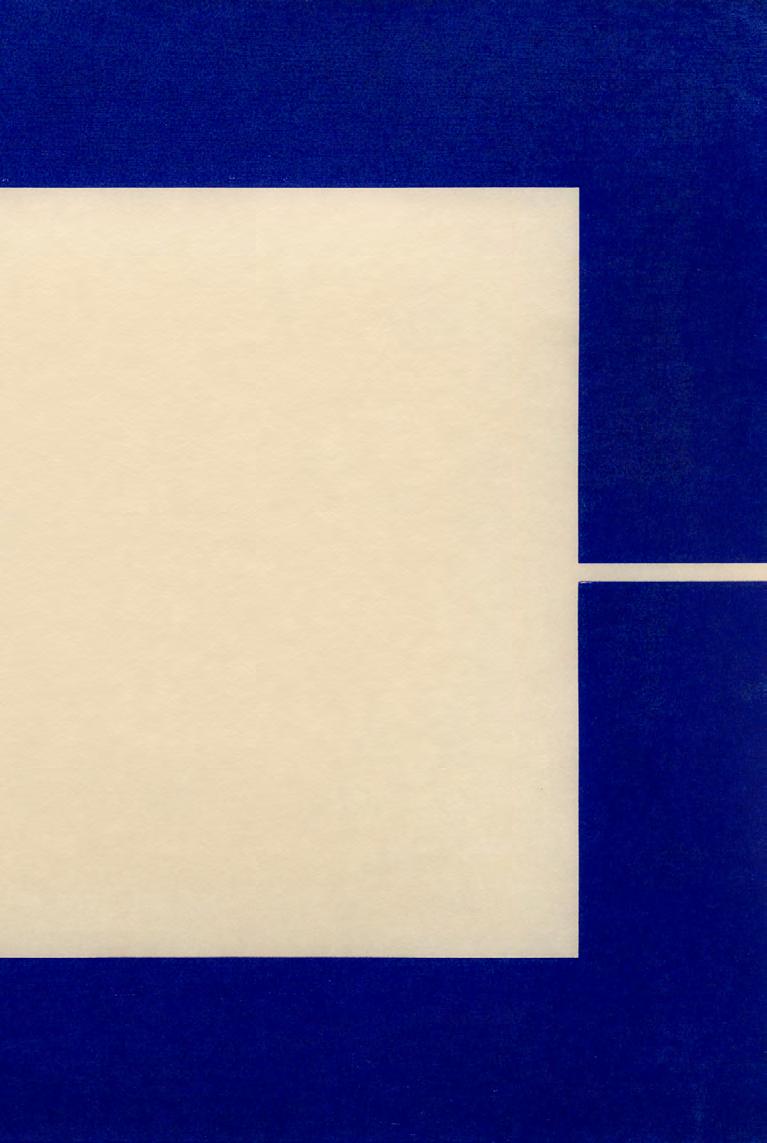
Untitled, 1988
Sheet size: 23 5/8 x 31 1/2 inches, each
(60 x 80 centimeters, each)
Printer: Derrière l’Etoile Studios, New York
Publisher: Brooke Alexander Editions, New York
Edition size: 25, plus proofs
Catalogue Raisonné: Schellmann 167-176
Each sheet is signed and numbered on verso
The very rare complete set of ten woodcuts.
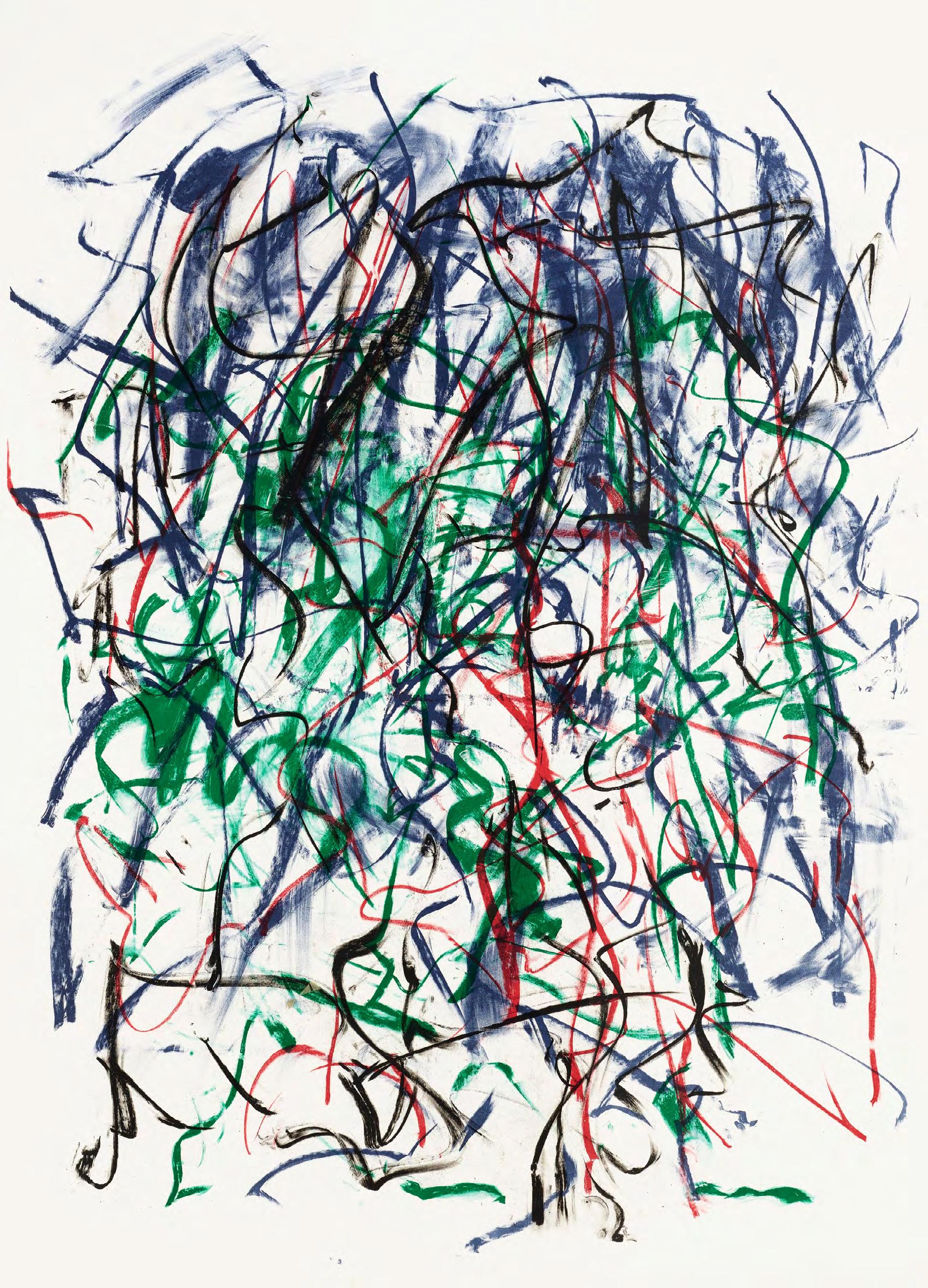
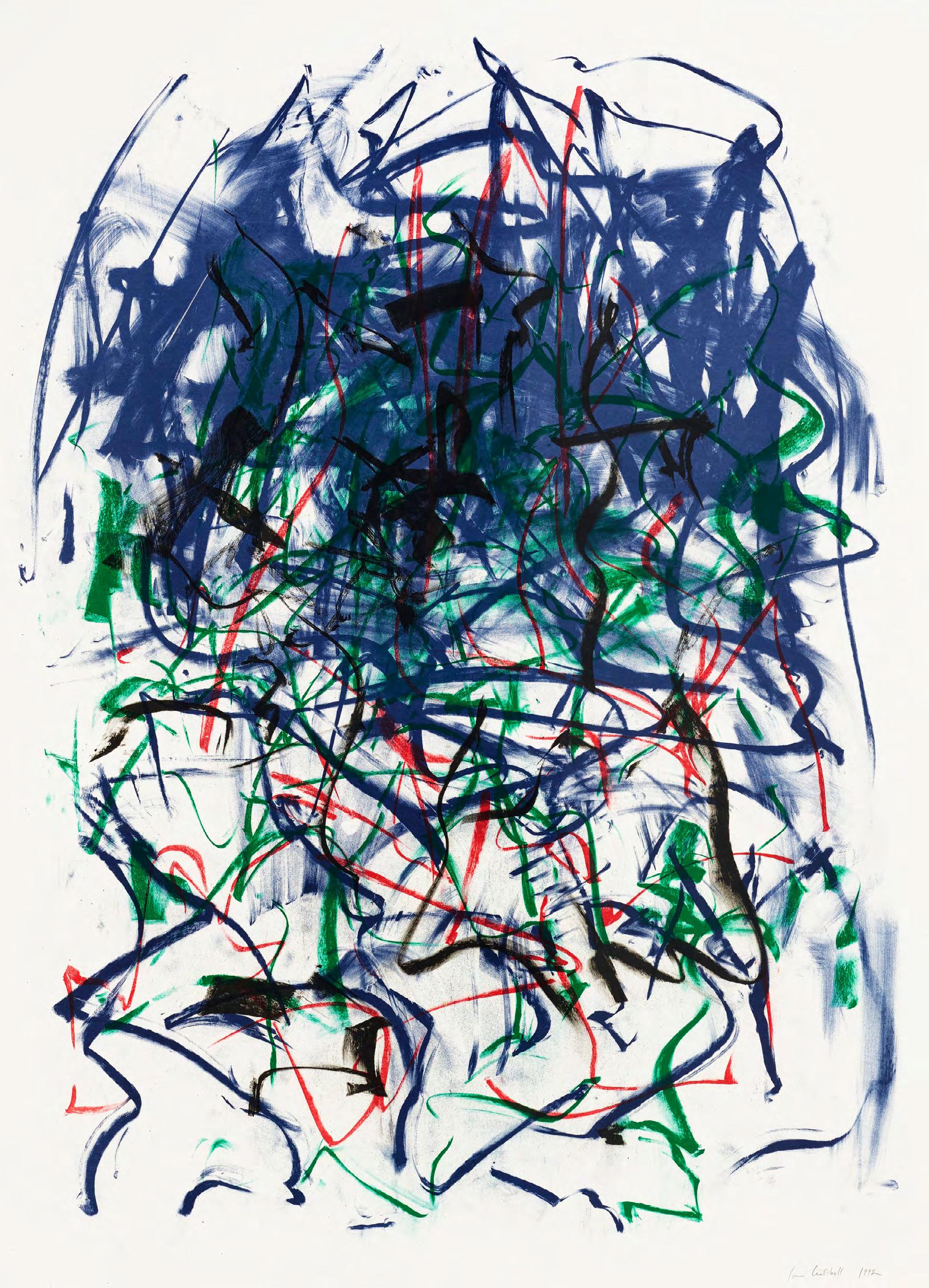
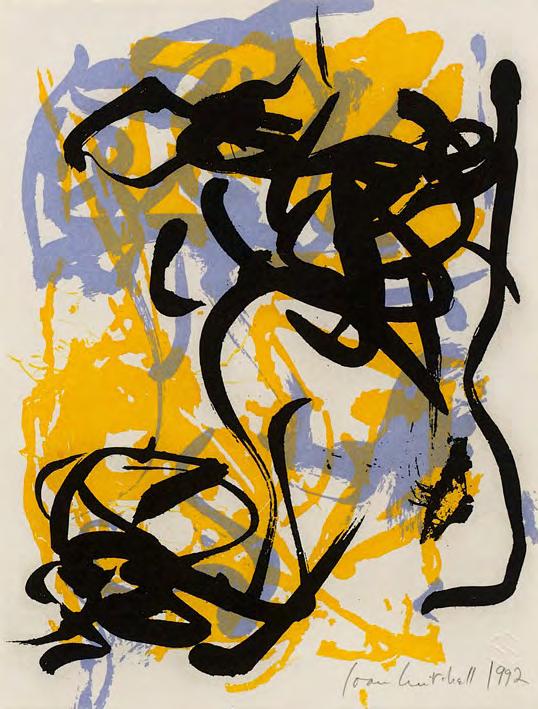
Joan Mitchell
Sunflowers II, 1992
Lithograph on two sheets
Sheet size: 57 x 82 1/4 inches, overall (144.8 x 209 centimeters, overall)
Printer and Publisher: Tyler Graphics, Ltd., Mount Kisco, New York
Edition size: 34, plus proofs
Signed, dated, and numbered
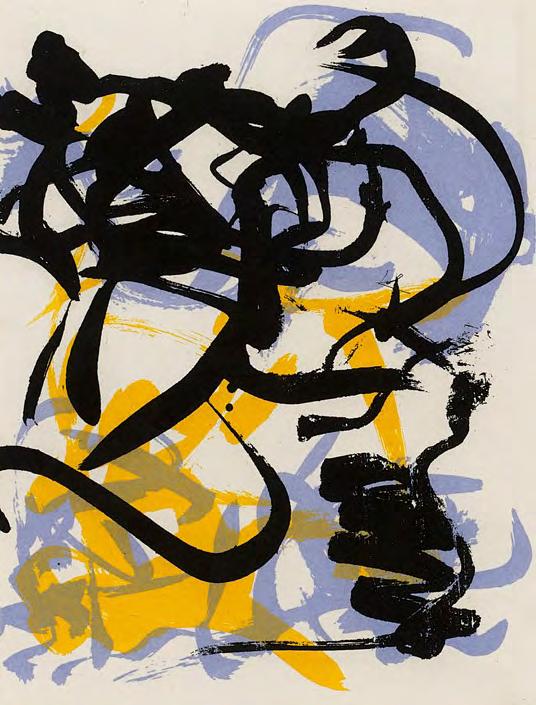
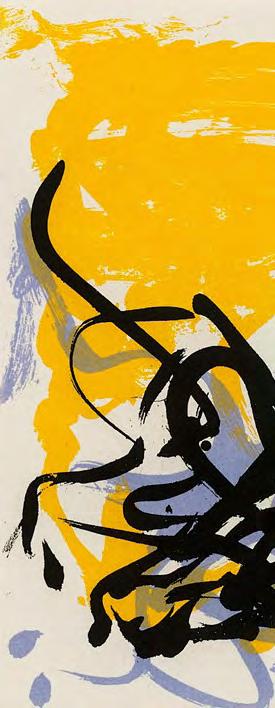
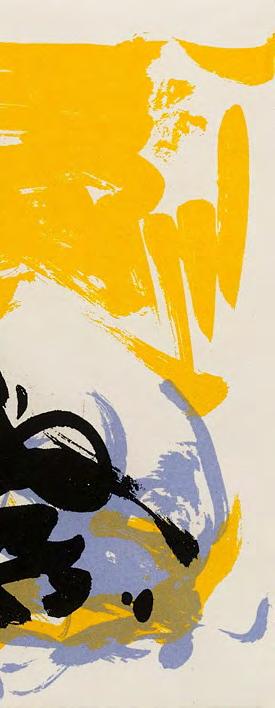
Joan Mitchell
Little Weeds I, 1992
Etching and aquatint on three sheets
Sheet size: 9 1/4 x 21 inches overall (23.5 x 53.4 centimeters, overall)
Printer and Publisher: Tyler Graphics, Ltd., Mount Kisco, New York
Edition size: 30, plus proofs
Signed, dated, and numbered
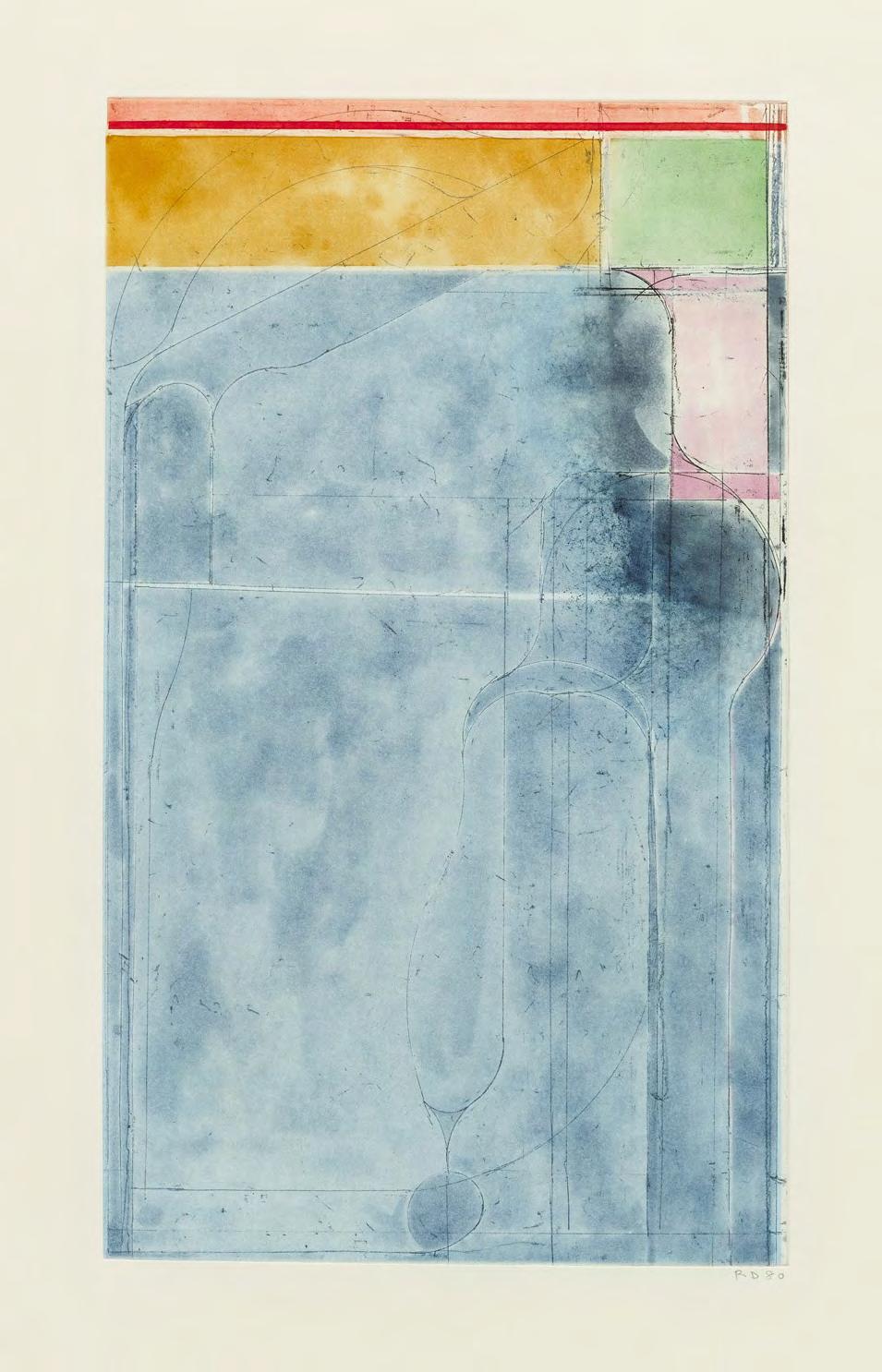
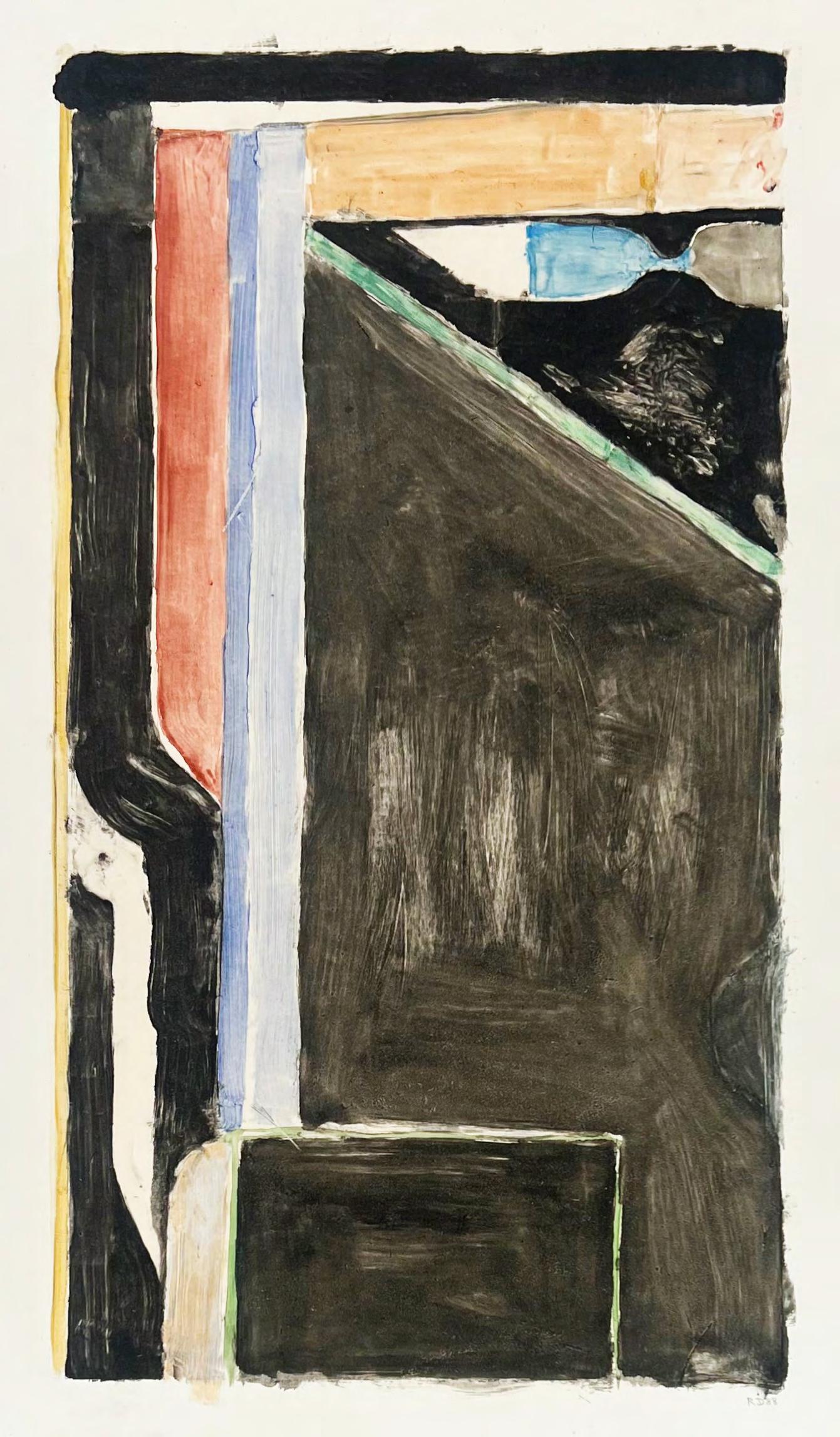
Richard Diebenkorn
Large Light Blue, 1980
Aquatint and etching
Sheet size: 39 1/2 x 26 inches (100.3 x 66 centimeters)
Printer and Publisher: Crown Point Press, Oakland, California
Edition size: 35, plus proofs
Catalogue Raisonné: Liguori 264
Initialed, dated, and numbered
In 1988, Richard Diebenkorn was preparing to close his Santa Monica studio ahead of a move to Healdsburg in Northern California. The transition left him feeling creatively blocked, and he turned to a medium that had helped him through similar struggles before: monotype. As the name suggests, monotypes are unique prints made by painting directly onto the printing matrix. The process is more immediate and informal than traditional printmaking, and Diebenkorn was particularly drawn to the concept of ghost plates, in which leftover ink from a previous printing is reused and manipulated into a new composition.
For this series, Diebenkorn enlisted his longtime friend Garner Tullis to organize a session at the printer’s Santa Monica workshop. Together they completed an impressive twenty-eight monotypes in just six days. The large-scale vertical works from the series are particularly resonant with Diebenkorn’s Ocean Park imagery, but viewed in sequence, new color palettes and forms begin to emerge. Tullis interpreted XIV, depicted here, as “the landscape of a modern city with its freeways and roads, rising bridges, parks, and ocean edges.”
Richard Diebenkorn
XIV, 1988 Monotype
Sheet size: 40 1/2 x 24 inches (102.9 x 61 centimeters)
Printer: Garner Tullis Workshop, Santa Barbara, California
Catalogue Raisonné: Liguori 323
Initaled and dated
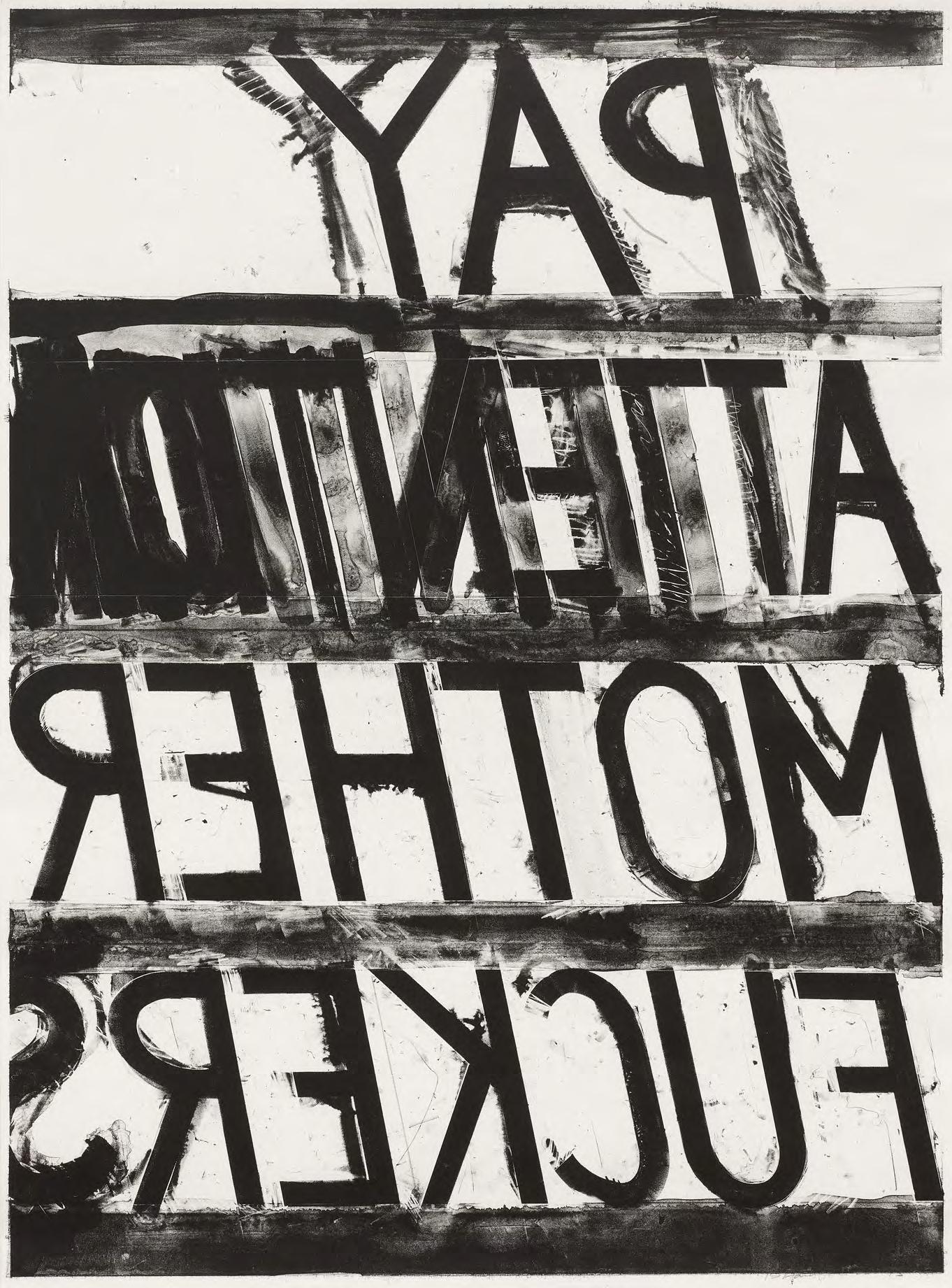
Bruce Nauman
Pay Attention, 1973
Lithograph
Sheet size: 38 1/4 x 28 1/4 inches (97.2 x 71.8 centimeters)
Printer and Publisher: Gemini G.E.L. Los Angeles
Edition size: 50, plus proofs
Catalogue Raisonné: Cordes 16
Signed, dated, and numbered
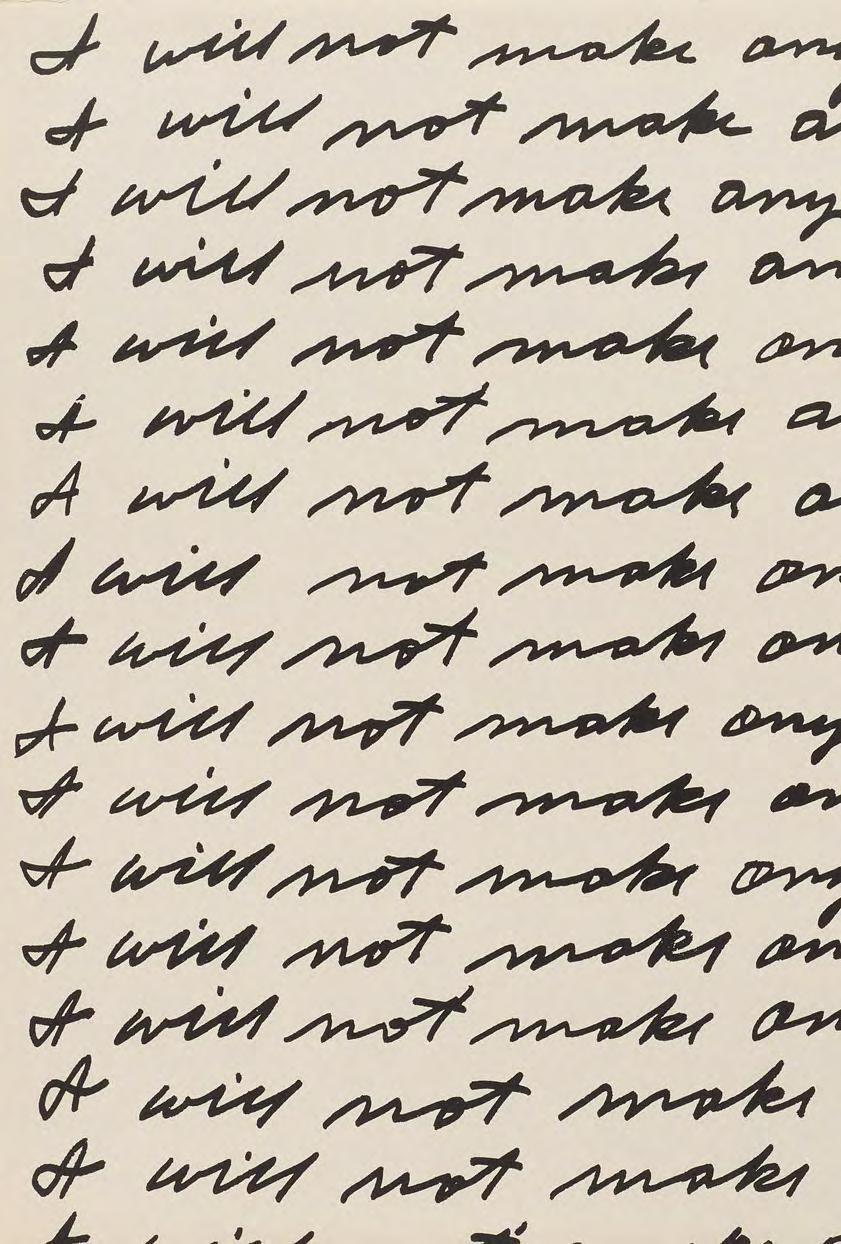
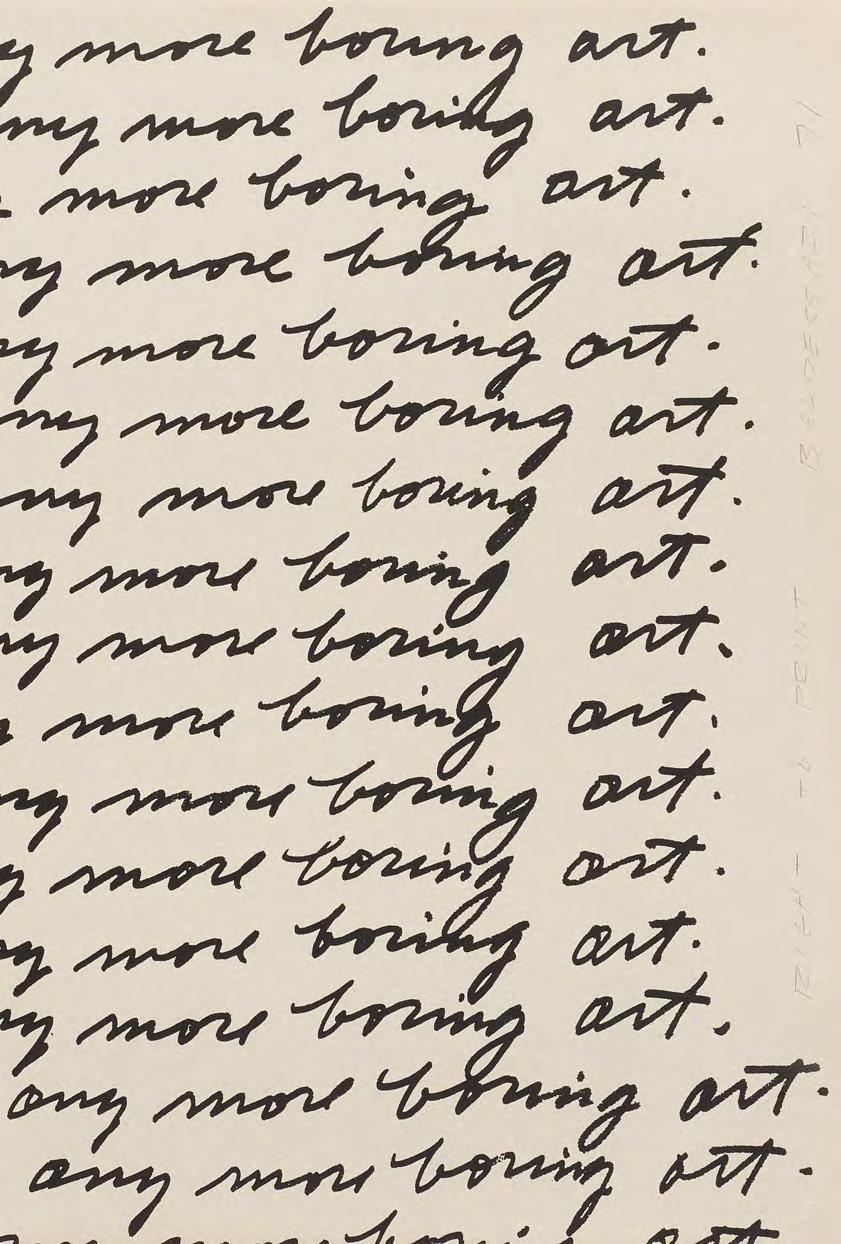
I Will Not Make Any More Boring Art, 1971
Lithograph
Sheet size: 22 1/2 x 30 inches
(57.2 x 76.2 centimeters)
Printer: Nova Scotia College of Art and Design Lithography Workshop, Halifax
Publisher: Nova Scotia College of Art and Design, Halifax
Edition size: 50, plus proofs
Catalogue Raisonné: Coplan Hurowitz 1
Signed, dated, and annotated “right to print”
Provenance:
Robert Rogers, printer at Tamarind Lithography Workshop, Los Angeles, California and Nova Scotia College of Art and Design Lithography Workshop, Halifax
Ed Ruscha
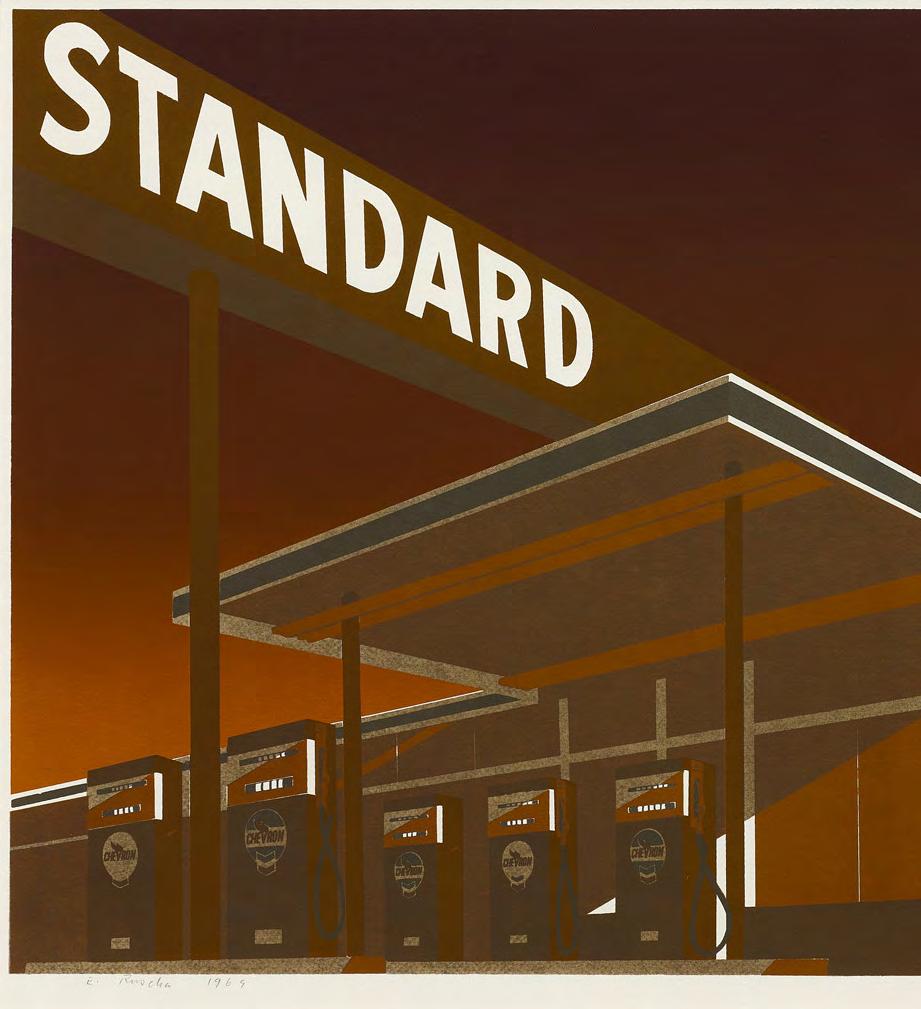
Mocha Standard, 1969
Screenprint
Sheet size: 25 5/8 x 40 inches
(65.1 x 101.6 centimeters)
Printer: Jean Milant and Daniel Socha
Publisher: The Artist
Edition size: 100, plus proofs
Catalogue Raisonné: Engberg 30
Signed, dated, and numbered
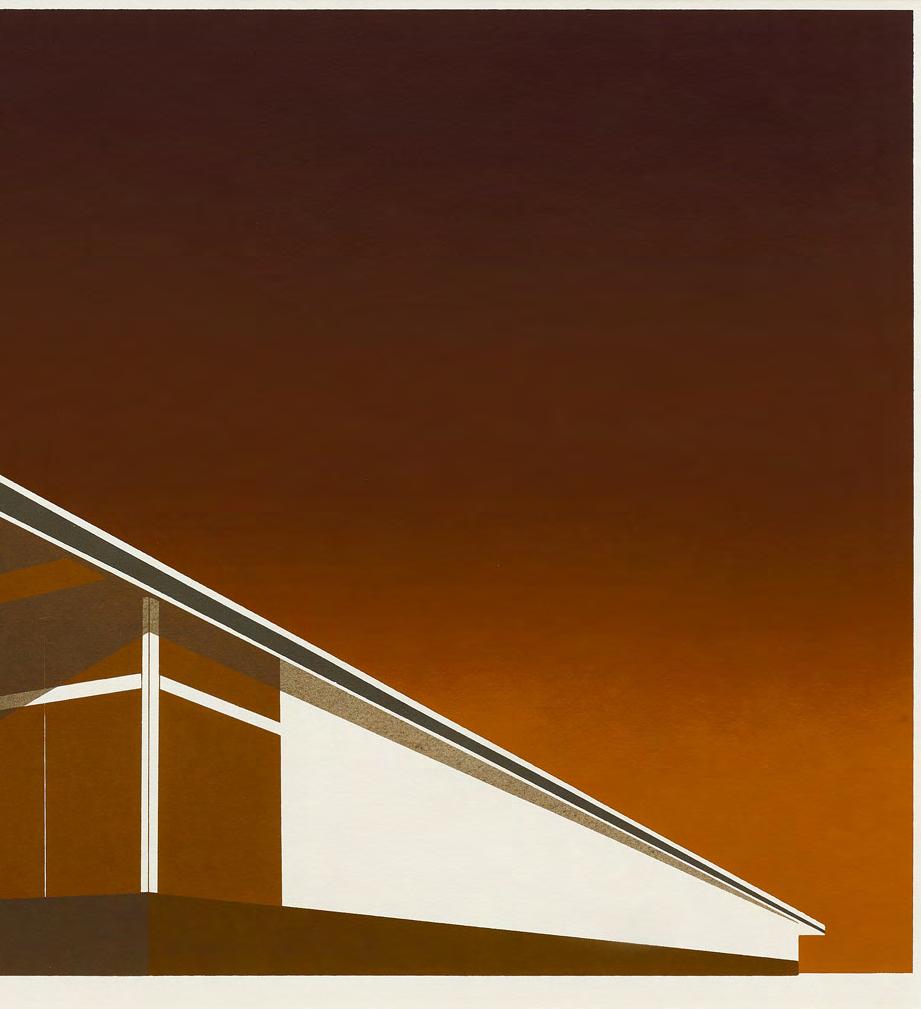
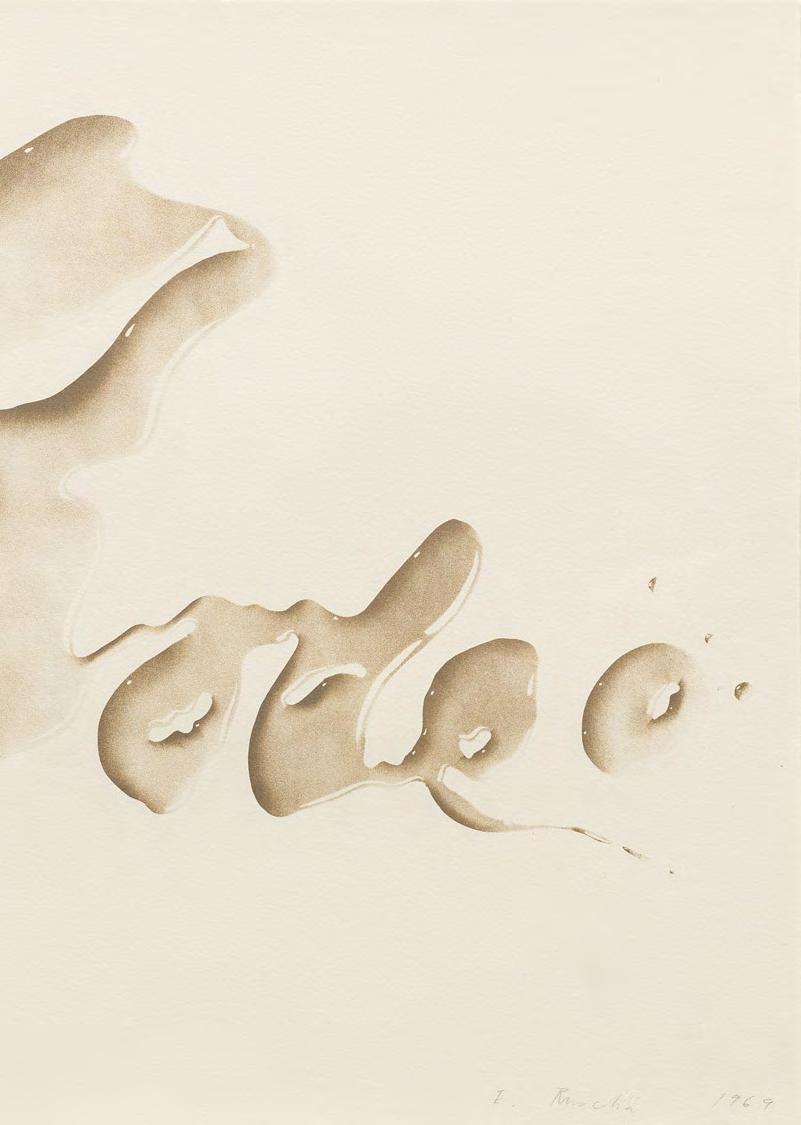
Ed Ruscha
Rodeo, 1969
Lithograph
Sheet size: 17 1/8 x 24 inches
(43.5 x 61 centimeters)
Printer and Publisher: Tamarind Lithography Workshop, Los Angeles
Edition size: 20, plus proofs
Catalogue Raisonné: Engberg 14
Signed, dated, and numbered
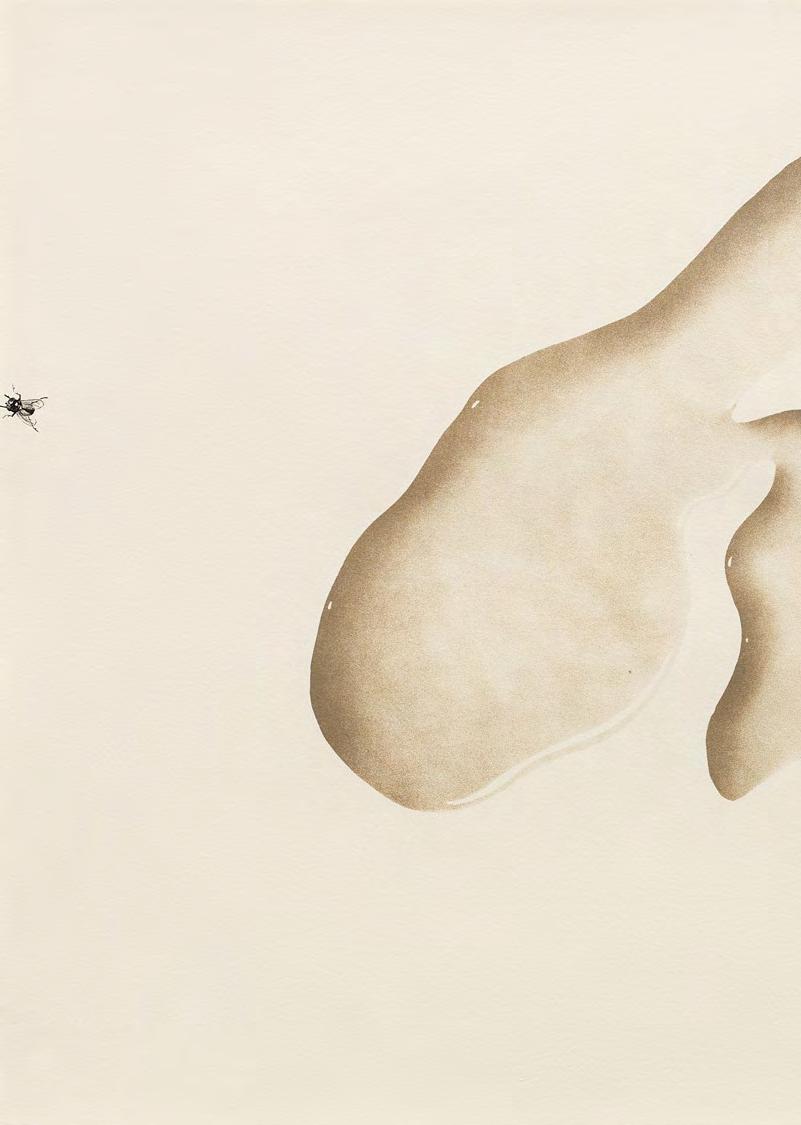
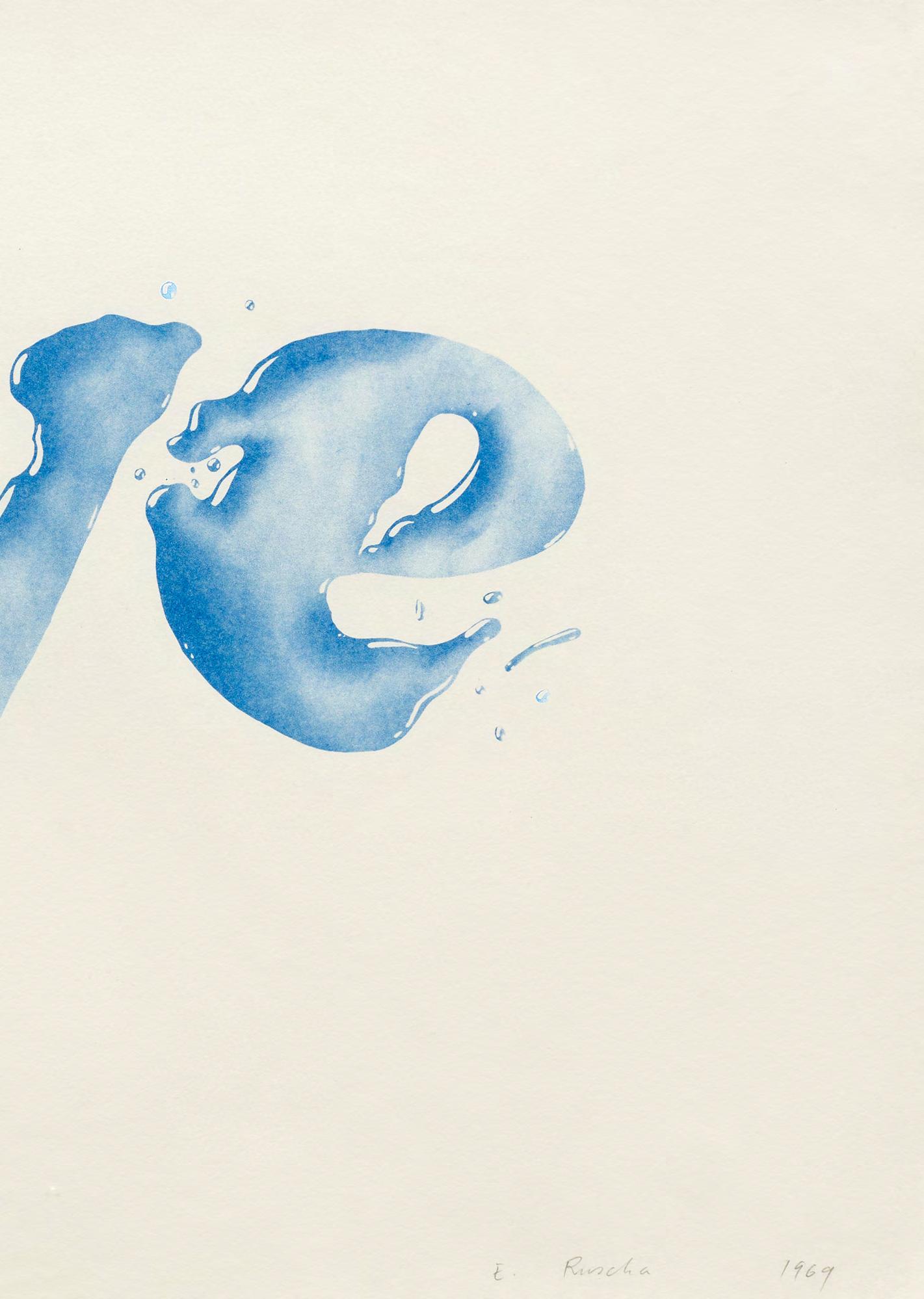
Ed Ruscha
Eye, 1969
Lithograph
Sheet size: 17 x 24 inches
(43.2 x 61 centimeters)
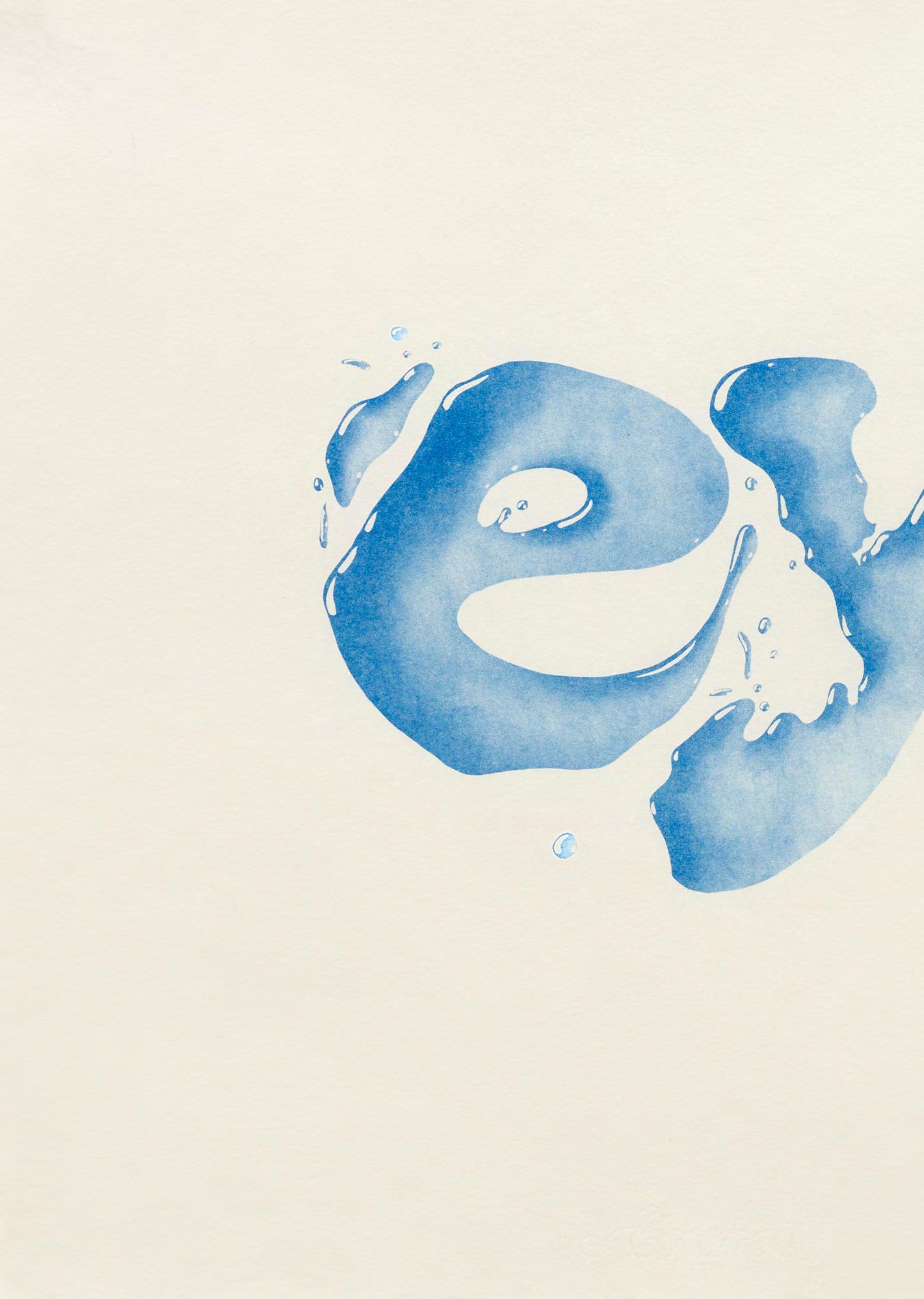
Printer and Publisher: Tamarind Lithography Workshop, Los Angeles
Edition size: 20, plus proofs
Catalogue Raisonné: Engberg 12
Signed, dated, and numbered
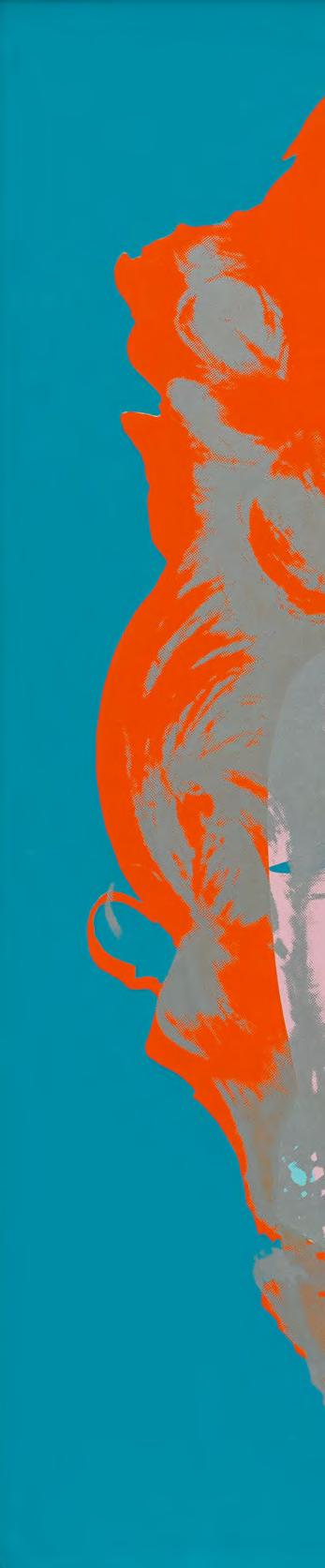
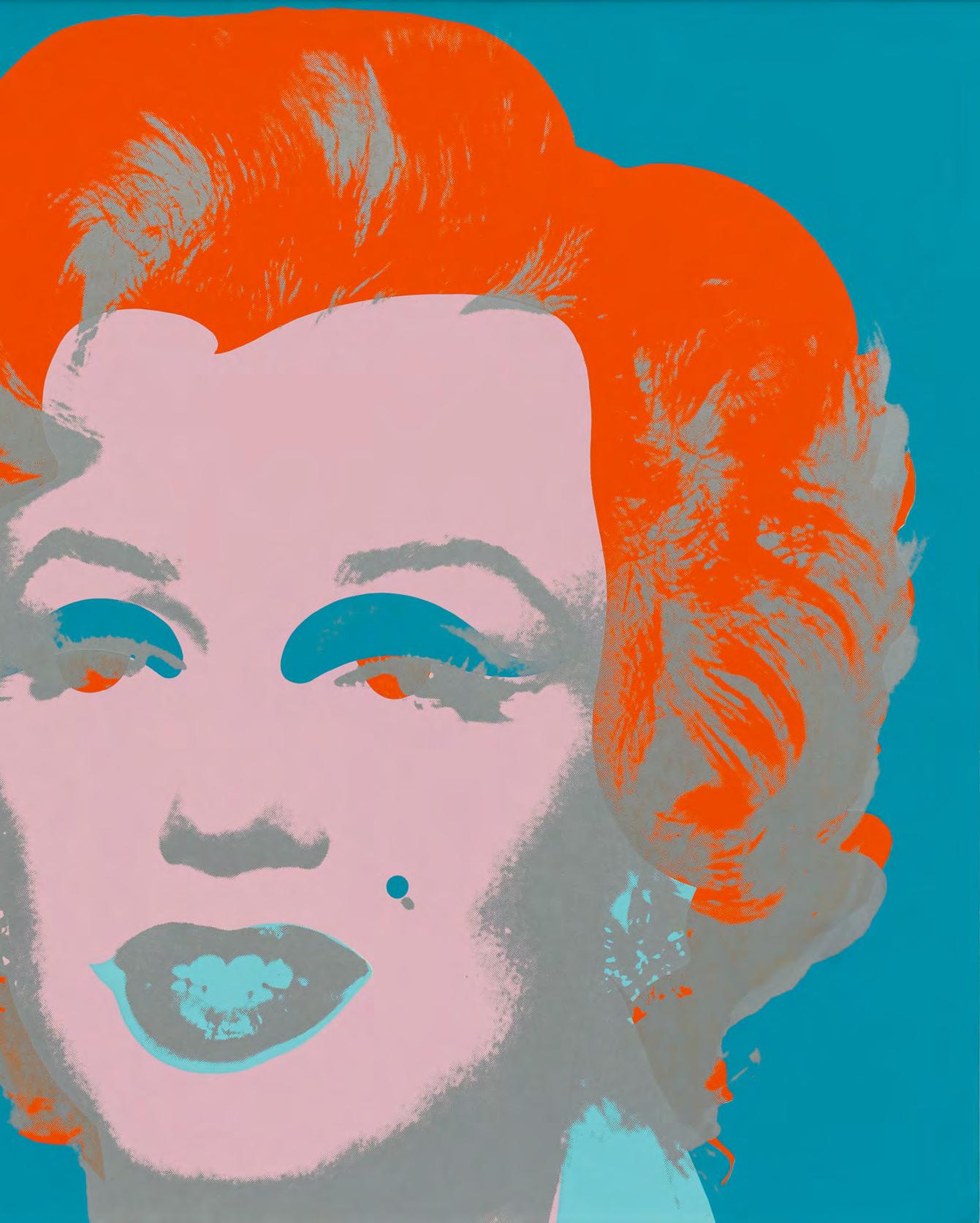
Marilyn Monroe (Marilyn), 1967
Screenprint
Sheet size: 35 7/8 x 36 inches (91.1 x 91.4 centimeters)
Printer: Aetna Silkscreen Products, Inc., New York
Publisher: Factory Additions, New York
Edition size: 250, plus proofs
Catalogue Raisonné: Feldman and Schellmann II.29
Signed on verso
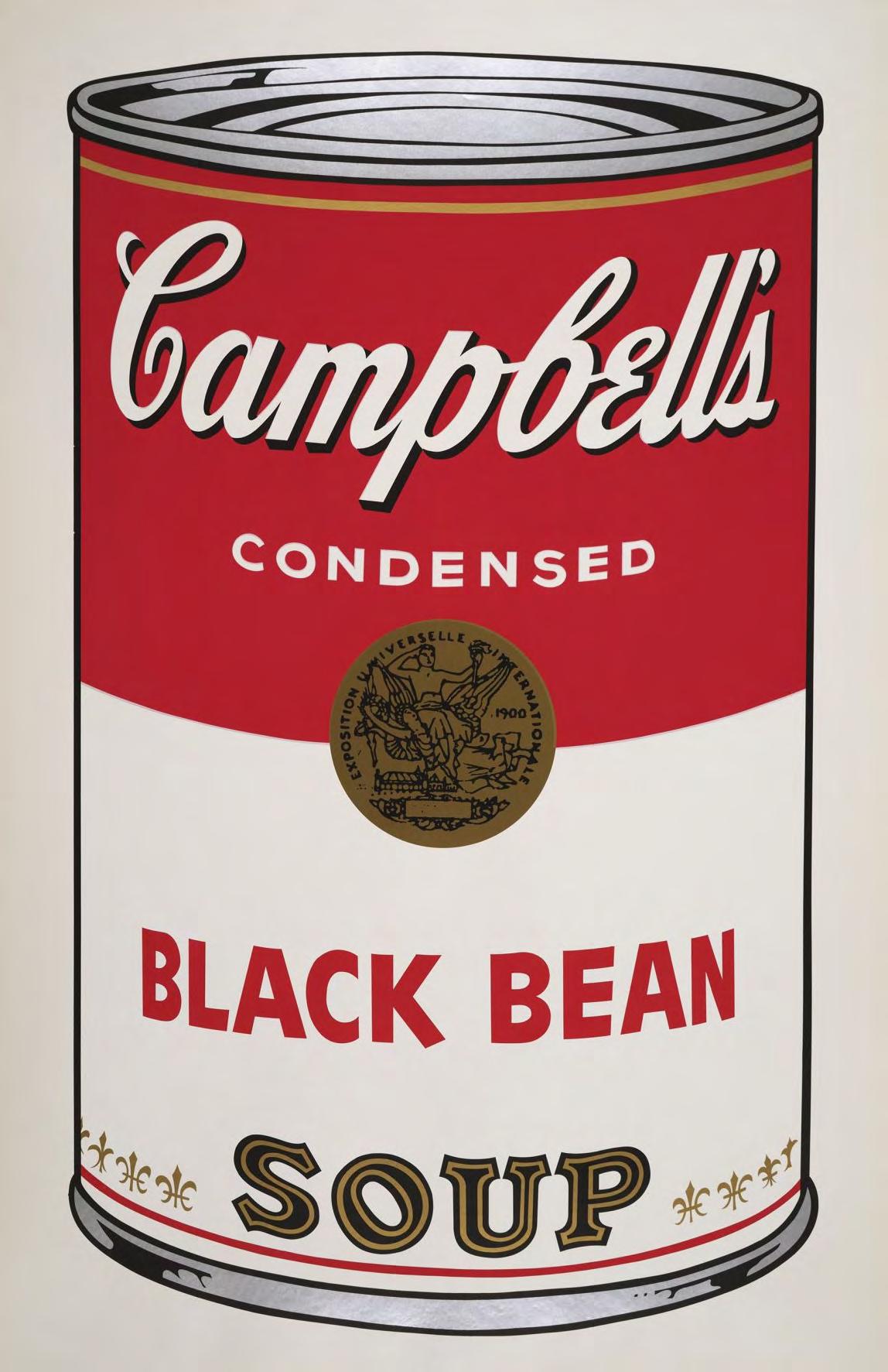
Campbell’s Soup I: Black Bean Soup, 1968
Screenprint
Sheet size: 35 x 23 inches
(88.9 x 48.4 centimeters)
Printer: Salvatore Silkscreen Co., Inc., New York
Publisher: Factory Additions, New York
Edition size: 250, plus proofs
Catalogue Raisonné: Feldman and Schellmann II.44
Signed and stamp numbered on verso
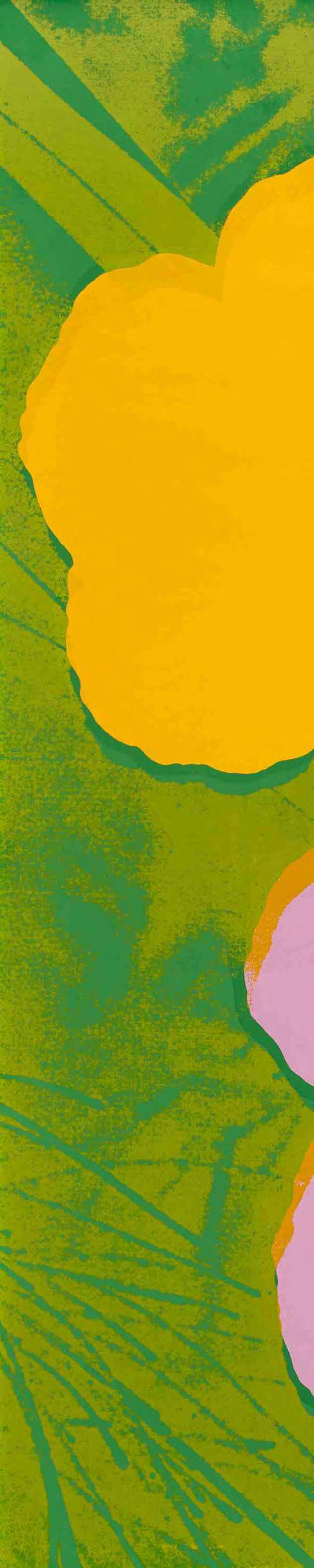
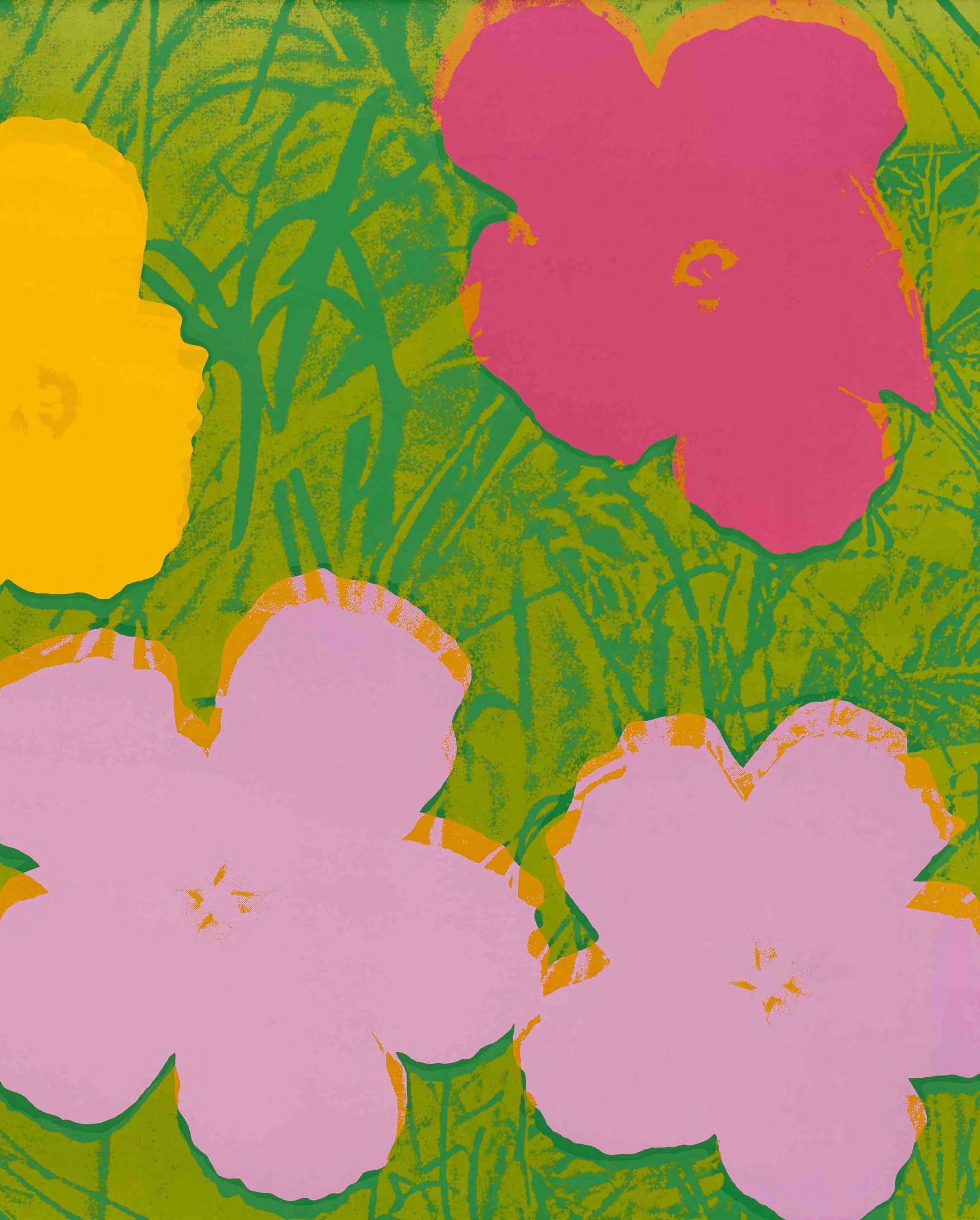
Flowers, 1970
Screenprint
Sheet size: 36 x 36 inches
(91.4 x 91.4 centimeters)
Printer: Aetna Silkscreen Products, Inc., New York
Publisher: Factory Additions, New York
Edition size: 250, plus proofs
Catalogue Raisonné: Feldman and Schellmann II.68
Signed and numbered on verso
Ellsworth Kelly
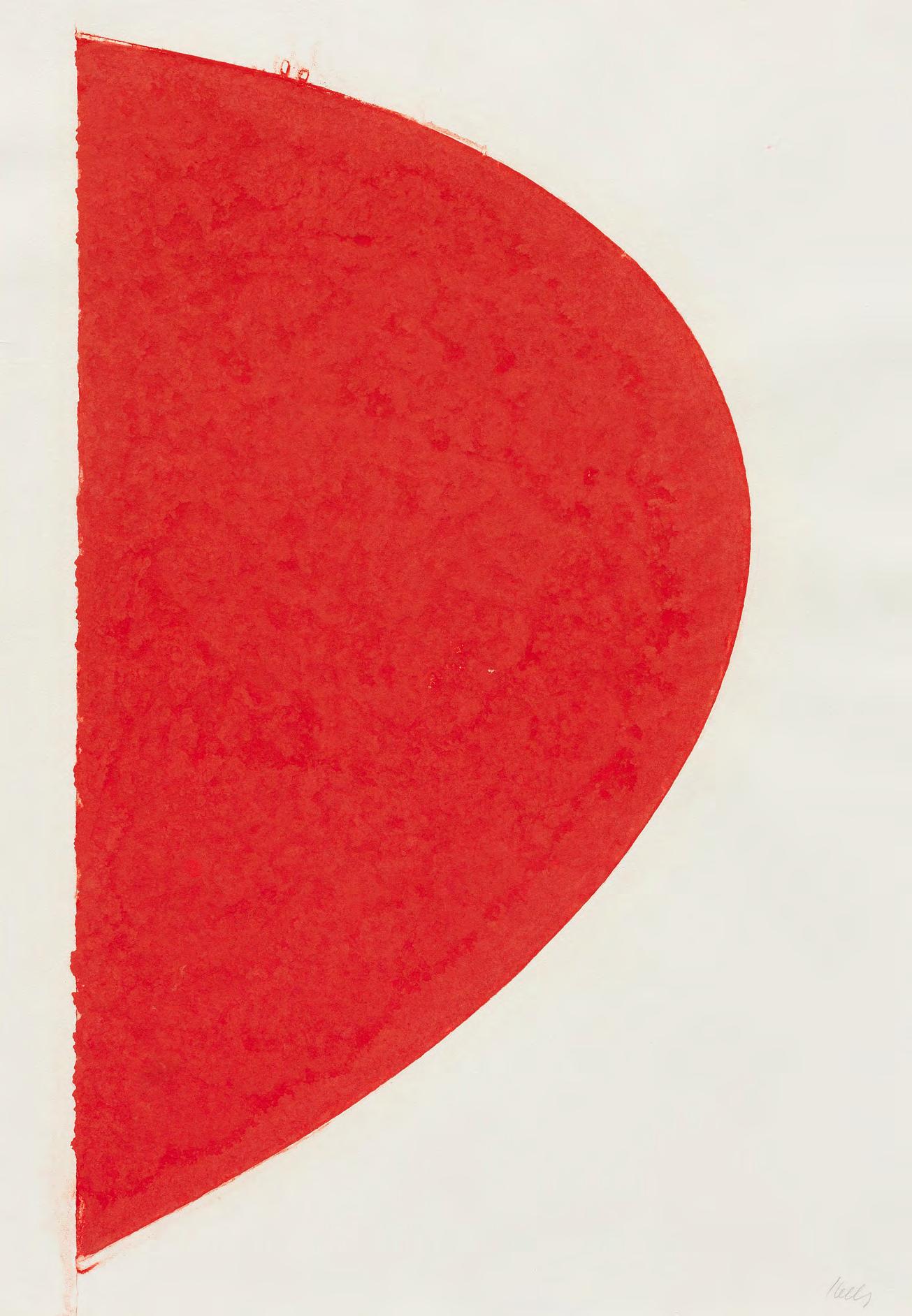
Colored Paper Image IV (Red Curve), 1976
Colored and pressed paper pulp
Sheet size: 46 1/2 x 32 1/2 inches (118.1 x 82.6 centimeters)
Printer: Ellsworth Kelly and Kenneth Tyler, fabricated at HMP Paper Mill, Woodstock, Connecticut
Publisher: Tyler Graphics Ltd., Bedford, New York
Edition size: 20, plus proofs
Catalogue Raisonné: Axsom 144
Signed and numbered
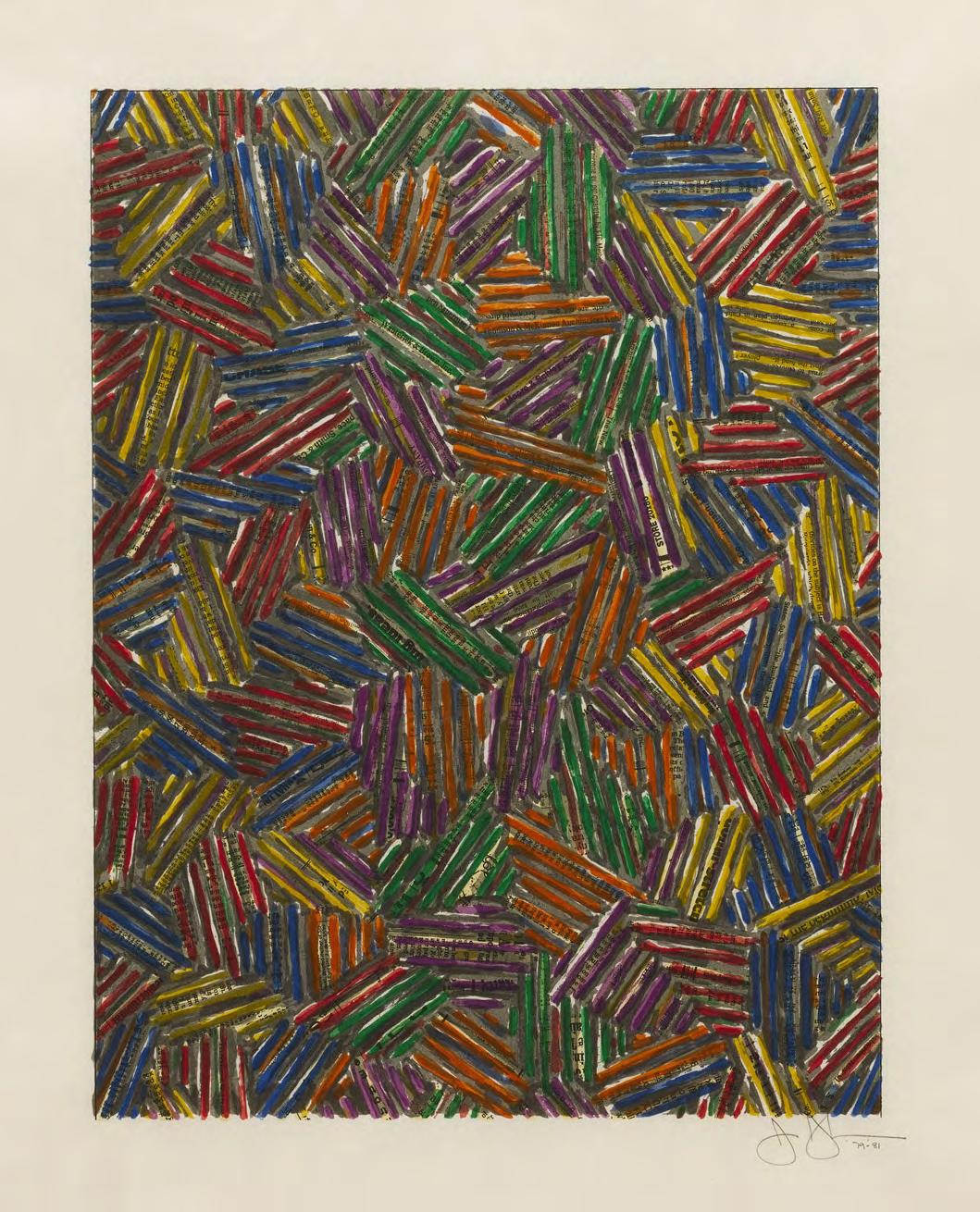
Jasper Johns
Cicada II, 1981
Screenprint
Sheet size: 24 x 18 1/2 inches (61 x 47 centimeters)
Printer and Publisher: The Artist and Simca Print Artists, Inc, New York
Edition size: 50, plus proofs
Catalogue Raisonné: ULAE 214
Signed, dated, and numbered
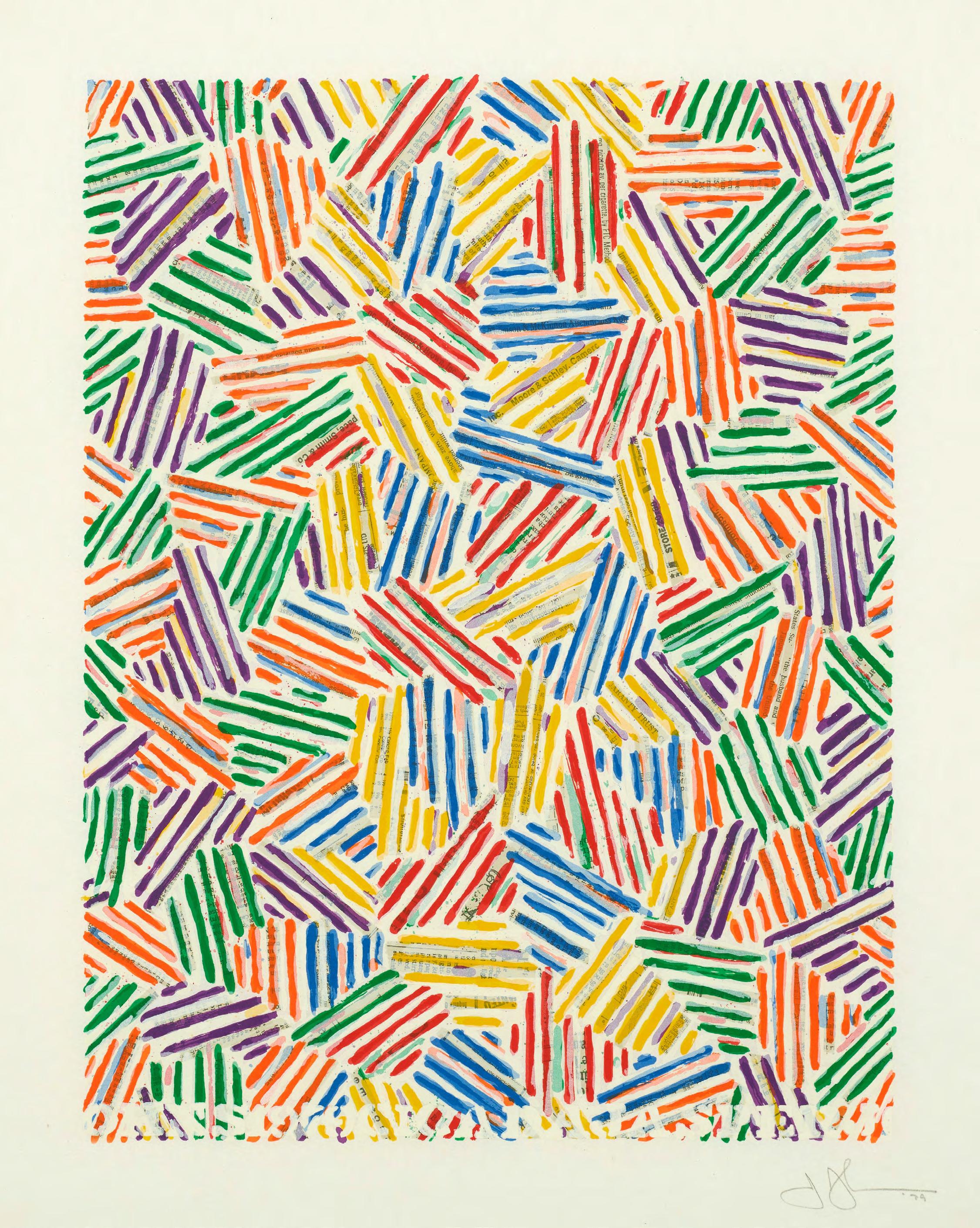
Jasper Johns
Cicada, 1979
Screenprint
Sheet size: 22 x 18 inches
(55.9 x 45.7 centimeters)
Printer: Simca Print Artists Inc.
Publisher: Jasper Johns and Simca Print Artist, Inc.
Edition size: 100, plus proofs
Catalogue Raisonné: ULAE 204
Signed, dated, and numbered
From the 1981 portfolio Marginalia: Hommage to Kusuo
, which also includes workd by Christo and Jeanne-Claude,
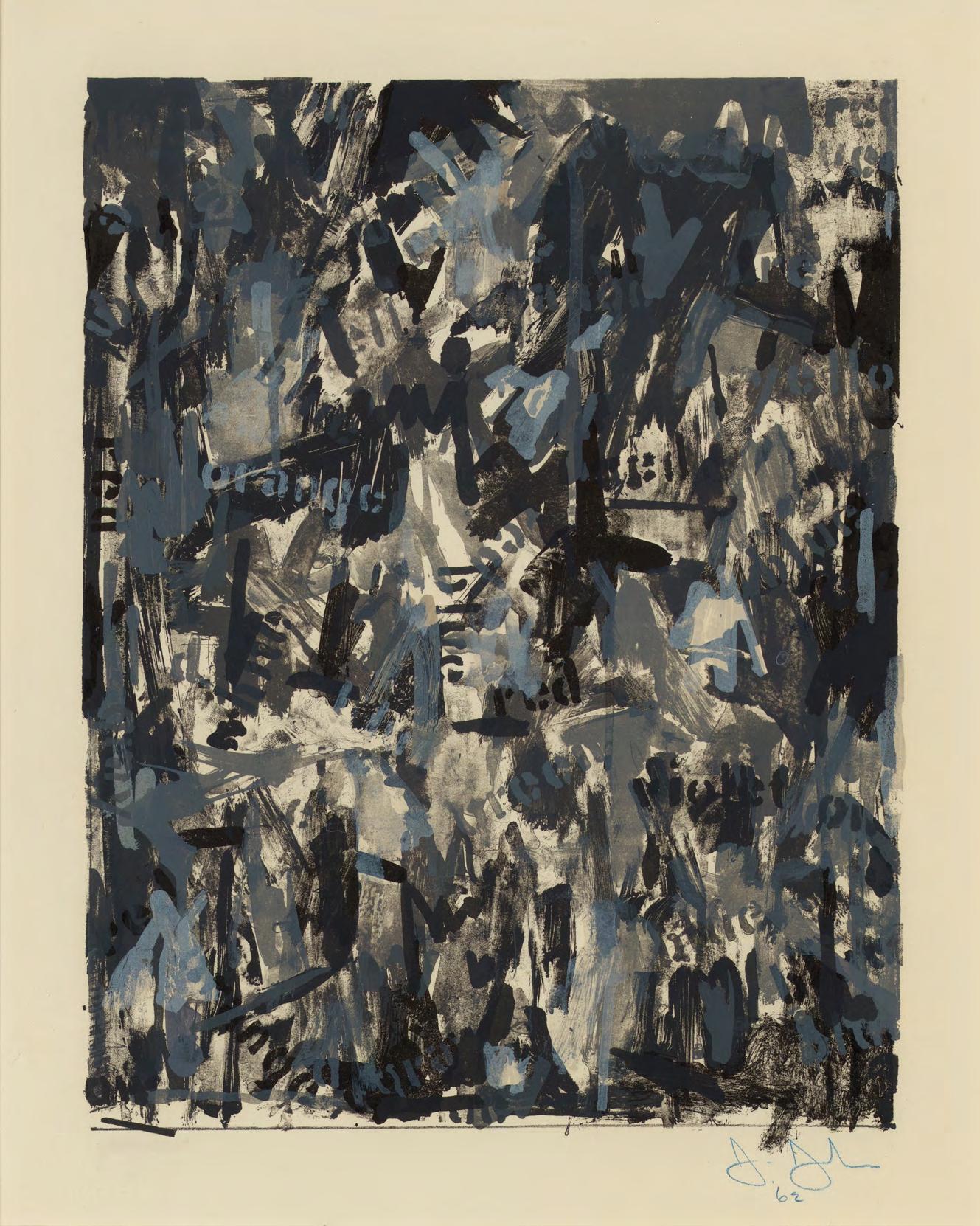
Jasper Johns
False Start II, 1962
Lithograph
Sheet size: 30 1/2 x 22 5/8 inches (77.5 x 57.5 centimeters)
Printer and Publisher: ULAE, West Islip, New York
Edition size: 30, plus proofs
Catalogue Raisonné: ULAE 10
Signed, dated, and numbered
Provenance:
The collection of Lois B. Torf, Boston
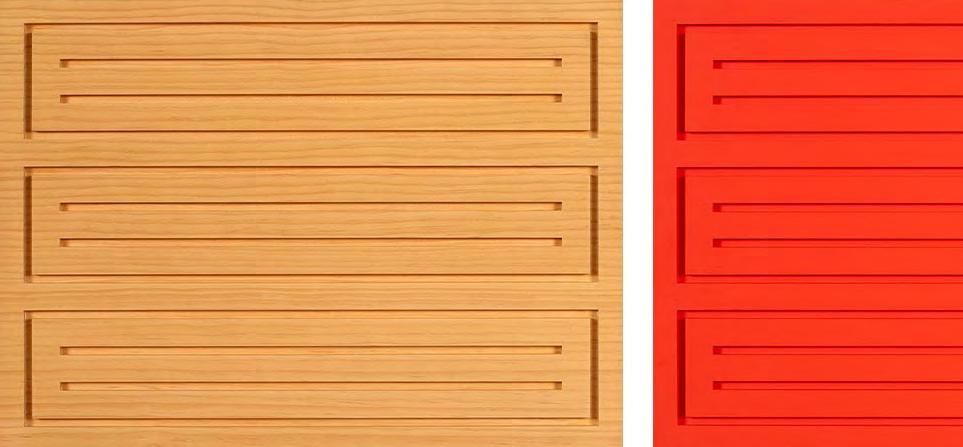
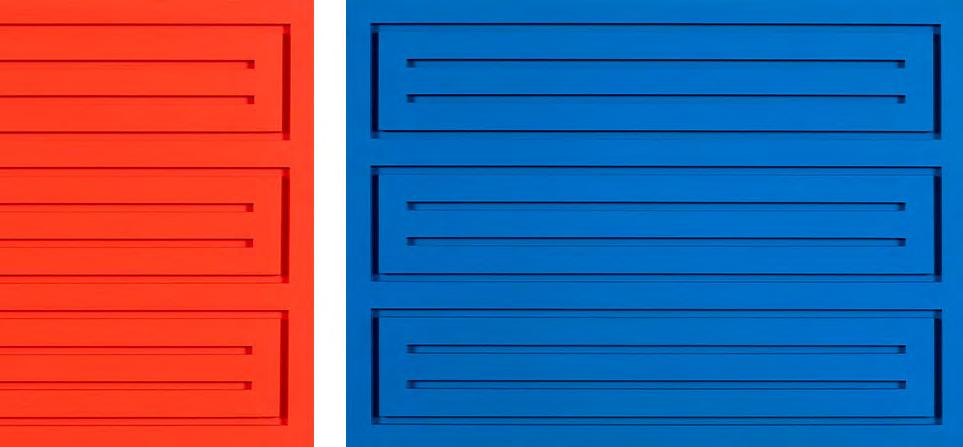
Donald Judd
Untitled, 1991
Woodblocks
Sheet size: 14 3/8 x 19 5/8 x 2 inches, each (36.5 x 49.9 x 5.1 centimeters, each)
Fabricator: Jim Cooper, New York
Publisher: Peder Bonnier, New York
Edition size: 20, plus proofs
Catalogue Raisonné: Schellmann 14-16
Each woodblock is signed ‘Judd’ by the artist on verso Stamped-signed ‘JUDD’, numbered and dated on verso
The complete set of three woodblocks that retain the original three wooden boxes made by Jim Cooper Each box is stamped with the corresponding edition number.
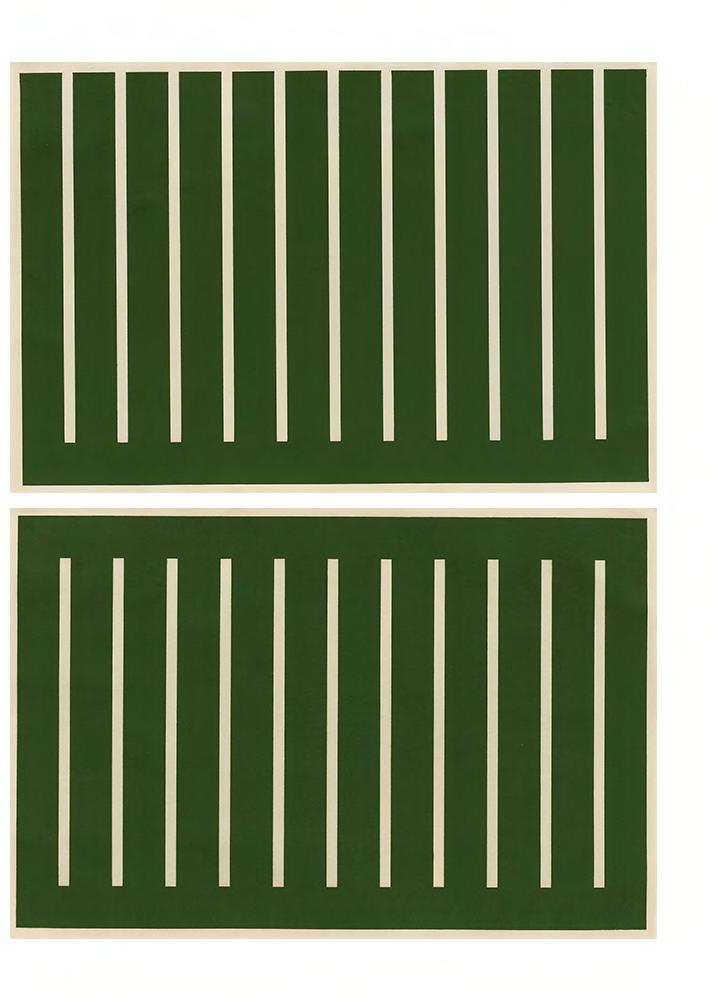
Untitled, 1991
Sheet size: 25 1/4 x 38 1/2 inches
(61.6 x 97.8 centimeters)
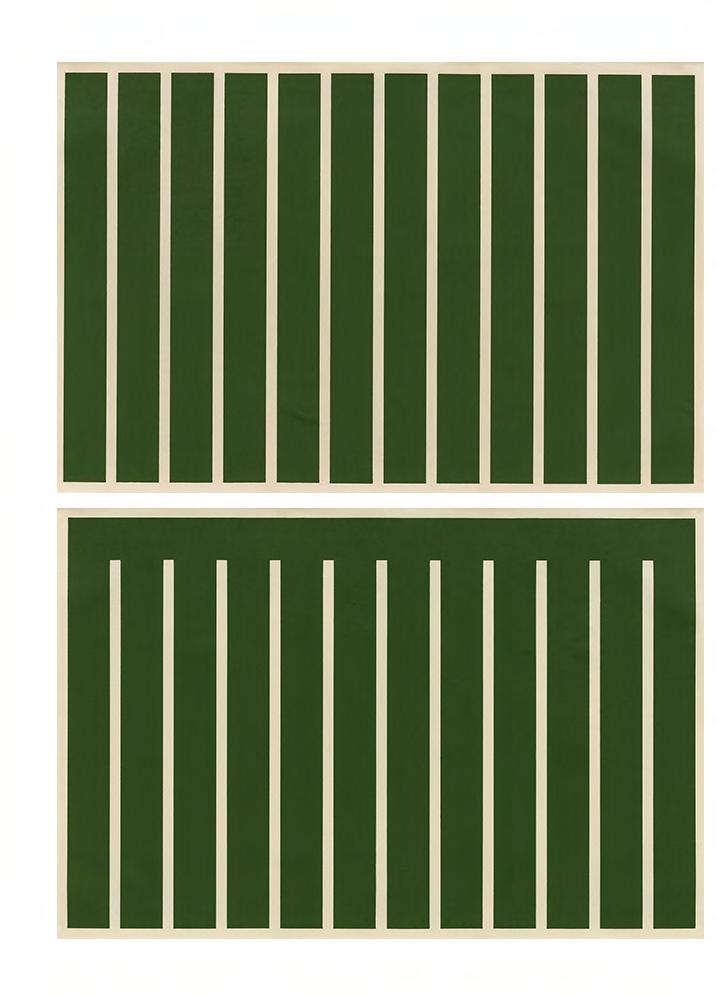
Printer: Derrière l’Etoile Studios, New York
Publisher: Brooke Alexander Editions, New York
Edition size: 25, plus proofs
Catalogue Raisonné: Schellmann 207-210
Each sheet signed and editioned on verso
The complete set of four woodcuts.
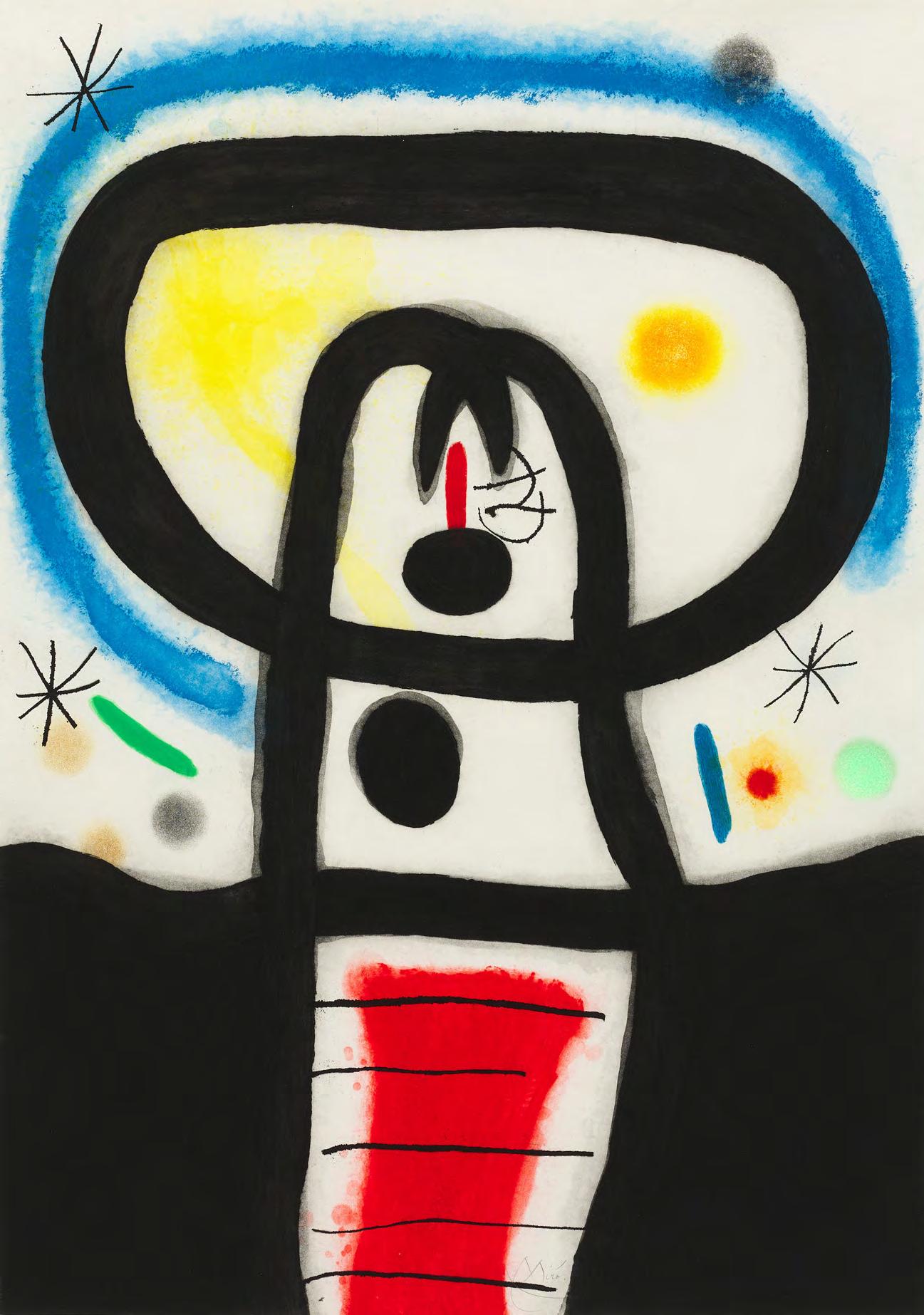
Équinoxe, 1967
Etching, aquatint, and carborundum
Sheet size: 41 x 29 inches (104.1 x 73.7 centimeters)
Printer: Art Adrien Maeght, Paris
Publisher: Maeght Éditeur, Paris
Edition size: 75, plus proofs
Catalogue Raisonné: Dupin 428
Signed and numbered
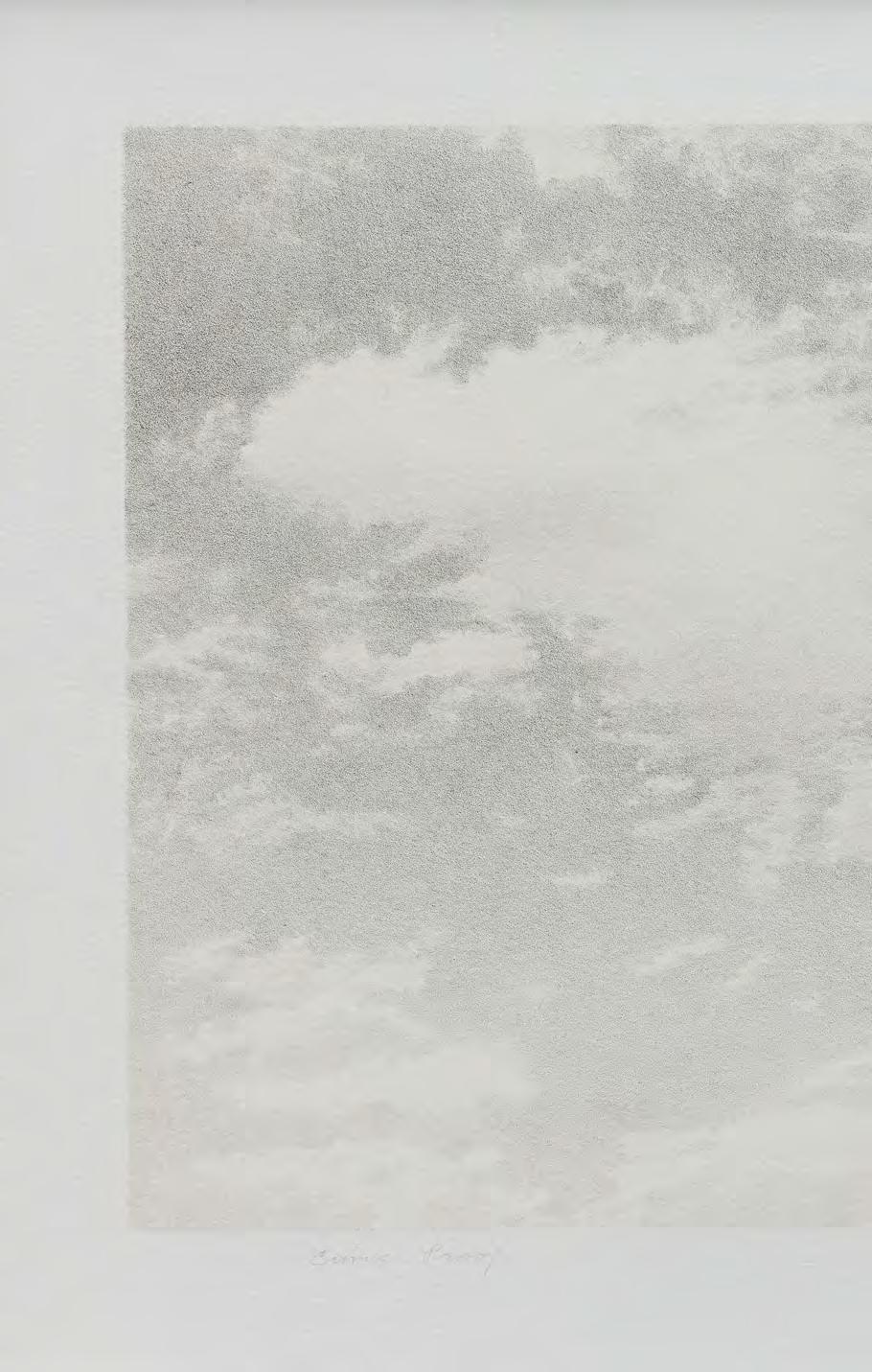
Untitled (Sky), 1975
Lithograph
Sheet size: 16 1/2 x 20 1/8 inches
(41.9 x 51.1 centimeters)
Printer and Publisher: Cirrus Editions, Los Angeles
Edition size: 75, plus proffs
Signed, dated, and annotated “Cirrus Proof”
Provenance:
Jean Milant, master printer and founder of Cirrus Editions, Los Angeles
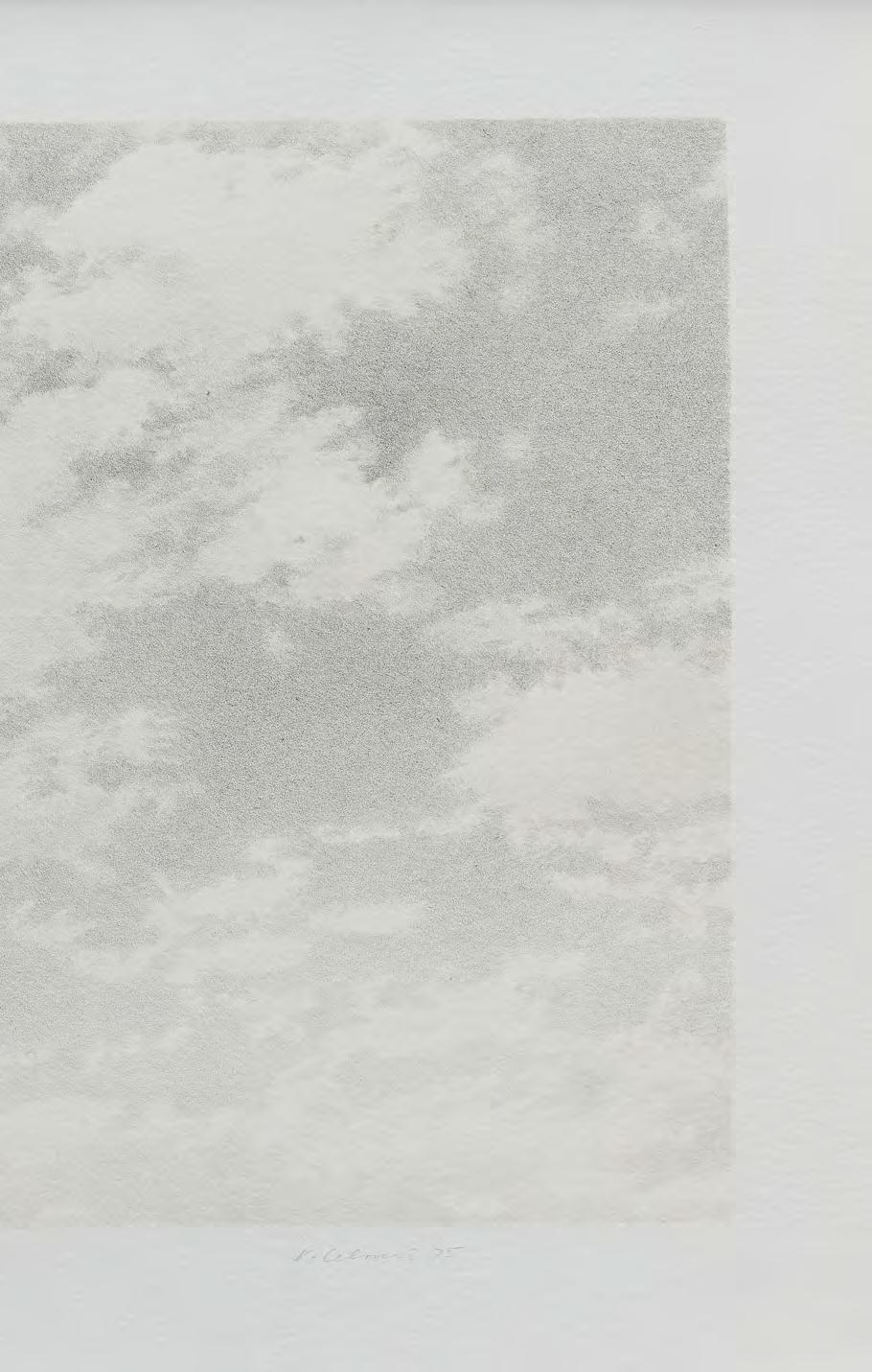
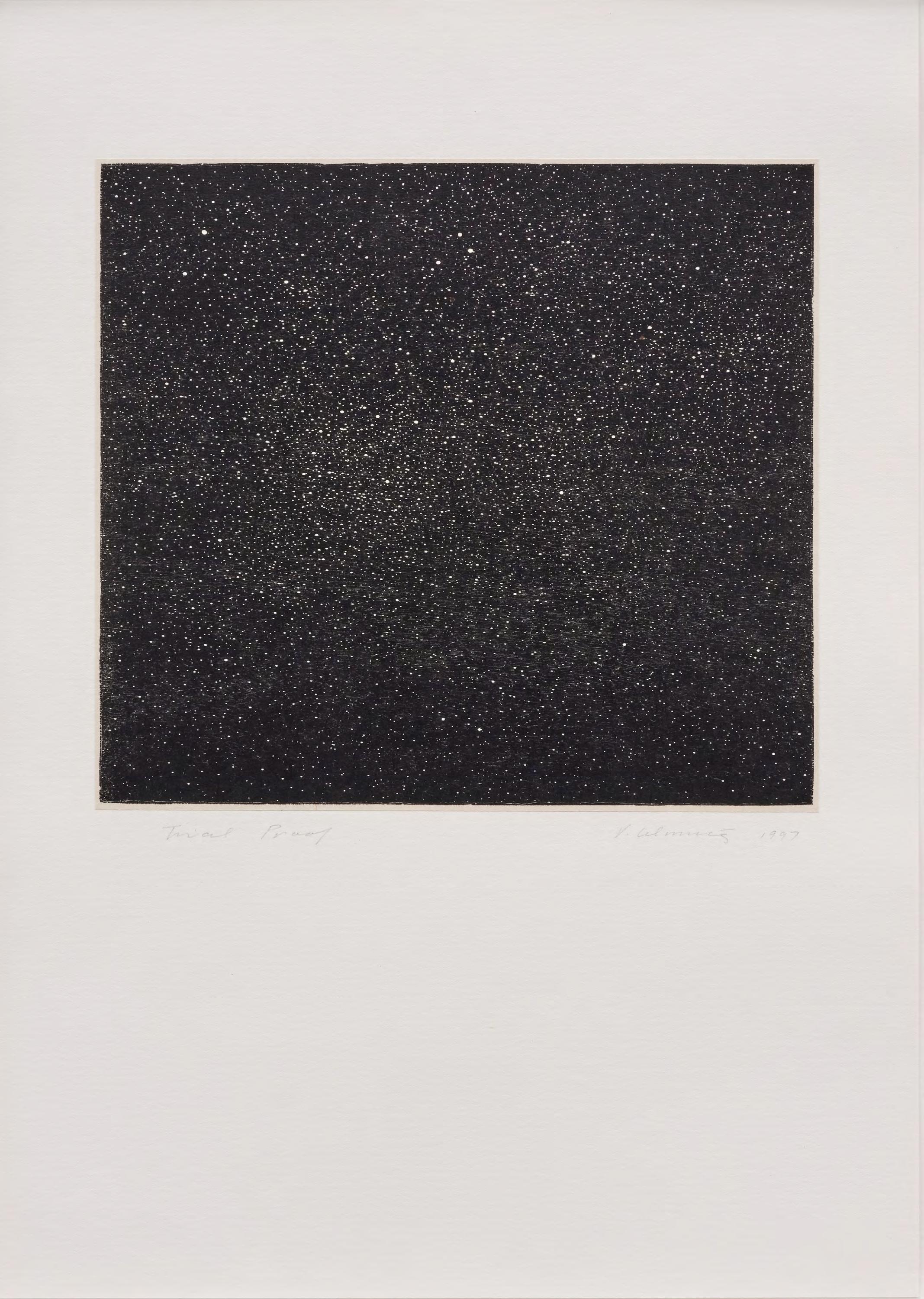
Night Sky Woodcut, 1997
Sheet size: 17 5/8 x 12 1/2 inches (44.8 x 31.8 centimeters)
Printer: Leslie Miller at Grenfell Press, New York
Publisher: Grenfell Press, New York
Edition size: 30, plus proofs Signed, dated, and annotated “Trial Proof”
info@susansheehangallery.com www.susansheehangallery.com