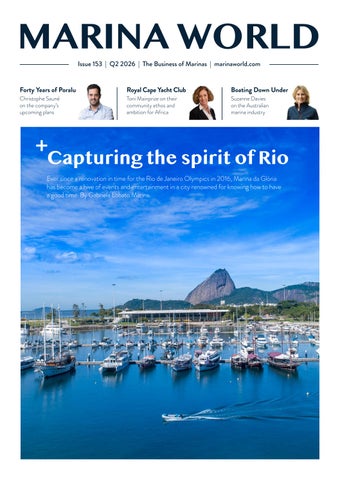
Marina World - Issue 153 - Q2 2026

Page 1


MARINA WORLD

SUPERDOCKS ™ PUSHING LIMITS

SF Marina is a world-renowned expert on developing new or existing premium marinas. We provide state-of-the-art floating breakwaters and concrete pontoons to anyone anywhere who plans on building a marina with superyacht berths. And who wants it to still be there after the storm.

The Southern Hemisphere

Dear Readers,

The global marina industry’s focus often falls on the northern hemisphere. This is understandable for two reasons. Firstly, the world’s two biggest recreational boating regions - the Mediterranean and North America including the Caribbean - are in the northern hemisphere, as are other destinations such as the Middle East, Thailand or Japan. There is plenty to talk about here.

Secondly, a marina exists just as much on land as water. Once you have discounted Antarctica’s 14 million square kilometres - because commercial or military developments there are prohibited by a number of international agreements - then the northern hemisphere accounts for 74 percent of the planet’s land area. There is simply more space to build marinas in the northern hemisphere.

This 153rd issue of Marina World addresses this imbalance by focusing on the southern hemisphere, especially in time for the Marinas26 conference and exhibition in Australia. Although representing only 26 percent of the planet’s developable land area, the southern hemisphere has some outstanding marinas, in iconic destinations, with fresh perspectives and plenty of water in between.

Gabriela Lobato Marins discusses how BR Marinas has captured the spirit of Rio de Janeiro through events at Marina da Glória. Toni Mainprize of Cape Town’s Royal Cape Yacht Club celebrates their community ethos and ambition for the continent. Staying in South Africa, I visit the Vaal Dam and the country’s biggest inland marina.

New Zealand’s Phil Wardale shares a selection of key ingredients required to deliver a successful project, Leona Caanen looks at the world-class Mantaray Marina in Gold Coast, and Marinas26’s own Suzanne Davies discusses marina development in Australia.

And don’t forget to check the news for exciting stories from the V&A Waterfront in Cape Town, Port Denarau in Fiji and even Stanley in the Falkland Islands.

EDITORIAL

EDITOR IN CHIEF EDITOR

NEWS WRITER

FEATURES WRITER

FEATURES WRITER

CREATIVE DIRECTOR

GRAPHIC DESIGNER

Francesca Webster

Patrick Norén

Ellaine Zabate

Enrico Chhibber

Leona Caanen

DESIGN PRODUCTION SALES & ADVERTISING

HEAD OF SALES

SALES MANAGER MARINA WORLD

CLIENT SERVICE MANAGER

SALES AMERICAS & CARIBBEAN SALES ITALY

Ivo Nupoort

Beatriz Ramos

Marieke de Vries Brianna Johann

Krista Andres

Philippe Critot info@admarex.com

CORPORATE

FOUNDER & DIRECTOR TECHNOLOGY DIRECTOR FINANCE DIRECTOR

Merijn de Waard Fabian Tollenaar

Laura Weber

SuperYacht Times B.V. Silodam 256, 1013 AS, Amsterdam, The Netherlands 31 (0) 20 773 28 64 info@superyachttimes.com www.superyachttimes.com

Cover Image:

Marina da Glória in Rio de Janeiro by Fabio Cavalcanti

“Marina World” (ISSN “1471-5856” USPS 19194) is published four times a year in January, April, July and October by “SuperYacht Times B.V.”, “256 Silodam, 1013 AS, Amsterdam, The Netherlands”. Airfreight and mailing in the USA by World Container Inc., c/o BBT 150-15 183rd St, Jamaica, NY 11413-4037, USA. Periodicals postage paid at Brooklyn, NY 11256.

POSTMASTER: Send address changes to “Marina World”, World Container Inc., c/o BBT 150-15, 183rd St, Jamaica, NY 11413, USA.

and

From Stellar to Storable with Simon Smith
The perseverance of Port Takola by Patrick Norén
For community
continent with Toni Mainprize
Marina development in Japan by Enrico Chhibber
Capturing the spirit of Rio by Gabriela Lobato Marins
Gold Coast by Leona Caanen

IF YOU OWN, BUILD, OR DESIGN FLOATING STRUCTURES

When your mooring choices look back at you after 20+ years, what do they say?

Did it hold in place through the worst storms?

Did it reduce loads and protect the structure or did it slowly introduce wear and tear?

What did it actually cost over time maintenance, replacements, downtime?

What about what you do not see the seabed, the environmental impact?

How about the accumulated visual impact above water?

These answers matter for mooring system selection

Make a mooring decision worthy of the next 20+ years

As your turnkey mooring partner, we work with you to evaluate your specific site and priorities, providing a mooring design aligned with your long-term goals.

Mooring selection should be based on proven long-term performance in real-world conditions, not assumptions or marketing claims.

Let’s get your floating vision sustainably moored!

Europe

€12.5M expansion at Marina de Lagos begins

Construction has begun on a €12.5 million (approximately $14.8 million USD) expansion at Marina de Lagos in Portugal. The project officially commenced with the laying of the first pile on the left bank of the Bensafrim River in Lagos.

The development will extend the marina’s capacity, introduce a yacht club and renew a public waterfront area beside the fishing harbour. More than three decades after the marina first opened, the surrounding area required improvement due to safety and operational concerns.

The project moved forward after Marlagos proposed increasing mooring capacity and upgrading the water basin and surrounding area, including commitments to maintain and improve operating conditions for professional fishing and other maritime activities in the area.

The expansion will add 102 new mooring places and redevelop approximately 1.8 hectares of space. Plans include 55 berths and 30 storage units for professional fishing, 40 berths for the Lagos Sailing Club and 170 berths for local recreational boating with floating pontoons. The plan also provides 135 additional parking spaces. The marina’s economic impact is expected to increase by 21 percent once the additional berths are operational.

Alcudiamar records 56% biodiversity rise after renaturalisation project

Alcudiamar Marina Resort in Spain has reported a 56 percent increase in the number of marine species within its port ten months after installing biomimetic micro-reefs in April 2025.

The site introduced ten Life Boosting Units® in partnership with the Spanish technology company Ocean Ecostructures. The first scientific monitoring results show measurable changes in biodiversity, biomass and carbon dioxide capture inside the marina basin.

A total of 38 native species have been recorded since the installation. Among them are five fish species of commercial interest, identified at juvenile and mature stages, which have established habitat around the structures.

Alcudiamar Marina operates over 740 mooring spaces, and its facilities include on-site refuelling, recycling services, a 150-tonne travel lift and a crane capable of lifting vessels up to 16 tonnes.

FHL acquires additional 23.5% stake in Port Denarau Marina

Fijian Holdings Limited (FHL) now holds 51 percent of Port Denarau Marina Limited (PDML) after completing the purchase of an additional 23.5 percent equity interest from Skeggs Group Limited.

$13M secured for Nelson Marina upgrades

Nearly $13 million NZD (about $7.8 million USD) in government funding has been approved to support major upgrades at Nelson Marina, including a new service centre and improvements to existing boatyard facilities.

Nelson Marina is located in Nelson Haven at the top of New Zealand’s South Island in Tasman Bay, within walking distance of Nelson’s city centre. The marina provides pile mooring, longterm berths and operates a travel lift. Nelson Marina is owned by Nelson City Council and managed by an in-house marina management team.

Following a $6 million Fijian dollars (approximately $2.7 million USD) expansion completed in September 2025, Port Denarau Marina now has 62 private berths, including 27 for superyachts over 24 metres. The marina also operates 63 commercial berths, 16 swing moorings and marine service facilities, including a 30-tonne travel lift.

“This acquisition strengthens FHL’s strategic footprint in Denarau, the heart of Fiji’s tourism hub, and aligns with the emerging developments in Malolo and the Yasawa Islands. It deepens our longterm exposure to the tourism sector, enhances portfolio alignment with our strategic objectives and reinforces our commitment to delivering sustainable value for our shareholders,” said Rokoseru Nabalarua, chairperson of FHL.

The funding comes from the Government’s Regional Infrastructure Fund and is administered by Kānoa – the Regional Economic Development & Investment Unit within the Ministry of Business, Innovation & Employment.

Up to $10.5 million NZD has been allocated for a two-storey Marine Service Centre of about one hectare. The building is expected to include workshops for boat building and maintenance, office accommodation and retail shopfronts for marine-related businesses.

A further $2.4 million NZD will support upgrades to the existing boatyard and hardstand facilities. This includes the installation of a new 110-tonne straddle lift, increasing lifting capacity from the current 50 tonnes.

Middle East

Saudi Red Sea Authority appoints Dr. Maryam Ali Ficociello as new CEO

The Saudi Red Sea Authority (SRSA) has appointed Dr. Maryam Ali Ficociello as its new chief executive officer.

She took up the position on 22 March 2026 and will lead the authority responsible for regulating marine tourism and navigation along Saudi Arabia’s Red Sea coastline.

Dr. Ficociello has more than 20 years of experience in governance, risk management, resilience and compliance across public and private organisations, including state-owned entities.

Before joining SRSA, she served as group chief governance officer at Red Sea Global, where she led the governance, risk and compliance division. In that role, she advised on environmental, social and governance matters connected to coastal tourism projects.

Dr. Ficociello commented: “I look forward to working with our stakeholders across government and industry to strengthen regulatory excellence, embed sustainability and resilience across the sector, and advance the Kingdom’s ambitions for responsible coastal tourism and the Blue Economy.”

Caribbean

complimentary hourly shuttle service runs daily between the marina and Gun Creek.

Biras Marina opens in Virgin Gorda, British Virgin Islands

Biras Marina has begun operations in North Sound, Virgin Gorda, as a marina serving superyachts in the British Virgin Islands.

The marina can accommodate vessels of over 150ft (46 metres) with a draft of up to 20ft (six metres), with both long-term and short-term berthing available. It also provides 20 mooring buoys for vessels of up to 60ft (18 metres).

Services include water and electricity connections, internet access and boat cleaning. A café and bakery operate on site, and a

“Our marina represents a strategic hub in the Caribbean, being the only marina in the region, specifically designed for superyachts, combining modern infrastructure and excellent services,” said Guillermo Houwer, owner of Biras Marina & Resort.

The opening of Biras Marina represents the first completed phase of the redevelopment. Further work is planned, including a limited number of private villas, additional dining outlets, a multi-brand retail space, a rooftop lounge, private event areas, a gourmet bistro and yacht-focused services.

The Americas

SkipperBud’s to operate North Point Marina in Illinois

SkipperBud’s will operate North Point Marina in Winthrop Harbor, Illinois, as the marina prepares for the 2026 boating season.

The decision follows the end of the previous concession agreement, with state and local authorities appointing an interim operator to keep the marina open while they prepare longer-term plans. The village of Winthrop Harbor announced the new operating arrangement and said SkipperBud’s is already familiar to the harbour community through boat sales, service and storage.

“Their transition into day-to-day marina operations brings experienced management, continuity and a team that understands both the needs of boaters and the importance of the marina to the surrounding community,” the village stated.

North Point Marina opened in 1989 on Lake Michigan between Chicago and Milwaukee. It covers about 77 acres of land and water and includes 21 docks with 1,477 floating slips measuring from 30-60 ft (nine to 18 metres). The State of Illinois operated North Point Marina from 1991 until 2016. The state then launched a request for proposal process to select a private operator.

Arch Henderson leads Falklands’ Stanley Harbour marina feasibility study

A feasibility study for a proposed marina at Stanley Harbour is in progress after the Falkland Islands Development Corporation (FIDC) appointed Arch Henderson to prepare a detailed report on the project.

FIDC confirmed the appointment following a request for proposal launched in April 2025. The process attracted 21 submissions from local and international firms. A panel made up of FIDC board members, together with representatives from the Falkland Islands Government, Falkland Islands Maritime Authority and the Falkland Islands Museum & National Trust, selected Arch Henderson.

The study will review market demand, socio-economic impact, cost and benefit considerations, technical options and risks. The programme is expected to run for about seven months, with a final report due in September 2026. That report will guide FIDC on whether the marina should proceed and what its first phase could involve.

Delivering the marinas of tomorrow

Hi-tech solutions to connect land and sea Pontoons, breakwaters, superyacht piers, floating crossings and constructions, off-the-shelf or customised, with robust and reliable structures in steel, aluminium or concrete.

Marina Santelena e Diporto Velico, Venezia - Italy

V&A Waterfront invests $13.7M in Quay 7 superyacht marina in Cape Town

The V&A Waterfront has announced a 230 million ZAR (approximately $13.7 million USD) investment in the Quay 7 superyacht marina in Cape Town, South Africa, with completion targeted for October 2026.

The Quay 7 superyacht marina will have eight berths, including six stern-in and two beam-on spaces for vessels up to 90 metres in length. Floating jetties will provide electricity, water and Wi-Fi. Fuel will be available at Elbow Quay through the FFS refuelling facility. The V&A Waterfront is pursuing Gold Anchor accreditation, which would position it among an elite cohort of internationally certified marinas. Currently, no Gold Anchor-accredited facilities exist in the immediate geographic region.

Graham Wood, CEO of the V&A Waterfront, commented: “Superyacht visits have grown steadily since 2009 and we welcomed 35 vessels in the 2024/25 season alone. Many stay for extended periods – six months, sometimes a year –because Cape Town offers a unique mix: world-class tourism, reliable marine services and access to adventure cruising routes that simply don’t exist in traditional yachting hubs.”

In the press release seen by Marina World, Andre Blaine, the executive director of marine and industrial property at the V&A Waterfront, said: “Captains and owners are seeking smarter, more operationally efficient alternatives to saturated hubs. Cape Town offers not just a safe harbour and world-class provisioning, but access to adventure cruising routes – Antarctic expeditions, Southern Ocean passages and Indian Ocean islands – that will define the next era of luxury yachting.

“We sit at the intersection of three oceans, with more than 30,000 commercial and tourism vessels passing the Cape annually,” Blaine added. “Our marine services sector is mature, our crew training facilities are internationally recognised and our tourism infrastructure rivals any global destination. What we’ve lacked is purpose-built berthing that matches the operational standards captains expect.”

GLOBAL TURNKEY DRYSTACK SOLUTIONS

An innovative family business with Antonio Zaforteza Ocibar:

Marina World discusses the ethos and growth of Ocibar, a network of six singular marinas in the heart of the Mediterranean, with their CEO Antonio Zaforteza.

How did Ocibar come into existence and how has the company grown over the last 25 years?

Everything started in 1999. At that time my father bought Port Adriano in Mallorca, it was a small marina of around 400 berths and we bought it with the intention to just manage that little marina. We didn’t have plans beyond that. But just as we acquired the marina, there were suddenly no more berths available in the Balearic Islands. So the industry changed suddenly.

My dad passed away in 2001 and I took over in 2003. I saw that the industry was changing a lot and I knew that there would be leases expiring, tenders coming up and new projects allowing marinas in the Balearics. We won a small tender in Ibiza and this was our first contact with larger yachts up to 60 metres. We learned a lot there, the superyacht industry was still quite niche back then.

We then got the license to expand Port Adriano in 2007 and turn it into what it is today. But the process of building was delayed by the financial crisis of 2008. By 2015 we had completed the expansion, a private equity firm could exit and we found a new shareholder in the company. After that we started looking at other opportunities.

Since then we have grown quite a bit. We have acquired 50 percent of Marina Santa Eulàlia in Ibiza, we won a tender for Marina Botafoc, also in Ibiza. We acquired Port Tarraco in Tarragona and we got a 25 percent stake in Marina d’Arechi in Salerno, Italy. Finally, last year, we won a tender for Marina Port Valencia. So we have been around for a while, we know the industry well and we have been following the trends of the last 25 years.

Left: Ocibar’s Port Adriano in Mallorca, Spain.
OCIBAR
Antonio Zaforteza

So Ocibar is a family business then? How does this shape your approach to managing individual marinas and the network?

Yes, Ocibar is very much a family business and we try to take advantage of that. We try to be very lean. Any problems that arise should be able to reach top management as fast as possible, if necessary. Decisions can be taken and problems can be addressed quickly.

Every marina of course has its own character, you cannot change this even if you wanted to. Small boats, big boats, locals, tourists, leisure, business, they are all different. But we still have to be lean in our structure and decision-making processes. Part of providing the same standard of service across the network - which everyone rightfully expects - is having the same

decision-making processes at all your locations.

That said, I don’t strictly believe in the idea of networks in marinas because especially the large yachts go where they want to go. I don’t think we have the power to move the customer in one direction or another.

However, when we know they are in those places - for example maybe they have been in Tarragona and we know they are going to Italy - we can support them with berthing, logistical issues, disposing garbage and so on. In those situations our network and family business structure starts to be powerful.

We have strong business synergies as well. We have one financial division, one accounting division, one environmental division. This makes for an efficient business and is an advantage of being a larger player.

The push to acquire more marinas and expand networks is very strong. Will Ocibar also look to expand further in the coming years?

We will try to expand but we will not rush into doing it. The market has become very popular in the last few years and there are many new players coming in. We have been able to land some good deals and expand, but we do not need to expand fast. We will only do it when we have the right opportunity and when it makes financial sense.

One thing that is quite special about Ocibar is that we are not owned by a fund, unlike many of the other private equity companies running around! We are not going to be sold in the future and this provides a certain guarantee for tenders and administration. They know who is going to be running the marina for the coming years, which is perhaps not the same with other groups.

We also don’t need to have 100 percent ownership of the marina. We can collaborate with partners. Managing a marina used to be simpler, it was less bureaucratic, there was less paperwork. Nowadays everything is a bit more complicated, there is more administration, authorities ask for more paperwork. So we can see that a marina, which was once a pleasure to have, can become a bit of a burden.

By collaborating with smaller marinas, we can take on some of those burdensome responsibilities and do it better and cheaper. This is our unique angle and this is how we won the tenders for Marina Santa Eulàlia and Marina d’Arechi.

Much of the innovation currently underway in the marina industry is in marina administration and management. What investments is Ocibar planning in this area?

We are currently investing in sales and new accounting software to keep up to date with the latest technological trends. It is important we have an administrative backbone that is up to date and working properly. Being part of a bigger group means we can save on insurance and fuel packages, so there are synergies there too.

We are looking to update our marina management software. In Spain there is one really big player, which is Pandora, and that is the one we use. They are updating their software and we are waiting to see what they can offer. But in the meantime we are looking at international players and investigating other options.

This page: Port Adriano, Mallorca.
OCIBAR
OCIBAR
OCIBAR

How is Ocibar approaching landside development opportunities across the network? Is the focus on leisure or is your strategy more nuanced?

The topic of waterfront and lifestyle investments to compliment the marina and attract additional footfall is an interesting one. I don’t think you can summarise across the board, however. There are many nuances, it will all depend on what you are doing and where.

For example, at Marina Botafoc in Ibiza, the marina is right in the middle of the city. It is quite easy to fill it up with restaurants and amenities to create that lively atmosphere. In Port Adriano, Mallorca, we have a mixture of business and leisure, some of which are related to the marine industry, but not all.

But in Tarragona it is completely the opposite. We have some buildings around the marina but it is a business park with offices. It is completely unrelated to the nautical industry. But when you have some elevation above the marina, these areas are a great location to work.

We are taking the same approach in Valencia where there is a lack of office space. There will be some restaurants to provide some life to the marina, but the main focus is offices. With the trend of remote work, companies are increasingly wanting their employees to come into the office. But for this to happen they need to provide a cool atmosphere and working environment.

The city centre of Valencia is very constrained. Down by the marina, however, we can provide office space that is open and bright, overlooking the sea and the boats. You can be minutes away from going paddle-boarding on your lunch break instead of the usual 2pm spinning class that we have in Spain! So we have an interesting angle there. It has worked well in Tarragona and we think it will work well in Valencia too.

Below: Marina d’Arechi in Salerno, Italy.

Australia: A boating nation

Boating in Australia was largely a beneficiary of the pandemic, evidenced by increased boat sales, registration and license holders. Sustaining that momentum is now a key focus for state boating industry associations as they seek to retain the next generation of boating enthusiasts.

Previous page: Hamilton Island, Whitsundays, Queensland.

Australia’s relationship with the water runs deep. Surrounded by nearly 60,000 kilometres of coastline and covering 7.75 million square kilometres of land, the island continent has long fostered a culture defined by boating, marine recreation and life by the sea. With around 85 percent of Australians living within 50 kilometres of the coast, access to waterways is both a lifestyle preference and part of who we are as a nation.

Australians excel at water-based sports such as surfing, sailing, rowing, canoeing, kayaking and swimming. Recreational boating, in particular, remains one of the country’s most popular pastimes. According to the 2024 Australian National Boating Survey conducted by the Boating Industry Association, nearly one in five Australians participates in some form of recreational boating each year, while approximately 10 percent of the population holds a boat licence.

A strong and resilient marina industry

For over a decade, Australian marina industries have been enjoying strong business conditions, and this looks set to continue.

The Marina Industries Association (MIA) conducts a biennial Health of the Australian Marina Industry Survey of the 300 professionally managed marinas in Australia. The survey, undertaken for nearly two decades by Michigan State University under the leadership of Dr Ed Mahoney, provides detailed insights into marina performance, economic contribution and industry trends. It is widely regarded as one of the most comprehensive marina industry studies conducted globally.

The findings highlight the sector’s substantial economic impact. Australian marinas contribute approximately $2.24 billion AUD annually to the national economy and support around 21,000 jobs. As the critical interface between land and water, marinas also play a pivotal role in supporting Australia’s tourism industry, one of the country’s largest export sectors.

Marine tourism activities such as diving, whale-watching tours, reef excursions and yacht charters rely on highquality marina infrastructure. Without modern berthing facilities, maintenance services and shore-side amenities, these operations would struggle to function efficiently.

Australian marinas perform well. The average marina operates at 86 percent occupancy, accommodates approximately 182 vessels and employs 14 staff. In addition to its own operations, marinas typically host nine small business tenants, from marine service providers to hospitality venues which create vibrant waterfront business communities.

On average, a marina generates annual revenue of $2.7 million while contributing an estimated $7.7 million to the broader economy.

Suzanne Davies

Regional differences across the country

While the industry performs strongly nationwide, regional variations exist.

New South Wales has the largest number of marinas in the country, with 108 facilities spread across its extensive network of waterways including Sydney Harbour, Pittwater, the Georges River, the Hawkesbury River and Lake Macquarie. These marinas tend to be smaller, reflecting the fragmented nature of waterways and historical development patterns.

By contrast, Queensland has fewer marinas at around 64, but they are typically much larger. The average Queensland marina can accommodate around 318 vessels, more than double the capacity of those in New South Wales.

Occupancy levels also vary by region. Both Tasmania and New South Wales record some of the highest average occupancy rates at around 91 percent, reflecting relatively stable, locally based boating communities. Queensland’s marinas average around 82 percent occupancy, influenced by the state’s strong tourism market and more transient boating activity.

Results from the 2025 survey are expected to show further improvements in performance and will be presented at the Marinas26 international conference and trade show on the Gold Coast in May, with the full report to be released soon afterwards.

Drivers of strength

Aside from a strong boating culture, several factors underpin the resilience and growth of Australia’s marina industry.

The “land down-under” is geographically remote from geopolitical instability and “hotspots” in the northern hemisphere. This, combined with world class eco-tourism offerings, has made Australia attractive to international visitation in recent years, particularly for superyachts, charter vessels and other luxury vessels.

The superyacht sector has become a major growth driver for marinas. According to Superyacht Australia, the economic impact of superyacht visitation increased by 18 percent in 2024 compared with the previous year.

One key factor is the dramatic increase in vessel stay duration. Over the six years to 2024, the average length of stay for visiting superyachts increased from 41 days to 124 days. Legislative changes have made charter operations more attractive, while the high quality of Australian marine trades and favourable exchange rates have encouraged owners to undertake refit and maintenance work locally. Approximately 75 percent of visiting vessels now undertake major works during their stay.

Another trend shaping marina development is the steady increase in vessel size. Over the past two decades, recreational boats have grown not only longer but significantly wider. As a result, spare capacity tends to exist primarily in smaller berths under 12 metres.

Many marinas have been reconfiguring their berthing layouts to adapt and accommodate larger vessels. However, unless the overall marina footprint expands, this process typically results in fewer total berths.

In the densely populated areas on the east coast, marina development faces supply constraints. Limited freehold waterfront land, competing coastal land uses, public access requirements and complex environmental approval processes all restrict new marina construction. Planning approvals are often lengthy and expensive, making large-scale greenfield developments difficult in major metropolitan areas.

As a result, development opportunities in cities are typically limited to the expansion or redevelopment of existing marinas.

SHEILA C / UNSPLASH

Previous page: A marina in Cairns, Queensland.

Below: A rendering of Mantaray Marina in Queensland; East Fremantle Yacht Club in Bicton, Western Australia.

Where it’s at

In metropolitan areas such as Sydney, expansion of existing facilities has become the primary mechanism for increasing vessel storage capacity. Similar redevelopment activity is occurring in Brisbane, where marina upgrades are expected in the lead-up to the 2032 Brisbane Olympics.

Greenfield opportunities, meanwhile, tend to be outside the capital cities or in regional areas. One of the most recent greenfield developments in NSW is Shellharbour Marina, just over 100km south of Sydney. More than 30 years in the making, the marina opened in 2023 as part of a large public-private partnership development centred on a 250-berth marina, dry stack facility and vessel maintenance precinct.

The wider waterfront includes boardwalks, beaches, promenades, hotels, retail spaces and residential housing, creating a vibrant coastal community. Developments like Shellharbour are increasingly viewed as valuable community assets that blend tourism, recreation and residential living.

On the west coast, Western Australia is seeing a mix of marina redevelopment and new projects outside Perth. The most prominent is Ocean Reef Marina, a major waterfront precinct combining retail, tourism, residential and recreational facilities alongside a new marina.

Southport Yacht Club, Gold Coast, Australia
HARRISON REILLY / UNSPLASH
THE MANTARAY MARINA | RESIDENCES

Queensland: Australia’s boating tourism capital

Queensland is the country’s boating hub and leads the way in greenfield marina precinct development and the large refit sector. The state hosts some of the country’s most significant marine tourism hubs, stretching from the Gold Coast and Sunshine Coast north to destinations such as Airlie Beach and Cairns.

The Gold Coast has positioned itself as Australia’s luxury boating capital. At the northern end of the city, a series of high-end marina developments is transforming the area known as ‘The Spit’ into a major superyacht and marine tourism precinct.

Among the new projects is the proposed Mantaray Marina and Residences, which will feature 67 berths for vessels up to 60 metres, alongside 24 luxury waterfront residences, retail and dining spaces. At its centre will be the Mantaray Club - a two-storey floating restaurant and bar designed as a focal point of the development.

Next door, the Main Beach Superyacht Marina will offer 66 berths capable of accommodating superyachts up to 73 metres, complemented by a 157-room Ritz-Carlton hotel and a luxury retail and dining precinct.

Further north sits Marina Mirage, where the marina component is already complete. It provides superyacht berths for vessels up to 70 metres, a floating beach club featuring a bar, restaurant and swimming pool. The surrounding land-based precinct is currently under development and will include private residences, waterfront dining, luxury retail and a hotel operated by The Luxury Collection.

Showcasing Australian marinas

The study tour to be held on Wednesday 27 May following Marinas26 will visit each of the three luxury marina developments on The Spit.

A second study tour will head to Airlie Beach in North Queensland to visit three more luxury marina developments including Hamilton Island Marina, Hayman Island and Coral Sea Marina - all internationally recognised marina precincts catering to the growing superyacht market.

Looking ahead

With strong boating participation, growing superyacht visitation and continued investment in waterfront precincts, Australia’s marina industry is well positioned for the future and Australia’s position as one of the world’s leading boating nations is set to strengthen even further.

Below: 1770 Marina in Queensland.
SEBASTIAN ASHTON / UNSPLASH

Sunday - Welcome Reception

Pelagic Risk Services Welcome Reception, Poolside at Royal Pines Resort

Tuesday - Conference & Trade Exhibition Day 2

Keynote, marina panel, lessons learned, innovation, risk on waterfront, AI practical applications for marinas, superyacht ready, future of boatyards, and more

Wednesday — Two Study Tours · Gold Coast Marina

Choose your adventure

Option1: The Gold Coast Tour

Monday - Conference & Trade Exhibition Day 1

Keynote, economic outlook, industry data, trends, international perspectives, marina maintenance, and more

Tuesday Evening - Gala Dinner

Marine Structures Gala Dinner, Royal Pines Resort tennis courts.

& Whitsundays

(27 May — Mantaray Marina, Main Beach Superyacht Marina, Marina Mirage, AkzoNobel Paint Application Training Centre, The Boat Works and Gold Coast City Marina & Shipyard)

Option2: Whitsundays Tour

(27–29 May — Coral Sea Marina Resort, Hayman Island Marina and Hamilton Island Marina)

Forty years of Poralu Marine with Christophe Saune

The French manufacturer of aluminium pontoons, Poralu Marine, began as a local, almost incidental activity to gradually become a sustainable business with its own brand. Marina World sits down with their group growth director, Christophe Saune.

Poralu Marine recently celebrated a big milestone. Could you tell us more about the inception and history of the company?

Poralu Marine’s history started around 40 years ago between Lyon and Geneva, in a small village called Port — a rather fitting name for a company whose main business is to build harbours and marinas all over the world.

At the time, the mother company was an industrial group specialising in steel structures for buildings and aluminium joinery. This heritage is a strong marker of who we are today: a company rooted in metallic materials and structural engineering with a strong wish to develop around industrial activities. Our expertise in aluminium, a material that would later become central to our marine solutions, comes directly from these early years.

The marine business itself started quite simply, with a request from a private individual for a small floating dock. That first project led to another, then another and soon after, to the construction of an entire marina. What began as a local, almost incidental activity gradually became a sustainable business with its own brand.

Four decades later, Poralu Marine has completed more than 15,000 projects across five continents, including some of the world's most iconic marinas. While the scale of the marina activity has changed dramatically, the spirit that drove that very first floating pontoon remains at the heart of Poralu Marine.

Poralu describes itself as the "world leader in marine-grade aluminium products" with over 15,000 projects completed worldwide. To what would you attribute this success?

Our success is the result of a long-term strategy that was initiated in the early stages of the company. To start with, we made a deliberate choice very early on to look beyond our French domestic market. While we naturally expanded across Europe, we also expanded our reach much further at a time when international development was far less common.

In 1998, we delivered the Woolloomooloo Wharf in Sydney, Australia, with docks manufactured in our factory in France. In 2001, we strengthened our presence in North America through the acquisition of a company and manufacturing facility near Montreal, allowing us to serve both the North and Latin American markets. In 2007, almost 20 years ago, we completed Yinhai International Yacht Club, the first marina in Qingdao, China, where the 2008 sailing competition for the Beijing Olympics took place, when yachting was practically non-existent there.

This proactive international strategy enabled us to spread our presence globally ahead of many local and international competitors, often positioning us as pioneers in what were considered emerging markets in the marina industry at the time.

These diverse experiences and locations have shaped our technical expertise. We had no choice but to propose infrastructure designed according to local conditions and customer expectations. Designing and delivering projects across vastly different environments has forced us to constantly adapt and innovate. We have tested our solutions in extreme Canadian winters, in regions where temperatures approach 50°C in summer, in hurricaneprone areas of the Caribbean and Latin America, and in typhoon-exposed zones in Asia.

These experiences drove our brand and product. Poralu Marine positions itself as a premium brand offering long-lasting installations combined with a unique level of personalisation. With aesthetics also being a strong marker of our solutions, our reputation is centered on durability, reliability and performance. This is still what helps us stand out in the fierce competition of the marina design and construction industry. We aim to honour our reputation as a premium product, which is why we do not compromise on quality.

Even if it seems a bit common to say, our greatest strength lies in our people. You don’t learn through school or degrees in our business. Each and every employee of the company has been trained to our practices, specificities and everything we do is the result of their combined expertise. Poralu Marine is driven by passionate teams whose primary objective is to deliver our promises to clients, and many of them have spent a significant part of their careers with the company.

Left: Vieux-Port of Marseille, France.

With Poralu already being well-established across Europe, North America, the Caribbean and Asia, how do you intend to grow the business in both traditional and emerging markets?

Building on our longstanding international presence, our growth strategy is both a continuation and an evolution of what has made us successful so far.

We are already firmly established across most global markets, with commercial and operational presence in Asia, the Middle East, Europe, and North and Latin America. This proximity to our clients is essential. It allows us to better understand local dynamics and their impact on our future marina infrastructures, and also to help our customers benefit from best practices and tailored global expertise. In many parts of the world, the nautical sector is still in its early stages of development. By maintaining a continuous local presence with a longterm vision, we are able to support these markets as they mature, trying to stand out from the competition by being better and not cheaper.

In more mature markets, our development is increasingly driven by our ability to support our existing

clients throughout the lifecycle of their projects. This is where the broader ecosystem of Wearth Group plays a key role. Through Marina Management & Consulting, we provide consultancy services to optimise marina operations and development strategies. With Rotax Marine, we offer rotomolded accessories for marinas. And through Poralu Marine Services, we deliver marina refurbishment and maintenance services.

TAILORED MARINA SERVICES TO SUIT

PORALU MARINE

You recently announced that the company will be expanding its range of concrete marina solutions. What factors drove the decision to expand into this market?

This development is a natural extension of our diversification strategy to provide more to our existing clients, whether developers, marina operators or public authorities. Aluminium dock manufacturing remains the core of our expertise, and it is often the best choice for floating structures. However, there are cases where concrete solutions are more suitable and our role is not to promote one material at all costs, but to recommend the right technology for the right environment. Concrete has clear advantages in certain applications, particularly when it comes to heavy-duty structures and wave attenuation systems.

Furthermore, the overall marina development market itself is undergoing a strong and notable evolution. The most naturally protected sites have largely already been developed. New projects and extensions are increasingly located in more exposed areas, where environmental conditions and specifically wave actions are more demanding. This exposure is further amplified by the effects of climate change with more frequent and intense storms. The ability to offer robust protection solutions — such as concrete floating breakwaters — has therefore become essential and a natural complement to our aluminium range of floating pontoons.

Left: A welder at a Poralu Marine facility.
Below: Harbour Cruises in Vancouver, Canada.
Christophe Sauné

Poralu says that, as a company and industrial player, you are aware of your impact on the environment. How are you innovating through research and development to become a more environmentally friendly company?

Environmental responsibility is deeply embedded in Poralu Marine's DNA. It has been part of our approach since the very beginning, long before sustainability became a fancy topic in our industry.

One of the recent initiatives I am personally most proud of is the development of our low-carbon HARMONY dock finishing. This project was not driven by regulation or external pressure. There is no law or standard that requires us to take this initiative. Instead, we chose to take responsibility as an industrial player to demonstrate that a different path is possible.

This has been one of the most ambitious projects undertaken by Poralu Marine in recent years. From the early stages of Poralu Marine, we made the decision to work exclusively with 100 percent recyclable material, keeping in mind that one day the overall value chain would be ready to reuse these recycled materials in an integrated circular economy.

Today, while still being 100 percent recyclable and with no impact on our pontoon structural strength, we can offer docks that are up to 80 percent recycled and biosourced, with a carbon footprint that is nearly half that of a standard aluminium pontoon. This initiative is in line with Wearth Group values, developing solutions in harmony with our ecosystems, finding the right balance in between performance and environmental responsibility.

With now three types of docks — NAUTIC (our standard dock), HARMONY (low impact dock) and PREMIUM (high end design and low impact dock) — we encourage further project customisation allowing each and every customer to get "their marina".

We consider true innovation to be anticipating future challenges and acting proactively, rather than being forced to react. Looking ahead, we will continue to invest in research and development to further reduce our environmental impact. As an industry, we can no longer afford to treat these issues lightly and we intend to remain at the forefront of this transformation.

How do you think Poralu — and indeed the marina industry at large — will look in five, 10 or even 50 years' time?

We see Poralu Marine evolving further as part of a broader ecosystem within Wearth Group, positioning ourselves as a global marina player.

Our ambition is to continue providing fully integrated turnkey solutions across the entire value chain of a marina project, from design and construction to operation and long-term management, complemented by additional products and services.

Beyond Poralu Marine itself, the marina industry is likely to go through a significant transformation. We are already witnessing a consolidation of market players within the marina industry, particularly in mature regions. Projects are becoming increasingly complex, with higher technical, industrial, financial and environmental requirements. Margins are also under pressure and delivery timelines are shrinking as everyone wants more, faster.

Only the most robust and well-structured companies will have the capacity to meet these expectations over the long term. This will naturally lead to a concentration of expertise and an aggregation of capabilities among a smaller number of key players.

Right, from top: VIP dock in Marina Costa Baja, Mexico; Tauranga Marina in New Zealand.
PORALU MARINE
PORALU

Strategic Advisory for the Superyacht Market

SYT Strategy advises investors, shipyards, marina operators, and governments on investments, growth strategy, and market positioning

Investment & Commercial Due Dilligence Market & Competitive Strategy

South Africa’s biggest inland marina

About one and a half hours south of Johannesburg lies the enormous Vaal Dam. With a surface area of 320 square kilometres and constructed in 1938, it is also home to Bayshore Marina, the biggest custom-built inland marina in South Africa.

MARINA WORLD

“The original marina was started by my dad in 1989,” said Greg Pilling, director of Bayshore Marina. “In a previous life he worked in video training and the CEO of a company he had once worked for retired due to ill health. That CEO started building a small development of four or five houses, but in those days there was not really much at the dam at all.”

“Then my dad came in and realised that, in order to encourage people to come in, buy and see the vision, he had to build a marina. So the marina really got built as a sales aid to the property development just next door.”

Construction on the marina took three years and some 440,000 cubic metres of earth were moved. They started by building a retainer wall to close off the marina from the dam, but no sooner than having finished the wall did the water level in the dam drop to below the critical level.

“If we’d waited a year we would have saved a fortune because we wouldn’t have had to build that wall!” Greg recounted.

After the marina’s opening in 1993, residents living in the neighbouring property development began renting garages for their boats, which remains one of Bayshore Marina’s main income streams to this day. A restaurant, a small petrol station, convenience stores and a boat hoist were also added, but it more or less stayed the same with minimal development for 20 years.

“The boat garages are brilliant. About 99 percent of them are power boats and those people don’t really want to shlep their boats backwards or forwards from Johannesburg. Some of them don’t even come down for a year or two, they just keep paying for the convenience. But the yachts, they are the people who want to spend their weekends on their boats, on the water, fiddling away, what yachties do!”

Weather patterns and low water levels

This being a dam, however, means that the marina is vulnerable to low water levels. Particularly in this part of South Africa, in an area known as the highveld that covers the central-northeast part of the country, winters are cold and dry. June, July and August will only average a few millimetres of rain each month. The Vaal Dam is also the main source of drinking water for Johannesburg and many other surrounding settlements, putting enormous pressure on the dam especially after prolonged dry periods.

“There are cycles in the weather, a short, mid and longterm cycle,” explained Greg. “When a couple of them coincide, water levels will drop quite significantly. There are times when the dam is only at about 20 percent. When this happens, the water is about 200m from the mouth of the harbour and all the walkways literally sit on the ground.”

Bayshore Marina offers customers the chance to store their boats on the hard thanks to a lifting crane, lifting basin and stands. About 80 percent of customers take them up on the offer but 20 percent leave and store their boats at home. This does present a problem for Bayshore, however.

“Eventually the water comes back and some people put their boats back, but you will only be at about 60-70 percent of what you used to be. It is difficult to build that business up again,” said Greg. “But the garages are great, the fuel station is seasonal, the marina is all ready now for someone to throw a bit more money at it, whether it be marina upgrades, a marina village, a retirement home or investing in the campsite. We already have the facilities for that, but it could be upgraded into a sort of ‘glamping’ campsite.”

Left: Bayshore Marina on the Vaal Dam, South Africa.

A busy day at Bayshore

The peak season at Bayshore Marina and indeed the surrounding Vaal Dam area is of course the summer, especially through December and around Christmas and New Year. On a busy day they will be launching around 30 boats, with sometimes a queue of up to 20 boats waiting to come in and fill up or be retrieved onto the hard.

“The restaurant is also pretty full,” said Greg. “In fact on Christmas Eve last year it was so full that we even ran out of food. So we had to close and then re-open again on Christmas Day. We have some day visitors coming in and in the very peak season we charge a nominal fee as well. In the peak summer weeks we will often stick around until eight or nine in the evening, taking boats out. But to be honest, we don’t market ourselves one bit, so there could be room to grow.”

During the austere highveld winters, Bayshore Marina will close the petrol station as very few people will be out and about on the dam at that time of year. Much of their work is “super seasonal”, according to Greg.

“However, the Midvaal Local Municipality in Meyerton has deemed our area to be a little island that forms part of the so-called ‘urban edge’ to try and grow tourism in the area. Beyond that, it’s all agricultural land where rezoning and developments are more difficult. The municipality is supporting developers with projects that will attract people to the Vaal Marina area. For example, we hope that a small soft game reserve with animals like antelope and houses all around will open soon.”

That said, nearby Johannesburg is notorious for its poor infrastructure, creaking and crumbling after decades of mismanagement and underinvestment. Whether it be the state of its roads, water and electricity supply, crime or corruption, one cannot hide from the fact that South Africa is not without its fair share of problems.

“People are looking for a place to get away,” said Greg. “It’s got to be safe, secure and nice. It’s got to have a holidaylike atmosphere. Places like ours, which are about one and a half hours south of Johannesburg, are perfect for that. It just needs a bit of critical mass to take off.”

Below, from top: Boat storage and slipway at Bayshore Marina; The restaurant at Bayshore Marina.
Right: Bayshore Marina on the Vaal Dam, South Africa.
ANNIKA KRÜGER NORÉN
MARINA WORLD MARINA WORLD

“Get

them out of the shopping malls”

Given the relative dearth of boating opportunities in the region - it can be difficult to find large bodies of water at almost 2,000m above sea level - boaters have been known to come from over two hours away to enjoy Bayshore Marina and the wider Vaal Dam, which straddles the three provinces of Gauteng, Mpumalanga and the Free State.

“The majority of people here used to be business owners from the southern half of Johannesburg, but then we started getting a few more from as far away as northern Pretoria because the Hartbeespoort Dam started having a problem with weeds. The Pelindaba nuclear power station is also nearby, and a couple of past incidents there made some people nervous. So they started coming down here for their boating fix,” Greg said.

In recent years, however, Bayshore Marina has seen an increase in customers from “career corporate people”, Greg explained, who would have children and want to “get them out of the shopping malls”. For many young people in South Africa, large shopping malls are often the place to go and hang out after school and on weekends.

“What tends to happen is that people’s kids get to around 10 years old, and then they start to see the lure of parties and shopping malls and that sort of thing. So the parents try to get their kids out of there, buy a boat and go out and have fun on the weekends out on the water.

“People tend to hang on to the boat garages for just over six years or so, which is roughly how long people hold houses for in the area. And it makes sense. By the time the kids are around 16 years old, they aren’t so interested in going away with their folks at the weekend! They want to go out with their mates and use exams as an excuse!”

Advertisement

IF IT’S ON WATER WE HAVE A SOLUTION! Design,
MARINA WORLD
Marina Jandía (Spain)
“We always find ways to do things very differently with what we’ve got. We always manage to find a way.”

Future developments

While the entrance to the marina and around the restaurant is around eight metres deep when the dam is at 100 percent, the opposite end of the marina is only about four metres deep. So if the water in the dam drops to about 60 percent, boats are unable to float in that corner of the marina, especially if they have a keel.

“I’m not sure if extending the marina into that part is worth the effort,” said Greg. “As far as the marina itself is concerned, I would like to get back to the 100 moorings with full rental occupancy. But this is more of a marketing thing.”

“But for the shallow half of the marina, my daft plan would be to build a wall, keep it permanently filled with water and, using the same walkways, moor a couple of boats there. I would then rent those boats out as apartments or mini-hotels. That way I don’t actually need any planning permission because they are boats, not buildings.”

The pontoons in the marina itself have been there for about 30 years, and while most of the wood and the floats are in pretty good shape, they need to spend “a lot of money”, according to Greg. “Just to replace the wood there will be about 350,000 ZAR,” he says, or about $21,600 USD.

“I would also like to build a walkway that goes directly from the restaurant to the moorings and then another one from the moorings to the residential area. We have all the planning permission and approvals for these residences, we just need to work a couple more things out before getting started.

“But for many of these technological marina upgrades we see coming to market, a lot of them are developed in hard currency. We need to recoup the cost of investing in them in South African rand, which can be challenging.”

“A farmer makes a plan”

Nevertheless, Bayshore was conceived as and remains a truly unique marina in a part of the world hardly wellknown for its boating. It was born during a time of seismic change in South Africa and has operated continuously for over 30 years, despite no shortage of challenges.

Greg Pilling is confident that no other marina like Bayshore will ever emerge, at least on the Vaal Dam. After all, the dam remains the main source of drinking water for Johannesburg and is managed by the Department of Water and Sanitation. The arrival of any more developments would bring concerns around water pollution, meaning that it is unlikely that any such development rights will ever be granted again. Bayshore Marina is therefore in a unique position to grow in an area with promising touristic credentials and without much competition when it comes to boating.

“There is a saying in Afrikaans and it encapsulates how many people in South Africa approach life,” concluded Greg. “We say ‘‘n boer maak ‘n plan’, which means ‘a farmer makes a plan’. We always find ways to do things very differently with what we’ve got. We always manage to find a way.”

Right, from top: Aerial view of the Vaal Dam and entrance to the marina; Bayshore Marina.
MARINA WORLD
ANNIKA KRÜGER NORÉN

CONOLIFT Upgrade to

• Towed, self-propelled, and highway trailers

• Towed, self-propelled, and highway trailers

• Sling lift trailers and boat hoists

• Sling lift trailers and boat hoists

Remote control hydraulic trailer tugs

Remote control hydraulic trailer tugs

• Galvanized boat storage stands

• Galvanized boat storage stands

• Simple operation, rugged durability, flexible features

• Simple operation, rugged durability, flexible features

• We also supply floating docks and breakwaters

• We also supply floating docks and breakwaters

Marina intelligence in Australia

Australian operators often manage large geographic distances between sites, mixed-use facilities, lean operational teams, high compliance expectations and strong professional accreditation standards. The rest of the world can learn a lot from their experiences of adopting the latest generation of marina digitalisation.

Digital transformation in marinas has often meant something relatively straightforward: replacing paper files, improving invoicing speed and using a CRM instead of excel or paper records.

The processes where marina managers often experience the most friction and therefore see the fastest return when using marina management software, are in the likes of berth availability, reservations, invoicing and billing, payments and customer communications. These are high-frequency tasks that directly influence revenue capture and the customer experience.

However, what we are now seeing is the transition from digital administration to marina intelligence. This distinction matters because while digital administration improves processes, marina intelligence connects them. It creates a live operational environment where berths, customers, contracts, payments, utilities, movements, compliance records, access, reporting and customer communications sit within a single, trusted system.

“No cash, no splash”

With the average Australian marina boasting 86 percent occupancy and accommodating approximately 182 vessel spaces, not even to mention the host of other activities going on in any given facility, Australia needs quality marina management software.

Gold Coast City Marina & Shipyard is one of the largest facilities of its kind in the South Pacific built on providing world-class services to boat owners, and is one of the most highly regarded shipyards in the Asia-Pacific region. It is constantly innovating, developing and expanding, and was one of the early adopters and beneficiaries of specialised marina management software.

Chief operating officer at Gold Coast City Marina & Shipyard, Andrew Chapman, has used Marina Master for many years. “As we know, all departments across a large facility interact as vessels pass through berths to lifts and onto hardstand, or inside factories with different goods and services all needing to be accounted for,” he said. Their software has assisted them with the problem of pulling everything together easily to facilitate the ‘no cash, no splash’ principle that the marina industry is based on.

This move from digital administration to marina intelligence is indeed particularly noticeable in Australia, where new technology is judged less by novelty and more by operational impact. CEO of Marina Master, Vesna Pavlovic, says that while a modern look can help, “What really matters is how well marina management software strengthens control, supports decision-making and performs under real pressure when the operational environment becomes more demanding. We are modernising our solution with this principle in mind.”

Fremantle Sailing Club, one of Australia’s largest ocean clubs, experienced a rapid return on investment after moving from manual processes to an online system. Their boatyard services manager, Steve Ottaway, said that they previously used a diary and excel spreadsheet that would have to be turned into an invoice by the accounts department.

They now have an online booking system that generates the booking and time slot, and invoices clients prior to going back into the water. “This allows us to have a history on boats at a click of a button and also allows mapping of a boatyard,” Ottaway said. “It also allows the boatyard to receive insurance and registration prior to lifting, saving endless hours on manually entering the bookings.”

Left: Southport Yacht Club in Gold Coast, Australia.
Irena Cadez

CRM for decision-making

Much of this progress has to do with the role of the customer relationship management (CRM). In earlier systems, CRM functioned primarily as a record-keeping tool, but in new models CRM becomes a decision-making layer where historic behavioural data, booking history, payment patterns, berth usage and service preferences can be combined with live operational inputs.

Shellharbour Marina in New South Wales is one of Australia’s newest lifestyle boating destinations and is managed by Marine Holdings Australia, a company with decades of experience in developing and running worldclass marinas. A marina of this kind depends on strong and reliable operational support behind the scenes.

Their marina manager Jarvis Binkin says that moving to a cloud-based marina management system has allowed their team to access the system remotely and manage day-to-day activities with much greater visibility and flexibility. “We’ve also integrated wireless power metering across the marina, with usage from the Widesky platform feeding directly into Marina Master,” he said. “This has reduced manual administration and improved billing accuracy. The system also makes managing new bookings seamless and straightforward, which is important with our high level of casual visitation.”

Meanwhile, Lorraine Yates, the general manager at Sydney’s most awarded boat maintenance facility, White Bay 6, says that their marina management software has improved efficiency, strengthened data management and given their team greater visibility across many aspects of the business. “Importantly, the platform continues to evolve with regular updates and improvements that reflect the changing needs of marina operators,” she says.

Right: Gold Coast City Marina & Shipyard.
Andrew Chapman

Rental pool revenue

Another innovation a marina can offer to its clients is a rental pool module, enabling passive income for berth owners. The rental pool module allows multiple berth owners to combine their individual berths into a collective pool, which is managed and rented out by the marina.

The marina handles all aspects of marketing, maintenance and guest bookings, while rental income is pooled and distributed among participating owners based on berth size and the number of days each berth is available for rent. The marina retains a portion of the income as management fees and applicable levies.

Lea Griffiths, business manager at North Harbour in Queensland, comments: “Since the conception of Mackay Marina some 25 years ago, we have offered our berth owners a return-on-investment opportunity through our rental pool, renting pooled berths and paying owners quarterly on a metered night rate formula. Berth owners can participate for days, weeks, years or move in and out of the pool for complete flexibility.

“Recently, we decided to take this long-standing process into the digital age. Our desire was to move our manual rental pool system, previously spread across an outdated CRM, multiple spreadsheets and separate accounting software, into one seamless programme. As we began unravelling the network of old interfaces, we quickly realised the scale of the challenge.

“This tailored solution gives berth owners an easy-touse digital form to join or exit the pool on their preferred timeline. The system automatically submits berths for rental listing, calculates the formula for pooled income, considers the tax implications and manages quarterly distributions, all within a single programme,” says Griffiths.

Access, control and customer service

Southport Yacht Club, the Gold Coast’s award-winning premier sports club, is known for its exceptional sailing and powerboat fraternities, award-winning boating facilities and exceptional and exclusive waterfront dining. Their waterfront manager, Mark Riddell, says that “Being able to have one system that does everything - bookings, reporting, client and vessel information and facial ID for access control, all in the owners’ files - is so convenient.”

After all, Southport Yacht Club is home to Australia’s spectacular offshore sailing regattas and fastest growing ocean race, and offers a wide range of function spaces, sailing programmes, events and training. This requires a strong and reliable digital management system as well as marina intelligence that connects operations and helps keep everything running smoothly. Southport Yacht Club was also an early adopter of Marina Master’s faceID, which simplifies staff and customers’ access to the marina, dry storage or boatyard facility.

Smarter marina management can positively impact customer experience in other ways too. Marina client portals can enable customers to request reservations, assistance and a live feed of their vessel, customers can pay online quickly and easily, and utility invoices can be issued in one click. These improvements are practical but they also fundamentally change and improve the customer experience.

If these advancements are merged sensitively with the overall customer experience and “human touch” that defines many marinas, technology can protect hospitality rather than undermine it. By reducing repetitive administrative tasks, marina teams can then focus on safety, service quality and personal engagement.

Lessons learned

There are very many different marina management solutions on the market and their number is still growing. In any case, the lessons learned from Australian marina operators on the benefits of adopting next-generation software are clear.

Across Australian marina groups and operators, staff have noted significant improvements in day-to-day operations and cost savings. Reduced billing errors, consistency of reporting, standardisation of data and clearer audit trails can improve maintenance and asset tracking, resource allocation and smoother workflows.

The most valuable shift occurs when connected workflows begin generating structured, reliable data that help marinas understand how they can operate their facility better. The Australian market is distinguished by a very high quality of service and facilities, and customer, vessel, berth, contract and asset records must therefore be standardised. Without this, reporting and forecasting become weak and fragmented, ultimately affecting revenue. Done well, these connected workflows help to plan pricing, capital and staff allocation.

With utilities, a strong initial approach is to first stabilise meter readings and billing, and then use the data gathered across the site to reduce exceptions. Once there is a reliable baseline, rules-based alerts can help identify problems and give both staff and customers more transparency and confidence in billing procedures. The same approach can be applied to fuel, sensors, access and security.

What’s more, solutions must be flexible instead of rigid, and should be open and able to grow together with the marina’s goals, needs and wider industry trends. Integrating and implementing requirements is usually only a question of time and resources if the will to do so is there.

Marina intelligence gives a real-time view of what’s happening in the marina and connects insights from the past with what’s coming next. It brings together day-to-day operations and valuable data in one place so marina staff can optimise processes and make better decisions with greater confidence, ultimately to the benefit and satisfaction of the customer. The real advantage of the next generation of marina management software is in owning your data, trusting it and knowing how to use it in the right way.

According to Tone Britovsek, owner of Marina Master: “There are no two marinas working the same way. Each marina has its own soul and its own way of working. However, one thing that all marinas do have in common is the need for an all-in-one system where office processes and dockside operations work as one and, wherever possible, evolve into marina intelligence.”

Mark Riddell
Below: Demo dashboard of marina management software.
MARINA MASTER

Designing in dialogue with water with Ryan Neiheiser

GEORGE SFAKIANAKIS

Marina World speaks to Ryan Neiheiser of Neiheiser Argyros Architects about how marinas can best be designed to merge cityscapes, landscapes and ecology into a single, integrated and attractive waterfront location.

Neiheiser Argyros has a background in ambitious public realm and cultural projects. Can you tell us more about your history and how you began working on marinas?

My partner, Xristina Argyros, and I founded Neiheiser Argyros ten years ago in London, and we opened our Athens office five years later. The practice is deliberately multidisciplinary and our work is guided less by project type than by a general intellectual curiosity, belief in the value of good design and commitment to creating environments with civic and cultural resonance. Our team of architects, master planners and landscape specialists work from early feasibility and concept design through construction, and our built work spans Europe, the UK and the United States, giving us a genuinely global perspective.

Our path into marina design was indirect and grew out of our long-standing interest in the relationship between architecture, landscape and water. One of our first major projects was the Tide Linear Park along the River Thames in North Greenwich, a one-kilometre-long waterfront park that weaves cycling and walking paths, gardens and elevated landscapes over existing infrastructure. Much like the High Line — which I worked on while at Diller Scofidio + Renfro in New York — it required us to think deeply about how nature and infrastructure can coexist, how cities meet water and how public spaces can support leisure, wellness and everyday civic life.

When we were later approached to design the new Astir Marina in Athens, we brought this same thinking to a very different context. While an urban waterfront park in London and a Mediterranean marina are distinct typologies, the core questions are remarkably similar: how land and water connect, how people are invited to engage with the waterfront, and how architecture, landscape and ecology can be conceived as a single, integrated system. That synthetic way of thinking ultimately defines our approach to marina design today.

What about the Astir Marina landscape design was particularly successful, in your opinion? How has this success informed other designs in Ermioni and Pelopponese?

At the outset of the Astir Marina project, we looked closely at the prevailing state of marina design and what struck us was how harsh these environments often are — particularly in the zone immediately behind the boats. Too often, this area is treated as pure infrastructure: expanses of concrete dominated by cars, services and power connections, with very little consideration for the public realm.

For Astir, we deliberately inverted this logic. We relocated the primary parking to the rear of the site and buffered it with a planted landscape — conceived as a series of slightly surreal, island-like mounds — so that the waterfront itself could become a generous, pedestrianfocused public space. Along the water’s edge, the marina promenade is primarily a shared walking environment with limited drop-off access, shaded seating and both visual and acoustic separation from vehicles. This shift fundamentally changed how the marina is experienced, prioritising people and landscape over infrastructure.

Each of the planted islands was given a distinct geometry and identity, creating a rhythm along the site and allowing the spaces between them to act as passages connecting the waterfront promenade to the back-of-house areas. Importantly, these elements were designed to feel as though they emerge from the ground rather than sit on top of it — exaggerated, three-dimensional landforms that create a new topography. We wanted to move away from the idea of the marina as neutral, flat ground and instead introduce a sense of landscape and life that feels intentional and spatially rich.

The conceptual foundation of this landscape comes from the specific context of the Vouliagmeni Peninsula — a lush pine forest on the south coast of Athens — combined with the paradox of designing a “landscape” on newly engineered ground constructed in the sea. Rather than treating this as a tabula rasa, we were interested in acknowledging the invisible but complex ecosystems of the seabed beneath. Nautical charts, with their contours, hatches, gradients and vectors, became an important reference as did the graphic language of topographic mapping.

We also studied the geographic history of the site, including World War II–era aerial surveys, to uncover the original shape of the coastline, its coves, beaches and small islands. By overlaying these historic contours onto the new marina geometry — shaped by contemporary engineering, logistics and environmental forces — we found a compelling way to merge the site’s past with its present. The resulting landscape tells a geological and cultural story, rather than simply accommodating boats.

Left: Aerial view of Astir Marina.

What are some of the core design principles you try to adhere to when designing a marina? What strategies would you use to ensure that a marina is contextual, accessible and inviting?

At the core of our approach is the belief that marinas should be conceived as extensions of their surroundings rather than isolated pieces of infrastructure. While they are highly specialised environments, they also have the potential to function as timeless and inclusive public places — welcoming waterfronts that belong as much to the local community as to visiting boaters. A successful marina should feel like a natural continuation of the town or landscape it touches, extending everyday life to the water’s edge.

In Ermioni, Greece, we are applying this idea by treating a new 260-berth marina as a contemporary extension of the adjacent historic village. The architecture and masterplan take cues from the scale, proportions and rhythms of traditional Greek coastal settlements, but reinterpret them in a restrained, contemporary way. Buildings remain low and compact, materials are drawn from the local palette and forms are kept simple and legible, allowing the development to sit comfortably within its context without resorting to pastiche.

At the scale of the masterplan, we focus on familiar spatial elements that make Mediterranean towns so inviting: walkable streets, shaded public spaces and continuous waterfront promenades. These elements help ensure the marina is not inward-looking but open and accessible, a place where people naturally gather, move through and linger. Clear connections between land and sea, along with generous public spaces, allow the marina to operate as a civic and social destination, not just a technical harbour.

Much discussion about marina design nowadays concerns how they can become vibrant, social waterfront areas around which a little community arises. Which design features and indeed materials do you believe are best suited to this purpose, and why?

Marinas are places where many different movements and activities intersect — boats arriving and departing, people walking, working, meeting and lingering. A successful marina needs to carefully organise these different speeds and flows, not only to function efficiently, but to create spaces that feel lively, comfortable and memorable. Beyond their technical role, marinas should be destinations in their own right: places to sit by the water, share a meal, meet friends or simply enjoy being at the waterfront.

We believe the most vibrant marinas are those that draw energy from their surroundings. By designing marinas as natural extensions of their context, it becomes possible to borrow the character, rhythms and public life of nearby towns or landscapes and intensify them into a new waterfront setting. This approach helps create a sense of authenticity and belonging rather than a place that feels separate or purely transactional.

Next page: Rendering of Ermioni Marina.
Ryan Neiheiser & Xristina Argyros

Key to this is the careful balance of uses and the quality of the public realm. A mix of programmes that attract people at different times of day and throughout the year helps sustain life beyond peak boating hours. Equally important is prioritising the pedestrian experience: generous promenades, welcoming plazas and shaded routes that are protected from service traffic and vehicle noise allow social life to unfold comfortably at the water’s edge.

In our Ermioni project, for example, the existing village promenade flows seamlessly into the marina, culminating in a plaza at the heart of the development where restaurants and shops animate the shoreline. Vehicle access and parking are discreetly placed to the rear, keeping the waterfront fully pedestrian, while amphitheatre-style steps descend to the water, offering casual seating and direct access to the bay. At the tip of the windward pier, a small shaded park provides a quiet lookout over the harbour, connecting visitors visually to the historic village across the bay.

“A marina that respects its surroundings and integrates thoughtfully... can become a long-lasting, positive neighbour to both the community and the environment.”

How can a new marina be a good ecological neighbour, not only to mitigate damage done during the marina’s construction but also for many years into the future?

Sustainability must be central to marina design. Building a marina can be extremely disruptive to both the existing land and the underwater environment, so it’s essential to approach each project with care and creativity to ensure it becomes a positive presence over the long term.

A good marina works with natural systems rather than against them. Strategies can include careful water management — capturing rainwater, channelling it into the ground and reducing irrigation demands — as well as harnessing renewable energy sources such as solar, wind or, where appropriate, the movement of waves and tides. Simple, context-sensitive design choices also make a big difference: orienting buildings for natural ventilation, providing generous shade in sunny Mediterranean climates, using locally sourced materials and planting a mix of species that support local birds, bees and pollinators.

Equally important is encouraging people to engage with the site on foot rather than by car, reducing its ecological footprint while enhancing the visitor experience. Ultimately, a marina that respects its surroundings and integrates thoughtfully with local ecosystems not only mitigates the impacts of construction, but can become a long-lasting, positive neighbour to both the community and the environment.

What other projects is Neiheiser Argyros working on at the moment? What new challenges are these projects posing and how are you tackling them?

One of our most ambitious current projects is a multiuse aquatics centre at the new Hellinikon development in Athens, Europe’s largest urban redevelopment. While not a marina, this project shares a central concern of ours: the relationship between architecture and water. The project brings together an Olympic training pool, indoor pools, wellness facilities, a gym and a spa, all organised around landscaped gardens and courtyard neighbourhoods that create a village-like rhythm while maintaining a quiet, enclosed presence from the surrounding streets.

The project explores water’s many dimensions — its practical role, its aesthetic qualities and its ability to engage and shape experiences. Water reflects light, creates movement and sound and invites interaction, making it both a functional and poetic element in architecture. This ongoing exploration continues to inform our work on marinas and waterfronts and we see it as a long-term investigation into how architecture can celebrate and enhance new modes of living in dialogue with water.

Below: Aerial views of Astir Marina, Greece.
GEORGE SFAKIANAKIS
GEORGE SFAKIANAKIS

The real value of project governance

Successful projects are those that have been well planned and thought through long before the physical works begin or the detailed design is completed.

RICHARD LUMBORG / UNSPLASH

My company and I have been associated with a broad variety of projects over the years, including privately funded and local government funded projects. We've learned that no two projects are the same, not because of the different physical infrastructure being renewed or built, but because of the various project delivery options available to the organisations tasked with delivering the new infrastructure.

Good planning and successful concept delivery are often achieved by the owners looking outside their own workforce to seek guidance from advisors and subject matter experts, and most importantly seeking out the people and companies with the most recent experience in delivering similar infrastructure. Some of our most recent health checks on projects have found that if external expert guidance had been sought early on in the concept’s development, then considerable anguish, challenges and stress during project delivery could have been avoided and millions of dollars saved.

Previous page:

In many instances, organisations may have conscientious, well-trained and industry-leading staff provide their best guidance for a particular project. However, unless they have recent experience in delivering a similar project or specific element thereof, it is likely that the outcome will be fraught with difficulties. One core issue I have often found is that the project was lacking a level of governance and oversight from the beginning. A well-structured project steering or governance group with independent experts will often prove to be a valuable investment in the project’s delivery and ultimately will increase the chance of success.

In one recent example, during a mid-project delivery health check, my team and I at Wardale explained to a client that if a member of our team had been involved with the project as a sitting member of a functional project steering group, then our expertise from having delivered very similar projects elsewhere could have saved an estimated $3-5 million NZD on the key elements of their project. Had they invested less than $100,000 NZD in one member of our team joining their project steering group, we would have been able to contribute significant first-hand knowledge that would have delivered additional project benefits or savings.

Project governance and steering groups need to have appropriate delegation, terms of reference and a well-considered membership, including staff from the sponsor company. This is so that any decisions and recommendations can be made and implemented without delays to the project. That said, such project delivery groups also need to be able to welcome additional subject matter experts from time to time during the project lifecycle. In our experience, a group is best chaired by an experienced project director responsible for the overarching delivery.

Viaduct Harbour, Auckland CBD, New Zealand. Left, from top: View of Chaffers Marina in Wellington, New Zealand.
HRUSHI CHAVHAN / UNSPLASH
SOPHIE TOMLINSON / UNSPLASH

Design engineers and consultants

Whilst project governance is critical, selecting and appointing the most appropriate and well-skilled design engineers and consultants is also critical to the project’s success. Some of the required experts may sit on the steering or governance group, or they may deliberately sit outside and be part of a technical advisory group.

However, where possible, we recommend that the first outreach at the start of the project should be to a design or engineering consultancy that has delivered similar pieces of infrastructure before. The value of engaging early with an experienced advisor is often missed or downplayed in the marine infrastructure world. In most instances, it is best to start not with an engineer but instead with a consultant who is most familiar with the concept design and project’s delivery so that learnings can be reviewed and shared, and possible collaboration on the new project considered.

Too often we have seen clients start projects by engaging the company’s go-to engineering firm without first developing a clear concept or undertaking some due diligence as to the company’s experience and success in delivering similar designs or projects. While familiarity with the same engineering firm may feel comfortable and appear the most logical way forward - and in some instances corporate guidelines may steer staff to a particular engineering firm - all benefits of this will quickly be lost if one design goes wrong or their marine inexperience results in mistakes being made that cost the client large sums of money over the life of the asset.

One recommendation that we often make is that if there is a trusted and long-term relationship with a particular engineer or advisor, then this party can remain associated with the project but the expert with the most recent experience should be allowed to lead. Meanwhile, the other party can be retained in an advisory capacity or as a peer reviewer. For example, the party could be part of a technical advisory group to contribute local knowledge or company experiences. Often their participation alongside industry experts can provide the added benefit of upskilling the regular or local advisor in particular industry knowledge.

A well-considered masterplan

Whilst recent engineering experience and learnings from another similar project are valuable, the marina and boatyard industry should not assume that an engineer or engineering practice is the best place to start when developing the concept for a new project.

There are now sufficient expert advisors to allow the industry to first complete a site’s masterplan and concept before moving to engage an engineer. Any well-considered masterplans should already include, engage and involve a host of internal and external stakeholders. Such engagement allows for projects and concepts to be well scoped with early guidance from stakeholders, so that one is more likely to succeed when incorporated into the final approved masterplan. Furthermore, a project with a clearly identified scope limits scope creep.

One valuable part of a well-considered masterplan is clearly outlining its various sub-projects, which may include staging and phasing towards any particular larger piece of the masterplan. We often recommend phasing or staging to allow for a health check as clients often inadvertently try to deliver a project in its entirety too quickly, which might create project delivery risks and add complexity.

Financial planning and procurement

Two further suggestions for successful project delivery are to include appropriate financial planning and oversight, and well-considered and implemented procurement and procurement planning.

Our project health checks often identify poor procurement planning and processes, poor selection of advisors and poor selection of construction delivery partners. Compressed time frames or pressure from within the client organisation are often identified as the core reasons for the company to not undertake professional procurement and instead directly appoint a particular contractor.

Planning and preparing for the procurement of a suitable construction partner can provide valuable and more detailed insight into the project, including specifying which components and items can be sourced from an expert industry provider instead of overpaying for bespoke components. Procurement planning often identifies construction partners that also have recent experience in developing such infrastructure, with early contractor involvement being one procurement method favoured by some clients.

Early contractor involvement has its benefits but only when it provides a value that cannot be sourced through consultants. We have often seen that early contractor involvement can result in higher construction costs when the partner has no competitive tension placed on them during the tender.

Formal procurement for a project through one or more tender stages often identifies project risks from a contractor’s perspective that the project delivery team may not have considered. These risks can also be assessed with mitigations developed in parallel to the completion of the procurement process.

The marina industry is also well served by a number of product and component suppliers. Therefore, procurement plans may need to consider splitting the procurement into smaller parts to allow these parties to participate. Alternatively, especially for smaller components, these suppliers can be named as preferred suppliers in the tender documents, guaranteeing their quality products are priced and considered.

Left, from top: Picton Marina at the entrance to New Zealand’s South Island; Vessel works infrastructure in Tauranga, New Zealand.
NICO SMIT / UNSPLASH

Quantity surveyors

Our health checks have often found that clients who have failed to engage an industry consultant may also fail to familiarise themselves with international suppliers that can be found via industry publications like Marina World’s Suppliers and Services Guide, or via regional industry association memberships. A visit to an industry association’s marina and boatyard trade show provides the opportunity to speak to suppliers and manufacturers who can guide them.

Lastly, our health checks regularly find that projects often start out with poor project estimates, resulting in poor budgeting and eventual financial difficulties during delivery. Our observation is that engineering estimates have often been used, which for smaller and simpler projects may be sufficient. However, for larger projects, in our opinion, engineers are not best placed to be sufficiently up to date on construction costs, project management costs, engagement costs, procurement costs or consenting fees.

We recommend that clients should engage a quantity surveyor with experience in similar types of marine projects. We believe that a quantity surveyor with experience in marine will be able to provide a clear budget for the project, assess any optioneering and feed into engineering options to reduce project costs or provide confidence to possible alternatives. If we are establishing a project delivery team we will ask the quantity surveyor to be a key member of the technical advisory group, which in turn will report to the project steering or governance group.

For larger projects we ask the quantity surveyor to maintain a “cost to complete” check on a project and review all contractor claims. Maintaining a watch on the project budget is one element where most businesses are inexperienced, and when done well will reduce unnecessary project delivery stresses.

Below: Auckland, the biggest city in New Zealand, is known as the “City of Sails”.
TIM MARSHALL / UNSPLASH

Monnickendam’s marina makeover

The small town of Monnickendam, only a stone’s throw away from Amsterdam, is seeing its Waterland Marina be completely revamped with better, bolder infrastructure through a partnership with SF Marina, Seijsener, Boat Lift and i-Marina.

Monnickendam is one of those typical quaint, charming and quietly stoic small Dutch towns that can feel like you are walking through a model village. The houses, the canals, the cobblestone streets, everything is in miniature. With 850 berths, however, one thing in the town that is certainly not miniature is its Waterland Marina, known in Dutch as Jachthaven Waterland.

The business started in 1985 as Waterland Yacht Charter, when Jan and Trees Zetzema began chartering out their own boat and the fleet grew steadily with Monnickendam as its base. The company as it is called today came into existence in 2002 following the purchase of Jachthaven Van Goor and the daughter of Jan and Trees, Nienke Zetzema, joined the company in 2015.

The business expanded to its present size in January 2019 after purchasing the neighbouring marina, and since then Jachthaven Waterland has consisted of two separate but adjoining locations: Waterland and Hemmeland.

It is these two marinas that are currently undergoing a major renovation and redesign, a project that Nienke, now managing director and owner of the company, has been working on for seven years.

They will be combined into one contiguous marina built around an enormous 220-metre-long, six-metre-wide central pontoon manufactured by SF Marina of Sweden. The total length of all the pontoons in the new marina will be 1.1 kilometres and will boast 224 finger piers, with all pontoons ultimately guiding arriving traffic to the harbour office and facilities.

The permissions and approvals started coming in thick and fast in 2024 and 2025, including on the construction of a new boat lift area, a geotube breakwater, remodelling the harbour building and changing the layout of the pontoons. Nienke is upbeat about the involvement and support of the local municipality, a rarity when it comes to marina developments.

“The municipality wanted to build houses for a new residential area,” she told me. “With two marinas opposite each other, integrating the municipal marina into ours and moving to their location was a logical step.”

“The municipality was very keen on facilitating our move, they are rather small and we are a big player in the area, so that helps. The redevelopment was in the interest of the municipality, as this ensured that the development of real estate could progress. And from our side, we deliberately adopted a very positive and constructive attitude, which really helps especially when things get difficult from time to time.”

JACHTHAVEN WATERLAND

Constructing the marina

Waterland Marina began dismantling the old, wooden pontoons at the beginning of November 2025 in time for the arrival of the 52 new pontoon sections from Gothenburg. They were unloaded in Amsterdam, connected to make sure they were in the correct order, and then towed on water to Monnickendam.

The first sections arrived at the start of February and I was lucky enough to see the very first pile of the very first section of the main pontoon driven into the marina when I visited on 17 February. By Friday - only three days laterthe main pontoon as well as pontoons 4, 5, 6 and 7 were all beginning to take shape.

Naturally, the aim is to be ready in time for the peak summer season when the majority of their clientslocal Dutch and holidaying Germans - will arrive in Monnickendam. The first boats were launched in midMarch with the rest being launched in April.

For SF Marina, the redevelopment represents a milestone. Despite having sold to some 70 countries since the company’s inception in 1918, they had never once secured a project in the Netherlands. Nienke Zetzema’s decision to go for SF Marina pontoons has finally changed that, a decision which managing director Michael Sigvardsson said they were “of course very happy” about.

“We wanted top quality and long-term reliability,” said Nienke about their choice of suppliers. “We made sure that we were a ‘medium-sized’ project, so delivery would not be immediately at risk when something got a bit delayed. And as a small-sized family business, we choose the people we work with carefully. People do business with people.”

MARINA WORLD JACHTHAVEN WATERLAND
JACHTHAVEN WATERLAND

Future-proof marina infrastructure

Once the pontoons and jetties were all in the correct position, it was down to the Dutch company Seijsener to install the pedestals and wiring. Walking around the development on a cold and windy day in February, I could still see some of the old Seijsener units there.

“Our history with Waterland goes back over 40 years,” said Jesse Pielage, commercial director at Seijsener. “Originally, this relationship began with our former director, who has officially not worked at Seijsener for over ten years.”

“But what we are now creating, together with SF Marina, is a new, state-of-the-art solution for the jetties,” Jesse continued. “We opted for durable, long-lasting materials, such as anodised columns and stainless steel sockets. Production and installation were coordinated in close consultation with both the client and SF Marina.”

A European market leader in marina power pedestals, Seijsener has successfully completed several similar projects in the past and a marina on Monnickendam’s scale is routine for them. But they nevertheless “strive to create a solution that takes the environment and energy management into account”, Jesse said, stressing that the final installations will be future-proof and easy to maintain.

Finally, the present boat lift at the Hemmeland location dates back to 1991 and is at the end of its working life, according to Nienke Zetzema. For that reason, they have also chosen to invest in a new 5.9-metre wide, 30-ton Boat Lift from Italy that runs on HVO100 fuel for low consumption and minimal emissions.

From compact solutions to premium designs, we deliver power, water, and connectivity

Previous spread: Aerial views of the old marina and the new marina under construction in winter 2026.
Left, from top: Design of the new marina; Aerial view of the new Waterland Marina under construction in February 2026; Monnickendam, the Netherlands.

Collaborative mindsets

Waterland started work on their newest location, Uitdam, several kilometres south of Monnickendam in 2025, and took the opportunity to run a trial of i-Marina’s management software.

“With the positive experience there, they decided to roll it out in Monnickendam during the renovation,” said Volker Meuzelaar of i-Marina. “They will be able to not only control their berths and invoicing, but also take control of their new hardware, including the electricity pedestals from Seijsener.”

“This automatisation will make their daily marina management more flexible, save time, and they will be able to operate and control their marina from anywhere. Invoicing, usage and payment will also be done with one click in i-Marina,” he said.

Working to optimise the marina is a collaborative effort between Waterland, Seijsener and i-Marina, said Volker, and this represents the biggest challenge. “Because of the size of the marina and timeframe for the new development, we need good coordination between all the parties involved.”

Thankfully, for the Dutch, good coordination between multiple stakeholders when it comes to the shared use of land and water comes fairly naturally. It is a principle without which the country - especially its densely populated urban heart between Rotterdam and Amsterdam - would cease to function.

The Netherlands is a masterclass in urban planning and design. Innovative, efficient solutions maximise the potential of limited space while generating economic value and raising the quality of life. Waterland’s renovation in Monnickendam - undertaken in partnership with SF Marina, Seijsener, i-Marina, Boat Lift and a supportive municipality - is a small snapshot of how this mindset can permeate into better, bolder marina infrastructure.

Left, from top: SF Marina pontoons lined up ready to be installed; Aerial view of the new marina under construction in winter 2026; The berths in the new marina beginning to take shape.
JACHTHAVEN WATERLAND
MARINA WORLD

Sales & Acquisitions

Family-owned Hidden Harbor Marina sold after more than

30 years

Hidden Harbor Marina on Center Hill Lake, Tennessee, has been sold after more than three decades in operation. The sale was confirmed in a letter to tenants and customers ahead of the 2026 boating season.

Hidden Harbor Marina provides boat slips and rentals, including pontoon boats, deck boats, fishing boats and houseboats. The site also offers cabin accommodation and a campground with 22 serviced sites that include water and electricity, as well as four rustic sites.

The marina began operating in 1989 and has remained under family ownership since. Brian and Stacey Leiser took over in 1998 and have run the property for the past 28 years.

Ownership now transfers to Bobby Davis, a Dallas-based operator with nine years of experience in the marina industry. Davis has worked with marinas in more than ten US states on inland lakes and coastal waters.

Bain Capital and BlueWater Marinas acquire Bayside Marine

Bain Capital Real Estate and BlueWater Marinas have acquired Bayside Marine in Duxbury, Massachusetts. The acquisition adds a fifth property to the firms’ joint venture, which was established in 2024.

Bayside Marine is located on Duxbury Bay, with direct access to Cape Cod Bay, and serves boaters across the South Shore and the greater Cape Cod area. Founded in 1949, the marina provides storage, servicing and boat sales, and operates as an authorised Grady-White dealer.

Bain Capital and BlueWater formed their joint venture in 2024 to acquire and operate marina properties in established coastal markets along the US East Coast, with a focus on storage-centric facilities.

As of September 2025, Bain Capital Real Estate had invested and committed more than $10.7 billion USD in equity across multiple property sectors. Bain Capital manages approximately $215 billion in assets globally.

Andrew Terris, a partner at Bain Capital Real Estate, said: “Bayside represents a compelling opportunity to invest in a highquality, full-service marina that expands our presence in the Northeast. This asset pairs well with our acquisition of Glyn’s Marine on Nantucket and reflects our strategy of building a portfolio of outstanding marina properties along the East Coast.”

BAC acquires Port Niantic marina in Connecticut

Boats Acquisition Company II LLC (BAC) has acquired Port Niantic Inc., a full-service marina in Connecticut, expanding its footprint on the Niantic River.

Port Niantic is located at the head of Niantic Bay and offers access to boating and fishing destinations along the coasts of Connecticut, Long Island and Rhode Island. The acquisition doubles BAC’s wet and dry slip capacity to about 350 slips.

The marina accommodates vessels in deep-water slips and dry racks with valet launch service. It also provides indoor and outdoor winter storage, including a 25,000sqft (2,322 sqm) indoor facility.

Dock facilities include electricity and Wi-Fi, along with restrooms and showers, and a covered picnic and grilling area. The site also provides mechanical and electrical services.

The current Port Niantic team will continue managing day-to-day operations at the marina during the transition.

Port of Airlie in Queensland’s Whitsundays sold for $20.75M

Port of Airlie, a terminal and marina in Airlie Beach in Queensland, Australia, has been sold for $20.75 million AUD to hospitality investor Glenn Piper through his company Epochal Hotels after more than a decade under Sentinel Property Group’s ownership.

The property includes a 1,400sqm terminal building on a 1,893sqm freehold site, along with about 310 metres of pontoon infrastructure and an 8,119sqm seabed lease marina. The terminal and marina serve vessels travelling from Airlie Beach to the Whitsunday Islands and the Great Barrier Reef.

The facility is leased to Cruise Whitsundays, part of the Journey Beyond group, which operates transport and tourism services across the region. The lease runs until 2035 and includes an option for a further 10 years.

In a report by Sarah Petty in the Australian Financial Review, Piper commented: “Our attraction to the Whitsundays is its connectivity to the major cities of Australia, and we see it as a premier tourist destination for years to come. We already had a recent arrangement with Cruise Whitsundays, who are the tenant there [at Port of Airlie] to serve Hook Island.”

The property was sold by Sentinel Property Group, which acquired the asset in 2015 through the Sentinel Infrastructure (Airlie Beach) Trust.

MA Financial Group to acquire Gold Coast City Marina & Shipyard

MA Financial Group is set to acquire Gold Coast City Marina & Shipyard (GCCM) in Coomera, Queensland, adding the marine facility to its d’Albora marina network as it continues to expand along Australia’s east coast.

GCCM is located between Sydney and the Great Barrier Reef, a route commonly used by vessels cruising along Australia’s east coast and the wider South Pacific. The area is also outside the North Queensland cyclone belt.

The facility accommodates about 100 vessels in wet berths and more than 280 boats in dry storage. It also includes roughly three hectares of marine industrial tenancies and around 3.5 hectares of hardstand space.

The shipyard includes four sheds used for superyacht refit and maintenance, alongside lifting systems such as 50-tonne and 300-tonne travelifts, 12-tonne and 14-tonne forklifts, and a 45-tonne hydraulic trailer.

Brad Couper, head of alternative real estate at MA Financial, said: “Gold Coast City Marina offers operational diversification across berthing, refit and marine services, tenancy revenue and hardstand offerings. It is a highly complementary addition to our existing portfolio and aligns with our strategy of growing a high-quality East Coast marina platform.”

CVC Capital Partners to sell D-Marin?

CVC Capital Partners is working with Goldman Sachs Group as it explores a potential sale of marina operator D-Marin, Bloomberg reported.

The report, written by Ugur Yilmaz and Kerim Karakaya, said the discussions are at an early stage and may not lead to a transaction. People familiar with the matter said CVC is seeking a valuation of about €1 billion ($1.2 billion USD).

According to the report, D-Marin generates roughly €70 million ($82 million) a year in earnings before interest, taxes, depreciation and amortisation. This would represent a valuation of around 15 times EBITDA.

Founded in 2003, D-Marin now operates around 26 marinas across nine countries. The company manages more than 1,000 superyacht berths and runs 12 boatyards, serving over 2,500 vessels each year.

CVC closed Fund VII at its hard cap of €15.5 billion ($18 billion) in June 2017. Three years later, in 2020, the fund acquired D-Marin from Turkey’s Doğuş Group. In 2025, D-Marin entered Spain with Marina Palma Cuarentena and advanced redevelopment projects in Italy, France and Greece. It has also expanded its digital systems, installing smart pedestals and smart sensors across its marinas. For 2026, the company plans further expansion and redevelopment projects, including work at Livorno, Camille Rayon and Pylos. CVC declined to comment when contacted by Marina World

Suntex adds Eagle Point Marina to its Texas portfolio

Suntex Marina Investors LLC, in partnership with Centerbridge Partners, L.P. and its affiliates, has acquired Eagle Point Marina in Texas. The marina operates on Lake Lewisville, the largest lake in the Dallas-Fort Worth area.

Located on the west shore of Lake Lewisville, Eagle Point Marina has 597 wet slips with both covered and uncovered berthing. On-site amenities include a fuel dock, ship store and boat rentals, along with boat services, dry storage, trailer parking and launch options.

With the new acquisition, Suntex now operates three marinas on Lake Lewisville. Its other locations on the lake are Hidden Cove Marina in Frisco, Texas and The Tribute Marina in The Colony, Texas, which is currently under construction.

Michael Warntjes, senior vice president of operations at Suntex Marinas, commented: “Expanding the Suntex standard of hospitality and service at Lake Lewisville has been a long-term goal. As a Dallas-based company, we call Eagle Point, Hidden Cove and The Tribute our homebase marinas. We look forward to welcoming our guests this summer to great experiences on and off the water at Eagle Point.”

Suntex-Windward merger adds 13 marinas across Florida

On Wednesday, 18 March 2026, Suntex Marina Investors LLC announced that it has entered into a merger with Windward Marina Group through a joint venture with Centerbridge Partners, L.P., adding 13 locations in Florida to its network.

Suntex’s portfolio now exceeds 100 marinas across the United States, with 34 located in Florida. The Windward sites add more than 3,000 slips and are spread across Amelia Island, Jacksonville Beach, St. Augustine, Port Orange, Micco, Fort Pierce, Port Charlotte, Englewood, Panacea and Pensacola, along the Atlantic Coast, Gulf Coast and the Panhandle.

Windward was founded by Stefan Johansson in partnership with Robert Finvarb, Nalpak Ventures LLC and Thomas D. Wood, Jr., a group with experience in marina operations, hospitality and real estate investment. Over the past seven years, the company has grown from a single marina into a network and focuses on the maintenance and improvement of waterfront infrastructure such as docks, seawalls and dredging, as well as the long-term management of marina assets in partnership with local operators.

Bryan Redmond, CEO and co-founder of Suntex, said: “Today’s announcement is a meaningful step forward in how we grow – intentionally, collaboratively and with the boater experience guiding every decision. Windward has assembled an exceptional portfolio of marinas across Florida’s most compelling boating destinations. Together, we are creating a highly connected coastal network with Suntex marinas positioned near major inlets from Miami to Amelia Island.”

A new international destination in Valencia

• Four marinas in one, for yachts up to 130 m LOA

• Sale and rental of berths

• Open refit yard with travel lifts up to 750 t

• Offices, retail spaces and co-working areas facing the sea

• Leisure, dining and entertainment areas

Check out our website: marinaportvalencia.es

A new chapter for the Gold Coast

A new development in southern Queensland is looking to expand the area’s luxury boating infrastructure by adding superyacht berths, premium low-rise apartments and world-class services.

On the Australian Gold Coast, in the province of Queensland, sits a stretch of land known as “The Spit”. It is the northernmost beach on the Gold Coast mainland and is famous for its sand-pumping jetty, beautiful beaches and waterfront leisure.

Set to open in mid-2026, the Mantaray Marina and Residences project combines a 67-berth superyacht marina with 24 luxury residences, hospitality venues and a waterfront promenade, forming the first development under the region’s broader Spit Master Plan.

The Spit Master Plan was published by the Queensland Government in 2019 and commits the government to contribute $60 million AUD to the plan’s implementation. The goal of the multi-year plan is to create a community of infrastructure projects through new development opportunities, including Mantaray Marina and Residences.

“The master plan articulates a shared vision for the longterm future of The Spit and supports our commitment to improving the area as a community asset for future generations,” the Queensland Government commented in a press release. The implementation of the master plan has created a strong pipeline of jobs and investment, while ensuring the protection and enhancement of public open spaces.

While the plan secures the future of 138 hectares of The Spit’s ample green space, it’s being balanced with the release of redevelopment site opportunities to create a vibrant village centre with shops, restaurants and business facilities. The Spit’s planning regulations ensure that all new developments will be limited to a maximum height of three stories and 15 metres so they integrate with the landscape and respect The Spit’s much-loved nature.

MANTARAY MARINA & RESIDENCES

Below: A rendering

A marina at the centre of a broader precinct

Located on a peninsula between the Pacific Ocean and the Broadwater, Mantaray Marina sits within a protected waterfront setting that provides ideal year-round boating conditions and easy access to open ocean cruising. Luke McCaul, who is running the expressionof-interest programme for Mantaray, notes how “the Gold Coast is probably one of the fastest growing economies in Australia at the moment”, making it a great place for new developments.

The site where Mantaray has been constructed offers immediate passage through the Gold Coast Seaway while remaining close to the region’s extensive marine services cluster, including the major refit and maintenance facilities in nearby Coomera. Whilst the marina forms the centrepiece of the build, the wider development is designed to integrate marine and land-based uses. A landscaped retail plaza and waterfront promenade will connect restaurants, cafés and retail outlets with the marina basin, creating a public interface with the water.

The residential component has been deliberately limited in scale, with just 24 apartments across the site. The Mantaray team notes how this boutique approach supports the broader concept of an integrated waterfront environment where marina users, residents and visitors share common amenities without the density typical of large coastal developments.

Previous spread: Aerial view of construction of Mantaray Marina.
Right: Ongoing construction of Mantaray Marina and the adjoining properties.
of the complete residences at Mantaray Marina.

Expanding superyacht berth capacity

The new marina will provide a total of 67 berths, of which 20 are already reserved, and are able to accommodate vessels from 10 to 60 metres. Of these, around 20 are designed specifically for superyachts between 25 and 60 metres, reflecting the growing presence of larger vessels cruising the Australian east coast.

Australia’s largest pontoon builder, Marine Structures, which was formed by the merger of Superior Jetties with The Jetty Specialist, both designed and constructed Mantaray Marina.

For the Gold Coast, additional berth capacity is significant. Marina space has historically been limited, particularly for larger yachts seeking high-quality facilities and secure long-term berthing. The new facility aims to address that gap while offering both short-term and annual berthing options to attract a mix of resident and visiting vessels.

Beyond capacity, the marina has been designed to deliver infrastructure typically associated with established international superyacht destinations. Berths are equipped with high-capacity shore power, fresh water supply and in-berth pump-out facilities, while 24-hour security, controlled access points and CCTV systems provide operational oversight.

A dedicated dock-hand service will support vessel arrivals and departures, while additional facilities include secure storage areas, on-site parking and a Captain’s Lounge equipped with business facilities.

Central to the marina experience will be the Mantaray Club, a two-storey floating lounge positioned at the entrance to the marina. Designed as both a social hub and service centre for berth holders, the club will include dining and bar facilities on the lower level and a flexible lounge space for events and private gatherings on the upper deck.

MANTARAY MARINA

A hospitality-led approach to marina management

Developers emphasise that the project is intended to go beyond traditional marina infrastructure by incorporating a hospitalitydriven service model. This includes a full concierge programme supporting both owners and crew, covering services such as provisioning, vessel detailing, itinerary planning and transport arrangements.

The concierge service will also coordinate partnerships with local hotels, leisure venues and tourism operators to provide crew recreation and guest experiences across the Gold Coast region. The Mantaray team highlights that this approach draws inspiration from established Mediterranean marina destinations where integrated lifestyle services are considered part of the overall berth offering.

MANTARAY MARINA & RESIDENCES

Mantaray Marina is widely regarded as the first major project to emerge under the Gold Coast’s long-term vision for The Spit. Other nearby marina and hospitality sites are also undergoing redevelopment, suggesting a broader transformation of the Broadwater precinct over the coming decade.

The project could help establish the Gold Coast as a more prominent superyacht hub in the Asia-Pacific region. With direct access to cruising grounds such as the Whitsundays and the Great Barrier Reef, as well as established marine refit infrastructure, the region is becoming a cruising destination and service base for international yachts.

For the marina sector, the development represents a significant investment in new berth capacity combined with a hospitality-driven operating model. As the facility prepares to open later this year, it may also offer an early indication of how Australia’s waterfront developments are evolving to meet the expectations of a global superyacht market.

Variable width configuration to increase storage density and maximise yard utilisation.

2 Tn integrated jib crane for safe and accurate handling of masts, engines, and auxiliary components.

Electronic steering system ensuring precise control and enhanced manoeuvrability in restricted areas.

Remote monitoring system supporting predictive maintenance and rapid remote diagnostics by GH´s dedicated team.

Heavy-duty construction engineered for intensive use in harsh marine environments, with full GH service support.

to move boats with precision.

your

motion@ghcranes.com motion.ghcranes.com

Below: Aerial view of Mantaray Marina under construction.

From Stellar to Storable with Simon Smith

Marina World speaks to the general manager of the marine division at Storable Marine about their rebrand from Molo/Stellar, expansion into the marina industry, trajectory of the company and the future of marina management software.

Could you give an introduction to Molo/Stellar and why was the decision taken to rebrand under the new name of Storable Marine? Will the company’s focus shift slightly or remain the same after the rebrand?

Molo and Stellar have been serving marina operators for years. Molo handles slip management and service operations, Stellar focuses on boat rentals and clubs. Bringing them together under Storable Marine gives operators one connected platform instead of piecing together separate tools.

Marina operators are juggling a lot. Slips, rentals, service, payments, customer communication. The rebrand reflects our commitment to building a system where all of that works together, backed by Storable's resources and deep technology expertise from self-storage and outdoor hospitality.

The focus stays the same: marinas, boat clubs, rentals, service operations. Molo will continue to power marina and service operations within Storable Marine, while Stellar becomes Storable Marine Rentals, still the go-to for rental and club operators.

Why was now the right moment to consolidate Molo/ Stellar under the Storable Marine?

We've had a few years now to integrate these products and teams. The technology is ready, the teams are aligned and our customers have been asking for tighter integration between the marina management and rental sides of the business.

Being part of Storable also means we can pull from what's worked in self-storage and outdoor hospitality. Things like dynamic pricing, automated marketing, better payment systems. Marina operators want those tools and now we have the infrastructure to deliver them faster. So, in that sense, the timing for this consolidation felt right.

What have been the key turning points in Molo/ Stellar’s growth and how have those experiences shaped the vision for Storable Marine?

Looking back, there’ve been a few moments that really stand out. Bringing Stellar into the fold was huge for us. That acquisition gave us the rental and club side of the business, and set us on the path toward building something truly unified. Landing the full Suntex portfolio was another major milestone as it validated that we could serve large, complex operations at scale. More recently, Hinckley Yachts chose Molo to power their nine service locations up and down the US east coast. Hinckley operates at an exceptionally high level, and the bar for quality and usability in that environment is incredibly demanding.

Over the years, we've also brought on a number of enterprise groups – Grove Point Marinas, Allied Strategic Partners, Topside Marinas, Integra Marinas, Nautical Boat Club. Each one of those partnerships pushed us to level up and build something that could genuinely scale with their operations.

All of those experiences have really shaped how we think about things now. For one, we now genuinely understand the customer across the full spectrum. Whether you're running a single marina or managing a hundred-location portfolio, we've worked with you and understand your challenges. Molo and Stellar were always built by people who know boats and that foundation remains central to who we are. Secondly, we've proven that enterprise-grade capabilities don't need to be reserved for the largest operators. A single-property marina can access the same powerful platform that major portfolios use and we can share best practices across our entire customer base.

Simon Smith
Below: One of the largest marinas in the world, Marina del Rey, in Los Angeles, California.

What originally motivated the company to enter the marina space? How has the team’s understanding of the marina industry - particularly in the US - evolved since those early days?

Storable is focused on helping operators run their businesses efficiently. When we looked at the marine industry we saw a lot of parallels between marina operators’ day-to-day needs and the products and services we offered clients in our other industries. We wanted to make sure the management software we offered to marina operators was tailor-made for their needs and saw the ideal offerings to help marina operators in Molo & Stellar.

The industry has been incredibly welcoming and eager to use best-in-class tools to run their businesses. It’s been exciting to see the desire for technology and the partnership with our clients means that we’re consistently evolving our offerings to meet client needs. We understood the seasonality of marine businesses before we entered the market, our other industries are also quite seasonal, but perhaps we did not appreciate how focused operators can be during the summer months.

We are very optimistic about the US market. As I mentioned we’ve seen continued demand for technology and believe our close partnership with our clients and the evolving preferences of boaters will drive practical innovation for years to come. We see the marina market evolving to adopt hospitality best practices, including digital check-in, marketing and price automations, text message updates, consumer portals, and single-page shopping and checkout. We are also seeing a slow but ongoing adoption of artificial intelligence.

Beyond software, we see the marina industry investing in infrastructure as most marinas are now over 20 years old. To that end, many marinas are investing in the location as a destination, in restaurants, in bars and hosting live events such as concerts.

Finally, we notice an increased desire to engage fractional boaters to bring more people into boating and drive demand. Our main competition in the marina space is not the marina down the road, it is everything else anyone can do on a Saturday, such as camping, watching a movie or sporting events.

Below, from top: Shalimar Harbor Marina, Florida; Laurel Marina & Yacht Club in Tennessee.
Next page: Roosevelt Lake Marina in Arizona.
SUNTEX MARINAS
SUNTEX MARINAS

What are Storable Marine’s priorities over the next three to five years? Will you be focusing on consolidating your position in the US or looking at new markets, and why?

Marinas still lag behind other areas of hospitality, but that's where the opportunity is. There's a great deal that we can do to improve the boater experience and bring in real automation – things like pricing that actually responds to what's happening in the market, or letting people book and check in completely digitally. Those are big priorities for us.

We're staying focused on marinas. We're not trying to move into other industries or chase different markets. What we are doing is taking technology that Storable has already built and proven in their other businesses – things like AI reporting, digital marketing tools, website platforms, insurance products – and bringing that over to marina operators. There's no reason to build everything from scratch when we can adapt what already works.

What innovations or product developments can marina operators expect from Storable Marine in the near future, and how will these changes improve operations or guest experiences?

Most of what we're building comes down to two things: giving boaters more control over their own experience and helping operators automate the stuff that eats up their time.

On the boater side, we want people to be able to manage things without having to call the office or wait for someone. In rentals, that means editing bookings, paying and selflaunching vessels without needing staff involvement. On the Molo side, the next version of our customer portal lets people update their boat information, go through onboarding digitally, set up automatic payments and all of that without needing help from staff.

For the operators, we're rolling out automation for pricing and marketing. Instead of manually tweaking rates or sending dozens of texts and emails every day, they can set rules and let the system handle it. We just launched bulk renewals too, which saves a ton of time. We're also adding things like mass meter reading and mass dock walks so those routine checks don't take all day.

And then there's AI. We're building out a platform AI chat, AI-driven reporting and a few other AI enhancements I can't get into yet. But it all comes back to the same idea: make things easier for our customers by letting their boaters do more independently and by automating the repetitive stuff that nobody wants to spend time on anyway.

How do you assess the US and global marina industries’ long-term evolution? What role do you intend for Storable Marine to play in this?

The marina industry has entered a maturation cycle but the market remains highly fragmented and dominated by small operators. I believe that people will gradually start adopting more technology while generational ownership transfers, labour shortages, rising costs and higher guest expectations will drive demand for more modern systems.

I think that consolidation will be gradual but durable. The “mom & pop” ownership might persist but professional operators and multi-site portfolios will steadily grow in market share. In theory, this should increase demand for scalable platforms. We have already started seeing this with some big acquisitions in the US and Europe in particular. Of course, the fact that international marina markets are also fragmented with limited adoption of technology means there is long-term expansion potential beyond the US.

Our ambition is simple, we want to be the operating system that marinas run on. The marina management system remains our foundation but we’ve intentionally added capabilities that support increasingly complex operations. Marinas will need these as they scale, diversify and professionalise.

We also want to lead product consolidation in this category. Marinas have historically had to piece together separate tools for payments, websites, access control, insurance and so on. We’re trying to bring those pieces together so operators have one platform instead of five different systems to deal with.

Long-term, we want to encourage operators to adopt more of what we offer. As I said earlier, as they mature and their operations get more sophisticated, they will need more advanced systems. Storable has great scale, expertise and reach and we intend to use that to help define what the marina industry looks like over the next decade.

SUNTEX MARINAS
Left: Conch Harbor Marina in Key West, Florida.

SOFTWARE FOR MODERN MARINAS

ONE POWERFUL SOLUTION FOR MARINAS, SERVICE YARDS, AND RENTAL OPERATIONS

From dockside services and daily boat rentals to service job tracking and billing, Storable Marine brings your entire waterfront operation together:

• Fill more slips and storage spaces

• Get paid faster with integrated billing and payments

• Keep your crew on schedule and your customers happy.

Marina development in Japan

As Japan attracts growing interest as a cruising destination for foreign-flagged superyachts, attention is increasingly turning to whether its existing marina infrastructure is suited to this shift in demand.

With a coastline of approximately 30,000 kilometres, Japan ranks among the countries with the longest shorelines in the world. As an archipelago of 14,125 islands, according to a 2023 survey by the Geospatial Information Authority of Japan, the country has long supported a substantial domestic recreational boating market, with marinas and boating facilities distributed across its coastline and inland waters.

But how many marinas does Japan really have and where are they concentrated? Even the question of scale is not straightforward. Estimates of Japan’s marina network vary widely, depending on how a “marina” is defined. Nigel Beatty of SYL Monaco, one of the principal investors in the Superyacht Base Kobe project, notes that while figures of around 1,250 sites are sometimes cited, many would not meet conventional definitions of a marina. “A lot of them will be little more than a ramp on a lake, where boats are stored ashore and basic oversight is provided,” he says, adding that such facilities “wouldn’t really be what the yachting industry considers a marina”.

Applying more stringent criteria, including proper berthing, utilities and basic services, reduces that figure significantly. “If you set some parameters, such as proper docks, shore power, water and services, you’re probably looking at closer to 600 marinas in Japan,” Beatty says.

Beatty notes that these figures relate specifically to pleasure vessels rather than fishing fleets, underlining the scale of Japan’s domestic boating market. “Japan has one of the largest populations of pleasure vessels in Asia,” he adds, with demand largely driven by private owners operating smaller leisure and sport fishing craft.

In geographic terms, Beatty suggests that the main concentration of marinas lies across central Japan, spanning cities such as Tokyo, Yokohama, Nagoya, Osaka and Kobe, and extending further west towards Hiroshima and Fukuoka. He describes this stretch as the “Japan Industrial Belt”, emphasising that it contains the country’s largest concentration of people, while facilities become more scattered outside the main population centres.

Left: Otaru Port Marina, Hokkaido, Japan.
633HIGHLAND / WIKIMEDIA COMMONS

Next

Evolution

Japan’s marina network is rooted in a much longer maritime tradition. As an island nation shaped by mountainous terrain, the country has historically relied heavily on the sea and Beatty describes Japan as “a seafaring nation for a long time”. He suggests that the roots of recreational boating in Japan extend further back than is sometimes assumed, pointing to documentation from Kobe dating to 1890 that refers to the Kobe Yacht Club, the Kobe Sailing Club and pleasure-yacht dock use. A similarly early example can be found in Yokohama, where the Yokohama Yacht Club dates to 1896.

As recreational boating became more firmly established in Japan, marina development appears to have accelerated, particularly during the 1960s, 1970s and 1980s. Kenta Inaba, Managing Partner at SYL Japan, who has been involved in the design of marinas in Japan, links this expansion to the country’s wider economic rise. He suggests that as living standards increased and Japan caught up with Europe and the United States, interest in leisure boating also grew. In turn, this helped drive demand for marinas, with a significant share of Japan’s existing boating infrastructure emerging during these decades. Development then slowed after the collapse of the country’s asset bubble in the early 1990s.

Despite this slowdown, Beatty adds that development “did not come to a halt”, with newer facilities continuing to emerge in the years that followed. He cites Ashiya Marina, which opened in 1998 in Ashiya City, Hyogo Prefecture, near Kobe, as one such example. The marina can accommodate visitor yachts of up to 55 metres with a maximum draft of four metres, illustrating how development persisted even after the sector’s earlier period of expansion had eased.

Right: The view from Kirosan Mountain, Ehime Prefecture, Japan.
Below: Renderings of Kobe Marina, Japan.
page: Yokohama waterfront.
KOBE MARINA
KOBE MARINA

Constraints

Beyond cost and location, marina development in Japan is also shaped by the governance of waterfront space. Inaba explains that development is often determined by whichever authority controls the relevant port or waterfront site. Depending on the location, that authority may rest with the central government, a prefectural authority or a municipal body such as a city government. In practice, this has meant that marina development has often taken place through concession-based arrangements rather than outright private ownership, with public authorities playing a central role in how waterfront space is allocated and used.

This governance structure has had important implications for investment. Inaba suggests that many marinas were historically government-built and governmentmanaged, or operated through local management arrangements that did not encourage substantial longterm reinvestment. He argues that where management rights were subject to relatively short cycles, operators had little incentive to commit major capital to upgrades, noting that “every five years, no one spent the millions to modify the marina for having a big boat, like a superyacht”. In practice, this has limited the extent to which existing facilities have been adapted for larger yachts.

Inaba also argues that the issue is partly historical. Much of Japan’s marina infrastructure was developed around the domestic small-boat market, with facilities primarily designed for vessels below 24 metres rather than for larger yachts. Combined with limited incentives for substantial reinvestment, this has left a significant share of the country’s marina network misaligned with the technical and operational requirements of superyachts.

Alongside these governance constraints, the development of new infrastructure remains shaped by a combination of economic and spatial factors. In well-connected and desirable coastal locations, land is both scarce and expensive, making it difficult to develop marinas that are both accessible and commercially viable. Beatty describes the cost of building such infrastructure from scratch as “pretty astronomical”.

For Beatty, the challenge is not simply one of securing waterfront land, but of finding sites with the right qualities. In more remote coastal areas, land may be easier to obtain, but projects there risk becoming what he calls “a boat park somewhere out in the middle of nowhere”, rather than a marina integrated into a broader destination.

The more attractive model, in his view, is one where visitors can “go ashore and walk into town”, with the marina embedded in the life of the surrounding area. Yet these are also the kinds of locations where waterfront real estate is most expensive. In major urban centres such as Tokyo, he notes, such sites are difficult for marina projects to secure, as they are more likely to be absorbed by higher-value commercial development.

These governance, historical and spatial constraints help explain why Japan’s marina network, while extensive, has not yet translated into widespread infrastructure suited to larger yachts. Even so, the landscape is beginning to evolve, with new developments such as Kobe Marina pointing to a gradual expansion of facilities capable of accommodating superyachts.

WREN CHAI / UNSPLASH
Nigel Beatty
Kenta Inaba

Future prospects

For both Beatty and Inaba, the future of marina development in Japan is unlikely to be defined by uniform expansion, but by a more selective shift towards destination-led projects, upgraded waterfronts and facilities better suited to larger yachts.

Beatty’s outlook is shaped primarily by location and destination appeal. In his view, future development should move away from isolated facilities and towards marinas that are more closely integrated with local business and local people. He argues that the stronger model is one where visitors can “go ashore and walk into town”, with marinas forming part of a wider destination that increases local business, rather than existing as remote stand-alone berthing sites.

He appears particularly optimistic about the Seto Inland Sea, where he suggests marina development could gather momentum alongside broader investment in hospitality and tourism. By contrast, he sees major metropolitan waterfronts such as central Tokyo as less likely to accommodate this kind of growth, given the high value and competing uses of urban coastal real estate.

Inaba’s perspective is more closely tied to policy and infrastructure. He suggests that future progress will depend

in large part on continued movement in government thinking, particularly around waterfront revitalisation, concession models and the adaptation of existing port infrastructure for larger yachts. In his view, this shift is already under way. He points to efforts to add “power, water” and other supporting infrastructure in port areas, as well as a growing willingness among authorities to open up or repurpose waterfront space for private-vessel use.

Rather than seeing future growth solely in the construction of entirely new marinas, Inaba also appears to envisage a gradual upgrading of existing commercial and underused waterfront sites to make them more suitable for superyacht operations.

Japan’s next phase of marina development is likely to be gradual rather than transformative. The strongest prospects appear to lie not in a nationwide wave of new-build marinas, but in a more selective combination of destination-led development, targeted infrastructure upgrades and the repurposing of existing waterfront space Whether that will be enough to create a broader network capable of supporting larger yachts remains uncertain. What is clearer is that Japan’s marina landscape is beginning to evolve beyond the domestic recreational model that shaped much of its earlier development.

Capturing the spirit of Rio

Ever

a

in

since
renovation
time for the Rio de Janeiro Olympics in 2016, Marina da Glória has become a hive of events and entertainment in a city renowned for knowing how to have a good time.
Gabriela Lobato Marins
“The marina has served as a convergence point for a wide variety of experiences and can be a blueprint for how other marinas can be vibrant events spaces in dynamic and diverse cities like Rio de Janeiro.”

With more than 7,000 kilometres of Atlantic coastline, Brazil boasts a huge number of protected bays, coves and islands, as well as historic cities and major urban centers. The warm climate makes it ideal for yearround outdoor activities and our relationship with the sea is part of our national DNA. Even so, the development of the nautical economy is relatively new.

BR Marinas, the largest marina network in Latin America, operates ten units across the state of Rio de Janeiro, a region internationally renowned for its natural beauty, tourist attractions and lifestyle. Aside from hosting more than 2,300 boats, BR Marinas also hosts nautical services, tourists and a wide variety of events, demonstrating that contemporary marinas can and should operate as destinations rather than being limited to boat storage infrastructure.

Marina da Glória is one of the best examples of this new approach. Located in one of the most beautiful parts of Rio de Janeiro on the shores of Guanabara Bay - surrounded by tourist attractions such as Sugarloaf Mountain and Christ the Redeemer, and set in a listed public park by the sea - the marina occupies an increasingly prominent position in the city's daily life as the venue of a number of standout local and international events. Furthermore, the fact that it is close to one of the country's most important airports, Santos Dumont, makes it a hub of continuous movement with a steady flow of visitors coming and going.

Ten years ago, Marina da Glória underwent a complete renovation financed entirely with private funds to host the sailing events of the Rio de Janeiro Olympics. This transformation of the marina and modernisation of its nautical facilities gave it a renewed and redefined sense of purpose. Since 2016, the marina has served as a convergence point for a wide variety of experiences and can be a blueprint for how other marinas can be vibrant events spaces in dynamic and diverse cities like Rio de Janeiro.

Previous spread: Marina da Glória in Rio de Janeiro.
Below: Daniel Buren’s Voile/Toile – Toile/Voile in January 2026.
Right: ArtRio at Marina da Glória.
FRED HOFFMANN
Gabriela Lobato Marins

Art exhibitions

The calendar of cultural, sporting, business and sustainability events is intense and constantly expanding. One of the leading annual art fairs in Latin America, ArtRio, takes place at Marina da Glória every year and provides an environment where contemporary art and the maritime landscape can interact naturally. International representatives, artists, collectors or simply people who are passionate about art occupy the shores of Guanabara Bay for days on end, transforming the marina and its surroundings into a dynamic outdoor gallery in a truly unique location.

In January 2026, the space became a stage for art with the first Brazilian edition of Voile/Toile – Toile/Voile by the French artist Daniel Buren, a project that transforms boat sails into moving artistic surfaces. The initiative involved a performance regatta with Optimist class sailboats, coloured with Buren's characteristic stripes, departing from Marina da Glória towards Guanabara Bay. Afterwards the boats were exhibited at the Rio de Janeiro Museum of Modern Art.

Sporting events and the Rio Boat Show

International sports have also become a part of this dynamic connecting the sea to the city, with the marina as a focal point. Every year, major marathons and triathlons use the marina as a strategic starting and finishing location and as a support base for athletes. The advantage of the marina’s position on the boundary of land and water is not limited to leisure, therefore. The combination of sports, nature and the city clearly shows how nautical areas like Marina da Glória can support large-scale sporting events and add another dimension to a city already famous for knowing how to have a good time.

It is no coincidence that Marina da Glória also hosts the headquarters of Brazil’s sailing confederation. The piers and boardwalks provide a space to train new athletes and celebrate the sport as a whole. Related events here include the CL Vela | BR Marinas Regatta, which will celebrate its 10th edition in 2026, as well as the Star Sailors League Sailing World Championship, attracting Olympic sailors and teams from five continents.

The importance of Marina da Glória as Brazil's main nautical venue is evident as the home of the Rio Boat Show, the largest of its kind in Latin America. The show brings together shipyards, manufacturers and international brands in an event that strengthens industry relationships and reaffirms Rio de Janeiro as a market benchmark. The last edition attracted more than 30,000 visitors who came to see new boat launches, accessories and services. Outside the Rio Boat Show, however, Marina da Glória also hosts trade fairs, business meetings and corporate events.

This transformation of Marina da Glória as a popular events hub runs deeper than individual moments. You see it and feel it every day. Over the last decade, Marina da Glória has attracted more and more visitors who come to enjoy its combination of beauty, dynamism and services just a few minutes from downtown Rio. Public areas, restaurants and the variety of different sports on offer such as sailing and Polynesian canoeing have increased the number of visitors to the marina.

It has started to truly reflect the famous Rio lifestyle, a way of living that values the outdoors, excellent cuisine and the total integration between nature and the city. When evening falls, Marina da Glória hosts concerts of different musical genres, from samba to electronic music, bringing together thousands of people for open-air nights of entertainment by the sea. The advantage of hosting these events at a marina is that the boats, the sea air, the stars and the warm breeze become part of the experience.

Environmental initiatives

Marina da Glória supports a series of coastal clean-up efforts throughout the year, including a clean-up day and community initiatives involving employees, partners and volunteers. Two other similar initiatives supported by BR Marinas concern monitoring and caring for green turtles living in the waters of Guanabara Bay as well as supporting lectures and workshops in public schools about protecting the marine environment.

These all form part of the portfolio of events that BR Marinas supports or directly organises, because we believe it is important that a marina becomes an agent of preservation just as much as generation. To this end, we are proud that Marina da Glória was recognised at the 5th Smart & Sustainable Marinas Rendezvous in Monaco in 2025 for its commitment to environmental practices and its model of integration between the city and the sea.

These examples reflect the lifestyle that is increasingly taking hold along the Brazilian coast and the growth of nautical tourism reinforces this vocation. More than half of the boats currently moored at Marina da Glória have started doubling up as tourist vessels to cater to visitors wanting to discover the beauty of Guanabara Bay and the larger Rio coastline.

This logic is repeated at other BR Marinas facilities. In Itacuruçá, in an area known as Costa Verde, or “Green Coast”, events focused on the pre-owned boat market serve as a barometer of national demand. In Paraty, events combine sailing and cultural tourism in one of South America's best-preserved colonial destinations. Each marina of course maintains their own identity, but all share a nautical lifestyle and the understanding that marinas can be unique generators of experiences and business.

Left, from top: Marina da Glória in Rio de Janeiro regularly hosts sporting events; Marina da Glória and the skyline of Rio de Janeiro.
FABIO CAVALCANTI
FABIO CAVALCANTI

A blueprint for the future

Our experience at Marina da Glória and BR Marinas shows that marinas can be outstanding locations for diverse events when operational excellence, necessary infrastructure, urban integration and ideal natural surroundings all combine.

The sea has always been part of our Brazilian national identity and BR Marinas are proud to play our part in celebrating this. After all, events can translate the coastline into really vibrant lifestyle destinations that generate a sense of belonging among diverse individuals. Creating this destination has been one of Marina da Glória’s biggest successes over the last 10 years and we hope that it can serve as a blueprint or inspiration for other marinas too.

Below: Marina da Glória is also a popular destination for trade shows as well as the Rio Boat Show.
FRED HOFFMANN

A. Neumueller - SF Pontona, Sweden

Yet another floating pontoon project where we have used DualDocker as mooring solution for a challenging ferry dock. We are very pleased with the perfomance of the damped mooring arms and particulary the easy installation during the construction phase 3 years ago! I believe the innovative DualDocker mooring solution adds value to heavy duty floating pontoon installations. Thanks to the DualDocker team for their valuable support!”

For community and continent with Toni Mainprize

Marina World sits down with Toni Mainprize, general manager of South Africa’s Royal Cape Yacht Club, to discuss the club’s spirit of community, upcoming investments in its marina and role shaping the future of boating on the continent.

The Royal Cape Yacht Club celebrated its 120th birthday last year. Can you tell me more about the history and evolution of the club from 1905 up to the present day?

We have come a long way since our founding 120 years ago. We started with 22 members and ten boats on 7 April 1905 and have grown to include 1,945 members and 341 registered boats in 2026. I am proud to be part of the legacy of an establishment that has been around for 120 years, especially in a relatively young city like Cape Town. Although the evolution of the club over these years has been huge, the essence of the club has not changed much.

As our president John Levin once said: “It is a vibrant association of diverse individuals whose common denominator is their love for the sea and sailing. Like all human organisations, it is ever-changing and yet, in essence, the Royal Cape Yacht Club is still the same club.”

This is a description that is more apt now than ever before. We still strive to be a place where all members can feel welcome and are proud to be members, and where local and international visitors can feel welcome too. The services we offer are comparable to the best in the world at competitive prices, bearing in mind that any profits generated are for the benefit of all members. But we are also a club that looks beyond the immediate and narrow needs of its members, and we play a role in the larger community of which we are a part.

Left: The Royal Cape Yacht Club sits in the shadow of the iconic Table Mountain.
Below: The Royal Cape Yacht Club greeted INSV Tarini as she and her crew arrived in Cape Town in April 2025 on the final leg of a circumnavigation of the world.
ROYAL CAPE YACHT CLUB
Toni Mainprize

What was your vision for the club when you joined in 2011? How did this evolve when you became general manager?

I joined the Royal Cape Yacht Club in 2011 to improve and expand the sailing events, and to attract more and better sponsors so that we can elevate our offering to members and sponsors alike. This was my initial focus over a fiveyear period. I was very fortunate to be working alongside a very active and forward-thinking sailing committee led by some great rear commodores of sailing, namely Hylton Hale, Luke Scott and Neil Gregory, all of whom were instrumental in their mentorship of me and the success of my role in the club. In 2017 I was promoted to general manager by then-commodore Vitor Medina, and I have been very fortunate over the past eight years in this role to have had positive, forward-looking leadership. I see this as essential to the survival and growth of yacht clubs.

My role was to effectively manage all operations of the club. We are a relatively large club with five clear departments:

– Food and beverage, with a 160-seater restaurant open seven days a week

– The marina and moorings, which builds, installs and maintains 368 walk-on moorings as well as the yard with an 18-ton crane, 40-ton slipway, cradles, a laundromat, a chandlery and various service suppliers

– The sailing office, which provides racing and cruising events all year round, including the Cape2Rio Race and the Cape to St Helena Race

– Administration, which supports membership, finance, marketing and sponsorship

– The RCYC Sailing Academy, which owns five eight-metre training keel boats to support local communities

My vision was to build a team of five strong heads of each department who are empowered to run these departments as if they were their own businesses. I wanted to ensure they are responsible and accountable for building their teams for the ongoing growth of each department, with the aim of providing a great member experience.

I really feel the value for a general manager of a yacht club is having worked under forward thinking leadership. All my commodores, to whom I report directly, from Vitor, to Neil Gregory, Alan Haefele and now David Garrard, have seen the importance of supporting good management and allowing them to run the club. This has been a substantial change in my years at the club and I believe it is one of the main ways that traditionally committee-managed yacht clubs can be sustainable in the long term.

“As one of the most established clubs in the country, if not the continent, the Royal Cape Yacht Club has both the platform and the obligation to help grow boating across southern Africa.”

The next project you will embark on is the marina. What changes and improvements are you looking to make to the marina and how will you go about it?

The marina is an essential service to a yacht club, giving members easy access to their vessels. Having a marina on the doorstep of the clubhouse is a great asset and we hope never to lose this location and accessibility. We are now reaching saturation, with the next challenge being how to persuade the many boats in our fleet that never leave their mooring to make way for boats that are actively sailed. The second challenge is to consider how we can improve our ageing block and chain marinas and to upgrade and create more space.

As our current marinas age rapidly in the increasingly erosive and corrosive environment, they remain a high expense in our annual budget and one that feels like an ever-increasing bottomless pit of money to maintain. It has certainly remained a much-discussed item on the committee agendas over the years, but the sticking point has always been the investment needed versus the security of our tenure in the rented port waters. However, having recently secured our next 20 years, the committee can now look to the global marina industry and investigate upgrading the marina.

Again, under the leadership of forward-thinking committees, the decision to invest a huge amount of club resources into our marina is a brave but necessary one. Marina World is indeed a good starting point and resource to look for solutions and contacts. I look forward to working with our leadership on this exciting yet challenging project.

Within your first year of being general manager you founded the Royal Cape Yacht Club Sailing Academy. Why did you decide to found the academy and are there any particular success stories?

When I arrived at the club in 2011 there was no academy and very few young people. There had been various attempts over the years to start a sail training programme for youngsters but a Royal Cape Yacht Club academy had not yet materialised.

I had two teenagers at the time who had started to enjoy Hobie Cat sailing and were ready and eager to try keel boat sailing. The new commodore at the time, Dale Kushner, knew we needed to broaden the base of sailing in the country and devised a sailing programme to enroll young adults and qualified instructors to the club at weekends to learn to sail. “Our focus was on development and upliftment. It was never going to be just about sailing,” he told me.

As I was sailing manager at the time, I set up the academy and I ran it. Later, under the guidance of our president, John Levin, we set up the academy as its own non-profit company - with no members - under the directorship of the Royal Cape Yacht Club. I employed an academy manager so it could be managed as its own entity and become self-sufficient through funding.

The academy has grown from strength to strength. The uniqueness of this academy, which is so different from other yacht club academies, is that we use sailing as a platform to teach life skills to generally under-privileged young adults. We offer the club as an opportunity to integrate and connect these youngsters with the sailing world as a way to access the job market, internships or simply the ocean.

Left, from top: Celebrating the 120th birthday of the Royal Cape Yacht Club; Community sits at the heart of the Royal Cape Yacht Club’s spirit; Princess Anne greeting students of the RCYC Sailing Academy in January 2025.

The Royal Cape Yacht Club regularly hosts events, races and regattas, including the iconic Cape2Rio race. How have these events shaped the identity of the yacht club? What advice would you give to other marinas and yacht clubs looking to organise their own events?

Events and regattas are part of our DNA, they are expressions of who we are as a club. Events like the iconic Cape2Rio Race connect us to the broader sailing world and reinforce our role as a custodian of maritime tradition in South Africa. They also raise standards and that discipline filters into everything we do.

But perhaps, most importantly, events bring people together, which speaks to my earlier comment of a sense of community. Whether someone is competing offshore, volunteering on the bridge or welcoming crews back into the clubhouse, they become part of something bigger than themselves. That shared experience builds lasting loyalty.

For other marinas and yacht clubs looking to host their own events, my advice would be to start with purpose before scale. Strong race management and safety frameworks, volunteer engagement and hospitality, all of these are important and will help ensure that people keep returning for the experience.

What role do you see for the Royal Cape Yacht Club in growing the boating market in southern Africa over the next decade?

We believe we have a responsibility that extends well beyond our marina. As one of the most established clubs in the country, if not the continent, the Royal Cape Yacht Club has both the platform and the obligation to help grow boating across southern Africa. I see our role as lowering barriers to entry while supporting standards of excellence.

That means investing in youth development and training, strengthening partnerships across the marine industry and creating events that inspire participation. We also need to ensure that our facilities and member experience create a modern and inclusive environment. Our ambition is for the Royal Cape Yacht Club to be both a gateway and benchmark of quality for the future of boating in Africa.

Below: Community sits at the heart of the Royal Cape Yacht Club’s spirit.
ROYAL CAPE YACHT CLUB

Specialist builders of marinas with more than sixty years’ experience on five different continents

Industry leading technical, design, manufacture and engineering capabilities

Floating wave attenuating, commercial and leisure pontoons, access bridges

Installation barges, dedicated piling and workboat fleet

The perseverance of Port Takola

A relatively new marina with a fascinating history has persevered through adversity to emerge as a challenger to the heart of Thailand’s boating industry in nearby Phuket.

The estate on which Port Takola in Krabi province, southern Thailand, was constructed has been in Matthew na Nagara’s family for over 100 years. In this time it has been a coconut plantation, shrimp farm, abandoned wasteland and, now, a full-service marina some 30 nautical miles east of Phuket.

“It was first established by my great grandfather, Phya Gangadharadhipati, who was the governor of Krabi and many other provinces in southern Thailand. When he retired in 1912, there was a large coconut industry that produced coconut oil for international export. So he decided to acquire the estate and start his own coconut plantation,” na Nagara, general manager of Port Takola, told me.

In fact, while Gangadharadhipati was governor of Krabi, one of his main achievements was to move the town from an area now known as the “old market” closer to the waterfront, mostly to support the export of coconuts to Penang, Malaysia, via Chinese junk.

“The location of the estate was ideal for export because it was just on the other side of the river from Krabi town and had a natural deep water channel where the junks could sail,” na Nagara said.

However, in the 1950s and 60s, it became known that coconut oil is very high in saturated fats that can lead to increased cholesterol levels in the blood. The price of coconut oil subsequently plummeted and since then has never really recovered. During that period, part of the land on the estate was let out as a shrimp farm as a large area of the property was ideal for farming shrimp due to the brackish water. The Thai government was also promoting the export of shrimp at the time.

“But then at some point the shrimp caught a disease, which, once caught, is very difficult to get rid of. So that put an end to the lease of the land for shrimp farming. After that, the area was abandoned and turned into a wasteland because the shrimp farming had damaged the earth so that it was no longer suitable for any kind of agriculture,” na Nagara said.

Left: Aerial view of the landscape surrounding Port Takola in Krabi.
“Initially we thought it would be easy to convert a former shrimp farm into a harbour. We realise now that we were a bit naive.”

A marina was born

With his father and grandfather having respectively served in the Royal Thai Navy as an orthopaedic surgeon and a brain surgeon, they both had an affinity to the sea. Matthew na Nagara’s father, Suriya na Nagara, was aware of Phuket having responded very strongly to the growth of yachting and marinas in the region, and, because of this navy background, he thought the location was ideal for a marina. Construction began in 2009, but was not without its challenges.

“Initially we thought it would be easy to convert a former shrimp farm into a harbour. We realise now that we were a bit naive. We thought you would just dredge two to three metres and that’s it, then the boats can come in. But we weren’t aware of the tidal difference at the time, so we had to end up excavating much more than initially planned,” na Nagara recounted.

The tropical climate also posed some problems. With the rainy season potentially lasting for as long as eight months of the year in that part of Thailand, their annual construction window was reduced to only four months. Much of the heavy equipment they were using simply could not work in such wet weather and construction faced considerable delays. Nevertheless, through perseverance and a chance meeting with a leading figure in the marina industry, the first round of construction was completed in 2016.

“It was by sheer chance via a mutual acquaintance that we ended up being introduced to Simon Arrol, the former managing director of Camper & Nicholsons marinas, who owned Arrol Consultancy, based in Dubai at the time. When we met him, we were convinced that he would be the one to help us design something long-term and of the right size to make an impact in Krabi province. All of this happened between 10-12 years ago,” na Nagara said.

Simon Arrol subsequently designed an expanded marina, with capacity growing from 150-200 berths to around 300, able to accommodate superyachts up to 45 metres long. To make the marina a more attractive natural environment rather than being surrounded by property developments, Arrol recommended building a marina that is low density and low rise, similar to Port Göcek in Turkey. Port Takola is still following that philosophy to this day.

Military coups and COVID blues

More or less as soon as Port Takola started operations in 2016, however, they were accused of having encroached into a protected area of mangrove forests during dredging despite having received all the necessary permits for the marina’s construction.

“This happened completely out of the blue during a military coup in Thailand,” explained na Nagara. “Although we were the first in Krabi province to get a dredging permit, there were a lot of misunderstandings with the government and we had to suspend our operations for two years. For us it was a major setback.”

The marina opened after the permitting issue was resolved but without water and electricity supply, and only after two to three years of successful operation did Port Takola begin investing in utilities. However, two years after that, the COVID pandemic threw yet another spanner in the works.

“It was also around the time that we signed the pontoon expansion contract with Marinetek,” said na Nagara. “But after the pontoons had arrived and had cleared customs after a delay, we then couldn’t install them because of lockdown. We weren’t allowed to do anything construction-wise. So instead we used that time to get the environmental impact assessment approved by the Thai authorities. In a way it was good that we could use this time to focus on the environmental impact assessment because as soon as it was approved we could install the pontoons.”

“We looked at the options and we chose Marinetek pontoons for their robustness and longevity. We had planned to install a 110-ton travel lift, however with the growth of catamarans in the region we instead decided to construct a slipway with a 12m span capable of launching up to 80-tons. This can accommodate up to 95 percent of the vessels in the marina.”

The Bangkok-based Harin Shipyard will also set up a location in Krabi in 2027, including a facility that can accommodate up to 600 tons. “Once we knew this, we saw that it was not worth investing in our own superyacht lift,” said na Nagara. “But if there is the demand in the future, we can still expand that lifting capacity if we need to.”

Left, from top: Cruising grounds near Port Takola in Krabi province, Thailand; Restaurant overlooking the marina at Port Takola.
PORT TAKOLA (2)

Expanding into the future

“We have to go slowly with the expansion,” he explained. “Firstly, it’s a family venture and we have to expand sustainably. Secondly, Krabi is a new destination and is not known by many people. When people think about sailing to Thailand they mostly think about Phuket. There are about 2000 boats in Phuket but only 200 in Krabi.”

“Although you can get a full refit done in Krabi, the availability of services here is not as high as in Phuket. Rigging is the main one that we are lacking, for example. But aside from that, people are now much more confident about keeping their vessels in Krabi than they used to be.”

“The aim with this next investment is to bring the marina to a new standard of service,” he said. “The major investment is the capitainerie, which will focus on providing greater comfort to tenants with upgraded toilet and shower facilities, as well as a swimming pool, marina office and chandlery. We also have space for yacht brokerage, if someone wants to take that opportunity and start that business.”

With a marina now capable of berthing around 300 boats, Matthew na Nagara hopes that enough of a market impetus will be generated for other marine businesses to emerge around the marina and in Krabi itself.

What’s more, with Krabi being an official port of entry and with the industry pushing for relaxed entrance rules for yacht crew, the groundwork is being laid for a decade of perseverance to finally pay off for Port Takola in Thailand.

PORT TAKOLA (2)
Left: Boat launch slipway at Port Takola.
Below: Port Takola during construction in 2010.

Products & Services

Marservis launches ECOcube waste collection station

Croatian marine services company Marservis d.o.o. has introduced ECOcube, a floating waste collection station designed to handle vessel sewage and solid waste in marinas and anchorages. The system allows marinas to monitor operations remotely.

The company describes ECOcube as a modular unit that can be positioned at the edge of marinas or near anchorages. Constructed from biocomposite materials, the floating station includes tanks for vessel sewage and desalinated water as well as solid waste containers. Waste is separated into PET, metal, glass, paper and mixed refuse.

Wastewater is stored for later removal or processed through primary biological filtration, depending on the system’s configuration. Treated water can then be used for cleaning vessels or irrigating nearby green areas.

The unit runs on solar energy to support its operations. Marinas can track capacity, system status and service intervals, and vessels can locate the station through onboard navigation systems or a mobile app.

Marservis d.o.o. says ECOcube is designed to tackle an ongoing challenge in the maritime industry, where limited disposal infrastructure has led some vessels to discharge wastewater at sea. The system provides a controlled approach to vessel waste management and is intended to reduce environmental pressure on coastal waters.

ReefFloat foam-free marina floats developed as EPS concerns grow

A UK-developed marina float system is emerging as concern grows over pollution caused by expanded polystyrene (EPS) used in pontoons worldwide.

A UK start-up has developed ReefFloat, a foam-free alternative for marina and pontoon use. The system uses a low-density foamed concrete core with a structural outer layer and eliminates the need for EPS. Despite the additional weight, it requires only up to 200 millimetres of extra depth to achieve buoyancy and improved stability.

Founder and managing director Toby Budd told Marina World that foam release from ageing pontoons is common in UK marinas, where EPS beads often collect in sheltered harbour areas.

According to Budd, the development focused on two priorities. The first was ensuring the material remains harmless in the marine environment if damaged or lost during extreme weather. The second was addressing disposal, which has become a growing concern for marina operators.

Since the 1970s, more than 10 million marina and pontoon berths have been installed globally, with most of them using EPS foam for buoyancy. As these structures age, outer concrete, plastic or textile layers can crack or

deteriorate and allow seawater to reach the foam inside.

Once exposed, EPS breaks down into small white beads that disperse rapidly. A single float can contain around 20 million of these particles, which may persist in the marine environment for hundreds of years. The beads resemble food and are often swallowed by marine animals such as fish, crabs and turtles, which raises concerns about harm to wildlife and the wider food chain.

In the UK, concrete floats containing EPS are classed as hazardous waste and must be sent to specialist landfill sites. Disposal fees can exceed the cost of replacement floats, discouraging timely removal. ReefFloat has been designed so that, at the end of its working life, it can be crushed and reused as hard core material.

The ReefFloat team presented the concept at the Marina Pavilion during during Metstrade in November 2025, where feedback from marina owners and pontoon manufacturers highlighted concerns over EPS use and the lack of practical alternatives. The concept was also shortlisted for a DAME Design Award.

Boatpark app connects more than 4,000 marinas

More than 4,000 marinas are now listed on the Boatpark app, a Swiss-based digital service that supports short-term berth bookings for visiting boats.

Boatpark provides a digital platform that allows marinas and private mooring owners to make temporarily unused berths available for short stays. The platform can be accessed through a mobile app and a web-based version, allowing users to search, book and pay for berths at any time without phone calls, radio contact or email exchanges.

For marinas, the service is intended to support the management of visitor traffic. Temporarily unused berths can be offered to visiting vessels without changing existing agreements. Permanent berth holders can make their berth available for limited periods, with the space returning to them as scheduled.

Marinas can be added to the platform within 24 hours using their marina layout and visitor pricing. There are no fixed fees to take part and marinas remain responsible for how berths are allocated. A commission of up to 10 percent applies only when a visitor booking is made through the app.

Boatpark says marinas using the platform have seen visitor capacity increase by 30 percent or more. The service has been operating for seven seasons and is used by nearly 100 marinas.

For boaters, the app offers a way to find and reserve berths across Europe at any time. The platform supports more than 14 languages and has recorded over 50,000 downloads. More than 4,200 marinas are currently listed, including locations in Spain and the Baltic Sea.

TengoInternet expands in North America’s marina sector after 24 years in business

TengoInternet, an employee-owned managed wireless internet service provider, is marking 24 years in business and highlighting its work with marinas across North America, where operators use managed connectivity systems to support operations and guest access.

The company provides connectivity services to outdoor hospitality properties including marinas, RV parks, campgrounds, mobile home communities, municipal parks and outdoor retail areas.

Marina properties often manage multiple activities within one site, such as fuel docks, repair services, retail outlets, events and berth leasing, typically without dedicated IT teams. This has led some operators to look for managed internet systems that support staff operations and guest connectivity.

TengoInternet’s approach focuses on fully managed wireless networks designed to run in the background for marina staff and boaters.

The network systems are designed to address conditions commonly found at waterfront facilities. These include salt air exposure, signal interference from metal-hulled vessels and the layout of docks and finger piers, which can affect connectivity. The platform also includes network segmentation that separates staff and operational systems from guest networks.

Blue Parameters launches Mermaid-K mooring system

B lue Parameters has introduced Mermaid-K, a mooring system designed for offshore and nearshore marine use, including mooring fields, aquaculture sites, marine infrastructure and energy projects.

The system was developed to operate in demanding marine environments and can be adapted to different water depths and site conditions. Mermaid-K may be installed as either a permanent or temporary mooring depending on project requirements.

Early use of the system has already taken place at a number of coastal locations. On the Isle of Eigg in Scotland, Mermaid-K was chosen for an advanced mooring installation intended to support visiting vessels and increase available mooring space with attention to environmental and local economic factors.

Another installation was completed at Stanley Harbour in the Falkland Islands, where the system supports vessels operating in the waters of the Southern Ocean.

In St. Catherine’s Bay in Jersey, Mermaid-K was set up to operate in an area where tidal movement can reach up to 12 metres. Two moorings were also installed at Seaview on the Isle of Wight within a seagrass meadow, where the configuration allows vessels to moor with minimal disturbance to the seabed.

Mermaid-K is designed to handle high loads, which may help with transport and installation. Its modular structure allows the system to be arranged according to site

requirements, and components can be installed using standard offshore equipment.

Materials and structural design were selected to help the system withstand fatigue and corrosion in marine conditions, which may extend service life and reduce maintenance needs. Environmental considerations were also included in the design, such as efficient use of materials, longer service life and the option to recover certain components at the end of use.

Nick Burton of Blue Parameters said: “With Mermaid-K, our objective was to develop a mooring system that addresses current technical requirements while supporting long-term operational and environmental considerations. Early installations have provided valuable operational feedback across a range of conditions.”

Launch Boat Protection to start operations across 48 US states

Launch Boat Protection is set to begin operations across 48 US states after receiving approval from the relevant local authorities.

Launch Boat Protection operates differently from the standard warranty model by providing boat owners

with a cash reimbursement based on the broken component, eliminating the hassle of warranties.

Launch customers can fix their boat at the repair shop of their choosing and filing a claim is as simple as taking a picture of the invoice with a smartphone. Marine service centres and dealerships can add Launch coverage to any boat sale to avoid lengthy claims approvals.

“Launch is free for marine businesses to offer and can even become a profit centre,” according to Chad Burris of Launch Boat Protection. “Coverage only costs the customer $39 USD per month regardless of boat type or value, provided that the boat is not older than 20 years.”

This new industry product, complemented by standard boat insurance and a towing membership, gives boat owners a blanket of coverage that protects their time on the water and their wallet, according to Launch.

The Yacht Club de Monaco has installed a hydraulic mooring damper system in part of its marina. The installation aims to reduce pressure on mooring lines and improve vessel stability at berths, particularly during winter periods when swell and water movement can become stronger.

The Seadamp mooring damper was developed by Italian marine technology company Seares, which has taken part in the Monaco Smart Marina programme in recent years. The installation also supports the yacht club’s initiative Monaco, Capital of Advanced Yachting, which promotes the use of new technologies and approaches in the marina and yachting sector.

Seadamp absorbs energy generated by waves and water movement, helping to reduce the force transferred to mooring lines. In other Mediterranean marinas where the system has been installed, stability at berth has increased, pontoon movement has decreased by about 50 percent and measured accelerations have been reduced by around 45 percent.

The system operates without an external energy supply. Instead, it converts wave movement into electrical energy that powers its onboard electronics. Each unit uses sensors to measure the load on its mooring line and send the data to a monitoring dashboard.

Giorgio Cucè, CEO of Seares, said: “As Seares, working alongside the Yacht Club de Monaco is a strong confirmation of the relevance of our Seadamp technology. This collaboration allows us to deploy and further refine data-driven mooring solutions in one of the most demanding and visionary marinas in the world, enhancing safety, comfort and environmental performance for today’s and tomorrow’s yachting.”

Yacht Club de Monaco installs Seadamp smart mooring system

A MARINA THAT BREATHES GREEN AND LIVES BLUE

We will soon renovate our facilities to become the most environmentally committed marina in the Mediterranean.

FACILITIES

Berths up to 60m LOA. Side boarding fingers.

SUSTAINABILITY & TECHNOLOGY

Energy self-sufficiency and efficient management.

382 solar panels on roofs and pergolas.

Walkable solar tiles.

Electric charging points.

Aerothermal air conditioning and wind turbine.

EFFICIENT WATER MANAGEMENT

1.000 l/hour desalination plant and 8.000-litre-tank for washing down superyachts.

Rainwater collection system for cleaning pontoons and watering plants.

RECOVERING UNDERWATER LIFE

Pioneer measures to improve marine biodiversity with BioHuts. Improve water quality with nanobubbles and multiparameter probes.

T +34 664 002 269

comercial@group-ipm.com

www.portdemallorca.com

BENEFITS FOR CLIENTS IN STP SHIPYARD PALMA

Marina Port de Mallorca and STP

Shipyard Palma, both part of the IPM Group, offer the perfect mix of berthage, repair, and maintenance. Direct access to the services at STP and preference based on availability.

ƒ MARKET LED SOLUTIONS

ƒ FUTURE PROOF DESIGN

ƒ MAXIMISE OCCUPANCY

ƒ OPTIMISE RETURN

ƒ ENHANCED USER EXPERIENCE

Turn static files into dynamic content formats.

Create a flipbook