August 2026
Discover the New Range — Page 16
Vol 19
No 7
$10.95
create lasting memories with
U.S.
PORK
it’s simply the best!
2
restaurantandcafé.co.nz
editor's note
Go in With a Plan
Caitlan Mitchell Editor-in-Chief
R
unning a restaurant or a cafe, you already know your margins have been under pressure for a while now. Food costs crept up, then just sort of... stayed there, quietly baked into your supplier's price list. Which is exactly why Bidfood's Expo is worth putting in the diary. Here's the baseline truth: most of us don't revisit our supplier relationships nearly as often as we should. We set the menu, we set the orders, and then the business takes over. The Bidfood Expo is one of the few times when that gets shaken up in a good way. Walking the floor means you see hundreds of suppliers and products at once, side by side, in a way that just doesn't happen when you're checking emails between services. You might spot a lower-waste packaging switch, a better-margin plant-based line, or a protein cut you hadn't considered. That kind of discovery takes months to happen by accident. At the expo, it happens in an afternoon. There's another side to this too, and it's worth saying out loud. Expo isn't just about finding new products. It's also your best shot at renegotiating what you're already paying. Suppliers on the floor are there to win business, which
puts you in a much stronger position to talk delivery frequency, order minimums and pricing than you'd ever get on a routine account call. For cafes especially, this is worth taking seriously. Coffee and bakery costs have moved differently supplier to supplier, and the gap between the best and worst deal on the same product can be 15 to 20 percent. If you haven't checked that gap in the last year, there's a good chance you're quietly missing a good deal without realising it. Now, the honest pushback: taking a day out of the kitchen or off the floor is a real cost, especially if you're running lean. That's fair, and it shouldn't be waved away. But staying put isn't actually free either. It just means the
cost shows up later, as slowly shrinking margin, rather than as a day you can see and plan for. So here's the practical bit. Go in with a plan. Bring your current costs, know which categories are hurting you most, and set yourself a goal, even something as simple as "renegotiate one supplier deal." Do that, and you'll leave with a lot more than free samples and a tote bag. You'll leave with a genuinely better cost base for the months ahead. Costs aren't easing off any time soon, whether that's wholesale food, energy or wages. The expo won't solve all of it. But it's one of the few chances all year to actually get ahead of some of your pricing, rather than just absorb whatever comes next.
Restaurant & Café SUPPORTS 100% OWNED Publisher: Tania Walters, tania@reviewmags.com General Manager: Kieran Mitchell, kieran@reviewmags.com Editor-in-Chief: Caitlan Mitchell, caitlan@reviewmags.com Editorial Associates: Jenelle Sequeria, Mark John Advertising: Caroline Boe, Pamela Vasquez-Gutierrez, Aidan Stanley, Charles Johns | E: sales@reviewmags.com Graphic Designer: Myah McQuay
READ ONLINE www.restaurantandcafe.co.nz ISSN 2422-9601(Print) ISSN 2744-5968(Online)
RESTAURANT & CAFÉ: Retail 6, Heards Building, 2 Ruskin Street Parnell, Auckland 1052. Tel (09) 304 0142 or Email: edit@reviewmags.com
This magazine is published monthly under license. Please direct all enquiries and correspondence to Review Publishing Co Ltd. This magazine is a platform for the industry and may include content that expresses views and opinions by contributing writers. Content is attributed to the author, and these opinions and the view/s are those of the author/s. They do not necessarily reflect the official policy or position of any other agency, organisation, employer or company. The opinions and material published in this edition are not necessarily those of the publishers unless expressly stated. All material appearing in the magazine, website and social media platforms is copyright and may only be reproduced with the written consent of the publisher. Copyright 2026
news
New Curriculum to Help Build Hospitality Skills A range of future-focused, industry-led secondary school subjects will give young New Zealanders more opportunities to connect what they learn at school with the jobs, training, and careers of the future. Hospitality New Zealand (Hospitality NZ) said the introduction of nine new industryled subjects into the National Curriculum for Years 12-13 will help strengthen pathways from secondary school into vocational careers. → READ MORE ONLINE
4
restaurantandcafé.co.nz
August Events Fuel Winter Trade Major food and drink festivals will provide a welcome winter boost for many hospitality businesses in August. Restaurant Month in Auckland, Visa Wellington On a Plate, and Beervana in the capital will be taking place during one of the traditionally quieter months for hospitality. → READ MORE ONLINE
MAGGI® GRAVY & SAUCE MIXES
MAKES A STAR SOUS CHEF Serving Suggestion For more information about MAGGI® Supreme Gravy Mix or our amazing range of MAGGI® Professional products and other solutions for your kitchen, please visit nestleprofessional.co.nz to find out more.
August 2026
5
news
Byron Bay’s New All-Day Dining Destination AUSTRALIA | The Bonobo by Raes has opened the doors to its Lobby Lounge, an all-day dining destination at the centre of Byron Bay's most anticipated new hotel. With seating for up to 100 guests across an indoor dining and lounge area and an outdoor terrace and courtyard, the Lobby Lounge has been designed to evolve seamlessly throughout the day. → READ MORE ONLINE
New Zealand Fashion Week Welcomes Daily Bread as Partner New Zealand Fashion Week has announced an exciting collaboration with Auckland's acclaimed bakery and hospitality brand, Daily Bread. The collaboration reflected a shared philosophy among two New Zealand businesses, built on craftsmanship, creativity, and a commitment to quality. → READ MORE ONLINE
6
restaurantandcafé.co.nz
ǀĞƌLJƚŚŝŶŐ ďĞŚŝŶĚ Ă ŐƌĞĂƚ ŵĞŶƵ͘ &ƌŽŵ ĨƌĞƐŚ ƉƌŽĚƵĐĞ ĂŶĚ ƉƌĞŵŝƵŵ ƉƌŽƚĞŝŶƐ ƚŽ ƉĂŶƚƌLJ ĞƐƐĞŶƚŝĂůƐ͕ ďĞǀĞƌĂŐĞƐ ĂŶĚ ĐůĞĂŶŝŶŐ ƐƵƉƉůŝĞƐ͕ 'ŝůŵŽƵƌƐ ŚĂƐ ƚŚĞ ƌĂŶŐĞ ƚŽ ƐƵƉƉŽƌƚ LJŽƵƌ ŵĞŶƵ͘
džƉůŽƌĞ ŽƵƌ ƌĂŶŐĞ ƚŽĚĂLJ
August 2026
7
8
restaurantandcafé.co.nz
August 2026
9
10 restaurantandcafé.co.nz
Bidfood
Live Demos From The Chef ’s Table Experience the Taste of Summer with an exciting lineup of live cooking demonstrations.
T
op chefs and experts will be at the Bidfood Taste of Summer Industry Show, blending global flavours, seasonal ingredients, and the latest trends to inspire a summer menu. The morning will begin with Chef Cameron teaming up with Todd to demonstrate Potato Gnocchi with a rich four-cheese sauce and candied walnuts, sharing techniques to create a comforting, premium dish with standout flavour and presentation. Chef Todd will also demonstrate Wagyu Short Rib with Perfect Italiano Whipped Ricotta, Mainland Gruyère Crisps, Smoked Whey Gel
12 restaurantandcafé.co.nz
and Burnt Onion Consommé. Then, visitors can join Chef Royce Bold to see how rescued baking mixes deliver more than great taste; they deliver impact, opportunity, and ways to reduce costs and wow customers. The afternoon sessions begin with Chef Brent, demonstrating Sous Vide three ways, showcasing how this versatile cooking technique can save valuable time in the kitchen while delivering consistent, highquality results. Chef Neil will demonstrate his Baked Salmon, wrapped in banana leaf and served with tamarind beurre blanc and burnt citrus, while sharing
techniques that deliver bold flavour, elegant presentation, and a premium menu offering. Following him, Chef Dinesh will present Madurai lamb rack (grilled or pan-seared) with kawakawa coconut yoghurt, tamarind gel, crispy curry leaves, and micro coriander, while Chef Matt breaks down a whole chicken into multiple dishes while sharing practical ways to maximise yield, reduce waste, and get more value from every ingredient. From fresh techniques to creative dishes, visitors can take away expert tips and actionable ideas to craft their best summer menu yet.
bidfood trade show
Insights To Help Your Business Thrive Visitors to the Bidfood Taste of Summer Industry Show can take a break from the exhibition floor and join one of its three free seminars held upstairs, packed with practical advice, inspiring stories and ideas to help your business thrive.
C
onnect, learn and grow with women shaping the future of hospitality at Women at the Head of the Table, as it will bring together inspiring female leaders from across the hospitality industry in New Zealand to share their experiences, insights and practical advice on how they have overcome challenges, built successful careers, and what the future holds for women shaping the industry. From economic pressures to
customer expectations, learn about what comes next at Future Proof as industry leaders and economic experts explore the trends, challenges and opportunities shaping the future of hospitality. Attendees can gain practical insights and fresh ideas to help their business adapt, grow and thrive in an everchanging market. This will be followed by a focus on sustainability and award-winning innovation that delivers business value, exploring how these two
can drive profitability, strengthen customer loyalty, and create a competitive advantage. Here, industry leaders who have turned great ideas into measurable business success will share practical ways to apply insights to businesses. Registrations will be available on the day, but pre-registration is recommended to secure your spot. The Bidfood Taste of Summer Industry Show will be held at the Auckland Showgrounds on Tuesday, the 18th of August 2026.
August 2026
13
bidfood trade show
Kickstart Your Summer Menu Planning Bidfood's most iconic event has returned to Auckland, turning up the heat heading into summer.
B
idfood's most iconic event has returned to Auckland, turning up the heat heading into summer. Held on Tuesday, the 18th of August 2026, Taste of Summer is back for its second year. This curated showcase will bring together the best in seasonal menu inspiration, emerging trends, and innovative products. Visitors can discover the latest product innovations in action and explore highlights from Bidfood’s
extensive product range, and stay ahead of the curve by exploring global flavours, trending concepts, and seasonal dishes to elevate the summer menu and set the business up for success. There will also be a dedicated Liquor area at the show featuring over 18 leading liquor suppliers, including premium spirits, craft beers, and curated wine selections. Additionally, industry professionals will be in action, providing
GLUTEN FREE BAKED GOODS Specialising in pizza bases, buns, bread, bagels, garlic bread and english muffins. Free from gluten, dairy and soy.
STAND
131
14 restaurantandcafé.co.nz
24 YEARS OF GLUTEN FREE GOODNESS
PRODUCT LIST MADE IN
NZ
first-hand insights from foodservice experts on the latest challenges and opportunities facing the hospitality sector. With six live demonstrations, three free seminars, a huge giveaway on the day, and more, the Bidfood Taste of Summer Industry Show is a mustattend event for building meaningful connections with Bidfood specialists, foodservice leaders, and equipment experts.
GLUT E N FR E E
Bidfood Code: 113532
Bidfood Code: 114347
CALLING ALL CHEFS.
This is not just another mayonnaise. Neutral Taste
Shear Stable
Heat Stable
Binds & Coats
Made with FREE RANGE EGG YOLK August 2026
15
bidfood trade show
Original Foods Single Serve Slices Original Foods’ popular Single Serve Slices have had a makeover! Now available in five irresistible flavours (up from three), these
Restaurant-Quality Meals, Ready in Minutes
convenient snack-sized treats are retail-ready and perfect for supermarkets, convenience stores, service stations, dairies, mobile coffee carts, and more. Made with quality ingredients for a deliciously fresh, home-baked taste, they're the perfect grab-and-go indulgence.
Choose from five delicious flavours: • Spice Spice Baby – Caramelised Biscuit • Oat My Goodness – Granola • Sweet As – Lolly Cake • Feelin’ a Lil’ Fudgy – New York Brownie • Oh Oh Cookie Dough – Cookie Caramel
Sampling at the Bidfood Trade Show, Stand 69 — come see us!
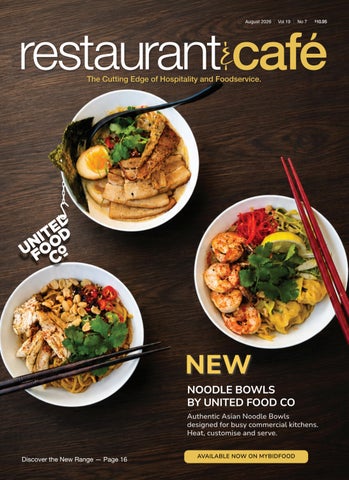
The NEW United Food Co. Noodle Bowl Range brings together authentic Asian flavours with a convenient heat-and-serve solution that helps reduce preparation time, maintain consistency, and expand your menu with minimal effort. • Prawn Wonton Noodle Soup • Vege Tonkotsu Noodle Ramen • Vege Dan Dan Noodles Make it your own Serve the bowls exactly as they are for maximum convenience, or add your own signature finishing touches to create something uniquely yours. Whether you're looking to save labour, expand your menu or introduce new meal options without additional kitchen complexity, these noodle bowls are your answer. With consistent portion sizes and minimal staff training required, it's a practical solution for kitchens that need efficiency without compromising on flavour, even during your busiest services. Explore the United Food Co. Noodle Bowl Range on MyBidfood.
16 restaurantandcafé.co.nz
August 2026
17
bidfood trade show
Flora Plant-Based Block Salted 250g Meet the buttery breakthrough your customers have been waiting for. Crafted for serious spreaders, bold bakers, and creative cooks, Flora Plant-Based Block Salted 250g is a smooth, savoury, dairy-free delight that delivers all the richness and flavour, without compromise. Now you can serve everyone, as this is an easy 1:1 swap for dairy butter in
Flora Thickened Plant Cream One Cream To Serve Everyone Flora Thickened Plant Cream is a lentil-based, dairy-free cream that replaces dairy cream 1:1 in all pouring, cooking and whipping applications. With no allergens to declare, it's vegan, dairy-free and palm oil-free,
Foodservice's Favourite Fries at Bidfood Looking to add something different to your menu? Be sure to visit Kenny's Kumara Fries at the Bidfood Trade Show and discover why their premium kumara fries have become a favourite with foodservice operators across New Zealand. At the show, Kenny's will be offering exclusive specials on both their
18 restaurantandcafé.co.nz
all recipes. There’s no tempering time; you can use it straight from the fridge With a brilliantly balanced, buttery taste and a salty kick, Flora PlantBased Block Salted is perfect for cooking, baking, and spreading. From pan to plate, it’s time to boost your sales and customers' appetites. Keep it bold, keep it buttery, keep it plant-powered. Whether you’re creating golden, flaky pastries, silky sauces, or beautifully baked treats, the Flora Block brings consistent, crave-worthy results every time.
helping you serve more customers with one versatile cream. Expect the same great taste, even better performance. It whips quicker than dairy cream, whips twice as firm, delivers improved shape stability, and performs reliably when cooking. From creamy pastas and soups to whipped cream, chocolate mousse and rich chocolate tarts, Flora Thickened Plant Cream makes it easy to elevate your favourites—without the dairy.
popular Kumara Fries and Deluxe Kumara Fries, the perfect opportunity to stock up and add a premium, high-margin side to your menu. Whether you're refreshing your menu or looking for a crowd-pleasing alternative to traditional fries, make sure Kenny's Kumara Fries is on your list of exhibitors to visit.
August 2026
19
bidfood trade show
Wild Chef Wild Chef Mini Cauliflower Rosti Everything you love about the Wild Chef Cauliflower Rosti 80g, now in a versatile 25g size. The NEW Wild Chef Mini Cauliflower Rosti 25g is made with the same quality ingredients – cauliflower, New Zealand Agria potato and a touch of celery for freshness. Designed for canapés, catering,
Shore Mariner Mussel Fritters Discover why Shore Mariner Mussel Fritters deserve a place on your menu. Packed with premium mussel meat and finished to a golden, crispy exterior, these generous 120g fritters
small plates and premium menu creations, it delivers versatility in every crispy, golden bite. Gluten-free, dairy-free, vegan-friendly, and onion and garlic-free, it's an easy way to add versatility across a wide range of menus. Whether you're creating elegant canapés or serving it as a premium side, the Mini Cauliflower Rosti provides a consistent, high-quality base. Visit wildchef.co.nz to learn more.
deliver consistent quality, flavour and portion control. Ideal as a starter, share plate, light meal or café special, they offer exceptional versatility with zero prep required. Simply cook from frozen by baking, frying or on the hot plate for fast, reliable service. Visit the Bidfood Auckland Trade Show to taste the perfect combination of convenience, quality and menu appeal at Stand 93.
35 Years of Baking Deliciousness! Trusted by cafés, foodservice operators and retailers across New Zealand with a range of ready-to-serve bakery favourites. We’re one of New Zealand’s leading award-winning bakery manufacturers, creating a delicious range of cakes, donuts, slices, muffins, brownies, and more. Made with quality ingredients and available in a range of formats, including gluten-free options.
Scan to explore our full foodservice range.
20 restaurantandcafé.co.nz
August 2026
21
Ocean of Flavours: One Ocean, Many Flavours A life source for many, the Pacific Ocean has sustained communities for generations, shaping identity and culture throughout the region.
A
life source for many, the Pacific Ocean has sustained communities for generations, shaping identity and culture throughout the region. Next month’s Ocean of Flavours: One Ocean, Many Flavours celebrates the Blue Continent, showcasing Pacific culinary excellence, Pacific producers and chefs, while strengthening the economic and cultural connections that bind the region together. Proudly presented by Pacific Trade Invest New Zealand (PTINZ), the Ministry of Foreign Affairs and Trade (MFAT) and Pacific Cooperation Broadcasting Limited (PCBL), and supported by New Zealand Chef Peter Gordon ONZM, Ocean of Flavours is set to take place on the 21st and the 22nd of September, at the Auckland
22 restaurantandcafé.co.nz
University of Technology (AUT) School of Hospitality and Tourism. Drawing inspiration from Kai Pasifika held in 2022, Ocean of Flavours will see renowned Pacific chefs from Fiji, New Caledonia, Tonga, Samoa, Solomon Islands and Papua New Guinea travelling to New Zealand to join forces with some of New Zealand’s top chefs to demonstrate their culinary skills. Pacific chefs invited to take part in Ocean of Flavours include: • Israel Gapi, Head Chef at Coral Seas Hotels (PNG) • Denzel Sumsum, Owner of Valin Kaba (Solomon Islands/Ni Vanuatu) • Ashim Singh, Executive Chef at Hilton Fiji Resort (Fiji) • Tracey Powell, Hospitality
Consultant (Fiji) • Alphonse Ishice Kocé, Chef at K2 Gastronomie Locale (Kanak – New Caledonia) • Lynda Song, Chef at Hotel Koulnoué Village (New Caledonia) • Su’a Aukusitino Suifaatau, Executive Chef, Culinary Educator, Hospitality leader (Samoa) • Soane Fakatava, Head Chef at Seaview Restaurant (Tonga). Along with a cohort of chefs from New Zealand, the group will take part in a high-energy culinary collaboration on day one and, with food writers, influencers, and industry stakeholders on day two, culminating in a dinner for the public on the 22nd of September. Working with the Pacific chefs, Chef Peter will work together to develop the dinner menu, using Pacific-sourced
pacific trade invest Food is a universal language, and culinary storytelling can turn a basic meal into a meaningful reflection of culture and community. products for guests as a way to showcase the flavours of the Pacific. “Hosting this event again is important for PTINZ in our quest as we continue to look for opportunities that strengthen relationships between New Zealand and the Pacific, as well as build enduring relationships across the food, tourism, hospitality, and trade sectors,” said PTINZ Trade Commissioner Glynis Miller. “A culinary event of this nature ticks all the boxes - it is a privilege to bring our Pacific chefs together for a day of cook-up, and I’m really excited to see and taste their craft.” Director of Pacific Connections at MFAT, Felicity Bollen, said Ocean of Flavours is an event which is designed to strengthen connections between New Zealand and the
Pacific region through expressions of food, storytelling, cultural exchange, and collaboration. “Food is a great connector in many cultures, including Pacific,” said Bollen. “The region is bursting with talent, and MFAT is proud to be part of this event to elevate Pacific cuisine and culinary leadership by providing a platform for chefs from the region to showcase their talent and their countries, share their stories and their unique cultures, and position Pacific food as a sophisticated, values-driven food system grounded in cultural expressions.” Chief Executive at PCBL, Natasha Meleisea, added that Ocean of Flavours is a golden opportunity for Pacific stories to be heard beyond the coral reef.
“Food is a universal language, and culinary storytelling can turn a basic meal into a meaningful reflection of culture and community. “All our chefs and producers have stories to be shared, and PCBL is proud to help make that happen on Pasifika TV, ensuring that the Pacific will get a taste of Ocean of Flavours on their screens.” On the final day of Ocean of Flavours, the visiting Pacific chefs will explore a slice of New Zealand’s culinary landscape, touring farms and producers before they return home. This unique event, showcasing Pacific cuisine, people, stories and livelihoods, is an opportunity for foodlovers and industry stakeholders not to be missed.
August 2026
23
foodsafety
Now is the Time to Train You know that feeling when the walk-in door opens and the cold air doesn't quite bite the way it did in June? That's your first summer warning, and it usually arrives before the Christmas bookings do.
E
very kitchen goes through the same shift as summer approaches. More covers, longer days, new faces on the pass who weren't there in winter. Nothing about that is unusual. What changes is how much slack the system has left to absorb mistakes once December hits and doesn't let up until February. Here's the thing about food safety training: it's not really a "new starter" job. It's more like knife sharpening. You don't do it once and forget about it. Procedures slip a little every month,
24 restaurantandcafé.co.nz
someone picks up a shortcut from a busy shift, and before long "that's just how we do it here" has replaced the actual method. Add the usual wave of casual and seasonal staff into that mix and the risk compounds fast. They're often thrown straight into a packed Friday night with a five-minute chat and an apron. Naturally, they copy whoever's next to them. If that person's cutting corners, so are they now. Then there's the heat itself, which does its own damage. Chilled deliveries sit on the loading dock
a few minutes longer in the summer sun. Prep gets done further ahead because service is relentless through the silly season. Fridges get packed tighter to keep pace with covers, which means airflow suffers and temperatures creep. None of this is dramatic on any single day. It adds up over a long, hot summer trading run. Outdoor dining, markets, food trucks and Christmas function catering feel it even more, since there's no fixed kitchen holding the line on refrigeration or hot water. The good news is this isn't complicated to fix. It just needs doing before the rush, not during it. A proper run-through now, handwashing, storage, temperature checks, allergen awareness, cross-contamination and knowing when to bin something, gives your team the confidence to handle a hot, chaotic service without you having to hover over every station. That confidence matters more than people admit. A team that actually understands why they're checking a fridge temp, rather than just ticking a box, makes fewer mistakes and needs less babysitting when you're three deep at the pass during a heatwave lunch service. One bad batch, one health inspector visit, one bad review about someone feeling off after a meal, costs a lot more than an hour spent walking the team through the basics this month. Summer will find the gaps in your system whether you're ready or not. Better to find them yourself, on a quiet Tuesday in spring, than have a customer or an inspector find them for you in the middle of January.
The Real Cost of a Rushed Induction Every summer roster has the same blind spot: operators plan for how many extra staff they need, but rarely plan for how many of them will still be there in February.
E
very summer roster has the same blind spot: operators plan for how many extra staff they need, but rarely plan for how many of them will still be there in February. Seasonal turnover is expensive, and most of the cost is hidden. Every time someone quits mid-season, or gets pulled off a section because they're not coping, that's a rehire, a re-roster and a re-train, landing in the weeks you can least afford the disruption. There's a link here that doesn't get
much airtime. Staff who get a proper induction tend to stick around longer. Not because the induction itself is inspiring, but because someone confident in the job is less likely to burn out or bail three weeks in. A shaky first fortnight is one of the better predictors of a seasonal hire not finishing the season. There's a documentation side worth naming too. Higher trading volumes over summer tend to bring more scrutiny with them, and if that scrutiny lands, "we talked them through it"
doesn't carry the same weight as a signed induction record. That's less about box-ticking and more about not having to relitigate the conversation later. Front of house and kitchen staff also need different content, not the same induction stretched across both. A front of house hire needs allergen questions and complaint escalation. A kitchen hire needs storage, prep and temperature basics specific to your menu. Running both through the same generic session misses the point of either. The scheduling tension is real. A day spent getting someone properly ready is a day you're short-staffed elsewhere. But set that against what a mid-season resignation actually costs: a shift down a body, a rushed replacement, hours of a manager's time spent re-training someone new all over again. The maths tends to land the same way most operators already suspect it does. None of this needs to be elaborate. A short structured checklist, signed off, and a supervisor who checks understanding rather than talking at someone, does most of the work. The operators who get through summer with the least disruption aren't the ones with the most staff on the books. They're the ones whose staff actually stay, because the first few days gave them a reason to.
August 2026
25
The Training That Doesn't Need a Roster Change The usual reason food safety training gets pushed back is simple. Nobody wants to pull someone off the floor for half a day during the busiest trading window of the year. So it waits. And waits.
T
he usual reason food safety training gets pushed back is simple. Nobody wants to pull someone off the floor for half a day, particularly heading into the busiest trading months of the year. So it waits. And waits. Hospo Safe, ServiceIQ’s online food and workplace safety course, is designed to get around that problem. It can be completed online in one sitting or worked through in stages around shifts. There is no venue to book and no need to roster someone
26 restaurantandcafé.co.nz
off to attend a classroom session. “At ServiceIQ, we know time is one of the biggest challenges for hospitality operators, so it's great to offer a training solution that fits around busy schedules while supporting compliance and safer workplaces," said Michael McLachlanm, B2B Marketing Manager. That flexibility is really the point. Training that someone has to physically attend competes with service hours. Training that can be
done on a quiet Tuesday afternoon, before a shift or when the roster allows is much easier to fit into the working week. Hospo Safe covers food safety and workplace safety requirements, giving operators a more formal record of the training undertaken. If an Environmental Health Officer or WorkSafe inspector starts asking about staff training, a completed course and certificate provides something more concrete than “we talked them through it”. It is worth looking beyond new hires too. Because the course is selfpaced, it can be used as a refresher for someone who has been in the job for several years, or for a team leader who has not revisited the material for a while. That matters because experienced staff can develop shortcuts just as easily as new staff can make mistakes. A refresher can bring everyone back to the same starting point before summer pressure, new menus, higher volumes and seasonal staff make the operation busier. Online training will not replace a supervisor walking someone through your actual kitchen, your fridge temperatures, cleaning procedures and the way your business handles food. Nor should it. The course works best as the foundation underneath that practical induction rather than a substitute for it. For operators weighing up the cost of training against the inconvenience of losing someone from a shift, that is where online learning starts to make commercial sense. A few hours completed around the roster is a much easier proposition than finding out later that something important was missed.
foodsafety
The Weak Link Isn't the Truck, It's the Journey Most food safety attention on a mobile operation goes to the truck itself, the fridge, the gas, the prep bench. Less goes to the part in between: getting food from where it's made to where it's served.
T
hat gap deserves more scrutiny than it usually gets. Most trucks and trailers run on a Food Control Plan registered to a home base, but that plan doesn't automatically cover trading elsewhere. A separate Mobile Trading Licence is needed from whichever council is hosting, or the event organiser's own permit stands in for it, depending on the arrangement. Easy to have one sorted and assume the other's covered too. Event organisers add a layer of their own. Most now ask for proof of food safety training and current insurance before confirming a booking, and that expectation has only grown as events get bigger and liability gets sharper
focus. Turning up short of what's asked for is a conversation nobody wants to have at the gate. Then there's the journey itself. Product prepped that morning at a commissary kitchen has to survive transport, setup and a full day of trading before it reaches anyone's plate. Every leg of that is a place where temperature control can slip quietly, a later departure than planned, a longer setup, a queue that runs past the hour it was meant to. A written plan earns its keep here. Knowing in advance how long product can sit mid-journey, and having already made the call on what gets binned if that window's blown, takes the decision out of a rushed
moment on site. Guessing under pressure is usually where things go wrong. Backup planning carries the same weight as the main setup. A spare battery, extra ice, a backup water container, none of it is overkill. It's what keeps a stall trading through a longer or hotter event day instead of packing up early. None of this sits in an obvious place, which is probably why it gets missed. It's not the truck and it's not the event, it's everything that happens between the two. For an operator counting on a strong events calendar to make the season count, that's exactly the space where an avoidable loss tends to happen.
August 2026
27
foodsafety
Free Online Training Makes Food Safety Easier for Businesses New Zealand Food Safety, a business unit within the Ministry for Primary Industries, is releasing a series of free online food safety modules, opening the doors for affordable food safety education.
T
rust in food safety underpins New Zealand’s hospitality sector. Diners rightly expect great food, great service, and consistently safe food. No matter how delicious a banh mi or chicken burger might be, no one wants their food to make a customer sick. For food service businesses already balancing day-to-day challenges, rising costs and consumer expectations, providing consistent food safety training can be a challenge. Staff turnover and day-to-day demands can make it tricky to prioritise food safety training. In addition, training approaches can vary between businesses, creating different levels of food safety knowledge among workers. Owners can sometimes worry about hiring staff who don’t already have a baseline understanding of food safety. To help address these challenges, New Zealand Food Safety is progressively releasing Food Safety Basics, a free online training series. The training provides foundational food safety knowledge that businesses can incorporate into their existing training programmes. Designed for busy workplaces, the six-module series are short and practical, using examples drawn
28 restaurantandcafé.co.nz
from the realities of hospitality work. In addition, the modules use plain language and accessible design principles to support a wide range of learners. “Our vision is to ensure that food is safe and suitable for everyone, everywhere,” said New Zealand Food Safety’s Deputy Director-General Vincent Arbuckle. “Food Safety Basics focuses on the key food safety behaviours that every food services worker needs to know”. What is Food Safety Basics? New Zealand Food Safety worked to develop content alongside the Restaurant Association, Hospitality New Zealand, as well as restaurants, cafes and local councils. The training focuses on everyday food safety practices, including: • Personal hygiene; • cleaning and sanitising equipment and surfaces; • what to do when something goes wrong; and • our collective responsibility for maintaining food safety. The first two modules, “Introduction to Food Safety” and “Personal Hygiene”, are now available online and free to
use. Participants who complete each module can download a certificate as evidence of their learning. Once the remaining four modules are completed, businesses will also be able to use them as evidence to meet the training requirements of their verification. These modules can also complement existing workplacespecific training, allowing flexibility to incorporate these resources into induction programmes, refresher training or other food safety management procedures. Industry uptake has been strong so far. Over 5,000 people have accessed “Introduction to Food Safety”, while over 3,000 have engaged with the second module since its July release. “We’re pleased
with such a strong response to the modules, and hope the remaining four will prove equally useful for businesses,” states Vincent Arbuckle. Since New Zealand Food Safety developed the content, businesses can be confident that their staff are learning content that aligns with national food safety expectations, while conserving costs. Building a stronger food safety culture Effective food safety outcomes depend on understanding procedures and creating an environment that encourages food safety practices and habits. The modules focus on encouraging positive food safety behaviours alongside technical
knowledge. This helps businesses build stronger food safety cultures where safe practices become part of everyday operations. As the hospitality sector continues to navigate workforce challenges and rising costs, accessible training solutions will play an increasingly important role in supporting both compliance and public confidence. By providing free food safety education, New Zealand Food Safety is helping businesses strengthen food safety practices while reducing the burden and cost of staff training. What’s next Looking ahead, New Zealand Food Safety plans to release four more Food Safety Basics modules by early 2027.
The third module, “Maintaining a Food Safe Workplace”, is due for release in September 2026, followed by food handling, allergen management, and traceability and recalls. For businesses looking to strengthen food safety culture whilst at the same time reducing cost or training burdens, Food Safety Basics is a practical place to start. The first two Food Safety Basics modules, Introduction to Food Safety and Personal Hygiene, are available free on the MPI website. Subscribe to “Food Act 2014” updates and receive notifications when new modules are released.
August 2026
29
worksafe
Accidents Happen A cut hand during the lunch rush can take a key person off the line.
A
burn, fall or lifting injury can leave the rest of the team trying to keep service moving while someone looks for the first aid kit and works out who knows what to do. That is not the time to discover the kit is out of date, the trained first aider has gone home or nobody on the shift knows the emergency procedure. Restaurants, cafés and foodservice businesses are busy places. Knives, hot oil, boiling water, heavy boxes, cleaning chemicals and slippery floors are part of the working day. Most shifts pass without a serious accident, but when something goes wrong, staff need to be able to respond straight away. New Zealand businesses must provide suitable first aid equipment, facilities and access to trained first aiders. What is needed depends on the work being done, how many people are on site, the size and layout of the workplace and how quickly medical help can arrive. For a small café, the arrangements may appear straightforward. There is a first aid kit, someone has completed a course and the medical centre is nearby. However, is that trained person working every shift, including evenings, weekends and public holidays?
30 restaurantandcafé.co.nz
What happens when they are sick, on leave or leave the business altogether? In a larger restaurant, production kitchen, foodservice warehouse or manufacturing site, one kit in the office may not be enough. Someone working in a kitchen, storeroom, loading area or separate building needs to be able to reach first aid supplies quickly. The contents of the kit should also suit the workplace. A commercial kitchen dealing with knives, hot equipment and boiling liquids will have different needs from an office. A warehouse using forklifts, pallets and loading equipment will have different risks again. Operators need to look at what could happen in their own business and check whether the current arrangements still make sense. Who is trained in first aid? Is someone available on every shift? Do casual staff and new employees know where the kit is kept? Are supplies checked and replaced? Can staff quickly find emergency contact details? Does the team know what to do when a customer becomes ill or is injured? These are basic questions, but they can be missed when rosters are tight, staff are changing and there
are more immediate jobs demanding attention. First aid is only part of keeping people safe. Every cut, burn, fall and near miss should be looked at properly. Was someone rushing because the team was short-staffed? Was equipment stored in the wrong place? Had a wet floor been left unattended? Did the employee know how to use the equipment safely? An accident form records what happened. It should also lead to a change that reduces the chance of the same thing happening again. There is a cost when someone is injured. A skilled employee may be unable to work, a replacement may be difficult to find and the remaining team has to pick up the extra load. Service can slow, production can be interrupted and pressure builds quickly. First aid arrangements also need regular attention. Staff leave, rosters change, new equipment is installed and businesses take on more people. A kit and training plan that suited the business a year ago may no longer be enough. Accidents happen, even in well-run workplaces. The important thing is that the people on the shift know where to find help, have the right supplies and are confident enough to act.
100 YEARS OF KIWI MUSIC You helped make happen When music plays in a hospitality venue, it creates a connection to the artists who made it. OneMusic licenses that music on behalf of APRA, helping ensure those songwriters are recognised and paid.
To celebrate 100 years of APRA, OneMusic would like to mihi the businesses that support music creators by inviting 10 customers and their guests to attend the APRA Silver Scroll Awards | Kaitito Kaiaka Aotearoa’s most iconic night of music.
14 October 2026 Kiri Te Kanawa Theatre, Aotea Centre, Auckland Open to new and existing OneMusic customers nationwide.
Enter for your chance to attend: Scan the QR Code to register at onemusicnz.com/apra100
* Terms and conditions apply. Not normally available to the public. Double pass valued at $500. Travel and accommodation are not included. Applications close 31 August. Successful applicants will be drawn on 21 September.
August 2026
31
michelin
Christchurch Restaurant Built on Consistency A Michelin star was something husband-and-wife restaurateur duo Lisa and Simon Levy had dreamed about.
I
nati, Director Lisa Levy, said it felt surreal to receive the recognition. “It’s hard to put into words all the emotions we’ve experienced since the awards were announced,” said Levy. It is special for Canterbury and New Zealand hospitality to have a Christchurch restaurant that now stands alongside some of the world’s best. Her husband, chef Simon Levy, had worked in Michelin-recognised kitchens throughout his career. He has always respected the star immensely, and receiving one was the result of decades of hard work and dedication. After many years working in and running successful restaurants in the UK, Lisa and Simon decided to build something of their own in Christchurch. “We saw a city that was rebuilding, full of resilience, energy, and opportunity,” she explained. Inati opened in 2017 with the goal of creating a restaurant centred around
32 restaurantandcafé.co.nz
genuine hospitality, exceptional food, and meaningful connections with guests. “From the beginning, we’ve wanted it to feel personal a place where people can celebrate, relax, and share an experience together. The journey hasn’t always been easy, but we’re incredibly proud of what Inati has become and the community that has grown around it.” The couple had been strong advocates for Michelin coming to New Zealand and were just as surprised as everyone else when it was announced that the Guide was already here and reviewing restaurants. Although the pair never set out to receive recognition, winning the star felt extremely rewarding. Hospitality is at the heart of everything they do. “We’re relentless about consistency. Whether it’s someone’s first visit or their tenth, we want every dish and every interaction to be delivered to the same standard.”
Although Inati offers a seasonal menu, some dishes have become iconic, such as The Duck Trumpet, a playful, memorable talking point. The restaurant loved showcasing exceptional local produce and creating dishes that told the story of the earth, land, and sea, and of the people who grow and produce the ingredients we use. Canterbury, in particular, was an incredibly special place to source produce. Within a relatively short distance, there was access to exceptional seafood, premium meats, world-class wine regions, and an abundance of fresh seasonal produce. Receiving a Michelin Star was motivation to keep pushing the boundaries and providing guests with memorable experiences. Levy hoped Michelin’s arrival would inspire young chefs, restaurateurs, and hospitality professionals to dream big and believe that world-class recognition can be achieved in New Zealand.
August 2026
33
michelin
Southern Hospitality Provides Fine Dining Experience A Queenstown restaurant has proven that Michelin dining does not have to be extravagant.
R
ātā restaurant believes that highlighting local produce, providing warm hospitality, and a sense of place make a truly memorable dining experience. Restaurant Manager Jade Maguire said it is an incredible honour to be one of the first New Zealand restaurants to be awarded a Michelin Star. “To be recognised as one of the first restaurants in New Zealand to receive a Michelin Star is very special, not just for Rātā, but for everyone who has been part of the journey over the last fifteen years,” said Maguire. The team at Rātā has always focused on creating the very best experience for every guest rather than cooking for awards. Maguire said the goal has always been to build a restaurant unique to Queenstown that showcased Southern New Zealand's incredible produce while making everyone feel genuinely welcome. “Whether guests arrive straight from the ski slopes or dressed for a special celebration, everyone receives the same warm welcome.” Rātā reflects its strong sense of place through the ingredients it sources from across the lower South Island. It has had long-standing relationships with its growers, farmers and fishermen.
34 restaurantandcafé.co.nz
The restaurant's cooking style is deliberately restrained. “We want the produce to speak for itself rather than being overshadowed.” Classical techniques have been paired with a distinctly New Zealand approach, allowing the natural quality of ingredients to shine. “Some of our favourite products to work with include Royalburn Lamb, Southland wild venison, Fiordland crayfish and Lake Ohau Wagyu, each of which tell their own story of the region.” Maguire said the arrival of the Michelin Guide felt like the natural next step as New Zealand's dining scene had matured enormously over the past decade, with chefs developing a strong sense of identity rooted in the landscapes, seasons and local producers. According to Maguire, New Zealand cuisine is unique because the country has an extraordinary natural environment and access to some of the world's best produce. She found the diversity to be remarkable, from seafood and shellfish to exceptional lamb, beef, venison, fruit and vegetables. Many chefs have close relationships with the people who grow and produce those ingredients. Rātā was founded in 2012 by Queenstown restaurateur Fleur
Caulton with the vision of creating a restaurant that truly reflected Southern New Zealand. Although the restaurant has evolved over the years, including a recent refurbishment that better reflects its connection to Queenstown and the surrounding landscape, its philosophy has remained remarkably consistent. “Everything we do is centred around showcasing exceptional local produce, celebrating the seasons, and creating an experience that feels unmistakably New Zealand.” The kitchen and front-of-house teams needed to be recognised for the dedication and professionalism they brought every day. “The culture within the restaurant is something we're very proud of, and everyone plays an important role in creating the experience our guests enjoy,” noted Maguire. Receiving a Michelin Star is a wonderful moment for Rātā, but Maguire believed it was also an exciting moment for New Zealand hospitality as a whole. She hoped it would shine a spotlight on the incredible talent, produce, and hospitality the country has to offer. Maguire was incredibly grateful to the guests for dining at the restaurant over the years and supporting Rātā through every stage of its journey.
August 2026
35
Farm in the Foothills Family-owned and operated Balvonie Wines is focused on meeting market demand by producing products that engage and excite customers. 36 restaurantandcafé.co.nz
grape to glass
B
en and Helen McLauchlan’s family have been in the Marlborough region since 1859, when Alexander McLauchlan first purchased farmland in the region. The farm, Balvonie, which means "farm in the foothills," was named for its Scottish heritage. The McLauchlan family bought more land in the region and began farming sheep and cattle there in 1935. Three generations later, Balvonie produces Sauvignon Blanc, Pinot Noir, Chardonnay and Glera, and finish grass-fed Wagyu beef with First Light Foods on the same property. The label started with the Balvonie Prosecco, which is 100 percent Glera and made using méthode traditionnelle, the first of its kind out of Marlborough. In 2024, the Prosecco was followed by a Pinot Noir, grown on Balvonie’s tandem block, which carries seven Pinot Noir clones. It is hand-picked, fermented with indigenous yeasts, hand-plunged daily, and aged across French oak and stainless steel. “Between the two, you get both sides of what this land can do, a sparkling wine built for approachability and a red built for depth.” McLauchlan believed the wine was special because of the site. Glera worked well with the free-draining soils and long ripening season at Balvonie’s Rapaura block. The loose bunch architecture kept disease pressure low and allowed the fruit to develop fully. The Prosecco spent time on lees to build texture, and Balvonie was willing to spend three years getting it right before releasing it under their name. The Pinot Noir clones were handplunged and left to find their own shape rather than being pushed into a style.
“A good wine should taste like where it's from, not like a formula,” McLauchlan explained. “We also don't rush it.” Balvonie waited for global Prosecco sales to rise before planting a single Glera vine to navigate the everchanging wine sector and consumer demand. It took a year of trials with Ormond Nurseries before Balvonie committed to Prosecco. McLauchlan said they also kept a keen eye on regulation. It has also been important to diversify the farm's production of grapes, beef, and wine so it is not dependent on any one market at a time. Two major challenges facing the global wine industry were changing
consumer consumption patterns and the balance between supply and demand. McLauclan said Balvonie was fortunate that global consumers want the fresh-fruit-driven flavours that New Zealand wines deliver. There would always be demand for New Zealand wines if makers continued to keep their quality-first focus. “Our continued focus will be on producing products that engage and excite consumers,” he said. “We are looking at new packaging opportunities, expanding production of our Prosecco and Rose Prosecco and potentially adding some innovative new varieties to the Balvonie family.”
August 2026
37
grape to glass
Making Marlborough Wine Accessible Allan Scott Family Winemakers have a large footprint in Marlborough’s winemaking story.
C
o-owner and Winemaker, Josh Scott, said his father Allan helped plant some of Montana’s first vines in 1973, where he began as a labourer before progressing to vineyard manager and viticulturalist. In 1985, his mother and father planted their own vineyard on Jacksons Road and initially supplied grapes to other wineries. They established Allan Scott Wines in 1990, opening the winery, Cellar Door and restaurant. “We were only the eighth winery in Marlborough, which shows how young the region was at the time,” Scott added. To this day, the company is still 100 percent family-owned and operated. The Cellar Door and Allan Scott Bistro have been open continuously since 1990, making it one of Marlborough’s longest-running winery restaurants. Scott and his sister Sara grew up working alongside their parents, pruning, tying vines and driving tractors, mowers and motorbikes. Leaving school at 16, he went straight into a winemaking apprenticeship, spent time in France and the US, and earned his Diploma in Viticulture and Wine Production in
38 restaurantandcafé.co.nz
New Zealand. Beginning as a cellar hand and eventually becoming a winemaker at Allan Scott Wines. The Sauvignon Blanc is the foundation of the label and represents the majority of its production. It also makes Pinot Gris, Pinot Noir, Chardonnay and Rosé, as well as smallproduction, single-vineyard wines such as Riesling and Grüner Veltliner. Allan Scott Wines’ Estate Range delivers consistently high-quality wine at accessible prices, while its premium Black Label Range allows it to explore special vineyard sites and more complex styles. The fruit-driven sparkling wine Cecilia, a signature wine from Allan Scott Wines’ collection, is named after Scott’s mother and has become a recognised New Zealand sparkling wine, enjoyed throughout the country. Scott said exceptional wine began with passion, but it was also about context. “The vineyard, soils, season, people and decisions behind the wine all contribute to its character,” said Scott. “When you understand where a wine comes from and how it was made, you gain a much deeper appreciation of what is in the glass.” Marlborough has been a fortunate
place to be a winegrower because global demand for its Sauvignon Blanc has grown enormously over several decades. Production had increased from roughly 10,000 tonnes in the early 1990s to more than 300,000 tonnes today. Demand has softened recently; however, the Marlborough Sauvignon Blanc is still distinctive and immediately recognisable. “That sense of place is difficult to replicate and gives the region a powerful long-term advantage.” Oversupply was one of the biggest immediate challenges facing the industry right now. Scott said during the industry’s growth, some vineyards were planted in unsuitable locations, and some investors entered without a genuine understanding of farming or wine. Wine is fundamentally an agricultural business, and it requires patience, commitment and care in
both good seasons and difficult ones. He believed authentic, established producers would lead recovery with real stories and consistent quality. “Consumers can buy any number of inexpensive wines with fashionable labels, but trusted family brands offer something deeper: provenance, continuity and confidence in what is inside the bottle.” Presently, Allan Scott Family Winemakers is exploring new formats and ways of making good wine more convenient and approachable. However, meaningful innovation can be difficult because wine remains a traditional and natural product. The label recently entered the bagin-box wine market to put genuinely good-quality wine in a practical, relaxed format. By eliminating glass, the environmental impact of transporting the product was considerably lower. Scott is proud that Marlborough is one of the world’s truly distinctive wine regions. “It brings freshness, character and international recognition to a wine list. For anyone wanting to showcase the world’s great regional styles, Marlborough Sauvignon Blanc deserves to be represented.”
August 2026
39
grape to glass
Leading with Tradition Ataahua Wines has held firm to tradition, producing unique, handcrafted wines despite shifts in the alcoholic beverage industry.
A
taahua Wines owner Stephanie HendersonGrant and her husband, Andrew, purchased their first vineyard in the Waipara Valley in 1995, when it was partially developed, with a mature blend of Cabernet Sauvignon and Merlot and freshly planted Pinot Noir. Over time, they developed the property, building a house, sheds, and eventually a winery, and have grown their business from a grape-producing vineyard into an established high-quality wine label. Henderson-Grant’s winemaking journey began with a degree in agricultural science at Lincoln
40 restaurantandcafé.co.nz
University and a stint in the wool industry. She had been working at a local winery, doing sales and marketing and pitching in during the harvest time. During that time, she studied winemaking and viticulture through correspondence with EIT Hawke's Bay, and then worked harvest seasons in California and Oregon before returning to Waipara to make wine. The harvest has always been the highlight of the year for her, as it is the end of the fruit-growing season, but just the beginning of the wine journey. She said the secret to producing great wine was great fruit, good hands and plenty of time.
The Ataahua range includes Riesling, Sauvignon Blanc, Gewurztraminer, Chardonnay, Pinot Noir and Syrah. The label produced a Rose from early-picked Pinot Noir and, every so often, made a dessert wine from Late Harvest Gewürztraminer. To keep up with consumer demand, Ataahua Valley has focused on producing small volumes of unique handcrafted wines. It tended to steer clear of the lower end of the market. Henderson-Grant said a major challenge ahead was competing with rising market demand for pre-mixed spirits and cocktails, and that Ataahua Valley’s approach will continue to be to keep making high-quality wine.
Biodiversity Within Central Otago Central Otago winemaker Burn Cottage places emphasis on biodiversity when it comes to producing Pinot Noir. Central Otago vineyard Burn Cottage has emphasised biodiversity in its Pinot Noir production. With a very experienced team, the site has highdensity vine plantings of ten Pinot Noir clones, all seated within selected parts of the amphitheatre site, taking advantage of different soil pockets, slopes, and aspects. The founders and owners, Marquis and Dianne Sauvage, purchased the original Lowburn vineyard and farm in 2002. There was an emphasis on biodiversity of plantings and shelter, such as glades of trees and beneficial plantings, as well as areas for composting, cows, sheep, pasture, and olives on the wider land. Burn Cottage began working with two further vineyards in Bannockburn: Sauvage in 2017 and Sappa in 2021, which were subsequently purchased. The predominant variety at Burn Cottage is Pinot Noir, complemented by small plantings of Riesling and Grüner Veltliner in the upper part of the Lowburn site. General Manager and Winemaker, Claire Mulholland, had a very keen interest in the vineyards and wines of Central Otago because of the promise the region was showing. She began her career in the wine industry with a background in farming and studies in soils, hydrology, and climate, as well as horticulture and viticulture. That led her to initially start working with the vines at Rippon and Chard Farm. From there, she studied further and joined the winemaking team at Gibbston Valley, before travelling to work with Pinot Noir in Europe, Oregon, Australia, and Wairarapa and then returned to Central Otago. Some highlights from her career included working with and visiting some impressive Pinot Noir Estates and their teams in France, Oregon and New Zealand. Mulholland said it was a privilege to
work with some special sites in Otago and New Zealand, producing organic and biodynamic fruit and the wines they make. She added that all three Burn Cottage vineyards showcased unique aspects of their produce, and that the Sabine selection from the Lowburn Pinot Noir site was a special release this year. “The label’s Moonlight Race Pinot Noir is a reflection of Central Otago and a blend of our Burn Cottage’s three sites. It is versatile and delicious,” Mulholland said. Burn Cottage also had a unique white blend of Riesling and Grüner Veltliner that was supple and bright, showcasing the wonderful fruit and mineral aspects of those varieties. Mulholland believes exquisite
wine is expressive and elegant, with a palate of layers and interest, and always has something really special about it that keeps people coming back. Burn Cottage has navigated the ever-changing wine sector and consumer demand by staying consistent and authentic with its wines and place. It was always experimenting in-house and running trials, both for continued learning and for future resilience. The label had replanted areas with this in mind, and was also trialling different canopy and vine work. Some exciting new Pinot Noirs were on their way, and a new Chardonnay from Sauvage Vineyard was also coming from Burn Cottage, which had recently completed planting.
August 2026
41