Action recommendations of the research project | PlastLIFE | September 2025
Threats and opportunities of biodegradable plastics
Plastics are popular materials because they are inexpensive, lightweight, and durable. Plastics labeled as biodegradable are expected to degrade at the end of their lifecycle into carbon dioxide, water, and microbial biomass. Often, biodegradability is used to create an image of environmental friendliness, but this is not always the case.
• In Finnish environmental conditions and biogas plants, the degradation of biodegradable plastics that meet current standards is too slow or insufficient.
• Biodegradable plastics also leave behind the chemicals they contain. Therefore, the use of biodegradable plastics may release even more chemicals into the environment than conventional plastics.
• Biodegradable plastics should only be used in applications where biodegradability is essential, for example in biowaste bags.
• EU biodegradability standards and certifications should be mandatory and ensure the material’s degradation at the end of the product’s lifecycle, considering northern conditions (soil, water bodies, recycling facilities, home composting).
• The entry of plastics into fertiliser products must be prevented. The most effective way to achieve this is by preventing plastics from ending up in biowaste already during the sorting phase.
syke.fi/en | environment.fi
Nonbiodegradable
Biodegradable
plastics are made of fossil-based or renewable, i.e. bio-based, materials
Bio-based
Bio-based, non-biodegradable plastics
e.g. bio-PE, bio-PE
Fossil-based, non-biodegradableplastics so called conventional plastics
eg PE, PP, PA
Bio-based, biodegradable plastics
e.g. PLA, PHA
Fossil-based, biodegradable plastics
e.g. PBAT, PC
Fossil-based
PE= polyethylene, PET = Polyethylene terephthalate, PLA= Polylactic acid, PHA = Polyhydroxyalkanoates, PP= Polypropylene, PA= Polyamide, PBAT= polybutylene adipate terephthalate and PCL= Polycaprolactone.
Source (modified from): Finnish Biocycle and Biogas Association, 2025.
Biodegradable or bio-based?
Raw materials for biodegradable plastics can originate either from renewable or fossil-based sources. Environmental factors such as temperature, pH, nutrients, and moisture, as well as the properties of the plastics themselves, affect their biodegradation.
Biodegradable plastics are sometimes confused with bio-based plastics. Bio-based plastics are made of renewable raw materials, but not all bio-based plastics are biodegradable. All plastics that end up in the environment become fragile due to sunlight and temperature changes and thus become sources of microplastics.
The EU Packaging and Packaging Waste Regulation refers to both aerobic and anaerobic degradation as composting.
Biodegradability of plastics in soil
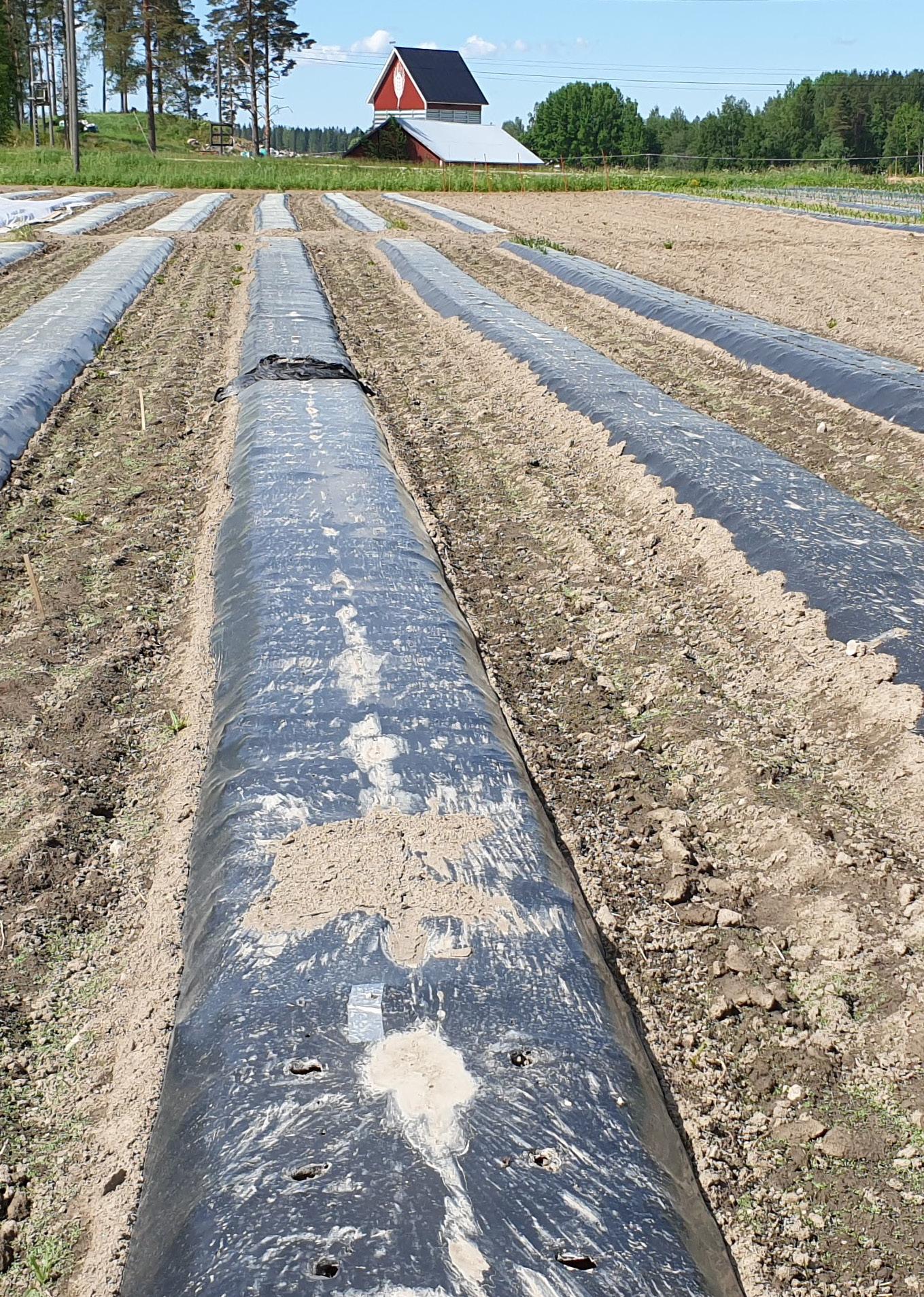
Biodegradable plastics end up in the soil for example via bio-based recycled fertilisers and biodegradable mulching films. Mulching films are used to suppress weeds and to create favorable moisture and temperature conditions. Biodegradable mulches are promoted in Europe because conventional mulch films have been found to leave plastic residues in the soil. Biodegradable mulch films are not removed after use but tilled into the soil to decompose. However, conditions in Europe vary from the warmth of the south to the cold and acidic soils of the north, where biological degradation is significantly slower. In Finland, the degradation of biodegradable mulching films has been found to be too slow (see info box).
Mulching films marketed as biodegradable in Finland, as well as biodegradable plastics ending up in biowaste, should degrade quickly enough under Finnish environmental conditions to prevent plastic accumulation in the soil. Current standard methods for testing the degradation of biodegradable plastics in
Biodegradable
soil (EN ISO 17556, EN 17033, ISO 23517) do not guarantee sufficient degradation within the required timeframe in Finnish soils.
Biodegradability of plastics in water
Research on the biodegradability of plastics in aquatic ecosystems is currently focused on the marine environment. The general criterion for marine biodegradability is determined within two years or faster than comparable standard materials. These criteria have been defined only for seawater and do not take into account northern conditions, where water freezes in winter. The biodegradability determination methods are based either on mass loss (ISO 22766:2021) or carbon dioxide production (ASTM D6691-17, ISO 23977-1:2021).
A research study by a Finnish research group found that the decomposition of plastics is influenced by the structure of the microbial community, water temperature, nutrients, humus content, and salinity (Taipale et al. 2023). The PlastLIFE project studied the degradability of various biodegradable plastics in lake water and Baltic Sea water using two different methods. Differences were observed in the degradation of plastics in lake water and Baltic Sea water, but the different methods also yielded varying results (Table 1). The study highlights the different behaviors and fates of plastics in fresh water and brackish water, as well as the impact of the chosen method on the research results. Additionally, current standard methods do not account for Finland’s four seasons. According to the study, degradation at summer temperatures is three times faster than in autumn, winter, or spring in the boreal zone (Vesamäki et al. 2024)
Biodegradability of plastics in recycling facilities
Biogas and composting plants process separately collected organic waste, which often includes biowaste
bags used in sorting, as well as biodegradable and nonbiodegradable packaging, disposable dishes, and cutlery. EU packaging legislation defines the applications in which biodegradable and compostable packaging should be used.
Starting from February 2028, certain packages – such as fruit stickers, labels, tea bags, and coffee capsules – must be compostable according to standards and recycled with biowaste either through composting or biogas treatment. Member states may extend compostability requirements to include, for example, hard coffee capsules and very lightweight or lightweight plastic bags.
The biodegradability of packaging is typically assessed based on the EN 13432 standard, which measures degradation in industrial composting. With the implementation of the EU Packaging and Packaging Waste Regulation, harmonized European standards will be developed to demonstrate compostability in both industrial composting and biogas treatment, as well as in home composting.
Biowaste bags used in sorting are not considered packaging, so packaging legislation requirements do not directly apply to them. The regulation concerning biodegradable cutlery and dishes is still unclear within the EU, leading to varying recycling guidelines across member states.
The PlastLIFE project studied the degradation of biowaste bags at three Finnish biogas plants. Not all tested biobags degraded as required by the EN 13432 standard during biogas treatment. Paper bags degraded best, and biodegradable biowaste bags with OK Compost HOME or DIN+ certification degraded reasonably well. The study
found that starch- and plastic-based impurities remain in the final product (digestate based fertiliser product). The amount depends on both the feed material used and the processing technology of the plant. Starch- and cellulose-based contaminants of the fertiliser ultimately degrade in the soil.
Biodegradable plastics decompose faster than conventional plastics
Criteria for biodegradation: faster than in two years or faster than reference material (cellulose)
Biodegradation faster than in two year
Biodegradation faster than in the reference material
No biodegradation detected
Table 1. Degradation rates and biodegradability of test materials using two different determination methods in lake water and the Baltic Sea. CA = cellulose acetate, PHB/PHV = polyhydroxybutyrate-polyhydroxyvalerate 8%, Bio bag = bag made of biodegradable plastic, PLLA = poly-L-lactide, cellulose = Whatman filter paper 42. Source: JYU / Emil Huovila 2025.
Info box: Degradation of Biodegradable Mulching Films in Soil
In a European-scale study (PAPILLONS, EU, Horizon2020), the degradation of mulching films certified as biodegradable in soil was significantly slower in Finland compared to Southern Europe.
In a Finnish study (MicrAgri, 2023), highest amounts of plastic residues were found in fields after use of biodegradable mulching films, which should have decomposed. According to a survey, some farmers had noticed that biodegradable mulching films degraded too slowly. More than half of the farmers who used biodegradable films removed the remaining plastic residues from the fields, even though it was labor-intensive. According to the survey, conventional mulch films were easier to remove. (Selonen et al., 2023.)

The amount of plastics (kg/ha) in different size classes found in 5 cm deep soil layer in fields after use of different mulching films and fabrics (mean ± standard deviation). Source: Selonen ym. 2023.
Recommendations for the decision makers:
1. In Finnish conditions, plastic recycling may be a better option than biodegradability. Biodegradable plastics should only be used in applications where biodegradability is beneficial and when the material cannot be recycled.
2. When biodegradable plastics are used, they must be able to degrade efficiently and completely at the end of their lifecycle. Otherwise, they must be recyclable along with other plastic waste.
3. Biodegradable plastics must degrade in the environment where they end up.
4. Standards for material biodegradability should be updated, and a mandatory EU-level certification system should be established. This would ensure that products meet strict biodegradability requirements and that both products and their packaging are clearly labeled.
5. The certificates and biodegradability standards must be verified under Finland’s cold conditions. Taking northern conditions into account in standards also opens opportunities for Finnish research and innovation.
6. Transparency regarding the composition and additives of biodegradable plastics must be increased in the production of plastics. Biodegradability should be taken into account in the development of life cycle assessments for packaging and products.
7. Regulations promoting chemical safety must better address the chemicals contained in biodegradable plastics, to prevent the release of harmful and persistent substances into the environment when the plastics degrade.
Related EU regulations:
► EU Packaging and Packaging Waste Regulation EU 2019/1020 (national implementation 2025-2027)
► EU Single-Use Plastics Directive 2019/904
► EU Fertilisers Regulation EU1069/2009 (assessment of the need to update the limit values for plastic impurities by 07/2029)
► Common Agricultural Policy (CAP) (Preparation for the period 2028-2034 in 2025-2027, e.g. termination of national support for tarpaulins)
► EU Circular Economy Regulation (drafting 20252027)
► EU Bioeconomy Strategy (update 2025-2026)
► Bio-based, biodegradable and compostable plastics policy developments COM/2022/682 final
► EU Circular Economy Action Plan COM/2020/98 final
► EU Plastics Strategy COM/2018/028 final
► EN13432 standard (update 2026-2028)
plastlife.fi/en
PlastLIFE Finland
Follow Syke’s current research : syke.fi/research
Read more:
► Biodegradation of microplastic in freshwaters: A longlasting process affected by the lake microbiome Environmental Microbiology, 25(12), 2669-2680. Taipale, S. J., Vesamäki, J., Kautonen, P., Kukkonen, J. V., Biasi, C., Nissinen, R., & Tiirola, M. 2023. https://doi.org/10.1111/1462-2920.16177
► Plastic and terrestrial organic matter degradation by the humic lake microbiome continues throughout the seasons. Environmental Microbiology Reports, 16(3), e13302. Vesamäki, J. S., Laine, M. B., Nissinen, R., & Taipale, S. J. 2024. https://doi.org/10.1111/1758-2229.13302
► Recommendations for the Biodegradability of Bioplastic PlastLIFE, D6.5. Suomen Biokierto ja Biokaasu ry. 2025
► Biohajoavien muovien hajoaminen järvi- ja murtovedessä. Pro gradu -tutkielma. Emil Huovila. Jyväskylän Yliopisto. 2025.
► Biohajoavan muovin kierrätyksen lainsäädäntökehys. PlastLIFE, D6.3. Suomen Biokierto ja Biokaasu ry. 2025.
► Mikromuovit maatalousmaassa – Päästöt, vaikutukset ja vähentäminen. Suomen ympäristökeskuksen raportteja 21/2023. Selonen, S., Maunuksela, L., Palojärvi, A., Johansson, A., Kauppi, S., Räisänen, M., Sillanpää, M., Turja, R., Peltoniemi, K., Dahlbo, H. Suomen ympäristökeskus. 2023.
Action recommendations of the research project | PlastLIFE | September 2025 Threats and opportunities of biodegradable plastics
Authors: Sari Kauppi1, Salla Selonen1, Sami Taipale2, Anna Virolainen-Hynnä3
Editors: Johanna Kaunisto1 and Katja Lepistö1. Layout and graphics: Satu Turtiainen1
1) Finnish Environment Institute (Syke), 2) University of Jyväskylä, 3) Finnish Biocycle and Biogas Association
Publisher: Finnish Environment Institute ISBN 978-952-11-5787-5 (PDF)
The PlastLIFE project receives funding from the EU’s LIFE program, with which the projects material have been produced. The content of the material represents only the views of the project, for which CINEA/European Commission is not responsible.