Boosting reuse at events: How municipalities can lead the way
EU legislation aims to reduce the use of single-use plastic products and encourages a shift towards reusable alternatives. In the future, consumers should have the option to buy takeaway food and drinks in their own containers or in reusable packaging. The goal is to have at least 10 per cent of takeaway portions be sold in reusable packaging by 2030.
In Finland, single-use tableware is commonly used for serving especially at outdoor events. Municipalities and regions play an essential role as enablers and pioneers of the circular economy.
• Procure responsibly. Public procurement is a means to promote sustainable events and to support the transition from a throwaway culture to resourceefficient event production.
• Create demand for new services. Municipalities can steer the development of business services in the desired, sustainable direction.
• Be bold and try new approaches. Adopting a new operating model takes time and patience. Build networks and join reuse campaigns. Your enthusiasm and commitment to the topic can inspire others to follow your lead.
• Communicate proactively. Make sure all parties involved in the event understand what reuse means and what practices are expected. Good communication before and during the event helps visitors make the right choices.
• Learn from others and share your insights. Experiences of reuse at events have already been gathered in Finland. Collect information before your own event and make use of existing knowledge. Share your own experiences and collect numerical data for the benefit of others.
syke.fi/en | environment.fi
Bans on certain single-use plastic products
The EU directive on reducing the environmental impact of certain plastic products (the SUP Directive) sets product bans, design and labelling requirements, and regulates extended producer responsibility and consumer awareness. The bans cover, among other things, single-use plastic forks, knives, spoons, chopsticks, plates, straws, drink stirrers, and food and beverage containers and cups made of expanded polystyrene. The SUP Directive has been implemented in Finland through amendments to the Waste Act and regulations, as well as a voluntary Green Deal agreement on single-use portion packs.
A responsible organiser demands reuse
Public procurement is a means to promote sustainable events and support the transition from single-use culture. Calls for tender can include, for example, replacing single-use plastic products with reusable alternatives or market dialogue can highlight the reuse of products.
Public procurer defines the level of responsibility
Call for tenders can set requirements or award criteria that favour for reusable dishes or services including the use, return and washing of dishes. One procurement criterion could be, for example, a return rate, at least 80 per cent. The provider may also be required to use reusable dishes, glasses and cutlery and to be responsible for their collection, washing and return system. Tenders can be evaluated based on the functionality of the return system, life-cycle costs and user-friendliness. Contract terms can include an obligation to report on usage and waste volumes after the event.
Rental and sharing services can also be used in public procurement. If life-cycle costing (LCC) is used
as an award criterion instead of purchase price alone, reuse may also prove to be a competitive option.
Standards and eco-labels as support
Responsibility can also be ensured through guidelines and standards. Procurer can require the use of a specific eco-label or compliance with equivalent criteria. For example, the Nordic Swan Ecolabel can be awarded to various types of events.
The requirement mainly applies to events with fewer than 300 people, where there is a separate seating area and food is not taken away. At these restaurant and café points, reusable dishes must be used. In public procurement, market dialogue can be used to explore how reuse could also be applied to larger-scale events.
Reduce the environmental and cost impact of events
Environmental savings at events can be achieved by:
• Choosing reusable tableware.
• Minimising loss of reusable tableware.
• Ensuring the tableware is used multiple times.
• Managing transport logistics and washing efficiently and with low emissions.
• Recycling end-of-life tableware instead of incinerating it.
Economic savings from reuse come from several sources. At events, savings do not necessarily accrue to the same actor as the costs. Reusable tableware is more expensive than single-use options. However, their use reduces waste and littering at the event, but savings in waste management and cleaning usually do not benefit the catering organisers. Minimising dish loss is also crucial from a cost perspective. In Manchester, participants have been motivated through lotteries or by donating money to charity in proportion to the number of dishes returned to the organiser.
Models for sustainable procurement
The EU has published Green Public Procurement (GPP) criteria for food and catering services. These criteria provide examples for technical requirements and their indicators for drafting tenders.
In the UK, the city of Manchester has published a guide explaining what requirements can be set for event organisers and how to prevent dishes from ending up outside the event area.
Estonia as a model for Finland: Pay attention to definitions
In 2024, Estonia introduced a law requiring reusable tableware to be used at all public events. The ban on single-use tableware was first tested in Tallinn with gradually stricter rules and was eventually implemented nationwide. At the initial stage, the legislative working group brought service providers together, offering them the opportunity to influence the preparation and prepare for upcoming restrictions.
Despite good preparation, Estonia has found shortcomings in the law’s definitions: some service providers take advantage of the fact that the law does not specify how often tableware must be reused. The law
Lessons from Finnish events
Tapiola
May Day aims to eliminate single-use
items
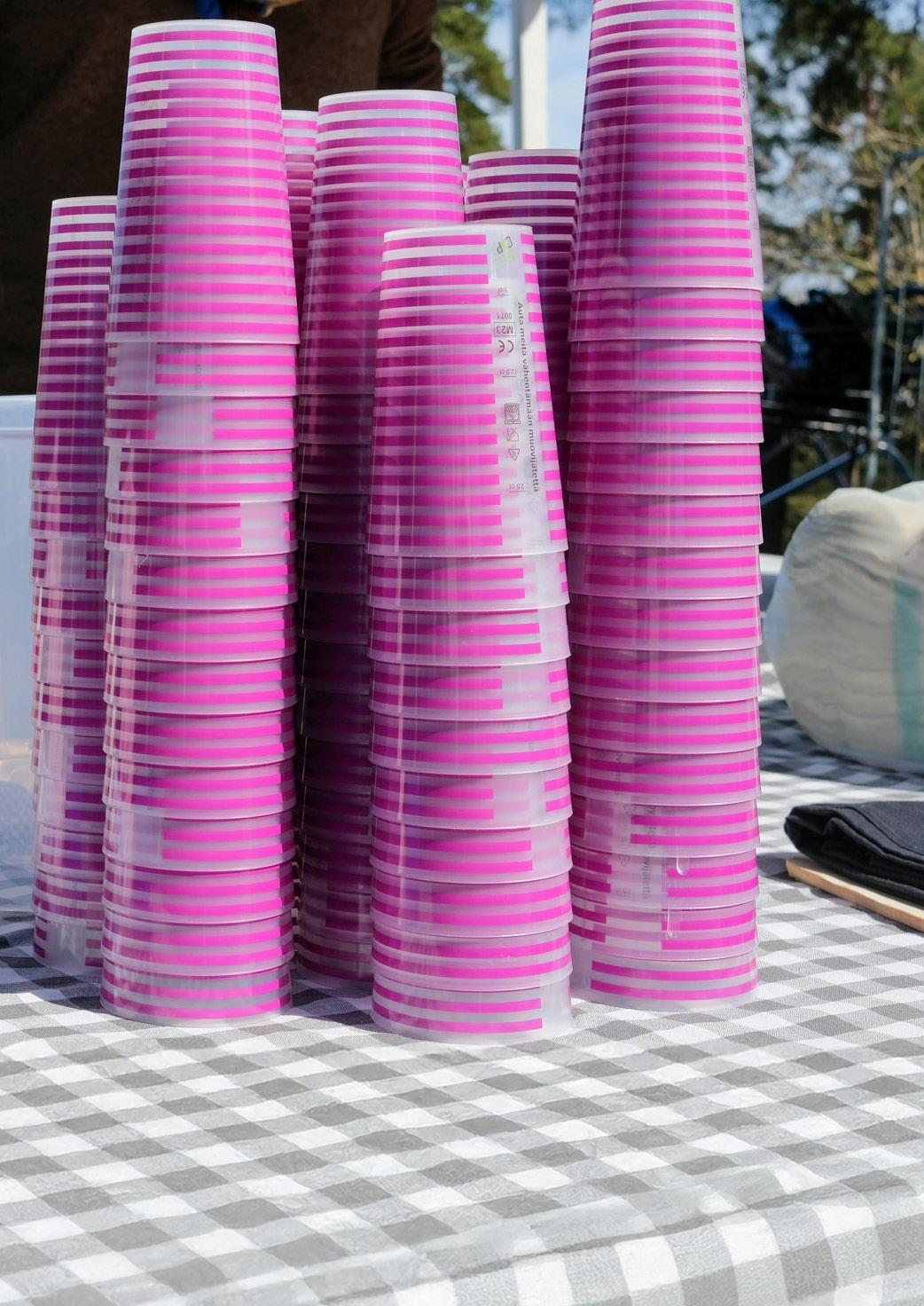
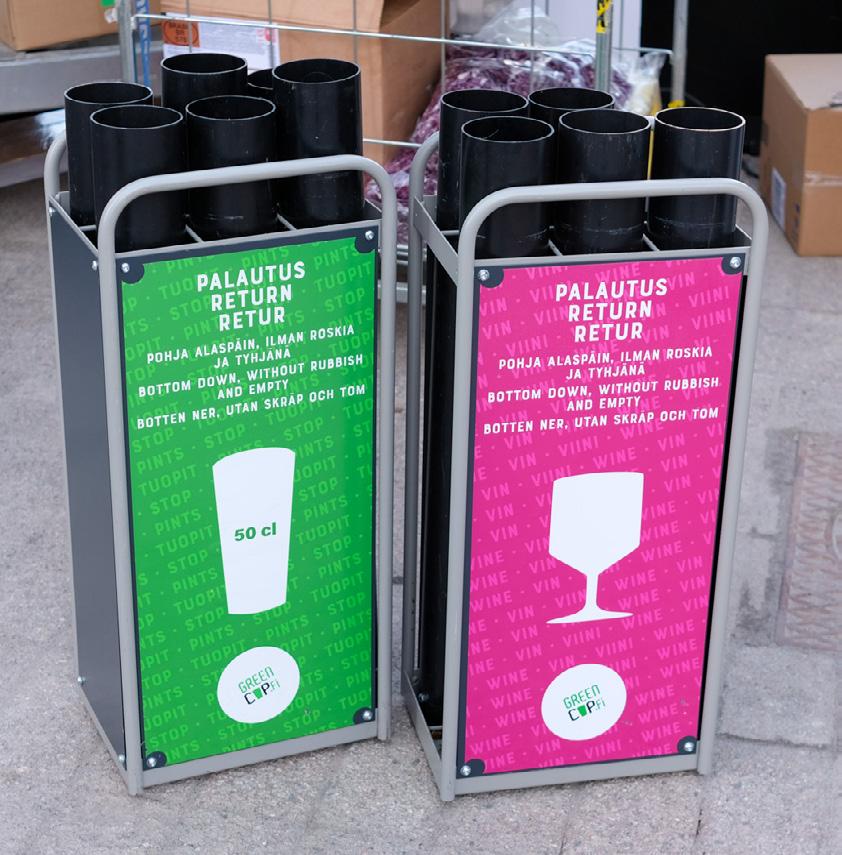
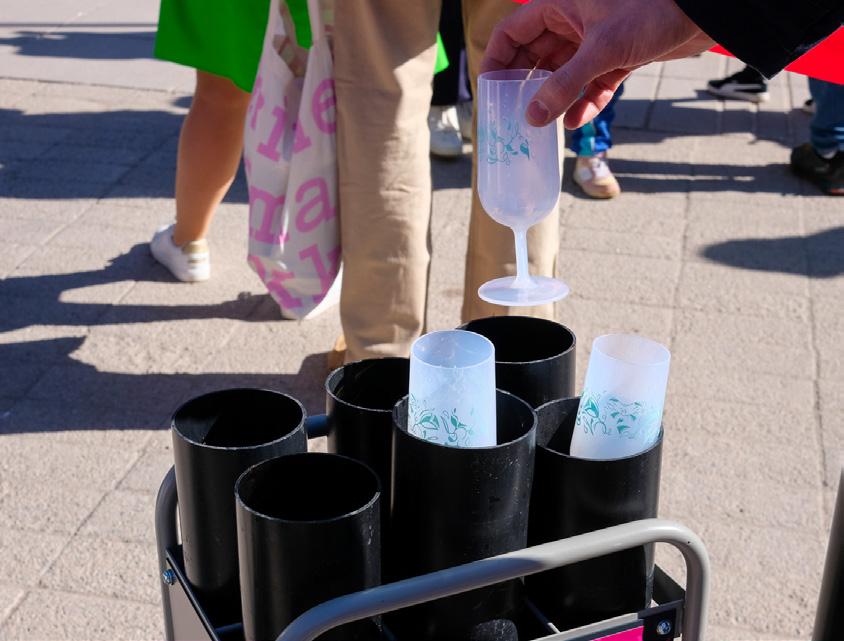
The City of Espoo piloted the use of reusable dishes instead of single-use ones at the outdoor event Tapiola May Day, organised by Tapiola Guild. Three food and drink vendors participated in the trial, where Espoo provided the dishes. The dishes were rented from Green Cup Oy, which took care of the delivery and collection of dirty dishes from the event site. Food vendors considered the trial successful and said they would use reusable dishes at future events. The event attracted 1,500–2,000 visitors.
The key takeaway: communication and instructions about dish return should be provided in advance and clearly on-site. Good guidance reduces the loss of dishes. It is also important to review event practices with service providers so everyone knows how the dishes should be handled.
Tavastia keeps festival crowds hydrated
Helsingin Rock and Roll Oy, better known as Tavastia, is a partner for festival organisers to provide restaurant and bar services. In 2025, one of Tavastia’s goals was to reduce littering. This was pursued together with organisers by increasing the share of reusable dishes in festival catering. For service they use mainly their own or rented hard plastic wine glasses, cocktail cups, beer mugs, carafes and buckets. At summer festivals, the need for dishes can reach tens of thousands.
Experience shows that dish availability is particularly challenging when several large events take place simultaneously. It is essential to inform customers clearly that the dishes in use are reusable. The location of return points and any deposit system must be communicated clearly. Using reusable dishes also affects the need for staff: for example, the return of deposit cups often peaks at the end of the event, which must be considered when planning and allocating
only obliges the use of reusable tableware at events but does not require organisers to take care of them afterwards. In addition, the definition of “public event” has sparked debate about how it should be interpreted.
Initially, Estonia faced challenges in finding enough suitable service providers. Gradually, as demand grew, the number of providers, their capacities and range of services also increased. Based on Estonia’s experience, Finland should start with smaller trials and expand to larger events as lessons are learned.
staff resources. Although reusable dishes increase costs, Tavastia sees the investment in responsible practices as worthwhile.
Finlandia Ski Marathon boldly tests reusable cups
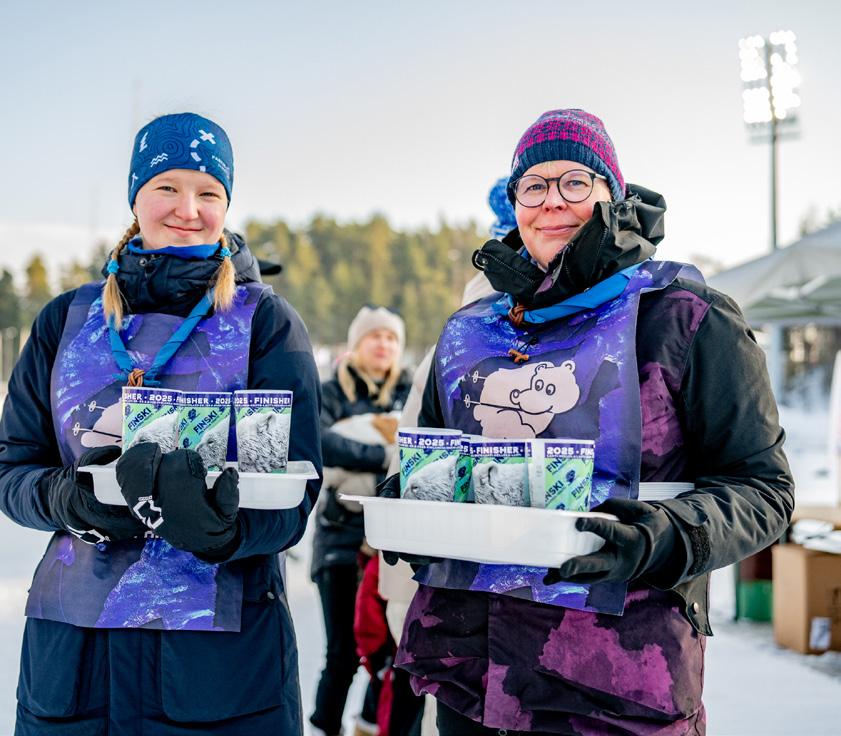
Large outdoor sports events create specific needs for serving dishes. During quick hydration breaks under time pressure, deposit systems for cups are not feasible. Finlandia Ski Marathon has tested reusable cups in cooperation with Green Cup Oy. Throughout the event, an estimated 50,000–70,000 single-use cups were used, with some replaced by reusable alternatives. Feedback has been positive: skiers liked the cups and thought they were of high quality. Visible sustainability enhances your image, as participants and partners increasingly value responsible practices. The challenge for reuse is the higher cost per cup. The price could be included in the ticket (eco-fee), but higher prices might reduce participation. Organisers are actively considering more sustainable solutions for future events. For example, several beverage brands want their own logo on the cups. Organisers encourage brands to acquire reusable cups for use at their own branded events. In Iceland, a concept is used where participants bring their own cup.
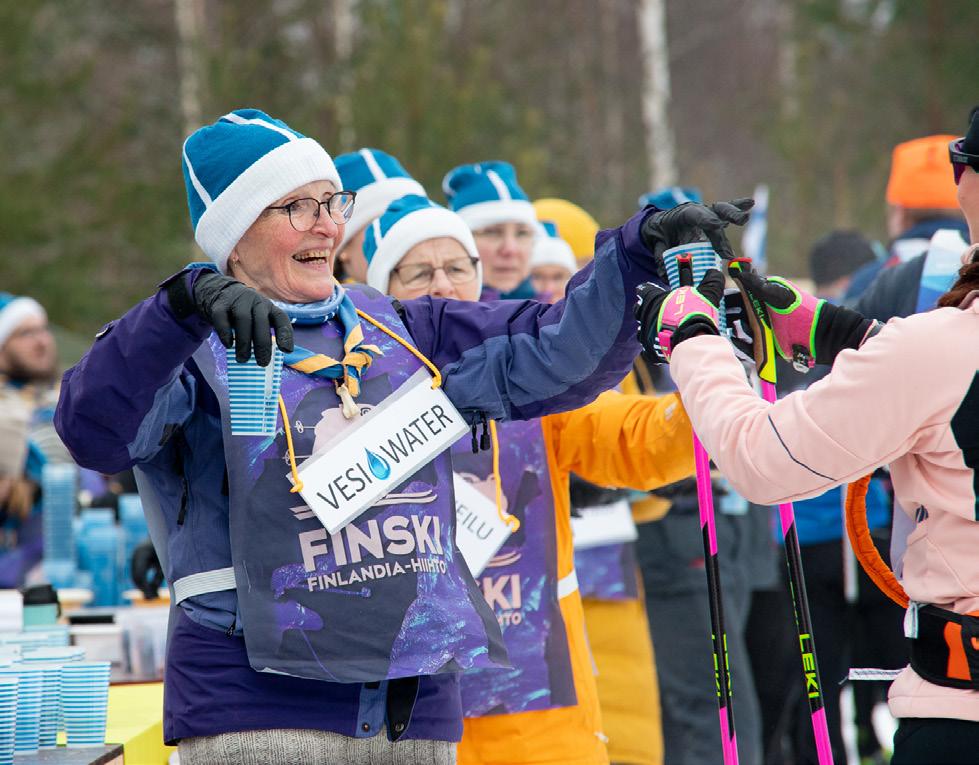
Photo: Finlandia Ski Marathon image archive
To promote reuse in municipalities:
Publisher: Finnish Environment Institute (Syke) ISBN 978-952-11-5817-9 (pdf) 1. 2 . 3. 4.
Join networks and explore their publications
► Zero Waste Cities: over 450 European municipalities have committed to a zero-waste programme since 2007.
► Subscribe to the PlastLIFE mailing list (in Finnish).
PlastLIFE supports Plastics Roadmap for Finland by promoting reuse and reducing unnecessary plastic consumption, e.g., at events.
► Use the RREUSE network , aimed mainly at businesses, but offering listings of publications and new partners.
► Explore Planet Reuse, a European network promoting collaboration on reusable packaging.
Be bold and experiment
► Trials help refine practices and gradually establish them as the new normal. Many companies and associations also rent dishes. See the updated list of Finnish service providers at Kiertotalousratkaisuja.fi (in Finnish).
Learn from others
► Could the Malta’s example be suitable for your event? In Malta, residents are encouraged to bring their own dishes through financial incentives, such as discounts for using personal dishes.
Leverage Finnish opportunities
► Tap water in Finland is excellent drinking water.
Event organisers can provide refill stations for personal water bottles and encourage participants in pre-event communication to bring their own bottle.
plastlife.fi/en
PlastLIFE Finland
Follow Syke’s current research : syke.fi/research
Action recommendations | PlastLIFE Project | November 2025
Boosting reuse at events: How municipalities can lead the way
Authors: Hanna Savolahti, Helena Dahlbo, Katriina Alhola, Hanna Salmenperä, Sari Kauppi, Waltteri Heikkilä.
Editors: Johanna Kaunisto and Katja Lepistö.
Photo: Marianna Saren
Photo: Outi Jounila, City of Espoo
Photo: Outi Jounila, City of Espoo