Binghamton research changes lives

![]()


Siyuan Rao’s research may lead to new therapeutic strategies for spinal cord injuries, which affect more than 15 million people worldwide.
Project title: Identifying Cellular Intraspinal Electrophysiological Features of “Spinal Shock”
Principal investigator: Siyuan Rao, assistant professor of biomedical engineering
Funding agency: National Institute of Neurological Disorders and Stroke
Grant amount: $470,293
Biomedical engineer Siyuan Rao received a grant from the National Institutes of Health in 2025 to look at multifunctional hydrogel neural probes for a better understanding of spinal shock, which is a temporary loss of all neurological function below a spinal cord injury. The grant comes from NIH’s R21 program, which funds exploratory, high-risk/high-reward research.
This study, to be conducted with a rodent model, aims to identify the electrophysiological characteristics of spinal motor neurons after a spinal cord injury (SCI). Capitalizing on preliminary experiments with soft, stretchable hydrogel microelectrodes, the project will use these tools to conduct intraspinal recordings from the ventral areas of the lumbar segment. The team will capture precise, real-time electrophysiological signals from motor neurons and correlate these patterns with observed behavioral changes throughout the recovery process.
Rao and her colleagues will optimize intraspinal electrophysiological recording from motor neurons in mice doing activities such as resting, walking and running over extended periods. They also plan to monitor and analyze electrophysiological properties throughout different recovery phases following a spinal cord injury.
Rao joined Binghamton’s faculty in 2023 after completing a postdoctoral fellowship at MIT. Her team in the Neurobiological Interfaces Lab at Binghamton University sits at the intersection of materials science engineering, electrical engineering, neuroscience and biomedicine.
Responsible AI will be the focus of a new center.
Binghamton University is poised to become a national leader in responsible artificial intelligence, thanks to the largest academic gift in campus history.
A record-setting $55 million commitment from a Binghamton University alumnus and New York state will establish the New York Center for AI Responsibility and Research, the first-ever independent AI research center at a public university in the U.S.

Part of the Empire AI project, an initiative to establish New York as a leader in responsible AI research and development, the center will be supported by a $30 million commitment from Tom Secunda ’76, MA ’79, co-founder of Bloomberg LP, who is a private sector partner and philanthropist involved in Gov. Kathy Hochul’s Empire AI consortium. This will be coupled with a $25 million capital investment from Hochul and the state Legislature.
“The New York Center for AI Responsibility and Research will bring together innovative research and scholarship, ethical leadership and public engagement at a moment when all three are urgently needed,” President Anne D’Alleva said. “I am deeply grateful to Governor Hochul and the state Legislature for their visionary support, and to Tom Secunda for his extraordinary generosity and continued commitment to his alma mater.”
Binghamton is one of the first members of the Empire AI Consortium, whose campus researchers are using Empire Alpha, a supercomputer housed at the State University of New York at Buffalo.
The center will build upon the research of Binghamton faculty, who are using machine learning and data science to solve real-world challenges ranging from delivering better healthcare to improving information security.

Christopher Bishop’s work could improve early diagnosis of Parkinson’s Disease.
Project title: Investigating the Mechanisms of Alphasynuclein-induced Anxiety in a Novel Preclinical Model of Parkinson’s Disease
Principal investigator: Christopher Bishop, professor of psychology
Funding agency: Michael J. Fox Foundation
Grant amount: $250,000
Anxiety emerges early in Parkinson’s Disease patients, and not just as an emotional response to a difficult diagnosis.
While some patients experience generalized anxiety, they may also have autonomic symptoms, such as sweating, a racing heart or physical nervousness.
“We have evidence from clinical pathology as well as some unique features of anxiety to suggest that it is organic and not simply a perception driven by disease diagnosis,” says Psychology Professor Christopher Bishop, who received a grant from the Michael J. Fox Foundation in 2025 to study the neurobiology of anxiety related to Parkinson’s.
Some patients experience anxiety before the motor symptoms characteristic of Parkinson’s emerge, Bishop said. Coupled with biomarkers, anxiety symptoms may help predict the progression of the disease.
Bishop will partner with Fredric Manfredsson at the Barrow Neurological Institute and Binghamton Professor Marvin Diaz on the project. This is Bishop’s fourth grant from the Michael J. Fox Foundation. His research has also been funded by the National Institutes of Health.

Binghamton University research changes lives. Our faculty members are responsible for innovations that improve people’s health, safeguard the environment and contribute to our understanding of places close to home and around the world. They are behind inventions that we use every day, including the batteries in your cell phone and the chips that enable artificial intelligence.
Our campus recorded its best year ever for research expenditures in 2024-2025, topping $87.3 million — a 28% increase from the previous year. Major awards from agencies such as the National Institutes of Health and the National Science Foundation support our innovative scholars as they work in areas ranging from microbiology to materials science. And we have dedicated an extraordinary team to strengthening the battery manufacturing ecosystem in upstate New York, with backing from federal and state sponsors and a large network of partners.
It’s exciting to see the campus bustling with this activity, whether you look into a lab where graduate students are using a new microscope or open the New York Times and notice one of our experts offering insights on a challenging topic. The University remains committed to ensuring that research findings make their way from the laboratory to the marketplace and from the campus to the community.
At Binghamton University, we don’t wait for change; we create it.
Center for Advanced Magnetic Resonance Imaging Science (CAMRIS)
Institute for AI and Society
Binghamton Biofilm Research Center (BBRC)
Center of Biomanufacturing for Regenerative Medicine (CBRM)
Center of Biomedical Technology
Center for Cognitive Applications (CAPS)
Binghamton Center of Complex Systems (CoCo)
Center for Development and Behavioral Neuroscience (CDBN)
Center for Healthcare Systems Engineering (CHSE)
Center for Imaging, Acoustics and Perception Science (CIAPS)
Center for Information Assurance and Cybersecurity (CIAC)
Bernard M. & Ruth R. Bass Center for Leadership Studies (CLS)
Center for Medieval and Renaissance Studies (CEMERS)
Natural Global Environmental Change Center (NAT-CHANGE)
Decker College of Nursing and Health Sciences (DCNHS) Office of Research and Scholarship
Public Archaeology Facility (PAF)
Center for Research in Advanced Sensor Technologies and Environmental Sustainability (CREATES)
Tick-borne Diseases Center
Center for Writers (CW)
Center for Community Schools
Center for Israel Studies
Center for Korean Studies
Human Rights Institute
Institute for Advanced Studies in Humanities
Institute for Asia and Asian Diasporas
Institute for Evolutionary Studies
Harriet Tubman Center for the Study of Freedom and Equity
Watson Institute for Systems Excellence
RESEARCH FUNDING 2020-2025
RESEARCH EXPENDITURES BY SPONSOR AND BY
TRANSFER 2024-2025 NEW TECHNOLOGY DISCLOSURES
U.S. PATENT APPLICATIONS
U.S. PATENTS ISSUED ROYALTIES 2024-2025
235,728
Sean Choi’s innovations could power the Internet of Things.

Seokheun “Sean” Choi developed bacteria-fueled biobatteries for use in remote locations. Now he’s taking on another challenge: integrating those fuel cells into 3D-printed flexible electronics.
A $550,000 grant from the National Science Foundation will support the development of a manufacturing process that will not kill the biological components necessary for power generation.
“The problem with microbial fuel cells as a power source is that liquid for bacterial material is not compatible with solid-state electronics,” says Choi, a professor of electrical and computer engineering. “Also, living bacteria cannot survive many extreme microfabrication processes.”

Project title: 3D-Printed Microbial Fuel Cells with Integrated Electronics for Sustainable On-Chip Energy
Principal investigator: Seokheun “Sean” Choi, professor of electrical and computer engineering
Funding agency: National Science Foundation
Grant amount: $550,000
For this project, Choi is looking to use dormant bacterial spores, which are resistant to harsh conditions and can survive for long periods of time. When the conditions are right, the spores will germinate and generate power.
The research ties into Choi’s ideas about ecofriendly electronics that can be used for the Internet of Things to connect more devices into a collective network. With an earlier NSF grant, he and his team are also pursuing better papertronics that are environmentally safe and biodegradable.
This company is advancing battery technology with help from Binghamton-led initiatives.
Ateios Systems, a leader in battery component manufacturing, received a $150,000 R&D grant and a $200,000 SuperBoost grant in December 2024 from the NSF Energy Storage Engine in Upstate New York. This funding supports the company’s pioneering approach to manufacturing next-generation, high-energy dense, environmentally friendly battery electrodes.
Grants like these are another sign that upstate New York is solidifying its position as a national hub for battery innovation and manufacturing, led by three major initiatives based at Binghamton.
The U.S. Economic Development Administration named the region a Build Back Better Regional Challenge awardee in 2022 and designated it as a national Battery Tech Hub in 2023. The U.S. National Science Foundation established upstate New York as a Regional Innovation Engine in 2024.
Ateios Systems was identified as a potential highimpact company while participating in the NSFfunded ChargeUp Accelerator at Binghamton. Ateios’ breakthrough technology aims to disrupt the $85 billion lithium-ion battery market by eliminating harmful chemicals and CO2 emissions from production. It also enhances battery performance and reduces production costs.
“I’m proud to play a role in strengthening the U.S. edge in battery manufacturing, and it’s significant to do so in upstate New York, where I grew up,” says Rajan Kumar, CEO of Ateios Systems.
Ateios was also named the 2025 Battery Manufacturer of the Year at The Battery Show North America. The award recognizes companies advancing innovation, performance and sustainability across the global battery industry. The company’s proprietary RaiCure technology enables the creation of “forever-chemical-free” battery electrodes, making the manufacturing process cleaner, more efficient and more sustainable.
AT BINGHAMTON UNIVERSITY
Center for Advanced Microelectronics Manufacturing (CAMM)
Center for Autonomous Solar Power (CASP)
Center for Energy-Smart Electronic Systems (ES2)
Center for Heterogeneous Integration Research in Packaging (CHIRP)
Integrated Electronics Engineering Center (IEEC)
FEDERALLY DESIGNATED RESEARCH CENTERS AT BINGHAMTON
Center for Energy-Smart Electronic Systems
A National Science Foundation Industry/University Cooperative Research Center
Developmental Exposure Alcohol Research Center
A National Institute on Alcohol Abuse and Alcoholism Alcohol Research Center (NIAAA)
NSF Energy Storage Engine in Upstate New York
A U.S. National Science Foundation Regional Innovation Engine designee
New Energy New York Build Back Better Regional Challenge winner and Tech Hub designee
New York Node of the NextFlex Flexible Hybrid Electronics Manufacturing Institute
A Department of Defense Manufacturing Innovation Institute
Center of Excellence engineers are working on a project that may save babies’ lives.

Researchers with S3IP, a New York State Center of Excellence focused on microelectronics R&D, are working with a nonprofit to reduce infant mortality in developing countries.
Dr. Jeffrey E. Green has volunteered at a Cambodian refugee camp and several medical clinics in low-income countries such as Uganda and Nepal. When he retired from his career as a cancer researcher at the National Institutes of Health, he set out to help address a crisis that he witnessed during his volunteer work: newborns dying of hypothermia.
He created a nonprofit startup called Apricity Solutions Inc. to make a device that would sustainably keep babies warm in challenging conditions. It needs to be safe, cheap, reusable and able to run on various sources of power.
From 1996-2025, the S3IP Center of Excellence has contributed to $2.32 billion in economic impact, with nearly 1,120 jobs created and 2,195 jobs retained.
Green wants it to be available in situations when a technique called kangaroo mother care — early, prolonged, skin-to-skin contact with a parent — is not possible for some reason.
“What I designed is an infant warming wrap that’s something like a small sleeping bag,” he says. “It will have a proprietary heating element within it that could run off of wall electricity, a battery or solar energy.”
Green designed the textile portion so that it can be sterilized and reused. Next he needed an electronic controller that would bring the blanket to a safe range of temperatures and maintain that temperature.
That’s where Binghamton researchers came in. Working with engineers Mark Poliks and Benson Chan of S3IP, Green was able to tap into new ideas from students at Binghamton.
Now an LCD screen shows the baby’s temperature and the temperature of the heating element. Additional safety features include a way to alert the user if the wrap malfunctions.
“With funding provided by the Center for Advanced Microelectronics Manufacturing,” says Chan, associate director of S3IP, “student researchers developed the entire package — including the circuitry, programming and housing.”
Office of the Vice President for Research
Binghamton University PO Box 6000
Binghamton, NY 13902-6000
binghamton.edu/research

Research is more than our mission
At Binghamton University, we don’t wait for change; we create it. Whether it’s the classroom or the darkroom, the cleanroom or the boardroom, research isn’t just a mission — it’s a movement.

CONNECT WITH BINGHAMTON UNIVERSITY’S DIVISION OF RESEARCH
Lisa Gilroy
Interim Vice President for Research lgilroy@binghamton.edu
Heather Bragg
Associate Vice President for Research, Ethics, Security and Compliance hbragg@binghamton.edu
Bandhana Katoch
Associate Vice President for Technology Commercialization and Economic Development bkatoch@binghamton.edu
Michael Jacobson
Executive Director of Strategic Research Initiatives mjacobso@binghamton.edu
Rachel Coker
Executive Director of Research Advancement rcoker@binghamton.edu
Darcy Fauci
Director of Government Relations and Chief of Staff dfauci@binghamton.edu
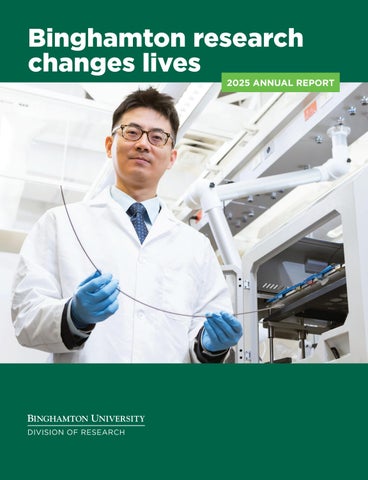
On the cover: Fuda Ning, associate professor in the School of Systems Science and Industrial Engineering at Binghamton, received a CAREER Award from the National Science Foundation to support his efforts to improve additive manufacturing with tungsten alloys. He was among six Binghamton researchers who received more than $4.4 million in CAREER Award funding to pursue projects in materials science, psychology, high-tech manufacturing and more. The awards are part of the NSF’s Faculty Early Career Development Program, which identifies academics who have the potential to serve as role models and leaders in research and education. Binghamton won more CAREER Awards in 2025 than any other SUNY campus.