ple
The Bay of Plenty & Coromandel’s own watersports news. Phone 07 578 0030
ase take one
JUNE 2012
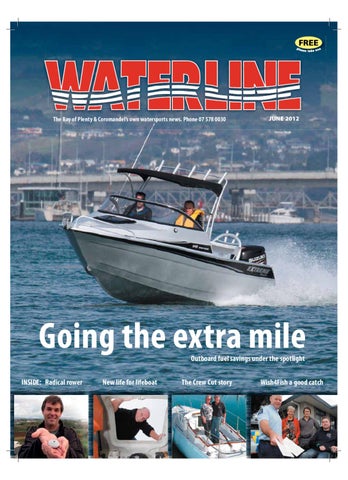
Going the extra mile Outboard fuel savings under the spotlight
INSIDE: Radical rower
New life for lifeboat
The Crew Cut story
Wish4Fish a good catch
02 WATERLINE
JUNE 2012
The Bay of Plenty’s own boating, fishing, diving, yachting and watersports news.
Missed an edition of Waterline?
Phone 07-578 0030 Fax 07-571 1116 No.1 The Strand, Tauranga. PO Box 240, Tauranga. email: brian@thesun.co.nz
Keep up to date with Waterline and your local marine news on SunLive.
For advertising, call Salina on 07 578 0030 email classi2@thesun.co.nz Follow us on facebook www.facebook.com/Waterlinemagazine
Waterline advertising & editorial deadlines
Edition
Deadline
June 2012 Sept 2012 Dec 2012 March 2013
1 June 2012 31 August 2012 30 Nov 2012 24 Feb 2013
Everything you need including weather, tides and weekly fishing reports.
www.sunlive.co.nz
TIDES Date
Time / Height Time / Height Time / Height Time / Height
JUNE 16 17 18 19 20 21 22 23 24 25 26 27 28 29 30
Sa Su Mo Tu We Th Fr Sa Su Mo Tu We Th Fr Sa
4:26 5:14 6:01 0:40 1:23 2:05 2:47 3:29 4:12 4:56 5:42 0:16 1:07 2:00 2:57
1.7 1.7 1.7 0.5 0.5 0.5 0.4 0.4 0.4 0.3 0.3 1.8 1.8 1.8 1.8
10:40 11:27 12:12 6:47 7:31 8:14 8:56 9:39 10:22 11:06 11:54 6:31 7:23 8:18 9:16
0.4 0.4 0.4 1.7 1.7 1.7 1.7 1.7 1.7 1.7 1.7 0.3 0.3 0.3 0.2
17:04 17:52 18:37 12:55 13:36 14:17 14:58 15:40 16:23 17:08 17:57 12:45 13:41 14:40 15:42
1.7 1.7 1.7 0.4 0.3 0.3 0.3 0.3 0.3 0.3 0.3 1.7 1.7 1.8 1.8
3:57 4:58 5:59 0:46 1:42 2:36 3:27 4:17 5:06
1.8 1.8 1.9 0.2 0.2 0.2 0.2 0.2 0.2
10:16 11:15 12:13 6:58 7:55 8:49 9:41 10:31 11:20
0.2 0.2 0.1 1.9 1.9 1.9 1.9 1.8 1.8
16:44 17:44 18:41 13:09 14:02 14:54 15:44 16:33 17:21
1.8 1.9 1.9 0.1 0.1 0.1 0.1 0.2 0.3
23:07 0.5 23:55 0.5 19:20 20:01 20:42 21:23 22:03 22:45 23:30
1.8 1.8 1.8 1.8 1.8 1.8 1.8
18:49 19:44 20:44 21:45
0.3 0.4 0.4 0.3
JULY 1 2 3 4 5 6 7 8 9
Su Mo Tu We Th Fr Sa Su Mo
22:47 0.3 23:47 0.3 19:36 20:29 21:21 22:10 22:59 23:46
2 2 2 2 1.9 1.9
Date
10 11 12 13 14 15 16 17 18 19 20 21 22 23 24 25 26 27 28 29 30 31
Tu We Th Fr Sa Su Mo Tu We Th Fr Sa Su Mo Tu We Th Fr Sa Su Mo Tu
Time / Height Time / Height Time / Height Time / Height
Date
5:54 0:33 1:19 2:07 2:55 3:45 4:36 5:26 0:06 0:52 1:36 2:20 3:03 3:47 4:32 5:19 6:09 0:46 1:40 2:39 3:41 4:43
4 5 6 7 8 9 10 11 12 13 14 15 16 17 18 19 20 21 22 23 24 25 26 27 28 29 30 31
0.3 1.8 1.7 1.7 1.6 1.6 1.6 1.6 0.5 0.5 0.4 0.4 0.3 0.3 0.2 0.2 0.2 1.8 1.8 1.8 1.8 1.8
12:09 6:41 7:29 8:18 9:07 9:58 10:48 11:36 6:15 7:01 7:47 8:31 9:15 9:59 10:46 11:34 12:26 7:01 7:57 8:56 9:56 10:57
1.7 0.3 0.4 0.4 0.4 0.4 0.4 0.4 1.6 1.7 1.7 1.7 1.8 1.8 1.8 1.8 1.8 0.2 0.2 0.2 0.2 0.2
18:10 12:58 13:48 14:40 15:33 16:25 17:16 18:03 12:22 13:06 13:49 14:32 15:16 16:00 16:47 17:37 18:29 13:22 14:23 15:25 16:27 17:27
0.4 1.7 1.6 1.6 1.6 1.6 1.6 1.7 0.4 0.3 0.3 0.2 0.2 0.2 0.2 0.3 0.3 1.8 1.8 1.8 1.8 1.8
19:00 19:50 20:43 21:36 22:28 23:18
0.4 0.5 0.5 0.6 0.6 0.5
18:48 19:31 20:14 20:56 21:38 22:22 23:07 23:55
1.7 1.8 1.8 1.8 1.9 1.9 1.9 1.9
19:26 20:26 21:28 22:30 23:31
0.3 0.3 0.3 0.3 0.3
AUGUST 1 We 5:45 1.8 11:56 0.2 18:24 1.9 2 Th 0:29 0.2 6:43 1.8 12:51 0.1 19:18 1.9 3 Fr 1:24 0.2 7:38 1.8 13:43 0.1 20:08 1.9
Time / Height Time / Height Time / Height Time / Height
Sa Su Mo Tu We Th Fr Sa Su Mo Tu We Th Fr Sa Su Mo Tu We Th Fr Sa Su Mo Tu We Th Fr
2:15 3:04 3:51 4:36 5:19 6:03 0:38 1:23 2:11 3:02 3:56 4:50 5:42 0:19 1:05 1:51 2:37 3:22 4:09 4:57 5:48 0:28 1:24 2:25 3:28 4:31 5:32 0:12
0.2 0.2 0.2 0.2 0.3 0.3 1.7 1.6 1.6 1.6 1.6 1.6 1.6 0.4 0.3 0.3 0.2 0.1 0.1 0.1 0.1 1.8 1.8 1.7 1.7 1.7 1.7 0.2
8:29 9:18 10:04 10:50 11:34 12:20 6:47 7:33 8:22 9:13 10:06 10:58 11:47 6:31 7:19 8:05 8:51 9:38 10:26 11:16 12:09 6:41 7:37 8:37 9:39 10:41 11:39 6:28
1.8 1.8 1.8 1.8 1.7 1.7 0.4 0.4 0.4 0.5 0.4 0.4 0.3 1.7 1.7 1.8 1.8 1.9 1.9 1.8 1.8 0.2 0.2 0.2 0.3 0.2 0.2 1.8
14:33 15:20 16:06 16:52 17:37 18:22 13:07 13:57 14:49 15:43 16:36 17:26 18:13 12:35 13:21 14:06 14:52 15:39 16:28 17:19 18:13 13:06 14:07 15:10 16:11 17:10 18:06 12:33
0.1 0.2 0.2 0.3 0.4 0.4 1.6 1.6 1.6 1.6 1.6 1.7 1.7 0.3 0.2 0.2 0.2 0.1 0.2 0.2 0.2 1.8 1.8 1.8 1.8 1.8 1.8 0.2
20:57 21:43 22:28 23:12 23:55
1.9 1.9 1.9 1.8 1.7
19:10 20:00 20:52 21:46 22:39 23:30
0.5 0.5 0.6 0.6 0.5 0.5
18:59 19:43 20:27 21:12 21:58 22:45 23:35
1.8 1.8 1.9 1.9 1.9 1.9 1.9
19:10 20:11 21:13 22:16 23:16
0.3 0.3 0.3 0.3 0.3
18:57 1.9
Tauranga tide heights in metres. Bowentown: subtract 5 minutes from Tauranga (both HW and LW) Katikati (Kauri Point): add 30 minutes to Tauranga (both HW and LW) Whitianga: High Water subtract 2 minutes from Tauranga HW tide; Low Water add 2 minutes to Tauranga Low Water. Every effort has been made to ensure that these times and tides are correct, no responsibility will be accepted for any inaccuracies, omissions, or misuse or misinterpretation of the values for tides and times published. Times used in the tide predictions are in New Zealand Standard Time (NZST1).
WATERLINE 03
JUNE 2012
New Mount at the Tauranga Game Fishing Club
Beni, Mike and Cory with ‘Blackie’
In late April this year a new fish mount was added to the 24 already adorning the walls and beams of the Tauranga Game Fishing Club bar and lounge. The new fish mount is the head of a 375kg black marlin caught on 37 kg line by club member Beni Hafoka from the 32ft. boat ‘Jan’s Decision’ in waters 80 metres deep West of Mayor Island in the first week of this year. Among the other fish mounts at the club this one is the third heaviest, it belongs to what in recent years has become one of the rarer species in Bay of Plenty waters, and it was a club black marlin 37kg line weight record. No other fish mounts have been added to the Tauranga Game club’s collection in the last three years. The angler Beni Hafoka has been game fishing for about four years but this was his first marlin, and he was incredibly lucky because he had allowed his club membership to lapse and had renewed it only on the day they set sail and brought the black marlin in the day after. On this most successful trip Beni’s gear included a Shimano Tiagra 80W reel and he was using a Top Gun Nightmare lure. They had gone out on Friday, January 6, 2012, to return to Tauranga on the Saturday, January 7. They were already starting on the homeward trip when the marlin was hooked. Beni
played the fish for 2 hours and 20 minutes. When the fish was finally brought alongside, although by then dead, it was so big and heavy that they could not get it onto the boat. So it remained half on, half off, and they kind of dragged it back to port. By this time the weather was certainly not the best, the wind was blowing a gale force 25knots, and there was a two metre swell (the night container vessel Rena grounded on the Astrolabe Reef broke in two). The voyage back to Tauranga took them three and a half hours travelling at between 6 to 8 knots. They were quite alone out there, all other vessels out appeared to have gone home or taken shelter some time earlier. The other two aboard the boat skipper Cory Davies and Leader man Mike Easton were both longtime Tauranga Game Fishing Club members and often fished together. The two and / or the boat ‘Jan’s Decision’ featured in the Club’s striped marlin both weighed in and tagged and released, and the blue marlin weighed in lists , and the thresher shark weigh in, for the 2010 -11 season. Early on it was decided to get the black marlin mounted for a number of reason’s including it was Beni’s first big catch, it was one of the heaviest Club catches in recent years, it was the heaviest black marlin for a number of years, and it was a Club black
marlin record catch on 37kg line, and overall it was a pretty impressive catch. The mount was put to the club who favoured a shoulder and head. Agreement all round was reached and the mount was referred to renowned Athenree marine taxidermist Kevin Flutey. For any who may mistakenly assume that the cast has something of the original fish or is a plaster coating or plaster cast model it is not. It is these days fibreglass. Mr Flutey has been making fish models for at least the last 20 years. The process he describes as moulding – taking an impression of the fish – in this case of the head; then glassing inside the mould followed by the outside; then the prominent bits and pieces such as fins, mouth, and eyes; and then putting it altogether and painted with the paints made up to the exact replica of the fish’s colouring. The process was a 50 to 60hour job, including 3 to 4 hours on each eye ( for which he had a fairly new technique process ).Then there is the task of mounting the finished piece to the wall as required. In this case it was mounted/affixed to the bar room cross beam facing the bar alongside a couple of others on the beam. The shared cost of the mounted head was said to be around $3,000, and the finished product was well worth the sum according to those involved. By Pinky Green
04 WATERLINE
JUNE 2012
Rena oil spill ‘could have been prevented’ The tonnes of heavy fuel oil that washed onto Bay of Plenty beaches after the container ship Rena struck the Astrolabe reef could have been prevented, claims a local lawyer.
The captain’s lawyer Paul Mabey QC revealed in submissions at the Captain’s recent Tauranga District Court sentencing that salvors over-ruled the advice of captain Mauro Balomaga in the days after the grounding. The ship struck the reef early on October 5. Soon afterwards the captain and chief engineer identified the source of oil in one of the Rena’s forward holds as coming from the No3 starboard tank via the duct keel. They were working on transferring
the oil from the No 3 tank into the No 5 Starboard tank when the salvors took over the ship. “For six days they were on the boat and they wouldn’t listen to the captain and engineers who said ‘The oil’s coming out of there we have identified it. If the weather turns bad we are going to have problems,’ says Paul outside the court. “The salvors said ‘Na, na, you don’t know what you are talking about, the boat is listing to port. “And of course when the weather did
hit and the tank broke, it was the no 3 starboard side tank that let all the oil out. It’s the very tank they identified as the one where all the oil polluted from. The captain was right about that. “They could have saved nearly all of the pollution and that’s exactly what it was. The Rena oil spill could have been prevented if Maritime NZ and the salvors had listened to advice from the captain and Rena’s chief engineer. “There might have been 20 tonnes instead of 350 tonnes.”
Looking forward to an exciting sail He’s built it, launched it, and now Michael Galloway is looking forward to learning how to sail his 10m Malcolm Tennant design catamaran. “Yes I built it myself over about a seven to eight year period. Michael’s built a Tennant Red Shift, but he’s extended the length by 250mm so he could put steps down the back, which wasn’t in the original design. Malcolm Tennant designed the Great Barrier Express, an 8.5 metre catamaran that combined element of a conventional beach cat bu is light and extremely fast. Michael’s Red Shift is glass over ply hulls, cabin top and decks are strip planked cedar with carbon fibre and epoxy throughout.
The Red Shift has aluminium cross beams and a wing mast Michael built himself. “When I first started wing masts were rather unusual, but now the Americas Cup has got in the act. “The idea’s been around 30-40 years. There’s nothing new in the design it’s just that people haven’t used it.” He got his sails a week before Waterline went to print. I’ve only had one sail. It went well but only in about seven knots of wind. Everything worked very well, but it wasn’t a huge test for it. It goes and the mast performed very well. you build something like that and you wonder it if will.” He built the cat in ‘various places’. He started on the hulls in a ten metre car port. The cabin tops were built under the house and the rest was done in a shed that he hired. The sails are by North Sails in Auckland. “It’s able to be raced but there is a problem with insurance,” says Michael. “At the moment it would not be covered for racing, especially at
this stage as I have got a lot to learn in how to drive it.” The boat is 10 metres LOA, the mast is 15.6 m, the beam 6.8m, draft about 350mm. dagger board and dagger board type rudders as well. “I’m really looking forward to a good exciting sail because I haven’t had that yet. I won’t be too keen to chance my arm in the winter. “I’m not too keen on getting really cold. In the right conditions when it is flying it will be a wet boat. so I won’t stay dry.”
Michael watches the wing mast being stepped.
WATERLINE 05
JUNE 2012
That’s a lot of garage sales
The lifeboat with Moss and Bridge Marina manager Tony Arnold on board.
To Moss Carlin the outcome of the Rena lifeboat auction is best summed up in terms of garage sales.
The life boat in operation.
“I’m very pleased with the result, that $20,800, that’s about 400 garage sales,” says Moss. The money will be going to the Bay of Plenty Child Cancer Foundation, of which Moss is a committee member. “If we did a garage sale the average is $500 and that’s a pretty loose average. When you put it in terms like that, that’s big for us. It would take two or three of us a month to organise a garage sale so in terms of fund raising, that’s really good for us. “I don’t know what I’m doing for the next trick.” Moss is also happy the lifeboat is staying local. The new owner Greg Clarke intends
using the lifeboat as a charity fund raiser, and as a tribute to all the people who helped with the clean-up of their beaches. “He came down and had a look at it, brought a boat guy down and they had a good rummage around,” says Moss. Greg intends to keep the boat intact, but other bidders were looking at adapting the fibreglass hull and engine for other uses. “We had a guy down there measuring it up, he wanted to turn it into a houseboat on Lake Rotoiti,” says Moss. “He was semi-retired boat builder. There were a few comments in that direction.” During the two week auction on Trademe Moss got to take the lifeboat out a few times, taking family and friends, the CCF committee, and other for trips to show how well it runs. Greg says he’s keen to hear residents’ ideas on how the life boat can be used for fund raising. “With the Papamoa Beach being one of the worst affected areas it will be fitting to display it at Palm Beach Plaza for a while. And of course it’s been cleaned up thanks to all the volunteers who poured thousands of hours into it.” Beyond a temporary display at the shopping centre, he has lots of ideas for how the 7.5m x 2.9m wide boat can be used. He suggests it could be used for overnight excursions, or “wild trips” out the Kaituna
Moss at the helm position hatch.
mouth in stormy weather, with the fee going to a fund to support environment groups and CCF. “There are all sorts of things it could be used for. I just want to make sure it stays in the community so I want to hear people’s ideas on how it can be used. “Let’s do something that’s going to have longevity, something that is going to remind us of the importance of protecting the environment and supporting the amazing work of the volunteers who help.” By Hamish Carter
06 WATERLINE
JUNE 2012
TV onboard in the digital age With the government rolling out digital TV service across the country, there has been a strong advertising campaign to let people know about the changes at home, but not much information about changes aboard their boats. For those who are unaware, at the end of the year, the Analog TV signal around the country will start to be turned off, leaving you with 2 choices for TV, Terrestrial Digital, or Satellite TV. Here in the bay the switch will be thrown at the end of 2013, but many people are making the change earlier, as the picture quality, programming guides and number of channels is much better on the new system. Terrestrial Digital is the cheaper of the two new options, but will still require some new hardware. The main thing to note when comparing Terrestrial Digital to Analog is that it will a have a much shorter range than the existing service and is largely limited to line of sight (like VHF). In some areas, including most of the Coromandel peninsular, it simply won’t work and you will need a satellite antenna to get TV instead. At home, Terrestrial Digital TV is received
The satellite coverage option. by the long directional antenna which looks like a hairbrush with a flyswat at one end. Since you are on a boat which moves and rotates, these will be useless. You will need an amplified, omni-directional antenna. Some options for antennas look like UFOs and some of our customers have been very happy with their reception, but we have found the best range comes from a whip antenna made by Bosch, which give excellent results when used with a proper ground plane. The
whip antenna is also much less obtrusive and cheaper than most of the other options. Satellite TV on boats has always been more expensive than terrestrial TV, however the cost is definitely falling. Decent dishes start at about $4500, and the great thing is you can go anywhere with it and not have any reception problems. The cheaper options available are prone to rain fade and reliability problems. We have not recommended them for a while. Despite the cost, satellite Freeview is not high definition, to get high definition content from a satellite dish a sky subscription is required. So what about those who enjoy cruising in remote areas, don’t want a satellite dish but still want to keep up with what’s happening in the world? The only real option is to use a Cellular internet connection. Downloading news and videos can be done over a much wider area than from digital terrestrial as the cell phone network is much more widespread. A good internet box and aerial starts at $1500, which will download video at broadband speed in good reception areas. Data starts at about $30 per Gigabyte, which would last most people the better part of a month. By Rob McAllister Bay Marine Electronics
WATERLINE 07
JUNE 2012
Simpler trout rules coming Trout fishing rules in the Eastern Fish and Game region are being re-written with the intention of making them simpler and easier to understand.
The review is prompted by comments from anglers says Fish & Game Officer Matt Osborne. “Changes have been raised to simplify the current rules which have been criticised as unnecessarily complex, says Matt. “What we propose is good news for veteran anglers and novices alike: the bottom line is greater opportunities for anglers – and now the Fish & Game Council is asking anglers to consider the suggestions, and write in with their feedback.”
Dammed trout fishermen Trout fishers in Shippensburg, Pennsylvania blamed high water levels and fierce winds for becoming stranded on top of a dam on the first day of a recent trout fishing season. All five occupants were reported to have been rescued unharmed, through combined efforts of the rescuers and fellow boaters. A tow line was thrown to the first boat, enabling it to be towed away from the dam and taken to shore. The other boat’s occupants were rescued via their PFD’s attached to a life line. They then entered the water and were pulled to safety. Their boat was abandoned on the breast of the dam. Photo: Brian Denham.
Proposed changes include: ‘Fly Fishing Only’ periods for all the winter shoreline sites on lakes Tarawera, Rotoiti and Okataina, will only come into effect from April 1st. This will mean far more opportunity for shoreline spin-fishing anglers over summer, but less during the winter when they’re not normally too active in any case. Another proposal is to open all waters in the region on October 1, providing anglers with more fishable waters earlier. At present some remain closed until December.
This will open up angling opportunities in areas such as the upper Ngongotaha, Waiteti and Utuhina streams (Rotorua), and the Mokau and Hopuruahine Streams at Waikaremoana (East Coast). The proposals for the 2012-13 season, if adopted, will come into effect on October 1st 2012. Anglers are invited to view the proposals in detail on the Eastern Fish & Game website (eastern.fishandgame.org.nz), or by contacting the local Eastern Region office.
08 WATERLINE
JUNE 2012
Gone are the lifejackets of old When I started my seafaring career about a hundred years ago, things were different. Lifejackets, for instance… Lifejackets of last century were huge, bulky kapok-filled plastic bags with a faded canvas covering. They were donned on obligatory occasions for lifeboat drill, but were removed as quickly as possible, because you couldn’t move in them, much less launch a lifeboat. As I recall, these old-style lifejackets were mostly used to jam under one side of the mattress in rough weather to help wedge you in to your bunk. In a small boat, they were about as useful as a chocolate kettle, being unwieldy and hard to stow. Looking even further back in time, Noah’s lifejacket might have consisted of an air-filled bladder made from a sheep’s stomach that was tied around the waist with some plaited twine. Thankfully, comparing Noah’s flotation device with a modern lifejacket is like comparing a Model T to a Ferrari.
Go slow near boats and swimmers
or pay a $200 fine!
Wear a
LIFEJACKET
You must have an observer when towing
or pay a $200 fine!
GO SLOW NEAR DIVERS
WATERLINE 09
JUNE 2012
... now there’s one to suit every activity Modern lifejackets are discrete, comfortable, high-tech – gosh, they could even be called sexy given the right circumstances. Lifejackets come in a wide variety of styles to suit your boating activity – and your purse. My own favourite lifejacket for winter boating is an inflatable type incorporated into a rain jacket with zip-off sleeves. It’s warm and is so comfortable that you forget you’re wearing a lifejacket. The only trick is that you need to fasten the crotch strap for the lifejacket to be effective: it will ride up around your face in the water if you have forgotten to ‘make it click’. A significant number of the boats involved in this year’s boating fatalities have been less than six metres in length - this includes kayaks and PWCs (often referred to as ‘jet skis’). These types of smaller craft are starting to show up as significant contributors to the drowning statistics as they become more popular. Let’s look at a few facts: - Most drownings are preventable, yet drowning is a leading cause of death in this country – only car crashes and falls
cause more fatalities. - Half the boat-related drownings each year could have been avoided if suitable lifejackets had been worn. - In particular, 85 percent of fatal accidents in NZ involving vessels under four metres in length could have been prevented if safety equipment had been available and used. Yes, that’s right, 85 percent of fatal accidents could have been prevented! - The drowning toll for 2011 was an alltime high, up 41 percent on the previous year, and the worst annual drowning toll on record since 2003. Significantly, 80 percent of those who drowned were males. - Alcohol was a factor in almost 20 percent of all drownings. - Another interesting statistic: most people who drown are close to the shore or help – sometimes within two metres. There’s a fairly clear picture emerging here. You might believe you’re bullet-proof, but the statistics say otherwise. Most accidents occur suddenly and without warning. There may be no time to grab a lifejacket, and it is extremely difficult or
My favourite winter inflatable lifejacket. impossible to put a lifejacket on once you are in the water. The law says that you must carry a lifejacket of the correct size for every person on board your boat and that they must be kept in a readily accessible location. Every person on board must wear a lifejacket – properly secured – in circumstances like rough weather, strong tidal flows, bar crossings or in emergencies. This applies to all boats, including kayaks, PWCs and tenders. There’s a $200 fine for not complying with these rules. Noah wouldn’t recognise a modern, inflatable lifejacket, but if he’d had one, he would surely have worn it during all that flooding. In doing so, he would have most certainly complied with today’s lifejacket rules to wear one in emergencies and rough weather! Stay safe, wear your lifejacket and survive. Jennifer Roberts, Harbour Master Western Bay of Plenty
10 WATERLINE
JUNE 2012
CLUB NEWS
Vara & H Bruce & Elaine Goodwin headed south again this summer, cruising the Marlborough Sounds, Fiordland and Stewart Island. Again, they gave various local enthusiasts the opportunity to crew the different legs of the voyage.
The Whitianga yacht Harmony in Fiordland.
WATERLINE 11
JUNE 2012
Tauranga Yacht & Power Boat Club
Harmony Head South Hearing of their intended voyage, Arnie Leigh from Whitianga decided to join them with his 26ft yacht Harmony. As he was preparing for his voyage Arnie’s wife Viv would ask, ‘When are you departing?’’ As time went by this question changed to, ‘When are we departing?’ So these intrepid adventurers, well into their seventies, set sail for Fiordland via North Cape, while Vara had departed some weeks earlier from Tauranga via East Cape. Interesting to note, from Whitianga it is only eighty miles further sailing north around the top to Nelson rather than via East Cape. Vara met a gust that topped 98 knots while underway in the Marlborough Sounds, making this area again the windiest of the trip. On the passage down the West Coast of the South Island Vara was romping along in very fresh conditions at night with the boom eased out and a preventer on. Suddenly everything turned to chaos as Vara lurched out of control and things got very messy. The problem turned out to be a blown hydraulic hose on the self-steering unit which meant hand-steering till they reached Milford Sound. In Fiordland the crew of Vara found the fiords to have a high number of sharks present. Nephew Nigel had to keep them at bay by prodding them with his spear gun while diving for crays. This upset his girlfriend more than it upset Nigel, but the cray gathering had to stop! At one anchorage Vara was enjoying the company of a large number of seals that reside there. During the night Nigel headed up on deck as one does in the middle of the night - and was greeted by seals packed so closely about the boat he couldn’t find clear water. Bruce’s snoring (believe me, he can snore!) had attracted
dozens of seals who probably thought the beach master was on board. In Doubtful Sound, Arnie & Viv arrived to sail in loose company. Harmony so loaded with gear that the boarding ladder was hanging in the rigging. Jerry cans of water and fuel filled the side decks, all carefully tied to the lifelines with twists of electrical wire. You can guess what Arnie’s trade was! Ian and Rhonda Ritchie and myself joined Vara at Stewart Island and caught up on the adventures had so far and enjoyed the company of all. We explored a small portion of the south coast of Stewart, Port Adventure and Lords River. Harmony had explored Port Pegasus as she arrived into this remote wilderness in the SW of Stewart
polar fleece and warm socks while Arnie & Viv appeared to be wearing layers of cotton skivvies and polo shirts and Viv in bare feet and crocs. These two are tuff!! We all departed Stewart for Dunedin, 24 hrs away for Vara. Harmony, who averages about 4 knots at best, got caught by a NE change, rough seas and strong winds, that added another 12hrs to their trip. They were totally unfazed. Dunedin was windy and freezing. Akaroa was warm and beautiful. I departed from there to fly home, while Ian, Rhonda and Bruce continued up the coast. They passed a huge steel catamaran that spends it’s time long lining between Banks Peninsula and the Chathams. Twenty nine thousand hooks are mechanically baited with barracuda at the rate of two to three per second (it misses about 10 per cent) and they catch a fish on about 10 per cent of the hooks each drop. Impressive. Rough seas off East Cape got the better of Rhonda’s tummy and water poured into the cockpit turning it into a cold spa bath. It was good to see them safely home. Harmony arrived home a few weeks later. Arnie and Bruce then joined Alan Waugh on Pacific Eagle and sailed for Vanuatu. You just can’t have too much adventure! By Roger Clark
Above: Bruce Goodwin at the helm - South Coast Stewart Island. Right: A Salvin’s Mollymawk. Island direct from Fiordland. We were not able to sail back west along the coast due to strong SW winds and rough seas. Harmony joined us a few days later in Paterson Inlet, here we were all wrapped up in layers of
12 WATERLINE
JUNE 2012
CLUB NEWS
Whitsundays weekend
Mt Maunganui Yacht Club
As Members of The Mount Maunganui Yacht Club the Legends Regatta is an annual event we both look forward to, the Legends Regatta marks the end of the winter racing season and beginning of the summer season and is held over Labour Weekend. The Regatta is well run by the Mount Maunganui Yacht Club Legends committee with all types of yachts taking part. The weekend begins on the Friday when all participating yachts sail to the Mercury Islands. On the Saturday and Sunday there are island races then a sail back home on the Monday. In between there is also time for socializing with beach activities, fishing, diving and the odd beverage or two along the way. The weekend is always great fun and due to the amazing sponsorship of Power Co, Dave Peet Jewellers, Electrical Works, Steve Marine Supplies, Bridge Marina Travel Life, Mills Reef Winery, Radio Network, Wild Kiwi Clothing, Sew hot monograms and Blokart the prize pool is fantastic. The 2010 Legends we entered was not only a great weekend but we were lucky enough to win the spot prize which was a five-night charter cruising the Whitsunday Islands on a Catalina 32 called “Beachhouse”. The prize was courtesy of Charter Yachts Australia, there was also a travel voucher for $2,500 and $500 spending money courtesy of the sponsors. So in July 2011 following arrangements with Charter Yachts Australia and Mount Travel agents we (Roy and Chris Petch) set off for our Australian trip. We flew to Brisbane then
and internal flight to Prosporpine arriving at Airlie Beach. We stayed in Airlie Beach which itself is the heart and soul of the Whitsunday’s and it proved to be the perfect place to base our Whitsunday holiday. It has a friendly villagetype atmosphere with a good selection of shops, restaurants and bars whose main focus is on activities available around the Whitsunday’s and Great Barrier Reef. There is a board-walk that snakes around the shore-line making walking and exploring very easy and pleasant. We stayed at the Marina Shores apartments which overlook the Marina. The apartment was both modern and airy and the Manager was very friendly and helpful. The first few days we explored Airlie Beach and also made a trip to Airlie Beach Sailing Club where we handed over the Mount Maunganui pennant which is now proudly displayed within the Club. The Whitsunday Islands are situated at the heart of the Great Barrier Reef on the north east tropical coast of Queensland. There are many islands within the Whitsunday group. The main islands that the Charter Boats cruise are Hayman Island, Whitsunday Island, Hook Island, Hamilton Island, and Mole Islands.
The Sailing Trip: July 2011 the day began very warm, with windy S/SE 15 /20/25 knots that remained throughout the week. We arrived at Charter Boats Australia and were met by Rick who took us through the boat, went over charts and the Whitsunday’s bible “100 magic miles”. We passed the test they set and then set off on our trip. The crossing met with both strong winds and tide and made for choppy conditions. All Charter boats have to be anchored for the night by 4 pm so we decided to anchor in Nara’s Inlet on Hook Island which was closest to us and is an all-weather anchorage. Following our gusty crossing we anchored at 3.30 in the beautiful calm cove of Nara’s Inlet. At 4pm each day there is a radio sked where all boats under charter with Charter Yachts call in to detail their current position and tomorrows planned sail. Our first night even though there was wind around the boat never moved, and we witnessed the first of many beautiful sunsets. In this bay there are some Aboriginal paintings that we visited early the next day before leaving Nara’s Inlet. The day was again warm, sunny with clear skies and perfect sailing conditions of SE winds 15 – 20 knots, we set Continued ...
WATERLINE 13
JUNE 2012
CLUB NEWS
Magical day’s at sea Continued ... sail travelling up the west coast of Hook Island passed Stonehaven Bay towards Manta Ray and Luncheon Bay where we anchored for lunch and then finally sailing into Butterfly Bay Hook Island where we anchored for the rest of the day and night. We went snorkeling as there is a reef running around the entire bay. We experienced our first strong wind “bullets” which are hill winds that gust through the bays. The next day we decided to sail down the eastern side of Hook and Whitsunday island but the winds and strong tides from the SSE made us turn back sailing through the Hook Passage where we saw three hump backed whales frolicking in the sea putting on a wonderful show. We sailed to CID harbour and anchored at Sawmill Bay. The winds and “bullets” were strong but the bay was calm so we went ashore for a walk talking a bottle of sparkling wine and settled down to watch another brilliant sunset. Following another perfect night’s sleep we sailed down to Hamilton Island which is at the bottom of the Whitsunday Island where we again met with strong winds and tides so sailed over to Stonehaven Bay on Hook Island for the night where we picked up a buoy for the night. In the bay where we swam we came across sea turtles and saw our first shoal of Bat fish. For our last day we sailed to the east coast of Hayman Island and anchored at Blue Pearl Bay where we spent a day of snorkeling a fantastic reef, the best we had seen on our trip it was truly amazing. Swimming back to the boat we were followed by another shoal of Bat Fish this time they hung around the boat letting us swim with them, and also touch them, they even tried to eat our toes when we were sitting on the back of the boat removing our fins. Following this magical day we sailed in perfect conditions down to Nara’s Inlet for our final night at sea. Highlights: Really too many to record, but Pearl Bay was probably the highlight for us the snorkeling and isolation of the beach were fantastic. Also sailing in shorts and tee-shirts during the winter was brilliant. We hope to do this trip again in the future and for any boatie it’s a trip that should be top of your bucket list so thanks once again to the Sponsors of the Legends Regatta and the Mount Maunganui Yacht Club for making it happen.
Aldermans dive trip Some crays, a few fish and some stunning pictures were brought back from the Mount Underwater Club’s recent Aldermans trip. Eight divers on board the Mantra left Tauranga on a Friday, and overnighted at The Mayor before heading to the Aldermen on Saturday morning. They were on site in the water on their first dive before 9am, with two more dives during the day, before setting up for the night dive, writes Steven grant in the club newsletter. “We set up for the night about 500 metres from our third dive site. It was 16 metres to the seafloor here. Dale and I were the only ones going to check out the nocturnal habits of the local aquatic community, the rest had dinner to get ready for us. “Night diving is great. Everything is just so much more focussed. Ian had anchored in a real pretty spot, lots of boulders and kelp with a channel of sand about 10 metres wide running through the site. This enabled me to check lots of differing styles of night time activities. Most of our day-time fish were jammed in little nooks and crannies, while the big eyes were out in the open partying up big time. “On the sand things were quite enthralling as the spearos had filleted their fish and disposed of the unwanted pieces. These had landed very conveniently on the sand, so I bumped into a feeding frenzy of juvenile snapper. The poor little buggers wondered what the ____ when I bowled up and turned on the video light, I can confirm most snapper do move at the speed of light.” Steven ended his dive half an hour early because of low battery power. More pictures are on the Mount Underwater Club’s facebook page. There is a link from the club website: mtunderwater.tauranga.co.nz
By Chris and Roy Petch
BATTERY WAREHOUSE
14 WATERLINE
JUNE 2012
CLUB NEWS
The people you meet Of all the benefits of participating in Women on Water, perhaps the most important for many of us has been meeting other women who enjoy sailing. Little did I know how completely this idea would apply to me when, two years ago, I raced with WOW for the first time. Being new to Tauranga, I mainly looked upon WOW as an opportune way to learn more about the physical dynamics of the harbour. It also seemed the perfect way to get out on the water, not owning a yacht myself. WOW did indeed help me to learn the harbour, and gave me much-loved hours under sail. Above all, however, it gave me the opportunity to create friendships with people who love sailing. Dear Tina, we only met a couple of months ago, but you seem like an adventurous person. Would you consider buying a boat with me? Little budget, big fun. Dear Nicole, yeeeeeessssssss!!!!!
BOAT SUPPLIES
TYPBC Women on Water
Dear Tina, sounds great. And I suppose I’d better make sure my husband agrees! Whereupon we began a search for the perfect (within budget) yacht, which we found before too long in the form of an H-28. As the yacht had no recorded name, we felt safe coming up with one, and after some discussion we chose Menagerie, which is French for “a collection of wild, exotic animals.” Never does this name seem more fitting than when we are sailing: Two WOW ladies, one husband (when he’s in town), five children, and an inflatable dolphin. If the one husband is out of town, we’re not averse to bringing another kid or another inflatable animal, usually a turtle. And we’ve found, much to our delight, that Tauranga Harbour is host to many nooks that work perfectly for the two- or three-day family “voyage.” We can literally leave our mooring at 4 p.m. and be anchoring an hour (or less) later, ready for a weekend on the water. The kids row themselves to shore, the adults congratulate themselves, and we give a cheer to WOW for helping us to get started. There’s also
WATER SPORTS
a bit of time for weekday sailing, sans kids, and the occasional singlehanded sail as well. There is always more to learn, always more fun to have, and I am forever grateful that WOW has played a key role in creating the spark of an idea that became our Menagerie.
FISHING GEAR
By Nicole Harris
ACCESSORIES
Having an extensively stocked shop is one thing, having staff with extensive experience and expertise is another ... because we love boating as much as you do.
MARINE SUPPLIES
18 Cross Road, Sulphur Point
Phone: 5789593 Email: info@stevesmarine.co.nz
Shop online at www.stevesmarine.co.nz
WATERLINE 15
JUNE 2012
CLUB NEWS
Lighting the way Classic snapper tourney with virtual beacons A New Zealand company is winning international awards for a development that can prevent accidents like the Rena’s grounding.
Every year I look forward to Laurence and Annette Flude’s tournament ‘The Tile Depot Snapper Classic’. I have fished with Laurie for quite a few years on ‘Gulfseeker’ and my boat was starting to become a bit of a garden ornament so I decided last year to start fishing the comp in my boat. With my original fishing buddy that I fished with last year having to pull out of this comp due to an overseas rugby coaching contract I asked Jason (Jock) Groom, a well-known snapper guru, if he wanted to fish. He was keen as he hasn’t fished many comps since joining the Te Kaha fishing club a couple of years ago. We headed to Mayor after briefing on Friday night and fished for a while but with not much success. At about 11pm we headed in to the Bay and had a great sleep out of the sloppy conditions. Expecting to be woken by the Bell birds and Tui’s at about 5am we didn’t set any alarms for a wake-up call. The birds must have had a sleep-in so we had a bit of a late start at around 6.30am. Overnight the wind had swung in our favour and our baits, mainly the small Mackerel we got the night before started to get nailed on just about every cast. By 10am we had a respectable tally of snapper including Jock’s 3rd placed 6.300kg fish. It was then that my Bait-runner screamed off and when it pulled up solid I knew it was a goodie! Luckily it was on 15kg and with a hard drag setting I managed to pull it from the kelp and steer it to the boat. We estimated it to be in the 10 kilo range but hoped it would be bigger. The fishing dropped away after that so we pulled the pin and with a deteriorating weather forecast we went chasing Puka before it got any worse. With only four small fish under 10kg we headed to the sheltered western side of the Island for an unproductive fish, then went in to Honeymoon Bay and tied up to Laurie and Pete in ‘Gulfseeker’. The massive lump of Laurie’s 64kg Bass was iced up in a tarp in the boats cockpit. What an awesome fish! You could imagine there were a few big stories floating around that night. I’m not quite sure why Laurie was running around in his undies at one point though. He said he had wet pants but I don’t know? Maybe Pete can tell us more?? A very slow Sunday saw us home and all cleaned up by 3pm ready for weigh-in. Thanks to Jock for the great weekend and the clock you chose for Muzz looks great on your wall. Thanks again to Lawrence and Annette from the Tile Depot for the great tournament and hope to be back next year to try again. By Mitch Pennell, Tauranga game Fishing Club
Auckland company Vesper Marine’s virtual AIS beacon technology, has already received multiple international technology and innovation awards this year for the virtual beacon. Vesper Marine originally developed the Watchmate AIS collision avoidance system for use on smaller vessels, such as yachts and launches. Tauranga based cruising sailors Robert and Laura Wright have been using Watchmate on board their ketch Shearwater for the last four years and he swears by it. The AIS lets them know ships are about before they can even see them, says Robert. There is a range of adjustable alarm settings to sound on time, or distance to any likely collision. “Ours is only the receiver it’s not a transponder, which means the ships can’t see us but we can see them,” says Robert. Since installing Watchmate four years ago the Wrights have sailed from New Zealand to Fiji and back, to Vanuatu New Caledonia and back and also local cruises round the Hauraki Gulf and Whangarei areas. AIS which means Automatic Identification System, is required on all ships over 300 tonnes. The Rena had one. AIS is a dedicated VHF radio transceiver continually transmitting a ship’s name, course, speed and position as well as its size. It receives the same information being transmitted by other ships in its immediate area. The information is fed to the ship’s electronic chart plotter and collision avoidance system. Typically a ship’s VHF radio range is 20 miles or more, providing ample time for collision avoidance calculations and implementation long before any collision is imminent. An AIS transceiver can also be placed on buoys. The buoy marking the underwater Tarapunga Rock near the entrance to Doubtful Sound, was unable to survive seven metre seas. The rock is now the site of the country’s first virtual AIS beacon, a system that can also work for Astrolabe Reef - Schooner Rocks, Brewis Shoal, Okaparu Reef, and other local hazards awaiting the next Rena. The Virtual AIS Beacon is created by sending a signal from one location to mark a remote point. The remote point displays on the ship’s chart plotter, AIS display or other receiving equipment. The Tarapunga Rock transmitter is located on nearby Secretary Island. The Astrolabe Reef transmitter could be located on Motiti Island. Cruise ships entering Doubtful Sound can now identify Tarapunga Rock from ten nautical miles out to sea, and about two nautical miles when travelling down the down towards the Tasman Sea. It would mean that when the Rena’s navigation officer altered course ten degrees to port about 1.30am on October 5, steering the ship directly at Astrolabe Reef, a virtual AIS beacon would have tripped the ship’s collision alarm while ship was still 20 miles away and in plenty of time to make a turn.
16 WATERLINE
From front cover
JUNE 2012
Special boat, Mastertech Marine has a pair of special combos being shown currently with the stars being the new range Suzuki four stroke outboards on the back.
“What we want to do is let people know that there’s a couple of new models of boat that we have here, the two brands we are very proud of having for sale - the Extreme 540, very good vessel as well and the Buccaneer 495, which is also a new model,” says proprietor Karl Rastrick. The Extreme is a stand-out, award winning aluminium hulled product that people are very interested and excited about. Buccaneer have been in business 36 years and is New Zealand’s leading production fibreglass
boat manufacturer. They are a very popular brand. Mastertech Marine stock both brands and is showing them with the new model Suzuki engines. “We have rigged them specifically to show not only the capabilities of the engines but the capabilities of the boats as well,” says Karl. “We have chosen this engine, we believe it is a very special engine, and we have put them on the two best boats to show them what we have.” The Extreme 540 is running the
WATERLINE 17
JUNE 2012
very special engine
Karl Rastrick of Mastertech Marine with one of the new range Suzuki four stroke outboards.
Suzuki 80hp engine and the Buccaneer 495 is powered by the Suzuki 90hp engine. The A series engines share the same block, and the Suzuki lean burn control system. “What that means is we are getting fuel consumption that is lower and fuel economy that is better than anything we have seen before by quite substantial amounts,” says Karl. “Typically we’d be pretty excited by a boat doing 1.5 nautical miles per litre of fuel. The Extreme is videoed doing 2.5
miles per litre of fuel. It’s just staggering how good that is.” It means a range of about 50 nautical miles on a tote tank – further than Tauranga-Mayor and back, where in the past it would be a tote tank there and a tote tank back, says Karl. “We are so confident on the fuel consumption we get that we challenge anybody to beat it.” Suzuki recently dropped their prices on the 2012 range, making the engines a real prospect for people looking to upgrade says Karl.
“If they have a motor they want to upgrade because they are finding it is a bit thirsty, carburettor two stroke motors – it’s a very real opportunity to get into something much more economical. Suzuki dropped the price on the 90hp by $3,500 about a month ago. “It’s a game changer as far as we are concerned. We should be able to sell a better engine for a much cheaper price than our competitors can. Look us up if you want to experience these engines if you are considering your current engine is too hungry and you want to repower.”
18 WATERLINE
JUNE 2012
WATERLINE 19
JUNE 2012
Good catch for charities
The weather may have been stink for the annual police fishing contest this year, but two Tauranga charities still came away with a good catch from the day.
Contest organiser Rob Everitt from the Tauranga South Police station handed the cheques over to the Waipuna Hospice and Wish for Fish recently. The police fishing contest raised $3500 for Wish4Fish and $3000 for Waipuna Hospice. A $1000 donation to Tauranga Volunteer Coastguard was made earlier.
Wish4Fish is a new charity formed to give those with physical and mental disabilities access to the water, for fishing or just a harbour cruise, says its founder Bryce Dineen. “The whole idea of Wish4Fish is if you want to nominate someone and send in an email and then will get them on the
Rob Everett and Trish Rae from Waipuna Hospice and Nick Earl and Bryce Dinneen from Wish 4 Fish.
next trip,” says Bryce. Wish4Fish is also looking for corporate or commercial sponsors. The website is Wish4Fish.co.nz. The highly popular contest draws competitors from across the North Island. This year, 230 fishers took part, including 75 police – one for each boat.
20 WATERLINE
JUNE 2012
WATERLINE 21
JUNE 2012
Brewer gets the Boat Sales big tick
Brewer, excellent example of a Pelin Challenger.
The Tauranga Boat Sales Tick pre-sale inspection programme continues to expand and get results. Recent TBS Tick sales include the Oliver 4000 “Meandros”. The exclusive TBS Tick played a key role in the outcome. Our feature TBS Tick boat this time is Brewer – an excellent example of the classic Pelin Challenger which has been executed in a sedan style launch. The Challenger design is known for its stability and handling in even the toughest New Zealand conditions. Brewer was first launched in 2004 and has
A light, bright interior.
been continually maintained and upgraded. She is powered by a single 370hp Cummins diesel which provides both economy and performance, and features a Lewmar bowthruster for a bit of help in tight manoeuvring. Her large cockpit works well for fishing, diving, and socializing. Her current owners are avid divers and find the big duckboard and double walk through transom ideally suited for easy diving. Plenty of crayfish and scallops have boarded this vessel over the years! Brewer’s light and airy interior features one double berth and four singles in two
cabins. The salon and helm station have plenty of seating and good views through the large windows. This well presented vessel is ideally suited for all around boating be it with family or friends. Style, comfort and safety combine to make Brewer a boat not to miss. Brewer is currently offered for sale through Tauranga Boat Sales and can be viewed on our exclusive sales berth at Tauranga bridge marina.
22 WATERLINE
JUNE 2012
For Sale
To Rent
12 FOOT ALUMINIUM boat with trailer - no outboard. Trailer is in good condition with Rego and WOF Quintrex Dart model with removable flooring, no leaks! Comes with two newly varnished oars anchor and rope spare tyre for the trailer and awning (not set up yet though). Working Navigation lights which have easy to hook up crocodile clips – battery not included. $2500 ono ph or text to view 027 561 1106
MOORING - C6 The Strand, Town Reach, Tauranga, new survey. Upto 10.5m. $1000 spent on survey. $4000 ono. Contact 07 307 9097 or 027 307 9009.
30 FT HARTLEY TIDESONG GOP – 3mtr Beam, out riggers, 8 knots, furruno sounder, garmin GPS, auto pilot, VHF, 2 burner gas stove, electric toilet, auto bilge pump, 2 live bait tanks, 2 ice boxes, duel steering, electric winch. Just been antifouled and repainted. Permanent berth at Sulphur Point Marina. $35 per week. $26,000 ono. Ph 07 548 2114 or 0275482114.
KEELER PARTNERSHIP 1/3 share in well maintained Farr 1104 in Westhaven. Share with 2 other experienced owners. Fully equipped inc mod cockpit, electric head, tiller pilot, RIB dinghy and outboard, near new 29hp motor c/w 3 bladed prop, capstan, cockpit shower, dodger etc. Cruise the Gulf and keep your boat at home. $38,000 ono. Phone Jonathan Gravit 0274 754 169 or email jgravit@xtra.co.nz
MARKLINE 900 – 12 metre Sulphur Point berth available extra. Volvo 200HP Diesel. One double, 4 single berths. Flybridge, Furuno Sounder, GPS, 2VHF’S. Fridge & Freezer, shore power. $90,000. Ph 07 576 6443.
YACHT - 26’ vanderstadt centreboarder, on launching trailer in hardstand. Very nice condition. 8HP yamaha outboard, alloy s/s rig. $12,990 neg. Ph 0274 272 054.
WARN BOAT WINCH - $150.00 as new. Ph Dennis 570 2071 STARLING - “CARPE DIEM” 1130, Professionally built & launched oct 1994, Built on same jig as “Helter Skelter” (1131), This yacht and fittings are in excellent condition Has been compliant with Bow Jig. Extras include Aluminium Beach Trolley, Road Cover and Spare Mast. Asking Price $3,900.00. Telephone 021 120 7060. CATAMARAN - 3yr old 11.4 mtr, Roger Simpson, Wildside, Twin 10 hp Yanmar, Diesels. 3 Queen, Size Double berth. Galley. Nav Station, Heads. Saloon. Usual instruments. Ph 07 866 5157 or email cox. wall@xtra.co.nz. WATER PUMP - 25PSI, Sureflow. As New $120. Ph 0274 333 220. FOLDING PROP - briski, 16 x 12. 25mm shaft. Right handed NZ. $500 ono. Very good condition. Ph 021 243 5555 QUARTER SHARE IN VINDEX 10 METRE LAUNCH - Shaft drive, 180 hp Ford Diesel Turbo, Sleeps 6, two showers, 3 steering stations cruises 10-12 kts. This syndicate has been operating successfully for 6yrs. A great opportunity to enjoy the pleasures a launch offers whilst sharing the costs. Based at Tauranga Bridge Marina. Price $20,000 Ph 548 2314. HARTLEY TS18 - ‘Antares’ is in really good condition. Trailer has WOF. She has been beautifully built inside and out with painted wood interior and can sleep up to 4 people. Comes with Honda 5HP outboard motor with stand for easy storage. Drop keel makes her a great family boat for going to places in and around the harbour. She has had new aluminium mast and rigging by Mike McCormack and new winch and guide bars added to trailer, for easy launch and retrieval. All ready to go for 2011. Asking price $4,500 ono. Phone Ian Gray 07 578 5022 or 027 572 9439. 4.95 ALUMINIUM MAST AND SAIL - plus centre board, rudder and anchor. All in V.G. condition. Open to reasonable offers. Please ring 576 0294 (has answer phone).
Call
MOORING - Waikaraeo Estuary #5. Good position, good swing, good depth. Fully rebuilt. Suit up to 29’ boat. Phone 07 576 1309 MOORING – Sheltered Waikerio Estuary, TGA. Rego Number W020. $3000. Ph Don 027 430 5185.
SPINNAKER - off Davidson 32. 11.5m-6.8m, orange/ white. In good condition $600. Phone 06 868 8328 28ft Keeler - a well maintained gulf cruiser, sleeps 5, Yanmar diesel engine, Furling headsail. $28,000 ono. Phone, 07 864 7432.
MOORING AVAILABLE to rent Te Puna.Good depth and close to wharf. Suit boat up to 30ft.Ph 548 0006. MOORING - Omokoroa. Phone 021 114 7339. Mooring to lease - Tanners Point. Suit launch or multihull. Long term. ph 5490091 SWING MOORING - for rent or sale at Tanners Point. Recently serviced. Ph 578 0230 or 027 491 5616. MOORING FOR RENT - Pilot Bay PT47 $25 per week. Phone 07 843 4392 or 027 620 9712 MOORING FOR RENT - Waikaraeo Estuary. Phone 07 843 4392 or 027 620 9712 MOORING FOR RENT OR PURCHASE – Phone Peter 027 491 5616 or 578 0230 MOORING - handy to Omokoroa Boat Club, suit up to 30’ boat. $17 per week. Ph 027 201 5113. MOORING - Tanners Point. Good location, just been reconditioned. $6000. Phone Grant Lawton 07 552 0737 or 021 057 5755 MOORING - Omokoroa, close to beach. $20 per week. Registered mooring. Ph 07 548 0328.
LAUNCH - Steel launch, 30’. View B46 Tauranga Marina. $48,000. Phone 07 843 4392 or mobile 027 620 9712.
MOORING - Closest mooring to wharf at Pilot Bay. Limited terms. $100 per month. Heavy mooring. Ph 575 9895 or 027 622 0451.
HARTLEY 16 QUIKSILVER mast and sails. Offers. Ph 07 576 0207.
MOORING available for rent or sale. Pilot Bay, excellent position. Ph Ian 07 570 0333
TRAILER YACHT VENTURE 20 - Good condition on trailer price $5000 phone 027 332 3369
MOORING to rent. Pilot Bay. Closest to wharf. Deep water. $110 per week. Ph 027 622 0451.
WING PADDLES - Brand new, used twice in demos. Rochfort,carbon shafts and blades. Pair would suit double kayak, racing or fast cruiser or will sell separately. $300 each. 0274 996 747 LAUNCH - Steel launch 30’. View B46 Tauranga Marina. $48,000. Ph 07 843 4392 or 027 620 9712 GENOA - well used but ok. Hoist 44’, foot 23’. Offers. Ph 07 552 4419 HOOD MAINSAIL - as new, for Davidson 31. Hoist 31’ 9”, foot 8’ 10” with slides on hoist and foot, also boom for davidson 31 9’ 8” overall. Ph 07 552 4419 CODAN SSB MKII - and antenna. Offers Ph 07 552 4419. 33FT WOODEN LAUNCH, 70h/p ford. GPS, VHF, stereo, auto pilot, electric capstan. Sleeps 3, 2 burner cooker and oven, electric toilet, game rigged. Good condition, on rented swing mooring. Best of offer $20k. Ph 021 0277 4294 TRIMARAN - 30’ piver, 15hp outboard, good condition, easily sailed. $18,000. Phone Grant Lawton 07 552 0737 or 021 057 5755 MOTOR SAILOR - 37’ LOA Kauri, shoal draft, twin keels. 20 Horse Yanmar. Painted ready for season. $66,000ono. Ph 07 211 9200. MOORING - Tanners Point. Good location, just been reconditioned. $6000. Phone Grant Lawton 07 552 0737 or 021 057 5755
WOODEN MAST and boom with standing riggings, free for removal. Ph 0274 393 028
36FT HERRESHOFF, $45,000. without Mast & Sail. Idea, restore then go to cruising the world. Available, 12m Marina berth Sulphurpoint. Ph 07 544 3675
Wanted WANTED TO RENT: Swing mooring for 25ft yacht, also short term marina berth. Phone/text Marc, 027 200 2316. HARTLEY 16 Fibreglass trailer sailer. Ph 07 576 0207. SPINNAKER to fit a Noelex 30. Ph 06 868 8328. BIG ANCHORS - anything considered. Ph Tony 575 8264. SWING MOORING - Pilot Bay. Suitable for H28 yacht, preferably close to shore for purchase or rent. Ph 572 2205 or 021 155 1245.
Finance for all marine finance 07-574 0002 or 0274 435 524 available 7 days
WATERLINE 23
JUNE 2012
Directory BATTERIES
BOAT SALES
KAYAKING
Battery Warehouse
Tauranga Boat Sales
Canoe & Kayak BOP
Ph/Fax: 07 578 8056
Tauranga Bridge Marina: 07 575 0512
Ph:574 7415
25 Marsh Street,
Sulphur Point Marina:
3/5 MacDonald St,
Tauranga
Email: thecrew@taurangaboatsales.co.nz
Mt Maunganui
0274 894 056
Website: www.taurangaboatsales.co.nz
OPEN 7 DAYS 9-5pm
Battery Direct NZ
CHANDLERY
Viking Kayaks
Free delivery in NZ
Steves Marine Supplies
Specialising in fishing and recreational kayaks.
www.BatteryDirect.co.nz
Ph: 07 578 9593
0800 529 253
sales@batterydirect.co.nz
18 Cross Road, Sulphur Point, Tauranga
www.vikingkayaks.co.nz
0800 267 468
DELIVERIES
MARINA
BOAT MAINTENANCE
Ross Hislop
Tauranga Bridge Marina
GemCo Ltd
Ph: 07 543 1023, mob 0274 770078
Ph: 07 575 8264 Fax: 07 575 8369
R63 Hewletts Rd,
Email: hislopra@xtra.co.nz
VHF: Ch 73 “Bridge Marina”
Mount Maunganui
ELECTRONICS
RIGGING
Ph 572 2411
Bay Marine Electronics
Mike McCormick
Hutcheson Boatbuilders
Robert McAllister
Ph: 578 3071
Ph:07-578 8312
Ph: 07 577 0250
59 Mirrielees Rd, Tauranga
Robert Page Engineering
www.baymarineelectronics.co.nz
TRAILERS
27 Glasgow Street, Tauranga
FINANCE
Prescott Trailers
Ph:07 578 4171
AFB Accept Finance Brokers
Ph 07-573 9130
www.robertpage.co.nz
Ph: 07 574 0002
29 Station Rd, Te Puke
Matamata Motor Trimmers &
FISHING & DIVING
www..prescotttrailers.co.nz
Upholstery
Big Fish Bait and Tackle Co
Greerton Engineering
Boat clears, canvas work, upholstery
Ph/Fax 07 575 9056
Ph 541 0024
Ph: 07 571 4421
15 Newton St, Mount Maunganui
64 Maleme Street
Cnr Mirrielees & Cross Roads, Tauranga
Ph/Fax 573 4493
TAURANGA
Oceanz Stainless Engineering
155 Jellicoe Street, Te Puke
www.greertoneng.co.nz
Ph:07-571 4130
Blue Ocean Charters Ltd
CLUB CONTACTS
30-34 Mirrielees Road, Tauranga
Ph 0800 224 278
Mount Maunganui Yacht Club
www.southernoceanmarine.co.nz
www.blueocean.co.nz
Ph: 542 0305
BOAT SALES
email: info@blueocean.co.nz
Omokoroa Boat Club
Challenger Boats
Mount Dive Shop
John Budden Ph: 548 1180
142 Newton Road, Mount Maunganui
15 Newton Street, Mount Maunganui
Alan Roberts Ph: 579 1967
Ph 07 575 0497
Ph: 575 4418
Tauranga Game Fishing Club
www.challengerboats.co.nz
Tauranga Marine Charters
Keith Allen Dr, Sulphur Point
Gulf Group Marine Brokers
MV Manutere Brett Keller
Tauranga
Ph 07 579 9716
Ph: 07 552 6283
Ph: 578 6203
email: tauranga@gulfgroup.co.nz
0274 351 353
Tauranga Marine Industry Assn.
www.gulfgroup.co.nz
Email: fishingcharters@xtra.co.nz
Hutcheson Boatbuilders
INSURANCE
PO Box 13303 Tauranga
07-578 8312
Tauranga Insurance
Mastertech Marine
Ph: 571 0405
Tga Yacht & Power Boat Club
60 Whiore Avenue,
195 Devonport Rd,
PO Box 14352 Tauranga
The Lakes, Tauriko
Tauranga
Ph 578 5512
Tauranga Ph:579 4240 www.mastertech.co.nz
07 571 8443
Steve Glover www.tmia.co.nz or secretary@tmia.co.nz
24 WATERLINE
JUNE 2012
Danny Sunk
Is your tow vehicle sagging?
before - on a lean
trailer boat launcher
after setting rear springs
Danny and a custom made Teflon impregnated wheel.
WATERLINE 25
JUNE 2012
kel, reinventing the wheel Among the many things different about Danny Sunkel’s wave piercing, self-righting, trimaran trans-tasman rowboat, is the rowing position. As with the rest of the 11.8 metre boat it will be made of carbon fibre, but the unusual part is the sliding outriggers. They’ve been banned in international rowing competition ever since Peter Kolbe won the gold medal at the 1981 world sculling champs using a sliding rigger design. “There were a few people starting to use it but from that point on it dropped into the background because it wasn’t being used in world competitive rowing,” says Danny. “It’s tended to pop up more in one-off ocean rowing dinghies and there are various examples round the world.” The attraction with sliding riggers is the design is inherently more efficient than the
rudder bearings. The rudder on Danny’s boat is breakable, and he’s working through a procedure to replace it while at sea – from on board – using a yet to be built carbon boat hook. It’s part of the approach of keeping things simple so that if they do break they can be repaired or replaced. Steering will be by auto pilot, aided by the canard, the centre board near the bow, a feature borrowed from Chinese junk design. The porpoise-like wave piercing bow of Danny’s boat is a solution to a big problem facing long distance rowers – the boat slows down every time it encounters a wave. When the boat weighs close to a tonne and the waves are ocean rollers, a rower can easily go backwards. The wave piercing bow breaks the wave allowing the boat through the wave crests with reduced loss of momentum and less effort. Fully loaded it will weigh about 900-1000kg with Danny on board. It’s about the same or slightly The launching of the trans tas tri maran. heavier than most solo boats which are in the region of 800-1000kg, says Danny but more efficient in many ways. The weight is beginning to nudge the limits a little, says Danny. “We have built as light as we possibly can, but at the end of the day I have got to survive in it too. It’s still going to be lighter than the other boats given that it is a considerable bit bigger.” The foam cores for the outriggers and floats were machined on the five axis cutter at CAD 3D build it bullet proof, because it’s one of the Profiles and Mouldings in Birch Ave. key things. If it breaks it’s all over. I can’t Danny’s planning to row for the Gold wait, its been a fair while coming.” Coast after departing from the Hokianga in As part of the total re-think from first the summer of 2013. principles, Danny’s project has actually The return journey will be attempted later involved re-inventing the wheel. the same year when he hopes to pick up the Slider wheels are a notorious source of westerlies towards the end of Septemberproblems for long distance rowers because October, and set out from southern New salt can seize the bearings. South Wales - northern Victoria with the Most people use roller blade wheels, but aim of landing near New Plymouth. they still have spacers and bearings. Danny’s new wheels are turned from a teflon impregIf anyone wants to get involved, Danny nated bearing plastic. can be contacted danny@dannysunkel.com It’s the same material normally used in more common sliding seat. With the rower’s body mass staying in one place, there is no momentum lost on the back stroke. The rowers’ body says in one position and the feet move. “It increases the length of your stroke,” says Danny. “Your shafts are parallel to the water longer, you tend to get a more efficient stroke. “In saying that, and in an ocean rowboat and this is one of the things we have to work through - is how much more benefit given that you are not rowing on a flat lake.” The design work on the sliding outriggers was completed just before Waterline went to press. The completed carbon fibre structure may be ready for testing in late June. It is also designed by LOMOcean director Andre Moltschaniwskyj, and will be constructed at Pachoud Yachts. “It’s not just how to make it but how to
26 WATERLINE
JUNE 2012
Stranger things happen at sea
I found myself happily ensconced on board a ship bound for the east coast of USA via Panama. She was a worn out elderly ship of dubious fitness. The crew were Burmese with limited English, a despotic Korean Chief Engineer and a newly promoted Chief Officer on his first voyage as Master, neither of whom spoke English in a manner that was easy to understand for me or the rest of the crew. I was looking after a cargo of highly valued fruit. The fruit required stringent carriage conditions, constant accurate monitoring and well maintained refrigeration machinery on board capable of instigating any changes required to maintain the fruit in top condition. This, I was assured by several people at departure time, would be an interesting voyage. It wasn’t long into the voyage when I formed the impression that the value of the cardboard packaging containing the fruit was likely to have more value than any maritime Steptoe knackery would pay for this entire ship as scrap. Myanmar (formerly known as Burma) is where a generation or two under a military dictatorship seemed to have sapped the life and creativity from the crew. They received pitiful wages, bad food, shocking living conditions and the dangers of a ship that was, how would I best describe it in one word? Yes, I know.... stuffed. The Chief Engineer and Captain were from a culture that was quite alien to the non Korean crew, and to me too as it happened. It seems that the elder on board, the Chief engineer, held authority over the captain because the Master was 15 years or so was younger. Not sure how that works but the Captain was definitely number two, and the 70 something Chief Engineer was undeniably to all on board, the boss. That was the ranking hierarchy, but for all practical purposes the second officer, a well spoken intelligent and capable Burmese national, actually ran the old vessel to the
best of his ability quite independently from the Master and the Chief engineer. The ship was beset with problems from the onset of the voyage. Cooling, power, wiring, temperature probes and essential auxiliary engines to maintain our cargo were all very suspect. Not long into the voyage toward the East Coast of USA, the ship was directed by the charter company to Tahiti, to pick up a trouble shooter. A very clever Dutch Reefer Engineer flew in to Tahiti and was bought aboard by the pilot. It was hoped that his expertise would be able to address the problems which had been concerning the ship’s charterer and the cargo owner. At best it was hoped he would be able to get the cargo to the East Coast of the US with sufficient market value to limit the likely losses they faced.
Chaos
The voyage from Tahiti through to Panama was chaotic. Watches, as officers spent time getting paper work in order for an expected inspection, were often not kept so the vessel often ploughed through the nights without a lookout for long periods of time. Safety was severely compromised but not, it seemed, of any concern to anyone else on board except me and the troubleshooter. There were Anchor winch issues when we arrived at Balboa. A terminally blown up auxiliary motor, and since the remaining two were barely able to produce the power that a similar single engine in average condition would have, this didn’t bode well for the cargo. The loading of an emergency power generator on the deck at Cristobel wasn’t without drama either. After moving to an anchorage, the discovery that the pump on the diesel tank that was to service the power generator, a huge thing the size of a container, had a 240 volt pump while the ship’s power was only 120 volts, caused some concern. Just another issue to joining the many problems that caused the trouble shooter’s head to bleed
from his constant scratching. Eventually we sailed into the Atlantic from Cristobal. A breakdown off Cuba had the ship wallowing for six hours without the main engine, then at the entrance to the Delaware River the US Coastguard stopped the vessel. They had been given prior warning as to the ship’s condition and wanted to check her out thoroughly before allowing her to proceed up the busy confined channels to Philadelphia where the fruit, and I, were to be discharged.
Inspection
After a rigorous six or seven hour inspection, which included putting the crew through all their safety drills, lowering the life boats which were still oar powered, and firing up powerful fire pumps while the hose that had been inspected earlier was still uncoiled and draped all over the wing deck. The hose took off like a demented snake as soon as the pump came on and the river pilot and I, who had been standing on the wing deck, dived for the safety of the bridge floor, slamming the door behind us. The heavy hose battered at the door spraying massive quantities of water over everything and setting various crew members into enhanced panic mode. The US Coastguard finally, and rather surprisingly, gave a restricted OK for the voyage to proceed toward the fruit berth at Wilmington, and for the fruit to be discharged should she make it that far. ‘She’s been an interesting voyage I bet.’ One of them said shaking his head sideways with a lock of mock dismay. And that should have been the end of it. Another six hours and I thought I would be home free. Wish in one hand and pour flat beer into the other and see what gets full first because I almost became a victim of 9/11. NEXT INSTALMENT: The story of how US Homeland security attempted to interfere with Graeme’s travel plans.
WATERLINE 27
JUNE 2012
A gap in the dinghy market The addition of a hard wood sheer strake, thwarts and engine pad to a fibreglass dinghy hull lift it clear of competitors and fill a gap in the market, says builder Max Laver. He’s been building the dinghies in his Omokoroa shed for about a year now, and says the prototype buyer was prepared to pay more than the asking price. He put a coat of oil on the wood turned the dinghy upside down in the back yard, and had time to notice the wood weath-
Hand made dinghies, in any colour you like.
ered really well, before someone came along and wanted to buy it. Max is using Tatajuba, a Brazilian timber that compares favourably with oak, but is darker in colour. It’s also known as Bagassa or poor man’s teak, says Max. He’s named the design Teddington after Teddington Lock on the River Thames, upstream from the city of London. The Teddington 7.4 is of unknown ancestry, but shares looks with the Seabird fibreglass dinghy.The Teddington originates in the South Island. “A fellow had a wooden boat, didn’t know
what the design was,” says Max. “It was a New Zealand boat and he had another boat builder take a mould off it. And then he did nothing with it, and I picked it up. “It wasn’t a great mould, so I lengthened it a bit, made a new mould and renamed it. I have no idea what the design was originally.” He’s been asked about adding a centre board case, but says he’s getting more inquiries about a bigger boat, a nine or ten foot version. “On that one I would look at putting a centre board in. She’s 7’4”, a nice size for one person to go rowing about in, or fishing or for a tender. But a bigger one would be ideal for putting a sail on for sure.” Max has been a boat builder for 15-16 years, and has worked in New Zealand for six years. He’s been working on the dinghy for the last year, tweaking the design. “I haven’t sold a lot of them, just trying to get the word out there. It’s hard to get that a dinghy in that size, there’s really no one selling that type of dinghy anymore.” The dinghies are hand laid in chop strand mat. Unlike factory productions, the gel coat colour is optional. “I’m currently building navy blue one for a company in the South island and that’s going to come up pretty sweet.” Instead of being just holes in the fibreglass, the rowlock barrels are turned 316 stainless with a lip, set into the gunwhales. Flotation tanks are set into the bow and stern, that can also double as lockers. By Andrew Campbell
28 WATERLINE
JUNE 2012
Polytechnic opening international doors Cruising the Caribbean while getting paid for it? Sounds all a bit too good to be true but that’s exactly what 27 year old Sam Webb is doing. Sam’s one of many young Kiwis on an OE working on superyachts around the world. Last heard, Sam was on board a luxury motor yacht leaving the picturesque Bequia before heading to Tobago Cays. “I’m loving every minute of it,” says Sam. “Although sometimes it gets a bit hectic cooking for 12 crew and 10 guests – breakfast, lunch and dinner! “The industry has turned out to be everything I imagined and more. The travelling side of it is amazing; for the last six nights I have gone to sleep in one country and woken up in another. I don’t know of any other job where you could do this!” Sam’s worked on the yacht for the last six months as a chef having completed a STCW qualification with Bay of Plenty Polytechnic. “The Polytech course was great preparation for my job. Aside from the fact that I had to have the qualification to get a job on a superyacht in the first place, it gave
Sam doing his fire fighting training.
me more than just a basic understanding of both how to survive in an emergency and how to live on a yacht with a lot of other crew in a confined space. “Since completing my qual and talking to people who’ve completed the same qual in other places both in NZ and abroad, there is no doubt in my mind that the Polytech’s course is by far the most indepth and informative.”
If you’re thinking of working on cruise ships, superyachts, oil rigs, merchant vessels or in the commercial fishing industry anywhere in the world then having a STCW95 qualification is an international requirement. Bay of Plenty Polytechnic has limited spaces available in July, August and September. Call 0800 BOPPOLY for more information.
WATERLINE 29
JUNE 2012
Love Boat fleet expansion The original builder is among some of the unexpected things that have come to light during Noel Reeves restoration of the yacht Crew Cut. By Andrew Campbell
Natalie and Noel on board Crew Cut
Dennis Lobb saw the article about Noel’s project in Waterline Magazine in June 2011, and contacted him. They have been emailing regularly since and Dennis is visiting next summer. Dennis built Crew Cut in New Plymouth’ launching the John Hacker 23 design in 1961. Crew Cut is one of four of the design built in New Plymouth at the time, and it was Dennis’ tales of Crew Cuts subsequent adventures across the Pacific that inspired Noel to build his first boat – and his decision to purchase when he found it on TradeMe. Noel’s 16 month restoration of Crew Cut is almost completed with the yacht returning to the water in May. Noel’s been working on the extensive refit seven days a week and eight hours a day, while driving the Luv Boat, The Spirit in his ‘spare’ time. Noel’s completely restored the interior, tweaking the cabin to include a galley, and adding a new engine. He built a new push pit for the cockpit, did a little bit of remodelling on the keel, and restored the original cutter rig. The colour scheme is also close to Dennis Lobb’s original, says Noel – apart from the yellow cabin and barber-shop striped mast, a photo of which was another find during the re-build. When Noel found Crew Cut on TradeMe, she was owned by a young bloke in Auckland
after sitting in Whangarei for about 30 years. Built of strip planked Oregon with laminated spotted gum ribs, Noel found the hull was sound, but there was a bit of dry rot about the chain plates and a few cracks in the deck, which was built in transverse planked kauri. “They didn’t have plywood in those days,” says Noel. The cabin roof is double diagonal kauri and the deck beams are longitudinal to preserve headroom. It’s a solution that seems to work says Noel. He stripped, everdured and painted the interior, and every cupboard door, drawer and facing. The keel which used to be full length is now ‘modernised’ and re-shaped into a fin keel with a skeg rudder. The cutaway wood was found to be wet, which resulted in the whole thing being stripped back, dried out and glassed. He thinks he took about 30kg of wood off the keel, and a similar amount off the stainless rudder shaft when he shortened it. “I took about 120kg off her but I probably put as much back in,” says Noel. TradeMe continued to be a good source. Noel found the stainless railing he built the push pit from on Trademe. He bought two pushpits second hand and cut them up and re-welded them. “I got a lot of things off TradeMe,” says Noel, “The pushpit, the folding prop...”
Crew Cut came with a good mast, Tufnell winches on the mast and bronze deck winches. She’s also got a good suit of sails, a legacy from an earlier attempt to change the rig. Noel’s restored the original cuter rig, putting the chainplates back on for the forward lower shrouds, and reinstalling the inner fore stay for the stays’l. Before buying the Luv Boat business the Reeves spent seven years cruising the Pacific on board Kyrie, a 43 foot Wilf O’Kell design that Noel launched in 1980. On Crew Cut they expect to get in midweek sailing over the winter. “We hope to sail further afield in our retirement,” says Natalie Reeves. “That’s what we have done it for.” Dennis Lobb was really touched when he saw the “New Plymouth” home port on the rejuvenated boat says Noel. Dennis sailed Crew Cut to Lord Howe Island, Sydney, the Great Barrier Reef, The Solomons Norfolk Island…and she hasn’t been back to New Plymouth since. Noel’s intending to register New Plymouth as Crew Cut’s home port if he ever takes her off shore again. Dennis is now living in Australia, but is planning to return to New Zealand later in the year, and will be visiting the Reeves and taking a look at Crew Cut. Photo galleries from the project are at http://www.facebook.com/Crewcut2010
30 WATERLINE
JUNE 2012
A boat with heart
Taiho, meaning heart of the tree, is a classic 40’ kauri carvel planked launch built of 1” kauri planking by Swanson’s Boat Yard in Picton in 1957.
She is powered by a 120hp Ford Diesel has a 6’ draft and weighs 15 tonnes. Taiho is fully surveyed to carry nine passengers on a day trip and six passengers overnight. Taiho fished Mayor Island waters for many years and has had many fish to her credit. Brian Worthington skippered Taiho for 14 years but it was in his father’s hands prior. Ross Worthington caught many game fish off Taiho including winning the nationals one year with three blue marlin and a stripey. Taiho is now on the market and Brian Worthington, who knows the boat very well, is marketing the old girl. She is presented in tidy order with her classic lines and full survey. Taiho has six berths, a toilet fridge freezer four burner stove and
oven, live bait tank, game rigged game chair, two helm stations. Taiho is on the market for $89,000. Contact Brian Worthington at Gulf Group Marine Brokers for more information.
JUNE 2012
WATERLINE 31
32 WATERLINE
JUNE 2012