Coast & Country News - March 2026

Page 1


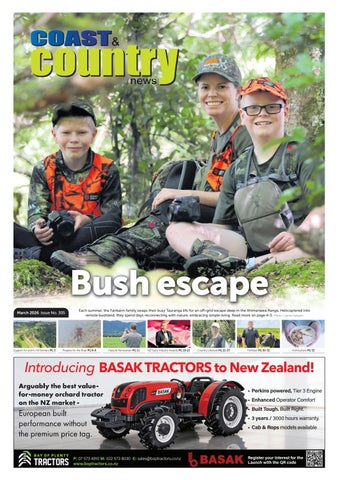
on page 4-5. Photo / Jamie Fairbairn

Love, weather patterns, and a trilby

Who would have thought?

The Hat is a Mr Darcy, a Valentino, a charmer - the deadest romantic.

I k know it because I saw it

A framed wedding photo of Daphne, his w wife of 45 years, sat on his nightstand

Just t her, in her bridal gown and bonnet Simmple, elegant, lovely Gosh - a hat marrried a hat!

I saw it when I went stickybeaking dowwn the hallway one day and sneaaked a voyeuristic glance insidde the inner sanctum: the prinncipal bedchamber

I f found myself wrestling with h the thought of The Hat on bended knee, telling Daphne he loved her and asking her to marry him m Because the word love e never cropped up in the conversations I heard between them

Their conversations were always about cold d fronts sweeping off thhe Antarctic ice, eczema spores, artificial insemination, fly strike, and pasture management subjects that didn’t require holding hands, any sort of public display of affection, let alone utterance of the word love

it had been parked on just one head, uninterrupted, for the last sixteen and a half hours. Did he stand there in homage, in his singllet and d baggy Y-ffronts, still wearing his trilby, before surrendering the hat to the nightstand and Daphne’s image? Did he ever forget to take it off ff when he slunk between the sheets?

There was also a Panasonic transistor radio in a brown leather case on the nightstand, alongside Daphne, his pouch of baccy, and the good book

A man ’ s faith

Although I did sense The Hat getting mildly aroused - excited - at the mention of extreme weather patterns.

The nightstand

Admittedly, Daphne’s portrait was pushed to the back of the nightstand, behind the ubiquitous trilby I wondered if the trilby was the last thing The Hat took off at night. Why did I wonder that? Perhaps because

Yes, The Hat was a m man of faith And everry night, before he rolled over, shoook hands with Daphne, dimmed the lights, and tapped the barommeter, The Hat would thumb through “his” good book and make his picks from the fields for the next day’s race meets His good book was Friday Flash But he never went to the races You have to have a day off work to go to the raceseven on New Year’s Day or Easter Monday “Public holidays!” The Hat would harrumph “The bane of the working man ” And the nearest TAB was 37 miles away “You don’t have to lose money to enjoy gambling,” The Hat offered. “At the end of the week, I just tot up what I would have lost but didn’t. Very satisfying.”

The TAB must hate people like The Hat. I didn’t understand The Hat’s logic. Because the things I enjoyed most were the things I had been warned against.

TAUPŌ
GISBORNE
Hunter Wells

Storm-hit farmers fear they will not qualify for help

While grateful for Government support for weather affected farmers, an industry leader says navigating claims may test those in need.

Recent weather events in the Bay of Plenty, Gisborne/Tairāwhiti, and Canterbury have been classified as a medium scale adverse event

The Ministry for Primary Industries (MPI) classifies adverse events - such as natural disasters, severe weather, and biosecurity incursions - as either localised, medium scale, or large scale

A medium scale adverse event indicates that weather conditions have caused significant impacts but not to the extent of a severe weather event

This classification enables additional support for farmers and growers in the affected regions who continue to face weather related challenges.

“The effects of these weather events continue to be felt in these regions,” Agriculture Minister Todd McClay says He says the announcement unlocks extra support, including tax relief, and enables the Ministry of Social Development (MSD) to consider Rural Assistance Payments and activate Enhanced Taskforce Green for affected farmers and growers These measures aim to assist those impacted by the adverse conditions and help them navigate the challenges they face

“We are obviously appreciative, but the criteria are tight and a lot won ’ t qualify,” says Bay of Plenty Federated Farmers president Brent Mountfort “But every little bit helps ” Running a 270 hectare sheep and beef property near Matata, Mountfort recalls the last time there were so many slips in the Papamoa Hills was 50 years ago

Localised damage

“It was very localised, with the Pāpāmoa Hills and the East Cape the worst hit ” Brent says the Pāpāmoa Hills contain a mix of farms, orchards, and lifestyle blocks “They y are facing g horrific decisions about what they do in the future Some slips have

Jodie says most reports came in a fortnight after the event “They usually run on adrenaline straight after”

Seven staff from Bay of Plenty Rural Support were involved in the January operation Those in need should phone Rural Support on 0800 787 254

She says farmers need a declaration signed off by Rural Support to be eligible for Rural Assistance Payments, which are paid during or after an adverse event to help farmers with essential living costs

gone right through kiwifruit blocks There is genuine hardship up there,” he says “I feel for them ”

He says the storms have emotional as well as financial effects on landowners

“They are asking, ‘Do we want to stay?’ It’s hell for them ”

Brent says the Waioweka Gorge and Cape Runaway were also badly affected He had heard of 140 slips reported in Cape Runaway

“This area is often forgotten ”

He says agencies including MPI, Rural Support, Federated Farmers, Horticulture NZ, and Civil Defence had all been talking before and after the storms

“On farm support from MPI has been a big help ”

Bay of Plenty Rural Support Trust regional co-ordinator Jodie Craig shares Brent’s sentiments

“We are so grateful for the classification, but there is strict criteria to be eligible for Rural Assistance Payments ”

She says the January storms were very different from previous weather events in the Bay of Plenty, affecting pockets across different council areas

“It hit farmers and growers, and there were different factors in different areas ”

Welfare issues

Along with property damage, she says some farms and orchards were isolated, causing welfare issues such as getting children to school or to medical apppointments

“Uncertainty creates anxiety”

Eligibility also depends on how much a farmer earns (excluding farm income) and any money or off farm assets they hold Payments are equivalent to the current rate of the Jobseeker Support benefit at the time of the event and are generally paid as a lump sum covering four weeks Farmers

needing support for longer must reapply every four weeks.

Enhanced Taskforce Green (ETFG) is a regional response to a significant adverse event either weather related or resulting from a natural disaster The Minister for Social Development can approve up to $500,000 plus GST of ETFG funding to assist with clean up activities where required At a regional level, agencies including MPI, the Rural Support Trust, and regional councils first determine whether ETFG is needed and the size and scale of clean up operations

“The MPI has been working closely with local groups to identify the most affected farmers and where support is needed most, including through on farm assessments, ” says Todd

Steve Edwards

BOP family embraces life

For the Fairbairn family holiday means being helicoptered into a remote piece of private land in the Ahimanawa Range, between Taupō and Napier, to live off-grid in the bush for a few days to disconnect from the busy world and decompress in a stunning natural environment.

Jamie and Amie Fairbairn run a busy Tauranga building company, Fairbairn Builders.

“Things go nuts leading up to the Christmas close down when we do our family Christmas and then head off into the bush,” says Jamie.

A love of the wild

Jamie was introduced to hunting and living off grid nearly 30 years ago by his uncles, Bob and Gary Ramsay Amie has joined him for the last 20 years. The couple now share the experience with their children, James (12) and Fletcher (10).

As well as shooting with a rifle, Jamie

WANTED

says

y y g him to take a camera into the bush and shoot photos of what he saw Jamie carries a good Canon camera, and the boys are embracing photography with his older cameras

Uncle Bob is in his late eighties and still spends a considerable amount of time in the bush in the company of family and friends

In 1992, Bob took on a private block in a very remote area. In some parts the nearest road can be a 24-hour walk away.

Nowadays, Jamie is a vital part of the block’s operation. He knows the area “like the back of his hand” and has taken many people in to shoot their first deer and experience their first helicopter ride

Living off grid

“We use a very old school structure built by Bob in 1992 It is a timber frame, tarpaulin covered hut but it’s dry and provides shelter We leave supplies there from visit to visit,” says Jamie

The family are into bush craft and finding hacks to have basic facilities Due to weight and space constraints in the helicopter, they have to travel with essentials only

“There’s definitely a survival element to every day,” says Jamie “There’s no cell phone coverage, no electricity, no emergency services, and best of all no people except us!”

Their toilet is a real toilet positioned

above a long drop hole and gravity fed water from a stream further uphill is piped into the cistern allowing normal flushing

If the weather is fine, they dip in the creek with a bar of soap, or they can boil up some water and add cold water in a 20-litre

container to have a traditional camp shower

Sources of food

Amie enjoys a break from cooking as Jamie likes the opportunity to cook using their gas cooking rings or the camp oven over

The Fairbairn family out for a hunt with their cameras. Photos / Jamie Fairbairn

off f -grid in the holidays

vegetable camp oven meal is legendary

“We don’t often hunt for food in January because the hinds have fawns at their side and the stags are in velvet Also, there’s nowhere to store the meat in the summer heat,” says Jamie

“Our fresh food runs out quite fast, but immersing sealed bags of fresh food in a moving creek keeps things surprisingly cool After that we rely on canned and dried food, and we keep supplies of those topped up at the hut,” says Amie

With no electricity other than LED headlamps run off a small solar panel, and t tired from a day of exploring the bush, the family tends to retire early

g are all about the ambience, listening to the sound of the creek and hearing the morepork calling We sometimes play cards or games, ” says Jamie

Their beds are stretchers or basic bunk beds and warm sleeping bags

“The boys usually build a hut somewhere in the bush o each trip and will often build or mend bridges over the creeks using rocks and sticks, which was a highlight for Fletcher this trip,” says Jamie For James the highlight wa taking photos of a sika fawn

Safety and survival

Jamie may be a highly e experienced bushman but there is no skimping where safety is concerned

letcher Fairbairn nds a cast-off eer antler.

James Fairbairn preparing lunch h while out on a hunt. .

“The bush can be a harsh

Jamie Fairbairn walking into camp on a rainy day

environment, and we all have suitable layers of hunting clothes, light waterproofs, puffer jackets, boots, blaze vests and caps We are also prepared with basic first aid for things like broken limbs or cuts, ” says Jamie They always carry Emergency Position Indicating Radio Beacons (EPIRBs) and have a Garmin InReach device which can be used for texting and sharing your GPS position using the global Iridium satellite network Jamie and Amie are grateful

to share their love of the bush with their boys and see them learn and embrace the slow the pace of life in the remote bush.

“It’s such a pleasure watching them observe and photograph the flora and fauna and appreciate what the bush offers ”

Catherine Fry
Fle fin de
Bush Robin.

A journey to a BOP Regional Council seat

Bay of Plenty Regional Councillor

Sarah van der Boom has had a varied and interesting career in the primary industries sector

A riding accident in 2018 put her into rehabilitation for nearly two years, but she has fought back to regain physical fitness and is now wholeheartedly embracing her regional council role

Raised in an urban environment but always a keen horse rider, Sarah left university with a Bachelor of Horticultural Science, an Honours degree in New Zealand plant ecology, and a Master’s paper in environmental behaviour change

“I was lucky to be selected as a Landcorp Farm Cadet straight out of uni, which led to working with their highcountry grassland group in the South Island,” says Sarah

The self-professed “jack of all trades, master of none ” has worked in production and amenity horticulture, a forestry gang, as a horse groom and trainer, in freshwater and marine biosecurity, driven a milk delivery truck, and spent more than 15 years working in environmental engagement and behaviour change projects.

“I am an accredited PRINZ (Public Relations Institute of New Zealand) practitioner and a qualified IAP2

Happy to be serving the community as a Bay of Plenty Regional Councillor Photos / Supplied

(International Association of Public Participation) facilitator”

She is currently completing a PhD investigating rural environmental issues and how women are experiencing and responding to them

“I’m interviewing women who are living and working in rural Bay of Plenty and Canterbury Rural research has traditionally focused on primary production, but today only 25% of rural residents are involved in primary production, and only 15% of them are directly working in it So, to be representative of contemporary rural society, research also needs to capture the experiences and actions of those outside primary industries ”

A riding accident

Sarah used to run five days a week and was very active in horse riding, skiing, tramping, and mountain biking She has competed in triathlons, marathons, ultramarathons, Ironman, Coast to Coast, adventure racing, cycle touring, and other endurance events

“That lifestyle ended abruptly in May 2018 when I was bucked off a friend’s recently broken-in horse. I flew about seven feet in the air, landed flat on my back, and I couldn’t move my legs.”

A CT scan at Whakatāne Hospital revealed an L1 unstable burst fracture, and she was airlifted to Tauranga Hospital for surgery Her surgeon said her L1 vertebra was so fragmented it was “like cornflakes and oatmeal,” and the fragments were compressing her spinal cord

After a posterior stabilisation procedure, Sarah regained sensation in her feet and legs

“I spent three months in bed lying flat on my back for 23 hours a day My brother, family, friends, and neighbours were amazing My kids, who were 13 and 17 at the time, really stepped up - though it was very hard on them

“Rehab was a long haul Twelve months post-accident, I had another surgery to remove the titanium frame and screws, followed by another six months of rehabilitation ”

Mentally and emotionally, the entire process brought significant challenges and learning experiences The first thing she learned was acceptance, and she chose to cultivate gratitude - treating rehab like a full-time job

“I started walking, swimming, gentle cycling, Pilates, and yoga Seven years post-accident, I run and walk a fourkilometre bush and farm circuit almost every day I still mountain bike and ride horses, but with low risk and low impact, and I occasionally compete in small events ”

Regional councillor

In 2025, Sarah successfully stood for an Eastern Bay seat on the Bay of Plenty Regional Council, believing that her education and varied career meant she was well placed to support rural landowners and managers to improve land, air, and water quality - benefiting both communities and the economy

“More than 90% of the Bay of Plenty

region is rural and under some form of primary production or indigenous forest, so these rural areas are where we will make the biggest gains in environmental quality”

Sarah says the Bay of Plenty Regional Council already has strong incentive and advisory programmes for rural landowners and managers

She would like to see even more resources invested in this work area, alongside the removal of “boulders” that make some environmental improvements difficult

“While rules are needed to achieve bottomline compliance, to achieve improvements beyond the baseline we really need to work in partnership and support mode, regardless of whether the land is iwi, private, council, farms, orchards, or government-owned ”

Sarah believes local government has become a “hungry animal” across New Zealand and wants to contribute to reform that delivers better value for regional and national communities.

“We have to think much longer term about what will be best for the community - and not just this political cycle Reform should be driven by local views on required functions, rather than blinkered options from central government ”

Sarah van der Boom learned acceptance and chose to culture gratitude to get herself through a gruelling rehab.
Sarah van der Boom riding her 24-year-old thoroughbred Boots around Mimiha near Matata.
Sarah had the titanium frame and screws in her back for a year.
Catherine Fry

‘Have a hmmm’ and prepare for

The Roar is a highlight of the big game hunting calendar in New Zealand, with thousands of hunters heading into the hills to hunt male stags during March and April.

To ensure everything goes as planned and you get the most out of your hunt, ‘Have a hmmm’ and think ahead before heading out, says ACC injury prevention leader James Whitaker

Over the past five years, it has cost close to $30 million to support people recovering from hunting injuries in New Zealand.

“It’s easy to get caught up in the excitement of the hunt and push your limits,” says James. “But it’s important to think things through well beforehand to avoid injury”

The NZ Mountain Safety Council (MSC) has developed a free 12week guide to support hunters to get fit, and to plan and prepare effectively for their hunt. James says the approach will help reduce the risk of injury

“It pays to start your fitness preparation

early to ensure you ’ re in top shape for hunting. Put in the groundwork early Start with walking, tramping, and shorter hunting trips. You can start small and build up slowly

“Introduce strength work this could be the weight of your pack or using weights at the gym. ”

Terrain

Hunting during the Roar often involves covering steep and uneven terrain while carrying heavy loads, says James

“Your level of fitness is crucial for both your enjoyment and your safety

“Good fitness reduces your risk of serious injury, improves your endurance, helps keep you mentally sharp, and enables you to get more out of your hunt.”

In 2025, ACC received more than 1800 hunting related injury claims. It cost $6.5 million to support hunters to recover from these injuries and return to work and independence.

Make sure to ‘Have a hmmm’ before heading out to hunt this Roar, says Whitaker

“Many injuries are caused by slips and

trips Y You can prevent these by watching out for uneven ground and tree roots, and by wearing sturdy footwear for support.

“Know your own limits and the abilities of everyone in your hunting party If you ’ re feeling fatigued, take a break and check in with your group Always stick together and make decisions as a group ”

Before you head out, research your hunting area and plan ahead, says James.

MSC’s Plan My Walk app and website allow you to plan your route, build your trip plan, and share it with an emergency contact

“Before you head out, it’s critical that you tell a trusted person where you ’ re going and when you’ll be back, so they can call for help if you ’ re not back on time,” says MSC chief executive Mike Daisley “Plan My Walk makes this step easy ”

Flow-on effects

f footing, a and assess terrain traps to avoid slips, falls, or dangerous detours ”

New Zealand’s weather can be unpredictable, so it pays to be well prepared, says James.

Check the forecast and keep an eye on conditions during the hunt, he says

“When checking the weather, use a forecast that’s specific to the exact area you ’ re heading into, so you know what conditions to expect.

“Checking the forecast for a nearby town won ’ t give you the information you need. Aotearoa New Zealand’s unique topography often causes huge variations in weather”

Injuries don’t just affect the injured person - there are flowon effects for your friends, family, and workmates too, says James

“Remember to ‘Have a hmmm’ - slow down, check your route, watch your

Check your gear before you go and ensure you ’ re carrying the essentials, James says “A rain jacket, warm layers, a warm hat and gloves, emergency shelter, a first aid kit, a head torch, extra food and water, two forms of communication, and a device that makes it easy for people to find you should be the minimum.”

Have a hmmm this Roar

Slow down – this has benefits not only for your safety but also for your hunt

Hunters head out during March and April to hunt stags. Photo / Cam Furlong

your hunt

That extra pause may give you the opportunity to spot the game you ’ re looking for Pay close attention to your route – take in your surroundings and track your movement on a map This can make all the difference when retracing your steps. Watch your footing – be deliberate with your foot placement to help prevent

slips, trips, and falls You’ll also be quieter, making you less likely to scare off game. Stay alert for terrain traps, such as bluffs – assess the landscape before committing to a route to avoid getting into trouble If you end up in a tight spot, pause and consider the safest way out even if it means backtracking.

-ACC

Data on hunting injuries

Between January 1 2021 and December 31 2025, ACC received 8561 hunting related injury claims. These injuries cost $28.8 million to help people recover In 2025, ACC received 1851 hunting related injury claims. It cost $6.5 million to support people to recover from these injuries.

The highest number of claims in 2025 were lodged in April (290), May (197), and March (185).

The regions with the highest number of claims were Waikato (287; $841,382), Canterbury (237; $786,267), Otago (170; $628,998), Bay of Plenty (159; $810,416), and Manawatū Whanganui (158; $725,175).

The highest number of claims were lodged by people aged 50–54 (192 claims) followed by 20–24 year olds (178) and 35–39 year olds (176)

The most common injury types were Soft Tissue Injuries (1,322), Laceration / Puncture / Sting (313), and Fracture / Dislocation (89).

The most common injury sites were the Knee (337), Lower Back / Spine (228) and Shoulder (172).

For more injury prevention tips to suit your lifestyle visit: www.acc.co.nz/preventiontips

Fruit fly discovery leads to biosecurity operation

A biosecurity operation is underway in the Auckland suburb of Papatoetoe following the discovery of a single male Oriental fruit fly in a surveillance trap

Biosecurity New Zealand commissioner north Mike Inglis says the fruit fly was identified on Wednesday, February 25.

“We will be ramping up trapping and inspections in Papatoetoe As a precautionary measure, Biosecurity New Zealand will put in place legal restrictions on the movement of fruit and vegetables out of the area where the fruit fly has been found

“Over the next 24 hours, we will issue details about these controls and the exact areas affected,” he says

In the meantime, it’s important that people who live and work in the suburb do not take any whole fresh fruit and vegetables out of their property

Queensland fruit fly in Mount Roskill, which wrapped up after six weeks of intensive fruit fly trapping and the inspection of more than 230kg of fruit

“The Oriental fruit fly find in Papatoetoe is unrelated to the Queensland fruit fly in Mt Roskill,” Mike says The fruit fly poses no human health risk, but there will be an economic cost to the horticulture industry if it’s allowed to establish here Adult flies lay eggs into fruit, where the maggots feed and cause the fruit to rot

How to identify f the fly

Adult flies are a little larger than a housefly (6mm to 8mm long); have a dark “T” shaped marking on the abdomen (the part behind the waist); usually have a bright yellow and orange abdomen (but can vary); have clear wings The female fly has a pointed “sting” to lay eggs inside fruit (but she can ’ t sting or bite people) The male fruit fly is a similar size but is reddish-brown

Biosecurity’s most recent eradication was a single male

Biosecurity New Zealand says if people who think they’ve found a fruit fly should photograph it, capture it if possible, and call MPI on 0800 80 99 66 -RNZ

Farmers urged to vote for stronger sector future

Around the country New Zealand dairy farmers are coming together to determine whether to continue with the Milksolids Levy

The Milksolids Levy vote occurs just once every six years Introduced in 2003, the Milksolids Levy is a collective investment by farm dairy sector

DairyNZ Chair Tra Brown says the levy vote is a chance to celebrate farmers’ collective investment and the sector’s success

“Continuing with the levy ensures DairyNZ can keep backing farmers with the research, development and advocacy that move our industry forwar By voting, you’re en advocacy, research and tools that contribute to a stronger future for New Zealand dairy,” she says “Working together provides farmers and the sector with greater access to government and international co-funding, sector partnerships, and innovation that would be difficult for individual farmers to achieve alone”

An independent report found DairyNZ’s levy-funded activities created a sevenfold return on investment for farmers in terms of value with benefits coming from productivity gains and costs avoided

An estimated $2 98 billion in value was generated from $341 million levy

ayers have until March 13 to cast r votes, and every te matters, says Tracy

“We do dairy really well here in New Zealand and our products are revered internationally But there is more work to do New hallenges will d fresh ideas, r tools, and the pirit of working at’s always set our sector apart Every vote in favour of the Milksolids Levy contributes to the shared knowledge, tools, and research that keep New Zealand dairy farms ahead,” she says

This collective investment approach has paid off for farmers

“Farmers have always worked best when we work together Now is your chance to continue making progress by backing initiatives that strengthen every farm, today and tomorrow Let’s vote – together, and make it count”

DairyNZ research in action: miti ti h t t

New DairyNZ research aims to help farmers mitigate the impacts of heat stress on herds in high-risk regions of the country.

DairyNZ scientists are in the final stages of an on-farm trial at DairyNZ’s Scott Farm in the Waikato to test common mitigation measures and assess their return on investment.

According to DairyNZ senior science manager Kirsty Verhoek, heat stress is an increasing challenge for pasture-based dairy systems, particularly in regions experiencing more frequent hot,

radiant, and still conditions.

“Through previous research and farmer engagement, we have heard clearly that farmers want practical, evidence-based solutions to help protect cow welfare, maintain milk production, and support long-term farm resilience,” she says

“However, many heat stress mitigation measures require investment and farmers have told us they need confidence that tools will work under New Zealand’s grazing conditions and deliver value on farm. This research programme has therefore been shaped alongside farmers, focusing on understanding where and when heat stress occurs, how cows

respond, and which mitigation measures are both effective and practical within real farm systems ”

Animal care

It is the latest piece of animal care research in DairyNZ’s ‘Comfortable Cows Outdoors’ project. To date, the three-year programme has mapped regions that are at higher risk of high temperatures, solar radiation, and wind; analysed datasets linking weather and milk yield; assessed how cows use shade; and completed a comprehensive survey of 350+ farmers in Waikato, Bay of Plenty, Canterbury and North Otago understanding awareness,

TREE CONTROL

tigating heat stress

attitudes and practices related to heat stress in dairy cows.

Scott Farm is in the final stages of a heat stress trial where five mobs of cows have been fitted with rumen temperature boluses, pedometers, and wearable technology all providing realtime data, to test the impact of various mitigation measures.

“We have a mob that’s gone once-a-day through the summer to avoid the afternoon walk to the milking shed, a second mob spending their daytime in a shaded area, a third mob that goes under misters in the yard cooling the environment around the cows while waiting for milking, a fourth mob that while waiting in the milking yard goes under a sprinkler where droplets saturate the coat (evaporative cooling); and a fifth (control) mob with no mitigations at all,” says DairyNZ scientist Charlotte Reed

Trial

A group of Waikato farmers recently got to see the trial in action during a workshop

at Scott Farm. Many of the farmers who attended have been actively involved in DairyNZ’s heat stress research to date and were able to share valuable feedback on the practicality and fit of different mitigations on farm.

“The workshop also provided an opportunity for farmers to see how their input has directly helped shape the research questions, trial design, and future direction of the programme, while getting an update on current progress. Our goal with testing this range of options is not to say, ‘this is what you should put in place’, but to provide information around a range of different strategies – a toolbox of options,” says Charlotte.

“A goal of the project is to better define how cows respond to heat load With the volatile weather experienced this summer, we ’ ve ended up with a comprehensive dataset that spans from cooler, wet days all the way to hot sunny days, which is very valuable.”

-Content supplied by

Dairy NZ
Cows in mist.
Photo / Supplied

AI steps into the paddock

For generatiions, f farmers h have wallked d paddocks armed with plate meters, spreadsheets, and a healthy dose of instinct.

Estimating pasture quality has long been a balancing act between rough measurement and educated guesswork, with laboratory testing offering depth but little speed—or affordability

Now, a new app is shifting that equation. Pasture Ai uses nothing more than a farmer’s smartphone camera and artificial intelligence to deliver instant insights into pasture quantity and quality By analysing a photo, the app estimates pasture cover, dry matter percentage, crude protein, metabolisable energy (MJME), and neutral detergent fibre (NDF) in seconds.

The appeal lies in its simplicity There are no meters to buy, no calibration curves to manage, and no spreadsheets to reconcile at the kitchen table. Instead, Pasture Ai promises “nutritionist-level” information directly from the paddock—without needing one on speed dial

T Techhnollogy rolllout

Extensively tested across a wide range of pasture types, the technology is now rolling out across New Zealand. While its initial focus is on dairy and intensive beef systems, the platform has broader potential for any pasture-based operation looking to improve feed utilisation.

The benefits are practical and immediate: more accurate feed allocation, reduced wastage, improved animal performance, and better optimisation of both pasture and supplements. A builtin feed calculator, driven primarily by MJME, and an AI Assistant help farmers translate data into day to day decisions. With feed costs rising and climate variability adding pressure, tools that turn better information into better outcomes are gaining momentum Pasture Ai is available now on iOS and Android, allowing farmers to trial the app alongside their existing measurement methods and see how artificial intelligence might earn its place in the paddock.

For more information, see their advert on this page.

A stormy summer may have disrupted holidays, but dairy farmers are now looking toward what could be a strong autumn.

DairyNZ farm systems specialist Aleisha Broomfield says March 1 is a pivotal date in the dairying calendar, marking the point where spring calving farmers - having completed 75-80% of their season ’ s production - should shift focus to preparing cows and farms for the new season.

Effective autumn management starts with understanding the farm’s current position, Aleisha says Farmers should assess average pasture cover (APC), round length, supplementary feed on hand, and individual herd body condition scores (BCS) From there, set calving targets: APC levels and BCS of 5.0 for mature cows and 5.5 for first and second calvers remain essential benchmarks

DairyNZ provides a wide range of autumn planning resources, including feed budgets, pasture road maps, BCS guides and pasture renewal information Aleisha encourages farmers to get out on farm with a Plate meter to evaluate pasture performance and identify paddocks requiring renewal Autumn can also be a great opportunity to teach team members how to plate walk and interpret results

She suggests making pasture assessment practical and even enjoyable for the team - for example, estimating the volume of grass or maize silage in stacks, and deciding what to use in autumn versus what to preserve for a potentially wet winter and spring

Round lengths, typically 30–36 days in summer, may need adjusting Many spring and autumn farms are lengthening rounds due to abundant grass, and winter rounds of 80–100 days are often a sound approach. A useful tool is the reverse spring rotation planner, which slowly increases area through autumn while monitoring APC with frequent pasture assessments.

Attention should also turn to the “superstars”: dairy cows Key considerations include BCS, calving dates and the number of days available for cows to reach their BCS targets. Early March is likewise an ideal time to check rising two year old heifers to ensure they are tracking toward live weight and BCS goals. This information feeds directly into constructing an accurate feed budget, which can help determine whether dryoff dates need adjusting.

Broomfield notes that although farmers are entering autumn with higher-thanusual pasture covers, compensatory autumn growth may be limited, and nitrogen reserves may be lower after strong summer growth.

Agricom’s Cassey Edgcombe reinforces that good planning is essential. Paddocks may look green but could hide open pastures once summer grasses and weeds disappear Using DairyNZ’s pasture scoring tool helps identify these gaps Cassey recommends starting now, tackling underlying issues, and considering under sowing with Italians or hybrids such as Manta AR128 and Mohaka AR128 to boost winter and spring feed, supported by strong endophytes for persistency

Steve Edwards

A farmer using the app in one of his fields Photo / Supplied

Young kiwifruit farmer recognised at 2025 HortNZ awards

Katikati orchardist Daniel Kenna has been awarded the 2025 Horticulture New Zealand President’s Trophy, recognising his leadership and contribution to the kiwifruit industry

The KW Kiwi Orchard Manager and Sustainability Lead was caught completely by surprise when his name was announced at the HortNZ Awards night, having attended only because he and his wife, Josephine, won their tickets in a radio competition.

“I had no idea I was even up for it, and I still don’t know who nominated me, but I am very proud to have won, ” says Daniel

Childhood in the orchard

Daniel and his two brothers, William and James, grew up on the KW Kiwi kiwifruit orchard, which was established by their parents, Stephen Kenna and Phillipa Wright, in the 1980s

“As a child, there wasn ’ t a time when I wasn ’ t involved in the seasonality of orchard work - it was just a way of life.”

Although Daniel always knew he would return to the orchard, he attended the University of Canterbury, completing a BSc in Geology He then spent time working in construction and worked as an abseiler stabilising slopes after the Kaikōura earthquake.

“I started full time on the orchard in 2019 Both my brothers have made their way back, and we work together with our parents We’re proud that the orchard has always been family-run and

will be safe in the hands of the next generation.”

Between them, the family holds decades of horticultural knowledge, combined with scientific grounding, a passion for sustainability, and a willingness to embrace new ideas and technology while continually learning and adapting

Industry

initiatives

Daniel has made a strong impact in a relatively short time since beginning his career in the horticultural sector

He has become a leader in research, community engagement, and innovation, and is passionate about the environmental and economic sustainability of New Zealand’s horticultural industry

“Previously I had participated in the Young Grower of the Year competition. I really enjoyed the experience, and it gave me the confidence to put my hand up for small governance roles within the sector ”

Most recently, his leadership has included establishing the Impact Orchard Network (ION) in partnership with Zespri, with the family orchard among the first participants

The programme is designed to develop, improve, and demonstrate sustainable, effective orchard practices Its goal is to enhance sustainability and transparency while maintaining or improving productivity across the kiwifruit industry

ION will support three orchards to share their insights with the wider industry highlighting what works well, what could be improved, and how they intend to create positive economic

and environmental change as they grow into the future

“The family enjoys sharing insights and knowledge - from technology to our own experiences - to bring people in the industry together”

Daniel is also part of an industry sub-group for Climate Change and Sustainability, where industry perspectives come together to navigate changing growing conditions and evolving customer expectations

“In this sub-group, I enjoy contributing to the challenge of meeting the continually evolving expectations of the international market ”

Governance roles

Daniel has stepped into governance as a Co-chair on the board of Future Farmers, an agricultural policy think tank.

“Future Farmers’ ‘Statement of Hope’ states that we stand at a pivotal moment for New Zealand’s food and fibre sector, which presents not just challenges but a chance to lead the world in the future of sustainable, high-value food production.

“Future Farmers believes the sector can collectively evolve again—embracing and

shaping the future.”

He also leads sustainability research for horticulture in New Zealand and globally He is part of a world-first research trial, involving several growers, exploring the impact of applying biochar to soil in a kiwifruit orchard.

This research sets the baseline for carbon removal in kiwifruit orchards and aims to provide solutions to carbon challenges in the horticulture sector

Daniel has also managed KW Kiwi’s crop estimation trial for Zespri, which provides an annual fruit count estimate to the industry

Moving forward, he is committed to continuing with the family business while growing and challenging himself

“I believe in surrounding myself with people who are more experienced than me, and listening and learning from the current guard. It takes their knowledge, combined with new technology and ideas, to steer the industry forward.”

Daniel also believes there is no better grounding than rural life and the seasonality of growing food, and he and Josephine are committed to raising their family rurally

Daniel Kenna on stage after winning the President’s Trophy at the 2025 Horticulture New Zealand Awards. Photo / Supplied
Catherine Fry

Kiwifruit crop still on track for record 221m trays

While kiwifruit orchards were battered in summer storms, a bumper season is still predicted.

New Zealand Kiwifruit Growers

Incorporated chief executive Colin Bond says despite periods of rough weather across New Zealand’s kiwifruit regions, overall crops have been given a reasonable opportunity to grow and are forecast to reach a new record production of just over 221 million trays of kiwifruit.

This volume is slightly more than last season ’ s record-breaking crop of almost 217 million trays. On average, each tray has around 30 pieces of kiwifruit.

“The loss of life from January’s severe weather in the Bay of Plenty has been devastating for all those impacted, and our thoughts are first with the families, whānau and communities affected,”

Colin says

“Against this backdrop, there have also been impacts on the kiwifruit industry which are still unfolding.”

He says these weather effects have been highly localised, with low-lying orchards mostly exposed.

“Slips and surface flooding have been the primary issues for orchards, although road access and logistics have been potentially greater challenges for some growers, particularly as harvest draws nearer for them.”

Colin says growers from Northland to the top of the South Island experienced issues with wind, rain and hail throughout the season and will be relieved to get their fruit off the vines.

While NZKGI, the wider industry, and

its partners are supporting growers who were affected by surface flooding and slips, he says the total number affected is relatively small and will not have a significant impact on this year ’ s production Growers as well as the local communities across New Zealand which profit from the success of New Zealand’s kiwifruit industry will breathe a collective sigh of relief when the fruit comes off the vines, says Colin.

Export earner

Kiwifruit is New Zealand’s largest horticultural export and in 2024/25, contributed some $3bn to the regions where it is grown.

Colin says strong demand means the New Zealand kiwifruit industry is experiencing rapid growth with sales expected to jump from $4.9 billion (211.6 million trays) in 2026 to $6.2 billion (239.7 million trays) in 2030

New Zealand’s kiwifruit industry is horticulture’s largest export with more than 2800 kiwifruit growers ’ orchards located from Kerikeri to Motueka.

The Bay of Plenty region again led the way in grower returns (orchard gate return) through 2024-2025, with Te Puke topping the list at $698m.

Next up was Tauranga with $320m, Katikati $285m, Ōpōtiki $261m, Pukehina

$212m, Paengaroa $194m, Whakatāne $176m, Maniatutu $156m, Maketū

$124m, Waikato $100m and Waihi $34m

Kiwifruit marketer Zespri’s sweet, berry-tinged tasting RubyRed is the first variety picked for supermarket shelves in New Zealand and some overseas markets,

followed shortly after by the Gold and Green varieties

The harvest traditionally peaks in midApril and runs through until June.

Zespri chief executive Jason Te Brake says it’s exciting to see the 2026/27 harvest getting underway, with growers positive about how fruit is looking.

“We’ve started 2026 on the back of Zespri’s largest ever crop and strong global demand

“With another large crop of Zespri Green, SunGold and RubyRed Kiwifruit to deliver to our 50 markets around the world, our focus will be on fruit quality through a smooth, consistent harvest as that’s key to maximising value,” says Jason.

Strong season

“Our customers and teams in market are coming off a strong Northern Hemisphere season which sets us up well for the New Zealand season, with our markets looking forward to receiving New Zealand-grown fruit and sales getting underway in the coming months ”

Zespri also recently released its final forecast for the 2025/26 season, with forecast per hectare returns at record levels

for all fruit categories.

Jason says forecast per tray returns have increased from the November forecast for Zespri Green, Organic Green and Organic SunGold, with returns exceeding the top end of the November ranges

Zespri SunGold, Sweet Green and RubyRed forecast per tray returns remain in line with the November forecast.

He says strong global demand has allowed Zespri to sell a record crop of around 215 million trays at strong value for growers

“The forecast reflects strong sales in Europe and North America this season, along with a more positive finish in Asia following earlier season challenges.

“Our Northern Hemisphere supply season is also performing well, helping maintain shelf space and keep the Zespri brand in front of customers year-round.

“With volumes up 27%, our sales window will extend through to mid-March, around a month longer than last season and with new season New Zealand fruit expected to arrive in market from mid-April, we ’ re moving closer to closing the supply gap ”

Zespri’s final season results will be published in May

New Zealand Kiwifruit Growers Incorporated (NZKGI) CEO Colin Bond. Photo / Supplied
Zespri chief executive Jason Te Brake Photo / Jamie Troughton/Dscribe Media

Two of the Far North’s leading Ahuwhenua Trusts have formalised a partnership at Ngawha Innovation Park, marking what they say is a new chapter in Māori-led economic and community development

The agreement between the OmapereRangihamama Trust (ORT) and the Oromahoe Trust signalled a commitment to work together across existing farming operations and new horticulture ventures

ORT general manager Stewart Otene says the MoU formalises a shared intention rather than creating something entirely new

“In practical terms, it’s about collaboration By working together, we can share expertise and capacity, achieve economies of scale, exchange knowledge and present a strong, unified advocacy voice

“Rather than operating in isolation, we are combining our strengths for the collective benefit of our whenua and people ”

Both trusts already operate sheep, beef, dairy and forestry businesses A joint horticulture development, potentially focused on kiwifruit, has emerged as a natural next step

Stewart says the timing reflects opportunity

“This partnership allows us to enhance those existing operations while stepping confidently into high-value horticulture in a measured and strategic way ”

“There are long standing whakapapa connections between the two Trusts, with shared tūpuna and whānau ties to the whenua that go back generations The MoU simply gives contemporary expression to relationships that have existed from time immemorial ”

The first focus will be a joint horticulture development opportunity, specifically exploring a kiwifruit venture

“This project represents both economic diversification and a practical step toward creating skilled employment and sustainable returns for our beneficiaries ”

He says success will be measured by a thriving diversification business delivering strong returns alongside our existing operations

“It will mean meaningful economic contribution to the region, demonstrated leadership, and tangible benefits flowing back to our whānau, hapū and wider communities Ultimately, success is when our people can see, feel and participate in the prosperity generated from their whenua ”

Yolisa Tswanya
The Omapere-Rangihamama and Oromahoe Trusts have signed a new MoU aimed to expand into high-value kiwifruit horticulture. Photo / Supplied / NZME

DMS says yes to avocados

At DMS, the love of avocados is more than just a taste preferenceit’s a passion.

“I personally love avocados,” says avocado manager Hamish McKain “They look great and taste fantastic ” And at DMS, that appreciation goes well beyond the lunchroom For 36 years, the company has been packing premium avocados and kiwifruit for export and local markets, building a reputation for quality, care, and consistency

Over the past three years, DMS has made significant

investments in its avocado packing operation. A stateof-the-art bin tip, advanced fruit in-feed systems, and water-blaster technology ensure fruit is handled gently and efficiently from the moment it arrives. The addition of camera-grading technology (Invision), alongside ongoing staff training and high-quality packing equipment, reflects a clear commitment to protecting growers ’ fruit and delivering top-quality produce to every market.

Behind the technology is a team deeply committed to the industry The DMS avocado division includes five dedicated

Grower Service Representatives and an Avogreen pestmonitoring team Collectively, they bring more than 50 years ’ experience in avocados and over 75 years in post-harvest and horticulture. But it’s not just experience that sets them apart - it’s attitude.

Getting stuck in

The DMS team isn’t afraid to roll up their sleeves and get stuck in. Whether it’s picking, planting, driving tractors, or helping to coordinate logistics, they work alongside growers to support orchards in a practical, hands-on way

“We understand that no two orchards are the same, ” says Hamish. “There’s always more than one way to get the job done.” Recognising that every property - and every groweroperates differently is central to the DMS approach. Just as importantly, the team values strong personal relationships, knowing that finding the right fit between grower and representative is key to longterm success

The 2025/26 season is now drawing to a close, with local market harvests wrapping up DMS packed more than 260,000 Class 1 export trays

for AVOCO, completing export volumes at the end of January For the local market, the team packed just shy of 200,000 trays across Class 2 and 3 fruit.

Resilience

Like any season, it brought both challenges and achievements. One of the most significant events was the severe wind storm in September 2025, which caused widespread damage across many orchards In the aftermath, the industry’s resilience shone through. Growers and teams rallied, supported one another,

reworked plans, and pushed ahead.

For DMS, the response embodied one of its core values: “Together we Achieve ” It was heart-warming to see everyone come together “We work with a great bunch of growers, and that fuels our drive to do what we do every day”

As the company looks ahead to the next season, DMS is inviting growers who share that same passion for quality and collaboration to join them. If you ’ re interested in becoming part of the DMS family, the team would love to hear from you.

DMS’s custom-built water-blaster feeding the grading and packing line.
Photos / David Hall
The DMS team gett t ing stuck in during avo season. Photos / Supplied

Avocado growers navigate a tougher but resilient season

In the face of a stormy spring and summer, the national avocado harvest was only slightly down on the previous 12 months

New Zealand Avocado chief executive Brad Siebert says the 2025–26 season has showcased the industry’s resilience, adaptability, and ambition.

Brad says the 2025–26 export season has concluded with total shipments of 3.445 million trays, including nearly 150,000 trays of classes 2 and 3.

“Despite multiple wind events and tight market windows, this represents only a nine per cent decrease on last season ’ s export volume,” he says.

Australia again took the largest share at 750,000 trays, accounting for 22% of total exports, while Korea reached 625,000 trays - a 70% increase on last year ’ s volume.

With less fruit shipped to Australia, Brad says several other markets absorbed significantly more volume.

Potential United States tariffs remain something of an unknown factor

Brad says while any tariffs on exports to the US are not ideal, New Zealand remains on a relatively even playing field with other producing countries subject to similar tariff levels.

Export markets

Brad says newer markets, such as the United States, received 43,000 trayslower than early-season estimates due to a narrow supply window created by extended South American supply

“China, Hong Kong and India all nearly doubled their previous year ’ s shipments, while Taiwan increased by 50%, where New Zealand continues to benefit from a period of seasonal exclusivity

“These gains across Asia reinforce the importance of strong and consistent importer relationships ”

However, there remains strong ambition to grow volume into the US, which continues to be the world’s largest importer and commercial market for traded avocados.

Canada met expectations with 283,000 trays, making it the industry’s fourthlargest volume market outside Australia for 2025.

From a whole-ofindustry perspective, class 1 pack-out averaged 52%, up from 48%, with average fruit size at 24 across both export and domestic programmes

Brad says fruit quality outcomes have been generally positive - extreme wind events notwithstanding - and reflect improved growing conditions and supply chain management that has maintained fruit performance.

The focus now shifts to the 2026–27 export season, with efforts to retain key trade relationships again depending on fruit quality and continued profiling of New Zealand supply in international markets as the sector builds on this year ’ s momentum

A new factor in the equation is New Zealand’s free trade agreement (FTA) with India

Brad says exports have been sent to India for the past 10 years despite being subject to tariffs.

Volumes have remained relatively modest, as market access typically relies on air freight at such long distances

He says the avocado industry worked closely with both the Ministry of Foreign Affairs and Trade (MFAT) and Indian officials during FTA negotiations,

resulting in avocados being included among the products scheduled for tariff elimination over time.

“While New Zealand avocado exports to India are already increasing, once the FTA comes into force we expect further growth in volumes as returns improve - although logistics will remain the key challenge in accessing this significant market.”

Domestic market

From here on out, the domestic market will receive dedicated supply, with 2.531 million trays supplied so far Brad says now is an “especially good time” to enjoy avocados.

“They’re ripening quickly and reaching peak quality, offering a rich, buttery texture consumers won ’ t want to miss. continued...

The 2025–26 avocado export season has concluded with total shipments of 3.445 million trays, including nearly 150,000 trays of classes 2 and 3. Photo / Getty Images
New Zealand Avocado CEO Brad Siebert. Photo / Supplied

The Super Bowl’s super-ssized, super-food

On February 8, 2026, at Levi’s Stadium in Santa Clara, California, the Seahawks beat the Patriots

Even for people who don’t follow American football, many still tune in for the half time show and the commercials because, let’s face it, it’s all pretty entertaining.

Super Bowl.

If you don’t live in the U.S., however, you may not know that a staple of Super Bowl gatherings is the avocado - with many joking that Super Sunday is actually “Guac Sunday”

In the U.S., the avocado industry actively connects with the Super Bowl, and it all began in 2015 when an avocado brand became the first fresh produce company to purchase Super Bowl ad time Since then, the brand has leaned into interactive digital campaigns tied to the game - for example, offering AI tools that provide football predictions and guacamole or seven-layer dip recipe ideas during Super Bowl week

In the lead-up to the big game, hundreds of millions of pounds of avocados are shipped to the U.S. because demand spikes so dramatically Last year, approximately 250 million avocados crossed the border from Mexico for Super Bowl consumption. The Super Bowl is no longer just about the game; it has become a celebration of rituals, socialising, food, and culture.

Super Bowl success

There are some very practical lessons the New Zealand avocado industry could borrow from avocado’s success with the

...continued

“New Zealand-grown avocados are a delicious and nutritious addition to any meal.”

Brad says local consumers can consistently access high-quality avocados, supporting demand throughout the peak season and beyond.

“By providing for domestic distribution alongside export commitments, the industry is working to maintain a balanced approach, ensuring reliable availability for retailers and food service providers across New Zealand ”

Ensuring consistent domestic supply to increase consumption remains a key part of the industry’s broader strategy

The focus on domestic supply reflects a recognition of the importance of the home market - particularly in years when export conditions present uncertainties. Autumn is a key time for growers to

First, shift from selling “health” to selling “lifestyle and social value.” New Zealand avocados are often marketed around nutrition and export quality - which matters - but that emotional layer is what makes a fresh product feel like a brand rather than a commodity

Second, could we ‘ own ’ an occasion? Avocados in the U.S. became synonymous with the Super Bowl because the industry aligned itself with a cultural moment people already cared about For New Zealand, that could be the summer BBQ season, Labour Weekend, or a major sporting event like the Rugby World Cup Third, align the whole supply chain behind the moment. The Super Bowl success worked because marketing efforts (ads, retail displays, pricing, etc.) and supply timing were coordinated. If the New Zealand industry chose a defined ‘avocado moment, ’ growers, packhouses, exporters, and retailers could synchronise operations and messaging to help drive the movement; everyone benefits from increased avocado sales

Finally, could we embrace an “avocado personality”? Produce marketing often plays it safe, but humour, bold visuals, and relevant storytelling are what helped avocados become fun and memorable overseas. New Zealand has a strong identity - clean and green, with unrivalled scenery in its growing regions - but there’s room to add a little more “something-something” so avocados feel like part of contemporary Kiwi life, not just a healthy ingredient. For now, if you want to try that seven-layer

gather information and plan for the season ahead. Setting trees up for success in spring can involve pruning and reviewing fertiliser plans

Brad says early crop estimates are beginning to build a picture for next season, with initial indications suggesting higher volumes are expected in the 2026–27 season

New Zealand has been exporting avocados for more than 45 years and now has access to more than 80 international markets - more than any other avocadoproducing nation.

While producing just two per cent of global supply, New Zealand is the ninthlargest international avocado exporter

There are more than 4500 hectares of avocado trees planted in New Zealand, primarily in the Bay of Plenty and Northland Steve Edwards

dip (highly recommmended) this side of the Pacific, order delicious New Zealand avocados through h BayFarms and get them deliivered straight to your door If you ’ re after deals or recipe ideas, follow them on your socials

Maybe we could start the NZ-eight-layer d dip and the slogan “If it ain’t eight, it ain’t great”… Thoughts?

In the lead up to the annual Super Bowl, hundreds of millions of avocados are shipped to the U.S. Photo / Supplied

Farming Like Grandad back for Easter

A beloved Eastern Bay tradition is gearing up for another big year, as preparations begin for the 2026 “Farming Like Grandad” country fair, an event born nearly a decade ago from the Waterwheel Historic Trust’s mission to preserve the region’s disappearing industrial and rural heritage

What started in 2017 as a fundraising idea between trust cochairs Stephanie Johnson and John Galbraith, and Clydesdale owner Glen Sutton, has since grown into one of the area ’ s most anticipated family events, celebrating the skills, machinery and way of life that shaped early settler farming communities

“Trust members, with like-minded organisations, were supplied land to hold the event by local farmer Mike Van Beek,” says Stephanie

After successful events from 2017-2020, a 2021 Covid cancellation and a January 2022 flood cancellation, the event was moved to the Easter school holidays at the racecourse on Grieve Rd, Te Teko

It will be held again at the racecourse on Saturday, April 18, from 10am to 4pm

The

Liz Voorend p 027 755 6501 e farmsafety@wfssconz workablefarmsafetyconz

LOWEST PRICE

The ONLY Health & Safety company that:

Bringsthefarmuptocompliance standard

Organiseshazardoussubstances, safetydatasheets,inventory&plan

Provideeasytousetemplates

Provideonthefarmfollow-upservices

Visitors will be treated to an extensive display of vintage tractors, cars and machinery and their enthusiastic owners who have lovingly restored them to working order

Modern machinery will be on hand for comparison.

To showcase the skills of the past, there will be craft stalls and demonstrations with hands-on activities

The axemen and women competition highlights how fit our forebears were to achieve what we take for granted, manually cutting wood for building and fires

The sheep shearers demonstrate their skills using a 100-year-old shearing plant

“For the children, we have pumpkin lantern, potato figure and sand art competitions, an animal petting area, a gymkhana and old-style kids’ games and

races, ” says Stephanie.

The Clydesdales, the gentle giants that worked tirelessly in the fields during the early settler days, are always popular and give rides in the vintage wagons from the Waterwheel Historic Trust’s collection

“We aim to have something to interest everyone There’s a produce competition, Best Dressed Scarecrow competition, Steam Punk displays, line dancing, live music and food trucks ”

In true country fair style, the Whakatāne Scottish Pipe Band will lead

the Grand Parade

“We rely heavily on volunteers to make Farming Like Grandad happen,” says Stephanie. “Volunteers man the gates, direct parking and traffic management

“It’s a big effort bringing this event together, but it’s worth it seeing the enjoyment and interest it offers It also raises much-needed funds for the Waterwheel Historic Trust so we can continue saving and restoring vintage machinery and objects to preserve our rural history” Catherine Fry

A vintage line-up of tractors. Photos / Waverley Klein Ovink
Left: The vintage machinery is always fascinating to young and old
Below:
vintage wagon rides with Bruce Fowler and his Clydesdales are always popular.

From sharemilking to ownership

For the three couples awarded a million-dollar boost towards farm ownership, the past year hasn’t been about rushing into the market, but instead about making full use of the expertise that came with their Fonterra & ASB First Farm Award prize package

Cam and Marg Bierre, Tash and Reece Cox, and Braden and Brigitte

Barnes each received up to $1 million of ASB Business Term Lending, fixed at 1% per annum for three years. They also received a $20,000 Farm Source account credit, as well as mentoring and support

“Over the years, we ’ ve put our heart and soul into a few properties and watched them improve,” says Cam

“Now we’d like our own bit of dirt It was always my dream to own a farm, but how to make that dream a reality

was something I couldn’t see early on ”

“This award has been a massive help on our journey,” says Reece. “It’s something to be very proud of Farm ownership is now more of a reality, because having people supporting us makes us more focused ”

“As part of ASB’s mission to accelerate progress for all New Zealanders, we launched this award last year to help remove barriers for the next generation of farm owners and to showcase what’s

possible in the sector, ” says ASB rural general manager Aidan Gent “Our winners get expert advice and access to funding to kick-start their journey, and it’s heart warming to see the progress they’ve made We remain committed to backing the future of New Zealand’s food and fibre sector ”

Entries for the 2026 Fonterra & ASB First Farm Award close on March 9

For more information, go to www dairyindustryawards co nz

2025 Fonterra & ASB First Farm Award winners: Cam and Marg Bierre, Tash and Reece Cox, and Braden and Brigitte Barnes.

Awards set to supercharge the

This year ’ s New Zealand Dairy Industry Awards are shaping up to be a cracker.

Robin Congdon, NZDIA general manager, says entries are tracking well and there is strong industry support from sponsors.

The 2026 programme will see the continuation of two awards introduced at last year ’ s event – First Farm and Alumni of the Year – alongside the ongoing Responsible Dairying Award

Robin says these awards give winners a financial advantage in their farm ownership journey

“They extend the scope of the NZDIA programme from supporting dairy trainees right through to the people purchasing farms and becoming part of the sector ’ s succession story ”

He says the continuation of these two awards is significant to the NZDIA programme, providing clear and valuable pathways for progression

within the industry

“NZDIA’s mission is to support and celebrate excellence in the New Zealand dairy industry, and these awards strengthen our ability to recognise excellence at all stages of people’s dairy careers. ”

ON SITE WORKING WITH YOU

We SPECIALISE in:

New Dairy plant installation

Existing Dairy plant maintenance

Licensed NZMPTA Milking Machine Testers

Dairy Effluent Systems design, installation & maintenance

Water & Pumping Systems design, installation & maintenance

Milking & Water Systems Ltd

11 Te Tahi Street Whakatane - Ph 07 307 0704

Contact: Innes Richardson - Ph 027 312 5082

Email:

The ASB Alumni of the Year Award is a collaboration between ASB and NZDIA to encourage and reward NZDIA alumni who have made significant contributions to the programme and the industry

The award is open to NZDIA alumni who have been entrants in the past seven years and are no longer eligible to enter the Dairy Manager of the Year or Share Farmer of the Year categories, are not yet ready to purchase their first farm, or already own one

Award criteria

Entrants must be former NZDIA award winners no longer eligible for SFOTY, or participants who may have progressed to farm ownership or have more than 50% equity in a farm business

Entrants are judged by representatives from ASB and NZDIA, with the winner

receiving up to $1 million of ASB Business Term Lending fixed at one per cent per annum for three years

The Fonterra & ASB First Farm Award (FFA) is a collaboration between ASB, Fonterra and the NZDIA Trust

Robin says the award aims to help the best in the industry successfully transition into farm ownership, ensuring strong succession and a sustainable future for the dairy sector

“It provides financial and strategic support to help the best in the industry successfully launch into farm ownership ”

Entrants must have participated in the Share Farmer of the Year category or be past Dairy Manager of the Year entrants ready to buy their first farm

There will be three FFA winners, each receiving up

Specialist Farm Accountants; helping farmers make sense of the numbers

Want help making sense of yours?

Give us a call for a free second opinion

New Zealand Dairy Industry Awards’ general manager Robin Congdon. Photo / Supplied

next generation of farm owners

to $1 million of ASB Business Term

Lending fixed at one per cent per annum for three years, along with a Fonterra launch package that includes $20,000 of Farm Source account credit to drive productivity and sustainability, mentoring, and additional support to help them transition into ownership

Steve and Amy Gillies won the 2025 Alumni of the Year Award, while fellow Waikato representatives Cameron and Margaret Bierre were equal winners of the First Farm Award, alongside Reece and Natasha Cox from the Central Plateau.

Future benefits

Robin Congdon says the First Farm and Alumni awards are another excellent reason to encourage young dairy farmers to enter the Dairy Trainee, Dairy Manager,

and Share Farmer categories, as the opportunities and value of being an alumni member continue to give back over time

The New Zealand Dairy Industry Awards are now in their 37th year

Robin says the awards continue to shine a light on positive sustainability stories in the dairy sector while showcasing pathway opportunities for future generations entering farm ownership and succession

“Together with the Fonterra Responsible Dairying Award, the New Zealand Dairy Industry Awards recognise leading farmers in the dairy sector, playing a key role in showcasing excellence, identifying role models and best practice, and lifting overall standards ”

He says the prize package continues to heat up across all categories, with LIC adding an impressive GeneMark

Genomics prize this year for the national winner of the LIC Animal Wellbeing Recording and Productivity Award

Power Farming has also come onboard as a new national sponsor and is giving away a brand-new Kioti HX 130–140hp tractor for a full year to the runner-up of the National Share Farmer of the Year

The Ministry for Primary Industries (MPI) is joining as one of several new allregion sponsors. It will present the Dairy Manager of the Year MPI Sustainable Farming – Environment Award at each of the 11 regional award ceremonies. Regional winners will compete for the national titles at a gala dinner at the Energy Events Centre in Rotorua on May 9, where the First Farm and Alumni awards will also be presented Steve Edwards

2025’s NZ Dairy Industry Awards’ Share Farmers of the Year: Anthony and Danelle Kiff (Central Plateau), Thomas and Fiona Langford (Waikato), and Natalie and Andrew Meier (Bay of Plenty). Photos / Supplied

Explore New Zeealand’s s remote landscapes

NZ Adventures is gearing up for another busy season as interest surges in its High Country Heritage tour, one of the company ’ s longest running and most popular South Island experiences.

The tour operator, known for its extensive range of guided four wheel drive journeys, continues to attract travellers seeking remote landscapes accessible only by capable 4WD vehicles with low range transmission and quality all terrain tyres.

The High Country Heritage tour traces a pioneering route along the eastern alpine foothills, travelling from Blenheim to Cardrona.

First introduced in the late 1990s, the six day itinerary remains a favourite for those wanting to explore high country stations,

conservation land and seldom visited inland valleys

Tours run annually in November, February and April, with overnight stops in Hanmer Springs, Methven, Fairlie, Omarama and Cromwell before concluding at the historic Cardrona Hotel.

Across six days, drivers encounter a mix of rugged hill country, sweeping plains and dramatic mountain vistas Highlights include Molesworth Station on Day One, followed by the expansive landscapes of North Canterbury

The tour then moves west toward the Southern Alps, offering views into vast inland basins, before crossing the Mackenzie Country’s gravel river valleys with glimpses of Aoraki/Mt Cook

The final days take participants into Central Otago, renowned for its goldmining history and

isolated mountain ranges

For 2027, NZ Adventures will also run an seven day tour from March 18–24, adding an overnight stay in Geraldine and

Twizel, and finishing just ahead of Easter weekend

Comfortable hotel and motel accommodation is provided throughout, along with

4WD tours offer journeys through remote landscapes.

meals either onsite or catered by local stations

For more information, please see NZ Adventure’s advert on this page.

For more information please contact NZ Adventures

Please phone 03 218 8569 Mobile 027 550 6727 or 027 4354 267

Email: info@nzadventures co nz

Or visit our website www.nzadventures.co.nz

Look forward to hearing from you

An increasing demand for knitters

BONZ (Best of New Zealand) needs knitters. The iconic clothing brand is calling on handknitters from around the country to help fill increasing demand for its jerseys and jackets.

Managing dir tourists and loc the unique kn boutique in Q “We need kn of them.”

y locals cant get enough of nitwear at the BONZ Queenstown. nitters…and lots send out erns,

BONZ can wool and patt plus a return courier bag, to hand-knitters anywhere in the country They are paid per garment, a recommend turnaround of BONZ uses merino and alpaca wool for its unisex sweaters and jackets, covering 20-25 different styles

tourists feature pictures of sheep, cows and golfing “The patterns are not complicated.”

j p worl

Home knitters can come on bo hobby and earn extra m

“The beauty of the is that they are o says Oscar “ a lot of lo person atte g ha sense of pride in what they New knitters will add to th existing BONZ network aro country l A hand-knitted garment fr f om the BONZ range.

Photo / Supplied

Rodwell says garments particularly popular with

The company was recently contacted online by a National Football League player in the United States who wants a BONZ jumper with a world map on it. as a money creations iginal,” “There’s e, nal care and tion that goes into them.” He says knitters ave a make he und the ueenstown

Established in 1972, the family-owned business also has a factory in Invercargill

For more information, see BONZ advert on this page.

Photo / Supplied
Steve Edwards

From Edwardian vill

An historic Waikato homestead is now at the centre of a commercial organic dairy milk business

Cleavedale dates back to 1911 and has been owned by the Vosper family near Matamata since 1919, spanning five generations Fourth-generation farmer John Vosper converted to organic production in 2003 and expanded into bottling and public sale of milk under the Jersey Girl brand in 2014.

Now occupied by his uncle and aunt, Maurice and Beth Vosper, the Cleavedale homestead was originally built for John Cranswick, who drew the Hinuera Road property in the Matamata subdivision ballot of 1904. Under the conditions of the ballot lease, Cranswick fenced his section and erected a small leanto to live in before constructing the main house.

Heritage New Zealand, formerly the Historic Places Trust, describes the homestead as an architecturally representative example of an Edwardian two bay villa with exceptional fretwork detailing.

“It has significant social history value for the town of Matamata, as it was built and inhabited by two pioneering families who greatly contributed to the growth and progress of the area ” The house is an Edwardian, singlestorey, two-bay villa with a return verandah that wraps around the front and one side of the building. Heritage New Zealand says the fretwork detailing is of an exceptional standard, and the balcony balustrades feature a geometric design. The house has a hipped roof and a combination of single and double

opening sash windows. It is constructed with tōtara framing, weatherboard cladding and a corrugated iron roof

The Cranswick family lived at Cleavedale for about five years before building a replica of the house in Matamata

New owner

The farm was subdivided, and in 1919 the land containing the homestead was purchased by Alfred Cleave Vosper

It is assumed the name ‘Cleavedale’ is derived from Vosper’s middle name; ‘Cleave’ is believed to be the maiden surname of Alfred’s mother Cleave Vosper and his brother Fred walked their cows from Taranaki to Matamata and nearby TurangaOMoana in 1911 Their father, Peter Vosper, migrated from Cornwall, England, in 1875 and farmed near Waitara.

Cleave and Fred, both born in Cornwall, farmed at Midhurst before moving to Matamata Cleave and his wife

Mary moved from TurangaOMoana to Hinuera Road in 1919

Cleavedale Jersey Stud was registered with the New Zealand Jersey Breeders’ Association in 1936.

Cleave and Mary Vosper retired to Tauranga in 1939, when their son Jack (John Peter Vosper) took over the farm. This initiated extensive drainage and clearing of a peat swamp at the rear of the property

Jack later divided the 80 hectare block into two separate milking units to prevent the spread of mastitis The experiment initially involved milking two-year-old first-calvers in a separate section of the shed and grazing them in different paddocks from the main herd

This eventually led to milking sheds being built on each of the adjoining blocks Jack sold the Hinuera Road property,

la to organic dairy

in two titles, to his sons Maurice and Ron. Maurice and his wife Beth moved into Cleavedale in 1966. They say the homestead remains largely in its original condition. Changes include a new kitchen and bathroom, a lounge converted into a bedroom, and a replaced roof

“We’ve kept a few old bits and pieces inside,” says Beth. “There’s a mixture of furnishings ”

Quality stock

On the farm, Maurice says the 1950s saw the purchase of several high producing, show quality cows

“Bulls from prominent breeders were bought, and young stock reared, raising herd numbers and productivity, as well as winning prizes and championships in the A&P show ring.”

Under the stewardship of Maurice and Ron, rotary and herringbone milking sheds were built on the adjoining properties. Maurice says significant refencing and pasture development further increased herd numbers.

The entire Hinuera Road operation now comes under a family trust - Cleavedale Farms Ltdoverseen by John Vosper, who pioneered Jersey Girl Organics The business is also supplied by another leased property near Matamata.

Fifth generation farmer Michael Vosper, son of John Vosper and Liz MacKay, is managing director of Jersey Girl Organics. The family business partnership also includes John’s sister Mary and his daughter Laura.

John Vosper says Jersey Girl now draws milk from 460 cows, with the finished product sold in Asia as well as across the North Island. A joint venture began in China in 2024, with homogenised milk airfreighted from New Zealand. Cleavedale cows are milked year round, calving in two seasons - spring and autumn - on the respective properties.

“It makes it easier to manage on the home farm (Hinuera Road) because we have less happening, with fewer calvings and fewer mobs of animals at different ages and stages of lactation,” says John Steve Edwards

Beth and Maurice Vosper outside Cleavedale homestead. Photo / Steve Edwards

Taking plasma donation on the road

New Zealand Blood Service is set to expand access to plasma donation with the launch of Aotearoa’s first mobile plasma collection bus, which will begin touring the central North Island from April 21.

The custom-designed bus will regularly visit Hastings, New Plymouth, Taupō, Whakatāne, Matamata and Rotorua, making plasma donation more accessible for thousands of potential donors across regions without permanent donor centres.

The mobile unit is expected to collect around 115 plasma donations each week, boosting national plasma collection volumes by about 4%.

Donor relations team leader Rachel Bowman says the team is excited to take plasma donation “ on tour, ” describing the experience as “ more tea, biscuits and lifesaving g plasma than rock n ’ roll ”

Uniquely engineered for mobile plasma collection, the bus has been fitted to safely transport eight plasma donation machines, essential equipment, refreshments, and seating for nine NZBS staff Bowman says the

rollout has required rigorous planning and additional staff training, as plasma collection is more complex and timeintensive than whole blood donation

Mobile blood drives already account for around 55% of whole blood donations nationwide, and NZBS expects mobile plasma collection to further strengthen its ability to meet demand for plasma-derived medicines. Plasma can be used to create up to 11 different lifesaving products, helping treat more than 50 conditions including cancer, kidney disease, blood clotting disorders and liver failure.

For many donors, the mobile service will dramatically reduce travel time.

One such donor is Nigel, a Bay of Plenty local and long-time plasma donor, who features on the fully branded bus Having spent years travelling more than 90 minutes to donate, he says being able to donate closer to home “will make such a difference”.

The first mobile plasma drive will take place in New Plymouth from April 21. NZBS encourages anyone interested to check their eligibility, book an appointment and give the friendly team a wave if they spot the bus on the road

NZBS relies on voluntary blood donations from individuals around the country to provide a constant supply of precious blood and blood products Photo / Supplied

Precision agriculture takes flight

AGRI-AIR BOP, operated by Ross and Schirelle Philips, has launched a new business using advanced aviation technology - specifically the D DJI T100 agdrone - t to proviide cost effective aerial application services in areas that are too small or challenging for helicopters, and too steep for ground based equipment.

Ross identified a growing need for precise, low rate applications on smaller or more complex terrain, and the technology has finally caught up to meet that need.

“The T100 is a heavy duty agricultural aircraft boasting a 3.5m span, a 100kg lift/spread capability, and a 100litre spray capacity Its use is comparable to a helicopter, but in some jobs it’s more efficient and more accurate.

“We needed a safe and efficient method of applying fertiliser on our 16 ha of steep sidelings, which are too steep for our tow spreader”

When DJI announced the T100 a significant upgrade from earlier models Ross knew it was the ideal solution. Initiating the certification process

in mid2025, Ross completed all licensing requirements by the time the first T100s arrived in New Zealand, including agricultural and chemical pilot certifications He became one of the first pilots to fly this heavyweight drone, which is well suited to orchards, farms, steep country, and semirural blocks.

AGRI-AIR BOP offers three payload attachments:

Sprayer: 100 litres, 40 L/minute, 12 m width ideal for weed control, fertiliser application, and various pastoral/crop treatments.

Spreader: 100 kg capacity, 400 kg/ minute, 10 m width suitable for granular fertiliser, seeding, and poison baits.

Lifting Kit: 10 m sling with anti-sway for transporting building/fencing materials, beehives, pest traps, or deploying native seeds to seedling trees for planting.

AGRI-AIR BOP is also CAA Part 102 approved for surveying, night flying, and pilot/service crew training, and is currently expanding into pest control operations using thermal imaging drones. For more information, see AGRI-AIR BOP’s advert on this page.

SPRAYING: 100 Ltrs

SPREADING: 100kg • Granular Fertiliser • Seed Sowing • Baits/Poisons LIFTING:

• Liquid Fertiliser • Agrichemicals • Orchards & Buildings

Ross and Schirelle Philips, operators of AGRI-AIR BOP Photo / Supplied

Hayward medal to Peter Ombler for kiwifruit

The kiwifruit industry’s Fresh Carriers Hayward Medal has been awarded to Peter Ombler for his significant and lasting contribution to the kiwifruit industry over four decades.

The Fresh Carriers Hayward Medal, established in 2012, recognises an individual’s outstanding contribution and leadership and honours those from across the industry - including growers, postharvest professionals and researchers

Kiwifruit Industry Advisory Committee chairman and Zespri director Craig Thompson presented the medal at the industry’s Momentum 2026 Conference dinner last month.

Craig says the judging panel unanimously awarded Peter the medal.

“Peter’s association with the kiwifruit industry spans more than 40 years, with his contribution playing a key role in shaping the success of our industry

“As a grower, consultant and industry leader, Peter has consistently demonstrated innovation, strong leadership and a commitment to sharing knowledge for the benefit of others.”

Craig says Peter was an early leader in organic and conventional kiwifruit production systems, driven by a passion for trying new approaches and a willingness to share his knowledge with fellow growers to help deliver high-quality kiwifruit to consumers around the world.

“He has also long been a strong supporter of innovation and made a significant contribution to the development and implementation of the KiwiGreen Programme in the 1990s.”

Developed in response to export restrictions into Italy, KiwiGreen required close collaboration between growers, scientists and consultants and delivered a fundamental shift in how pests and diseases were managed across the industry within a short timeframe.

Peter continued this focus through his involvement in initiatives to improve spraying practices and lift industry standards. Craig says that, in addition to his commitment to innovation, Peter demonstrates strong leadership across the kiwifruit industry, including holding critical governance roles.

“During the 2010 Psa incursion, Peter was a founding member and the second

chair of Kiwifruit Vine Health (KVH), providing strategic leadership and hands-on support during a critical period for the industry

“He also helped shape the future direction of KVH by recognising the need for a broader focus on biosecurity risks beyond Psa. Craig says Peter was also known as a strong supporter of the Single Point of Entry (SPE) structure, particularly evident during his leadership as president

of New Zealand Kiwifruit Growers Incorporated (NZKGI).

“Peter is also widely respected for his work behind the scenes, strong relationship-building skills, and ability to bring people together during challenging times. “His passion, dedication, and service have helped make a lasting difference, and we acknowledge the significant time commitment Peter has made for the benefit of the industry” - Supplied by Zespri

Keeping the gutters clear

Fallen autumn leaves clogging guutters is a significant maintenance issuue for homeowners, so now ’ s the time to permanently keep your gutters clear for this season and year-round peeace of mind, says NZ Gutter Protection Ltd owner Martin Smith.

“Installing gutter protection will keep p out leaves and hail, which can cause floodinng, as well as messy and noisy nesting birds, p pests like rats and possums, and it will protect water collection tanks from contamination

“It will also save you the ongoing hasssle and risk of a fall from climbing a ladder to clear your gutters. ”

NZ Gutter Protection Ltd mesh is maade from durable, heavy-duty polyethylene e and comes in a range of colours to match anny roof It can be fitted on all roof types, has a 15-year guarantee on materials and workmanshhip and each installation includes a free gutter c clean Martin does the installation himself, providing the continuity of personal seervice from free quote to finished result.

He’s been installing gutter protection on homes, farm buildings and commercial l properties since 2005, throughout Waiikato and Bay of Plenty

Gutter protection ensures this home is well prepared for autumn leaf fall Photo / Supplied
FCC’s President and COO Toshiyuki Koga (left), Hayward Medal recipient Peter Ombler, and Kiwifruit Industry Advisory Committee Chair and Zespri Director Craig Thompson. Photo / Brydie Thompson, Brydie Photography

A life rooted in growing:

Sarah Oliver has always grown food at every property she has rented, which was often challenging and not always approved of by her landlords In her twenties, her partner leased land for a market garden, but a late frost wiped out a main crop and curtailed their plans for fulltime market gardening.

Now married to museum technician and artist/sculptor Stuart Bridson, Sarah lives on three acres near Waitetuna in the Waikato Now in her fifties, she is finally pursuing her dream of market gardening

“I became a vegetarian in my early twenties, influenced by the ‘cool’ group of women I was mixing with in those days I became a vegan in my late thirties, this time on more ethical grounds,” says Sarah

“I’m not antifarming at all - the world has to be fed, and unless the movement for plant-based food really takes off, people will continue to eat animal products It’s a personal decision for me not to eat factory farmed food or by-products ”

While Sarah has always been interested in growing organically, the veganic aspect followed later

“Veganic gardening means you don’t use any inputs from farmed or fished animals - so no fish based products, no blood and bone, no sheep pellets, no animal manure, and an important one

the infrastructure for the garden, including an additional water tank, water lines to the gardens, a polytunnel, and a processing shed

Aching, cramping, itchy, restless or swollen legs?

Varicose veins may be causing these symptoms

Call to book an assessment with Dr Anuya to see what can be done non-surgically for your varicose or spider veins

From 2015, Sarah began seriously experimenting with veganic techniques, and the land was fully certified organic in 2019 This year she has taken the plunge and upscaled to a market garden

A learning curve

“I’ve found that being vegan and growing food veganically and organically means I’m constantly learning It takes a lot of time, experimenting, and gaining knowledge ”

In her own diet, she finds good plant based protein sources in nuts, lentils, soybeans, corn, chickpeas, linseeds, and beans of all kinds She has had some success growing the latter three in the Waikato climate

“The market garden covers around 400 square metres, which is potentially enough for market requirements, but I would like to increase the size ” She uses a “chop and drop” approach with cover crops including clover, lupins, and phacelia to build fertility Keeping the soil well mulched with grass clippings from around the property makes a huge difference, along with

for me, no chicken litter from factory farmed poultry” Stuart is a big supporter of Sarah’s veganic gardening and has helped with
Veganic market gardener, Sarah Oliver Photos / Catherine Fry

Veganic takes shape

crop rotation She is also exploring polycropping, influenced by another grower who is having great success with the technique

Two seasons ago, non-invasive willow trees were planted along a small wetland area on the property Sarah has started coppicing them and using the branches for ramial woodchip mulch

“The method is to cut branches less than seven centimetres in diameter from deciduous trees in winter, chip them, and lay them around fruit trees A small amount is also used in the green manure phase of the rotation cover crop plan

“Compared to larger trunk wood, this m material is rich in nutrients and minerals and has a lower carbon to nitrogen ratio ”

Sarah is slowly building up her own compost and sometimes buys compost made from plant material She also uses seaweed fertiliser products

Friends and foes

“I’m passionate about encouraging native species, whether it be worms, bees, birds or other fauna ”

The key to this is diversity. Native bush has been planted throughout the property, along with fruit trees such as plums, apples, and figs, providing a large variety of food sources that attract beneficial creatures

“There are so many birds in the garden, and they take care of the snails for me

This year we were inundated with slugs

, Netting stops the white butterfly getting to the brassicas

and I collected them for several weeks and relocated them to another area of the property that worked well to rebalance the population ”

The cabbage white butterfly is kept at bay using butterfly netting, and Sarah says the difference is significant

Mulching encourages worms, other soil life, and moisture retention There are about 180 known native species of worms in New Zealand, as well as introduced species

Native planting brings beneficial insects and native bees to the garden Some bees nest in the ground, others in wood, and the family ensures they have space to go about their business

Sarah would love to expand her veganic market garden She spends time visiting other growers, watching YouTube videos, and reading widely on the topic

Catherine Fry
Winter broad beans still keep the soil covered until it’s needed for summer planting.

Using 3D imagery and AI technology to

A Waikato-founded agritech startup is aiming to transform how farmers measure and manage livestock, using 3D imaging and artificial intelligence to predict animal weights without traditional scales.

Scanabull chief executive Dan Bull grew up on his family’s sheep and beef farm at Te Akau, across the Whaingaroa Harbour from Raglan.

After completing a Master of Science in Machine Learning degree at the University of Waikato, he built a career as a data scientist specialising in computer vision systems.

But his early years farming, particularly raising Friesian bull calves into 18- to 20month-old beef animals, kept him connected to the daytoday challenges on the farm.

“Even when hand reared and relatively friendly, bulls are not the easiest to manage and are prone to breaking stuff and each other,” he says.

“Getting them into the yards from the back of long farms can be a mission, especially if all they need is to be weighed ”

Farming and imagery

Dan has long theorised that 3D measurements could accurately predict an animal’s weight, but the technology wasn ’ t accessible when the idea first came to him around 2012.

“Now, there is cheap, accurate Light Detection and Ranging (LiDAR) hardware available. We wrote our own

algorithms to process these images.”

LiDAR uses pulses of laser light to measure distance. The data can be used create 3D representations of objects an environments, in this case animals.

The company was created in April 20 and Dan’s 14-year-old son George cam up with the very apt name Scanabull.

Software developer and chief technica officer Daniel Stuart-Jones (Daniel SJ) came on board with his experience in imaging solutions for an international company He moved his family to Ragl in 2019, where he met Dan and started work in 2024 on the development of interfacing Scanabull using existing iPhone technology

“The new iPhones have a 3D camera, and Apple have done a great job,” Dan SJ says “If farmers have an iPhone, the already have the hardware on them wh out in the yards and paddocks.”

Dan says using the iPhone 3D images makes it quick and easy to weigh the animals and provide a visual match.

“This data can be used by stock agents by sending a link, and will be useful during stock yard sales ”

Partnering with companies

Silver Fern Farms has expressed interest in being an initial customer and sharing data.

“For meat companies, it can be hard to predict the supply chain, and hard to run a consistent business,” says Dan.

“If the app is out there, creating valuable information earlier in the supply chain, it can eliminate animals that would be too small or large before

they are sent for processing.”

He sees this as a win for farmers, meat processors and the environment as it gets stock off the farm promptly, and less methane is produced

“If more trading happened on-farm, there would be less journey time. With both an image and an accurate live weight, our system adds trust to on-farm sales It demonstrates better animal welfare, less yard time for large animals, less travelling and better farm efficiencies.”

Custom hardware

Traditional scales can be only 95% accurate to the true weight of an animal

because of calibration inconsistencies and animal gut fill.

Next year, in addition to using a hand held iPhone, a custom hardware weigh box will be available. This shoeboxsized, waterproof weigh box will allow automatic weighing of animals in the paddock.

“The box can be positioned in a gateway and, as each animal passes through, it automatically takes a 3D scan which predicts the weight plus an image for identification purposes, ” says Dan. The weigh box will assist with automated farming and sharing data with the vets, stock agents, supply chain and meat processors.

Dan Bull using Scanabull 3D software to weigh a bull. Photos / Supplied

weigh large animals

Weight is important for dairy industry grazers, as well as beef farmers, and Dan is already talking to the big dairy companies about using Scanabull.

“Using extensive data supplied by Silver Fern Farms, we are also training our AI algorithms to predict carcass weight and grading score.

“It’s useful information for the farmer to predict what the payout might be, and gives the meat processors better supplychain knowledge.”

Dan has been testing the systems on Pamu farms, and they have been very helpful. Live weight, carcass weight and grading scores will be available for every

animal in future.

The four shareholders, Dan and Daniel SJ, head of operations Paul Sealock and chief commercial officer Ursula Haywood, were thrilled to be finalists in the 2025 Fieldays Innovations Awards

This self-funded venture has been a leap of faith for them all. They intend to use New Zealand as a test bed and then introduce their product to Australia, the United States, Canada and Europe.

Scanabull will soft-launch early this year Its big commercial launch, alongside its business partners, will be at Fieldays in June.

New options to trace sheep for better disease response

The Government has proposed new options to improve pig and sheep traceability, so it can better respond to disease outbreaks

While counting sheep may put some to sleep, keeping track of the animals and where they had been could be vital when it came to disease management

Currently, when sheep are moved between farms, saleyards and meatworks, farmers are required to fill out animal status declarations or ASDs – on paper or in PDF form

The Ministry of Primary Industries (MPI) has put out a proposal to improve traceability for sheep and pigs

The three options included staying with the status quo, moving to a fully electronic mob tracing system, or including sheep in NAIT, the National Animal Identification and Tracing System

Beef + Lamb NZ chairwoman Kate Acland says moving to electronic monitoring is the preferred option

“Beef + Lamb supports doing it under the ASD system, but moving to fully electronic forms – it’s already in place and relatively low cost compared to the other options, and it’s simple and practical

“We support improving the traceability in the livestock system, sheep is a gap at the moment – we just need something that is practical and useful on farm ”

Currently, cattle and deer are tracked individually under NAIT, and farmers pay a levy per animal

Kate says that’s not necessary with sheep

“Bringing sheep under NAIT would be a lengthy process as it would require changes to the legislation and there would be a greater cost for farmers, whereas an ASD is something farmers already use, so it just makes sense to use a system that’s already in place ”

One option the MPI proposal did not include was individually tracking each sheep, as Australia, Canada, the UK and the EU did

The proposal pointed out that of the 38 members of the Organisation for Economic Co-operation and Development (OECD), New Zealand is one of 11 countries that doesn’t individually trace sheep

“Of these 11 countries, New Zealand stands out as being highly reliant on exports of animal-based primary products ”

MPI says New Zealand could be expected to follow global practice and move towards traceability of individual sheep in the future

“However, we do not discuss individual traceability as an option because a significant amount of work with stakeholders and providers is needed to understand the costs, benefits and operational resourcing required for this option,” the consultation document says

Kate says sheep are run in much larger mobs in New Zealand, and the benefits of individual tracing would not outweigh the significant costs this would impose on farmers

Submissions on the proposal close on April 5

-Sally Murphy of RNZ

The Scanabull team - Munaz Jahan, left, Ursula Haywood, Dan Bull, Daniel Stuart-Jones, Paul Sealock.
Catherine Fry

Load up with everything you need for autumn.

The Ravensdown team has all the tools you need to set up a year of growth Local agronomy advice, 70+ expert agri managers, top-quality nutrients, and the game-changing HawkEye Pro are just part of the package. Together, we’ll help you farm smarter and make every dollar count

Call 0800 100 123 or talk to your agri manager today.

Coating controls PCU quality

When it comes to nitrogen fertilisers, PCU (polymer coated urea) is without doubt one of the most nutrient efficient alternatives to traditional urea that we currently have It’s a game-changer because the semipermeable coating controls the way that the nutrients are released into the soil so that far less is lost, saving time and money

However, not all PCUs are manufactured in the same way, and some are more successful than others in regard to their performance in the field It all depends on the quality of the polymer coating

Polymer coating

Polymer coated granules of fertiliser have been around for some time Many will be familiar with ‘Osmocote’, a controlled release polymer-coated fertiliser used since 1988 in the nursery trade to provide nutrition to potted plants and other high value crops for extended periods of up to six months.

Until relatively recently, it was too expensive to manufacture controlled release fertilisers like ‘Osmocote’ for wider horticulture and agriculture application But new technology has enabled the development of coatings that are now cost effective

Some polymer coatings are made from inorganic materials such as sulphur and polystyrene while others are made from organic substances like starch or cellulose At present, one of the best performing coatings is an ultra-thin polymer film made of vegetable oil

This polymer coating not only allows the nutrient release to be controlled for up to 180 days, but also enables the rate of release to be matched to the growth requirements of specific crops such as bananas, coffee, palm oil, rice, sugarcane, potatoes, and of course, pasture

PCU research

There is a lot of published research across the globe supporting the use of

polymer coated fertilisers and their nutrient efficiency

In NZ too, we have published, peerreviewed research conducted on PCU by independent researchers Edmeades and McBride (2017).

They carried out five field trials across various sites in the North Island with a PCU ‘Smartfert’, currently marketed by Fertco as ‘N Smart’

They measured pasture production and pasture nitrogen concentration, concluding that ‘Smartfert’ could be used to “reduce N fertiliser application costs reducing pasture N concentrations and hence N leaching”

It is important to note that the PCU tested had the ultra-thin polymer coating and that the research took place in the field rather than in a laboratory

Coatings must be robust

To achieve predicted nutrient release patterns, coatings must be permeable enough to gradually release the nutrients in the fertiliser granule. However, the coating must be robust enough to withstand handling when blended with other fertilisers, and avoid being damaged by machinery when spread The coating must also stand up to fluctuating soil pressure and soil moisture. Should the coating become cracked, the nutrients can leak out of the granule.

For PCU, this can result in higher than optimal nitrate levels in the soil and in plants, and wastage to the environment through leaching

Biodegradable

While the coating must be robust, it must also biodegrade It’s all well and good controlling the amount of nutrient in the soil so that leaching is reduced, but it’s not so great if the soil becomes littered with empty shells because the polymer coating does not break down after the nutrients have diffused out In Europe, the EU has restricted the use of any fertiliser products like

PCU from 2026 onwards unless they can demonstrate biodegradability

Fortunately, we already have access to such a product since ‘N Smart’ has the ultra-thin coatings made from vegetable oil which have been shown to achieve 99 1% biodegradability by 152 days after application However, it’s important to be aware that other PCUs with different coatings may not biodegrade at all

So, if you decide to give PCU a go, make sure you choose a top-quality product with a coating that is robust enough to deliver the nutrient efficiency claimed, and biodegradable so you don’t end up with polymer shells littering your soil.

Delivers fast-acting ammonia

Delivers controlled release polymer coated urea Powers grass growth for 3 months

Applied at 150kg per hectare, 44 Magnum delivers 44kg of N

Former rugby player brings farmer-first mindset to growth role

AgriSea NZ has appointed Craig Hudson as Chief Growth Officer, drawing on his strong connection to farming communities and a career shaped by working alongside rural businesses across New Zealand.

Craig’s professional background spans rugby, agribusiness and international technology companies, but he says his understanding of farming - and what makes rural businesses workhas been central to every step

After school, Craig moved to Christchurch to join the Crusaders Academy and played club rugby while living on local farms.

“That was my first real introduction to farming life,” he says. “It gave me an appreciation for how practical farmers are and how closely decisions are tied to value ”

A professional rugby career followed, including time with the New Zealand Sevens and playing overseas, before illness cut his playing

days short and forced a rethink

“Walking away from rugby was tough, but it also made me step back and look at what I was good at outside of sport, ” Craig says

Approach

That next phase included roles with Organic Direct and McFall Fuel, where Craig worked closely with farmers and rural contractors across the country He says those conversations helped shape his approach to business

“Farmers don’t have time for fluff If something doesn’t stack up, they’ll tell you, ” he says

“That taught me to focus on practical outcomes, long-term thinking and building trust ”

After several years in the UK with Xero, Craig returned to New Zealand as the Managing Director and has now taken up the role of Chief Growth Officer at AgriSea NZ, a Paeroa-based company developing seaweed-derived products for use across agriculture and other sectors

In his new role, Craig is focused

on identifying growth opportunities and supporting the export of AgriSea’s intellectual property into international markets.

The company ’ s research and development work is supported through a partnership with BSI – Scion Group “For me, this role brings

COST EFFECTIVE RETRACTING ROOF SYSTEM

Can be retrofitted to existing concrete wood or block bins

Unique space saving sectional design

Canvas or steel cladding options Winch system for easy access Keeps feed or fertiliser dry Kitset options available

together everything I’ve learned from farming communities, technology and innovation through to scaling local businesses globally

“AgriSea is grounded in agriculture, but it’s also looking outward, which is an exciting place to be ” Craig says staying connected to rural New Zealand remains important

“The best ideas still need to work on the ground That’s something farmers are very clear about, and it’s a mindset I bring with me every day” -Content supplied by AgriSea

Heavier Lambs and Healthier Ewes with AgriSea

A recent Lincoln University trial has validated what many farmers are seeing on the ground: AgriSea mixed with conventional fertilizer grows heavier lambs, healthier ewes and resilient soils and pasture. Here are the results on rye and clover pasture:

• Lambs achieved 18 5% more weight gain, averaging 4 8kg heavier

Lamb Results Ewe Results

• That 4 8kg gain represents an extra $19 20 - $24 revenue PER LAMB (based on $4/kg - $5/kg store price)

• Ewes recorded 72.6g per day more weight gain

• 39% decrease in blood stress markers (NEFA) indicating better metabolic performance

Craig Hudson in his playing days – a career cut short by illness, but the start of a new journey back into the rural sector. Photo / Supplied
As chief growth officer at AgriSea NZ, Craig is exploring innovative applications for New Zealand farmers while helping the Paeroa-based company reach global markets
Photo / Artzentao Photography

How macadamia husks sparked a research alliance

A partnership between Torere Macadamias Ltd and the Riddet Institute aims to unlock value from macadamia nuts while growing the next generation of Māori agribusiness researchers.

Torere Macadamias Ltd and the Riddet Institute have signed a strategic partnership to advance food innovation and support the growth of Aotearoa New Zealand’s macadamia industry This collaboration formalises and celebrates four years of shared research and innovation.

Together they aim to help strengthen New Zealand’s macadamia value chain by transforming nuts and by-products into high-value foods and ingredients. In a collaboration with Pūhoro STEMM Academy, the partners hope to establish enduring career pipelines for rangatahi Māori through food science and mātauranga Māori.

Torere Macadamias Ltd is a whānau-led organic macadamia nursery, orchard and nut company based in the Eastern Bay of Plenty Pioneering founder and general manager Vanessa Hayes has spent 40 years developing unique macadamia varieties for New Zealand, with a 2022 Plant & Food Research study confirming the nuts were nutritionally superior to imported varieties.

Growing practices

Vanessa, who also champions sustainable, organic growing practices, won the 2024 Entrepreneurial Māori Business Leader award, reflecting Torere Macadamias Ltd’s impact on Māori

Macadamia honey muesli produced by Torere Macadamias Ltd.

enterprise and sustainable agribusiness in Aotearoa

The Ridddet Institute is an internationally recognised Centre of Research Excellence in food science and related disciplines, hosted by Massey University in Palmerston North

The roots of the new partnership go back to 2022, when Vanessa began exploring the potential value of macadamia husks and shells as sources of bioactive ingredients Her interest in the husks was sparked by an observation of animal behaviour

“For many years the cows from neighbouring properties have been pushing down our fence to get to the macadamia husks,” she says

“We wanted to understand what was attracting the cows, so we met up with experts at the Riddet Institute to see what’s there and how we might extract and use the valuable compounds in new innovations ”

Faruk Ahmed, supervised by Riddet

Institute scientist Ali Rashidinejad, commenced a PhD research project to investigate m macadamia husks, s shells and leaves for bioactive compounds that could be used in functional food products or pharmaceutical supplements. The results to date have demonstrated that macadamia husks contain major phenolic compounds (a potent source of antioxidants) with significant potential for future applications.

Macadamia research

Vanessa says formalising the strategic partnership with the Riddet Institute is a significant milestone, adding to her decades of pioneering macadamia research in New Zealand

“Together, through our research partner network, we can further secure New Zealand’s macadamia industry, deepen academic capability and fuel future discoveries towards developing unique new products, such as those for health and wellness, cosmetics and pet foods.

“We see this as a critical lever to empower Māori land owners and businesses, supporting the longevity of a sustainable and collaborative business sector through research and innovation in globally relevant food science ” The Riddet Institute’s Acting Director, Dist. Prof Paul Moughan, says the Riddet Institute is delighted to collaborate with Torere Macadamias Ltd to explore new frontiers in high-value food and ingredient development. He said the partnership would promote local expertise and indigenous know-how, together with cutting-edge science

“This strategic partnership is a powerful example of how indigenous enterprise and advanced food science can work together to generate real economic and social impact,” Paul says

“Macadamias present exciting opportunities for future foods and bioactive ingredients, and we are extremely proud to support the aspirations of Torere Macadamias Ltd and Māori capability building through research projects that connect young rangatahi to meaningful careers in food science ”

Vanessa expects the partnership will lead to unique new products that extend Torere Macadamias Ltd’s highvalue product range The company ’ s Cinnamon Glaze macadamias have been a business class snack on Air New Zealand flights since 2024

Torere Macadamias Ltd products are available at Commonsense Organic outlets in Auckland and Wellington, at Moore Wilsons in Wellington and online

Photo / Jairam photography

Rain, rising prices, and renewed optimism on farm

What a cracker of a season it’s been for most farmers - dairy farmers in particular Regular rainfall, bringing with it “free nitrogen,” has driven exceptional pasture growth.

A firm milk price, easing interest rates, and the promised $2 per share tax-free capital return for Fonterra suppliers have added to the optimism. It’s enough to make anyone consider switching to dairying.

Here in the Bay of Plenty, February’s 75mm of rainfall largely mirrors last year ’ s total (when we were fortunate to avoid the worst of the drought). With record falls in January, we ’ ve received more than

400mm so far this year

Soil moisture levels have remained consistently high - something one of our team discovered after managing to bury a four-wheel drive beside a maize paddock that would normally be safe in summer

From a stock feed supplier’s perspective, selling feed this season has felt like selling ice to Iceland With surplus pasture, farmers have been making cut after cut of grass silage, replenishing reserves that were depleted during last

year ’ s dry spell. In the maize game, though, the pendulum swings quickly Following bumper crops, there are sharp d deals available on maize silage - so it’s a good time to take advantage.

Maize silage remains a valuable component of a dairy system. It provides a high energy, cost effective supplement to bridge pasture deficits, extend lactation, and support body condition. At this time of year, the balance between maximising days in milk and protecting body condition score is critical. Profitability is strongly linked to days in milk, but milking too long without adequate nutrition can compromise next season ’ s performance and increase calving risk. Used strategically, maize silage helps maintain production while protecting cow condition heading into winter

Autumn

Autumn is also prime time for pasture renovation. Ideally, paddocks earmarked for renewal were identified earlier and, in some cases, sown in a summer crop ready for regrassing now With so many new seed varieties available, choosing the right one can be challenging, and many farmers understandably stick with proven performers. On our maize paddocks, where we sow annual grass following harvest, we ’ re shifting to Abuzz - the successor to Winter Star - a variety that has delivered reliably for years.

On the financial front, I had expected last year ’ s strong milk and meat prices to ease back toward break even levels. Instead, beef prices have risen again, and we ’ ve seen four consecutive increases in the Global Dairy Trade index following eight declines Confidence appears to be returning, reflected in elevated prices for quality dairy cows - levels not seen for some time.

Meanwhile, Dr Anna Breman, Governor of the Reserve Bank of New Zealand, delivered her first statement on February 18. She downplayed current inflationary

pressures, indicating inflation will most likely return to the 1–3% target band. Markets were surprised, prompting a partial unwind of previously priced in OCR increases. That’s welcome news for farmers and borrowers alike.

Money

In recent years, I’ve been critical of monetary policy swings - from reacting too slowly to rising inflation, to tightening too aggressively and holding rates high for too long Both approaches create uncertainty and volatility, the opposite of what businesses need to invest and grow Here’s hoping we see a steadier hand this time around.

As always, I have a full range of feed options available, including maize silage and hay If you’d like to talk through your autumn feed strategy or take advantage of current maize deals, give me a call.

Regular rain has driven pasture growth for most farmers. Photo / NZME

How a change of focus can move an industry

The major fertiliser companies here manufacture single superphosphate, which should not be confused with double or triple superphosphate.

Single superphosphate is made by reacting rock phosphate with sulphuric acid. To produce 100 tonnes of superphosphate, about 60 tonnes of rock phosphate and 11 tonnes of sulphur are used. The resulting product contains roughly 9% phosphorus and 11% sulphur It is not widely manufactured internationally; however, in New Zealand it was a cost effective way of meeting both the sulphur and phosphate requirements of pasture plants. In the 1950s, 60s, and 70s, we had access to high grade phosphate rock from Nauru and Ocean Island in the Pacific. As those reserves depleted, Christmas Island rock was used.

Fertiliser cost

With limited finances, the cost of fertiliser was a key consideration. Lower cost meant more could be applied, and in the early developmental stages of pastoral farming, this resulted in increased production of meat, milk, and wool.

The pillar of lowcost single superphosphate was established and remains in place today; however, times have changed.

Almost all pastoral land is no longer phosphorus responsive due to decades of applications exceeding maintenance requirements, yet recommendations often fail to recognise this Today, phosphate rock is primarily sourced from North Africa, increasing the cost of transport, and the cheapest rock can contain variable levels of impurities, particularly cadmium.

Initially, the purpose of applying superphosphate was to promote both clover and grasses, with grasses providing the bulk of cooler season feed Clover thrives in warmer conditions over summer and early autumn Feed quality is high, and clover has the added benefit of providing nitrogen free of charge Nutritionally, clovers perform best where lime has been applied and soil pH is above 6 0

On many properties, pH is lower than 6 0, resulting in suboptimal

pasture production, particularly over summer

Soils

Soils naturally acidify over time, and excess synthetic nitrogen accelerates this process by stripping calcium, reducing both the vigour and nitrogen fixing ability of clover Where calcium focused soil fertility programmes have been implemented - with phosphorus applied only at levels required for optimum growth - costs have been significantly reduced. Total pasture performance has increased, with much more feed grown over summer and autumn. Animal production improves, and animal health costs decrease.

Unwanted plants - such as thistles, ragwort, and buttercup - steadily decline as gaps between grass plants are filled by clover and other high fertility species Weed spraying becomes targeted to increasingly small areas. The need for pasture renewal also steadily declines, along with the associated time

subdivision an option to reduce debt?

If you are moving to a new farm and considering subdivision as a way to reduce debt, it is important to understand what may be possible before relying on it in your financial planning.

A common mistake is assuming the rules will be the same as those in the district you have come from While subdivision is governed nationally under the Resource Management Act, each district council interprets and applies the rules differently In many cases, neighbouring districts can have very different approaches

More complex

Technology and demand

While farming systems continue to change with technology and market demand, these historic minimum sizes often remain embedded in planning rules, even if they no longer reflect current realities.

Over time, subdivision policies have been shaped by environmental concerns, sustainability objectives, productivity goals and, at times, political influence The overall trend has been toward tighter controls on rural subdivision Historically, each significant legislative change has tended to make the process more complex rather than simpler Rural subdivision is generally guided by principles such as protecting productive land and maintaining rural character To manage this, councils establish minimum lot sizes within their district plans The commonly adopted 40-hectare minimum block size evolved largely from historic dairy farming patterns Before that, the 4-hectare (10acre) block was often used to support more intensive farming

and expense

Calcium, in the form of limestone, is in plentiful supply By shifting the focus to calcium as the driver of growth, with all other nutrients applied only as necessary, the pieces of the soilplant-animal health puzzle begin to fall into place Those who have persisted with this approach usually ask one question: Can farming genuinely be this simple?

Before relying on subdivision to reduce debt or provide financial flexibility, take the time to understand the local rules and seek advice early Proper due diligence can help you make informed decisions and make the most of your land. Is a

from New Zealand that were grown or raised on

There can be opportunities to apply for subdivision outside standard rules, but these applications typically involve higher costs and greater uncertainty Councils work hard to defend their district plans, and alternative proposals can face close scrutiny

Other potential pathways may include subdivision in return for environmental protection, limited lifestyle allotments in certain areas, boundary adjustments between titles, or purchasing a property that already has multiple titles. Owning land with multiple titles can provide valuable flexibility If not, exploring subdivision options within current rules may still create future opportunities.

The key message is not to make assumptions. Just because a neighbour has subdivided does not mean the same outcome will apply today Rules change, and timing matters

Plentiful summer pasture.
Photo / Supplied

Dairy Expo draws exhibitors and strong farmer support

The 2026 New Zealand Dairy Expo has received rave reviews from farmers and site holders

Coordinator Amanda Hodgson was “ very pleased” with the third edition of the dairy only event, held recently in Matamata

A full house of 174 exhibitors set up shop on Bedford Park for the two day expo

This was up from 130 last year, with preliminary figures showing more than 1000 people attending each day

Visitors included farmers from the South Island, Northland, Wairarapa and Hawke’s Bay

“We had all the sites we could accommodate, with good numbers attending,” says Amanda

services such as Rural Support and Federated Farmers were also represented Martin Prescott, production manager at Matamata based farm effluent systems company Reid & Harrison, thoroughly enjoyed this year ’ s expo

“We had good inquiry,” he says “It was

Apart from sporadic light showers, Bedford Park was bathed in sunshine for this year ’ s event

Amanda says a small team worked hard to put the expo together

“But it’s getting easier every year, now we ’ ve done it a few times ”

Sites covered a wide cross section of large and small businesses offering a range of goods and services related to the dairy industry

These included farm machinery suppliers, excavation contractors, and specialists in effluent disposal and water supply

Also present were dairy farm technology advisors covering everything from milking to mating, including animal health and welfare Farmer support

very positive Farmers are pretty happy”

Reid & Harrison has attended all three editions of the NZ Dairy Expo at Bedford Park

“It’s right up our avenue, ” says Martin

“Just dairying ”

“An added bonus is it’s right on our doorstep ”

Return planned

Martin says there was more foot traffic at this year ’ s event, and the company is already planning to return for the 2027 expo

Matamata drystock farmer and former dairyman David Wearne, who worked on the Takanini Feeds site, says the dairy only focus means farmers know exactly what they want to talk

about and see “It’s really good,” he says “We caught up with existing clients and potential new ones It’s a great PR thing ” David has attended all three expos, the first two on the Federated Farmers stand. “The layout is excellent,” he says “It’s not too packed ” He says farmers are feeling positive heading into autumn

“They were buying as well as talking ” Sam Mathis, director of Tauranga based solar panel and battery installation company Supreme Solar, says the NZ Dairy Expo is a great event

“I was very impressed with the quality of sites,” he says Supreme Solar has exhibited at all three expos

“We had some good chats with farmers It was pretty busy,” says Sam “We probably got more leads than in previous years ”

He says the expo works perfectly for Supreme Solar, with dairy farmers being the company ’ s key market

“We’ll be back next year ” Tatuanui based Leask Engineering was another company returning for its third NZ Dairy Expo

“It’s a good fit for us, ” says managing director David Leask “It’s a good dairy focused event which suits us and is local ” David says the expo is also at the right time of year for his company, with farmers planning projects to be completed when herds are dried off “Winter is when a bulk of our work is done

He says the expo gives farmers the opportunity to talk directly about the products and services the company offers “They want to touch it and not just see it on a website ”

Next year ’ s NZ Dairy Expo will again be held in February at Bedford Park, with dates yet to be confirmed

Steve Edwards
More than a 1000 people-a-day attended the 2026 New Zealand Dairy Expo in Matamata. Photos /Steve Edwards
There was something for everyone involved in dairying.
Plenty to chat about at this year ’ s expo.

Turn static files into dynamic content formats.

Create a flipbook