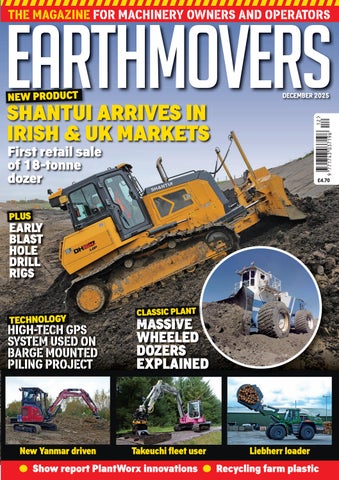
Earthmovers December 2026

Page 1


First retail sale of 18-tonne dozer

PLUS EARLY BLAST HOLE DRILL RIGS

*Terms and conditions apply, see www.finning.com/winbig for details. Celebrating 100 years of Caterpillar®

Editor Graham Black

Editor@EarthmoversMagazine.co.uk

Sub Editor Paul Carter

Advertisement Sales

Richard Cosgrove +44 (0) 20 8639 4416

Michael Burgess +44 (0) 20 8639 4417

Sales & Marketing Manager Richard Cosgrove

Administrator Martin Attis

Publishing Director Paul Cosgrove

EARTHMOVERS is published by

Sundial Magazines Ltd, Sundial House, 17 Wickham Road, Beckenham, Kent BR3 5JS. +44 (0) 20 8639 4400

www.EarthmoversMagazine.co.uk

Info@EarthmoversMagazine.co.uk

Subscriptions

Earthmovers subscriptions

Trinity House, Sculpins Lane, Essex, CM7 4AY, England. +44 (0) 1371 853 632

earthmovers@escosubs.co.uk

Newstrade

If you have any difficulty obtaining Earthmovers from your newsagent please contact Seymour Distribution, 5 East Poultry Avenue, London EC1A 9PT.

+44 (0) 20 7429 4000

Repro

Design & Printing Solutions Ltd, 8 Jagow House, Joseph Wilson Industrial Estate, Whitstable, Kent CT5 3PS.

Printing

William Gibbons & Sons Ltd., 26 Planetary Road, Willenhall, West Midlands, WV13 3XB.

Copyright

Sundial Magazines Ltd 2025. All rights reserved. Reproduction in whole or in part is forbidden except with the written permission of the publishers.

ISSN 1743-0372 Sundial Magazines Ltd. Registered in England No 4134490.

Conditions for advertising

All advertisements are accepted subject to the publisher’s standard conditions of insertion. For a copy of Advertising Terms & Conditions, please write to Paul Cosgrove at Sundial Magazines Ltd, Sundial House, 17 Wickham Road, Beckenham, Kent BR3 5JS.

Australian subs sales agent

Greg McNiece, Rally Badges, PO Box 9, Tatura, Victoria 3616, Australia. +61 (0) 3 5824 1734

www.twitter.com/ EarthmoversMag December

The next issue of EARTHMOVERS magazine is available on5 December

80 years young

As we go to press, JCB is celebrating its 80th anniversary, which is a tremendous achievement for this iconic British-based manufacturer.

Over the decades it has become best known for the development of the backhoe loader, with the latest dual-drive machines being a truly innovative design. However, in more recent times, they have made significant progress with their range of excavators. The older JS models were Marmite machines: some loved them, others hated them. By comparison, the current in-house developed X Series excavators are genuinely worldclass products that have received justifiable praise as the best of British engineering.

Looking to the future, there can be no question that JCB will be justifiably credited with the introduction of zero-emissions, hydrogen-powered machinery. I strongly suspect that this accolade will not only be applied to construction, agricultural and power generation kit, but their R&D effort will also have a significant impact in wider communities around the world.

In the next issue, we will look at JCB’s history in more detail, but for now credit where credit is due. There are not many countries around the world that have the benefit of such an industrial powerhouse that doesn’t just follow market tends, but makes them.

Yours till next month

CONTENTS

Dozer of choice for County Mayobased civils contractor P&D Lydon.

A

All the

At the controls of their latest product, a 3.7-tonne mini-excavator.

Expanded operations provided by a new Kobelco SK520 and Finlay processing kit.

Machine highlights of the recent show, which attracted over 10,000 visitors.

Flannery’s Andy Byatt at the Plantworx Hiboo Big Data discussion.

A new mobile screener has seen an immediate improvement in productivity.

Takeuchi excavators fan has just added another FR model to his fleet.

Timber processer has added another Liebherr wheel loader to its fleet.

Collecting and handling plastic waste requires a co-ordinated approach.

Gloucestershire and Worestershire hire firm has a JCB electric mini-excavator on its fleet.

Swedish-built wheel loader adapted to perform a variety of tasks.

A challenging crushing application solved by an unusual machine.

72 CLASSIC PLANT LARGE WHEELED DOZERS

A historical look at some of the largest wheeled dozers ever produced.

77 TECHNOLOGY SMART PILING

Latest Leica technology used to install the piles supporting a new bridge.

81

FACTORY HISTORY MOTHERWELL

Key milestones and machines produced at the famous haul truck factory.

86

PLANT HISTORY BUCYRUS BLAST HOLE RIGS

The history of the development of large Bucyrus-Erie blast hole drills.

91 NEXT MONTH

Here’s a taster of just some of the exciting features planned for the next issue.

94 PLANTMOBILIA YANMAR

The current range of replica 1:32 and 1:50-scale models in the firm’s current red colour scheme.

97

OPERATOR INTERVIEW STARS OF THE FUTURE

Two winners of the CPA’s Stars of the Future apprenticeship scheme.

COST EFFECTIVE DOZING

As a leading civil engineering and plant hire company with a long and successful history in the industry, P&D Lydon takes its machine choices very seriously. Its extensive fleet acts as an ambassador for the company and its overall reputation, so any unplanned downtime or inefficiency is unacceptable. This places a major vote of confidence in the recent purchase of a Chinese-built Shantui DH16M LGP dozer.

Formed in 1999, P&D Lydon is based at Cross near Cong in County Mayo. It undertakes projects for the Electricity Supply Board, Irish Water, Irish Rail and local authorities, as well as commercial developments over a broad area, while also offering a plant hire service.

The firm runs a large fleet of established

As Eoghan Daly reports, County Mayobased P&D Lydon has recently put a Shantui DH16M dozer into service

brands serving the Irish market, although recent buying decisions have included several machines from emerging Chinese-based manufacturers. They have included mini-excavators and compaction equipment from XCMG, together with excavators and a telescopic handler from Sany.

Faced with replacing one of its Komatsu dozers, P&D Lydon went to the market with an open mind in search of the most suitable successor. This coincided with the availability of Shantui machines (see panel overleaf)

Inset right and below: Experienced dozer operator John Burke has now put almost 500 trouble-free hours on the new dozer and cannot fault its performance, comfort or reliability.
“THECONTROLSYSTEMISEASYTOWORKWITHANDDOESN’TTAKE MUCHTIMETOGETTOKNOWYOURWAYAROUNDTHELAYOUT.”

SHANTUI BRIEF HISTORY

While Shantui may be new to the Irish and UK markets, it has a wealth of experience of manufacturing construction equipment but is best known for its dozers.

Its history starts in 1952 when a factory was established at Yantai in China, then relocated to Jining City. Several manufacturers in Jining were consolidated in 1980 to form Shandong Bulldozer. Renamed Shantui, the firm was listed on the Shenzhen stock exchange in 1997. Shantui is probably the largest dozer manufacturer in the world, reported to produce 10,000 units a year. Its current dozer range extends from a 10-tonne compact machine right up to the giant 105-tonne DH90 model.

on the Irish market through HML Plant Sales, which operates from Buncrana in County Donegal and Rathcoole in County Dublin. HML has done much to promote the awareness of the Shantui brand in both the Republic and Northern Ireland. Having machines in stock meant that an appraisal of their design, specification and build quality could be undertaken first-hand and they would be available for immediate delivery.

P&D Lydon identified the DH16M LGP model as the most appropriate unit to meet their needs. The requirement was for a dozer with a good all-round working capability, but with a particular focus on finishing operations through its sensible proportions and its six-way power angle tilt (PAT) blade.

In low ground pressure (LPG) configuration with a PAT blade and currently fitted with a rear drawbar, the DH16M weighs 18,830kg. The dozer was taken from dealer stock and immediately

put to work. In the near future a multishank ripper will be fitted – the hydraulics and controls are part of the standard build – increasing its operational weight to 20,375kg. The dozer was supplied ready to fit a Trimble 3D GPS control and guidance system, which will also soon be fitted.

OPERATOR FEEDBACK

On delivery, the new Shantui dozer went straight to work on an operated long-term hire basis to an important County Mayo flood relief project, undertaking a wide range of tasks across the vast site.

John Burke has spent over 40 years as an operator, including on wheel loaders for Harrington Quarries and then on a variety of machine types for the civil engineering company Wills Bros. On joining P&D Lydon, he has focused almost exclusively on dozer operation, on a diverse range of projects.

HE said, “The Shantui DH16M dozer looked very well designed and built, with

Below: Shantui is the largest dozer manufacturer in the world. Its current range extends from a 10-tonne compact machine right up to the 105-tonne DH90 model.

a good overall level of finish. At work with the machine, I soon saw it was well up to the job. It has good pushing power and does not struggle in any way with anything we have expected it to do.

“I have spent a lot of time operating dozers since I started on a little Cat D4 and then used several Komatsu D65PX machines, which I have always rated very highly. Following nearly three months on this Shantui dozer, I feel its performance would equal any other same size class dozer from the other manufacturers.”

IN THE CAB

The DH16M’s cab gives the impression is of a generously dimensioned work station. Its large door provides uninhibited access and egress, while the legroom and sense of space around the seat is vast. The light grey interior moulding on both side consoles gives a bright feel to the interior while also being aesthetically pleasing.

There are plenty of open storage areas around the operator, together with good space behind the seat, plus those allimportant cup holders. The woven cloth upholstered air-suspension seat offers a full range of adjustment, while all the controls are sensibly laid out around it, all within easy reach.

In addition to a horn button, the left joystick includes a button to control steering sensitivity, which can be toggled between aggressive, standard or grading modes. The right joystick controls all blade movements, while a conveniently located lever on the right governs the ripper. There is a footrest

NEW PRODUCT // SHANTUI

on the floor and a brake pedal; the latter can be set to control either engine deceleration and braking or transmission mode.

There are very few other physical controls around the operator, as most settings are activated through the machine’s central control system. On the left console there is a throttle dial and locking switch plus power sockets. Switches for the lights, wipers and the air-conditioning system and

radio are in the cab roof panel, again within easy reach.

There is no jog dial mechanism to navigate through the menu structures on the non-reflective 7in control screen. However, the touch screen is supplemented by a row of function keys, making the process user friendly.

In the main screen view, the display presents information on machine

Above and above right: The air-conditioned cab interior offers generous space and plenty of storage plus an adjustable air-suspension seat.
Right: All-round visibility is good, particularly to the front. A comprehensive control system offers an array of machine settings.
“HAVINGTHOUGHTABOUTALLITS FEATURESANDHOWITISDESIGNED, ICOULDN’TPOINTTOANYTHING THATCOULDBEIMPROVED”

performance, together with an array of warning symbols across the top. This home screen includes digital gauges showing engine coolant and hydraulic oil temperatures, which are flanked by fuel and AdBlue levels in stacked graph format. Forward and reverse gear selection is also shown on the screen, together with the various modes and settings selected. Footage from the rear-view camera can also be displayed in a central panel on this screen.

There is a comprehensive menu structure within the control system, of which two screens are particularly noteworthy. The first is the system settings, which allow for adjustment of many key machine elements. This includes brake pedal mode, driving response, reverse engine speed pre-set, slip rate control, fan reverse and the reverse alarm. Another key menu is the user information section where errors and faults can be viewed together with regeneration settings.

John Burke said, “It is a very nice machine to operate and is well finished inside the cab, which is very roomy with a good view in all directions. The control system is easy to work with and doesn’t take much time to get to know your way around the layout.”

DRIVELINE

The new Shantui dozer is said to offer good value for money without compromising on performance or operator comfort. Even though the DH16M may not have the contoured body panels and acute sloping front bonnet of some of its competitors, it is by no means

lacking when it comes to specification, as all principal elements are sourced from established manufacturers.

While other dozers in the Shantui range use Cummins engines, the DH16M is

Below: The 4m-wide PAT blade has a six-way tilt mechanism and a rated capacity of 4.0cu.m, marginally greater than some dozers in this size class.

Below: The Shantui DH16M is powered by a six-cylinder FPT powerpack rated at 151kW, providing its maximum torque of 940Nm at a mere 1500rpm.

NEW

powered by a sixcylinder FPT powerpack rated at 151kW, providing its maximum torque of 940Nm at a mere 1500rpm. The six-pot engine’s generous torque reserves ensure it is under no strain in delivering the maximum power when required, yet remains economical with considerable work derived from its 389-litre fuel tank.

John commented, “I would consider the Shantui a bit lighter on fuel than some of the Komatsus I’ve used in the past. If this machine is doing hard dozing for a full 12 hours then it will burn a full tank in a day, but for normal work it will last much longer than this. It has great pushing power and even though it is a smaller size class mainly for finishing work, it still has the power to take on heavier work when needed.”

The FPT engine drives a Linde hydrostatic transmission and hydraulics. The Linde hydraulic control system includes the ability for the operator to set a maximum speed, while the control programme delivers the appropriate level of hydraulic performance to match the application. The system also provides the operator with three working modes: power, standard and economy, together with a smooth start feature so no sharp impacts are experienced during shifting, steering or reversing.

STRUCTURE

Unlike some manufacturers who have structural elements of such machines fabricated by third parties, Shantui

prides itself in conducting all stages of the process in-house, including manufacturing the undercarriage.

The resulting structures feature a reassuringly robust build quality.

As an LGP model, the undercarriage is fitted with 810mm single-grouser track shoes and the machine runs on 43 shoes per side with a ground contact length of 3075mm, which equates to a ground pressure of 36.9kPA. Eight bottom and two top track rollers ensure smooth running of the track chain, while the final drives exert good tractive force and pushing power is rated at 230kN. With a track gauge of 2350mm the overall track width on 800mm-wide track shoes is 3160mm. In addition to offering a firm stance, this provides an adequate recess of the tracks inside of the 4m-wide PAT blade.

At 4.011m wide and 1.387m high, the PAT blade has a rated capacity of 4.01cu.m, marginally greater than some dozers in this size class. The blade’s six-way tilt mechanism works effectively and delivers a positive range of movement.

A 24-degree turning angle is achievable at ground level while its maximum tilt height is 528mm.

Operations conducted by the dozer so far have included pushing bulk material in a large cut area, then conducting trimming operations to formation level. The machine has also been tasked with spreading topsoil on steep embankments, where its climbing ability and stability were noteworthy.

SUMMARY

The Shantui DH16M LGP dozer was a cost-effective purchase for P&D Lydon, and has performed well without any issues on a wide range of tasks over its first 500 hours on the fleet.

Experienced operator John Burke concluded, “I couldn’t fault the dozer. It is working very well with no problems. Having thought about all its features and how it is designed, I couldn’t point to anything that could be improved on.”

SHANTUI DH16M WALK AROUND

There are four main compartments, two either side of the engine bay and one of each rear quarter. Their steel panel doors and hinges, locks and latches are all reassuringly robust.

The two engine panels provide direct access to principal components such as the air filter and the engine oil dip stick and fill point. Less frequently used components, such as filters, are located below these openings, behind lift-off panels secured by bolts.

The two compartments at the rear contain the batteries, the 43-litre AdBlue tank and its fill point on the nearside. The corresponding offside compartment houses the windscreen washer reservoir, the hydraulic valves and filters together with a sight gauge on the hydraulic oil tank. Diesel and hydraulic oil refill points are located below the rear cab window.

Above left, above and inset left: The four main compartments feature steel panel doors that are all reassuringly robust.

JCB’S £100 MILLION

INVESTMENT

O

ne of the ways that JCB marked its 80th birthday was the announcement that a further £100m of investment would be made in its factory at Rocester in Staffordshire. In addition to a full modernisation of the shop floor, complete with new machining centres, friction welders and cylinder boring machines, a £60m fully automated powder paint plant will be installed.

Lord Bamford said, “Basing JCB in the UK makes business sense, just as it has always made business sense. The work ethic in our country remains strong – especially in the Midlands, with its deep engineering heritage. It makes perfect sense to invest heavily in our British factories and the £100 million we are investing now will put us at the forefront of our industry.

“Obviously, we are expanding overseas, not least in America, where we have been for decades, but the UK is our home. We directly employ more than 19,000 people around the world, more than 8000 of whom are in the UK. Around three-quarters of our UK production is exported, we continue to make a huge contribution to this country and to the national economy.”

NEW SCOTTISH DEALER FOR HITACHI MINIS

Hitachi has appointed Ayrshire-based Corsehouse Commercials as a sub-dealer for its range of mini-excavators in Scotland. Corsehouse has over 25 years of experience of supplying new and used construction plant.

A round-up of news stories in the plant and machinery construction industry ant

KUBOTA FLEET FOR KJ HIRE

Swansea-based plant and tool rental business KJ Hire has added a host of Kubota 1.8-tonne, three-, five- and eight-tonne compact excavators to its rapidly growing fleet, through dealer Chepstow Construction Equipment. While some of the equipment has been replacement of existing models, the majority are additions to a total fleet of more than 200 machines.

MD Laura Williams said, “Our yard was almost cleared of equipment, so we expanded the fleet to ensure we could meet customer demand.”

The business was started in 1983 by Ms Williams’ late father John. Various family members work within the company, in the workshops and on the hire desk. Much of the business is local to the firm’s Swansea base, close to the M4 motorway, although KJ is more than happy to travel to look after existing customers, many of whom are national businesses with long-term hire requirements.

UNDERGROUND BUILD OF CAT 988

inning has commissioned a Cat 988 wheel loader 150m below ground at the UK’s largest salt mine, operated by Compass Minerals at Winsford in Cheshire. The 50-tonne class loader was initially built up and tested at Finning’s local workshop, then stripped down to enable the components to be lowered into the mine via a 4m x 4m shaft. It was then rebuilt by a team of Finning’s service engineers.

F HUGE ORDER FOR EPIROC

Epiroc has won a large order for mining equipment and digital systems from Asante Gold for a huge site in the West African country of Ghana. It includes a fleet of underground mining trucks, loaders, face drilling rigs and production drilling rigs for the Chirano Gold Mine, a combined underground and open pit site. In addition, the order includes a digital situational awareness system that will increase efficiency by keeping track of the machines and provide near real-time production metrics.

AAIR AMBULANCE CHARITY BUCKET FINNING APPRENTICES

ttachment manufacturer Miller has announced the successful auction of its specially branded charity bucket, which has raised £5000 for the Great North Air Ambulance Service. The bucket was showcased at the recent Plantworx event. The winning bid came from Flannery Plant Hire, who will display the bucket at its Wembley depot. Paul Flannery said, “We were happy to support Miller’s fundraising efforts for the Great North Air Ambulance Service. We already work closely with similar charities across the UK and even had a specially branded machine on display at Plantworx in the Air Ambulance UK colours. We’re proud to help keep these essential services running and having the bucket on display at one of our depots will serve as a great reminder of our commitment to giving back to the communities where we operate.”

fter spending four years on the Finning apprenticeship scheme, 12 trainees have now completed their Level 3 programme and have graduated to work in various field and workshop engineering roles. Finning has now welcomed its 2025 cohort of 24 apprentices, as individuals begin a worldclass training programme.

A

s a result of customer feedback, Northern Ireland-based Screencore has upgraded its Trident 165 heavy-duty, double -deck scalping screen. It is now easier to transport, has a shorter set-up time and much improved controls. Perhaps the biggest update is that it can now provide auxiliary electric or hydraulic power for a downstream stockpiler.

Based in Chile, Codelco is the world’s largest copper producer. It has announced that its Radomiro Tomic site will be used to field test Cat’s Dynamic Energy Transfer (DET) on three of its Cat 798AC diesel-electric haul trucks. Preliminary estimates indicate that these machines could reduce their emissions by 60% to 70%, in addition to extending the

lifespan of their engines, by receiving electrical power from this external source.

In addition to a power transfer module, which converts power from the site’s electrical source to the required voltage, the DET system includes an electrified rail to transmit the power and a machineconnection system to transfer power to the truck’s drivetrain.

orking on behalf of Holcim UK, the team from Careys has successfully completed the civils works on a new cement manufacturing and distribution facility at the Port of Tilbury. It marks a key point in the multi-million-pound project, as structural and mechanical installation begins on one of the most advanced facilities of its kind in the UK.

As part of the civils works, specialist contractor Aarsleff installed over 3500 concrete piles on this site. Careys then used hydraulic pile croppers supplied by National Pile Croppers to crop them to size.

W UPDATED SCREENCORE TRIDENT 165 CROPPING FOUNDATIONS FOR CEMENT FACTORY CAT EXTERNAL ELECTRIC POWER SYSTEM TEST

THWAITES DUMPERS FOR TOUCHSTONE

Newly established Touchstone Civil Engineering, the Midlands-based residential groundworker and civil engineering contractor, has placed a fleet deal for 10 Thwaites site dumpers through dealer BTE Plant Sales. It will consist of eight six-tonne ROPS+ models and two nine-tonne cabbed dumpers. ROPS+ is an extension of the existing Roll Over Protection System (ROPS). The overhead latch bar is pulled over and locked into position in front of the operator. The seat must be occupied and the seat belt must be worn, as both have safety sensors that prevent any workarounds.

They join a fleet of recently acquired Hitachi ZX-130 and ZX-210 excavators.

APC CIVILS TAKES CAT M319

ACat M319 wheeled excavator has been added to the fleet of APC Civils, primarily to install temporary concrete safety barriers for civil engineering, highways and construction projects.

MD Shane Clarke said, “Our working environment is typically defined by limitations in space due to existing infrastructure on highways, or urban construction sites. By design, wheeled excavators are far more sensitive to their environment than the tracked version

because they can travel on paved roads. This is vital when working in built-up areas where you want to limit the damage caused to roads, pavements and other existing infrastructure, which wouldn’t be possible on tracks.

“Additionally, wheeled excavators are often more compact and more manoeuvrable than the tracked excavators, which means they are easier to operate in the often-confined parameters of urban environments, between buildings, cars or through residential streets.”

The Statom Group has bought 48 Kobelco excavators from Molson in a deal valued at £4m. It includes various mini- and midi-excavators, together with a batch of 21-tonne class SK210-11E models.

unward’s foundation equipment business unit has appointed Watson & Hillhouse as exclusive dealer for its equipment for the UK and Ireland.

Watson & Hillhouse has sold and hired piling and foundation equipment since 1972, its hire fleet is currently worth £12m. The firm operates the UK’s only ‘absolute refusal’ piling equipment test bed, used to determine the suitability of any piece of piling plant for a particular application, and for testing every item of equipment before it is supplied to its customers.

At this year’s Bauma show, Sunward launched three advanced rotary drilling rigs for the European market. A 47t class CFA drilling rig joins the Watson & Hillhouse rental fleet at the end of this year and will be available to hire early in the New Year from the company’s main depot in Ipswich or its northern depot in Warrington.

PLANTWORX MODEL WINNER

The giant scale model of a Liebherr R9800 displayed on the EARTHMOVERS stand at Plantworx has been won by Alex Carter from Bicester.

KUBOTA DEALER EXPANSION

S E SUNWARD PILING RIGS IN UK

ffective from 1 Jan 2026, Kubota dealers Shellplant and Boss Plant Sales will have extended territories. Northamptonshirebased Shellplant will add Norfolk and Suffolk to its existing sales area, while Hertfordshirebased Boss Plant Sales will assume responsibility for neighbouring Essex.

3 YEAR WARRANTY*

5 YEAR TFM TELEMATICS

PROVEN

Proven high performance compact track loaders Now Available from Takeuchi UK. TL6R • TL8R-2 • TL10V-2 • TL12V-2

Designed from the ground up to deliver power and traction for every attachment. Compact in Size • Versatile in Performance

PLANTWORX INNOVATION AWARDS

EARTHMOVING ENGINEERING EXCELLENCE

Graham Black reports on the winners of the PlantWorx Innovation Awards 2025

lantWorx 2025 opened with a night of celebration as the Innovation Awards recognised the products, people and initiatives shaping the future of construction. The evening began with a tribute to Joanna Oliver MBE, marking her 30 years of service with the CEA, followed by the inaugural Claire Plant Award. Created in memory of Claire Plant, who played a key role in supporting Steelwrist UK and co-founding S Type X, the award was accepted by her husband, Pat Bulcock, in a moving moment that set the tone for the night.

The judging panel, of which I was a member, deliberated long and hard, as the quality of the entries was superb. The winners on the night were as follows:

PLANTWORX INNOVATION AWARDS

Support Products Award

Winner: Towmate Trailers/Pivot Axle, praised by judges as “simple, clever and designed to solve a very real challenge for operators.”

Highly commended: SITE-ARC/Tracked Welder Generator, a Network Rail-approved tracked welder designed for remote and challenging locations.

Sustainability Initiative Award

Winner: Gaia Group/Automate, an AI-driven power management system that reduces site emissions by up to 80%.

Highly Commended: Donaldson Europe/ PowerCore Edge, a compact air cleaner delivering full filtration performance in 65% less space.

Safety Innovation Award

Winner: Xwatch Safety Solutions/Xwatch MK2, commended for its next-generation approach to operator protection and integration with other site systems.

Highly commended: Conquip Engineering Group/concrete skip safety attachment.

Best Use of Engineering & Technology Innovation

Winner: Worsley Plant/Dynaset HRVB hydraulic recycling vacuum bucket, offering a faster, cleaner and more sustainable way to collect and sort materials.

Highly Commended: Watson & Hillhouse/ Movax side rip SG-VA Series, a precision pile-driving solution ideal for restricted spaces.

Security Initiative Award

Winner: RAPID, the Registered Assets Police Information Database, recognised as a vital tool in tackling machinery theft.

Excellence in Workforce Development

Joint winners: Lynch Plant for its Second Chances programme at HMP Highpoint, which gives prisoners the opportunity to train for construction careers ahead of release. Rethinking Futures for its schools and college careers project and careers event, helping young people connect with industry.

Alternative Power Innovation Award

Winner: Kubota/electric retrofit kit, allowing KX019-4 mini-excavators to be converted to zero-emissions machines.

Highly Commended: Instagrid UK Ltd – Instagrid GO, delivering portable, emissions-free energy for high-power tools on construction sites.

Special Achievement Award for Sustainability & Alternative Power

Winners: BAM, Flannery and Plantforce for their leadership in the Element One hydrogen trial programme, and Lynch Plant Hire for its deployment of the Ultimate Cell Truck Engine V3.0, achieving fuel savings of over 30% in live site conditions.

Left and below: The winners included Kubota for the electric retrofit kit for a mini-excavator and Worsley Plant for the Dynaset hydraulic-powered recycling vacuum bucket.

Meet the Develon DX25Z-7 – a 2.5t class zero-tail-swing mini excavator built for tight spaces, with the strength and stability to match. Designed for operator comfort and control, business moving. eu.develon-ce.com

DESIGNED IN JAPAN, BUILT IN FRANCE

Nick Drew visits Yanmar’s French factory and spends time operating their latest product, a 3.7-tonne mini-excavator

Historically, Yanmar is a brand synonymous with compact diesel engines, used to power a huge variety of construction, agricultural and marine machinery. However, the Japanese company is equally well known for producing compact construction machinery, particularly mini-excavators. This part of their history goes back to 1968 when they launched the YNB 300 model, the world’s first selfpropelled wheeled compact excavator. In 1989, Yanmar established a factory in the French town of Saint-Dizier, south of Reims, which continues to this day as the main manufacturing plant for the European market. In 2016 they acquired the Terex Schaeff compact equipment range, which included a factory in the German town of Crailsheim.

Production at this site is now being wound down, as Yanmar’s compact wheeled loader range is soon to be manufactured at Saint-Dizier.

FACTORY VISIT

The vast Saint-Dizier factory covers an area of 54,000 square metres. It is a true manufacturing site, where raw steel sheets come in at one end. They are then cut, formed, drilled and welded by skilled men and women, who are quite clearly passionate about the work they undertake. The team currently produces 18 machines a day from a single seven-hour shift, with the ability to double this from working a two-shift pattern. The build process starts with

the fabrication of the machine’s floor/ turntable. A large piece of circular steel is fixed to a jig to have various brackets welded into place, which will eventually receive the rest of the upper-structure and

Below: The latest addition to the Yanmar range of compact excavators is the 3.7-tonne SZ39-7 model.

associated components. Meanwhile, the components for the boom and dipper are cut, bent and then expertly welded together. All the individual fabricated sections, which will be added to the machine further down the line, are surface treated, followed by primary and final painting.

The undercarriage follows a similar path, before the painted assembly is married to the upper-structure. The engines are mounted and all the sub-assemblies and components are then added. Trolleys loaded with pipework, electrical looms and other items designated to a particular machine, accompany it down the line as the build-up continues. The seat and joystick

“THESAINT-DIZIERPLANT FOLLOWSTHESAME PROCESSESTHATARE UNDERTAKENIN

FIRST DRIVE // YANMAR SV39-7

consoles are added, followed by the boom and dipper arm, after which the cab structure is finally mounted.

Each machine is then hot tested and inspected. Any remedial work, such as touching up paintwork, is completed before the finished machine makes its way to the shipment area. Everything goes like clockwork on the factory floor, which should come as no surprise, as the Saint-Dizier plant follows the same assembly and quality control processes that are undertaken in Yanmar’s main factory at Fukoka in Japan.

The machines are then transferred to the logistics centre, a short drive away in Marnaval. This vast warehouse covers some 23,000 square metres and offers enough storage capacity for 1800 machines, plus an array of storage racks containing buckets and other attachments. Before shipment, the machines are given a final polish and their decals fixed in place.

NEW PRODUCT

At the nearby Yanmar training and demonstration centre at Bettancourt, I had the opportunity to put the new SV39-7 compact excavator through its paces. It was seen for the first time in the UK at the recent Plantworx show. The conventional

tailswing SV39-7 weighs 3670kg with a canopy. The cabbed version comes in at 3790kg, some 80kg heavier than Yanmar’s zero-tailswing Vio38-7 model.

The example available on the demonstration area was a top spec cabbed machine that included an additional 160kg counterweight. This is well worth the extra money, especially if you are going to be running heavy attachments or larger than standard buckets. Yanmar’s move to red livery gives these machines a dynamic new look. An initial walk round gives the impression of a stable and capable machine, which was to be proved later during the test drive.

Sitting on standard 300mm-wide rubber tracks – options include steel tracks – the SV39-7 has an overall track length of 2160mm and an overall width of 1740mm. Each track frame has four bottom rollers plus one top carrier roller. The dozer blade looked strong in design and featured a nice forward curve to promote good rollover of material being pushed. Six tie-down points are integrated into the machine for secure transportation.

At the business end this machine featured the optional full set of auxiliary lines and a return drain line for running hydraulic attachments. Each hydraulic cylinder features impact protection, while the rod is further protected by spring-

Above and left: The vast Saint-Dizier factory takes in sheet steel at one end, and finished machines roll off the production line at the other.
Left: The former Terex Schaeff factory in Germany is being wound down, as production of Yanmar’s compact wheel loader range is transferred to Saint-Dizier.

type steel plate. These simple solutions can save owners thousands of pounds caused by accidental damage, especially machines out on hire.

IN THE CAB

Access into the ROPS & FOPS level 1 cab is easy via a decent width door. For those operators who prefer to have the door open when working, it locks back nicely within the confines of the upper-structure and counterweight.

Settling into the luxury of the airsuspension seat and viewing my surroundings, I was impressed with how much space there was around me. There was plenty of legroom, although there is absolutely no space behind the seat for storing any personal effects. Having said that, it’s a compromise we have to make on such compact machines.

There are some minimal storage compartments on the right-hand side

“THANKS TO ITS WIDE FOOTPRINT AND THE ADDITIONAL COUNTERWEIGHT, IT PROVED TO BE IMPOSSIBLE TO UNBALANCE THE SV39-7”

console and that all-important necessity – a cup holder – is located towards the rear. Rocker switches are provided for such things as working lights, wiper/wash, overload warning and flashing beacon. There are also USB points for charging mobile phones and tablets.

I was impressed by the blade control lever, which comes up out of the console and leans over towards the operator. It falls very nicely to hand and features the two-speed tracking button on top of the lever. The tracking pedals were the foldaway type and, when folded down would be ample for those with large boots. To the right of the tracking pedals is the familiar Yanmar offset boom rocker pedal, an option that I personally prefer.

The SV39-7 features a brand-new 4.3in full colour monitor that includes a raft of menus to fine tune the machine. They include auxiliary settings for up to five different attachments. I was even able to control the oil flow speed to the tilt bucket on this example, so it wasn’t too fierce. As expected, its screen doubles up to show the footage from the rear-view camera when tracking in reverse.

It’s the simple things that often make a big difference and in the SV39-7 the large rubber floor mat is nicely designed. It looks easy to sweep out debris at the end of a shift, with no dirt traps that we sometimes find on other brands. Anything that makes an operator’s life easier can only be a good thing in my eyes.

Below: The standard maximum reach of the SV39-7 at ground level is 5370mm. The boom slew function offers 52 degrees swing to the right and a useful 71 degrees to the left.
Below and below right: This high-spec model featured an additional 160kg counterweight and a full set of auxiliary hydraulic service lines.

IN THE DIG

Having explored this new machine, it was time to put it to work. Turning the key, the Yanmar three-cylinder engine sprung into life, a familiar sound that we have become accustomed to on a wide range of compact construction machinery.

I cranked up the throttle dial and gave a little tug on the right-hand Rexroth joystick to raise the boom. Going through the motions with boom and dipper arm movements, I instantly felt at home in this powerful yet compact machine. I let go of the levers again and after four seconds the fuel saving auto-idle function cut down the

revs until I was ready to work again.

We often judge many machines on their grading ability, which is an essential part of operating. Without a doubt, some machines are better at it than others. On some machines you really have to work at it until you become accustomed to how the controls react. However, this Yanmar was super smooth straightaway and presented no problems in that department.

The French soil was a clay type of material and on this part of the demo plot it was quite damp. I assumed it had been dug over on numerous occasions and maybe not always sealed up from the elements, but it

YANMAR SV39-6 WALK AROUND

Opening up the rear engine panel door, it comes as no surprise to discover that the machine is powered by the well proven three-cylinder Yanmar engine that offers a gross power output rating of 18.9kW (25.3hp) at 2200rpm. The engine drives a high-performance blue-chip hydraulic system, comprising dual variable displacement pumps, each rated at 37.9lit/min and a 26.7lit/min gear pump, ensuring fast and responsive operation.

Access to all fluid and air filters is easy. Daily checks and routine servicing are also extremely convenient, as everything is easily accessible. Above the engine compartment there is another panel door, providing access to the screen wash bottle and the optional air-conditioning system.

On the offside rear, another large steel panel door opens outwards to reveal the substantial cooling pack, which is easy to clean and remove debris build-up from. Below that we have the 12v battery, and there is also a travel alarm situated in this bay.

Moving right round to the offside, a lockable plastic bonnet covers the entire length of the upper-structure, which lifts to gain access to the 30-litre hydraulic oil tank and the 44-litre fuel tank, which is nicely located at the front for ease of filling.

gave us a good chance to handle some heavier material. It also presented a good opportunity to test the machine’s stability with a load on.

This machine was fitted with the UK preferred 1620mm-long dipper arm. I dived into the damp soil and gouged out the biggest heaped bucketful I could, then stretched out the boom and dipper over the side. The standard maximum reach at ground level is 5370mm, with the tilting

The mini is powered by a three-cylinder Yanmar engine rated at 18.9kW (25.3hp). Access to routine service and maintenance points is good.

FIRST DRIVE // YANMAR SV39-7

bucket fitted on this example it was a tad further. Thanks to the combination of its wide footprint and the additional counterweight, it proved impossible to unbalance the SV39-7, which remained planted to the ground – all very impressive.

With the afternoon sun beaming into the cab, I was very appreciative of this machine’s air-conditioning option. I cranked up the blower and opened the forward vents to receive a nice flow of cooling air. I have never been one to operate with the front window closed, but it’s still nice to deploy the air-conditioning for that extra cooling breeze. For those who just want fresh air, there are plenty of options: both offside windows slide open to suit the individual.

Visibility all round is very good, thanks to plenty of glass, and of course the rear-view camera is extremely useful when reversing the machine. My only concern with the cab was the curved screen to the rear. While it looks great and offers a good view to the rear, as we know curved screens are expensive to replace if vandalised.

Putting the machine’s strength to the test, I grabbed another large bucketful and tracked up a bank to test its uphill slewing capability. Once again at full stretch, this presented no problem for this powerful mini, which continued to impress me as the day went by.

Another feature that impressed me was the flexibility of the boom swing function, offering 52 degrees to the right and the preferred option of 71 degrees to the left. Having the increased swing to the left is great when undertaking such tasks as ditch cleaning.

I finished my time on this machine blading off some of the material we had dug over during the course of the test drive. The floating dozer blade function makes blading out the material easy, although if you wanted to trim it to a particular level I would say you are still better off doing it manually. However, it’s a useful feature for rough and fast levelling. Talking of speed, the machine in tortoise tracking mode travels at 2.6kph, while in hare mode can achieve 4.5kph.

“THE YANMAR SV39-7 IS ACRACKINGPIECEOFKIT, WHICH I FEEL WOULD REALLY APPEAL TO OWNER/OPERATORS IN THE UK MARKET”

In summary, the Yanmar SV39-7 is a cracking piece of kit, which I feel would really appeal to owner/operators in the UK market who need something bigger than can be towed behind a 4x4. It certainly ticked a lot of boxes for me.

Above. left and below: The comfortable cab on the SV39-7 offers great visibility and plenty of space for the operator, but lacks storage space behind the seat.

A LONG WAY TOGETHER

EARTHMAX SR 41

No matter how challenging your needs, EARTHMAX SR 41 is your best ally when it comes to operations that require extraordinary traction. Thanks to its All Steel radial structure and the special block pattern, EARTHMAX SR 41 provides excellent resistance against punctures and an extended service life. In addition to long working hours without downtime, the tyre ensures extraordinary comfort.

EARTHMAX SR 41 is BKT’s response to withstand the toughest operating conditions in haulage, loading and dozing applications.

POWER & REACH

Paul Argent reports on a new excavator and mobile processing kit purchased by G. Webb Haulage for their expanded quarrying operations

Operating a large fleet of tippers from its base at Longstanton in Cambridgeshire, G. Webb Haulage has been tramping the roads of the UK since 1947. The company is still under the control of the Webb family and has expanded significantly since George Webb founded it over 75 years ago, currently running over 55 trucks on bulk and aggregate haulage throughout the UK.

Under the leadership of operations director Darren Allison, the company’s aggregates division has expanded its portfolio of operations from simply transporting materials to and from site to running both recycled and virgin

aggregates, thus increasing the utilisation of its haulage fleet.

The mix of virgin quarry and recycling operations has called for an eclectic variety of kit to be added to the fleet to cope with the different material the sites handle.

Little Paxton, on the side of the A14 near St Neots, handles recycled material with a range of wheeled loaders and crushing and screening plant. The latest addition to the company’s portfolio, a site at South Witham, offers both recycled material and virgin aggregates.

SITE BACKGROUND

Production of aggregates at South Witham is handled on one part of the expanding

“HAVINGTHEMORE

site both by mobile crushing and screening equipment and a wash plant. This generates a wide variety of high-quality aggregates, primarily from the large volume of unwanted material left on site by previous quarrying operations.

Assistant quarry manager Dan Killner said, “We have invested heavily on the site to allow us to reclaim materials that the site’s previous owners thought were unsuitable. This investment now allows us to produce a wide range of products and allows us to properly landscape the site as our work continues.”

Reclamation of previously discarded quarry materials is only part of the operation, as quarrying virgin limestone takes place on another part of the site. Dan continued, “We don’t have a huge volume of material left to remove at the southern end of the quarry. But its removal gives us access to land on which we are able to produce material suitable for the restoration of the site.

“Primary aggregates are relatively easy to handle. We have to be a little more careful when it comes to recycled material, as it can contain rebar and other products that can quickly block the jaw and conveyors up.”

Left and above: A new 54-tonne Kobelco SK520 excavator is in the capable hands of operator Gareth ‘Albert’ Cook (72 years young).
“WEUSETHERIDDLEBUCKETTOREMOVEASMUCH SMALLERMATERIALASPOSSIBLE.THISALLOWSACLEANER PRODUCTTOBEPROCESSED”

NEW EXCAVATOR

While the processing side of the operation is steadily being transformed thanks to Finlay machines supplied through the Molson Group (see panel), Webb has invested in a Kobelco SK520 excavator also through this dealer. Darren Allison commented, “We will look at any piece of plant to see the benefits it can offer us. This may be the initial purchase cost, running costs and residuals and the acceptance by our operators.

“When we decided the site required a larger frontline excavator, we approached almost every brand to see what their offerings were. One market leader was discounted immediately because of its initial purchase price, but we took several other demonstrators for the operators to try out and see what they brought to the operations.

“The Kobelco was taken because we felt it offered us everything we had asked from the supplier. Firstly, our operators liked it; this is a major point for us as they are all very experienced people and know what they are talking about. Secondly, Molson was able to offer us a competitive price, supported by their comprehensive servicing package. Thirdly, the fuel economy from the Plantforce machine we trialled was

considerably lower than their competitors and was a major factor in swinging the deal for us.”

The new Kobelco SK520-11e is one of the latest generation of heavy excavators from the Japanese manufacturer. With an operating weight around 54 tonnes, the SK520 has taken on the looks of a true heavyweight excavator. Moving away from the previous model’s curvaceous bodywork, the new model styles itself on the angular, more aggressive design of the larger SK850 model.

PERFORMANCE

Underneath the squared-off rear end is a 15.6-litre, six-cylinder Isuzu engine. This tried and tested powerplant kicks out 467hp and delivers its peak torque of 2050Nm at just 1300rpm. The provision of two main 370-litre-per-minute pumps

Above: The excavator’s working equipment consists of a 7m boom and a 3.45m stick, which hosts a Geith quick coupler to change between a digging bucket, a ripper and a riddle bucket.

Below and bottom: The operator highly rates his new working environment, which provides a comfortable perch to undertake a day’s hard digging and loading.

enables the operator to confidently get the machine to perform several functions without any loss of power. It is configured with a standard 7m boom fitted with a 3.45m dipper stick.

Dan continued, “We need a combination of reach and power for the work we do. A lot of the work involves digging material out, where the Kobelco’s impressive breakout force is fully utilised. We also need it to feed the Finlay crusher, where the reach comes into play.”

To further the versatility of the machine, it has been fitted with a Geith quick coupler, allowing it to change from a Miller digging bucket to a ripper and, when loading the crusher, a riddle bucket.

Dan continued, “We use the riddle bucket to remove as much smaller material as possible. This allows a cleaner product to be processed and reduces both the volume of secondary material that the Finlay and Keestrack machines need to process, and we have to handle. “We try and process material by type. The yellow limestone is a softer material and can be crushed almost straight from the face.

PROCESSING KIT

The purchase of the Kobelco excavator follows the arrival of a new crusher from the same source. Molson Finlay’s sales manager, Tom Pope, said, “I have had a long relationship with the team at Webb. We have worked together through a previous company I worked for and, since my arrival at Molson, Webb has steadily added Finlay products to its portfolio.”

Finlay has developed several alternative drive machines, enabling operators to reap the benefits of reduced fuel consumption through the use of electric drive technology. It is one of these hybrid machines that has recently been delivered to Webb’s South Witham quarry. The Finlay J-1175 mobile jaw crusher offers the flexibility to power the machine either by mains electric connection or the onboard genset, reducing both noise and fuel consumption.

The new crusher at South Witham is currently being used with the on-board genset option, resulting in servicing and maintenance cost savings in direct comparison to a diesel/hydraulic-powered plant. Another added benefit of the J-1175 is its ability to generate sufficient electrical energy to allow it to power downstream equipment, such as a screener or stockpile conveyor.

“The harder blue material requires lifting and breaking before we can process it. With the blue limestone sitting on bands of clay, when we’ve tried to break in-situ, the clay has absorbed the impact from the hammer and reduced the effectiveness of our work. We have changed tack and started removing it in slabs and breaking once it’s out in the open. Having the more powerful Kobelco doing this has also made the job easier and safer for us.”

OPERATOR FEEDBACK

The keys of the new Kobelco have been handed to 72-year-old Gareth ‘Albert’ Cook who still enjoys his days in the quarry. He said, “This is a far better machine than the last one I was on. It will dig easier, load smoother and you don’t feel exhausted after a day’s work. The cab is huge, with so much room behind the seat and it’s so easy to use. I wouldn’t want to operate anything else on this job, and I’ve been lucky enough to have operated almost every brand, starting off from my early days on Hymac and Poclain machines.”

With a pile of mixed material in front of him Albert steadily picked up, shook the riddle bucket and fed the rock into the Finlay’s large hopper.

Left and below: The Kobelco SK520 is used both to feed the crusher and to break out the hard blue limestone found at the South Witham site.

SITE VISIT // SOUTH WITHAM QUARRY

“IWOULDN’TWANTTOOPERATE ANYTHINGELSEONTHISJOB,ANDI’VE OPERATEDALMOSTEVERYBRAND”

Below and inset: The Kobelco’s 15.6-litre, six-cylinder Isuzu engine is rated at 467hp but delivers its peak torque of 2050Nm at just 1300rpm.

As the pile of material needing crushing disappeared fast, Albert dropped the riddle bucket and picked up his digging bucket, before tracking the short distance to the shallow face to demonstrate his slab removal technique. Prying the material out in shallow bands, he was able to lift most of the material before dropping it ready for secondary breaking.

He commented, “It’s a far easier job doing this with the Kobelco. There’s far more power available and with the controls being more precise, I can easily find the weak spots in the rock and pry them out.”

CONCLUSION

The arrival of the new crusher and excavator from Molson, with another crusher due in the near future, marks a significant step forward for the quarrying and recycling teams at Webb. With a focus on reducing overheads, the reliability and fuel consumption savings offered by the Finlay and Kobelco kit will help the progressive haulier/recycling contractor to meet its economic and environmental targets.

EARTHMOVING EXTRAVAGANZA

Nick Drew reports on the machinery highlights of the recent Plantworx show, which attracted over 10,000 visitors to the Newark showground

SHANTUI ENTERS UK MARKET

The latest Chinese manufacturer to enter the UK market is Shantui. Its Belgium-based European HQ team brought along a selection of machines from its range, including the DH20M dozer powered by a 220hp Cummins engine. Having clocked up its first 500 hours with an Irish operator, its smaller sibling is reviewed elsewhere in this issue.

As expected, Shantui also promoted its range of compact equipment, but an unexpected star of its stand was the batterypowered LE60X5 wheel loader. Little information was available on this 18.2-tonne machine, other than it has a bucket capacity of 3.3cu.m and a rated load capacity of 5.8 tonnes.

SUNWARD DEMO PLOT

On the Sunward demonstration plot there were three zero-tailswing compact excavators, the SWE25UF, SWE50UF and the SWE90UF. Also shown was the sub-one-tonne SWE08F micro-excavator, which now features joystick pods.

HUGE JCB PRESENCE

ith what must have been one of the largest stands on the showground, JCB made a big impact at the event. JCB’s demonstration team put the machines through their paces on a dedicated plot, adjacent to their large static display. It was particularly good to see the 145XR complete with Steelwrist tilt-rotator in action. This machine is proving to be very popular with the housing groundworks sector, thanks to its compact dimensions, smooth hydraulics and powerful performance.

At the other end of the scale, JCB showcased the 370X model. Powered by a 322hp Cummins engine, it is the largest excavator in their range.

SITE SUSTAINABILITY

W The Site Sustainability Showcase Zone was extremely popular with visitors, who evaluated battery- and hydrogen-powered machinery, power storage systems and the benefits of solar-powered accommodation units. What caught my eye was a battery-powered Komatsu PC138E-11 compact radius excavator in the livery of L. Lynch Plant Hire. Key stats for this machine include a 0.50cu.m bucket and a tailswing radius of 1803mm. It features a 225.6kWh battery pack driving a 72.5kW electric motor.

VERSAFFIX TILT-ROTATORS

As the only dedicated tilt-rotator manufacturer in the UK and Ireland, Versaffix made a big impression on their stand with regular demonstrations of their latest offerings. They also had high profile tilt-rotator customer user James Covell on stand, who was full of praise for the company and the high standard of their products.

NEW CAT TRACKED LOADER

Caterpillar distributor Finning had a buzzing stand at the show, where one of the highlights was the all-new Cat 285XE compact tracked loader. The largest machine in the Cat skid-steer range that was making its UK debut, this beast of a machine is powered by a 3.6-litre engine rated at 100kW/134hp.

Finning also presented a stunning example of the Cat 444 backhoe loader, sporting the limited-edition centennial grey paintwork, which looked spectacular.

ALL-NEW KUBOTAS

One of the most impressive stands on the showground was that of Kubota, who had plenty to shout about, not least the fact that the company has now manufactured over one million compact excavators.

It had several new products on its stand, many of which had not been seen before in the UK. One of the standout machines was the new 15-tonne class U145, built in collaboration with Sumitomo and powered by a 76.4kW/102hp engine. It is a wellproven machine that we have seen with different branding in the UK over the years and will be a great addition to the Kubota line-up.

Also adding another dimension to the Kubota range is the announcement of new wheeled excavators – KW095 and KW115 – built as part of a new partnership with Liebherr and powered by Kubota’s V3800 engine. On show was the 55kW/74hp KW095 model.

Another new machine to the UK market is the SVL75-3 compact tracked loader, which is powered by the same Kubota 55kW (74hp) engine. Already reported to be a market leader in the USA, the machine offers a breakout force of 2710kg and a rated capacity of 1613kg at 50% tipping load.

VACUUM EXCAVATIONS

Truck-mounted vacuum excavators are currently selling well in the UK market. They are an increasingly popular method of safely and effectively excavating in high-risk areas, avoiding cable strikes and damage to other services. Several examples were spotted around the showground, including this example from Vac-Ex.

NEW YANMARS

ne of the few manufacturers not to exhibit at this year’s Bauma show, Yanmar had genuinely new products to see on its stand at Plantworx. Star of the show was the SV39 mini-excavator, which is subject to a full first drive report elsewhere in this issue. Another new product was the batterypowered SV17e mini-excavator. It features a 18.3kWh nickel manganese cobalt battery pack, which is said to provide half a day of continuous hard work on a single change, even longer on less arduous applications.

OROTATING ATTACHMENTS

German attachment company Holp was represented at the show by its regional dealers and had a wide range of attachments on show. The focal point on the demo area was a Kubota KX085-5 fitted with a Rototop rotating hitch, a cheaper, lighter and stronger alternative to a full-blown tilt-rotator. Visitors who had tried out the hitch were suitably impressed with its capabilities and several orders were taken at the show.

TAKEUCHI TRACKED SKID-STEERS

The big news on the Takeuchi stand was the long-awaited UK debut of its TL compact tracked loader range, of which two models were displayed, the TL8R-2 and the TL12V-2. These powerful machines have been available in the United States for some considerable time and are apparently highly regarded by their many owners. Interest from UK users was reported to be high, and several orders were taken across the three days of the show.

Interest was also high in the new battery-powered mini-excavators, including the TB20e, which now features a fully glazed and heated cab. Always a popular size with utility contractors, these electric models are also proving their worth, especially when working in noise sensitive areas. Takeuchi also previewed a prototype of the larger TB35e battery-powered mini.

ZOOMLION GAINS TRACTION

recent entrant to the UK market, Chinese-based ZoomLion, presented new machines at the show, several of which had already been sold to Buckinghamshire-based TriAgg Construction. Machines of note included the ZE55GU zero-tailswing mini-excavator, which is claimed to have a 5% improved

Adigging capacity compared to the previous model. It also features a larger cab more suited to the European market and an air-suspension seat.

In addition to skid -steer loaders, scissor lifts and mobile aerial platforms, other mini-excavators on show included the ZE18GU, the ZE27GU and the ZE36GU.

DRAGON HYBRID CRUSHER

uffolk-based manufacturer Dragon Equipment presented its all-new CR550 Hybrid tracked mini-crusher at Plantworx. The CR550 Hybrid combines a 19kW diesel engine with a 10kW battery pack, which is said to offer exceptional performance while saving on fuel burn. The unit features hydraulically adjustable jaws from 3mm to 75mm, enabling quick changes on the job. Anti-stall technology ensures seamlessly smooth operation during crushing and minimal downtime.

PREVENTING UTILITY STRIKES

tart-up business Machinetech has been set up by well-known industry figures Katie Clarke, Ash Mills and Matthew Lacey, who have collectively spent the last decade helping the construction industry adopt new technologies. Their latest venture is becoming the sole distributor in the UK and Ireland for the Rodradar excavator bucket system. It comprises digging buckets that have built-in radar imaging technology. The system provides real time alerts to the operator to prevent damage to any underground services.

BUCKET HOOK

The brainchild of owner/operator Tom Hardwick of Hardwicks Hire, Bucket-Hook is a simple and cost-effective way to move your digger buckets. With his patented hook design, you can connect multiple buckets together and travel with them on site, reducing multiple machine movements and saving time. When transporting on a truck or trailer, a simple ratchet strap wraps round for increased security.

A HYUNDAI’S LATEST PRODUCTS

mong the many highlights on the Hyundai stand was the first example of its HD130A dozer to be sold in the UK, ready to be delivered to Scottish contractor DA Johnstone straight after the show.

Another highlight was their all-new HX400 excavator, which is powered by Hyundai’s new DX08 six-cylinder engine, rated at 254kW/341hp and providing a whopping 1460Nm of torque.

At the other end of the scale, also on show was the HX19e battery powered miniexcavator, Hyundai’s first electric model. It is available with either a 32kWh or 40kWh battery pack offering six to 10 hours of operation and providing the same breakout forces as its diesel counterpart.

T IMPRESSIVE XCMG STAND

he XCMG stand had a wide range of products from medium and mini-excavators together with compaction equipment. What caught my eye was the XE135E, which I have tried and can confirm is a nice piece of kit to operate. It comes with a host of extras at what I’m sure is a very competitive price. This example was already sold, along with many more deals done during the show.

ELECTRIC SANYS

There was a strong emphasis on electric powered machines on the Sany stand, including the upgraded SY19E mini, which was joined by the new SY35E mini that offers six hours of continuous run time and fast charging. At the larger end of the excavator’s scale, the 23-tonne class battery-powered SY215E was presented, now featuring the logo of Select Plant. Sany also showcased two new telehandlers, the 9m STH936 and the fully-electric 6m STH625e model.

MERLO DUMPERS

Merlo had an action-packed stand: in addition to all the telehandlers we normally associate with the firm, they also presented the DM9 site dumper.

The nine-tonne class DM9 is a dual-view style site dumper featuring a 180-degree swivel skip, facilitating the discharge of materials into a trench or for a kerb race on either side of the machine.

On their demonstration plot, Merlo showcased two compact machines, including the Cingo M700TD Hi-Tip ride-on tracked dumper. Powered by a 12hp Honda engine, its scissor-lift body is designed to lift a 500kg load safely and tip into a standard UK waste skip. Its 750mm width enables it to access narrow gateways, especially useful for residential back garden work.

Also put through its paces was the Cingo M12.3-Evo Handler 400, a ride-on tracked telescopic handler that features a 400kg lift capacity and a 3.4m lift height. Power on this machine comes from a 21hp Kubota engine.

AVANT POWERS UP

ompact wheel loader manufacturer Avant Techno and its sister business Avant Power have launched two new generation OptiTemp battery packs for the new fully-electric Avant e5-27 and e5-13 models. The OptiTemp system keeps the temperature of the batteries optimised, giving the same capacity in hot and freezing weather. Avant also displayed one of the latest models in its e700 series of electric-powered compact loaders, the e727. Launched at Bauma earlier this year, this machine along with the e747 is the largest and most powerful electric zero-emissions loader manufactured by the company, boasting a 47kW/h battery and a direct electric driveline.

TheHX19eElectricMini

IntroducingtheHyundaiHX19eelectriccompactexcavator. Withthebiggestandstrongestbatteryinitsclass,itcan runfor10hoursplus,easilyoutlastingeverycompetitor machine.Thebatterycanbeeasilychargedusinga standardcarchargerandwithzeroemissions,lownoise andusingbio-oil,itcanworkinthestrictesteco-zones.

Findoutmore.Contactyourlocaldealer. www.hyundai-ce.eu

BIG DATA OPPORTUNITIES

Peter Haddock talks to Flannery’s Andy Byatt at The Big Data discussion hosted by Hiboo equipment management software team at Plantworx 2025

Andy Byatt, head of innovation and sustainability at Flannery Plant Hire, said, “When you manage one of the largest and most diverse fleets in the UK, you quickly learn that innovation isn’t just about new technology, it’s about how you use it.

“At Flannery, we’ve got thousands of connected assets from 20 different manufacturers. One of my roles is to make sure we get the best out of every single one of them. That means understanding which machines we should be purchasing, how we collect and interpret data from them, and how that information can help us and our customers make smarter, more sustainable decisions.

“One big challenge is the inconsistent way telematics data is shared across manufacturers. Even though they must comply with the ISO 15143-3 standard, which defines the basic things like machine ID, location, hours and fuel usage, every manufacturer seems to handle it differently. Some are excellent at providing frequent, transparent updates. Others, not so much.

“That inconsistency makes it hard to get a clear picture across a mixed fleet. When we first started trying to monitor this information some years ago, we used to have to log into 20 separate portals just to see what was happening. Fortunately, with our new partnership with Hiboo, we’ve consolidated all that information into one integrated platform.

“In practical terms, this gives us a single cloud-based web portal, where we can view

every connected machine in near real time, analyse utilisation and idling data and share insights with our customers. We can even feed the same data straight into our clients’ own systems, so they can access it in their own project dashboards.

“The result is faster decisions, better planning and more transparency, not just for us, but for the whole supply chain. And when you can see the advantages this delivers you realise how important data can be.

“This is why a big part of my job is about working with manufacturers to improve data standards. And every time we push a manufacturer to provide more complete and frequent data, it benefits everyone in the industry who operates their machines.

“Another challenge, however, is that the standardised data set was built around traditional diesel-powered machines. With the rise of electric- and hydrogen-powered machines, we now need new data fields to manage these next generation assets properly. They include things like charge state, battery health and energy throughput.

“That’s why, when we specify new plant, we don’t just look at performance or cost. We also assess whether the manufacturer can give us the data we need to manage the machine efficiently over its lifecycle.”

REDUCING FUEL USE

Andy continued, “Talk to anyone in the industry about telematics and idle time will come up within the first five minutes. For good reason. Every hour a machine idles unnecessarily is money and carbon wasted.

Reducing that idle time means less fuel burned, lower emissions and more efficient projects. It’s not just an environmental issue, it’s a commercial one.

“We use this data to offer real, practical support through our Eco-Operator training. It’s a value added service, free to our clients, where we help operators and supervisors understand what the telemetry is showing them and how simple changes can make a big difference.

“By combining data insights with real world operator feedback, we’ve helped customers significantly cut fuel costs and emissions, often without changing the equipment at all.

“The insights we gain from our telematics also help us prepare for the transition to low and zero-emissions plant. Reducing idle time and improving utilisation today makes it much easier to integrate electric or hydrogen-powered machines tomorrow.

“Similarly, the faster you know you have excessive idle time, the quicker you can act to reduce it. This is where the Hiboo platform comes into its own. We can now load and review thousands of assets in under three seconds, giving us real-time visibility across the fleet. That responsiveness is vital as we start managing battery charge levels and hydrogen fuel data in the same ecosystem.

“As I often say, you can’t manage what you can’t measure. That’s why having clean, frequent and consistent data has to be an integral part of any serious move toward net zero.”

19th-20th November

A NEW

Paul Argent reports from a Morayshire quarry, where the addition of a new Finlay mobile screener has seen an immediate improvement in productivity

Scottish aggregates producer Tennants of Elgin has long since opted to keep a fleet of ageing crushing and screening equipment running, to produce the aggregates it required for its concrete batching plants and aggregate supplies. Recent events within the company have seen Gavin Tennant step up to take the managing directors role and with this responsibility he has started to look at the overall running costs and production abilities from the ageing fleet.

Gavin said, “Sadly, we lost my father recently and while his methods were fine to supply limited volumes of aggregates for our own requirements, increasing downtime from the plant and an increasing need to buy in material we couldn’t produce in house

made us rethink our policy of running older machinery. Replacing all of our older kit in one fell swoop wasn’t an option, but we have made a start in our Lhanbryde sand quarry, where we realised we could improve production figures quickly.”

The first port of call for Tennants was Mike MacKenzie, a crushing and screening equipment specialist at Molson Finlay Scotland. He said, “We looked at all of Tennant’s operations and came up with a list of machines we could integrate into their operations to improve not only their productivity, but also increase the variety of material produced. The Lhanbryde quarry was the quickest and easiest site to address the issues. Working with Gavin and his team, we have introduced a new Finlay 684 tracked screen.”

NEW SCREENER

The 684 is one of ten inclined screens in Finlay’s range and, while not the largest, the addition of this machine has seen production rates at Lhanbryde quarry sky rocket to a point where the team have been able to reduce the operating hours of the plant. Designed to provide a consistent grade of material day in day out, the Finlay 684 features an 8cu.m in-feed hopper, while a conveyor moves it steadily up to the two-deck inclined screen. The 684 uses a 4.3m x 1.7m screen box that can be hydraulically inclined from 18 to 37 degrees, allowing material to pass through at different rates depending on the quality and quantity desired.

The main conveyor is 1m wide and uses three anti-rollback plates to stop material

dropping back and blocking the flow. The sides of the conveyor are also fitted with substantial skirts to stop material falling off. There are two other material conveyors on the machine, one on each side of the screen box.

The fines conveyor on the left-hand side of the machine is 1.2m wide and extends to a maximum height of 4.15m above ground. It will effectively provide over 100cu.m of stockpiling capacity without the need to move any material. The medium grade conveyor on the right-hand side of the machine is 650mm wide, but will still allow up to 194cu.m of stockpiled material to build up below it.

Tennants have opted for a 24mm woven mesh on the top deck with 6mm piano wire mesh on the lower deck. This allows them to produce three consistent grades of material, i.e. 10mm, 16mm and 20mm sand. The oversized material, consisting of former river stones, is placed to one side to await crushing when there is a sufficient volume.

Mid-size material is graded to a range of sizes and the fine material stockpiled or fed through the veteran Finlay wash plant to further process the sand. In total, the site now produces 16 different material sizes, more than double it had in previous years.

FUTURE PLANS

The site currently uses a 14-tonne excavator as the primary loading tool, but the new Finlay’s increased productivity has put this relatively small excavator under pressure to keep up. Gavin commented, “Upping the size of the digger would allow us to improve the production on the site and to use the Finlay to its maximum ability, but that’s something we may do in the future.

“What we are thinking of doing is creating sufficient products at Lhanbryde before moving the Finlay to undertake a spell at one of our other quarries. If we are able to share it between

“THEFINLAYHASMADE

sites, not only will this allow us to increase the range of materials we can supply from our hard rock quarries, but it will also reduce the need for additional kit for each quarry.”

SUMMARY

The Finlay 684 screener is the first new piece of processing kit the company has invested in for many years. The almost instant increase in productivity has made a huge difference to their bottom line, as large volumes of sand for their concrete batching plants can now be produced in house. Gavin said, “The Finlay has made a big difference to the way we operate. It has opened our eyes to the potential we now have in our own sites.”

While this is the first machine supplied by the Molson Scotland team, it has hugely impressed Tennant’s entire management team with its reliability and productivity. This has been echoed by the support and service Molson Finlay Scotland have given the company. Gavin concluded, “Mike has taken some time and effort to get exactly what we wanted to benefit the quarry. Their back-up and service is excellent and the assistance from Mike and his team to tweak the screen into its right specification and position help us immensely.”

Left, inset, right and below right: With a 24mm woven mesh on the top deck and 6mm piano wire mesh on the lower deck, the Finlay 684 produces three consistent grades of material.
Left and above left: The Finlay 684 screener is the first new piece of processing kit the company has invested in for many years.
“IJUSTCAN’TFAULTTHE TAKEUCHIBRAND,SOSMOOTH ANDDEPENDABLEANDALSO THEBACK-UPSERVICEWEGET”

IN THE

Nick Drew visits a fan of Takeuchi excavators who has just added another FR model to his fleet

BPINK

ased at Honiton in Devon, in a familiar tale Barry Locke spent much of his formative years going to work with his father Mo, who we have featured in this publication in the past. Mo started his own business in 1985 and it was only natural for Barry to be out helping on a wide variety of jobs, gaining invaluable experience on machines and learning the tricks of the trade in the timehonoured way.

As time went by, Mo undertook an increasing volume of work on forestry projects, with a focus on road and track maintenance and drainage including ditch cleaning. In 2017

he decided he was ready to retire from working every day and it was agreed that Barry and his wife Jo would set up their own business: B&J Locke. Along with the purchase of a van, Barry bought his father’s Takeuchi TB290 excavator, which was fitted with a TAB boom and NOX tilt-rotator.

Barry said, “I wanted to continue with dad’s legacy of working in the forest locations. In my opinion, there is nothing better than being left alone to work, often in the middle of nowhere, it’s absolutely brilliant.”

The firm works mainly for Forestry England, with whom they currently have a four-year contract, and some work for the National Trust. They work in forests from the New Forest in Hampshire right down through Dorset, Devon and into Cornwall. We caught up with them at Fernworthy Forest on the edge of Dartmoor National Park, where they were engaged on a job

Above and below: Barry Locke currently runs five Takeuchi excavators, the latest addition to his fleet being an 8.5-tonne TB280FR complete with an Engcon tilt-rotator.
“IT’SINCREDIBLETHENUMBEROF PEOPLEWHOSEETHEIRPINK MACHINESWHOCOMEUPTO THANKHIMFORWHAT HE’SDOING”

for Forestry England. It entails freshening up tracks and some widening works to enable ease of access for some delivery trucks that are scheduled for another project that will be taking place in the forest.

FLEET FOCUS

Mo’s admiration for Takeuchi machines has clearly rubbed off on Barry, who said, “I just can’t fault the Takeuchi brand, so smooth and dependable and also the back-up service we get. On the odd occasion that something goes wrong, I can ring Joe at CBL Plant Sales and I know that within a couple of hours they will send Matt out to fix it, it’s second to none in terms of service. In addition, they are now doing three years warranty instead of two, which is great for peace of mind.

“As a family, we have been dealing with CBL since 1995 when dad bought his first TB216. They are just brilliant and work as a proper team. As an example, I’ve rung up to hire additional equipment in the past and John Elliott, who is the regional director for CBL, is on the hire desk phone. That’s how he is, really hands-on and always super helpful.

“Because I learnt with my dad on old school controls, I like the levers to be the SAE pattern instead of ISO. Takeuchi seems to be the only ones who provide a switchover valve, so we can change lever patterns to suit individual operators.”

Barry is currently running five Takeuchi machines, including a TB219 that he describes as a bombproof digger and a TB350R model that was displayed at the

2023 Royal Cornwall Show. There is also a TB290 with TAB boom in the fleet, which is shortly to be replaced by a brand new version. In addition, he runs an older TB153FR model that features Takeuchi’s unique boom swing system (see below).

With a vast array of attachments, he describes this as a real Swiss Army Knife of a machine, which undertakes a lot of hedge trimming work, especially in tight spaces –hence he’s reluctant to let it go.

LATEST MODEL

The most recent addition to the fleet is a zero-tailswing TB280FR model. Takeuchi’s FR models feature their quirky side-to-side offset boom. They are a bit of a Marmite machine – some love them while others are not so keen. I have used

and above:

facilitate good drainage.

them in the past, and once you get your head around the unusual offset movement, they are great machines, especially on tight job sites.

The 8.5-tonne TB280FR has been around for some time now, having been launched back in 2014. Power comes from the well-proven four-cylinder Yanmar 4TNV98-WTBZ engine rated at 51.6kW at 2400rpm.

Commenting on the boom offset system, Barry said, “A lot of our work can be in confined spaces, where some of the tracks are barely wide enough to get a lorry down. When loading a lorry for instance, with the standard TB290 geometry you

Top
The Engcon grading beam was put to good use to maintain a camber on the forest track to

could quite easily hit the top of the lorry body if you’re not careful. But the FR is so versatile, as it can fold right back alongside the offside of the cab. This enables you to gain great height from the dipper arm and then be able tuck it all in to spin around in tight spots. It just makes the work a lot easier, and now with the TB280FR it can handle the extra weight of the Engcon tilt-rotator.

“The only downside for me is that, due to the zero-tailswing design, there is a compromise with the cab interior space. For bigger chaps like me, it’s a bit of a squeeze, but it’s manageable. I’m not operating this one at the moment, I’m further up in the forest on the TB350R.

work all via the phone, which was just brilliant and something we had never done before, the technology is amazing.”

CONCLUSION

Talking about plans for the future, Barry said that we can expect to see another new machine on the CBL stand at next year’s Royal Cornwall Show, in the form of a new two-tonne TB320 model. It will come as no surprise to hear that it will be fitted with an Engcon tilt-rotator and, in keeping with the rest of the fleet, will also be receiving the pink livery and Breast Cancer Awareness logos (see panel).

Operating the TB280FR at the moment is Stewart Terry, who has been with us some time now.

“Engcon tilt-rotators have been a game changer for us, as is the support we get from Tim Leach, who is their technical support guy. He recently helped me to change the controls on the new machine, as it was set up wrong for me. He was able to undertake the

and

Summarising, Barry said, “It’s all about keeping the fleet up together really, so we can continue to be reliable while keeping

PINK LIVERY

All Barry’s Takeuchis sport stunning pink livery in support of breast cancer awareness. Barry commented, “In our family there are five little kids, all girls. I’m the only male in my immediate family and in total there are 10 women and girls across our families. I thought, what could I do to make a difference, especially with us working in forests all the time? I spoke to dad about it and he said why don’t we do something completely different to stand out from the rest, so we decided to go pink and raise awareness about breast cancer.

“Fortunately, none of our girls or our wives has been affected by breast cancer, but it’s such a terribly common thing and we wanted to do our bit to remind women in general to get themselves checked regularly. Having discussed it with our CBL sales rep Mark Crocker, he suggested we get WH Bond in Cornwall to do the transformation. They do a cracking job and offer us a very good deal to help support the charity.”

Barry said it’s incredible the number of people, mainly walkers, who see their pink machines in the forests and come up to thank him for what he’s doing to raise awareness.

breakdowns to a minimum. We have also recently added a new Bomag BW138AD double-drum roller, once again from CBL, and we have a new Thwaites site dumper with the new ROPS design on order, but they seem hard to get hold of down here at the moment.

“These additional bits of equipment should see us well set up for the foreseeable future, and with plenty of work ahead of us, it’s an absolute joy to come to work every day, especially in such glorious surroundings.”

Left and above: The zero-tailswing Takeuchi TB280FR is powered by a well-proven four-cylinder Yanmar engine rated at 51.6kW.
Inset above: Takeuchi’s FR models feature a side-to-side offset boom, which is particularly useful in tight job sites.
Right: Barry Locke highly rates Takeuchi excavators
his local dealer CBL Plant Sales. The new excavator is in the capable hands of operator Stewart Terry.

TIMBER

HANDLING

As Paul Argent reports, one of the UK’s leading timber processing firms has added yet another Liebherr L566 XPower wheel loader to its fleet

While the UK’s construction industry relies on large volume of timber imported from the EU, home-grown material still plays a major role in supplying various industry sectors. One of the UK’s leading timber specialists is James Jones and Sons, based at Larbert in Stirlingshire.

With a history dating back more than 180 years, James Jones currently operates from 25 locations around the country;

it is one of the UK’s largest privately owned sawmills, timber engineering and pallet manufacturing companies.

Early in 2022 the firm made a major investment in the Australian market with the purchase of Hyne Timber and XLam. Operating from four locations, this strategic purchase immediately gave them a 20% market share in the region. The impetus towards their global position has been driven by the firm’s constant reinvestment to build not only the most

efficient and profitable plants, but also in developing sustainable and ecologically friendly operations.

SITE BACKGROUND

One of the company’s largest and most productive plants in the UK is at Stevens Croft near Lockerbie in Dumfries and Galloway. They opened the first sawmill on this huge site in 2000. A second mill was added in 2006 and a third commissioned in 2009. Currently employing 170 people, the combined weekly throughput of the three mills at Stevens Croft is more than 12,000 tonnes. The firm works closely with landowners and harvesting companies, so most of this raw material is purchased as locally as possible to reduce the overall environmental impact.

Rob MacKenna, Jones’s general manager for southern Scotland, commented, “Forestry is a long-term

Left: The by-products from the mills are sorted, stored undercover and loaded by an L566 XPower wheel loader equipped with a high-capacity high-tip bucket.
“LIKETHEMATERIALS HANDLERS,WEHAVE GROWNTHEBUSINESS WITHLIEBHERR WHEELLOADERS”

FLEET FOCUS // JAMES JONES

LH 35 TIMBER BRIEF SPECS

The LH35 Timber is a 30-tonne, 204hp materials handler specifically designed for use in the timber processing industry. Its long and wide chassis provides a hugely stable platform for the pick-and-carry machine to operate from. At just over 3.3m in width, the chassis uses heavy-duty ZF axles to provide both four-wheel drive and four-wheel steer, giving the machine a tight turning circle of just under 6m. A sturdy blade is fitted to the front of the chassis allowing logs to be manoeuvred into position when required. Unlike traditional materials handlers with a hydraulically elevating cab, the LH35 Timber uses a fixed, 1300mm riser offering increased vision for the operator. A sturdy galvanised step arrangement over the wheels along with wellplaced handles and steps offer safe and easy access to and from the cab. The standard Liebherr cab gives ample room for the operator.

business, working closely with our partners is essential for the long-term success of all our operations, benefiting the industry as a whole.”

The huge range of products manufactured at the Stevens Croft site ensures every little bit of timber is used. They produce a range of construction timbers, fencing and manufacture pallets. The sawdust, chips and bark is used to make board or as biomass. Rob continued, “We pride ourselves in our ability to use

every part of the trees we grow and harvest. No part of the logs we bring in goes to waste throughout any of our operations.”

The company has been running Liebherr material handling equipment at the Stevens Croft site since its inception. Rob said, “We have worked with Liebherr for many years to tweak the design of their timber handling machines, not only to benefit our operations, but to ensure they are the best for the entire market. While James Jones will always look at the best

package available in terms of fuel use, production and reliability, Liebherr LH material handling products are always foremost in our purchasing plans, as they deliver everything we require in a pickand-carry machine.”

SITE VISIT

The huge yard is one of the cleanest in the industry, fully concreted, and with a complex drainage system. Rob continued, “We have invested heavily in developing

Above, right and below: The first part of the process is debarking and sizing the round logs, which are then stacked in the yard to feed the mills.

Below: The latest loader has been configured with a 3.0cu.m Powerhand grab on industrial linkage loader arms, able to carry up to eight tonnes of logs at a time.

concentrating on producing pallet timber, the other on construction timber. The bulk of the incoming material is self-unloaded by the timber trucks and stacked in rows. This round timber is stripped of its bark and then sent down the log sorting line, where it drops into a bin dependent upon its diameter.

and installing the yard and its drainage system to allow our machines to work more productively with less chance of damage. The only downside we have found is that working across the slope gets the pick-andcarry machines working a little harder than they would on a totally flat site. Saying that, the Liebherrs cope exceptionally well and still deliver very good fuel and production figures.”

The three mills on Stevens Croft site include two production saw lines, one

area for the sawmills’ by-products. Both dust and chip are separated into different parts of the shed, which are handled and loaded by another L566 XPower wheel loader fitted with a large capacity Powerhand toe-tip bucket.

LATEST LOADER

Unlike the rest of the Liebherr fleet on site, the new arrival has been delivered in the company’s green and grey livery. Rob commented, “As the company moves forward, we are looking to bring all of our material handling machines into the fleet “WEAREVERY

Moving the incoming material is undertaken by a Liebherr LH35 Timber pick and carry materials handler and a Liebherr L566 XPower wheel loader. Two more LH35 Timber machines spend each shift removing the sized logs from the bins before travelling up to 100m to stack them in the infeed yard. Every couple of days, as the stacks fill up, the two LH35s swap over to the other side of the sizing line to fill up the other side of the yard. Between these two mills is a large covered

The latest machine to join the fleet is another L566 XPower wheel loader fitted with a 3.0cu.m Powerhand grab, used to feed the sized timber from the stacks into the mill.

branded in a similar way. It gives us that corporate identity while looking totally different to our competition.

“Like the material handlers, we have grown the business with Liebherr wheel loaders. They deliver the performance and productivity we need day in day out, are reliable machines and our operators like them.”

Like Rob, yard manager George McDonald has been working on this site since it opened in 2000 and has clearly developed a liking for Liebherr loaders over the years. The XPower’s continuously variable transmission (CVT) is mated to Liebherr’s six-cylinder, 292hp D936 A7 engine, which sits towards the rear of the chassis. This provides excellent weight distribution and allows the cooling pack to be mounted high behind the cab, away from airborne dust stirred up by the tyres.

the industrial linkage relinquishes some of the breakout force for greater control of a fully loaded grab carrying up to eight tonnes of logs. The new arrival has also been fitted with a 360-degree camera system and an Ogden radar detection system that constantly scans the area behind the loader and automatically deploys the brakes should it see an object. The 24-tonne wheel loader has also been fitted with a comprehensive fire suppression system from Fire Shield.

Below and inset: The high-spec loader has been fitted with a 360-degree camera, rear radar detection and a fire suppression system.

FLEET FOCUS // JAMES JONES

CONCLUSION

In another environmental push forward, Rob is keen to be able to use the ability to run the Liebherr fl eet on HVO fuels. He explained, “We have been studying its use in trucks for a number of years and feel that this is the way forward at this time. We have an electric truck on the fl eet and while it is good, its range is limiting.

We are very interested in Liebherr’s hydrogen wheel loader, which has been shown at Bauma, and feel that this alternative fuel is the way to go in terms of large plant.”

Overall, the team at James Jones are very happy with their relationship with Liebherr, as Rob concluded, “They listen to us and they react when they need to change things. Having a single point of contact with Mark Gorrie is ideal. He’s very proactive and committed to delivering just what the customer needs.”

George said, “We have had other makes come in and spend a little while on the fleet, but they are never really on top of the job like the Liebherrs are. They are very quick across the ground, which allows us to keep up with the mill when it’s at full speed. The latest model has been supplied with joystick steering, making it easier and more comfortable to operate.

“The loaders are able to pick up a full grab of timber very easily. They are very precise on the controls, allowing us to feather any movement from the loader arms or grab. We also find that the industrial arm linkage offers far more control over the grab than a standard Z-bar configuration does.”

While a Z-bar set-up is designed for powerful crowding and quick dumping,

As reports, and farm waste an coordinated

TAKING PLASTIC FROM THE FOOD CHAIN

As Eoghan Daly reports, collecting and handling farm plastic waste requires an extremely coordinated approach

Ronan Smith established a dairy and beef farming enterprise at Carnin near Ballyjamesduff in County Cavan, which he grew initially by diversifying into agricultural contracting and plant hire. He then realised the opportunity that recycling farm plastics would bring, which resulted in his family run firm Smith Farm Plastic Recycling & Agri Contracting growing considerably in recent years.

REGULATORY BACKGROUND

Ireland is one of the few European countries to have farm plastic recycling legislation in place, which was initially introduced as far back as 1997, with a revision in 2001 and further amendment to the regulations in 2017.

The Smith family firm works through the Irish Farm Film Producers Group (IFFPG), which spearheads such recycling operations in Ireland and

Left and below: Two Hitachi LCN130 excavators are deployed to each temporary farm plastic waste collection point, together with a Hitachi 5-tonne mini.
“THEHITACHI130SHAVE SHOWNTOBEWELLUPTOTHE WORK,NOMATTERWHATJOB WEAREUSINGTHEMON”

ensures compliance with the legislation. Since the IFFPG was first set up it has been responsible for recycling over half a million tonnes of farm plastic and is currently co-ordinating the recycling of around 36,000 tonnes of material each year. This equates to 90% of all farm plastics used throughout Ireland.

The scheme runs a network of some 235 temporary collection points, known as ‘bring centres’. The schedule of opening days for these bring centres is circulated to farmers registered on the system. In addition, there is an on-line service to arrange the collection of such plastic waste from farms.

The range of material accepted at the bring centres includes bale film wrap and net together with plastic sheets and twine formerly used as silage clamp

covers. Any chemical drums must be double rinsed beforehand to remove any residue, while inserts of fertiliser bags must be removed in advance of delivery. In addition to removing any contaminates and being as clean as possible, all the materials deposited must be pre-segregated to avoid the inconvenience of time-consuming sorting operations at bring centres.

Even though this service is undertaken by several specialist companies, Smith Farm

Below and inset: Bought new in 2023, the Hitachi Zaxis 130LCN-7 is equipped with a Hill Tefra quick-hitch and an MB G900 selector grab.

Plastic Recycling holds a dominant position, as it is responsible for undertaking this work in 13 out of the 26 Counties of Ireland.

FLEET FOCUS

Ronan’s son Ross Smith said, “When we are running the bring centres for farm plastic recycling there is no room for downtime from any of the machines. When we are working at a bring centre location for one or two days, farmers bring in a constant flow of material, which we need to stockpile and load on to the trucks without any delay. Because of this, there has been a lot of investment in excavators for handling and also on the haulage side. Newer machines that don’t give problems are the only safeguard to keeping reliability at the levels we want it to be.”

The firm runs five Hitachi excavators, of which three are deployed to service the various bring centres and two are used at their base in County Cavan to feed the plastic waste into a baling machine and other handling tasks. The operation was started with Hitachi EX120 models, which provided good performance and reliability, plus strong residual values.

Seeing no reason to look elsewhere for their excavators, they continued to regularly update their Hitachi fleet. The oldest machine, which is used in their baling yard, is an EX120 Landy. The youngest is a Zaxis 130LCN-7 model, which was purchased new in 2023.

They originally equipped their excavators with a thumb-style grab for handling plastic waste, but over recent years have phased in rotating selector grabs. They are better when dealing with smaller plastic fragments, but really come into their own when loading the material into trucks and trailers, as they offer a much greater degree of control.

The latest LCN130-7 excavator is fitted with a Hill Tefra quick-hitch and paired with a G900 selector grab from the wellrespected Italian manufacturer MB. Mounted via a top plate manufactured by Tighe Engineering, the G900 features

360-degree rotation capability and worthwhile capacity thanks to its depth of 540mm. Also, it can easily be filled to the maximum level thanks to its 1826mm-wide jaw opening.

Large volumes of bale film wrap tend to have lots of trailing fragments. Before loading this into a trailer it is firmed up by rotating the full grab, which coils any fragments around the core material. This produces a denser bundle of film wrap, which helps to obtain maximum legal loads in the trailer.

Even though the performance of the MB grab is commended, to ensure no valuable working time is lost in the event of a problem, even as trivial as a hydraulic hose rupture, a reserve grab is deployed to each bring centre.

The 130LCN-7 is accompanied by a 130LCN-5 model at the bring centres, together with a Hitachi Zaxis 55U reduced swing radius compact excavator. The five-tonner, equipped with a Cangini grapple, is used to unload any non-tipping farm trailers that turn up at the bring centres, and to handle bulk bags and plastic drums.

To ensure complete control over all stages of the operation, a considerable investment has been made in the haulage fleet over recent years. The firm initially used haulage sub-contractors, but now undertakes the vast majority of this work using in-house resources. The transfer of

Above and right: Despite its small size, the Hitachi Zaxis 55U reduced swing radius mini-excavator plays a key role at the bring centres.
Below: The core team deployed to the bring centres includes (from left to right) Ross Smith, Thomas Ryan, Cillian Smith and Darren Farrelly.
“THEREISALWAYSPLENTYOFWORKFORTHE EXCAVATORSWHENWEARENOTUSINGTHEM ONHANDLINGPLASTIC”

BRING CENTRES

Much planning and set up are required for each bring centre before it is opened for one or two days. They are located in appropriate venues, including livestock auction facilities, agricultural merchants and quarry product producers’ premises.

While some of these sites have weighing facilities, where they do not exist Smiths will deploy their own mobile weighbridge. All vehicles carrying plastic waste are weighed on entry and exit, the difference being used to calculate the fees to be paid.

Before leaving the bring centre, farmers present the weight docket to a member of Smith’s staff in a mobile office. This is recorded alongside the farmer’s details, together with the batch number of the plastic brought for recycling and the details of the agricultural merchant from whom it was sourced. Failure to produce these traceability

details incurs a greater charge. The ability to take card payments greatly eases the process for administrative staff, who must work in a fast-paced environment to ensure the smooth running of the bring centre.

Even though bring centres typically close to material intake at 5pm, this is certainly not the end of the working day for the Smith team. All the remaining plastic waste must be removed, to leave the area in an acceptable condition for their hosts. The excavators, mobile office and the weighbridge are also loaded for transfer to the next bring centre in readiness for the next day’s operations. Requiring a high level of co--ordination, the success of the operation is attributable to the role played by each team member, in addition to the reliability and consistent performance of the equipment they are using.

OFF-SEASON WORK

Collecting farm plastic waste at the bring centres occurs during nine months of the year, with three month off-season. During this time the excavator fleet is available to undertake construction, land reclamation and drainage works for their famer clients. However, this period coincides with the legal hedge-cutting season, when the excavators are in great demand.

Ross Smith said, “There is always plenty of work for the excavators when we are not using them on handling plastic at the bring centres. We have built up a range of attachments for them to allow us to use them on hedge-cutting and mulching work, which fits in well since the open season for this work is when we are not running the bring centres.

“The Hitachi 130s have shown to be well up to the work, no matter what job we are using them on and are good, reliable all-round machines. They drive the circular saw or Flail Tec mulcher well, even the smallest Zaxis 55U has its own McConnell flail head for hedge-cutting work, so they all have their uses all year round.”

Above, below and right: In addition to excavators and attachments, recent years have seen a considerable investment in transport, including trucks with high-capacity walking floor trailers.

Rory J Holbrook is a family-run haulage, plant and aggregate supplier founded in 1988. With over 35 years of experience, we’re proud to play a vital role in keeping the construction industry moving. Our fleet of more than 150 vehicles support projects of every size across the UK, importing over 750,000 tonnes of material into the East Anglian region each year through

our dedicated railheads. From our sites in Attleborough, Snetterton, Wymondham, Brandon and Lakenheath, we supply competitively priced primary, recycled and decorative aggregates, with customer service at the heart of everything we do. With 17 grab lorries ready to deliver directly to site, we make it simple to get the materials you need, where and when you need them.

Below:

Nick Drew visits a local plant hire firm covering Gloucestershire and Worcestershire that has an electric JCB mini-excavator on its fleet

G LEADING THE

loucester-based Ermin Plant Hire was established in 1966 by Nigel Kelly. The company expanded over the years as additional depots were opened in Cheltenham, Stroud, Cirencester, Worcester and Ross-on-Wye. They offer a one-stop shop for hand tools, compact excavators up to eight tonnes, access platforms and everything in-between.

Nigel decided to retire when he was 67 years old; unfortunately, none of his children had an interest in taking on the firm, so he decided to sell the company as an ongoing concern. However, he had no interest in selling it to one of the multi-nationals and wanted it to go to another family-run business. In 2023 Ermin was sold to the Smiths Group, which ensured that the local company remained in the hands of another successful family business.

DEPOT VISIT

CHARGE

We visited the Cheltenham depot to find out more about the business from operations director Mark Davis, who oversees the six depots and has been with Ermin Plant Hire for over 25 years.

He said, “We deal with everybody from the general public up to large trade businesses. Over the years we have built up a massive portfolio of customers, which we always aim to serve in a professional manner. The Ermin name is well known in the industry locally, as we have been around such a long time. We have just recently changed our logo to freshen things up a bit in this new era for the company.

“The Smith family are really good. Although they have bought the business, they have kept it pretty much as it is. I have meetings with them monthly and they don’t

get involved too heavily, but from an investment point of view they back us all the way, which is brilliant.

“Our Cheltenham depot is very popular. We have good access, you can get on the motorway to head south or north very quickly, and also get into the town centre rapidly. We have a wide range of plant here from leading brands like JCB, Bomag and Kubota. We have a fantastic shop here that stocks loads of stuff, in fact you name it, we probably have it on the shelf. The team do a fantastic job for both DIY and trade visitors, while the depot presents the perfect footprint for a general plant hire premises.”

ELECTRIC MINI

Mark had been a keen observer of electric machines, in particular mini-excavators. He wanted to have an option on the fleet that

would set them apart from other plant hire companies, so he took the decision to invest in a JCB 19C-1E.

He continued, “We previously had people ringing us and we weren’t able to offer them a greener option. I did a lot of research on the electric machines, which were always too expensive, but I was, and still am, convinced that once people get to know about it, it will fly. It’s all about getting the message out there about these machines and what they are actually capable of, as there is still some reluctance about even trying an electric version. I have always been one of those guys looking for a niche product, for which we can become a go-to provider.

“Paul Smith of the Smiths Group said to me why don’t we buy one, and they will buy one for their fleet as part of a purchase deal from Holt JCB. It came into our fleet about a year ago and I feel that it’s a brilliant little machine that ticks all the boxes for us. There are customers who want to use the green option, such as the Environment Agency, utility firms working in city centres, demolition firms and specialist contractors working in noise sensitive locations like hospitals and even graveyards.

“I posted about the electric mini on

“THEMACHINEDIGSLIKE CRAZY,PLENTYOF POWERANDSMOOTHON THELEVERS,WITHOUT ALLTHENOISEANDSMELL OFACOMBUSTION ENGINE”

LinkedIn the other day and a guy commented, “I hired that machine just recently and it was brilliant!.” I think the majority of people who have hired it feel exactly the same. From my point view, it’s just going to be a bit of a slow burner. Having said that, we have noticed we are getting more and more enquiries about it, as word gets out that we have one available for hire.

“Not that long ago a company rang us up and specifically requested an electric digger. Ours fitted the bill, so they had it on hire for six weeks. They paid the full hire rate for it and absolutely loved it, no problem. Then it came back into the yard and sat there for six to eight weeks.

“This is frustrating, as we felt we were getting traction for it, and then it stops. However, I don’t think it will take much to start getting it out more regularly; it’s just a case of convincing people who are unsure. I liken

JCB 19C-1E BRIEF SPECS

The 1.9-tonne JCB 19C-1E is powered by four lithium-ion batteries, providing 20kWh of energy storage. Like its diesel counterpart, the machine offers a maximum dig depth of 2.819m and a maximum bucket dump height of 2.818m.

it to using your mobile phone; during tea and lunch breaks you generally pop your phone on charge, it’s effectively exactly the same with the electric digger.

“At the end of the day, the machine digs like crazy, plenty of power and smooth on the levers, just without all the noise and smell of a conventional combustion engine equivalent. I’m still 100% committed to the electric machine and I feel in time it will become a fantastic addition to our fleet. There’s no way I want to sell it; we just have to look at the bigger picture.”

Right: Ermin Plant Hire deals with both trade and DIY customers. Its Cheltenham depot includes a large, well-stocked retail store.
Right, below and below right: There is a huge variety of compact construction machinery available for hire, sourced from leading brands in the industry.
“WEHAVEDIFFERENT TASKSFORTHE LOADERSTHROUGHTHE YEAR,SOTHEREIS NEVERANYOFF-PEAK TIMEFORTHEM”

MAXIMUM

VERSATILITY

As Eoghan Daly discovered, Swedes use their wheel loaders for many more applications than materials handling and loading

Our Scandinavian counterparts certainly know how to get the most from their investment in machines, as the theme of versatility is applied at every possible opportunity. For example, unlike the UK and Ireland, where a wheeled loader is almost exclusively used for loading applications, throughout the Nordic countries the earning potential of such machines is often taken to the ultimate level. This has led to the development of a wide range of specialist attachments that allow wheel loaders to perform a wide range of operations.

CONTRACTOR BACKGROUND

Swedish contractor Fornahässle Maskintjänst AB, headed by Robin Persson, is active in several industry sectors, including agricultural and forestry contracting, transport, plant hire and civil engineering works. They also undertake road maintenance operations through the year, ranging from snow clearance in the harsher winter months, to a large volume of verge-cutting operations during the rest of the year.

Though he already runs several Ljungby wheel loaders with quick-hitch mounted cranes to host verge-cutting heads of various types, Robin set about taking the concept to a much higher level, using a 16-tonne Ljungby L15 as the base unit.

This has seen the in-house development of a unit with impressive reach and stability to create the ultimate road verge maintenance combination. It is not only down to the attachment, but also due to the superior stability and oil flow of Ljungby machines.

Robin said, “We are based at Killeberg, which is very close to where Ljungby loaders are manufactured. Having a high-class manufacturer so near means I don’t have to look far to meet our wheel loader needs. They build a top-class machine with very high standards of specification and quality at all levels. That makes them very dependable machines over long-term service.

“We have different tasks for the loaders through the year, so there is never any

Above and inset: Robin Persson of Fornahässle Maskintjänst AB runs several Ljungby wheel loaders, one of which is equipped with a long-reach crane hosting a mulcher.

Left: The crane base also includes a headstock on its front, designed to mount attachments such as a sweeper.

Below and right: Formally used on a timber harvester, the telescopic boom Ponsse HN125 with a rotating base is mounted on a custom base that is carried on the wheel loader’s standard headstock.

off-peak time for them. This means we put up high hours on many of the machines, especially our loaders, so if there were any weaknesses in their design or main parts, we would soon find them.”

These wheel loader applications include relatively common uses such as loading and hauling bales, silage clamp formation and handling wood chip. The more specialist applications include the use of an Allu screening bucket, while loading peat with large capacity buckets while running on dual wheels is also an important activity. However, it is the road maintenance aspect of the business that requires the greatest level of specialist attachments on his fleet of Ljungby loaders. Before the onset of winter snowfalls, guide poles need to be erected along the verge of roads, to serve as an indicator for subsequent ploughing operations. Once the winter snows have arrived, the fleet is used with snow ploughs, in addition to salt spreading and gritting attachments. However, it is in the road verge maintenance season that we really see the extent of Robin Persson’s in-house engineering capabilities.

CONVERSION PROCESS

Wheel loaders equipped with long-reach cutting heads are commonplace in Sweden – Fornahässle Maskintjänst runs several examples on its Ljungby fleet. In his search

The 16-tonne Ljungby L15 is powered by a six-cylinder AGCO engine rated at 205kW, matched to a ZF transmission and axles together with Parker hydraulics.
“THECOMFORTSYSTEM DOESMAKEAREAL DIFFERENCETOHOW SMOOTHAND COMFORTABLETHE MACHINESARETO

OPERATE”

to create the ultimate road verge cutting combination, Robin first looked for a suitable crane. He decided on a telescopic boom Ponsse HN125 with a rotating base, which had previously been used on a forest harvester. It would provide the reach required, but equally important was its low centre of gravity thanks to its short kingpost design. It was also compact when fully retracted, making it less obtrusive during road travel.

Perhaps the most significant challenge on this project was to design and fabricate the mounting base for the crane, which would be securely coupled to the headstock of a Ljungby L15 wheel loader. When routing the various hydraulic hoses, the design allows a freedom of movement between the working and travel positions. The design of the crane base also incorporates a front headstock with its own auxiliary hydraulics. This will allow other attachments, such as a broom or sweeper, to be used.

Instead of mounting the verge-cutting attachment directly to the end of the crane, where the rotating harvester head would normally be attached, Robin designed a dipper arm that can be tilted up and down and a tilting hitch for the end of the dipper arm. This allows the mulching or cutting head to follow ground contours and other terrain deviations.

LJUNGBY WHEEL LOADERS

Established in 1983 by Rune Andersson, Ljungby Maskin AB has built over 5000 wheeled loaders from its dedicated 40,000 square metre factory just outside the town of Ljungby in Krononberg County in southern Sweden. It is the second incarnation of the family business. Rune and his brother Holger Andersson established the forklift manufacturer Ljungbytruck back in 1966, which they ran until the operation was sold to renowned manufacturer Kalmar in 1975.

In establishing Ljungby Maskin, Rune set out to provide a range of wheel loaders that were superior to mass-market machines. Although buying in blue-chip engines, transmissions, axles and hydraulic components, as well as the main control system computers, their philosophy centres on the in-house production of practically all other components. This ensures total control and traceability over all stages of the manufacturing process.

Building approximately 200 machines per year, they offer an extremely broad range of options and can cater for bespoke builds more easily than their larger competitors.

While the combination can host a range of different cutting heads from the company’s arsenal of attachments, at the time of our visit it was working with a FAE mulching head with a float function built into its mounting plate. This mechanism ensures that it maintains ground contact and can still have a degree of adaptability when encountering undulations. In turn, this allows the combination to maintain a consistent travel speed during operation. Based on the need for a considerable selection of hydraulic services to control the various crane movements and that of its newly added dipper, together with

Above: The hydraulic services are run to two quick-release couplers, allowing for easy mounting and dismounting of the crane attachment.

powering the attachment, sensibly routing the hoses was a crucial factor in the design process.

Unlike standard wheeled loaders, the Ljungby L15 has a comprehensive bank of auxiliary hydraulics on the rear of the machine. These and other hoses required to drive the combination are routed carefully towards the front of the machine, emerging in a holding tray beneath the right side of the front axle. These 10 hoses are then directed up to a mounting plate on the front of the loader, where they enter two banks of multi-dock quick couplers. This results in rapid connection and disconnection of hydraulic lines going to the crane and attachment, making the process to mount and dismount the crane particularly user friendly, while eliminating any confusion with hose identification.

IN THE CAB

The standard Ljungby L15 in-cab controls include a mini steering joystick on the left armrest, together with a series of finger levers on the right to control the loader functions. Robin has added a multi-function SVAB joystick on the right armrest that controls all the crane movements and the attachment. This set-up means that, when working, all machine and crane movements are controlled by just two levers, again making the whole process particularly user friendly.

Even though the machine has a good level of all-round visibility, there are four cameras that provide a bird’s-eye view around the combination. This image is displayed on the Ljungby’s large control screen. The machine has been fitted with additional working lights that illuminate the entire working area, especially towards the right side where the crane and mulching head operate.

A unique aspect of the Ljungby design is its Comfort System, where the cab is mounted on four hydraulic cylinders. Robin commented, “The Comfort System does make a real difference to how smooth and comfortable the machines are to operate and can be seen in both off-road work or when travelling at higher speeds on the highway.”

LJUNGBY L15

“ITMAKESSENSETOGET THEMOSTFROMTHEIR SERVICETHROUGH ADDINGSPECIALISED ATTACHMENTS”

Like all Ljungby loaders, the 16-tonne L15’s build quality, specification and service access are of a premium level. Their larger loaders are powered by Cummins engines, while this model and their 18-tonner get AGCO power packs. The L15 is powered by a six-cylinder engine rated at 205kW, matched to a ZF transmission and axles. It also features a Parker hydraulic system, governed by the proven Parker ICAN control system.

As opposed to a conventional Z-bar linkage, the L15 is confi gured with

parallel lift working equipment that better meets the varied roles that such a machine will be used for, which also provides better visibility to the attachment.

Robin said, “The L15 is a very wellbalanced loader and the stability it gives makes running the crane-mounted mulching head on verge cutting so much easier. The build quality of the machine makes a natural ballast. The weight is so well distributed it is an ideal base machine for even the most demanding attachments, which is also helped by the oil flow and power it gives.

“Compared to some other

manufacturers’ loaders, Ljungby machines command a higher price because of the kind of specification and quality of build they offer. They are a premium class loader so it makes sense to get the most from their service by increasing the amount of work they can handle by adding specialised attachments.

“Being able to get work all through the year for a machine like this is vital. With 3500 hours recorded on this 2023 machine in under two years it is definitely being used, but has the quality of build to meet this pace.”

Above right, right and below right: In addition to a huge array of working lights and a multi-camera system, this loader has been equipped with numerous storage lockers and extended mudflaps.

Below: With a standard mini steering joystick on the left armrest, a multi-function joystick has been added to the right armrest to control all the crane functions.

Inset left, left and above: At the end of the telescopic crane there is a tilting dipper arm carrying a tilting hitch. This FAE mulching head also has a float function built into its mounting plate.

Good

Large

PROCESSING KIT // CAIMAN 150

TOUGH

Paul Argent reports on a challenging crushing application, which was solved by deploying an unusual machine

SCRUSHING

ome say that crushing and screening is an easy job, maybe so if you are working on clean, easily processed materials. This wasn’t the case for Yorkshire-based Utley Plant Hire: they were asked to supply a machine to process hundreds of tonnes of material that had been tipped as a waste product at a recycling centre on the outskirts of Manchester.

The client operated a state-of-the-art wash plant, where cleaner material was screened and cleaned to provide a wide range of recycled aggregates, while the pile of material with a high soil and clay content facing Tom Utley was gradually getting larger. After many weeks of trials with a range of crushers, very little progress was made. The site’s management team were prepared to forget about the potential of recycling this material.

Tom said, “We were getting a lot of clogged-up equipment. I scoured the market looking for alternatives and, while I found some really large-scale kit that was well out of our price range and too big for the site, we found a potential solution in the EvoQuip Caiman 150 from Molson Green.”

“WEHAVENOWBEEN ABLETOTURNAUSELESS MATERIALINTOONETHAT CANBEEFFECTIVELY RECYCLED”

SHREDDING CRUSHER

The Caiman 150 is one of 33 models of compact crushing and screening equipment designed and built by Terex in Northern Ireland. Unlike traditional jaw, impact or cone crushers, the Caiman 150’s design is more akin to that of a waste shredder. In fact, it does have a dual purpose of being able to cost effectively shred waste material, doubling its versatility.

The compact machine weighs just 16.5 tonnes and is easily transported between sites on the back of an 8x4 hook lift. With a transport length of 8.4m and a width of just 2.5m, the Caiman is an ideal solution for operators wanting a powerful and productive compact shredder/crusher.

Once transported to site, it takes just a few minutes to set up the Caiman with the main body and conveyor extended

Above and below: Large conventional crushers were only producing 50 tonnes per hour because of the regular blockages, while the Caiman 150 is consistently producing over 120tph.

PROCESSING KIT // CAIMAN

“THEFINANCIALANDENVIRONMENTALBENEFITS GAINEDBYTHECLIENTMASSIVELYOUTWEIGHTHE ADDEDCOSTOFREPAIRS”

REGULAR MAINTENANCE

While the effectiveness and productivity of the Caiman is more than satisfactory in this challenging application, it is a maintenance-intense machine.

Handling concrete, brick, stone, clays and other materials often found in street work excavations puts a strain on the shafts, requiring them to be regularly inspected and rebuilt every couple of weeks.

Tom said, “There is always a downside in finding a solution to a problem and with the Caiman in this material, the issue is the wear on the shafts. We have factored this into our daily inspection and maintenance regime. We have found that while the wear and tear is slightly higher than we would get from crushing a cleaner material, the financial and environmental benefits gained by the client massively outweigh the added cost of repairs.

“There is also a huge benefit with the design of the crushing chamber and the shaft mounts that help reduce downtime. We can swap out a set of shafts in about an hour. Replacing them with a set we have refaced keeps the costs and downtime to a minimum.

This also means we can move the Caiman on to other material quickly if it is required with just a change of shafts.”

Such has been the success of the first Caiman that Tom has already invested in a second machine to capitalise on its versatility and productivity. He said, “We have received great feedback on the Caiman and this made it a simple choice to add a second machine.

ready for work. Powered by a Cat C4.4 diesel engine, the Caiman 150 uses a hydrostatic drive unit to provide unbeatable power to the twin shredding shafts.

Material is placed into the 1.8m x 2.6m hopper that has a capacity of 2.5cu.m, where the 1.5m-long, 250mm-diameter aggressive shafts process the product. Thanks to the hydrostatic drive, the torque rating of each shaft is an unbelievable 80,000Nm, allowing them to tackle any material with ease. Thanks to the variable speed of the shafts, controlled by remote control in the excavator operator’s cab, the material is steadily worked on.

The asynchronous crushing action result in the shafts continually working the material, ensuring production is maximised. While the material prior to processing was only fit for landfill, following work by the Caiman, the material resembles a stabilised product that can be fed into the adjacent wash plant.

Tom continued, “Where the conventional crushers we tried were producing around 50 tonnes per hour because of the regular

blockages, the Caiman is consistently producing in excess of 120 tonnes per hour. We have now been able to turn a useless material into one that can be effectively recycled, fulfilling our client’s request and further removing material destined for landfill.”

It is such a good design and easily maintained, it is a credit to the manufacturer. Having the back-up we receive from the team at Molson has also made it an easier decision, as we find them to be very proactive in keeping the customer happy and the machines running.”

Above and below: The compact Caiman 150 uses a hydrostatic drive unit to provide unbeatable power to its twin shredding shafts.

All

Maintenance

Exportenquiries

FAST BIG PUSHERS

Keith Haddock takes a historical look at some of the largest wheeled dozers ever produced, initially used in America to push-load motor scrapers.

From early farm tractors fitted with a front-mounted blade, the development of wheeled dozers took a giant leap forward when motor scrapers became a widely accepted method of earthmoving after World War II. The overall productivity of scrapers significantly increases when more power is applied during the loading part of the cycle. When employing large scrapers, earthmoving contractors therefore began to use two or even three crawler dozers to push-load them.

However, their superior mobility and higher travel speed provided wheeled push dozers with advantages over their tracked counterparts in the right conditions. They could keep pace with the fastest motor scrapers and boost their loads to the

maximum. When the scraper box was filled to overflowing, the wheeled pusher could make a hasty retreat in reverse and position itself in a just a few seconds ready to push the next scraper. By employing one push-dozer in the cut instead of two or three tracked machines, staffing requirements were reduced and manoeuvring time between loads minimised.

Although it is now extremely rare to see wheeled dozers being used to push motor scrapers, they also found favour in the mining sector, where they continued to be used. For example, large wheeled dozers are employed as clean-up machines around rope shovels. They typically serve several units at the same time, scooting between them at high speed, cleaning the road

as they go. They can also make a quick run to the tip site without damaging the haul road, while repairing any irregularities along the way. At the tip site they maintain a safe turning area for the dump trucks, take care of the safety berm and then quickly return to the shovels.

Several early wheel dozers were developed from wheel loaders by fitting a dozer blade in place of the loader arms and bucket. However, this adaptation was only a success where the machine was used for light-duty tasks. For heavy work,

Right: The model C and its successor the Super C, were by far the most popular LeTourneau Tournadozers, for which production spanned from 1947 to 1972.
Below: The 160-ton LeTourneau K-205 Pacemaker had three Cummins V12 engines producing 1260hp, electrically powering its five wheels, the rear one providing steering.

CLASSIC PLANT // LARGE WHEELED DOZERS

manufacturers realised that wheel dozers must be designed from the ground up, built with appropriate transmission, gear ratios and strong frames for mounting the dozer arms. These essential features provide maximum reliability in adverse conditions and resulted in some wheeled push dozers becoming the largest bulldozer-type machines ever constructed.

LETOURNEAU

The first large wheeled dozers suitable for earthmoving applications were produced by none other than muck-shifting machinery pioneer R.G. LeTourneau. He began designing rubber-tyred dozers to push-load his scrapers as early as 1943, but wartime production demands caused delay in development. Four sizes of dozer were eventually released into production during 1947, known as models A, B, C, and D Tournadozers. All featured mechanical drive, electrically-operated blade controls and used the skid-steer principle for steering.

The star of the Tournadozer range was the huge 750hp model A, promoted at the 1948 Chicago Road Show as the largest bulldozer ever built. It was powered by a Packard marine engine set up to run on butane fuel, carried a 16ft-wide blade and was capable of a top speed of 14mph. After proving unreliable in the field, particularly its transmission, the model A had its engine derated to 500hp. But even after further testing and development was withdrawn from production in 1950.

The Model C and its successor the Super C were by far the most popular Tournadozers. They remained in production after 1953 as a LeTourneau-

Westinghouse (Wabco) product until 1972.

The C Tournadozer was powered by a Buda 160hp engine; the upgraded Super C appeared in 1949 with a Detroit 6-71 engine developing 186hp.

The LeTourneau K-205 Pacemaker was a product of the 1960s. This colossal dozer weighed 160 tons when ballasted for traction. Designed to push-load scrapers, the monster machine’s five wheels were electrically driven, the single rear wheel providing steering. As with all LeTourneau’s Pacemaker machines, power for steering, blade movements and other attachments was transmitted from hightorque AC electric motors through rack-and-pinion drives.

This largest of the Pacemaker electric dozer line was built with a 20ft-wide blade and powered by a battery of three Cummins V12 diesel engines providing 1260hp. K-205 literature published at the time boasted: ‘How to swap three tractors for one and still load 45 scrapers an hour’. The tractors

Launched in 1962, the 75-ton Allis-Chalmers model 555 was ranked as one of the largest wheel dozers built up to that time. An unusual design concept, it was essentially the firm’s 562 twin-engine motor scraper without a bowl and an articulated joint in the middle of the two axles. Front and rear engines were identical A-C 25000 diesels giving a total of 774 flywheel horsepower.

The WI-30 was a large wheeled dozer produced by FWD-Wagner of Portland, Oregon, a company formed when FWD took over Wagner Tractor in 1961. Wagner was associated with Mixermobile, famous pioneer of the Scoopmobile articulated loaders of the mid-1950s. The 50-ton model WI-30 wheeled dozer used Scoopmobile articulated steering technology and featured dual controls and a swivel seat for the operator. It could be fitted with a dozer blade on one end and a push block for scraper loading on the other. Two Cummins 350hp engines powered the big dozer through dual torque converters.

Below: The 100-ton LeTourneau D-800 LeTro-Doze was launched in 1978 as the dozer version of its L-800 wheeled loader, powered by either 800hp Detroit or Cummins engines.
Above: The largest of LeTourneau’s Tournadozer range was the 750hp model A, later derated to 500hp, but withdrawn from production in 1950.

Right: Tiger Engineering of Australia converted Caterpillar wheel loaders to wheeled dozers; its 790 model was based on the Cat 990.

Below: The Cat 824 was launched in 1963 initially with a 250hp engine, which was subsequently upgraded to a 300hp powerpack.

INTERNATIONAL D500

International started at the top when it decided to build its first wheel dozer. In 1959 a prototype model, the D-500, was developed as a purpose-built wheel dozer of 600hp and 64 tons operating weight. When officially launched in 1961, it was claimed to be the first articulated wheel dozer and was certainly the largest ever built by International. The D-500 was developed into the H-400, an articulated loader in the 10-yard class launched in 1964. That same year, International added two more models to its dozer line, the D-100 and D-120 of 220 and 300 flywheel horsepower, respectively.

replaced in this example were none other than the world’s largest crawler dozers, the Euclid TC-12.

The big D-800 ‘LeTro-Dozer’ came on the market in 1978 as the dozer version of the 15-cubic-yard L-800 loader. Powered by either Detroit or Cummins diesel engines of 800 flywheel horsepower, the D-800 weighed approximately 100 tons in operating condition. The standard

Below: The 28-ton/262hp Michigan 280 wheeled dozer was launched in 1957, an adaptation of the firm’s 275A wheeled loader.

19ft-wide blade could be exchanged for a special blade nine feet high and 22ft 5in wide for coal stockpiling work.

CATERPILLAR/TIGER

In 1963, Caterpillar launched two articulated wheel dozers, models 824 and 834. Initially rated at 250 and 360 flywheel horsepower, respectively. By the end of the decade their power was boosted to 300hp

CLASSIC PLANT // LARGE WHEELED DOZERS //

and 400hp. The 834 was discontinued in 1974, but returned as the larger 834B in 1982 with 450 flywheel horsepower. Compactor versions, on which steel tamping-foot wheels replaced the rubber tyres, became available in the late 1960s.

In 1981, at the request of BHP Iron Ore for use at its Mount Whaleback Mine in Western Australia, Tiger Engineering began making dozer versions of Caterpillar’s 690hp 992C wheel loader. Known as the Tiger 690, units were then sold to other surface mines in Australia and in 1987 the first unit was exported to the USA. The 690D model, based on the upgraded Cat 992D, appeared in 1993, followed by the model 590 based on the Cat 990 loader.

In 1997, Caterpillar purchased the designs and manufacturing rights of Tiger’s then current models, the 590B and 790G, and marketed them as the Cat 844 and 854G, with 625 and 800 flywheel horsepower, respectively.

CLARK EQUIPMENT

The Clark Equipment Company started a construction machinery division in 1952. The following year it purchased the Michigan Power Shovel Company, a manufacturer of excavators and cranes. In 1954, the company introduced three rugged wheel loaders, the Michigan 75A, 125A and 175A. The following year, the first Michigan wheel dozer appeared, the 162hp model 180. In 1957, the wheel loader range was expanded with the models 275A and

375A, together with wheel dozer versions designated models 280 and 380. These machines had engines of 262hp and 375hp and operating weights of 28 tons and 37 tons, respectively.

Clark boosted its wheel dozer line again in 1958 with the giant 52-ton model 480. Targeted for heavy-duty reclamation work and push-loading scrapers on surface mining sites, it was offered with either 600hp GM or Cummins diesel engines and a 14ft-wide blade. In the early 1960s, one was purchased by R. A. Davis for work at its Poplars opencast coal site near Tamworth in Staffordshire. The 480 remained in production until 1965, by which time an articulated version replaced the earlier rigid-frame model.

CF&I Engineers of Denver, Colorado,

Clark subsidiary Melroe – of Bobcat skid-steer loader fame – which sold it from 1978 to 1982. The design lay dormant until 1996, when a new company, Innovative

ZETTELMEYER/ TEREX WD3000

The WD3000 wheel dozer was a Terex product for just the three years that IBH owned the company. Formerly it belonged to the construction equipment line produced by the Zettelmeyer organisation in Germany, which got its start building road rollers in 1910. Zettelmeyer was the company that started the IBH empire in 1975 and exported its products to North America in Terex branding from 1981. After the collapse of IBH in 1983, Zettelmeyer reverted back to independent ownership and the products, including the wheel dozer, continued under their own brand. The WD3000 had an operating weight of 25 tons and was powered by a Deutz 280-flywheel horsepower engine, boasting a top speed of 40mph. Photo Credit: Eric C. Orlemann collection.

designed and built a large dozer in 1970 called the Multi-Wheel 70. It consisted of a rigid frame and four in-line driving wheels on each side, connected by chains. Two 335hp engines, each driving one side through its own transmission, allowed the operator to steer by varying the speed and direction of each drive train.

This machine was acquired by the

Above: Caterpillar purchased the Tiger product line in 1997, their 790G model becoming the Cat 854G wheeled dozer.
Right: The 52-ton Michigan 480 was launched in 1958, offered with either 600hp GM or Cummins diesel engines and a 14foot-wide blade.

TAIL END // CLASSIC PLANT // LARGE WHEELED DOZERS

Mining & Equipment of Gillette, Wyoming, started to rework the original machines.

HUGE WHEELED DOZERS

In addition to the 1260hp LeTourneau K-205 Pacemaker, there were two other giant wheeled dozers with engine packs rated at over 1000hp. The V-Con was designed by the Peerless Manufacturing Company of Dallas and went to work in 1970. It was a diesel-electric machine with planetary wheel motors in each wheel, fitted with a choice of diesel engines from 1000hp to 1500hp. With an operating weight of 150 tons, it was designed as a reclamation dozer for surface mining operations. Only one prototype machine was built by 1973 when the Marion Power Shovel Company acquired rights to purchase the V-Con Division from Peerless. Marion built two V220 models that were tested at various sites, however the V-Con programme was dropped in 1977.

The Western 2000 was the largest wheeled dozer ever built. This one-of-akind behemoth was designed and built by Western Contracting Corporation. First used on the 17-million-yard Milford Dam job near Junction City, Kansas, the diesel electric machine derived a total of 1850hp from two engines and weighed 170 tons in operation. The main engine, a 16-cylinder GM diesel rated at 1650hp,

drove a 1400-kilowatt DC generator providing power to a 400hp electric motor in each of its four wheels. A second 200hp GM engine ran a 75-kilowatt AC generator. The 15.5ft-wide Western 2000 was articulated at both ends and ran on 44.5 x 45 tyres, the largest made at that time. The one-and-only machine served its owners well from 1963 until it was scrapped in 1981.

Above: An upgraded version of the Melroe Multi-Wheel 70 featured two 425hp engines and was known as the M-880. Photo credit Eric C. Orlemann collection.
Above inset: Designed by Peerless, the diesel-electric 150-ton V-Con was offered with a choice of diesel engines from 1000hp to 1500hp. Photo credit Eric C. Orlemann collection.
Below: The 170-ton/1850hp Western 2000 was the largest wheeled dozer ever built. The only example worked from 1963 to 1981. Photo credit Eric C. Orlemann collection.
“THEPILINGPROCESS BEGINSWITHUSINGTHE LEICATABLETTOPOSITION THEBARGEINTHECORRECT LOCATION”

CROSSING THE ALLIGATOR RIVER

Peter Haddock reports from North Carolina on the use of the latest Leica technology to install the piles to support a new bridge

In North Carolina, three huge barges are moving across the Alligator River that separates Tyrrell and Dare Counties, each carrying a large crane and piling rig. Their mission is to install the supports for a new 3.2-mile-long bridge, at a total project cost of around US$450m.

It will replace the Lindsay C. Warren swing span bridge that was built back in 1960. This structure has come to the end of its lifecycle, and the time and cost of increased inspection and maintenance has become prohibitive.

It is a critical part of the local infrastructure that supports the evacuation of residents from hurricanes, as the region is one of the most hurricane-prone states in America.

The new bridge will be a two-lane, fixed-span high-rise design, just north of the current structure and will include two 12ft travel lanes with 8ft breakdown lanes.

The high-rise section will be used for boats to pass under, so traffic congestion on and around the bridge will be dramatically improved. Residents will no longer have to wait for the swing bridge to open and close.

For main contractor Skanska, there are numerous challenges on the project due to its length and location. As the bridge is located within a protected national reserve, one of these challenges is that piling must stop for several months each year during fish spawning season. However, unlike the construction of similar structures, the massive piling effort is using the very latest in GPS machine control positioning from Leica Geosystems, combined with 3D design technology. All of which has already delivered significant productivity improvements.

Below: The piling work for the new bridge is undertaken from barges, each containing a high-capacity crane and a large piling rig.
“WHENISTARTED25YEARSAGO, EVERYTHINGWASMANUAL.EVERY YEARSINCETHEN,TECHNOLOGY HASCONTINUEDTOEVOLVE”

PROJECT MANAGEMENT

For the experienced piling team, the addition of the new technology has led to a step change in both the accuracy and speed of pile placement, breaking records and therefore allowing the team to stay on schedule despite the challenging build.

For the project survey manager, Jason, it has dramatically reduced the need for surveyors to support piling teams by travelling to and from the barges. This is because the system uses GNSS satellite positioning and over-the-air updates from the local GPS mobile network, allowing Jason and the engineering team to view each rig’s location in real time.

Jason said, “I have had over 20 years working on bridge projects, but never have I witnessed the speed of piling we have achieved, since we put the first pile in the ground in February 2025. Traditionally, this type of marine piling would demand intensive survey work. Crews would position barges manually, repeatedly resetting anchors and rely on visual cues, which are less accurate. All this meant time was lost, which would ultimately increase cost.

“Because we knew we were going to lose a couple of months in the summer during fish spawning season, we put on a big push to drive as many piles as possible before the July 15 moratorium. This allowed us to stay

on programme and use the time to prepare for the next push.

“Yes, using this new technology-driven approach has taken a lot of getting used to, but as each pile has gone in, we have gathered more experience and confidence. Of course, it all comes down to having some very experienced team members on the rigs, as they totally understand how to do this job and how to look after the equipment itself.

“The big difference with the 3D modelling and the way the software integrates with the machine control system is that it’s no longer as survey-intensive as it used to be. Everything is on the Leica tablet, which is mounted on the rig right next to the controls. I am also seeing the same information on my big screens in the office, so we are all working with one version of the truth.

“The piling process begins with using the Leica tablet to position the barge in the correct location. The team then puts out the anchors to secure it to the riverbed, and using the tablet they adjust the lines to fine-tune the barge positioning. Once the barge is in the right place, the tablet is then used as a guide to position the piles and get the right angles for their placement. All this is done in real time and monitored by the piling team and me before the piles are driven in.

“What is key to the success of this

approach is the visualisation that comes with using the tablet, as the crews see precise pile positions overlaid on the screen. For this project in particular, we need a high level of accuracy as the piles are driven into muddy ground without a rock base.”

The collaboration with Leica Geosystems is not just about the hardware fitted to the rigs; a key part of the system is the use of Leica’s ConX cloud platform. This manages data from the site teams to project managers and even clients, who can access real-time progress data and model updates, no matter where they are.

Jason continued, “On a job like this, you can’t just drive back to the office, as all the action is on the water and it takes some time to get out to each rig. With ConX, crews can download the latest model to the tablet and upload information from the barge. Similarly, if we need support from Leica, we can grant one of their experts access to the tablet for troubleshooting. This was very helpful, in particular when we were getting used to using the system, as most things are quick fixes or can be talked through. That level of connected support has really been a game-changer.

“It now gives us a competitive advantage when tendering for other projects, as we know what can be achieved and we have already gone through the learning curve process.”

PROJECT SUPERVISION

Out on one of the piling barges we met Luke, one of the project superintendents, who again has decades of experience on piling work, both on the ground and on the water.

When asked about how the shift to 3D machine control technology had impacted productivity, he said, “It’s helping out a lot, a whole lot. In the past, we relied heavily on surveyors with total stations to shoot in piles. Now we’ve eliminated that process by training our foremen and other operators directly on the system, so the work is much faster and more efficient.

“For example, we can now drive three to four piles a day, compared with just one or two under traditional methods. The difference is particularly significant when working in challenging environments. Some days you will have great calm weather and others it can be more choppy. If the water’s rough, the rig can shift back and forth by about an inch or two. But we can work around that to keep the numbers right so we’re hitting the piles within the defined tolerances.

“When I started 25 years ago, everything was manual. Every year since

then, technology has continued to evolve. Investing in these systems makes the whole industry better. It’s a whole lot better now than it was when I started out. However, experienced operators and committed teams bring the skills and judgement needed to apply technology in real-world conditions, so the support and training we benefited from were critical to rolling out this approach.”

OPERATOR PERSPECTIVE

Preston, one of his piling team members, showed us around one of the barges, explaining, “This is what we call a ‘Super Rig’. It’s formed of three barges joined together, carrying a Triple 8 ringer crane. The barge system gives us the stability we need to handle enormous loads, while the crane has more lifting capacity than you could ever imagine.”

Right: The Leica tablet is used both to position the barge and to ensure that the piles are driven in strict accordance with the plan.
Left, below and right:
In addition to lifting the large piles on to the barge and them into the piling rig, the crane is used to set the giant anchors to secure the barge.

TAIL END // TECHNOLOGY // SMART PILING

“EVERYTHINGISINTHECOMPUTERTOGETTHOSE PILESEXACTLYWHERETHEYNEEDTOBE”

This capacity is vital when dealing with the project’s main piles, which range from 89 to 125ft in length and weigh up to 143,000lb (65 tonnes). Preston continued, “When you are ready to put in a pile, the process begins with what we call the driving cap. It’s a 10,400lb block of metal that transfers the hammer’s force on to each pile. Between the hammer and cap sit cushion blocks, which absorb shock and protect the pile head. Right now, we’re using 18 inches of cushion block. We’ll

change them out roughly every 800 to 900 blows.

“To prepare the pile, we first use the fixed crane to support the lifting of piles from smaller barges on to the platform and then into the rig itself.

The crane is also used to lift up and place the anchors into position when moving to the next location. Once piles are positioned, the hammer stand and A-frame guides secure them before driving begins.

“You’ve then got a spotter looking at the Leica tablet while talking to the anchor operators on radios. The anchors and spuds hold us in place, securing the barge against horizontal movement, while providing vertical stability. The tablet dictates where everything needs to be.”

The system displays both toe and head positioning of each pile, and operators adjust until both align ‘in the green’. This ensures that even angled batter piles are installed correctly. With machine control guiding alignment, the North Carolina

Department of Transportation oversees quality by monitoring blow counts as piles are driven. Once a pile meets depth and resistance criteria, operators switch cushions or reposition for the next cycle.

Preston continued, “Everything is in the computer to get those piles exactly where they need to be. For us guys on the rig, it feels like working on dry land, even though we’re out here on the water. There are two different types of piles: the circular piles are core to the main section of the bridge, which is the hump that allows vessels to pass beneath. It’s critical we get it right.”

SUMMARY

What strikes you most about how this project is being delivered is the immense scale of the task at hand. There are huge cranes, 65-tonne piles and triple-barge rigs, all ultimately controlled by something as compact as a Leica Geosystems MC1 tablet. But what the team has demonstrated is that, if you can marry experience with the proven precision of machine control technology and the raw power of heavy equipment, projects like this can be delivered safer and quicker.

Below and inset: Using the Leica technology has helped each barge crew to double its production rate to three or four piles per day.

75 YEARS OF SCOTTISH DUMP TRUCKS

David Wylie looks back at some of the key milestones and machines produced at the famous haul truck factory located at Newhouse near Motherwell

In September 1950, an R15 dump truck was the first machine produced at Euclid’s newly established factory. 75 years later the site still serves global markets with a wide range of off-highway haulers.

To trace the history of this Scottish manufacturing plant, we must go back to 1907 when George Armington established the Armington Electric Hoist Company at Wickliffe in Ohio, USA. The business was relocated to Euclid in Ohio and renamed

Euclid Crane & Hoist. The company prospered and was reorganised into several divisions, including the Euclid Road Machinery Company. In 1934 this entity is credited with producing the world’s first purpose built off-road hauler, the 14-ton capacity 1Z Trac-Truk.

Such was the success of Euclid dump trucks that they decided to expand their manufacturing operations to Europe and bought a site at Newhouse near Motherwell in Scotland. On 6 September 1950, just 51

Top and inset above: Production of the Euclid R15 started at Motherwell in 1950. The first unit off the production line was bought by George Wimpey & Co. Ltd.
Below right: The 14-ton capacity 1Z Trac-Truk was the first true off-highway dump truck, built by Euclid in Ohio in 1934.

HISTORIC DEALER

While the team at Motherwell built the products, it was Blackwood Hodge that sold the machines during the early years. This dealer was formed in 1941 in Scotland by John Blackwood and Neil Hodge, trading as John Blackwood Hodge & Co Ltd. In 1978, their 25-year anniversary, Blackwood Hodge had grown into the biggest earthmoving equipment dealer in the world, with 6000 staff in 30 countries. They had also grown worldwide sales from £2m in 1953 to £60m in 1976.

days after the 64,000sq.ft factory buildings were completed, the first off-highway truck rolled off the production line. It was a 15-ton capacity R15 model, which was bought by George Wimpey & Co. It was the start of an incredible production run for the R15, during the next 18 years over 3000 examples were built at Newhouse, many of which were exported. A spec sheet from 1955 shows the R15 was fitted with a Leyland engine producing 154hp at 2000rpm. The cab windows were made of shatter-proof safety glass and the dump body had 38mm-thick oak planking, sandwiched between the 9.5mm steel top liner plate and the 7.9mm bottom plate.

GENERAL MOTORS

In the meantime, in 1953 General Motors (GM) had bought Euclid, including their Scottish factory, for a reported US$20m.

One year later, the factory marked a major milestone as the 1000th truck rolled off the line. Under GM’s management, the factory started to move away from importing all the large components and started to fabricate structural components in-house, including tipper bodies.

GM then unveiled a range of motor scrapers in the USA, the S-7, S-18 and TS-18 models, which were also to be built in Motherwell. In 1957, the TS-18 was updated to become the famous TS24 scraper. Fitted with twin six-cylinder, two-stroke diesel engines rated at 300hp up front and 218hp at the rear, both engines were mated to an Allison transmission built in Aberdeen. They helped to give the TS24 a struck capacity of 24 cubic yards, or 32 cubic yards heaped.

Right and below right: By 1961 Motherwell had produced 4000 motor scrapers; the last example, a TS14G, was dispatched to a customer in Canada in 2010.

The Motherwell factory hit another milestone in 1961, when it produced its 4000th scraper. In 1968 the extremely successful R-15 truck was superseded by the 17-ton capacity R-17, which was to enjoy another long production run, the last example left the factory in 1984. 1968 was a momentous year for General Motors as they divested the Euclid brand and their remaining earthmoving concerns, all of which was renamed Terex.

As rigid haul truck sizes increased, the factory started to produce a 45-ton capacity R-45, then launched the 65-ton R-65 model. By 1969 the Motherwell factory employed over 1600 people, with another 150 jobs in the pipeline. In the same year, the 33 series haul trucks were introduced.

With a booming order book, the factory management commissioned an extension for a new assembly line that was officially

FACTORY HISTORY // MOTHERWELL

Below right: One of the first ADTs designed and built at Motherwell was the 32-04 model, arguably one of their most successful product lines in recent times.

opened in 1970. Around the same time the factory announced the purchase of adjacent land for a new 50-acre £1.8m parts centre, which freed up production capacity, the manufacturing site now covering some 120 acres. To facilitate the construction of the parts centre, the factory had produced a 275 hp 82-40 dozer, which was used by the main contractor, George Wimpy, for general site clearance duties. Another 82-40 dozer had been built for Shellabear Price, sub-contractors to Tarmac and used to construct a section of the M6 motorway.

During the 1970s, GM’s Terex Division created some of the industry’s most notable heavy construction equipment, including

Right: In 1968 a Motherwell-built Euclid 82-40 dozer was delivered to the M6 project, photographed by Keith Haddock who was working on site at the time.
Below: Motherwell also built a range of wheel loaders. This picture from 1989 shows the flagship 90C model loading a 3310E haul truck.
Below: 1968 was a momentous year for General Motors as they divested the Euclid brand and the remaining earthmoving division, which was renamed Terex.
Below: A pair of Euclid R-65s were driven from Motherwell to South Wales for delivery to opencast coal sites, photographed by Keith Haddock at Thrimby on the A6 in 1968.

the world’s first twin-powered dozer, the TC-12. In July 1973, GM announced a massive £3.3m order for 112 of their 82-30 dozers rated at 225hp. They were bound for Brazil, the majority of which were built at Motherwell.

A range of wheel loaders was also built at the factory. The smallest was a pivot-steer 72-11 model, which featured a distinctive single lift arm, offered a capacity of 1.15cu.m and was powered by a 94hp engine.

At the other end of the scale was the flagship 72-81 model sporting a 7.65cu.m bucket. It started life as the Euclid 72-80 and was launched under the Terex brand in 1969 as the 72-81. It was powered by a V12 two-stroke diesel engine rated at 465hp. The machine was upgraded in 1973 as a B series model and featured the Terex trademark keystone grille and stayed in production until 1982, when it was replaced by the Terex 90C.

SOLD & BOUGHT BACK

On 1 January1981, General Motors sold their Terex Division to IBH Holding of Germany. GM retained a small shareholding in IBH and remained the freeholder of the Motherwell factory site, which turned out to be very important for its future and the Terex brand as a whole.

Due to a downturn in the global economy, in November 1983 the German bank that was financing IBH collapsed and took IBH with it. However, GM was not going to let its former earthmoving division get cut up under the liquidation of IBH assets. In February 1984, they bought back the Scottish assets of Terex.

Between 1983 and 1988, the factory designed and manufactured 35 examples of the TS-8 twin-engine scraper for the British Army, specially made to fit within the hold of a Hercules aircraft. The factory continued to produce motor scrapers, but by the turn of the new millennium, global demand had begun to decline. The last scraper, a TS14G model, rolled out of the factory in 2010,

Above left and left: In 2021 the Motherwell-produced articulated dump trucks were rebranded Rokbak and supplied through their own global dealer network.
Below: From Euclid green through Terex white to Volvo yellow, off-highway dump trucks have been produced at Motherwell for 75 years.

destined for a customer in Canada.

One of the major achievements of the Motherwell factory team was the design and manufacture of the first ever Terex articulated dump truck, which was launched in 1983 and was arguably one of their most successful product lines.

The first model was the 6x4 drive 32-04, a 23-tonne capacity ADT powered by an air-cooled, six-cylinder Deutz engine producing 212 hp. This drove a six-speed ZF gearbox with auto lock-up of the torque converter in its top four gears, driving the front and foremost rear axles. It was superseded by the 6x6 model 23-66 in 1985. Over the next decade, the range of ADTs was further developed and expanded.

In 1998 the two truck ranges made at the factory changed from their famous green livery to Terex white, the articulated models becoming the TA series and the rigid haulers becoming the TR series.

Partly due to increasingly stringent emissions regulations, the articulated haulers were progressively improved.

In 2002 the Generation 7 ADTs were launched, three years later the Newhouse factory celebrated the production of its 1000th ADT.

In 2009 the Generation 8 models were introduced and model numbers

FACTORY HISTORY // MOTHERWELL

changed to TA250, TA300 and TA400. 2011 heralded the introduction of the Generation 9 ADTs, which were powered by Scania Stage 3B engines.

To support this ongoing development programme, in 2012/13 Terex invested a further £4.7m in the factory, which included £3.3m on three new CNC machining centres to take control of this process back in-house. In addition, ultrasonic testing machines were introduced to ensure the quality of the fabrications.

VOLVO OWNERSHIP

At the end of 2013, Terex announced the agreement to sell the Motherwell factory and its range of rigid and articulated haulers to Volvo Construction Equipment for approximately $160m.

Under Volvo ownership, a new range of rigid dump trucks was designed, together with a significant investment in the factory. In 2018 the all-new 95-tonne capacity Volvo R100 rigid dump truck was launched. The two smaller models in the TR range were given a facelift and introduced as the Volvo 70D and 60D.

In 2023 the Volvo 55-tonne capacity R60 rigid hauler was introduced, based on the same design principles as the R100 model. It was followed in 2025 by the 65-tonne capacity R70.

While the brand-new rigid trucks have been fully integrated into the Volvo global product line, the articulated dump trucks produced at the Motherwell factory were rebranded Rokbak in 2021. Featuring a separate global dealer network, they are also proving to be an export success.

CONCLUSION

The managing director of the Motherwell site Paul Douglas said, “Celebrating 75 years of the Motherwell factory is a moment of immense pride for all of us. This site has been at the heart of Scottish industry for generations. Its legacy is built on the skill, dedication and passion of the people who have worked here over the decades.

“From our earliest days to today’s innovative manufacturing operations, we’ve consistently delivered engineering excellence to customers around the world. This milestone is not just about looking back, it’s about honouring our history while driving forward with innovation, sustainability and ambition for the future.”

O&K RIGID HAULERS

During the 1990s, before Terex bought the O&K mining business for a reported £108m, the Motherwell factory was producing O&Kbranded rigid haul trucks. One noticeable difference was that the O&K trucks did not have the keystone engine hood/radiator grille shape. The O&K K95 model was a version of the Terex 33-11E, while the later K100 was based on the 33-100.

Above and above inset: A brand-new range of rigid quarry trucks was designed under Volvo ownership. These Motherwell-built products were integrated into their global product range.
Right: Generations of skilled trades people have created world-class muck-shifting products at Motherwell in Scotland.

DON’T FORGET THE DRILLS

Keith Haddock explores the history of the development of large Bucyrus-Erie blast hole drills

Above: This early churn-type drill was one of the first sold by Armstrong Manufacturing Company soon after its formation in 1910. The company was the successor to former drill companies going back to 1868. Bucyrus-Erie entered the drill market with the purchase of Armstrong in 1933 and acquired a line of blast hole and water well drills.

Below: When the ground surface was uneven, early drills had to be levelled and supported on planks and timbers to ensure plumb and parallel holes. The 27-T churn drill was one of the first to be equipped with levelling jack screws. It could deliver 50 to 60 blows per minute with drill strings of up to 2000lb. The 27-RT British version was built by RustonBucyrus at the Lincoln factory.

PLANT HISTORY // BUCYRUS BLAST HOLE RIGS

During my travels and visits to large surface mines over the decades, I’ve often been told, ‘Don’t forget the drills’. With spectacular action from large walking draglines dumping a hundred or more yards of overburden from their buckets, or a sixty-yard shovel loading a giant hauler, the drills working ahead of these machines can often be overlooked.

The blast hole drill just sits there making noise and dust, but they are just as important as shovels and draglines, for without them, rock or hard overburden could not be dug efficiently by the excavators.

Leading manufacturers producing large rotary blast hole drills today include Epiroc, Sandvik, Komatsu (formerly P&H preceded by Gardner Denver) and Caterpillar (formerly Bucyrus preceded by Bucyrus-Erie). The latter appeared most common during my visits to many surface mines, so this article will focus on the history of the former Bucyrus-Erie drills, now part of the range of Caterpillar products.

Beginning in the early 1930s, the manufacture and sale of blast hole drills by Bucyrus-Erie played a major role in the company’s success. At that time, they were already well established in the shovel and dragline markets, then realised that most of their customers would also need a drill when blasting to break up hard material. Consequently, Bucyrus-Erie acquired the rights to the Armstrong Manufacturing Company of Waterloo, Iowa in 1933.

Right: The 29-T churn-type drill, originally designed by Armstrong Manufacturing, was adopted by Bucyrus-Erie after the takeover in 1933. It weighed 26,000lb and was capable of drilling holes up to 9in in diameter with 2600lb of drill string. The 29-T proved to be the most popular of the T-series drills with 753 sold up to 1959.

Middle right: The 10-R was a truck-mounted rotary drill adaptable for water well or shallow oil drilling, seismic work and exploration. Announced in 1959, it could drill holes up to 6in diameter to 1000ft. An updated 10-R series II launched in 1969 offered rotary drilling to depths of 1700ft.

Below right: Three versions of the 30-R blast hole drill were offered when introduced in 1959. The 30-RP truck-mounted model used the truck’s power take-off; the 30-RS model was also truck-mounted, but was independently powered; and (as shown) the 30-R was a crawler-mounted unit. All drilled holes to 7 7/8in diameter and provided a pull-down force of 30,000lb through exclusive rack and pinion cable drive. GM or Caterpillar diesel engines of 140hp provided the power.

BUCYRUS-ARMSTRONG

Armstrong had enjoyed a long and successful history as its ancestral companies went back to 1868, and the Armstrong Manufacturing Company was established in 1910. Under the Bucyrus-Armstrong trade name, several different types of drills were produced for water well, oil well and blast hole work, as well as drill tools and bit dressers.

Blast hole drills manufactured by Bucyrus-Armstrong were not the rotary type of drill with which we are familiar today. They were known as ‘churn’ drills, also known as ‘spudder’ drills. Their simple action consisted of a steel rod, sharpened to a chisel point with a bit dresser, and continuously raised and dropped into the hole, breaking the rock into small particles. Water was pumped into the drill hole to form a slurry from the churning action of the drill bit, and the drill cuttings were flushed out.

Below: The 50-R introduced by Bucyrus-Erie in 1952 became the first commercially accepted large-diameter rotary blast hole drill. It used twin air compressors, each powered by its own 125hp electric

by

to remove the

were provided for

and rotary drives. The 56-ton drilling unit was mounted on heavy-duty 42in-wide crawlers and could drill holes up to 12.25in diameter.

motor,
cuttings
air. 50hp electric motors
hoist

Above: First appearing in 1966, the 75-ton 45-R drilled holes to 10 5/8 in diameter with bit loading to 70,000lb. Electrically powered but with a diesel option, it featured a 50hp DC electric rotary drive, twin hydraulic cylinders to raise and lower the mast, hydraulic levelling jacks and an exclusive hydraulic pipe-handling system that changed drill pipes without the operator leaving his cab.

Left: Introduced as the 49-R in 1986 with bit loading to 100,000lb, the first in this series featured a new chainless pull-down system with DC motor mounted on the head and hydrostatic propel drive with planetary gear reduction in each crawler frame. This drill was upgraded to the 49-R II in 1992 with bit loading increased to 120,000lb and hole size to 15in.

ROTARY BLAST HOLE DRILLS

The Bucyrus-Erie 50-R launched in 1952 was the first commercially successful large-diameter rotary blast hole drill, and the first in a long line of Bucyrus-Erie R-series rotary drills. It was developed jointly by Bucyrus-Erie and Maumee Collieries Company – later merged into Peabody Coal – at its surface coal mining operations near Linton, Indiana. As an aside, Peabody Coal’s Bear Run opencast mine is still operating in that same area today, producing approximately seven million tons of coal per year.

The need for larger drill holes spurred the introduction of the 45-R, 60-R and 61-R rotary drill models in the 1960s, capable of putting down holes up to 17.5in diameter. From 1960 to 1984, the company also built rotary-type water well drills.

Top left: Here is Bucyrus-Erie’s first rotary blast hole drill, the 50-R developed jointly with Peabody Coal Company, photographed by the author at the Hawthorne Mine, Indiana, USA, in 1977.

PLANT HISTORY // BUCYRUS BLAST HOLE RIGS

Below right: TThe 60-R with its dual motor rotary drive and dual air compressor brother, the 61-R, became workhorses of the surface mining industry and the company’s biggest selling large blast hole drills. Between 1962 and 1993, some 374 examples of the 60-R/61-R drills were produced. The first 60-R could drill holes to 12.5in in diameter with bit loading to 90,000lb. Diesel or electric power was available. Upgrades brought the Series II in 1968, Series III in 1973 and Series IV in 1979 with bit loading to 125,000lb.

Below right: Drilling verburden is the task of this Bucyrus-Erie 61-R working ahead of the large stripping shovel seen in the background. The 61-R could drill a hole through 150ft of solid rock in just 15 minutes!

When the churn drill market levelled off in the 1980s, having largely been supplanted by the more productive rotary drill, Bucyrus-Erie sold manufacturing rights for all its churn-type models to Buckeye Drill of Zanesville, Ohio, in 1984. It was the end of a successful product, of which over 11,600 were sold, but it allowed the company to concentrate on design and manufacture of rotary blast hole drills, for which there was a greatly expanding market in surface mines, boosted by the Arab oil embargo of the early 1970s.

The R-series drill production prospered and much innovative design work was applied to new models. In the mid-1980s an in-depth marketing study involving over 70 different mining companies

resulted in radical design changes for drills. Introduced in 1986, the first of the drills resulting from the study, the model 49-R, incorporated a new image with a fresh outward appearance designed by an external industrial design firm.

After Caterpillar’s takeover of Bucyrus in 2011, the latter’s drill range has been continuously upgraded with the latest in drill technology. The current range of blast hole drills comprises five models in the MD Series, with bit loadings from 35,000lb to 141,000lb, and hole diameters from 7.5 to 16in.

More recently, autonomously controlled drills are becoming accepted. Designed drill patterns with specified hole diameter, hole spacing and depth, lend themselves to driverless control.

Above: The 39-R rotary blast hole drill, introduced in 1996, featured a revolutionary new concept to drill design with its triangularsection mast inspired by similar designs on Bucyrus-Erie dragline booms. All motions including propel, rack-and-pinion hoist and rotary head drive were by hydraulic motors. Key specifications include pull-down capacity to 42,000lb, hole diameters to 8in and working weight of 40 tons.

NEXT MONTH

EARTHMOVERS IN

SITE VISIT

HITACHI EX1200-7

The Walters Group has returned to Hitachi for its latest large excavator, which has been put to work in one of the UK’s largest quarries in the south-west of England.

RECYCLING PEGASUS SKIP HIRE

This Stourbridge-based business serves both commercial and domestic customers with its fleet of mobile kit dominated by Case.

FLEET FOCUS MOLLOY PLANT

G. Molloy & Son recently added a Hitachi ZX95 midi-excavator to its expanding fleet.

MARKET GUIDE

ARTICULATED TRUCKS

The latest news and models of 6x6 articulated dump trucks available in the UK & Ireland.

RUNNING REPORT ELECTRIC TRUCK

Banks Mining runs a battery-powered eight-wheel Volvo FMX EV tipper truck on one of the contracts at a customer’s quarry.

HISTORY JCB 80TH ANNIVERSARY

We look back over the decades at the significant milestones in this remarkable British-based firm.

SITE SERVICES

WANTED

OLD BOTTLES

(by collector)

Stone Ginger Beers, Stouts, Jugs, Pot Lids. All Early Glass & Stoneware, Enamel Signs, Chemist Bottles, Cream Pots. Old Pub & Tobacco, Memorabilia. Poison bottles and location of tips to dig. Top Prices Paid.

BREAKING FOR SPARES

PARTS FOR CONSTRUCTION MACHINERY

New And Used Spare Parts Available Final Drives, Hydraulic Pumps, Swing Drives Engine overhaul Kits, Bucket pins & Bushings. MACHINES

BREAKING FOR SPARE PARTS Samsung, Volvo, Komatsu, Case/Poclain Caterpillar, Daewoo, Hitachi, Liebherr, JCB

UNITED PARTS LTD

Station Farm, Station Road, Kirton Lindsey, Gainsborough, Lincs, DN21 4BD, UK

Tel UK 01652 648931 : Fax 01652 640769 : Mobile 07966 484425 Email sales@unitedparts.co.uk : Web www.unitedparts.co.uk Suppliers of Quality Used

REPLICATED IN RED

Steven Downes reviews the current range of Yanmar replica models in 1:32 and 1:50 scale in the firm’s current red colour scheme.

Sharing the same tooling, the smallest models available are the SV17 and SV19 mini-excavators. The only difference is the bucket, as the SV17 has a toothed digging bucket and the SV19 a grading bucket. There is a lot of detailing on these 1:50 -scale models, from the textured cooling grille, accurate body shape and replicated cab interior to the working equipment, which, despite the small dimensions, has enough movement to impress and is finished with some flexible hydraulic hoses.

The latest tracked excavator scale model to be added to the range is the SV86 midi, produced in China in 1:32 scale. There are high levels of detail and good functionality, starting with the undercarriage where individually linked metal track pads have been fitted, along with a blade that can be raised. The body contours have been faithfully reproduced – the protruding rear ballast and crisp panel lines stand out, while the cab features an opening door and replicated interior. The model has a mono boom and dipper stick that replicate the movement of the original well, while an array of flexible hydraulic lines and toothed bucket finishes off a worthy addition to the range.

PLANTMOBILIA

Having started life as a Terex machine before appearing in Yanmar yellow illustrates how old the tooling is for the 1:50-scale Yanmar B110W wheeled excavator model. With the change to the red design, the model has been reproduced by NZG and still looks good, not lacking any of its charm. The undercarriage features a steering axle and a pair of adjustable stabilisers with pivoting pads. The body design is accurately captured, as is the large cab with visible interior details. The two-piece adjustable boom offers many posing possibilities. The flexible hydraulic lines add realism, while the toothed bucket can be detached from the arm, allowing other aftermarket attachments to be fitted.

Rlso presented in 1:50 scale is the SV60, an accomplished release from Ros Engineering that has plenty of detail and realism. The working equipment captures the range of movement of the original well and unusually features a tilting hitch. The undercarriage has a working dozer blade and rubber band tracks while the upper body has been faithfully replicated, as has the cab interior that leaves nothing to the imagination.

eproduced in Yanmar’s new red corporate colours is the 1:32-scale SV100 from Ros Engineering. It comes with a two-piece boom that offers an authentic range of movement. All the fixed and flexible hydraulic lines are modelled, even the auxiliary circuits. The bucket uses screws to fix it to the arm, allowing other attachments to be sourced – a welcome decision from the manufacturer. The cab has an opening door, allowing an unobstructed view of the interior that has all the essentials replicated. The undercarriage is fitted with rubber band style tracks and has a height adjustable dozer blade.

n the past, Yanmar commissioned a 1:32-scale model from its compact wheel loader range. It has now commissioned NZG to produce not one, but two models using almost the same tooling. The V7 is a conventional diesel-powered loader while the V8e is an electric loader, the only difference being the rear bumper where the V7 has a hole for the exhaust. The loader arms have a good range of movement and the cab interior is very well executed. Lots of finer details add realism, e.g. the rear-view mirrors, grab rails and hydraulic hoses.

OPERATOR INTERVIEWS // STARS OF THE FUTURE // TAIL END

THE RIGHT ATTITUDE

Lucas Haddock talks with the two plant operator winners of the Construction Plant-Hire Association’s (CPA) Stars of the Future apprentice recognition scheme

After an extremely successful 14-year career in the British Army, which included numerous overseas tours, ex-platoon sergeant James Grant made the decision to return to civvy street and become a plant operator. This decision was mainly driven by the desire to spend more time with his young family and a wish to earn more money to better support them.

James recently won the Plant Operative of the Year category at the CPA’s Stars of The Future Awards. One of the judges, our own Graham Black, described James as an outstanding candidate, who clearly has an extremely rewarding second career ahead of him.

James got his start in the industry when he learnt that Flannery Plant Hire was offering training boot camps. A couple of weeks after he contacted them, he was asked to report to the Flannery Operator Skills Hub in Coleshill near Birmingham. Here he learnt how to operate a forward tipping dumper and then a compaction roller, gaining the relevant CPCS tickets. Soon afterward, he was working on a Flannery site.

James, who had been a qualified instructor in his previous career, stated that his experience in the boot camp was eye-opening, especially with the use of the Explain, Demonstrate, Imitate, Practise (EDIP) training technique, which is the same approach used in the military.

He said, “I didn’t realise there were so many transferable skills that I already possessed from the military that are relevant to plant operating. The level of training itself is right up there, all the instructors are very good, it’s a high level of teaching.”

After gaining initial experience on site, James was then offered the opportunity to obtain his ticket on a 360-degree excavator, which is currently his machine of choice. He said, “I absolutely love it. It’s a very versatile machine that is in high demand on site for the jobs Flannery is doing, so getting a 360 ticket is great for me.” In addition to the quality of the training provided at the boot camp, James was impressed by the fact that the course is fully funded by the government. Clearly, he already feels at home in the plant sector and would recommend it to anyone looking to change careers from the military, particularly those that want a better work/ life balance and financial security.

James concluded, “When you leave the military it’s difficult to know where to go next, especially when you have been around a team of great people working so closely together. But I do feel like the plant sector has definitely got a lot to offer people like me. When you are out in the field you feel like you are part of a bigger team, all working to the same goal, which is great.”

TAIL END // OPERATOR INTERVIEWS // STARS OF THE FUTURE

YOUNG PLANT OPERATOR

Flannery’s Molly Gill was chosen as the Young Plant Operative of the Year at the CPA’s Stars of the Future Awards event. In contrast to James’s background, Molly had studied media, hair & make-up in college, but soon realised that this wasn’t the right career path for her. Seeking something that would be more fulfilling, she hopped from job to job, including office and sales roles, to care work and even becoming a nursery assistant.

She said, “I just didn’t feel that any of these jobs sparked a passion from within me, so I just kept wondering what I could do that would give me this feeling.”

Her father recommended that she contact Flannery Plant Hire to enquire about becoming a plant operator. A short time later she started training on an ADT and a tracked dumper.

Molly continued, “I had never thought it would be a career choice for me, but

I had grown up being surrounded by male family members who had been working in construction. They always had a laugh and stories to tell about working on jobs, so I thought if they can do it, so can I.

“I couldn’t really believe what happened next, as within a short period I had been into Flannery for an interview and they offered me a place on its governmentfunded Skills Boot Camp, which was scheduled to begin in a couple of weeks in Birmingham.

“The size of the class made it feel a lot more personal. Considering I was entirely new to the job and to the sector, I was very nervous, but the trainers were always there to help and keep me at ease.”

Once Molly had completed her training and certification, she was operating a Hydrema tracked dumper on a small project. She added, “This was the perfect introduction into my entirely new job, on site with a small group of people. Being the

“I’MVERYPROUD,NOTONLY FORMYSELF,BUTALSOTHE INDUSTRYI’MIN”

only woman on site was rather intimidating at first, but all of my colleagues made it much easier for me by always being there to help me out.”

Molly has clearly found her niche in life. After a short time in the industry she has made a significant impact on all those that have come into contact with her. So much so that Flannery nominated her for the Stars of the Future awards.

With the awards ceremony underway, Molly was shocked after her name was called as the winner of the Young Plant Operative of The Year.

She concluded, “I was very excited to be there, just to be recognised for my work within the industry, being nominated is an award in itself.

“I feel ecstatic, to be honest. It’s incredible to be here and experience winning such an amazing award. I’m very proud, not only for myself, but also the industry I’m in.”

ENGINEERED FOR ACCURACY & EFFICIENCY

The all new DS8 Dust Suppression Unit is an essential for areas with strict environmental regulations. The self-propelled machine works to reduce airborne dust particles, improving site air quality, personnel safety, visability, and reducing dust and debris near sensitive zones. The 8,000L tank is attached to a DV90 chassis for a compact yet highly manouverable design.

PRODUCT FEATURES

• The 8,000L capacity tank is equipped with rear pressurised spray heads, pressure hose reel/nozzle, 3” suction pump system with hydrant fitting connections, along with a gravity fed dribble bar.

• Control valves regulate the pressure and flow rate of water to give an even spread pattern with an adjustable spread width up to 14m and variable flow rates of 200 to 800 litres a minute.

• Uses include: dust suppression, site, road & machinery cleaning, soil stabilisation & ground preparation applications, drainage solutions, fire control & water management capabilities, and demolition & construction sites.

• In-house designed software control system automates, monitors and optimises water usage and spraying operations, featuring a timer function ensuring pumps are not running for extended periods.

• Main Hopper: 4mm mild steel. Fully seam welded.

• Internal perforated tanker baffles to reduce water surges when braking, changing direction or bouncing.

• Demountable and Multipurpose: the unit can be easily converted back to a dumper or flat deck body using the pin and bolt system for simple transfer.

• Tank stands: each tank is supplied with demountable stands for safely leaving the tanker on the ground when not fitted to the unit.

• Stone Trap: each tank is fitted with an easy access stone, mud, and rubbish trap for ease of cleaning.

• Top and rear quick fill point with splash guard.

• Water level sight tube gauge on front of the tank for driver monitoring.

• More compact than a similar tractor and tanker combination, and easier to transport two via lowbed.

• Easy to operate using existing ticketed dumper and ADT drivers.

LOWER PRICES ON OVER 4,000 PARTS

It’s not just a discount It’s our commitment to you

Turn static files into dynamic content formats.

Create a flipbook