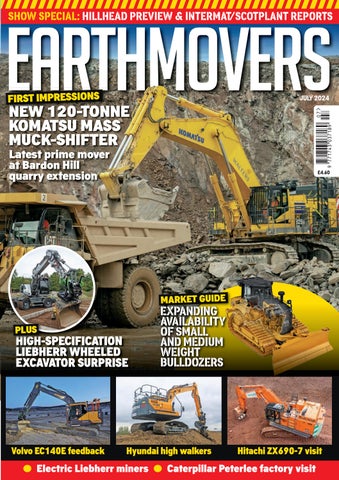
Earthmovers July 2024

Page 1


Editor Graham Black

Editor@EarthmoversMagazine.co.uk

News Editor Kyle Molyneux

Sub Editor Paul Carter

Advertisement Sales

Richard Cosgrove +44 (0) 20 8639 4416

Michael Burgess +44 (0) 20 8639 4417

Sales & Marketing Manager Richard Cosgrove

Administrator Martin Attis

Publishing Director Paul Cosgrove

EARTHMOVERS is published by

Sundial Magazines Ltd, Sundial House, 17 Wickham Road, Beckenham, Kent BR3 5JS. +44 (0) 20 8639 4400

www.EarthmoversMagazine.co.uk

Info@EarthmoversMagazine.co.uk

Subscriptions

Earthmovers subscriptions

Trinity House, Sculpins Lane, Essex, CM7 4AY, England. +44 (0) 1371 853 632

earthmovers@escosubs.co.uk

Newstrade

If you have any difficulty obtaining Earthmovers from your newsagent please contact Seymour Distribution, 5 East Poultry Avenue, London EC1A 9PT. +44 (0) 20 7429 4000

Repro

Design & Printing Solutions Ltd, First Floor, Unit 45C, Joseph Wilson Industrial Estate, Whitstable, Kent CT5 3PS.

Printing

William Gibbons & Sons Ltd., 26 Planetary Road, Willenhall, West Midlands, WV13 3XB.

Copyright

Sundial Magazines Ltd 2024. All rights reserved. Reproduction in whole or in part is forbidden except with the written permission of the publishers.

ISSN 1743-0372 Sundial Magazines Ltd. Registered in England No 4134490.

Conditions for advertising

All advertisements are accepted subject to the publisher’s standard conditions of insertion. For a copy of Advertising Terms & Conditions, please write to Paul Cosgrove at Sundial Magazines Ltd, Sundial House, 17 Wickham Road, Beckenham, Kent BR3 5JS.

Australian subs sales agent

Greg McNiece, Rally Badges, PO Box 9, Tatura, Victoria 3616, Australia. +61 (0) 3 5824 1734

www.twitter.com/ EarthmoversMag

The next issue of EARTHMOVERS magazine is available on 5 July

Show season

The early summer show season in Europe has been dominated by the appearance of larger battery-electric earthmoving machinery. At the previous Intermat event, which was held before the Pandemic, the very notion of a decent sized excavator powered by a battery would have been received with a Gallic shrug. As would hydrogen-powered machines and autonomous construction equipment. The global industry has come a long way in just a few years to begin to offer its customers low- to zero-emissions technology.

One sector that is ahead of the game is the cluster of mobile crushing and screening machinery manufacturers based in Northern Ireland. As we will see at the forthcoming Hillhead show, such kit increasingly features a diesel-electric driveline. In itself, this is an economic and environmentally friendly way to consume diesel, but the ability to plug them into an appropriate electrical supply provides the opportunity for zero-emissions working.

Perhaps the highlight of the year so far is the first public appearance of machines powered by hydrogen fuel cells, in the shape of Volvo’s articulated dump truck and Liebherr’s just-announced large mining haul truck.

One thing is for sure, by the time the industry gathers at Plantworx 2025, the pressure will be on to accelerate the adoption of such modern earthmoving technologies.

Yours till next month

CONTENTS

New Komatsu PC1250SP-11 excavator makes its working debut in the UK.

A round-up of the latest news from the earthmoving and associated machinery industry.

The availability of small- to mediumsized dozers continues to increase.

Small business in Ireland has diversified into operating large dozers.

Working with contractor WM Donald’s latest high-spec Volvo excavator.

Wide range of zero-emissions machinery on display at the Paris Intermat show.

New compact construction equipment at the recent French show

Report from Aberdeen on a high-spec 16-tonne class wheeled excavator.

Operator has found a niche in precise excavation and finishing works.

Looking forward to the forthcoming Hillhead machinery extravaganza.

Highlights of the machinery exhibition at the Highland Showground.

New 70-plus-tonne excavator at the NRS Group’s Saredon Quarry.

Huge project in Helsinki includes significant underground excavation.

73 85 91 57

79 MATERIALS HANDLING SENNEBOGEN 865E

FM Conway’s electric 100-tonner on dockside duties in Greater London.

85

FACTORY VISIT CAT PETERLEE

The manufacturing and assembly operations at Cat’s UK ADT plant.

89 INTERVIEW RICHARD BRADBURY

Head of the Hillhead show team’s ambitions for this year’s spectacular.

91

TECHNOLOGY LIEBHERR MINING

Australia’s Fortescue Metals’ progress towards carbon neutral mining.

96

PLANTMOBILIA SENNEBOGEN 830E

Conrad’s 1:50-scale model of this high-reach demolition-spec excavator.

98 NEXT MONTH

Here’s a taster of just some of the exciting features planned for the next issue.

102 PICTURE POST

Got any interesting or unusual pictures of earthmoving men or machinery? WIN £20 for our ‘Pic of the Month’.

NEW PRIME MOVER FOR NEW WORKINGS

Paul Argent reports on the 120-tonne class Komatsu PC1250SP-11 excavator run by the Walters Group, the first example of this model to be put to work in the UK

Below and inset: A 120-tonne class Komatsu PC1250SP-11 mass excavator has been commissioned by the Walters Group for the load and haul contract at the Bardon Hill Quarry.
“YOUGETTHE TOOLSTOENSURE YOUCANDOYOUR JOBSAFELYAND PRODUCTIVELY, WHICHMAKES OURLIFEEASIER”

The Bardon Hill site in Leicestershire is one of a handful of operations in the UK that are classified as a ‘Super Quarry’, in this case producing four million tonnes of high-quality aggregates a year. Now owned and operated by Aggregate Industries, part of one of the global Holcim Group, the granite deposit at Bardon Hill has been worked since 1835, and serious commercial operations started in 1857. The Victorian-era quarry has now been worked-out, its final voids being filled with overburden generated from the establishment of a new quarrying area at Bardon Hill.

Complete with its own primary crusher, the new 128-hectare site will essentially be a replica of the former quarry. Reaching a maximum depth of 200m, the new workings could yield over 130m tonnes of high-quality granite over the next three decades or so. The majority of this much sought-after granite will be crushed and screened into a variety of aggregates. There is minimal waste, as oversized blasted material finds uses in sea defence and scour protection projects.

The development of the quarry extension started in 2015, when South Wales-based Walters Group conducted the soil and overburden strip, followed by enabling works. Leading this team was contract manager Nick Cox, who has lived and breathed this project since its conception.

He said, “The entire development work for the new quarry has been an interesting one. A very busy one and one that has had me awake in the early hours some mornings. As with any major infrastructure and earthmoving project, we had to hit our goals, which we did, and deliver what is now a four million tonne a year quarry.”

UP AND RUNNING

Nick and his team have remained on site, their previous contribution helping Walters secure the contract to load and haul the blasted rock from the faces to the crusher. In addition, they continue to strip overburden across the new quarry site. The load and haul contract is to feed a static primary crusher located in a corner of the site, which is capable of handling up to 2200 tonnes per hour. Its in-feed hopper is

designed for a pair of 100t capacity dump trucks to discharge their loads simultaneously. The resulting crushed granite is then sent via a conveyor belt over to the existing secondary crusher and screening plant, located close to the original workings.

The team work a single shift over five days, with the occasional Saturday mornings when required, which is not a lot of time to shift four million tonnes a year. However, they clearly have the operation dialled into perfection, backed up by the substantial plant fleet of the Walters Group. This includes a 105-tonne wheel loader and a 95-tonne excavator conducting primary loading at the faces, together with a raft of smaller kit, allowing the team the flexibility to work the different seams of material quickly, safely and productively.

NEW 120-TONNER

One of the latest additions to the front-line fleet at Bardon Hill is the first Komatsu PC1250SP-11 excavator to be put to work in the UK. The SP in the model’s name stands for Super Performance, Komatsu’s label for a mass excavation spec machine, which features a shorter than normal boom and

Below: With the Victorian-era workings now exhausted and being back-filled, a new granite quarrying area is now being worked at the massive Bardon Hill site.

Above, inset and below:

A

dipper for increased breakout forces.

The Walters Group has been a fan of these excavators for many years, using them in their former coal mining operations as well as quarrying projects.

Works manager Colin Beasley said, “We like the Komatsu as a product. The PC1250SP-8 we used here before was an excellent digger, powerful and reliable and was always on top of the job. Over the years we have used several large Komatsu excavators, loading shovels and trucks here, they have been excellent performers.”

Colin has over 35 years of quarrying experience, most of which has been gained at Bardon Hill, on both the original quarry and now with Walters on the new workings. He continued, “Walters is a great company to work for. They expect you to deliver, but their support is fantastic. Just look at all of the new and modern kit we have here. You get the tools to ensure you can do your job safely and productively, and that makes our life a little easier.”

Unlike Komatsu’s construction excavators that are built in the UK, this smallest example of their quarry/mining excavator range is manufactured at their Osaka factory in Japan. The PC1250SP-11 arrived at Bardon Hill at the end of 2023, as 10 loads of pre-built assemblies.

HILL QUARRY

KOMATSU PC1250-11 SPEC

The SP version of the PC1250-11 is configured with a 7.8m mono-boom and a 3.4m dipper stick. This short working equipment is ideally suited to the heavy digging conditions in this granite quarry. However, this short boom and dipper combination provides a ground level reach of 15m. Again, it is ideally suited to the site’s working practices, which will see the excavator sitting on a shallow bench, pulling the blasted material towards it for loading.

The Dash 11 version of the PC1250 looks like its old-school predecessor, but at 118 tonnes, it has put on almost eight tonnes, mainly in the undercarriage, dipper stick and main cylinders. One notable change is a new cab, which is reached by a new walkway and steps in a design inspired by the larger PC2000 mining excavator.

One of the biggest changes over the outgoing Dash 8 model is an ultra-low emissions 23-litre, six-cylinder Komatsu engine rated at 758hp, 15% more than its predecessor. This increase in power, with a significant reduction in carbon emissions and an improvement in performance, has not come at the cost of a much higher fuel bill. The feedback from Walters is that the new Dash 11 is consuming very little more than the old Dash 8 machine.

Komatsu’s recommendation for a PC1250SP-11 in lighter material is a 7.57cu.m capacity bucket. The high density of the granite rock at Bardon Hill has meant a reduction in bucket volume down to 6.5 cubic metres, which still equates to around 10 tonnes per loading cycle. The heavy-duty bucket in question was manufactured in the UK by HSM.

Right: The load and haul contract feeds a primary crusher, which features two tipping stations on its intake hopper, at a rate of up to 2200 tonnes per hour.
6.5cu.m heavy-duty rock bucket from HSM is attached to mass excavation working equipment comprising a 7.8m boom and a 3.4m stick.

SITE VISIT // BARDON HILL QUARRY

“IT’SACOMFORTABLEAND

A team from dealer Marubeni Komatsu spent two weeks assembling and commissioning the 120-tonne/758hp machine.

IN THE CAB

In addition to a more powerful 23-litre engine (see panel), the major difference between the Dash 11 and 8 versions of the PC1250 is the cab, the new model benefiting from the wider Komatsu SpaceCab, which sits on viscous mountings. As a result the transmission of vibration and shaking to the operator is minimised. Fittings include a high-backed heated and air-suspended seat.

Its regular operator Billy Upton was on the levers of the previous Komatsu and other excavators of a similar size. Regarding the new Dash 11 machine he said, “It has a comfortable and spacious cab with userfriendly controls within easy reach. It’s also quiet, which is great as handling rock all day can be a noisy job.”

The standard fi includes a falling object guard on the roof and a guard against impacts to the laminated one-piece front screen. Partly thanks to the position of the boom mounting, the view from the seat to the offside of the machine is surprisingly good for an excavator in this size class. This is supplemented by the multi-camera KomVision system, which provides the operator with a 270-degree bird’s-eye view round the 120-tonner.

The climb up to the next bench was no problem for the big excavator. Once settled on top of the shallow bench, Billy first tackled the material lying against the face. The excavator’s short mass excavation working equipment provided a very respectable ground level reach of 15m,

enabling this working sequence to quickly form a rock trap between the face and the excavator.

Slewing only 90 degrees on each cycle, Billy loaded a mixture of 100- and 65-tonne capacity quarry trucks with approximately 10 tonnes of blasted granite in around 20 seconds per pass. The variables were the material itself and what condition it is in after being blasted. It takes about three minutes to load a 100-tonner, while the smaller haulers are despatched after just two minutes.

Apart from the sound of the first bucket-load hitting the bottom of the truck’s body, in operation this modern, ultra-low emissions mining excavator

generated very little noise. The sound of blast hole drilling on another part of the site was more noticeable to a bystander than the excavator digging and slewing.

CONCLUSION

As the extraction teams are currently working on a similar level to the crusher, current haul times are minimal, but as the workings gradually deepen, additional trucks will be drafted in by Walters to maintain production levels.

Over its first few months in wet, winter conditions, the new Komatsu PC1250SP-11 has settled well into its life at the Bardon Hill granite quarry. The Walters Group is gearing up for a big push over the forthcoming months. With drier weather on the horizon, contract manager Nick Cox and the overburden team are getting ready to shift a serious volume of material, which we plan to report on in due course.

Below and inset: Operator Billy Upton says the large new-generation cab is comfortable, the controls are all within easy reach and it is a nice and quiet working environment.

NEWS

X LEICA-XWATCH CONSOLIDATION

watch Safety Solutions, run by Dan Leaney, has been bought by Hexagon, the parent company of Leica. This follows the successful collaboration between Leica and Xwatch to offer an innovative 3D avoidance zone system. Xwatch will continue to operate under its own brand and maintain its relationships with dealers and installers. However, this move opens the global market to Xwatch’s cutting-edge safety technology, which was designed in the UK.

In other news, Leica has launched the iCON 120 smart GPS antenna, a scalable and flexible input into their MC1 machine control platform. This is intended for use on a wider range of smaller equipment than a more sophisticated excavator or dozer installation, for example on compaction rollers, which usually require only sub-metre accuracy.

A round-up of news stories in the plant and machinery construction industry ant

USED CATS FOR UKRAINE

It can now be disclosed that in November 2023 the UK Ministry of Defence (MoD) placed a significant order with Caterpillar distributor Finning for a range of heavy equipment for shipment to Ukraine. The MoD, on behalf of the UK-administered International Fund for Ukraine, ordered 82 fully operational used machines, to be delivered in-country by the end of April 2024. These machines are primarily needed to support rebuilding works on important parts of the country’s infrastructure, including sites damaged during the conflict, and repairing underground utilities.

Over half of the units were sourced from used stock in the UK, the rest coming from Caterpillar dealerships around Europe and even as far afield as the USA. All the machines were prepped at one of Finning’s depots across the UK. Remarkably, the first batch of 25 machines was delivered by the end of 2023 and the balance shipped in the first few months of this year.

UPDATED KOMATSU QUARRY TRUCK

Komatsu’s new 64-tonne payload/43cu.m capacity HD605-10 rigid dump truck is powered by an ultra-low emissions 610kW engine and features three drive modes: economy, economy light and power, together with hill start assist and cruise control.

STOP PRESS

s mentioned elsewhere in this issue, working with the progressive Australian mining firm Fortescue Metals, Liebherr was thought to be close to demonstrating the viability of a large mining dump truck powered by hydrogen fuel. As we go to press, news came through that the T264 haul truck, nick-named Europa, has been driven for the first time. It features a 500kW fuel cell, for which the energy is stored in a UK-developed 1.6MWh battery pack. The vehicle’s onboard tanks are able to store 380kg of liquid hydrogen.

A HYUNDAI SUGRUE AHEAD HYDROGEN HAULER SURPRISE

Suffolk-based plant hire and contracting company JJ Sugrue has added the first Hyundai HX85A midi-excavator to its fleet, with a second machine already on order. Supplied by local dealer Ernest Doe, the 8.5-tonne excavator is the 38th Hyundai machine to be purchased by the company over the years.

The CEO of Fortescue Metals, Dino Otranto, said, “Following the success of our battery-electric haul truck prototype, we’re thrilled to now have Europa up and running on hydrogen. This is a huge achievement for the team and brings Fortescue another step closer to having a fl eet of zero-emissions trucks at our sites by the end of this decade. We’re aiming to transport Europa to our mining operations within the coming weeks, where it will then undergo further site-based testing and commissioning.”

METSO MINING NEWS

The new Metso XM Series of mining crushers are said to combine the latest in digital technologies, such as their SmartCone and SmartStation sub-systems, with the Mineral Crusher Pilot (MCP) automation system. The XM Series uses Nordberg MP Series cone crushers and Superior MKIII primary gyratory crushers. The Xtreme forged heads of the Nordberg MP Series crushers are three times more robust than industry standards and are the most durable heads designed for the most demanding crushing applications. Hence the units come with an impressive 25-year warranty.

In other news, Metso has introduced the Lokotrack EC range of diesel-electric/all electric processing machinery. The first two include the 68t LT400J high-capacity jaw crusher, designed for the primary crushing of hard rock and recycled aggregates. It is joined by the 50t LT350C cone crusher, designed for secondary and tertiary crushing.

In addition to now offering payload weight systems, Metso has expanded its range of products to include haul truck bed liners, together with buckets and wear parts. Metso has also announced the delivery of its 100th mining haul truck body, the milestone example having been delivered to Boliden’s Kevitsa mine in the Sodankylä region of Finland.

NEW NORTHERN DEALERS

ollowing their appointment as the dealer for Thwaites for the north-east of England, the Molson Group now also covers Dumfries and Galloway together with the Scottish Borders region for the iconic British site dumper manufacturer. Meanwhile, AngloFrench manufacturer Mecalac has announced the appointment of Carlisle-based Lloyd as its dealer across northern England and southern/central Scotland.

TRADE FUNDING TO COMBAT PLANT THEFT

unding by the Construction Plant-hire Association (CPA) and other trade organisations is having a direct impact on the successful recovery of stolen plant equipment, says superintendent Andy Huddleston, who heads up the Police’s National Rural Crime Unit and the National Construction & Agriculture Theft Team.

Last year, the CPA made a three-year commitment to fund £90,000 to help fight plant equipment theft and fraud, which is costing the construction plant industry millions every year. With additional funding from the Construction Equipment Association (CEA), CESAR donors and insurers, a total of £650,000 is being contributed collectively to help fund the national crime units.

The next annual CPA conference will take place on 7 November 2024, at the Heart of England Conference and Events Centre near Coventry.

NEW ADT & LOADER TYRES

ichelin has unveiled a new range of tyres for wheel loaders and articulated dump trucks, built to cater for the more powerful and sturdy vehicles that operate in modern quarries. Badged Michelin Xtra Defend E4 L4, the new range has a load capacity of up to 25,400kg per tyre, and a speed ranging up to 14kph.

They have been developed to adapt to intensive cycles on both hard and muddy ground. The new tyres are said to offer great mobility under difficult conditions on aggressive surfaces during loading and transport cycles. With six sizes available, the re-treadable Xtra Defend E4 L4 range increases Michelin’s construction tyre offering from 25in to 29in.

JCB FLEET FOR COBALT

n an order worth £4m, Cobalt Plant Hire has invested in a further batch of new JCB machinery. Founded in 2022 with support from JCB Finance, Cobalt’s fleet has been expanded with 140X and 220X excavators, 85Z-2 and 86C-2 midi-excavators, together with six-and nine-tonne site dumpers. Supplied by dealer Greenshields, they take Cobalt’s fleet of JCBs up to 55 machines, all with the Kent-based firm’s striking dark blue livery.

A GLIMPSE OF TOMORROW

Eoghan Daly reports from Paris on the wide range of zero-emissions machinery on display at the much-awaited return of the Intermat trade show

Judging by the volume of zero-emissions machinery on display at the recent 2024 event – from pavers to container handlers – much has changed over the six years since the previous Intermat show in 2018.

Most leading global construction machinery manufacturers now have a small electric mini-excavator or two in their range. There is also an increasingly wide variety of associated battery-powered compact equipment available, including

site dumpers and telehandlers, particularly from European manufacturers.

What we are now seeing in Northern European markets is the introduction of much larger battery-powered excavators in the 22-tonne class. Full-sized wheel loaders and electric wheeled excavators are also beginning to appear, alongside battery-powered road construction and materials handling kit, together with electric road-going trucks.

HYDROGEN POWER

A lack of supply and infrastructure is hampering the introduction of hydrogenpowered machinery, which has much to offer, particularly machine availability. As the refuelling time of batteryelectric kit is measured in hours, such machines do not

easily fit into the working pattern of those earthmoving sites that operate over more than one shift a day.

Hydrogen machinery, powered either by a combustion engine or a fuel cell, can be refuelled in minutes. The fuel can also be delivered on the back of a truck, without the need to deploy a diesel/solar generator set to support a machine working in a temporary remote location.

As reviewed in last month’s issue of EARTHMOVERS, the star attraction on the Volvo stand was a development prototype of a hydrogen fuel cell-powered articulated dump truck. On the Develon stand, a concept machine, the 250 FCEV (fuel cell electric vehicle) wheel loader, made a public appearance. Its bulky rear end currently hosts a hydrogen fuel cell and tanks, but we understand that a battery-electric version is also being developed.

Engine manufacturer Deutz showed several items from its growing range of sustainable power products, including a production-ready hydrogen-fuelled combustion engine. This zero-emissions engine is also at the heart of Deutz’s on-site generator/power bank, which they call the Power Tree. Deutz has also developed an array of battery/electric drivetrain components, as demonstrated on their stand with a mini-excavator that had been converted from diesel-power.

Above and below left: Two hydrogen fuel cell-powered machines caught the eye at Intermat: Volvo’s articulated dump truck and Develon’s wheel loader.
Above: Deutz is developing several environmentally friendly power systems, including a hydrogen combustion engine.

DEVELON DUCK DUO

One of the most impressive machines at Intermat was the Develon 14W-EREV (extended range electric vehicle) wheeled excavator. It is being developed both as a battery-electric machine and a diesel-electric hybrid. The hybrid version on show featured an in-house 50kW diesel engine and a 120kWh battery. Fully electric version will feature two of these battery packs. The overall configuration of this 14-tonne, zero-tailswing wheeled excavator sees most of its driveline components located in the undercarriage, an overall layout that is already well proven in JCB’s Hydradig.

COMPACT

14-TONNE HITACHI

Hitachi showcased its reduced radius Zaxis 135-6 crawler excavator, which is produced in Europe. It features a 300kWh battery pack driving an 800v system, the rated power of the electric motors being 160kW. It has an operating range of six hours, taking just over two hours to recharge from an AC supply, or just 75 minutes from Hitachi’s rapid charger.

RECHARGING THE BIG SUNWARD

In addition to a reduced radius six-tonne mini-excavator, Sunward presented the SWE240 FED model. At 24-plus-tonnes it’s the largest battery-electric excavator currently on the market. However, what also caught the eye was their prototype of a high mobility AC/DC recharging unit that features a 300kWh power bank mounted on the back of a tracked carrier base unit.

A LONG WAY TOGETHER

EARTHMAX SR 41

No matter how challenging your needs, EARTHMAX SR 41 is your best ally when it comes to operations that require extraordinary traction. Thanks to its All Steel radial structure and the special block pattern, EARTHMAX SR 41 provides excellent resistance against punctures and an extended service life. In addition to long working hours without downtime, the tyre ensures extraordinary comfort.

EARTHMAX SR 41 is BKT’s response to withstand the toughest operating conditions in haulage, loading and dozing applications.

IMPORTER FOR THE UK

Tel: +44 0151 728 4171

bkt_enquiries@kirkbytyres.co.uk

www.kirkbytyres.co.uk

COMPACT RADIUS KOMATSU 15-TONNER

Showcased alongside the PC210-11LCE counterbalance excavator and other battery-electric machines on the Komatsu stand was the compact radius PC138-11E model. With a slew radius of 1830mm, it is 350mm longer than its diesel counterpart, but for a 15-plus-tonne excavator is still reasonably short. Its rear end accommodates a 225kWh battery pack, which drives a 72.5kW electric motor, just about the same power rating as the diesel-powered PC139US-11.

TECHNOLOGY ZERO EMISSIONS

LIEBHERR ELECTIC HANDLERS

In addition to electric cranes and port handling machinery, Liebherr displayed the 507E battery/ electric compact wheel loader, together with a similarly powered telehandler. The T32-7E compact telescopic handler features a maximum lift height of 6.9m, a maximum lift capacity of 3.2 tonnes, while the telescopic boom delivers just over 4m of maximum forward reach.

VOLVO PAVER

Volvo highlighted its in-house conversion of an L120H wheel loader to a batteryelectric machine. It features a 237kWh battery pack that drives a 204kW Parker electric motor, which delivers 1395Nm of torque at 1400rpm. However, Volvo also showed a wide range on zero-emissions machinery, including a prototype of the all-electric high-capacity ABG P4820 paver.

BIG AND SMALL CATS

French Caterpillar dealer Bergerat Monneyeur’s stand included a batteryelectric, 19.7-tonne 950GC wheel loader. This prototype is powered by a 600v system and features a battery capacity of 256kWh. Other Cat electric prototypes include the 300.9D mini-excavator, the 906 compact wheel loader and the 320 crawler excavator.

O ELECTRIC SANYS

ne of the largest battery-electric machines on show was the Sany SRSC45ES container reach stacker. This 73-tonner has a massive 422kWh battery pack, providing eight hours of operation. Equipped with two DC charging ports, each with a capacity of 150kW, the machine can be fully recharged in just 90 minutes. At the other end of its growing range of electric construction kit is the Sany SCM500E-10 compact road planer, which provides a milling width of 500mm and a maximum working depth of 180mm.

HYDREMA SITE DUMPER

Hydrema’s first foray into the world of battery-electric construction machines is the DT6 site dumper, a unique design that offers a capacity of 5.5 tonnes from its rotating skip. This version of the DT6 is fitted with a 63kWh lithium-ion battery pack, driving a 96v electric motor from driveline specialist ZF.

YANMAR COMPACT LOADER

Weighing in at 4.5 tonnes, the Yanmar V8E compact wheel loader is available with the choice of two battery packs, rated at either 39.9kWh or 53.2kWh. This machine offers a maximum travel speed of 20kph and can lift 1800kg on pallet forks.

MECALAC SWING LOADER

Mecalac showcased the E12 wheeled excavator, the battery-electric variant of their 12MXT model, which features an articulated chassis and unique working equipment designed for both excavating and loading tasks.

Another unique Mecalac design is the swing wheel loader, where the entire front end working equipment is mounted on a 180-degree slew ring, on a four-wheel steer undercarriage. The ES1000 battery-electric version on show weighs seven tonnes, its 75kWh battery pack providing a working range of eight hours.

LIUGONG 22-TONNER

Intermat was the first opportunity for European customers to see the 22-tonne, 140kW LiuGong 922FE battery-electric excavator, a production machine that is already sold in other markets.

At the show, LiuGong stated their intention to develop a complete range of battery-electric machines, including the 870HE wheeled loader and making the 45t capacity DR50CE forty-five tonne rigid quarry truck available in Europe. Also on their stand was the 6.4-tonne 820TE compact wheel loader, which features a maximum travel speed of 40kph.

anish manufacturer HG showed its range of site dumpers including the 2000E, which offers a capacity of two tonnes in its high-tip rotating skip. Four hours of high-power charge time will provide up to 12 hours of operating range.

SILVER SURPRISE

Paul Argent reports from Aberdeen on a high-spec 16-tonne class wheeled excavator

Below: KNC Groundworks has upgraded its largest wheeled excavator with another Liebherr A914 Compact, on which a triple articulating boom hosts a Steelwrist tilt-rotator.

“ABIGPLUSPOINTFOR THELIEBHERRISTHE GOODALL-ROUNDVISION FROMTHECAB”

A914 COMPACT WALK AROUND

The Liebherr A914 Compact short tailswing wheeled excavator weighs between 15.2 and 17.5 tonnes, depending on its configurations.

The offside of the compact upperstructure, which results in a rear overhang of around 300mm, houses the engine, cooling pack and hydraulic pumps. The engine in question is a four-cylinder FPT powerpack rated at 143hp at 1800rpm.

Driveline components and their service points are easily accessed from ground level, thanks to the full-length gull-wing door on the offside of the upper-structure. Offside and rear cameras are part of the standard spec, which display their output on the Liebherr’s 7in control screen.

“HAVINGTHEABILITYTO WORKCLOSEINTOTHE BODYMAKESITEASYTO SQUEEZEINTOSPOTSTHAT ASTANDARDMACHINE WOULDSTRUGGLE”

Based at Alford near Aberdeen, over the past decade KNC Groundworks has grown significantly under the leadership of Kevin Crawford. Expanding the business around his groundworks profession, Kevin and his team work on behalf of small private clients and large housing and construction companies.

The firm runs a fleet of earthmoving, paving and ancillary equipment, particularly favouring wheeled excavators. Their manoeuvrability, versatility and on-road mobility are ideally suited to work in this rural area.

Kevin said, “We can use a wheeled excavator in the morning on one project and relocate it to another for the rest of the day with ease. It allows us to be more flexible than running an entire fleet of tracked machines, which require transport from job to job.”

The most recent addition to their fleet involved updating their largest wheeled excavator, a 16-tonne class Liebherr, with the latest version of the same reduced swing radius model, configured with a triple articulated boom (TAB) and a tilt-rotator.

Dealing with Liebherr’s Mark Gorrie, there was a late amendment to the order.

Kevin continued, “We were looking to upgrade our existing Liebherr A914 Compact. It had been a great machine despite a few initial niggles, which were sorted out quickly by Mark and his team. We had been discussing a new version and eventually placed the order.

“It was shortly after placing the order I spoke to Mark about the possibility of having the machine in a silver livery, to match our vans and trucks, and he duly obliged. What I didn’t do was tell the machine’s operator, Iain Gray, exactly what he was getting!

“Iain is my longest serving employee, he’s also a great operator and a good person to have on the team. We managed to keep the colour scheme a secret until Iain went to pick the machine up!”

OPERATOR FEEDBACK

In addition to its unique livery and a tilt-rotator on the end of TAB working equipment, this A914 Compact model was ordered with a rear-mounted blade, twin toolboxes and ABS mudguards. Operator Iain commented, “I knew Kevin had ordered a new machine, but to have it turn up in such a good specification and colour was a big

FIRST IMPRESSIONS // LIEBHERR A914

Operator Iain
the Liebherr’s cab comfort and visibility, the smoothness and precision of its hydraulics and its on-road performance.

surprise. He’s a great boss to work for and you want for very little working for him.”

Talking about the cab of his latest A914 Compact, Iain continued, “It’s a great workplace, very comfortable and well laid out. We opted to run the Steelwrist through the existing Liebherr joysticks, as they provide enough functionality for our requirements. That is one thing I like about Liebherrs, they are so smooth on the levers you get feel and precision at all times.

“A big plus point for the Liebherr is the good all-round vision from the cab, despite having the boom to my right-hand side, the low build height of the bodywork means there is very good vision through the mirrors, which is boosted by the side and rear-view cameras.”

From the range of working equipment available for this versatile wheeled excavator, Kevin opted for a two-piece boom with a 2.25m dipper stick. Operator Iain thinks this is ideal for the work he undertakes, providing the best combination of reach and power.

The short arm is fitted with a Steelwrist X18 tilt-rotator supplied by Gareth Evans. Iain remarked, “It adds so much more versatility to an already impressive machine

and allows me to cut out a lot of shovel or raking work for the men on the ground.”

SITE VISIT

We met man and machine on site at a housing development on the outskirts of Banchory, the gateway to Royal Deeside. It was easy to spot the excavator against the trees bordering the site, thanks to its gleaming silver paintwork and its lightbars, supplied by the innovative excavator accessory firm S-Type-X. It had also received a visit from Scotglass, who tinted the windows, adding to the effect of the silver colour scheme.

With the site levelled and the footings in place, Iain was focusing on in-filling around the footings, to create a level surface for the construction team. Some of the stockpile of suitable material, which had been initially stripped from the site, was being tipped in heaps for Iain to spread out.

This would typically be the work of a tracked excavator, but Iain is confident of his wheeled machine’s abilities, saying, “You do have to be sensible, but I have never had any issues taking this, or the older machine, on to softer material, even with the standard Liebherr twin tyres fitted.”

Working his way round the footings, Iain steadily fed the material up to the blockwork, leaving very little shovel work for his labourer, saying, “I can just sit in one position and place the material wherever it is required. Having the two-piece boom adds further to what I’m able to do. The reach on it is great but having the ability to work close into the body makes it easy to squeeze into spots a small standard machine would struggle. It really is a very versatile piece of kit.”

Illustrating the versatility of his wheeled machine, Iain picked up a large compactor plate with the Steelwrist’s integrated gripper and moved it into the foundation for the groundworks team. He then quickly swapped his Scandi-style bucket for a set of pallet forks to move some coils of ducting across the site. Spending a lot of time working in the valleys of the rivers Dee and Don, which flow from the Grampian mountains, Iain concluded by saying that the Liebherr’s two-speed powershift transmission is good on the road. Only the steepest climbs will slow his progress, while on-road comfort is helped by the wheeled excavator’s boom suspension system.

Gray praises

JOIN US AT HILLHEAD 2024

Explore the full range of CASE products and services, tailored to meet your construction business needs

25-27 JUNE

Hillhead Quarry, Buxton, Derbyshire, UK

Stand X10

SHOW PREVIEW // HILLHEAD 2024

HILLHEAD HIGHLIGHTS

Paul Argent reports on a new 70-plus-tonne Hitachi excavator working at the NRS Group’s Saredon Quarry

he 2024 Hillhead exhibition looks set to be the biggest to date, with more than 600 companies demonstrating the latest equipment, technology and services available to contractors in the quarrying, construction and recycling industries. Taking place at the Hillhead Quarry near Buxton in Derbyshire from June 25 to 27, more than 18,000 visitors are expected to attend this year’s event.

THillhead is a unique event in the world’s heavy plant trade show calendar, as there are extensive demonstration areas at the face of a working quarry. This allows crusher and screener manufacturers a rare opportunity to showcase their latest kit in action, fed by a variety of excavator and truck combinations, which is always a highlight of the show.

Powerscreen will have an updated 1300X cone crusher at work at the face.

This revised model follows last year’s updates to their jaw and impact crusher ranges, focusing on further improving

productivity and reducing carbon emissions. The firm will also be providing further details of their project with Catagen, a developer of hydrogen and other green e-fuel systems. It is understood that this development project is initially focusing on a Premiertrak 450E crusher and a Chieftain 1700XE screen.

Austrian mobile crushing plant manufacturer SBM Mineral Processing will be at Hillhead with a range of Jawmax track-mounted jaw crushers and Remax impact crushers, which stretch from 23 to 160 tonnes operating weight. The machines use a diesel-electric hybrid driveline, with the option of a full electric plug-in solution. Hillhead will see the UK launch of the Remax 600 impact crusher, which produces up to 600 tonnes/hour. It weighs 80 tonnes and, where possible, can be transported as a single unit, providing a set-up time of just 45 minutes.

While tracked crushing and screening equipment may be well established in the UK market, Rapid International and sister

company Rapid Power Generation are hoping to bring crawler-mounted concrete mixing to the sector. Working with sales partner Concrete Technology, Rapid will exhibit the Trakmix 250, a crawlermounted mobile continuous mixing plant. It can produce up to 250 tonnes/hour in a self-contained production unit that can be set up and mixing within hours of arrival on site, which also weighs all materials.

Hill Engineering will debut an updated 20-tonne Tefra Connect coupler and their Tefra Connect display screen at the show. Other highlights of their stand will be a quick-hitch for a JCB 3CX, a tilt-coupler aimed at 20-tonne class excavators and a bucket/thumb combination for 13-tonners. Tefra Connect is a new way to connect hydraulic attachments automatically, while retaining the ability to use standard attachments on the same machine.

The following are highlights of the new earthmoving machinery to be found at the show, which should be worth a visit.

JCB RETURNS WITH A BANG

UK plant giant JCB will make a welcome return to the show this year, demonstrating its biggest X-Series crawler excavator, the recently launched 370X model. It will compete in the 35- to 40-tonne sector of the market and is powered by a 322hp (240kW) Cummins engine. The updated cab features JCB’s new UX interface, which works through a 10in touch-screen. A full range of JCB kit will be on display, from loading shovels to power generation kit, including their revolutionary Dual Drive backhoe loaders, plus the new Raptor tilt-rotator for the Hydradig wheeled excavator.

WIDER CASE RANGE

Case will concentrate on wheeled loaders and crawler excavators at this year’s show, where the recently-launched 651G Evolution loader and second version of the 21-tonne excavator take centre stage. The 651G sits between the established 621G and 721G models, boasting increased loading performance, reinforced chassis sections and axles with a choice of locking differentials. The CX210E-S is a 21-tonne class excavator offered with a simplified list of options at a lower entry price than the standard machine. There will also be two electric minis on show, together with the electric 12EV loader.

DEVELON DIGS DEEP

Develon is showcasing its DX530-7 excavator on the stand, plus a DX420-7 working on the demo area. These larger excavators are an ideal match to the firm’s DA45-7 articulated dump truck, which will also be on display. Develon’s wheeled loader range will be present too, with a DL420-7 on the stand and a DL550-7 working. No doubt attracting much attention will be the firm’s new dozer, the DD130-7 model, as reviewed in the previous issue of EARTHMOVERS. Finally, Develon will also present the DX140RDM-7, a 22.5-tonne demolition excavator that offers a wide range of boom configurations.

SHOW PREVIEW // HILLHEAD 2024

HEAVYWEIGHT HYUNDAIS

Hyundai will also move to a new stand position in front of the main demonstration area, where it will host their largest excavator, the 100-tonne HX1000A. This is one of two new quarry machines on offer from Hyundai, the other being the 80-tonne HX800A model. Also a new large wheel loader will be on show in the shape of the HL985A. This 35-tonner has a standard bucket capacity of 7cu.m, and a bucket breakout force of up to 28,400kg. Another highlight of their stand is the recently-launched

SANY ON A ROLL

Sany has benefited from a shake-up in stand locations at Hillhead, as they are now in a prime position in front of the demonstration area. Both their large SY500H and SY390H excavators will make the most of this opportunity, while a second SY390H model will be available on their stand for closer inspection.

Other static exhibits include an extensive range of compact excavators, alongside a new 18m-reach STH1840 telehandler, which was recently launched at the Scotplant show. It joins two smaller telehandlers in the range, all powered by Deutz engines.

75 YEARS OF LIEBHERR

Liebherr will be celebrating its 75th anniversary this year at Hillhead, though the company is far from resting on past success. Looking to the future, their stand will display a range of new technologies, including electric machines and progress towards hydrogen power.

Static equipment on show will include dozers, tracked excavators, telescopic handlers, wheeled loaders and the latest truck mixers, together with their increasingly popular articulated dump truck. The firm will also have several machines from the Liebherr Rental fleet at work in the demonstration area.

SHOW PREVIEW // HILLHEAD 2024

TAKEUCHI COMPACTS

The latest 3-Series of compact excavators will take centre stage on the Takeuchi stand, including the TB320 mini, which is available with either a cab or canopy. Capable of handling heavy attachments, it comes with four auxiliary ports, a long dipper arm, heavy counterweight and longer track frame for added stability. The new wheeled TB370W model, available from early next year, comes with a two-piece boom as standard. The larger 10-tonne TB395W wheeled excavator now comes with the option of four-wheel steering, including crab steering and a fourth auxiliary circuit.

DIESEL & ELECTRIC MINIS

Fresh from their success at the Intermat show, Sunward will use Hillhead 2024 to launch the SWE50UF and SWE60UFED compact excavators on to the UK market. Weighing in at five tonnes, the SWE50UF is a zero-swing model that is powered by a Kubota diesel engine. The six-tonne SWE 60UFED model also features a zero-swing design, but is battery-electric and one of the new generation of larger compact machines that is zero emissions.

Working in the demonstration area will be the SWE215F-5A model, the latest version of their 21-class conventional tracked excavator.

EXPANDING WIRTGEN RANGE

The Wirtgen Group will show machinery from across its various businesses, including Wirtgen, Vogele, Hamm, Kleemann, Benninghoven and John Deere. It will include what is claimed to be the world’s first hydrogen burner from Benninghoven that aims to reduce carbon emissions from asphalt production. There will be two new Vogele pavers, the Super 1900-5i Highway Class and the Mini 500 Compact, while the Wirtgen division will show the W150Fi compact milling machine. The Mobirex MR100(i) NEO/NEOe mobile impact crusher from Kleemann should also prove popular with visitors.

HIGH-SPEC CONFIGURATION

EXPANDING TRACK FRAME

PROPORTIONAL CONTROLS

TRUSTED RELIABILITY

MADE IN JAPAN

READY

MORE FLOW - READY TO GO

The New TAKEUCHI 3-SERIES TB320 2-tonne excavator, available in cab and canopy configurations. Designed to accommodate a wide range of attachments with 3 auxiliary ports as standard, 4th line optional. Ideal for landscapers and owner operators with increased power, hydraulic flow and proportional controls.

Heavy machinery auction - Maltby June 26th

Featuring amazing quarry, screeningand crushing equipment!

Experience the auction live, come visit our stand at Hillhead Stand RE4 (in the registration pavilion) at Hillhead

2018 Kleemann MR110Z Evo 2
2017 McCloskey R155

“ASTHEMATERIALWAS GETTINGHARDER,THEIR OLDEXCAVATORLACKED THEPOWERREQUIRED FORTHETASK”

WHEN THE GOING GETS TOUGH

Paul Argent reports on a new 70-plus-tonne Hitachi excavator working at the NRS Group’s Saredon Quarry

Below and inset: The NRS Group, run by Mark Ketcher, has deployed a new Hitachi ZX690-7 in bulk excavation configuration to their Saredon Quarry.

HITACHI ZX690-7 DRIVELINE

The ultra-low emissions 467hp, six-pot Isuzu engine in this latest Dash 7 version of the Hitachi ZX690 is claimed to be up to 22% more fuel efficient than its predecessor. It drives Hitachi’s legendary hydraulic system, in this application featuring two pumps and two control valves, which are said to enhance efficiency in the swing, boom lowering and arm and bucket roll-out in their large excavator range.

This ZX690-7 model sits on a mechanically extendible undercarriage. With a set of 600mm double grouser pads, the machine puts over 5.5 square metres of track on the ground, while also providing high ground clearance and tractive forces.

With wide-opening doors and ample space around the components, the large, boxy upper-structure provides excellent service access. Inspection points for items such as the fuel filter and the fuel pre-filter, are conveniently located from the walkway surrounding the upper-structure.

This large excavator comes with Hitachi’s unique ConSite oil sub-system as standard. This takes excavator telematics remote data monitoring systems to another level, as it also monitors the quality of the engine and hydraulic oils, checking for early signs of deterioration or contamination.

The NRS Group was formed 19 years ago by Mark Ketcher, initially running a single tipper truck and gradually expanding to a general haulage business running a fleet of HGVs. With tipper trucks at the heart of the operation, Mark and his team became familiar with inert landfill and quarry sites.

When the opportunity arose to acquire several Biffa sites across the Midlands region of England, Mark jumped at the chance. It started in 2011, when NRS purchased the huge Saredon Quarry located adjacent to the M6 motorway and was followed in 2014 by the establishment of their recycling and landfill site at Meriden. A move into ready-mixed concrete production saw Midlands Mini Mix open for business the following year, and Woodcote Quarry near Telford was acquired in 2017.

NRS runs some of the largest inert tipping facilities, along with quarrying and recycling aggregate production operations in the Midlands and has over 130 employees. Mark believes in treating people how he would like to be treated, resulting

“WEARENOWLOOKINGTOPOTENTIALLY ADDACOUPLEOF40-TONNETRUCKSTOGET THEFULLBENEFITFROMTHEMACHINE”

in extremely low employee turnover and a team that strives to offer their customers a high-quality service.

NEW 70-TONNER

Tipper trucks are at the core of the NRS fleet, supplemented in recent years by concrete trucks, together with substantial investments over the years in earthmoving equipment to operate their landfill and quarrying sites. NRS’s handful of quarries alone have a combined output of over one million tonnes a year.

Many of their front-line earthmoving machines were sourced locally to their sites. This changed recently when a factory-fresh Hitachi ZX690-7 excavator, in bulk excavation configuration and weighing some 72 tonnes, started work at Saredon. NRS operated an older excavator, of a similar weight, at the Saredon Quarry. However, as the material was getting harder and harder, their old excavator lacked the power required for the task in hand, with concerns about its ongoing availability in increasingly tough conditions.

As Mark was pondering his options, Hitachi’s regional sales director,

Jon Barnfield, called in to see him. NRS has a long-standing relationship with Hitachi UK, as they are Hitachi’s landlord for their used equipment site at Meriden. Jon jokingly asked why his potential customers should have to see yellow booms in the air when they come and look at the used Hitachi machines. The unexpected reply from Mark was to request a quote for a new 70-tonner.

Jon said, “I’ll admit we weren’t the cheapest for this particular deal. However, when we factored in the increased productivity, reliability and strong residuals, a ZX690-7 was an obvious choice. We were also able to supply quickly and, following a trial at their Woodcote Quarry site, impressed operator Steve Platt that much that we secured the deal there and then.”

INITIAL PERFORMANCE

Following a brief spell at the fi rm’s Woodcote Quarry, the big Hitachi was put to work at the massive Saredon site. At the time of our visit, it was deployed on site development works, excavating a new haul road.

The cab on the ZX690 has been brought into line with the other Dash 7 models, with an increase in size to accommodate additional space behind the seat, together with providing additional headroom. The cab isolation mounts have been upgraded, as has the sound insulation, with an in-cab noise level of just 74dB(A).

The new cab also features a refreshed layout with a new control console, together with a heated and cooled cup holder, USB ports, 12v and 24v sockets. The new 8in LCD monitor allows easier access and a clearer display of machine functions including air conditioning, DAB+ radio and Bluetooth.

The heated, air-suspended seat and joysticks are now as one, allowing for a range of movements to suit every operator’s preference to be dialled in. The front windscreen features a new parallel wiper system with washers, allowing more glass area to be cleaned on every pass.

FIRST IMPRESSIONS // HITACHI ZX690-7

“SHEDIGSFARBETTER THANTHEOTHERBIG MACHINEWEHAD.I’M VERYPLEASEDWITH THEPERFORMANCE”

This ZX690-7 was supplied in Hitachi’s bulk excavation (BE) specification, with a 6.8m boom married to a 2.9m dipper stick. It provides the operator with a ground level reach of over 11m and a dig depth of just over 7m. More importantly in this application, this shorter than normal working equipment provides an increase in breakout force, up from 324kN to 369kN, an impressive 14% increase over the standard build. Powered by a six-cylinder Isuzu engine rated at 467hp, the new 70-tonne class Hitachi is more than a match for the site’s 30t capacity articulated dump trucks.

NRS’s Allan McKenzie said, “We are very pleased with the productivity from the Hitachi. With its ability to fill the 30-tonne trucks in just four passes, we are now looking to potentially add a couple of 40-tonners to get the full benefit from the machine. While the Hitachi hasn’t had an issue with the hard material, it is getting the ability to rip it into smaller pieces, which will allow us to process it quicker and easier.”

With a suitable heavy-duty quick coupler on order, the excavator currently carries a 3.7cu.m rock bucket built by Nick Moore at John Moore Trading. Allan continued, “We have had several buckets built by Nick and his team and they have proved to be very capable in our tough and abrasive material. They were able to turn this bucket around very quickly for us, allowing the machine to go to work at short notice. They are underway with the manufacture of our ripper tooth, which should give us further production savings.”

SITE VISIT

Since the purchase of Saredon some 13 years ago, NRS has continuously developed the site. Along with a licensed inert material tip, sands and gravels are extracted, which are then put through a large wash plant. Over this time NRS has conducted largescale landscaping works, to enable the site to better blend into the surrounding countryside.

Allan continued, “We take huge pride in the way our sites are presented. We have sacrificed a huge volume of tip area to create the lake and landscaping at the northern edge of the site, where our weighbridge and offices are located. It will be the first thing people see when they arrive on site and as they say, first impressions last.”

been awful over the past few months and has delayed us expanding the operations. We’ve taken the opportunity in this very brief dry spell to at least make a start, to get as much of the development works underway, to allow us to hit the ground running when we get some better weather.”

With an extension to the current quarry approved, the new Hitachi and a trio of 30t capacity Cat articulated trucks were deployed to cut a new haul road into the site, the 70-plus-tonne excavator working its way through the red sandstone overburden.

Allan commented, “The weather has

Operator Steve Platt used the custom 3.7cu.m rock bucket on the 72-tonne excavator to excavate the hard overburden, fourpass loading 30t ADTs, which squirmed their way up the ramp and out of the cut. As each truck was despatched, Steve loosened up the material in front of him, to speed up the next loading cycles.

After being suitably impressed on the initial demonstration of the machine, Steve concluded, “She digs far better than the other big machine we had. She is very stable, even when you get into some of the really tough material, she’ll just knuckle down and dig. It’s very rare I have to back off and try a different approach. I’m very pleased with the performance so far.”

Below and inset: Operator Steve Platt is impressed with the big Hitachi’s digging power and stability, even in the toughest of material.

See it in action at Hillhead 2024. Visit us on stand Z3

The new ZX530-7 large excavator increases your productivity to new levels. It has been designed to deliver guaranteed maximum uptime and reduce your total cost of ownership, which will have a positive impact on your bottom line.

KEEP ON PUSHING

Peter Anderson reviews the increasing availability of small- to medium-sized dozers, with an introduction by Graham Black

The bulldozer has come a long way since its 1920s origins as an agricultural tracked tractor equipped with a cable-operated blade. The versatility of such a machine gained global recognition after an unimaginably large number of them were deployed in the second half of WW2. For example, from 1942 to 1945, Caterpillar built over 56,000 tracked tractors, 40% of which were the larger D7 models typically equipped with a Le Tourneau dozer blade. The post-war rush towards mechanisation of both agricultural and construction activities resulted in a broader choice of dozers from a variety of manufacturers. A key change to the underlying configuration was the introduction of hydraulic – as opposed to cable – operated attachments, which was duly followed by fully enclosed cabs.

By this time, high-horsepower, all-wheel drive wheeled agricultural tractors were increasingly performing the work of tracked machines, leading to a fall in demand for dozers, particularly the smaller models.

With the increasing use of hydraulic 360-degree excavators, many parts of the construction industry turned their backs on the use of medium-sized dozers. Easier to operate excavators also took over many of the duties traditionally performed by backhoe loaders, tracked loaders, scrapers and graders.

Together with the consolidation of the global manufacturing industry towards the end of the century, the choice of construction dozers was becoming severely limited, to the point of just three mainstream options: American Caterpillar, Japanese Komatsu or European Liebherr designs.

SIZE MATTERS

Today, the largest mining dozers, from 50 to over 100 tonnes, are some of the most sophisticated earthmoving machines on the face of the planet. Their mass muck-shifting counterparts, from 35 tonnes upwards, increasingly share much of the same technology.

However, for most construction-related projects, a modern 30-tonne class dozer, such as a Cat D7, Komatsu D85 or the slightly smaller Liebherr PR746, is usually more than enough, many opting for a 20-plus-tonne machine instead, often configured with a low ground pressure undercarriage.

The appeal of such dozers has been transformed in recent years with the introduction of 3D GPS machine control systems. The combination of enough

Above and inset: Operating a modern GPS-equipped small to medium-sized dozer is a far cry from the good old days, particularly cab comfort and visibility.

grunt to push a serious volume of material and perform extremely accurate levelling works at speed, has won hearts, minds and wallets.

Apart from specialist sectors of the industry, the use of sub-20-tonne dozers largely went out of fashion in the UK. However, dozers with operating weights up to 15 tonnes are now enjoying something of a global resurgence. Helped by a 2D or 3D machine guidance or control system, one operator can get through a surprising volume and variety of work. All in a compact package that offers much better visibility than a traditional dozer, and dramatically out-performing the largest tracked skid-steer loader.

BENCHMARK CATS

Caterpillar continues to offer an impressive full range of dozers, from the eight- to 10-tonne D1 and D2 models upwards, including the iconic D7, which now weighs

the best part of 30 tonnes.

Cat has pioneered the use of high drive undercarriages on its larger dozers, which is now fitted to their 20-tonne D5 and 23-tonne D6 models, while the 13-tonne D4 retains a traditional dozer undercarriage. The D6 model is also available with a diesel-electric driveline, which offers many advantages, including fuel consumption, over a conventional driveline.

GPS working environment. They include Slope Assist, Steer Assist and Blade Load Monitor, the last automatically compensating for ground conditions to optimise blade carrying capacity.

HIGH-TECH KOMATSUS

In addition to the nine- to 10-tonne D37 and D39 models that are offered in selected markets, Komatsu’s dozer range includes the 14-tonne D51, the sub-20-tonne D61, the 20-plus-tonne conventional D65 and the high-visibility D71 models, together with the 30-tonne class D85. All are available in either long track (EX) or low ground pressure (PX) configuration. These machines are also available as ‘i’ variants, indicating that they are intelligent dozers, which feature a fully integrated 3D GPS machine control system. The dozers are both physically and digitally equipped to work with such a system, the machine control logic being embedded within the machine’s hydraulics. This allows truly automatic operation, from heavy dozing to fine grading operations.

From the D4 model upwards, the operator simply sets the ground speed based on the changing load. The machine’s black boxes continuously adjust the driveline for the best mix of power and efficiency. Newly manufactured versions now include a range of additional operator assist features as standard, which are intended to fit into a 3D

The operator in charge of the job is helped by the tilt steering function, which automatically tilts the blade to keep the dozer tracking straight. Meanwhile, the integrated system senses and controls the blade load, to optimise the start of the cut and minimise track slip. For both experienced and less-experienced operators all this adds up to a measurable productivity increase, compared with machines working with conventional automated grade-control systems.

Below, right, far right, inset below and below right: This size of dozer is seeing a fundamental change in configuration, providing the operator with much improved visibility and access.

MARKET GUIDE // CONSTRUCTION DOZERS

HYDROSTATIC LIEBHERRS

Over the decades, Liebherr has pioneered and constantly developed hydrostatic drivelines for its dozer range, which deliver controllability and fuel consumption benefits over a power-shift mechanical transmission.

The firm’s current Generation 8 range includes four models with operating weights below 30 tonnes, from the 13-tonne PR716 to the 26-tonne PR746. As you would expect with Liebherr, a wide range of configurations are available, including straight, semi-U and six-way blades, together with a selection of rear attachments.

A 23cm control monitor display allows the operator to precisely adjust then save the machine’s response to any tracking and steering inputs. The main functions of the dozers are still controlled by means of tactile buttons, while the monitor is used to configure the sub-systems and for finetuning.

Various levels of operator assistance functions are available. The standard build includes Liebherr’s Active Sensor Control (ASC), which is used to stabilise all blade

axes. The ‘Free Grade’ suite offers active blade stabilisation during fine grading. The ‘Definition Grade’ level includes automatic blade positioning when creating 2D grades, while the ‘3D Grade’ level models and follows complex terrain shapes.

THE OLD CONTENDER

Inspired by International Harvester designs, the Polish-based Dressta brand dates back to the glory days of dozers. Well known in Central and Eastern Europe, these tough and simple machines also had a loyal following in harsh working environments around the world, including the Australian outback.

Dressta’s fortunes were transformed in 2012, when the Chinese manufacturer LiuGong bought the company and made a commitment to turn the factory into a global supplier of modern dozers. There are currently three Cummins-powered models below 30 tonnes: the 19-plus-tonne TD-15M and new TD-16N models, together with the 24-tonne TD-20M.

All are available with standard, long-track, low ground pressure or wide-track undercarriages.

The new TD-16N represents the cutting edge of medium dozer design. Its mid-cab design can be accessed without climbing on the tracks and offers the operator exceptional all-round visibility, helped by floor-to-ceiling glass. The four-post cab also features electro-hydraulic joysticks and a 25cm colour touch-screen monitor. The machine comes with a six-way angle blade and is compatible with 2D and 3D grade control systems.

The TD-16N’s unique undercarriage uses the same track gauge for all track shoe widths. This allows the dozer to be reconfigured at any point in its life, for example from standard to low ground pressure, by simply changing the pads and blade.

Above: While conventional dozers are offered with either a hydrostatic or powershift transmission, Cat also offers a fuel-efficient diesel-electric driveline.

THE NEW CONTENDER

As reported in the previous issue of EARTHMOVERS, the latest entrant to the European dozer market is Develon, with the introduction of the 15-tonne high visibility DD130-7 model. It is supplied with a standard low ground pressure blade width of 3.3m and 710mm-wide track shoes.

Eoghan Daly reports on a specialist, excavatorbased small business in Ireland, which has diversified into operating relatively large dozers

DOZER

DIVERSIFICATION

Having started out on his own seven years ago with a used Fiat Hitachi FH130-3 excavator, County Laois-based Thomas Keightley was determined to build a substantial machinery-based contracting business. Having recognised the potential in diversification and specialising in niche sectors, he has already amassed a decent fleet of machinery, including 30- and 40-tonne dozers.

HIGH-CLEARANCE 14-TONNERS

However, at the heart of the business is a pair of Hyundai HX140 high ground-clearance excavators, comprising a converted example with a tilting hitch and a factory-built machine now carrying a tilt-rotator.

“THE14-TONNERSARETHECOREOFWHATIDO,BUT ADDINGMOREOFTHEMDIDN’THAVEMUCHAPPEAL”

Thomas replaced his old Fiat Hitachi excavator with a used Hyundai 140-7 and has remained loyal to the brand ever since. In 2020 he purchased a standard Hyundai HX140 model and had it converted by Mooney Engineering of County Offaly to a high-walker (HW) configuration equipped it with a Geith tilting hitch. He said, “Having run the converted high-walker for a few years, I could see all the advantages it brought to the work I do, I would not have considered going for a standard undercarriage machine.

“Mulching and tree work using our shear and grapple was generating a lot of activity. As much of this work has a short operating season, I needed to get through as much of it as possible in a fairly short time, which meant I needed a second

Above and below: The firm runs a pair of high ground clearance Hyundai excavators, which undertake specialist seasonal work in addition to earthmoving contracts.

Below: Apart from the fleets of the larger civil engineering contractors, not many 25-plustonne dozers are available in the local market to undertake other work.

CAT 336D EXCAVATOR

With several bulk earthworks and quarry overburden stripping contracts secured, Thomas decided that he needed a large excavator to complement his pair of dozers, which could potentially be used for other tasks than intensive excavation and loading operations.

He said, “I have always been impressed by the Cat D series excavators and when I wanted a 40-tonne class machine considered the 336D to be the best option. In my view they were bulletproof machines and lacked the complications of later models. That said, they are hard to find, but luckily a used equipment dealer in Holland had the ideal machine, which as a 2011 model was one of the last of this series.”

This really was a fortunate find, as the 336D had both mass-excavation and long-reach working equipment Its original Nordic owner also had ticked a lot of the options boxes, including full-length track guides and other undercarriage upgrades, together with the obligatory additional working light pack. The windscreen had also been modified with shatter-proof glazing, and the excavator had all the wiring in place for a Trimble machine control system.

Thomas continued, “The 336D is a simple machine without Ad-Blue or regeneration systems and is in no way complicated, which should help with reliability. It had worked just 7650 hours when I got it, so should have plenty of life left in it.

“It is also a bonus having the option of fitting a Trimble GPS in the future, which is something I will definitely be doing. I have already used a Spectra 2D system on the D85PX dozer, as well as a Topcon system recently on one of the Hyundais, so this kind of technology is definitely the way to go for the 336D.”

“IHADSEENPOTENTIALFORAFEWLARGERDOZERS, ASNOTMANYWERERUNNINGTHEMINIRELAND”

high-walker excavator. Luckily, dealer Whelan Plant Sales had a new HX140HW in stock. It was ready for immediate delivery and arrived in January 2022.”

It was originally equipped with an Oriel tilting hitch, which Thomas replaced after a few months with a high-specification Engcon EC219 tilt-rotator. He added, “Having used the tilt hitches on both machines, I thought it was time to take it to the next level with a tilt rotator on the new Hyundai.

“It might have been a big investment coming soon after buying the excavator, but it has turned it into a completely different machine and has been well worth it.

Digging foundations on house construction sites or completing groundworks are completely different with the tilt-rotator. The amount of work the machine can get through is more than enough to justify having it.

“All the feedback I had from users of tilt-rotators pointed to Engcon being the best long-term solution. I dropped the machine off at dealer FJS Plant Sales and they had the tilt-rotator and new joysticks and safety systems fitted in a very short time. It was professional in every way with excellent service and the quality of the workmanship in the fitting was second to none, so I couldn’t ask for more.”

DOZER DIVERSIFICATION

Thomas continued, “The 14-tonne class excavators have always been the core of what I do, but adding more of them didn’t seem to have too much appeal. Complementing them with something else seemed the better option.

“I had always seen potential for a few larger dozers as, apart from the fleets of bigger civil companies, there weren’t many running them in Ireland. Having looked around there appeared to be a good bit of work for dozers stripping sites and working on quarry development. I finally made the move in 2022 and got the Komatsu D85PX. I recently added a second machine, a Komatsu D155AX, which has really brought a new level of working capacity to what we do.”

The 30-tonne class D85PX was sourced from a reputable used equipment dealer in The Netherlands. Thomas was impressed by

the condition of the 2006 machine, which showed only 8400 hours on its clock and was backed up by a full maintenance file. Minor issues to be addressed were all known problem areas with Komatsu dozers of this age, including the steering joystick, which Thomas replaced. The transmission oil temperature sensor and issues with the wipers were also addressed, all parts again being sourced through FJS Plant Sales. Having to strip a hub to take care of an oil leak, Thomas decided to have it fully rebuilt to avoid issues in the future.

Although investing in such a relatively large dozer was a risky undertaking, Thomas did not consider anything smaller. He explained, “For those doing plant hire work with dozers, machines like the D65 are probably ideal. But when going for more intensive contract work like I decided to pursue, something with more power and capacity is a must, which made the D85PX the ideal start-off dozer for me.

“A machine in the size class of the D85 is light enough, especially with its PX undercarriage, for working on wetter ground and still has the blade capacity and pushing power for intensive stripping work. Its double U-blade provides great capacity and is ideal for carry dozing. It also has a multi-shank ripper, but I tend to use just one tooth, which makes it easier on the machine when working to greater depth.”

LARGER DOZER

The Komatsu dozer was an immediate success, both in terms of reliability and the work it brought in. Thomas continued, “The D85PX works very well, hasn’t given a minute’s bother and has still plenty of life remaining. However, the scale of the

FLEET FOCUS // T.

projects that started to come my way meant it was too much to expect it to cope with such a volume of work. I was about to start work on a large quarry-stripping job for a regular client and needed a second machine to move the job forward. Looking at what was available, I was lucky to find a Komatsu D155AX from the fleet of a well-respected, Dublin-based contractor.”

As the 40-tonne class dozer spent its life in the care of a team with old-school values, both in terms of operating and maintenance, this D155AX was in excellent mechanical and cosmetic condition. With a good undercarriage, transmission and engine, no wear parts or major components required immediate attention. It was a real credit to its previous owner and was put straight to work on the quarry-stripping job.

This shake-down revealed a few issues that caught Thomas’s attention. Its high-pressure fuel pump clearly needed to be reconditioned, along with the EGR valve and its cooler, while the exhaust manifold also needed to be skimmed. After addressing a few minor oil leaks, the big dozer was given a full service.

In the meantime, Thomas focused on what he saw as the biggest issue with his latest investment: the D155AX was not equipped with a rear ripper. The easy route would have been to purchase the appropriate Komatsu attachment, which

Left, below and above: Thomas Keightley invested in an Engcon tilt-rotator, which he reports has transformed what was an already extremely capable 14-tonne class excavator.

FLEET FOCUS // T. KEIGHTLEY PLANT

“I’MSTICKINGTOPRICEWORK,TAKINGON

ACOMPLETEJOBRATHERTHANWORKON ANHOURLYRATE”

would provide more stability and open up more working possibilities. However, Thomas had bigger things in mind, as he had access to a seven-tonne single-shank ripper from a 50-tonne class Cat D9 dozer, which would be ideal to conduct intensive rock ripping jobs.

He continued, “We couldn’t use the Komatsu bolts to mount the ripper to the D155AX, as the Cat ripper’s backing plate is twice as thick. I went to a local engineering shop, which made us all new longer high-tensile bolts to match the pitch on the threads in the back end of the D155AX, so the ripper could be mounted perfectly.

We then replaced the seals in the top rams, which had become perished as the ripper had been out of use for a time. All the work was done by Luke Hudziak, who also conducts all servicing and repairs on both dozers.

“The ripper has made a new dozer out of the D155AX from a traction point of view and makes it less prone to diving in the front when stripping soil. Before fitting the ripper, it was very heavy on the blade and tended to dive into softer ground when pushing, but is now far more balanced.”

CONCLUSION

As proven on several occasions since, the resulting D155AX dozer can cope with the most intensive site stripping and quarry overburden removal tasks. The double tilt function on its Sigma blade really comes into its own in slot dozing operations. Thomas commented, “When you get into a slot, you just lean back the blade and it just drives on, with a serious volume of material before it.”

Having recently completed a substantial gravel pit stripping operation near Baltinglass in County Wicklow, the capacity of the D155AX was clearly in evidence. Also evident was the ability of the D85PX to make a meaningful contribution to such an intensive project.

Thomas concluded, “I’m sticking to price work for the machines and much prefer to take on a complete job and go in and get it done rather than working on an hourly rate. There is a good flow of work coming up for them in the months ahead, including a large quarry expansion job. I’m also fortunate to have some very good repeat clients, which has taken much of the risk out of expanding into dozers.”

Left, above and inset: The 40-tonne class Komatsu D155AX dozer is configured with a double tilt Sigma blade up front and an oversized ripper from a D9 at the rear.

INFLUENCER’S DREAM MACHINE

David Wylie reports from the north-east of Scotland on contractor WM Donald’s latest high-spec Volvo excavator

“THE14-TONNEVOLVO

WITHTHETILT-ROTATOR ANDGPSISAN UNBEATABLEPACKAGE, FORALLSORTSOF APPLICATIONS”

Based at Stonehaven to the south of Aberdeen, WM Donald is a family run business that was established in the late 1970s. From humble beginnings the firm has grown to become one of the largest and most respected civil engineering companies based in the north-east of Scotland. They have over 200 employees, supported by 80 subcontractors and an extensive supply chain, undertaken projects on roads, sewers, utility networks, bridges, foundations and structures.

WM Donald has a reputation of making things happen, getting the job done on time, no matter what the circumstances. One of the ways they achieve this is to retain the best operators, providing them with the best possible machines. The firm is proactive when it comes to continuously improving working practices, which results in high-spec machines within their fleet. For example,

one of their longest serving operators has been given the keys to a new Volvo EC300 tracked excavator, the first example in the UK with factory-installed joystick steering (see panel on next page). However, the purpose of our visit was to speak with one of their more recently employed operators, about his stunning new EC140.

Below: There is nothing quite like a factory-fresh machine, which Steve has improved and intends to keep it and its cab looking like new.

OPERATOR INTERVIEW // STEVE WILLIAMSON

Above, left, above right and below right: With long winter nights this far north, and with projects to deliver safely and on time, this excavator has been fitted with an extensive array of additional work lights.

PIMPED-UP DIGGER

Earthmovers reader Steve Williamson has been working for WM Donald for around three years and has just received the keys to his dream digger package. He is fascinated by Scandinavian-spec machines and their associated working practices, drawing inspiration from them when it comes to helping to specify and configure his own mount.

Steve and his employer got a little help with some of the goodies on the new excavator, such as the cab roof bar from MittX Aluminiumproffset AB. Steve is a well-respected social media commentator, particularly when it comes to tilt-rotators. He is also a tilt-rotator demonstrator for Kinshofer, working at the recent Intermat show and already booked to appear at Bauma 2025. He said, “Social media is something I really enjoyed doing, but I make no money from it whatsoever. However, I am

grateful to all the people that support me by supplying bits and pieces that really make my digger stand out and help to showcase their products.

“When this new Volvo EC140E arrived about two weeks ago it came equipped with a Steelwrist tilt-rotator and Trimble technology, operating such a set-up was always my dream. I think the 14-tonne Volvo with the tilt-rotator and GPS is an unbeatable package for all sorts of applications, as it’s just the right size and is a powerful machine.

“This EC140E is a fantastic bit of kit to operate, as it has all the latest features and comfort, such as auto-shutdown during idling, and it protects the turbo with timed stop control. It’s got the luxury seat, which is both air cooled and heated with adjustable armrests for a perfect hand position to fit the Steelwrist joysticks.

“I’m grateful to WM Donald and equipment suppliers to be able to

VOLVO EC140E DRIVELINE

Depending on its configuration, a Volvo EC140E weighs between 13.1 and 16.2 tonnes. It is powered by an in-house, ultra-low emissions four-litre engine rated at 121hp. The latest generation of Volvo’s hydraulics include a boom float function and a regenerating boom circuit, together with electronic pump control. This example is currently sipping fuel at the rate of just 5.5 litres an hour, with the engine in Eco mode.

NEW EURO-FAB BUCKET

This new excavator has now been fitted with a Scandinavian-style bucket from Euro-Fab, painted blue to reflect that it is made in Scotland.

Operator Steve Williamson said, “This new Euro-Fab bucket is an absolute cracking piece of kit. It’s just so well made and designed, as it’s got a long nose and is really well shaped and a perfect match for my tilt-rotator. This is typical of these well-made Euro-Fab buckets. You can see they have not scrimped on the material, unlike some other buckets I’ve used in the past. When I knew the bucket was being ordered, I asked for a special spill guard. It helps to protect the integral grapple of the tilt-rotator from highly abrasive material like sand, it’s turned out really well.”

customise the machine. I’m very proud of how it has turned out, with additional decals, lighting package and some very nice parts from Patrick Bulcock at STypeX accessories.”

WM Donald fitted an extra-wide cab step, which is an additional safety element, but also helps to keep the cab clean by allowing the operator to scrape the mud from their boots. Steve takes this one stage further, by using this platform to remove his boots, before stepping into the immaculately maintained cab. There is a ‘Lose the boots’ graphic on the door, part of an additional visual treatment carried out by Steve and a friend who prints graphics. This includes pin-striping round the upper-structure, in an orange colour to match the standard Volvo grab handles.

Steve has also added a multitude of extra work lights, stating, “People may wonder why we want and have so many lights. The main reason is operating in pure darkness you can have some blind spots with standard light placement. I can

now see round the whole machine with added lights. They not only look cool, but they are on this machine because I want to see 360 degrees around at any time of day, summer or winter.”

GPS SITE VISIT

We met Steve and his new mount on a large housing development near Elgin. He added, “On this site I tackle a whole range of jobs, everything from digging out ponds, foundations, roads, drainage and loading site dumpers. “From an operator’s

perspective, the benefits of having the Trimble GPS system are countless, as you get to see the whole jobsite when you download the formation files. It definitely makes you work smarter not harder, as you can forward plan quite a number of jobs. You can move material exactly where it needs to go on the first cut, which saves you building stockpiles or bunds of materials where they should or shouldn’t be in relation to the overall plan of the job site.

“Once you are sent GPS files of the more detailed parts of the site, such as sewer lines or road and kerb profiles, it really does become an invaluable tool as it saves you over- or under-digging. You can also use the Trimble GPS system to dial in offsets based on the data provided, so you know that you get the road sub-base and blacktop to the exact height.

“The other thing I like about the Trimble GPS system is you can dig an area for the likes of a drainage manhole and create the space for that structure, even before the road is in place, and you’ll know that’ll be exactly where it needs to be. The help I get from Sitech technical

OPERATOR INTERVIEW // STEVE

support, to get the maximum out of the Trimble GPS system, is outstanding.”

At the time of our visit, one focus of activity was shifting a lot of sand, which is in a 2m layer across parts of the site. Steve was busy moving material around and forming batters, all with the help of the precise movements of the Scandi-style bucket on the tilt-rotator, and all aided by the Trimble GPS system. Then he had some finishing-off work to undertake, leaving an area round a complex set of manholes to the desired finished level. On Steve’s set-up, there is an extra switch pad mounted on the right-hand joystick, used to control the Trimble screen, such as adding an offset to the GPS dig profile, without taking his hand off the levers.

Steve is passionate about being a machine operator and sharing his experiences through social media, which all helps to promote the industry. Clearly, he is absolutely delighted to be operating his dream machine.

“THEBENEFITSOF HAVINGTHETRIMBLE GPSSYSTEMARE COUNTLESS,ASYOU GETTOSEETHEWHOLE JOBSITE”

EC300E JOYSTICK STEERING

During his decades working with WM Donald, operator Bill Ferrier has had a dozen new machines. His latest mount is a Volvo EC300E, which is the first example in the UK to include the new factory option of joystick steering. It replaced a similar model, on which Bill had clocked up 8800 hours.

Bill said, “I’ve had the pleasure of working for WM Donald for over 35 years and this is my eighth Volvo machine during that time. I think they are very good machines, as they are so smooth to operate and have nice comfortable cabs. After so many years of using pedals or levers to track the machine, this new Volvo system took a few days to get comfortable with. Now I’ve get used to it, it’s definitely the way forward, particularly if you have to track the machine over a fair distance.”

Left, below and inset right: Operator Steve Williamson is a demonstrator and a social media commentator on tilt-rotators. He believes that these hitches, together with a 3D GPS machine guidance system, are the perfect combination.

Is it intelligence, skill or just the way they make even the toughest job look easy?

The LiuGong excavation team has the answer.

Breaking, lifting, digging or loading, the LiuGong machines have the job site credibility to get the job done right. The team covers every application and delivers the intelligent control, digging force, comfort and fuel economy you need. With 50,000 machines already in action, and over 1/2 billion productive hours worked, LiuGong has the expertise you can trust.

See us online or talk to us today to find out more. WHAT MAKES A REAL EXPERT?

STARS ON THE PARISIAN WALKWAYS

Nick Drew reports on the new compact construction equipment seen at the recent French plant show

As the planned 2021 event was cancelled due to the Pandemic, Intermat made a triumphant return to its spiritual home of the Paris-Nord Villepinte exhibition centre. I took many a wander through the maze of walkways of this huge venue to pick out the star attractions among the vast array of new compact construction equipment. Although there were several distinguished absences on the exhibitors’ list, it should take nothing away from those present.

Develon stole the show, not only with prototypes of large zero-emissions machinery (as reported elsewhere in this issue), but also with a show-stopping demonstration. The crowds gathered to watch their autonomous excavator and dozer, which were seen working in Europe for the first time.

The showstopper on the Bobcat stand was a prototype of an electric telehandler. However, what caught my eye on this machine was its transparent control

screen monitor, which is based on T-OLED screen technology and developed in conjunction with LG and BSI Research. It can display all the functions of a traditional monitor to the operator, including offside and rear cameras, in a Top Gun-like manner – particularly useful on a telehandler when its boom is raised. A detailed report of this emerging technology, together with Bobcat’s new collision avoidance system, will be in a forthcoming issue.

Below and inset: Visitors to the show had the first opportunity to see Develon’s prototype autonomous excavator and dozer working in Europe for the first time.

NEW COMPACT KIT

Big news on the Takeuchi stand was the unveiling of a new seven-tonne class compact wheeled excavator, the TB370W. This long-awaited machine is based on the TB370 tracked variant and features a triple articulated boom (TAB).

Talking of compact wheeled excavators, over on the Hitachi stand, they presented the ZX95W-7 model. This machine is aimed at the European market and is the result of collaboration between Hitachi and Mecalac. With an operating weight from 9640kg to 9970kg depending on spec, the ZX95W-7 is powered by a four-cylinder

2.9-litre Deutz engine rated at 55.4kW at 2300rpm.

Much of the attention on the Yanmar stand was directed at their trio of recently introduced electric machines, the C08e compact tracked dumper, the V8e compact wheeled loader and the SV17e miniexcavator. However, they also showcased their latest machines powered by an in-house ultra-low emissions diesel engine, the SV100-7 and SV86-7 tracked midiexcavators. The SV86-7 boasts high lifting capacities of 1290kg over the side and 2280kg to the front. Meanwhile, the SV100-7 can lift 1420kg and 2390kg, respectively.

Sunward also displayed two examples of their new compact loader range. With an operating weight of 1700kg, the SL06W model is powered by a Yanmar engine, while the new SL10W tips the scales at 2500kg and features a Kubota power pack.

NEW ELECTRIC COMPACTS

These notable exceptions apart, together with developments from the site dumper sector, few new diesel-powered compact

construction machines were introduced at Intermat. The focus of attention was on the ever-increasing availability of batterypowered kit. For example, Komatsu launched not one, but three electric mini-excavators at the show. The new PC20E, PC26E and PC33E models were demonstrated in a giant indoor sand pit. During a stop on the Liebherr stand there was the offi cial handover of the fi rst battery electric L507E compact wheel loader to be sold in France, which will be put to work on a waste disposal site. This six-tonne class machine runs on a 377v system, with a lithium-ion battery pack of either 32.2kWh or 64.4kWh capacity. It provides a maximum run time of up to an impressive 16 hours, and the onboard charger takes either 1.5 or three hours to recharge the battery pack.

CHINESE MANUFACTURERS

As European and Japanese manufacturers are seemingly pioneering the development

Above right and inset right: Site dumper developments include a concept of a next generation restraining structure, together with a revolving operator’s seat from Ausa.

Above and left: Midi-excavators continue to come back into fashion – the latest wheeled Takeuchi and tracked Yanmar models were on show.

SHOW REPORT // INTERMAT 2024

of battery-electric compact equipment, the leading Chinese manufacturers have been somewhat sluggish to introduce such kit into their European ranges. This all changed at Intermat 2024, where a flurry of new electric compact excavators were revealed, together with the first sighting of their much larger brothers.

LiuGong had an entire fleet of electric machines on display, all looking resplendent in the firm’s signature green livery. They were headed by their flagship full-size wheel loader, an example of which is the largest truly mobile, modern earthmoving machine being used by a UK customer.

However, it was the other end of LiuGong’s electric range that caught my attention, in the form of the 2.7-tonne 9027FE mini-excavator, which I have to say looked like a quality piece of kit. It was fitted with an industry standard lithium-ion battery with a rated capacity of 20.6kWh, which supplies the electric motor with a rated power output of 16.5kW (22.1hp). Standard charging time is six hours, but fast charging can be achieved in just 90 minutes.

We haven’t yet seen Zoomlion, a wellregarded Chinese manufacturer of compact equipment, enter the UK market, but it can only be a matter of time. Operator challenge competitions are always popular at the shows and Zoomlion chipped in with a basketball themed game, showcasing

Below: A vision of the future: Bobcat’s semi-transparent control screen that, in real life, is more transparent than you would think.

SITE DUMPER DEVELOPMENTS

In terms of focusing attention on site safety, since they were first seen as concept machines back in 2019, the impact of Wacker Neuson’s Dual View site dumpers has been nothing short of phenomenal. At the very least, they kick-started the increasing use of cabbed dumpers in the UK market. The latest model to join the range is the 4.2-tonne payload, swivel-skip DV45, which features a powered rotating cab. Other news from Wacker Neuson includes that their longawaited EZ26e battery-powered miniexcavator is now expected to be available from the start of 2025.

The future of forward-tipping site dumpers with a total operating mass of over 4.5 tonnes is machines with full cabs. They are a costly and bulky addition, deemed not practical or appropriate for the typical risks associated with operating machines with a GVW of below 3.5t. Which leaves a grey area in between, which is being filled from spring 2025 by the EN474 2022: part 6 manufacturing standard. This recognises that users of machines with capacities approaching three tonnes have a legitimate need and wish to have the option of an open operating platform.

Long established British site dumper manufacturer Thwaites launched their new ROPS+ concept, which is designed to exceed these regulations and will be on their stand for a closer look at the forthcoming Hillhead show.

Spanish manufacturer Ausa presented several battery-electric site dumpers, alongside a dual view-style of a Deutz diesel-powered, ROPS canopy dumper, a low-profile cabbed version of which is expected in the not-too-distant future.

After the show, it was announced that Ausa has been purchased by American specialist vehicle manufacturer Oshkosh, joining the JLG and Hinowa brands in their expanding portfolio of compact construction equipment.

Above: New battery-powered small compact equipment dominated the news at Intermat, including three models from Komatsu.

the attributes of their zero-tailswing ZE26GU mini-excavator.

I had started my walkabout on the Sunward stand, where no fewer than 26 items of equipment were on display, including seven new products, of which the star attraction was their impressivelooking 24-tonne electric excavator.

Also included was the launch of Sunward’s six-tonne class SWE60UFED zero-tailswing electric midi-excavator. It is

powered by a lithium-ion phosphate battery with a capacity of 66.6kWh, producing a power output rating of 30kW. The battery can be fully charged in 1.5 hours and the machine is capable of operating for up to six hours. It joins the upgraded one-tonne SWE10FED and two-tonne SWE20FED models in their battery-electric range of minis.

EDITOR’S COMMENTS

There is now a variety of small batterypowered mini-excavators available to European customers from most

mainstream manufacturers, and the fi rst generation of larger electric compact excavators is also beginning to appear. In many ways, a battery-electric driveline is the ideal zero-emissions technology for such small construction kit. This seems to apply to anything that could, in theory, be powered by a modern, power-dense three-cylinder diesel engine, including compact telehandlers, wheel loaders and site dumpers, in addition to excavators. Such smaller machines do not tend to be run continuously for a full shift, and

Above: LiuGong was among a handful of exhibitors with battery-electric 22-tonne class tracked excavators on show.
Above: The uniquely styled range from Chinese manufacturer Boleo includes 1.7- and 3.5-tonne minis, together with a ride-on skid-steer loader.
Left: Sunward launched the 6t SWE60UFED zerotailswing, battery-electric midi-excavator, which features a 66.6kWh battery pack.

SHOW REPORT // INTERMAT 2024

an actual working day is well within the range provided by an overnight charge. If they are being worked hard, a lunchtime recharge may be in order, either at a central point on site, or from a mobile power bank. On top of the eye-watering purchase price of an electric mini, there is also the cost of the recharging infrastructure to consider, all of which adds up to a hefty bill to implement a client’s wish to become carbon neutral.

However, as the port, waste and mining sectors know all too well, the further up the weight categories you go, the sums begin to look more attractive, particularly spreading the infrastructure costs across a far higher output. There are also significant maintenance cost and downtime improvements to be had, perhaps even the opportunity to slash fuel costs.

One of the key trends at Intermat 2024 was the handful of 22-tonne class batteryelectric excavators on show, selected examples of which are already working in northern Europe, including the UK. The initial feedback on these machines is that they perform faster and more aggressively in the dig than their diesel equivalents, but also excel when it comes to more delicate work. With a lunchtime top-up, they appear

to be fitting in well on sites operating a single shift.

Battery-electric 22t tracked excavators represent the first generation of truly mobile, zero-emissions heavy construction equipment, supported by infrastructure that is available today. A lack of infrastructure is delaying the introduction of what will be this fuel type’s greatest rival in the race towards carbon neutral construction sites, hydrogen combustion engines.

I expect there will be a mix of fuels used on the sites of the future, with a hydrogenpowered generator – either a combustion engine or a fuel cell – serving all of their off-grid electrical power requirements, including some of the plant fleet.

UNFAMILIAR MACHINES

Machines from the long-established Turkish manufacturer MST are often displayed at international machinery shows, but we have not seen them in the UK so far. Their range includes backhoe loaders, telescopic handlers, excavators and mini-excavators.

A rare machine is the French-built 2.7-tonne Easy-Grader from Soerma, which was designed in 2015 after an enquiry from a public works contractor. The requirement was for a compact motor grader for high precision work. At the time there was simply nothing on the market below eight tonnes.

German attachment company DMS Technologie is best known for its unique grabs, which feature a double-acting plunger cylinder with, uniquely, the piston rod and all the oil channels inside the compact housing. They were in the news during the show, as the recipient of an Intermat 2024 Innovation Award, taking silver in the Roads, Materials Industries & Foundations category for their laser-based excavator blade control system.

A variety of lesser-known Chinese manufacturers were exhibiting at Intermat, including Lovol, which presented a number of mini-excavators including the FR26F-U, a 2.6-tonne class zero-tailswing machine powered by a three-cylinder Yanmar engine.

Boleo is another Chinese compact construction equipment brand I had never come across before. The firm manufactures three models: the DIWAL X ride-on skid-steer loader, the ZEWEIT X 1.7-tonne miniexcavator, and the ZEWEIT R which is a 3.5-tonne mini. These futuristic looking machines, assembled with blue chip components, were painted in an almost military style drab green and are radically different to anything else on the market.

Above: For those few looking for a compact motor grader, the French built 2.7-tonne Easy-Grader from Soerma may just fit the bill.
Left: Chinese compact equipment manufacturer Zoomlion was out in force, as they ramp up their presence in the European market.
Right: Wacker Neuson’s long-awaited EZ26e batterypowered mini-excavator is expected to be available from the start of next year.

Expander® lightens the workload of pin maintenance - in the field or at the workshop. Regardless of pivot position, wear pattern or available equipment, Expander System can be installed in the field with general tooling. Cut repair hours, simplify installation & removal and upgrade to the longer lasting pin system.

See how it works and use our pin finder: www.nord-lock.com/expander-upgrade

MAKING THE GRADE

Eoghan Daly reports on an owner-operator who has found a niche in precise excavation and finishing works, using a combination of Case, Topcon and Geith kit

“ITISONLYWHENYOUUSE OTHERMACHINESTHATTHE CASEISFULLYAPPRECIATED, WITHITSECONOMYALSO STANDINGOUT”

At the age of 17, County Kerry native Brian ‘Stig’ O’Connor started driving tractors for a local agricultural contractor, before advancing to operating their excavators. This was a good start to his career, but he had ambitions to become an owner-operator. This was achieved five years ago, when he purchased a used, Japanesebuilt Case CX130C excavator.

Brian then identified a gap in the market, to perform precise finishing and excavation works on major construction sites. To make the most of the opportunity, he upgraded his excavator to a used Case CX210D model and then equipped it with a Topcon 3D GPS system. It proved to be a shrewd move as Brian, trading as On Grade Civils,

secured long-term work and persuaded him to consider investing in a brand new CX210D.

He recalled, “When I looked at replacing my original CX210D my first choice would have been buying my first new machine. Unfortunately, like all new excavators, a new Case CX210D had experienced a major price increase, which forced me to rethink and look for a low-hours used machine instead. I was lucky to find a 2019 CX210D with just 3000 hours and, since I had known the previous owner, knew it was a genuine machine.”

Below and inset: This immaculate Case CX210D now has 7500 hours on its clock. It is configured with a Geith tilting hitch, carrying Geith buckets and is guided by a Topcon GPS system.

“THISCASECX210DISDOING EVERYTHINGIEXPECT;ITHASPROVEDTO BEAVERYSUCCESSFULMACHINEFORME”

RUNNING REPORT

This CX210D was fitted with a new Topcon GPS system and a set of Nordic work lights, together with a Geith tilting coupler. Having put an additional 4500 hours on the used excavator over the past couple of years, it has proved a reliable machine, apart from the known faults with this generation of Case diggers.

Brian continued, “The only issues I have had with the current CX210D have been common problems to all the Italian-built Case machines. They include weeping hoses from the joysticks after about 3500 hours, which just called for replacement hoses with a higher pressure rating.

“The plastic mouldings around the control consoles also cracked and broke away at the mounting bolts. These issues just affected the Italian-built machines of the time and manufacture is now back in Japan. I wouldn’t have continued with Case if they weren’t working to my satisfaction. The CX210D is a real operator’s machine: it is comfortable over a long shift with smooth and precise controls.

“It is only when you use other machines that the Case is fully appreciated, as its economy also stands out. On the hardest digging the most the fuel consumption ever rises to is 18 litres per hour, which is four litres less than the Hitachi 210-6 I had operated in the past. On grading and

Above,

finishing work, the fuel burn is much less, so the CX210D is really fuel efficient and still has good digging power and speed.”

GEITH TILTING HITCH

While many in his line of work would opt for a tilt-rotator, Brian has chosen to equip his high-precision excavator with a tilting hitch. Connected to the excavator’s GPS system, it provides all the functionality he requires. Although Brian appreciates the benefits of a tilt-rotator, but in terms of cost, complexity and bulk, together with the impact on the machine’s balance and breakout forces, it’s not the most appropriate choice for his projected workload.

Brain undertook a comprehensive review of the tilting hitches on the market and opted for the Geith unit, stating, “There are many choices when it comes to tilt couplers and on looking at the options, it soon becomes clear they are not all the same. Some use tilt rams, which I would be against, as they make the hitch wider and the rams and hoses can be exposed to damage on some designs. That is why a tilt coupler without hydraulic rams was the first choice for me, and the Geith has a greater tilt angle and a much more compact design.”

This was not an unexpected choice, as Brian has only used Geith buckets since he started his own business, commenting, “I have always liked using Geith buckets and see their grading bucket as being excellent, making fine grading so much easier. On getting each grading bucket, I have had a friend do the same modification every time, which involves welding a plate across the floor of the bucket on the outside. This takes away the lip on the base behind the cutting edge and means getting a perfectly

inset and right: Brian ‘Stig’ O’Connor formed On Grade Civils, focusing on performing precise finishing works and intricate excavations.

smooth finish when grading ponds and batters becomes so much easier.

“Compared to other tilt couplers, the Geith unit is shallower and means the bucket is much closer to the dipper arm end, so you don’t end up losing too much digging power. There is a bit of a reduction in breakout force compared to a CX210D using a standard hitch, but these disadvantages are easily offset by the working advantages having the tilt coupler brings.”

TOPCON GPS SYSTEM

The CX210D’s Trimble GPS system had been retained by its previous owner, so Brian had no hesitation in ordering a new Topcon 3D machine guidance system for his new mount, adding, “The graphics on some other systems may be of a much higher standard compared to Topcon, but a fast response to any problems with a GPS guidance system is a must. From my experience Topcon offers a much better service than others, which was a big part in selecting their system.”

Under normal operation, excavation, trimming and grading are conducted with the guidance of the Topcon system to a tolerance of 20mm to 25mm. Brian said, “The Case is really smooth on the levers and can trim off as little as 20mm without any effort, which makes it an ideal machine for the kind of work I am doing.”

When higher levels of accuracy are required, for example when trimming a road base, his set-up uses an automated total station (ATS). With fast and accurate data fed through to the Topcon’s in-cab display and fast and accurate response from the excavator, experienced operator Brian quickly achieves the desired grade. His working envelope from a single location is much extended by the use of a tilting coupler.

The only issue Brian has to keep an eye on is a key interface between the bucket and the Topcon system: the tilt sensor mounted on the coupler. He said, “A dedicated mounting position for a tilt angle sensor should be considered in any future design changes as, when the bucket is loaded and tilted back, it is easy for the sensor to have an impact

from a stone. It does take a bit of watching to make sure this doesn’t happen, but I’ve been fortunate enough to avoid it so far.

“I have replaced the cables going to the sensor a few times, which have become worn mainly as they are going into the sensor from the side and tend to wear as a result. The newer Topcon sensors have the cable going in through the top, which is a more direct way and should be without problems.”

CONCLUSION

Brian O’Conner/On Grade Civils has secured a long-term string of work with the well-regarded contractor John Sisk & Son. He said, “The machine and its combination of tilt coupler and Topcon system have come into their own on many projects including the Dunkettle Realignment outside Cork City for Sisk. The Topcon

system made it really easy to get the finish on batters and ponds on this large project.” Brian is currently working on another Sisk site, which involves attenuation pond excavation and other works on the Ballina Killaloe bypass. With his Case CX210D now on 7500 hours it is still going strong and there are no immediate plans to replace it. However, Brian has come to the conclusion that his next excavator will probably be a reduced swing radius machine. It would be better suited to work on the floor of attenuation ponds, or close to the verges on shaping works and on road realignment in narrower operating corridors, but would come with a hefty price tag.

He concluded, “I would seriously look at a zero swing radius machine next time, as they are so much more compact when working on sites with limited space. On the down side, the cab of what Case has to offer in the 245DSR is not over spacious, which is where Kobelco or JCB win. But for now, this Case CX210D is doing everything I expect of it and it has proved to be a very successful machine for me. It’s a purchase that I have never regretted.”

Below: The low build height and compact Geith tilting hitch is digitally connected to the Topcon GPS system, which stores data on the dimensions of the buckets used.

David Wylie reports on the highlights of the ScotPlant machinery exhibition, held at the Highland Showground adjacent to Edinburgh Airport

SUNNY

SUCCESSFUL SHOW

For the third time in a row, visitors to the ScotPlant show were blessed with good weather. A record 6600 members of the Scottish plant community turned out to see what was on offer from over 200 exhibitors, from whose perspective the show was a great success.

Kubota dealer HRN’s Andy Wilson had a new compact telehandler and loader on his stand. He said, “Best-ever ScotPlant, the vibe and positivity at this year’s event was second to none. The weather was kind, deals were done and so much to follow up.”

SHOW HIGHLIGHTS

As sponsors of the Newcastle Falcons Rugby Club, Hitachi has again teamed up with sister company Synergy Hire to raise funds for the My Name’s Doddie Foundation. Established by the late Scottish rugby legend Doddie Weir, a former Falcons player, the foundation supports research into Motor Neurone Disease (MND). Hitachi had branded a ZX130-7 excavator in the Doddie tartan, and Synergy Hire donated a

proportion of the rental income from this eye-catching machine.

There was also distinctive Scottish focus on the Molson Group stand, including promoting the benefits of the locally-built range of Rokbak articulated dump trucks, one of the many brands they represent. Molson also announced a further expansion of their territory as a Thwaites site dumper dealer, which now includes Dumfries, Galloway and the Scottish Borders regions.

The Molson Group also partnered with the Lighthouse Charity to host a series of mental health talks during the show. This initiative is to encourage a more supportive environment within the industry, encouraging workers facing mental health challenges to reach out for the assistance they need.

Seen in Scotland for the first time, the new range-topping 370X excavator

Above and below: There was something for everybody at ScotPlant 2024, which was not only supported by the full-line manufacturers, but also a wide variety of specialised firms.

INDUSTRY LEADERSHIP

One of the most popular stands at the show was that of the Scottish Plant Owners Association (SPOA), which attracted over 1000 visitors during the two-day event. Many had a go in their simulator trainer, which was mounted in a bespoke trailer. It’s used by the association’s members to promote the benefits of the plant industry at local schools and career fairs.

Former SPOA Apprentice of the Year award winners Deklyn Feather and Andrew Manson were also on hand to speak to those young adults considering an apprenticeship. Encouraged by the SPOA’s focus on developing a more diverse workforce, it was particularly pleasing to see how many women were visiting their stand. There was also a representative from the Construction Industry Training Board, to engage with employers about apprenticeships and funding opportunities.

The SPOA stand hosted the qualifying round for the Scottish Plant Operator Challenge, which is to be held on 27 July at Errol Airfield, alongside the Morris Leslie classic plant working weekend. Almost 100 operators, from as far afield as Islay, Arran, Shetland and Orkney, took to the sticks of the Kobelco SK75 midi-excavator, in an attempt to gain one of the 40 places available in the finals. Congratulations to Leigh Andrews and Bart Jeziorski for scoring the highest number of points on the qualifying challenge.

attracted much attention on the large Scot JCB stand, as did the recently launched 25Z and 26C mini-excavators. The stand also hosted an operator challenge, with a trip to Las Vegas up for grabs. It was one of seven regional heats taking place across the country, ahead of the final in June.

The highlight of the Marubeni-Komatsu stand was a PC490-11HRD high-reach demolition rig, with all its various boom/ stick configurations on display. A welcome sight on their stand was the new PW198-11 wheeled excavator, also seen in Scotland for the first time.

Products from the new generation of Chinese machinery manufacturers were out in force at ScotPlant, which have now been joined by XCMG excavators, following the appointment of the Molson Group as their Scottish dealer. Newly appointed local Sunward dealer Kattrak

announced they had sold over 50 units in their first year, which included a midiexcavator fleet deal to Advance Construction Scotland. The new Dressta TD-16N compact dozer was also on show, on the stand of LiuGong dealer the Fox Group.

Occupying a prominent spot in the main showground, Sany displayed a huge range of products, including their recently launched telehandler range, plus an all-terrain mobile crane and the SY19E battery-electric mini-excavator. However, the highlight of their stand was the 50-tonne class SY500H excavator, which is heading to the fleet of Dem-Master after the show.

A JCB backhoe in the livery of Police Scotland was also on display, which has spent the last year visiting every corner of the country to help raise awareness of plant theft. This is part of the SPOA’s association with the Scottish Partnership Against Acquisitive Crime (SPAACE) initiative, with two representatives from Police Scotland on duty on the stand, who provided advice on theft prevention methods.

Above, left and below: A wide range of manufacturers and dealers exhibited at the show, which attracted a record number of visitors.

ATTACHMENTS ARE KEY

Located next to the Rokbak factory in Motherwell is attachment manufacture Euro-Fab, which some visitors felt stole the show with their ‘Naked’ heavy-duty all Hardox rock bucket that was beautifully welded for all to see. Derek Macaloney, owner of Euro-Fab, was delighted with the event, stating, “My skilled fabricators were able to meet and discuss the fruits of their labour with existing and potential customers.”

Fellow attachment manufacturer Miller showcased the new GT quick coupler range, as well as an array of buckets from heavy-duty, tilting ditch cleaning, through to an extreme rock bucket. Based in the north-east of England, Miller continues to make significant investments in robotic welders, which now have the capability of dealing with attachments for machines with operating weights over 100 tonnes. Making an impact at the show was Hammerglass, promoting their new generation of high-performance cab glazing made from nano surface-treated polycarbonate, which is said to be virtually unbreakable. The surface treatment also provides 99.96% UV protection, which means the material will not cloud,

Above inset, above and below: Star attractions included Komatsu’s large demo rig in all its glory, the beautiful Euro-Fab bucket and some field-testing of the aptly-named Hammerglass smart cab glazing.

SHOW REPORT // SCOTPLANT 2024

discolour or undergo any other change in optical quality over time.

Plant industry stalwarts Pat Bulcock and Claire Plant made a welcome return to ScotPlant, exhibiting some of the products available from his new venture StypeX The business is on a mission to add ‘bling’ to the nation’s construction sites, by providing customisation and lighting equipment. StypeX is the UK importer for products including MittX light bars and EMA excavator attachments, as well

as a supplier of LED lights from Lazer Lamps.

Tilt-rotator manufacturers were out in force at the show, where Rototilt, Steelwrist and Engcon all showcased their latest products. A tilt-rotator market guide is scheduled for the next issue of EARTHMOVERS.

Finally, Blue Machinery has been confirmed as the dealer for the full range of Semix concrete batching machines across Scotland and the north-east of England. They hit the ground running with the first batching plant recently installed at A&L McCrae’s site at Clachan Quarry, and another five plants are on order.

Above, below and inset: Although unfamiliar brands to many, cost-effective and durable Chinese-made machinery is proving to be increasingly popular in the UK market.

AFP Construction is a multi disciplined nationwide company and incorporates a fleet of machines available for hire, our current fleet ranges from 1 ton – 40 ton excavators including Hitachi super long reach excavators, Komatsu Intelligent GPS machines, low ground pressure dump trucks, high specification wheeled excavators and loading shovels, all machines can be supplied with a variation of attachments to suit your needs.

We specialize in: Earthworks • Site remediation • Plant hire • Facilities / Ground Maintenance Fencing ( Industrial / Security / Domestic) • Demolition.

AFP Construction (Bishopton) Ltd, Georgetown Reception Centre, Houston Road, Houston, Johnstone, Scotland, PA6 7BG To discuss in more detail call 01505 862358 or email: info@afpconstruction.co.uk • Web: www.afpconstruction.co.uk •

HEALTHY DEEP DIGGING

As Nick Drew reports, a huge hospital project is underway in Helsinki, which includes a significant element of underground excavation works

One of Finland’s largest construction projects is well underway, on behalf of the City of Helsinki and the Uusimaa Hospital District. At an estimated cost of €1bn, the Laakso joint hospital project will eventually provide over 900 beds. It is an extremely complex project, as the

cluster of existing hospitals across the large site will continue to treat patients during the extensive works, which includes frequent surface and underground blasts. Patient care in the new and refurbished buildings will be phased in from 2027, and the entire project completed in 2030.

BACKGROUND

Some of the original structures are 100 years old. They have historic building status and will be retained and renovated. However, much space is required for the new build and the old gatehouse of the original Aurora hospital has been demolished,

as has a day-care centre and a health centre. Part of the extensive hospital maintenance building has also been removed. The rest of it is scheduled for demolition early in 2025. Next in line is the Laakso hospital’s current food preparation centre, which will be razed to the ground as soon as the site’s new catering facility is ready.

Main contractor Destia is working with SRV Infra in a joint venture to deliver the new hospital complex. Our host was Destia’s project manager Olli Korhonen. The conventional aspect of the project is to remove 200,000 cubic metres of material from the surface of the site to make way for the foundations and basements of the new structures.

and below: Together with

Left
several access tunnels, the Laakso hospital project in Helsinki features much of its infrastructure, such as car parks, below the finished ground level.

More significantly, a massive 300,000cu.m of material is to be removed from underground workings, including a 700m tunnel connecting the Meilahti and Laakso hospital areas. Being Finland, all the material in question is hard bedrock.

Olli said, “We started excavation works here last year, initially above ground in February and tunnel mining in May. At the moment, about 85 percent of the surface mining is complete and about two-thirds of the rock is already extracted.”

An interesting aspect of the overall design is that much of the non-patient care facilities, including the maintenance and logistics teams, will be located under the new hospital, as will the patient pick-up and drop-off area. A further 25,000 cubic metres of rock are being excavated to form the tunnel that will serve as the hospital’s main entrance. It will be opened in 2027, initially taking virtually all the hospital’s nonemergency traffic to a new underground car park.

Above and below: A variety of sub-contractors have excavators on site, principally to load the blasted rock, but also to perform other duties.
“DURINGBLASTS,SOME OFTHEHOSPITAL’S FUNCTIONSMUSTBE STOPPED,SUCHAS ROBOTICSANDX-RAY EQUIPMENT”

BLASTED TUNNEL

The entrance tunnel to the hospital is being excavated from the surface and will eventually be covered and landscaped. It passes through the grounds of a horseriding arena, which is currently being used as the site’s offices and as a compound for general building materials. The rock in the cut looked to be hard going to me, but Olli explained that it was fairly uniform in quality, which enabled the team to make consistent progress and keep everything on schedule.

Unlike a commercial project, where there is only money at stake, keeping these early aspects of this massive hospital project on schedule is key to the future well-being of the community. Earthmoving work on site starts at 7am and finishes at 9pm, the only constraint being that surface blasts cannot be carried out after dark.

Blast holes are drilled by Destia’s in-house team, with the assistance of a couple of sub-contractors. The largest blast on site released around 1000 cubic metres of rock,

but a typical blast shatters a more modest 400cu.m. Half a dozen Sandvik Ranger drill rigs have been deployed widely on this project, which will probably be replaced by Sandvik’s new Commando and Scorpion machines.

At the time of my visit, a short-radius Kobelco SK270SR excavator, configured with a crane hook attachment, was being used to place blast mats on top of the next area of rock to be shattered. To be frank, it looked to be a lot of tedious, painstaking work, but the team is clearly well versed both in the process and meeting the daily targets to keep the project on schedule.

Olli continued, “We do our first blasts at 7am, which means any disturbance to the old hospital, which is still in operation, is kept to an absolute minimum.

“The exchange of information between the hospital and the jobsite is seamless. For example, during our blasts, some of the hospital’s functions must be stopped, such as robotics and X-ray equipment, that cannot be kept running during that time.

These are the challenges we face working in close proximity to a functioning hospital.”

The nature of the blasts has also been tailored to this unique environment and to prevent damaging nearby properties. The explosive charges in the boreholes do not explode at the same time, but are delayed by a few milliseconds, causing the rock to explode in ‘slices’. This way, vibration is not generated by the whole explosion at once, but by a series of smaller blasts, milliseconds apart.

EARTHMOVING FLEET

There were a variety of excavators on site from a variety of sub-contractors. All except for the Hitachi 490-7 that was loading much of the blasted material were equipped with a tilt-rotator. They included a Volvo EC300E that was fitted with a Finnish-built Marttiini tilty, which was sitting on the upper level, casting rock down for ease of loading into trucks.

A couple of tower cranes took care of all the concrete shuttering and pouring operations, so much of the material

Left, below and right:
The €bn project is being constructed on bedrock in a suburb of Helsinki, adjacent to a working hospital, requiring frequent but extremely wellcontrolled, blasts.

movements around the site was undertaken by a Volvo L60H wheeled loader with a fork attachment. A smaller Wacker Neuson compact wheel loader was also being used for similar duties. Inevitably on a Scandinavian site, there was also a wheeled excavator to undertake a wide range of miscellaneous duties, in this case a Liebherr R914 Compact model.

On average, 100 truckloads of basted rock leave the site each day, a total of 500 days at this rate should see the excavation works complete. At the moment, all of it is being used by the City of Helsinki as infill material on other large infrastructure projects. Efforts have been made to reduce the impact of so many truck movements, wherever possible they return to site with a load of other building materials. However, towards the end of the project, a crushing and screening operation may be established on site. This would produce a variety of high-quality stone and smaller

“100TRUCKLOADSOF ROCKLEAVETHESITE EACHDAY.ATOTALOF 500DAYSATTHISRATE SHOULDSEETHEWORKS COMPLETE”

aggregates, used to backfill the site’s new infrastructure, such as its drainage network.

CONCLUSION

The nature of the material being blasted and loaded gives the impression that the site is run as a series of small quarry operations. All daily production targets aim to meet a weekly schedule that feeds into the monthly master plan, which will achieve each year’s goals. All this is for a very good reason, but paints an unfair picture of the nature of this Finnish site.

A good example of the ethos of flexibility and co-operation is the quick reaction from all concerned to the public’s comments about the exposed rock face between the old and new hospital facilities. The plan called for it to be covered in concrete, but everybody liked how it looked, so it will be turned into a more natural rock wall feature. Across the site,

several rock formations will be left in their natural state, and selected trees also protected in situ.

Olli concluded, “We strive for an economical and as environmentally friendly operation as possible on this site. The safety of our work force and local residents is under special observation all the time.”

Above and below: Elsewhere on site, the new hospital buildings and structures are being quickly constructed, so the facility can be opened in phases from 2027 to 2030.

Whether you have to drill, break, crush, demolish, recycle ... Montabert can offer the right product and service to help you achieve your goals with maximum efficiency and service.

For more than 100 years, Montabert products have been produced with a commitment to designing methods and solutions focused on productivity, reliability and safety.

ATTACHMENT SPECIALISTS

First for HIRE, SALES & REPAIR of all Hydraulic Manufactures

MTK Breakers specialise in sales and hire for a large range of hydraulic attachments, offering an extensive and customerfocused service from purchase to fitting.

We offer a quick, reliable, and professional service for clients across a range of different industry sectors. There’s a reason MTK is one of the UK’s leading providers of hydraulic excavator mounted attachments. Whether you’re hiring; buying new; purchasing second-hand equipment; or require repairs, service, or spare parts for your own equipment, we like to go the extra mile for the customer, making sure that all your needs are taken care of and that equipment is delivered on time and direct to site.

With a huge range of attachments for HIRE & SALE you will not find a better place to look

We offer:

BREAKERS / COMPACTOR PLATES / PILING HAMMERS / SORTING GRABS / ROCKWHEELS / AUGERS / STEEL SHEARS / PULVERISERS

MULTI PROCESSORS / CLAMSHELL BUCKETS / RIDDLE BUCKETS / RAKES / RIPPER TEETH / TREE SHEARS / PATCH PLANERS / FLAILS

CRUSHER BUCKETS / BRICK GRABS / TILTROTATORS

REPAIR INSTALLATION available for all the above as well as TOP BRACKET FABRICATION & SPECIALISED FABRICATION JOBS

Nelstrop Road, Off Longford Road West, Levenshulme, Manchester, M19 3JL • Manchester Tel: 0161 225 9740

Website: www.mtk-breakers.co.uk • Email: hire@mtk-breaker.co.uk / sales@mtk-breakers.co.uk / admin@mtk-breakers.co.uk

“FOLLOWINGSIXMONTHSOFALMOST DAILYUSE,WEKNOWWEHAVEMADE THERIGHTCHOICE”

Paul Argent reports on FM Conway’s 100-tonne electric-powered materials handler, unloading vessels serving their asphalt plant in Greater London

TSILENT GREEN OFF-LOADING

he green-coloured tipper trucks of Sevenoaks-based FM Conway are a regular sight across the roads of south-east England, as are their utilities, civil engineering and surfacing teams. This is their public-facing persona; behind the scenes, the firm is a self-sufficient, forward-thinking contractor with a sophisticated supply chain, which includes its own asphalt plant in Greater London.

The business was started in 1961 when Francis Michael ‘Frank’ Conway traded in

his family’s car against a tipper truck. Frank’s vision was to develop a great company, which would be based on a good ethos with a passion for people.

A sentiment continued by Frank’s son, Michael, who took over control of the company in 1981.

The late Michael Conway MBE, who sadly passed away in 2022, had an immediate impact on the family firm, increasing its turnover to £1m in just four years. Despite the prevailing attitudes of the mid-1980s, Michael pioneered more sustainable

construction practices. At the time, his creativity in using recycled materials was unprecedented. He was also reported to be a big believer in the family business being as self-sufficient as possible.

ASPHALT PRODUCTION

As the FM Conway business developed under Michael’s leadership, alongside increasing its presence across London and the south-east, it opened additional depots as far north as Coventry and as far west as Hampshire. This expansion also saw the

Below and above inset: FM Conway is unloading aggregate vessels at its Erith wharf using an almost silent, electricpowered 100-tonne materials handler.
“ITISVIRTUALLYSILENTIN OPERATION,WITHONLYSOME HYDRAULICSOUNDSBEINGEMITTED FROMITSUPPER-STRUCTURE”

development of their own state-of-the-art asphalt plant at Erith, on the south bank of the river Thames. This was a major step forward to allow the firm to self-deliver projects, instead of relying on outside suppliers.

The establishment of this operation was followed by the development of a bitumen plant, the key raw material of asphalt, located a few miles downriver at Gravesend. The site of the asphalt plant also came with

access to a dedicated wharf on the river Thames, allowing them to import aggregates in bulk by water, saving hundreds of truck journeys a week.

FM Conway’s Jim Gibb said, “We have long held the belief that being a master of your own destiny is by far the best for the business. Over the course of seven days we will receive five vessels, ranging in capacity from 1500-ton barges to 5000-ton coasters, carrying 6mm, 10mm, 14mm, 16mm and

20mm stone. We can keep our material stocks high, which allows us to produce material 24-7, without any reliance on road transport putting pressure on our increasingly busy road network.”

To transfer this material from the vessels into the huge stockpile building adjacent to the asphalt plant, FM Conway has installed a conveyor belt system. Covered by a CCTV system, the team on the wharf can move the discharge conveyor as each stockpile gets towards its limit, to ensure the discharge of each vessel runs smoothly and quickly.

ELECTRIC HANDLER

Looking to further reduce their carbon footprint, in addition to all the other benefits of running an electric-powered machine, when it came time to think about a replacement for their current materials handler, this option was explored further. This resulted in the deployment of the first example of Sennebogen’s German-built, electric-powered, 100-tonne 865E in the UK, supplied through dealer Molson Green.

FM Conway’s head of major projects Mark Whelehan said, “We had successfully used a similar sized Sennebogen for almost 13 years. With a need to change the machine, we met with the Molson team to explore all possibilities for a fully-electric option, designed to meet our operational

MATERIALS HANDLING // SENNEBOGEN

needs and reduce our running costs.

“Following lengthy discussions, we settled on the machine we have now and, following six months of almost daily use, we know we have made the right choice. The Sennebogen has been flawless in use and has massively increased our productivity in the short time it has been here. On the rare occasions we have had to speak with the Molson team, their response has been second to none.”

This 865E was configured in a B24 Port set-up, which provides a maximum reach of almost 26m. Mark added, “This was the ideal set-up for us and allows us to safely service the variety of vessels we handle daily. We have chosen to fit a three-cubic-metre Exstel clamshell, which is proving to be an excellent choice for its reliability and durability.”

Already having a substantial electrical supply to the asphalt plant, the installation of a suitable service for the 865E, although costly, wasn’t as difficult as starting from scratch. The T-shaped jetty was fitted with intermediate sockets, allowing the materials handler to track on to the 150m-long wharf front. At this point, the fixed working cable is connected to the Sennebogen’s selfadjusting reel, which allows it to travel freely along the wharf. The extremely quiet-running 100-tonne materials handler features a 250kW electric motor powering

a standard hydraulic system.

Conway’s 865E has been configured with Sennebogen’s Maxcab Industry, which is their medium sized elevating cab option available on their larger materials handlers. Part of this package is a dipper stick mounted camera, which provides a great view into the holds of the vessels, helping to ensure that every last bit of material is removed. This camera feed has a dedicated screen in the cab, where there is also a screen providing a 360-degree view round the handler. Together with the screen to control the Xwatch height and slew restrictor system, in relative terms this generous-sized cab is uncluttered.

SITE VISIT

Painted in the familiar FM Conway green colour scheme, the Sennebogen handler works on a wharf that allows vessels to be unloaded at any height of the tidal Thames. Its mechanically extendible undercarriage enables the 865E to sit snugly within the sturdy edge protection fitted on both

Left, below left and right: The Sennebogen 865E tracks back and forth along the 150m wharf, its 250kW electric motor powered through a trailing cable on an automatic reel.
Right and inset above: In B24 Port configuration, this 865E provides a maximum reach of almost 26m for its 3cu.m Exstel clamshell bucket.

TAIL END // MATERIALS HANDLING // SENNEBOGEN 865E

sides of the wharf. Its upper-structure is tall enough to slew over the handrails that protect the access route along the structure.

There are three major benefits to an electric materials handler in this application. The first is that, with no engine and its sub-systems to regularly service, machine availability is significantly improved. The second benefit is that there is no need to interrupt unloading to allow the machine to be refuelled. Not using diesel, a potential hazard in this marine environment, brings a host of other advantages, including removing the risk of spills into the River Thames.

The third advantage of an electric machine in this application is harder to quantify, as it is virtually silent in operation, with only some hydraulic sounds being emitted from its large upper-structure. Although the Erith site is within an industrial area, the prevailing winds help to carry intrusive engine noises across the water to nearby residential properties, a particular concern at night or early in the morning.

“THESENNEBOGENHASBEENFLAWLESSINUSE ANDHASMASSIVELYINCREASEDOUR PRODUCTIVITY”

barge that had been loaded just along the coastline at Northfleet. These vessels take between six and eight hours to unload, depending on the tides. The larger 5000t vessels make the journey all the way from Northern Ireland and will be alongside the wharf at Erith for anything between 13 and 16 hours.

productivity over its 12-year-old predecessor, with a real-world output rate of 420 tonnes per hour. Over the course of a year, this equates to an increase in unloading capacity of a whopping 100,000 tonnes. An increasing volume of this is recycled aggregates, reducing the quantity of virgin material used by the asphalt plant.

At the time of our visit, the wharf team were busy unloading one of the smaller vessels they receive, a 1500t capacity

The Sennebogen deposits the material into a large feed hopper over a conveyor belt. The hopper is remotely controlled by the conveyor operators, who move it along the wharf to keep it within easy reach of the 865E. This ultra-modern materials handler offers increased

FM Conway’s marine and rail replenishment manager Jo Barker-Collins concluded, “Working closely with our material providers we have built up a system that has allowed us to increase productivity while managing costs. Running vessels into the site, even from Northfleet and Tilbury, has significantly improved operational efficiencies for supplying material and has reduced our overall carbon footprint.”

Above left, right and below: The operators of this Sennebogen 865E are delivering an output rate of 420 tonnes per hour, in the silent environment of a generously sized and equipped cab.

25

Selected-used

All

Engine

Maintenance

Exportenquiries

“THEAWARD-WINNINGAPPRENTICESHIP PROGRAMMESEESYOUNGADULTSSTARTOUTIN AVARIETYOFPRODUCTIONFUNCTIONS”

FROM STEEL PLATE TO FACTORY GATE

David Wylie reports on the manufacturing and assembly operations of the only factory in the world to supply the global Caterpillar dealer network with articulated dump trucks

In the May 2024 issue, we reported on how David J. Brown established the DJB articulated dump truck (ADT) factory at Peterlee in County Durham in the early 1970s. Just a decade later, DJB was a global market leader, and the rights to the product range were sold to Caterpillar in 1985. Caterpillar made substantial investments in the factory infrastructure and then, in conjunction with David J. Brown, began to design the next generation of ADTs, the all-new 700 Series, which was eventually launched in 1999.

They were exciting times for the closeknit team at Peterlee, especially for the

younger generation with a career in front of them, such as the 16-year-old fabrication and welding apprentice Stuart Plant. Some 37 years later, Stuart is the factory’s quality manager and said, “I joined the business in 1987 and really appreciated the opportunity I had been given to learn and work at the same time.

“During my four-year apprenticeship I benefited greatly from the hands-on learning experience. If you look at the average length of time a Peterlee apprentice stays with Caterpillar, it speaks volumes for the success of the programme and the engagement that it builds during those early years of employment.”

IT’S A PEOPLE BUSINESS

Stuart started the factory tour at the metal plate section, where the high-quality clean stock is sorted and then sent for cutting by state-of-the-art lasers. The finish and the precision of the process are impressive. The laser-cut 10mm to 15mm fastener holes in the main frames look as if they have been machined in place. The cut components are then bent into shape in the press shop, which includes several machine tools with rated capacities between 600 and 1000 tonnes, sufficient to cope with the thickest of steel plate.

These large presses look like new, but were in fact rigorously maintained

Above and inset: For the past 50 years, generations of employees at the Peterlee factory have been producing a world-leading range of articulated dump trucks.

20-year-old bits of kit. Coupled with the high level of cleanliness and order in this heavy engineering facility, it is a quality environment. Not only in terms of the components they produce, but also more importantly for the people working on the shop floor.

The cut and shaped components are then craned over to the fabrication section, where time-served welders tack the various pieces together in a jig. They will also undertake the finished welds on tricky or hard-to-reach areas, but all of the routine work is performed by robots. Once all the fabrication has been completed and quality checked, it is then sent to the paint shop where Cat’s iconic yellow paint is applied, using modern environmentally friendly techniques to achieve a high-quality gloss finish.

Peterlee is not that far from the traditional heartland of shipbuilding in the north-east of England. In the early days, the factory could recruit highly skilled individuals, such as welders, from the

shipyards. With that traditional labour pool long gone, they grow their own talent through an apprenticeship programme. Caterpillar Peterlee promotes the opportunities for a career in the manufacturing sector through a longrunning Business Ambassador scheme in local schools and colleges. Their awardwinning, four-year apprenticeship programme sees young adults start out mostly in a variety of production functions.

FACTORY VISIT

They are mentored with a common goal of developing into safe, skilled and qualified individuals, with an appreciation of the benefits of teamwork and, hopefully, a passion for manufacturing.

Over the decades, substantial investments have been made in the factory. In more recent times, an in-house cab assembly shop was brought on line in 2016, along with a new dump body robotic painting system. The following year they launched what turned out to be their most popular product, the 45t capacity 745 model. In 2019, the Peterlee team produced the facility’s 50,000th truck and set a new record: a remarkable two million working hours without a recordable injury incident.

ASSEMBLY OPERATIONS

As our tour continued, I was surprised by the range of secondary components that are manufactured on site, including fuel and hydraulic tanks, together with front wing assemblies, to name but a few. On closer inspection, these tanks are intricate affairs, and their fit and finish looked stunning.

Caterpillar’s other manufacturing facilities around the UK also feed components into Peterlee’s assembly

operation. Axle and transmission subassemblies are supplied by their Springvale factory in Belfast, while engines come from Peterborough.

They join the components produced at Peterlee in a well-orchestrated move through the assembly area. Chassis frames and other large components are craned overhead into place on the moving line, and a fleet of lift trucks move pallets of components and full sub-assemblies into the relevant workstation bays.

“GENERATIONSOF LONG-STANDING PETERLEEEMPLOYEES CANBEPROUDOF 50YEARSOF MANUFACTURING, FROMSTEELPLATE TOFACTORYGATE”

As you might expect, every aspect of this operation is monitored, within an environment of constantly improving the processes, to reduce defects as close to zero

as possible and to remove any sort of variation between builds, which drives both product quality and the team’s overall productivity. At the end of the long assembly line, the trucks are fuelled, oils added and they are driven off to the test and final quality check area. After being thoroughly examined, each vehicle is given a 30-minute road test, then checked again. Generations of long-standing Peterlee employees can be proud of 50 years of manufacturing – from steel plate to factory gate – one of Caterpillar’s leading products, continuing the site’s tradition of exporting UK-designed and built articulated dump trucks to every corner of the earth.

Top left, above left, above, far left and inset: Steel plate arriving at one end of the factory is transformed into complex components, which are mated with UK-made driveline assemblies to produce a range of articulated dump trucks.

A TURNING POINT

Peter Haddock speaks with Richard Bradbury, the head of the Hillhead show team, about his ambitions for this year’s spectacular event

The thousands heading to Buxton between 25 and 27 June this year will notice several significant changes in the layout of the Hillhead show. For a start, the indoor pavilion area has increased by almost a third, and there is now a central food court, which will be an ideal meeting place. There are also improved welfare facilities, including the free supply of cold filtered water from a network of hydration stations. Richard Bradbury, MD of event organisers The QMJ Group, has worked on the Hillhead show for the past two decades. He said, “When we open the show this year, visitors will be met by 600 exhibitors in a sell-out event. So big has the demand been from exhibitors that we have already blasted a huge amount of material, creating

a new demonstration experience that is our biggest yet. It will incorporate a squaredoff main area with two large, elevated levels, making more demonstrations possible throughout the day.”

NEW TECHNOLOGIES

About this year’s event, Richard added, “I think the real impact of Hillhead is in our ability to educate the industry. Yes, we have the wow factor with the big machines, but we also have the tech factor when it comes to the digitalisation of our sector.

“For this show, we have also recognised the continued importance of showing visitors how our industry is progressing. For example, our autonomous truck demo with Bell Equipment will be eyeopening this year. We are also a showcase

for a lot of electric-powered machines this year, some of which will feature in our live demonstrations for the first time.

“From telemetry solutions to machine control, drones, AI-driven safety and the latest advanced 3D site management and modelling, the connected site will really come alive this year. Thanks to our continued investment in wifi connectivity onsite, we will have live data feeds even from our on-site demonstrations.

“This year, Hillhead will continue to be the place where visitors can keep up to date with what is going on. Particularly to use their time to understand the transition the industry is undergoing, as we embrace digitalisation and alternative fuels in our drive to be a low carbon, sustainable sector.”

“THEFIRSTFACTORY-BUILT ELECTRICHYDRAULICMINING EXCAVATORTOBEPUTTO WORKINAUSTRALIA”

ZERO-EMISSIONS EXTRACTION

David Wylie reports on Australia-based Fortescue Metals’ progress towards carbon neutral mining, including the deployment of electric-hydraulic excavators

This decade will see a transformation of the operations conducted by the world’s largest mining companies, as they aggressively stride towards becoming carbon neutral enterprises. As their sites currently consume many millions of litres of diesel a year, a key change will be that mobile mining machinery will increasingly be powered, in one form or another, by electricity.

Of course, the underlying technology is nothing new, as mining draglines, stripping shovels and large rope shovels are usually electric-powered machines, fed by an external power source through trailing cables. Smaller loading

excavators, those weighing only hundreds of tonnes, also used to be powered in this manner. The transition from rope shovels to hydraulic excavators has resulted in the widespread use of diesel engines in this size of mining prime mover, making them extremely mobile.

However, a minority of hydraulic mining excavators, particularly face shovels, have continued to be powered through an electric cable. Their restricted mobility and higher support costs are more than offset by lower long-term operating and maintenance costs, while offering higher availability and productivity than their diesel-powered equivalents. This wellproven technology is coming back into

Above and inset below: Liebherr’s electric mining excavators feature the option of an automatic cable reel system, which dramatically improves their self-sufficient mobility.
“ONCEWEDECARBONISEOURENTIRE FLEET,AROUND95MILLIONLITRESOF DIESELWILLBEREMOVEDFROMOUR OPERATIONSEVERYYEAR”

fashion, part of a raft of changes to the world’s fleets of massive mining machinery.

However, for Liebherr, externally powered electric mining excavators never really went out of fashion, indeed they have been developing the concept for the past four decades, alongside their equally impressive port handling machinery. Not only to use the latest AC electric drive and control systems, but also to improve the practicality of tethered excavators, with a revolutionary cable-reel management sub-system.

FIRST IN AUSTRALIA

In December 2023, Liebherr announced that a 350-tonne class R9400E, one of an order for three, had been commissioned at Fortescue Metals’ Cloudbreak mine. Working at the end of a 2km in-pit cable network from the site’s solar-fed 6.6kV substation, this is the first factory-built electric hydraulic mining excavator to be put to work in Australia.

Just three months later, this big backhoe had already loaded one million tonnes of material. Fortescue Metal’s CEO, Dino Otranto, commented, “This is an exciting

milestone for Fortescue and our decarbonisation journey. We will have two additional electric excavators commissioned by the end of April. Importantly, we’ve been able to achieve this while maintaining our high safety standards.

“The commissioning of this fully electric excavator is a massive achievement by the team and is the first of its kind for the mining industry in Australia. It’s a true demonstration of industry collaboration, where we’ve been fortunate enough to work with industry experts who have been using trailing cable for decades, and then repurpose this in our own operations as part of our decarbonisation journey.

“Already, our Chichester operations, which include Cloudbreak, run partially off solar, enabling this first excavator to be powered using renewable electricity. Once we decarbonise our electricity grid, all these excavators will be operating on renewable electricity. Once we decarbonise our entire fleet, around 95 million litres of diesel will be removed from our operations every year, or more than a quarter of a million tonnes of carbon dioxide.”

Below, inset right and below right: Liebherr Australia has recently completed a rebuild of a R9400 mining excavator to an electric-powered model, the modular design of the machine aiding this process.

TECHNOLOGY // LIEBHERR

LIEBHERR R9400E

Equipped with a 24-cubic-metre capacity bucket, a 350-tonne R9400E excavator is designed to load 140-tonne payload trucks in three or four passes. It is five-pass matched to 190t trucks, while taking six loading cycles to fill 240-tonne capacity dumpers. Fortescue’s R9400E may be the first factory-built machine to start work in Australia, but there was another example already working.

Earlier in 2023, Liebherr Australia repowered one of Fortescue’s existing R9400 excavators, not with an updated diesel powerpack, but converted to an electricpowered R9400E model.

In addition to the raft of environmental and running cost advantages this will bring, there are also operational benefits of running electric-powered machines over conventional diesel models. Thanks to the constant rated speed of the electric motor, this results in faster loading times and an extended lifespan of the hydraulic pumps. In addition, when required to do so, the electric motor will happily deliver

far more power than its nominal rating, helping to keep cycle times down when working in challenging material. Without the need to stop the operation to refuel the excavator, ‘hot seat’ shift changes can take place, to further improve site productivity.

This generation of Liebherr mining excavator is a modular design, which means that such a conversion takes only a matter of weeks, either in a regional service centre or on site. Typically, such work will be scheduled when the excavator is due for a major planned overhaul, minimising its total time out of service.

Liebherr project manager Chris Di-Nardo said, “Approximately 60% of an electricpowered Liebherr mining excavator is the same as a diesel-driven machine, which helps to simplify the repowering process.”

ELECTRIC DRIVELINE

The conversion from R9400 to R9400E sees the substantial diesel engine replaced by an extreme duty electric motor from GE Electric. This is more commonly used to power large locomotives, suitably modified to cope with the extremes of dust, heat and, most importantly, vibration for use in this mining application.

The R9400’s fuel tanks, together with the engine’s cooling, exhaust and intake components are all removed, and a highvoltage electric cabinet joins the electric motor in the engine housing. In addition, a new rotary connection is fitted, in order to accommodate the high-voltage interface between the cable coming into the

AUTO CABLE REEL

The management of a traditional trailing cable along the pit floor to an electric mining excavator working at the face, either a rope shovel or a hydraulic face shovel, is part of the routine for the support crews. The cable is regularly repositioned as the prime mover advances forward along the face.

Some form of automation of this task would obviously be of benefit, but when it comes to electric backhoes, there is a greater need. Often deployed on tasks that require frequent repositioning, they reverse far more than a face shovel does – a risky manoeuvre for a large machine with a trailing high-voltage cable.

As fitted to Fortescue’s R9400E backhoe, Liebherr’s solution to dramatically increase the mobility of electric excavators is a smart cable reel system, which automatically reels in the cable as the machine is reversing.

Traditional trailing cables are tough, designed to withstand the friction caused by continuous contact with the ground, particularly when being pulled by the excavator when it moves along the face. Although also offering good wear resistance, Liebherr’s cable is far more flexible, to allow it to be coiled on a reel, in addition to being a thicker gauge than standard, to prevent it overheating.

The hydraulically powered drum is attached to the centre girder of the undercarriage, its capacity dependant on model. The larger mining excavators provide more clearance beneath the upper-structure for a larger drum. The maximum cable length for this system is 300m. The cable reel mechanism is protected by thick steel plates to prevent it being damaged should it encounter the terrain.

The key to the whole system is a set of sensors, which ensure that the cable always remains at an optimal tension. It also informs the operator of the length of cable remaining on the drum, issuing a warning when approaching the end of the cable.

TAIL END // TECHNOLOGY // LIEBHERR MINING

Below: Fortescue Metals and Liebherr are developing alternative-fuelled mining dump trucks, including a battery-powered example and one powered by a hydrogen fuel cell.

“BRIDGINGTHEGAP BETWEENZEROEMISSIONSPOWER SYSTEMSAND DIESELFLEETS, PROVINGTHAT DECARBONISATION ISPOSSIBLE”

undercarriage and the upper-structure.

Chris Di-Nardo continued, “Repowering the R9400 was an exciting challenge for our team, but one that they quickly overcame. Most of the people working on this project had previously only worked with dieselpowered machines. However, thanks to the combined efforts of more experienced team members here in Australia and the engineering assistance from the factory, the team was able to complete the project tasks safely and on time.”

The starting procedure for a R9400E begins with the system checking that it has a stable 6600v power supply, then the massive electric motor can be started. To avoid disruption to a site’s electrical grid, the resulting in-rush of current required to get the motor moving is handled by on-board transformers. With the electric motor spinning economically, the hydraulic system can then be brought up to working temperature.

The routine service intervals for this electric excavator are 1000 hours and focuses on its hydraulic system. This compares with 250-hour intervals to service a diesel-powered machine, and these periods of inactivity also consume engine oil and coolant, together with oil, fuel and air filters.

If any work is required on the powerpack, Liebherr’s mining field service technicians are high-voltage qualified, while training and certification are carried out by an independent organisation. Saying that,

during a working life of an R9400E, the only components of the electric drive system that will require replacement are the mechanical isolator switch and the circuit breaker, together with the coupling between the electric motor and the hydraulic system. In addition, the trailing cable is also a replaceable item, less so with Liebherr’s automatic cable drum arrangement (see panel).

ELECTRIC HAULERS

In addition to deploying electric-powered mining excavators, Fortescue Metals is focusing on decarbonising its fleets of large capacity haul trucks. In June 2022, it announced a partnership with Liebherr for the development of zero-emissions haul trucks, which included a commitment to buy 120 examples.

This included converting an old Terex/ Unit Rig MT4400AC diesel-electric truck to run on a 1.4MWh battery pack, a test bed that has been named ‘Roadrunner’. The battery pack has been developed by UK-based Williams Advanced Engineering (WAE), which is now part of the Fortescue group of companies.

Fortescue’s CEO Dino Otranto said, “Roadrunner recently completed its first phase of testing, which exceeded the performance expectations of the battery power system. This included laps round our testing track and ramp tests with hill starts, all while carrying 231 tonnes of iron ore.

OVERHEAD POWER

As many ultra-class haulers are dieselelectric drive, a quick win is to install an overhead electrical system on the climb out of the pit and a pantograph on the trucks. This not only dramatically reduces the fuel bill, but also allows the electric driveline to work at its full potential, leading to reduced cycle times.

Liebherr has also scaled down such systems, to work with 100t capacity T236 diesel-electric haul trucks, developed and in operational use at the Erzberg iron mine in Austria.

It’s milestones such as these that are bridging the gap between zero-emissions power systems and diesel fleets, and proving to the world that decarbonisation is possible.”

It is understood that Fortescue will soon have another milestone to report as, in addition to working with the WAE team on the battery hauler, Liebherr is also developing a 240t capacity T264 truck powered by a hydrogen fuel cell.

AG200-200KVA £14,995 + VAT

AG275-275KVA £19,995 + VAT

AG30E-30 KVA

£4,250 + VAT

AG50E-50KVA £4,750 + VAT

AG60E-6 KVA £5,250 + VAT

AG70E-70KVA

AG80E-80KVA

+ VAT

+ VAT

Mobile Washing Systems

“A tailored package to meet your specific needs” Including:

• MOBILE DEWATERING SCREENS & CYCLONES

• MOBILE WATER RECYCLING PLANTS

• MOBILE CENTRIFUGES FOR SLUDGE REMOVAL

• REMOTE CONTROLLED, UNMANNED, LAGOON DREDGES ALSO AVAILABLE

Total water recirculation = Lower water use Does not require settlement lagoons CRUSHERS AND DRY SCREENERS

HIGH-REACH DEMO RIG

Steven Downes reviews a 1:50-scale model produced by Conrad of the Sennebogen 830E demolition excavator

This model replicates the 830E’s rear counterweight mechanism, which provides the ability for the machine to self-dismount and remount its ballast by a pair of pivoting support arms.

The cab is mounted on an adjustable height riser, and the working height and the angle of the cab arte changeable. The cab’s interior is clearly visible and a protective front windscreen guard is also fitted.

The safety railings running around the sides and rear of the upper-structure are supplied separately and need to be fitted, as does the separate access platform on the cab.

Sennebogen continues to commission interesting replicas of its unique range of machinery, the latest being the high-reach 830E demolition machine. The track frames can be extended to provide a wide working footprint, while being retracted in transport mode. Talking of transport, a matching Mercedes-Benz Arocs 6x4 truck with a Doll five-axle trailer is also available in Sennebogen colours.

PLANTMOBILIA //

Resting on the supplied stand, the three-piece high-reach working equipment makes an interesting display in its own right. The boom pins into place on the base machine and features the full complement of hydraulic lines, from silver-finished fixed lines to flexible hoses.

A quick coupler is mounted to the end of the arm, to which the supplied demolition work tool can be pinned in place. It features detailed opening jaws and 360-degree rotation of the head. In addition, Conrad has produced a set of three MBI demo attachments that will also fit the 830E.

NEXT MONTH

EARTHMOVERS IN

EXTREME MACHINE LETOURNEAU L1800

David Wylie reports from the massive Coal Creek surface mine in Wyoming on the extreme machines undertaking coaling and restoration work. They include a giant LeTourneau wheel loader, equipped with a 25-cubic-metre capacity bucket.

FIRST IMPRESSIONS CAT 309CR MIDI

Norwich-based arboriculturists Broadland Tree Services has just added a 10-tonne compact radius excavator to its growing fleet.

USER FEEDBACK EURO-FAB BUCKETS

Aberfeldy-based Kevin Cross talks about having the most appropriate buckets.

SHOW REPORT NICHE INTERMAT

Some of the unusual and niche-sector machinery launched at the Intermat show.

SITE VISIT GORDON TIMBER

We report from Nairn in the Highlands of Scotland on the JCB 437HT wheel loader operated by this long-established, family-run firm.

MARKET GUIDE TILT-ROTATORS

Following a host of product launches, we review the latest news on tilt-rotators.

(by collector)

Stone Ginger Beers, Stouts, Jugs, Pot Lids. All Early Glass & Stoneware, Enamel Signs, Chemist Bottles, Cream Pots. Old Pub & Tobacco, Memorabilia. Poison bottles and location of

PARTS FOR CONSTRUCTION MACHINERY

New And Used Spare Parts Available

Final Drives, Hydraulic Pumps, Swing Drives Engine overhaul Kits, Bucket pins & Bushings. MACHINES

BREAKING FOR SPARE PARTS

Samsung, Volvo, Komatsu, Case/Poclain Caterpillar, Daewoo, Hitachi, Liebherr, JCB

UNITED PARTS LTD

Station Farm, Station Road, Kirton Lindsey, Gainsborough, Lincs, DN21 4BD, UK

Tel UK 01652 648931 : Fax 01652 640769 : Mobile 07966 484425 Email sales@unitedparts.co.uk : Web www.unitedparts.co.uk Suppliers of Quality Used and Reconditioned Spare Parts

PICTURE POST

Spotted an interesting earthmover? Send us the details and you could win £20!

Earthmovers turn up in every corner of the world. It doesn’t matter whether they are stuck, submerged, or just plain interesting - we want to see them all. As an extra incentive (other than the obvious thrill of seeing your pictures in print), we’re offering £20 for each month’s star picture.

Tell us as much as you can about the machine in the picture, and don’t forget to enclose your name and address, and an SAE if you would like us to return your picture(s).

E-mail high-resolution images to editor@ EarthmoversMagazine.co.uk or send your prints to:Picture Post, EARTHMOVERS, Sundial Magazines Limited, Sundial House, 17 Wickham Road, Beckenham, Kent BR3 5JS.

wisdom states that

Knowing the limitations of your machine is one key to becoming a safe and productive operator, as is picking your fights.

The groundworkers gave this operator high marks for artistic ability, but could not figure out how he got into this position.

Fortunately, this operator managed to get his machine out of the trench, which apparently just appeared under the excavator’s tracks.

Sometimes, no matter how carefully the job is planned, Mother Nature has other plans and conspires to ruin your day.

Conventional
hydraulic cylinders are supposed to be straight, which hasn’t stopped this coastal protection job.

SERVICE & REPAIR

Our mobile and workshop-based engineers and coded welders are equipped to carry out repairs and the knowledge and back-up to be able to solve most problems that your equipment may throw at you.

Turn static files into dynamic content formats.

Create a flipbook
Earthmovers July 2024 by Sundial Magazines - Issuu