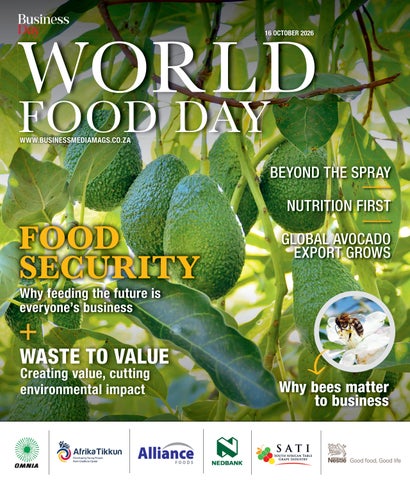
WORLD 16 OCTOBER 2026
FOOD DAY WWW.BUSINESSMEDIAMAGS.CO.ZA
BEYOND THE SPRAY NUTRITION FIRST
FOOD SECURITY
GLOBAL AVOCADO EXPORT GROWS
Why feeding the future is everyone’s business
+
WASTE TO VALUE Creating value, cutting environmental impact
WFD_Cover.indd 1
Why bees matter to business
2026/10/06 12:01
Untitled-1 2
2026/09/18 09:42
Untitled-1 3
2026/09/18 09:42
FROM THE EDITOR
EVERYONE’S BUSINESS
CONTENTS 06
WASTE TO VALUE
08
MARKET READY
09 10
Agricultural waste is becoming a resource through recycling, biogas and biochar.
Elriza Theron Editor
13 14
Moving into formal retail requires more than producing good-quality food.
BEYOND THE SPRAY Biocontrols and biostimulants offer growers new ways to manage resistance and environmental pressures.
BEE MANAGEMENT
BEHIND EVERY HARVEST
2
WORLD FOOD DAY
From nursery to port, avocado production depends on expertise, finance and collaboration.
NUTRITION FIRST Africa’s food-security challenge demands agriculture delivers nutrition alongside higher yields.
NEXT-GEN FARMING We unpack how education and training can turn agriculture’s job potential into sustainable careers.
15
FROM FIELDS TO AI
16
LOCAL PROCUREMENT
Pollination influences yield, fruit quality and profitability – making bee management a critical farm input.
12
Contents.indd 2
programmes and examine what it takes for smallholder farmers to transition into supplying major retailers. In this issue, we consider the opportunities for young people and the many partnerships supporting a successful harvest long before food reaches the consumer. No discussion of sustainable food production would be complete without considering the natural systems on which agriculture depends. Our feature on the business case for pollinators highlights the importance of protecting healthy bee populations while maintaining productive farming systems. Together, these stories offer an encouraging look at an agricultural sector that is changing, adapting and finding new ways to feed a growing population while building a more sustainable and resilient food system. As we mark World Food Day this year, I’m reminded that food security does not exist in a vacuum; it’s everyone’s business.
6
Technology is reshaping agriculture far beyond the tractor and the field.
FOOD DAY PUBLISHED BY
A proud division of Arena Holdings (Pty) Ltd Hill on Empire, 16 Empire Road (cnr Hillside Road), Parktown, Johannesburg, 2193 PO Box 12500, Mill Street, Cape Town, 8010 www.businessmediamags.co.za EDITORIAL Editor: Elriza Theron Content Manager: Raina Julies rainaj@picasso.co.za Contributors: Jennifer Booth, Hanlie du Plessis, Magda du Toit, Busani Moyo, Ivor Price, Jeanne van der Merwe Copy Editor: Brenda Bryden Content Co-ordinator: Natasha Maneveldt DESIGN Head of Design: Jayne Macé-Ferguson Senior Design: Mfundo Archie Ndzo Cover image: istock.com/Ianm35 SALES Project Manager: Frank Simons Franks@picasso.co.za +27 82 366 3125 DIGITAL Online Editor: Stacey Visser vissers@businessmediamags.co.za PRODUCTION Production Editor: Shamiela Brenner Advertising Co-ordinator: Johan Labuschagne Subscriptions and Distribution: Fatima Dramat, fatimad@picasso.co.za Printer: CTP Printers, Cape Town MANAGEMENT Management Accountant: Deidre Musha Business Manager: Lodewyk van der Walt General Manager, Magazines: Jocelyne Bayer
South Africa’s school feeding programme could do more than fight hunger. Copyright: No portion of this magazine may be reproduced in any form without written consent of the publisher. The publisher is not responsible for unsolicited material. World Food Day is published by Picasso Headline. The opinions expressed are not necessarily those of Picasso Headline. All advertisements/ advertorials have been paid for and therefore do not carry any endorsement by the publisher.
IMAGES: XXXXXXXX
F
ood security is about far more than producing enough food. It is about ensuring nutritious, affordable food reaches the people who need it, while creating an agricultural sector that is resilient enough to continue producing amid changing economic, environmental and social pressures. This issue, timed to coincide with World Food Day, explores some of the many ways South African agriculture is contributing to that bigger picture. Across the stories in this issue, you’ll probably note that there is no single solution for the challenges facing our food system. Progress depends on collaboration between farmers and agribusinesses, government and researchers, established businesses and emerging entrepreneurs, and across the many different links in the agricultural value chain. We look at how farmers and businesses are finding new value in what was once considered waste, turning crop residues, manure and byproducts into compost, energy, animal feed and other useful products. We explore initiatives connecting local farmers with school nutrition
WORLD
2026/10/06 12:04
Untitled-2 1
2026/10/05 11:04
ROOTED IN AFRICA, GROWING GLOBALLY
Sasolburg operations supporting environmental stewardship
The agriculture sector is vitally important in South Africa and the wider region, and OMNIA is deeply committed to contributing to its development
4
Omnia combines deep local knowledge with science, technology and expertise from across the world to support farmers to improve productivity and strengthen the resilience of food production.
Made for local conditions, made for our farmers Our commitment to agriculture starts with understanding the conditions in which farmers operate. Developing our products locally and making them relevant to local conditions has proved to be critical to empowering farmers to produce more efficiently. Engagements with farmers, including through our “feet on the farm” approach and platforms such as NAMPO,
“GUIDED BY OUR PURPOSE OF INNOVATING TO ENHANCE LIFE, TOGETHER CREATING A GREENER FUTURE, WE REMAIN FOCUSED ON ADVANCING FOOD SECURITY.” – SEELAN GOBALSAMY
IMAGES: SUPPLIED
F
ood security is a pressing challenge for Africa. Climate volatility, escalating input costs for farmers, increasing pressure on land and water resources, and global supply chain uncertainty all contribute to an increasingly complex challenge. The agriculture sector remains a vital anchor for South Africa and the wider region, underpinning economic growth, employment and food security, while putting food on tables and sustaining livelihoods across communities. Rooted in South Africa and drawing on a 73-year heritage, Omnia is acutely committed to contributing to the sector’s development. “Guided by our purpose of innovating to enhance life, together creating a greener future, we remain focused on advancing food security and enabling mineral extraction that supports economic growth, while contributing to a more sustainable future for all stakeholders,” says Seelan Gobalsamy, Omnia’s group chief executive officer. That ambition is reflected in how Omnia operates. From fertilisers and biostimulants to innovative and bespoke soil-health solutions,
reinforce how important it is that innovation begins with the realities on the ground. “The challenge for agriculture is to use inputs more efficiently,” says Stephan Serfontein, executive director at Omnia. “Through our Nutriology® offering, we combine agronomic expertise, technology and data to support farmers to apply the right nutrients, at the right time and in the right quantities. The proposition we offer farmers is greater nutrient and water-use efficiency, higher yields and ultimately better returns.” That approach reflects a broader principle: agricultural productivity and sustainability cannot be separated. “By combining science-based insights with specialised fertilisers, biostimulants and agronomic advice, Omnia supports farmers to produce more efficiently and more sustainably. Healthy soil, informed decisions and the right solutions at the right time are key to building resilient and profitable farming businesses,” Serfontein explains. That science-led approach is backed by advanced analytical capability. Omnia conducts more than 500 000 soil sample tests annually through its advanced laboratories, using technologies, including soil and leaf-sap analysis, to give farmers deeper insight into crop nutrition and help anticipate crop performance and quality. However, innovation also requires partnership. No one organisation can address food security alone. We must all work together with local farmers, governments and communities while drawing on international partnerships, expertise and markets. This allows knowledge and innovation to go both ways; solutions developed at home can compete globally, while international expertise and technology can strengthen what we offer.
WORLD FOOD DAY
DPS Advertorial - Omnia Empowering economies_subbed.indd 4
2026/10/05 10:57
IN PARTNERSHIP WITH OMNIA RESILIENCE STARTS BEFORE DISRUPTION Recent global developments have reinforced the importance of resilient supply chains. Geopolitical uncertainty has had far-reaching consequences well beyond the countries at the centre of these events, affecting farmers who cannot simply delay planting until critical inputs arrive on our shores. For Omnia, that resilience has been tested repeatedly. Over the years, the business has successfully navigated a series of global disruptions, from the volatility of the COVID-19 era and the blockage of the Suez Canal to the Russia-Ukraine conflict and the ongoing crisis in the Middle East, while continuing to ensure security of supply for its customers. That means investing ahead of the need. Over time, Omnia has strengthened its manufacturing, storage and logistics capabilities, including a fleet of 205 rail tankers with a combined capacity of approximately 8 200 tonnes and 10 road tankers. Rail and road tankers operating between Richards Bay, Sasolburg and Secunda provide additional flexibility and strengthen security of ammonia supply, a critical input into fertiliser production. Resilience, however, is about more than securing supply chains. Ongoing investment in manufacturing reliability and renewable-energy infrastructure at Omnia’s operations helps reduce exposure to disruptions in critical inputs, energy supply and other infrastructure constraints. That resilience is part of our unique value proposition to Southern Africa. A strong local manufacturing base, supported by diversified global sourcing relationships, ensures critical agricultural inputs reach our markets when needed and demonstrates why local and global partnerships are complementary, not competing. Our international growth extends that model. Today, Omnia combines its established African footprint with an international business that includes manufacturing capacity in Australia, exports to more than 30 countries, and a presence in Brazil and the United States. “Food security, supply chain resilience and sustainability are part of the same ecosystem,” Serfontein explains. “Omnia’s role is to innovate across it.”
IMAGES: SUPPLIED
CREATING OPPORTUNITIES THAT LAST While we take pride in our South African roots and global reach, what matters most is the impact we create in the lives of the people and communities we serve. Whether it is through science, technology, engineering and mathematics education or skills development, we work hard to help create
Community investment for sustainable growth
“OUR LONG-TERM APPROACH INFORMS HOW WE DESIGN PRODUCTS AND SOLUTIONS, SUPPORT OUR PEOPLE AND THE COMMUNITIES WITHIN WHICH WE WORK.” – TIAAN KOTZÉ
opportunities for young people while building the capabilities that the agriculture and mining industries will need in the future. We also pay the same attention internally, with a focus on developing our people, cultivating specialist skills and creating a more inclusive workplace, recognising that these are investments in Omnia’s future as much as they are investments in individual careers. “We want to create an impact that will affect generations. Our long-term approach informs how we design products and solutions, support our people and the communities within which we work,” Tiaan Kotzé, Omnia’s group chief operating officer says. Sustainability follows the same logic. “Our investments are not separate from our commercial performance, but serve to help us use our resources responsibly, ensure the efficient continuity of our operations and most importantly, create long-term value for our business, the value chain we operate in and the communities where we work,” Kotzé adds.
resources available to us. Partnerships are what connect these ambitions. “We could never solve food and job security alone,” Gobalsamy concludes. “However, we can act as a catalyst, bringing science-based solutions to the sectors we serve and ensuring our impact is felt far and wide. “For Omnia, being rooted in Africa and growing globally are not opposing ambitions. Our future lies in doing both, remaining committed to South Africa and the Southern African Development Community, partnering locally and internationally, investing in our people and communities, and using science, innovation and responsible growth to build industries that can compete and endure for generations to come.”
VISIT WEBSITE SCAN THIS QR CODE TO GO TO THE OMNIA WEBSITE
STRONGER TOGETHER As we deepen our engagements with our stakeholders, from farmers and policymakers to investors and communities, we are increasingly seeing our role as more than operational. We also recognise that the challenges we face are too interconnected for any one of us to solve alone. Food security depends on productive farmers, healthy soil, reliable inputs and functioning infrastructure. Economic growth depends on competitive industries, investment, skills and jobs. Sustainability depends on using science and technology to do more with the
For more information: www.omnia.co.za
WO R L D F O O D DAY
DPS Advertorial - Omnia Empowering economies_subbed.indd 5
5
2026/10/05 10:57
WASTE TO VALUE says Sean Thomas, business development director for Bio2Watt Energy Holdings, adding that it will process cattle manure from the dairy farm as well as “other organic waste streams from within the catchment area”.
TURNING AGRICULTURAL WASTE INTO WEALTH Agricultural waste is no longer just a disposal problem. Recycling, biogas and biochar are transforming waste into valuable resources while addressing environmental challenges, writes JEANNE VAN DER MERWE
L
ike most industries, food production creates its fair share of waste and byproducts, whether on farms or in food processing. However, one industry’s waste is another’s raw material, and businesses are increasingly finding ways to turn agricultural byproducts into valuable resources. One example is the millions of agricultural remedy containers entering the market every year. Much of this plastic cannot be reused by consumers because of the potentially hazardous chemicals it once contained. To prevent these containers from ending in landfills and threatening the environment, the industry, under the auspices of CropLife SA, has established a nationwide network of drop-off points from where containers are collected and recycled. Dr Gerhard Verdoorn, manager of CropLife SA’s Product Responsibility Organisation, says the network comprises 137 recyclers across the country, collecting steel, aluminium, cardboard, paper, polypropylene and low-density polyethylene containers. However, the largest proportion is high-density polyethylene (HDPE) drums. “As far as HDPE drums are concerned, we recycle one hundred per cent of what goes to
6
WORLD FOOD DAY
market,” he says. “The drums are cleaned, shredded and turned into pellets, which are then used to make all-new products. The only thing such recycled plastic cannot be used for is food or beverage packaging; it is only used for industrial applications.” Some recycled HDPE pesticide drums even find their way into newly manufactured pesticide containers. Kya Sand-based manufacturer Grief produces pesticide drums containing 30 per cent recycled plastic and 70 per cent virgin plastic.
FROM WASTE TO RESOURCE Meanwhile, cattle manure, often criticised because of the methane emissions associated with livestock, is set to become a source of renewable energy in the Swartland. Renewable energy provider Bio2Watt is in the final planning stages for its Cape Dairy biogas plant near Malmesbury. The company has operated a biogas power plant in Bronkhorstspruit for the past 10 years, converting organic waste into electricity for BMW’s Rosslyn plant. “The facility will process in excess of three hundred tonnes of waste per day, and produce similar amounts of liquid and solid fertiliser,”
Biochar is another promising application, with potential benefits for soil health. Made through pyrolysis, or oxygen-free burning, it leaves behind carbon that was sequestered in the plant through photosynthesis. Japie Buckle, managing director of landscape restoring consultancy Hive Ecosystems, explains: “Biochar has a very porous microscopic structure, with many gaps formerly occupied by the noncarbon plant material. These are perfect gaps for micro-organisms to colonise. Biochar can be used to enrich nutrient-poor soil by first treating it with a biological product such as a biostimulant or biofertiliser and then spreading it over fields to establish and enrich soil microbial life,” he explains. A major challenge is the cost of felling and transporting alien vegetation to pyrolysis plants. However, a research partnership between Stellenbosch University’s School of Climate Studies and Sayari Earth is exploring ways to turn invasive biomass into an economic resource. “Invasive alien vegetation is a significant and growing ecological challenge across multiple provinces in South Africa, affecting biodiversity, water resources, fire risk and productive landscapes,” says Hassan Sachedina, founder and chief executive officer of Sayari Earth. “The opportunity is to turn part of that challenge into an economic resource. Invasive biomass can be cleared and converted into biochar, while carbon finance can potentially contribute towards the costs of clearing and, importantly, the long-term suppression required to prevent regrowth. This is particularly relevant where conventional public funding for invasive-species clearing and follow-up control is constrained.” As these initiatives demonstrate, turning agricultural waste into valuable resources could play an increasingly important role in building a more sustainable and circular food-production system.
Follow: Dr Gerhard Verdoorn www.linkedin.com/in/dr-gerhard-h-verdoorn-99540388 Japie Buckle www.linkedin.com/in/japie-buckle-64997b212 Hassan Sachedina www.linkedin.com/in/hsachedina Sayari Earth www.instagram.com/sayari.earth
IMAGE: UNSPLASH/MONIKA KUBALA
TURNING PROBLEMS INTO PRODUCTS
IN PARTNERSHIP WITH
UNDERSTANDING FOOD SECURITY’S
MISSING MIDDLE
The future of food security in South Africa depends on a stronger pipeline of medium-scale farmers who can bridge the gap between commercial agriculture and subsistence farming, writes NICOLE ROOS, market head and CEO at Nestlé East & Southern Africa Region
S
outh Africa’s food security debate is dominated by several concerns. Can households afford a basic food basket? Will rainfall be sufficient? Can farmers absorb rising logistics and financing costs? These are all pressing questions. However, the long-term question is: who will be producing South Africa’s food in 2050? With the country’s population expected to reach over 79 million by 2050, according to Stats SA, and growing pressure on water resources, energy systems, processing capacity, transport infrastructure and food distribution networks, feeding citizens will require more than increased agricultural output. The question is not only whether the country can produce Nicole Roos enough food, but whether it is developing the people and enterprises capable of sustaining food production over the coming decades. South Africa possesses one of the most sophisticated agricultural sectors on the continent. Yet this productive agricultural economy coexists with widespread household hunger, food insecurity and poor diet quality. The challenge is therefore not simply production, but ensuring nutritious food remains affordable, accessible and available to all South Africans.
IMAGES: SUPPLIED
AGRICULTURE CAN ADDRESS THE CHALLENGES South Africa also faces persistently high youth unemployment. Agriculture presents an opportunity to address this and the food security challenge. The sector can provide a pathway into productive work while creating a new generation of farmers, agribusiness entrepreneurs and technical specialists capable of meeting future food demand.
If South Africa succeeds in expanding agricultural productivity, supporting emerging producers, strengthening climate resilience and increasing export competitiveness, agriculture could become a trillion-rand sector by 2050. Such growth would generate opportunities across farming, manufacturing, logistics and retail value chains while helping secure food supplies for a significantly larger population. Conversely, failing to develop a new generation of commercial producers risks constraining one of the country’s most strategic economic sectors precisely when demand for food will be greatest. The future of food security is therefore not only about land, water or technology. It is about people. More specifically, it is about building a stronger pipeline of commercially viable farmers who can scale production and compete in modern agricultural value chains. This is where South Africa’s “missing middle” becomes critical. Food security will not be secured through commercial agriculture or subsistence farming alone. It will depend on the emergence of a robust cohort of medium-scale farmers who can bridge the gap between these two sectors. These producers could potentially increase production, create rural employment, stimulate local economies and expand participation in agricultural markets. Yet they are often overlooked by policy and investment frameworks, falling between programmes designed for commercial agriculture and those targeted at smallholder support.
NESTLÉ
efficiently and build resilience to climate shocks while maintaining productive and commercially viable farms. With access to training, finance, technology and secure markets, producers can adopt regenerative practices at scale and contribute to a more resilient food system. Unlocking the potential of this segment requires co-ordinated action. Government, agribusiness, financial institutions and established commercial farmers must work together to improve access to land, finance, infrastructure, skills development, technology and markets. Emerging producers must be integrated into formal value chains and supported to become resilient, profitable and competitive enterprises. As the continent’s agriculture increasingly focuses on sustainability and climate resilience, South Africa has an opportunity to position itself as a leader in inclusive agricultural transformation. Expanding access to productivity-enhancing technologies, climate-smart farming practices and modern agricultural inputs will be essential to achieving this objective. Investing in the “missing middle is an economic, social and food-security imperative, which will determine if South Africa can meet future demand, strengthen rural economies and maintain its agricultural competitiveness in a rapidly changing world.
ABOUT NESTLÉ Nestlé is a leading global food and beverage company, operating in 187 countries. Guided by its purpose of unlocking the power of food to enhance quality of life today and for future generations, Nestlé offers a broad portfolio of products and services for people and their pets. Company performance is driven by its Nutrition, Health and Wellness strategy.
VISIT WEBSITE SCAN THIS QR CODE TO GO TO THE NESTLÉ WEBSITE
STRENGTHENING THE MISSING MIDDLE Regenerative agriculture can strengthen this missing middle by enabling medium-scale farmers to improve soil health, use water more
For more information: www.nestle-esar.com
WO R L D F O O D DAY
Nestle_FCP Advertorial.indd 7
7
2026/10/05 11:33
FARM TO MARKET
WHAT DOES IT TAKE TO SUPPLY FORMAL RETAIL?
T
he route from informal markets into formal retail is seldom straightforward for smaller fresh produce farmers. Consumer demand for quality, consistency and food safety shapes many of the requirements farmers must meet. The challenge is making the transition commercially sustainable. Agricultural economist Dr Sifiso Ntombela says formal retail offers greater predictability and economies of scale, but farmers also need to consider compliance costs and payment terms. “Informal markets may offer farmers better margins and quicker payment and generally have fewer infrastructure and compliance requirements. Demand, however, can be less predictable,” he explains. Leona Archary, chief executive officer of the Agricultural Development Agency (AGDA), has seen good farmers do everything Leona Archary right and still fail to connect with the retail market because the different forms of support they need do not always come together at the right time. Finance, infrastructure, technical support, compliance and market access may all be needed, but Archary believes the starting point should be the market. She says: “Finance without a market waiting on the other end places the farmer at risk. Retail readiness has to be demand-led.”
START WITH THE MARKET Once a market is secured, the support farmers need can be planned around its requirements. Providing packing facilities before farmers are producing at the required level can leave infrastructure unused, while certification without the funding or support needed to supply the market may achieve little.
8
WO R L D F O O D DAY
Sophy Litshani Musabeni
Access to appropriate finance can present another challenge. Archary says conventional lending models can exclude smaller farmers whose track records and risk profiles do not fit traditional lending criteria. AGDA works with public and private-sector partners on funding approaches that can help bridge the gap towards commercial lending. Some farmers make the transition independently, while others benefit from development programmes. One example is SPAR’s Supplier Development Hub. James Lonsdale, national sustainability manager at The SPAR Group, explains: “The programme prioritises securing a guaranteed market for the farmer first. Production planning and farmer development are then aligned with that demand.” Increasing production without a dependable market can create financial and operational pressure rather than growth, Lonsdale says. Once demand is established, farmers can plan around the crop, volumes, quality and timing required. The hub aims to support farmers towards commercially sustainable operations within five years. “Commercial sustainability ultimately depends on the farmer being able to
understand demand, plan production, manage costs and maintain a viable customer base,” Lonsdale says. Entering formal retail does not necessarily mean becoming a large national supplier. Lonsdale says SPAR’s independent retail model can create opportunities for smaller farmers to supply at local or regional level, provided they meet the relevant requirements. Planning production around demand is also part of Boxer’s approach. Head of department: fresh produce at Boxer, Deon Wessels, says once a producer has demonstrated consistent supply, Boxer may provide a growing programme. “These programmes help align planting and harvesting with expected volumes, quality requirements and anticipated supply needs across the relevant distribution network,” Wessels says.
MEETING THE STANDARD Sophy Litshani Musabeni, founder of Vhegies, experienced the importance of understanding the market early in her farming journey. She started by selling produce within her local community, including to neighbours, small businesses and street hawkers. Moving into formal retail brought new requirements for the business. “We adapted by implementing good agricultural practices, strict hygiene and traceability, proper pesticide and fertiliser records, controlled harvesting and handling, quality grading, packaging standards, cold-chain management and regular inspections,” Musabeni says. Commercial banks, the Department of Agriculture and enterprise-development programmes also provided funding, training, market access and guidance as Vhegies entered formal markets. Today, Vhegies supplies retail while continuing to sell through wholesalers, fresh produce markets, restaurants and informal traders, as well as to customers in neighbouring SADC countries. Formal retail has become part of a broader market mix for the business.
Follow: Dr Sifiso Ntombela www.linkedin.com/in/sifiso-mboneni-ntombela-6a079419a Leona Archary www.linkedin.com/in/leona-archary-02370990 James Lonsdale www.linkedin.com/in/james-lonsdale-36a92531 Sophy Litshani Musabeni www.facebook.com/sophylitshani.musabeni Dr Sifiso Ntombela Deon Wessels www.linkedin.com/in/deon-wessels-48663722b
IMAGE: SUPPLIED
Moving from informal markets into formal retail requires more than producing good-quality food, writes JENNIFER BOOTH
NATURAL DEFENCE
BEYOND THE SPRAY
Biologicals take root in mainstream crop protection
IMAGES: SUPPLIED
S
outh African farmers are adding biological products to their crop-protection toolbox as pressure builds to manage pesticide resistance, reduce chemical residues and use water and nutrients more efficiently. Once viewed mainly as an organic option, biologicals are increasingly entering mainstream farming programmes. Debbie Matteucci, chief executive officer of the South African Bioproducts Organisation (SABO), describes agricultural biologicals as naturally derived biostimulants, biocontrol agents or biofertilisers. They may be living organisms or products derived from naturally occurring organisms, plant extracts or organic matter. She says biocontrol agents suppress pests and diseases, while biostimulants support nutrient uptake, root development, crop establishment and tolerance to environmental stress. Ané Jacobs, technical and commercial manager and field representative for Insectec in Limpopo, says biologicals generally deliver most value within an integrated pest management (IPM) programme combining biological, chemical, cultural and mechanical measures. Pest-specific biocontrols can target pests that are difficult to manage chemically while protecting beneficial insects, and alternating modes of action can help manage resistance. She says short re-entry and pre-harvest intervals can allow workers back into orchards sooner and help maintain harvest schedules. Biological products often degrade rapidly and are exempt from maximum residue limits, helping export growers meet different market requirements. Eddie Vorster, a director of the Mahela Group in Limpopo and a citrus grower and exporter, says biological control has become a standard part of the group’s IPM programme rather than an emergency fallback. Its biological programme costs roughly the same as chemical control, while helping the business protect beneficial organisms and manage residue risks that could restrict market access.
Biologicals are moving from niche products to an increasingly practical part of mainstream crop protection, writes HANLIE DU PLESSIS emergence rates, sex ratios and expected hatching dates. Regular scouting must establish pest pressure, track beneficial insect populations and guide decisions on whether and when to intervene. Biostimulants require similar scrutiny. Raw materials should be standardised and tested batch by batch, while on-farm bioassays should confirm biological activity. Trials across crops, seasons, soils and locations are needed to establish dosage, timing, performance and economic return.
Did you know?
Scouting as part of an integrated pest management programme.
Biologicals aren’t just an organic-farming tool – South Africa regulates and tests biopesticides for use in conventional agriculture. Source: South African Department
GETTING THE BALANCE RIGHT
of Agriculture, guidelines for
Jacobs cautions that biologicals do not always provide the rapid knock-down associated with conventional pesticides. Some microbial agents progressively slow a pest’s feeding and development before it dies. Growers must therefore match the mode of action to the pest’s host range and life cycle, and apply the product while the pest or disease is vulnerable. Early intervention is more effective than treating an established infection. She adds that temperature, humidity, water pH, storage, timing and application method can influence performance. Spray equipment must be cleaned thoroughly because chemical residues may undermine a biological product’s effectiveness. Jacobs says growers should check whether an existing pesticide programme is compatible with beneficial organisms being introduced. Suppliers of insect-based products should disclose organism numbers, mortality,
agricultural remedies.
Follow: Ané Jacobs www.linkedin.com/in/an%C3%A9-jacobs-564499246 SABO www.linkedin.com/company/south-african-bioproducts-organisation-sabo-
Piet Engelbrecht, citrus farmer and Agri Limpopo president, warns that quality varies: “Some of the products are good and can add value to a production system, but on the other hand, some products can even cause damage in certain situations.” He advises growers to request independent trial data, confirm registration and quality standards, consult trusted farmers and test products on a limited area before wider use. Biologicals are therefore not positioned to replace conventional crop protection outright. Their strength lies in addressing defined problems such as resistant pests, residue pressure, protection of beneficial organisms and plant efficiency. Jacobs emphasises that the outcome depends on correct selection, timing, handling and monitoring. Used well, biologicals add another mode of action to an integrated programme without requiring growers to abandon conventional tools that remain effective.
WO R L D F O O D DAY
9
BEE MANAGEMENT
Pollination is a critical farm input, influencing yield, fruit quality and profitability. Careful management helps protect the bees behind production. By ELRIZA THERON Using the 2024 Western Cape Bee Industry Association guideline tariff for hive rental, she estimates that this represents a direct cost of approximately R2 500 to R6 300 per hectare, excluding VAT. Against the value of the crop at risk, this can be a relatively small investment. A 2025 study by Veldtman and De Lange in the Insects journal estimated that insect pollination contributed more than US$1.5-billion to South African crop production in 2018, equivalent to 42.2 per cent of the annual production value of Bee pollination during blossom season. insect-pollination-dependent crops. Apples alone accounted for an estimated US$294-million of this value. n most farms producing fruit, nuts and seed crops, pollination is far from just another part of the natural THE RETURN ON BEES environment. Effective crop pollination The business case, however, extends increases total crop yield, fruit beyond simply hiring enough hives. A range quality and, ultimately, farm profitability. For of management practices, from orchard commercial farmers, pollination is essential design and the distribution and timing of for production, making effective and reliable compatible polliniser cultivars to the location pollination services a critical asset. and timing of hive placement, can all influence In South Africa’s deciduous fruit industry, the effectiveness of the pollination service. the importance of pollination is particularly Providing bees with water and diverse clear. Dr Nanike Esterhuizen, entomologist forage can also support colony health during at Hortgro, explains that many commercial pollination, particularly where flowering cover apple and pear cultivars are self-incompatible crops and other nonplants can provide valuable and require cross-pollination by a compatible nutritional resources. cultivar, facilitated primarily by insect pollinators such as managed honeybees. PROTECTING THE POLLINATORS “Effective pollination is critical to fruit Safeguarding pollinators during crop production and business success,” she says. protection applications is equally important. It influences fruit set, seed number, fruit Dr Gerhard Verdoorn, director of the Griffon development and size and fruit quality. Poor Poison Centre, stresses that farmers must pollination can reduce grower revenue through prevent bees from coming into contact with lower yields and smaller or misshapen fruit orchard sprays. Where insecticides are that fail to meet higher-value market grades necessary during flowering, applications should for fruit export. be carefully timed to minimise exposure, for This makes commercial pollination services example, when bees are no longer actively an investment in crop yield and quality, rather foraging, and all label requirements and than another production cost. Dr Esterhuizen precautions must be followed. says apple and pear growers commonly use Communication between farmers and two to five honeybee colonies per hectare beekeepers is critical for responsible during blossom, depending on the crop, pollination management. Growers should cultivar and environmental conditions. notify beekeepers well in advance of planned
O
10
WO R L D F O O D DAY
pesticide applications, allowing hives to be moved where necessary. Spray drift must also be considered, particularly under windy conditions. Dr Esterhuizen adds that several practical considerations during the pollination window could pose challenges. “For example, the weather during bloom. Cold, rain, wind or unusually hot conditions can restrict bee flight precisely when flowers are receptive. Another factor is when growers do not work with reputable, registered beekeepers who adequately prepare hives before pollination. Weak or poorly timed colonies may not deliver sufficient foragers to complete the pollination task,” she says. There is also broader economic consideration. South Africa’s agricultural industries increasingly compete for commercial honeybee colonies during peak flowering periods. In the Western Cape, deciduous fruit, berries, nuts and seed crops create a seasonal pollination bottleneck, with drought, fires, bee diseases and declining forage resources placing further pressure on the beekeeping sector, says Dr Esterhuizen. For farmers, pollinator-friendly practices can strengthen production resilience. Conserving bee forage, maintaining good relationships with beekeepers, using crop-protection products responsibly and planning pollination strategically can help protect both crops and the ecosystem that supports future production.
POLLINATION BY THE NUMBERS 2–5 Honeybee colonies commonly used per hectare during apple and pear blossom.
R2 500–R6 300 The estimated hive-rental cost per hectare, excluding VAT.
US$1.5-billion The estimated contribution of insect pollination to South African crop production in 2018.
42.2% The share of the annual production value of insect-pollination-dependent crops attributed to insect pollination.
US$294-million The estimated value of insect pollination to South Africa’s apple production alone.
Follow: Dr Nanike Esterhuizen www.linkedin.com/in/nanike-esterhuizen Dr Gerhard Verdoorn www.linkedin.com/in/dr-gerhard-h-verdoorn-99540388 Hortgro www.facebook.com/HORTGRO www.instagram.com/hortgro
IMAGE: SUPPLIED
THE BUSINESS CASE FOR POLLINATORS
IN PARTNERSHIP WITH
DELIVERING SUSTAINABLE, PEOPLE-CENTRED ASSISTANCE ACTIONAID SOUTH AFRICA, a human rights-based entity, views the issues of gender justice, good governance and the eradication of poverty as the keys to building a more equal society
G
IMAGES: SUPPLIED
IMAGES: SUPPLIED
uided by feminist analysis and a human rights-based approach, ActionAid South Africa (AASA) is a nationally registered civil society organisation that works with people living in poverty and exclusion to build sustainable, people-centred and just alternatives to injustice and inequality. It is a part of the ActionAid International Federation. Sakhile Zungu, interim country programme manager at AASA, says the organisation integrates water, sanitation and hygiene (WASH) into its work by focusing on women’s and girls’ rights to water and sanitation. It also addresses infrastructure issues, advocates for increased government investment in WASH, and works with communities to implement sustainable solutions to poverty and injustice. “A good example is the efforts undertaken in the OR Tambo District Municipality in the Eastern Cape, which experienced heavy flooding in June. The rains caused extensive damage to households, infrastructure and properties. We initiated a humanitarian response, partnering with local organisations in uMthatha, as well as City Hope, Oxfam SA, uBuntu Restoration and the Farmers Network SA, to collaborate and provide a positive intervention,” he says.
“AASA and its partners supported the affected population through the provision of WASH goods, nonfood items (NFI), and food security, among others. We delivered food parcels and health and sanitary kits to over 1 200 vulnerable households. In addition, we offered psychosocial support – in the form of group therapy and one-on-one counselling sessions for survivors – and gender-based violence (GBV) training.” Zungu explains that these services were delivered across the 13 centres housing the displaced and included food parcels containing the basic food requirements for an entire family, as well as NFIs, including building materials, stoves, pots, dishes and blankets – critical elements needed to restart their lives. “Additional support was in the form of infant packs, specifically for those with newborns, including diapers and baby clothing, and some 800 school uniforms, books and stationery for the displaced children. “In crises like these, there is often an increase in GBV because of the stressful situation. We provided GBV training on spaces where victims can be safe, how to reach out for help and how to relate to one another in an environment where everyone is cramped together and tempers can easily reach boiling point.”
“AT AASA, WE APPROACH SITUATIONS LIKE THESE FROM A PLACE OF MUTUAL RESPECT, UNDERSTANDING AND CARE.” – SAKHILE ZUNGU
ACTIONAID SOUTH AFRICA
The organisation further ensured mobile kitchens were provided in some of the centres, which, as community halls, were not designed to care for the displaced. Oxfam SA supplied JoJo tanks for water storage so everyone had access to safe, potable water. “At AASA, we approach situations like these from a place of mutual respect, understanding and care. For us, it is about more than merely providing support. It is equally about ensuring that survivors are treated as human beings,” he comments. “This is why we speak to their physical, emotional and mental health needs. Anyone who went through what these communities did would experience psychological trauma. For us, it is about delivering mental healthcare support, wrapped up in simple and basic humanity.” The organisation currently provides this and many other types of support in six of the country’s nine provinces. “Other focuses include advancing climate resilience, prioritising the inclusion of marginalised communities in the green transition, strengthening women’s rights and gender equality, advocating for law reform and championing youth economic empowerment and leadership. “We identify as a human rights-based entity, viewing the issues of gender justice, good governance and the eradication of poverty as the keys to building a more equal society and fighting the existing systems of injustice. We do this by working at the grassroots level and partnering with underprivileged communities, rather than simply viewing them as beneficiaries,” concludes Zungu.
ActionAid is a global movement of people working together to further human rights for all and defeat poverty.
SCAN THIS QR CODE TO GO TO THE ACTIONAID SOUTH AFRICA WEBSITE
For more information: www.actionaid.org www.twitter.com/actionaid www.facebook.com/actionaid
WO R L D F O O D DAY
ActionAid SA_FCP Advertorial.indd 11
11
2026/10/06 10:12
FARM TO MARKET
BEHIND EVERY HARVEST The partnerships farmers depend on Donkin says keeping pace with research remains important as the industry grows, helping producers improve yields and fruit quality, manage pests and diseases and meet the requirements of increasingly competitive international markets.
FROM ROOTSTOCK TO ORCHARD
G
lobal avocado exports have grown fourfold over the past 15 years, with further growth expected as markets develop and the demand for healthy foods increases. Meeting this demand requires collaboration across the value chain, from production and finance to post-harvest handling, logistics and market access. Over five decades, South Africa’s avocado industry has expanded from about 2 000 hectares to more than 20 000 hectares, supported by grower-funded research and knowledge sharing, according to Derek Donkin, chief executive officer of the South African Subtropical Growers’ Association (Subtrop).
Did you know?
South Africa sent its first full-season avocado shipment to China in May 2025, building on a 21-tonne trial shipment that arrived in Shanghai in October 2024. Source: https://www.sanews.gov. za/business-south-africa-world/ first-shipment-south-african-avocadosarrive-china?utm_source=chatgpt.com
12
WO R L D F O O D DAY
The avocado production cycle starts in specialist nurseries, where healthy rootstocks are combined with selected avocado varieties to produce young trees ready for the orchard. Sakkie Froneman, nursery and farm manager of The Fruit Farm Group South Africa (TFFGSA), says producing these trees requires technical skill and is labour-intensive. Accredited nurseries are regularly audited by the Avocado Nurserymen’s Association (ANA) against standards covering propagation, hygiene, traceability and key pests and diseases. From the nursery, the young trees are planted in orchards, with production concentrated in Limpopo, Mpumalanga and KwaZulu-Natal and expanding into newer growing areas. Froneman says careful management continues in the orchard, where growers are exploring floral attractants, pollinator-friendly crops and even drone-assisted pollen dispersal. “On our Schagen farm in Mpumalanga, we use flowering wild basil as a cover crop to attract foraging bees,” he says. Orchard establishment has long-term consequences, as a productive avocado block can last 30 years or more. Site selection, soil preparation, drainage, tree spacing and irrigation can influence yields, disease pressure and production costs. Considerable capital is required upfront for trees, irrigation and infrastructure well before full production. Costs continue after harvest through grading, processing, packaging, cooling, transport and shipping. Dawie Maree, head of FNB agriculture marketing and information, says finance
is a strategic enabler across the avocado value chain and should be aligned with the crop’s biological cycle, market timing and infrastructure requirements. “When finance is properly structured, it helps unlock higher-value markets, improves resilience and supports the long-term sustainability of the avocado business,” he says.
THE JOURNEY BEYOND THE FARM About half of South Africa’s avocado crop is destined for export markets. Export avocados reach the packhouse within a few hours of picking, where orchard heat is removed and the fruit prepared for refrigerated transport. With much of the crop grown in Limpopo and Mpumalanga, fruit can travel long distances to market, making cold-chain management and co-ordination with shipping schedules essential. South Africa’s ability to compete internationally depends on consistently delivering quality fruit on time. However, Donkin explains that poor port performance remains a constraint, and unfavourable trade conditions can make competing in some markets more difficult. “India would be the most promising if government can negotiate better tariff conditions. South African avocados are subject to a thirty per cent import tariff in India, while our major competitor, Tanzania, has zero-tariff access,” Donkin says. China and Japan have also opened their markets to South African avocados, although export protocols bring additional requirements. Japan, for example, requires avocados to undergo cold treatment at 2°C or below for at least 19 consecutive days. “China has the potential to become a major consumer of avocados,” Donkin says. While new markets offer growth opportunities, Europe and the United Kingdom remain South Africa’s main export markets. Maintaining these established markets is critical, requiring consistent quality, reliable supply and the ability to meet changing customer and market requirements.
Follow: Dawie Maree www.linkedin.com/in/dawie-maree-65ab118 Sakkie Froneman www.linkedin.com/in/sakkie-froneman-655172140 www.linkedin.com/company/subtrop Subtrop
IMAGE: IANM35/ISTOCK.COM
From nursery to orchard, packhouse to port, avocado production depends on a network of partnerships that help growers manage risk, raise quality and reach global markets. By JENNIFER BOOTH
NUTRITION FIRST
FARMING FOR NUTRITION, NOT JUST YIELD As food insecurity intensifies across Africa, agriculture is being challenged to deliver more than volume. By MAGDA DU TOIT
F
IMAGE: SUPPLIED
arming with a focus on nutrition, rather than yield alone, has moved to the centre of Africa’s food-security conversation as the continent became the global epicentre of undernourishment. In 2025, an estimated 309 million Africans did not have access to sufficient nutritious food. The 2026 State of Food Security and Nutrition in the World report by the Food and Agriculture Organisation (FAO) shows that 56.6 per cent of Africa’s population is now experiencing moderate or severe food insecurity. Building safe and resilient food systems requires a collective commitment from everyone in the agriculture value chain, engaging policymakers, input suppliers, seed breeders, farmers, processors and retailers. It calls for continuous innovation, collaboration and, above all, responsible farming practices season Dr Lukeshni Chetty after season. Hendrik van Staden, field crops head for Syngenta Seeds in Africa and the Middle East, says agriculture is evolving rapidly. “Precision agriculture is increasingly reshaping the way farmers grow food, pairing resilient crop breeding with digital tools and biological innovations to boost efficiency, cut input use and still meet essential nutritional demands.
“FOOD SECURITY DEPENDS ON THE SUCCESSFUL FUNCTIONING OF THE ENTIRE FOOD VALUE CHAIN, WITH SEED AS THE STARTING POINT.” – DR LUKESHNI CHETTY
“To achieve food safety and security, breeders and farmers alike must make practical, informed decisions in the field. Growing safe, nutritious food is never just a matter of planting a seed and waiting for harvest. It requires a team of experts working alongside the farmer, selecting the best-adapted varieties, applying crop protection products responsibly, using targeted and biological interventions to manage pests and disease, and following sound agronomic practices that support balanced nutrition. Once the crop leaves the field, careful post-harvest handling is essential to reduce losses and waste throughout the value chain,” van Staden explains.
WHEN YIELD ISN’T ENOUGH Dr Lukeshni Chetty, chief executive officer of the South African National Seed Organization (SANSOR), says food security depends on the successful functioning of the entire food value chain, with seed as the starting point. “Historically, seed breeders focused primarily on agronomical traits. Plant breeding has evolved, however, with breeders now also targeting characteristics such as taste and nutrition more precisely.” She argues that feeding millions every day is no small feat. “In South Africa, ensuring that 65.5 million people have food on the table starts with one fundamental truth, namely we need crops that bring yields, from smallholder farmers providing food for their own families to large commercial farms supplying consumers nationwide.” Breeders therefore have a dual focus, she says. “They have to focus on crops achieving
higher yields while also delivering on taste and nutrition. The GABA tomato released in Japan in 2021 was the first precision-bred food to reach consumers. This tomato contains high levels of an amino acid called GABA, which supports lower blood pressure. With precision breeding, the levels of the amino acid are increased, thus also increasing the health benefits.”
DESIGNING A HEALTHIER HARVEST Precision breeding was also used to lower the gluten content in wheat to address health issues related to gluten intolerance. In addition, Dr Chetty points out, research also focuses on extending the shelf life of fruits and vegetables such as bananas, melons and tomatoes. “By extending the shelf life of products, less food will be wasted, especially in rural areas where access and optimal storage can sometimes be limited. “Seed companies are constantly looking at bringing healthier, more resilient crop varieties to the market. One only has to consider the variety of produce we can buy in stores. Products such as squash, lettuce, carrots, broccoli and pulses can all be grown from seed produced in South Africa,” Dr Chetty notes. “Food production and human and animal nutrition and health cannot be managed in isolation,” says Liesl Breytenbach, executive director of the Animal Feed Manufacturers Association (AFMA). “What happens in crop production influences animal feed and nutrition as well as animal health and productivity. The research that goes into quality and traceability of animal feed is vital, even if less visible, as it ultimately affects food safety and security.”
READ
THE STATE OF FOOD SECURITY AND NUTRITION IN THE WORLD
Follow: Dr Lukeshni Chetty www.linkedin.com/in/lukeshni-chetty-16185b6 Hendrik van Staden www.linkedin.com/in/hendrik-van-staden-a27175250 SANSOR www.linkedin.com/company/south-african-national-seed-organization
WO R L D F O O D DAY
13
NEXT-GEN FARMING
GROWING CAREERS BEYOND THE FARM GATE
A
griculture can help address youth unemployment, but its potential depends on training that reflects modern industry needs and gives young people clear routes into work, says AgriSETA chief executive officer, Fanny Phetla. For young South Africans considering agriculture, the possibilities extend far beyond owning a farm or working in a field. The sector needs scientists, technicians, artisans, machinery operators, managers and supply-chain professionals, a breadth of opportunity that could challenge youth unemployment and outdated perceptions of agricultural work. Phetla says young people should view agriculture as an extensive value chain containing technical, scientific, managerial and commercial careers. “Occupations currently offering strong employment prospects include agricultural farm managers, horticultural farmers, agricultural technicians, agricultural scientists, millwrights, diesel mechanics, agricultural mobile plant operators, supply and distribution managers, mixed-crop farm production managers or foremen and finance managers,” Phetla says.
MORE THAN FARMING Several occupations offer numerous specialisations. Agricultural technicians may work in irrigation, animal breeding, poultry, agronomy, seed research, laboratory testing or artificial insemination. Agricultural scientists can specialise in plant pathology, soil and plant science, animal nutrition, seed development, agronomy or animal husbandry. Young people can therefore enter the food system without necessarily owning land. The availability of occupations does not automatically give young people access to
14
WO R L D F O O D DAY
Did you know?
Agricultural employment increased by 30 000 in South Africa in the fourth quarter of 2025, according to Stats SA. sustainable careers. Phetla says the pathways connecting different qualifications and institutions require urgent attention. “Articulation and progression across institutions have been identified as an area necessitating prompt action and collaboration among the key role players to work together to review existing systems, establish supportive frameworks for career pathways and facilitate seamless mobility across institutional arrangements,” he says. The capacity and readiness of institutions must also be considered, together with whether their programmes remain relevant to the agricultural sector’s changing requirements. “The issue of capacity, readiness and relevance of programme offerings across institutions Fanny Phetla has been identified as a fundamental area requiring attention and review,” Phetla says.
CLOSING THE SKILLS GAP AgriSETA has responded by convening an Agri-Edu Symposium bringing together role players from the agricultural and education sectors. The initiative seeks to improve progression through the education system. “AgriSETA addressed this anomaly by holding a strategicworkshop with key industry role players from the education and agriculture fraternity in the form of an Agri-Edu Symposium.
In essence, what this means is aligning a college qualification with a university degree,” Phetla says. Better alignment could help young people avoid repeating learning or reaching educational dead ends. It could also give employers confidence that graduates possess qualifications and practical capabilities corresponding with workplace needs. Phetla adds that agricultural education must keep pace with technological change, sustainability pressures and new production methods if it is to improve young people’s employment prospects. “South Africa’s agricultural curriculum must be updated to meet modern industry demands and technological advancements. We must also tackle the disparity between academic qualifications and the skills needed in the workforce to ensure students are job-ready,” he says. “Educational frameworks must incorporate sustainable farming practices, climate-smart agriculture and modern production techniques if education is to remain aligned with industry needs,” Phetla says. Achieving this will require government, training institutions and agricultural businesses to work together. Educational providers need industry input when designing programmes, while businesses can offer workplace exposure and practical training. “Partnerships between the private sector, government and educational institutions are important if we are to foster innovation, create jobs and build a thriving agricultural workforce,” he says. Agriculture cannot resolve South Africa’s youth-unemployment crisis alone. However, when relevant education is connected to recognised qualifications, practical experience and workplace demand, it can provide careers throughout the value chain. Training the next generation is a food-security investment. The country needs young people capable of producing food, maintaining machinery, managing supply chains and building a resilient agricultural system.
Follow: AgriSETA
www.agriseta.co.za
IMAGES: SUPPLIED
Agriculture’s job potential extends far beyond working the land; however, turning that potential into sustainable careers requires better-connected education and training. By BUSANI MOYO
SMART FARMING
FROM FIELDS TO AI Agriculture goes high-tech
Technology is reshaping agriculture far beyond the tractor and the field, writes IVOR PRICE
S
IMAGES: SUPPLIED
hadrack Kubyane, chief executive officer and co-founder of eFama App, has high hopes for agriculture’s future: “I hope that the next generation sees agriculture not as an industry to escape, but as a place to build, whether they are growing food, flying a drone, writing software, analysing data or creating the next technology we haven’t imagined yet.” This is not just an optimistic view; it’s already taking shape. The old picture of farming is increasingly incomplete. Agriculture is no longer simply about tractors, fields and manual labour. It is becoming a sector where artificial intelligence (AI), satellite technology, digital marketplaces, precision farming, renewable energy and smart infrastructure are changing how food is produced, sold and managed. Kubyane, who grew up in a farming family and now works at the intersection of agriculture and technology, says opportunities extend well beyond the farm gate. “Today the sector needs everyone, from farmers and scientists to drone pilots, mechanical engineers, biotech specialists, veterinary data specialists and cloud engineers.”
BEYOND THE FARM GATE For young people, agriculture is increasingly an ecosystem where technology and entrepreneurship can unlock new businesses and careers. Technology can also change who
Shadrack Kubyane and his wife, Pretty, the team behind the eFama App.
gets to participate. Kubyane says eFama’s biggest lesson has been that connecting farmers with buyers is only part of solving the market-access challenge. Farmers also need visibility of demand and prices, buyer requirements, verification, compliance, traceability and logistics. The platform aims to close that commercial-information gap, moving farmers away from planting first and searching for buyers later. Kubyane says one farmer increased production by roughly 300 per cent and doubled his workforce within six months after gaining more consistent access to demand. “Inclusion should not mean lowering the bar; it should mean giving more farmers the tools to reach it,” he says. The transformation is not limited to digital technology. Energy is becoming equally important to the modern farm.
POWERING THE MODERN FARM David Durie, agriculture partner specialist at Huawei Digital Power South Africa, says reliable energy has become a strategic part of agricultural productivity and resilience, rather than simply another operating expense. Modern farms depend on electricity for irrigation, refrigeration, cold storage, processing and water management. Rising electricity costs and unreliable grid supply can put pressure on already tight margins. Renewable energy, battery storage and intelligent energy management offer farmers new ways to manage that risk. Solar photovoltaic (PV) can reduce reliance on grid electricity, while batteries store excess energy for later use. “The opportunity goes beyond simply installing solar panels,” Durie says. An intelligent energy solution can combine solar PV, advanced inverters, battery storage and
Huawei Digital Power South Africa’s Farmer Energy Innovation Day.
energy management software to optimise how energy is generated, stored and consumed. For agricultural businesses, battery backup can also protect critical operations when grid supply is interrupted. Huawei’s collaboration with AgriCulture Gauteng has brought these possibilities closer to farmers through practical engagement, including a farmers’ energy innovation day, where producers could explore the technology and its applications. Durie sees this as part of a broader convergence. The future of agriculture, he says, will increasingly be shaped by renewable energy, energy storage, digitalisation, artificial intelligence and smart infrastructure. However, neither Kubyane nor Durie presents technology as a substitute for people. The opportunity is to make people more productive, businesses more resilient and agriculture more accessible to the next generation. Kubyane believes AI and automation will bring better forecasting, precision farming, smarter machinery and more intelligence into everyday decisions. Yet technology should empower people rather than simply eliminate jobs. “The future of farming isn’t about working harder; it’s about making the world’s most advanced tech wonders work for the everyday farmer.” The farmer of the future may still grow food, but may also analyse data, operate a drone, manage renewable energy systems, develop software or build an entirely new agricultural business. The field remains at the heart of farming; however, increasingly, the future of agriculture is being built far beyond it.
Follow: Shadrack Kubyane www.linkedin.com/in/shadrackkubyane David Durie www.linkedin.com/in/david-gerald-durie-521667129 eFama App www.linkedin.com/company/efamaapp www.instagram.com/efamaapp Huawei Digital Power www.linkedin.com/company/huawei-digital-power-subsaharan-africa
WO R L D F O O D DAY
15
LOCAL PROCUREMENT
SCHOOL MEALS COULD CREATE MARKETS FOR LOCAL FARMERS
THE NSNP COULD PLAY A BIGGER ROLE IN SUPPORTING LOCAL AGRICULTURE, WITH THE DEPARTMENT EXPLORING WAYS TO INVOLVE MORE SMALL-SCALE FARMERS IN SUPPLYING SCHOOLS.
“We certainly want more, but we also ensure we are utilising the economies of scale based on what we are able to negotiate, considering that we’re a big buyer,” Gwarube says. The opportunity is significant. Even a greater share of school food procurement directed towards suitable local producers could create a meaningful market for small-scale farmers.
A MARKET WITH SCALE However, local procurement is not as simple as directing schools to nearby farms. Farmers
16
South Africa’s school feeding programme could do more than fight FROM MEALS TO MARKETS hunger. IVOR PRICE finds out more There are already examples of private-sector
In-school breakfast programme by Tiger Brands Foundation.
need to produce consistently, meet foodsafety requirements and deliver at the required volumes. Schools and provincial education departments must also operate within procurement and budget rules. FoodForward SA’s work with vulnerable communities illustrates the importance of connecting nutrition interventions with local needs. The organisation’s mother-and-child nutrition programme provides monthly food parcels to at-risk pregnant women and children under five. It works with health authorities and clinics to identify communities where children are most at risk. “We identified Bloekombos and Wallacedene in Kraaifontein in the Western Cape because they are so overpopulated. People get sick, and the infections increase. We’re working closely with the city health department and the local clinics to ensure we identify the children early enough to get the nutrition they need,” says Andy Du Plessis, managing director of FoodForward SA. Its food parcels are designed to feed a family of four for a month and contain a combination of protein, starch and fresh produce. For school nutrition, the lesson is that local procurement requires co-ordination between government, farmers, food organisations and communities.
partnerships complementing the NSNP. The Tiger Brands Foundation, working with the Department of Basic Education, operates an in-school breakfast programme. In the Northern Cape’s greater Kuruman area, an initiative with Kathu Solar Park supports about 4 500 learners with fortified porridge made from sorghum, maize or oats. At Bankhara-Bodulong Primary School, principal BG Magome says the breakfast programme has helped keep learners engaged. “Without this initiative, we may have seen a rise in learner dropouts,” Magome explains. “The breakfast programme ensures learners start the day nourished, motivates them to arrive at school on time and helps even the most disadvantaged children manage their morning learning activities with greater confidence.” The Tiger Brands Foundation has also invested R2.47-million in four kitchen facilities in Limpopo and trained 55 food handlers through its accredited skills-development programme. The scale of the NSNP means that procurement decisions can have an impact beyond the school gates. For farmers, reliable institutional markets can provide an alternative to informal or unpredictable sales. For schools, local sourcing could strengthen connections between communities and the food served to children. Gwarube, however, has acknowledged challenges, including funding, food inflation, fuel costs, infrastructure, food safety, menu quality and uneven implementation between provinces. The opportunity, then, is not simply to feed children, but to strengthen the systems that produce, prepare and deliver that food. A school meal can address hunger today. With careful procurement, it could also help build stronger local food economies for tomorrow.
Follow: Siviwe Gwarube www.linkedin.com/in/siviwe-gwarube-28b54579 Tiger Brands Foundation www.linkedin.com/company/thetigerbrandsfoundation, www.facebook.com/TheTigerBrandsFoundation www.facebook.com/HORTGRO FoodForward SA www.linkedin.com/company/foodforwardsa www.instagram.com/foodforwardsa
IMAGE: SUPPLIED
S
outh Africa’s school feeding programme is not only a nutrition intervention. With millions of meals served every school day, it is also a significant food procurement system, raising the question of how much of that spending could benefit farmers and food producers in the communities where schools operate. The National School Nutrition Programme (NSNP) currently provides meals to about 9.8 million learners at 20 504 public schools, according to Basic Education Minister Siviwe Gwarube. The programme aims to reduce hunger during the school day while supporting attendance, concentration and participation. Its menus include starch, protein and vegetables or fruit. The programme also supports school food gardens, which can supplement meals while exposing learners to food production. Gwarube indicates that the NSNP could play a bigger role in supporting local agriculture, with the department exploring ways to involve more small-scale farmers in supplying schools.
WO R L D F O O D DAY
SCHOOL FEEDING_subbed .indd 16
2026/10/05 11:24
ToCheck_fcp.indd 2
2026/10/02 09:33
ToCheck_fcp.indd 2
2026/10/02 12:21