www.themediaonline.co.za
AUTHORITATIVE. TRUSTED. CREDIBLE.
Itumeleng Thulare
Lebo Madiba Julie-Anne Bell
Zoe Ramushu Cheryl Ingram Tamlynne Wilton-Gurney
Kay Cheytanov
Dr Caroline Azionya
Andrea Rademeyer
Zodwa Vundla
Verashni Pillay Dawn Rowlands
ToCheck_fcp.indd 2
2026/07/27 11:59
ToCheck_fcp.indd 3
2026/07/27 12:00
F ROM T H E E D I T O R
INDEPENDENT INDUSTRY INTELLIGENCE
www.themediaonline.co.za
ON THE RECORD...
W
hat an eye-opening experience it has been reading the contributions from the thought leaders featured in our 2026 issue of Women in The Media. Uplifting, inspiring and infuriating, all at the same time. Timely, too, is the release of the South African National Editors’ Forum’s latest research, Glass Ceilings: Women in South African Media. Edited by Professor Glenda Daniels, it comes eight years after the first edition was published in 2018. “When we published the previous report, the challenge wasn’t getting women into newsrooms but getting them into positions of power,” she told me. “That hasn’t changed. If anything, quite the reverse.” Therein lies an unsettling – and infuriating – story, one we explore in this issue. But good news arrived late on Friday, with the announcement that Minette Ferreira has been appointed CEO of Media24. With Nerisa Coetzee as chief revenue officer and Jerusha Raath as general manager of Media24’s news brands, the media owner’s top leadership has a distinct new look. Back to Daniels who points out there are reasons for optimism. South Africa has an active civil society, and organisations such as SANEF are engaging with big tech companies to tackle the explosion of misogyny, organised online abuse, cyber misogyny and the harassment of women journalists. In another inspiring story, Kirsty Carlson reports back on the first cohort of the Her Collective mentoring project. The programme paired 30 senior industry leaders with 30 ambitious women from across the media and marketing industry in a structured mentorship journey built on honest conversations, accountability and mutual growth. The results, she says, exceeded every expectation. Tinyiko Thobejane, head of sales and partnerships at Arena Holdings, shares her own uplifting story of ambition, resilience and determination in the media industry, culminating in a historic leadership role. As she says: “It’s the first time there’s actually an African female sitting on this chair at the pinnacle...” This edition of Women in The Media also marks the beginning of The Media’s association with the Public Relations Institute of South Africa (PRISA). The magazine will be distributed at PRISA’s Women in Power Conference. We hope you enjoy the insights shared by women working across South Africa’s media industry. Thank you to our contributors, partners and advertisers for your continued support. The Media. Got to love it.
Postal Address: PO Box 1746 Saxonwold, Johannesburg 2193 Telephone: +27 11 280 3000
EDITORIAL Editor: Glenda Nevill glenda.nevill@cybersmart.co.za Content Manager: Raina Julies rainaj@picasso.co.za Proofreader: Lucinda Jordaan Content Co-ordinator: Natasha Maneveldt Contributors: Julie-Ann Bell, Roch-Lé Bloem, Ana Carrapichano, Anthea Carstens, Kirsty Carlson, Kay Cheytanov, Minenhle Dlamini, Koo Govender, Bridget von Holdt, Lebo Madiba, Lindiwe Maduna, Lebogang Moerane, Lerato Motjale, Pinky Myeni, Dashni Naidu Vilakazi, Andrea Rademeyer, Zoe Ramushu, Itumeleng Thulare, Dimitri Tsaperas, Nicola van Niekerk, Zodwa Vundla, Charlie Wannell
DESIGN Head of Design: Jayne Macé-Ferguson Senior Designer: Mfundo Archie Ndzo Project Designer: Anja Hagenbuch
SALES Project Manager: Tarin-Lee Watts wattst@arena.africa +27 79 504 7729
PRODUCTION Production Editor: Shamiela Brenner Advertising Co-ordinator: Johan Labuschagne
MANAGEMENT General Manager, Magazines: Jocelyne Bayer Copyright: The Media No portion of this magazine may be reproduced in any form without written consent of the publisher. The publisher is not responsible for unsolicited material. The Media is published by Arena Holdings. The opinions expressed are not necessarily those of Arena Holdings. All advertisements/ advertorials have been paid for and therefore do not carry any endorsement by the publisher. The Advertising Media Forum (AMF) is partnering with The Media to amplify reach, distributing the Women in The Media edition directly to its members.
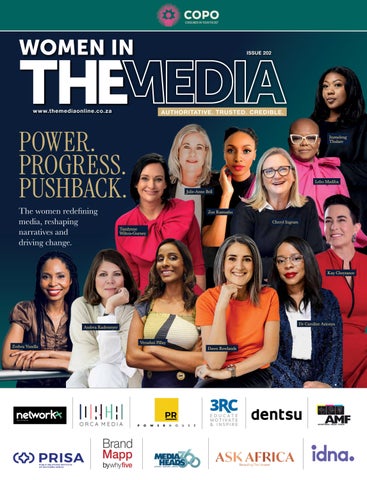
ON THE COVER From bottom left: Zodwa Vundla, Andrea Rademeyer, Verashni Pillay, Dawn Rowlands, Dr Caroline Azionya, Kay Cheytenov Middle: Tamlynne Wilton-Gurney, Cheryl Ingram Top: Julie-Ann Bell, Zoe Ramushu, Lebe Madiba and Itumeleng Thulare
Glenda
2 I THE MEDIA
PUBLISHED BY Arena Holdings (Pty) Ltd Hill on Empire, 16 Empire Road (cnr Hillside Road), Parktown, Johannesburg, 2193
themediaonline.co.za
CONTENTS
THOUGHT LEADERS
24 V ISIBLE VICTORIES Sports journalist and women’s sport advocate Lerato Motjale says stories told about women in sport are vital in advancing equality on and off the field.
27 DRIVEN BY CURIOSITY Ana Carrapichano on why lifelong learning inspired the launch of the Mediology Academy to prepare media professionals for a rapidly changing industry.
FEATURES 06 THE CYBER CEILING Professor Glenda Daniels discusses the findings of the Glass Ceiling: Women in South African media report with Glenda Nevill.
38 OUR STORIES
Tinyiko Thobejane’s career wasn’t mapped out, but was built on curiosity and resilience, she tells Glenda Nevill.
14 C OLLECTIVE MENTORSHIP Her Collective’s inaugural mentorship programme proved that career-changing guidance is about more than advancement, writes Kirsty Carlson.
19 LEADERSHIP SHIFT More women are shaping media and business leadership, bringing strategic perspectives that open doors for those who follow, says Itumeleng Thulare.
20 C HANGING NARRATIVES Dr Caroline Azionya believes Africa’s greatest story is its own, and communicators have a responsibility to tell it with credibility and purpose.
14
41 MIC POWER Women in radio Pinky Myeni, Minenhle Dlamini and Roch-Lé Bloem tell us how they are use their voices to lead, create opportunities and uplift communities.
18 S TRATEGIC SHIFT AI is reshaping PR, shifting its value from content creation to strategic counsel, trust and reputation management, says Lebo Madiba.
Tamlynne Wilton-Gurney explores imposter syndrome and why leadership begins when we stop pretending to be fearless.
26 MAKING SPACE Candice Marescia and Terushka Heuvel reflect on what ‘leading beyond labels’ means to them.
28 FOLLOW THE WOMEN Women drive township economies. Smart brands start by recognising that reality, says Dimitri Tsaperas.
44 THE INNOVATORS Four influential women are
Careers rarely follow a straight line. Growth begins when we question our assumptions, writes Zodwa Vundla.
25 B EYOND PERFECTION
Anthea Carstens, Charlie Wannell, Dashni Vilakazi, Koo Govender, Lindiwe Maduna and Nicola van Niekerk share their insights.
10 P URPOSE, FOUND
12 S HIFTING GOALPOSTS
reshaping media and communications by building trust, championing innovation and creating platforms that put audiences first, writes Glenda Nevill.
46 POWER & PURPOSE Bridget von Holdt on why women are redefining leadership across Africa through strategy, trust and relationships.
52 IT’S A WRAP Zoe Ramushu on how Wrapped is opening doors, widening access and reshaping film industry hiring.
56 T HE TRAILBLAZERS South Africa’s top women in media and advertising are building stronger businesses while creating opportunities for those who follow, says the AMF.
58 O NLINE FAULT LINES The Centre for Analytics and Behavioural Change finds that hostile narratives continue to dominate conversations about LGBTQIA+ communities.
33 SOCIAL FIRST Lebogang Moerane on why brands winning today aren’t the loudest but earning attention through relevance, creators and culture.
43 AFRICAN EXPERTISE Ask Africa founder Andrea Rademeyer helps redefine African leadership by building trusted institutions, advancing women in business and ensuring local expertise shapes global decision-making.
48 THE WHY FACTOR Curiosity about people, not brands, shaped Julie-Anne Bell’s career founded on a fascination with consumer choices.
59 SUCCESS UNSCRIPTED Kay Cheytanov reflects on a 25-year journey shaped by instinct, resilience and unexpected turns.
38
themediaonline.co.za
THE MEDIA I 3
FROM DINING TABLE TO DEAL Exploring the role the women directors and founder of TDMC play in driving the agency’s growth and success.
I
n 2013, long before paid digital media became an industry standard in South Africa, Cheryl Ingram took a leap of faith and launched The Digital Media Collective from her dining table in Durban. Fast forward to today, and that company has grown from its first offices in Cheryl’s garage to one of the region’s leading e-commerce and digital marketing agencies, with a client base that includes some of SA’s best-known online retailers. However, TDMC’s success story doesn’t end there. In June this year, CA&S Group, the JSE and Botswana Stock Exchange-listed FMCG route-to-market group, announced a strategic 30% investment in TDMC, with a pathway to majority ownership over a phased transition. On paper, TDMC’s trajectory seems like a classic growth story, but beneath it is something less often told: a business led almost entirely by women, now run by six directors, four of them women. Cheryl Ingram, Melissa Humphry, Nicola Ashe and Zandile Dlamini didn’t just help TDMC grow. They shaped how it grows.
Ingram doesn’t sugarcoat how hard that journey has been. “There were many nights that I lay awake questioning my decision. The buyout didn’t happen because I got lucky. It happened because I stayed in the room on the days I wanted to walk out of it.”
WHERE IT STARTED
BUILDING A DREAM TEAM
Thirteen years ago, recently retrenched Ingram found herself back in South Africa after a decade growing her career in London – including a formative stint at Microsoft’s MSN UK, where, she says, she was “mentored by some incredible men and women” whose people-first habits she has carried into her own business. Known as a straight shooter, Ingram’s advice to any woman considering the same leap today is direct. “Start before you feel ready because you never will,” she says. “I built TDMC around my dining table in 2013 with a laptop and a stubborn belief that I had the experience that the South African market lacked. I didn’t have a grand plan. I had a problem I knew how to solve and the nerve to back myself. If you’re waiting for permission or the perfect moment, you’ll wait forever.”
None of TDMC’s current leadership arrived through a conventional hiring process. Nicola Ashe, now strategic creative business director, first met Ingram as a client. Eight weeks and one successful campaign later, Ingram asked her to join the business. Within three months, Ashe was a shareholder. Zandile Dlamini joined in 2023, doing copywriting and managing influencer campaigns under Ashe’s wing. A senior role followed within six months, and a directorship a year later. Today, she is the content partnerships director. Melissa Humphry joined in April 2016 to manage a single portfolio, as social media was shifting from a community tool into a serious advertising channel. She moved into strategic leadership,
4 I THE MEDIA
Cheryl Ingram
themediaonline.co.za
Zandile Dlamini
became a shareholder, then media director, and now leads new business as business development director.
WHY FEMALE MENTORSHIP MATTERS Ask any of the four women what has driven TDMC’s growth, and mentorship comes up immediately – not as a soft value, but as infrastructure. For Ashe, it is practical rather than sentimental. “It’s not encouragement; it’s a transfer of information that would otherwise cost someone years to learn on their own,” she says.
PARTN E R CO NTENT
Melissa Humphry
“FEMALE MENTORSHIP HAS BEEN INCREDIBLY VALUABLE BECAUSE IT’S GROUNDED IN LIVED EXPERIENCE.” – MELISSA HUMPHRY
IMAGES: SUPPLIED
Nicola Ashe
Dlamini sees mentorship as a way to expand what’s possible for other women. “We operate in a world that often teaches women to shrink themselves, so having successful women who are willing to open doors and share what they know matters enormously,” she says. “When women are given room to lead, they don’t just create opportunities for themselves; they create opportunities for others too.” Humphry points to the relief of shared experience. “Female mentorship has been incredibly valuable because it’s grounded in lived experience. Learning from women who’ve built successful careers, led teams and navigated the same challenges and life experiences, both personal and professional, has given me confidence in my own journey. It’s reinforced that you don’t have to change who you are to be an effective leader.” For Ingram, at 55, mentorship is a thread that runs from her schoolgirl friendships through to the boardroom. “Mentorship between women is so much more than just advice; it’s evidence,” she
says. “When you watch another woman do the thing you’re terrified to attempt, the fear loses its grip.”
THE DIFFERENT EYES WOMEN BRING As Women lead differently, all four women’s answers converge on execution as much as empathy. “Women are natural leaders,” says Dlamini. “We’re used to managing multiple things at once, staying alert to what everyone in the room needs. Women are executors; we don’t just have ideas; we get them done.” Humphry connects it to her own experience of motherhood reshaping her leadership. “Becoming a mum changed the way I lead,” she says. “It taught me how important flexibility, trust and understanding are, because everyone is balancing something outside of work.” Ingram sees it as a direct challenge to old assumptions about the industry. “Female leaders challenge the myth that there’s a glass ceiling in this industry,” she says. “Women bring a different set of eyes, and a resourcefulness and ability to juggle that suits a highly distracted world.” themediaonline.co.za
The CA&S deal gives TDMC, now a 75-person team servicing clients in 15 markets, what Ingram calls a bigger engine – physical route-to-market scale to match the digital capability the agency has built. However, she is clear that he partnership was never about chasing size. “It was about finding the partner whose strengths made ours worth more.” What hasn’t changed is the culture that got them there – one built, as Ingram puts it, on the belief that “if my team believe in me and where I want to take the business, they’ll get me there”. From a brave idea to a landmark investment, that has been the constant: women backing themselves, and then backing each other. This is sponsored content.
Website: www.tdmc.co.za
THE MEDIA I 5
BEYOND THE GLASS CEILING: THE RISE OF THE CYBER CEILING Glenda Nevill interviews Professor Glenda Daniels ahead of the release of research report, Glass Ceilings 2026: Women in South African media. and people begin to believe conspiracy theories such as women are taking away their power. Of course that’s not true. All we’re fighting for is equality. That’s what feminism means to most of us.” Women occupying visible positions in journalism appear to carry the greatest burden. “The women who are already out there – in politics, investigations, opinion, as editors – are the ones who receive the most backlash,” Daniels says. The report suggests that what appeared to be an emerging issue in 2018 has now become the defining challenge facing women journalists. “In 2018 we introduced a new chapter on cyber misogyny and wondered whether it would become a trend. It most certainly has.”
EXPLOSION OF MISOGYNY That shift reflects the explosion of misogyny and organised abuse on social media, where women journalists increasingly find themselves targeted simply for doing their jobs. “There’s a free-for-all on the internet,” Daniels says. “Groups coalesce around very right-wing, manosphere interests 6 I THE MEDIA
06-07_WomenInTheMedia2026_GlassCeiling.indd 6
Professor Glenda Daniels
The findings are stark. Of the 111 women surveyed, 75% identified cyber misogyny as the biggest problem they face. “That was the highest percentage across every question in the survey,” Daniels says. “Back in 2018 people thought, ‘Maybe it’s a problem.’ Today it’s full-on.” Ironically, she says, artificial intelligence may currently occupy a similar position in public thinking. “When we asked women about AI as a future threat, relatively few thought it was a major issue. That’s exactly where cyber misogyny was in 2018. Now it’s become the biggest threat.”
BRUTAL BACKLASH While women continue to dominate reporting roles in many newsrooms, Daniels says representation has not translated into influence. “Women still seem to be the majority as reporters,” she says. “But you can’t equate women’s numbers with women’s voices. Reporters are still at the bottom of the realm of power.” Senior editorial leadership remains overwhelmingly male. “The positions of power – news editors, editors, managing editors, media owners and boards – are still not where women are.” Unlike the 2018 study, researchers did not attempt to gather management statistics directly from media companies. “The majority of companies simply did not want to provide those figures last time,” Daniels explains. “They also didn’t want to open their books on the gender pay gap. We decided not to waste our time and instead asked women directly. Their answer was clear: nothing has changed.” Daniels believes women remain concentrated in middle management rather than executive leadership.
themediaonline.co.za
2026/07/30 10:07
IMAGES: SUPPLIED
E
ight years after the publication of the landmark Glass Ceilings report in 2018, the picture for women in South African journalism has not improved. According to media academic Professor Glenda Daniels, many of the gains that once appeared within reach have stalled and in some cases, gone into reverse. “When we published the previous report, the challenge wasn’t getting women into newsrooms but getting them into positions of power,” Daniels says. “That hasn’t changed. If anything, quite the reverse.” The 2026 Glass Ceilings report was designed to check the progress of gender equality in South African media. Instead of documenting steady advances, Daniels says the research uncovered what she describes as “complete backsliding”. “The whole point of Glass Ceilings is a progress report. What kind of progress are we making as women, against sexism, towards our Constitution, diversity and plurality? That’s why we do this research. But what we’ve seen is a complete backsliding, an anti-feminist backlash.” For Daniels, the metaphor that has shaped decades of conversations about women in leadership no longer fully captures the challenge. “The glass ceiling has shifted to the cyber ceiling,” she says.
C YBER MISO GYNY
Perhaps the greatest disappointment is the apparent reversal in the progress made by black women in leadership. “When we did the first State of the Newsroom report, published in 2013, we saw fabulous progress. Black women were moving into editor positions and senior leadership. We thought it would continue to grow in a linear way. That hasn’t happened.” Again, Daniels returns to one word. “The big word that stands out for me is ‘backlash’.” Part of that backlash, she believes, stems from the online environment where misogynistic narratives have flourished. Another consequence is that many experienced women are simply leaving journalism. “Women are withdrawing from journalism,” she says. “They’re moving into government, starting their own businesses or leaving the profession altogether. That’s the saddest part of this entire research.”
MY VIEW IS THAT AI IS GOING TO MAKE THINGS WORSE BECAUSE IT’S AN UNREGULATED SPACE WITH A LOT OF MISINFORMATION. COORDINATED ATTACKS AGAINST WOMEN CAN BECOME MUCH EASIER. Although formal newsroom policies against discrimination and harassment exist in many organisations, Daniels says culture has not kept pace. “The overt sexism we experienced years ago has become more covert inside newsrooms,” she says. “The overt hatred now plays out on social media.”
IMAGES: SUPPLIED
ACTIVIST CIVIL SOCIETY Women are also becoming less likely to report online harassment. “They’re more reluctant because there’s very little understanding of online violence,” Daniels says. She recalls earlier international research where women reporting online abuse were told by police to provide evidence of physical injury.
“They’d say, ‘Show me your bruises.’ There’s still a huge lack of understanding about what emotional and online violence actually is.” Civil society has increasingly stepped into the gap left by employers, with organisations such as the South African National Editors Forum (SANEF) developing peer support, wellness initiatives and legal assistance for journalists facing harassment. “I don’t believe it should all be doom and gloom,” Daniels says. “Civil society in South Africa is incredibly active. Thank God we’ve still got that activist nature.” Some media organisations have introduced counselling and support services, but Daniels believes these remain the exception rather than the norm. Looking ahead, she fears artificial intelligence could further intensify online abuse. “My view is that AI is going to make things worse because it’s an unregulated
Professor Glenda Daniels is A National Research Foundation-rated and full professor at Wits University’s Media Studies department, Johannesburg. She is also secretary general at the South African National Editors Forum (SANEF). Her areas of expertise are: Democracy Theory, Media and Politics, the Politics of Technology, State of the Newsroom and Cybermisogyny.
themediaonline.co.za
06-07_WomenInTheMedia2026_GlassCeiling.indd 7
space with a lot of misinformation. Coordinated attacks against women can become much easier.” The new report also broadens its scope beyond gender. It includes chapters examining race, LGBTQIA+ inclusion, socioeconomic inequality and community media. One chapter, written by News24 journalist Bongekile Makhubela, explores what Daniels describes as “the African Boys’ Club” and the recycling of senior male editors, arguing that black women continue to struggle for genuine inclusion at the highest levels of newsroom leadership. For Daniels, the overall conclusion is clear. The conversation is no longer simply about breaking the glass ceiling. “The glass ceiling has shifted to the cyber ceiling,” she says. “That’s the reality women journalists are confronting today.” Read story on online fault lines on page 58.
THE MEDIA I 7
2026/07/30 10:08
CELEBRATING ROSESTAD 100.6FM’S INCREDIBLE WOMEN ROSESTAD 100.6FM profiles six remarkable women in marketing and sales who, with a shared commitment to professionalism, service and integrity, make an incredible contribution to the radio station’s success. JOHLEEN OLIVIER, SALES MANAGER My journey into the radio industry began unexpectedly while I was working in real estate. After selling a house to the marketing and sales manager of the then SABC, he encouraged me to apply for a sales representative position with the SABC. I joined in October 1989 with no radio experience, but quickly discovered a passion that has shaped my career ever since. In April 1995, I was promoted to marketing and sales manager – one of only three women in management at the SABC in the Free State. When Radio Oranje was privatised, I continued as sales manager with the newly established station. Over the years, I was entrusted with establishing and strengthening sales departments at several radio stations, working closely with advertising sales houses to broaden my industry knowledge. I believe radio remains one of the most trusted sources of local news and community connection, a role reinforced during the Covid-19 pandemic. Women continue to play a vital role in the industry’s future, bringing strong leadership, creativity and fresh perspectives. Throughout my career, I have been inspired by respected business and radio leaders whose resilience, innovation and commitment to excellence encouraged me to embrace continuous learning and the philosophy of ‘Just Do It’. 8 I THE MEDIA
One of my proudest achievements was attending a radio conference in Las Vegas after being recognised as Sales Manager of the Year. I am grateful for the unwavering support of my family, whose encouragement has allowed me to pursue a career I remain deeply passionate about.
KARIN BOOYSEN, SCHEDULER I joined the radio station in 2008 after a family member asked me to assist with music scheduling and reception. What started as temporary support soon became a permanent role as music controller and receptionist. About 10 years later, I took up my current position as scheduler. From the early days of manual scheduling to today’s automated systems, I coordinate advertisements, interviews, recordings and other broadcasts, ensuring everything goes on air accurately and timeously. I believe women bring empathy, creativity and fresh perspectives to radio, helping the industry remain relevant while building meaningful connections with listeners. I am inspired by people who face life’s challenges with faith, perseverance, humility and a heart for serving others. I am proud to have created opportunities to help others and positively impact my community. My dream is to continue serving with purpose and leave a legacy of integrity for my children. themediaonline.co.za
JO VAN ZYL-NAUDÉ, NATIONAL AGENCIES CO-ORDINATOR My radio career began in 1988 at the then SAUK as programme secretary for Radio Oranje, after developing a passion for entertainment and media while working at the Sand du Plessis Theatre Association. Following a 10-year break from radio, I joined Rosestad 100.6FM in August 2020. Radio has become more than a career; it is my passion. I am dedicated to serving listeners and clients while helping others succeed. I believe women bring valuable insight to the industry by looking beyond the obvious and finding solutions to challenges. I am inspired by leaders who lead by example while never losing the human touch, and am blessed to have such a direct line manager. I am proud of my professional growth from administration to marketing and sales, my karate achievements and business successes. My greatest dream is for my family to enjoy a loving, contented life.
SELMA ROSSOUW, ACCOUNT EXECUTIVE I have been in the radio industry for the past 19 years after asking a friend, who was working in radio, how to apply for a position. When a vacancy became available, I applied, and from day one, I have learned every aspect of the industry from the ground up. Even after all these years, I continue learning every day. For me, radio is about constant change. No two days, clients or challenges are ever the same. Working behind the scenes, I enjoy developing new ideas for clients and seeing them deliver successful results. It is often the small victories that make the biggest difference.
PARTN E R CO NTENT
I believe women are essential to radio’s future, bringing balance, insight and strength to the industry. I am inspired by Johleen Olivier, whose commitment to growth, compassionate leadership and genuine care for her team I deeply admire. My greatest dream is to remain an active part of my family’s lives while exploring the world through international travel.
IMAGES: SUPPLIED
CHAREDELE VENTER, ACCOUNT EXECUTIVE As a young professional with two years in the radio industry, I wouldn’t trade this career for anything. While many people assume working in radio means being a presenter, I have discovered the many roles behind every successful station. As a sales representative, I connect businesses with radio advertising, helping them share their stories with the right audience. Radio has always been part of my life. From school mornings debating stations with my dad to family road trips
and quiet drives after difficult days, it has always informed, entertained and connected people. I believe women play an important role in radio’s future. We bring warmth, creativity and fresh perspectives that strengthen relationships and help the industry evolve. Whether working with clients or behind the scenes, women make radio more personal, relevant and connected to its audience. I am excited to be part of that future.
TANIA BENSON, FINANCIAL OFFICER I have been part of Radio Rosestad for the past 22 years, a journey I cherish with gratitude and pride. I started as an advertising scheduler, writing and recording commercials, editing advertisements and church services, scheduling broadcasts, supporting outside broadcasts and managing music uploads. themediaonline.co.za
Although I presented a few radio shows, I realised my passion was behind the scenes. Today, I serve as Radio Rosestad’s financial officer, ensuring the station’s finances run smoothly so the team can focus on delivering quality programming. Radio has given me opportunities for personal growth, lasting friendships and continuous learning. Every team member, on air or behind the scenes, contributes to the station’s success. Inspired by humble, hardworking people who persevere, I value the trust I have earned. My greatest dream is a happy, healthy family and to continue growing and making a positive difference. This is sponsored content.
Contact Information: Telephone Number: 051 412 6401 Email: sales@rosestad.co.za Website: www.rosestad.co.za
THE MEDIA I 9
M E D I A S ALE S
BUILDING OPPORTUNITIES, BREAKING BARRIERS
Tinyiko Thobejane’s career has
WANTED TO BE NOTICED She was determined to progress. Rather than waiting for opportunities, she sought out senior leaders, learnt from them and worked relentlessly. 10 I T H E M E D I A
10_WomenInTheMedia2026_TINYIKO.indd 10
“I spent a lot of time with people who were more senior than me. It was a strategy to get promotions. I worked my butt off. I wanted to be noticed and recognised for my skill set as well as my ambition.” That strategy paid dividends, opening doors to agency sales and eventually much larger leadership roles. One of the defining moments of her Tinyiko career came during Thobejane preparations for the 2010 FIFA World Cup, when she joined a small agency responsible for major projects around the tournament, including the opening of Peter Mokaba Stadium and managing international media relations. The experience fundamentally changed how she viewed herself. “I learned that I can actually be an entrepreneur,” she says. “I found my passion and realised for the first time that I’m actually a self-starter.” Working within a small organisation meant building systems from scratch, recruiting staff and even establishing an in-house creative department. “It was one of those moments when you realise, ‘I actually can start my own business.’” She eventually did exactly that before returning to Arena Holdings after a 12-year absence. Today, as head of sales and partnerships, she oversees commercial operations across print, digital, television, sponsorships and strategic partnerships. Her appointment is personally significant but historically significant too. “It’s the first time there’s actually an African female sitting on this chair at the pinnacle,” she says. “It’s never happened in my lifetime.” She believes that milestone carries responsibility.
“We have an opportunity to change the game,” she says. “But intentionally take everyone along with us in this journey. At the end of the day, it’s not about having the loudest voice. It’s about making good decisions and bringing people together around shared objectives.” Although she acknowledges the industry has made meaningful progress, she believes genuine equality remains unfinished business. “I think there’s always been glass ceilings,” she says candidly. “It’s been a tough journey to finally get here.”
ENCOURAGING SIGNS At the same time, she sees encouraging signs across the broader marketing and communications ecosystem, where more women and black executives are assuming influential leadership positions. “I do think that if you look at the entire value chain and not just media, there is transformation taking place.” Her leadership philosophy mirrors the evolution of the industry itself. Advertising is no longer about simply selling space. “We’re no longer selling placements,” she explains. “We’re selling a multimedia platform. We always start with the client’s objectives.” Despite building an impressive career without completing her original qualification, she remains a firm believer in education. In fact, she is considering returning to university herself. “I said to my mentor two weeks ago, ‘I need to go back to school.’ I feel like I need something to help me pivot going forward’.”
IMAGE: SUPPLIED
W
hen Tinyiko Thobejane looks back on her career, she doesn’t see a carefully planned route. She sees a series of opportunities that she was curious enough, and brave enough, to pursue. “I started my career in radio while studying interior design,” she says. “A friend told me a community radio station was looking for weekend presenters. I wanted something to keep me busy and also to earn extra income to help my mom.” Her family circumstances shaped her early ambitions. After her father left, her mother was raising four children and paying for tertiary education. A weekend radio show became more than a student job. It was the beginning of a career. But it wasn’t presenting that captured her imagination. “I took an interest in marketing and media sales. Every time they gave updates in staff meetings, I wanted to know more. I asked if I could job-shadow someone, and that’s literally how I got into media sales.” A serious health scare forced her to leave her studies after several weeks in hospital. Rather than returning to interior design, she accepted a junior marketing role at the station. Looking back, she sees it as the moment everything changed. “I didn’t finish my degree,” she says. “But that’s how I started.” From there, her career gathered momentum. She sold advertising for AutoTrader, moved into magazine publishing and eventually secured a junior sales executive position at the Sunday Times – a role that confirmed she had found her calling. “I realised this is a career for me and this is something I want to grow into.”
been driven by curiosity, resilience and a willingness to embrace opportunity, writes Glenda Nevill.
themediaonline.co.za
2026/07/30 10:07
Untitled-1 1
2026/07/15 12:34
TH OU G H T LE AD E R SHI P
REOPENING COLD CASES
I
’ve developed an unhealthy fascination with true crime documentaries. I promise it’s not because I enjoy the crime. Quite the opposite. I’m fascinated by the investigation. Every episode begins with certainty. The evidence appears straightforward, the suspect seems obvious and everyone believes they’re looking in the right direction. Then someone asks a different question. A witness remembers something small. A timeline no longer fits. An assumption is challenged. Suddenly, the entire investigation changes because the first theory turns out not to be the whole story. The media industry has taught me that careers can be a little like that. When I started mine, I thought I understood the rules. Work hard. Be dependable. Keep learning. Be patient. Surely good work would eventually be recognised and rewarded. Sometimes it was. Sometimes the goalposts shifted just as they came into view. A promotion came with a different title than expected. A role carried less influence
OUR BUSINESS DEPENDS ON UNDERSTANDING PEOPLE. WE QUESTION WHY CONSUMERS BEHAVE THE WAY THEY DO, CHALLENGE ASSUMPTIONS AND SEARCH FOR THE INSIGHT HIDDEN BENEATH THE OBVIOUS. I FIND IT CURIOUS THAT MANY OF US SPEND YEARS ANALYSING EVERYONE ELSE’S BEHAVIOUR BEFORE STOPPING TO QUESTION OUR OWN ASSUMPTIONS. 12 I T H E M E D I A
than anticipated. A salary didn’t quite reflect the responsibility. Whether that was because of gender, race, timing or simply the realities of business, I’ll never know. Like many women, I accepted what was in front of me and used it as a stepping stone rather than a stopping point.
QUESTIONS WE SHOULD BE ASKING Looking back, I sometimes think it’s worth reopening a few cold cases. Instead of asking, “Is this fair?”, perhaps I should also have asked, “What am I prepared to ask for?” Like many women of my generation, I believed hard work spoke for itself. Recognition would arrive if I simply earned it. Failure wasn’t really an option either. I’d chosen a career my family didn’t fully understand, so I felt an enormous responsibility to make it work.
Zodwa Vundla
It took me far longer than I’d like to admit to realise that waiting is not a career strategy. What I admire about many younger women entering our industry is that they seem less burdened by those assumptions. They negotiate. They ask questions. They challenge decisions respectfully and walk away at the first whiff of exploitation. Perhaps they’ve simply inherited a world that has permitted them to speak sooner than many of us did. Every generation inherits a different case to solve. My generation fought for a seat at the table. Today’s leaders are navigating artificial intelligence, shrinking influence and organisations that expect more with fewer resources. If the evidence changes, so should we. Our business depends on understanding people. We question why consumers behave the way they do, challenge assumptions and search for the insight hidden beneath the obvious. I find it curious that many of us spend years analysing everyone else’s behaviour before stopping to question our own assumptions. Maybe the same applies to the stories we’ve inherited about ambition and leadership. The first story we tell ourselves about our careers probably isn’t the whole story either. The best investigators know that certainty can be dangerous. They stay curious long enough for a better story to emerge. Perhaps the best leaders do the same. This is sponsored content.
IMAGE: SUPPLIED
Sometimes the stories we tell ourselves deserve a second investigation, writes Zodwa Vundla, managing director of MediaHeads 360.
Zodwa Vundla is the managing director of MediaHeads 360. She has an incurable curiosity about why people think and behave the way they do, which is fortunate because she works in media and marketing. She enjoys simplifying complexity, occasionally challenging industry norms (politely, of course), and disappearing down rabbit holes in search of a better question rather than an easy answer.
themediaonline.co.za
Untitled-3 1
2026/07/14 09:56
BUILDING THE FUTURE OF WOMEN IN MEDIA, ONE CONNECTION AT A TIME In every industry, careers are shaped by opportunity. More often than not, however, they’re transformed by people, writes Kirsty Carlson.
IF THERE’S ONE LESSON WE’VE LEARNED FROM OUR INAUGURAL COHORT, IT’S THIS: WHEN WOMEN LIFT WOMEN, EXTRAORDINARY THINGS HAPPEN.
Kirsty Carlson
14 I T H E M E D I A
themediaonline.co.za
T
here is a saying that people don’t remember every meeting you had with them, but they remember how you made them feel. In many ways, that captures the heart of mentorship. A single conversation can change the way someone sees themselves. A trusted mentor can help someone navigate uncertainty, make a difficult career decision, find the confidence to speak up, or simply remind them that they belong. That belief became the foundation for Her Collective. Founded to connect women across media, marketing, advertising and communications, Her Collective was created to build something many of us wished we’d had earlier in our careers— a trusted community where women could learn from one another, share experiences openly and grow together. The inaugural Her Collective Mentorship Programme brought together 30 senior industry leaders and 30 ambitious women from across South Africa’s media and marketing industry for a structured mentorship journey built on honest conversations, accountability and mutual growth. What followed exceeded every expectation. While we hoped the programme would build confidence, strengthen leadership and create meaningful connections, it became so much more. As the testimonials from our inaugural
ME NTO RSHIP
cohort began to arrive, one thing became abundantly clear: mentorship doesn’t simply change careers—it changes the way women see themselves.
IMAGES: SUPPLIED
CONFIDENCE. COURAGE. COMMUNITY For many mentees, the greatest transformation wasn’t reflected on a CV. It was internal. Cara Woods, sales manager at Tractor Outdoor, described the programme as one of the most valuable experiences of her career. “What I gained was so much more than guidance. I gained confidence, clarity and someone who genuinely invested in my growth. The mentorship helped me develop the confidence, communication skills and self-belief needed to step into a leadership role,” she says. For Tangerine Mathebula, Her Collective became the catalyst for entrepreneurship. As she notes, “I came to Her Collective looking for direction, and I’m leaving with a consulting business and a newfound sense of confidence.” Another mentee, Courtney Locke, discovered the courage to pursue a dream she’d been quietly carrying. “Her Collective helped me recognise my own capabilities, trust my instincts and believe that I was capable of building something beyond my day-to-day role,” she says. “That confidence gave me the push I needed to launch my own business.” For Thobekile Radebe, the journey wasn’t about becoming someone new. “I expected to reinvent myself. Instead, I discovered there was never anything wrong with my voice to begin with. What I needed wasn’t reinvention; it was clarity, confidence and someone who believed in me enough to help me see my own potential.” Some stories were deeply personal. Khayelihle Dlamini reflected on a simple car ride home with her mentor that changed how she saw herself. “The programme has given me more than professional development. It has given me a community that reminds me that I belong, that my voice matters, and that I have something meaningful to contribute.” For Yvonne Moyo, already an accomplished media professional in the out of home industry, the programme
challenged the belief that mentorship is only for those starting out. “Growth doesn’t have an expiry date... Her Collective gave me the framework, accountability and confidence to move from thinking to doing,” she says. And for Tynielle Beyers, the biggest shift was visible every day. “One of the biggest changes I’ve noticed is in how I show up professionally. I walk into rooms differently now.” Different women. Different journeys. Yet the themes remained remarkably consistent: confidence, courage, belonging and the reassurance that no woman has to navigate her career alone.
MENTORS IMPACTED TOO One of the greatest surprises of the inaugural cohort was hearing just as many powerful reflections from mentors. Many joined believing they would simply give back. Instead, they found themselves growing too. Valentine Gaudin-Muteba, managing director of TRACE Southern Africa, summed it up beautifully. “Having the opportunity to support, encourage and share my experiences with another woman reminded me just how powerful mentorship can be—not only for the mentee, but for the mentor as well,” she says. Michelle Randall Sharnock, co-founder of Kirelley, shared a similar reflection. “I joined this programme thinking about what I could give. What I didn’t expect was just how much I would receive in return.” For Genevieve Coward, COO of Primedia Outdoor, watching her mentee’s transformation became one of the highlights of her own leadership journey. “Watching her grow into a confident leader, build and lead a team, and take the courageous step of launching her own business has been inspiring to witness firsthand.” Merissa Himraj reflected on how the experience reshaped her own leadership. “This process has made me learn more about how I show up in leadership, friendship and family life. Mentorship means we can change the pattern for future women in the workplace.” For Dashni Vilakazi, managing director of The MediaShop, the programme represents something much bigger than one cohort. themediaonline.co.za
“Our industry needs more women who actively open doors for others so we can accelerate their growth and create a ripple effect where today’s mentees become tomorrow’s leaders and mentors.” And Katharine Liese, commercial director at Dentsu, captured the essence of Her Collective best. “Her Collective is more than a mentorship programme. It is a reminder that none of us achieves success alone, and that some of the most meaningful impact we can have is helping others realise their potential.”
THE RIPPLE EFFECT Success isn’t measured by the number of mentoring sessions held or hours invested. It’s measured in the women who now lead with greater confidence. The businesses that have been launched. The promotions earned. The difficult conversations that are no longer avoided. The women who finally believe they deserve a seat at the table. The inaugural cohort has shown what becomes possible when women intentionally invest in one another. Today’s mentees will become tomorrow’s mentors. Today’s conversations will shape tomorrow’s leaders. And the ripple effect has only just begun. As Her Collective continues to grow through mentorship, networking events, learning opportunities and industry partnerships, our vision remains unchanged: to create a community where women don’t compete for a seat at the table – they build a bigger table together. If there’s one lesson we’ve learned from our inaugural cohort, it’s this: When women lift women, extraordinary things happen. Kirsty Carlson is owner and founder of Her Collective and an independent media consultant. She is also co-host and founder of Beyond the Billboard and OOH Central. Applications have opened for the second Her Collective cohort. More here: www.hercollectiveco.com and LinkedIn: Her Collective Co
T H E M E D I A I 15
Untitled-1 2
2026/07/17 10:18
Untitled-1 3
2026/07/17 10:19
TH OU G H T LE AD E R SHI P
AI DIDN’T KILL THE PR STAR
I
n 1979, The Buggles released Video Killed the Radio Star, making history with the first music video ever broadcast on MTV on 1 August 1981 – and representing the impact of technological change on an industry. Nearly half a century later, artificial intelligence (AI) is raising similar questions across the communications sector. Writers, designers, marketers and public relations (PR) practitioners are all considering what becomes of their work when content can be produced faster, cheaper and at scale. For PR, the more useful question is not whether AI will replace the profession. It is what AI reveals about where the profession’s value lies. This is particularly so this year, as World Public Relations Day was celebrated under the theme The Golden Age of Strategic PR. The theme reflects the environment in which brands and organisations now operate. Geopolitical instability, declining trust, misinformation, stakeholder activism and rapid technological change have increased the reputational consequences of business decisions. Communication is therefore becoming more closely connected to strategy and decision-making. The role of PR is not limited to explaining decisions after they’ve been made. It includes helping leaders understand how those decisions may be received, where trust may be affected and what reputational consequences may follow. This contribution isn’t always reflected in how the profession is measured. Press releases, campaigns, media interviews, coverage reports and social media content are visible and easy to count. They remain important outputs, but don’t represent the full value of the work. AI has made many of these outputs easier to produce. A media statement, campaign concept or speech can now
18 I T H E M E D I A
be drafted in seconds. The quality may vary, but the speed and accessibility are undeniable. That, however, does not reduce the value of PR. It clarifies the distinction between production and professional counsel. This distinction also provides context for the Africa Declaration on the Professionalisation of Public Relations and Responsible Communication, championed by the Public Relations Institute of Southern Africa. The declaration seeks to establish clearer expectations around competence, ethics, transparency and accountability across the profession. This is especially relevant in an environment where persuasive communication can be generated quickly and distributed widely.
Lebo Madiba
As content production becomes more accessible, professional value will increasingly be determined by the quality of the thinking behind the work, the ethical standards that guide it and the willingness to be accountable for its outcomes. Professionalisation provides a clearer way to define the value of PR through competence, ethics, accountability and strategic counsel. Technology will continue to change how practitioners research, write, analyse and distribute information. In an industry responding to events in real time, these tools are becoming part of everyday practice. The more important development is what this shift asks of the profession. As communication becomes easier to produce and distribute, practitioners will need to demonstrate the quality of their counsel, the standards that guide their work and their accountability for its consequences. The opportunity presented by professionalisation is to define public relations by what practitioners produce and by the competence, ethics and responsibility they bring to brands operating in an increasingly complex and fragmented world. AI has not killed the PR star; it has amplified what has always defined the profession, the need for sound decision-making, credibility and accountability. This is sponsored content. Lebo Madiba founded PR Powerhouse to build the kind of communications firm she believed clients increasingly needed, that is senior, thoughtful, commercially aware, and able to move between strategy, reputation, media, leadership, and stakeholder realities without losing the human thread. Her work is shaped by curiosity, context and a belief that influence carries responsibility.
themediaonline.co.za
IMAGE: SUPPLIED
AI has amplified what has always defined PR: sound judgement, credibility and accountability, says Lebo Madiba, founder and managing director of PR Powerhouse.
C OR P OR ATE L E A DERSHIP
LEADING WITHOUT APOLOGY The presence of more women leaders in the media and corporate space is inspiring – and essential – writes Itumeleng Thulare.
O
ver the course of the last decade, we have seen more and more women leading in the media space – we’re seeing more women as CEO of broadcasters, awardwinning producers and directors in the TV and film space and as CMOs of notable organisations. We still have a long way to go in levelling the playing field, but we can’t deny that there is more diversity in the media space now. I entered the media industry at a time when women were taking on leading roles, which was incredibly inspiring. I’ve had the privilege of witnessing women exponentially grow organisations under their leadership and then pivoting into other areas – Newzroom Afrika is one example.
SEEING WOMEN LEAD WITHOUT APOLOGY AND FEAR WILL ALWAYS GIVE OTHER WOMEN THE COURAGE AND LICENCE TO THRIVE WHERE THEIR FEET ARE PLANTED. There are still some limitations, especially in the corporate space, but it is certain that the impact made by those women who came before has delivered opportunities for women to sit in certain spaces where they were not welcome before.
IMAGE: SUPPLIED
DIFFERENT PERSPECTIVE I joined MultiChoice in 2021 from an agency background and was senior manager: corporate communications at MultiChoice South Africa when the CANAL+ merger took place. I’ve since shifted across to MultiChoice as head of corporate affairs. MultiChoice is the entity carved out during the transaction to hold the broadcasting license for DStv in South Africa, since local broadcasting licenses must be held by South African companies. My focus at MultiChoice
is on managing the corporate affairs of the business and working with the CANAL+ owned MultiChoice entity and its various divisions to meet the needs of our South African customers. I believe women bring an undeniably different perspective to the media space, they are needed. I see our perspective not as a ‘softer’ or inherently ‘different’ skill set, but as a strategic asset built from navigating environments that were not originally designed for us. There’s duality in the sense that we have the ‘sensible’ side as well as the side that matches our male counterparts. In my experience, the ‘sensibility’ we bring is fundamentally grounded in contextual awareness. When you spend your career as a minority in rooms where decisions are made, you become adept at reading the room, anticipating how a message will land with diverse audiences, and identifying the blind spots that others might miss – and that’s an asset to have.
REINVENTING THE BRAND The media space is changing rapidly and we have gone from competing with other broadcasters to competing with streaming platforms, social media platforms and the like. The challenge MultiChoice faces is keeping up, then leading – and reinventing the brand in South Africa to be relatable to our customers and meeting them where they need us. Mentorship for anyone in the corporate space is essential for growth and
Itumeleng Thulare
themediaonline.co.za
MultiChoice gives people across the business opportunities to take part in various leadership optimisation programmes, with Wits Business School, for example, which can ultimately change the trajectory of their careers. Outside of that, mentorship from senior, experienced people within the organisation is easy to access for anyone who wants to learn. That type of access and proximity can do wonders for someone who is a mid-level employee looking for growth. Although MultiChoice is no longer part of the Group, we still follow a similar ethos to add value to the lives of others, which includes our employees. Reflecting this commitment, the executive leadership team at MultiChoice now comprises more than 80% women – an encouraging milestone for the organisation Career-defining moments in the industry will always pertain to women unapologetically leading with impact. One such example is how the former Showmax CEO pivoted from leading MultiChoice’s General Entertainment channels into the world of streaming at a time when it was still a new concept to the continental industry. Women like Fhulufhelo Badugela, who are fearless in the pursuit of growth and impact, really inspire a special kind of greatness – under her leadership, Africa’s biggest broadcaster delivered a return to profitability after navigating many challenges. Seeing women lead without apology and fear will always give other women the courage and licence to thrive where their feet are planted.
Itumeleng Thulare is head of corporate affairs at MultiChoice, where she leads the company’s corporate affairs strategy and works closely with the CANAL+-owned MultiChoice Group and its divisions to support the needs of South African customers.
T H E M E D I A I 19
OUR STORY TO TELL Dr Caroline Azionya on telling Africa’s story and who gets to tell it. PRISA’s new president wants to put the continent’s capabilities, and its practitioners’ credibility, at the centre of the story.
I
n South African newsrooms, the share of women in top editorial jobs fell from 47% in 2020 to 38% in 2025. That was one of the sharpest declines in the Reuters Institute’s 12-market study. The same pattern of underrepresentation is evident across the wider communications industry, not only in newsrooms. Dr Caroline Azionya steps into that landscape as the new president of the Public Relations Institute of Southern Africa (PRISA). She is clear about the story she most wants told. “Africa has so many positive narratives waiting to be told,” she says, “and too few of them are ours.”
GOOD PR IS NOT SPIN. INCREASINGLY, WE ARE THE CUSTODIANS OF TRUST. Her focus is on the continent’s socio-economic capabilities and the ingenuity born of limited resources – the resourcefulness that turns constraint into innovation. Azionya uses her own platform to champion those narratives, and she wants every practitioner to understand what good public relations can achieve. “We should be telling the world about Africa’s capabilities and our ingenuity,” she says. “That’s the story I want our profession to carry.” That belief comes with a warning she returns to often. In a world
20 I T H E M E D I A
awash with digital disinformation, she argues, “Good PR is not spin. Increasingly, we are the custodians of trust and, in an age of disinformation, that is one of the most important jobs there is.”
WOMEN IN POWER For the next three years, PRISA will be led by women. Azionya, senior lecturer in strategic communication at the University of Johannesburg, serves as president. Mary Gearing, deputy managing director of Magna Carta, is presidentelect. Tsholofelo Dihutso, senior brand and communications manager at Deloitte, is vice-president, while Annah Jordan, PRISA’s general manager, oversees the secretariat.
A PROVEN HAND Azionya does not arrive untested. As president-elect last year, she chaired the 2025 PRISMS Summit and Awards, one of the institute’s most successful events in recent years. She focused on member value and repositioning the summit, then in its third year, as a platform for meaningful industry conversations. “We aligned ourselves with the G20 Presidency and positioned it as Africa’s win,” she reflects. “It was Africa’s moment and we had a seat at the table. We have entered an era of African selfdetermination, where we are no longer asking for permission to create solutions that benefit us.” The data showed practitioners wanted content tailored to their realities, so she created dedicated plenaries for PR’s four key sectors – government, academia, corporate and agency – while reserving panels for themes shared across the profession. She also introduced Presidential Roundtables tackling the profession’s toughest questions – professionalisation, AI safety and governance – drawing themediaonline.co.za
association presidents from across the region to add weight to the discussions. Working closely with Jordan, sponsorship was restructured so the various event streams strengthened rather than cannibalised profitability. She added an academic track to showcase leading research and took the institute onto university campuses to revive student membership. Gearing, recipient of the Presidential Award at the 2025 PRISMS and chair of the PR and Marketing Board, helped build visibility for the event, while Dihutso continued her longstanding role as a PRISMS judge. The results, including a meaningful contribution to PRISA’s financial sustainability, speak for themselves. “I don’t innovate for its own sake. I follow the data to where the value is, and then I build it. I’ll bring exactly that energy to my term,” she says.
AFRICA HAS SO MANY POSITIVE NARRATIVES WAITING TO BE TOLD – AND TOO FEW OF THEM ARE OURS. THE TERM AHEAD Azionya’s mandate is firmly regional. She wants to build a genuinely Southern African Development Community (SADC)-wide professional home for communicators – one that practitioners in Gaborone or Lusaka recognise as their own and that delivers tangible value at every stage of their careers. PRISA has championed ethical and responsible communication for 69 years. Founded in 1957, it is the only SAQArecognised professional body for public relations in Southern Africa. Former president Oscar Tshifure initiated PRISA’s professionalisation drive. That work now forms part of a broader continental movement shaped by the newly launched Africa Declaration on the Professionalisation of Public Relations and Responsible Communication. The declaration seeks to build shared recognition and formal standing for the profession, anchored in ethics and accountability in the public interest.
P U BL I C R ELATIO NS
AS A WOMAN, YOUR VOICE IS NOT A NICE-TO-HAVE. STOP WAITING FOR PERMISSION TO LEAD. Bradly Howland is co-lead of the initiative. Azionya describes it as the defining strategic moment of both her presidency and the profession across the continent. PRISA is a founding signatory and co-lead of the initiative. Azionya is candid that leadership is rarely easy and that being first often comes at a cost. “Being a leader and a pathfinder can be lonely, even painful. But if you have a vision, you stick it out. You create a path others can be inspired by. And once the foundation is there, it isn’t hard to teach them to dream of more.” She knows the value of that path because other women cleared one for her. The glass ceiling remains a reality for many women leaders in South Africa. However, 2025 research by Kholosa Mathetha and Nelesh Dhanpat found it can be broken through mentorship, strategic networking and continuous skills development. Azionya is passionate about female empowerment because she has experienced its impact firsthand. She attributes many of her career milestones to the women who mentored and supported her. She was brought into the fold by Professor René Benecke, her colleague at the University of Johannesburg and PRISA president at the time – a debt she acknowledges deliberately because it reflects the kind of leadership she wants to practise.
Her message to emerging women communicators is also a promise about the space she and her fellow PRISA leaders are building. Past president Phuthi Mothapo established the annual Women in Power event to mentor and develop women in public relations. Each year, Jordan mentors a cohort of PR interns from institutions across the country and has guided more than 40 interns to date.
Dihutso has similarly mentored PR and communication students, many of whom have gone on to secure permanent roles. Gearing continues to mentor peers and emerging practitioners, while Azionya, through her academic career, has taught and mentored countless future communicators and remains committed to developing the next generation. As she concludes: “As a woman, your voice is not a nice-to-have. Learn the craft, hold the standard, and stop waiting for permission to lead. Someone held the door open for me. Now it’s my turn to hold it open for you.”
IMAGE: SUPPLIED
SOMEONE HELD THE DOOR OPEN FOR ME. NOW IT’S MY TURN TO HOLD IT OPEN FOR YOU. “I’ve been fortunate that women like Professor Benecke embrace their womanhood and use their position and platform to nurture and raise the next generation. That is what leadership should do,” she says.
Dr Caroline Azionya
themediaonline.co.za
Dr Caroline Azionya is president of the Public Relations Institute of Southern Africa and a senior lecturer in strategic communication at the University of Johannesburg.
T H E M E D I A I 21
Untitled-1 2
2026/08/03 09:22
Untitled-2 3
2026/07/20 09:38
SPORTS M E D I A
Sports journalist and women’s sport advocate Lerato Motjale argues that storytelling is one of the most powerful tools for advancing equality in sport.
L
ong before I called myself a sports journalist, I was already studying stories. Growing up, I was drawn to newspapers, reading not only the headlines but also paying attention to how stories were framed, whose voices were prioritised and what narratives were being built. Even then, I was fascinated by the power of media to shape public perception. At the same time, I was growing up in a world where women’s achievements in sport were often sidelined. Their victories received less attention, their journeys lacked depth and their contributions were too easily forgotten. It taught me early that the stories behind athletes matter just as much as the trophies they lift because media determines whose legacies endure.
Lerato Motjale
That conviction grew stronger during my time at the Premier Soccer League (PSL), where former CEO Trevor Phillips challenged me every Monday to analyse not just what had been written about the league, but why those narratives mattered.
MORE THAN SCORES Those lessons taught me to look beyond match results and understand the power of communication. As a sports journalist, I have come to see sports communication as more than reporting scores. It is about shaping public perception, preserving legacies and ensuring athletes and coaches are recognised in their full humanity. I see myself not only as a storyteller but as a narrative builder and media strategist, intentional about how stories are framed and the impact they leave behind. In women’s sport, communication carries even greater responsibility because visibility remains part of the fight for equality. Too often, women are celebrated only after winning major tournaments or breaking records, while the leadership, resilience, sacrifices and daily realities that define their careers receive little attention.
INTENTIONAL STORYTELLING That is what drives me as a women’s sport advocate. One of my proudest moments was writing about Desiree Ellis. Her story was never only about football success. It was about purpose, resilience and leading with conviction long before the spotlight arrived. It reinforced why context matters. Great leadership deserves to be understood, not simply celebrated. Through my work with the Female Coaching Network, I have had the privilege of profiling South African coaches and 24 I T H E M E D I A
themediaonline.co.za
TELLING THEIR TRUTH Leadership in this space begins with trust. Athletes and coaches entrust journalists with their experiences, and we have a responsibility to tell those stories with integrity and accuracy.
I OFTEN DESCRIBE THIS WORK AS BEING A VISIBILITY ARCHITECT, HELPING CREATE SPACES WHERE WOMEN’S ACHIEVEMENTS CAN BE SEEN, VALUED AND CELEBRATED. My mission is simple: to change narratives. Thoughtful storytelling has the power to transform how the world sees women in sport. A single profile can lead to recognition. Recognition can attract sponsorship. Sponsorship can unlock investment. Investment can transform careers, strengthen communities and create opportunities for future generations. As I continue to grow in this field, I want my work to represent credibility, global representation and purposeful storytelling that challenges outdated perceptions and expands opportunities for the next generation. Because beyond every scoreboard is a deeper story and that is where my work begins.
Lerato Motjale is a sports communicator, storyteller and women’s football advocate committed to shifting who gets access, visibility and leadership in the game. She’s served as a media liaison and marketing coordinator at the Premier Soccer League, working within elite football environments to shape narratives, manage communications and coordinate high-profile events.
IMAGE: SUPPLIED
BEYOND THE SCOREBOARD
sharing their journeys with a global audience. More than publishing articles, I am helping document history and ensuring women who are transforming sport are remembered. I often describe this work as being a visibility architect, helping create spaces where women’s achievements can be seen, valued and celebrated. After all, people cannot support what they do not see, or value what they do not fully understand.
TH OU GH T L E ADERSHIP
THE COST OF PERFORMING ‘Fake it till you make it’ might be the worst leadership advice anyone has ever given us, writes Tamlynne Wilton-Gurney.
F
or years, I assumed confidence was something you earned. Build the business. Tick the boxes. Stand on enough stages, win enough clients, and eventually the nagging voice in your head would take the hint and disappear. Mine didn’t… she just got more articulate. She has a name now: Phyllis is a flamingo, because she has no interest in blending in. She has no interest in blending in. She’s bright, conspicuous and a little dramatic. She arrives roughly 90 seconds before anything important, and announces that today is when everyone discovers I’ve been winging it all along. She’s exhausting, but she’s also taught me something. We spend a staggering amount of energy trying to silence the parts of ourselves we’ve decided don’t belong. Carl Jung called them the shadow. Not because they’re dark or dangerous, but because we’ve pushed them out of sight. Fear. Self-doubt. Insecurity. The parts that don’t fit the identity we’ve carefully built as capable, successful, ‘got our sh*t together’ people. The harder we work to hide those parts, the more energy we spend protecting the performance.
IMAGE: SUPPLIED
CONGRUENCE
look like certainty. We reward confidence, decisiveness and composure while quietly treating vulnerability as something to manage behind closed doors. However, leadership doesn’t happen in isolation. Our teams are constantly watching us, taking their cues from what we say, but, more importantly, from what we don’t. We often think of imposter syndrome as an individual problem. We encourage people to be more confident, to own their achievements and believe they deserve a seat at the table. Good advice, but I’m not convinced it’s the whole story. If every leader around me appears completely certain, composed and unshakeable, it’s hardly surprising that I assume I’m the only one questioning myself. I don’t
Tamlynne Wilton-Gurney
Lately, I’ve become slightly obsessed with another word: congruence. Psychologist Carl Rogers described it as the alignment between who we really are and who we present to the world. When those two versions of ourselves drift too far apart, keeping up appearances becomes exhausting. I wonder if that’s what many leaders are carrying? Somewhere along the way, we’ve decided that leadership should
compare myself to their reality; I compare myself to their performance. Perhaps that’s where imposter syndrome really takes hold. One of the ideas that has stayed with me from Gabor Maté’s work is that suppressing who we are comes at a cost. Whether it shows up in our health, our relationships or in the effort it takes to keep pretending, something eventually carries the weight. Does this happen in organisations, too? Psychological safety starts when a leader dares to say, “I got that wrong”, “I’m not sure”, or “I’m finding this difficult, too.” Not because vulnerability is fashionable, but because honesty permits other people to stop performing. Phyllis has been reading over my shoulder while I’ve written this article. She feels it’s an extraordinary decision for someone who is clearly one sentence away from being exposed as unqualified to have an opinion on anything. She recommends deleting it before anyone sees it.
WE SPEND A STAGGERING AMOUNT OF ENERGY TRYING TO SILENCE THE PARTS OF OURSELVES WE’VE DECIDED DON’T BELONG. I’ve learnt not to argue with her, but I don’t let her decide anymore. Perhaps authentic leadership isn’t about becoming fearless. Perhaps it’s about becoming more congruent. The more closely who we are on the inside resembles who we allow people to see, the less energy we waste on pretending. Maybe if more leaders stopped performing perfection, fewer people would spend their careers believing they’re the only fraud in the room. This is sponsored content.
Tamlynne Wilton-Gurney is the founder and chief ideas officer of idna, an experience design agency blending psychology, strategy and creativity, and serves on the board of EO Johannesburg. With over 20 years in events and a background in psychology, she’s passionate about human behaviour and designing experiences that connect people and shift thinking.
themediaonline.co.za
T H E M E D I A I 25
EMPOWERING WOMEN At EDELMAN AFRICA, we know there is no single blueprint for leadership. The strongest leaders bring different perspectives, experiences and leadership styles, and those differences shape stronger teams and more meaningful work.
T
his Women’s Month, two of the business’s inspiring leaders, Candice Marescia and Terushka Heuvel, reflect on what ‘Leading Beyond Labels’ means to them.
CANDICE MARESCIA, DIRECTOR, INTEGRATED BRAND “Growing up, I was surrounded by strong women who led their families as heads of their households. They did not always have all the answers, but somehow, they found a way forward. Candice Marescia Watching them taught me that leadership is not always loud or visible. Sometimes, it looks like resilience, consistency, sacrifice and refusing to give up. “As I started my own career and leadership journey, I began to realise how much our backgrounds shape the leaders we become. The women I grew up around taught me to be strong, to care and to keep going when things feel uncertain. I have always wanted to be one of two kinds of leaders: the kind I was fortunate enough to experience growing up, or the kind I sometimes wished I had encountered in my career. For me, that means leading with empathy, listening to people, creating space for different voices and helping others feel valued and supported.
“My leadership style is still evolving, and I think that is an important part of leadership. To be empowering means using my experiences to lead with purpose, Terushka Heuvel compassion and courage, while creating space for others to do the same. We need to recognise that there is no single blueprint for leadership, and no one way to be a female leader. For me, it is about showing up as I am and drawing strength from where I come from.” Candice’s reflections speak to the importance of authenticity in leadership, a sentiment echoed by Terushka Heuvel.
TERUSHKA HEUVEL, DIRECTOR, CORPORATE AFFAIRS “For me, leadership has always been about being of service and leaving things better than I found them. That principle has guided me throughout my career, regardless of the title I’ve held. “When I first joined the industry, I was the person who would read every piece of content before it went out. I’d fix grammar, tidy formatting and add that final polish where I could. Partly it was because I wanted to show I cared, but it was also
LEADERSHIP ISN’T ABOUT FITTING A MOULD. IT’S ABOUT LEADING WITH AUTHENTICITY, MAKING SPACE FOR OTHERS AND EMBRACING THE DIFFERENT EXPERIENCES THAT STRENGTHEN OUR TEAMS, OUR INDUSTRY AND SOCIETY 26 I T H E M E D I A
themediaonline.co.za
one of the best ways to learn. Every document taught me something new and I like to think the work was a little better because I’d taken the time to look at it. “That same principle has stayed with me throughout my career, even though what ‘being of service’ looks like has changed. Today, it means leading alongside my team, being in the trenches with them rather than directing from the sidelines. People are far more willing to go the extra mile when they know you’re willing to do the same and when they’re treated as equals rather than subordinates. That was one of the biggest ‘aha’ moments in my own leadership journey. “I hope every team I work with feels seen, respected and valued for what they bring. I also want them to feel comfortable challenging me and questioning my decisions. “Leadership isn’t defined by a job title or hierarchy. If there’s one lesson I’ve carried with me throughout my career, it’s this: always ask questions, of yourself, of your team and of your clients. That’s where growth begins.” Together, their perspectives are a reminder that leadership isn’t about fitting a mould. It’s about leading with authenticity, making space for others and embracing the different experiences that strengthen our teams, our industry and society. This is sponsored content.
Candice Marescia is Director of Integrated Brand at Edelman Africa in Johannesburg, specialising in brand-led growth, strategic market positioning and executive stakeholder engagement across a diverse range of B2B and consumer sectors.Her cross-sector experience includes healthcare, where she brings together an understanding of health policy with expertise in brand, reputation and stakeholder engagement. Candice also regularly shares perspectives on emerging industry trends, including the evolving intersection of healthcare and artificial intelligence. Terushka Heuvel, Director at Edelman Africa, is a corporate affairs and communications professional with experience in crisis management, financial communications and stakeholder relations. Recognising the changing role of corporate affairs and public relations, she has pursued postgraduate degrees that enable her to lead strategic foresight and planning, helping organisations anticipate and prepare for change, both internally and externally.
IMAGES: SUPPLIED
TH OU G H T LE AD E R SHI P
ME D I A A GENCY
A COMMITMENT TO CURIOSITY Ana Carrapichano recently launched the Mediology Academy, a place where practitioners, graduates and leaders can build the skills needed to stay ahead in an industry undergoing constant change.
F
or as long as I can remember, I have believed there is never a dull moment in media. You simply need to be fuelled by boundless curiosity. That curiosity has shaped every stage of my career. For more than three decades, I have worked in an industry that continually challenges me and expands my understanding of how media shapes business, influences behaviour and drives growth. It has introduced me to extraordinary people, remarkable brands and the privilege of solving complex business problems through the power of media. Along the way, I discovered another passion that has become just as important as media itself: developing people. Long before I founded Mediology, I worked with the Advertising Media Association of South Africa (AMASA), running workshops for aspiring media professionals and later lecturing at universities and advertising schools. Watching people discover media strategy, planning and buying proved every bit as rewarding as practising it. When I founded Mediology more than 20 years ago, that passion became part of our culture. Developing people has always been woven into our DNA. Over the years, Mediology has become known as a place where media careers are built. Graduates became strategists, strategists became leaders, and today several members of our leadership team – who started their careers with us – now mentor others. Many former colleagues have gone on to make their mark across agencies, media owners and client organisations.
IMAGE: SUPPLIED
LOGIC MEETS MAGIC Looking back, I realise we were building the Mediology Academy long before we gave it a name. We simply hadn’t recognised that our culture of continuous learning had become
of thinking. We connect something worth sharing through collaboration, with the wider industry. mentorship and a Media is often community that misunderstood. Every believes knowledge day, professionals make is meant to be shared. decisions involving billions And we explore the of rands in marketing ideas, technologies investment. Those and trends shaping decisions influence business the future of media. performance, shape Ana Carrapichano These principles come consumer behaviour and to life through The Media-Led determine whether organisations achieve Playbook, our flagship cohort-based meaningful returns. That responsibility learning experience, alongside demands exceptional thinking. masterclasses, workshops, The Media At Mediology, we have always believed Verse podcast and MediaFest. Together media is where logic meets magic. It they create a living ecosystem where sits at the intersection of business, ideas are exchanged, assumptions communication, behavioural science, challenged and learning never stands still. creativity, technology and data. That Knowledge is one of the few things that combination makes it one of the most becomes more valuable the more it is demanding – and fascinating – professions shared. Every student, mentor and in the world. industry expert strengthens the It is also a profession that requires Academy by bringing new experience, constant learning. fresh perspectives and different ways I have always believed curiosity is of thinking. more than a personality trait; it is a The media industry has given me a professional responsibility. The moment career I have loved from the very we think we know enough is the moment beginning. Building the Mediology we stop growing. Academy is my way of giving something back while embracing my next challenge. THE MINDSET THAT MATTERS It allows me to keep learning, questioning That mindset matters now more than ever. and contributing to a profession that When the industry moves, education continues to inspire me every day. must move with it. If my journey has taught me one lesson, That belief gave rise to the it is this: never lose your curiosity. Mediology Academy. It will make you a better strategist, a Born out of Mediology but open to the better leader and a better partner. More entire industry, the Academy exists to importantly, it will help ensure our industry bridge the gap between formal education continues to be shaped by people who and real-world practice. Our ambition is never stop asking questions, never stop to become the definitive home for media learning and never stop exploring what learning – a place where professionals is possible. come to grow, stay relevant and prepare That is a legacy worth building together. for what comes next. Everything we do is guided by four principles: Learn. Grow. Connect. Explore. Ana Carrapichano is founder and We learn through practical programmes CEO of Mediology and founder of the designed by practitioners. We grow by Mediology Academy. developing new skills and new ways themediaonline.co.za
T H E M E D I A I 27
TH OU G H T LE AD E R SHI P
TO UNDERSTAND TOWNSHIP ADVERTISING, FOLLOW WOMEN
W
omen are part of the infrastructure that keeps township economies moving. They are commuters, caregivers, traders, spaza customers, salon owners, stokvel members, churchgoers, students, professionals, side-hustlers and household decision-makers. They move through taxi ranks, high streets, schools, clinics, retail strips, malls, taverns, churches and informal trade nodes daily. In many township environments, these are both public and decision-making spaces. Township advertising is no longer a secondary-market conversation; it is a commercially alive, culturally influential and behaviourally complex media environment. Network X OOH sees this daily across the spaces where outdoor media sits close to how people move, buy, wait, work and connect. Stats SA’s 2025 labour-market analysis shows that in Q2 2025, close to 1.2 million women, or 15.9% of all employed women in South Africa, worked in
Dimitri Tsaperas
28 I T H E M E D I A
the informal sector. For advertisers, that matters because township out-of-home (OOH) often sits close to transport routes, trading nodes, retail strips and public spaces where women’s economic participation is most visible. Women are central to that economy. Eighty20’s 2025 analysis of South Africa’s women’s market shows why brands need to move beyond simplistic assumptions. While female-headed households earn an average of R93 540 compared with R176 812 for male-headed households, Eighty20 argues that this income gap does not capture the full complexity of women’s influence on consumer behaviour. That is where many campaigns fall short.
A DIVERSE AUDIENCE Township women are not one audience. A young professional, a trader, a mother, a salon owner and a student do not move, spend, decide or respond in exactly the same way. Their lives may intersect in shared environments, but their motivations, aspirations, pressures and purchase decisions are highly specific. This is why context matters so much in township OOH media. A site’s value is defined by the people and activity that surround it every day. For women in township economies, movement often carries multiple responsibilities. A route may connect work, school, shopping, caregiving, banking, worship and social life. A single high street can hold formal retail, informal trade, transport, food, beauty, mobile money and community conversation. For brands, that means OOH is not simply a reach mechanism. It can be a way to show up close to real behaviour. themediaonline.co.za
The opportunity is significant, but only if brands arrive with respect because visibility is not the same as relevance. Township audiences know when a brand has made an effort and when it has simply bought space. Women in these environments are especially attuned to messaging that feels lazy, imposed or disconnected from daily reality. Forced vernacular, generic empowerment lines and copy-paste creative reveal that a brand has not done the work. The better approach is to plan township media around lived intelligence. However, data alone cannot tell a brand which corner is trusted, which route carries influence, which message feels out of place, or which creative reference will land with warmth rather than awkwardness. At Network X OOH, this is central to how we think about township media. Commercial strength, cultural fit and community sensitivity matter. The best sites are not only visible; they are relevant to the movement, trade and social rhythm around them. If brands want to use Women’s Month meaningfully, they should ask better questions about how women move through the markets they claim to understand. In township advertising, the street speaks loudly. Very often, it speaks through the women who keep it moving. This is sponsored content. Network X OOH is an out-of-home media company redefining how brands connect with people in motion. Through a network of premium outdoor placements, township digital screens, transit media and strategically positioned roadside assets, the company delivers culturally relevant, context-aware advertising experiences.
IMAGE: SUPPLIED
Women’s Month often encourages brands to talk about empowerment, writes Dimitri Tsaperas, CEO and co-founder of Network X OOH. However, in township markets, the more useful question is whether brands understand the economic role women already play.
ToCheck_fcp.indd 2
2026/07/09 11:42
T
BEYOND THE SCORECARD In a fronting-heavy landscape, ORCA MEDIA makes a stand for integrity.
he introduction of broad-based black economic empowerment (B-BBBEE) was intended to address historical inequalities and promote broader economic participation. While the policy has created opportunities for black-owned businesses and entrepreneurs, concerns around fronting have also become part of the conversation surrounding transformation and compliance. As a result, questions are sometimes raised about the legitimacy of companies that promote their B-BBBEE credentials. These perceptions can affect businesses that have achieved their B-BBBEE status through legitimate means and in accordance with the required standards. Orca Media, a Level 1 B-BBBEE company, is one such business operating within this environment. To better understand the impact of these perceptions, as well as the company’s growth, achievements and future plans, we spoke with Tshepi Mpanza and Masa Mkawe from Orca Media, a case study in authentic transformation and community centred media practice.
Q: A:
Tell us about Orca Media. What do you do? At Orca Media, we build meaningful connections between brands and communities, combining strategic media planning with local knowledge and trusted relationships. We’re 100% black-female-owned, and that ethos runs through our supply chain – our partners, including The Brand Connection and Sounda – are predominantly black-owned, too. We partner with veterinary organisation, and hold community radio stations across the country accountable, so clients get true value for their money.
FRONTING UNDERMINES THE PURPOSE OF B-BBBEE – REAL PARTICIPATION, DIGNITY AND TRANSFORMATION. IT LETS COMPANIES THAT AREN’T TRULY TRANSFORMED COMPETE FOR OPPORTUNITIES MEANT FOR AUTHENTIC BLACK-OWNED BUSINESSES. Tshepiso Mpanza (Owner, Director)
30 I T H E M E D I A
themediaonline.co.za
Q: A:
How long has Orca Media existed, and what inspired its inception? Founded in 2022, Orca Media started from the idea that brands need to build genuine trust with communities, not just sell to them. Rather than chasing the biggest audience, we connect brands with the right audiences through trusted local platforms and real conversations. The team draws on nearly two decades of combined community radio experience, and Orca Media has kept 11 families employed after their previous employer shut down.
PARTN E R CO NTENT
Q: A:
Tell us about your team Orca Media runs on a team of 11 specialists, covering every stage of the client journey, backed by solid admin and operations support – enough structure to handle multinational accounts, yet agile enough for a personalised, hands-on service. Staff from different regions and language backgrounds give the team a genuine feel for the diverse communities it serves.
WE BELIEVE TRANSFORMATION MUST BE AUTHENTIC AND ROOTED IN INTEGRITY, AND WE’RE DISHEARTENED WHEN GENUINE EFFORT IS OVERLOOKED IN FAVOUR OF BUSINESSES THAT MERELY APPEAR COMPLIANT ON PAPER.
Q: A:
Who is your ideal client? Return clients are the clearest reflection of our value. For a delivery-service client, our activations drove app downloads and sign-ups well beyond target. We’ve also worked with WCG for over three years, running non-traditional radio campaigns that blend digital platforms with on-ground activations.
Q: A:
Share your successes. Three years in business, entering our fourth year this October. We’ve grown our broadcasting capability, including our top-tier OB vans, and continue to see new clients through word of mouth. Both clients and stations have invited us to give industry talks – a strong signal of stakeholder trust.
Q: A:
IMAGES: SUPPLIED
What is Orca Media’s vision for the next five years? We want to be known as the knowledge hub of community radio – the go-to partner for agencies and clients. Over five years, we aim to become South Africa’s leading community media partner for brands seeking real impact, not just awareness: expanding our network, deepening relationships and building innovative media solutions. As our positioning puts it: sparking change, making a difference, connecting brands with the audiences that matter to them.
Q: A:
Is there anything more you’d like readers to know? Not every media owner in this space will travel to a town like Vredendal to understand a station’s audience and match it with the right brand – we do. That’s how you create
Masa Nkawe ( Sales Director)
genuine homes for brands. Our insights and activations are built on that same principle. We see ourselves as original champions of community radio.
Q: A:
How does fronting affect genuinely black-owned businesses like Orca Media? Fronting undermines the purpose of B-BBBEE – real participation, dignity and transformation. It lets companies that aren’t truly transformed compete for opportunities meant for authentic black-owned businesses, at the expense of those who’ve built expertise and credibility through years of hard work. It also weakens confidence in the B-BBBEE framework as a whole and slows South Africa’s transformation. At Orca Media, we believe transformation must be authentic and rooted in integrity, and we’re disheartened when genuine effort is overlooked in favour of businesses that merely appear compliant on paper.
we serve. Our message to agencies is simple: engage with us before assuming. Due diligence should be rooted in facts and transparency, not perception – and our ownership, leadership and governance have been open to scrutiny from day one.
Q:
What would you say to organisations hesitant to partner with black-owned businesses over fronting concerns? Ask us – don’t assume. Fronting is a legitimate concern, and proper due diligence matters, but it should be based on facts and engagement, not rumour. Meet our leadership, speak to our partners and clients, and see the impact we’ve made in community radio. Genuine black-owned businesses should be judged on credibility, capability and track record – not painted with the same brush as those who front. This is sponsored content.
A:
Q: A:
What’s the biggest misconception about B-BBBEE-compliant companies? That fronting is the same as transformation; it’s actually the opposite. Fronting falsely represents a company’s B-BBBEE credentials and disadvantages legitimate black-owned businesses. At Orca Media, we go beyond ticking boxes: we demonstrate real participation, capability and long-term value in the communities themediaonline.co.za
Contact Information: www.orcamedia.co.za
T H E M E D I A I 31
Untitled-1 1
2026/07/15 11:37
TH OU GH T L E ADERSHIP
REACH IS DEAD – RELEVANCE WINS
IMAGE: SUPPLIED
B
ack when I was the youngest in the room, glued to my BlackBerry, I was asked to “figure out” Facebook and Twitter before brand pages even existed. What felt like experimentation then has become the centre of how brands grow now. Yet many organisations still approach social like it’s an add-on. It isn’t. We are witnessing a fundamental shift in how attention works. We have moved from social graphs to interest graphs. From networks built on who you know, to ecosystems defined by what you care about. Algorithms no longer reward scale. They reward relevance. One piece of content can outperform years of brandbuilding if it resonates in the moment; and the biggest brands can become invisible if they don’t connect. Your brand is only as strong as the attention it earns today. At dentsu, we build Social First businesses, where social becomes the operating system driving how brands think, create and act in real time. This starts with a clear point of view. Too many brands still chase culture instead of shaping it. Jumping on trends, mimicking creators, hoping to be noticed. But visibility without meaning doesn’t last. To move beyond that, we focus on two things. Cohorts and Cultural Territories. Cohorts are the communities that define your relevance. The people you exist to entertain, engage, and influence. Cultural Territories are where you show up consistently and credibly, the spaces where you have permission to participate and the authority to lead. When those are defined, brands stop reacting, and start building presence. And when you combine that with creators, something powerful happens. Creators bring authenticity
Social First is not a trend. It is the new foundation for growth, writes Lebogang Moerane, head of social and inflence. and access. Brands bring consistency and memory. Together, they don’t just produce content, they build worlds that people want to be part of. This is where innovation becomes critical. We have built an advanced cultural intelligence capability that moves us beyond passive social listening into active decision-making. By layering traditional social listening data with signals like dynamic geo data, search behaviour and our clients’ own sales and customer data, interpreting this through agentic artificial intelligence, we can understand not just what is happening, but what matters, how fast it is moving, and whether we should act. The result is precision with speed. We are no longer reacting to culture after the fact. We are identifying opportunities
Lebogang Moerane
earlier, sometimes even shaping the direction of the conversation. We have tested this in market, and it works. Right now, this level of capability is not common in Africa – but should be. Because African audiences are not passive consumers. They are some of the most dynamic, expressive and culturally influential in the world. They create, remix and amplify at speed. Which means the cost of irrelevance is immediate. But so is the opportunity.
MY GOAL IS TO AMPLIFY WHAT’S ALREADY WORKING AND HELP SHAPE A CAPABILITY THAT DOESN’T JUST KEEP PACE WITH CULTURE BUT LEADS IT. People come to social platforms to connect, express themselves and discover something new. Winning brands aren’t those chasing platforms or trends, but the ones that understand people and build systems that allow them to respond, in real time, with meaning. This is the line being drawn in our industry. Between brands that optimise for reach and those that earn relevance; between those following culture and those shaping it. Social First is not a trend. It is the new foundation for growth, and in Africa, it is an opportunity we cannot afford to miss. This is sponsored content.
Influencer Lebogang Moerane is head of social at Dentsu Creative South Africa. A passionate advocate for the power of tech to spark human connection, she brings sharp digital instincts, cultural fluency and a creator-first approach to the team. Moerane says dentsu Influence is a force in the industry. She brings a focus on building desire through social media, creating native, culturally fluent work that earns attention and drives results.
themediaonline.co.za
T H E M E D I A I 33
DENTSU’S WOMEN ARE REBUILDING GLOBAL MARKETING FOR AFRICA Africa does not accommodate abstraction; it demands accountability.
34 I T H E M E D I A
themediaonline.co.za
PARTN E R CO NTENT
M
arketing has operated on a set of assumptions shaped elsewhere. Linear funnels. Channel silos. Creativity separated from effectiveness. Strategy elevated above execution. Technology prioritised above adoption. Those assumptions are now breaking down – not gradually, but systemically. And nowhere is that more visible than in Sub-Saharan Africa, where market complexity, cultural nuance and accelerating digital behaviour are exposing the limits of the global marketing model. Africa does not accommodate abstraction; it demands accountability. Work either delivers, or it disappears. At dentsu, that reality has not been observed from a distance. It has been built into how the company operates. And increasingly, it is being shaped by a generation of women who are not responding to change, but architecting what comes next.
This has fundamentally raised the bar. Creativity cannot sit apart from media. Media cannot operate without data. And data has no value unless it drives action. Integration is no longer an ambition; it is a requirement.
COMMERCE REPLACES THE FUNNEL If this defines the standard, the battleground itself has also shifted. As business transformation strategic head of retail and commerce media Ansa Leighton-Buys argues, commerce is no longer the point where marketing converts. It is where it competes.
CREATIVITY CANNOT SIT APART FROM MEDIA. MEDIA CANNOT OPERATE WITHOUT DATA.
The traditional funnel has collapsed into a single moment of decision, shaped by artificial intelligence (AI)-driven discovery, marketplace-driven value comparison and retail media influencing choice in real time. In South Africa alone, this is already visible with online retail exceeding R100-billion and scaling rapidly, retail media growing at double-digit rates and on-demand ecosystems like Checkers Sixty60 redefining convenience and expectation. Consumers no longer move in stages, they move in systems; and brands are no longer competing through campaigns – they are competing inside algorithm-driven decision environments. Winning here requires more than capability. It requires a different operating system. At dentsu, that system connects product, pricing and proposition; media and retail environments; data, identity and measurement; and strategy and real-time performance. This is not coordination. It is orchestration.
THE STANDARD IS NO LONGER CREATIVE – IT IS COMMERCIAL As dentsu Africa CEO Dawn Rowlands makes clear, the industry has been measuring the wrong thing. Creative excellence remains important, and recognition still matters – but neither defines success. The real measure is far less visible, and far more demanding: does the work work? Across African markets, the difference is stark. Good work is everywhere, but work that works is rare. The work that endures is not designed for attention. It is designed for outcomes rooted in cultural truth, not borrowed insight; built for specific markets, not general audiences; and proven through behaviour change, not impressions.
Dawn Rowlands
CREATIVE EXCELLENCE REMAINS IMPORTANT, AND RECOGNITION STILL MATTERS – BUT NEITHER DEFINES SUCCESS. THE REAL MEASURE IS FAR LESS VISIBLE, AND FAR MORE DEMANDING: DOES THE WORK WORK?
Ansa Leighton-Buys
themediaonline.co.za
T H E M E D I A I 35
EXECUTION THE PRIMARY ADVANTAGE
THE CHALLENGE FACING BRANDS TODAY IS NOT INEFFICIENCY, BUT UNPREDICTABILITY.
For years, strategy has been treated as the highest-value discipline in marketing. But as dentsu chief growth officer Carni Wilkens makes clear, that advantage has eroded. In platform-driven ecosystems, strategy is accessible to everyone; execution is not. The challenge facing brands today is not inefficiency, but unpredictability. Performance fluctuates without clear cause, success cannot be reliably replicated, and platforms optimise independently of strategic intent. The result is a consistent industry frustration: the strategy was right, but the results do not reflect it. This is not a strategic failure, but an execution failure.
… TRANSFORMATION DOES NOT FAIL BECAUSE ORGANISATIONS RESIST CHANGE – IT FAILS BECAUSE THEY UNDERESTIMATE WHAT IT TAKES TO EMBED IT. Dentsu’s response has been to treat execution as a system, not a layer. Through frameworks like CURATOR, it has built a single, consistent data spine across Sub-Saharan Africa, unified audience definition across platforms, execution conditions that preserve strategic intent, and learning systems that compound over time. This is the difference between activity and advantage – because in algorithmic environments, the brands that win are not those that plan best, they are the ones that execute consistently and learn fastest.
TRANSFORMATION FAILS WHEN PEOPLE ARE AN AFTERTHOUGHT
Lebo Moerane
36 I T H E M E D I A
themediaonline.co.za
Even as systems evolve, one constraint remains constant: people. As dentsu business transformation specialist Laurelle Simonetti highlights, transformation does not fail because organisations resist change – it fails because they underestimate what it takes to embed it. Technology does not create value; adoption does. And in an era shaped by AI, the stakes are higher: change is faster, impact is broader,
PARTN E R CO NTENT
and it is deeply personal to how people work. The organisations succeeding are not those deploying the most advanced tools. They are those designing for adoption from the outset: aligning leadership behaviour with change, building capability beyond training into practice, reinforcing adoption through systems and incentives and measuring behaviour, not activity. This is not supporting work. It is the foundation of transformation that delivers.
A DIFFERENT KIND OF LEADERSHIP
IMAGES: SUPPLIED
What unites these perspectives is not role or discipline. It is a consistent challenge to the way marketing has traditionally worked. Across dentsu Africa, these leaders have redefined the fundamentals – that creativity without effectiveness is incomplete, media without commerce is disconnected, data without integration is wasted, strategy without execution is fragile and transformation without adoption does not scale. This is not incremental improvement. It is a structural reset, and it reflects a broader truth – that Africa is no longer a market that adapts global thinking. It is a market that exposes its limitations and demands something better.
FROM NETWORK TO OPERATING SYSTEM This is where dentsu’s difference becomes clear. We are not building a collection of
THE GLOBAL MODEL IS BEING REWRITTEN, AND IT IS NOT BEING REWRITTEN IN THEORY. IT IS BEING REBUILT, EVERY DAY, IN MARKETS THAT DO NOT REWARD INTENTION – ONLY OUTCOMES. capabilities. We are building a connected growth system designed for the realities of Sub-Saharan Africa. A system that integrates creativity, media, data and commerce; operates across fragmented and fast-moving ecosystems; learns continuously and scales what works; and delivers measurable business impact, consistently. This is what allows us to compete differently. Not by doing more, but by making marketing work as a system, not a series of outputs.
WHAT THIS SIGNALS FOR THE INDUSTRY Africa is often described in terms of growth potential. But its real value is something else. It is a proving ground for what marketing must become. Because if it can work here, across complexity, fragmentation, diversity and speed, it can work anywhere. And what is emerging is clear: the future is system-led, not channel-led; execution matters more than persuasion; commerce is the core, not the end point; and people, not platforms, determine value.
Carni Wilkens
This is not a story about representation. It is a story about reinvention. At dentsu Africa, women are not just part of the leadership narrative – they are defining how modern marketing operates. It is commercially accountable, structurally integrated, operationally rigorous, and built to deliver, not just to be seen. The global model is being rewritten and it is not being rewritten in theory. It is being rebuilt, every day, in markets that do not reward intention – only outcomes. Africa is forcing marketing to prove its value, and dentsu’s women leaders are building the systems that make it work. This is sponsored content.
Dentsu is an integrated growth and transformation partner to the world’s leading organisations. Founded in 1901 in Tokyo, Japan, and now present in over 145 countries and regions, it has a proven track record of nurturing and developing innovations, combining the talents of its global network of leadership brands to develop impactful and integrated growth solutions for clients. Dentsu delivers end-to-end experience transformation by integrating its services across media, CXM and creative, while its business transformation mindset pushes the boundaries of transformation and sustainable growth for brands, people and society.
For more information, contact: Esther Ngobeni Communications lead 011 507 9209 esther.ngobeni@dentsu.com Ingrid von Stein Strategic communications lead 021 442 5771 Ingrid.vonstein@dentsu.com Dentsu, innovating to impact. Find out more: www.dentsu.com www.group.dentsu.com
Laurelle Simonetti
themediaonline.co.za
T H E M E D I A I 37
REAL TALK
What is a conversation the media industry isn’t having about women? If you could rewrite a rule for the next generation, what would it be? And what is on your mind right now?
OPEN THE DOOR, THEN HOLD IT OPEN
W
e’ve made real progress in improving representation, and many media organisations are committed to advancing it. But the conversation still stops short of the executive table. We’re not talking enough about power, influence and ownership. We need to ask who is making the decisions, who owns media businesses, who receives investment and who is shaping the future of our industry. Representation means little if women aren’t part of the conversations where strategy is set, resources are allocated and the biggest decisions are made. The next conversation isn’t just about visibility; it’s about influence. Until more women are leading, owning and building media businesses, our ability to create lasting change will remain limited. If I could rewrite one unspoken rule, it would be that women need permission to lead.
Too many women have been taught that leadership comes only after years of proving they belong. While many of us have experienced that reality, it doesn’t mean the next generation should have to. As leaders, we have a responsibility to create space for emerging women to contribute, challenge ideas and help shape the future of our industry. Leadership isn’t about protecting a seat at the table; it’s about making room for others. The mindset of “I struggled, so they should too” has no place in modern leadership. If we want a stronger, more innovative media industry, we have to open doors, share opportunities and actively champion the women who will one day take our place. What gives me the greatest optimism is the next generation of women entering our industry. They are brave, curious, ambitious and unafraid to ask difficult
THE INVISIBLE BURDEN
O
ne of the most important conversations we are still not having openly enough is about the invisible burden women carry in the workplace. Beyond delivering results, many women are expected to mentor colleagues, support team wellbeing and navigate difficult dynamics. These contributions are invaluable, yet they are rarely recognised or rewarded. As the industry faces rapid technological change, economic pressure and evolving audience expectations, we cannot afford to overlook the women doing the work that holds teams and cultures together. Supporting women both physically and mentally is essential if we want to retain talent and build sustainable leadership. I would replace the outdated rule that women must constantly prove they belong.
38 I T H E M E D I A
The new rule would be: Your value is not determined by how hard you work to earn a seat at the table, but by the impact you create once you are there. Too many women spend years seeking permission, validation or sponsorship before stepping into leadership. The next generation should feel empowered to lead with confidence, speak with authority and take up space without apology. Women need to trust their abilities, back themselves and embrace opportunities without waiting for someone else’s approval. My biggest concern is ensuring that progress does not become complacency. We have more women in leadership, more diverse themediaonline.co.za
questions. They bring fresh thinking, new perspectives and an energy that Anthea reminds us why this Carstens industry matters. My hope is that we create environments where they can thrive rather than simply survive. Mentorship, sponsorship and meaningful opportunities matter. We need to invest our time, share our experience and open as many doors as we can. Leadership isn’t measured by how far we’ve climbed, but by how many people we’ve helped bring with us. If we commit to developing the next generation of women leaders, the future of South Africa’s media industry will be in very capable hands. Anthea Carstens is general manager at Kagiso Connect Publishing.
voices and more opportunities than ever before, but equality is still a work in progress. We must continue creating workplaces where women can thrive without having to choose between ambition and authenticity. I am optimistic because I see women challenging conventions, leading transformation and shaping the stories that define our society. My hope is that the next generation inherits an industry where opportunity is determined by talent, creativity and courage, not gender. Women in leadership is about impact, influence and inspiration. We must continue empowering one another while investing in ourselves by embracing new technologies, building future-ready skills and preparing for the changes that will shape our industry. Koo Govender is CEO of Publicis Groupe Africa.
Koo Govender
INSIGHTS
MAKE THE CIRCLE BIGGER
I
believe we still don’t celebrate enough the strengths women naturally bring to leadership. Qualities such as empathy, kindness, collaboration and emotional intelligence are often described as ‘soft’ skills, when in reality they are the qualities that build trust, inspire creativity and bring out the best in people. As our industry evolves through technology and constant change, these human strengths matter more than ever. The future of media won’t be shaped by innovation alone, but by leaders who know how to bring people together. The rule I would rewrite is the belief that success is something you achieve alone. At Duma Collective, we believe in making the circle bigger. That means ensuring everyone has a seat at the
table, every voice has the opportunity to be heard, and every person feels they belong. I’ve learned that the best ideas don’t come from one person; they emerge when people with different perspectives work together with trust and respect. I hope the next generation of women knows they don’t have to become someone else to succeed. Their ability to build community, create opportunities for others, and lead with generosity is not something to overcome but their superpower. I’m thinking about the kind of legacy we’re leaving behind. The campaigns we create will eventually be forgotten, but the cultures we build will shape generations of talent. I want to help
THERE’S MORE THAN ONE WAY TO LEAD
IMAGES: SUPPLIED
A
fter nearly 30 years in media, I’ve become convinced that one of the biggest conversations we’re still not having isn’t whether women belong in leadership. We do. The conversation we’re still avoiding is whether we’ve been measuring leadership by the right standards. Recently, I was in a room with leadership teams from across a group of businesses. These were the people shaping strategy, culture and the future of their organisations. As I looked around, one thing stood out: there were very few women at the highest levels. Every woman in the room noticed. Some of the men did too. It wasn’t about questioning how anyone had earned their place. It was a reminder that, despite progress, representation at the top still has some way to go. Perhaps
Charlie Wannell
the glass ceiling isn’t only made of glass. Perhaps it’s also made of expectations about how women should lead, speak, behave and succeed. About who is seen as ‘executive’, who is considered ‘ready’ and whose voice carries weight before they’ve even spoken. Like many women, I’ve learnt that building a career rarely happens in isolation. It happens alongside raising families, caring for others and balancing ambition with responsibility. Somewhere between strategy meetings, hospital
themediaonline.co.za
create an industry where ambition and kindness exist side by side, where collaboration is celebrated as much as creativity, and where making the circle bigger becomes the measure of great leadership. Because when everyone has a seat at the table, we don’t just create better work, we build Lindiwe Maduna a better industry. Lindiwe Maduna is managing director at Duma Collective.
appointments, school sports and wondering what’s for dinner, many of us develop skills that rarely appear on a CV but matter enormously in leadership. If I could rewrite one rule for the next generation, it would be this: don’t change who you are to fit someone else’s definition of leadership. Build your expertise, back yourself and speak up when it matters. But never believe you have to become louder, tougher or less authentic to succeed. As burnout reshapes workplaces and people question not just where they work but why, qualities once dismissed as ‘soft’ have never mattered more: empathy, curiosity, emotional intelligence, collaboration and the ability to listen. These aren’t soft skills. They’re the foundations of what I call gentle leadership – leadership with humanity, accountability and ambition. The opportunity before us isn’t simply to see more women in leadership. It’s to broaden our understanding of what leadership looks like. The future doesn’t need women to fit the mould. It needs all of us to build a better one. Charlie Wannell is head of marketing at Mediamark.
T H E M E D I A I 39
IN SIG H T S
CONFIDENCE ISN’T RUDE
W
e’re very good at talking about representation, diversity and whose stories we’re finally telling. What we’re not good at is talking about who’s actually in the room when media revenue and spend are signed off. I’ve sat in plenty of those rooms as the only woman present and, conveniently, the one asking why budget sign-off still feels like the boys’ braai I wasn’t invited to even though I’m the one who organised the meat. It matters now because AI is about to make those spending decisions faster than any of us can react. If women aren’t in the room shaping how these systems are trained, we’re not fixing bias. We’re simply giving it more power. I’d scrap the rule that says you need to say ‘sorry’. I did that for years,
softening good business strategies as though I was asking permission to exist in the meeting. These days, I just say what needs to be said to build revenue and support a sustainable business. My advice to the young women coming through? Hold your ground, and don’t apologise for being the smartest person in the room. Confidence isn’t rude. It’s just unfamiliar territory for some. Whether we’re chasing the next shiny Loeries or Cannes Lions Grand Prix, awards fade from the mantelpiece much faster than the systems and legacies we put in place. What I think about most is what the women coming up behind me at The MediaShop are actually inheriting, and that’s not just seats at the table, but real staying power, and whether I’ve helped create lanes for them alongside me. I want a version of this industry where a woman being the only one in the room isn’t a small, quiet victory but simply the natural evolution of our industry.
Dashni Naidu Vilakazi Dashni Naidu Vilakazi is managing director of The MediaShop.
BEYOND THE ‘HARDCORE’
Nicola van Niekerk
40 I T H E M E D I A
themediaonline.co.za
I’d rewrite the rule that suggests women must adapt to an industry where only the ‘hardcore’ succeed. Instead, the industry should evolve to make the most of all talent. Women should be recognised for the quality of their work and given equal opportunities to be seen, heard and considered for leadership. I’d also like to see mentorship become a formal pillar of our culture at every level. Many women naturally invest in developing others, and that contribution should be recognised and celebrated as a core leadership strength. We are already seeing positive progress across agencies, brands and media owners, which is an encouraging sign that meaningful transformation is underway. Nicola van Niekerk is managing director of Naritive.
IMAGES: SUPPLIED
I
believe we don’t talk enough about the distinct value women bring to media. Our industry is built on human connection, and women often bring a vital instinct for understanding people, empathy and emotional intelligence that makes work more meaningful. At the same time, I greatly admire the clarity, confidence and focus that many men bring to this field. I believe it is the balance between these strengths that makes our industry a well-run, effective engine. The conversation now needs to evolve towards structural support. Organisations should recognise the different life stages women navigate and adapt the workplace to better support these transitions. By doing so, they can empower people to perform at their best while maintaining productivity and building more resilient organisations.
RA DIO
VOICES THAT MATTER We asked women working at two regional radio stations, Algoa FM and Gagasi FM, to share insights into the work they do and the challenges they face.
P
inky Myeni, head of commercial hub at Gagasi FM, believes the greatest lesson she has learnt in regional radio is that leadership is about far more than competence. As a woman in the industry, she says one of her biggest challenges has been leading in environments where women are often expected to prove themselves more than their male counterparts.
IMAGES: SUPPLIED
Amplifying community “Early in my career, I realised that competence alone isn’t always enough – you also need resilience, consistency and the confidence to own your voice,” she says. Those experiences have shaped her leadership philosophy. “I lead with empathy, but I also hold people accountable. I believe in creating opportunities for others because I know how powerful it is when someone believes in your potential before you’ve fully recognised it yourself.” Reflecting on Women’s Month, Myeni encourages young women to seize opportunities instead of waiting for the perfect moment. “Don’t wait until you feel ready – start where you are. Be curious, keep learning and don’t be afraid to ask questions. Every opportunity, no matter how small it seems, is a chance to grow.” Having started her own career as a radio intern before rising to lead one of regional broadcasting’s leading commercial teams, she believes authenticity is a woman’s greatest asset. “Never underestimate the value of your perspective. Your voice, your ideas and your lived experiences are your greatest strengths. The industry needs more women who are willing to lead with authenticity. Success isn’t about having all the answers; it’s about showing up consistently, staying true to your values and believing that you belong in every room you enter.” Pinky Myeni
For Gagasi FM managing director Minenhle Dlamini, giving a voice to communities means creating opportunities that extend well beyond the studio microphone.
THE SHEROS One of the station’s flagship initiatives is the annual Shero Awards, which celebrates women making a meaningful difference in their communities. “Our audience nominates these Sheros by telling us about the work they do. We have 13 categories, and the campaign culminates in an awards event where our community Sheros receive certificates and trophies in recognition of their contribution.” The station also invests in empowering young women through its Girl Chats programme, held during August. “We visit schools on the outskirts of our cities – schools that are often forgotten,” says Dlamini. “We have Girl Chats with female matric learners, focusing on hygiene, teen pregnancy and post-matric studies, while our female presenters share their own stories of overcoming challenges during their teenage years.” For Dlamini, these initiatives demonstrate the true role of regional radio: amplifying voices that might otherwise go unheard while inspiring and uplifting the communities it serves.
Never let your postcode determine your potential For Roch-Lé Bloem, weekday presenter on Algoa FM, regional radio is a lifeline that connects people, communities and stories that might otherwise go unheard.
Minenhle Dlamini themediaonline.co.za
She believes radio remains one of the few platforms where people can genuinely feel “seen, heard, and understood”, making it a powerful space for authentic storytelling. Throughout her career, Bloem has used her platform to celebrate local success stories, spotlight community initiatives, support charities and small businesses and create opportunities for meaningful conversations. “I often say that radio gives us the opportunity to be a voice for the voiceless,” she says. “Your everyday conversations and stories need to be heard.” For Bloem, success is measured by the impact her voice has on others. “If I can use my voice to make someone feel less alone, inspired, or empowered, then I’ve done my job.” Reflecting on her 14 years in the media industry, Bloem says one of the most valuable lessons has been learning to trust her own voice. “As women, we sometimes feel we need to prove ourselves before we believe we belong in the room,” she says. Working across radio, television and digital media has strengthened her resilience and adaptability while reinforcing the importance of remaining true to herself. For Bloem, leadership is not defined by a job title but by influence. “Leadership, to me, isn’t about titles – it’s about impact. It’s about mentoring others, creating opportunities where you can, and lifting each other up as you climb.” She believes women achieve more when they support one another, a philosophy she brings to every project, interview and interaction with her audience. This Women’s Month, Bloem hopes to inspire young women – particularly those from smaller towns and rural communities – to believe in the value of their own stories. “Never underestimate the power of your story. Your dreams are valid, regardless of where you come from,” she says. And for young women wondering whether their hometown limits their ambitions, Bloem has one final message: “Some of the most powerful stories come from the smallest towns and cities. Never let your postcode determine your potential.”
Roch-Lé Bloem
T H E M E D I A I 41
Untitled-1 1
2026/07/17 10:17
TH OU G HT LEA DERSHIP
WOMEN REDEFINING AFRICAN LEADERSHIP – BUILDING AFRICA THROUGH MARKET INTELLIGENCE For decades, Africa’s women have led businesses, families, communities and institutions while navigating often invisible pressures. Their leadership has been shaped by limited access to capital, unequal opportunity, social expectations and the persistent need to prove both their competence and the value of the markets they represent, writes ASK AFRICA.
F
ounder of ASK AFRICA Andrea Rademeyer’s career reflects this reality. Spending over three decades building an African insights business that operates at the highest global standards, is underpinned by her continued executive education at institutions, such as INSEAD & Harvard Business School. With the clear purpose of challenging assumptions, and remaining close to international best practice, she ensures African companies can meet and co-create those standards. The first African woman to chair the ESOMAR congress and recognised among the Global Legends250, Rademeyer demonstrates what is possible when African women are allowed to lead with authority. These achievements also challenge the outdated assumption that expertise, standards and intellectual leadership must be imported into the continent. African women in leadership frequently carry a dual responsibility. They must deliver results while widening the path for those who will follow. Every credible outcome, successful business and influential appointment changes the perception of what African leadership can look like. The strongest female leaders not only occupy positions of influence; they build institutions, create employment, transfer knowledge and ensure the next generation enters a landscape with fewer barriers.
IMAGE: SUPPLIED
MAKING AFRICAN EXPERTISE VISIBLE This is reflected in ASK AFRICA’S 60% female workforce. Creating opportunities for women is embedded in how it develops capabilities sustainably and creates space for women to build
meaningful, influential careers within leading African institutions. Part of Rademeyer’s mission is to tell Africa’s story with greater clarity. Limited knowledge of African markets has repeatedly caused global companies to exclude the continent from strategies, investment decisions and budgets. They overlook diverse consumer economies, rapidly developing industries and opportunities that cannot be understood through distant assumptions. This is where the quality of African expertise becomes critical. ASK AFRICA has built its reputation on evidence that can withstand scrutiny and inform decisions with real consequences. It has supported government policy, commercial strategy, customer experience, transformation and social investment. In certain matters, its findings have had to withstand legal examination, demanding rigorous, defensible data grounded in local reality. The company’s integrity is reinforced by externally audited, independently scrutinised and published data assets. By placing equal importance on the quality of the interview and integrity of the sample, the output is protected by an additional layer of rigorous quality assessment. Whilst transparently identifying artificially-generated or otherwise disqualifying submissions. Its established benchmarks, including the ASK AFRICA Orange IndexTM, TGITM and bespoke models, themediaonline.co.za
ASK Africa.indd 43
AFRICAN WOMEN IN LEADERSHIP FREQUENTLY CARRY A DUAL RESPONSIBILITY. THEY MUST DELIVER RESULTS WHILE WIDENING THE PATH FOR THOSE WHO WILL FOLLOW demonstrate what becomes possible when global methodological discipline is combined with hyperlocal expertise. For Rademeyer, proving that world-class quality can come within Africa, carries both meaning and commercial value. Businesses entering or expanding across the continent need partners who understand global expectations as well as local consumers, cultures and operating realities. African women are already shaping global standards. The task now is to recognise and invest in their leadership to ensure their influence is no longer treated as the exception. www.askafrica.co.za This is sponsored content.
Andrea Rademeyer founded ASK AFRICA as a twenty-something year old in 1995, during the early stages of South Africa’s democratic developments. With a strong belief in the power of Africa, she has spent the last three decades proving that industries prosper by embedding rigorous, ethical market intelligence, amplified by the right partnerships partnerships. Underpinned by developing strong leadership, she sees business playing a pivotal role in shaping and changing society, and has committed to that transformation through revealing Africa’s unseen realities. Andrea Rademeyer
T H E M E D I A I 43
2026/07/28 11:26
WOMEN WHO ARE CHANGING THE NARRATIVE
Four influential women in media and marketing reveal how they are shaping narratives and building brands while redefining leadership in a time of unprecedented industry transformation, writes Glenda Nevill.
O
ne is the award-winning Africa-based communications director of a global nonprofit organisation, another founded a successful independent news business, and two have launched a no-holds-barred digital talk show exploring the vital conversations women have with one another.
TRUST IS THE STRATEGY Palesa Mokomele is the communications director of DKMS Africa, a nonprofit organisation that matches stem cell donors with people fighting blood cancer and blood disorders. DKMS Africa has transformed donor recruitment in South Africa, growing its registry from fewer than 19 000 to more than 173 000 donors in just four years. In May, the organisation was recognised at the SMARTIES Awards, winning two golds and a silver for its purpose-led campaigns. “The biggest innovation wasn’t a campaign; it was our approach,” says Mokomele. “Before we communicated anything, we invested time in understanding exactly who we wanted to reach and what would motivate them to act. That became the foundation of everything we did.” Once her team shared a clear strategic vision, she says, communications became far more intentional. “We weren’t creating campaigns for the sake of visibility, but designing interventions that resonated with specific communities, addressed real barriers and ultimately inspired people to register as stem cell donors.” Mokomele also wanted to build a communications team that reflected South
Africa itself. “That diversity strengthens our creativity because it allows us to tell stories that genuinely resonate across communities.” Trust, she believes, is built through consistency. At a time when audiences are increasingly sceptical of marketing messages, honest storytelling is essential. “We never overpromise, exaggerate or tell stories that aren’t ours to tell.” Her own upbringing continues to shape that philosophy. “I grew up in a very close-knit community in Nyanga where everyone genuinely cared about each other’s joys and struggles. That continues to shape my approach to extending the same generosity to others.” For Mokomele, strategy has always balanced digital innovation with meaningful community engagement. “When you’re asking someone to become a potential lifesaver, creativity can’t exist for its own sake. Every campaign has to move someone closer to action. We constantly ask ourselves: Does this build understanding? Does it create trust? Will it encourage someone to register? If not, we rethink it.” People aged 17 to 25 make up the majority of new donors. “They want transparency, honesty and stories they can relate to. Our volunteer programme, with close to two hundred young people nationwide,
INNOVATION THROUGH EXPLANATION Her career has spanned legacy media, digital journalism, broadcasting and now entrepreneurship. Verashni Pillay, founder of Explain.co.za, understands that innovation is constantly evolving. “As a young journalist, I thought innovation meant telling stories in different ways to engage audiences better.
Palesa Mokomele Verashni Pillay
Follow: Verashni Pillay www.linkedin.com/in/verashni www.linkedin.com/in/palesa-mokomele-ma-05a60619 Palesa Mokomele www.linkedin.com/in/angelique-gerber-8b94a924 Angelique Gerber www.linkedin.com/in/jacqueline-ferns-39a95b22b Jacqueline Ferns
44 I T H E M E D I A
is instrumental in making the brand visible, youth-friendly and tangible,” she says. Despite the importance of digital platforms, she believes they should never replace face-to-face engagement. “Our audience lives online, but they also need to experience us in real life. People still need to touch, feel and experience an organisation before they believe in its mission, especially when that mission involves something as personal as stem cell donation.” For Mokomele, genuine purpose is never driven by publicity; it is driven by people.
themediaonline.co.za
IMAGES: SUPPLIED
W OME N IN MEDIA
Instead of a 1 200-word story, I loved experimenting with interactive timelines and other digital formats,” she says. The digital medium, she adds, has been transformative, but it has also disrupted journalism’s business model. “That’s why I find myself running my own news publication and exploring different ways to fund quality journalism. Innovation now means asking: Where are the audiences? How do we serve them? How do we build a loyal community that supports our work?” Explain.co.za was built around making complex news accessible and understandable. “Once upon a time, journalism was a one-way conversation. Today, we have detailed data that helps us understand what people actually want and need from us as news providers. For news organisations to remain relevant, they must put their audience at the centre of everything they do.” Building trust has become equally critical in an era of misinformation, disinformation and artificial intelligence (AI). Pillay says every story undergoes three layers of checks before publication, while staff receive ongoing fact-checking training. “For us, making news understandable is important, but the primary function of journalism is to provide accurate and reliable information. We deliberately prioritise context over breaking news because it gives us more time to verify information and avoid errors.” Financial sustainability, she says, has been one of her biggest lessons as an entrepreneur. Alongside Explain News, Pillay also runs Explain Agency, a communications and marketing consultancy that helps fund the newsroom. “The latest Reuters News report shows audiences are increasingly turning to generative AI to understand the news better. That points to the information gap we’re trying to fill. “The traditional inverted triangle assumes audiences are closely following a story and only want the latest update. In today’s world of information overload, that’s no longer true. We need to explain why a story matters and what it means for people’s lives while placing it within a broader narrative.”
Pillay is equally candid about the personal resilience required to build a business. “It’s been a very interesting and intense ten years. Following a public scandal in 2016, it took me a long time to rebuild emotionally, psychologically and professionally. But I kept coming back to two questions: What am I passionate about? And what does the world need? As much as journalism is in crisis, and as badly as I’ve been burnt by it, I knew it was where I belonged.” She says the biggest lesson has been finding a way to practice journalism on her own terms. “In most jobs, I could only grow to the limits of the position or the company’s vision. Running my own enterprise is incredibly challenging, but it gives me the freedom to keep growing.” Building a successful business from scratch, she concludes, has changed her perspective. “It no longer matters what people think of you because you’ve already proven to yourself just how much you’re capable of.”
YOUR NETWORK IS YOUR NET WORTH Angelique Gerber and Jacqueline Ferns recently launched Unscripted with Angie and Jacs, a YouTube series founded on the “shared belief that modern women need more honesty, less performance and fewer sugar-coated conversations”. Gerber is an actress and presenter whose credits include 7de Laan, Boer Soek ’n Vrou, Family Secrets, and Diepe Waters, while Ferns is a former Mrs South Africa and entrepreneur. “As women, we have countless conversations with friends, moms, sisters and in our mom groups. We share our struggles, ask questions and voice our concerns, but too often the conversation ends there.” “That’s why we created Unscripted. We take those conversations further by asking the hard questions, seeking real answers and bringing in trusted professionals to share insights on the topics that matter most to women.” For Gerber and Ferns, the biggest risk in launching a YouTube-first platform has been choosing vulnerability over perfection. themediaonline.co.za
Jacqueline Ferns and Angelique Gerber
“We openly share our own struggles, wear our hearts on our sleeves and invite the public into our lives. Along with the personal and financial leap of faith, we hoped our stories would resonate with other women and remind them they’re not alone.” They believe vulnerability is one of the greatest strengths a leader can possess. “It’s easy to let life’s struggles make you guarded and unapproachable, but true strength is choosing to remain open. Vulnerability is having the courage to be honest about who you are, what you’ve been through and how you feel.” They believe women bring authenticity, empathy, resilience and emotional intelligence to the media industry. “We aren’t afraid to have the difficult conversations or tell stories that truly matter. Female leaders understand the power of connection and community, and we’re creating spaces where people feel seen, heard and understood. Rather than simply producing content, we’re building conversations that inspire, educate and create lasting impact. That’s the kind of media that changes lives.” They also subscribe to the belief that “your network is your net worth”. “We’ve built strong, meaningful relationships across a variety of industries. No one succeeds alone, and no great vision is built in isolation. That’s why we’ve partnered with industry experts, leaders and professionals to help shape Unscripted. Together, we’re building something bigger than a podcast: a trusted platform that informs, inspires and empowers women.” T H E M E D I A I 45
LEADING THE CONVERSATION As Inzalo Consulting joins the United Partners Network as its African strategic communications partner, Bridget von Holdt reflects on how women are reshaping communications leadership.
T
here was a time when I couldn’t open a business bank account without my father and brother standing surety for me. There was also a time when communications professionals were invited into the boardroom only after the important decisions had been made. Today, banks compete for women entrepreneurs. Communications leaders sit on executive committees, advising CEOs and boards on strategy, reputation and risk before decisions are taken. Both journeys tell the same story. Over the past three decades, I have had the privilege of watching and helping to shape that transformation. The rise of women in business and the rise of communications as a strategic leadership discipline have happened side by side. Neither journey has been easy, but together they have fundamentally changed how organisations lead, engage and build trust. When I was 21 years old, I started my own business. It was an exciting time, but the world looked very different. Opening a business bank account required my father and brother to stand surety for me. That was simply how the system worked. The same was true elsewhere. Women could organise golf days for clients, but we weren’t welcome in the clubhouse bar afterwards. Playing on a Saturday afternoon alongside the men wasn’t even a consideration. Today, golf clubs actively encourage women to become members because they recognise the value women bring to both business and the sport. We’ve gone from being accommodated to being actively sought after.
AS I LOOK AT THE NEXT GENERATION ENTERING OUR PROFESSION, I AM FILLED WITH OPTIMISM. THEY ARE MORE DIVERSE, MORE CONNECTED, MORE GLOBALLY AWARE AND MORE INFLUENTIAL THAN ANY GENERATION BEFORE THEM.
The communications profession has undergone a similar evolution. Years ago, particularly in the corporate environment, public relations was largely male-led at senior levels. Today, women lead many of the profession’s most influential agencies, consultancies and corporate communications functions. More importantly, they are not simply leading communications teams; they are helping lead organisations. That matters because communication itself has changed. Today’s communication professionals are expected to understand business strategy, organisational risk, stakeholder expectations, governance, reputation, digital transformation, investor confidence and social impact. We don’t just communicate decisions; we help shape better ones. Communication is no longer a support function. It is a leadership responsibility.
LEADERSHIP RESPONSIBILITY For me, crisis communication has always been where strategy and communication intersect. My first major assignment involved managing the aftermath of a prestigious vehicle event in which participants had been racing high-performance cars on public roads. What began as a competitive challenge ended in tragedy, with lives lost and reputations shattered. It taught me a lesson that has stayed with me throughout my career: every organisation is only one decision away from either building trust or destroying it. From that moment, my career evolved into helping organisations navigate their most challenging moments across insurance, aviation, mining, manufacturing, energy, financial services and environmental management. Every sector has different challenges, but every crisis shares one common truth: reputation is built long before it is tested. Communication is no longer about saying the right thing. It’s about helping organisations do the right thing. That philosophy has taken me far beyond South Africa. My late husband encouraged me to think bigger. He challenged
Bridget von Holdt
46 I T H E M E D I A
46-47_WomenInTheMedia2026_Bridget.indd 46
themediaonline.co.za
2026/07/31 09:19
C OMMU NICATIO NS
TODAY’S COMMUNICATION PROFESSIONALS ARE EXPECTED TO UNDERSTAND BUSINESS STRATEGY, ORGANISATIONAL RISK, STAKEHOLDER EXPECTATIONS, GOVERNANCE, REPUTATION, DIGITAL TRANSFORMATION, INVESTOR CONFIDENCE AND SOCIAL IMPACT. me to look north and embrace the opportunities across Africa rather than seeing the continent as a collection of difficult markets. It was some of the best advice I have ever received. Over the past decade, Africa has become one of the most rewarding chapters of my career. I’ve had the privilege of helping organisations build brands, establish reputations, launch businesses, navigate crises and build lasting stakeholder relationships across the continent. Every country has taught me something different. Every culture has reminded me that communication begins with listening.
IMAGE: SUPPLIED
ARRIVE WITH CURIOSITY Too often, organisations enter Africa believing they have all the answers. The successful ones arrive with curiosity instead. They invest time in understanding people before promoting products. They build relationships before negotiating transactions. They respect local knowledge rather than imposing external thinking. Relationships remain our profession’s greatest currency. Technology will continue to evolve. Artificial intelligence will transform the way we work. Platforms will change and audiences will become increasingly fragmented. But trust will always be built between people. Perhaps that’s why women have flourished in communications. We have often led through empathy, collaboration, resilience and relationship-building - qualities once dismissed as ‘soft skills’ but now recognised as essential leadership capabilities.
One lesson I’ve carried throughout my career is that no profession grows unless its people are willing to give back to it. I’ve always believed that if you want to get something out of an industry, you first have to put something into it. That belief has shaped much of my career outside client work. For more than two decades, I had the privilege of founding and leading the PRISM Awards. Watching them grow into one of South Africa’s most respected benchmarks of excellence was immensely rewarding–not because of the trophies, but because of what they represented. I watched agencies build their reputations through awardwinning campaigns, young practitioners gain confidence, and clients begin to appreciate the strategic value of outstanding public relations. I was also involved in building the importance of PRISA’s Consultancy Chapter, recognising that consultants face different challenges from practitioners working in-house. That commitment to strengthening the profession extended across the continent through my work with APRA and as one of the initiators of the PRCA Africa Network. I have always believed that Africa’s communications industry is stronger when we collaborate, share knowledge and raise professional standards together.
Watching it become a globally recognised call to action reinforced something I have always believed: communication, at its best, inspires people not only to think differently, but to act differently. I’ve also had the privilege of managing communications around visits by global presidents, African heads of state, Princess Anne and other international dignitaries. Yet some of the work that remains closest to my heart has been supporting non-profit organisations that simply needed someone to help them tell their story well enough to be heard. Perhaps that’s why, after more than three decades, the excitement hasn’t disappeared. I’ve helped build brands, shape executive reputations, guide organisations through crises and support leaders during defining moments. Yet I still feel a sense of excitement when a client’s article appears in print, when a campaign changes perceptions, or when someone simply says, “Thank you. You made a difference.” Awards fade. Headlines pass. Campaigns come and go. The relationships you build, the people you mentor and the difference you make – that is the legacy that lasts. As I look at the next generation entering our profession, I am filled with optimism. They are more diverse, more connected, more globally aware and more influential than any generation before them. They are entering a profession that has finally claimed its rightful place in organisational leadership. For women especially, there has never been a more exciting time to be in communications. We are no longer asking for a seat at the table. We are helping to shape the future from it.
BUILDING A MOVEMENT One of the greatest privileges of my career was working with the Nelson Mandela Foundation for more than a decade to help establish Nelson Mandela Day as more than a commemorative date. We helped build a movement that inspired people around the world to give 67 minutes of their time in service of others.
themediaonline.co.za
Bridget von Holdt is executive director of Inzalo Consulting. Her core expertise lies in reputation management and crisis communication, where she provides strategic guidance and hands-on support to organisations facing critical issues. She also deliver bespoke media and crisis communication training to C-suite executives, equipping them with the skills and confidence to navigate challenging situations effectively.
T H E M E D I A I 47
TH OU G H T LE AD E R SHI P
DRIVEN BY CURIOSITY
J
ulie-Anne Bell began her career in media sales before moving into marketing and brand management roles. While she enjoyed building brands, it was the people choosing them who increasingly captured her attention. Selling media space had shown her that every advertisement represents a business trying to connect with real people. “This sparked a fascination with what makes consumers notice, engage and ultimately choose one brand over another,” she says. “Later, helping to shape brand strategy and marketing decisions, I found myself curious about the people choosing them. I realised I was more interested in understanding the consumer than the brand itself. That led me into research.” Her transition into consumer research, first through TGI and later into WhyFive with its unique BrandMapp dataset, allowed her to explore not only what consumers buy, but why they make the choices they do. “I’ve moved from getting excited about having access to millions of data points to knowing that data alone has little value. Its real power lies in uncovering the human stories behind the numbers and translating those insights into meaningful business impact.” Today, Bell helps organisations make evidence-based decisions using one of South Africa’s richest consumer intelligence platforms. However, she explains that her role extends well beyond delivering research findings: “My role isn’t to sell research. It’s to build confidence in the decisions our clients make because of it.”
48 I T H E M E D I A
“The magic happens when we share our insights with clients and tell them things about their brand that they didn’t know. The ‘story’ is what gives the numbers meaning. The ‘so what’ is where that story becomes commercially valuable.” Those principles were reinforced by two people who played a defining role in her career – WhyFive’s co-founder, the late Stuart Lowe, and its director of storytelling, Brandon de Kock. Bell first encountered BrandMapp when one of its trends reports landed in her inbox. She was struck not only by the quality of the data, but by the way it was translated into compelling stories about South African consumers. Years later, while working at Primedia Malls, BrandMapp became the first consumer dataset she subscribed to for her sales teams. That set off a working relationship with Lowe, who would later mentor her as she prepared to take up the commercial leadership of WhyFive. She credits both Lowe and De Kock with reinforcing a philosophy that continues to guide her work today: research only becomes valuable when it helps people make better decisions.
NEW CURIOSITIES SHAPING THE CONSUMER LANDSCAPE Raising her daughter as a single mother has given her a close view of the young adults now driving consumerism in the country. She says: “Youth behaviour has become the latest fascination for me. These young people are growing up with different pressures, influences and relationships with brands, media, money, identity and technology. This generation is more fluid, themediaonline.co.za
Julie-Anne Bell
questioning and digitally shaped, and far less willing to accept brands at face value.” Fluidity is also evident in how Bell views artificial intelligence (AI). “AI has become part of my everyday workflow. I use it as a tool to challenge my thinking, explore different perspectives, identify patterns I may have overlooked and help me move from insight to strategy. “AI can identify patterns, but it doesn’t understand context the way people do. It doesn’t build relationships, appreciate cultural nuance or make strategic judgement calls. That’s still our job.”
AT THE END OF THE DAY, BEHIND EVERY BRAND, EVERY DATASET AND EVERY BUSINESS DECISION, THERE’S A HUMAN BEING. Bell believes the future of consumer intelligence “isn’t about collecting more data. It’s about asking better questions, more creative questions, recognising change earlier and helping businesses understand people before those shifts become obvious”. Given her career journey, it’s not surprising that in Bell’s view curiosity is the most powerful tool of all. “At the end of the day, behind every brand, every dataset and every business decision, there’s a human being.” This is sponsored content. Contact Information: www.whyfive.co.za/brandmapp
IMAGE: SUPPLIED
Julie-Anne Bell, commercial director at WHYFIVE, didn’t set out to build a career in consumer insights. Looking back, each stage of her working life led her to more questions she wanted answered
Untitled-1 1
2026/07/15 11:36
PARTNE R C O N T E N T
THE WOMAN BEHIND THE NUMBERS Who is the consumer-class South African woman? BRANDMAPP gives the lowdown.
Nearly three-quarters already own some form of savings or investment product. Almost nine out of 10 manage to save or invest something every month, with more than a third putting away over R1 000 monthly. Sixty percent belong to medical aid schemes, most feel in control of their debt, and the majority believe they are financially stable or even better off than they were just two years ago. Financial success for this group isn’t built on extravagance. It’s built on discipline.
SHE KNOWS WHO TO TRUST AND WHERE TO BE INSPIRED
MORE WOMEN WORRY ABOUT THE LACK OF RESPECT SHOWN TOWARDS WOMEN IN SOUTH AFRICA THAN THEY WORRY ABOUT THEIR OWN HEALTH. SHE BELIEVES IN INVESTING IN HERSELF Education is one of the defining characteristics of this group, which makes up half of the consumer class, half of the employed population and half of the taxpayer base. Nearly three-quarters have studied beyond school and almost four in ten already hold a university degree or postgraduate qualification. 50 I T H E M E D I A
Perhaps more telling is that her learning journey is far from over. Three out of four say they are either already studying or intend to study further. She understands that personal growth is one of the few investments that can never be taken away.
SHE CARRIES ENORMOUS RESPONSIBILITY Behind many of these women are households depending on them. Almost half are mothers, but parenthood in South Africa is a moveable feast. We know that almost 40% of children in the country are growing up in single-parent homes, and the consumer class follows that trend. So more than one in five of these women is raising children on their own. They are balancing careers, school runs, household budgets, family responsibilities and long-term aspirations, often all at the same time. The modern South African woman wears many hats, often before breakfast.
THE DEFINING PORTRAIT Perhaps the most important insight is that these women are neither carefree nor complacent. They are educated, ambitious and optimistic enough to know they have not reached the finish line. They are still climbing. Every qualification earned, every rand saved, every promotion achieved and every carefully considered purchase reflects a woman determined to build a better future – for herself, her family and the next generation. That, more than any single statistic, is the story of South Africa’s consumer-class woman. This is sponsored content.
SHE DOESN’T SIMPLY EARN MONEY; SHE MANAGES IT CAREFULLY One of the most significant insights in the BrandMapp data has nothing to do with how much money these women earn, but how thoughtfully they manage it. themediaonline.co.za
Contact Information: www.whyfive.co.za/brandmapp
IMAGE: SUPPLIED
P
lot spoiler: the BrandMapp data paints a picture of hope and inspiration. When you go behind the door of a consumer-class household in South Africa (i.e. one earning more than R10 000 per month), what you’ll find is an ambitious, resilient and quietly optimistic woman. She is building a better life for herself and those around her, not through sudden leaps, but through thousands of small, deliberate decisions made every day. In short, she’s a woman in motion.
An interesting contradiction in the data is how differently these women consume media. When they want trustworthy news, they continue to turn to traditional media such as radio, television and newspapers. These remain the most credible sources of information in their lives. However, when it comes to advertising that actually changes behaviour, social media tells a different story. Platforms such as TikTok, Facebook and Instagram are significantly more likely to inspire purchases. Trust and influence are no longer found in the same places. Traditional media builds credibility. Digital media drives action.
WRAPPED FOR ACCESS Zoe Ramushu, the Cape Town-based filmmaker and tech entrepreneur, was shortlisted for the Impact Leadership Award at the Global Production Awards 2026 at the Cannes Film Festival. She is the creator of the Wrapped app. Ramushu reflects on the barriers that inspired Wrapped.
Q:
practical one. Different perspectives produce better work. And if we’re serious about inclusion, it has to reach sound, lighting, post-production, every department. Not just the visible ones. Without infrastructure that makes it part of the process, inclusion stays performative. With infrastructure, it becomes embedded.
A:
Q: A:
In your experience, is this a pipeline problem, a visibility problem, or something else entirely? It’s a visibility problem disguised as a pipeline problem. I lived this firsthand. On my first Netflix project we had close to 120 people on set. I said to my line producer, “We need at least one female in each department.” There was silence in the room, like people were waiting for me to say I was joking. Looking for women in each department was a time-consuming and costly exercise. I remember this one guy saying, “Oh yeah, I once worked with a girl in sound. She was a boom op. It was like three productions ago.
52 I T H E M E D I A
52-53_WomenInTheMedia2026_ZOE.indd 52
Zoe Ramushu
Let me call this guy, I think he knows her.” It literally sounded like this guy was searching for a unicorn. We managed to get a woman in every single department. But it cost us time, and on production, time is literally money. The women were out there. The problem was that there was no centralised system to find them. People’s visibility right now is scattered. They have an Instagram page, a website, a page on a crew agent’s site. All of the information is everywhere and they’re not sure the right people are seeing it. That’s not a pipeline issue. That’s a systems failure.
Q: A:
How important is representation across every department on a film set? It’s essential. And it goes beyond what most people think about when they hear the word representation. The industry’s diversity conversation has focused heavily on headline roles. Directors, producers, lead actors. But a film set has dozens of departments and every single one of them shapes what ends up on screen and how it gets made. When only a narrow group of people are filling those roles, you’re limiting the creative intelligence of the entire production. When I insisted on having women in every department on my Netflix production, it wasn’t a political statement. It was a
Q:
Networking and word-of-mouth hiring remain common in film. How does this affect women’s careers, particularly those who are early in their careers or outside established networks? It locks them out before they even get a chance to prove themselves. Currently hiring in the film industry happens through WhatsApp groups, Facebook groups, spreadsheets, and referrals. Someone posts a gig in a WhatsApp group and it’s taken in two minutes. You don’t even know what that job was. If you’re not in the right group, if you don’t know the right person, you simply don’t exist in the hiring pool. That’s why I built Wrapped. To widen the fishing net so the industry can hire from a place of abundance as opposed to scarcity. When everybody is on one platform and categorised by their skills and level of experience, the playing field shifts. Access stops depending on who you know.
A:
Q:
What role can technology play in creating a more inclusive and equitable film industry for women across Africa? Technology introduces structure into what has traditionally been an informal system. And that structure is what turns good intentions into actual outcomes. For years the industry has talked about inclusion, but without systems those conversations don’t translate into action. Technology allows you to actually track hiring, expand access, and make inclusion part of the process, not an afterthought. Without infrastructure, inclusion is optional. With infrastructure, it becomes embedded.
A:
themediaonline.co.za
2026/07/31 09:22
IMAGE: SUPPLIED
What barriers do women in film still face when trying to access opportunities behind the camera, and have you seen meaningful progress in recent years? The biggest barrier is still access. The industry operates on referrals and word of mouth, which means if you’re not already connected, you’re often invisible. And that disproportionately affects women, especially in crew roles behind the camera. When we published a report in 2017 through SWIFT, Sisters Working in Film and Television, which I co-founded, the data was clear. Women were not getting hired, especially as crew members on film sets. The biggest response we got from the industry was “I don’t hire women. Not because I’m against it, not because I think they’re incompetent. Just because I don’t know someone who does that job and is a woman.” Has there been meaningful progress? There has been movement. More conversation, more awareness, more women pushing their way in. But conversation without infrastructure only gets you so far. The system still relies on closed networks and institutional memory captured in human brains. That is where exclusion becomes systemic, even when it’s not intentional.
WO MEN IN FILM
Q:
Beyond representation, what changes are needed to ensure women have equal access to decision-making roles, investment and career progression within the film industry? Structured access, sustainable career pathways, and money. Access to opportunities and networks is still the biggest gap. The industry relies on referrals and closed networks, which means the same people are hired repeatedly. Decision-making power stays concentrated because the pathways to those roles are informal and often invisible. Career progression in film is fragile. Freelancers can work 30 or 52 jobs in a year, jumping from project to project, company to company. There’s no continuity, no pension, no medical aid for many. A lot of filmmakers and freelancers in this industry die without anything after years of honest work. The lack of money and the lack of sustainability. That’s what still makes me angry. Not frustrated. Angry.
Q:
Mentorship and community are often cited as critical to women’s success in film. How have mentorship or women’s networks influenced your own journey? Profoundly. My entry into the film industry was through co-founding SWIFT, Sisters Working in Film and Television. I spent the next five to six years building that organisation voluntarily because I believe in being part of the change. You recently returned from Cannes. What insights did you gain there in terms of women in the industry?
A:
Q:
A:
Wrapped has been visible at Cannes for three years running, through the Producers Network and the Global Production Awards. What’s become clearer each time is that the conversation around women in film is maturing globally, but the infrastructure still hasn’t caught up. There’s genuine energy and intent. People understand that the industry needs to work differently. But intent without systems is where things stall. What I took away is that the global industry is ready for tools that don’t just talk about inclusion but operationalise it. The appetite is real. What’s been missing is the infrastructure. And that’s exactly what we’re building.
Q:
If you could change one thing about the African film industry to make it easier for women to build sustainable careers, what would it be and why? More money. Full stop.
A:
IMAGE: SUPPLIED
A:
When people have done honest work and haven’t received honest remuneration because of how the system is set up. Women need more than a seat at the table. They need the financial infrastructure, the funding pathways, and the systems that allow careers to be built over decades, not just seasons.
themediaonline.co.za
52-53_WomenInTheMedia2026_ZOE.indd 53
T H E M E D I A I 53
2026/07/31 09:23
HIGH ACHIEVERS ARE ROLE MODELS IN ALGOA COUNTRY The women presenters on ALGOA FM bring more than distinctive voices to Algoa Country; they also develop genuine connections with listeners.
T
hese women are high achievers, serving as role models for women who tune in to be entertained, informed and connected. Off air, they regularly connect with listeners through Algoa FM’s ‘on-the-ground’ activations and as MCs at high-profile events.
OUR PASSION TO MAINTAIN RADIO’S RELEVANCE WILL ALWAYS BE FUELLED BY ADAPTING TO NEW TECHNOLOGIES AND MAINTAINING A STRONG, LOCAL, AND HUMAN CONNECTION
A proud mother of two teenage daughters, she is also an avid runner, having completed more than 30 marathons and ultra-marathons, including five Comrades Marathons.
WAKING UP ALGOA COUNTRY Next is Lee Duru, who has been waking up Algoa Country for a decade with fellow Algoa FM Breakfast show presenters Wayne Hart and Charlton Tobias. Known for her quick wit, infectious laugh and refreshingly candid style, Duru balances humour with substance, leaving listeners entertained, informed and feeling part of something bigger. Duru has an instinct for noticing what others overlook. She asks the question everyone else is thinking, finds the interesting angle in everyday
conversations and has a gift for making even the most complex or unlikely topics engaging and accessible. Those same qualities have made her a firm favourite with younger listeners, who know they can expect equal parts laughter, encouragement and the occasional life lesson. Duru’s multicultural heritage and lived experiences have shaped a broadcasting style that celebrates different perspectives and creates a genuine sense of community. She is known for finding the shared experiences that bring people together. At her core, Duru believes the best conversations don’t just inform people. They leave them feeling seen, heard and a little more connected than before.
EARLY BIRD
Roch-Lé Bloem
Queenie Grootboom Anathi Seyisi
54 I T H E M E D I A
54-55_WomenInTheMedia2026_Algoa.indd 54
themediaonline.co.za
2026/07/28 09:29
IMAGES: SUPPLIED
First up on weekday mornings, from 5:00 to 6:00, is award-winning Carly Fields, who hosted YOTV for nearly a decade and travelled extensively overseas to interview A-list actors and film directors. Field’s introduction to radio was as the winner of a 5FM female DJ search, which enabled her to work with radio legend Barney Simon. In 2017, Field relocated from Johannesburg to Gqeberha, where she continued magazine shoots, public appearances, voice-over work, webinars, emceeing, product endorsements and social media engagement before joining Algoa FM.
PARTNER CO NTENT
BRINGING SPARKLE AND SHINE
MULTITALENTED CONVERSATIONALIST
From 9:00 to noon on weekdays, Roch-Lé Bloem adds sparkle to listeners’ days. Born and raised in Gqeberha, Bloem is a dynamic broadcaster, entrepreneur, MC, voice-over artist, TV personality, mentor and media professional, whose warmth, authenticity and energy have made her a familiar voice across Algoa Country. “Radio is a platform where you can make a difference and inspire change in communities. I have always believed in being a voice for the voiceless, speaking out for change and motivating people,” she says. With more than 14 years in the media industry, including radio and television, she has built a social media following of more than 80 000 across various platforms. Bloem is currently completing her master’s degree in media studies through Nelson Mandela University, with a focus on audience engagement and the evolving digital media landscape. Deeply invested in uplifting others, Bloem believes that when women work together, they all have an opportunity to shine. “We should always open the door for one another, celebrate each other’s successes and create spaces where women feel
From 19:00 to 22:00 on weekdays, another Algoa Country local, the multitalented Anathi Seyisi, takes to the airwaves. Born and raised in Knysna, she established herself as a presenter, actress, radio DJ, MC, and voice artist in Gauteng before returning to the Cape. Her natural charisma and love of storytelling make her a dynamic voice behind the microphone and on stage and screen. Fluent in English, isiXhosa and isiZulu, television audiences will recognise her as Ndoni Jele in e.tv’s popular drama Harvest – nominated for Best Drama at the South African Film and Television Awards. Passionate about connecting with people and sharing stories that resonate, Seyisi brings authenticity, creativity and personality to every show. Whether keeping listeners company in the evenings or brightening Saturday afternoons, she is all about great conversation, good music and the sound of home.
WOMEN BROADCASTERS BEHIND SUCCESS Women broadcasters have been an integral part of the success of Algoa FM, which started broadcasting 40 years ago. Driven by constant innovation and a passion for quality broadcasting, Algoa FM has made the region its own as a multimedia company immersed in Algoa Country – stretching from the Garden Route to the Wild Coast, and inland through the Karoo. Algoa FM connects advertisers with a loyal and engaged audience through active engagement on air, on the ground and online.
seen, heard and supported. There is enough room for all of us to shine.” When not behind a microphone or in front of a camera, she enjoys travelling, fitness, boxing, dance, fashion, theatre, film and spending quality time with family and friends.
Lee Duru
Rounding off the weekday line-up is Queenie Grootboom, Algoa FM’s ‘ball of love’. With more than 20 years of industry experience, Grootboom brings warmth, character and authenticity to the airwaves. She says she loves her listeners as much as she loves flowers, the moon, sunsets, cartoons, ships at sea, the sky by day or night, good friends, family, wildlife, animal rescue, and even spiders and snakes. Her positive, caring personality reflects Algoa FM’s commitment to meaningful connection and community support. It is the spirit Grootboom carries naturally into every show. On air from 10pm to 2am, Sunday to Thursday, she brings that same warmth to late-night listeners across Algoa Country. This is sponsored content.
IMAGES: SUPPLIED
Carly Fields
BALL OF LOVE
themediaonline.co.za
54-55_WomenInTheMedia2026_Algoa.indd 55
T H E M E D I A I 55
2026/07/28 09:29
BOARDROOM BREAKTHROUGHS As South Africa’s media and advertising industry sees more women leading agencies, building businesses and shaping the future, this Women’s Month celebrates the leaders transforming not only boardrooms, but the culture of leadership itself, says the Advertising Media Forum.
C
hairperson of the Advertising Media Forum Koo Govender did not begin her career with a road map in her hand or a mentor waiting at every turn. There was no neatly marked path, no big sister in the boardroom whispering what to do next. What she had instead was instinct, stamina, intelligence and courage. Her climb has been remarkable. After 22 years at MultiChoice, where she rose to become corporate marketing and communications director, Govender went on to make history as the first female CEO of VWV Group. She later led dentsu South Africa and, in 2023, became the first female CEO of Publicis Groupe Africa, guiding one of the continent’s most influential communications networks
56 I T H E M E D I A
across creative, media, PR, production, commerce, data and technology. But what makes Govender’s story so compelling is not only the title on the door. It is what she has chosen to do with the influence she earned. Having experienced first-hand what it means to build a career without enough mentorship, she has made it part of her life’s work to open doors for others. Through the Phakama Women’s Academy, which equips young women with the confidence, skills and professional readiness to enter corporate life, Govender has transformed personal experience into public purpose. Her career has become both a case study in corporate excellence and a blueprint for the women coming next: the themediaonline.co.za
graduates, strategists, planners, analysts, account leads and entrepreneurs who deserve to see themselves reflected in the highest seats of influence. South Africa’s media and advertising industry is not an easy arena. It is fast, commercial, exacting and relentless. Budgets are scrutinised, audiences are fragmented, technology evolves rapidly and clients expect sharper thinking, better returns and bolder ideas. Campaigns are no longer simply placed; they are designed, measured, optimised and defended in boardrooms where every rand must prove its worth. To lead in this environment requires more than technical competence. It demands emotional intelligence, commercial clarity, creativity under
MEDIA
pressure, resilience in uncertainty and the ability to rally people around a shared sense of possibility.
SHAPING THE ARENA Increasingly, South African women are proving they do not merely belong in this arena. They are shaping it. A powerful generation of leaders is shifting the industry’s centre of gravity. Among them, Dawn Rowlands, CEO of dentsu Africa, has helped build a regional business of scale and influence while championing growth, transformation and African talent across markets. Roxana Ravjee, CEO of dentsu South Africa, brings operational discipline, client focus and strategic clarity to one of the country’s leading agency groups. At Omnicom Media Group, Anne Dearnaley and Ntsako Lowane-Boros continue to strengthen the leadership bench. Kagiso Musi, sub-Saharan CEO of WPP Media, represents the strength of independent thinking and entrepreneurial agility in a market that increasingly rewards both. She leads with the support of a formidable executive team that includes Tebogo Skwambane. Across The MediaShop South Africa, Dashni Vilakazi in Johannesburg, Bonita Bachmann in Cape Town and Arisha Saroop in Durban demonstrate that leadership extends well beyond national head offices. They are driving regional excellence, nurturing client relationships and building high-performing teams where the work happens every day.
This moment of recognition matters because representation should not be a decorative word. For a young woman walking into her first agency job, seeing women lead complex businesses changes the scale of what feels possible. It says: “You can be strategic and warm, demanding and generous, commercially sharp and deeply human. You can lead without becoming a copy of the men who once defined the room.”
WHAT THESE LEADERS EMBODY IS THE UNDERSTANDING THAT SUCCESS HAS NEVER BEEN ONLY ABOUT REACHING THE TOP BUT ABOUT MAKING THE TOP LESS LONELY FOR THE WOMEN WHO FOLLOW. What these leaders embody is the understanding that success has never been only about reaching the top but about making the top less lonely for the women who follow. Their advocacy for diversity, equity and inclusion, board service and commitment to mentorship all point to a broader truth: corporate
IMAGES: UNSPLASH.COM, SUPPLIED
THE BUILDERS Then there are the women who built their own tables. Nikki Lewin of Alphabet Soup, Anna Carrapichano of Mediology and Virginia Hollis of Magnetic Connection remind the industry that leadership is not only appointed; it is also created. Their agencies have been built through vision, consistency, client trust and the entrepreneurial courage required to compete in a demanding marketplace. Together, these women represent decades of leadership experience forged through periods of rapid change and disruption. Their achievements extend far beyond titles and awards. They are reflected in the people they have mentored, the cultures they have shaped, the businesses they have grown and the standards they continue to set.
influence becomes more meaningful when it is used to widen access. The industry has benefited enormously from this kind of leadership. Women have helped professionalise operations, strengthen governance, deepen client partnerships, accelerate digital transformation and bring a richer understanding of consumers into the work. In a country as layered and complex as South Africa, that diversity of insight is not a nice-to-have but a competitive advantage.
NO ROOM FOR COMPLACENCY Yet celebration should never become complacency. The next chapter must be intentional. The industry still needs stronger mentorship pipelines, fairer promotion practices, flexible working cultures that do not punish ambition, and leadership development programmes that prepare women not only to enter the room but to shape what happens inside it. The careers of these leaders challenge the industry to move beyond applause and into action. Celebrate today’s pioneers, but also fund the academies, sponsor emerging talent, share networks, challenge bias and create the conditions for the next generation to rise with less resistance than those who came before. When women lead, the industry does not simply look better; it performs better. It becomes more attuned to people, more open to different perspectives, more alert to opportunity and more capable of building brands that genuinely connect with the lives they hope to influence. South Africa’s corporate media leaders have already shown what is possible. They have led through disruption, built businesses, inspired teams, transformed cultures and widened the path for those who follow. Their contribution is not symbolic. It is structural, commercial and cultural. That is the real celebration this Women’s Month: not simply women in corporate, but women transforming corporate leadership itself. Happy Women’s Month.
Koo Govender The Advertising Media Forum (AMF) is a collective of media agencies and individuals from media strategists, planners and consultants through which 95% of all media expenditure in South Africa is bought.
themediaonline.co.za
T H E M E D I A I 57
SOC IAL M E D I A RE SE A R CH
ONLINE DEBATE EXPOSES LGBTQIA+ FAULT LINES Online conversations reveals South Africa’s LGBTQIA+ divide despite constitutional protections, research by the Centre for Analytics and Behavioural Change has found.
S
outh Africa may be recognised globally for its progressive constitutional protections for LGBTQIA+ people, but a new analysis of social media conversations suggests acceptance remains deeply contested in everyday public discourse, A year-long study examining more than 909 000 posts, reposts and replies on X (formerly Twitter), generated by over 156 000 South African users, found that hostile narratives consistently achieve greater visibility than supportive voices. While affirming communities continue to celebrate Pride, visibility and inclusion, they remain significantly less amplified than conversations rooted in discrimination, misinformation and prejudice. The research paints a picture of a country where legal equality has not yet translated into social acceptance. One of the strongest findings is the persistence of everyday language that marginalises LGBTQIA+ people. Rather than overt hate speech dominating the conversation, researchers found that the word “gay” is frequently used as a casual insult to imply weakness, failure or inadequacy, often with no connection to sexual orientation.
POLARISING CONVERSATIONS The report argues that this seemingly ordinary language plays an important role in reinforcing heteronormative expectations. By normalising the association between queerness and failure, these everyday expressions contribute to stigma, particularly for younger people navigating questions of identity. The study also highlights how conversations around transgender people remain among the most polarising online. High-profile discussions involving 58 I T H E M E D I A
transgender women in sport generated some of the largest engagement levels in the dataset, with many users refusing to recognise transgender women as women. While supportive voices were also present, including posts celebrating transgender women of colour, these attracted substantially lower reach than hostile narratives. The contrast illustrates how affirmation exists online but struggles to compete with more divisive content. Researchers say this reflects broader structural inequalities where gender identity intersects with race, public visibility and existing social prejudices. Violence against LGBTQIA+ people emerged as another major theme. Conversations condemning so-called “corrective rape” attracted significant engagement, demonstrating widespread public concern over one of South Africa’s most brutal forms of gender-based violence. Several of the study’s largest discussion peaks followed incidents involving violence against LGBTQIA+ individuals, including online calls for justice after the alleged homophobic murder of a 16-year-old child. While these conversations showed strong public solidarity, researchers caution that jokes, dismissive commentary and rhetoric surrounding corrective rape continue to circulate online, potentially contributing to the normalisation of offline violence against lesbian, bisexual and asexual women. The report also examines how LGBTQIA+ identities are framed through cultural and historical narratives. Posts claiming homosexuality is “un-African” or incompatible with African culture continue to gain significant traction despite historical evidence of diverse gender identities and same-sex relationships across pre-colonial African societies. According to the researchers, these themediaonline.co.za
narratives often erase historical context while presenting queer identities as foreign imports. Despite these challenges, the report also identifies important signs of resilience. Pride Month, Transgender Day of Visibility and community-led celebrations generated thousands of supportive posts centred on identity, belonging and joy. These conversations positioned LGBTQIA+ identity as fully compatible with African heritage while providing spaces for solidarity and resistance against discrimination. Although these affirming narratives reach smaller audiences than hostile discussions, researchers argue they remain essential in building online communities that challenge exclusion and create alternative narratives of belonging. The report stresses that social media conversations should not be interpreted as representing the views of all South Africans. Instead, they offer insight into the narratives that receive attention, shape perceptions and influence public discourse. For communicators, journalists and platform operators, the findings raise important questions about amplification, moderation and representation. As social platforms continue to shape public opinion, the research suggests the challenge is no longer simply protecting LGBTQIA+ rights in law. It is ensuring that online spaces do not continue to reinforce the prejudice, exclusion and misinformation that constitutional protections were designed to overcome.
The CABC is a non-profit company dedicated to fostering change through building social cohesion in online communities. Find out more at https:// cabc.org.za/reports/.
TH OU GH T L E ADERSHIP
SUCCESS ISN’T A STRAIGHT LINE We love the myth: work hard, make a plan, execute it, hit the finish line. My 25-year journey looks nothing like that, and that’s exactly the point writes Kay Cheytanov, founder and owner of 3RC.
I
was an information technology consultant singing in pubs and clubs at night, restless because the crowds I performed for weren’t the ones I wanted to reach. An ad for a computer college sparked an idea: perform for free at high schools, bringing career information along with the show. The Rocking Future Roadshow was born, not from a five-year plan, but from an instinct that only looks intentional in hindsight. Then came a plot twist nobody plans for: a #2 hit single as a solo artist, one month after giving birth to my son. What followed wasn’t the highlight reel, breastfeeding behind school curtains, waking to snow in Bloemfontein too afraid to take my baby outside, a first birthday with four people and no cake. The first five years were emotionally draining and financially brutal. A divorce nearly ended it all. Nobody warns you about this part: the middle feels like failure, even when it isn’t. The more I learnt, the more clearly I saw everything I still didn’t know. That’s not a setback, it’s simply what it feels like to build something from the inside out. In 2006, stability arrived through my husband Lubo. Life steadied, and my company grew. Then, just when the story
might have flattened into a straight climb, it twisted again. 2020 and Covid-19 hit the world hard, but in the Cheytanov household, it was hard in a different way. Bullying over my daughter’s identity spiralled into a crisis so severe that Lubo found her on the floor. With a diagnosis of PTSD and depressive psychosis, there was a long road to healing.
Out of that pain, I built the High 5 wellness show, designed to reach kids before they break. It now reaches 24 000 learners a year – a goal I never set out chasing, because goalposts move. That’s not a bug. It’s what goals do: you hit one, and before you can sit in it, another appears. Here’s what my story shows, stripped of the highlight reel: long stretches where nothing seems to move, followed by jumps that feel disproportionate. Skills built for one reason, performing, connecting with teenagers, mattering later for a different one. Motivation that comes and goes. Failures that are just failures, not secret lessons in disguise, until much later they turn out to be exactly what was needed. Struggle wasn’t the price I paid for success. It showed up because building something real is hard, not because hardship was the point. So if your path looks less like a line and more like fog, flat stretches, sudden climbs, goalposts that keep moving, that’s not evidence you’re doing it wrong. Twenty-five years in, I still build on the motto I started with: educate, motivate, inspire. The shape of it only makes sense looking back from where I stand now. This is sponsored content.
IMAGE: SUPPLIED
Kay Cheytanov
STRUGGLE WASN’T THE PRICE I PAID FOR SUCCESS. IT SHOWED UP BECAUSE BUILDING SOMETHING REAL IS HARD, NOT BECAUSE HARDSHIP WAS THE POINT.
Kay Cheytanov started 3RC in 2001 as a creative outlet for her musical career. She needed to find a different audience and school children sounded ideal. Tired of touring the country surrounded by intoxicated people she longed for a sober crowd where she could share her story and passion.
themediaonline.co.za
T H E M E D I A I 59
Untitled-2 2
2026/07/22 10:35
Untitled-2 3
2026/07/22 10:36
Untitled-2 1
2026/07/20 09:37