











In our first issue of The Media in 2026, we are pressing forward, with media professionals sharing their perspectives on what matters now. Unsurprisingly, much of it centres on leadership.
Media leadership reimagined, in fact. That was the focus of the inaugural Pulse Media Leadership Reimagined conference in February, a theme for the moment, for this market and for what lies ahead.
Interestingly, while leadership was the raison d’être, speakers weren’t constrained by the topic. Yet, as co-founder Sandra Gordon (alongside industry veterans Ken Varejes and Chris Hitchings) pointed out, it’s exactly where the conversation landed.
“It was clear that media leadership needs to step up,” Gordon told The Media after the conference. “Everyone spoke about its importance going forward.”
And with good reason. The scale of disruption in the media landscape –from AI to talent shortages, a weakened leadership pipeline and a tough trading environment – means strong leadership is critical.
“There was a lot of discussion around AI. What’s happening, what’s not, what could happen, and what should happen,” said Gordon. “And there was a real sense that good leadership will see us through.”
South Africa is not without strong, capable leaders. But there’s a growing sense that in this environment, good may no longer be enough.
Media leaders need to do more.
At the conference, five media professionals were asked a simple question: what’s keeping you awake at night? Their answers – shared during a panel on the critical issues facing media, marketing and advertising leaders – reflect an industry grappling with real challenges.
In this issue, media leaders have shared what they are keeping an eye on in 2026. Among them are concerns that media investment may still be anchored in outdated metrics like impressions, and whether South Africa is equipped to meet the growing demand for upskilling in evidence-based marketing.
And yet, despite it all, there is resolve.
Whatever the challenges, the media sector is heading into 2026 with intent and a determination to find solutions.
Finally, many thanks to the Advertising Media Forum, which is partnering with The Media to distribute this issue to its members.
The Media. Got to love it.
Glenda
www.themediaonline.co.za
Arena Holdings (Pty) Ltd
Hill on Empire, 16 Empire Road (cnr Hillside Road), Parktown, Johannesburg, 2193
Postal Address: PO Box 1746
Saxonwold, Johannesburg 2193
Telephone: +27 11 280 3000
Editor: Glenda Nevill
glenda.nevill@cybersmart.co.za
Content Manager: Raina Julies rainaj@picasso.co.za
Proofreader: Lucinda Jordaan
Content Co-ordinator: Natasha Maneveldt
Contributors: Wayne Bischoff, Jody Daniels, Nombini Mehlomakulu, Willington Ngwepe, Sam Swaine, Zodwa Vundla, Nick van Zyl-Smith
Head of Design: Jayne Macé-Ferguson
Senior Designer: Mfundo Archie Ndzo
Project Designer: Anja Hagenbuch
Sales Manager: Tarin-Lee Watts wattst@arena.africa +27 79 504 7729
PRODUCTION
Production Editor: Shamiela Brenner
Advertising Co-ordinator: Shamiela Brenner
General Manager, Magazines: Jocelyne Bayer
Copyright: The Media No portion of this magazine may be reproduced in any form without written consent of the publisher. The publisher is not responsible for unsolicited material. The Media is published by Arena Holdings. The opinions expressed are not necessarily those of Arena Holdings. All advertisements/ advertorials have been paid for and therefore do not carry any endorsement by the publisher.
The Advertising Media Forum (AMF) is partnering with The Media to amplify reach, distributing the Press Forward edition directly to its members.
ON THE COVER
Wayne Bischoff, Willington Ngwepe, Nombini Mehlomakulu, Zodwa Vundla
The best planners I’ve ever known weren’t good because they could build a spreadsheet. They were good because they understood people, says Cory Treffiletti
12
04 VISIBLE SHIFTS IN THE AGENCY MODEL
Simplicity is achieved through alignment, not fragmentation, writes Nombini Mehlomakulu, questioning the rise of panel-based models at a time when trust is everything.
08
Fear not, media world – through Zodwa Vundla’s lens – is not all doom and gloom. She believes within the current disruption lies a significant opportunity, particularly in the African context.
10 WEIGHTY
A panel of media leaders at the Pulse Media Leadership Reimagined Conference share share the issues keeping them up at night.
13
Sisters Michelle Randall Sharnoc k and Kirsten Dugmore launched Kirelley to champion evidence-based marketing and elevate effectiveness across South Africa’s industry. Glenda Nevill finds out more.
With the Canal+ buyout of the MultiChoice Group, head of MultiChoice Willington Ngwepe says South African stories will remain the centrepiece of its offering.
14
The FIFA World Cup is thriving commercially but it risks losing cultural meaning through over-expansion. What does this mean for brands and and sponsors? asks Jody Daniels

16
The mandate for media planners in 2026 is clear: we can no longer hide behind MRC viewability standards, which act as a poor proxy for actual attention, writes Nick van Zyl-Smith
18
The industry is geared towards performance, but the winners will be those who understand that performance without trust is shallow, and trust without performance is incomplete, Wayne Bischoff believes.
20
Podcasts build trust, compound authority, and quietly power AI discovery, SEO, and long-term growth, writes Sam Swaine




04 18 18
The communications industry has always evolved alongside shifts in business, society and technology. What has changed in recent years is not only the pace of that evolution, but its permanence. We are no longer moving through disruption. We are operating within it, writes
Nombini Mehlomakulu.
The communications industry has always evolved alongside shifts in business, society and technology. What has changed in recent years is not only the pace of that evolution, but its permanence. We are no longer moving through disruption. We are operating within it.
For agencies and clients alike, the post Covid-19 environment has fundamentally altered how value is defined and delivered. The traditional playbooks that once guided marketing and communication are no longer sufficient on their own. Organisations are navigating a more complex terrain. Stakeholders are more vocal, trust is more fragile, and the margin for error is significantly smaller.
In this context, the agency client relationship has come under renewed scrutiny. One of the most visible shifts has been the rise of panel-based models. Many organisations have moved away from appointing a single lead agency, opting instead for a roster of partners who compete on a brief by brief basis. The intent is understandable. Clients are seeking flexibility, diverse thinking and cost efficiency.
On paper, this model offers a compelling proposition. In practice, however, the outcomes have been mixed. The first challenge is strategic coherence. Communication is not a series of disconnected outputs. It is a continuous narrative that shapes perception over time. When multiple agencies respond to the same brief without a shared strategic centre, that narrative becomes fragmented. The work may be creative in isolation, but it often lacks the cohesion required to build sustained impact.
The second challenge lies in the quality of engagement. Effective communication is rooted in interrogation. It requires agencies to challenge assumptions, test ideas and engage deeply with the client’s business. In a competitive panel environment, where agencies are working with limited context and tight timelines, that depth is difficult to achieve. The result is work that can be reactive rather than considered.
THE COMPLEXITY OF TODAY’S COMMUNICATION ENVIRONMENT DEMANDS A MORE CONNECTED APPROACH. THIS IS WHERE THE INTEGRATED, OR ‘ONE ROOF’, MODEL HAS REGAINED RELEVANCE.
There is also a structural tension that is often overlooked. When agencies are required to compete on every brief, the relationship shifts from partnership to transaction. Over time, this erodes trust. It discourages long term thinking and incentivises short term wins. For an industry that is fundamentally about building reputation, this is a misalignment.
Pricing adds another layer of complexity. A model that drives agencies towards the lowest possible cost may deliver immediate savings, but it introduces longer term risks. Quality, consistency and talent investment all come under pressure. For clients, this can translate into uneven
delivery and missed opportunities to build meaningful brand equity.
This is not to suggest that panel models cannot work. There are examples where they deliver strong results, particularly where there is clear governance, defined roles and a culture of collaboration rather than competition. In most cases, however, these successes are built over time through strong relationships and mutual understanding.
The broader point is that structure alone does not guarantee value. As the industry continues to evolve, there is a growing recognition that integration is not a luxury, but a necessity. The complexity of today’s communication environment demands a more connected approach. This is where the integrated, or “one roof”, model has regained relevance.
At its core, this model brings together strategy, creative, media, digital, public relations and reputation management within a single ecosystem. It is less about physical proximity and more about strategic alignment. The objective is to create a unified team that is accountable for delivering against a shared set of business outcomes.
The benefits are both practical and strategic. From a strategic perspective, integration enables depth. When a team is fully immersed in a client’s business, it develops a richer understanding of the organisation’s priorities, stakeholders and risks. This allows for more informed decision making and more effective communication.
From an execution perspective, it enables coherence. In a world where audiences engage across multiple platforms, consistency of message
is critical. An integrated team is better positioned to ensure that communication across channels is aligned and mutually reinforcing. There is also a clear efficiency advantage. By reducing duplication and streamlining processes, integrated models can deliver value without compromising quality. The conversation shifts from cost to impact, which is where it should be.
Perhaps most importantly, integration supports the rebuilding of trust.
Trust is the currency of our industry. It underpins relationships between brands and their stakeholders, and between clients and their agency partners. It is built over time through consistency, transparency and shared accountability. An integrated model creates the conditions for this to happen.
For communication leaders, the implication is clear. The focus must move beyond structure to intent. It is not about choosing between a panel or a single agency model. It is about designing partnerships that enable strategic thinking, encourage collaboration and deliver measurable outcomes. It is about ensuring that communication is positioned as a driver of business value, not simply a cost centre. Clients must be willing to invest in relationships, not just outputs.
Agencies must operate as true partners, bringing insight, challenge and accountability. Both must recognise that in a complex environment, simplicity is achieved through alignment, not fragmentation.
As we look ahead, the industry will continue to change. New technologies will reshape engagement. Data will influence decision making. Stakeholder expectations will evolve. What will not change is the need for clarity, consistency and trust. In a market defined by noise, the organisations that succeed will be those able to tell a coherent story, delivered through aligned partnerships, with a clear line of sight to business outcomes.
That is the real opportunity for our industry.
Nombini Mehlomakulu , a director of Ebony+Ivory, is responsible for the agency’s financial health, strategy development & client service. Her experience spans a broad client base including corporates & niched brands, providing her with deep knowledge in managing & marketing brands. Mehlomakulu is a Harvard Business School Fellow.
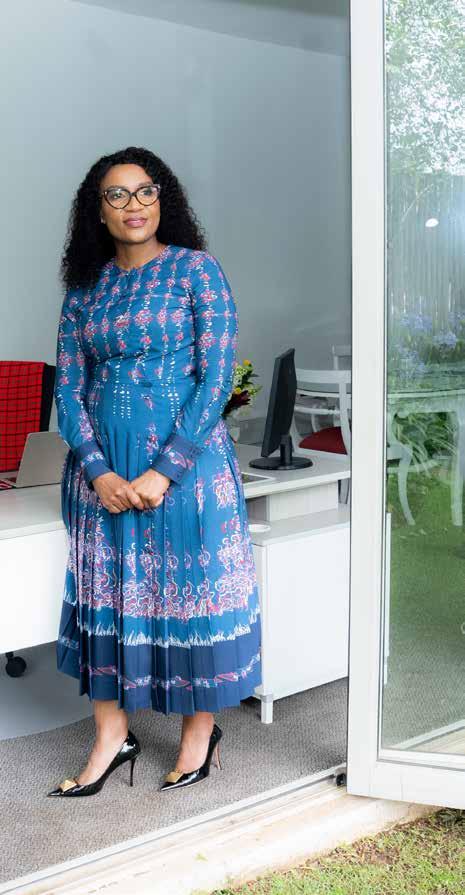
Engaging effectively in Africa requires proximity, understanding and a willingness to work within complexity, not ignore it, Zodwa Vundla believes.
Kwasukasukela. Once upon a time, the story of media was simple. It started slowly.
The climb was almost reassuring, familiar even. More platforms. More data. More tools. More ways to reach audiences than ever before. The industry leaned in, optimising, refining, adding layers of sophistication. For a moment, it felt like progress. That this is what growth was meant to look like.
Then there was a pause. Followed suddenly by a drop.
Budgets tightened. Margins compressed. Global agency groups consolidated, centralised and restructured. Decision-making moved further away from the market. Procurement became sharper, faster, less forgiving.
And just like that, the rules had changed.
As we head deeper into 2026, this is the reality the media industry must confront. That while complexity has been accelerating, tolerance for it is rapidly declining. For years, we told ourselves that sophistication equals effectiveness, that more layers meant better thinking, that complexity signalled progress.
Entire ecosystems have been built around this belief, with each player responsible for a piece of an increasingly intricate puzzle. Consolidation is exposing a fundamental flaw in that story because as global agency groups grow in scale and tighten control, the number of partners they engage with will inevitably shrink.
With that comes a sharper focus on cost, efficiency and, most critically, measurable impact. This is where margin pressure stops being a financial concern and becomes a strategic filter.
If your value cannot be clearly articulated, easily integrated and directly linked to outcomes, you will be squeezed out. Not gradually, but quickly.
The uncomfortable truth is that parts of our industry have been sustained by fragmentation, not just in channels, but in thinking. Media, creative and strategy have often operated in parallel, not in partnership.
There are different incentives, different definitions of success and different pressures shaping decisions. While this has been accepted as part of the process, it has also created a quiet but significant inefficiency.
When one part of the system is optimising for efficiency, another for originality and another for recognition, alignment becomes difficult and outcomes become inconsistent.
The industry has, at times, rewarded this misalignment. It has sometimes done so more visibly than it has rewarded effectiveness because work that gains attention does not always translate into business impact.
These are not isolated issues. They are the result of a system that has not been designed to integrate thinking from the outset. The future will reward those who can integrate brand and performance thinking, as well as media and creative thinking, deliberately and effectively.
In practical terms, this means rethinking how we approach channels altogether because their real power lies in how they are connected, how they move audiences from passive attention to active engagement without friction.
This is not a new idea, simply one we have not prioritised enough because it requires alignment across disciplines, not just channels.
Fear not, the world through my lens is not all doom and gloom. Within this disruption lies a significant opportunity, particularly in the African context. As

global agency structures become more centralised, there is a real risk that decision-making becomes more distant from the nuances of local markets.
Efficiency, at scale, often comes at the expense of context but Africa does not respond well to simplified assumptions. Engaging effectively here requires proximity, understanding and a willingness to work within complexity, not ignore it.
This is where Afro-optimism becomes more than a narrative, it becomes a strategy. As global systems streamline, they will inevitably leave gaps in nuance, in cultural relevance and in the ability to connect meaningfully with audiences on the ground.
Those gaps will not stay empty because for smaller, local and more agile players, this is the opportunity. Not to compete on scale, but to compete on relevance. Not to replicate global models, but to build solutions that actually work here.
This will require us to rewrite parts of the story we have been telling ourselves. This means that not everything we have built as an industry will survive this shift, but then again, not everything should.
When the ride levels out, the winners will not be those who held onto complexity the longest. They will be the ones who simplified intelligently, aligned their thinking and stayed closest to the realities of the market, not the version of it we present in boardrooms. Cos’ cos’ kwaphela. Or perhaps, this is where a new story begins.
Zodwa Vundla is the managing director of MediaHeads 360 and an aspiring fantasy writer – one pays the bills, the other keeps things interesting. She simplifies complexity, occasionally challenges industry norms (politely, of course) and believes effective media should work in the real world, not just in boardrooms.
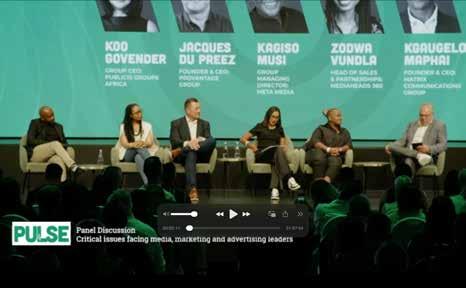
Five media leaders, with MC Aki Anastasiou in charge of the conversation, recently took part in a panel discussion on critical issues facing media, marketing and advertising leaders.
koo Govender (CEO of Publicis Africa), Kagiso Musi (managing director of Meta Media now with WPP), Jacques du Preez (founder and CEO of Provantage), Zodwa Vundla (managing director of Mediaheads 360) and Kgaugelo Maphai (founder of Matrix Communications Group) shared their no-holds-barred thoughts on what ails the media sector.
KGAUGELO MAPHAI
I think the world is just going at such a quick pace. I think post-Covid, so many things have changed: the way people behave, the way people are consuming media, the way people are consuming content. We’re seeing broadcasting being disrupted. We’re seeing just how people are relating to one another. And I think it’s making our jobs so much harder now. It’s no longer about finding audiences and simply advertising to them. We have to go so much deeper. So the need for getting
real time data is really becoming the most important thing. The one thing that’s keeping us up is if we are making informed decisions, because decisions are literally changing in real time.
Just generally, in the industry, I think it’s our inability to adapt as quickly as we could, across a whole host of different areas. How we employ, how we rescale, how we bring technology into processes, how we relook at our operations. So it’s all of that. It’s not one thing. But it really is about adaptability and how quickly we’re actually able to pull that through.
Being a people’s person, I think the most important thing is our leadership drain in the industry and people leaving our industry. The second thing is all our speakers spoke about AI and the impact
of AI. And also from a capability perspective, there’s a huge erosion of capability with the impact of AI.
There are a few things. I think one of the things many of the speakers touched on is AI. I think the cycles of innovation and how fast things change these days is really something to deal with. How do we resource up our organisations, our staff, our management teams to deal with that flux in cycles that that spin faster and faster? I think if you live in South Africa, something that can’t be ignored is governance. Leadership in other spheres spill over into our industry and does affect us. That keeps me up and awake. But I think leadership matters everywhere in life. It is significant. So how do we cultivate the next generation? And I think for us, for me personally, that is a big lesson and something I’m focusing on and it definitely keeps me awake. How do we intentionally grow the next cycle of leaders in organisations and in our industry? I think there’s no shortcut, and I think sometimes we do throw people in too deep end, too fast. But I think we need to be a lot more intentional through AMASA and some of our industry bodies and associations to also give some guidance and formal leadership training to make sure that next wave is up to scratch and can deal with the complexities happening all around us.
Right now, nothing is actually keeping me awake, besides this panel discussion. If anything, it is excitement about opportunities. As other panel speakers have said, change is constant. You never know what’s coming. You don’t know what the next curve ball is. But I think with us as a smaller agency, smaller player, any change results in opportunities for us. And I think that’s actually what has sustained us, being able to evolve, over the years, just depending on where the economy was going, the industry was going. So for me, it’s excitement. And I think, the beauty is not having a global master because I’m sure Koo and Kagiso will have a very different experience. They don’t have the same type of flexibility to be able to move the way the industry moves.
What happens to the media plan when an AI agent can create one in just a few minutes? Cory Treffiletti has some ideas.
Iremember the first media plan I ever put together. It was a super-detailed PowerPoint deck accompanied by a highly detailed spreadsheet that truly impressed my boss, but which no one would recognise today.
It had rows of placements across different channels and formats, columns of circulation counted in audience and impressions, GRPs, CPMs, reach and frequency estimates cobbled together from rate cards and gut instinct. It took days to build and days more to get approved.
It was the plan, and the plan was sacred in the world of media planning and buying.
Here’s a question I’ve been sitting with lately: What happens to that plan when an AI agent can do all of that in just a few minutes?
That’s the conversation for where we are today. Right now, platforms like Yahoo DSP, PubMatic, and others are embedding agentic AI directly into the buying workflow, creating systems that can take a campaign objective written in plain language and autonomously plan, execute, pace, and optimise a media buy in real time, without a human touching a single line item.
The Interactive Advertising Bureau Tech Lab has already released a roadmap for agentic buying. NBCUniversal is testing agentic systems that execute buys across its entire portfolio automatically.
The machinery of the media plan, the targeting parameters, the bid logic, the pacing rules, the optimisation levers, are all being absorbed into software that doesn’t sleep and doesn’t need a PowerPoint to explain its rationale.
The media planning document, as we knew it the last 30 years, is dying. Maybe that’s OK?
The unspoken truth about the media plan is most of it was simple performance. It was a formal exercise in making assumptions look like certainty. We built elaborate spreadsheets to give clients confidence that we’d thought through every variable, when the reality was that the second a campaign went live, half of those variables went out the window, and we were optimising on the fly.
The plan was what we called the strategy. Actually, it was the story we told about the strategy. The real strategy came from what we did once things went live.
Agentic media buying makes clear that when the mechanical work disappears, the creative becomes the only real differentiator left. An AI can optimise distribution. It can negotiate placements, shift budget between channels in real time, and identify the best moment to reach a given audience at a given price. What it cannot do is decide what you say when you get there. It cannot craft the brief that gives the campaign its reason for being. It cannot make the creative decision that turns a campaign into a cultural moment.
We spent so much time on the how and the where that we often shortchanged the why and the what. The best media plan in the world doesn’t save bad creative. Now that agents are taking over the how and the where, the why and the what become the whole job.
So, what do media planners do in this new world? I’d argue they become something closer to a strategist and a creative director than they’ve ever been. They set the objectives that the agent operates within, the approach to the audience, and the tone that no algorithm inherently understands.

They read the signals that the agent surfaces and make judgement calls that require context the machines can’t yet have (and may never have). They own the brief. The brief becomes sacred the way the plan used to be.
I’ll be honest. I have some nostalgia for the old-school media plan. There was something satisfying about building a comprehensive document that mapped out a campaign from start to finish, even if reality had other ideas.
That being said, nostalgia is a terrible strategy. The media plan was a tool, and like every tool in this industry, it will be replaced by a better one. The best planners I’ve ever known weren’t good because they could build a spreadsheet. They were good because they understood people.
And that part? No agent is coming for that anytime soon.
Cory Treffiletti is chief marketing officer at generative AI-powered product placement platform, Rembrand . He has been a thought leader, executive and business driver in the digital media landscape since 1994. In addition to authoring a weekly column on digital media, advertising and marketing since 2000 for MediaPost ’s Online Spin, Treffiletti has been a successful executive, media expert and/or founding team member for a number of companies.

Michelle Randall Sharnock and Kirsten Dugmore have founded Kirelley, a company centered around evidence-based marketing designed to drive brand growth, writes Glenda Nevill.
In 2024, Michelle Randall Sharnock was the only South African named by World Advertising Research Centre (WARC) among a global cohort of “attention innovators reshaping the rules of advertising”.
WARC said Randall Sharnock’s work “highlights the transformative power of attention metrics in reshaping South Africa’s media industry”, adding that her advocacy has “sparked industry-wide conversations”, nudging the market away from low-CPM thinking towards attention-led investment.
A year on, Randall Sharnock and her sister, Kirsten Dugmore, have launched Kirelley – a business focused on building evidence-based marketing capability to power sustainable brand and business growth.
“It’s been an interesting start to the year, put it that way,” she says. “The standout has been the industry’s response. Launching a new business is no small feat – there’s always a touch of imposter syndrome – but the reaction has been overwhelmingly positive. A lot of what we’re hearing is: ‘It’s about bloody time’.”
While the sisters followed separate career paths, both built their foundations in media – as did their mother, Gill Randall, former CEO of Spark Media.
“There’s no denying the passion,” Randall Sharnock says. “We’ve spent years understanding – and, frankly, preaching – evidence-based marketing and the principles of brand growth. Now we get to bring that together and, hopefully, make a real difference.”
A key focus for Kirelley is making global best practice accessible locally. While international leaders continue to advance research into effectiveness, cost remains a barrier for South African marketers.
“There are excellent courses globally,” she says, “but scaling that learning locally is a challenge.”
Kirelley’s answer is a 12-module programme spanning marketing disciplines, with a strong emphasis on creative effectiveness and attention.
“Attention is front and centre,” she notes. “Particularly in digital, we’ve lost our way when it comes to what drives memorable, impactful creative.”
The company has just received news from the Marketing Association of South Africa (MASA) that it has secured CPD accreditation – a move Randall Sharnock believes is critical to elevating industry standards.
Agency interest has been strong. “There’s real appetite to align with global
thinking and build a shared language between clients, media and creative partners,” she says. “That alignment is where you start to see meaningful progress.”
Crucially, she argues, this shift must be led from the top. “Evidence-based marketing principles need to sit at executive level. Without that, it’s difficult to cascade the thinking effectively.”
Some brands are already enrolling cross-functional teams – clients and agencies together – to ensure consistency in approach.
Education remains a long-term play. Kirelley is working closely with the AAA School of Advertising to embed these principles at a foundational level, while also eyeing scale beyond South Africa. By the end of 2026, the ambition is to launch an online platform to expand reach across the continent.
“The goal isn’t just South Africa,” she says. “We want to scale this across Africa.”
For Randall Sharnock, the broader challenge is cultural. “As an industry, we tend to chase the new – often at the expense of the fundamentals. We get swept up in efficiency at the cost of effectiveness. But we need to be careful. We’ve never spent more on advertising, and we’ve never seen less effect.”
Last word to Mike Follett of Lumen: “The launch of Kirelley really excites me. As media becomes more cluttered and competitive, attention has become one of the most important, and often overlooked, drivers of effectiveness. Without attention, even the best media plans and creative ideas struggle to deliver impact.
“At Lumen, we see this clearly in the evidence every day. What I value about working with Michelle Randall and Kirst Dugmore is their commitment to practical, evidence-led education and their shared focus on bringing attention to the forefront of how media effectiveness is understood and applied. I’m excited to collaborate with them in helping build stronger marketing capability across South Africa and the continent.”
For an industry under pressure to prove its impact, that shift may be long overdue.
and Kirsten
Kirelley builds evidence-based marketing capability that drives sustainable brand and business growth.
MultiChoice and CANAL+ remain committed to local content, says CEO Willington Ngwepe, describing how it will all work.
MultiChoice’s belief in the power and importance of South African content is reflected in the way we continue to drive the commissioning of local sport and entertainment content, and how we honour our commitment to giving our subscribers access to a diverse and informative local news offering.
We want to ensure South African stories remain the centrepiece of the offering for our subscribers, alongside the best of international content. We know that this is what our subscribers want – they love to see relatable characters celebrating, debating and sharing their cultures, on their screens.
For CANAL+ to complete the purchase of MultiChoice Group in September 2025, it had to meet strict regulatory requirements. Under the Electronic Communications Act (ECA) of 2005, foreign ownership in a South African commercial broadcasting service licensee is limited to a maximum of 20%.
To ensure compliance and allow the finalisation of that transaction, MultiChoice (Pty) Ltd, the company that was created to hold the licence to operate and broadcast DStv in South Africa, was carved out from the group.
MultiChoice is a South African company, with 80% South African ownership, while MultiChoice Group (a CANAL+ company) holds the maximum regulated 20% stake.
MultiChoice (the licenced entity) has contracted MultiChoice Group, a CANAL+ company, to provide it with several services, including overseeing the commissioning and production of South African content.
Working together, MultiChoice and MultiChoice Group issue briefs, assess proposals and appoint independent producers to develop local programming. MultiChoice pays MultiChoice Group for providing the content slate on the relevant DStv channels.
The structure of this relationship ensures DStv remains a South African broadcaster while leveraging the global partnership to bring better value to subscribers.
MultiChoice’s documented commitment to commissioning South African content is a massive vote of confidence in our filmmakers, actors and technical crews. This investment will add to a local content library that now stands at over 91 000 hours of African stories.
CANAL+ ownership of MultiChoice Group also gives access to new global deals. MultiChoice’s relationship with the MultiChoice Group means some of that content could well find its way onto DStv. These deals also open up new avenues for South African content on new platforms, in new territories.
The 1st of April has historically been the date on which we apply annual price adjustments for DStv services. Subscribers will note that they have not yet received communication around a price adjustment – and I can confirm that they will not, this year.

We recognise the immense economic pressure on South African households and have opted to keep our current
We are also reevaluating the entire MultiChoice commercial proposition, beyond our pricing, to our
package structure. What our subscribers consume is changing alongside the ways they consume it and the reality is that they have much more choice in the digital age, so we must move with the times.
Our goal is to move away from our complex packaging, to offer more intuitive and streamlined packages to meet the needs of our subscribers.
Content piracy is an existential threat. We are working with all stakeholders, including government and regulators to put in place regulatory and legislative measures to stamp out the scrouge of this illegal industry.
It does demonstrable damage amounting to billions of Rands, not only to our business but to other broadcasters and various stakeholders (including producers, rights owners, etc) across the audio visual content ecosystem in the South African creative industry.
MultiChoice continued investment in to the production of South African local content is our pledge to the industry. We will deliver on this commitment through leveraging the relationship with MultiChoice Group (and the global scale if brings through CANAL+).
Our current price freeze and the review of our offers demonstrate our commitment to meet the needs of our subscribers. Together, these signal a new era for a new MultiChoice with a new purpose – one that is more agile and remains a proud champion of South African stories.
Willington Ngwepe is CEO of MultiChoice . He was previously executive head of regulatory affairs at MultiChoice Group. Ngwepe served as the CEO of the Independent Communications Authority of South Africa, Icasa, for eight years, ending in 2022.
The FIFA World Cup is just six weeks away. But is it resonating culturally the way it used to? Jody Daniels is concerned.

This article isn’t really about football (or soccer as it’s called in the USA). It’s about what happens when one of the world’s most powerful cultural assets starts to lose its meaning – while appearing more successful than ever.
The FIFA World Cup remains one of the most watched events on the planet. Billions still tune in. Stadiums still get filled. Sponsors still line up. By most commercial measures, it’s thriving. And yet... something about this 2026 FIFA World Cup feels different.
The anticipation isn’t what it used to be. The cultural grip feels looser. The sense of occasion is … diluted. That’s not a collapse in performance. It’s something more subtle and far more dangerous: A slow erosion of meaning.
On paper, the numbers look exceptional. The 2018 FIFA World Cup sold close to three million tickets.
The 2022 FIFA World Cup exceeded 3.4 million, a record.
Global viewership still reaches billions of people – with the 2022 tournament alone drawing over five billion engagements across platforms.
But growth alone doesn’t equal strength. Because not all growth signals value creation.
Some of it signals over-extraction. And when it comes to cultural institutions such as the World Cup, value isn’t just measured in revenue or reach: it’s measured in meaning.
1. Frequency is diluting significance
The World Cup was never just another sporting event.
It was a moment in time: rare, cyclical, almost sacred. Now, global football operates on a near-constant calendar:
IT’S A CASE STUDY IN WHAT HAPPENS WHEN ORGANISATIONS OPTIMISE AGGRESSIVELY FOR SCALE, EFFICIENCY AND SHORT-TERM GAINS – WITHOUT SAFEGUARDING THE INTANGIBLE ELEMENTS THAT CREATE LONG-TERM VALUE.
• Expanded continental tournaments
• New international competitions
• More qualifiers, more fixtures, more noise
• And from 2026, the tournament itself expands to 48 countries, increasing the number of matches and extending its footprint
The logic is clear: more games, more markets, more revenue. But the trade-off of this expansion is not really acknowledged: Scarcity creates significance. Saturation erodes it. When everything feels big, nothing feels special.
2. Pricing vs accessibility
Football has always been positioned as the people’s game.
But attending a World Cup is increasingly out of reach for the average fan. Travel, accommodation and ticket costs have collectively shifted the experience toward a premium product.
That creates a strategic tension: You can maximise revenue per fan – or maximise cultural reach and emotional connection. Rarely both.
And over time, that shift not only changes who the event is for, but also how deeply it resonates with the fan-base.
3. Narrative fragmentation
Modern football fandom is no longer anchored primarily in national identity.
Club football – particularly in Europe –dominates emotional investment year-round. Domestic leagues, Champions League narratives, and player-driven fandoms command consistent attention.
By comparison, international football now competes for relevance within an already saturated ecosystem.
Meaning, which was once built over four years of anticipation, now struggles to cut through a constant stream of competing storylines. And without strong narrative build-up, even the biggest stage can feel … transactional.
This is where most critiques fall short. FIFA isn’t failing to promote the World Cup. It’s failing to protect and design its meaning.
There’s no shortage of content, campaigns, or global amplification. But as astute marketers know, volume is not the same as value.
In a fragmented media landscape (where linear TV audiences are declining while digital consumption grows) attention is no longer guaranteed. It must be earned differently.
And that requires more than scale. It requires intentional storytelling, emotional build-up and cultural relevance.
Without that, even the biggest sporting event risks becoming just another item in the content feed. It becomes content to consume, not a moment to belong to.
Through a design thinking lens, the issue becomes clearer – and more concerning. FIFA hasn’t failed commercially. But it may be mis-defining the problem it’s trying to solve.
Instead of asking: “How do we preserve the meaning and magic of the World Cup?” FIFA’s business system appears optimised around: “How do we expand reach and maximise revenue?”
That shift leads to three critical breakdowns:
• Empathy gap: Underestimating how much fans value anticipation, rarity and emotional build-up
• Problem misdefinition: Treating the World Cup as a scalable product, rather than a cultural moment
• Over-scaling the solution: Adding more tournaments and matches instead of deepening the experience And that’s where even successful systems begin to drift and lose relevance.
To be clear, this isn’t a failure story. FIFA continues to deliver:
• Unmatched global reach
• Commercial sustainability
• A platform that elevates talent and unites nations
But those strengths can mask a deeper vulnerability: When growth becomes the strategy, meaning becomes the casualty.
This isn’t just about football. It’s a case study in what happens when organisations


optimise aggressively for scale efficiency, and short-term gains – without safeguarding the intangible elements that create long-term value.
Whether you’re a leader in sport, business, religion or culture, the lessons are clear:
• Growth without restraint can erode brand equity
• Frequency reduces perceived importance
• Pricing shapes not just revenue, but belonging
• Meaning must be designed, not assumed Because in today’s environment, attention is abundant. But significance is rare.
The World Cup doesn’t need more expansion.
It doesn’t need more matches. It doesn’t need more noise. It needs restraint.
Because what made it powerful was never how often it happened –but how much it mattered when it did. And if that meaning continues to erode, the risk isn’t empty stadiums or declining viewership.
It’s something far more subtle yet consequential: That the biggest and most powerful sporting event in the world becomes... forgettable.
Jody Daniels is a strategic leader and marketing consultant, currently managing director of Idreate Solutions and strategy director & partner at Styled Collective. He is the author of Deconstructing Design
Thinking and publishes the Cup of Jo Leadership Chronicle on LinkedIn, sharing sharp insights on leadership, strategy, culture and building brands that deliver meaningful value and growth.
The digital advertising industry has been addicted to a very comfortable lie: the impression,
writes Nick van Zyl-Smith.
Fover a decade, billions have been invested in optimising toward a metric that, at its core, simply means “the ad loaded”. Entire ecosystems have been engineered to deliver scale against this proxy, yet the human on the other side of the screen has steadily faded from view.
There is increasing evidence that this gap is not trivial. Studies from attention measurement firms such as Lumen suggest a significant proportion – at least 70% – of ‘viewable’ ads are never meaningfully seen by a human.
If that is true, even directionally, it raises an uncomfortable question about how much of modern media investment is built on signals that were never real to begin with.
If the last few years have been about acknowledging wasted spend, 2026 may be the year the industry is forced to confront what to do about it.
Naritive understands that attention is the precondition for effectiveness, and without it, there is no recall, no persuasion and no conversion. That is why we are aligning our measurement with Lumen’s rigorous approach to the attention economy, which continues to point to a direct relationship between time spent looking at an ad and the commercial outcomes that follow.
So instead of asking how cheaply reach can be bought, we have a more relevant question in mind: how much actual attention is being generated and what is it worth?
Our emerging predictive models point to a shift from the vanity of cost per mille (CPM) to the reality of attentive cost per mille (aCPM), where media is valued by attentive seconds rather than impressions. As measurement evolves to capture dwell time and interaction, the focus moves to engaged human attention instead of ads that simply load. Why? Because we want our clients to pay for engaged human attention, not just pixels loading on a page.

Capturing attention is only half the battle. If we stop there, we are just building a better billboard. The real opportunity for 2026 is translating that high-intent attention directly into bottom-line performance. Currently, the performance marketing funnel is broken by friction. The industry continues to rely on a fragmented journey: capture attention, drive a click, load a page, reorient the user, and hope they complete the task. This approach exposes a fundamental weakness as every step introduces friction and lost opportunity.
Using an attention-first approach, the focus should not just be on engagement but on translating meaningful attention into measurable business outcomes. Integrating performance capabilities
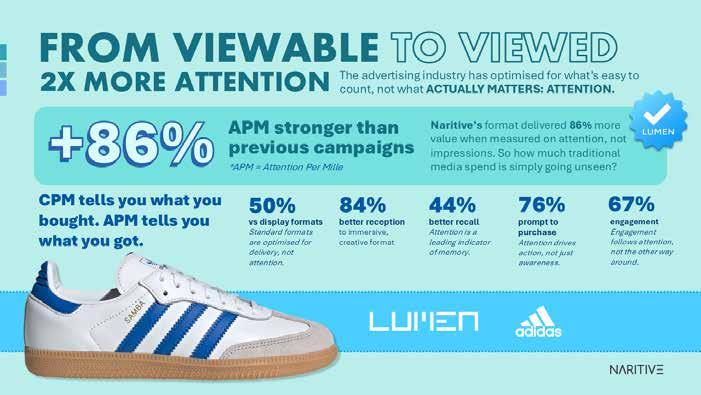
directly into immersive ad experiences allows users to take action without leaving the environment, eliminating a major friction point in the customer journey. This fundamentally changes how performance is generated and measured.
To understand why a frictionless approach matters, it’s time to say the quiet part out loud: the fundamentals of performance marketing have essentially flatlined. Since Google rolled out smart bidding and machine learning to replace manual cost-per-click (CPC), the tools we rely on today are built on the same principles used for years. Even ‘revolutionary’ rollouts like PMax often amount to little more than repackaging existing capabilities inside a black box. AI may reshape inventory, but the core principles of how algorithms hunt for conversions will remain largely the same.
Meanwhile, the industry has spent the last decade refining how ads are bought while underinvesting in how they are experienced by humans. You cannot fix a broken, friction-filled user journey with a slightly better bidding algorithm. Delivering real impact at scale requires operational muscle and programmatic
SUCCESS NOW MEANS PRIORITISING REAL HUMAN ATTENTION OVER EMPTY IMPRESSIONS, DESIGNING FOR ACTION RATHER THAN COUNTING CLICKS…
infrastructure built for attention. Naritive is now part of the Google Scale Tier, gaining access to the tools and framework needed to deploy high-attention, low-friction formats at massive scale.
By meeting algorithms where their power is strongest and designing for the human experience first, attention can finally be captured, measured and translated into meaningful business outcomes.
The mandate for media planners in 2026 is clear: we can no longer hide behind Media Rating Council (MRC) viewability standards, which act as a poor proxy for actual attention.
The agencies and brands that will win this year are the ones who understand ‘performance’ isn’t a separate discipline from ‘creative’. They are the ones who build formats designed to demand attention and pair them with frictionless technology that translates that attention into measurable business results.
Connecting the user directly to the business outcome as seamlessly as possible should be our objective, and removing the friction is how we get there.
For media leaders, the rules of the game are changing, and there’s no room for half measures. Success now means prioritising real human attention over empty impressions, designing for action rather than counting clicks, and removing friction altogether instead of endlessly optimising a broken journey. Anything less risks campaigns that look good on paper but fail in the real world.
and visible online.
Trust has always been one of the most powerful forces in media, but for years it was treated as something soft, emotional, or intangible.
Today, as the industry shifts decisively toward performance, trust is proving to be one of the most measurable commercial multipliers.
The future of media is not brand versus performance, or storytelling versus data. It is the integration of trusted environments and measurable outcomes into a single system that drives attention, action, and long-term value.
Performance media is accelerating because advertisers want certainty. They want attribution, efficiency and proof. They want to know that every rand is working as hard as it can. But performance is not defined by channel –it is defined by outcomes.
And outcomes are shaped by context.
When people trust the environment, they pay deeper attention. They absorb messages more fully. They act with greater confidence. In this sense, trust is not separate from performance – it is one of its most powerful drivers.
This is where trusted audio environments play a critical role. Radio stations that have been part of South African life for decades, community voices that carry cultural credibility, and presenters who feel like family create high-attention environments where audiences lean in rather than scroll past.
These are not just trusted spaces; they are performance environments that drive recall, response, and conversion.
When trust is established first, performance compounds. Campaigns

Mediamark’s Wayne Bischoff believes when trust comes first, campaigns hit deeper, messages reach wider and results last longer.

THE INDUSTRY IS MOVING TOWARD PERFORMANCE, BUT THE WINNERS WILL BE THOSE WHO UNDERSTAND THAT PERFORMANCE WITHOUT TRUST IS SHALLOW, AND TRUST WITHOUT PERFORMANCE IS INCOMPLETE.
land harder. Messages travel further. Outcomes become more sustainable. Trust turns attention into action.
At the same time, the omnichannel programmatic landscape is becoming more complex. As more layers sit between brand and audience, working media value can erode. Each intermediary fragments accountability and makes it harder for marketers to see what is truly driving performance.
This is why trust must also extend to the supply chain itself.
The next era of performance media will demand a more open model — one where brands understand how their investment moves, where optimisation decisions are visible, and where outcomes are measured against real business impact.
This is where an integrated ecosystem becomes powerful. Trusted audio environments create attention and credibility, while performance technology amplifies reach, optimises delivery, and measures outcomes.
Together, they form a system where trust fuels performance and performance validates trust.
The industry is moving toward performance, but the winners will be those who understand that performance without trust is shallow, and trust without performance is incomplete.
The real opportunity lies in integrating the two. That is where the next era of media effectiveness will be defined – and where Mediamark intends to lead.
Wayne Bischoff is CEO of Mediamark
Podcasts live on, with every episode loaded to an archive a compounding searchable asset, writes Sam Swaine.
South Africa’s podcast conversation has moved on. The question is no longer whether brands should be in this space. The question is whether they understand the platform. And what they’re leaving on the table.
A podcast is not a content channel. It is a content engine. One recorded conversation generates soundbites, blog posts, social copy, email nurturing and customer relationship material. No other format delivers that kind of return on a single piece of content.
There is a longer game too. Every transcribed episode, every indexed show note, every piece of derivative content builds a brand’s searchable footprint. Good SEO has always rewarded consistent, authoritative publishing.
But in an era where audiences are increasingly turning to AI large language models for recommendations and research, that footprint has a new dimension. A brand with two years of published podcast content is feeding the very models its potential clients are using to make decisions. That is not a content strategy. That is infrastructure.
A campaign has a flight date. A podcast episode published today is still discoverable in three years. Still building authority. Still feeding the algorithms. This is the nature of evergreen content – it does not expire, it accumulates. Every episode added to an archive is a compounding searchable asset, not a sunk cost.
Podcasts anthropomorphise a brand. It gives it a real human voice, a point of view, a way of seeing the world - and once the listener feels this, something shifts. They feel safer, they feel connected. They’re now invested.
Psychologists call this a parasocial connection. Marketers should call it the most underutilised trust-building mechanism available to them.

For brands, a voice owns the narrative. For CEOs and thought leaders, the same parasocial psychology plays out – but the stakes are sharper and the strategy more surgical.
Consider the guest strategy. Inviting an industry heavyweight, a wish-list client or a name you’ve been trying to get in front of onto your podcast is the most elegant cold outreach ever devised. Nobody says no to being interviewed.
What looks like a conversation is actually one of the sharpest new business development channels a CEO has. You get access, they get a platform. What looks like generosity is actually leverage.
A potential client who has spent three months listening to your CEO arrives at the first meeting already informed. They understand your values, your vision, your position on issues that matter in your industry. You haven’t pitched them. They know exactly who they’re dealing with.
But none of it works if you automate the soul out of it. Every connective tissue of trust requires an actual human in the recording.
AI generated content cannot build a parasocial connection. It cannot make a listener feel anything at all. It produces information. It does not produce chemistry. And in a format that runs entirely on chemistry, that is not a minor limitation. It is a fatal one.
South Africa’s podcast market generated $307.5 million in 2024 and is projected to reach $1.8 billion by 2030 – the fastest growing podcast market in the Middle East and Africa region. That growth means the space is about to get significantly more crowded.
But a crowded market is not a reason to stall. It’s a reason to get specific. Brands and CEOs who are forced to define their point of view with forensic precision who they are, what they stand for, which conversations they are uniquely qualified to own – don’t just cut through the noise. They render the noise irrelevant.
The category ownership window is open. But podcast category ownership is not won in a single campaign cycle. It is built through consistency, through a point of view that sharpens with every episode, every season, through an archive that works while you sleep.
A brand or CEO who has been publishing with intent for two years has something no budget can buy overnight: a body of work. Evidence of thinking. A perspective with a track record.
Steven Bartlett has spoken openly about the distance between his earliest episodes and where the show is now. That distance is the point. A legacy is not launched. It is built.
This is what separates a content strategy from a legacy. A campaign asks: what do we need to say this quarter? A legacy asks: what do we want to be known for in ten years? The answer to that question belongs in a recording studio, not a media schedule.
The mic is the only thing missing.
Sam Swaine is a communications strategist, journalist and founder of Audibly, a fullservice specialist podcast agency. Basically a strategy agency with a mic.