
TRANSPARENCY SHOULD BE STANDARD
Remi du Preez

Esmé Smit







TRANSPARENCY SHOULD BE STANDARD
Remi du Preez
Esmé Smit

Reading the contributions to this issue of The Business of the Media, alongside the latest local and global industry research, is a sobering exercise. There are green shoots, certainly, but the reality is that many of the challenges facing media businesses are unlikely to disappear anytime soon.
As it does every June, the Reuters Digital News Report delivers the numbers and insights that make it essential reading. South Africa remains one of the world’s biggest consumers of online news video, with usage exceeding 80%. Digital news creators and personalitydriven journalism continue to grow rapidly, competing directly with established media brands for audience attention. At the same time, concerns around misinformation, foreign influence campaigns, AI-generated content and ad fraud are becoming increasingly difficult to ignore.
Two contributors to this issue – Esmé Smit, general manager of Novus Media, and Rochelle de Kock, head of news at Arena Holdings – offer valuable perspectives from different corners of the news business. Yet both arrive at the same conclusion: audience trust matters more than ever. In an increasingly crowded and fragmented information environment, credibility remains one of media’s strongest competitive advantages.
The latest Ornico Social Media Landscape Report paints a similarly nuanced picture. While social media remains deeply embedded in daily life, the report notes that emotional attachment to these platforms is waning, particularly among younger users who once defined social media culture. For marketers, that shift has significant implications. The major platforms continue to play an important role, but priorities, usage patterns and content strategies are evolving.
One statistic that particularly stood out is South Africa’s retail media ad spend, which reached R1.14-billion in the fourth quarter of 2025. The figure aligns with findings from PwC’s Africa Entertainment and Media Outlook 2025–2029, which identifies retail media and paid search as two of the fastest-growing advertising segments. Growth is being fuelled by e-commerce, social media, gaming, influencer marketing and programmatic advertising – all areas reshaping how brands connect with consumers.
Our contributors from the Advertising Media Forum unpack these trends further, providing insight into both the opportunities and threats facing media agencies in 2026. Meanwhile, Brian Yuyi, CEO of the Marketing Association of South Africa (MASA), makes a compelling case for marketers having a seat at the executive table. As he puts it: “Marketing is business, and business is marketing.”
On that note, we’re pleased to welcome MASA as a distribution partner for The Media magazine, alongside the Advertising Media Forum.
The Media.
Got to love it.
Glenda
Arena Holdings (Pty) Ltd
Hill on Empire, 16 Empire Road (cnr Hillside Road), Parktown, Johannesburg, 2193
Postal Address: PO Box 1746
Saxonwold, Johannesburg 2193
Telephone: +27 11 280 3000
EDITORIAL
Editor: Glenda Nevill
glenda.nevill@cybersmart.co.za
Content Manager: Raina Julies rainaj@picasso.co.za
Proofreader: Lucinda Jordaan
Content Co-ordinator: Natasha Maneveldt
Contributors: Jacques du Preez, Remi du Preez, Koo Govender, Joshua Harvey, Lynette Naidoo, Abulele Ndamase, Johleen Olivier, Esmé Smit, Jason Steyn, Brian Yuyi, Zodwa Vundla
Head of Design: Jayne Macé-Ferguson
Senior Designer: Mfundo Archie Ndzo
Project Designer: Anja Hagenbuch
Sales Manager: Tarin-Lee Watts wattst@arena.africa +27 79 504 7729
Production Editor: Shamiela Brenner
Advertising Co-ordinator: Shamiela Brenner
General Manager, Magazines: Jocelyne Bayer
Copyright: The Media No portion of this magazine may be reproduced in any form without written consent of the publisher. The publisher is not responsible for unsolicited material. The Media is published by Arena Holdings. The opinions expressed are not necessarily those of Arena Holdings. All advertisements/ advertorials have been paid for and therefore do not carry any endorsement by the publisher.
The Advertising Media Forum (AMF) is partnering with The Media to amplify reach, distributing the Press Forward edition directly to its members.
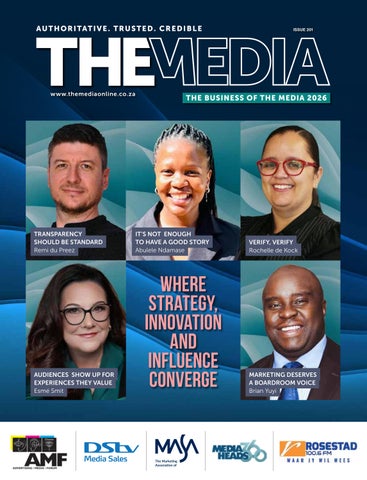
ON THE COVER
Remi du Preez, Abulele Ndamase, Rochelle de Kock, Esmé Smit, Brian Yuyi
As programmatic efficiency rises, trusted audiences, credible environments and genuine engagement drive lasting growth, notes Esmé Smit.
06 RADIO’S TALENT DEFICIT
Audio ambassador Tim Zunckel tells Glenda Nevill why he decided to tackle the radio’s growing talent gap with a mentoring framework.
08 LOST IN RECALCULATION
Zodwa Vundla explains why understanding moments creates smarter media strategies today.
09 BEYOND COVERAGE
Trust, consistency and genuine human connection remain the foundation of effective media relations in an evolving landscape, writes Abulele Ndamase.
10
Advertising Media Forum members Koo Govender, Lynette Naidoo and Robert Notrica deliver their insights into what matters most for media agencies this year.
14
Glenda Nevill chats to Arena Holdings’ group head of news Rochelle de Kock about how collaboration, AI and audience-first strategies are reshaping journalism.
15 ELEVATING CREATIVITY
Independent Agency Selection CEO Johanna McDowell recently returned from AdForum in Toronto and New York. She discusses the trends with Glenda Nevill.
16
With marketing at a crossroads, strategies must be firmly rooted in business outcomes, says Brian Yuyi, CEO of the Marketing Association of South Africa.

18
The question is not whether township consumers are reachable. They are. The better question is whether brands are relevant enough to matter, Jason Steyn believes.
20
As pDOOH grows, transparency, verification and accountable audience measurement are essential for advertiser trust, says Remi du Preez.
21
Jacques du Preez reports on out of home media’s next era of accountability after attending the World Out of Organization conference in London.
22 SYSTEM
Joshua Harvey tackles the tricky subject of whether systems beneath digital growth are strong enough to sustain the load and pace. 10 16




Dustin Martin’s recent piece on programmatic advertising on The Media Online articulates something many marketers have quietly known for years: somewhere along the way, the industry became more efficient at distributing advertising than building audience value. The metrics improved. Dashboards became more sophisticated. Targeting became more precise. And yet, somehow, many brands stopped growing.
That contradiction matters because the uncomfortable truth beneath the programmatic conversation is not simply about wasted spend or advertising fraud. It is about something much deeper: the economics of trust in modern media. Audiences cannot be fabricated. Trust cannot be automated. Community cannot be programmed.
The statistic Martin cites stopped me in my tracks: only 36 cents of every programmatic dollar reaches an actual consumer. The rest disappears into a sprawling intermediary ecosystem designed largely to sustain itself rather than create meaningful value for brands or audiences alike.
The real transition taking place in media today is not print versus digital, writes Esmé Smit. It’s from noise to signal, from passive exposure to meaningful engagement and from synthetic reach to genuine human connection. MEASUREMENT BECAME MISTAKEN FOR
At the same time, the broader market trend tells an equally revealing story. From 1960 to 2010 – the era of mass media, print, radio and shared cultural moments –many of the world’s largest FMCG brands achieved compounded annual growth of around 8%. Since the rise of digital dominance post-2010, collective growth across many of those same businesses has slowed to under 1% annually.
That is not nostalgia for a pre-digital era, nor is it an argument against technology. It is, however, a meaningful signal that reach and relationship are not the same thing.
For years, modern marketing has optimised aggressively for visibility, scale and efficiency. In the process, many brands quietly disconnected from the trusted environments that once gave advertising its contextual power and emotional credibility.
Measurement became mistaken for meaning. Scale became mistaken for influence. Impressions became mistaken for attention.
That is why the renewed interest in direct and contextual media environments matters. Audiences do not experience brands in isolation; they experience them through the credibility of the spaces surrounding them. A trusted environment transfers trust.
The challenge is not simply that advertising became digital. The challenge is that, over time, the ecosystem became increasingly intermediated and increasingly detached from real audience relationships.
Brands chased efficiency while losing proximity to the communities they were trying to influence. Reach scaled faster than trust. Complexity expanded while genuine engagement weakened.
The result is an industry where many campaigns achieve extraordinary visibility but surprisingly little emotional or commercial resonance.
The irony is that the more sophisticated the system became, the harder it often became to answer the most important question of all: do real people actually care?
This is why the conversation around direct buying, trusted publishing environments and accountable audience ecosystems matters so profoundly today.
Novus Media sits at the centre of this industry shift. Over the past year, the business has made a deliberate decision to invest in something increasingly rare in modern media: trusted audience ecosystems rooted in real communities, credible journalism and enduring reader relationships.
Acquired from Media24 and operating independently since November 2024, Novus Media transitioned 37 weekly community newspaper editions onto a sustainable platform deeply connected to the communities they serve.
These are not abstract impressions floating through anonymous ad exchanges. These are readers engaging with stories about their schools, municipalities, local sports teams and neighbourhoods. It is media participation grounded in proximity, familiarity and trust.
In May 2025, Novus Media acquired Rooi Rose, an 83-year-old Afrikaans lifestyle brand with one of the most loyal readership communities in the country. That kind of longevity cannot be engineered through optimisation
algorithms. It is built slowly, over decades, through editorial consistency, cultural relevance and earned credibility.
In June 2025, KickOff returned to print, a decision that initially surprised parts of the industry. By Quarter 3 ABC reporting, the title had reached an audited distribution of 21 000 copies, making it the largest sports magazine in South Africa. In an era obsessed with digital scale, the relaunch demonstrated something important: audiences still show up for media experiences they genuinely value.
The same principle underpins NovaNews.co.za, launched in July 2025 as a national digital platform rooted in hyperlocal journalism and trusted bilingual reporting. Within a year, the platform had already received Silver for Best Emerging News Provider at the 2026 WAN-IFRA African Digital Media Awards. This recognition was not simply for growth, but for credibility, originality and public contribution.
Across the broader Novus Sport ecosystem, including Soccer Laduma and KickOff, the combined audience now exceeds 11 million monthly users across print, digital, social and podcast platforms. That includes The Carwash, hosted by Teko Modise, Brighton Mhlongo and Linda Mntambo, a format built not around manufactured virality, but authentic conversation and cultural relevance.
Collectively, the Novus Media network now reaches more than 16.4 million readers and users each month.
Dustin argues, correctly, for more transparent and accountable media buying. But perhaps the larger lesson is this: the most valuable media investment is not necessarily the one with the greatest reach. It is the one with the greatest audience integrity. It is the environment where audiences still pay attention voluntarily, where context enhances credibility, and where readers return consistently because trust has been earned
COLLECTIVELY, THE NOVUS MEDIA NETWORK NOW REACHES MORE THAN 16.4 MILLION READERS AND USERS EACH MONTH.
over time rather than rented momentarily through algorithmic interruption.
That is what trusted media brands still provide. Not frictionless exposure. Not infinite impressions. But something far more commercially valuable: belief.
And belief compounds.

The real transition taking place in media today is not print versus digital. That debate is increasingly outdated. The real transition is from noise to signal, from passive exposure to meaningful engagement, and from synthetic reach to genuine human connection.
The future of media will not belong to the platforms with the loudest algorithms. It will belong to the brands and publishers that still understand how to earn attention, trust and belonging. That is the alternative Novus Media is building. And increasingly, audiences are choosing it.
for grassroots journalism and community news media. She is a dynamic business-minded professional with a rich 30-year history in media management, currently serving as general manager at Novus Media where she oversees a network of various geographically dispersed business units publishing 37 local community newspaper editions weekly as well as sport publications.
Glenda Nevill caught up with audio ambassador Tim Zunckel to find out why he’s launched a mentorship framework and programme for aspiring radio talent.
Q: Where do the gaps lie in current formal radio or audio education?
A: There are many of young people attending colleges, institutions and universities, learning about media in a textbook fashion. When they graduate and enter the real world of broadcasting, there is a total disconnect between what was taught in the classroom and what is actually happening on the ground. The ability to translate academic skills into creating content, connecting with audiences, speaking to marketers and engaging with the various value points within an organisation is almost entirely absent.
At a community radio level, many stations serve as catalysts for training and development. But these organisations are also under financial pressure and cannot simply train talent and feed them into the commercial and public broadcasting space indefinitely.
The gap, fundamentally, lies in taking industry of our size, that

media houses like the SABC no longer have structured programmes where people can come in and develop a broad range of skills after completing their education. Exposure to advertising, technical operations, content creation and studio work has largely fallen away. Internships exist, but in many cases they have become box-ticking exercises. What we really need is the establishment of dedicated academies, similar to the Y Academy or the Hot Training Academy, but there is just not enough critical movement in that direction.
Q: Why do you think so little attention is paid to searching for and mentoring potential talent?
A:Public and commercial broadcasters are under massive pressure to deliver on revenues. The commercialisation of the business model means it is all hands on deck to make money and that translates into stripping out costs and focusing almost entirely on the commercial element of the business.
Mentoring talent is time-intensive and costly. And the reality is that talent may not even stay with you. After investing a year or two in someone, they might receive a better offer elsewhere. So what tends to happen? We put people on freelance contracts, pay them poorly, and when they do leave, we essentially show them the door.
It is a complex issue, and it is not that people do not want to address it. It comes up in virtually every conversation with anyone in the commercial space who is responsible for hiring and developing people. The intent is there. But the honest question we have to ask ourselves is: where is the next generation of breakfast show hosts? We keep recycling the same faces.
These future leaders should already be sitting inside our organisations.
Q: Why don’t broadcasters invest in talent?
A: Historically, commercial and public radio has not needed to invest heavily in talent development because community radio served as the perfect feeding ground.
The best would rise to the top, get noticed and get picked up by public or commercial stations. If you are working at a community radio station for little or no pay, of course you will move when someone offers you 10 times as much.
So there was never really a need to invest, because the pipeline existed elsewhere.
The problem now is that community radio faces the same sustainability pressures as commercial radio. There is less time and attention available for developing talent, because people are focused on running business models and business units.
Q: How much good do on-air talent competitions do? Do they help?
A: On-air talent competitions are largely marketing vehicles for radio stations. I do not believe they are genuinely about finding talent, with one or two exceptions. They are about the radio station.
You should already know where those people are. You should be engaging with them consistently.
Beyond that, on-air talent competitions only surface on-air people. But this business is far bigger than the voice you hear on the radio. Our talent problem extends well beyond the studio. It sits in sales, in technical, in marketing, in operations. On-air competitions do not come close to solving that.
Q: Who are you looking for in terms of your offering?
A: I am looking for people who are asking themselves questions and not finding the answers. People who are focused on building long-term careers, not just making their next job move. People who are passionate about this industry for the long haul and who represent the next layer of leadership and talent in broadcasting.
There are a lot of people like that out there. Some are receiving advice. Some are having good conversations but do not know how to convert those conversations into actionable steps. Some are trying and failing. Those are exactly the people I want to connect with.

South Africa has never been one audience. It’s made up of millions of moments, writes Zodwa Vundla.
Millions more conversations are already happening before any brand arrives.
You know the feeling when GPS is not GPS-ing during Johannesburg’s evening rush hour?
It confidently tells you there are three routes to the same destination. One will save you four minutes. Another avoids toll roads. A third is apparently ‘ the fastest route’.
You make your choice and settle in, convinced you’ve beaten the traffic. Then, somewhere along Winnie Mandela Drive, your phone politely interrupts.
‘A faster route is now available.’
‘Tyhini!’ you mutter at the faceless voice. You weren’t lost. The destination hadn’t changed. Only the information had.
Our industry feels a lot like that right now.
Every Monday there’s another faster route. Artificial intelligence. Retail media. Creator economies. Programmatic. Commerce media. Data clean rooms. New platforms. New algorithms. By Thursday we’re already talking about something else.
we accidentally removed curiosity too. Technology can now tell us almost everything about a consumer. If they clicked. Where they are. What they bought. What they watched. How long they stayed. What time they logged on. It knows almost everything... Except why any of it mattered.
But people don’t make decisions inside dashboards. They make them while sitting in traffic, making dinner, walking through a shopping centre, listening to the radio on the school run, scrolling social media before bed or laughing at a conversation they weren’t expecting to have.
Context changes everything.
The same person who ignores a five-second video advert while juggling supper plans and the kids’ homework might happily spend 20 minutes listening to a trusted radio presenter discussing exactly the same topic on the drive home.

Nothing about that person changed. Only the moment did.
I smile every time someone confidently talks about ‘the South African consumer’. Which one?
The second-generation South African listening to a podcast while jogging in Sandton?
The bookkeeper catching a taxi in Mthatha?
The matric learner discovering a brand on TikTok?
The doctor who still trusts her favourite radio presenter more than any influencer?
South Africa has never been one audience.
It’s made up of millions of moments.
Millions more conversations are already happening before any brand arrives.
The marketers who understand this don’t begin by asking, “Where can I place my advert?”
They ask something far more interesting. “What is happening in this person’s life when my message arrives?”
That’s a completely different question. I suspect that’s where the next competitive advantage lies.
Not in getting more exposure, more cheaply.
But in understanding people more deeply. We’ll continue embracing new technology, as we should. It makes us faster, smarter, more accountable and, in some ways, more ‘connected’.
But if we’re not careful, we’ll become so busy recalculating the route that we forget why people were making the journey in the first place.
Maybe the future of media isn’t about finding more audiences.
Maybe it’s about finally seeing the ones that have been there all along.
Because media has never really been about platforms.
It’s always been about people.
Ja no mntakama...
The rest is just directions. This is sponsored content.

Zodwa Vundla is the managing director of MediaHeads 360 . She has an incurable curiosity about why people think and behave the way they do, which is fortunate because she works in media and marketing. She enjoys simplifying complexity, occasionally challenging industry norms (politely, of course), and disappearing down rabbit holes in search of a better question rather than an easy answer.
In public relations and communications, it is easy to describe media relationships in structured terms: strategy, targeting, storytelling and coverage. These elements matter, but over time I have learned that the reality of media relations is far less structured than we often present it. At its core, it is a business built on people, timing, trust and consistency.
As the business of media continues to evolve, shaped by digital transformation, shrinking newsrooms and increasing content demands, the value of strong relationships has become even more apparent.
Journalists and editors are under constant pressure to produce more with fewer resources, which has changed the way PR professionals need to engage with them. It is no longer enough to simply have a good story. How you show up consistently within the ecosystem matters just as much.
One of the most important lessons I have learned is that media relationships cannot be built on need alone. When engagement happens only at the point of pitching, it becomes transactional. In a space as fast-paced as media, transactional relationships are rarely sustainable.
Journalists and editors can easily recognise when there is no continuity and, equally, when there is no genuine understanding of their work or audience.
What has shifted my approach is learning to slow down and focus on people, not just publications. Reading a journalist’s work consistently, understanding their editorial lens and recognising the themes they naturally gravitate towards has made my approach more intentional. It has also helped me respect when a story simply is not right for them, instead of forcing relevance where it does not exist.
Over time, I have also learned that the most meaningful media relationships are built in the in-between moments –not during launches or high-pressure campaign periods, but through quieter interactions outside of deadlines.
Communications professional Abulele Ndamase on why relationships still matter in the business of media.

Checking in without a pitch, engaging with a journalist’s work without expectation, or acknowledging their milestones and achievements helps build familiarity over time. Even small human gestures contribute to a sense of mutual respect that strengthens trust.
Trust is ultimately the foundation of everything in media relations. A journalist is far more likely to engage with someone they trust, even when a story is not immediately relevant, than with someone who only appears when there is a deadline or campaign requirement. Trust, in many ways, becomes the currency that determines whether relationships grow or fade.
Another key lesson I have learned is that media work is deeply emotionally intelligent work, even if it is not always described that way. It requires reading tone, understanding timing, respecting silence and knowing when to step forward or step back. Not every story will land, and not every pitch will succeed but the way you handle those moments often defines the strength of the relationship more than the successful ones.
Working across lifestyle, retail, finance, fashion and food and beverage brands has reinforced the fact that there is no
single formula for effective media relations. Different journalists operate within different pressures, audiences and editorial priorities. What works in one context may not work in another. This requires adaptability but also consistency in how you show up professionally.
I have become more intentional about treating media relationships as long-term investments rather than campaign-specific interactions. Journalists remember how you communicate with them, whether you are clear and respectful of their time and whether you understand the realities of their work environment. These experiences accumulate over time and shape whether they choose to engage with you again.
At its heart, PR and communications is not only about securing coverage. It is about building relationships where people trust your judgement, value your approach, and are willing to engage beyond immediate need. The industry will continue to evolve, shaped by technology, platforms and audience behaviour, but the importance of human connection within media will remain constant.
Ultimately, what I have learned is that meaningful media relationships are not built quickly. They are built slowly, through consistency, respect and a genuine understanding that behind every byline is a person navigating their own pressures and priorities.
In a business that is constantly changing, those relationships remain one of the most valuable and enduring parts of the work we do.
Beyond her professional responsibilities, Abulele Ndamase is committed to continuous growth and community participation. She dedicates time to learning, mentoring aspiring PR professionals at an early stage of their careers, and contributing to local initiatives that align with her passion for purposeful communication. Outside the boardroom, she finds joy in quiet mornings with a good book, long walks in nature, especially by the lake near her complex.
Koo Govender explores relevance, data and media’s next frontier.
1. What is your overall view of the South African media space in 2026?
It is defined by rapid evolution and increasing complexity. Audiences are more fragmented than ever, consuming content across multiple platforms and devices, often simultaneously. This has fundamentally changed how brands engage. Success is no longer about reach alone but about relevance, connection and meaningful engagement. Digital continues to dominate, particularly in mobile-first environments, which remain critical in South Africa. However, traditional channels still play an important role when used strategically. The real shift is towards integration, connecting channels to create seamless and consistent brand experiences. We are also seeing a stronger focus on accountability.
Despite the challenges, the market remains resilient and full of opportunity.
2. What is the biggest opportunity this year?
Commerce-led media presents one of the biggest opportunities. There is a clear shift away from siloed media buying towards integrated ecosystems that connect brand storytelling directly to business outcomes. Across Africa, this opportunity is especially strong in shopper and commerce environments rather than fully developed retail media networks. Brands are seeking solutions that influence decisions closer to the point of purchase, whether in-store, online or through mobile channels. At the same time, first-party data has become increasingly valuable. Another significant opportunity lies in localisation at scale. Africa is not a single market but a collection of diverse cultures, economies and consumer behaviours. Brands that invest in understanding these nuances and reflect them meaningfully in their media strategies will outperform competitors.
3. What is the biggest threat to media?
The biggest threat is the growing fragmentation of attention. This can
lead to inefficiencies in spend and reduced effectiveness if strategies are not well integrated.
Another concern is the erosion of trust. The rise of misinformation, low-quality content and AI-generated material has made audiences more sceptical. Brands must work harder to establish credibility, authenticity and transparency in their communications.
Many organisations are operating within constrained budgets, placing greater scrutiny on every marketing investment. Media partners are expected to demonstrate effectiveness while continuing to innovate.
4. What sectors are showing the strongest advertising growth, and which are under pressure?
Strong growth is being driven by sectors closely aligned with digital adoption and changing consumer behaviour. Retail, particularly e-commerce-enabled retail, continues to expand as consumers embrace increasingly hybrid shopping journeys. Financial services are also investing heavily, especially in digital solutions that improve accessibility and convenience.
Telecommunications and technology remain major contributors, fuelled by continued demand for connectivity, devices and digital services.
Conversely, industries more exposed to economic pressure are approaching media investment with greater caution.
Categories that rely heavily on discretionary consumer spending are also under pressure as households become more selective with their budgets.
5. What are clients demanding most from media partners in 2026?
One of the most significant shifts is the demand for integrated thinking. Clients no longer want fragmented solutions across media, creative and technology disciplines. They are seeking partners who can connect these elements into a unified strategy. Data and insights have become essential. Clients expect partners to move beyond reporting and provide actionable intelligence that informs decision-making and drives performance. Speed and adaptability are equally important.
6. How are younger audiences changing media planning strategies?

Younger audiences are fundamentally reshaping media planning. They are highly digital, mobile-first and platformagnostic, making traditional planning models increasingly ineffective. Their behaviour is driven by content rather than channels. This requires more flexible, content-centric planning approaches.
Authenticity is another defining factor. Younger consumers are more likely to engage with brands that feel genuine, culturally relevant and aligned with their values. As a result, media strategies are becoming more adaptive, data-led and culturally informed, with a stronger emphasis on storytelling, community building and engagement rather than reach alone.
Koo
Govender is CEO of Publicis Groupe Africa
The South African media landscape is rapidly shifting towards accountability and the expectation that media must demonstrate clear contribution to business outcomes.
The conversation has moved beyond reach and exposure toward a more rigorous focus on growth – whether through sales, loyalty, market share or long-term brand equity.
This shift is driving a closer integration between media, data and business strategy. It is no longer sufficient for media to be efficient in isolation; it must be effective in delivering measurable impact across the consumer journey.
As a result, planning is becoming more outcome-led, with stronger emphasis on connecting investment decisions directly to sources of growth and business performance.
At the same time, AI is fundamentally
changing how we operate as an industry. It is enabling faster insight generation, more intelligent optimisation, and greater efficiency in execution. However, its real value lies not in automation alone, but in elevating human decision-making, freeing teams to focus on sharper thinking, stronger strategy and better interpretation of data signals.
Clients are increasingly expecting this dual capability from partners: accountability in proving impact, and intelligence in how technology is applied to improve speed, precision, and effectiveness. This is redefining the role of agencies – from media execution partners to active drivers of business growth.
Lynette Naidoo is managing director of Publicis Media
The South African media industry is evolving rapidly. While traditional media faces pressure from audience fragmentation and global digital platforms, the sector remains resilient through digital innovation, streaming, podcasts, creator content, and datadriven advertising. Media businesses are becoming more audience-focused, mobile-first, and performance-oriented.
The biggest opportunity is helping brands connect content, data, AI, and commerce to deliver measurable business outcomes. Media companies that move beyond selling audiences and can demonstrate impact on sales, customer acquisition, and brand growth will capture a larger share of marketing budgets.
The biggest threat is the growing dominance of global technology platforms and AI-driven content ecosystems, which continue to attract audience attention and advertising

spend. Economic uncertainty and slow growth also place pressure on marketing budgets and media revenues.
• Retail and e-commerce
• Telecommunications

• Financial services and fintech
• Technology and digital services
• Traditional print-reliant categories
• FMCG brands facing margin and consumer spending pressures
• Smaller businesses with constrained marketing budgets
1. Measurable business outcomes –clear evidence that media investment drives growth.
2. Data and actionable insights –audience intelligence, analytics, and optimisation.
3. Integrated solutions – the ability to simplify a fragmented media environment and deliver consistent results across multiple channels.
Robert Notrica, client partner
The Coca-Cola Company at WPP Media , is a member of the AMF
New ideas, fresh approaches and thinking outside the box become essential when the market starts asking, ‘What’s next?’
When uncertainty arises among customers, radio is there to reassure, inform and ensure that products and services continue to be heard and promoted in a positive way.
At Rosestad 100.6FM, we would like to remind decision-makers of an old saying: hearing and seeing work far better together than either one on its own. However, before people can see, they often need to hear first. Radio builds that bridge.
Radio remains one of the strongest foundations of all media platforms and continues to be an essential marketing tool, despite perceptions that it may be outdated. If we look at where radio began and how it has evolved –from traditional broadcasting to streaming directly on your mobile phone – it becomes clear that radio has adapted and remained relevant through every generation.
A listener hears about a business on the radio and immediately searches for it online. They visit the company’s Facebook page, enter a competition or browse the website to learn more about products, services and locations. Even if they are not listening in their car or office, they can simply open the station app and tune in from anywhere in the world.
For advertisers, radio remains one of the most affordable, flexible and fastacting advertising platforms available. Success depends on how effectively you engage listeners. Competitions attract attention because people enjoy the opportunity to win prizes. Professionally produced advertisements that reflect the personality of a business create stronger connections.
At Rosestad 100.6FM, our mission is simple: to build meaningful connections between listeners, consumers, advertisers, businesses and the wider community, writes Johleen Olivier.

Products such as Market Wave¹ and Rolling Banner² campaigns provide additional visibility, while compelling interviews create memorable listener experiences.
(¹ & ² We’ll gladly give you a peek on request )
Rosestad 100.6FM broadcasts within a 120km radius of Bloemfontein, reaching a highly engaged local audience.
The station’s broadcasting licence requires 90% Afrikaans and 10% English content. This also creates a valuable opportunity for national advertisers to utilise English advertising within the allocated percentage, helping them reach their target audiences while maintaining a strong local presence.
Radio serves three important functions:
- Education
Educational interviews and informative content provide listeners with valuable knowledge and insights on topics that matter to them.
- Information
Advertising plays a key role in keeping communities informed. Radio helps listeners discover local businesses, products, services, events and opportunities available within the region.
- Entertainment
Music remains at the heart of a music radio station. Alongside music, listeners receive essential updates through news, sport, weather, traffic reports and carefully selected advertising content. Community feedback is equally important. It helps us refine our programming, conduct music research, understand our audience better and ensure we continue delivering content that listeners enjoy and value.
At Rosestad 100.6FM, our mission is simple: to build meaningful connections between listeners, consumers, advertisers, businesses and the wider community.
We are proud to be the bridge that brings people together.
Keep an eye on this space in our next edition, where we’ll share some exciting new developments and changes that are on the horizon!
This is sponsored content.

Johleen Olivier Sales Manager at Rosestad 100.6FM 083 264 0270 johleen@rosestad.co.za

Rochelle de Kock, group head of news at Arena Holdings, talks Glenda Nevill through the newsroom transformation drive.
From intern reporter to head of news, Rochelle de Kock’s newsroom journey perfectly positions her to tackle the challenge of creating a unified digital structure for Arena’s news titles.
As of 1 January, Arena’s Digital Hub came to life after months of intense collaboration between the various titles, platforms and editors.
“When I arrived, there was no centralised team reporting to me. Every title had its own digital editor, social media manager and production staff. My first task was to create a unified digital structure,” says De Kock.
“We established what we call the Digital Hub and organised it into four streams: publishing, production, innovation and audiovisual. I appointed managers to lead each area and brought together staff from across the group’s titles.”
It was by no means an easy process but it was one that ultimately received the buy-in from the editors.
“Many people were accustomed to working independently, and some editors were concerned about losing control of their digital platforms. My argument was simple: it made no sense to have multiple journalists from different titles covering the same story, with separate editorial and production processes duplicating effort. We needed to collaborate rather than operate in silos,” De Kock explains.
“We started with basic changes such as shared news diaries and improved communication between news editors,” she says. “Then we used the G20 Summit as a major collaborative project, bringing politics, business and multimedia teams together to coordinate coverage.”
The results were significant. As De Kock points out, “We expanded our coverage, increased content output and strengthened our digital presence across platforms, including TikTok.”
De Kock began her rise to head of news as an intern on The Herald in the Eastern Cape as part of the Pearson internship programme.
In 2016, she was appointed politics editor of The Herald and Weekend Post. In early 2020 she became acting editor of The Herald. Later that year, De Kock was appointed editor of both The Herald and Weekend Post, a position she held until November 2025 when she accepted the head of news position in Johannesburg.
Six months in to the new operations playbook, De Kock says Arena’s digital performance has improved substantially. “The centralised structure allows us to deploy resources more effectively and maximise the strengths of the entire organisation,” she says.
“We’ve also implemented title leads to ensure individual brands maintain their distinct identities while benefiting from shared resources. It’s a complex operation with many moving parts, but it’s working.”
Newsroom transformation isn’t the only big issue she deals with in her role. There’s the artificial intelligence question, how to build and retain Gen Z and younger audiences and local government elections approaching in which Mis- and disinformation is already playing a role.
Younger audiences are “absolutely critical’ says De Kock, so “we have to meet them where they are”.
Today, she says, news editors are making strategic decisions about where stories should break. “Is a story best suited to the website, Instagram, Facebook or

TikTok? Those decisions are now central to the editorial process. Video has become particularly important. Younger audiences often encounter news through short-form video content before engaging with deeper reporting,” De Kock says. “Rather than viewing multimedia as an add-on, we’re treating platform choice as a core editorial decision.”
On AI, De Kock says Arena is exploring AI primarily as an operational and efficiency tool, but human oversight remains essential. “AI can assist, but it cannot replace editorial judgement,” she stresses.
“Transparency is critical. If we use AIgenerated content, whether that’s animation, graphics or other assets, we disclose both the fact that AI was used and the specific tool involved,” De Kock explains.
In terms of disinformation, De Kock believes, “The fundamentals of journalism remain the best defence: verify, verify and verify again.”
At the same time, journalists have attended election-focused masterclasses with external experts to discuss misinformation, verification tools and emerging risks.
In a news saturated world, where readers have to doomscroll through screeds of bad news, good news is more important than ever, says De Kock. Some of our most-read stories are positive, uplifting stories,” she says.
She says audiences are fatigued by constant negativity. While major scandals and breaking news still attract attention, stories that inspire, solve problems or celebrate achievement often resonate deeply.
As she points out, “People want journalism that informs them, but they also want stories that remind them of what’s possible.”
After six days, 22 agency visits and conversations across Toronto and New York, AdForum 2026 revealed an industry moving rapidly into a new era. According to Johanna McDowell, CEO of the Independent Agency Selection Company, highlights five key learnings from her trips to AdForum in Toronto and New York.
1. AI has moved beyond experimentation
The most significant shift was the maturity of AI adoption among global agency groups. Meetings with agencies including WPP Creative, Dentsu, Monks and Critical Mass showed that AI is no longer a future ambition but an operational reality.
“They’re not just talking about it,” McDowell said. “They’ve done it. And the investments they’ve made are huge.”
The major networks have built proprietary AI infrastructure, integrating data, technology and automation into systems that support campaign planning, content creation, customer experience and media optimisation. Case studies demonstrated that many agencies are already deploying these tools at scale.
“We saw some very interesting case studies relating to this infrastructure,” said McDowell. “It’s showing us what the future is going to look like.”
2. Agencies are ahead of their clients
While agencies have embraced AI aggressively, many marketers are still working through governance, privacy and implementation challenges.
“The agencies are definitely ahead of the curve,” McDowell observed.
Many of the solutions presented can be customised for individual clients, but adoption remains uneven. Financial services brands, in particular, are moving cautiously because of regulatory requirements and data concerns.
This creates a new tension for agencies. Having invested heavily in AI capabilities, they now need clients to catch up in order to realise returns on those investments.
“The clients can either use it or not, depending on their budgets and
From the rise of agency-owned AI platforms to the resilience of independent agencies and the growing importance of human creativity, several clear trends emerged, Johanna McDowell tells Glenda Nevill.
depending on where they are in terms of their own AI infrastructure,” she said.
3. Creativity remains the ultimate differentiator
Despite the industry’s AI obsession, the strongest consensus across both cities was that technology alone will not create competitive advantage.
“The differentiator is going to be creativity,” said McDowell. “It’s not going to be the technology.”
Agency leaders repeatedly emphasised that while AI can improve efficiency and automate tasks, it cannot replace human understanding of culture, emotion, trust and judgement.
McDowell pointed to conclusions drawn by AdForum founder Hervé de Clerck after the New York meetings: “The agencies navigating this moment best are not choosing between AI and creativity. They are using AI to do more of what only humans can do.”
4. Independent agencies continue to thrive
One of the surprises from AdForum Toronto was the strength of Canada’s independent agency sector. independents,” McDowell said.
“These are not necessarily new independent start-ups. They are
well-established agencies with serious clients and long-term commitments.”
Many have no interest in being acquired and see independence as central to their culture and creative output.
The Canadian market also demonstrated how smaller budgets can drive innovation. Compared with their US counterparts, Canadian agencies often operate with fewer resources and have developed a reputation for delivering highly creative work efficiently.
“The way they see themselves is that their budgets are small,” McDowell said. “As a result, they’re clever with how they spend their money.”
5. Local relevance matters more than ever
The contrast between Toronto and New York highlighted another important trend: successful agencies are becoming increasingly shaped by local culture and context.
Canada’s bilingual market requires agencies to navigate both English- and French-speaking audiences, while Toronto’s multicultural population creates a diverse communications environment.
For McDowell, Canada’s openness and international outlook stood in stark contrast to the scale and confidence of the American market.
The encouraging takeaway for South Africa is that local agencies are not falling behind.

“South Africa is not behind the curve at all,” McDowell said, pointing to recent global pitches where agencies presented AI-enabled solutions comparable to those seen internationally.
If AdForum 2026 revealed anything, it is that the future belongs neither to technology nor creativity alone. The winning agencies will be those that combine advanced AI capabilities with the distinctly human skills that machines cannot replicate.
As McDowell concluded: “The differentiator is still going to be creativity.”
CEO of MASA, Brian Yuyi, on reclaiming respect, reasserting value and redefining the future. Marketing is business, and business is marketing. It is an integral cog in the wheel.
As we head into the second half of 2026, marketing finds itself at a pivotal moment. Brands and marketing services remain the lifeblood of any organisation fuelling growth, shaping perception and driving demand, competitiveness and long-term sustainability.
Yet, paradoxically, the discipline has seen its influence and perceived credibility diminish in many a boardroom. For an industry so central to business performance, this erosion of respect in the C-suite is not just surprising; it is unsustainable.
From the perspective of The Marketing Association of South Africa (MASA), this moment calls for both reflection and recalibration.
It is not that marketing has lost its value. However, what it has lost, in some cases, is its clarity of purpose, professional consistency and its seat at the strategic boardroom table. The challenge and the opportunity for us is to restore that respect, anchor marketing strategies firmly in business outcomes and ensure the profession evolves with intention rather than reaction.
We are operating in an environment defined by fluidity, fragmentation and acceleration. Consumer behaviour shifts faster than planning cycles. Digital and social platforms rise and fall within months. Data multiplies exponentially. Artificial
intelligence, technology and automation reconfigure workflows almost daily.
In this fast-changing and evolving climate, it is understandable that marketers feel pressure, possibly even anxiety, about their relevance and replacement within the workplace. But MASA believes it is time to relax the fear around AI and adopt a more mature, grounded perspective.
Yes, AI and digital enhancement will fundamentally change how marketing is executed. But they do not change why marketing exists. Technology can optimise, accelerate and scale. But what it cannot replace is the essence of what marketing is fundamentally about, the human connection, incorporating emotional intelligence, cultural insights, ethical judgement, creativity rooted in the lived experience, and the ability to connect, and build trust and meaning with consumers.
The brands that will win in 2026 and beyond will not be those that use AI most aggressively, but those that use it most intelligently through augmenting, and not replacing, the human touch. The marketer who thrives will be the one who understands how to marry technology with humanity, not pit them against each other. The future marketer must be both analytically sharp and emotionally fluent.

An uncomfortable truth must be addressed: marketing has sometimes undermined itself. One of the most pressing challenges facing the profession is structural: marketing is too often positioned as a downstream function, tasked with execution rather than strategy. We have over the years allowed ourselves to be positioned that way.
If marketing is to reclaim its rightful place in the C-suite, marketers themselves must evolve. When marketing cannot clearly link its work to the organisation’s strategies of growth, margin, loyalty, reputation and enterprise value, it will get relegated down the organisational hierarchy.
To regain respect in the C Suite, marketers must re-anchor themselves not only in brand speak but in business literacy: understanding balance sheets and income statements, by speaking the language of risk, return and resilience, in demonstrating how brand equity translates into shareholder value, and through proving that marketing is a long-term investment, not a cost.
Respect is not demanded. It is earned through demonstrable contribution to the bottom line, and the future CMO will not rise by being the best campaign manager.
The skills we prioritise now will determine whether marketing ascends as a strategic discipline or continues to be commoditised. MASA believes the future marketer must be accountable for five core areas:
• Growth leadership: Marketing must own its role in driving demand, expansion and long-term value creation
• Brand stewardship: In an age of AI-generated sameness, uniquely distinctive and trusted brands will be a company’s most defensible and powerful asset
• Human connection: Technology may mediate interactions, but emotional resonance remains a human skill, and a fiercely competitive one at that
• Ethical influence: As data and automation grow, the responsibility to market responsibly grows with it
• Professional credibility: Expertise must be verified, current and continuously developed and never assumed Marketing can no longer afford to be regarded as an informal craft with uneven standards. It must stand alongside medicine, finance, engineering and law as a profession with recognised qualifications, governance and accountability.
MASA’s mandate to set standards of excellence, uphold quality, and formalise
NOTE: Not an exhaustive map of the landscape. Not all relationships
recognition within the industry is central to restoring trust in the discipline. Qualifications and professional designations are not mere credentials; they are signals of skill, competence, experience and accountability.
They provide verified proof of skills and expertise, alignment with nationally recognised frameworks (including SAQA and NQF) and are an assurance to employers that capability matches claim. In an era where anyone can claim to be a ‘marketer’, verification becomes invaluable.
For organisations, this translates directly into both efficiencies and cost savings. By leveraging MASA’s rigorous vetting processes, employers can significantly reduce the time, risk, and expense associated with recruitment, eliminating up to two-thirds of the costs typically incurred during the hiring process.
If marketing is to regain its stature, it must do so on three fronts: credibility, through proven skills and measurable outcomes; consistency, through industry standards and professionalisation; and connection, through our uniquely human ability to understand and move people.
It is MASA’s role to champion all three over and above our work across policy, regulation and legislation that affects the marketing ecosystem as a whole.
However, our vision is not simply to drive certifications and designations, but
to elevate the entire profession. The association believes the marketers who will define the next decade are not those who resist change, nor those who blindly chase it. It is the ones who manage to balance both.
They will embrace technology without losing humanity, and strive to build brands with purpose and precision, while anchoring creativity in commercial impact.
We sit at a crossroads. The tools are evolving. The rules are shifting. The skills curve is bending. Marketing can either fragment further under the pressure of speed and technology, or it can embrace it, professionalise, unify and rise.
MASA firmly believes the future belongs to marketers who can embrace innovation without losing humanity. It is these individuals who will demand standards without taking shortcuts, having built their credibility through qualification, skill, competence plus related professional certification and accountability, and can lead with purpose.
MASA should be recognised as the umbrella body, the one collective tent under which everyone on the brand owner/client-side of the sector gathers to converse and connect, to share best practice, to deal with industry issues, and
l Agency/Execution
l Media/Platform Owner
l Research/Measurement
l Regulation
to protect and professionalise marketing, including the upholding of ethics, standards, and skill and capability building, all the while driving the broader marketing, advertising and communications industry forward.
We know that respect in the boardroom is not granted or guaranteed. It is earned, demonstrated and sustained. Now is the time for us as marketers to claim our seat at the top table, not as a support function, but as a driver of business growth and success.
And, MASA stands ready to lead that charge.
About MASA: The Marketing Association of South Africa (MASA) is the Member Association and Professional Body for the South African client-side marketing community and the representative voice for organisations and individuals in the client-side marketing industry. As the representative voice for organisations and individuals within the South African client-side marketing industry, MASA is dedicated to advancing the professionalism of the entire South African marketing sector. MASA is active in leading and influencing transformation, policy, legislation, education and training, learning and development, and best practice on marketing and related business topics.
Too many brands claim to understand South Africa while treating its most commercially active communities as an afterthought in their media plans, writes Jason Steyn.

Township advertising has too often been reduced to reach and frequency when it should be treated as one of the clearest tests of whether a brand understands South Africa.
South Africa’s townships are commercially alive, culturally influential and behaviourally complex environments where brands are tested in public by people making real choices with real money under pressure.
Township consumers are easy to reach but hard to fool, which is why lazy brands get visibility but never earn relevance.
The mistake many advertisers still make is thinking township out of home (OOH) is about presence. Buy the site, add a logo, translate the line and call it done. But being seen does not automatically mean being accepted.
Township consumers are mobile, connected, aspirational, price-aware and culturally fluent. They know when a brand has made an effort and when it has simply bought a board.
GG Alcock has repeatedly challenged assumptions about township and informal markets, describing them as sophisticated economic systems. Some estimates put South Africa’s township economy at around R1 trillion, yet too many strategies still treat this audience as an add-on rather than a growth engine.
The Rogerwilco 2025 Township CX Report shows a digitally connected, commercially active township consumer. According to the report, 37% of township consumers spend between R251 and R500 a month on connectivity. This is a consumer base using digital tools and engaging with brands across physical and mobile environments.
The question is not whether township consumers are reachable. They are.
Afintech brand wanted to drive awareness and adoption of a portable POS payment device among township-based entrepreneurs. The target audience was informal traders, spaza operators, small business owners and everyday merchants operating in high-volume cash environments, but increasingly open to accessible digital payment solutions. The campaign challenge was not simply to make the product visible. It had to make the product feel useful, practical and relevant to traders whose
The better question is whether brands are relevant enough to matter.
Township life is mobile and social. Taxi ranks, high streets, spaza nodes, taverns, malls, clinics, schools and commuter routes are decision-making environments where people wait, move, talk, trade, compare prices and make choices. A billboard here is not a passive surface; it sits inside the rhythm of daily life.
That is what makes township OOH different from highway or suburban outdoor. Highway OOH speaks to people at speed. Township OOH speaks to people in context, with dwell time, repetition, word of mouth, proximity to trade and community memory. A site
TOWNSHIP ADVERTISING CANNOT BECOME A DUMPING GROUND FOR CLUTTER, POOR MAINTENANCE, NON-CONFORMING
SITES AND CARELESS CATEGORY PLACEMENT.
businesses are built on speed, trust and daily transactions.
Network X OOH placed the campaign across high-traffic township environments, including commuter routes, retail corridors, taxi-rank-adjacent spaces and busy informal trade zones. These sites were selected because they sat close to where the target audience was already moving, trading and making business decisions. What made the campaign effective was that the out of home did not work in isolation. The sites became geographic anchors for field activation,
near a taxi rank, spaza cluster, mall entrance, clinic or high street can influence behaviour close to where decisions are made.
But only if the brand understands the space. Township consumers are not one audience. A campaign that lands in Soweto cannot simply be copied into Umlazi, Khayelitsha, Tembisa or Mamelodi. Language, humour, movement patterns and retail behaviour all shift. Treating ‘township’ as a single block is laziness dressed up as scale.
Township OOH can build familiarity along commuter and retail routes, support conversion close to purchase points and connect with mobile through QR codes, WhatsApp, USSD and location-based promotions. At its best, it supports communities rather than simply extracting attention from them.
But township advertising cannot become a dumping ground for clutter, poor maintenance, non-conforming sites and careless category placement.
which allowed brand teams enter the surrounding business ecosystem, speak directly to local traders, demonstrate the product, explain the benefits of digital payments and distribute free POS devices to qualifying merchants.
The campaign worked because it respected how township economies actually function. These are not abstract “emerging markets”. They are entrepreneurial, relationship-driven and commercially active environments where trust is built through proximity and relevance.
A campaign near a school, church, clinic, taxi rank or family retail node needs contextual judgement, not just audience numbers. Visibility without contextual intelligence can become reputational risk.
Data and human insight must work together. Commercial strength matters, but so do cultural fit and community sensitivity. A strong site is not only about movement, dwell time, visibility and proximity to trade. It is also about what happens around the site and whether the brand message belongs there. Numbers give confidence, but local nuance gives accuracy.
That is where township OOH becomes powerful. It stops being a poster and becomes an entry point into the economy.
The future of township advertising will not be won by brands that buy the most space. It will be won by brands that connect the board to the phone, the store, the street and the sale. Township audiences have already emerged. The question is whether brands and media planners have caught up.
Jason Steyn is sales director at Network X . With over 700+ media platforms nationwide and the largest township digital billboard network in South Africa, the agency owns and manages a multitude of outdoor advertising products.
With ad fraud continuing to drain marketing budgets, South African brands need to know exactly how audiences are measured and verified in the programmatic DOOH space, writes Remi du Preez.
Every advertiser wants the same thing: to know that the audience they paid for is the audience they received. It sounds straightforward, yet money continues to flow to invalid, fraudulent and made-for-advertising websites, skewing performance metrics and delivering little to no value.
In many cases, fraudulent inventory is presented as legitimate, diverting ad spend away from genuine audiences and into environments that generate no meaningful return.
While there is no consensus on exactly how much money is lost to ad fraud in South Africa, there is little doubt the figure is substantial. If marketers want to continue investing in digital channels, they cannot afford to take inventory and traffic at face value.
The good news is that programmatic digital out of home (pDOOH) operates differently from many other programmatic channels. There are no bots walking past our screens on Rivonia Road. Our medium exists in the real world.
This physical presence removes many of the challenges associated with invalid traffic and creates a far more transparent environment for advertisers. The supply chain is also leaner, with fewer publishers involved than in many traditional online channels.
That does not mean pDOOH is immune from scrutiny. The biggest risk is not bots or fake impressions, but audience inflation driven by inconsistent measurement methodologies. Publishers are responsible for ingesting data into their networks to determine how many people are exposed to each ad play.
Yet there is no standardised industry approach to calculating those audience
figures. This means unscrupulous or inexperienced publishers can potentially use non-standard or biased data to inflate audience numbers and increase revenue per programmatic ad play.
The answer for advertisers is to demand transparency. Ask simple questions: How are audience numbers calculated? Where does the data come from? How is audience verification conducted?
Advertisers should be able to see the inventory they are buying, and credible publishers should be able to show exactly where their screens are located. Ask which third-party verification systems they support and what industry bodies endorse them. If publishers are cagey with their answers, consider it a red flag.
At Polygon, we have built our approach around transparency. We believe pDOOH should be a glass box, not a black box, where everyone can understand how the systems work and what algorithms drive them.
We follow the audience
website. Anyone in the industry will be able to review it and see exactly how we arrive at our audience figures.
As a Google Partner and IAB member, we are required to meet strict industry standards, giving advertisers an additional layer of assurance. We have also introduced independent verification through our partnership with Seedooh, making Polygon the first programmatically verifiable business in South Africa. Through the platform, advertisers can verify where and when their campaigns appeared and how many people were exposed to them. We provide detailed reporting and proof of flighting for most campaigns, including photographs showing ads as they appeared on screen.
The industry is moving towards greater transparency and standardisation, and that can only be a good thing. Transparency should not be a competitive advantage enjoyed by a handful of publishers. It should be the norm.

I expect to see more independent verification systems, greater consistency in audience measurement and deeper involvement from major demand-side platforms as pDOOH continues to mature. The future of the channel depends on creating an environment that is both frictionless to buy and easy to verify.
Ultimately, advertisers should never have to take audience numbers on faith.
If a number cannot be explained, it should not be trusted.
Remi du Preez is managing director Polygon , a digital out of home aggregated publisher network. It focuses on multiple venues, thousands of screens and millions of audience members available programmatically.
The 2026 World Out of Home Congress was the largest in its history, with a record 807 delegates from 55 nations filling London’s Park Lane Hilton for the industry’s first global gathering in the city since 1989, reports Jacques du Preez.
London showcased an industry with growing confidence in its future, but also a clear understanding of what comes next. Digitisation and expansion remain important, but the conversation has evolved. Instead, delegates focused on the capabilities required to make out of home (OOH) more accountable, more accessible and more valuable to advertisers.
The President of the World Out of Home Organization (WOO), Tom Goddard, framed the opportunity in clear terms. Global OOH revenues have reached $54 billion, up 15% on the previous year. Digital now represents 47% of the medium and is on the verge of overtaking static for the first time in the industry’s history. Growth is outpacing the wider advertising market in several regions, led by Asia-Pacific at close to 30%.
He believes proving effectiveness is now an urgent priority, arguing that if media owners deliver the data and evidence advertisers demand, OOH will not simply grow with the market but consistently take a larger share of it.
The keynotes gave that argument its sharper edges. Jean-François Decaux made a case the industry too often leaves unspoken: OOH funds public transport, civic infrastructure and shared public spaces, and it does so in full view of the people it serves.
“We are a force for good,” he told the room, “not a scam or an addiction, but we need to be heard.”
It was at once a defence of the medium’s social licence and a challenge to an industry that has been reluctant to claim it. He paired this with a commercial point. In markets that have built the measurement and trading infrastructure to compete, OOH already commands a double-digit share of advertising spend. The headroom is not theoretical.

Nick Brien of OUTFRONT framed the same opportunity as “in real life”. As audiences shift from merely paying attention to taking action, advertising anchored in the physical world is structurally advantaged on reach, influence and, increasingly, trust.
Sean Reilly of Lamar kept the room honest, reminding delegates that the most effective OOH still begins with a powerful idea rather than a sophisticated piece of technology.
Measurement sat at the centre of the Congress. The question is no longer whether OOH works, but whether its contribution can be demonstrated using the same standards applied to every other channel.
The launch of the WOO Global OOH Audience Measurement Guidelines 2.0, developed with input from measurement bodies around the world, reflected the industry’s commitment to greater consistency and comparability.
Creativity also held its ground. Tim Bleakley’s Make Outdoor Creative Again was a deliberate provocation: weak creative erodes effectiveness, depresses returns and ultimately discourages the very investment the medium is fighting to attract, while strong creative builds
memory and commercial impact in ways no amount of targeting can replicate.
As digital inventory multiplies and screens proliferate, the differentiator is not the screen but the idea on it. That is a discipline the industry will need to protect rather than assume.
Technology underpinned almost every session. Artificial intelligence, programmatic trading, automation and audience aggregation are increasingly embedded in how campaigns are planned, bought and optimised.
The message from London was simple: technology should remove friction, not add it. The operators that succeed will not necessarily be those with the most technology, but those that use it most effectively to simplify planning, buying and measurement. In doing so, they make OOH easier to integrate into omnichannel strategies and better positioned to compete for a greater share of advertising investment.
The Congress reinforced an important reality: many of the challenges facing OOH cannot be solved competitively. The strongest OOH markets in the world are supported by strong industry bodies, shared research, collective advocacy and common standards.
An extended version of this story will be posted on The Media Online.
Jacques du Preez is the founder of Provantage , an integrated OOH media and marketing services group comprising 13 specialist businesses. A committed advocate for people development and industry progress, he has championed initiatives such as the Provantage Training Academy and Leap by Provantage, the group’s sustainability and community development platform.
South African businesses are built for speed. We launch platforms, automate processes and rapidly bring new ideas to market.
Nowhere is that urgency more apparent than in highly regulated environments, says Joshua Harvey.
Customer expectations are rising. Compliance demands are increasing. Legacy systems remain in play. Teams are expected to modernise without introducing new operational risk.
But speed can hide a more uncomfortable question: are the systems underneath that growth actually strong enough to sustain the load?
That question sat at the heart of Specno’s Fix My Product Month and the recently released South African Digital Product Readiness Report. We set out to understand where digital products break as businesses scale. What we found was revealing. The problem was rarely the product itself. More often, it was the operating ecosystem around it.
The pattern emerged across businesses that looked very different on the surface. One was a long-established supplier turning over millions of rands each month, with much of its commercial activity still running through WhatsApp. Another was an early-stage marketplace attempting to formalise a highly human, trust-based service. A third was a sophisticated fintech platform operating across 14 countries, serving banks and major financial brands.
Different sectors. Different levels of maturity. The same underlying challenge: growth had outrun the machinery designed to support it.
Teams were shipping, selling and responding but often without sufficient visibility into margins, customer evidence, product accountability or the true bottlenecks between attention and revenue.
data custodians, compliance engines and customer-experience brands. A customer portal, payment flow, internal workflow, compliance process, marketplace feature or even a WhatsApp operating model is no longer just a digital touchpoint. It forms part of a broader commercial operating system.
In one business, demand already existed, but orders were disappearing into hundreds of WhatsApp conversations. In another, content reached 70 000 people without generating measurable conversion. At the most advanced end of the spectrum, the challenge was no longer whether teams could build fast enough, but whether support, governance, security and distribution could keep pace with expansion.
These weaknesses extend far beyond efficiency. As businesses become increasingly digital, operational maturity and resilience are becoming commercial necessities.
South Africa recorded more than 17 million cyber-threat detections in a single year, underscoring how security, governance and operational discipline are no longer separate from growth strategies. They are growth strategies.
This matters particularly for businesses operating in regulated, high-trust and operationally complex environments. They are not exposed because they lack digital products. They are exposed because the systems surrounding those products are not mature enough to support scale, regulation and sustained growth.

The reality is that many organisations are no longer simply service providers, financial institutions, logistics operators or platform businesses. Increasingly, they function simultaneously as digital product companies,
A platform may attract users but struggle to retain them. A campaign may generate attention but fail to convert it into commercial outcomes. A workflow may be digitised while still relying heavily on manual intervention behind the scenes. A business may appear to be scaling successfully even as its decision-making, governance and operational systems become increasingly fragile.
That is why businesses need to look beyond output metrics. Revenue, reach, engagement, downloads and sprint velocity all matter but they do not tell the full story.
Leaders also need visibility into three deeper layers: how decisions are made, how quickly learning turns into execution and how effectively product activity converts into commercial outcomes. Artificial intelligence makes this challenge even more urgent. It has dramatically lowered the cost of building. It has accelerated prototyping and given smaller teams access to capabilities that once required far larger budgets. But those same tools are now available to everyone.
The competitive advantage will not belong to the organisation with the most tools. It will belong to the organisation with the clearest decision-making and the people capable of using those tools intelligently.
The strongest operators we encounter are not asking, “What can we build?” They are asking, “How quickly can we learn what is worth building?” That distinction is becoming decisive.
A product can usually be fixed. A broken system is far harder to detect and far more expensive to ignore.




Out August 2026.
Women in The Media, a print and digital title, connects your brand with the leaders, decision-makers and emerging talent driving South Africa’s media, marketing, advertising and communications sectors.
Published by The Media – one of South Africa’s most respected trade publications since 2002 – this special edition offers advertisers a powerful platform to align with leadership, innovation and the advancement of women in the industry. Reach an influential readership of CEOs, CMOs, media planners, media buyers, media owners, journalists, academics and media students.
Beyond The Media’s established subscriber base, Women in The Media is promoted across Arena Holdings platforms with distribution amplified through partnerships with the AMF, MASA and PRISA (including at the Women in Power conference), ensuring targeted exposure to senior professionals and key decision-makers across the communications landscape. Position your brand where influence, leadership and industry conversations converge.